TYPES OF REACTOR THERMAL REACTORS are the simplest and most proven of reactor types. Others are under development FAST REACTORS Fast refers to the speed of the neutrons Using the table of cross-sections (Lecture 17)we can evaluate h (Fuel
"TYPES OF REACTOR THERMAL REACTORS are the simplest" is the property of its rightful owner. Permission is granted to
download and print the materials on this website for personal, non-commercial use only, and to display it
on your personal computer provided you do not modify the materials and that you retain all copyright
notices contained in the materials. By downloading content from our website, you accept the terms of this
agreement.
Presentation Transcript
01
TYPES OF REACTOR THERMAL REACTORS are the simplest and most proven of reactor types. Others are under development
FAST REACTORS
‘Fast’ refers to the speed of the neutrons
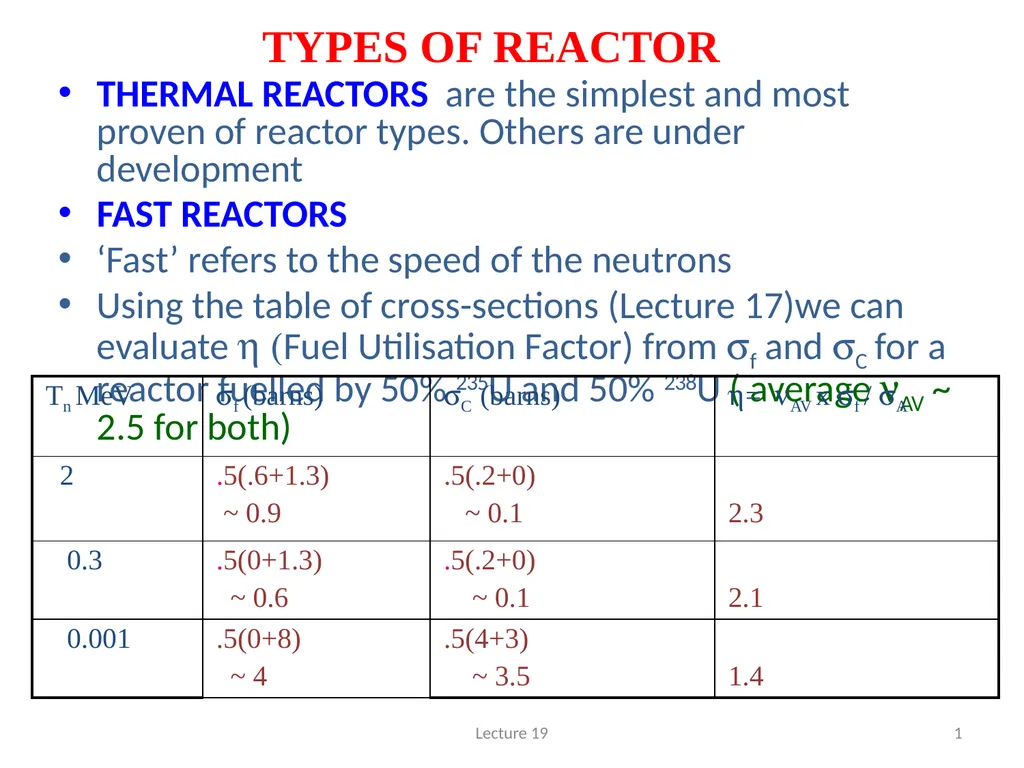
Using the table of cross-sections (Lecture 17)we can evaluate h (Fuel Utilisation Factor) from sf and sC for a reactor fuelled by 50% 235U and 50% 238U ( average nAV ~ 2.5 for both) 1 Lecture 19<br>
02
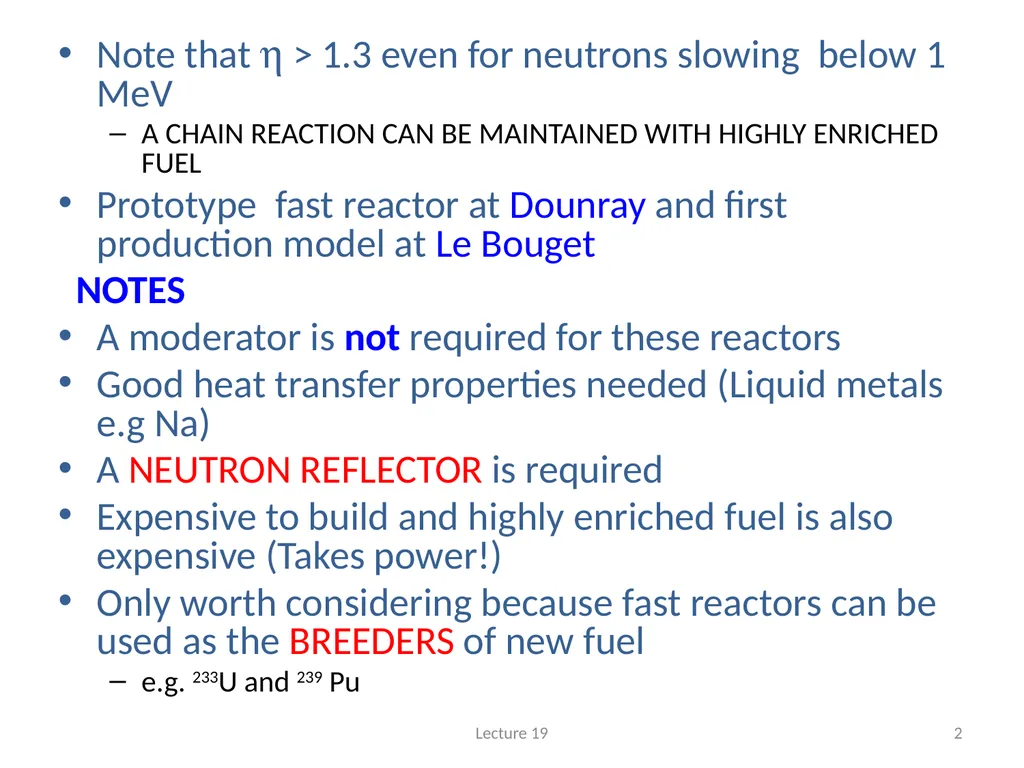
Note that h > 1.3 even for neutrons slowing below 1 MeV
A CHAIN REACTION CAN BE MAINTAINED WITH HIGHLY ENRICHED FUEL
Prototype fast reactor at Dounray and first production model at Le Bouget
NOTES
A moderator is not required for these reactors
Good heat transfer properties needed (Liquid metals e.g Na)
A NEUTRON REFLECTOR is required
Expensive to build and highly enriched fuel is also expensive (Takes power!)
Only worth considering because fast reactors can be used as the BREEDERS of new fuel
e.g. 233U and 239 Pu 2 Lecture 19<br>
03
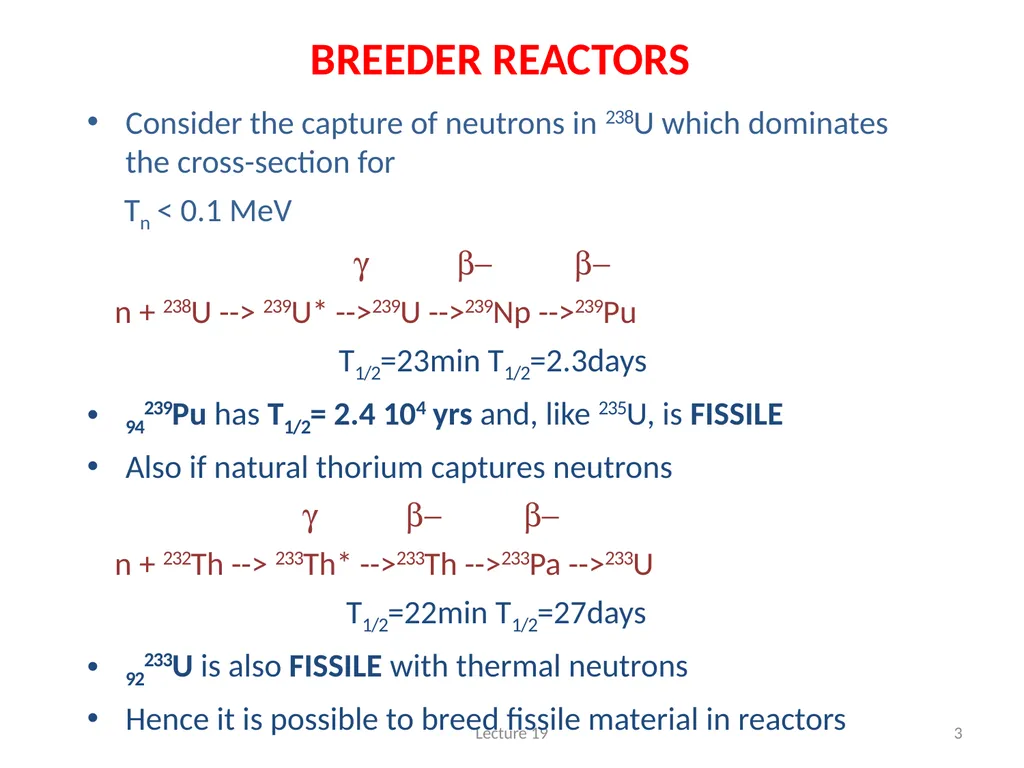
BREEDER REACTORS Consider the capture of neutrons in 238U which dominates the cross-section for
Tn < 0.1 MeV
g b- b-
n + 238U --> 239U* -->239U -->239Np -->239Pu
T1/2=23min T1/2=2.3days
94239Pu has T1/2= 2.4 104 yrs and, like 235U, is FISSILE
Also if natural thorium captures neutrons
g b- b-
n + 232Th --> 233Th* -->233Th -->233Pa -->233U
T1/2=22min T1/2=27days
92233U is also FISSILE with thermal neutrons
Hence it is possible to breed fissile material in reactors 3 Lecture 19<br>
04
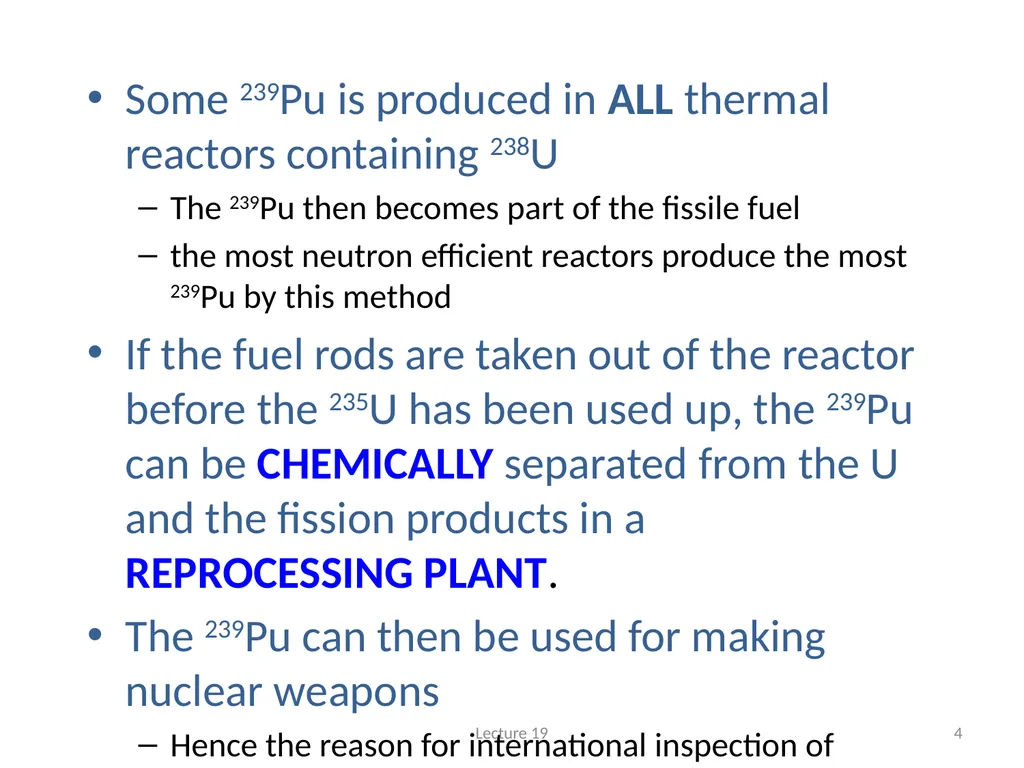
Some 239Pu is produced in ALL thermal reactors containing 238U
The 239Pu then becomes part of the fissile fuel
the most neutron efficient reactors produce the most 239Pu by this method
If the fuel rods are taken out of the reactor before the 235U has been used up, the 239Pu can be CHEMICALLY separated from the U and the fission products in a REPROCESSING PLANT.
The 239Pu can then be used for making nuclear weapons
Hence the reason for international inspection of nuclear power plants under the auspices of the IAEA 4 Lecture 19<br>
05
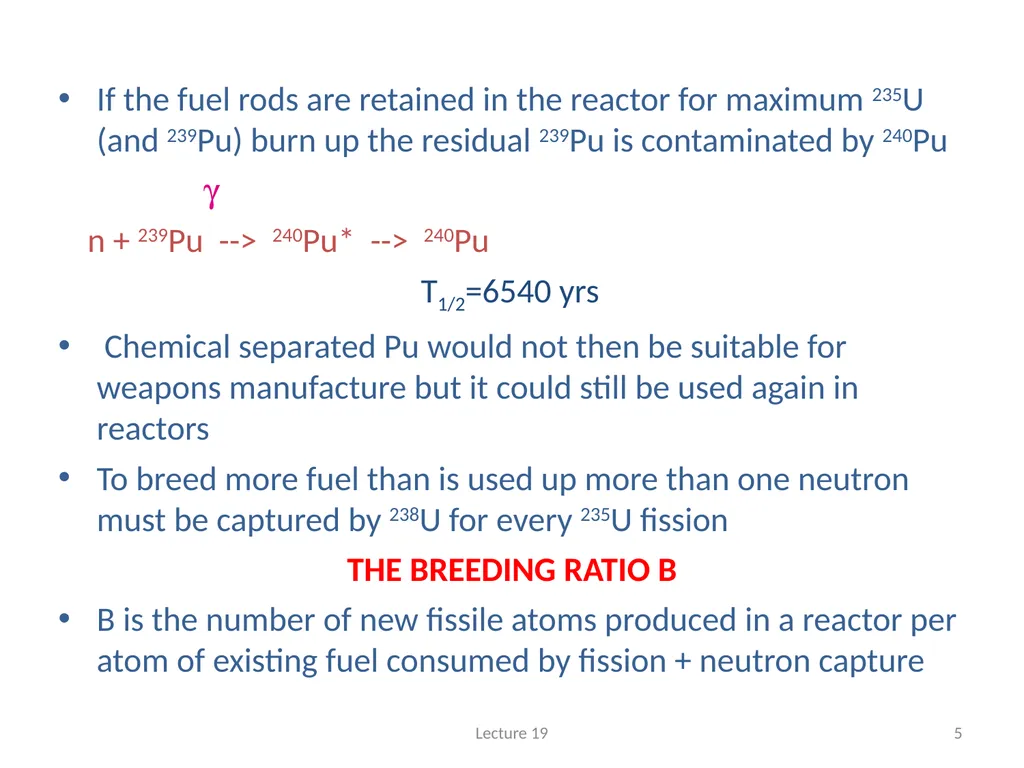
If the fuel rods are retained in the reactor for maximum 235U (and 239Pu) burn up the residual 239Pu is contaminated by 240Pu
g
n + 239Pu --> 240Pu* --> 240Pu
T1/2=6540 yrs
Chemical separated Pu would not then be suitable for weapons manufacture but it could still be used again in reactors
To breed more fuel than is used up more than one neutron must be captured by 238U for every 235U fission
THE BREEDING RATIO B
B is the number of new fissile atoms produced in a reactor per atom of existing fuel consumed by fission + neutron capture 5 Lecture 19<br>
06
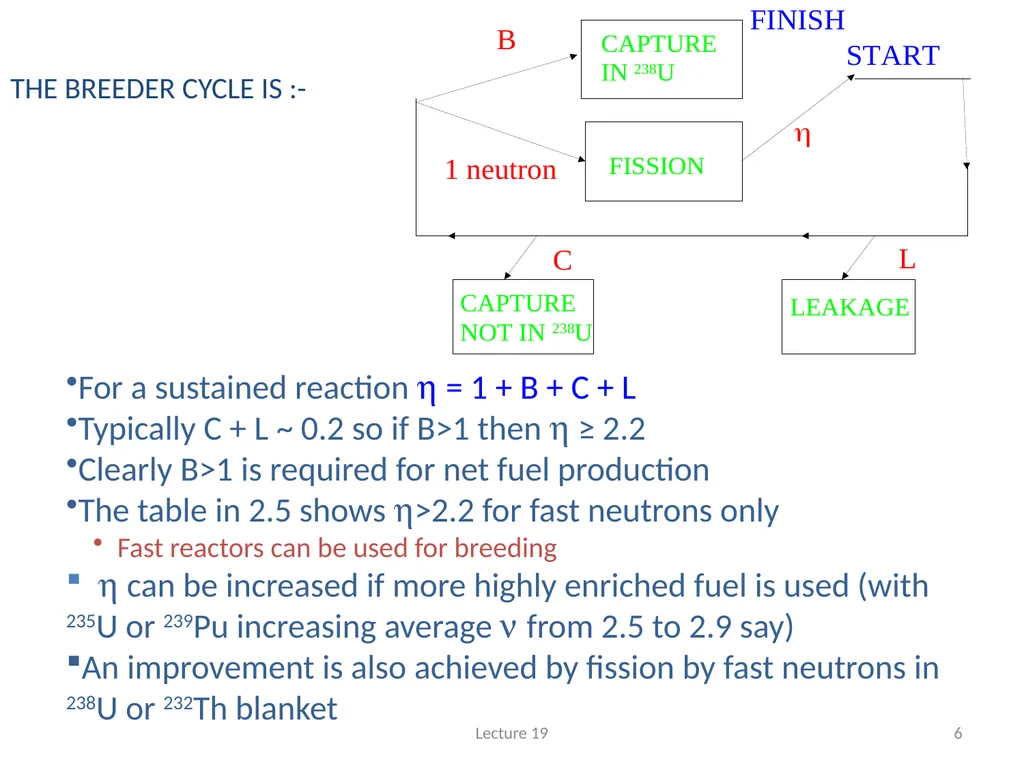
THE BREEDER CYCLE IS :- For a sustained reaction h = 1 + B + C + L
Typically C + L ~ 0.2 so if B>1 then h ≥ 2.2
Clearly B>1 is required for net fuel production
The table in 2.5 shows h>2.2 for fast neutrons only
Fast reactors can be used for breeding
h can be increased if more highly enriched fuel is used (with 235U or 239Pu increasing average n from 2.5 to 2.9 say)
An improvement is also achieved by fission by fast neutrons in 238U or 232Th blanket 6 Lecture 19<br>
07
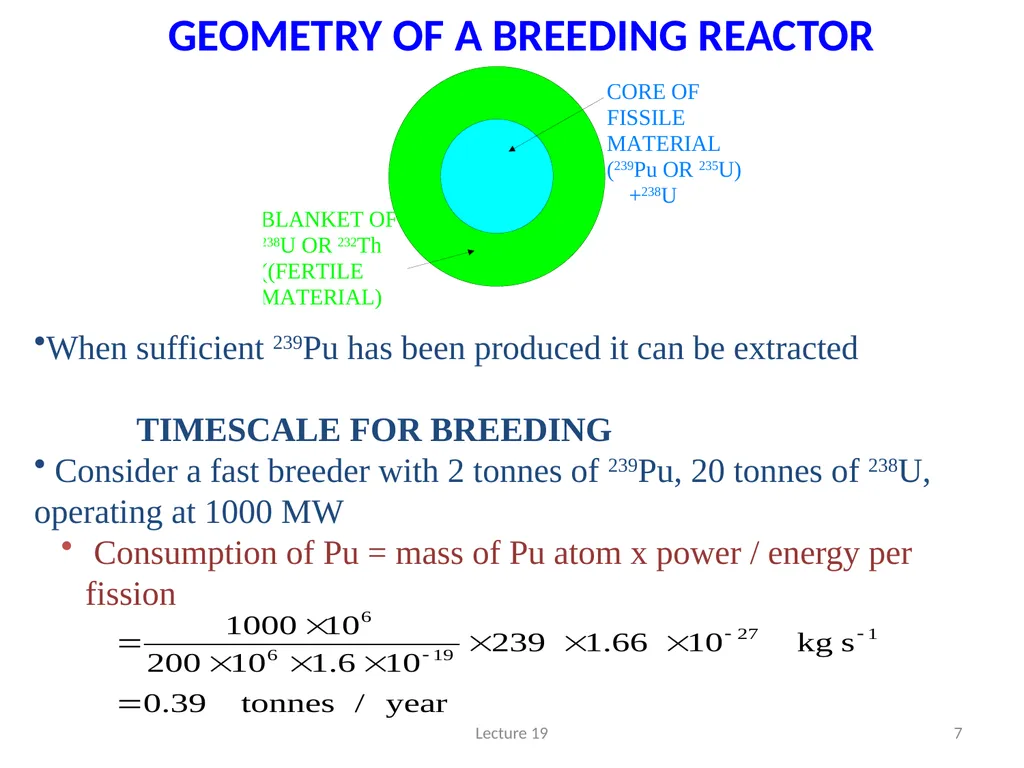
GEOMETRY OF A BREEDING REACTOR When sufficient 239Pu has been produced it can be extracted
TIMESCALE FOR BREEDING
Consider a fast breeder with 2 tonnes of 239Pu, 20 tonnes of 238U, operating at 1000 MW
Consumption of Pu = mass of Pu atom x power / energy per fission 7 Lecture 19<br>
08
If B = 1.2 then we gain 0.2 x 0.39 ~ 0.08 tonnes / year
This generates fuel for a second reactor (i.e. 2 tonnes) in 2 /0.08 years = 25 years!!
Concern about the Earth’s fuel reserves interest in Breeder Reactors
UN statistics (1984 excluding Eastern Europe, USSR and China)
FUEL COAL EQUIVALENT
IN 109 TONNES
COAL 1520
OIL 140
GAS 115
URANIUM 146
(No breeding, 2% burn up)
URANIUM 7300
(Breeding, 100% burn up)
Rough numbers depending on what it is considered economic to recover 8 Lecture 19<br>
09
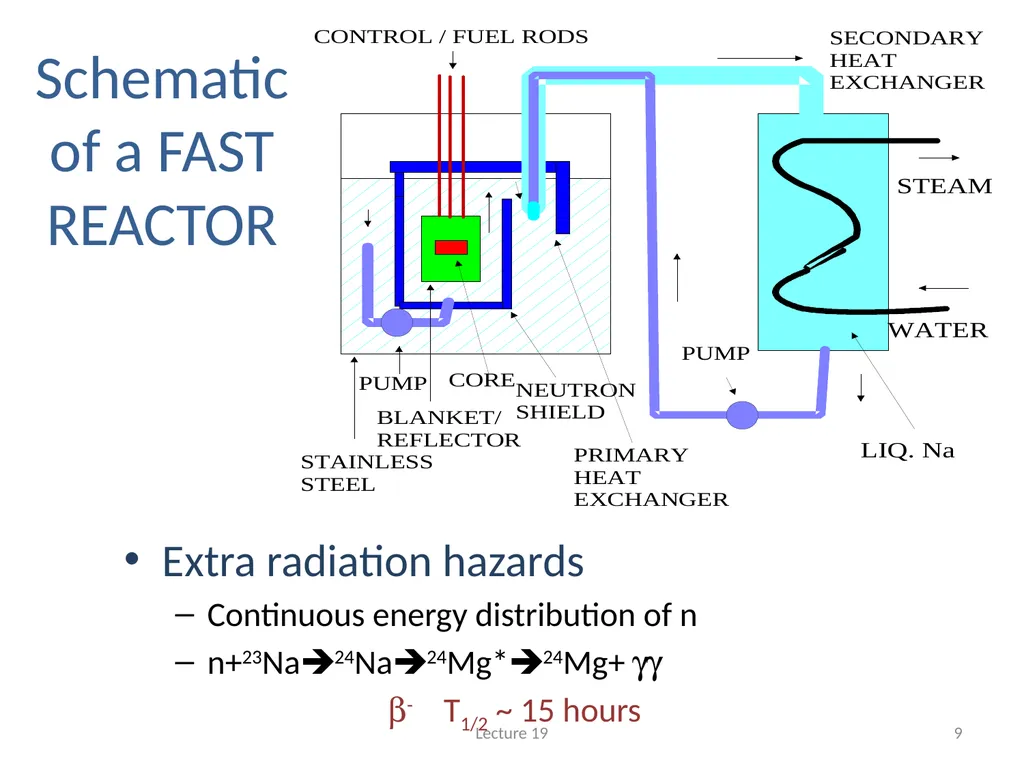
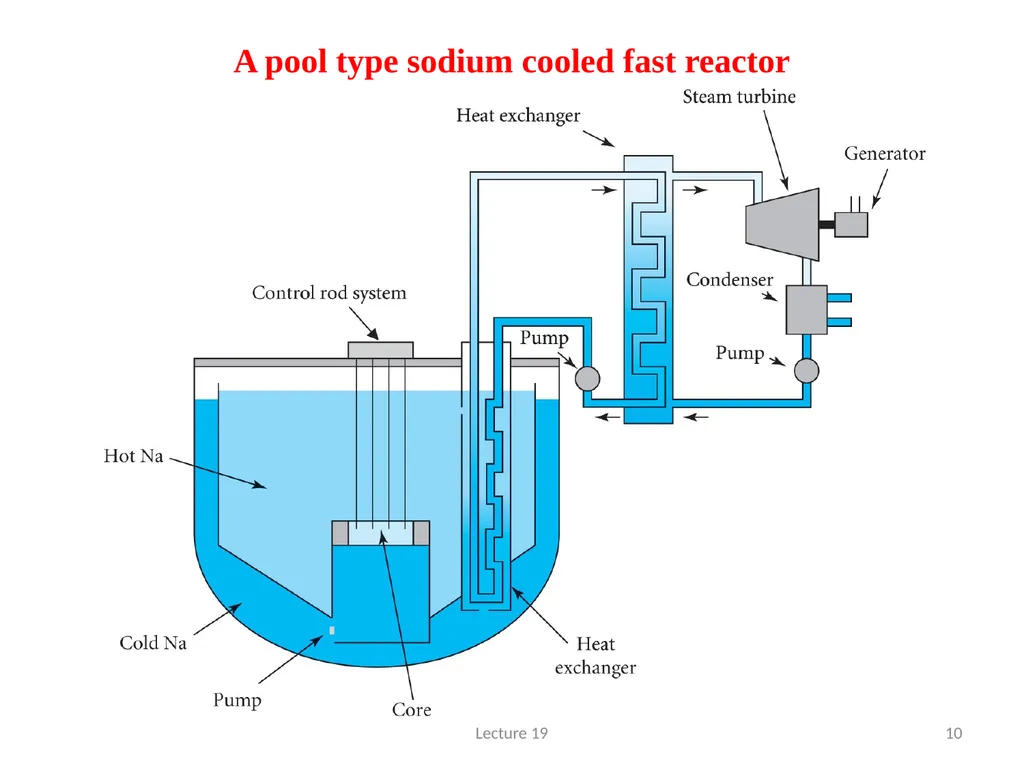
Schematic of a FAST REACTOR Extra radiation hazards
Continuous energy distribution of n
n+23Na24Na24Mg*24Mg+ gg
b- T1/2 ~ 15 hours 9 Lecture 19<br>
10
A pool type sodium cooled fast reactor 10 Lecture 19<br>
11
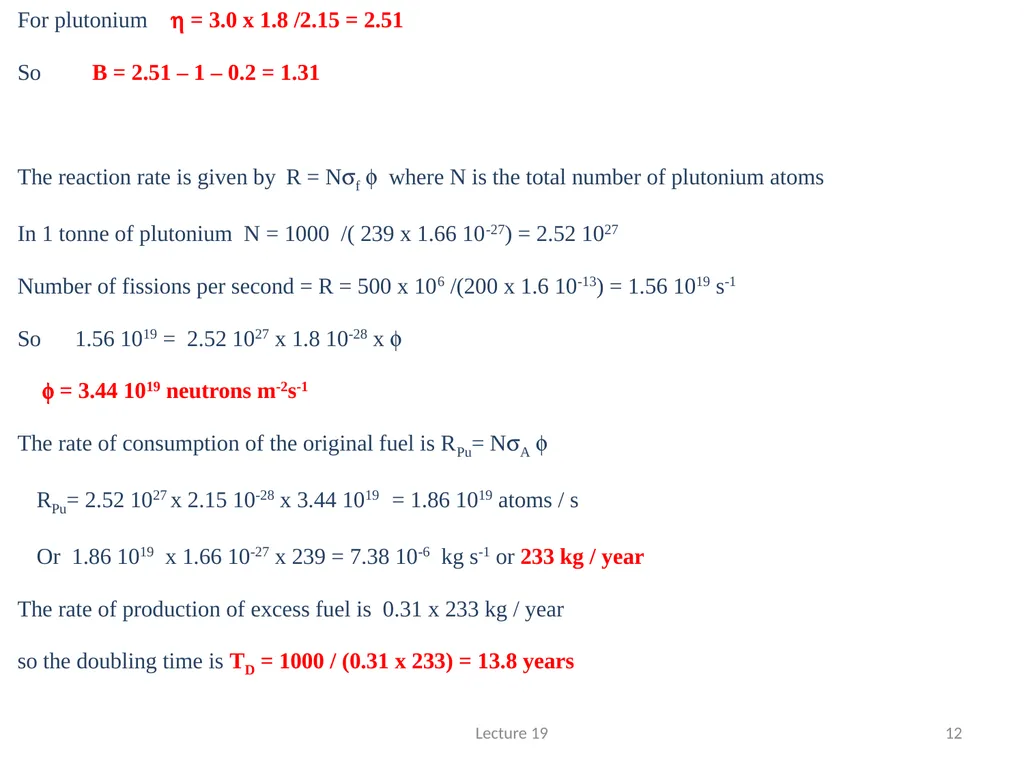
EXAMPLE:- A fast breeder reactor operates with a plutonium fuel. Plutonium emits on average 3.0 neutrons per fission and the neutron fission and absorption cross sections are sf = 1.8b and sA = 2.15b respectively. Determine a value for h. Assuming that the neutron losses are 20% in total calculate the value of B. The breeder reactor operates at a rating of 500 MW per tonne of fuel. Calculate the neutron flux and the consumption of plutonium fuel per year (You may assume that 200MeV is released per fission). Hence calculate the ‘doubling time’, i.e. the time needed to double the amount of fuel. Lecture 19 11<br>
12
For plutonium h = 3.0 x 1.8 /2.15 = 2.51
So B = 2.51 – 1 – 0.2 = 1.31
The reaction rate is given by R = Nsf f where N is the total number of plutonium atoms
In 1 tonne of plutonium N = 1000 /( 239 x 1.66 10-27) = 2.52 1027
Number of fissions per second = R = 500 x 106 /(200 x 1.6 10-13) = 1.56 1019 s-1
So 1.56 1019 = 2.52 1027 x 1.8 10-28 x f
f = 3.44 1019 neutrons m-2s-1
The rate of consumption of the original fuel is RPu= NsA f
RPu= 2.52 1027 x 2.15 10-28 x 3.44 1019 = 1.86 1019 atoms / s
Or 1.86 1019 x 1.66 10-27 x 239 = 7.38 10-6 kg s-1 or 233 kg / year
The rate of production of excess fuel is 0.31 x 233 kg / year
so the doubling time is TD = 1000 / (0.31 x 233) = 13.8 years Lecture 19 12<br>