Ukrainian banking: refreshed and efficient, but vulnerable to political risks Dmytro Sologub Berlin, June 2019 Deputy Governor Where we are 2 The next IMF tranche has been postponed until the parliamentary elections and formation of a new
"Ukrainian banking: refreshed and efficient, but" is the property of its rightful owner. Permission is granted to
download and print the materials on this website for personal, non-commercial use only, and to display it
on your personal computer provided you do not modify the materials and that you retain all copyright
notices contained in the materials. By downloading content from our website, you accept the terms of this
agreement.
Presentation Transcript
01
Ukrainian banking: refreshed and efficient, but vulnerable to political risks Dmytro Sologub Berlin, June 2019 Deputy Governor<br>
02
Where we are 2 The next IMF tranche has been postponed until the parliamentary elections and formation of a new government.
Macroeconomic policy remains sound.
No disruptive issues with banking system.
Mild deterioration of FX and business expectations.
A key assumption of the macroeconomic and financial sector forecast is that Ukraine will continue to cooperate with the IMF, which will allow to attract other official financing, improve access to the international capital markets and support interest of nonresidents in UAH-denominated bonds.<br>
03
More uncertainty due to early parliament election
External risks ( global recession, decline in commodity prices)
Uncertainty over the volume of gas transit through Ukraine in 2020
Escalation of the military conflict and new trade restrictions by RF
Risks to Ukraine's financial stability and the NBU’s independence Key risks 3<br>
04
Macroeconomic recovery is underway Macroeconomic stability has been entrenched amid steady growth recovery and decelerating inflation
GDP growth slows down to 2.5% in 2019 but will accelerate in the coming years.
Inflation will go down to 6.3% this year and will hit the target in 2020. 4 Headline CPI, % Source: SSSU, NBU staff estimates. Contributions to Real GDP Growth, pp Source: SSSU, NBU staff estimates.<br>
05
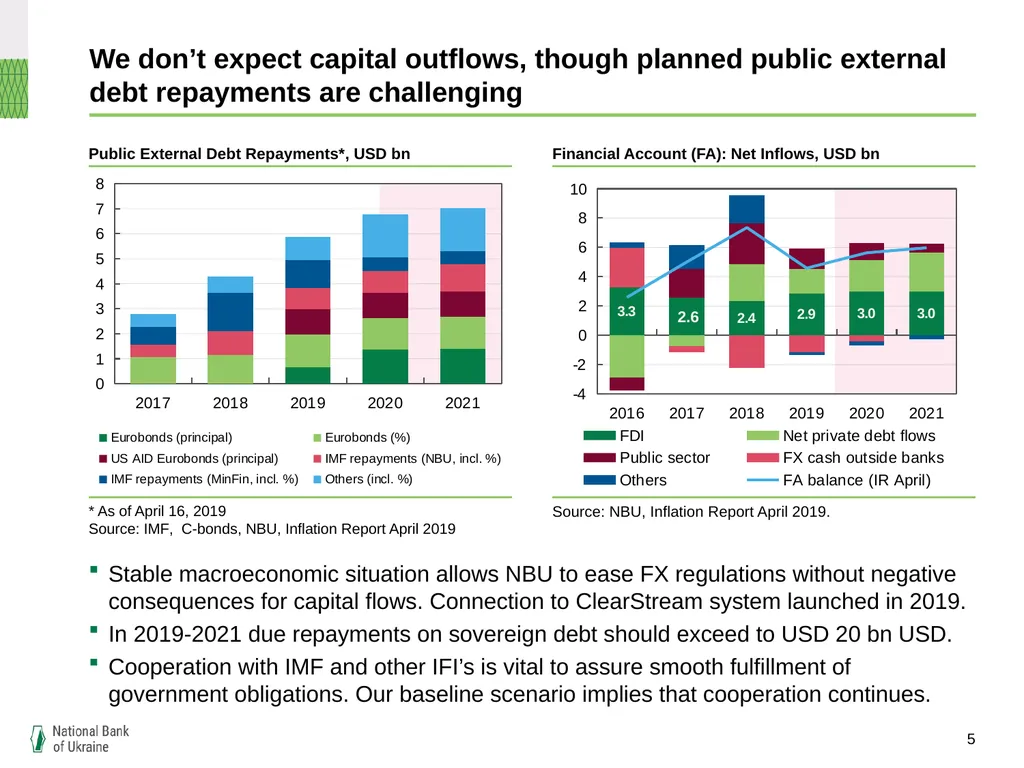
5 We don’t expect capital outflows, though planned public external debt repayments are challenging Public External Debt Repayments*, USD bn Stable macroeconomic situation allows NBU to ease FX regulations without negative consequences for capital flows. Connection to ClearStream system launched in 2019.
In 2019-2021 due repayments on sovereign debt should exceed to USD 20 bn USD.
Cooperation with IMF and other IFI’s is vital to assure smooth fulfillment of government obligations. Our baseline scenario implies that cooperation continues. * As of April 16, 2019
Source: IMF, С-bonds, NBU, Inflation Report April 2019 Financial Account (FA): Net Inflows, USD bn Source: NBU, Inflation Report April 2019.<br>
06
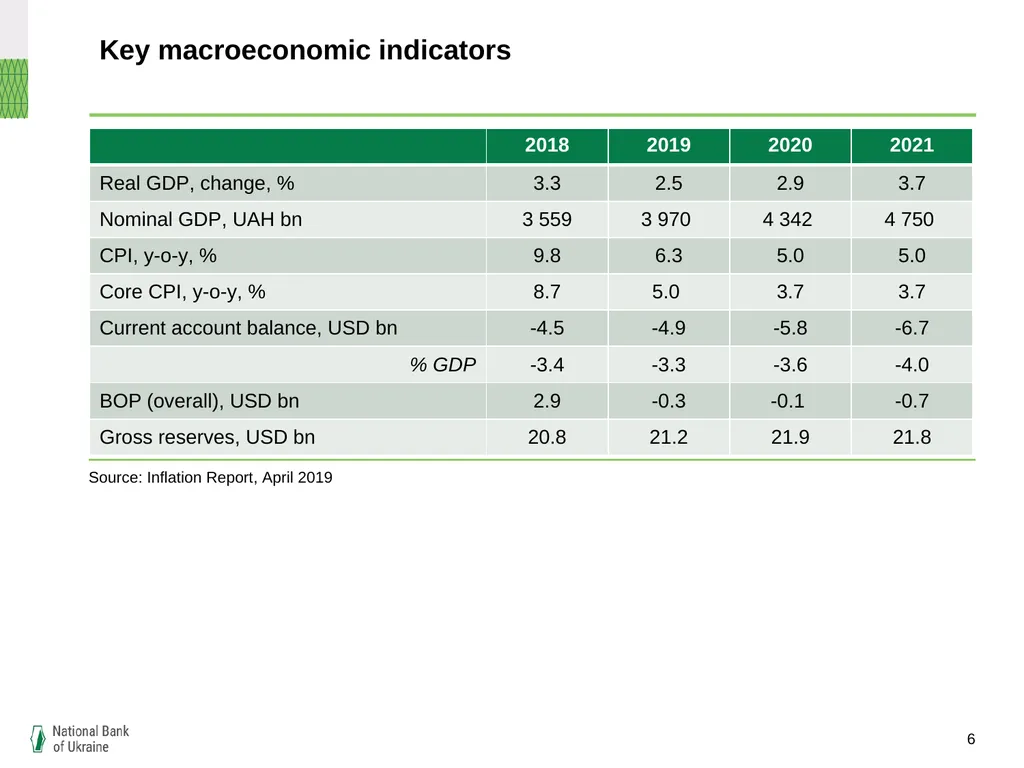
6 Key macroeconomic indicators Source: Inflation Report, April 2019<br>
07
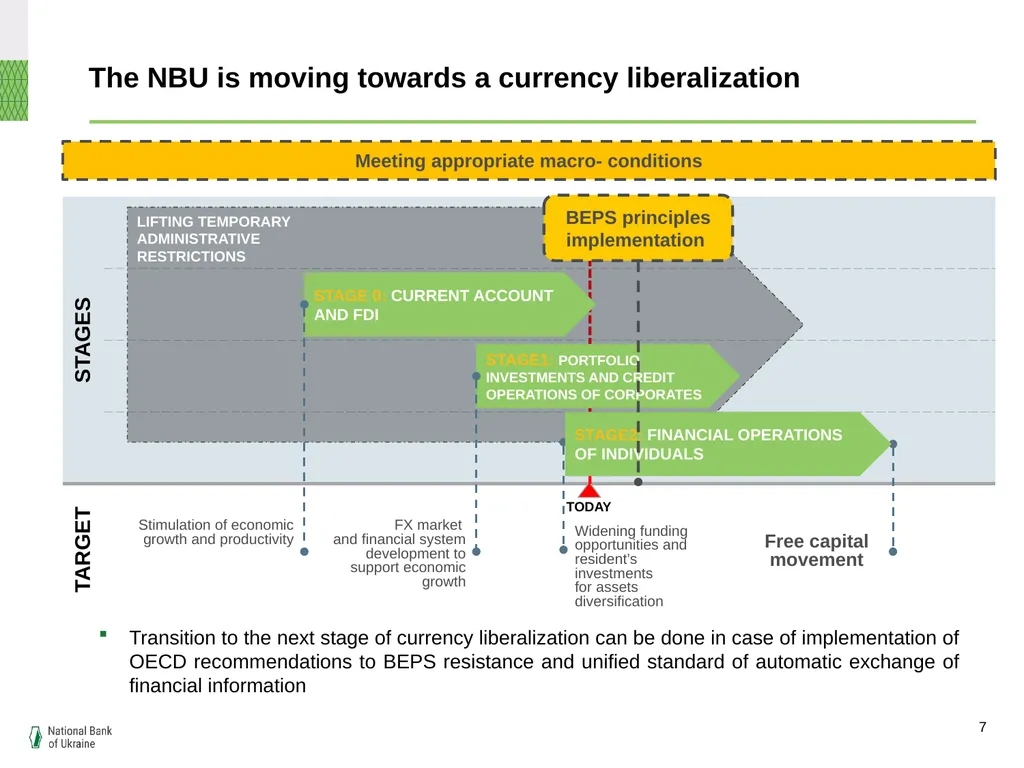
The NBU is moving towards a currency liberalization 7 Transition to the next stage of currency liberalization can be done in case of implementation of OECD recommendations to BEPS resistance and unified standard of automatic exchange of financial information<br>
08
ЗУ «Про валюту і валютні операції» та нові НПА 9<br>
09
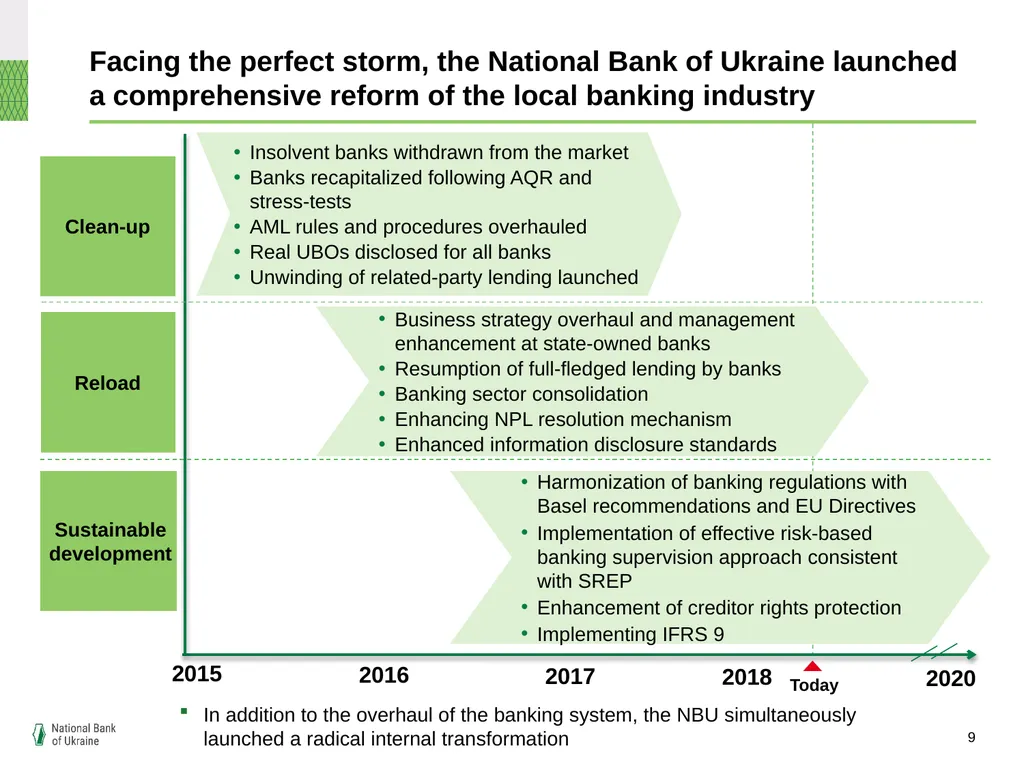
Facing the perfect storm, the National Bank of Ukraine launched a comprehensive reform of the local banking industry 2017 2016 2015 Reload Sustainable development Insolvent banks withdrawn from the market
Banks recapitalized following AQR and stress-tests
AML rules and procedures overhauled
Real UBOs disclosed for all banks
Unwinding of related-party lending launched Clean-up Business strategy overhaul and management enhancement at state-owned banks
Resumption of full-fledged lending by banks
Banking sector consolidation
Enhancing NPL resolution mechanism
Enhanced information disclosure standards 2020 2018 Today Harmonization of banking regulations with Basel recommendations and EU Directives
Implementation of effective risk-based banking supervision approach consistent with SREP
Enhancement of creditor rights protection
Implementing IFRS 9 In addition to the overhaul of the banking system, the NBU simultaneously launched a radical internal transformation 9<br>
10
Run on banks ends off, the banking system is stable though still dominated by state-owned banks 10 Banks’ total assets by groups, UAH billion Source: NBU.
Solvent banks were grouped under the relevant classification for the given years. Figures - number of banks in each group. Number of banks Source: NBU. 76 banks operate in the market as of the beginning of June.
No new bank bankruptcies over last 1.5 years – a smaller number of banks results form M&A and banks’ reorganizations into financial companies.
At present, state-owned banks dominate the market – the issue which Ukraine started to resolve in 2018. Government has adopted The Strategy for SOBs, which aims at privatization of state-owned banks. New supervisory boards with independent Directors were appointed, which will lead to corporate governance improvement.<br>
11
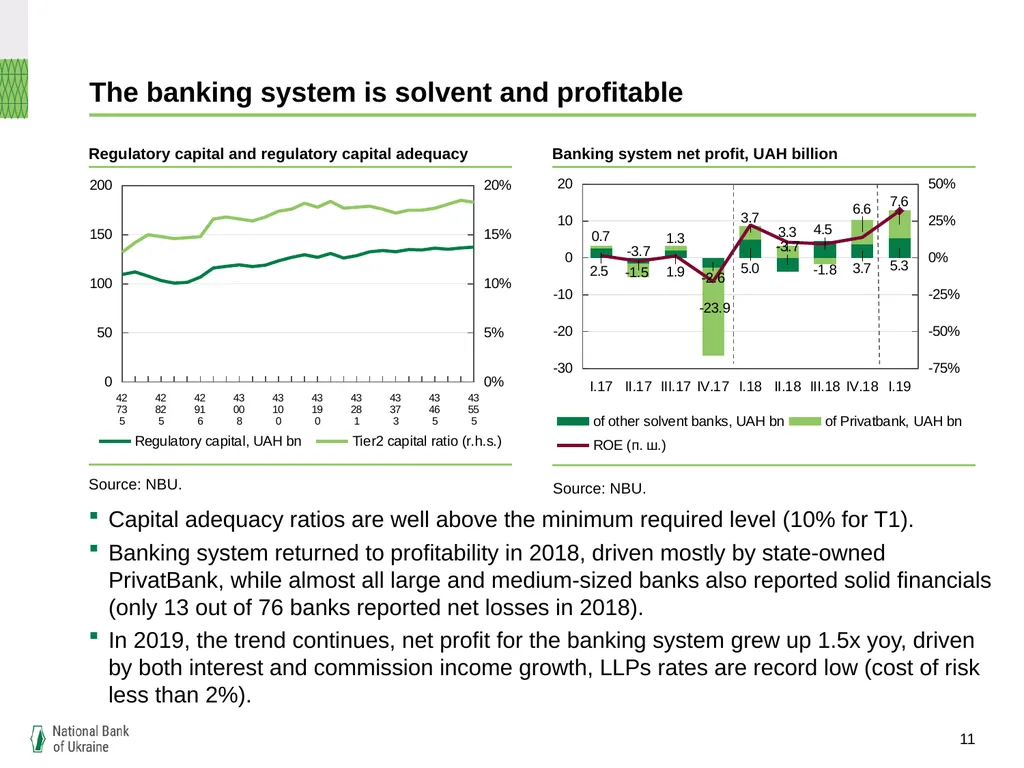
The banking system is solvent and profitable 11 Regulatory capital and regulatory capital adequacy Banking system net profit, UAH billion Source: NBU. Source: NBU. Capital adequacy ratios are well above the minimum required level (10% for T1).
Banking system returned to profitability in 2018, driven mostly by state-owned PrivatBank, while almost all large and medium-sized banks also reported solid financials (only 13 out of 76 banks reported net losses in 2018).
In 2019, the trend continues, net profit for the banking system grew up 1.5x yoy, driven by both interest and commission income growth, LLPs rates are record low (cost of risk less than 2%).<br>
12
Both loans and deposits are growing, mostly UAH-denominated 12 Strong increase in nominal wages, high interest rates on the back of hryvnia appreciation and improved inflation expectations contributed to the inflow of households' UAH deposits.
Consumer loans have been growing fast. Loans to high-quality borrowers with no record of loan default in 2014–2018 continued to grow by more that 25% yoy in 2018. However, high share of NPLs still restrains corporate loans growth. Source: NBU. Deposit Developments, 12.2016=100 Loan Developments, 12.2016=100 Source: NBU.<br>
13
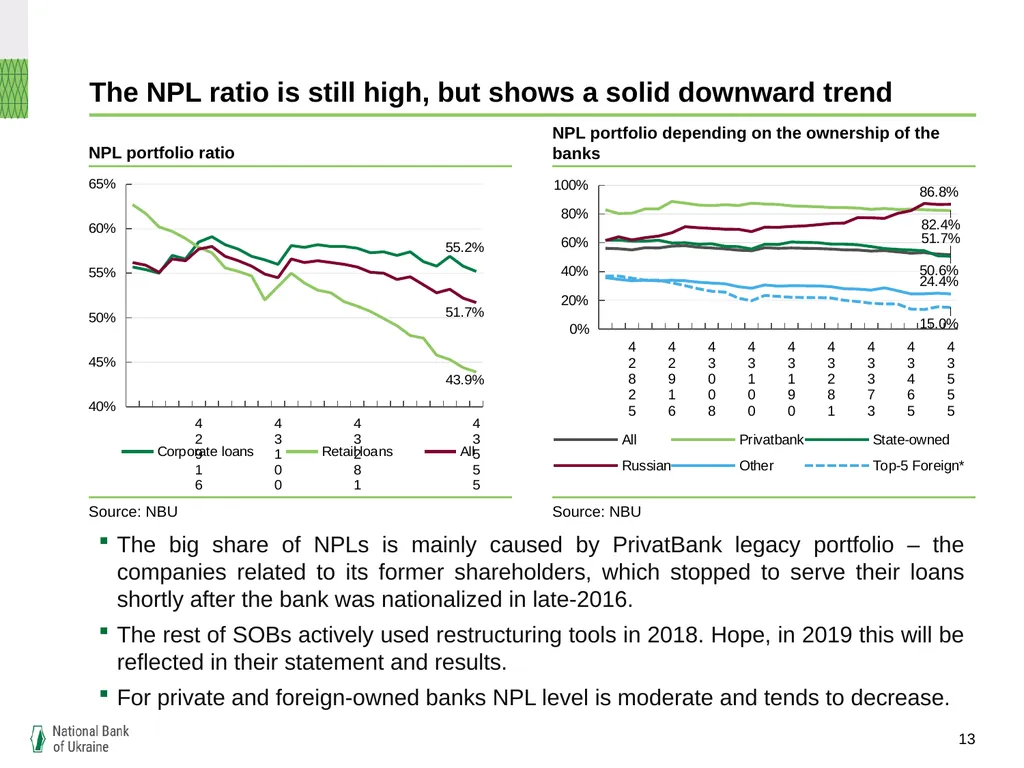
The NPL ratio is still high, but shows a solid downward trend NPL portfolio ratio NPL portfolio depending on the ownership of the banks 13 The big share of NPLs is mainly caused by PrivatBank legacy portfolio – the companies related to its former shareholders, which stopped to serve their loans shortly after the bank was nationalized in late-2016.
The rest of SOBs actively used restructuring tools in 2018. Hope, in 2019 this will be reflected in their statement and results.
For private and foreign-owned banks NPL level is moderate and tends to decrease. Source: NBU Source: NBU<br>
14
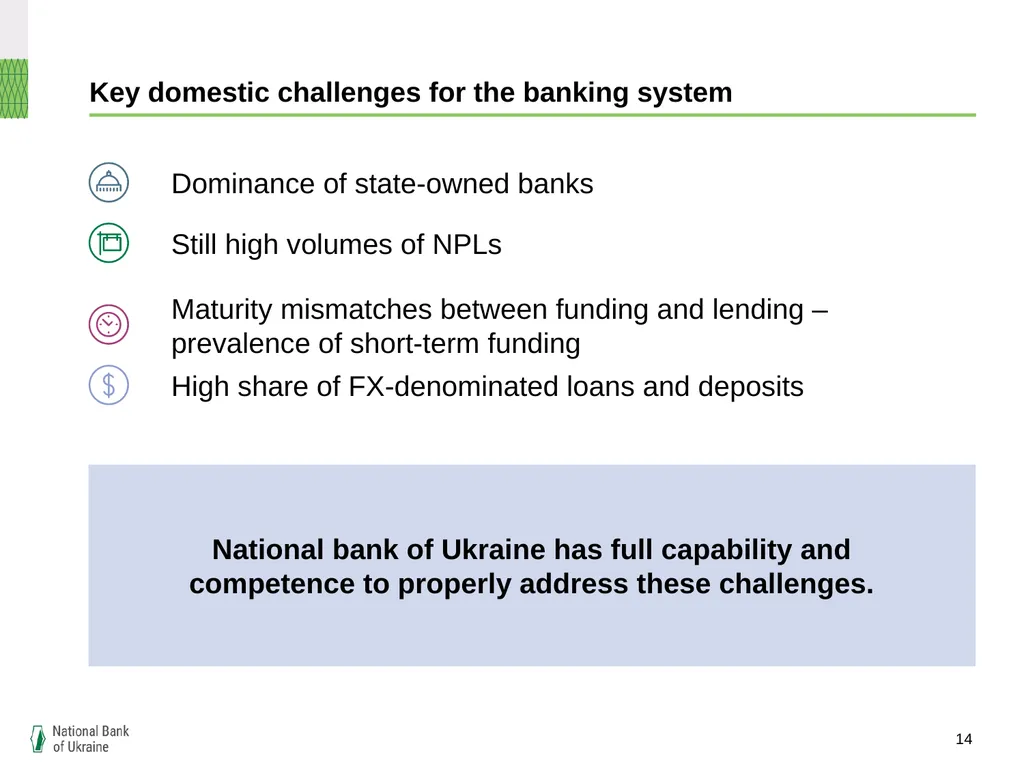
Key domestic challenges for the banking system 14 Dominance of state-owned banks Still high volumes of NPLs Maturity mismatches between funding and lending –
prevalence of short-term funding High share of FX-denominated loans and deposits National bank of Ukraine has full capability and competence to properly address these challenges.<br>
15
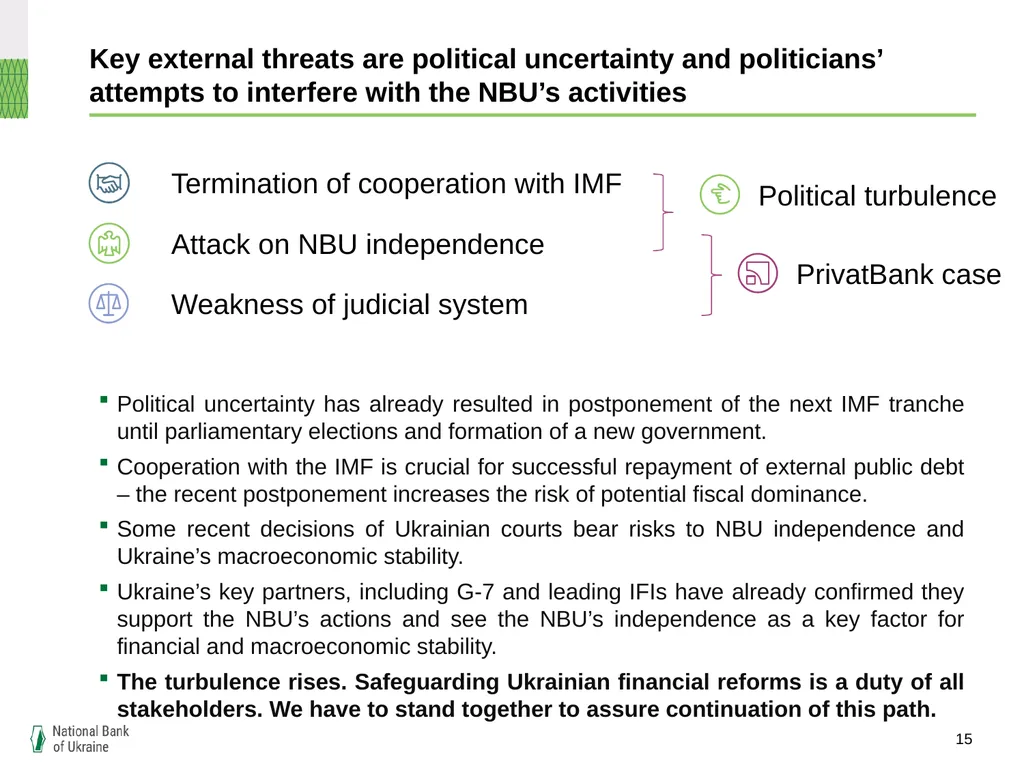
Key external threats are political uncertainty and politicians’ attempts to interfere with the NBU’s activities 15 Political uncertainty has already resulted in postponement of the next IMF tranche until parliamentary elections and formation of a new government.
Cooperation with the IMF is crucial for successful repayment of external public debt – the recent postponement increases the risk of potential fiscal dominance.
Some recent decisions of Ukrainian courts bear risks to NBU independence and Ukraine’s macroeconomic stability.
Ukraine’s key partners, including G-7 and leading IFIs have already confirmed they support the NBU’s actions and see the NBU’s independence as a key factor for financial and macroeconomic stability.
The turbulence rises. Safeguarding Ukrainian financial reforms is a duty of all stakeholders. We have to stand together to assure continuation of this path.<br>