UNCAC Coalition Annual Activity Survey Civic space challenges facing CSOs working on anti-corruption June 2025 Responses received 2025: Total Responses: 182 Members: 133 responses out of 159 Affiliated Groups: 42 responses out of 207
"UNCAC Coalition Annual Activity Survey Civic space" is the property of its rightful owner. Permission is granted to
download and print the materials on this website for personal, non-commercial use only, and to display it
on your personal computer provided you do not modify the materials and that you retain all copyright
notices contained in the materials. By downloading content from our website, you accept the terms of this
agreement.
Presentation Transcript
01
UNCAC Coalition
Annual Activity Survey Civic space challenges facing CSOs working on anti-corruption
June 2025<br>
02
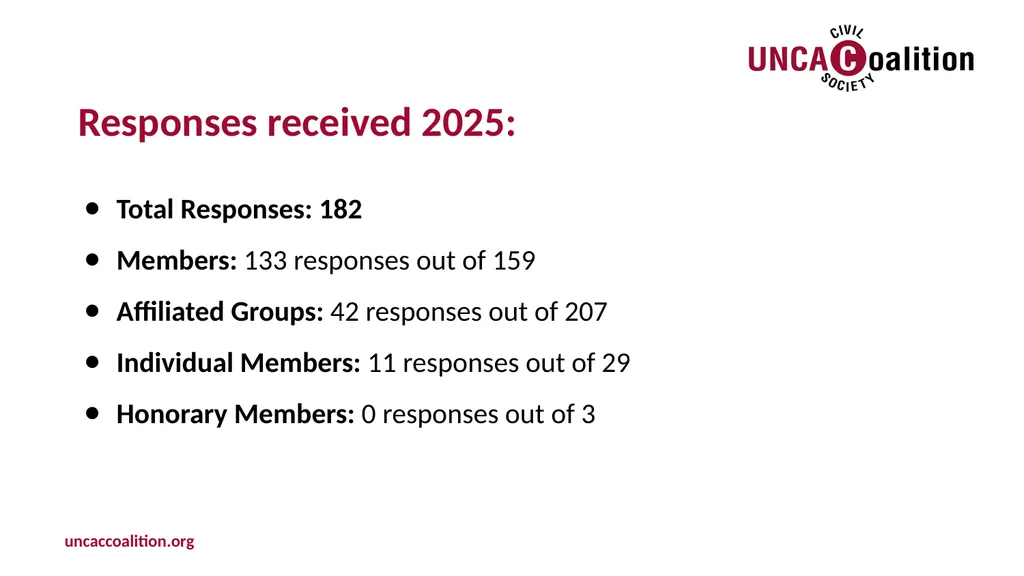
Responses received 2025:
Total Responses: 182
Members: 133 responses out of 159
Affiliated Groups: 42 responses out of 207
Individual Members: 11 responses out of 29
Honorary Members: 0 responses out of 3 uncaccoalition.org<br>
03
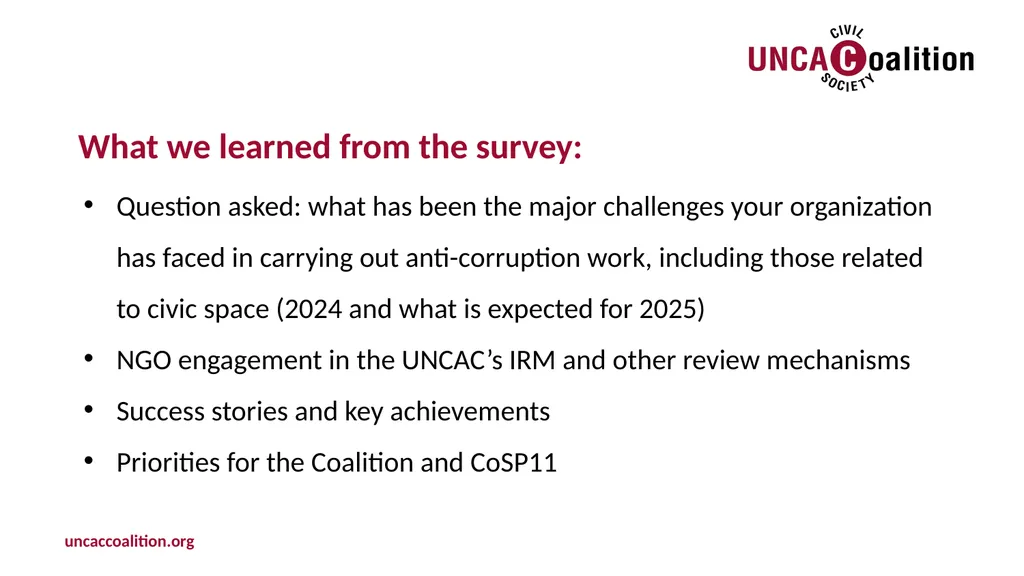
What we learned from the survey:
Question asked: what has been the major challenges your organization has faced in carrying out anti-corruption work, including those related to civic space (2024 and what is expected for 2025)
NGO engagement in the UNCAC’s IRM and other review mechanisms
Success stories and key achievements
Priorities for the Coalition and CoSP11 uncaccoalition.org<br>
04
Top challenges
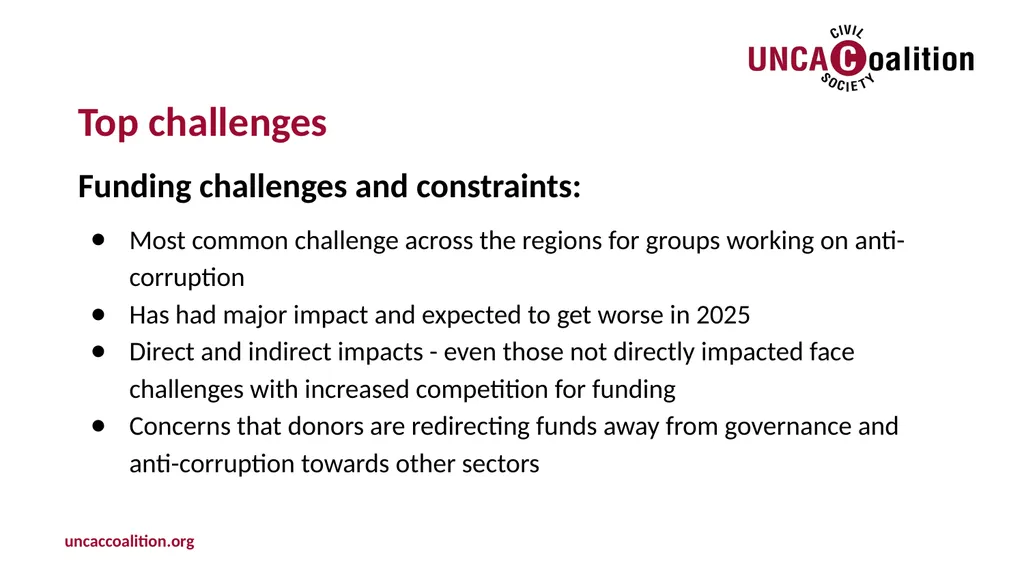
Funding challenges and constraints:
Most common challenge across the regions for groups working on anti-corruption
Has had major impact and expected to get worse in 2025
Direct and indirect impacts - even those not directly impacted face challenges with increased competition for funding
Concerns that donors are redirecting funds away from governance and anti-corruption towards other sectors uncaccoalition.org<br>
05
Top challenges
Barriers in access to information
Restrictions in access to decision makers and decision making processes
Restrictive laws and legal threats: foreign agent laws, weaponization of laws against NGOs, SLAPP lawsuits
Physical attacks, threats, intimidation, and harassment, online harassment and surveillance, cyber attacks, attacks on social media uncaccoalition.org<br>
06
Other challenges faced:
Changing geo-political landscape and backsliding on anti-corruption
Anti-NGO narratives and rhetoric
Weak whistleblower reporting and protection laws and gaps in implementation
In some regions, heightened risk of corruption for elections in 2025 uncaccoalition.org<br>
07
How to support civil society in carrying out anti-corruption work:
Provide a safe, enabling and inclusive environment for civil society to contribute to anti-corruption
Ensure conditions are present for civil society to effectively contribute to anti-corruption at national, regional, global levels (UNCAC/multilateral fora), review mechanisms
Early warning and protection systems to defend & protect those coming under attack uncaccoalition.org<br>
08
How to support civil society in carrying out anti-corruption work:
Addressing funding crisis to help CSOs access sustainable funding
Ensure effective access to information laws & implementation
Ensure comprehensive whistleblower laws & effective implementation
Provide capacity building and training on anti-corruption topics, security and to help strengthen skills in carrying out work
Support for advocacy at national level and joint global advocacy
Promote networking opportunities for CSOs to network with other CSOs, with governments, donors and other stakeholders uncaccoalition.org<br>
09
NGO Engagement in the IRM and other review mechanisms
NGOs engagement in other review mechanism uncaccoalition.org<br>
10
NGO Engagement in the IRM and other review mechanisms
NGOs involvement in the second cycle country review to assess UNCAC implementation uncaccoalition.org<br>
11
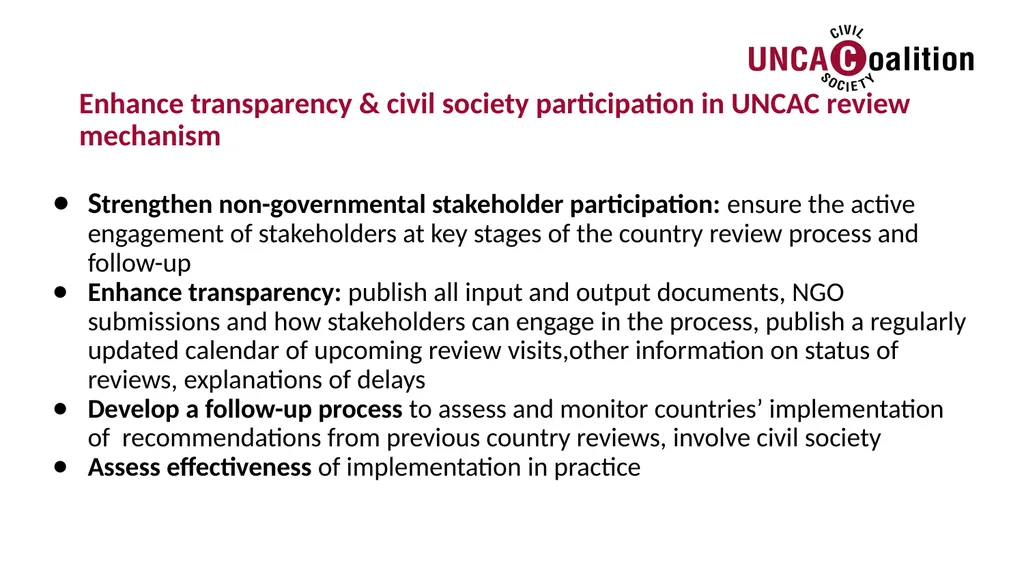
Enhance transparency & civil society participation in UNCAC review mechanism Strengthen non-governmental stakeholder participation: ensure the active engagement of stakeholders at key stages of the country review process and follow-up
Enhance transparency: publish all input and output documents, NGO submissions and how stakeholders can engage in the process, publish a regularly updated calendar of upcoming review visits,other information on status of reviews, explanations of delays
Develop a follow-up process to assess and monitor countries’ implementation of recommendations from previous country reviews, involve civil society
Assess effectiveness of implementation in practice<br>
12
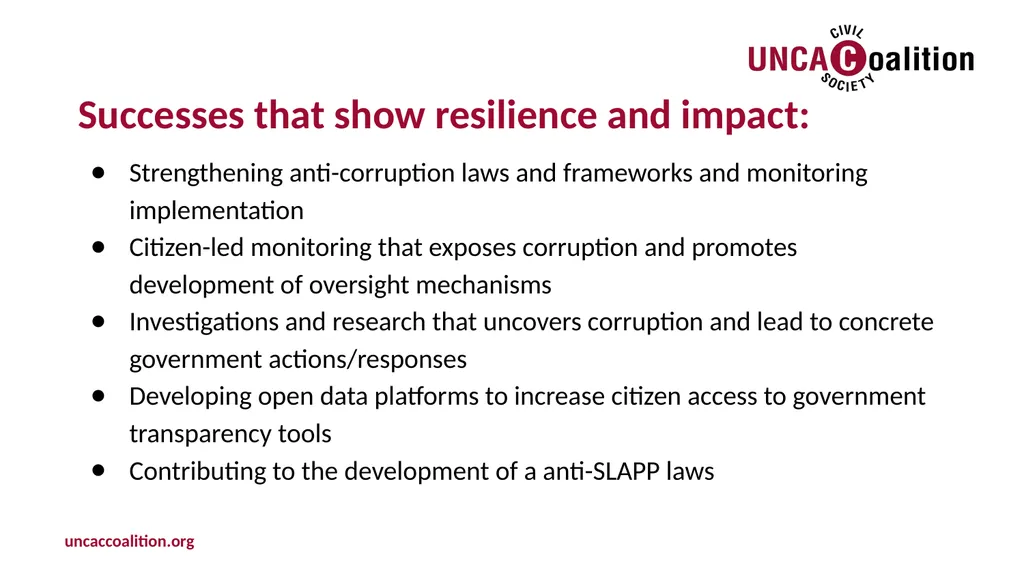
Successes that show resilience and impact:
Strengthening anti-corruption laws and frameworks and monitoring implementation
Citizen-led monitoring that exposes corruption and promotes development of oversight mechanisms
Investigations and research that uncovers corruption and lead to concrete government actions/responses
Developing open data platforms to increase citizen access to government transparency tools
Contributing to the development of a anti-SLAPP laws uncaccoalition.org<br>