Understanding Credit Reports 1 2017 How is it determined? How to read a credit report? How to build and maintain credit? 2 Understanding Credit Reports What is a credit report? A credit report is simply a file that is created by the bureaus
Related Topics
Share
Embed code
Download this presentation From Below
"Understanding Credit Reports 1 2017 How is it" is the property of its rightful owner. Permission is granted to
download and print the materials on this website for personal, non-commercial use only, and to display it
on your personal computer provided you do not modify the materials and that you retain all copyright
notices contained in the materials. By downloading content from our website, you accept the terms of this
agreement.
Presentation Transcript
01
Understanding Credit Reports 1 2017 How is it determined?
How to read a credit report?
How to build and maintain credit?<br>
02
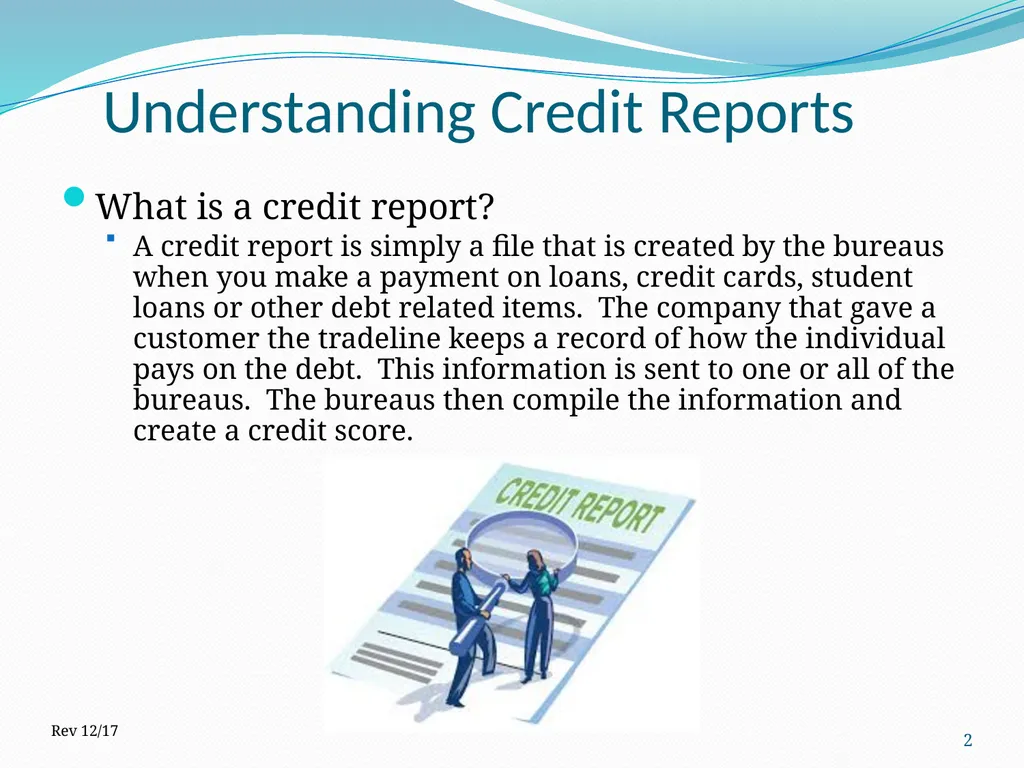
2 Understanding Credit Reports What is a credit report?
A credit report is simply a file that is created by the bureaus when you make a payment on loans, credit cards, student loans or other debt related items. The company that gave a customer the tradeline keeps a record of how the individual pays on the debt. This information is sent to one or all of the bureaus. The bureaus then compile the information and create a credit score. Rev 12/17<br>
03
Before we jump into all things credit report related, it is important for us to know a few key terms.
Terms
Credit Score, Beacon, and FICO (Fair, Isaac & Co)
Tradeline
Open-End Credit or Revolving Line of Credit
A good way to get credit started – secured credit card
Closed-End Credit or Installment
Delinquency – 30, 60, 90, 120, 180
Charge-offs
Collections 3 Understanding Credit Reports Rev 12/17<br>
04
4 Understanding Credit Reports Terms (cont.)
Public Records
Bankruptcy
Tax Lien
Civil Judgements Rev 12/17<br>
05
There are 3 main credit bureaus, also known as agencies, that receive information from creditors regarding the history of different loans, credit cards, and other debt related items.
Equifax – We use this bureau when pulling credit reports for accounts and consumer loan applications.
TransUnion
Experian
www.annualcreditreport.com
Pull your credit and review! 5 Understanding Credit Reports Rev 12/17<br>
06
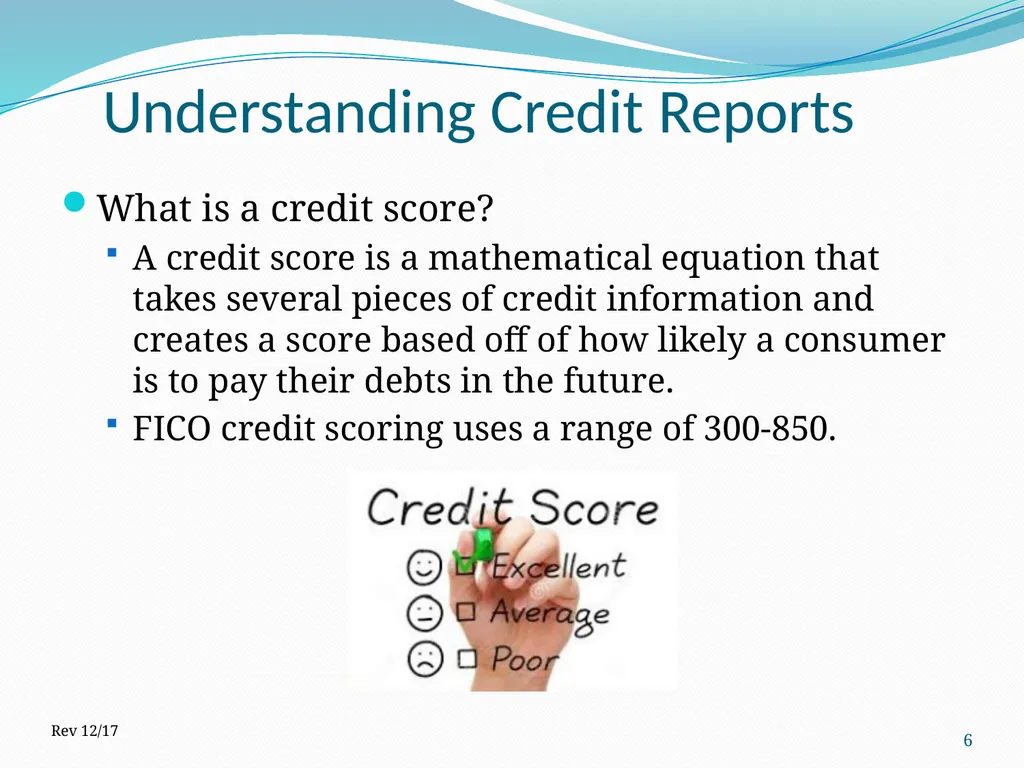
What is a credit score?
A credit score is a mathematical equation that takes several pieces of credit information and creates a score based off of how likely a consumer is to pay their debts in the future.
FICO credit scoring uses a range of 300-850. 6 Understanding Credit Reports Rev 12/17<br>
07
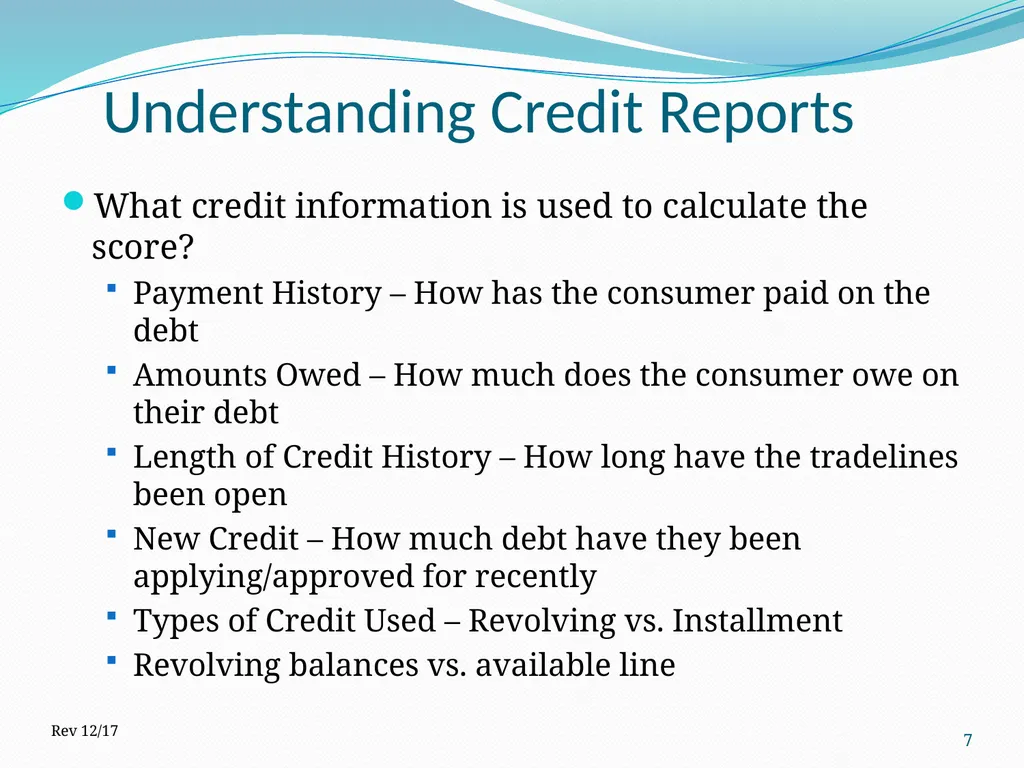
7 Understanding Credit Reports Rev 12/17 What credit information is used to calculate the score?
Payment History – How has the consumer paid on the debt
Amounts Owed – How much does the consumer owe on their debt
Length of Credit History – How long have the tradelines been open
New Credit – How much debt have they been applying/approved for recently
Types of Credit Used – Revolving vs. Installment
Revolving balances vs. available line<br>
08
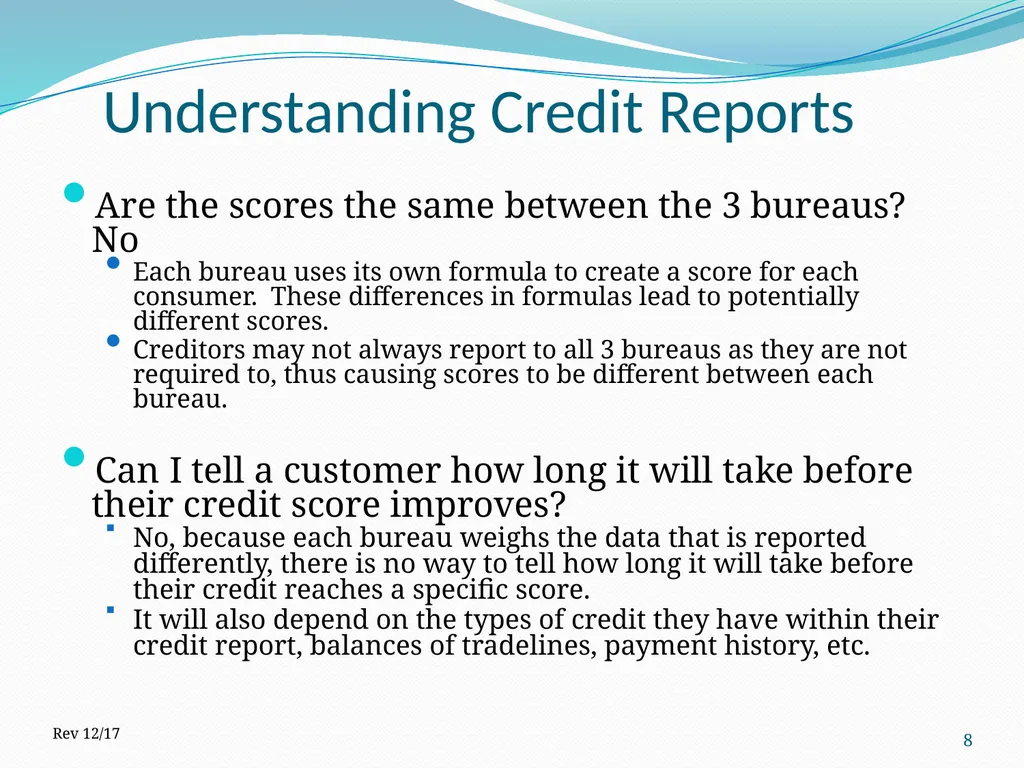
Are the scores the same between the 3 bureaus? No
Each bureau uses its own formula to create a score for each consumer. These differences in formulas lead to potentially different scores.
Creditors may not always report to all 3 bureaus as they are not required to, thus causing scores to be different between each bureau.
Can I tell a customer how long it will take before their credit score improves?
No, because each bureau weighs the data that is reported differently, there is no way to tell how long it will take before their credit reaches a specific score.
It will also depend on the types of credit they have within their credit report, balances of tradelines, payment history, etc. 8 Understanding Credit Reports Rev 12/17<br>
09
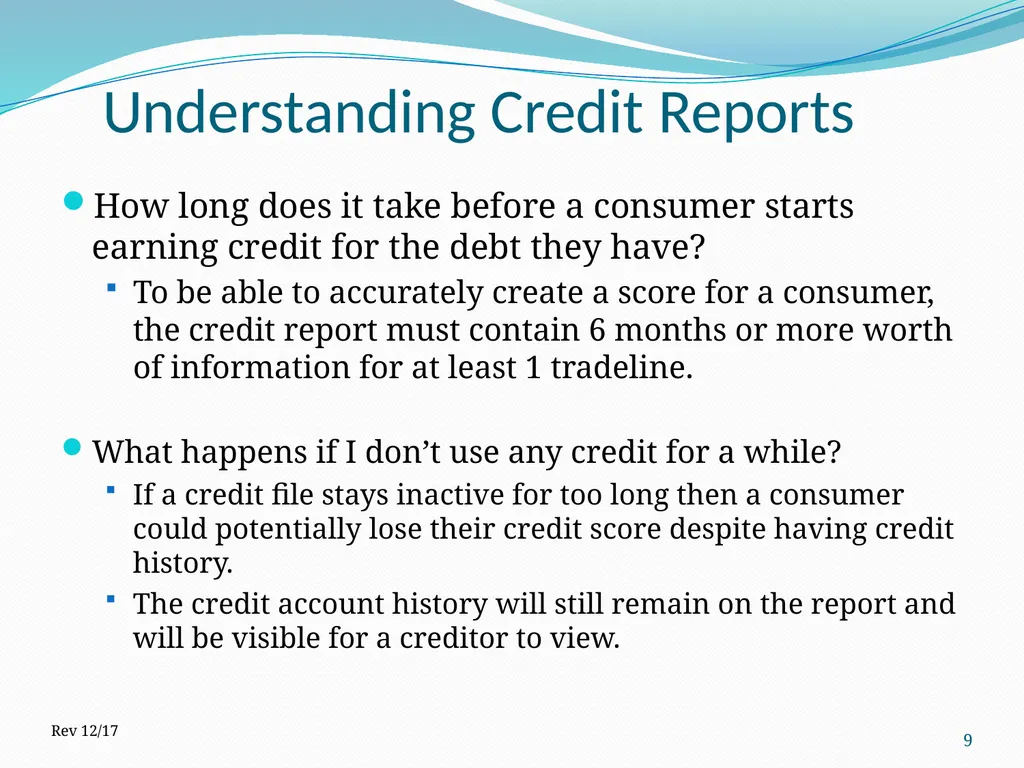
9 Understanding Credit Reports How long does it take before a consumer starts earning credit for the debt they have?
To be able to accurately create a score for a consumer, the credit report must contain 6 months or more worth of information for at least 1 tradeline. Rev 12/17 What happens if I don’t use any credit for a while?
If a credit file stays inactive for too long then a consumer could potentially lose their credit score despite having credit history.
The credit account history will still remain on the report and will be visible for a creditor to view.<br>
10
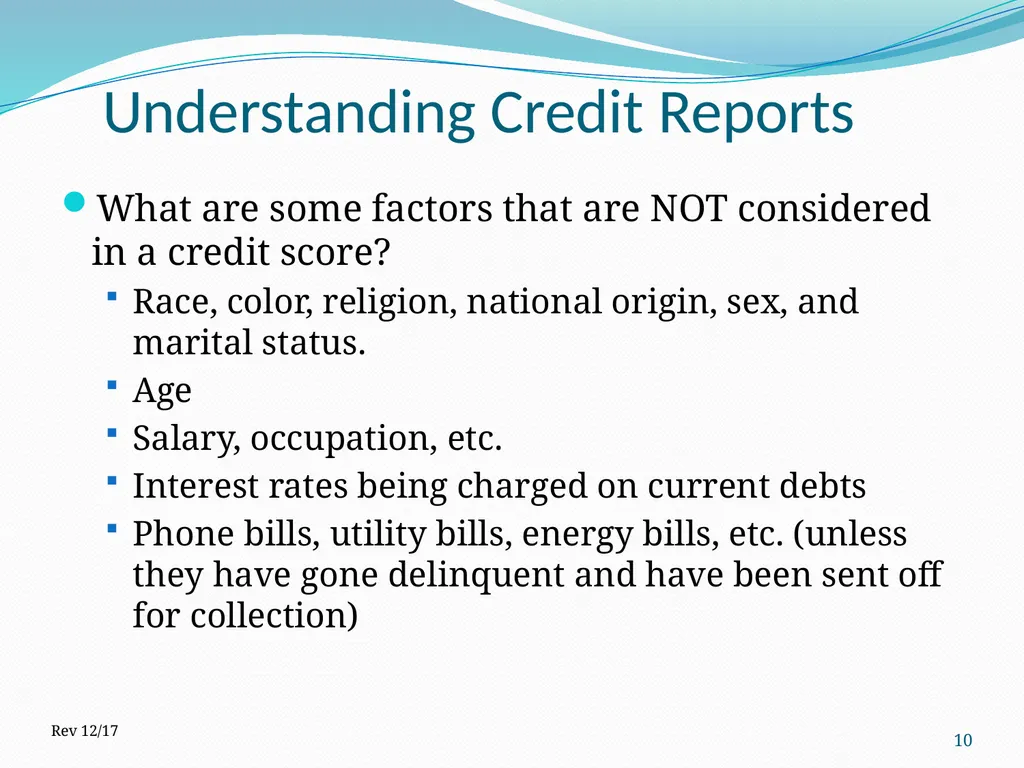
10 Understanding Credit Reports What are some factors that are NOT considered in a credit score?
Race, color, religion, national origin, sex, and marital status.
Age
Salary, occupation, etc.
Interest rates being charged on current debts
Phone bills, utility bills, energy bills, etc. (unless they have gone delinquent and have been sent off for collection) Rev 12/17<br>
11
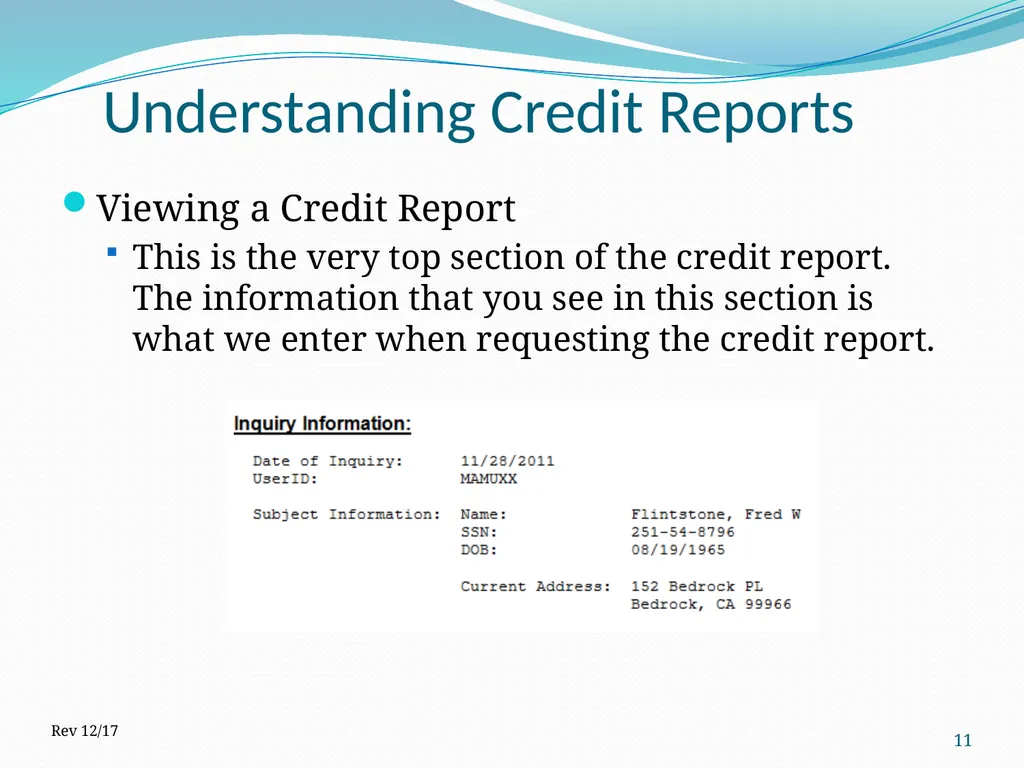
Viewing a Credit Report
This is the very top section of the credit report. The information that you see in this section is what we enter when requesting the credit report. 11 Understanding Credit Reports Rev 12/17<br>
12
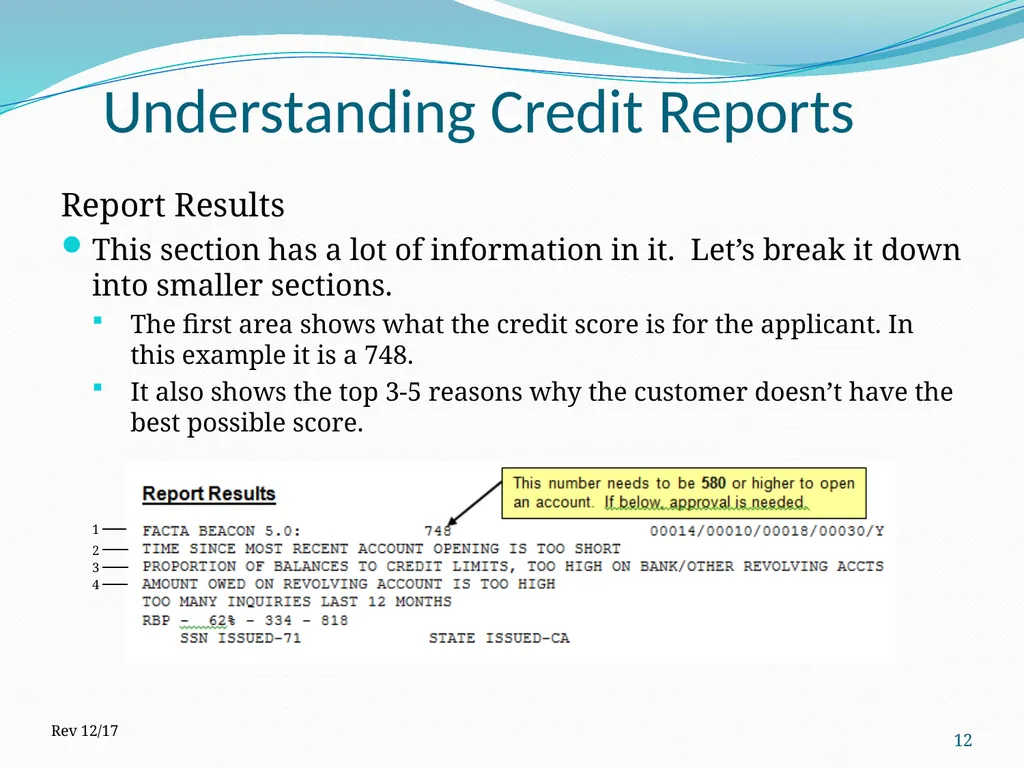
Report Results
This section has a lot of information in it. Let’s break it down into smaller sections.
The first area shows what the credit score is for the applicant. In this example it is a 748.
It also shows the top 3-5 reasons why the customer doesn’t have the best possible score. 12 Understanding Credit Reports Rev 12/17<br>
13
Report Results
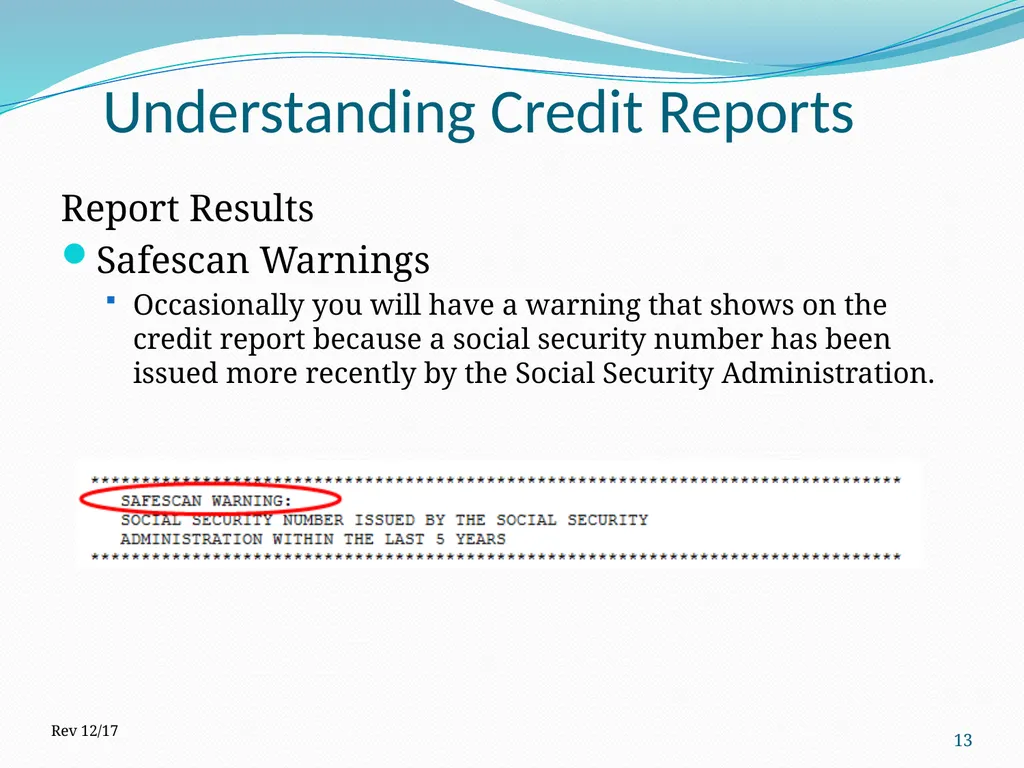
Safescan Warnings
Occasionally you will have a warning that shows on the credit report because a social security number has been issued more recently by the Social Security Administration. 13 Understanding Credit Reports Rev 12/17<br>
14
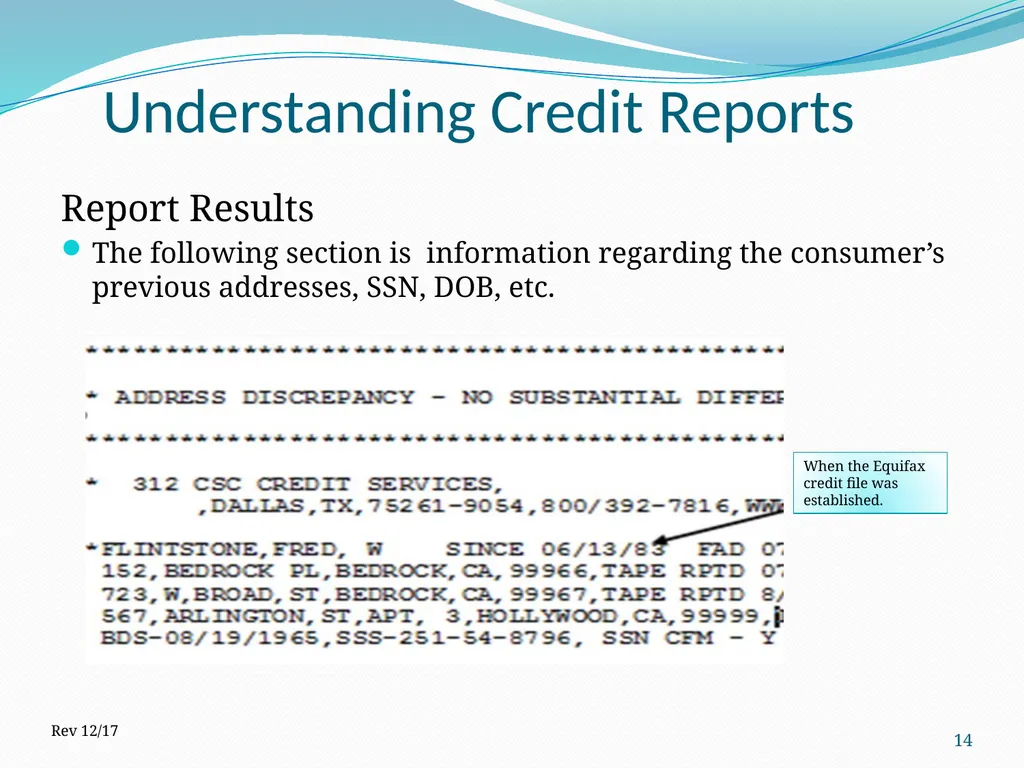
14 Understanding Credit Reports Report Results
The following section is information regarding the consumer’s previous addresses, SSN, DOB, etc. Rev 12/17 When the Equifax credit file was established.<br>
15
15 Understanding Credit Reports Report Results
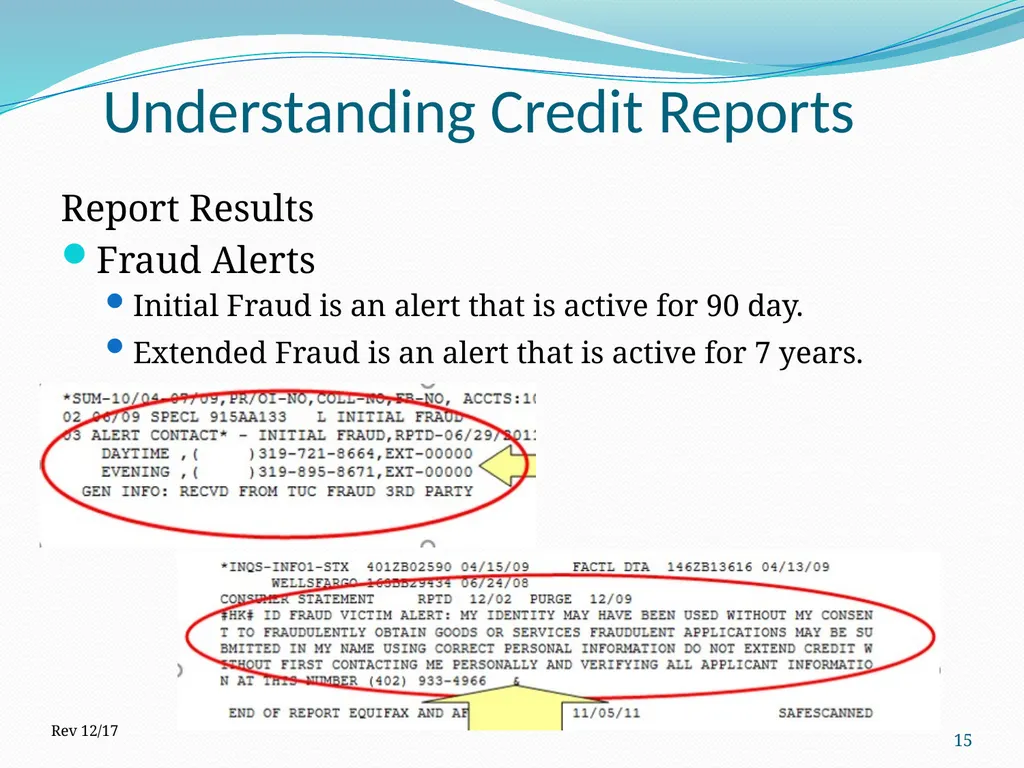
Fraud Alerts
Initial Fraud is an alert that is active for 90 day.
Extended Fraud is an alert that is active for 7 years. Rev 12/17<br>
16
16 Report Results
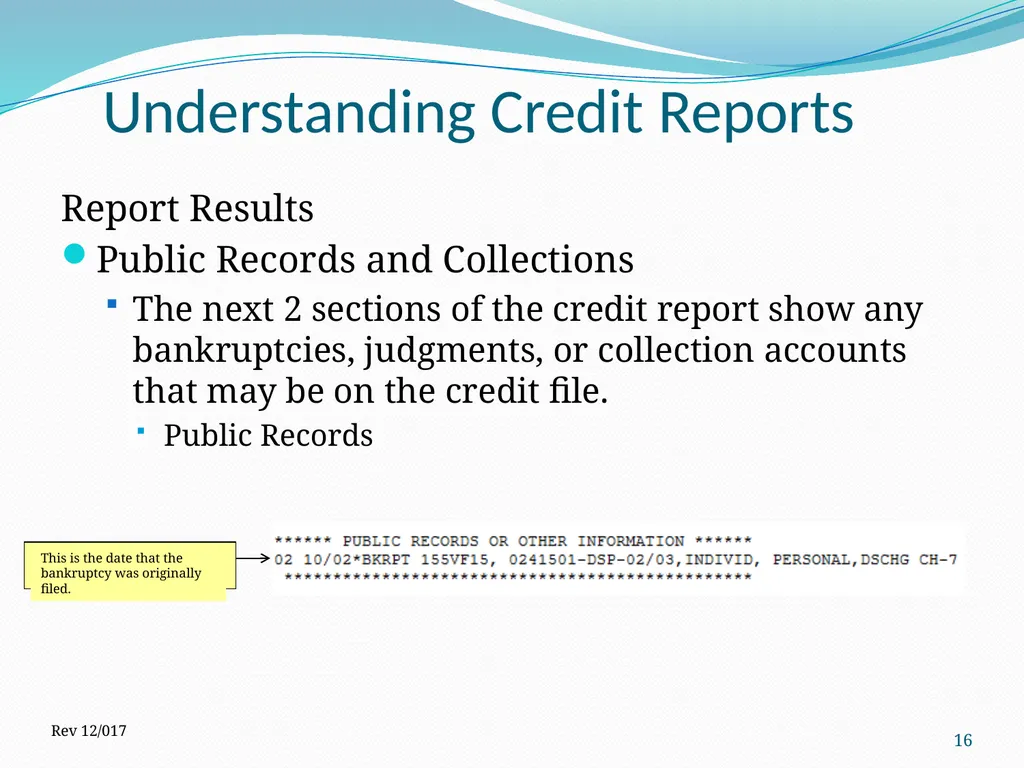
Public Records and Collections
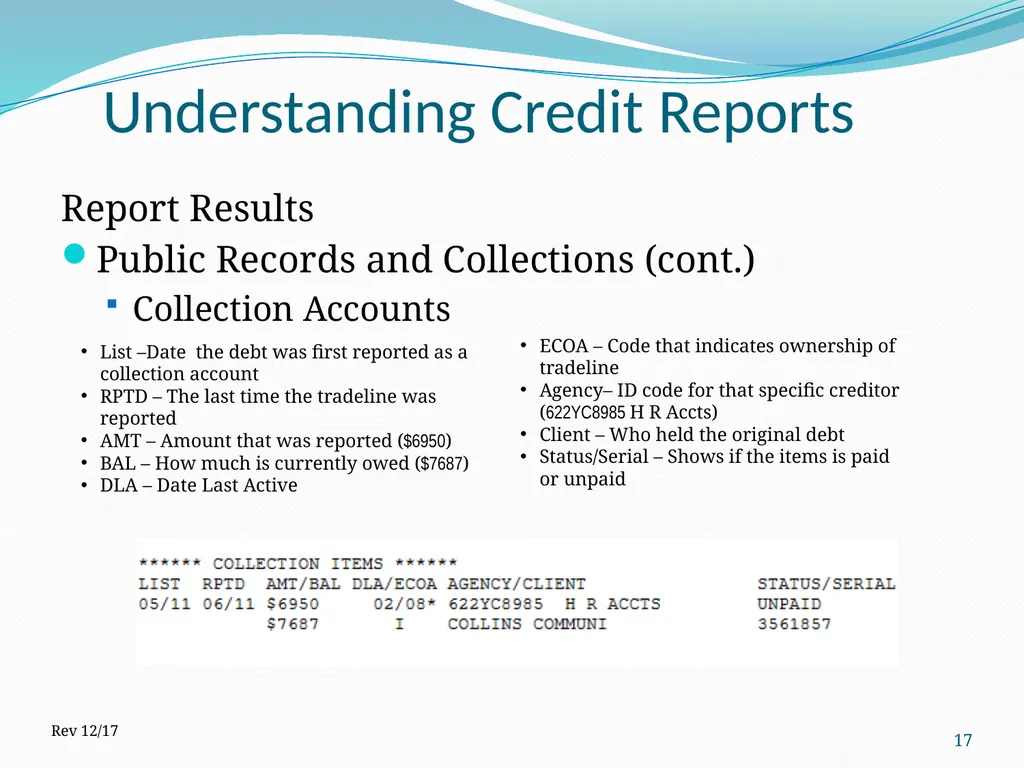
The next 2 sections of the credit report show any bankruptcies, judgments, or collection accounts that may be on the credit file.
Public Records Understanding Credit Reports Rev 12/017<br>
17
17 Understanding Credit Reports Rev 12/17 Report Results
Public Records and Collections (cont.)
Collection Accounts List –Date the debt was first reported as a collection account
RPTD – The last time the tradeline was reported
AMT – Amount that was reported ($6950)
BAL – How much is currently owed ($7687)
DLA – Date Last Active ECOA – Code that indicates ownership of tradeline
Agency– ID code for that specific creditor (622YC8985 H R Accts)
Client – Who held the original debt
Status/Serial – Shows if the items is paid or unpaid<br>
18
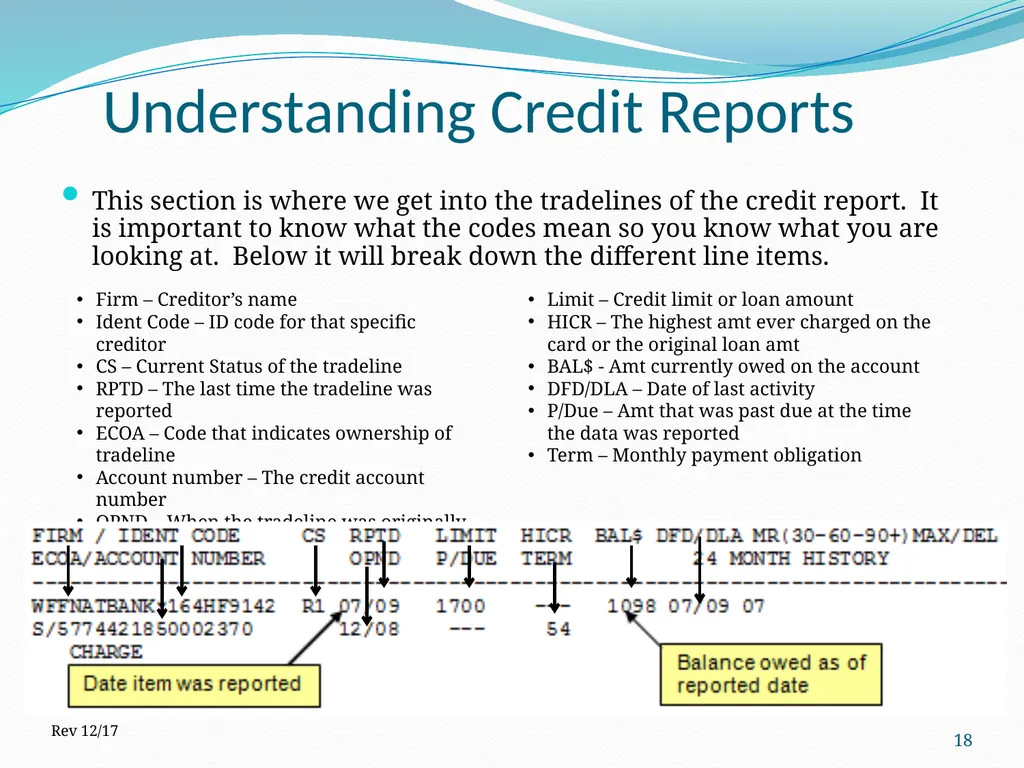
18 Understanding Credit Reports This section is where we get into the tradelines of the credit report. It is important to know what the codes mean so you know what you are looking at. Below it will break down the different line items. Rev 12/17 Firm – Creditor’s name
Ident Code – ID code for that specific creditor
CS – Current Status of the tradeline
RPTD – The last time the tradeline was reported
ECOA – Code that indicates ownership of tradeline
Account number – The credit account number
OPND – When the tradeline was originally opened Limit – Credit limit or loan amount
HICR – The highest amt ever charged on the card or the original loan amt
BAL$ - Amt currently owed on the account
DFD/DLA – Date of last activity
P/Due – Amt that was past due at the time the data was reported
Term – Monthly payment obligation<br>
19
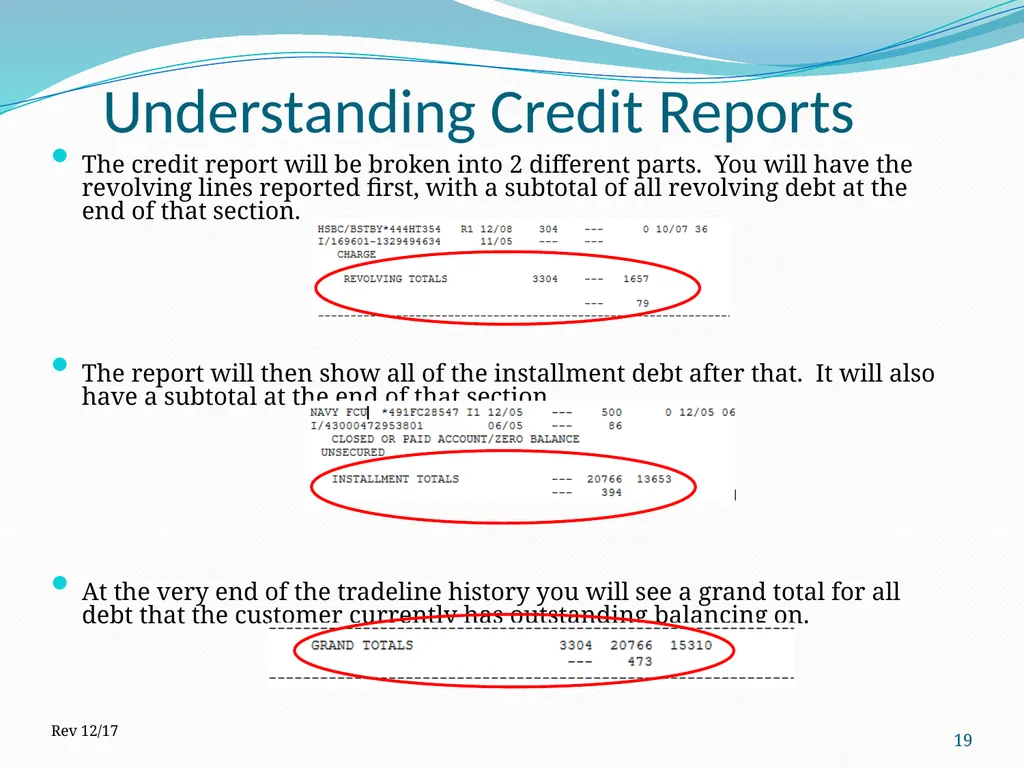
19 Understanding Credit Reports Rev 12/17 The credit report will be broken into 2 different parts. You will have the revolving lines reported first, with a subtotal of all revolving debt at the end of that section.
The report will then show all of the installment debt after that. It will also have a subtotal at the end of that section.
At the very end of the tradeline history you will see a grand total for all debt that the customer currently has outstanding balancing on.<br>
20
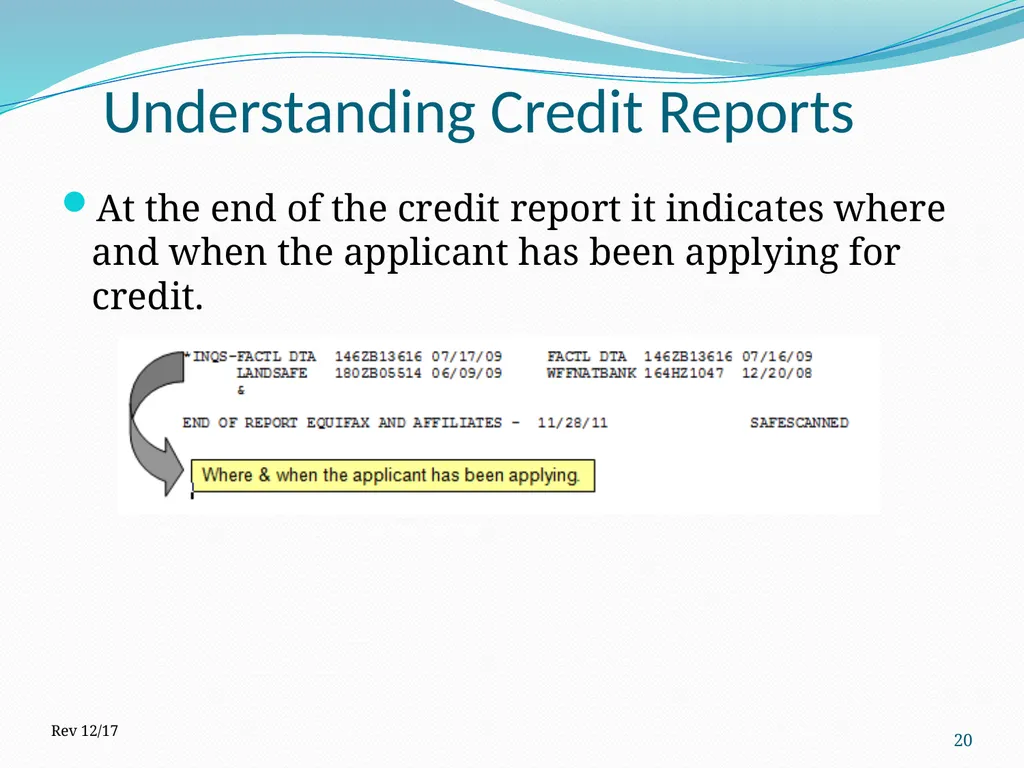
20 Understanding Credit Reports At the end of the credit report it indicates where and when the applicant has been applying for credit. Rev 12/17<br>
21
Understanding Credit Reports How do you get started?
Deposit accounts
Secured credit card account
Check your credit report annually
Communicate with your creditors 21<br>
22
22 Understanding Credit Reports Rev 12/17 Jennifer Lough
319-358-6160<br>