
UNDERSTANDING FINANCES Annual Financial Statements
Description: UNDERSTANDING FINANCES Annual Financial Statements 22 September 2023 With special thanks to for providing on-site support during these workshops INTRODUCTION Source: https:charities.govt.nzreporting-standardsabout What is the
Related Topics
Download Presentation
"UNDERSTANDING FINANCES Annual Financial Statements" is the property of its rightful owner. Permission is granted to download and print the materials on this website for personal, non-commercial use only, and to display it on your personal computer provided you do not modify the materials and that you retain all copyright notices contained in the materials. By downloading content from our website, you accept the terms of this agreement.
Presentation Transcript
slide1. UNDERSTANDING FINANCES
Annual Financial Statements
22 September 2023 With special thanks to for providing on-site support during these workshops<br>
slide2. INTRODUCTION Source: https://charities.govt.nz/reporting-standards/about/ What is the difference between Financial Statements and Performance Reports?
Financial statements provide information about your activities, transactions and balances. They include a statement of financial performance (profit or loss) which shows revenue and expenses, and a statement of financial position (balance sheet) which lists all the assets and liabilities. Tier 1 and 2 charities attach their financial statements to their annual return.
People interested in your financial statements read them so they can make informed decisions. Interested parties could include the governance, members, funders, and donors. It is important that these statements fairly present the activities, transactions and balances and give the whole story of your charity.
Performance reports refer to the financial statements that Tier 3 and 4 charities (and Incorporated Societies from October 2023) attach to their annual return. They contain financial AND non-financial information such as mission or purpose and what the charity does.
Who is XRB?
Reporting standards are set by the External Reporting Board (XRB), the independent Crown Entity responsible for developing and issuing accounting standards. With over 27,000 registered charities in New Zealand, of all different shapes and sizes, four different reporting tiers have been developed to allow smaller charities to prepare financial statements on a simplified basis. Larger charities will be required to use a set of accounting standards.<br>
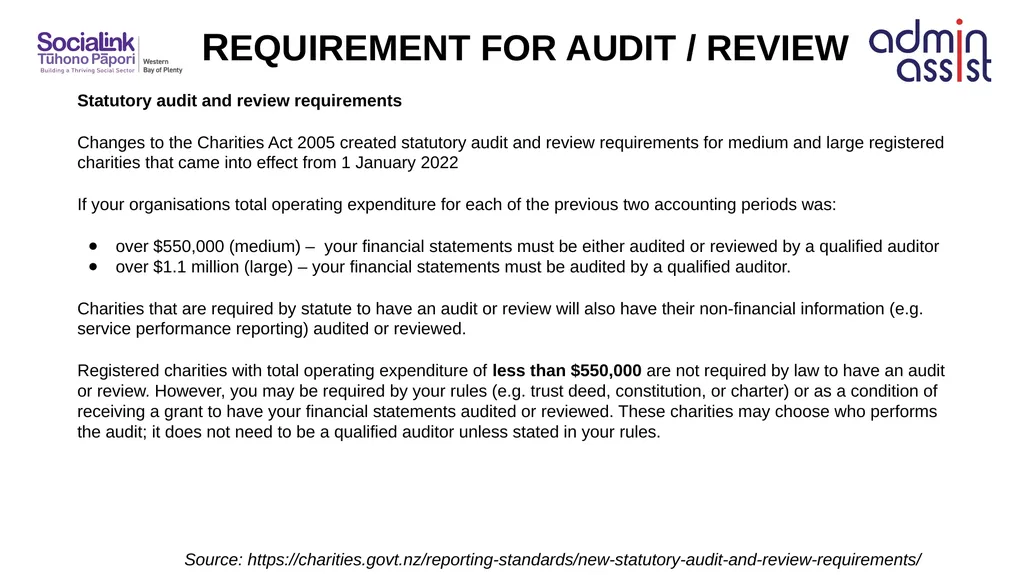
slide3. REQUIREMENT FOR AUDIT / REVIEW Statutory audit and review requirements
Changes to the Charities Act 2005 created statutory audit and review requirements for medium and large registered charities that came into effect from 1 January 2022
If your organisations total operating expenditure for each of the previous two accounting periods was:
over $550,000 (medium) – your financial statements must be either audited or reviewed by a qualified auditor
over $1.1 million (large) – your financial statements must be audited by a qualified auditor.
Charities that are required by statute to have an audit or review will also have their non-financial information (e.g. service performance reporting) audited or reviewed.
Registered charities with total operating expenditure of less than $550,000 are not required by law to have an audit or review. However, you may be required by your rules (e.g. trust deed, constitution, or charter) or as a condition of receiving a grant to have your financial statements audited or reviewed. These charities may choose who performs the audit; it does not need to be a qualified auditor unless stated in your rules. Source: https://charities.govt.nz/reporting-standards/new-statutory-audit-and-review-requirements/<br>
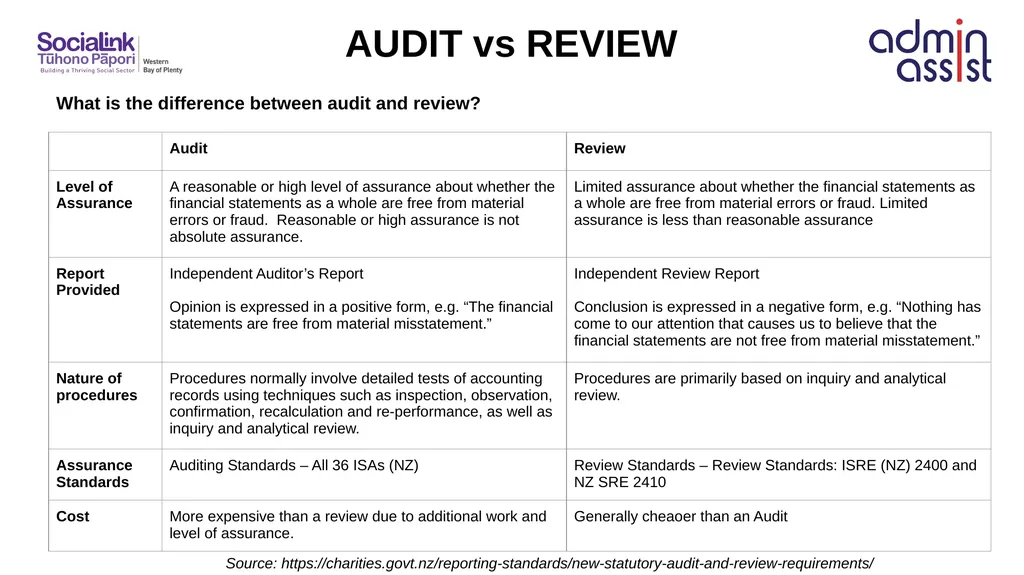
slide4. AUDIT vs REVIEW What is the difference between audit and review? Source: https://charities.govt.nz/reporting-standards/new-statutory-audit-and-review-requirements/<br>
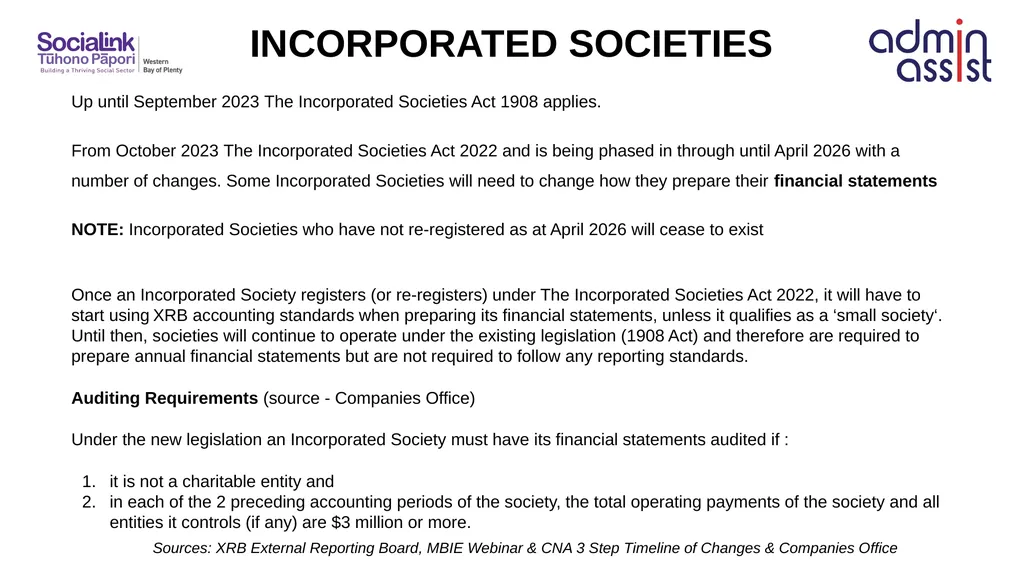
slide5. INCORPORATED SOCIETIES Sources: XRB External Reporting Board, MBIE Webinar & CNA 3 Step Timeline of Changes & Companies Office Up until September 2023 The Incorporated Societies Act 1908 applies.
From October 2023 The Incorporated Societies Act 2022 and is being phased in through until April 2026 with a number of changes. Some Incorporated Societies will need to change how they prepare their financial statements
Once an Incorporated Society registers (or re-registers) under The Incorporated Societies Act 2022, it will have to start using XRB accounting standards when preparing its financial statements, unless it qualifies as a ‘small society‘. Until then, societies will continue to operate under the existing legislation (1908 Act) and therefore are required to prepare annual financial statements but are not required to follow any reporting standards.
Auditing Requirements (source - Companies Office)
Under the new legislation an Incorporated Society must have its financial statements audited if :
it is not a charitable entity and
in each of the 2 preceding accounting periods of the society, the total operating payments of the society and all entities it controls (if any) are $3 million or more. NOTE: Incorporated Societies who have not re-registered as at April 2026 will cease to exist<br>
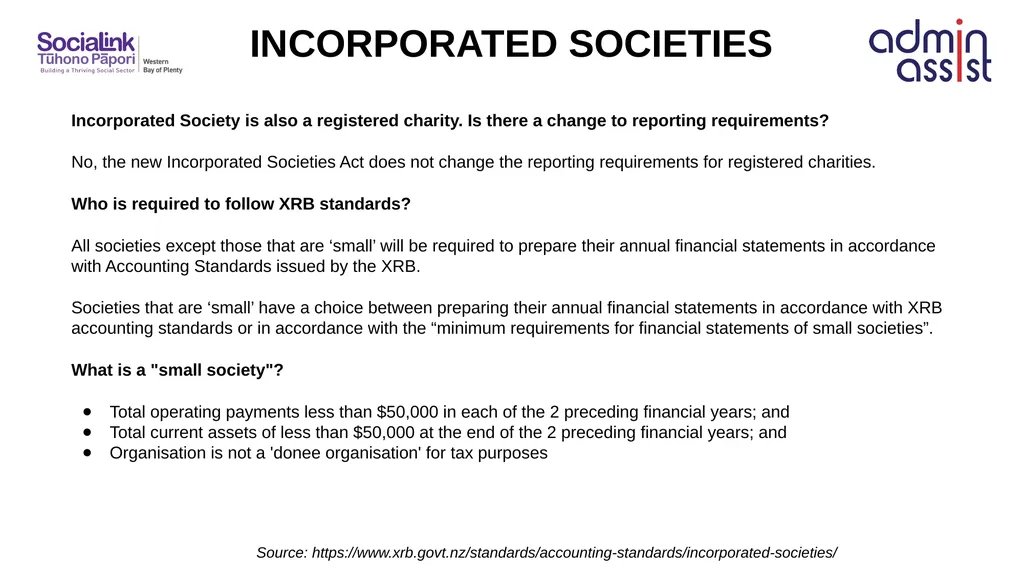
slide6. INCORPORATED SOCIETIES Incorporated Society is also a registered charity. Is there a change to reporting requirements?
No, the new Incorporated Societies Act does not change the reporting requirements for registered charities.
Who is required to follow XRB standards?
All societies except those that are ‘small’ will be required to prepare their annual financial statements in accordance with Accounting Standards issued by the XRB.
Societies that are ‘small’ have a choice between preparing their annual financial statements in accordance with XRB accounting standards or in accordance with the “minimum requirements for financial statements of small societies”.
What is a "small society"?
Total operating payments less than $50,000 in each of the 2 preceding financial years; and
Total current assets of less than $50,000 at the end of the 2 preceding financial years; and
Organisation is not a 'donee organisation' for tax purposes Source: https://www.xrb.govt.nz/standards/accounting-standards/incorporated-societies/<br>
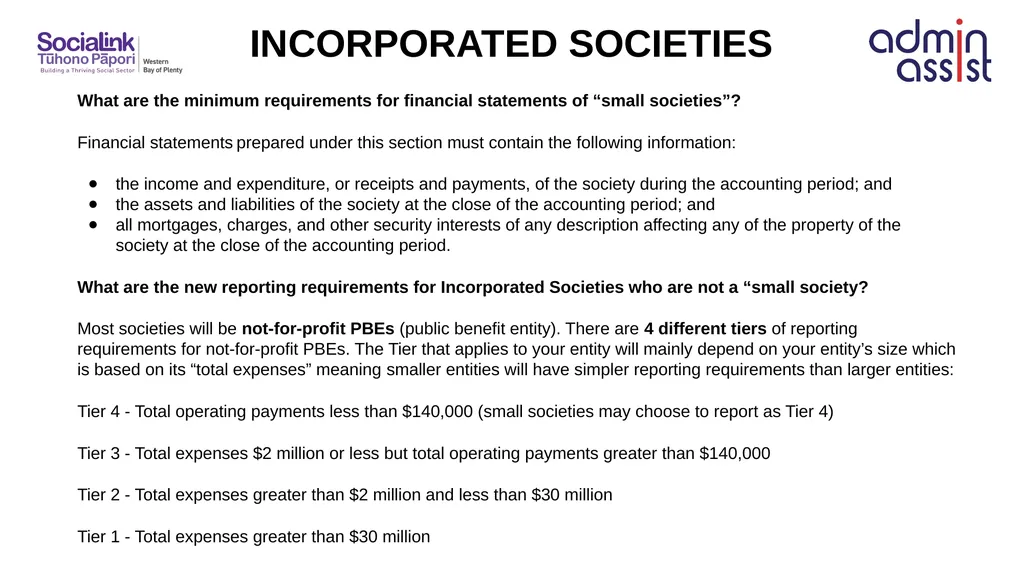
slide7. INCORPORATED SOCIETIES What are the minimum requirements for financial statements of “small societies”?
Financial statements prepared under this section must contain the following information:
the income and expenditure, or receipts and payments, of the society during the accounting period; and
the assets and liabilities of the society at the close of the accounting period; and
all mortgages, charges, and other security interests of any description affecting any of the property of the society at the close of the accounting period.
What are the new reporting requirements for Incorporated Societies who are not a “small society?
Most societies will be not-for-profit PBEs (public benefit entity). There are 4 different tiers of reporting requirements for not-for-profit PBEs. The Tier that applies to your entity will mainly depend on your entity’s size which is based on its “total expenses” meaning smaller entities will have simpler reporting requirements than larger entities:
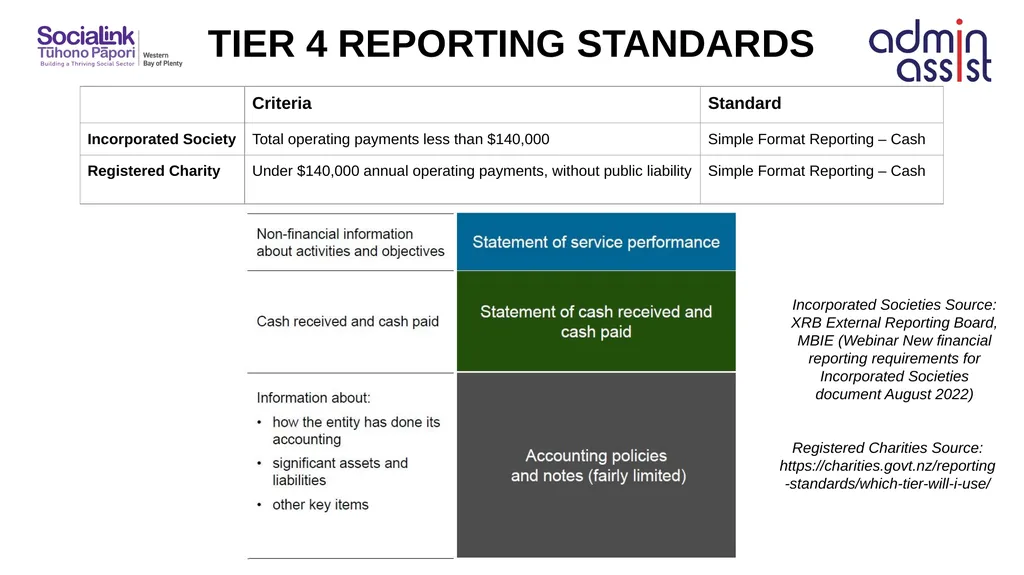
Tier 4 - Total operating payments less than $140,000 (small societies may choose to report as Tier 4)
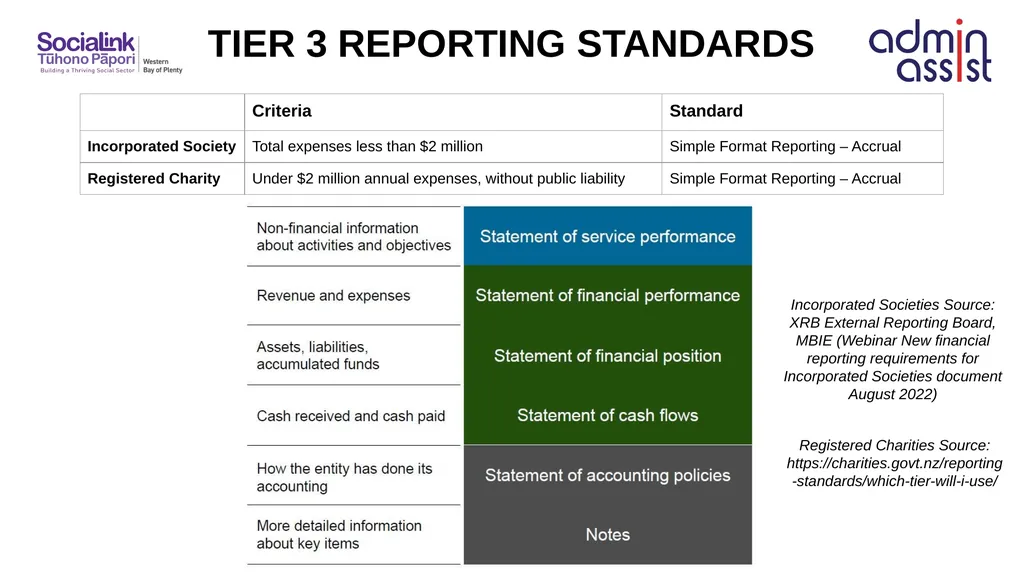
Tier 3 - Total expenses $2 million or less but total operating payments greater than $140,000
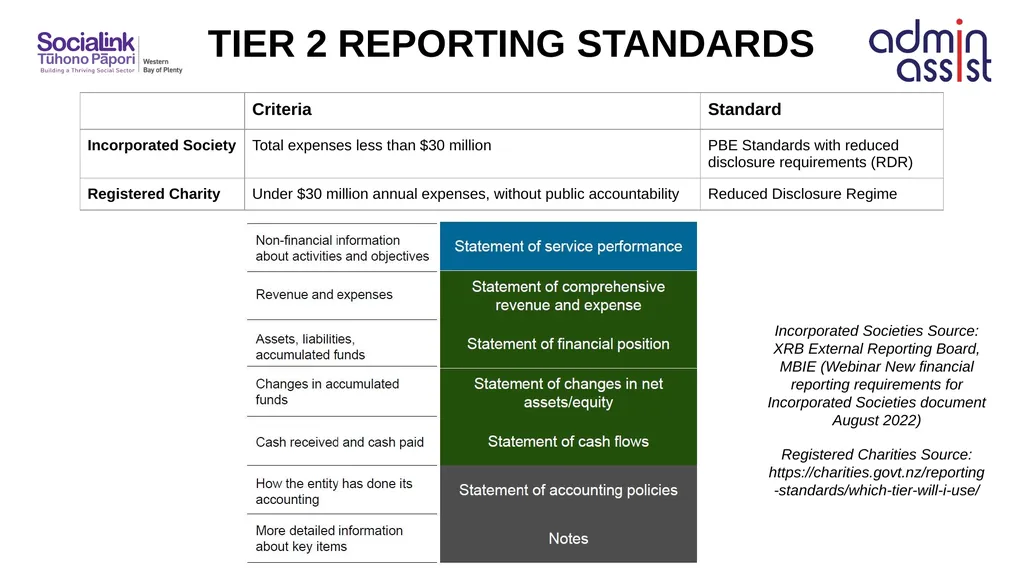
Tier 2 - Total expenses greater than $2 million and less than $30 million
Tier 1 - Total expenses greater than $30 million Source: https://www.xrb.govt.nz/standards/accounting-standards/incorporated-societies/<br>
slide8. TIER 4 REPORTING STANDARDS Source: XRB External Reporting Board, MBIE (Webinar New financial reporting requirements for Incorporated Societies document August 2022) Incorporated Societies Source: XRB External Reporting Board, MBIE (Webinar New financial reporting requirements for Incorporated Societies document August 2022) Registered Charities Source: https://charities.govt.nz/reporting-standards/which-tier-will-i-use/<br>
slide9. TIER 3 REPORTING STANDARDS Incorporated Societies Source: XRB External Reporting Board, MBIE (Webinar New financial reporting requirements for Incorporated Societies document August 2022) Registered Charities Source: https://charities.govt.nz/reporting-standards/which-tier-will-i-use/<br>
slide10. TIER 2 REPORTING STANDARDS Incorporated Societies Source: XRB External Reporting Board, MBIE (Webinar New financial reporting requirements for Incorporated Societies document August 2022) Registered Charities Source: https://charities.govt.nz/reporting-standards/which-tier-will-i-use/<br>
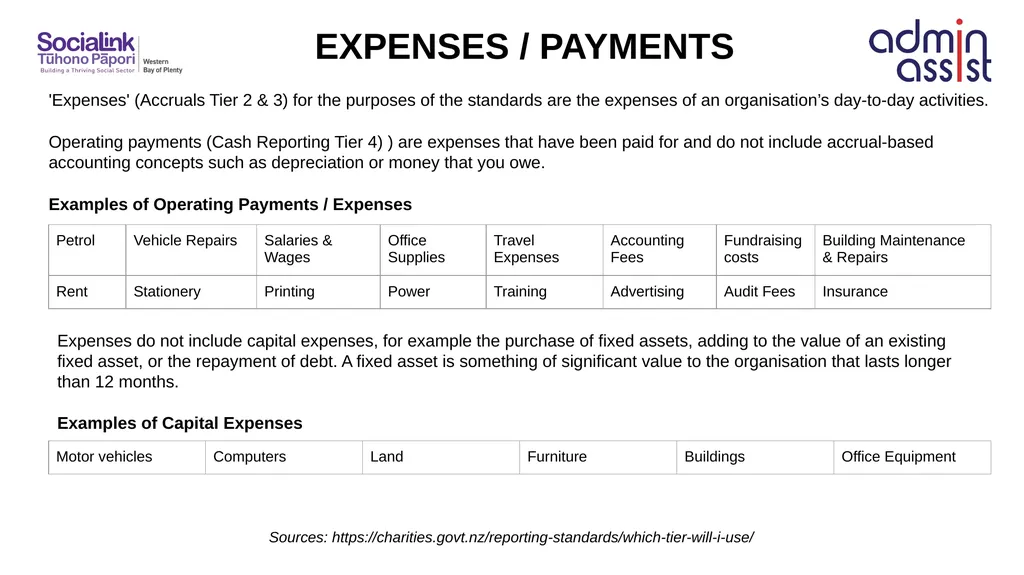
slide11. EXPENSES / PAYMENTS Sources: https://charities.govt.nz/reporting-standards/which-tier-will-i-use/ 'Expenses' (Accruals Tier 2 & 3) for the purposes of the standards are the expenses of an organisation’s day-to-day activities.
Operating payments (Cash Reporting Tier 4) ) are expenses that have been paid for and do not include accrual-based accounting concepts such as depreciation or money that you owe.
Examples of Operating Payments / Expenses Expenses do not include capital expenses, for example the purchase of fixed assets, adding to the value of an existing fixed asset, or the repayment of debt. A fixed asset is something of significant value to the organisation that lasts longer than 12 months.
Examples of Capital Expenses<br>
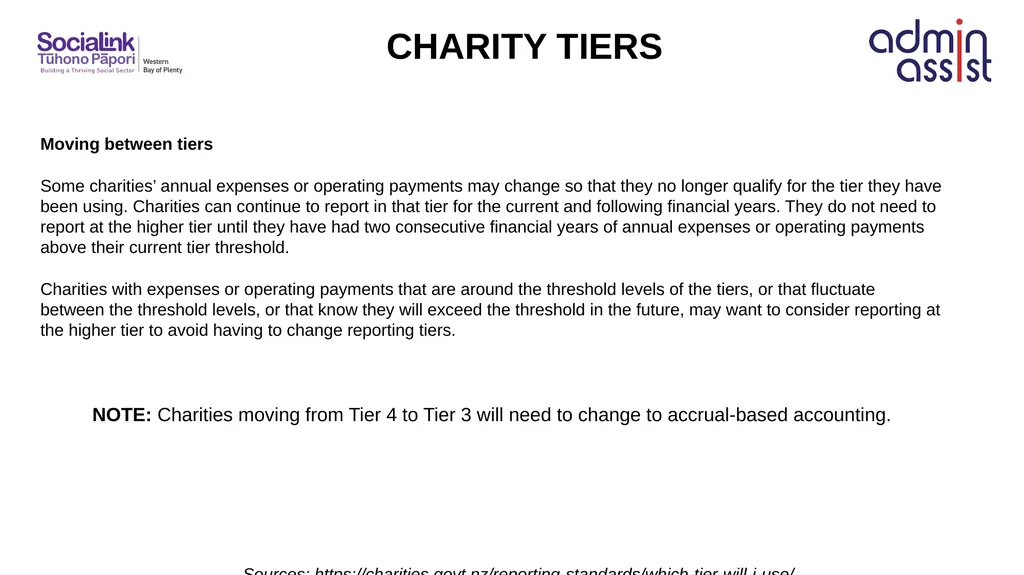
slide12. CHARITY TIERS Sources: https://charities.govt.nz/reporting-standards/which-tier-will-i-use/ Moving between tiers
Some charities’ annual expenses or operating payments may change so that they no longer qualify for the tier they have been using. Charities can continue to report in that tier for the current and following financial years. They do not need to report at the higher tier until they have had two consecutive financial years of annual expenses or operating payments above their current tier threshold.
Charities with expenses or operating payments that are around the threshold levels of the tiers, or that fluctuate between the threshold levels, or that know they will exceed the threshold in the future, may want to consider reporting at the higher tier to avoid having to change reporting tiers.
NOTE: Charities moving from Tier 4 to Tier 3 will need to change to accrual-based accounting.<br>
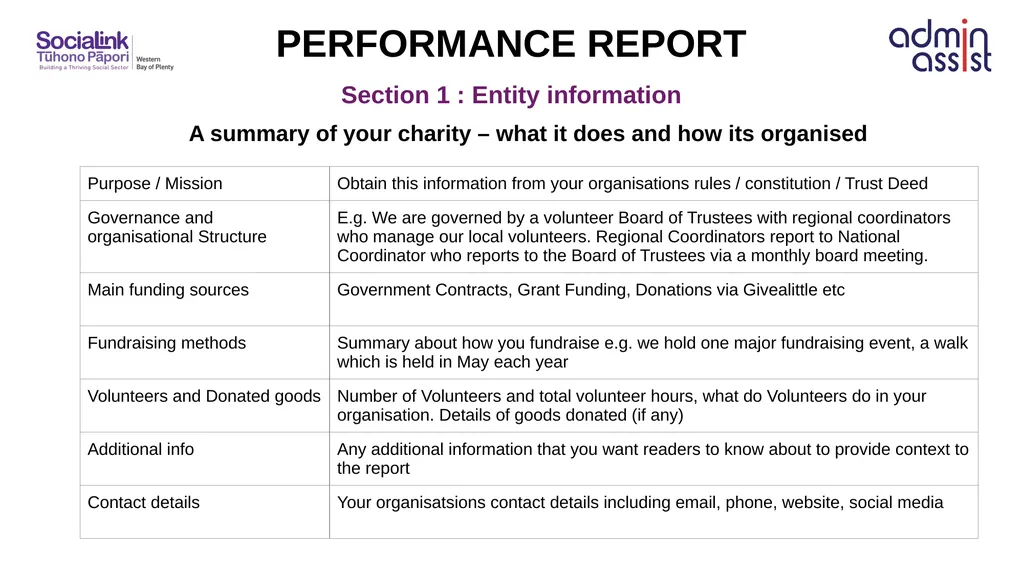
slide13. PERFORMANCE REPORT Section 1 : Entity information
A summary of your charity – what it does and how its organised<br>
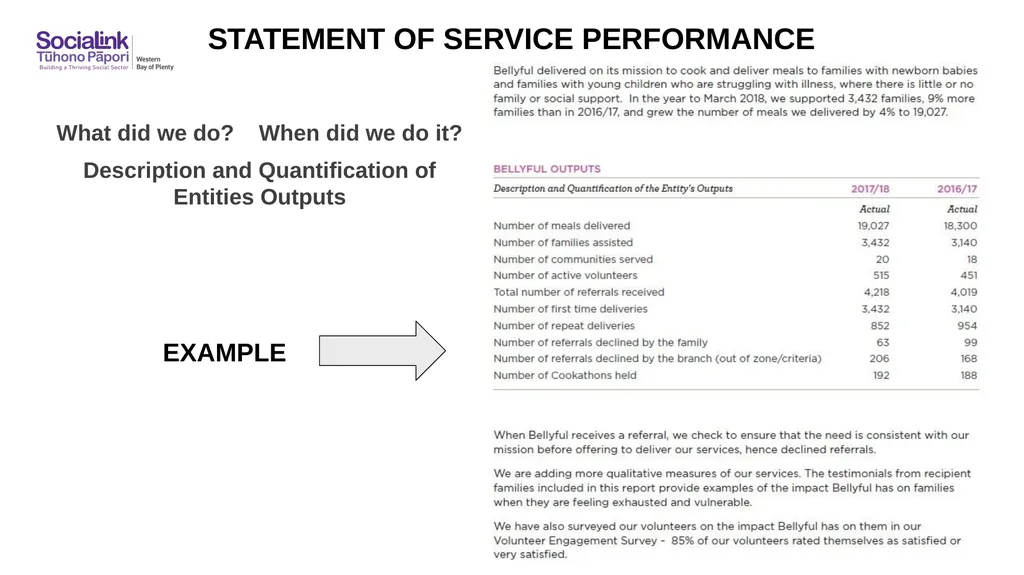
slide14. STATEMENT OF SERVICE PERFORMANCE What did we do? When did we do it?
Description and Quantification of Entities Outputs EXAMPLE<br>
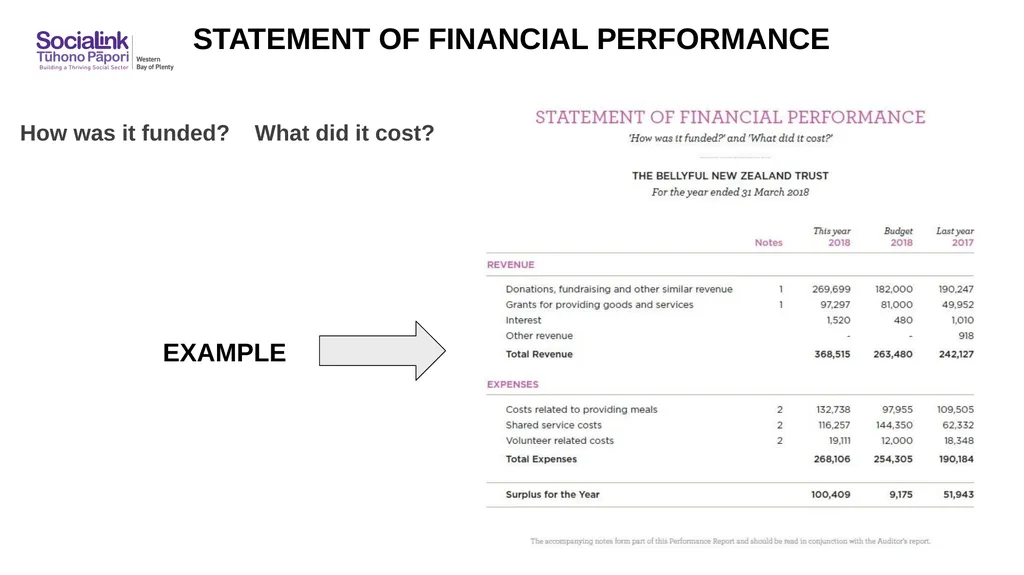
slide15. STATEMENT OF FINANCIAL PERFORMANCE How was it funded? What did it cost? EXAMPLE<br>
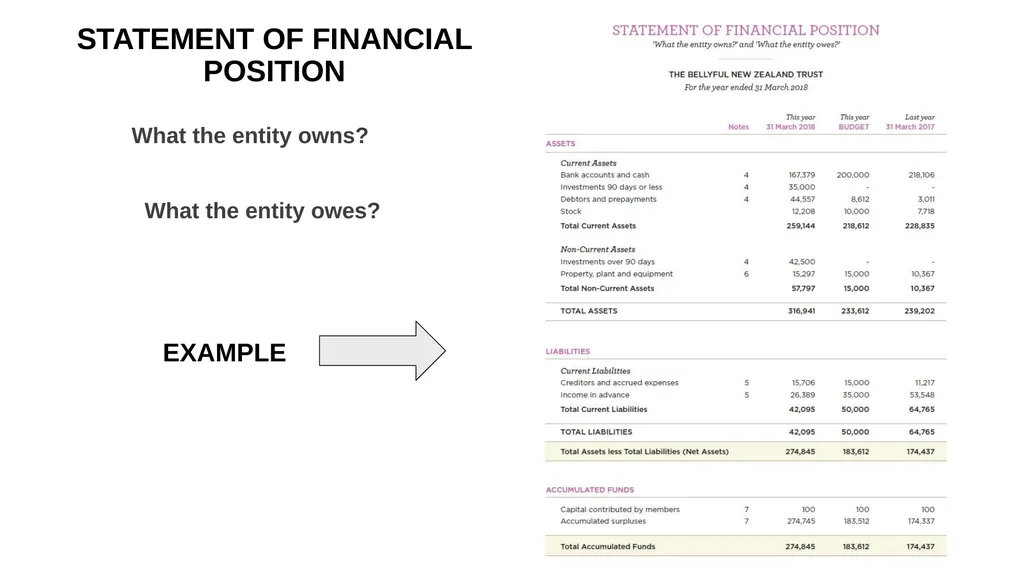
slide16. STATEMENT OF FINANCIAL POSITION What the entity owns?
What the entity owes? EXAMPLE<br>
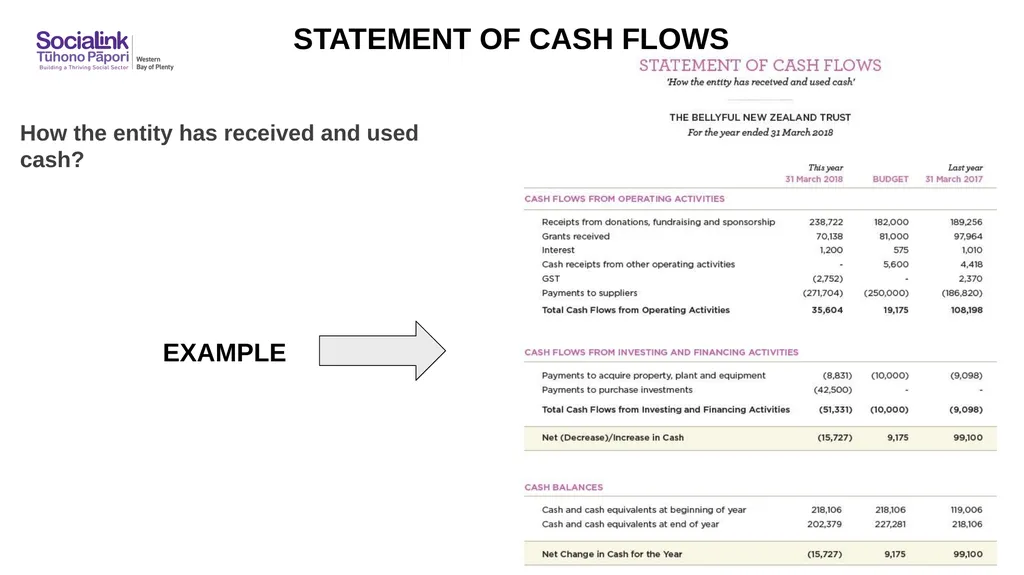
slide17. STATEMENT OF CASH FLOWS How the entity has received and used cash? EXAMPLE<br>
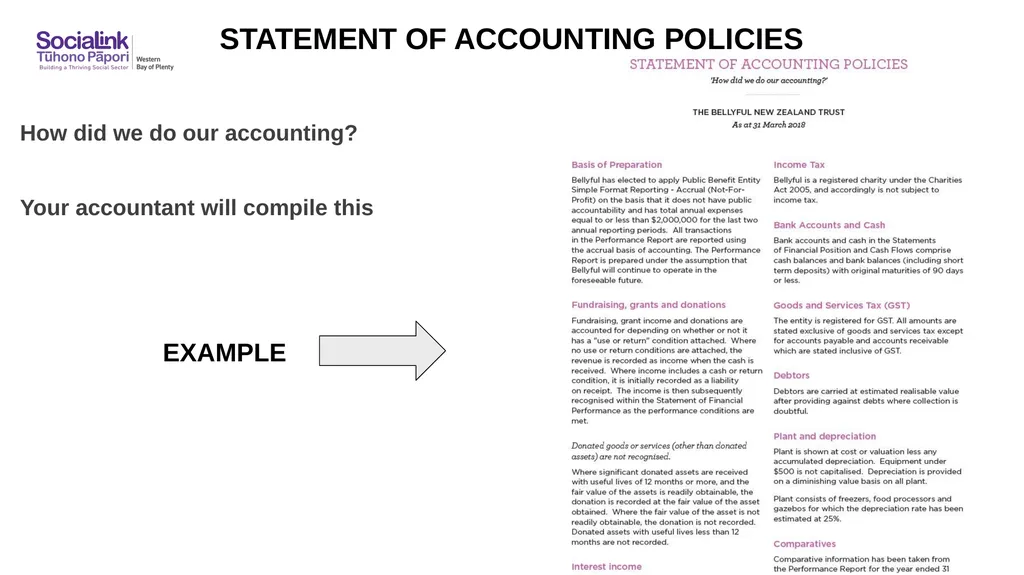
slide18. STATEMENT OF ACCOUNTING POLICIES How did we do our accounting?
Your accountant will compile this EXAMPLE<br>
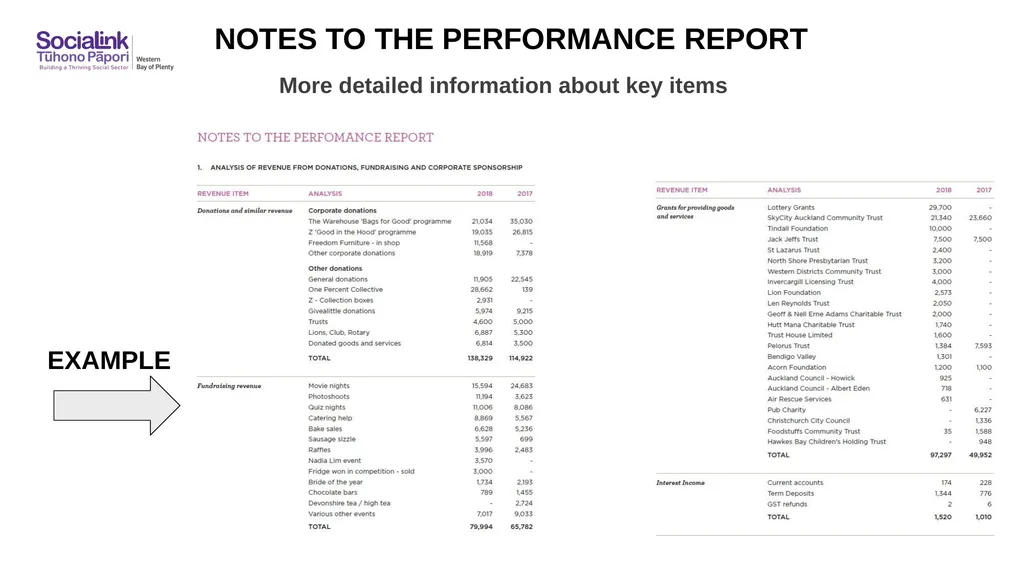
slide19. NOTES TO THE PERFORMANCE REPORT More detailed information about key items EXAMPLE<br>
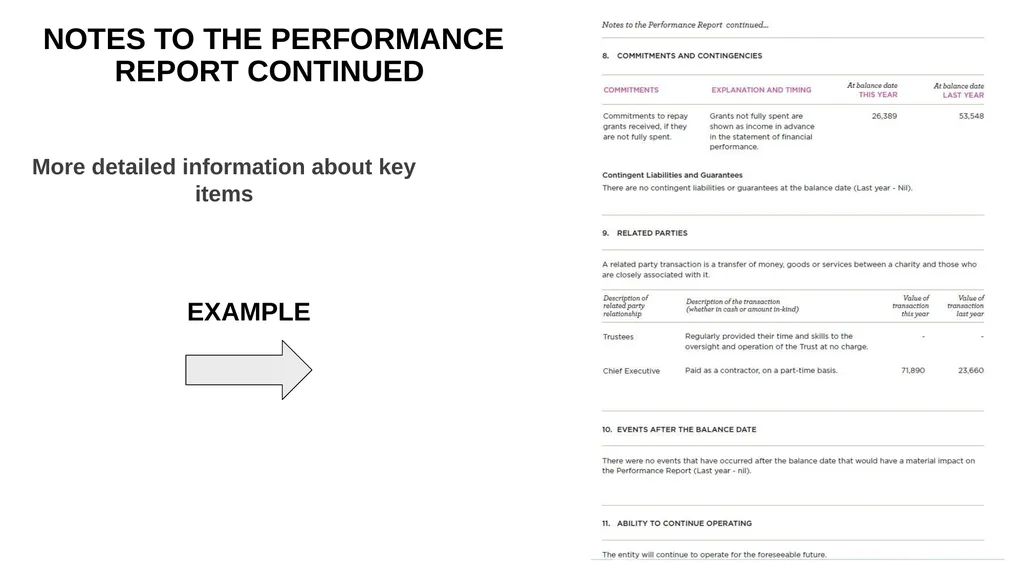
slide20. NOTES TO THE PERFORMANCE REPORT CONTINUED More detailed information about key items EXAMPLE<br>
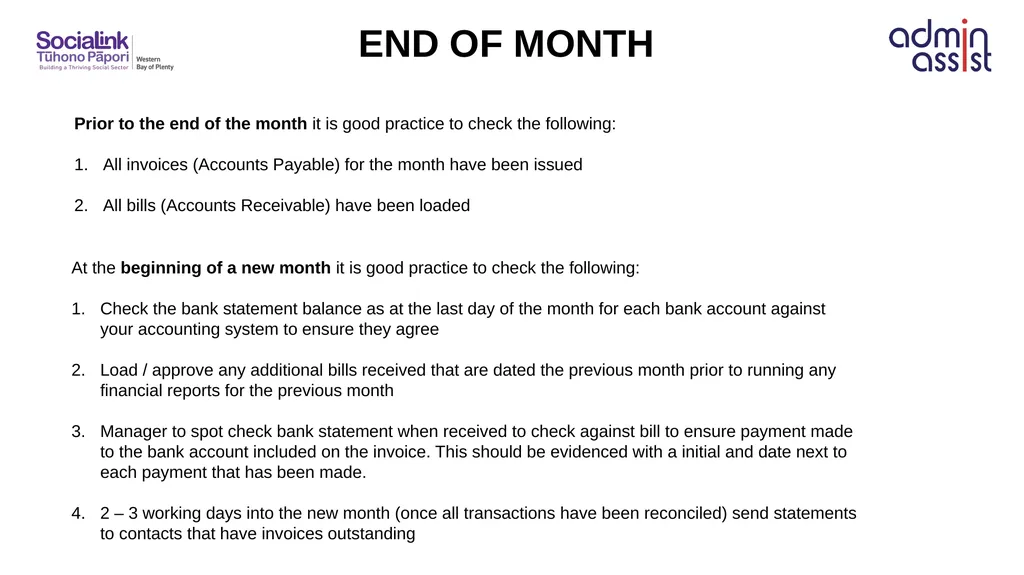
slide21. END OF MONTH Prior to the end of the month it is good practice to check the following:
All invoices (Accounts Payable) for the month have been issued
All bills (Accounts Receivable) have been loaded At the beginning of a new month it is good practice to check the following:
Check the bank statement balance as at the last day of the month for each bank account against your accounting system to ensure they agree
Load / approve any additional bills received that are dated the previous month prior to running any financial reports for the previous month
Manager to spot check bank statement when received to check against bill to ensure payment made to the bank account included on the invoice. This should be evidenced with a initial and date next to each payment that has been made.
2 – 3 working days into the new month (once all transactions have been reconciled) send statements to contacts that have invoices outstanding<br>
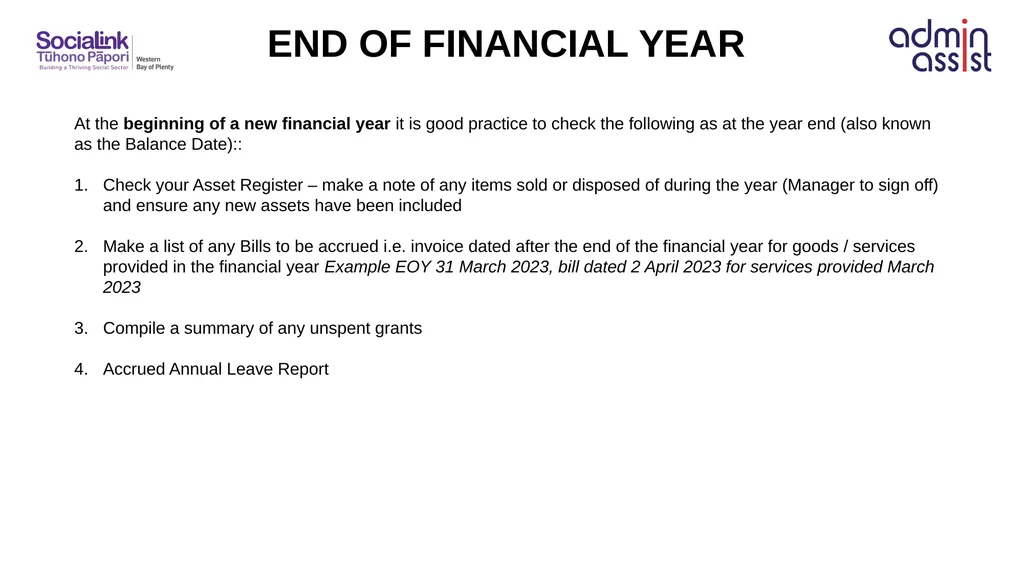
slide22. END OF FINANCIAL YEAR At the beginning of a new financial year it is good practice to check the following as at the year end (also known as the Balance Date)::
Check your Asset Register – make a note of any items sold or disposed of during the year (Manager to sign off) and ensure any new assets have been included
Make a list of any Bills to be accrued i.e. invoice dated after the end of the financial year for goods / services provided in the financial year Example EOY 31 March 2023, bill dated 2 April 2023 for services provided March 2023
Compile a summary of any unspent grants
Accrued Annual Leave Report<br>
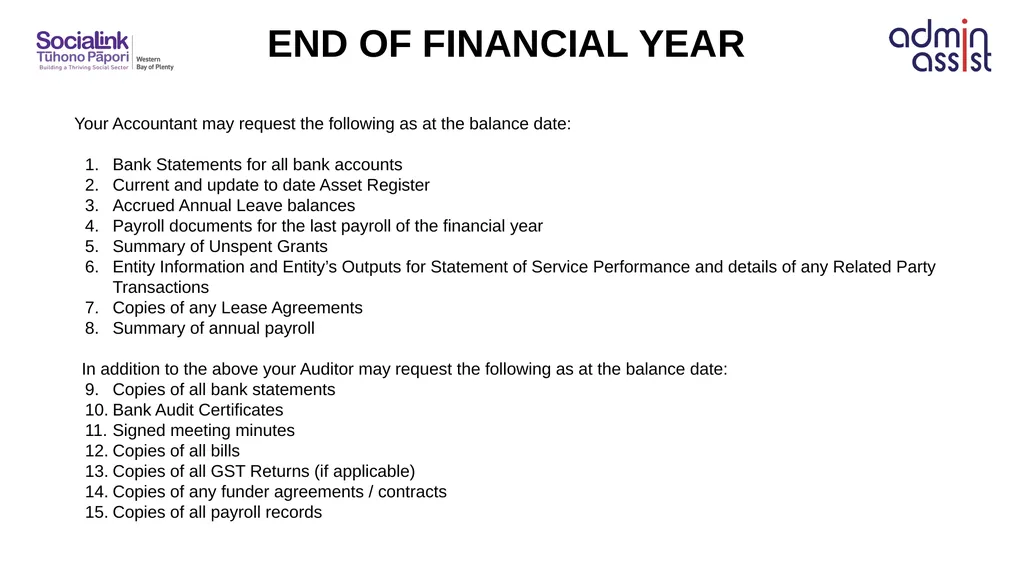
slide23. END OF FINANCIAL YEAR Your Accountant may request the following as at the balance date:
Bank Statements for all bank accounts
Current and update to date Asset Register
Accrued Annual Leave balances
Payroll documents for the last payroll of the financial year
Summary of Unspent Grants
Entity Information and Entity’s Outputs for Statement of Service Performance and details of any Related Party Transactions
Copies of any Lease Agreements
Summary of annual payroll
In addition to the above your Auditor may request the following as at the balance date:
Copies of all bank statements
Bank Audit Certificates
Signed meeting minutes
Copies of all bills
Copies of all GST Returns (if applicable)
Copies of any funder agreements / contracts
Copies of all payroll records<br>
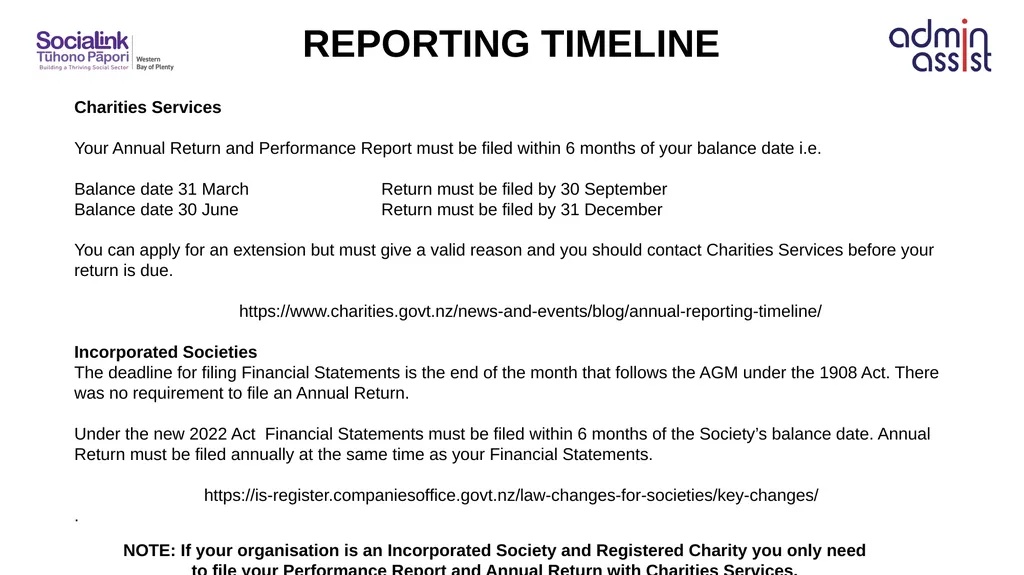
slide24. REPORTING TIMELINE Charities Services
Your Annual Return and Performance Report must be filed within 6 months of your balance date i.e.
Balance date 31 March Return must be filed by 30 September
Balance date 30 June Return must be filed by 31 December
You can apply for an extension but must give a valid reason and you should contact Charities Services before your return is due.
https://www.charities.govt.nz/news-and-events/blog/annual-reporting-timeline/
Incorporated Societies
The deadline for filing Financial Statements is the end of the month that follows the AGM under the 1908 Act. There was no requirement to file an Annual Return.
Under the new 2022 Act Financial Statements must be filed within 6 months of the Society’s balance date. Annual Return must be filed annually at the same time as your Financial Statements.
https://is-register.companiesoffice.govt.nz/law-changes-for-societies/key-changes/
. NOTE: If your organisation is an Incorporated Society and Registered Charity you only need to file your Performance Report and Annual Return with Charities Services.<br>
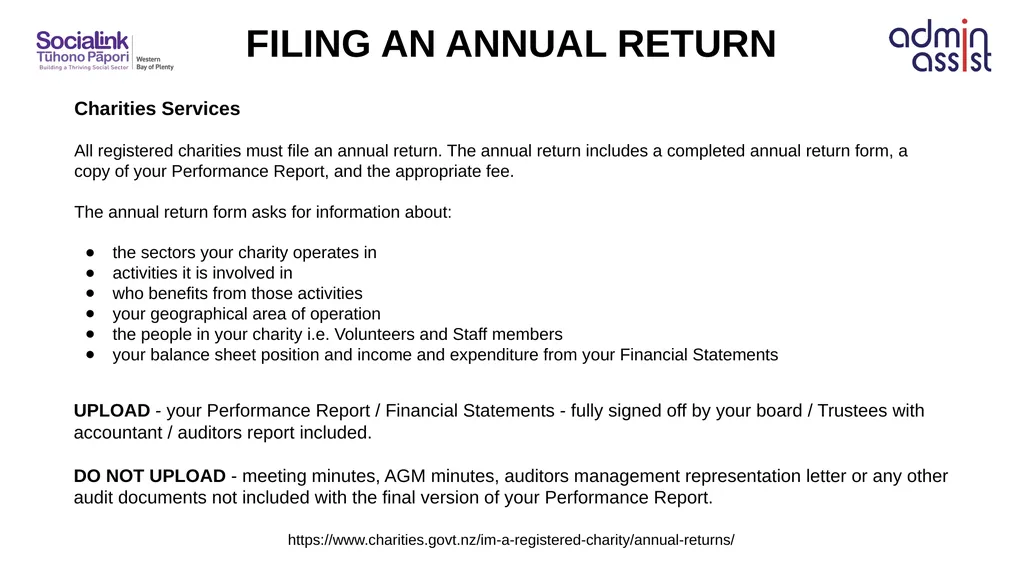
slide25. FILING AN ANNUAL RETURN Charities Services
All registered charities must file an annual return. The annual return includes a completed annual return form, a copy of your Performance Report, and the appropriate fee.
The annual return form asks for information about:
the sectors your charity operates in
activities it is involved in
who benefits from those activities
your geographical area of operation
the people in your charity i.e. Volunteers and Staff members
your balance sheet position and income and expenditure from your Financial Statements https://www.charities.govt.nz/im-a-registered-charity/annual-returns/ UPLOAD - your Performance Report / Financial Statements - fully signed off by your board / Trustees with accountant / auditors report included.
DO NOT UPLOAD - meeting minutes, AGM minutes, auditors management representation letter or any other audit documents not included with the final version of your Performance Report.<br>
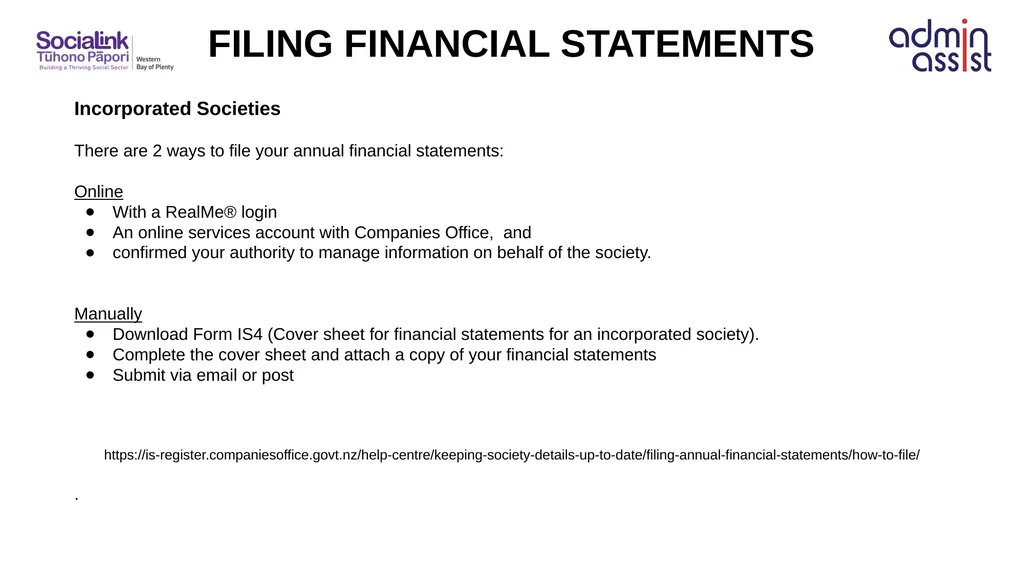
slide26. FILING FINANCIAL STATEMENTS Incorporated Societies
There are 2 ways to file your annual financial statements:
Online
With a RealMe® login
An online services account with Companies Office, and
confirmed your authority to manage information on behalf of the society.
Manually
Download Form IS4 (Cover sheet for financial statements for an incorporated society).
Complete the cover sheet and attach a copy of your financial statements
Submit via email or post
https://is-register.companiesoffice.govt.nz/help-centre/keeping-society-details-up-to-date/filing-annual-financial-statements/how-to-file/
.<br>
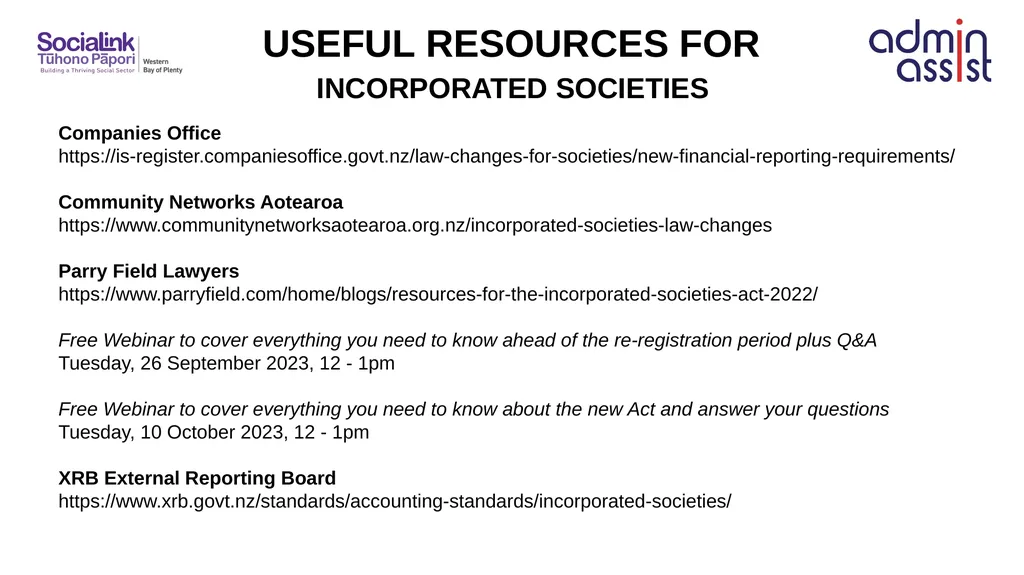
slide27. USEFUL RESOURCES FOR
INCORPORATED SOCIETIES Companies Office
https://is-register.companiesoffice.govt.nz/law-changes-for-societies/new-financial-reporting-requirements/
Community Networks Aotearoa
https://www.communitynetworksaotearoa.org.nz/incorporated-societies-law-changes
Parry Field Lawyers
https://www.parryfield.com/home/blogs/resources-for-the-incorporated-societies-act-2022/
Free Webinar to cover everything you need to know ahead of the re-registration period plus Q&A Tuesday, 26 September 2023, 12 - 1pm
Free Webinar to cover everything you need to know about the new Act and answer your questions
Tuesday, 10 October 2023, 12 - 1pm
XRB External Reporting Board
https://www.xrb.govt.nz/standards/accounting-standards/incorporated-societies/<br>
slide28. USEFUL RESOURCES Charities Services
https://charities.govt.nz/
Reporting Standards for Charities - video
https://www.charities.govt.nz/reporting-standards/about/
Baker Tilly Staples Rodway
https://bakertillysr.nz/news/ - search “Charity and Not-for-Profit<br>
slide2. INTRODUCTION Source: https://charities.govt.nz/reporting-standards/about/ What is the difference between Financial Statements and Performance Reports?
Financial statements provide information about your activities, transactions and balances. They include a statement of financial performance (profit or loss) which shows revenue and expenses, and a statement of financial position (balance sheet) which lists all the assets and liabilities. Tier 1 and 2 charities attach their financial statements to their annual return.
People interested in your financial statements read them so they can make informed decisions. Interested parties could include the governance, members, funders, and donors. It is important that these statements fairly present the activities, transactions and balances and give the whole story of your charity.
Performance reports refer to the financial statements that Tier 3 and 4 charities (and Incorporated Societies from October 2023) attach to their annual return. They contain financial AND non-financial information such as mission or purpose and what the charity does.
Who is XRB?
Reporting standards are set by the External Reporting Board (XRB), the independent Crown Entity responsible for developing and issuing accounting standards. With over 27,000 registered charities in New Zealand, of all different shapes and sizes, four different reporting tiers have been developed to allow smaller charities to prepare financial statements on a simplified basis. Larger charities will be required to use a set of accounting standards.<br>
slide3. REQUIREMENT FOR AUDIT / REVIEW Statutory audit and review requirements
Changes to the Charities Act 2005 created statutory audit and review requirements for medium and large registered charities that came into effect from 1 January 2022
If your organisations total operating expenditure for each of the previous two accounting periods was:
over $550,000 (medium) – your financial statements must be either audited or reviewed by a qualified auditor
over $1.1 million (large) – your financial statements must be audited by a qualified auditor.
Charities that are required by statute to have an audit or review will also have their non-financial information (e.g. service performance reporting) audited or reviewed.
Registered charities with total operating expenditure of less than $550,000 are not required by law to have an audit or review. However, you may be required by your rules (e.g. trust deed, constitution, or charter) or as a condition of receiving a grant to have your financial statements audited or reviewed. These charities may choose who performs the audit; it does not need to be a qualified auditor unless stated in your rules. Source: https://charities.govt.nz/reporting-standards/new-statutory-audit-and-review-requirements/<br>
slide4. AUDIT vs REVIEW What is the difference between audit and review? Source: https://charities.govt.nz/reporting-standards/new-statutory-audit-and-review-requirements/<br>
slide5. INCORPORATED SOCIETIES Sources: XRB External Reporting Board, MBIE Webinar & CNA 3 Step Timeline of Changes & Companies Office Up until September 2023 The Incorporated Societies Act 1908 applies.
From October 2023 The Incorporated Societies Act 2022 and is being phased in through until April 2026 with a number of changes. Some Incorporated Societies will need to change how they prepare their financial statements
Once an Incorporated Society registers (or re-registers) under The Incorporated Societies Act 2022, it will have to start using XRB accounting standards when preparing its financial statements, unless it qualifies as a ‘small society‘. Until then, societies will continue to operate under the existing legislation (1908 Act) and therefore are required to prepare annual financial statements but are not required to follow any reporting standards.
Auditing Requirements (source - Companies Office)
Under the new legislation an Incorporated Society must have its financial statements audited if :
it is not a charitable entity and
in each of the 2 preceding accounting periods of the society, the total operating payments of the society and all entities it controls (if any) are $3 million or more. NOTE: Incorporated Societies who have not re-registered as at April 2026 will cease to exist<br>
slide6. INCORPORATED SOCIETIES Incorporated Society is also a registered charity. Is there a change to reporting requirements?
No, the new Incorporated Societies Act does not change the reporting requirements for registered charities.
Who is required to follow XRB standards?
All societies except those that are ‘small’ will be required to prepare their annual financial statements in accordance with Accounting Standards issued by the XRB.
Societies that are ‘small’ have a choice between preparing their annual financial statements in accordance with XRB accounting standards or in accordance with the “minimum requirements for financial statements of small societies”.
What is a "small society"?
Total operating payments less than $50,000 in each of the 2 preceding financial years; and
Total current assets of less than $50,000 at the end of the 2 preceding financial years; and
Organisation is not a 'donee organisation' for tax purposes Source: https://www.xrb.govt.nz/standards/accounting-standards/incorporated-societies/<br>
slide7. INCORPORATED SOCIETIES What are the minimum requirements for financial statements of “small societies”?
Financial statements prepared under this section must contain the following information:
the income and expenditure, or receipts and payments, of the society during the accounting period; and
the assets and liabilities of the society at the close of the accounting period; and
all mortgages, charges, and other security interests of any description affecting any of the property of the society at the close of the accounting period.
What are the new reporting requirements for Incorporated Societies who are not a “small society?
Most societies will be not-for-profit PBEs (public benefit entity). There are 4 different tiers of reporting requirements for not-for-profit PBEs. The Tier that applies to your entity will mainly depend on your entity’s size which is based on its “total expenses” meaning smaller entities will have simpler reporting requirements than larger entities:
Tier 4 - Total operating payments less than $140,000 (small societies may choose to report as Tier 4)
Tier 3 - Total expenses $2 million or less but total operating payments greater than $140,000
Tier 2 - Total expenses greater than $2 million and less than $30 million
Tier 1 - Total expenses greater than $30 million Source: https://www.xrb.govt.nz/standards/accounting-standards/incorporated-societies/<br>
slide8. TIER 4 REPORTING STANDARDS Source: XRB External Reporting Board, MBIE (Webinar New financial reporting requirements for Incorporated Societies document August 2022) Incorporated Societies Source: XRB External Reporting Board, MBIE (Webinar New financial reporting requirements for Incorporated Societies document August 2022) Registered Charities Source: https://charities.govt.nz/reporting-standards/which-tier-will-i-use/<br>
slide9. TIER 3 REPORTING STANDARDS Incorporated Societies Source: XRB External Reporting Board, MBIE (Webinar New financial reporting requirements for Incorporated Societies document August 2022) Registered Charities Source: https://charities.govt.nz/reporting-standards/which-tier-will-i-use/<br>
slide10. TIER 2 REPORTING STANDARDS Incorporated Societies Source: XRB External Reporting Board, MBIE (Webinar New financial reporting requirements for Incorporated Societies document August 2022) Registered Charities Source: https://charities.govt.nz/reporting-standards/which-tier-will-i-use/<br>
slide11. EXPENSES / PAYMENTS Sources: https://charities.govt.nz/reporting-standards/which-tier-will-i-use/ 'Expenses' (Accruals Tier 2 & 3) for the purposes of the standards are the expenses of an organisation’s day-to-day activities.
Operating payments (Cash Reporting Tier 4) ) are expenses that have been paid for and do not include accrual-based accounting concepts such as depreciation or money that you owe.
Examples of Operating Payments / Expenses Expenses do not include capital expenses, for example the purchase of fixed assets, adding to the value of an existing fixed asset, or the repayment of debt. A fixed asset is something of significant value to the organisation that lasts longer than 12 months.
Examples of Capital Expenses<br>
slide12. CHARITY TIERS Sources: https://charities.govt.nz/reporting-standards/which-tier-will-i-use/ Moving between tiers
Some charities’ annual expenses or operating payments may change so that they no longer qualify for the tier they have been using. Charities can continue to report in that tier for the current and following financial years. They do not need to report at the higher tier until they have had two consecutive financial years of annual expenses or operating payments above their current tier threshold.
Charities with expenses or operating payments that are around the threshold levels of the tiers, or that fluctuate between the threshold levels, or that know they will exceed the threshold in the future, may want to consider reporting at the higher tier to avoid having to change reporting tiers.
NOTE: Charities moving from Tier 4 to Tier 3 will need to change to accrual-based accounting.<br>
slide13. PERFORMANCE REPORT Section 1 : Entity information
A summary of your charity – what it does and how its organised<br>
slide14. STATEMENT OF SERVICE PERFORMANCE What did we do? When did we do it?
Description and Quantification of Entities Outputs EXAMPLE<br>
slide15. STATEMENT OF FINANCIAL PERFORMANCE How was it funded? What did it cost? EXAMPLE<br>
slide16. STATEMENT OF FINANCIAL POSITION What the entity owns?
What the entity owes? EXAMPLE<br>
slide17. STATEMENT OF CASH FLOWS How the entity has received and used cash? EXAMPLE<br>
slide18. STATEMENT OF ACCOUNTING POLICIES How did we do our accounting?
Your accountant will compile this EXAMPLE<br>
slide19. NOTES TO THE PERFORMANCE REPORT More detailed information about key items EXAMPLE<br>
slide20. NOTES TO THE PERFORMANCE REPORT CONTINUED More detailed information about key items EXAMPLE<br>
slide21. END OF MONTH Prior to the end of the month it is good practice to check the following:
All invoices (Accounts Payable) for the month have been issued
All bills (Accounts Receivable) have been loaded At the beginning of a new month it is good practice to check the following:
Check the bank statement balance as at the last day of the month for each bank account against your accounting system to ensure they agree
Load / approve any additional bills received that are dated the previous month prior to running any financial reports for the previous month
Manager to spot check bank statement when received to check against bill to ensure payment made to the bank account included on the invoice. This should be evidenced with a initial and date next to each payment that has been made.
2 – 3 working days into the new month (once all transactions have been reconciled) send statements to contacts that have invoices outstanding<br>
slide22. END OF FINANCIAL YEAR At the beginning of a new financial year it is good practice to check the following as at the year end (also known as the Balance Date)::
Check your Asset Register – make a note of any items sold or disposed of during the year (Manager to sign off) and ensure any new assets have been included
Make a list of any Bills to be accrued i.e. invoice dated after the end of the financial year for goods / services provided in the financial year Example EOY 31 March 2023, bill dated 2 April 2023 for services provided March 2023
Compile a summary of any unspent grants
Accrued Annual Leave Report<br>
slide23. END OF FINANCIAL YEAR Your Accountant may request the following as at the balance date:
Bank Statements for all bank accounts
Current and update to date Asset Register
Accrued Annual Leave balances
Payroll documents for the last payroll of the financial year
Summary of Unspent Grants
Entity Information and Entity’s Outputs for Statement of Service Performance and details of any Related Party Transactions
Copies of any Lease Agreements
Summary of annual payroll
In addition to the above your Auditor may request the following as at the balance date:
Copies of all bank statements
Bank Audit Certificates
Signed meeting minutes
Copies of all bills
Copies of all GST Returns (if applicable)
Copies of any funder agreements / contracts
Copies of all payroll records<br>
slide24. REPORTING TIMELINE Charities Services
Your Annual Return and Performance Report must be filed within 6 months of your balance date i.e.
Balance date 31 March Return must be filed by 30 September
Balance date 30 June Return must be filed by 31 December
You can apply for an extension but must give a valid reason and you should contact Charities Services before your return is due.
https://www.charities.govt.nz/news-and-events/blog/annual-reporting-timeline/
Incorporated Societies
The deadline for filing Financial Statements is the end of the month that follows the AGM under the 1908 Act. There was no requirement to file an Annual Return.
Under the new 2022 Act Financial Statements must be filed within 6 months of the Society’s balance date. Annual Return must be filed annually at the same time as your Financial Statements.
https://is-register.companiesoffice.govt.nz/law-changes-for-societies/key-changes/
. NOTE: If your organisation is an Incorporated Society and Registered Charity you only need to file your Performance Report and Annual Return with Charities Services.<br>
slide25. FILING AN ANNUAL RETURN Charities Services
All registered charities must file an annual return. The annual return includes a completed annual return form, a copy of your Performance Report, and the appropriate fee.
The annual return form asks for information about:
the sectors your charity operates in
activities it is involved in
who benefits from those activities
your geographical area of operation
the people in your charity i.e. Volunteers and Staff members
your balance sheet position and income and expenditure from your Financial Statements https://www.charities.govt.nz/im-a-registered-charity/annual-returns/ UPLOAD - your Performance Report / Financial Statements - fully signed off by your board / Trustees with accountant / auditors report included.
DO NOT UPLOAD - meeting minutes, AGM minutes, auditors management representation letter or any other audit documents not included with the final version of your Performance Report.<br>
slide26. FILING FINANCIAL STATEMENTS Incorporated Societies
There are 2 ways to file your annual financial statements:
Online
With a RealMe® login
An online services account with Companies Office, and
confirmed your authority to manage information on behalf of the society.
Manually
Download Form IS4 (Cover sheet for financial statements for an incorporated society).
Complete the cover sheet and attach a copy of your financial statements
Submit via email or post
https://is-register.companiesoffice.govt.nz/help-centre/keeping-society-details-up-to-date/filing-annual-financial-statements/how-to-file/
.<br>
slide27. USEFUL RESOURCES FOR
INCORPORATED SOCIETIES Companies Office
https://is-register.companiesoffice.govt.nz/law-changes-for-societies/new-financial-reporting-requirements/
Community Networks Aotearoa
https://www.communitynetworksaotearoa.org.nz/incorporated-societies-law-changes
Parry Field Lawyers
https://www.parryfield.com/home/blogs/resources-for-the-incorporated-societies-act-2022/
Free Webinar to cover everything you need to know ahead of the re-registration period plus Q&A Tuesday, 26 September 2023, 12 - 1pm
Free Webinar to cover everything you need to know about the new Act and answer your questions
Tuesday, 10 October 2023, 12 - 1pm
XRB External Reporting Board
https://www.xrb.govt.nz/standards/accounting-standards/incorporated-societies/<br>
slide28. USEFUL RESOURCES Charities Services
https://charities.govt.nz/
Reporting Standards for Charities - video
https://www.charities.govt.nz/reporting-standards/about/
Baker Tilly Staples Rodway
https://bakertillysr.nz/news/ - search “Charity and Not-for-Profit<br>