
Understanding NRSA Fellowships (“F”) and Training
CP
Published · 54 slides · 0 views

1 / 1


Description
Understanding NRSA Fellowships (F) and Training (T) Grants Presenters: Dennis A. Twombly, Deputy Director, Office of Extramural Policy, Training Officer, National Institute of Child Health Human Development (NICHD NIH) Lisa Moeller,
Related Topics
Share
Embed code
Download this presentation From Below
"Understanding NRSA Fellowships (“F”) and Training" is the property of its rightful owner. Permission is granted to download and print the materials on this website for personal, non-commercial use only, and to display it on your personal computer provided you do not modify the materials and that you retain all copyright notices contained in the materials. By downloading content from our website, you accept the terms of this agreement.
Presentation Transcript
01
Understanding NRSA Fellowships (“F”) and Training (“T”) Grants Presenters:
Dennis A. Twombly, Deputy Director, Office of Extramural Policy, Training
Officer, National Institute of Child Health & Human Development (NICHD – NIH)
Lisa Moeller, Team Leader, Grants Administration Branch
National Institute of General Medical Sciences (NIGMS – NIH) NIH Virtual Seminar October 27 – 30, 2020 1 1<br>
Dennis A. Twombly, Deputy Director, Office of Extramural Policy, Training
Officer, National Institute of Child Health & Human Development (NICHD – NIH)
Lisa Moeller, Team Leader, Grants Administration Branch
National Institute of General Medical Sciences (NIGMS – NIH) NIH Virtual Seminar October 27 – 30, 2020 1 1<br>
02
Session Overview Objective of Session:
Provide an overview of Individual NRSA Fellowships (F awards) and Institutional Training Grants (T awards), including the purpose of the programs, eligibility, application process, and post-award management.
Format of Presentation:
NRSA Programs: Fellowships and Training Grants (eligibility and general requirements)
Individual Fellowships (F): Programs and Applications
Institutional Training Grants (T32): Programs and Applications
Post-award Issues: Individual Fellowships
Post-award Issues: Institutional Training Grants 2<br>
Provide an overview of Individual NRSA Fellowships (F awards) and Institutional Training Grants (T awards), including the purpose of the programs, eligibility, application process, and post-award management.
Format of Presentation:
NRSA Programs: Fellowships and Training Grants (eligibility and general requirements)
Individual Fellowships (F): Programs and Applications
Institutional Training Grants (T32): Programs and Applications
Post-award Issues: Individual Fellowships
Post-award Issues: Institutional Training Grants 2<br>
03
What and Why? 3 What are they?
NRSA awards support the training of biomedical, behavioral, and clinical researchers through individual pre- and postdoctoral fellowships, and institutional research training grants.
Program purpose?
Ensuring that a diverse pool of highly trained scientists is available in adequate numbers and in appropriate research areas to carry out the Nation’s biomedical, behavioral, and clinical research agenda.<br>
NRSA awards support the training of biomedical, behavioral, and clinical researchers through individual pre- and postdoctoral fellowships, and institutional research training grants.
Program purpose?
Ensuring that a diverse pool of highly trained scientists is available in adequate numbers and in appropriate research areas to carry out the Nation’s biomedical, behavioral, and clinical research agenda.<br>
04
27 NIH Institutes and Centers (ICs) Each with different:
Mission & priorities
Budget
Funding strategy
Workforce needs 4<br>
Mission & priorities
Budget
Funding strategy
Workforce needs 4<br>
05
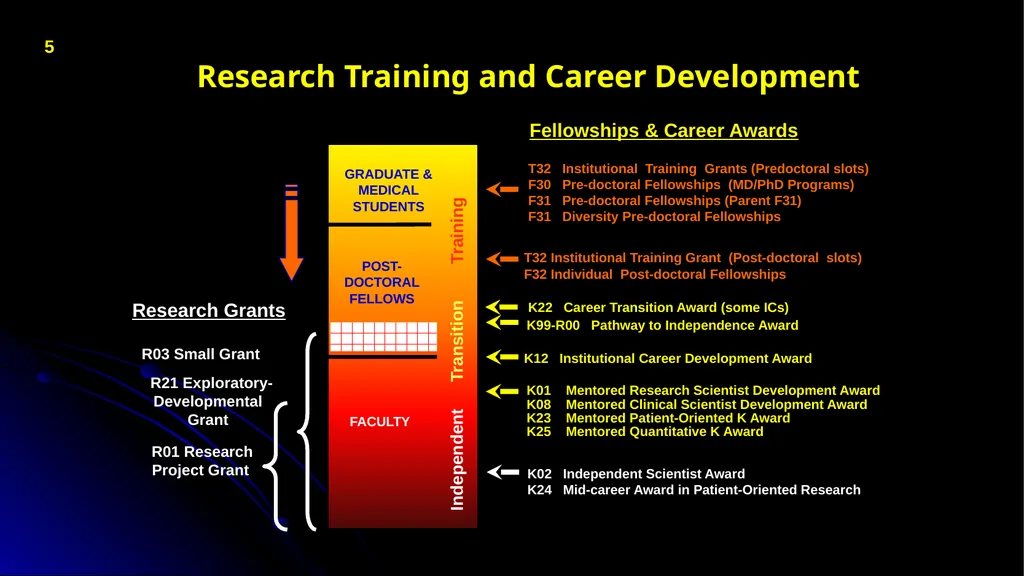
R03 Small Grant R01 Research Project Grant Fellowships & Career Awards GRADUATE &
MEDICAL
STUDENTS POST-
DOCTORAL
FELLOWS FACULTY K01 Mentored Research Scientist Development Award
K08 Mentored Clinical Scientist Development Award
K23 Mentored Patient-Oriented K Award
K25 Mentored Quantitative K Award K02 Independent Scientist Award
K24 Mid-career Award in Patient-Oriented Research R21 Exploratory-
Developmental
Grant Research Training and Career Development Training Independent Research Grants Transition K99-R00 Pathway to Independence Award K12 Institutional Career Development Award T32 Institutional Training Grant (Post-doctoral slots)
F32 Individual Post-doctoral Fellowships T32 Institutional Training Grants (Predoctoral slots)
F30 Pre-doctoral Fellowships (MD/PhD Programs)
F31 Pre-doctoral Fellowships (Parent F31)
F31 Diversity Pre-doctoral Fellowships K22 Career Transition Award (some ICs) 5<br>
MEDICAL
STUDENTS POST-
DOCTORAL
FELLOWS FACULTY K01 Mentored Research Scientist Development Award
K08 Mentored Clinical Scientist Development Award
K23 Mentored Patient-Oriented K Award
K25 Mentored Quantitative K Award K02 Independent Scientist Award
K24 Mid-career Award in Patient-Oriented Research R21 Exploratory-
Developmental
Grant Research Training and Career Development Training Independent Research Grants Transition K99-R00 Pathway to Independence Award K12 Institutional Career Development Award T32 Institutional Training Grant (Post-doctoral slots)
F32 Individual Post-doctoral Fellowships T32 Institutional Training Grants (Predoctoral slots)
F30 Pre-doctoral Fellowships (MD/PhD Programs)
F31 Pre-doctoral Fellowships (Parent F31)
F31 Diversity Pre-doctoral Fellowships K22 Career Transition Award (some ICs) 5<br>
06
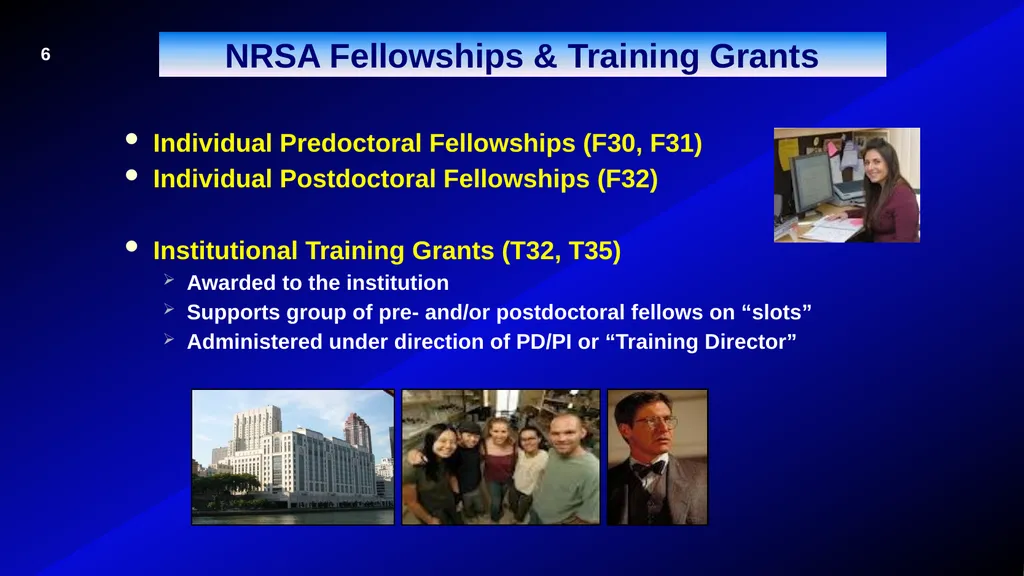
NRSA Fellowships & Training Grants Individual Predoctoral Fellowships (F30, F31)
Individual Postdoctoral Fellowships (F32)
Institutional Training Grants (T32, T35)
Awarded to the institution
Supports group of pre- and/or postdoctoral fellows on “slots”
Administered under direction of PD/PI or “Training Director” 6<br>
Individual Postdoctoral Fellowships (F32)
Institutional Training Grants (T32, T35)
Awarded to the institution
Supports group of pre- and/or postdoctoral fellows on “slots”
Administered under direction of PD/PI or “Training Director” 6<br>
07
NRSA Programs
Eligibility and Requirements 7 Citizenship: NRSA fellows and trainees must be U.S. Citizens, non-citizen nationals, or lawfully admitted for permanent residence at time of award (F) or time of appointment (T)
Degree Requirements:
Predoctoral: Must have a baccalaureate degree and be enrolled in doctoral program leading to PhD or equivalent, or dual research/clinical doctorate such as the MD/PhD
Postdoctoral: Must have a PhD or MD or comparable doctoral degree from an accredited domestic or foreign institution<br>
Degree Requirements:
Predoctoral: Must have a baccalaureate degree and be enrolled in doctoral program leading to PhD or equivalent, or dual research/clinical doctorate such as the MD/PhD
Postdoctoral: Must have a PhD or MD or comparable doctoral degree from an accredited domestic or foreign institution<br>
08
NRSA Duration of Support Predoc: 5 years (6 years for dual degree, eg MD/PhD)
Postdoc: 3 Years
Aggregate limits apply: any combination from individual and/or institutional awards
Exceptions:
Interruptions (break in service)
Waiver request requires IC prior approval
Exceptions are Rare 8<br>
Postdoc: 3 Years
Aggregate limits apply: any combination from individual and/or institutional awards
Exceptions:
Interruptions (break in service)
Waiver request requires IC prior approval
Exceptions are Rare 8<br>
09
Time Commitment of NRSA Fellows/Trainees Full-time Training: NRSA fellows are required to pursue full-time training, as defined by 40 hrs/week devoted to research training activities.
Part-time Training: Less than full-time training may be approved under certain conditions.
Allowed in unusual personal circumstances (e.g., medical conditions, disability, personal or family situations such as child or elder care)
Part-time training is not allowable to accommodate other sources of funding, job opportunities, or clinical practice or training
NIH prior approval required: Program Director or Sponsor must submit written request, countersigned by fellow & authorized institutional official
Fellow/trainee must continue to devote at least 50% effort. Less than 50% would require unpaid leave-of-absence from NRSA support. 9<br>
Part-time Training: Less than full-time training may be approved under certain conditions.
Allowed in unusual personal circumstances (e.g., medical conditions, disability, personal or family situations such as child or elder care)
Part-time training is not allowable to accommodate other sources of funding, job opportunities, or clinical practice or training
NIH prior approval required: Program Director or Sponsor must submit written request, countersigned by fellow & authorized institutional official
Fellow/trainee must continue to devote at least 50% effort. Less than 50% would require unpaid leave-of-absence from NRSA support. 9<br>
10
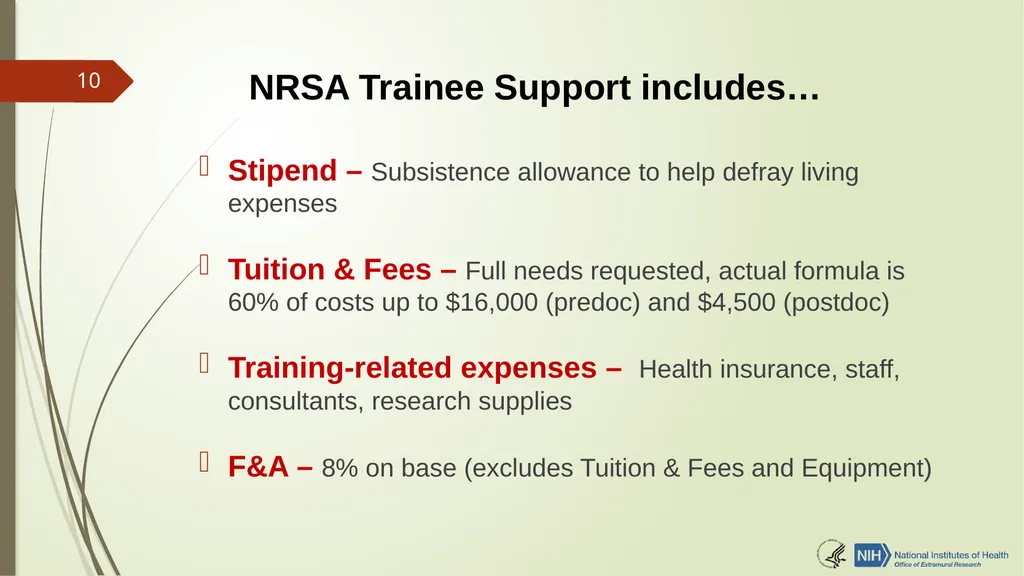
NRSA Trainee Support includes… Stipend – Subsistence allowance to help defray living expenses
Tuition & Fees – Full needs requested, actual formula is 60% of costs up to $16,000 (predoc) and $4,500 (postdoc)
Training-related expenses – Health insurance, staff, consultants, research supplies
F&A – 8% on base (excludes Tuition & Fees and Equipment) 10<br>
Tuition & Fees – Full needs requested, actual formula is 60% of costs up to $16,000 (predoc) and $4,500 (postdoc)
Training-related expenses – Health insurance, staff, consultants, research supplies
F&A – 8% on base (excludes Tuition & Fees and Equipment) 10<br>
11
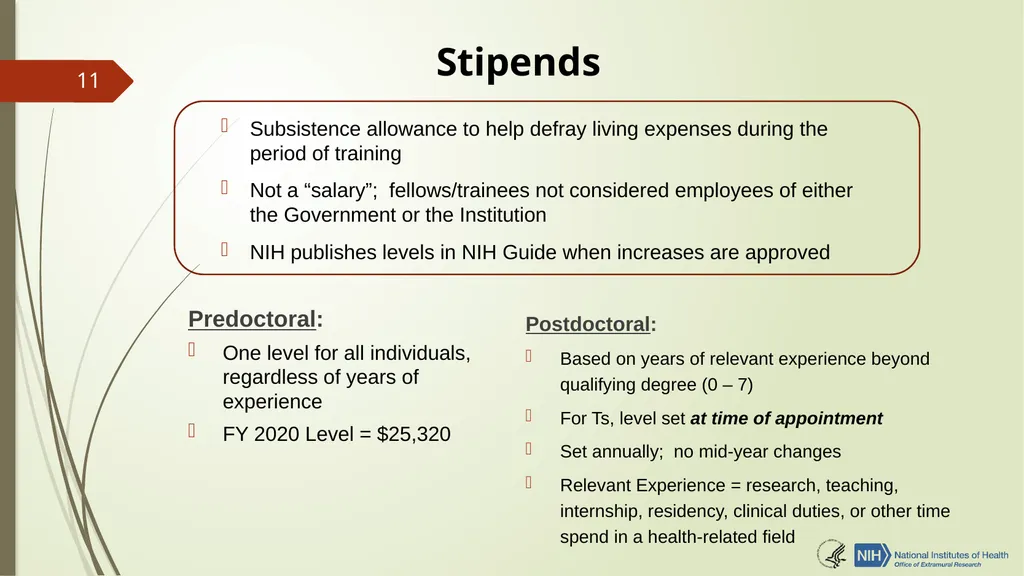
Stipends Subsistence allowance to help defray living expenses during the period of training
Not a “salary”; fellows/trainees not considered employees of either the Government or the Institution
NIH publishes levels in NIH Guide when increases are approved 11 Predoctoral:
One level for all individuals, regardless of years of experience
FY 2020 Level = $25,320 Postdoctoral:
Based on years of relevant experience beyond qualifying degree (0 – 7)
For Ts, level set at time of appointment
Set annually; no mid-year changes
Relevant Experience = research, teaching, internship, residency, clinical duties, or other time spend in a health-related field<br>
Not a “salary”; fellows/trainees not considered employees of either the Government or the Institution
NIH publishes levels in NIH Guide when increases are approved 11 Predoctoral:
One level for all individuals, regardless of years of experience
FY 2020 Level = $25,320 Postdoctoral:
Based on years of relevant experience beyond qualifying degree (0 – 7)
For Ts, level set at time of appointment
Set annually; no mid-year changes
Relevant Experience = research, teaching, internship, residency, clinical duties, or other time spend in a health-related field<br>
12
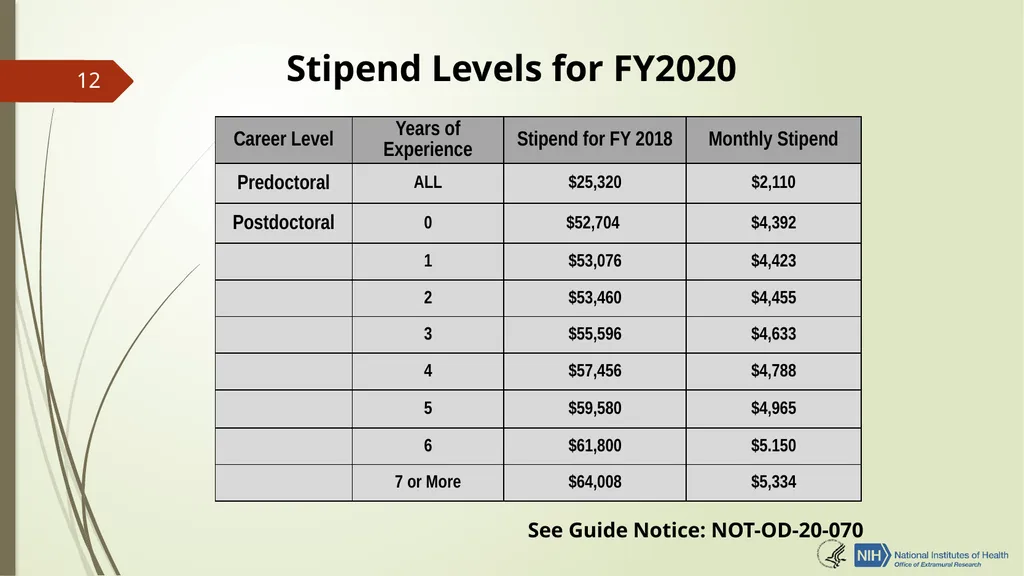
Stipend Levels for FY2020 12 See Guide Notice: NOT-OD-20-070<br>
13
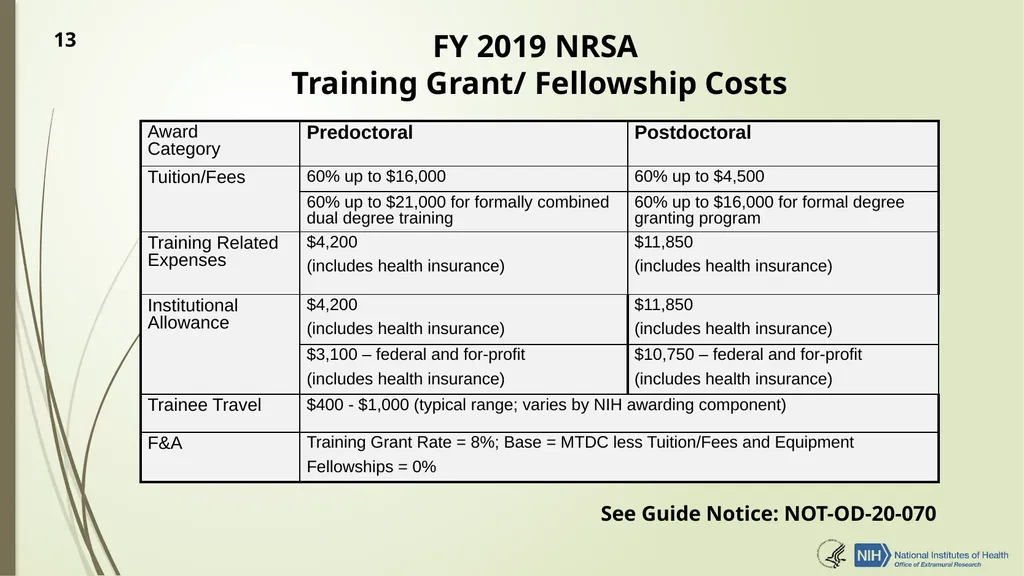
FY 2019 NRSA
Training Grant/ Fellowship Costs See Guide Notice: NOT-OD-20-070 13<br>
14
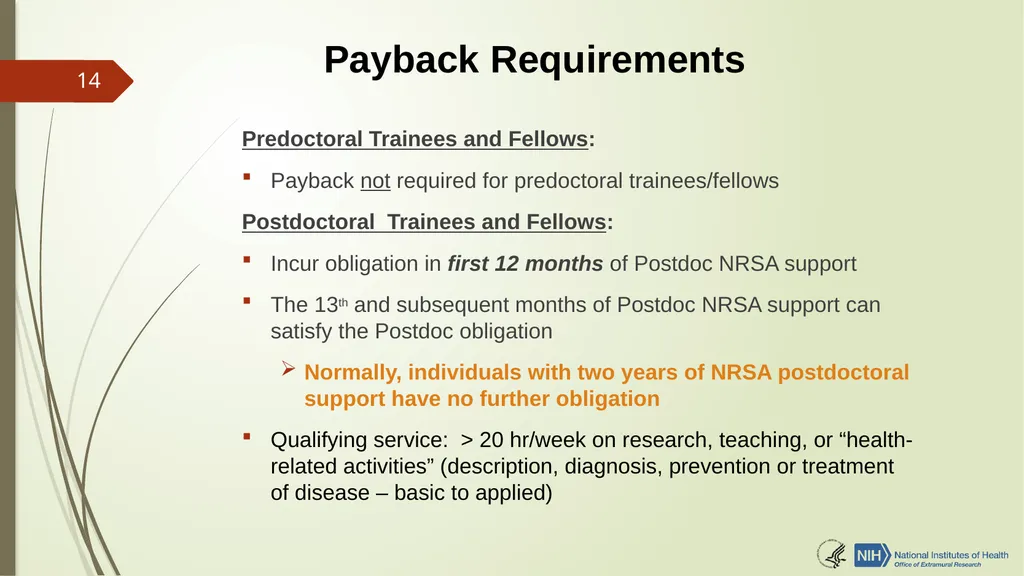
Payback Requirements Predoctoral Trainees and Fellows:
Payback not required for predoctoral trainees/fellows
Postdoctoral Trainees and Fellows:
Incur obligation in first 12 months of Postdoc NRSA support
The 13th and subsequent months of Postdoc NRSA support can satisfy the Postdoc obligation
Normally, individuals with two years of NRSA postdoctoral support have no further obligation
Qualifying service: > 20 hr/week on research, teaching, or “health-related activities” (description, diagnosis, prevention or treatment of disease – basic to applied) 14<br>
Payback not required for predoctoral trainees/fellows
Postdoctoral Trainees and Fellows:
Incur obligation in first 12 months of Postdoc NRSA support
The 13th and subsequent months of Postdoc NRSA support can satisfy the Postdoc obligation
Normally, individuals with two years of NRSA postdoctoral support have no further obligation
Qualifying service: > 20 hr/week on research, teaching, or “health-related activities” (description, diagnosis, prevention or treatment of disease – basic to applied) 14<br>
15
Individual NRSA Fellowships
Programs and Applications 15<br>
16
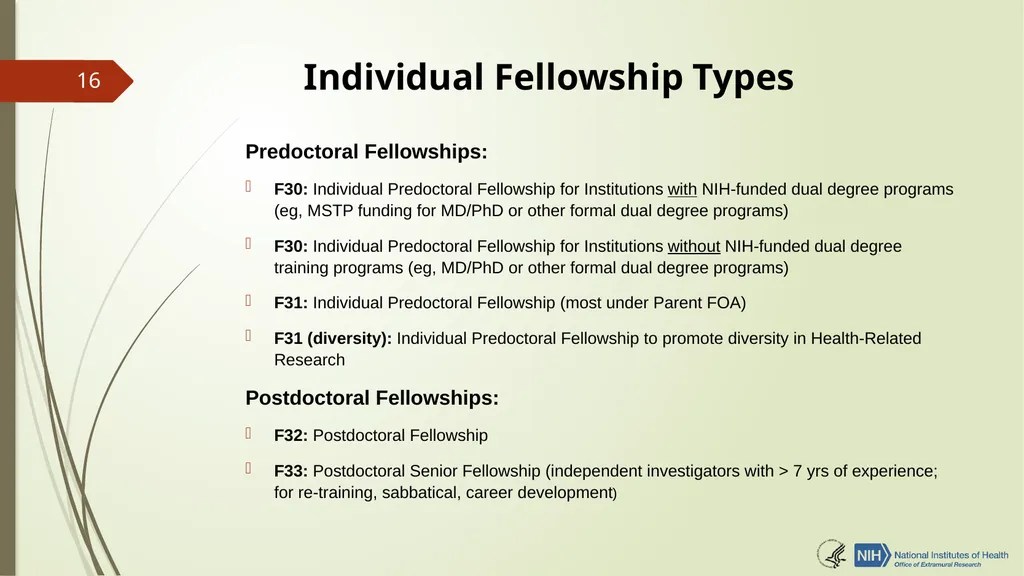
Individual Fellowship Types Predoctoral Fellowships:
F30: Individual Predoctoral Fellowship for Institutions with NIH-funded dual degree programs (eg, MSTP funding for MD/PhD or other formal dual degree programs)
F30: Individual Predoctoral Fellowship for Institutions without NIH-funded dual degree training programs (eg, MD/PhD or other formal dual degree programs)
F31: Individual Predoctoral Fellowship (most under Parent FOA)
F31 (diversity): Individual Predoctoral Fellowship to promote diversity in Health-Related Research
Postdoctoral Fellowships:
F32: Postdoctoral Fellowship
F33: Postdoctoral Senior Fellowship (independent investigators with > 7 yrs of experience; for re-training, sabbatical, career development) 16<br>
F30: Individual Predoctoral Fellowship for Institutions with NIH-funded dual degree programs (eg, MSTP funding for MD/PhD or other formal dual degree programs)
F30: Individual Predoctoral Fellowship for Institutions without NIH-funded dual degree training programs (eg, MD/PhD or other formal dual degree programs)
F31: Individual Predoctoral Fellowship (most under Parent FOA)
F31 (diversity): Individual Predoctoral Fellowship to promote diversity in Health-Related Research
Postdoctoral Fellowships:
F32: Postdoctoral Fellowship
F33: Postdoctoral Senior Fellowship (independent investigators with > 7 yrs of experience; for re-training, sabbatical, career development) 16<br>
17
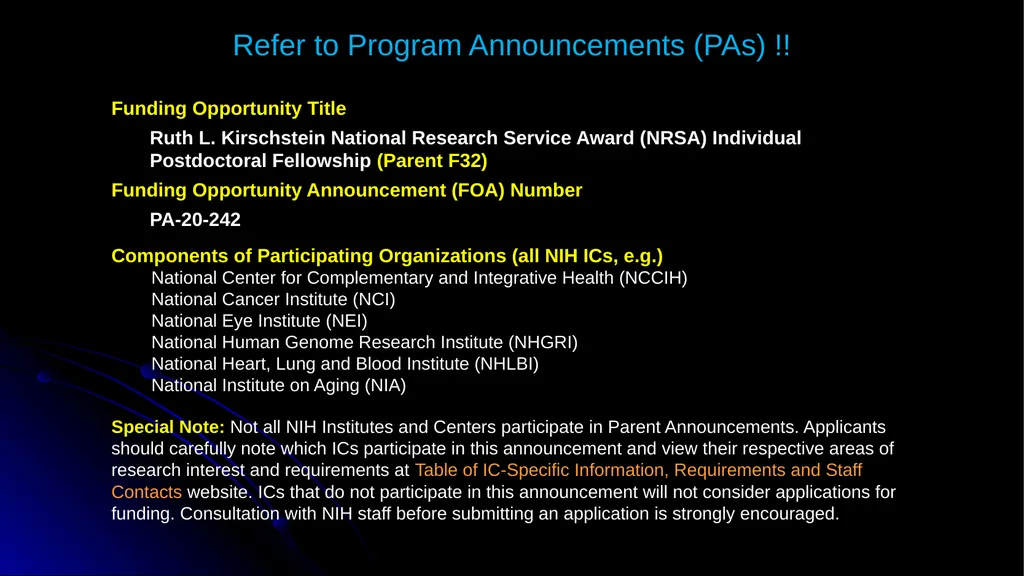
Refer to Program Announcements (PAs) !! Funding Opportunity Title
Ruth L. Kirschstein National Research Service Award (NRSA) Individual Postdoctoral Fellowship (Parent F32)
Funding Opportunity Announcement (FOA) Number
PA-20-242
Components of Participating Organizations (all NIH ICs, e.g.)
National Center for Complementary and Integrative Health (NCCIH)
National Cancer Institute (NCI)
National Eye Institute (NEI)
National Human Genome Research Institute (NHGRI)
National Heart, Lung and Blood Institute (NHLBI)
National Institute on Aging (NIA)
Special Note: Not all NIH Institutes and Centers participate in Parent Announcements. Applicants should carefully note which ICs participate in this announcement and view their respective areas of research interest and requirements at Table of IC-Specific Information, Requirements and Staff Contacts website. ICs that do not participate in this announcement will not consider applications for funding. Consultation with NIH staff before submitting an application is strongly encouraged.<br>
Ruth L. Kirschstein National Research Service Award (NRSA) Individual Postdoctoral Fellowship (Parent F32)
Funding Opportunity Announcement (FOA) Number
PA-20-242
Components of Participating Organizations (all NIH ICs, e.g.)
National Center for Complementary and Integrative Health (NCCIH)
National Cancer Institute (NCI)
National Eye Institute (NEI)
National Human Genome Research Institute (NHGRI)
National Heart, Lung and Blood Institute (NHLBI)
National Institute on Aging (NIA)
Special Note: Not all NIH Institutes and Centers participate in Parent Announcements. Applicants should carefully note which ICs participate in this announcement and view their respective areas of research interest and requirements at Table of IC-Specific Information, Requirements and Staff Contacts website. ICs that do not participate in this announcement will not consider applications for funding. Consultation with NIH staff before submitting an application is strongly encouraged.<br>
18
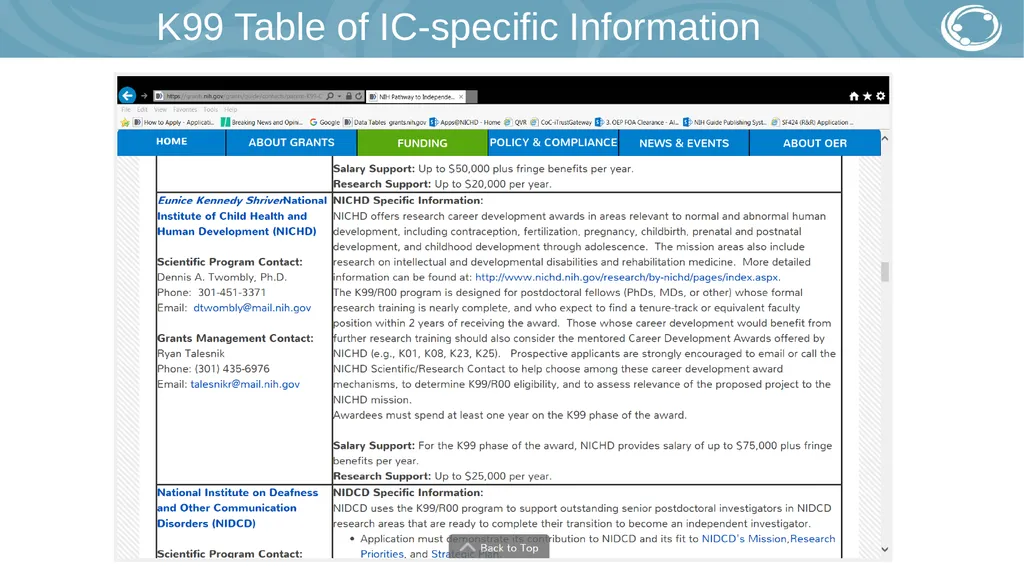
K99 Table of IC-specific Information<br>
19
Fellowship Applications Eligible Institutions = Domestic, non-Domestic, non-profit, public or private institutions
Research training must fall within the mission of the NIH awarding Institute or Center
Submitted electronically through Grants.gov using Application Package found with the FOA
Reference letters submitted separately through the NIH eRA Commons system; are matched with application at NIH
Letters are due by the application receipt date 19<br>
Research training must fall within the mission of the NIH awarding Institute or Center
Submitted electronically through Grants.gov using Application Package found with the FOA
Reference letters submitted separately through the NIH eRA Commons system; are matched with application at NIH
Letters are due by the application receipt date 19<br>
20
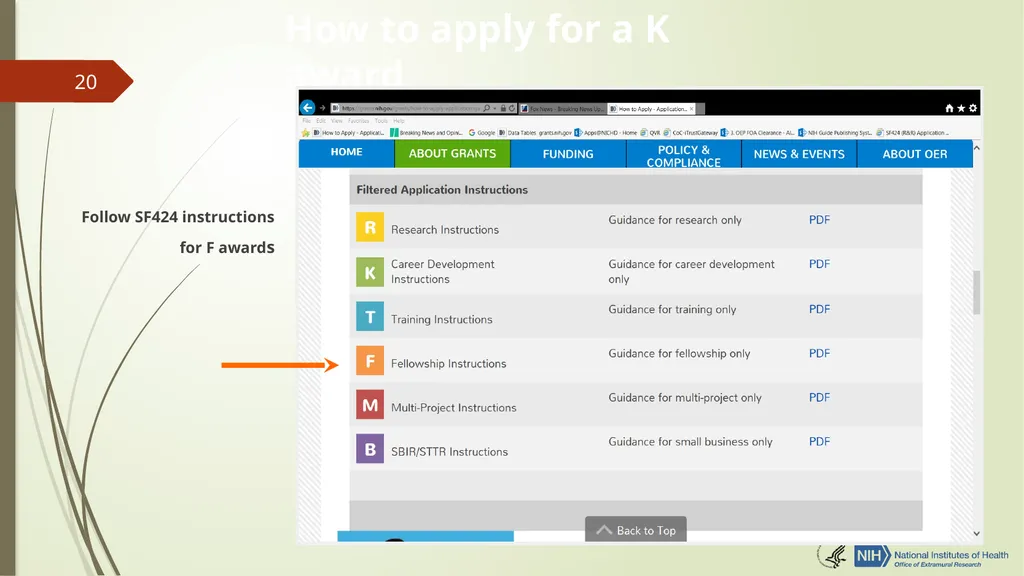
How to apply for a K award Follow SF424 instructions
for F awards 20<br>
for F awards 20<br>
21
Fellowship Review and Award Two-stage review:
Initial Review Group (CSR Fellowship Study Sections or IC-based study sections)
Institute/Center Program Staff (analogous to Council)
Generally 5-6 month period from receipt to earliest possible award (except October Council)
Actual start date depends on Council round, budgets, pay guidelines, grant processing time, etc.
Check Funding Opportunity Announcements for variations 21<br>
Initial Review Group (CSR Fellowship Study Sections or IC-based study sections)
Institute/Center Program Staff (analogous to Council)
Generally 5-6 month period from receipt to earliest possible award (except October Council)
Actual start date depends on Council round, budgets, pay guidelines, grant processing time, etc.
Check Funding Opportunity Announcements for variations 21<br>
22
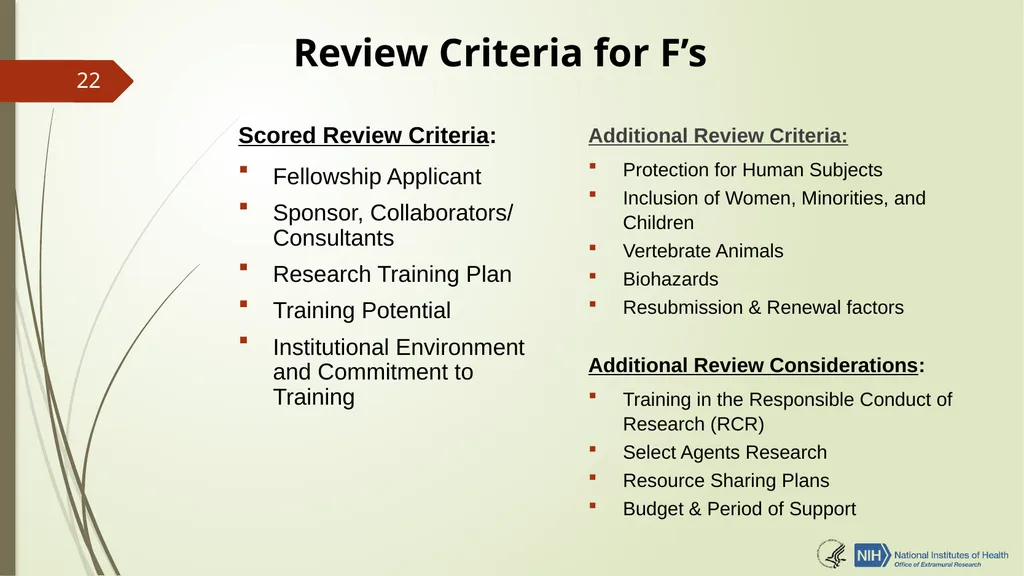
Review Criteria for F’s 22 Scored Review Criteria:
Fellowship Applicant
Sponsor, Collaborators/ Consultants
Research Training Plan
Training Potential
Institutional Environment and Commitment to Training Additional Review Criteria:
Protection for Human Subjects
Inclusion of Women, Minorities, and Children
Vertebrate Animals
Biohazards
Resubmission & Renewal factors
Additional Review Considerations:
Training in the Responsible Conduct of Research (RCR)
Select Agents Research
Resource Sharing Plans
Budget & Period of Support<br>
Fellowship Applicant
Sponsor, Collaborators/ Consultants
Research Training Plan
Training Potential
Institutional Environment and Commitment to Training Additional Review Criteria:
Protection for Human Subjects
Inclusion of Women, Minorities, and Children
Vertebrate Animals
Biohazards
Resubmission & Renewal factors
Additional Review Considerations:
Training in the Responsible Conduct of Research (RCR)
Select Agents Research
Resource Sharing Plans
Budget & Period of Support<br>
23
Institutional Training Grants Program Features and Applications 23<br>
24
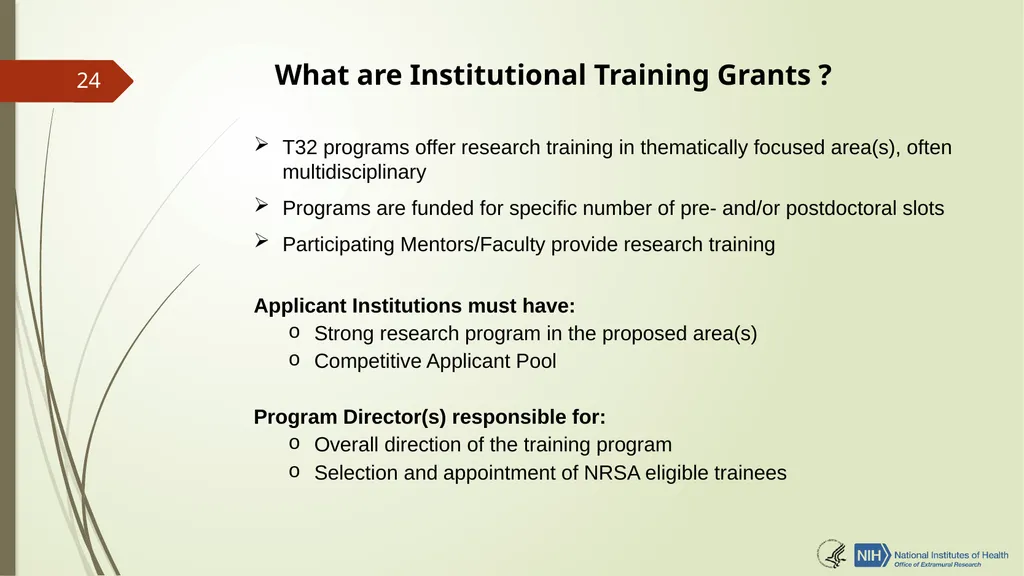
What are Institutional Training Grants ? 24 T32 programs offer research training in thematically focused area(s), often multidisciplinary
Programs are funded for specific number of pre- and/or postdoctoral slots
Participating Mentors/Faculty provide research training
Applicant Institutions must have:
Strong research program in the proposed area(s)
Competitive Applicant Pool
Program Director(s) responsible for:
Overall direction of the training program
Selection and appointment of NRSA eligible trainees<br>
Programs are funded for specific number of pre- and/or postdoctoral slots
Participating Mentors/Faculty provide research training
Applicant Institutions must have:
Strong research program in the proposed area(s)
Competitive Applicant Pool
Program Director(s) responsible for:
Overall direction of the training program
Selection and appointment of NRSA eligible trainees<br>
25
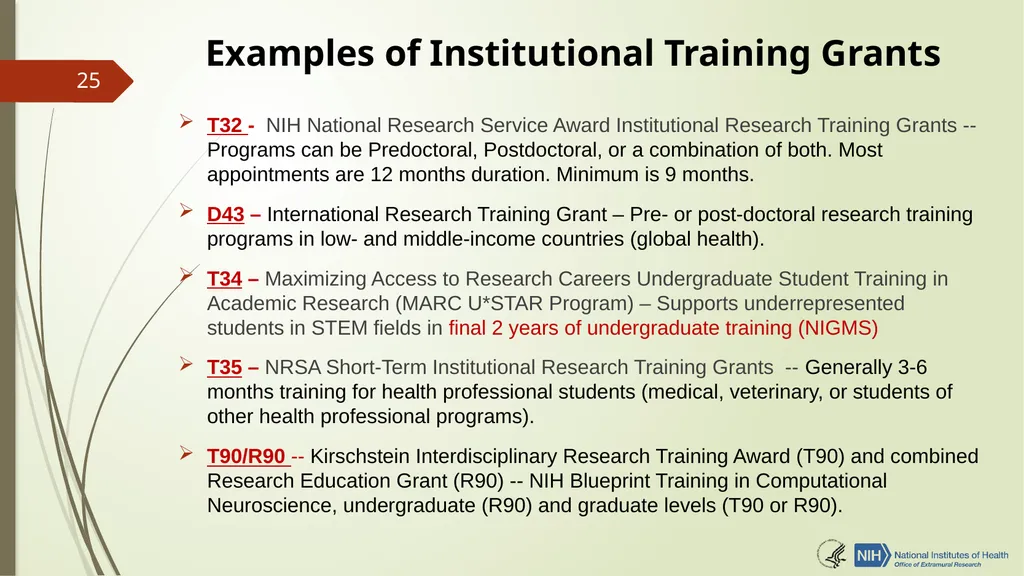
Examples of Institutional Training Grants T32 - NIH National Research Service Award Institutional Research Training Grants -- Programs can be Predoctoral, Postdoctoral, or a combination of both. Most appointments are 12 months duration. Minimum is 9 months.
D43 – International Research Training Grant – Pre- or post-doctoral research training programs in low- and middle-income countries (global health).
T34 – Maximizing Access to Research Careers Undergraduate Student Training in Academic Research (MARC U*STAR Program) – Supports underrepresented students in STEM fields in final 2 years of undergraduate training (NIGMS)
T35 – NRSA Short-Term Institutional Research Training Grants -- Generally 3-6 months training for health professional students (medical, veterinary, or students of other health professional programs).
T90/R90 -- Kirschstein Interdisciplinary Research Training Award (T90) and combined Research Education Grant (R90) -- NIH Blueprint Training in Computational Neuroscience, undergraduate (R90) and graduate levels (T90 or R90). 25<br>
D43 – International Research Training Grant – Pre- or post-doctoral research training programs in low- and middle-income countries (global health).
T34 – Maximizing Access to Research Careers Undergraduate Student Training in Academic Research (MARC U*STAR Program) – Supports underrepresented students in STEM fields in final 2 years of undergraduate training (NIGMS)
T35 – NRSA Short-Term Institutional Research Training Grants -- Generally 3-6 months training for health professional students (medical, veterinary, or students of other health professional programs).
T90/R90 -- Kirschstein Interdisciplinary Research Training Award (T90) and combined Research Education Grant (R90) -- NIH Blueprint Training in Computational Neuroscience, undergraduate (R90) and graduate levels (T90 or R90). 25<br>
26
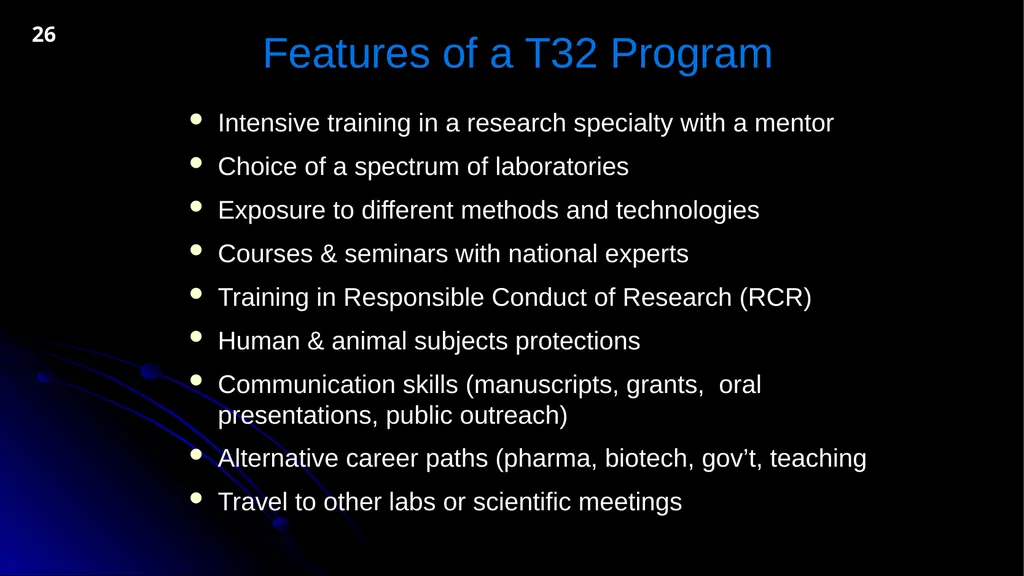
Features of a T32 Program Intensive training in a research specialty with a mentor
Choice of a spectrum of laboratories
Exposure to different methods and technologies
Courses & seminars with national experts
Training in Responsible Conduct of Research (RCR)
Human & animal subjects protections
Communication skills (manuscripts, grants, oral presentations, public outreach)
Alternative career paths (pharma, biotech, gov’t, teaching
Travel to other labs or scientific meetings 26<br>
Choice of a spectrum of laboratories
Exposure to different methods and technologies
Courses & seminars with national experts
Training in Responsible Conduct of Research (RCR)
Human & animal subjects protections
Communication skills (manuscripts, grants, oral presentations, public outreach)
Alternative career paths (pharma, biotech, gov’t, teaching
Travel to other labs or scientific meetings 26<br>
27
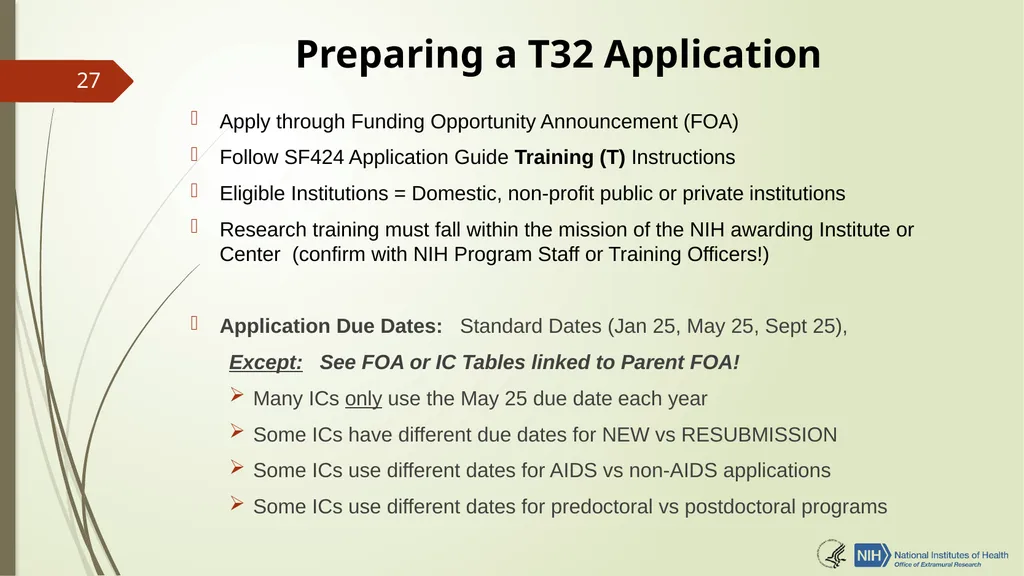
Preparing a T32 Application Apply through Funding Opportunity Announcement (FOA)
Follow SF424 Application Guide Training (T) Instructions
Eligible Institutions = Domestic, non-profit public or private institutions
Research training must fall within the mission of the NIH awarding Institute or Center (confirm with NIH Program Staff or Training Officers!)
Application Due Dates: Standard Dates (Jan 25, May 25, Sept 25),
Except: See FOA or IC Tables linked to Parent FOA!
Many ICs only use the May 25 due date each year
Some ICs have different due dates for NEW vs RESUBMISSION
Some ICs use different dates for AIDS vs non-AIDS applications
Some ICs use different dates for predoctoral vs postdoctoral programs 27<br>
Follow SF424 Application Guide Training (T) Instructions
Eligible Institutions = Domestic, non-profit public or private institutions
Research training must fall within the mission of the NIH awarding Institute or Center (confirm with NIH Program Staff or Training Officers!)
Application Due Dates: Standard Dates (Jan 25, May 25, Sept 25),
Except: See FOA or IC Tables linked to Parent FOA!
Many ICs only use the May 25 due date each year
Some ICs have different due dates for NEW vs RESUBMISSION
Some ICs use different dates for AIDS vs non-AIDS applications
Some ICs use different dates for predoctoral vs postdoctoral programs 27<br>
28
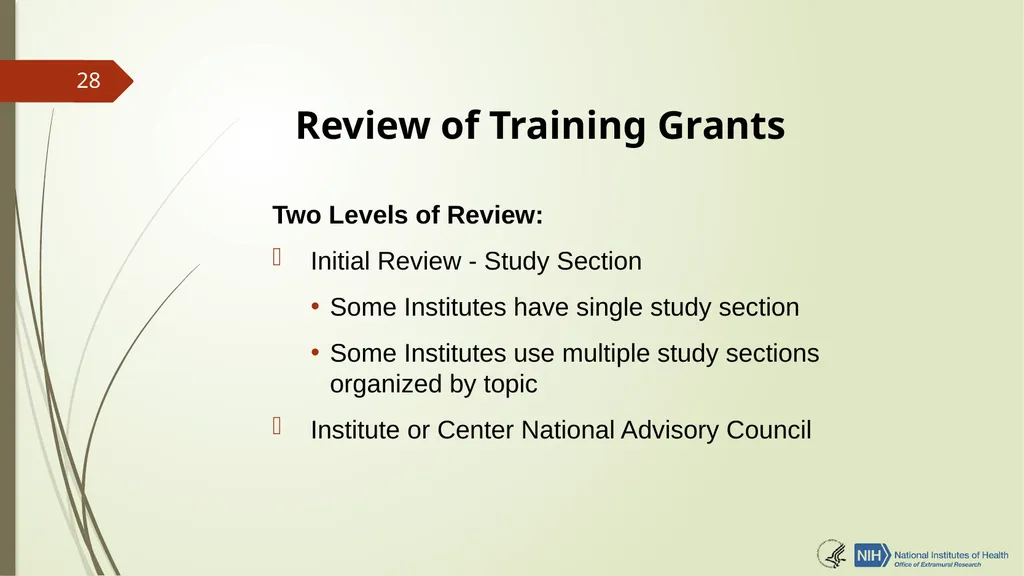
Review of Training Grants Two Levels of Review:
Initial Review - Study Section
Some Institutes have single study section
Some Institutes use multiple study sections organized by topic
Institute or Center National Advisory Council 28<br>
Initial Review - Study Section
Some Institutes have single study section
Some Institutes use multiple study sections organized by topic
Institute or Center National Advisory Council 28<br>
29
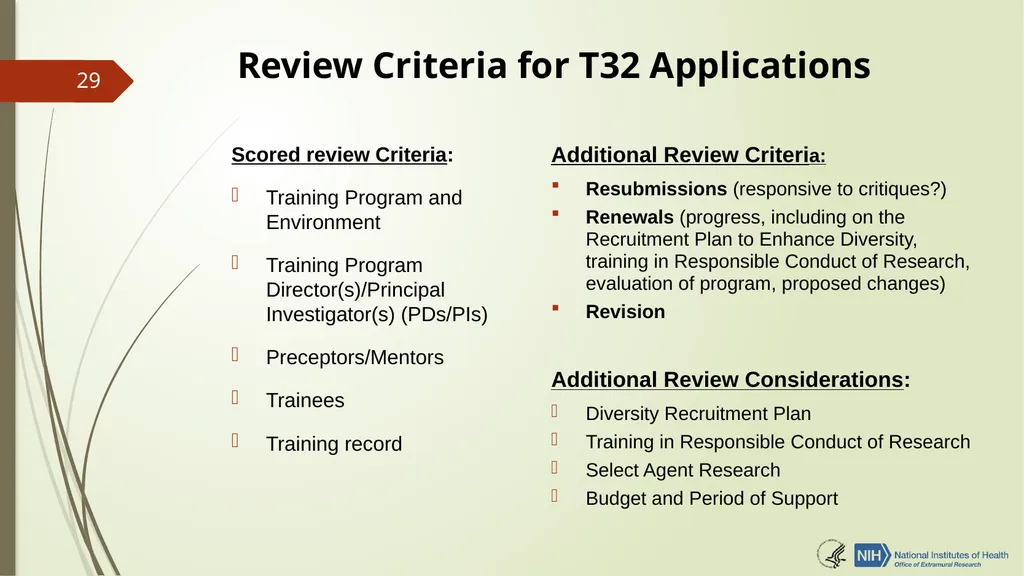
Review Criteria for T32 Applications 29 Scored review Criteria:
Training Program and Environment
Training Program Director(s)/Principal Investigator(s) (PDs/PIs)
Preceptors/Mentors
Trainees
Training record Additional Review Criteria:
Resubmissions (responsive to critiques?)
Renewals (progress, including on the Recruitment Plan to Enhance Diversity, training in Responsible Conduct of Research, evaluation of program, proposed changes)
Revision
Additional Review Considerations:
Diversity Recruitment Plan
Training in Responsible Conduct of Research
Select Agent Research
Budget and Period of Support<br>
Training Program and Environment
Training Program Director(s)/Principal Investigator(s) (PDs/PIs)
Preceptors/Mentors
Trainees
Training record Additional Review Criteria:
Resubmissions (responsive to critiques?)
Renewals (progress, including on the Recruitment Plan to Enhance Diversity, training in Responsible Conduct of Research, evaluation of program, proposed changes)
Revision
Additional Review Considerations:
Diversity Recruitment Plan
Training in Responsible Conduct of Research
Select Agent Research
Budget and Period of Support<br>
30
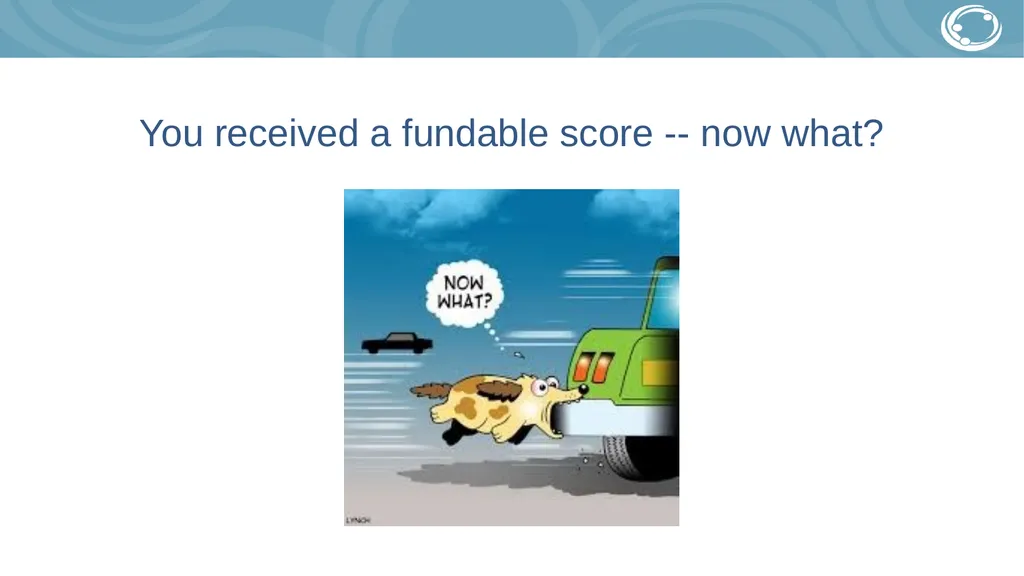
You received a fundable score -- now what?<br>
31
Individual NRSA Fellowships
Post-award Issues 31<br>
32
NRSA Fellowships
Initiation of Support Awarding component will notify individual of intention to make an award
The fellowship Notice of Award will be issued
Fellow must start training within six months of the award issue date
Before the day Fellow begins training, Activation Notice and Payback Agreement (only for Postdoc fellows in first 12 months of NRSA support) must be completed and submitted to awarding component
Termination Notice due at end of fellowship and submitted via xTRAIN 32<br>
The fellowship Notice of Award will be issued
Fellow must start training within six months of the award issue date
Before the day Fellow begins training, Activation Notice and Payback Agreement (only for Postdoc fellows in first 12 months of NRSA support) must be completed and submitted to awarding component
Termination Notice due at end of fellowship and submitted via xTRAIN 32<br>
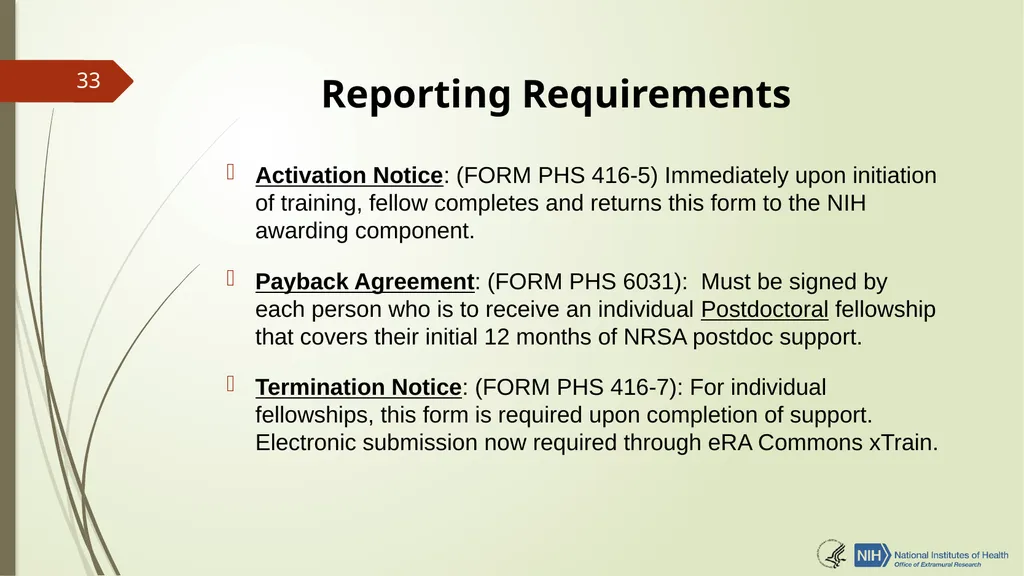
33
Reporting Requirements Activation Notice: (FORM PHS 416-5) Immediately upon initiation of training, fellow completes and returns this form to the NIH awarding component.
Payback Agreement: (FORM PHS 6031): Must be signed by each person who is to receive an individual Postdoctoral fellowship that covers their initial 12 months of NRSA postdoc support.
Termination Notice: (FORM PHS 416-7): For individual fellowships, this form is required upon completion of support. Electronic submission now required through eRA Commons xTrain. 33<br>
Payback Agreement: (FORM PHS 6031): Must be signed by each person who is to receive an individual Postdoctoral fellowship that covers their initial 12 months of NRSA postdoc support.
Termination Notice: (FORM PHS 416-7): For individual fellowships, this form is required upon completion of support. Electronic submission now required through eRA Commons xTrain. 33<br>
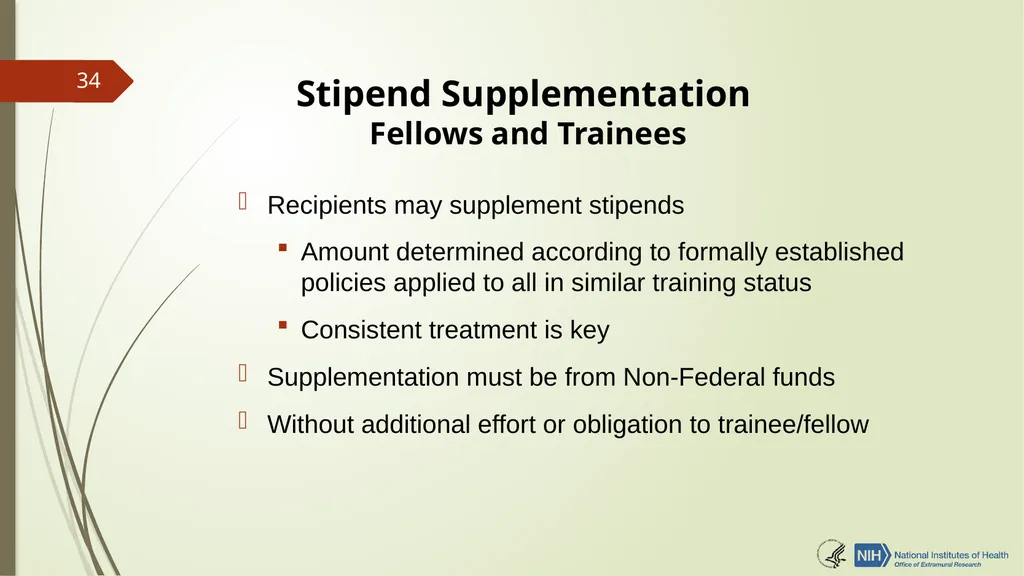
34
Stipend Supplementation
Fellows and Trainees Recipients may supplement stipends
Amount determined according to formally established policies applied to all in similar training status
Consistent treatment is key
Supplementation must be from Non-Federal funds
Without additional effort or obligation to trainee/fellow 34<br>
Amount determined according to formally established policies applied to all in similar training status
Consistent treatment is key
Supplementation must be from Non-Federal funds
Without additional effort or obligation to trainee/fellow 34<br>
35
Compensation Trainees/Fellows may receive additional compensation for services associated with employment, e.g., teaching assistant, lab assistant
Individual receives salary; not considered stipend supplementation
Can compensation be from an NIH research grant?
Yes, on a limited part-time basis (25% time = 10 hr/week)
May not be from same grant that is part of training experience
Fellowship Sponsor or Training Grant Program Director must approve
May not interfere with or prolong the approved NRSA training 35<br>
Individual receives salary; not considered stipend supplementation
Can compensation be from an NIH research grant?
Yes, on a limited part-time basis (25% time = 10 hr/week)
May not be from same grant that is part of training experience
Fellowship Sponsor or Training Grant Program Director must approve
May not interfere with or prolong the approved NRSA training 35<br>
36
Progress Reports Progress Reports: Progress reports must be submitted annually using the Research Performance Progress Report (RPPR) in the eRA Commons.
Final Progress Report: For individual awards, a final progress report is required as part of the Termination Notice. A separate final progress report is not required.
Federal Financial Report (FFR): A Financial Expenditure Report is not required for individual fellowship awards. However, institutions must complete the Federal cash transaction using the FFR to PMS (SF425). 36<br>
Final Progress Report: For individual awards, a final progress report is required as part of the Termination Notice. A separate final progress report is not required.
Federal Financial Report (FFR): A Financial Expenditure Report is not required for individual fellowship awards. However, institutions must complete the Federal cash transaction using the FFR to PMS (SF425). 36<br>
37
Fellowships: Changes in Project Individual fellowship awards are made for training at a specific institution under the guidance of a particular sponsor.
A transfer of the award to another institution or a change in sponsor requires the approval of the NIH awarding component. Should consult with NIH awarding component ASAP.
Any proposed change in the individual’s area of research training must be approved by the awarding component.
When the sponsor plans to be absent for a continuous period of more than 3 months, an interim sponsor must be named by the institution and approved by the NIH awarding IC. 37<br>
A transfer of the award to another institution or a change in sponsor requires the approval of the NIH awarding component. Should consult with NIH awarding component ASAP.
Any proposed change in the individual’s area of research training must be approved by the awarding component.
When the sponsor plans to be absent for a continuous period of more than 3 months, an interim sponsor must be named by the institution and approved by the NIH awarding IC. 37<br>
38
Leave Policies: Fellows and Trainees Vacations & Holidays: Predoc and Postdoc Fellows & Trainees may receive the same vacations and holidays available to individuals at the recipient or sponsoring institution. Trainees will continue to receive stipends.
Sick Leave: May continue to receive stipends for up to 15 calendar days (2 weeks) of sick leave per year.
Parental Leave: May receive stipends for up to 60 calendar days (8 weeks) of parental leave per year for the adoption or birth of a child.
Unpaid Leave: Extended leave beyond above allowances must be requested in advance from awarding component.
Fellowship: award will be revised extending termination date by the number of months of leave.
Trainee (T32): terminate & reappoint
Stipends may not be reimbursed during unpaid leave; continued health insurance coverage is allowable if consistent with institutional policy. 38 See NIH Grants Policy Statement and NOT-OD-18-154<br>
Sick Leave: May continue to receive stipends for up to 15 calendar days (2 weeks) of sick leave per year.
Parental Leave: May receive stipends for up to 60 calendar days (8 weeks) of parental leave per year for the adoption or birth of a child.
Unpaid Leave: Extended leave beyond above allowances must be requested in advance from awarding component.
Fellowship: award will be revised extending termination date by the number of months of leave.
Trainee (T32): terminate & reappoint
Stipends may not be reimbursed during unpaid leave; continued health insurance coverage is allowable if consistent with institutional policy. 38 See NIH Grants Policy Statement and NOT-OD-18-154<br>
39
Institutional Training Grants (T) Post-Award Issues 39<br>
40
xTRAIN — Appointment and Termination Notices xTRAIN: eRA Commons electronic submission of trainee appointments, reappointments, amendments, and Termination Notices – REQUIRED
Appointment Forms (PHS 2271)
Due on or before the start of the appointment period
No stipend or other allowance may be paid until submitted
Delinquent submissions (> 30 days) may result in disallowance
Termination Notices (PHS 416-7)
Required at time an appointment is ending
Reflects total period of support & NIH stipend only (do not include any supplementation)
If there was a hiatus of support, report only current period 40<br>
Appointment Forms (PHS 2271)
Due on or before the start of the appointment period
No stipend or other allowance may be paid until submitted
Delinquent submissions (> 30 days) may result in disallowance
Termination Notices (PHS 416-7)
Required at time an appointment is ending
Reflects total period of support & NIH stipend only (do not include any supplementation)
If there was a hiatus of support, report only current period 40<br>
41
Trainee Appointments Trainees considered full-time participants in training program (40 hrs/wk)
Most appointments are 12 months in duration
Appointments less than 9 months not allowed unless completing a planned training program
Appointments may begin any time during the budget period 41<br>
Most appointments are 12 months in duration
Appointments less than 9 months not allowed unless completing a planned training program
Appointments may begin any time during the budget period 41<br>
42
Appointments Training slots vs. Training months
Varies according to IC
3 FTTPs = 36 training months (3 x 12)
Look for footnote under terms and conditions or contact awarding IC
Example: This award includes funds to support X trainees (xx Training Months). The maximum number of trainees that may be appointed without the prior written approval of NIGMS staff is X ( xx Training Months) if funds are available through rebudgeting. 42<br>
Varies according to IC
3 FTTPs = 36 training months (3 x 12)
Look for footnote under terms and conditions or contact awarding IC
Example: This award includes funds to support X trainees (xx Training Months). The maximum number of trainees that may be appointed without the prior written approval of NIGMS staff is X ( xx Training Months) if funds are available through rebudgeting. 42<br>
43
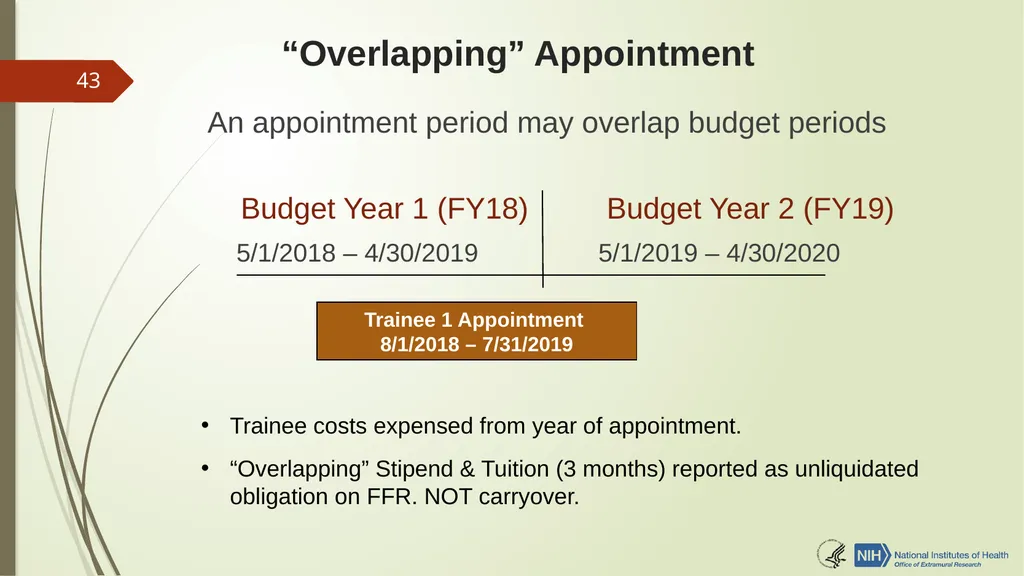
Trainee costs expensed from year of appointment.
“Overlapping” Stipend & Tuition (3 months) reported as unliquidated obligation on FFR. NOT carryover. An appointment period may overlap budget periods
Budget Year 1 (FY18) Budget Year 2 (FY19)
5/1/2018 – 4/30/2019 5/1/2019 – 4/30/2020 Trainee 1 Appointment
8/1/2018 – 7/31/2019 43 “Overlapping” Appointment<br>
“Overlapping” Stipend & Tuition (3 months) reported as unliquidated obligation on FFR. NOT carryover. An appointment period may overlap budget periods
Budget Year 1 (FY18) Budget Year 2 (FY19)
5/1/2018 – 4/30/2019 5/1/2019 – 4/30/2020 Trainee 1 Appointment
8/1/2018 – 7/31/2019 43 “Overlapping” Appointment<br>
44
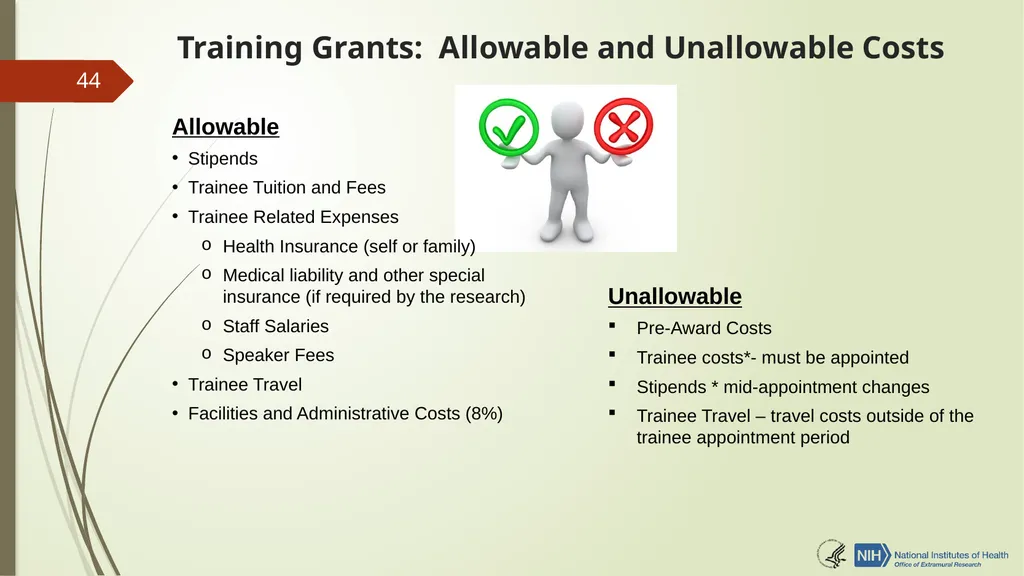
Training Grants: Allowable and Unallowable Costs 44 Allowable
Stipends
Trainee Tuition and Fees
Trainee Related Expenses
Health Insurance (self or family)
Medical liability and other special insurance (if required by the research)
Staff Salaries
Speaker Fees
Trainee Travel
Facilities and Administrative Costs (8%) Unallowable
Pre-Award Costs
Trainee costs*- must be appointed
Stipends * mid-appointment changes
Trainee Travel – travel costs outside of the trainee appointment period<br>
Stipends
Trainee Tuition and Fees
Trainee Related Expenses
Health Insurance (self or family)
Medical liability and other special insurance (if required by the research)
Staff Salaries
Speaker Fees
Trainee Travel
Facilities and Administrative Costs (8%) Unallowable
Pre-Award Costs
Trainee costs*- must be appointed
Stipends * mid-appointment changes
Trainee Travel – travel costs outside of the trainee appointment period<br>
45
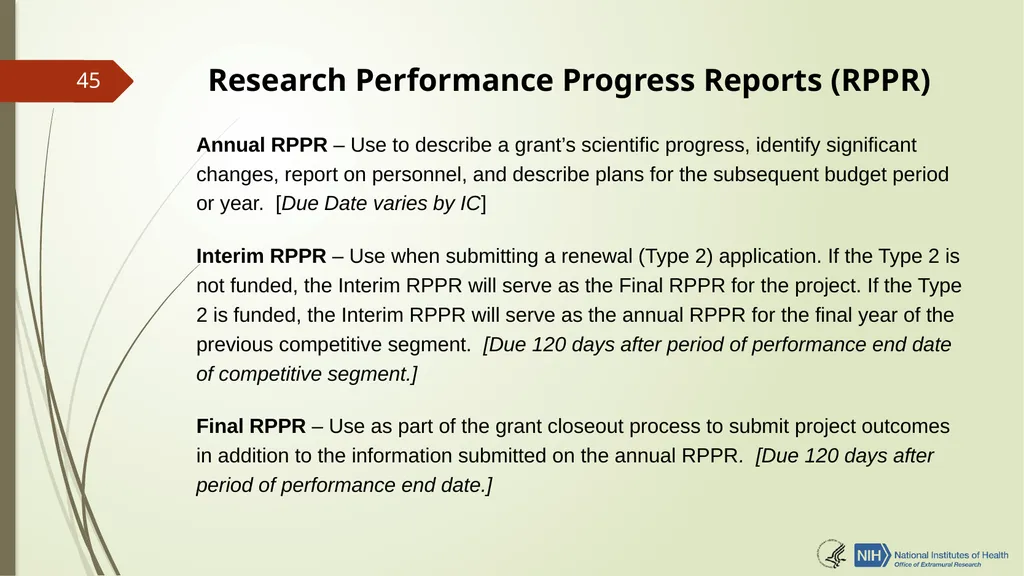
Research Performance Progress Reports (RPPR) 45 Annual RPPR – Use to describe a grant’s scientific progress, identify significant changes, report on personnel, and describe plans for the subsequent budget period or year. [Due Date varies by IC]
Interim RPPR – Use when submitting a renewal (Type 2) application. If the Type 2 is not funded, the Interim RPPR will serve as the Final RPPR for the project. If the Type 2 is funded, the Interim RPPR will serve as the annual RPPR for the final year of the previous competitive segment. [Due 120 days after period of performance end date of competitive segment.]
Final RPPR – Use as part of the grant closeout process to submit project outcomes in addition to the information submitted on the annual RPPR. [Due 120 days after period of performance end date.]<br>
Interim RPPR – Use when submitting a renewal (Type 2) application. If the Type 2 is not funded, the Interim RPPR will serve as the Final RPPR for the project. If the Type 2 is funded, the Interim RPPR will serve as the annual RPPR for the final year of the previous competitive segment. [Due 120 days after period of performance end date of competitive segment.]
Final RPPR – Use as part of the grant closeout process to submit project outcomes in addition to the information submitted on the annual RPPR. [Due 120 days after period of performance end date.]<br>
46
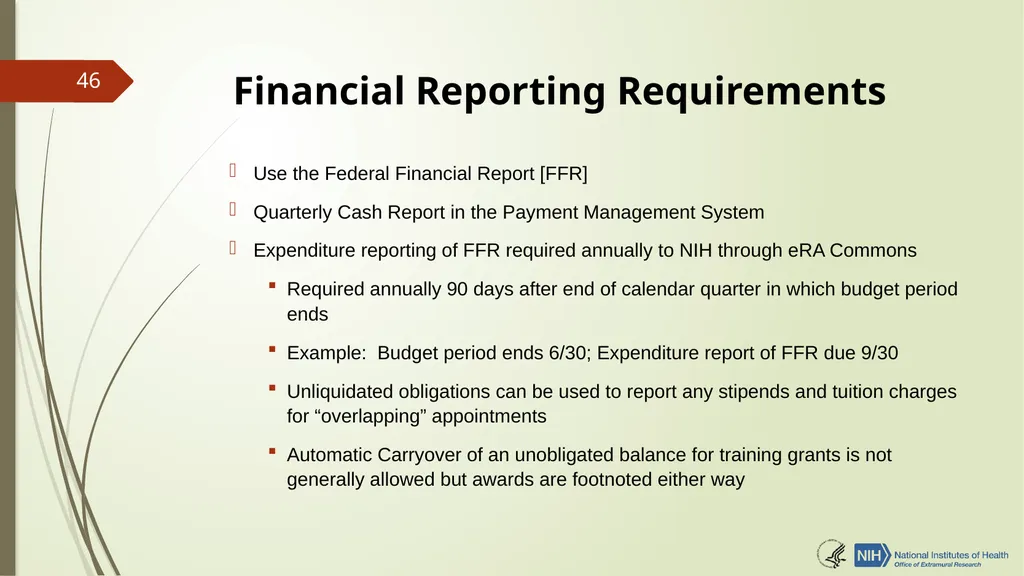
Financial Reporting Requirements Use the Federal Financial Report [FFR]
Quarterly Cash Report in the Payment Management System
Expenditure reporting of FFR required annually to NIH through eRA Commons
Required annually 90 days after end of calendar quarter in which budget period ends
Example: Budget period ends 6/30; Expenditure report of FFR due 9/30
Unliquidated obligations can be used to report any stipends and tuition charges for “overlapping” appointments
Automatic Carryover of an unobligated balance for training grants is not generally allowed but awards are footnoted either way 46<br>
Quarterly Cash Report in the Payment Management System
Expenditure reporting of FFR required annually to NIH through eRA Commons
Required annually 90 days after end of calendar quarter in which budget period ends
Example: Budget period ends 6/30; Expenditure report of FFR due 9/30
Unliquidated obligations can be used to report any stipends and tuition charges for “overlapping” appointments
Automatic Carryover of an unobligated balance for training grants is not generally allowed but awards are footnoted either way 46<br>
47
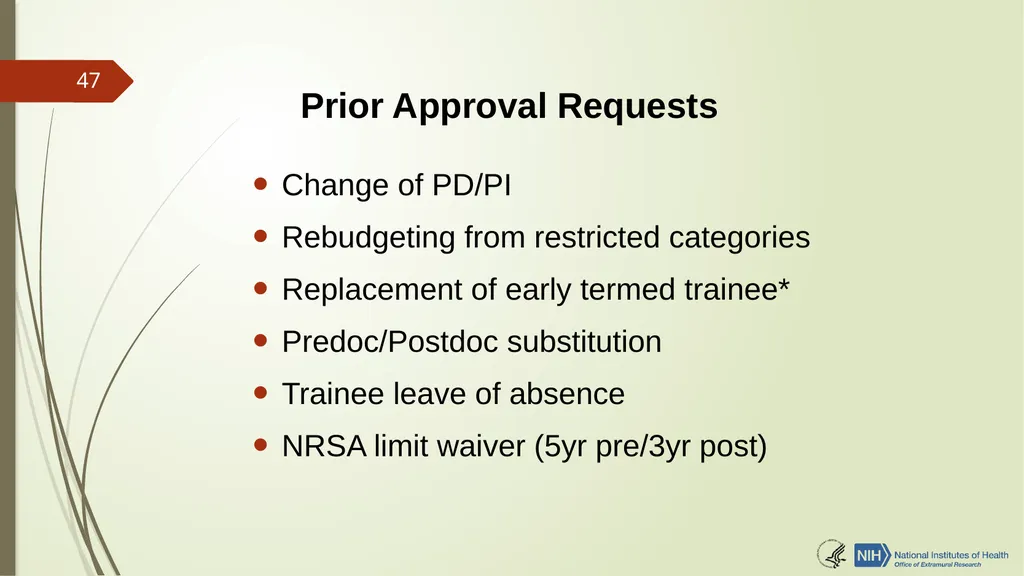
Prior Approval Requests Change of PD/PI
Rebudgeting from restricted categories
Replacement of early termed trainee*
Predoc/Postdoc substitution
Trainee leave of absence
NRSA limit waiver (5yr pre/3yr post) 47<br>
Rebudgeting from restricted categories
Replacement of early termed trainee*
Predoc/Postdoc substitution
Trainee leave of absence
NRSA limit waiver (5yr pre/3yr post) 47<br>
48
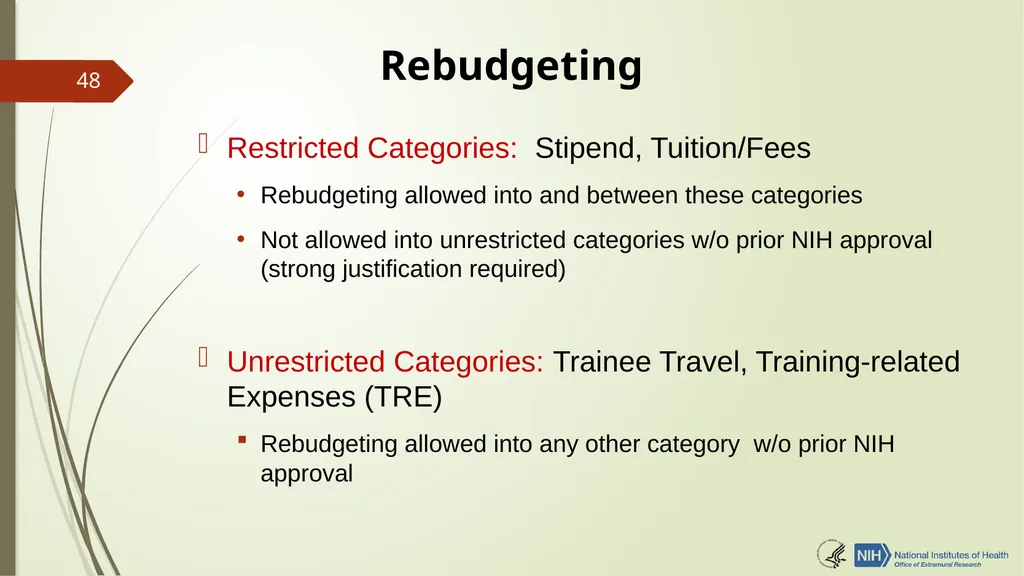
Rebudgeting Restricted Categories: Stipend, Tuition/Fees
Rebudgeting allowed into and between these categories
Not allowed into unrestricted categories w/o prior NIH approval (strong justification required)
Unrestricted Categories: Trainee Travel, Training-related Expenses (TRE)
Rebudgeting allowed into any other category w/o prior NIH approval 48<br>
Rebudgeting allowed into and between these categories
Not allowed into unrestricted categories w/o prior NIH approval (strong justification required)
Unrestricted Categories: Trainee Travel, Training-related Expenses (TRE)
Rebudgeting allowed into any other category w/o prior NIH approval 48<br>
49
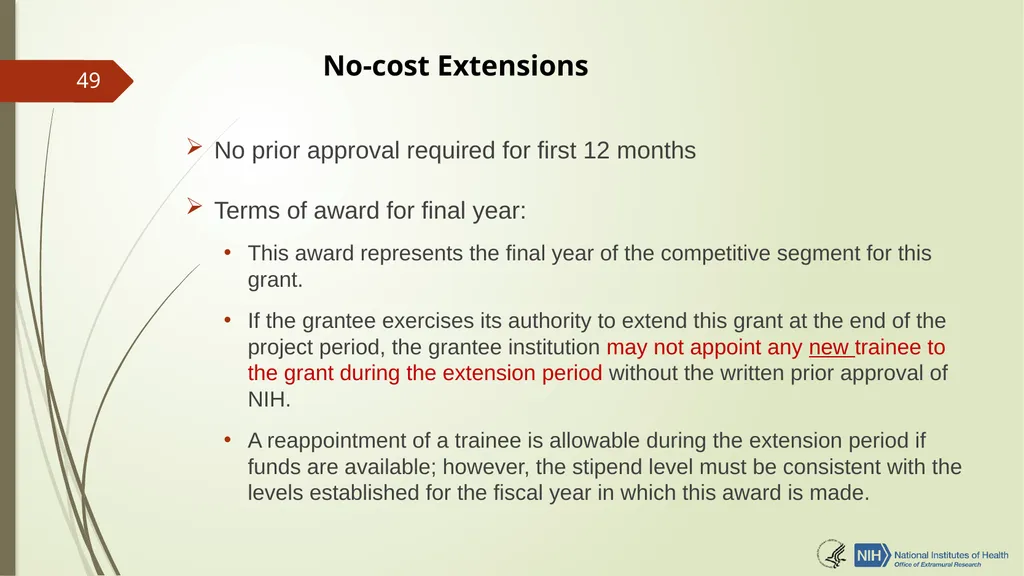
No-cost Extensions No prior approval required for first 12 months
Terms of award for final year:
This award represents the final year of the competitive segment for this grant.
If the grantee exercises its authority to extend this grant at the end of the project period, the grantee institution may not appoint any new trainee to the grant during the extension period without the written prior approval of NIH.
A reappointment of a trainee is allowable during the extension period if funds are available; however, the stipend level must be consistent with the levels established for the fiscal year in which this award is made. 49<br>
Terms of award for final year:
This award represents the final year of the competitive segment for this grant.
If the grantee exercises its authority to extend this grant at the end of the project period, the grantee institution may not appoint any new trainee to the grant during the extension period without the written prior approval of NIH.
A reappointment of a trainee is allowable during the extension period if funds are available; however, the stipend level must be consistent with the levels established for the fiscal year in which this award is made. 49<br>
50
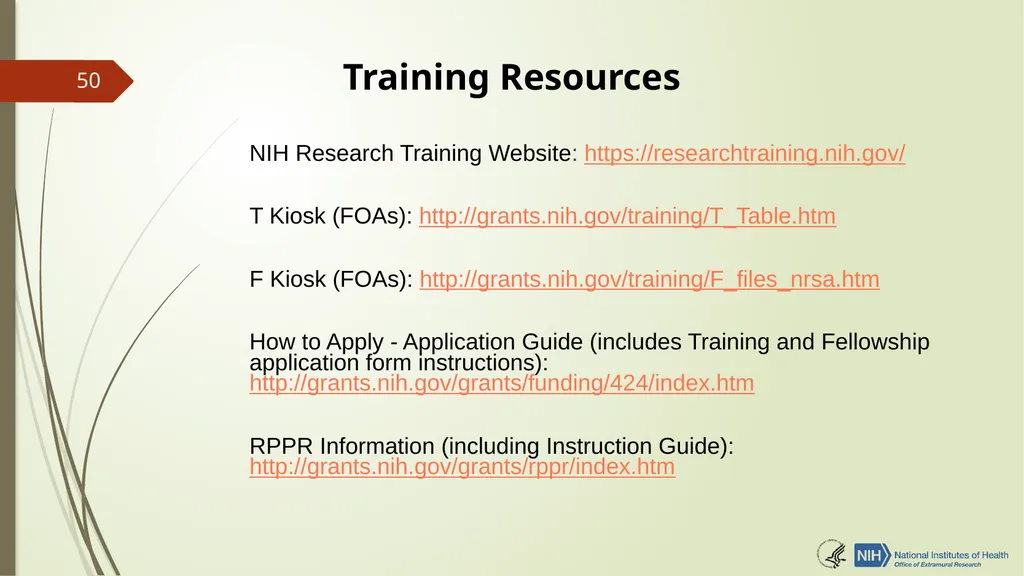
Training Resources NIH Research Training Website: https://researchtraining.nih.gov/
T Kiosk (FOAs): http://grants.nih.gov/training/T_Table.htm
F Kiosk (FOAs): http://grants.nih.gov/training/F_files_nrsa.htm
How to Apply - Application Guide (includes Training and Fellowship application form instructions): http://grants.nih.gov/grants/funding/424/index.htm
RPPR Information (including Instruction Guide): http://grants.nih.gov/grants/rppr/index.htm 50<br>
T Kiosk (FOAs): http://grants.nih.gov/training/T_Table.htm
F Kiosk (FOAs): http://grants.nih.gov/training/F_files_nrsa.htm
How to Apply - Application Guide (includes Training and Fellowship application form instructions): http://grants.nih.gov/grants/funding/424/index.htm
RPPR Information (including Instruction Guide): http://grants.nih.gov/grants/rppr/index.htm 50<br>
51
Grants Information: Contacts 51 General Application Questions:
E-Mail: GrantsInfo@nih.gov
Phone: 301-945-7573
Grants.gov Customer Support:
E-Mail: support@grants.gov
Webpage: http://grants.gov/
Phone: 1-800-518-4726
eRA Service Desk (formerly eRA Commons Helpdesk):
Web: https://grants.nih.gov/support/index.html
Toll-free: 1-866-504-9552
Phone: 301-402-7469
Hours: Mon-Fri, 7a.m. to 8 p.m. Eastern Time<br>
E-Mail: GrantsInfo@nih.gov
Phone: 301-945-7573
Grants.gov Customer Support:
E-Mail: support@grants.gov
Webpage: http://grants.gov/
Phone: 1-800-518-4726
eRA Service Desk (formerly eRA Commons Helpdesk):
Web: https://grants.nih.gov/support/index.html
Toll-free: 1-866-504-9552
Phone: 301-402-7469
Hours: Mon-Fri, 7a.m. to 8 p.m. Eastern Time<br>
52
Grants Policy Contacts 52 Division of Grants Policy:
E-Mail: GrantsPolicy@mail.nih.gov
Phone: 301-435-0949
Division of Grants Compliance & Oversight:
E-Mail: GrantsCompliance@mail.nih.gov
Phone: 301-435-0949
Division of Extramural Inventions and Technology Resources:
E-Mail: Inventions@nih.gov
Phone: 301-435-1986<br>
E-Mail: GrantsPolicy@mail.nih.gov
Phone: 301-435-0949
Division of Grants Compliance & Oversight:
E-Mail: GrantsCompliance@mail.nih.gov
Phone: 301-435-0949
Division of Extramural Inventions and Technology Resources:
E-Mail: Inventions@nih.gov
Phone: 301-435-1986<br>
53
Resources for Applicants NIH Program Announcements (PAs, RFAs)
Purpose, eligibility, allowable costs, review criteria
Tables of IC-specific Information, Requirements, & Staff Contacts
www.nih.gov (follow links to “training” or “peer review”)
Office of Extramural Research (“OER” grant programs, forms)
Center for Scientific Review: www.csr.nih.gov (review process)
Institute web sites: www.nichd.nih.gov (program interests)
Mentor (current and/or proposed)
Department Chair or Administrator
University/School Sponsored Programs Office
Other colleagues & faculty
NIH Program Staff (before applying and after review) !!<br>
Purpose, eligibility, allowable costs, review criteria
Tables of IC-specific Information, Requirements, & Staff Contacts
www.nih.gov (follow links to “training” or “peer review”)
Office of Extramural Research (“OER” grant programs, forms)
Center for Scientific Review: www.csr.nih.gov (review process)
Institute web sites: www.nichd.nih.gov (program interests)
Mentor (current and/or proposed)
Department Chair or Administrator
University/School Sponsored Programs Office
Other colleagues & faculty
NIH Program Staff (before applying and after review) !!<br>
54
Contacts Dennis A. Twombly
Training Officer, NICHD-NIH
Email: dennis.twombly@nih.gov
Lisa Moeller
Team Leader, Grants Administration Branch, NIGMS-NIH
Email: moellerl@mail.nih.gov
NICHD Website: (Includes program, review, policy contacts)
http://www.nichd.nih.gov/<br>
Training Officer, NICHD-NIH
Email: dennis.twombly@nih.gov
Lisa Moeller
Team Leader, Grants Administration Branch, NIGMS-NIH
Email: moellerl@mail.nih.gov
NICHD Website: (Includes program, review, policy contacts)
http://www.nichd.nih.gov/<br>