
Understanding the “big(ger)”picture: Systems
LO
Published · 26 slides · 0 views
1 / 1
Description
Understanding the big(ger)picture: Systems thinking for digital health in a global context Sundeep Sahay Learning objectives What is the phenomenon you will study in the Masters programme? What is a system and systems thinking? Why this
Related Topics
Share
Embed code
Download this presentation From Below
"Understanding the “big(ger)”picture: Systems" is the property of its rightful owner. Permission is granted to download and print the materials on this website for personal, non-commercial use only, and to display it on your personal computer provided you do not modify the materials and that you retain all copyright notices contained in the materials. By downloading content from our website, you accept the terms of this agreement.
Presentation Transcript
01
Understanding the “big(ger)”picture: Systems thinking for digital health in a global context Sundeep Sahay<br>
02
Learning objectives What is the phenomenon you will study in the Masters programme?
What is a system and systems thinking?
Why this conceptualization is relevant and important for the study of digital global health?
What are some key concepts in systems thinking ?
Applying systems thinking to an underlying complex challenge in digital global health?”
Providing some foundational concepts for your Masters study<br>
What is a system and systems thinking?
Why this conceptualization is relevant and important for the study of digital global health?
What are some key concepts in systems thinking ?
Applying systems thinking to an underlying complex challenge in digital global health?”
Providing some foundational concepts for your Masters study<br>
03
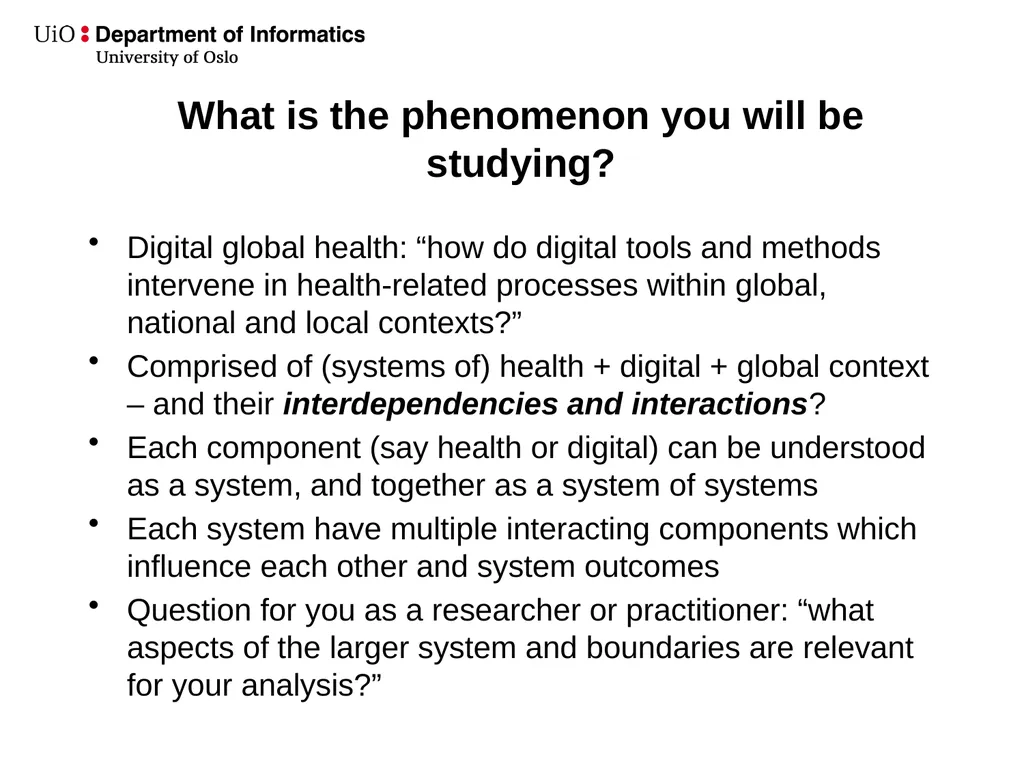
What is the phenomenon you will be studying? Digital global health: “how do digital tools and methods intervene in health-related processes within global, national and local contexts?”
Comprised of (systems of) health + digital + global context – and their interdependencies and interactions?
Each component (say health or digital) can be understood as a system, and together as a system of systems
Each system have multiple interacting components which influence each other and system outcomes
Question for you as a researcher or practitioner: “what aspects of the larger system and boundaries are relevant for your analysis?”<br>
Comprised of (systems of) health + digital + global context – and their interdependencies and interactions?
Each component (say health or digital) can be understood as a system, and together as a system of systems
Each system have multiple interacting components which influence each other and system outcomes
Question for you as a researcher or practitioner: “what aspects of the larger system and boundaries are relevant for your analysis?”<br>
04
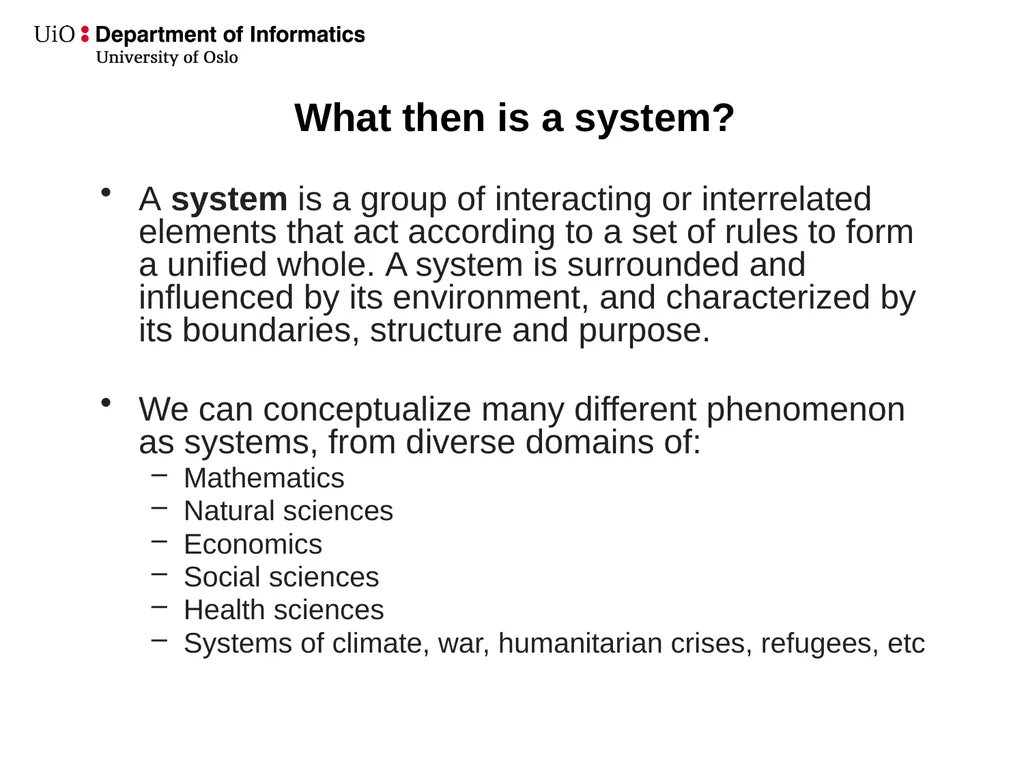
What then is a system? A system is a group of interacting or interrelated elements that act according to a set of rules to form a unified whole. A system is surrounded and influenced by its environment, and characterized by its boundaries, structure and purpose.
We can conceptualize many different phenomenon as systems, from diverse domains of:
Mathematics
Natural sciences
Economics
Social sciences
Health sciences
Systems of climate, war, humanitarian crises, refugees, etc<br>
We can conceptualize many different phenomenon as systems, from diverse domains of:
Mathematics
Natural sciences
Economics
Social sciences
Health sciences
Systems of climate, war, humanitarian crises, refugees, etc<br>
05
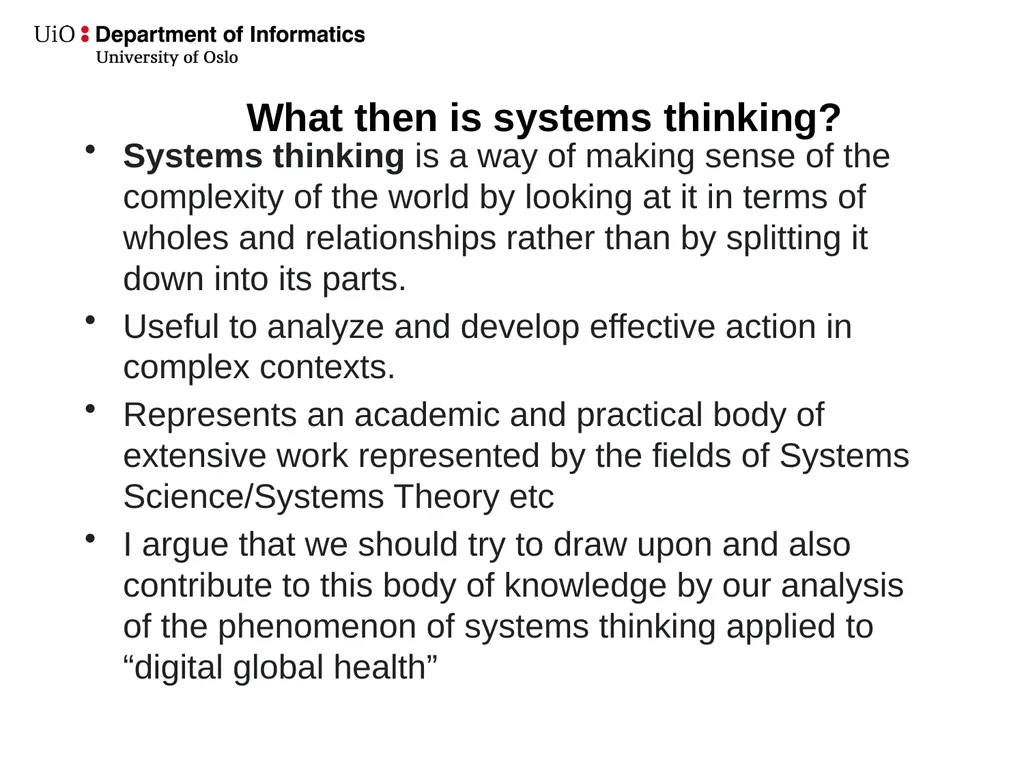
What then is systems thinking? Systems thinking is a way of making sense of the complexity of the world by looking at it in terms of wholes and relationships rather than by splitting it down into its parts.
Useful to analyze and develop effective action in complex contexts.
Represents an academic and practical body of extensive work represented by the fields of Systems Science/Systems Theory etc
I argue that we should try to draw upon and also contribute to this body of knowledge by our analysis of the phenomenon of systems thinking applied to “digital global health”<br>
Useful to analyze and develop effective action in complex contexts.
Represents an academic and practical body of extensive work represented by the fields of Systems Science/Systems Theory etc
I argue that we should try to draw upon and also contribute to this body of knowledge by our analysis of the phenomenon of systems thinking applied to “digital global health”<br>
06
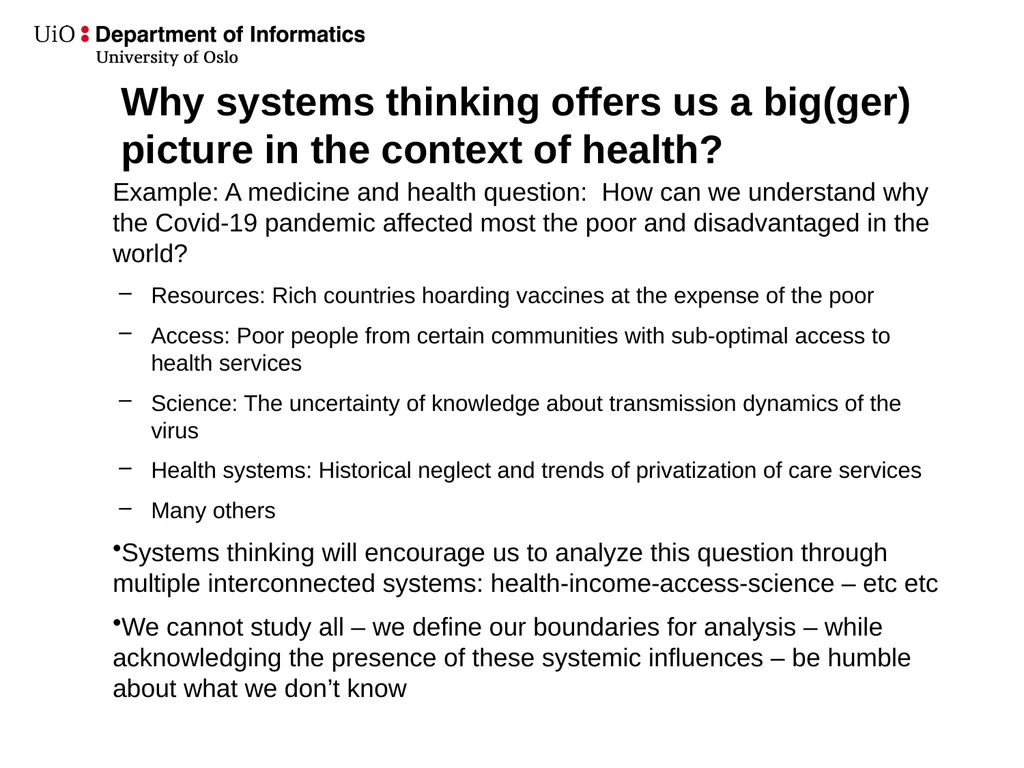
Why systems thinking offers us a big(ger) picture in the context of health? Example: A medicine and health question: How can we understand why the Covid-19 pandemic affected most the poor and disadvantaged in the world?
Resources: Rich countries hoarding vaccines at the expense of the poor
Access: Poor people from certain communities with sub-optimal access to health services
Science: The uncertainty of knowledge about transmission dynamics of the virus
Health systems: Historical neglect and trends of privatization of care services
Many others
Systems thinking will encourage us to analyze this question through multiple interconnected systems: health-income-access-science – etc etc
We cannot study all – we define our boundaries for analysis – while acknowledging the presence of these systemic influences – be humble about what we don’t know<br>
Resources: Rich countries hoarding vaccines at the expense of the poor
Access: Poor people from certain communities with sub-optimal access to health services
Science: The uncertainty of knowledge about transmission dynamics of the virus
Health systems: Historical neglect and trends of privatization of care services
Many others
Systems thinking will encourage us to analyze this question through multiple interconnected systems: health-income-access-science – etc etc
We cannot study all – we define our boundaries for analysis – while acknowledging the presence of these systemic influences – be humble about what we don’t know<br>
07
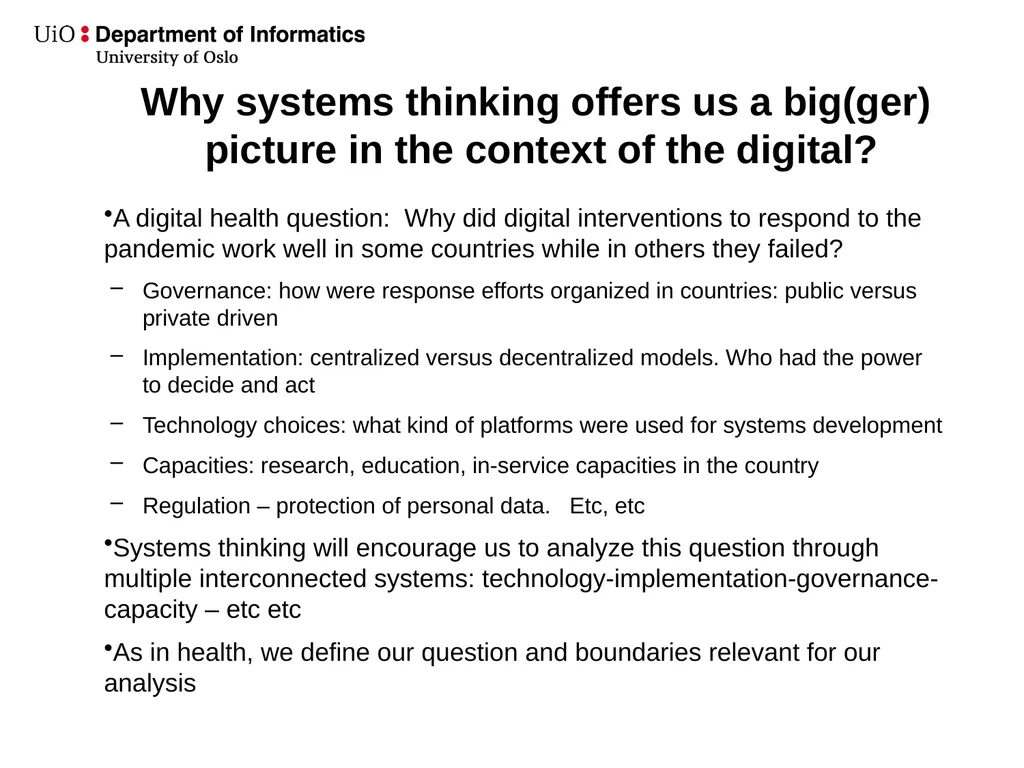
Why systems thinking offers us a big(ger) picture in the context of the digital? A digital health question: Why did digital interventions to respond to the pandemic work well in some countries while in others they failed?
Governance: how were response efforts organized in countries: public versus private driven
Implementation: centralized versus decentralized models. Who had the power to decide and act
Technology choices: what kind of platforms were used for systems development
Capacities: research, education, in-service capacities in the country
Regulation – protection of personal data. Etc, etc
Systems thinking will encourage us to analyze this question through multiple interconnected systems: technology-implementation-governance-capacity – etc etc
As in health, we define our question and boundaries relevant for our analysis<br>
Governance: how were response efforts organized in countries: public versus private driven
Implementation: centralized versus decentralized models. Who had the power to decide and act
Technology choices: what kind of platforms were used for systems development
Capacities: research, education, in-service capacities in the country
Regulation – protection of personal data. Etc, etc
Systems thinking will encourage us to analyze this question through multiple interconnected systems: technology-implementation-governance-capacity – etc etc
As in health, we define our question and boundaries relevant for our analysis<br>
08
Linking health-digital-global: System of systems Complexity is enhanced manifold
Framing of “system of systems” helps unpack this complexity
System of systems is a collection of task-oriented or dedicated systems that pool their resources and capabilities together to create a new, more complex system which offers more functionality and performance than simply the sum of the constituent systems.
What is the added value which comes from the health-digital-global system of systems which we would not have got from a singular focus of these independent systems?<br>
Framing of “system of systems” helps unpack this complexity
System of systems is a collection of task-oriented or dedicated systems that pool their resources and capabilities together to create a new, more complex system which offers more functionality and performance than simply the sum of the constituent systems.
What is the added value which comes from the health-digital-global system of systems which we would not have got from a singular focus of these independent systems?<br>
09
Understanding what a system is Most important: A system is never “real”, existing in material terms, but only represents how we want to understand a phenomenon
University is an educational system
Care services are provided by the health system
Social services are shaped by the political system
In most basic terms, a system consists of different interacting sub-systems:
Input
Throughput
Output
Feedback
Environment
Their interactions and inter-relationships<br>
University is an educational system
Care services are provided by the health system
Social services are shaped by the political system
In most basic terms, a system consists of different interacting sub-systems:
Input
Throughput
Output
Feedback
Environment
Their interactions and inter-relationships<br>
10
Some key relevant concepts Complex Adaptive Systems (CAS)
Multiplicity – stakeholders, interests, disciplines, levels
Wicked problem
Unintended consequences
Leverage points
Mental maps (boundaries of analysis)
Rich picture<br>
Multiplicity – stakeholders, interests, disciplines, levels
Wicked problem
Unintended consequences
Leverage points
Mental maps (boundaries of analysis)
Rich picture<br>
11
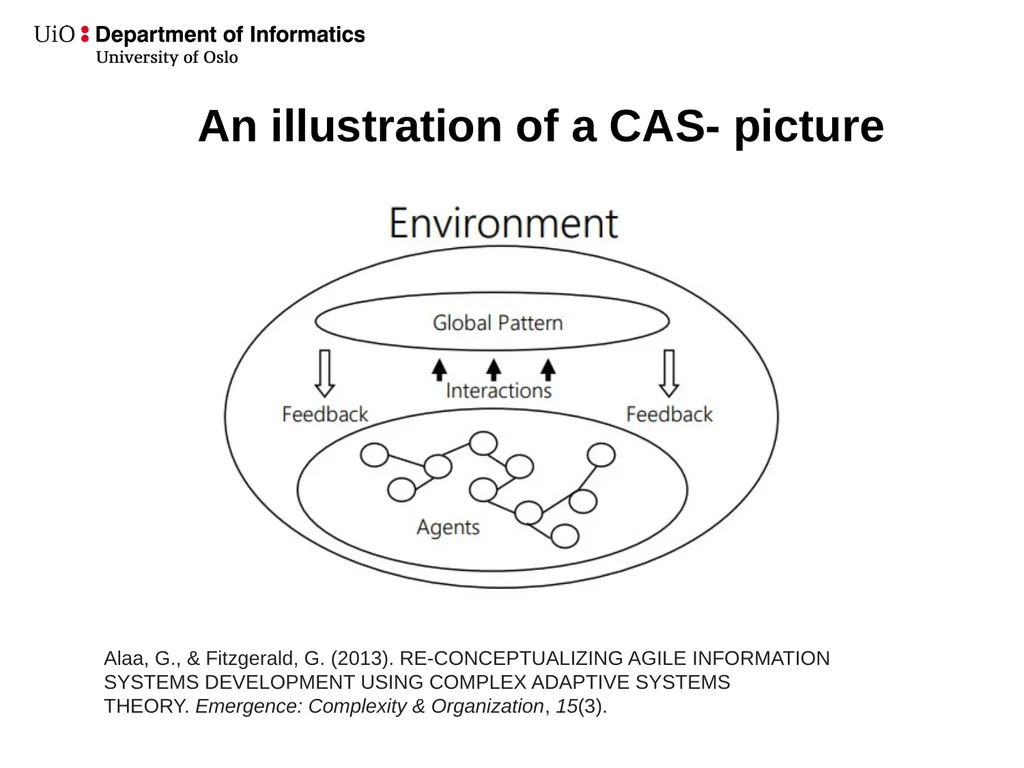
Complex adaptive systems (CAS) A complex adaptive system is a complex system comprised of a dynamic network of interactions, whose collective behavior cannot be predicted according to the behavior of its components. It is adaptive in that the individual and collective behavior mutate and self-organize corresponding to the change-initiating collection of events, which helps them to survive as a macro-structure.<br>
12
An illustration of a CAS- picture Alaa, G., & Fitzgerald, G. (2013). RE-CONCEPTUALIZING AGILE INFORMATION SYSTEMS DEVELOPMENT USING COMPLEX ADAPTIVE SYSTEMS THEORY. Emergence: Complexity & Organization, 15(3).<br>
13
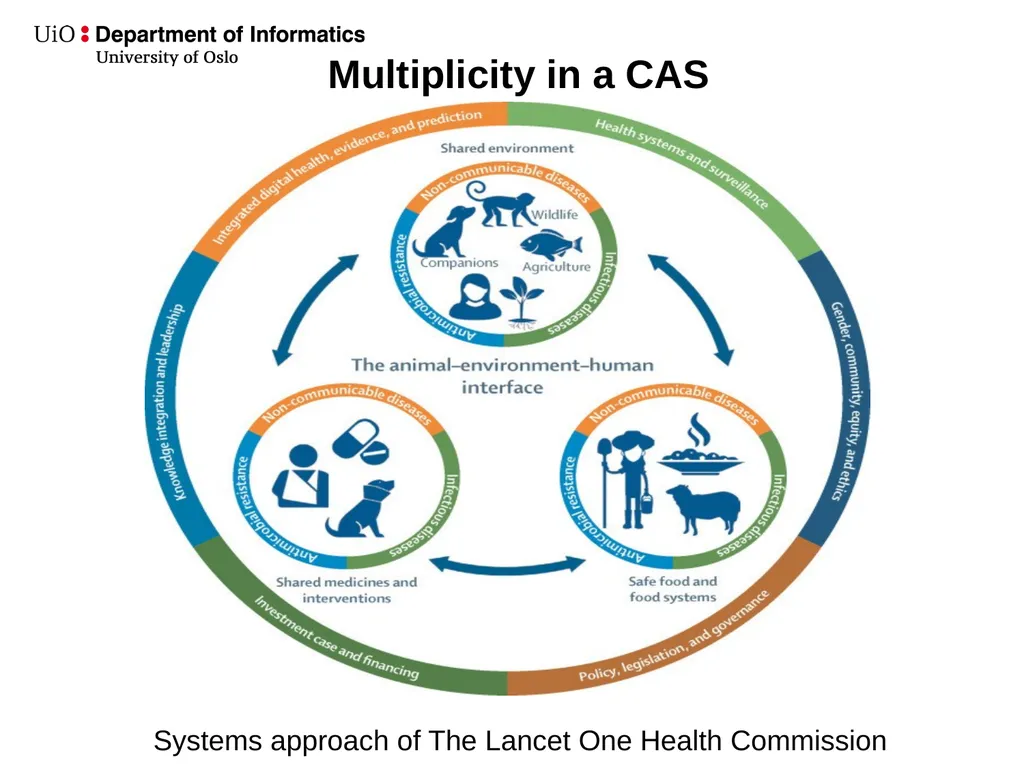
Multiplicity The applicability of multiple theoretical perspectives (theoretical multiplicity) as well as the existence of multiple configurations of relevant factors (configurational multiplicity) for a given theoretical perspective.
Interactions take place across multiple levels, involving multiple stakeholders with multiple interest<br>
Interactions take place across multiple levels, involving multiple stakeholders with multiple interest<br>
14
Multiplicity in a CAS Systems approach of The Lancet One Health Commission<br>
15
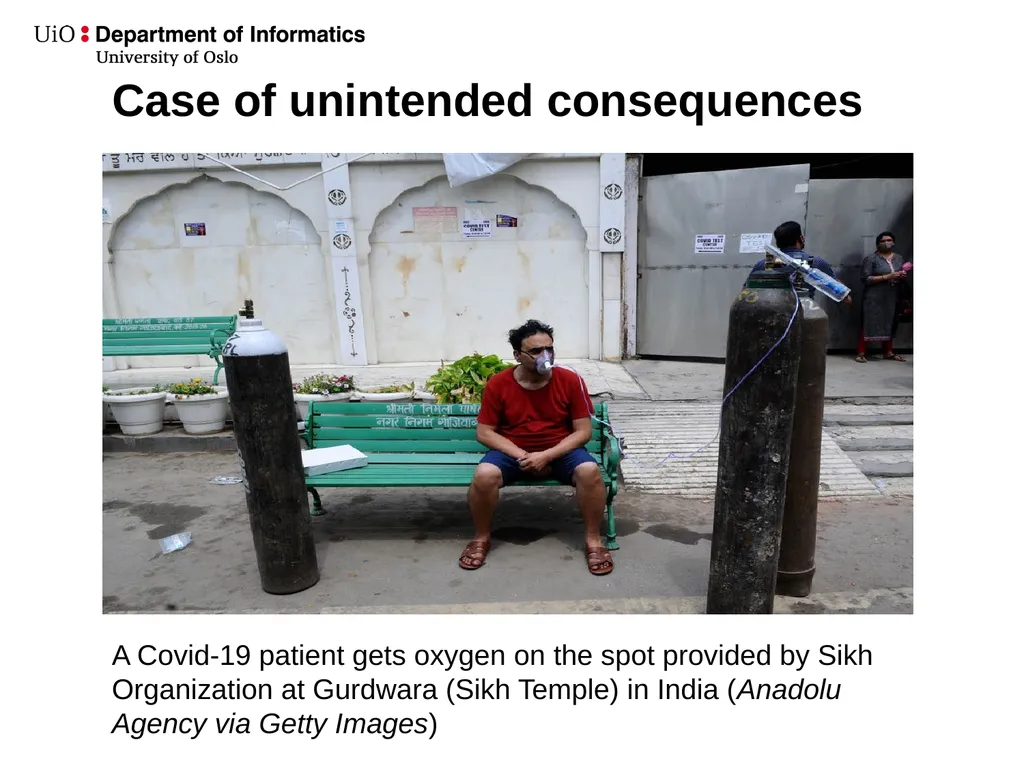
Unintended consequences Unintended consequences (sometimes called unanticipated consequences or unforeseen consequences) are outcomes of an action that are not intended or foreseen. Often, such consequences are undesirable.<br>
16
Wicked problem A problem comprised of multiple interacting relationships
Trying to find a solution in one part of the problem can lead to new problems in other parts of the problem
For example: the Russia-Ukraine war, a military and political problem, leads to large-scale refugee crisis, and in European countries debates around immigration policy 11. april 2011 Ny Powerpoint mal 2011 17<br>
Trying to find a solution in one part of the problem can lead to new problems in other parts of the problem
For example: the Russia-Ukraine war, a military and political problem, leads to large-scale refugee crisis, and in European countries debates around immigration policy 11. april 2011 Ny Powerpoint mal 2011 17<br>
17
Case of unintended consequences A Covid-19 patient gets oxygen on the spot provided by Sikh Organization at Gurdwara (Sikh Temple) in India (Anadolu Agency via Getty Images)<br>
18
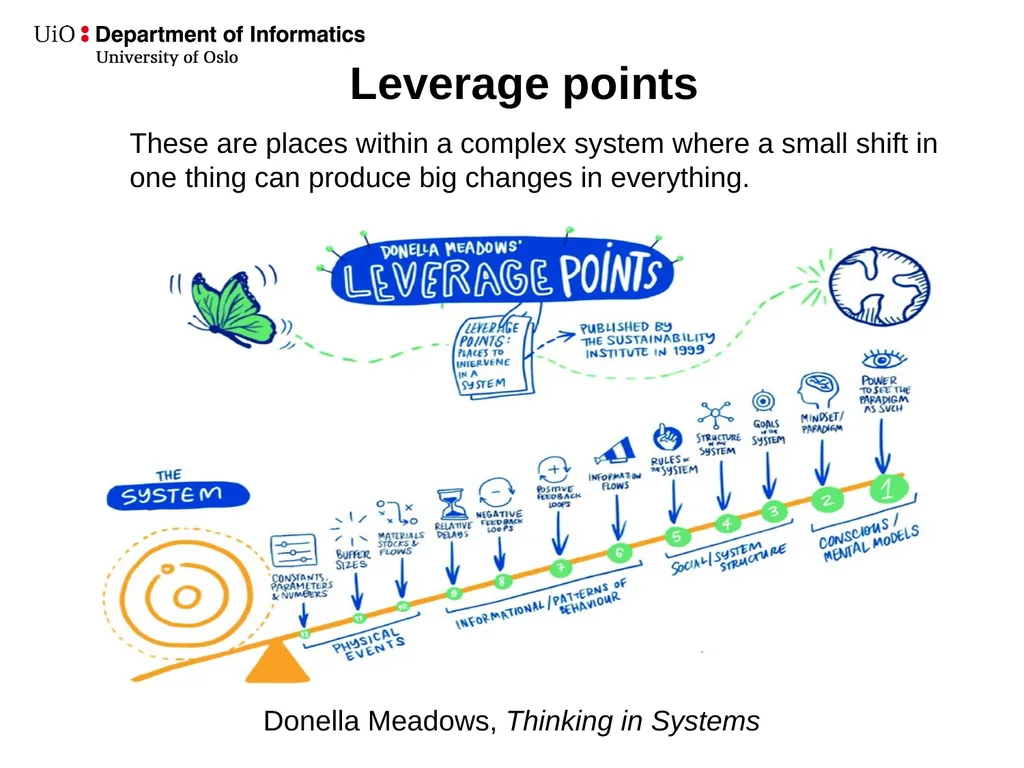
Leverage points These are places within a complex system where a small shift in one thing can produce big changes in everything. Donella Meadows, Thinking in Systems<br>
19
Mental maps (boundaries of analysis) Mental maps are used to visualize and analyse the factors that make up a system.
Mental map analyses are widely used in understanding the level of perception of individuals regarding the surrounding environment.<br>
Mental map analyses are widely used in understanding the level of perception of individuals regarding the surrounding environment.<br>
20
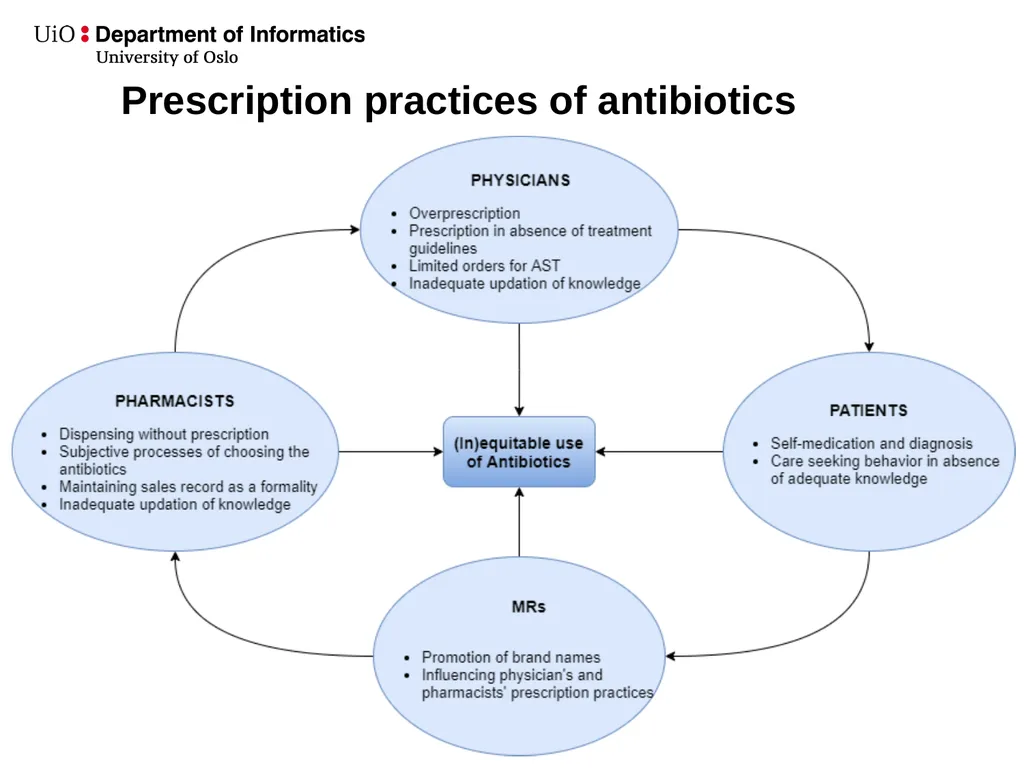
Prescription practices of antibiotics<br>
21
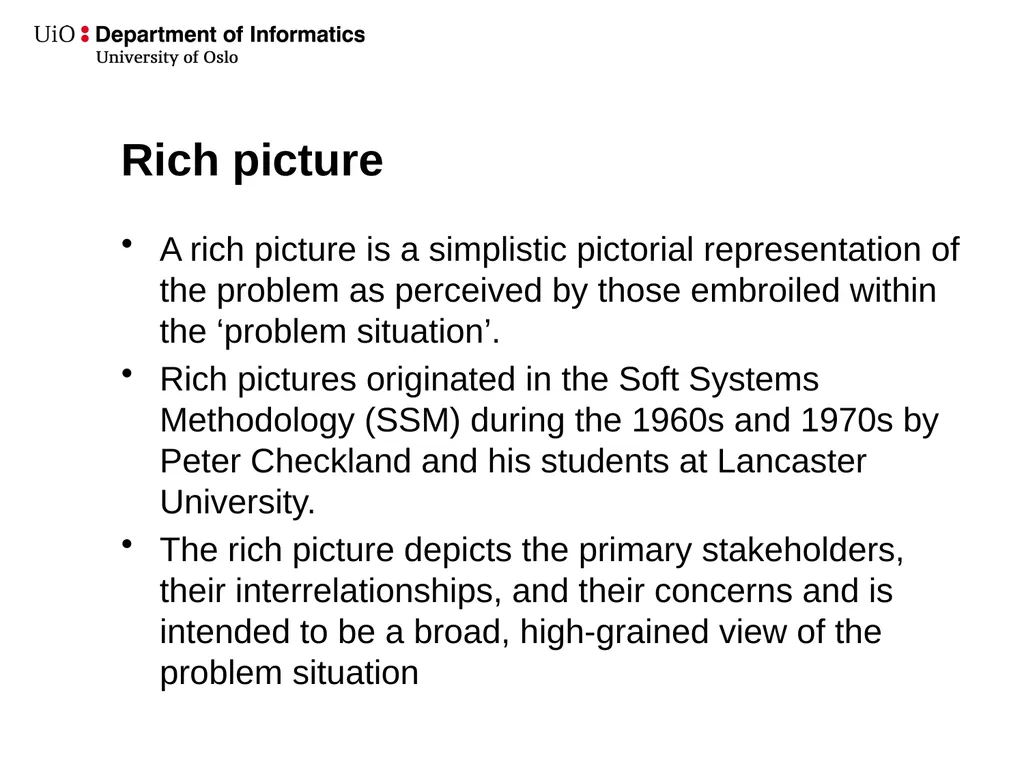
Rich picture A rich picture is a simplistic pictorial representation of the problem as perceived by those embroiled within the ‘problem situation’.
Rich pictures originated in the Soft Systems Methodology (SSM) during the 1960s and 1970s by Peter Checkland and his students at Lancaster University.
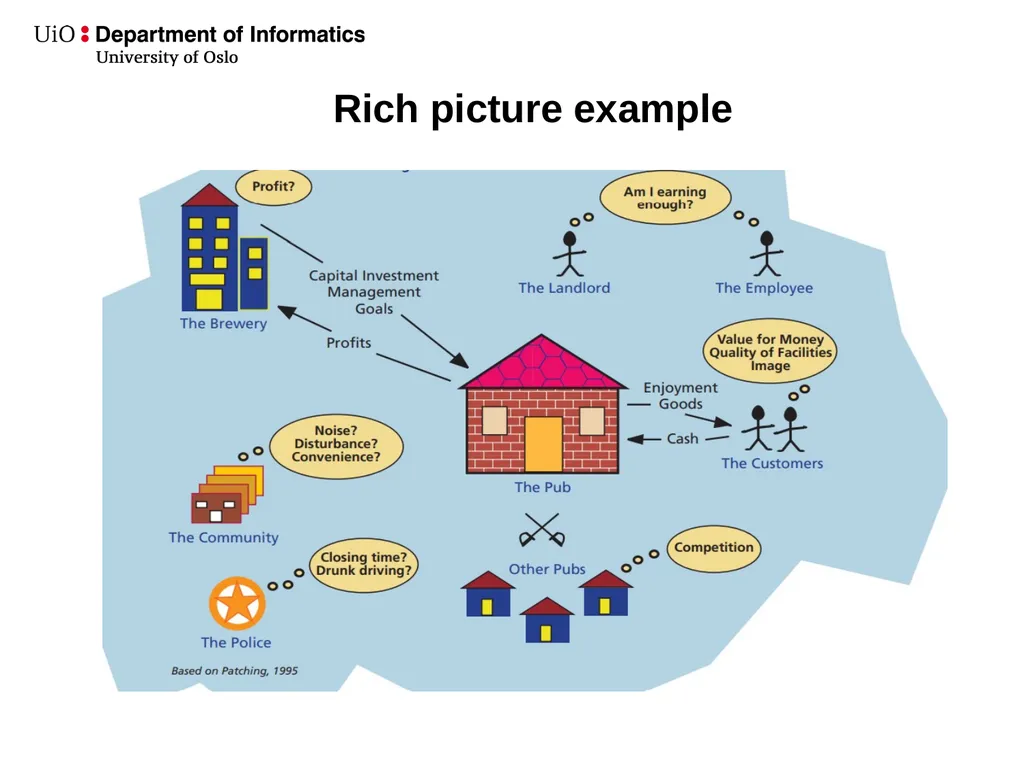
The rich picture depicts the primary stakeholders, their interrelationships, and their concerns and is intended to be a broad, high-grained view of the problem situation<br>
Rich pictures originated in the Soft Systems Methodology (SSM) during the 1960s and 1970s by Peter Checkland and his students at Lancaster University.
The rich picture depicts the primary stakeholders, their interrelationships, and their concerns and is intended to be a broad, high-grained view of the problem situation<br>
22
Rich picture example<br>
23
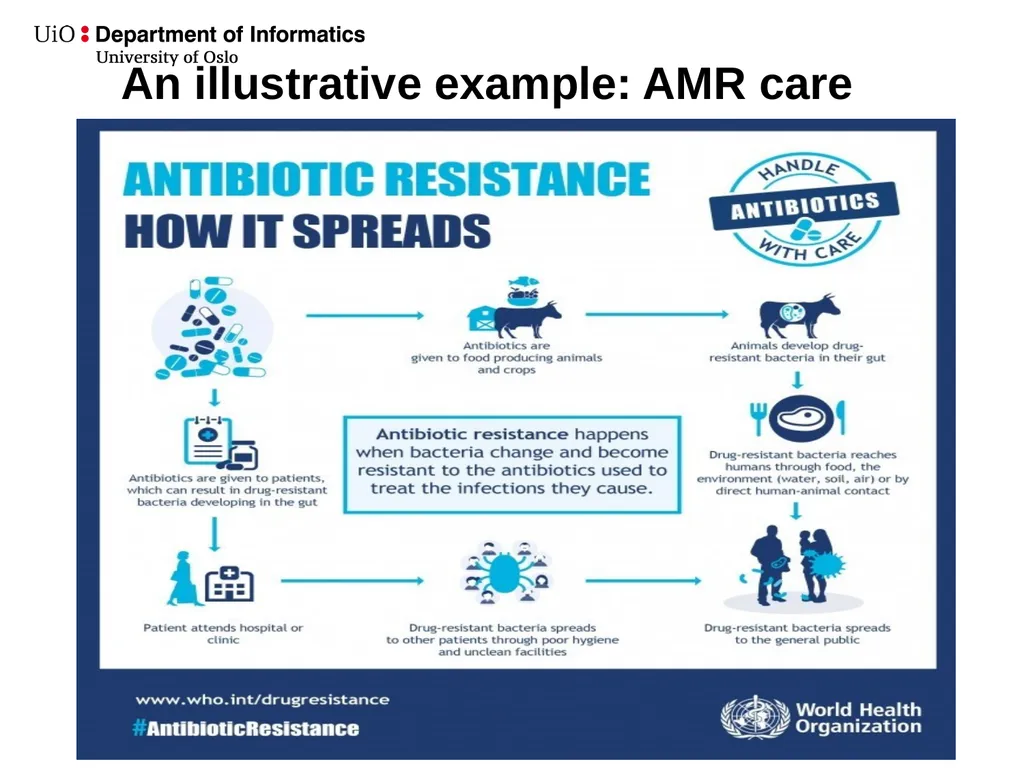
An illustrative example: AMR care<br>
24
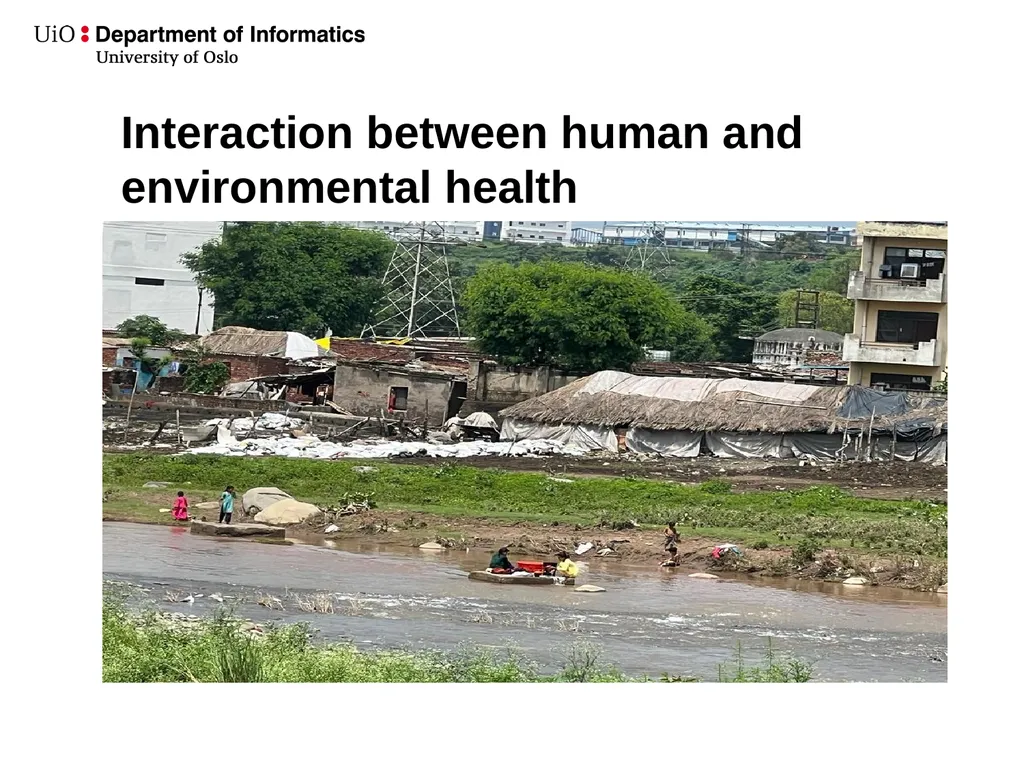
Interaction between human and environmental health<br>
25
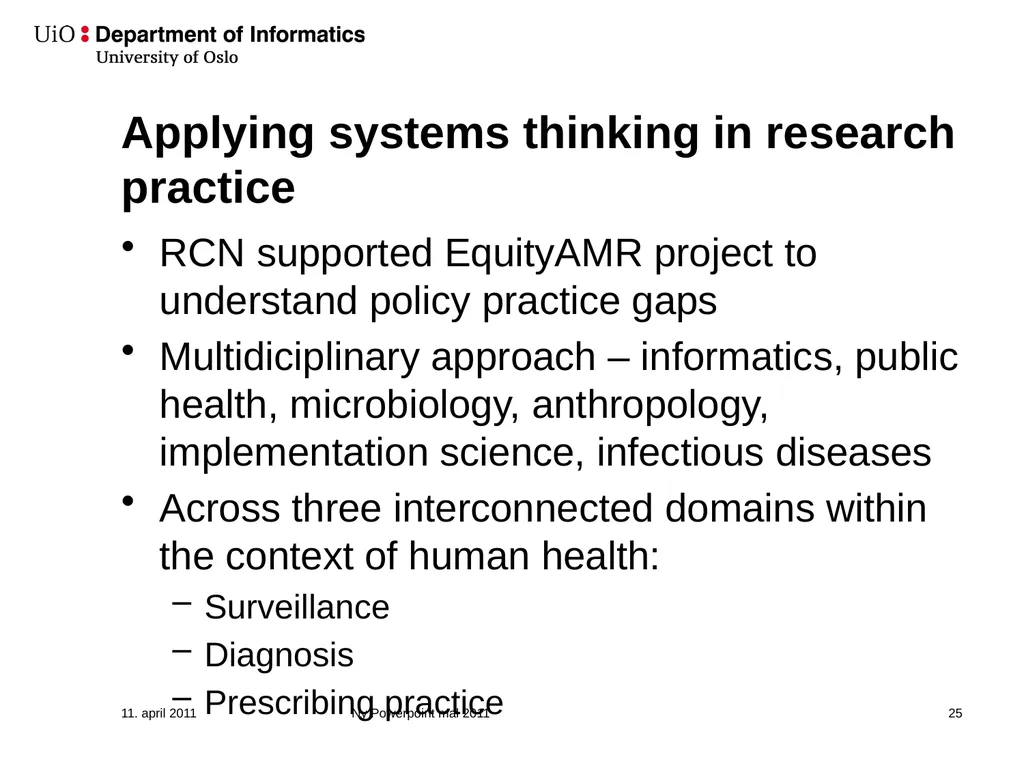
Applying systems thinking in research practice RCN supported EquityAMR project to understand policy practice gaps
Multidiciplinary approach – informatics, public health, microbiology, anthropology, implementation science, infectious diseases
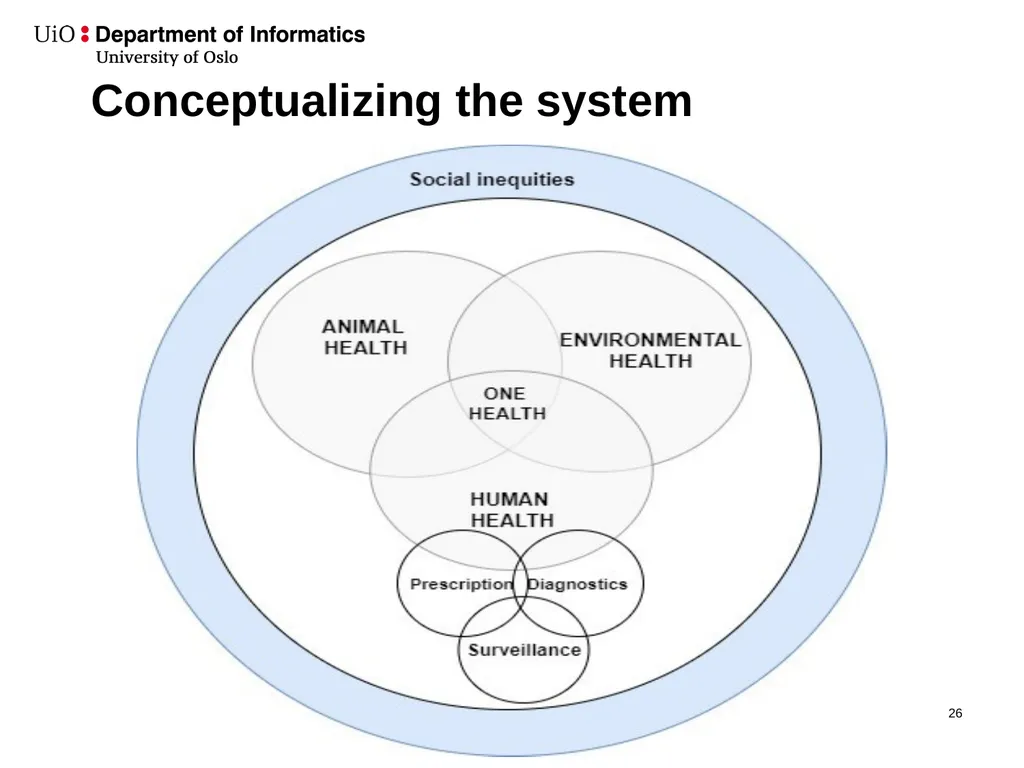
Across three interconnected domains within the context of human health:
Surveillance
Diagnosis
Prescribing practice 11. april 2011 Ny Powerpoint mal 2011 26<br>
Multidiciplinary approach – informatics, public health, microbiology, anthropology, implementation science, infectious diseases
Across three interconnected domains within the context of human health:
Surveillance
Diagnosis
Prescribing practice 11. april 2011 Ny Powerpoint mal 2011 26<br>
26
Conceptualizing the system 27<br>