Understanding the Impacts of Mistrust and
Description: Understanding the Impacts of Mistrust and Disinformation Canadian Experiences with the Probit Panel By Frank Graves Presentation to CIPHER February 26-28, 2025 Shifting challenges in maintaining demographic and psychographic
Related Topics
Download Presentation
"Understanding the Impacts of Mistrust and" is the property of its rightful owner. Permission is granted to download and print the materials on this website for personal, non-commercial use only, and to display it on your personal computer provided you do not modify the materials and that you retain all copyright notices contained in the materials. By downloading content from our website, you accept the terms of this agreement.
Presentation Transcript
slide1. Understanding the Impacts of Mistrust and DisinformationCanadian Experiences with the Probit PanelBy Frank GravesPresentation to CIPHERFebruary 26-28, 2025<br>
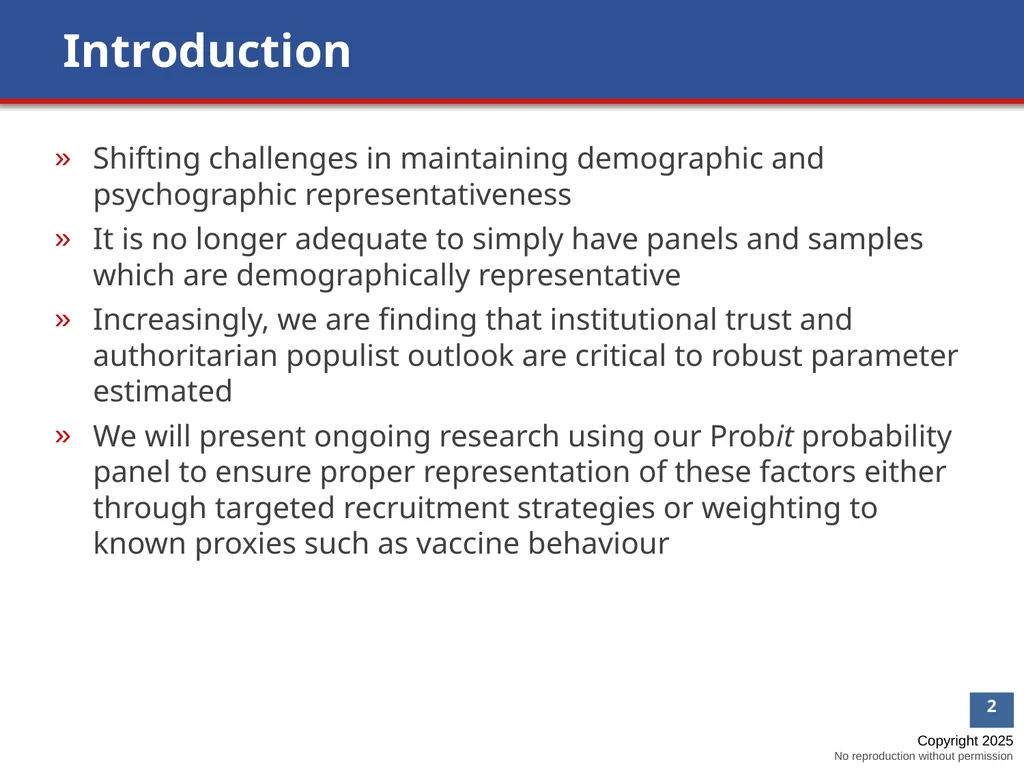
slide2. Shifting challenges in maintaining demographic and psychographic representativeness
It is no longer adequate to simply have panels and samples which are demographically representative
Increasingly, we are finding that institutional trust and authoritarian populist outlook are critical to robust parameter estimated
We will present ongoing research using our Probit probability panel to ensure proper representation of these factors either through targeted recruitment strategies or weighting to known proxies such as vaccine behaviour Introduction<br>
slide3. For better or worse, political polling principal yardstick used to evaluate survey accuracy
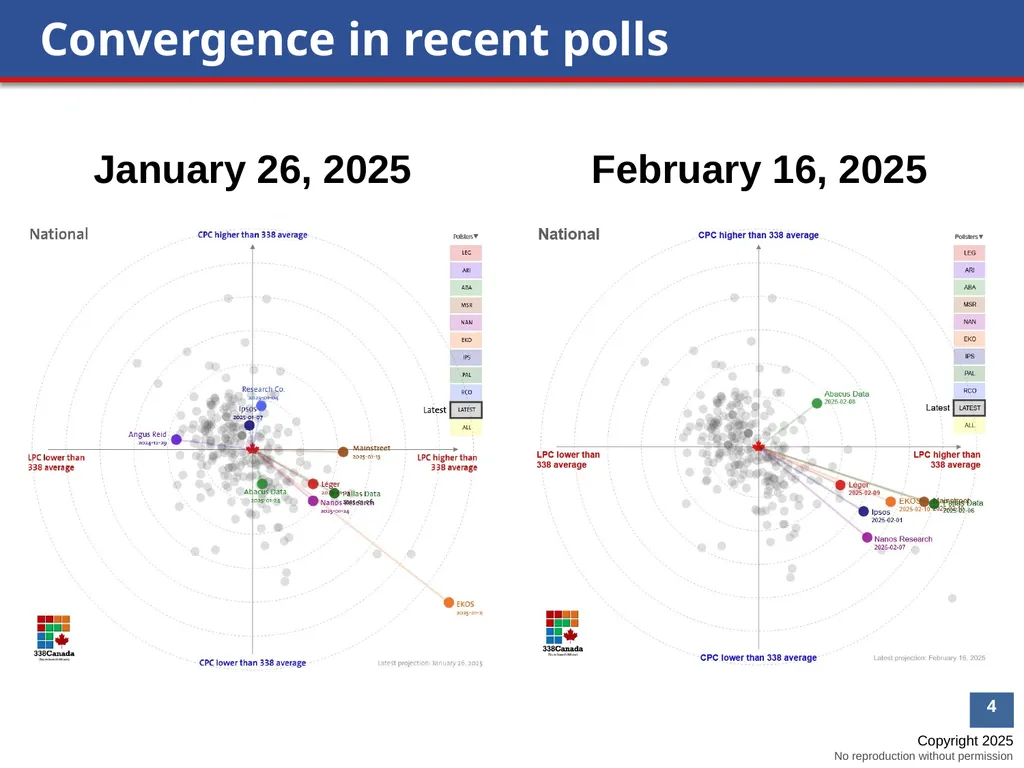
Massive shifts in political landscape in recent weeks (Trump effect)
Our polling considered an outlier, treated with deep skepticism
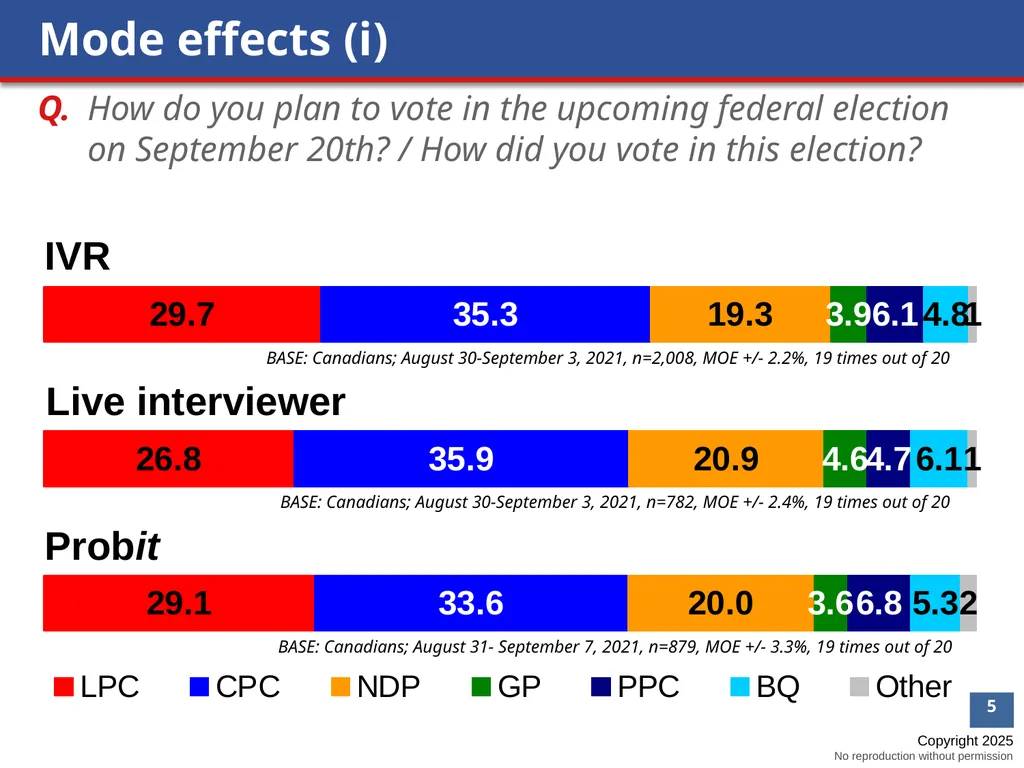
Pundit view was that differences were due to mode effects (i.e., phone versus online)
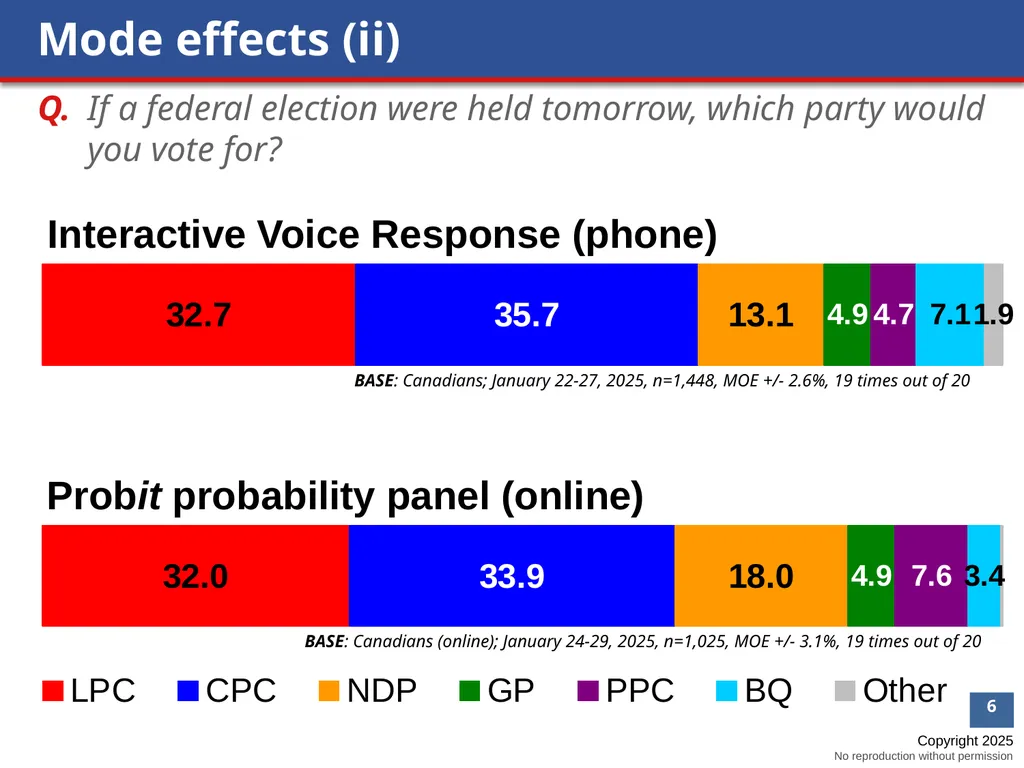
However, IVR and Probit produce the same results in our election polling
IVR (and live interviewer) primary intake method for Probit
The notion that differences between pollsters are due to phone versus online is not borne out by the evidence
Rather, the cause is probability vs. non-probability
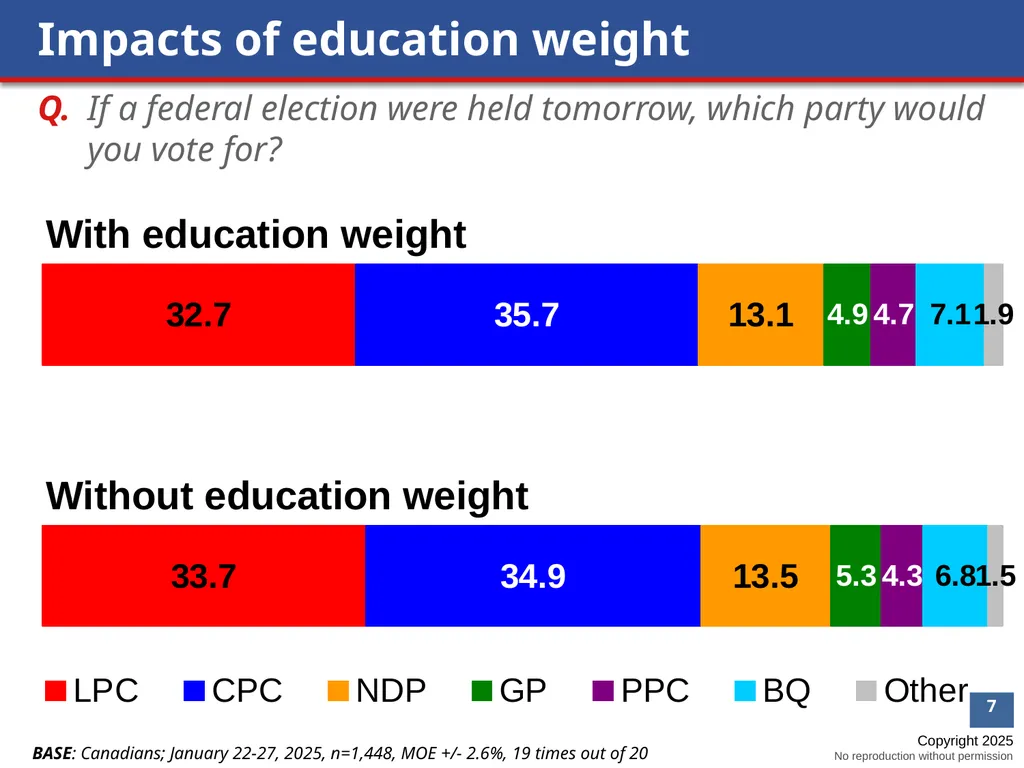
Overrepresentation of university-educated Canadians a blend of sampling and measurement issues Election polling (i)<br>
slide4. Convergence in recent polls January 26, 2025 February 16, 2025<br>
slide5. Mode effects (i) Q. How do you plan to vote in the upcoming federal election on September 20th? / How did you vote in this election? IVR BASE: Canadians; August 30-September 3, 2021, n=2,008, MOE +/- 2.2%, 19 times out of 20 Probit BASE: Canadians; August 30-September 3, 2021, n=782, MOE +/- 2.4%, 19 times out of 20 BASE: Canadians; August 31- September 7, 2021, n=879, MOE +/- 3.3%, 19 times out of 20 Live interviewer<br>
slide6. Mode effects (ii) Q. If a federal election were held tomorrow, which party would you vote for? Interactive Voice Response (phone) Probit probability panel (online) BASE: Canadians (online); January 24-29, 2025, n=1,025, MOE +/- 3.1%, 19 times out of 20 BASE: Canadians; January 22-27, 2025, n=1,448, MOE +/- 2.6%, 19 times out of 20<br>
slide7. Impacts of education weight Q. If a federal election were held tomorrow, which party would you vote for? With education weight Without education weight BASE: Canadians; January 22-27, 2025, n=1,448, MOE +/- 2.6%, 19 times out of 20<br>
slide8. Results reveal intense polarization around disinformation
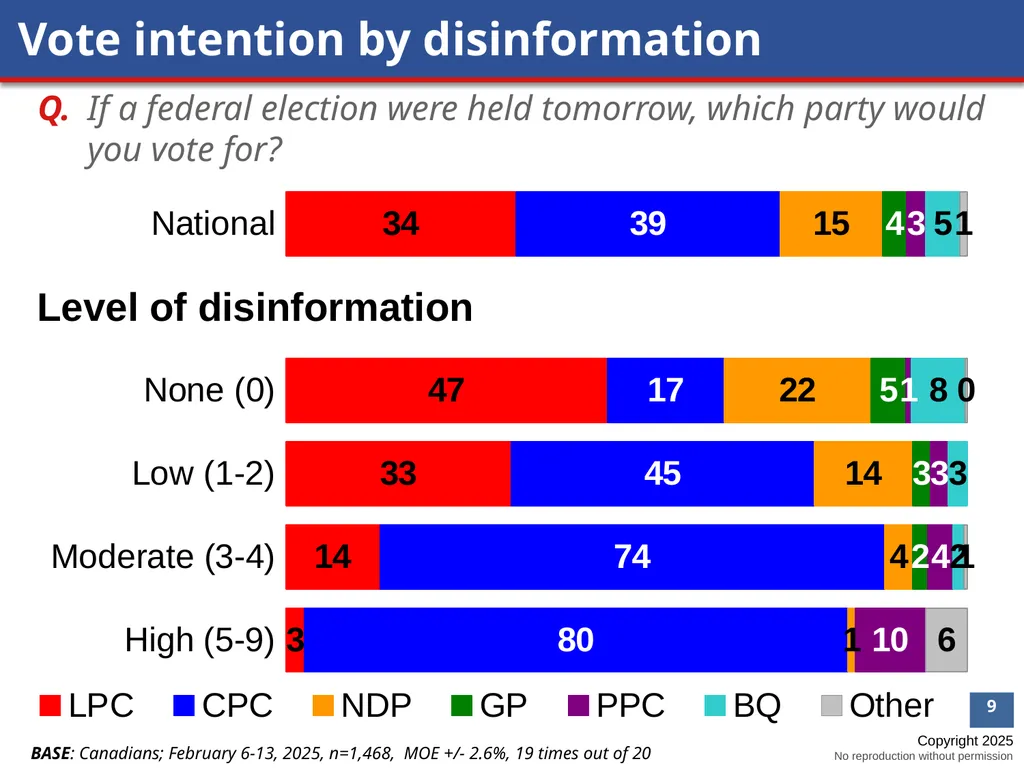
While ordered populism has been a critical feature reshaping voter landscapes over past decade, disinformation even more powerful
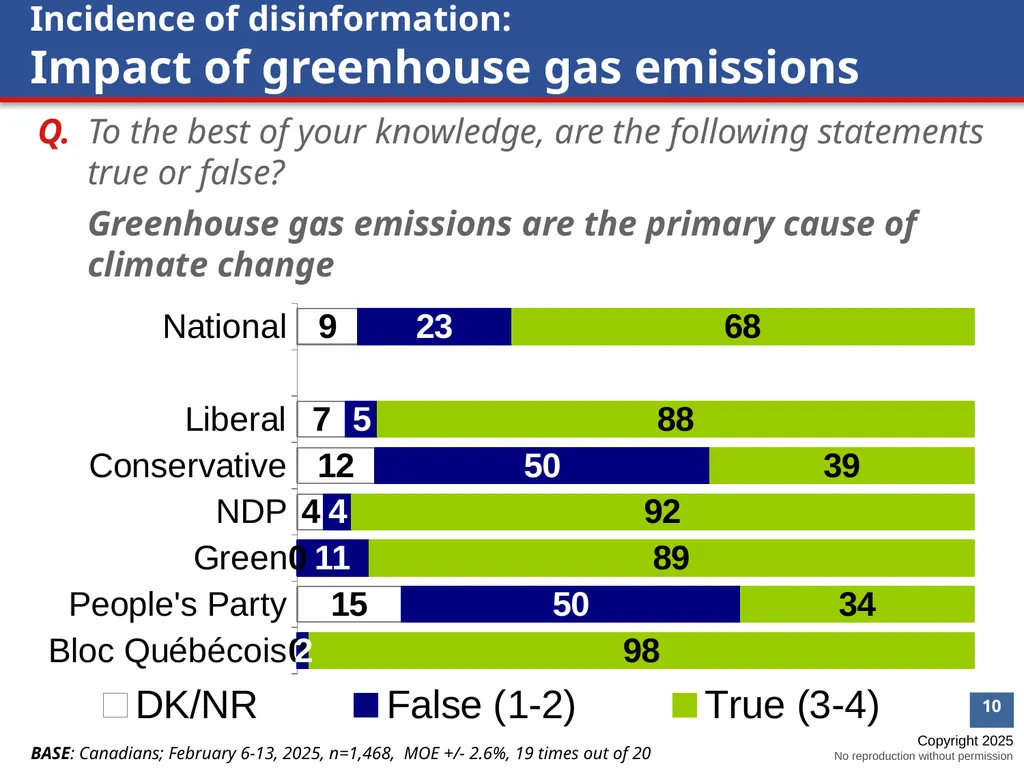
Spurious beliefs about climate change, vaccine safety, and Russia now best predictors of vote intention Rise of disinformation<br>
slide9. Vote intention by disinformation Q. If a federal election were held tomorrow, which party would you vote for? Level of disinformation BASE: Canadians; February 6-13, 2025, n=1,468, MOE +/- 2.6%, 19 times out of 20<br>
slide10. Incidence of disinformation:Impact of greenhouse gas emissions Q. To the best of your knowledge, are the following statements true or false?Greenhouse gas emissions are the primary cause of climate change BASE: Canadians; February 6-13, 2025, n=1,468, MOE +/- 2.6%, 19 times out of 20<br>
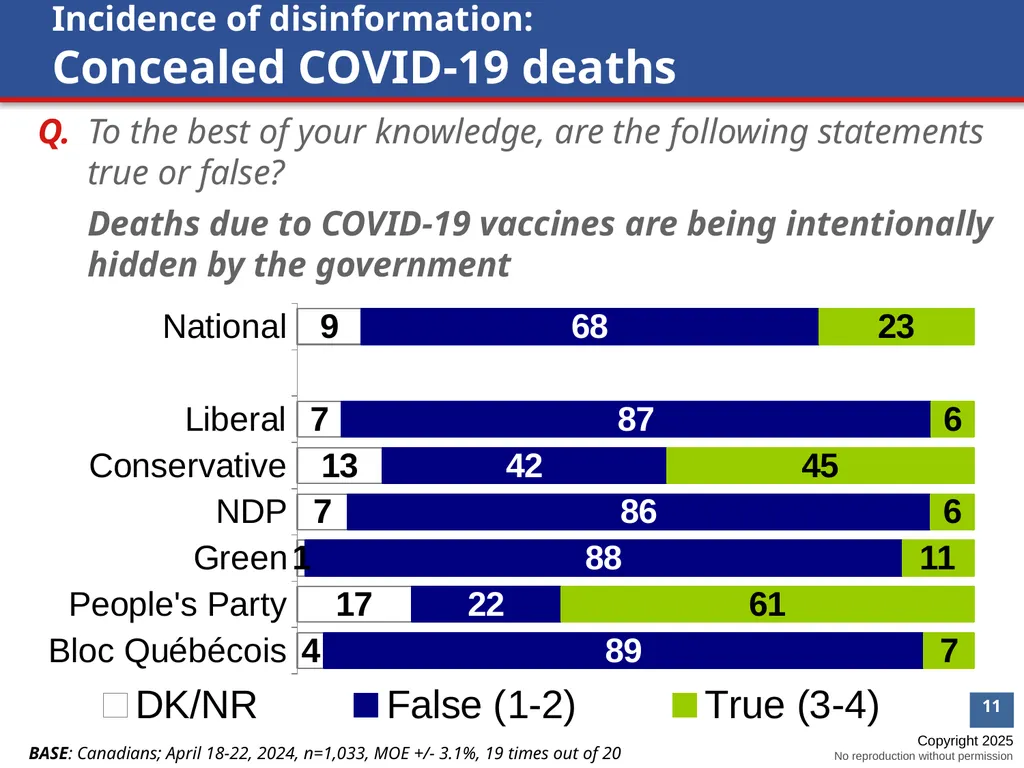
slide11. BASE: Canadians; April 18-22, 2024, n=1,033, MOE +/- 3.1%, 19 times out of 20 Incidence of disinformation:Concealed COVID-19 deaths Q. To the best of your knowledge, are the following statements true or false?Deaths due to COVID-19 vaccines are being intentionally hidden by the government<br>
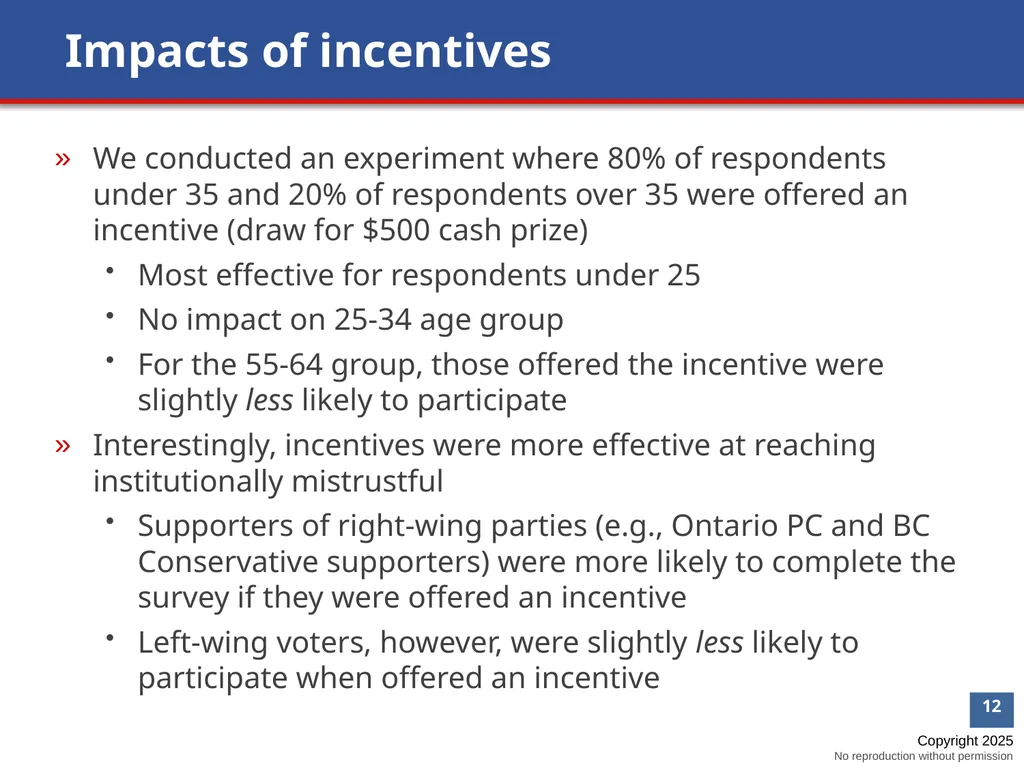
slide12. We conducted an experiment where 80% of respondents under 35 and 20% of respondents over 35 were offered an incentive (draw for $500 cash prize)
Most effective for respondents under 25
No impact on 25-34 age group
For the 55-64 group, those offered the incentive were slightly less likely to participate
Interestingly, incentives were more effective at reaching institutionally mistrustful
Supporters of right-wing parties (e.g., Ontario PC and BC Conservative supporters) were more likely to complete the survey if they were offered an incentive
Left-wing voters, however, were slightly less likely to participate when offered an incentive Impacts of incentives<br>
slide13. Women remain panel members longer than men (2.8 years versus 2.3 years)
Respondents between the ages of 55 and 64 remain panel members longer (3.8 years)
Those 18 and 24 remain just 0.6 years on average
Regionally, residents of Quebec remain panel members longest (6.6 years), while BC residents stay for a year and a half on average
Those with a high school education or less stay 3 years on average, while those with a graduate degree stay on for a little over 2 years
Only slight variation between visible minorities and other Canadians (2.4 years vs. 2.5 years)
No statistical variation in terms of online respondents versus telephone-only respondents Variations in panel attrition<br>
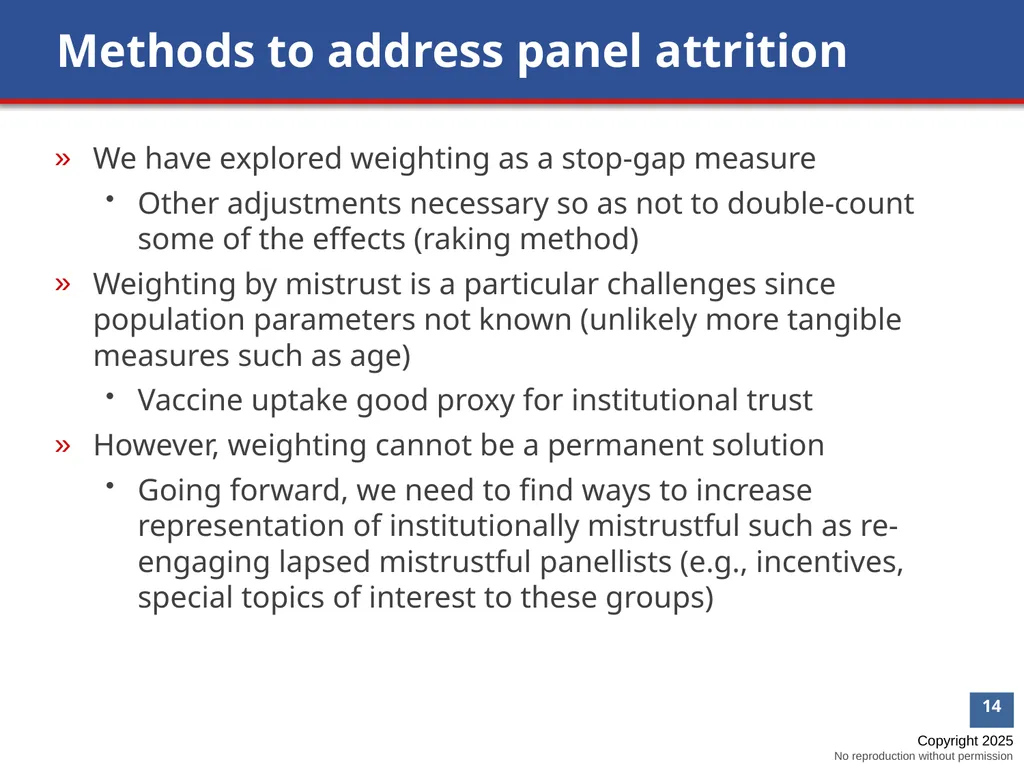
slide14. We have explored weighting as a stop-gap measure
Other adjustments necessary so as not to double-count some of the effects (raking method)
Weighting by mistrust is a particular challenges since population parameters not known (unlikely more tangible measures such as age)
Vaccine uptake good proxy for institutional trust
However, weighting cannot be a permanent solution
Going forward, we need to find ways to increase representation of institutionally mistrustful such as re-engaging lapsed mistrustful panellists (e.g., incentives, special topics of interest to these groups) Methods to address panel attrition<br>
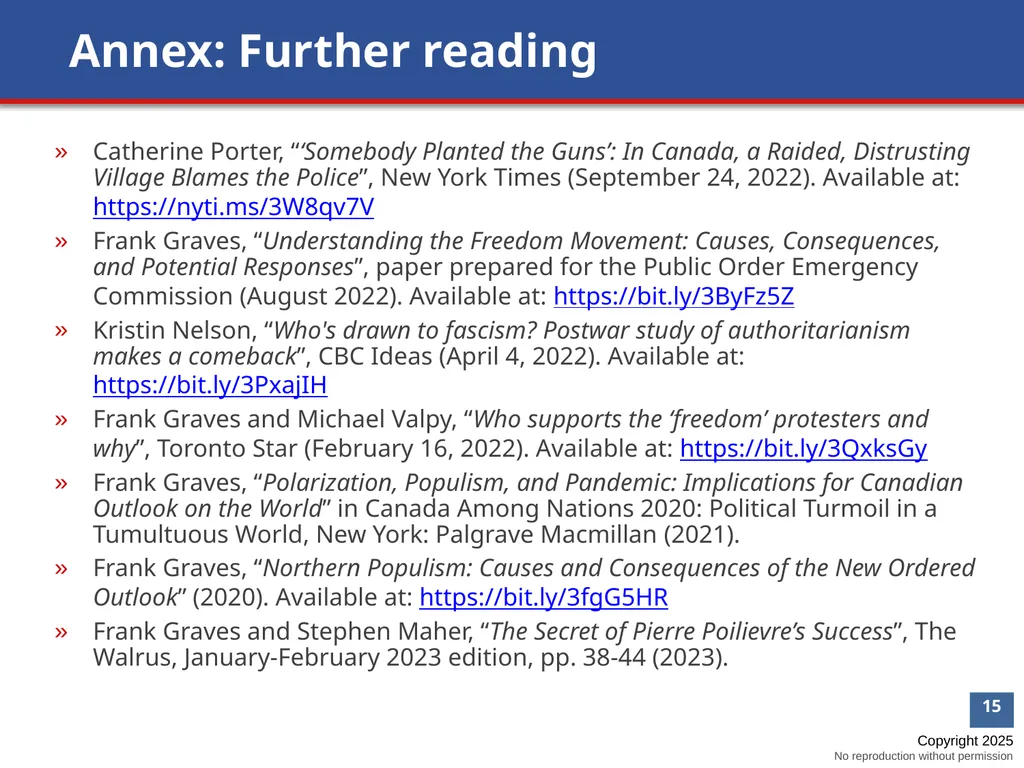
slide15. Catherine Porter, ââSomebody Planted the Gunsâ: In Canada, a Raided, Distrusting Village Blames the Policeâ, New York Times (September 24, 2022). Available at: https://nyti.ms/3W8qv7V
Frank Graves, âUnderstanding the Freedom Movement: Causes, Consequences, and Potential Responsesâ, paper prepared for the Public Order Emergency Commission (August 2022). Available at: https://bit.ly/3ByFz5Z
Kristin Nelson, âWho's drawn to fascism? Postwar study of authoritarianism makes a comebackâ, CBC Ideas (April 4, 2022). Available at: https://bit.ly/3PxajIH
Frank Graves and Michael Valpy, âWho supports the âfreedomâ protesters and whyâ, Toronto Star (February 16, 2022). Available at: https://bit.ly/3QxksGy
Frank Graves, âPolarization, Populism, and Pandemic: Implications for Canadian Outlook on the Worldâ in Canada Among Nations 2020: Political Turmoil in a Tumultuous World, New York: Palgrave Macmillan (2021).
Frank Graves, âNorthern Populism: Causes and Consequences of the New Ordered Outlookâ (2020). Available at: https://bit.ly/3fgG5HR
Frank Graves and Stephen Maher, âThe Secret of Pierre Poilievreâs Successâ, The Walrus, January-February 2023 edition, pp. 38-44 (2023). Annex: Further reading<br>
slide16. For more information:
FRANK GRAVES
EKOS Research Associates
fgraves@ekos.com
(613) 235-7215 ekos.com Copyright 2025. No reproduction without permission.<br>

slide2. Shifting challenges in maintaining demographic and psychographic representativeness
It is no longer adequate to simply have panels and samples which are demographically representative
Increasingly, we are finding that institutional trust and authoritarian populist outlook are critical to robust parameter estimated
We will present ongoing research using our Probit probability panel to ensure proper representation of these factors either through targeted recruitment strategies or weighting to known proxies such as vaccine behaviour Introduction<br>
slide3. For better or worse, political polling principal yardstick used to evaluate survey accuracy
Massive shifts in political landscape in recent weeks (Trump effect)
Our polling considered an outlier, treated with deep skepticism
Pundit view was that differences were due to mode effects (i.e., phone versus online)
However, IVR and Probit produce the same results in our election polling
IVR (and live interviewer) primary intake method for Probit
The notion that differences between pollsters are due to phone versus online is not borne out by the evidence
Rather, the cause is probability vs. non-probability
Overrepresentation of university-educated Canadians a blend of sampling and measurement issues Election polling (i)<br>
slide4. Convergence in recent polls January 26, 2025 February 16, 2025<br>
slide5. Mode effects (i) Q. How do you plan to vote in the upcoming federal election on September 20th? / How did you vote in this election? IVR BASE: Canadians; August 30-September 3, 2021, n=2,008, MOE +/- 2.2%, 19 times out of 20 Probit BASE: Canadians; August 30-September 3, 2021, n=782, MOE +/- 2.4%, 19 times out of 20 BASE: Canadians; August 31- September 7, 2021, n=879, MOE +/- 3.3%, 19 times out of 20 Live interviewer<br>
slide6. Mode effects (ii) Q. If a federal election were held tomorrow, which party would you vote for? Interactive Voice Response (phone) Probit probability panel (online) BASE: Canadians (online); January 24-29, 2025, n=1,025, MOE +/- 3.1%, 19 times out of 20 BASE: Canadians; January 22-27, 2025, n=1,448, MOE +/- 2.6%, 19 times out of 20<br>
slide7. Impacts of education weight Q. If a federal election were held tomorrow, which party would you vote for? With education weight Without education weight BASE: Canadians; January 22-27, 2025, n=1,448, MOE +/- 2.6%, 19 times out of 20<br>
slide8. Results reveal intense polarization around disinformation
While ordered populism has been a critical feature reshaping voter landscapes over past decade, disinformation even more powerful
Spurious beliefs about climate change, vaccine safety, and Russia now best predictors of vote intention Rise of disinformation<br>
slide9. Vote intention by disinformation Q. If a federal election were held tomorrow, which party would you vote for? Level of disinformation BASE: Canadians; February 6-13, 2025, n=1,468, MOE +/- 2.6%, 19 times out of 20<br>
slide10. Incidence of disinformation:Impact of greenhouse gas emissions Q. To the best of your knowledge, are the following statements true or false?Greenhouse gas emissions are the primary cause of climate change BASE: Canadians; February 6-13, 2025, n=1,468, MOE +/- 2.6%, 19 times out of 20<br>
slide11. BASE: Canadians; April 18-22, 2024, n=1,033, MOE +/- 3.1%, 19 times out of 20 Incidence of disinformation:Concealed COVID-19 deaths Q. To the best of your knowledge, are the following statements true or false?Deaths due to COVID-19 vaccines are being intentionally hidden by the government<br>
slide12. We conducted an experiment where 80% of respondents under 35 and 20% of respondents over 35 were offered an incentive (draw for $500 cash prize)
Most effective for respondents under 25
No impact on 25-34 age group
For the 55-64 group, those offered the incentive were slightly less likely to participate
Interestingly, incentives were more effective at reaching institutionally mistrustful
Supporters of right-wing parties (e.g., Ontario PC and BC Conservative supporters) were more likely to complete the survey if they were offered an incentive
Left-wing voters, however, were slightly less likely to participate when offered an incentive Impacts of incentives<br>
slide13. Women remain panel members longer than men (2.8 years versus 2.3 years)
Respondents between the ages of 55 and 64 remain panel members longer (3.8 years)
Those 18 and 24 remain just 0.6 years on average
Regionally, residents of Quebec remain panel members longest (6.6 years), while BC residents stay for a year and a half on average
Those with a high school education or less stay 3 years on average, while those with a graduate degree stay on for a little over 2 years
Only slight variation between visible minorities and other Canadians (2.4 years vs. 2.5 years)
No statistical variation in terms of online respondents versus telephone-only respondents Variations in panel attrition<br>
slide14. We have explored weighting as a stop-gap measure
Other adjustments necessary so as not to double-count some of the effects (raking method)
Weighting by mistrust is a particular challenges since population parameters not known (unlikely more tangible measures such as age)
Vaccine uptake good proxy for institutional trust
However, weighting cannot be a permanent solution
Going forward, we need to find ways to increase representation of institutionally mistrustful such as re-engaging lapsed mistrustful panellists (e.g., incentives, special topics of interest to these groups) Methods to address panel attrition<br>
slide15. Catherine Porter, ââSomebody Planted the Gunsâ: In Canada, a Raided, Distrusting Village Blames the Policeâ, New York Times (September 24, 2022). Available at: https://nyti.ms/3W8qv7V
Frank Graves, âUnderstanding the Freedom Movement: Causes, Consequences, and Potential Responsesâ, paper prepared for the Public Order Emergency Commission (August 2022). Available at: https://bit.ly/3ByFz5Z
Kristin Nelson, âWho's drawn to fascism? Postwar study of authoritarianism makes a comebackâ, CBC Ideas (April 4, 2022). Available at: https://bit.ly/3PxajIH
Frank Graves and Michael Valpy, âWho supports the âfreedomâ protesters and whyâ, Toronto Star (February 16, 2022). Available at: https://bit.ly/3QxksGy
Frank Graves, âPolarization, Populism, and Pandemic: Implications for Canadian Outlook on the Worldâ in Canada Among Nations 2020: Political Turmoil in a Tumultuous World, New York: Palgrave Macmillan (2021).
Frank Graves, âNorthern Populism: Causes and Consequences of the New Ordered Outlookâ (2020). Available at: https://bit.ly/3fgG5HR
Frank Graves and Stephen Maher, âThe Secret of Pierre Poilievreâs Successâ, The Walrus, January-February 2023 edition, pp. 38-44 (2023). Annex: Further reading<br>
slide16. For more information:
FRANK GRAVES
EKOS Research Associates
fgraves@ekos.com
(613) 235-7215 ekos.com Copyright 2025. No reproduction without permission.<br>