Uniform Guardianship, Conservatorship, and Other Protective Arrangements Act Presented by Benjamin Orzeske, Chief Counsel, Uniform Law Commission Diana Noel, Senior Legislative Representative, AARP National College of Probate Judges 2019
"Uniform Guardianship, Conservatorship, and Other" is the property of its rightful owner. Permission is granted to
download and print the materials on this website for personal, non-commercial use only, and to display it
on your personal computer provided you do not modify the materials and that you retain all copyright
notices contained in the materials. By downloading content from our website, you accept the terms of this
agreement.
Presentation Transcript
01
Uniform Guardianship, Conservatorship, and Other Protective Arrangements Act Presented by
Benjamin Orzeske, Chief Counsel, Uniform Law Commission &
Diana Noel, Senior Legislative Representative, AARP National College of Probate Judges
2019 Spring Conference
New Orleans, Louisiana<br>
02
What is the ULC? Uniform Law Commission (ULC)
Non-profit organization formed in 1892
Commissioners are volunteer attorneys appointed by the states
ULC drafts model state legislation on topics where uniformity among the states is desirable
Legislative staff based in Chicago headquarters
www.uniformlaws.org<br>
03
49-Year History of Law Reform 1969: Uniform Probate Code (Article V on Protection of Persons Under Disability and their Property)
1979: Uniform Durable Power of Attorney Act
1982: Uniform Guardianship & Protective Proceedings Act (Introduces limited guardianships)
1997: Revised UGPPA (More protective of an individual’s legal rights; least restrictive alternative; court visitor; must take person’s views into account)
2006: Uniform Power of Attorney Act (Greater protection against financial abuse; encourages wider acceptance)<br>
04
The Road to UGCOPAA October 2011: National Guardianship Network Third National Guardianship Summit<br>
05
The Road to UGCOPAA<br>
06
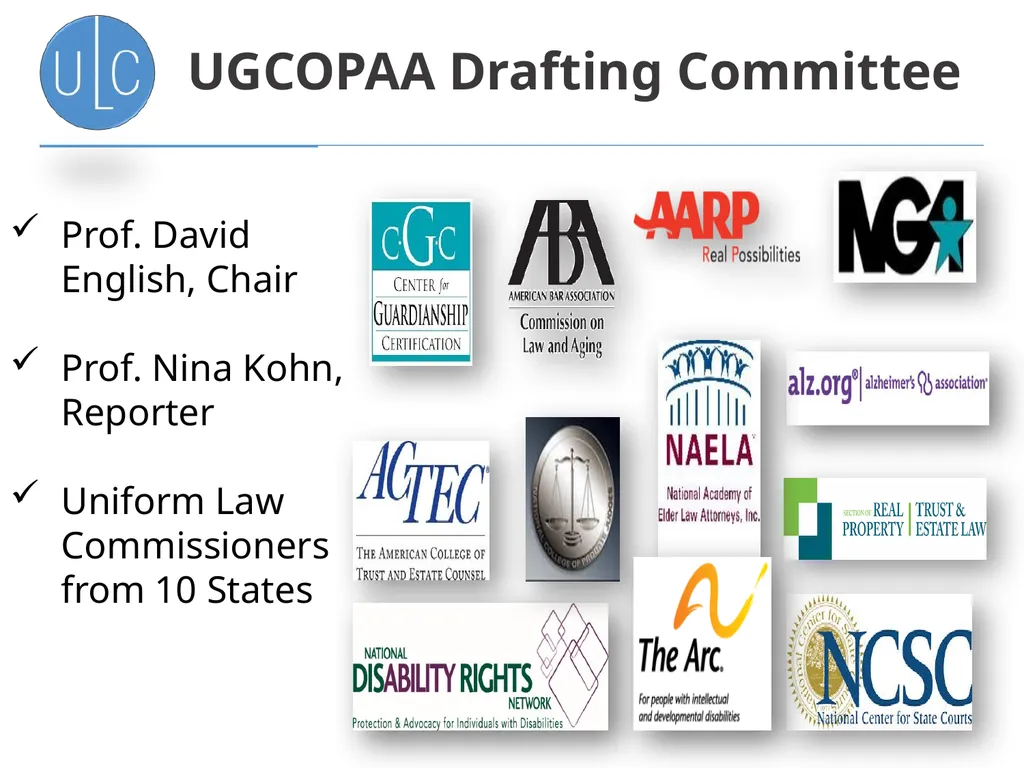
UGCOPAA Drafting Committee Prof. David English, Chair
Prof. Nina Kohn, Reporter
Uniform Law Commissioners from 10 States<br>
07
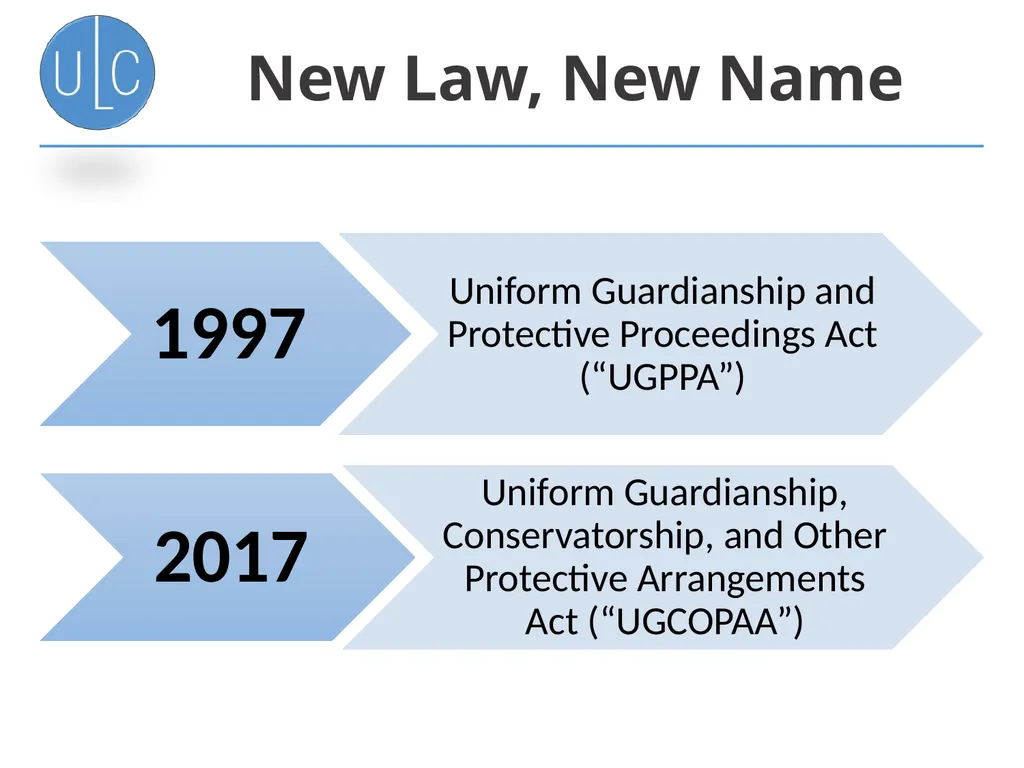
New Law, New Name<br>
08
UGCOPAA Terminology “Guardian” means a person appointed by the court to make decisions with respect to the personal affairs of an individual.
“Conservator” means a person appointed by a court to make decisions with respect to the property or financial affairs of an individual.
“Less restrictive alternative” means an approach to meeting an individual’s needs which restricts fewer rights of the individual than would the appointment of a guardian or conservator. The term includes supported decision making, appropriate technological assistance, appointment of a representative payee, and appointment of an agent by the individual, including appointment under a [power of attorney].<br>
09
Why Guardianship Reform Recent articles have spotlighted many holes in state systems that failed vulnerable adults and exposed them to abuse and exploitation
People are living longer and there will be more people in a system that it’s not prepared to handle
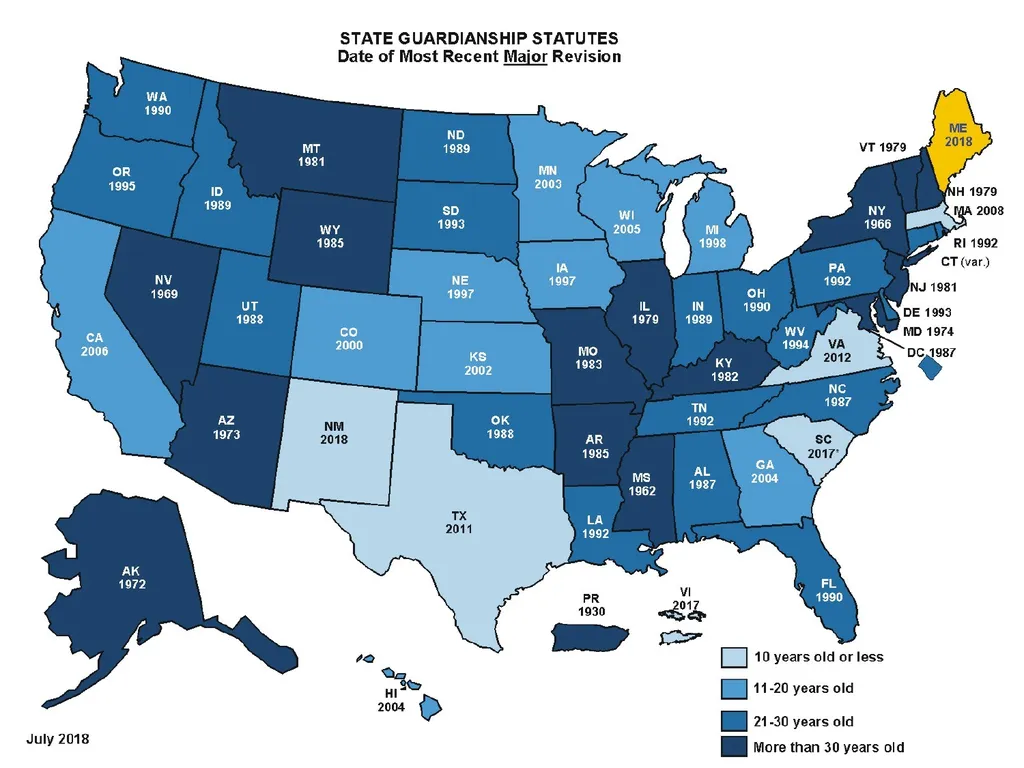
Most states haven’t had a major revision of guardianship laws in over 20 years<br>
10
Political Landscape Typically a bi-partisan issue
Issue isn’t “hot”…UNLESS there’s a crisis or tragedy
Broad issue and could be a very long process
No one-size-fits-all solution
Lack of data
Policy wonks aren’t necessarily on-the-ground/frontline, workers and vice versa<br>
11
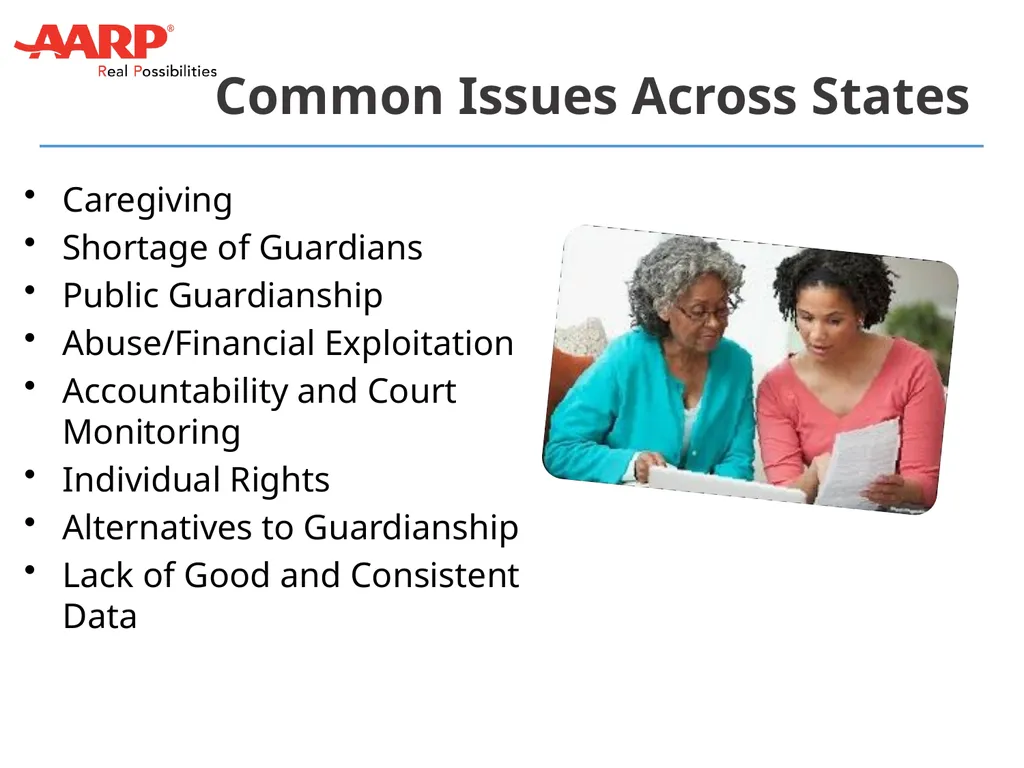
Common Issues Across States Caregiving
Shortage of Guardians
Public Guardianship
Abuse/Financial Exploitation
Accountability and Court Monitoring
Individual Rights
Alternatives to Guardianship
Lack of Good and Consistent Data<br>
12
Reform Trends Individuals, their family and friends are speaking up!
Person-centered approach
Alternatives to guardianship
Standards and training for ALL guardians
Increase in education and outreach
Monitoring reforms to prevent abuse/exploitation
More collaboration/taskforces/ multidisciplinary teams (ex. WINGS)
State courts are taking on a more active role<br>
13
Person-Centered Terminology Old:
Ward
Alleged incapacitated person
Incapacitated person
New:
Adult/Minor
Respondent
Adult/Minor subject to guardianship/conservatorship<br>
14
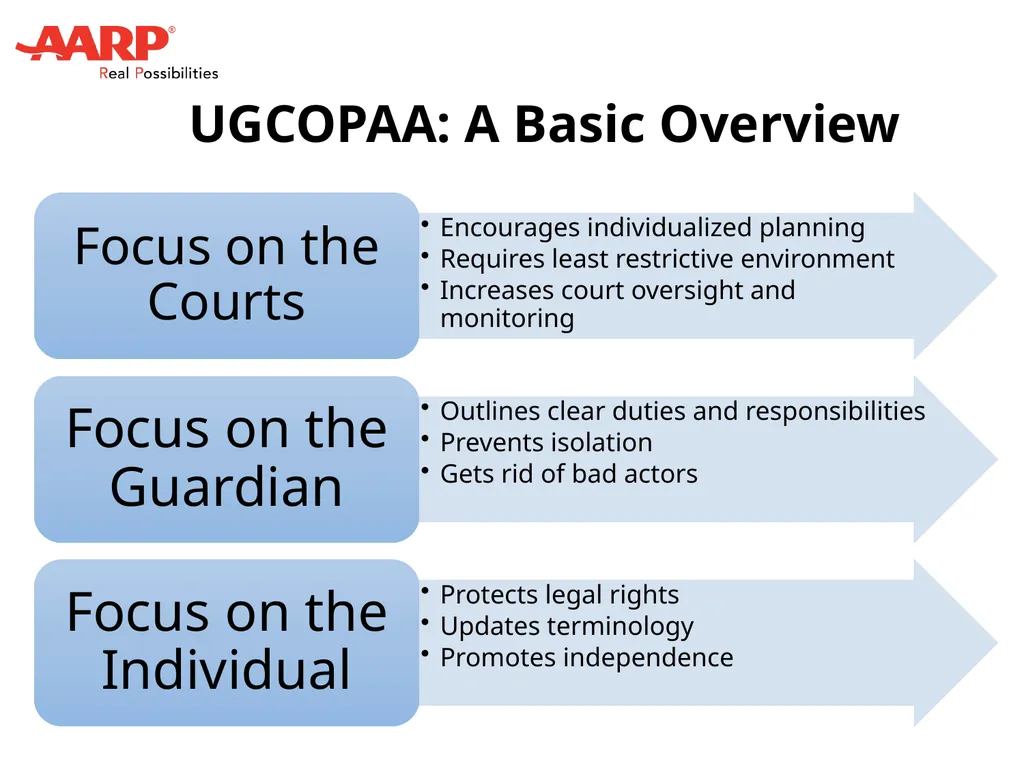
UGCOPAA: A Basic Overview<br>
15
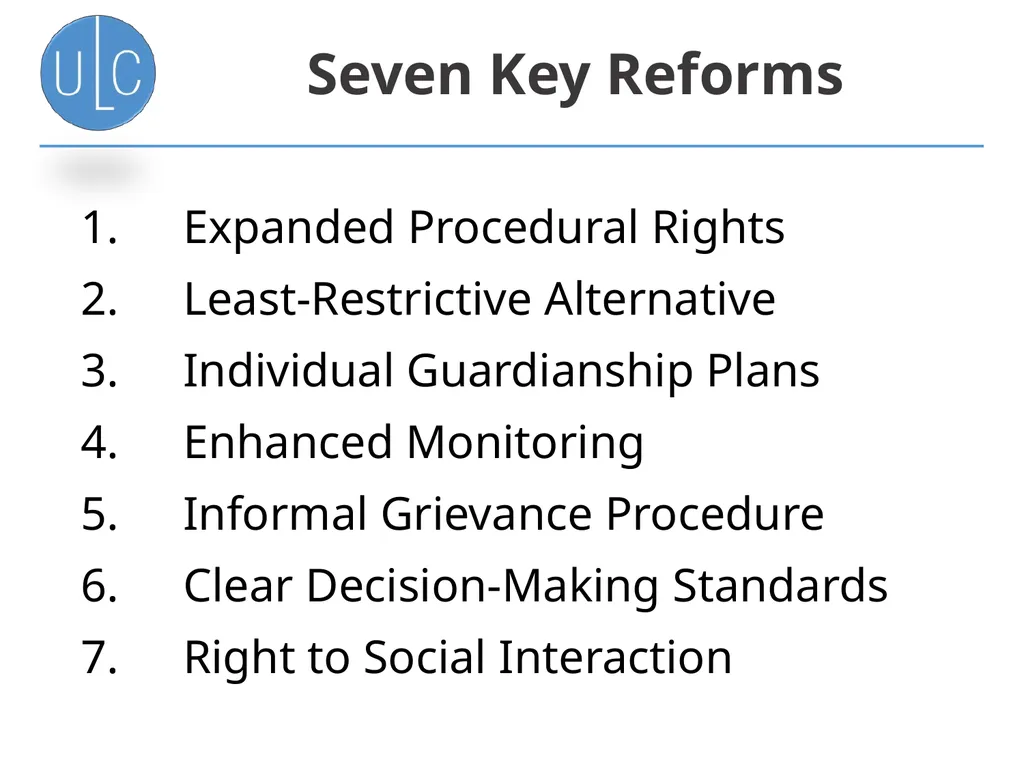
Seven Key Reforms Expanded Procedural Rights
Least-Restrictive Alternative
Individual Guardianship Plans
Enhanced Monitoring
Informal Grievance Procedure
Clear Decision-Making Standards
Right to Social Interaction<br>
16
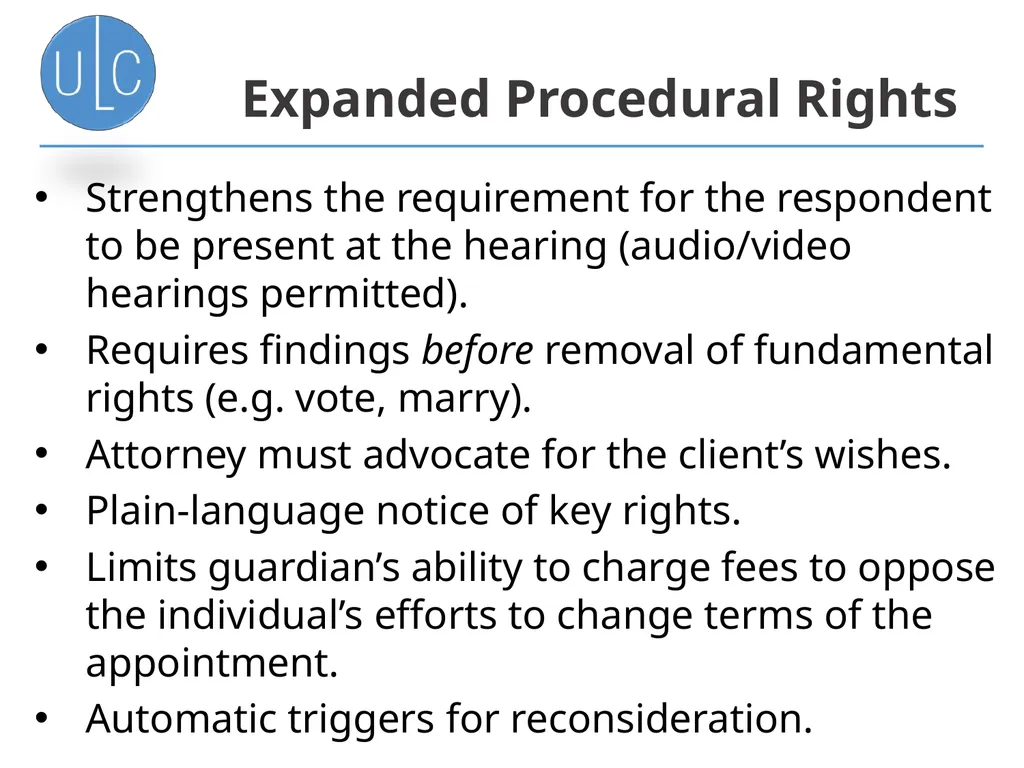
Expanded Procedural Rights Strengthens the requirement for the respondent to be present at the hearing (audio/video hearings permitted).
Requires findings before removal of fundamental rights (e.g. vote, marry).
Attorney must advocate for the client’s wishes.
Plain-language notice of key rights.
Limits guardian’s ability to charge fees to oppose the individual’s efforts to change terms of the appointment.
Automatic triggers for reconsideration.<br>
17
Least-Restrictive Alternative Petitioners seeking guardianship or conservatorship must explain why a less restrictive alternative is not sufficient.
Courts may treat a petition for guardianship or conservatorship as a petition for a less-restrictive alternative.
Courts ordering guardianship or conservatorship must include findings explaining why a less-restrictive alternative is not sufficient.<br>
18
Individual Guardianship & Conservatorship Plans Guardian or conservator must file a plan within 60 days of appointment, with copies to whomever the court directs.
Plan must include:
Living arrangements, services, and supports;
Social and educational activities;
Persons with whom the adult has personal relationships and plans for facilitating visits with those persons;
Nature and frequency of guardian’s communication with the adult;
Goals, including future restoration of rights;
Statement of proposed charges & expenses.
Plan must be updated at least annually.<br>
19
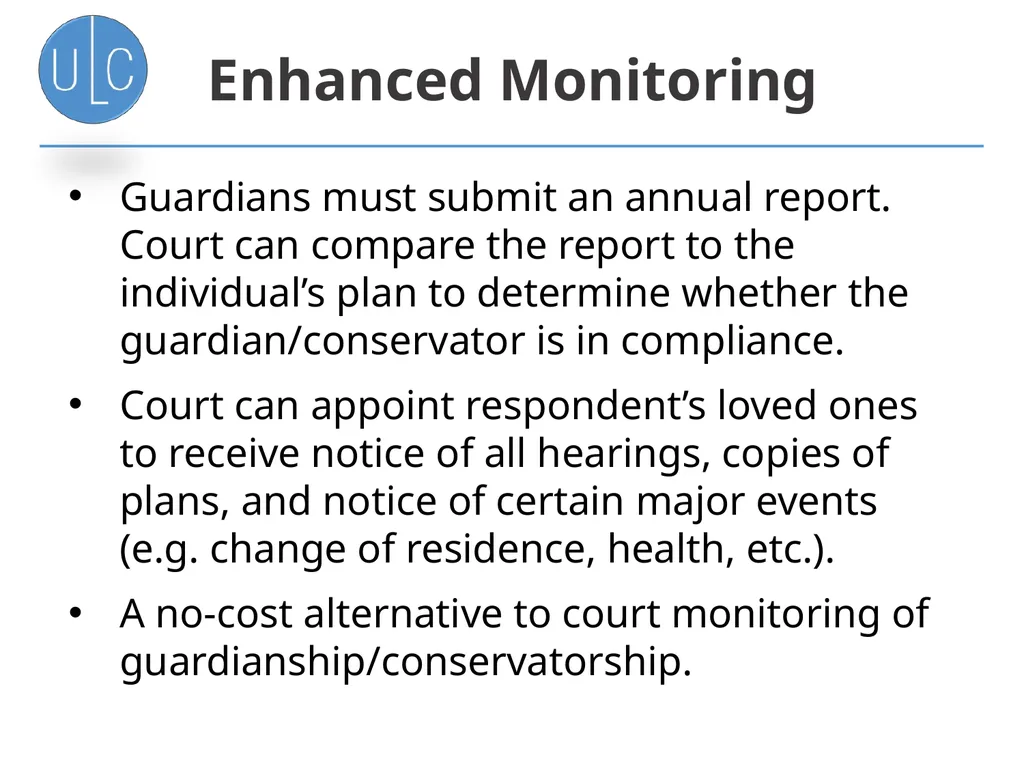
Enhanced Monitoring Guardians must submit an annual report. Court can compare the report to the individual’s plan to determine whether the guardian/conservator is in compliance.
Court can appoint respondent’s loved ones to receive notice of all hearings, copies of plans, and notice of certain major events (e.g. change of residence, health, etc.).
A no-cost alternative to court monitoring of guardianship/conservatorship.<br>
20
Informal Grievance Procedure Any interested person who reasonably believes the guardian/conservator is out of compliance may submit a grievance to the court in writing.
No formal petition necessary.
Court required to review and respond as appropriate, unless a similar grievance was filed in the previous six months.<br>
21
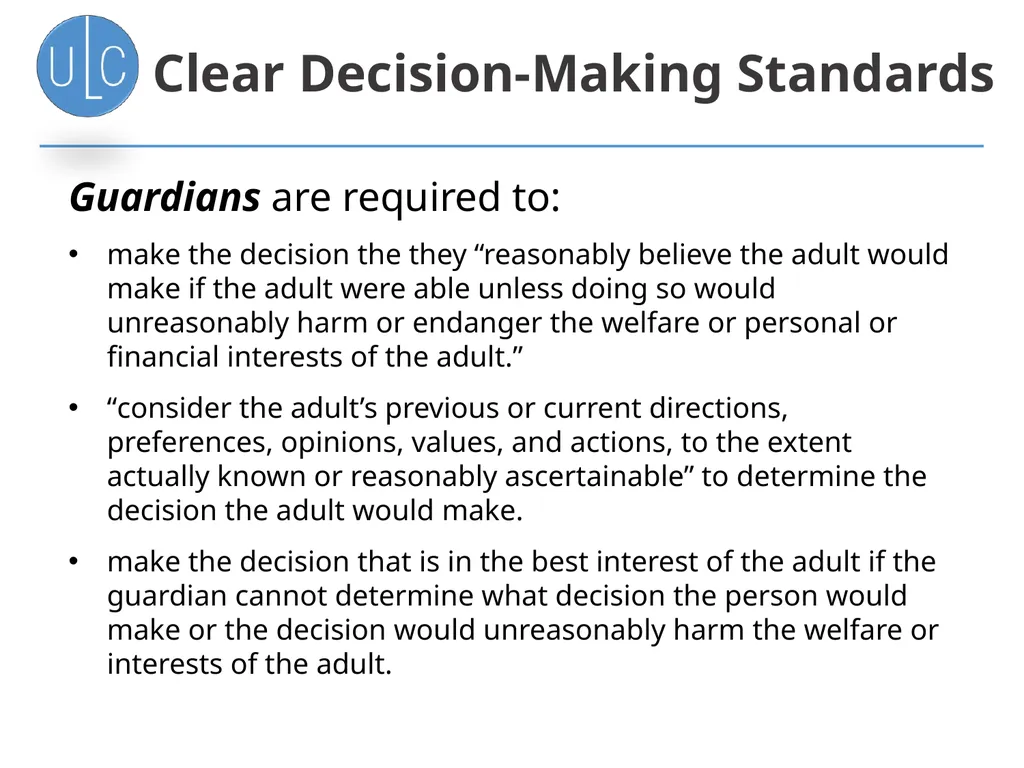
Clear Decision-Making Standards Guardians are required to:
make the decision the they “reasonably believe the adult would make if the adult were able unless doing so would unreasonably harm or endanger the welfare or personal or financial interests of the adult.”
“consider the adult’s previous or current directions, preferences, opinions, values, and actions, to the extent actually known or reasonably ascertainable” to determine the decision the adult would make.
make the decision that is in the best interest of the adult if the guardian cannot determine what decision the person would make or the decision would unreasonably harm the welfare or interests of the adult.<br>
22
Clear Decision-Making Standards Conservators are required to:
“make the decision the conservator reasonably believes the individual would make if the individual were able unless doing so would unless doing so would fail to preserve the resources needed to maintain the individual’s well-being and lifestyle or otherwise unreasonably harm or endanger the welfare or personal or financial interests of the individual.”
use a best interest approach if – and only if – the conservator cannot determine what decision the individual would make or the individual’s decision would fail to preserve resources needed to maintain the individual’s well-being and lifestyle or otherwise would unreasonably harm or endanger the individual or the individual’s interests.”<br>
23
Right to Social Interaction Details about social interaction (who, where, how often, etc.) go into the plan.
Without court approval, a guardian for an adult may not indefinitely restrict interaction with another person unless the guardian has good cause to believe interaction poses a risk of significant physical, psychological, or financial harm.
Restriction limited to 7 days if the person has a family or pre-existing social relation-ship with the adult, otherwise 60 days.<br>
24
Potential Players Courts
Court Administration
Guardians & Conservators
State Bar Association (elder law/family law/probate/trust)
Senior Advocates
Child Advocates
Advocates for the Developmentally Disabled
Uniform Law Commissioners<br>