Unit 3 the passive voice How and why do we use the passive voice in comparison to the active? Lets look at: Common reasons why we use the passive voice. The passive voice and cohesioncoherence. The passive voice in different forms.
"Unit 3 – the passive voice How and why do" is the property of its rightful owner. Permission is granted to
download and print the materials on this website for personal, non-commercial use only, and to display it
on your personal computer provided you do not modify the materials and that you retain all copyright
notices contained in the materials. By downloading content from our website, you accept the terms of this
agreement.
Presentation Transcript
01
Unit 3 – the passive voice<br>
02
How and why do we use the passive voice in comparison to the active? Let’s look at:
Common reasons why we use the passive voice.
The passive voice and cohesion/coherence.
The passive voice in different forms. Pearson (c) 2018 Gold Experience 2nd Edition B2+ Common uses of the passive voice...<br>
03
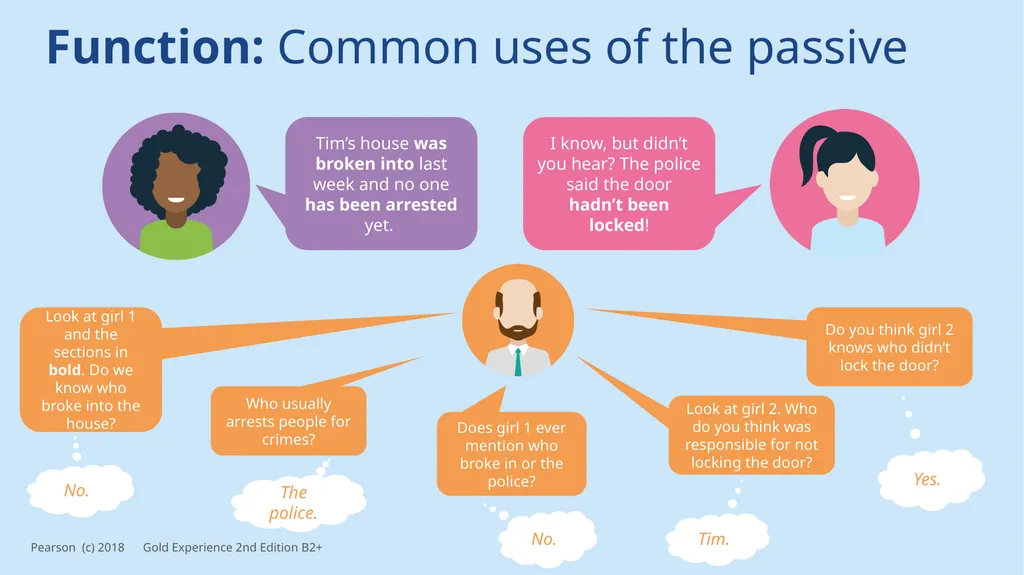
Function: Common uses of the passive No. Yes. Tim. No. The police. Pearson (c) 2018 Gold Experience 2nd Edition B2+ Tim’s house was broken into last week and no one has been arrested yet. Does girl 1 ever mention who broke in or the police? Do you think girl 2 knows who didn’t lock the door? Look at girl 1 and the sections in bold. Do we know who broke into the house? Who usually arrests people for crimes? Look at girl 2. Who do you think was responsible for not locking the door? I know, but didn’t you hear? The police said the door hadn’t been locked!<br>
04
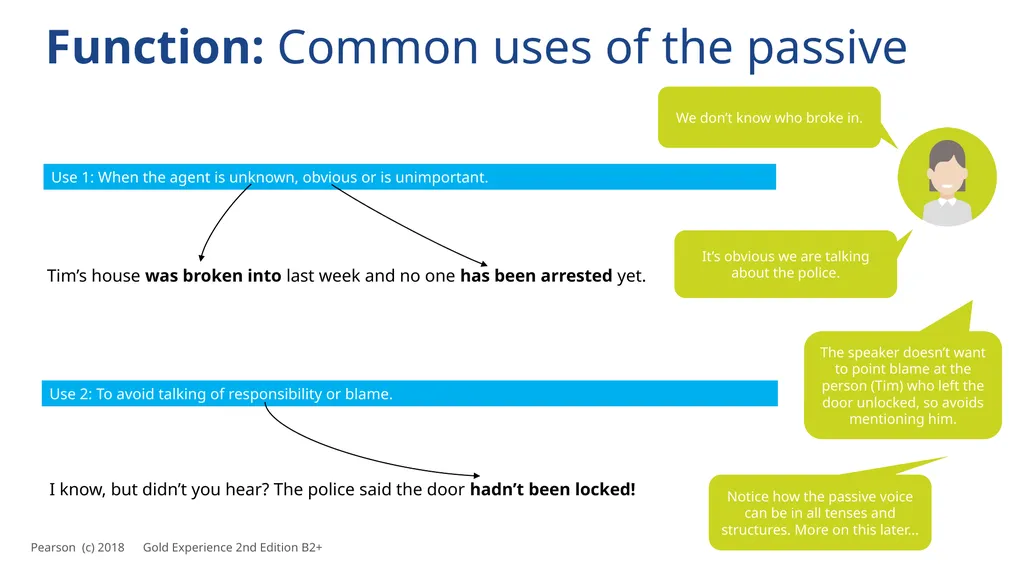
Tim’s house was broken into last week and no one has been arrested yet. I know, but didn’t you hear? The police said the door hadn’t been locked! Use 1: When the agent is unknown, obvious or is unimportant. Use 2: To avoid talking of responsibility or blame. Function: Common uses of the passive The speaker doesn’t want to point blame at the person (Tim) who left the door unlocked, so avoids mentioning him. We don’t know who broke in. It’s obvious we are talking about the police. Notice how the passive voice can be in all tenses and structures. More on this later... Pearson (c) 2018 Gold Experience 2nd Edition B2+<br>
05
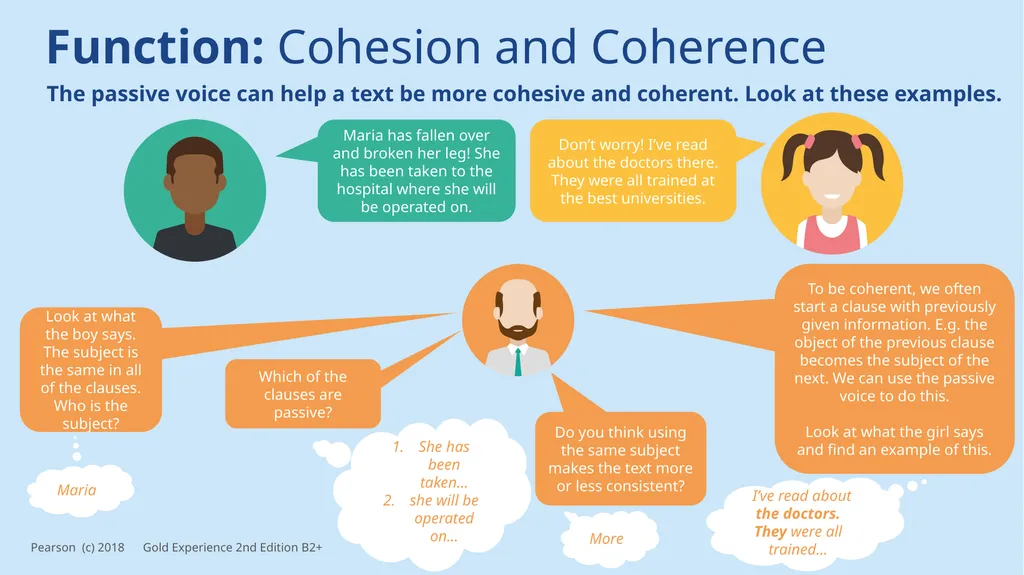
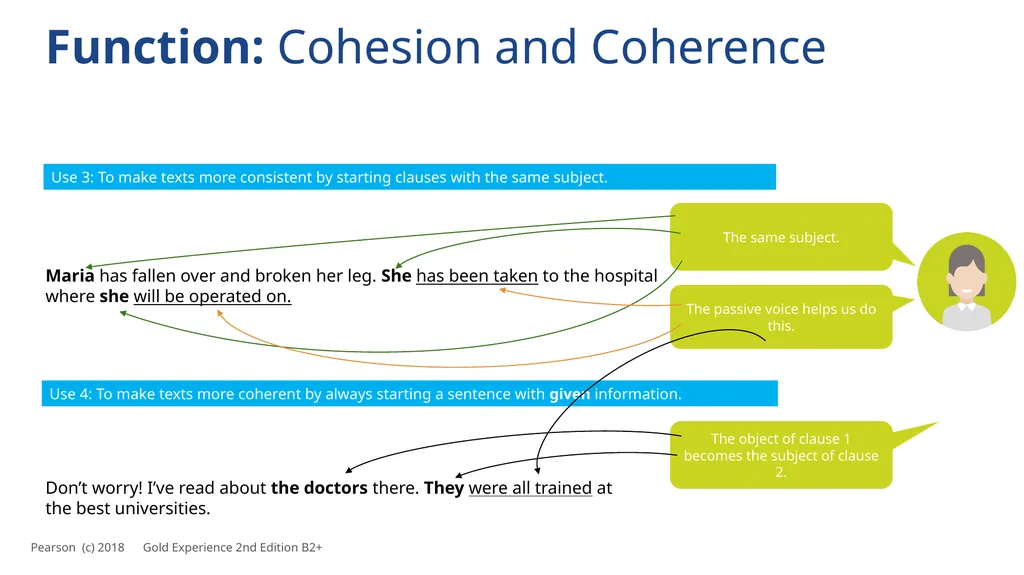
Function: Cohesion and Coherence The passive voice can help a text be more cohesive and coherent. Look at these examples. Maria I’ve read about the doctors. They were all trained... More She has been taken…
she will be operated on... Pearson (c) 2018 Gold Experience 2nd Edition B2+ Do you think using the same subject makes the text more or less consistent? To be coherent, we often start a clause with previously given information. E.g. the object of the previous clause becomes the subject of the next. We can use the passive voice to do this.
Look at what the girl says and find an example of this. Look at what the boy says. The subject is the same in all of the clauses. Who is the subject? Which of the clauses are passive? Maria has fallen over and broken her leg! She has been taken to the hospital where she will be operated on. Don’t worry! I’ve read about the doctors there. They were all trained at the best universities.<br>
06
Maria has fallen over and broken her leg. She has been taken to the hospital where she will be operated on. Don’t worry! I’ve read about the doctors there. They were all trained at the best universities. Use 3: To make texts more consistent by starting clauses with the same subject. Use 4: To make texts more coherent by always starting a sentence with given information. Function: Cohesion and Coherence The passive voice helps us do this. The same subject. The object of clause 1 becomes the subject of clause 2. Pearson (c) 2018 Gold Experience 2nd Edition B2+<br>
07
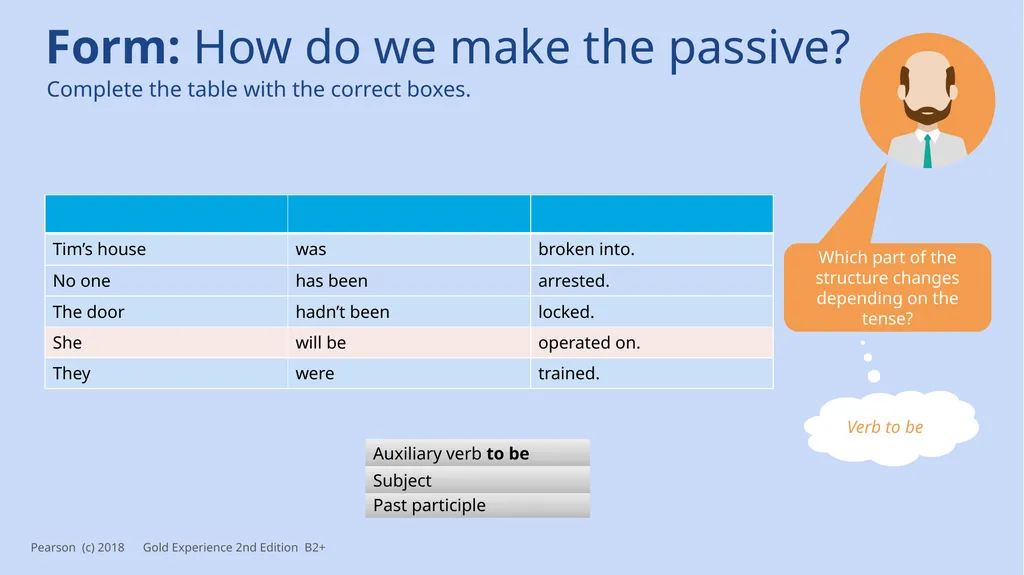
Pearson (c) 2018 Gold Experience 2nd Edition B2+ Form: How do we make the passive? Which part of the structure changes depending on the tense? Complete the table with the correct boxes. Verb to be Past participle Subject Auxiliary verb to be<br>
08
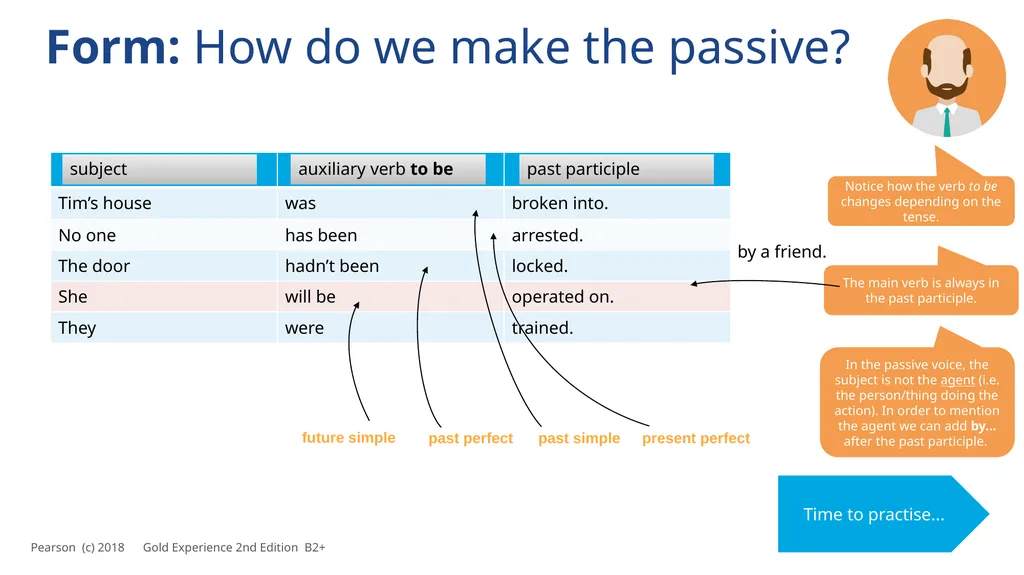
Pearson (c) 2018 Gold Experience 2nd Edition B2+ Form: How do we make the passive? Notice how the verb to be changes depending on the tense. subject auxiliary verb to be past participle The main verb is always in the past participle. In the passive voice, the subject is not the agent (i.e. the person/thing doing the action). In order to mention the agent we can add by… after the past participle. future simple past perfect past simple present perfect by a friend. Time to practise...<br>
09
The ambulance took her to the hospital last night. She was taken to the hospital last night. Pearson (c) 2018 Gold Experience 2nd Edition B2+ Practice activities Change these sentences from the active to the passive voice. You don’t need to mention the agent. The headmaster has spoken to Ariana about her behaviour. Everyone at the party had eaten all the cake before Jude arrived. Ariana has been spoken to about her behaviour. All the cake had been eaten before Jude arrived. Read the text and try to make it more coherent by starting sentences with given information. School leavers face a number of difficult challenges. However, they can overcome many of these challenges by simply talking to a school counsellor. Courses train the school counsellors to listen to students and give advice. Students might accept this advice or not, but the most important thing is the process of discussing future options. School leavers face a number of difficult challenges. However, many of these challenges can be overcome by simply talking to a school counsellor. School counsellors are trained to listen to students and give advice.This advice might be accepted or not, but the most important thing is the process of discussing future options.<br>