04
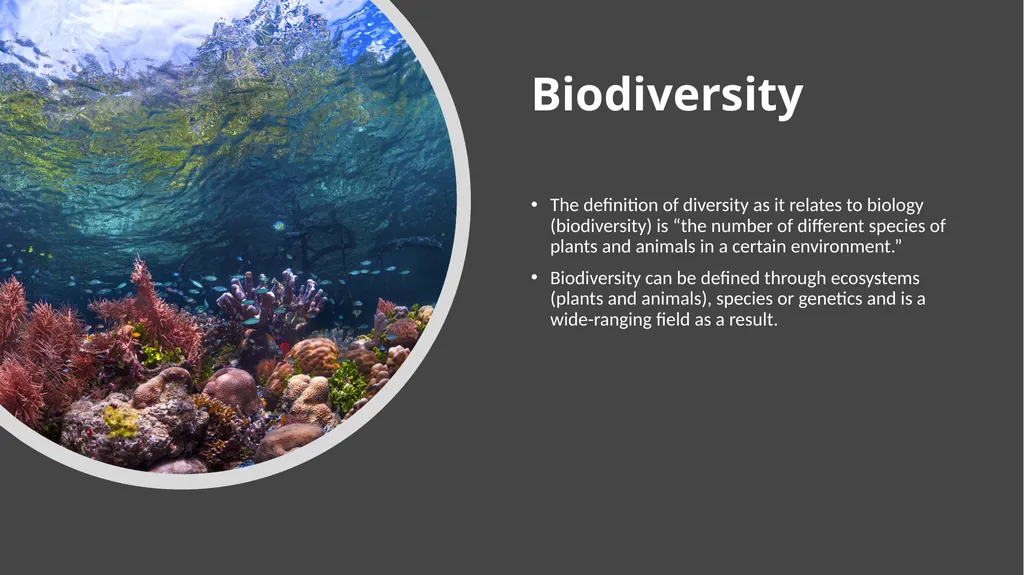
Biodiversity The definition of diversity as it relates to biology (biodiversity) is “the number of different species of plants and animals in a certain environment.”
Biodiversity can be defined through ecosystems (plants and animals), species or genetics and is a wide-ranging field as a result.<br>
05
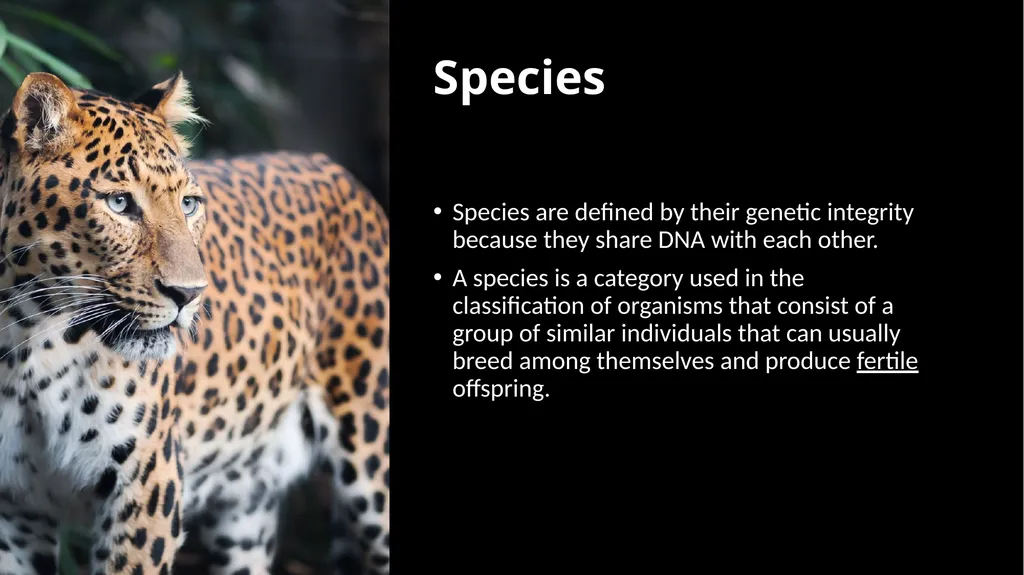
Species Species are defined by their genetic integrity because they share DNA with each other.
A species is a category used in the classification of organisms that consist of a group of similar individuals that can usually breed among themselves and produce fertile offspring.<br>
06
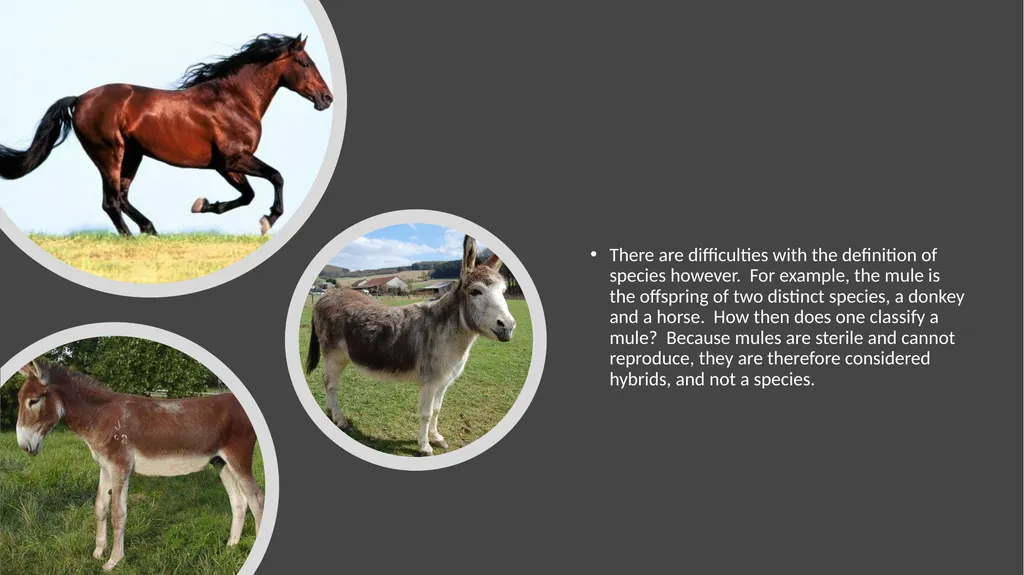
There are difficulties with the definition of species however. For example, the mule is the offspring of two distinct species, a donkey and a horse. How then does one classify a mule? Because mules are sterile and cannot reproduce, they are therefore considered hybrids, and not a species.<br>
07
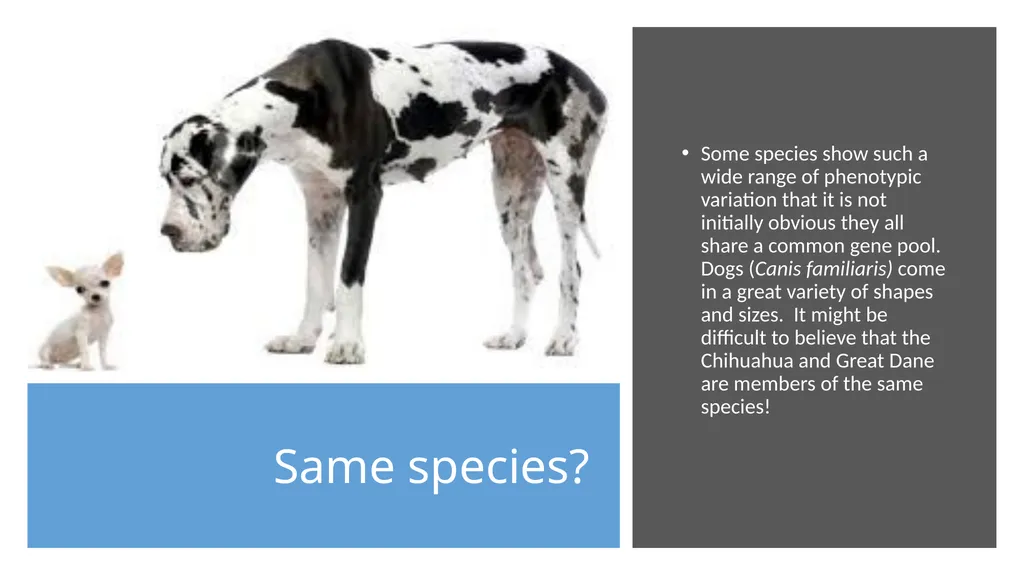
Same species? Some species show such a wide range of phenotypic variation that it is not initially obvious they all share a common gene pool. Dogs (Canis familiaris) come in a great variety of shapes and sizes. It might be difficult to believe that the Chihuahua and Great Dane are members of the same species!<br>
08
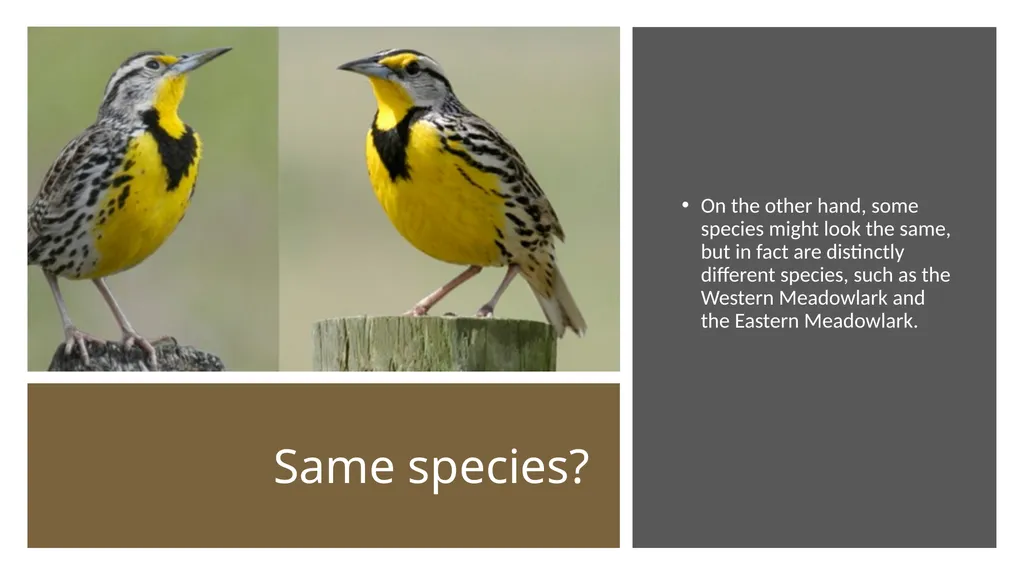
Same species? On the other hand, some species might look the same, but in fact are distinctly different species, such as the Western Meadowlark and the Eastern Meadowlark.<br>
09
Cladogram video https://www.youtube.com/watch?app=desktop&v=ouZ9zEkxGWg
Bozeman science 7 minutes<br>
10
Give the worksheets a try!<br>
11
Creature Id Using a Dichotomous Key<br>
12
Classifying Sharks Using a Dichotomous Key<br>
13
Bozeman Science – Classification of Life� (6 minutes) https://www.youtube.com/watch?app=desktop&v=tYL_8gv7RiE<br>
14
In 1959 Robert Whittaker proposed the five kingdom system. The five kingdoms of life are as follows: Monera
Protista
Fungi
Plantae
Animalia<br>
15
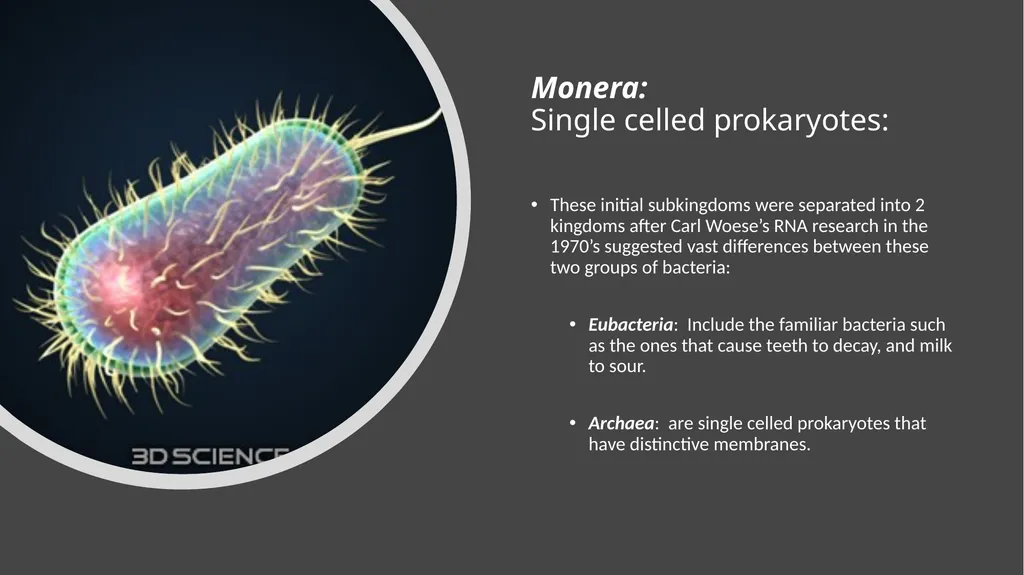
Monera: �Single celled prokaryotes: These initial subkingdoms were separated into 2 kingdoms after Carl Woese’s RNA research in the 1970’s suggested vast differences between these two groups of bacteria:
Eubacteria: Include the familiar bacteria such as the ones that cause teeth to decay, and milk to sour.
Archaea: are single celled prokaryotes that have distinctive membranes.<br>
16
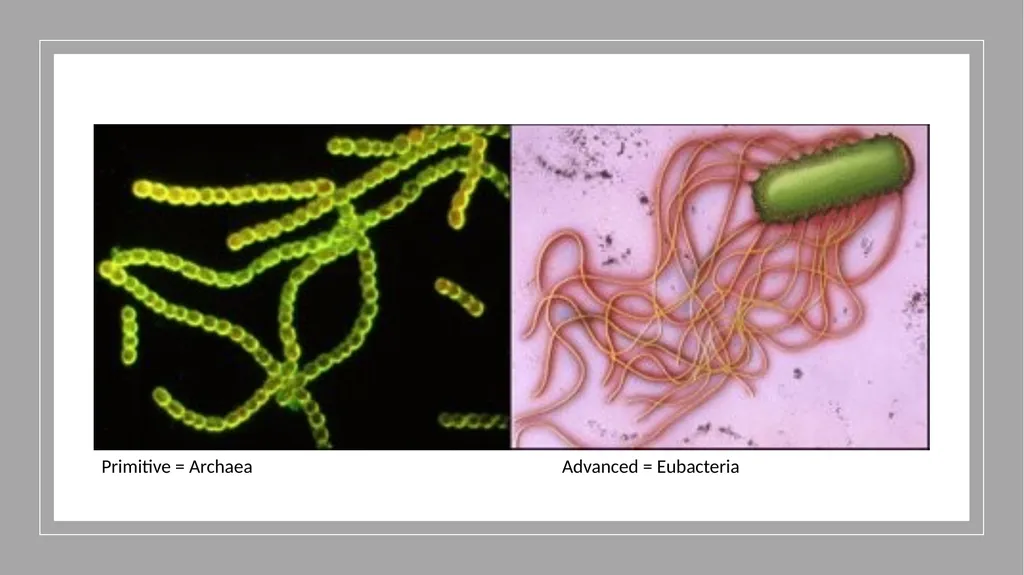
Primitive = Archaea Advanced = Eubacteria<br>
17
KINGDOM MONERA Found everywhere
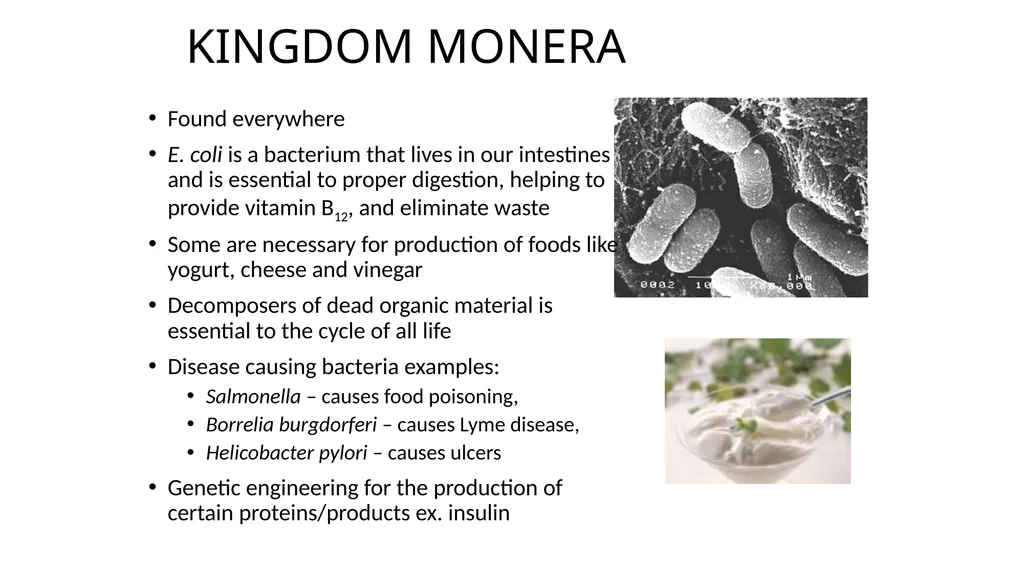
E. coli is a bacterium that lives in our intestines and is essential to proper digestion, helping to provide vitamin B12, and eliminate waste
Some are necessary for production of foods like yogurt, cheese and vinegar
Decomposers of dead organic material is essential to the cycle of all life
Disease causing bacteria examples:
Salmonella – causes food poisoning,
Borrelia burgdorferi – causes Lyme disease,
Helicobacter pylori – causes ulcers
Genetic engineering for the production of certain proteins/products ex. insulin<br>
18
KINGDOM MONERA Classifying Bacteria:
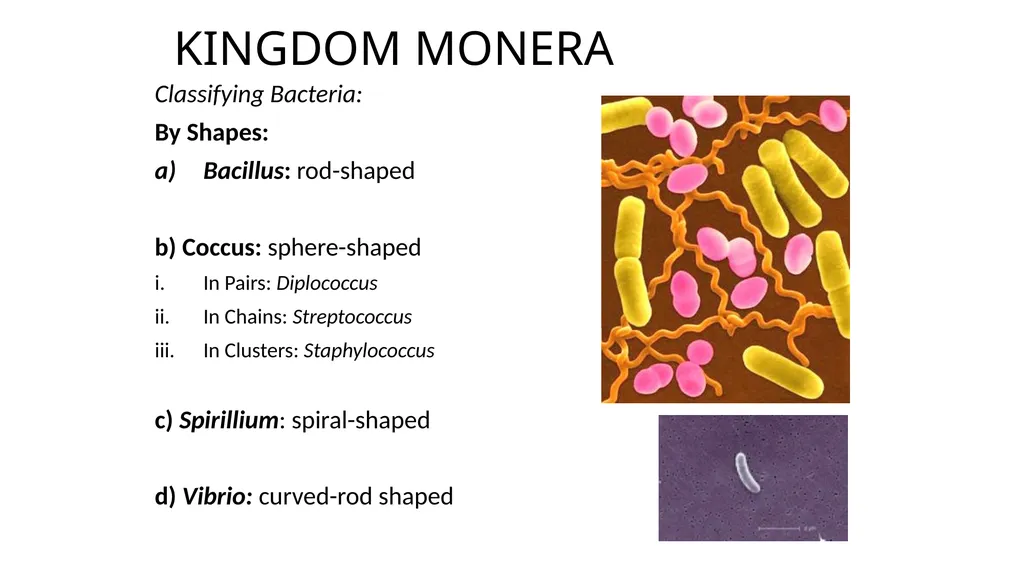
By Shapes:
Bacillus: rod-shaped
b) Coccus: sphere-shaped
In Pairs: Diplococcus
In Chains: Streptococcus
In Clusters: Staphylococcus
c) Spirillium: spiral-shaped
d) Vibrio: curved-rod shaped<br>
19
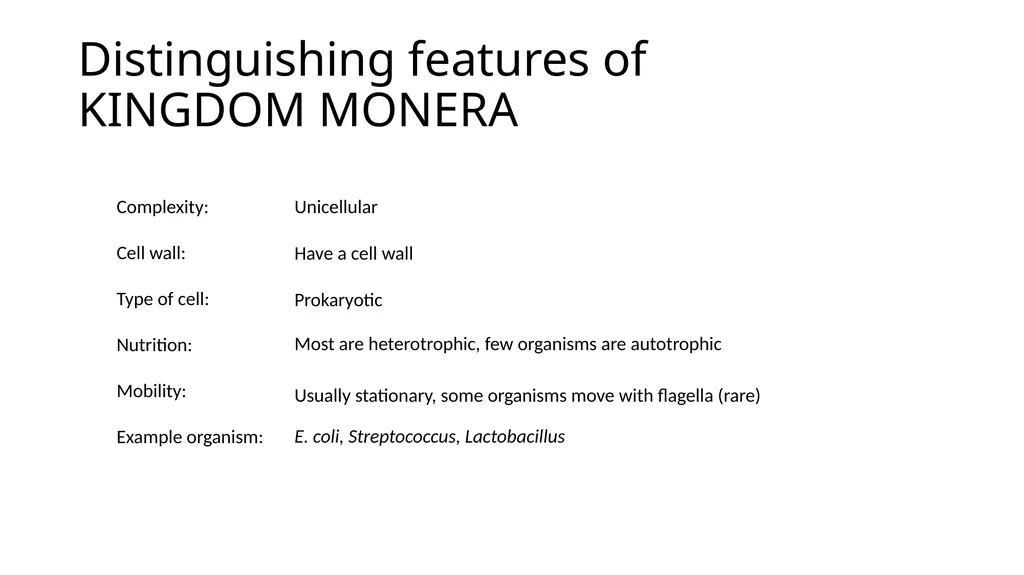
Distinguishing features of �KINGDOM MONERA Complexity:
Cell wall:
Type of cell:
Nutrition:
Mobility:
Example organism: Unicellular Have a cell wall Prokaryotic Most are heterotrophic, few organisms are autotrophic Usually stationary, some organisms move with flagella (rare) E. coli, Streptococcus, Lactobacillus<br>
20
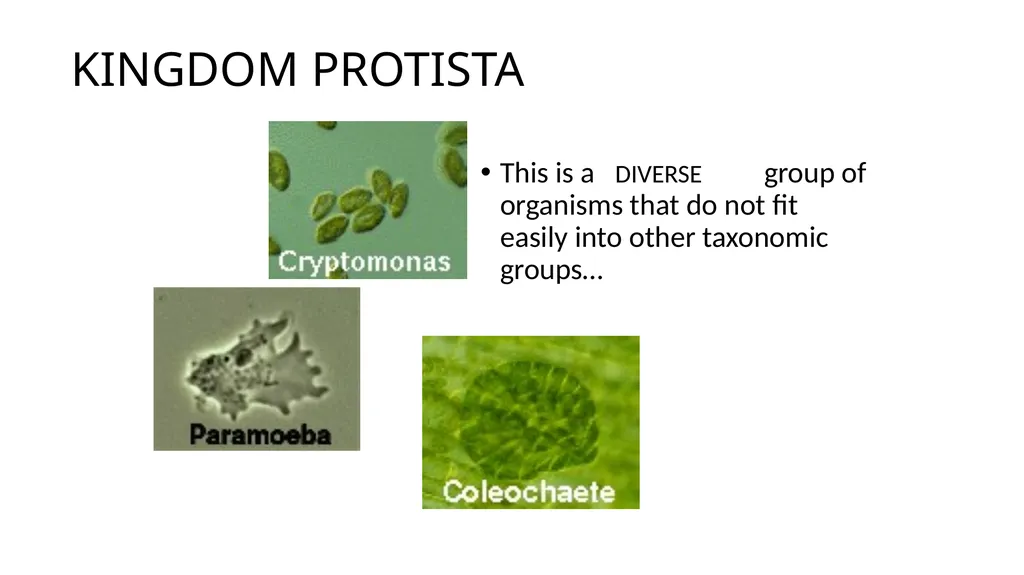
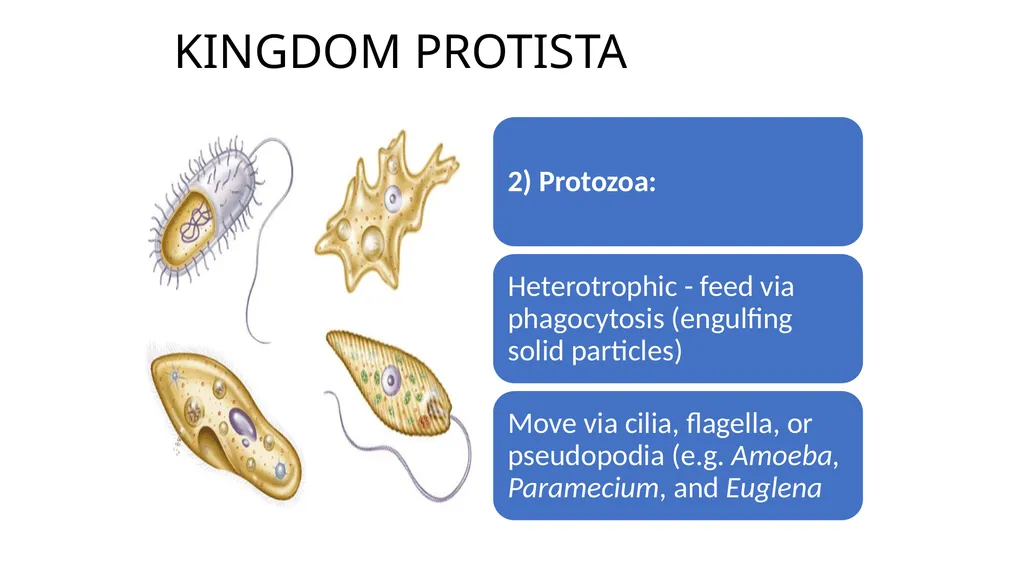
KINGDOM PROTISTA This is a group of organisms that do not fit easily into other taxonomic groups… DIVERSE<br>
21
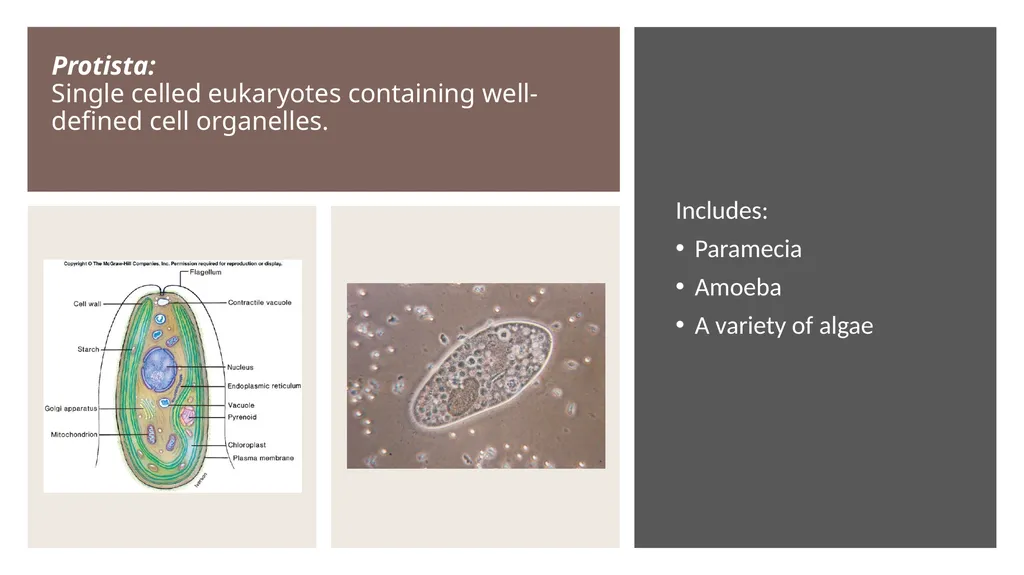
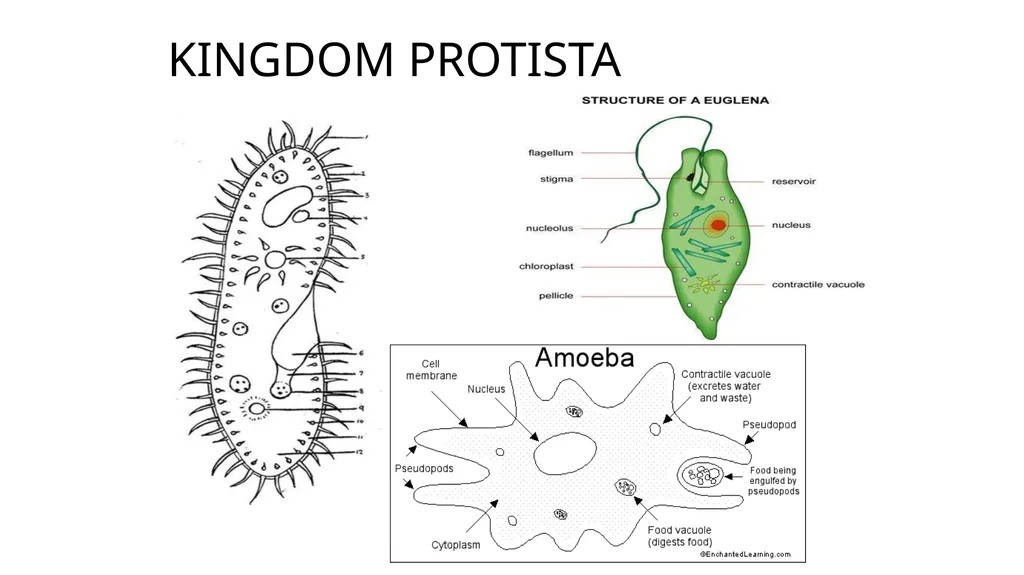
Protista: �Single celled eukaryotes containing well-defined cell organelles. Includes:
Paramecia
Amoeba
A variety of algae<br>
22
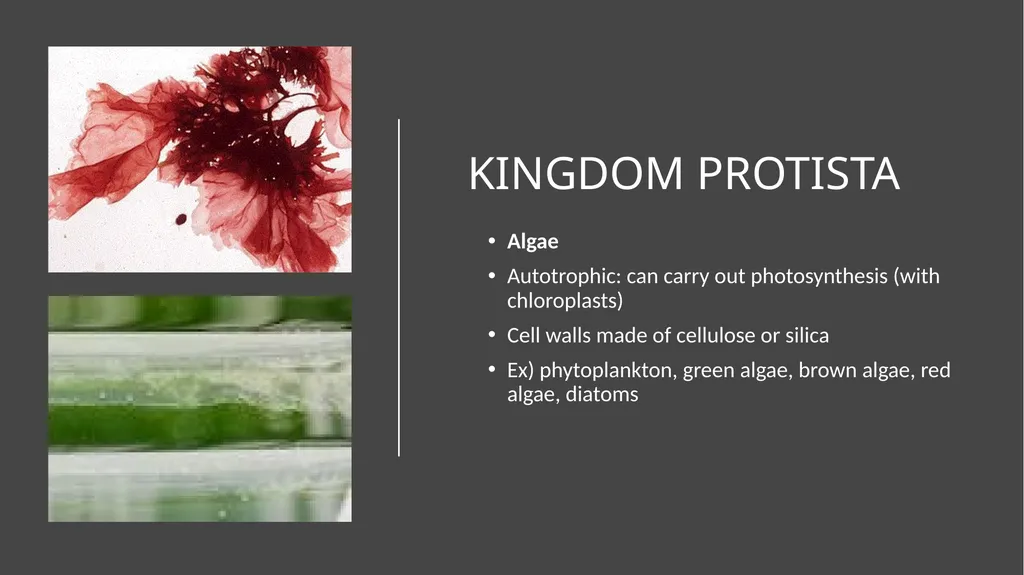
KINGDOM PROTISTA Algae
Autotrophic: can carry out photosynthesis (with chloroplasts)
Cell walls made of cellulose or silica
Ex) phytoplankton, green algae, brown algae, red algae, diatoms<br>
23
KINGDOM PROTISTA Heterotrophic<br>
25
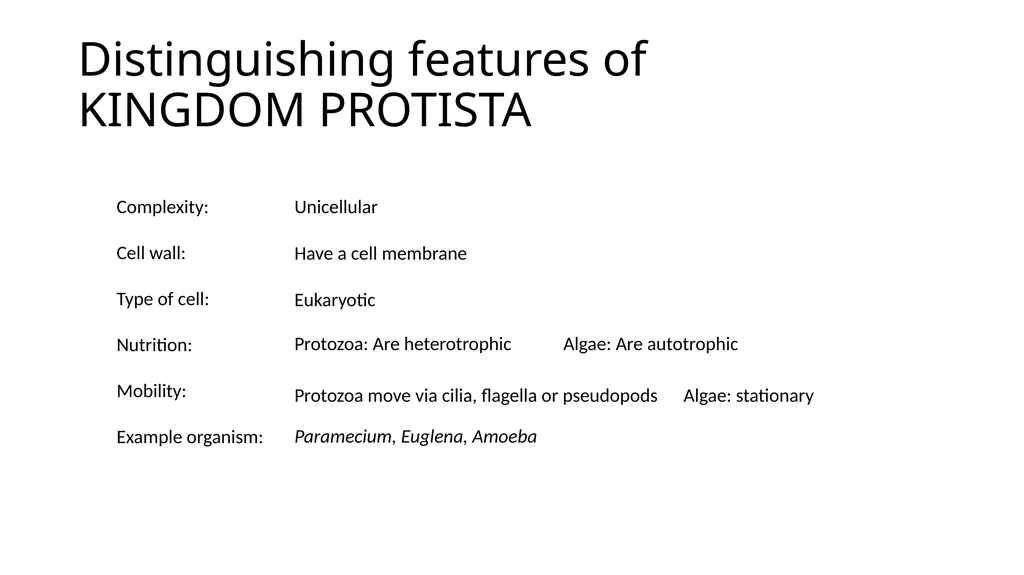
Distinguishing features of �KINGDOM PROTISTA Complexity:
Cell wall:
Type of cell:
Nutrition:
Mobility:
Example organism: Unicellular Have a cell membrane Eukaryotic Protozoa: Are heterotrophic Algae: Are autotrophic Protozoa move via cilia, flagella or pseudopods Algae: stationary Paramecium, Euglena, Amoeba<br>
26
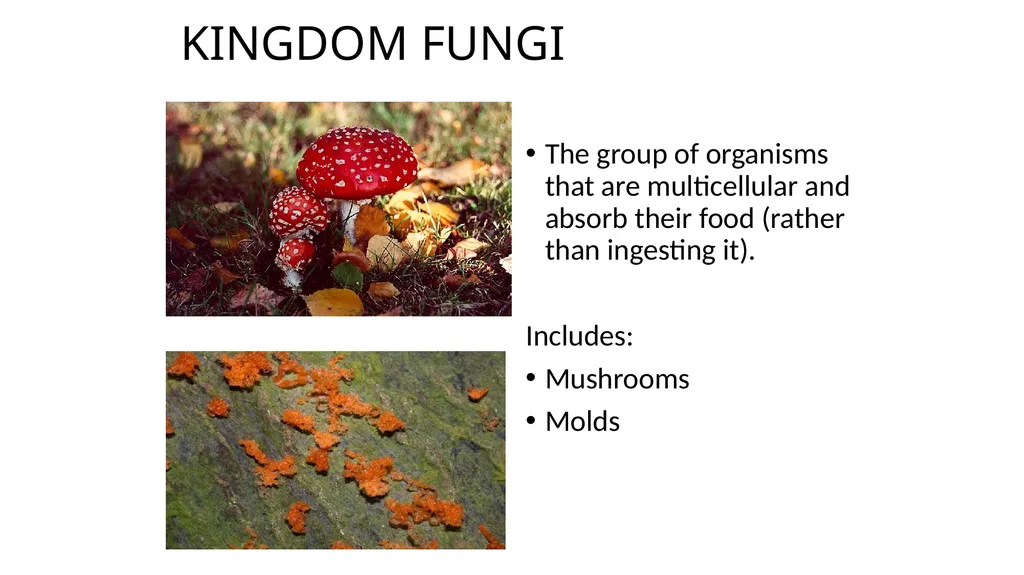
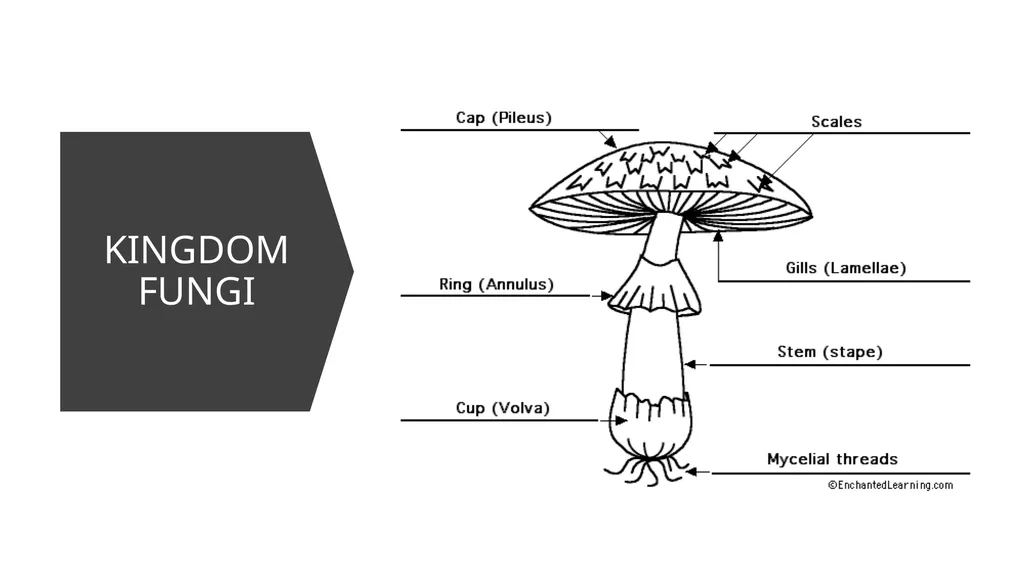
KINGDOM FUNGI The group of organisms that are multicellular and absorb their food (rather than ingesting it).
Includes:
Mushrooms
Molds<br>
28
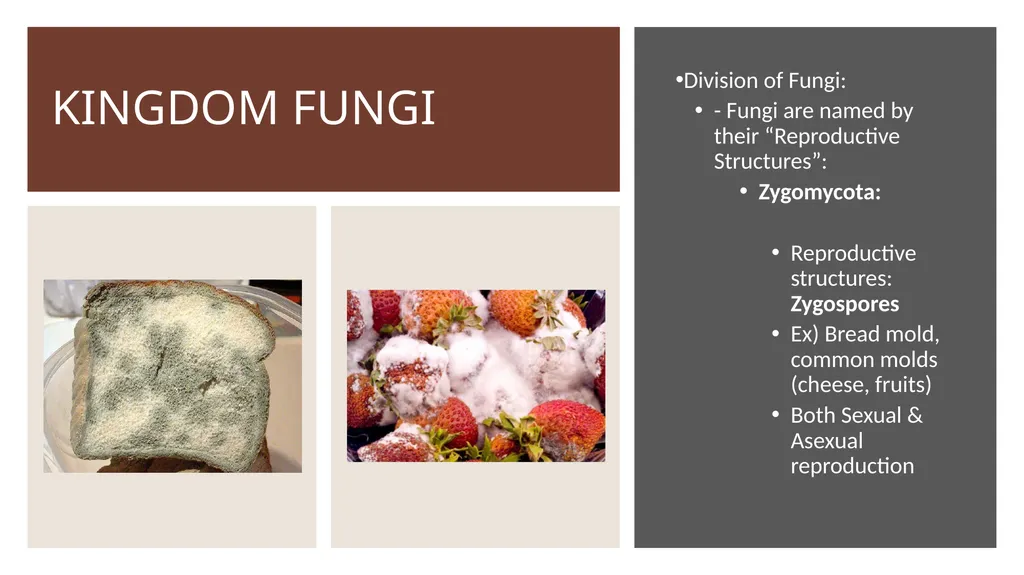
KINGDOM FUNGI Division of Fungi:
- Fungi are named by their “Reproductive Structures”:
Zygomycota:
Reproductive structures: Zygospores
Ex) Bread mold, common molds (cheese, fruits)
Both Sexual & Asexual reproduction<br>
29
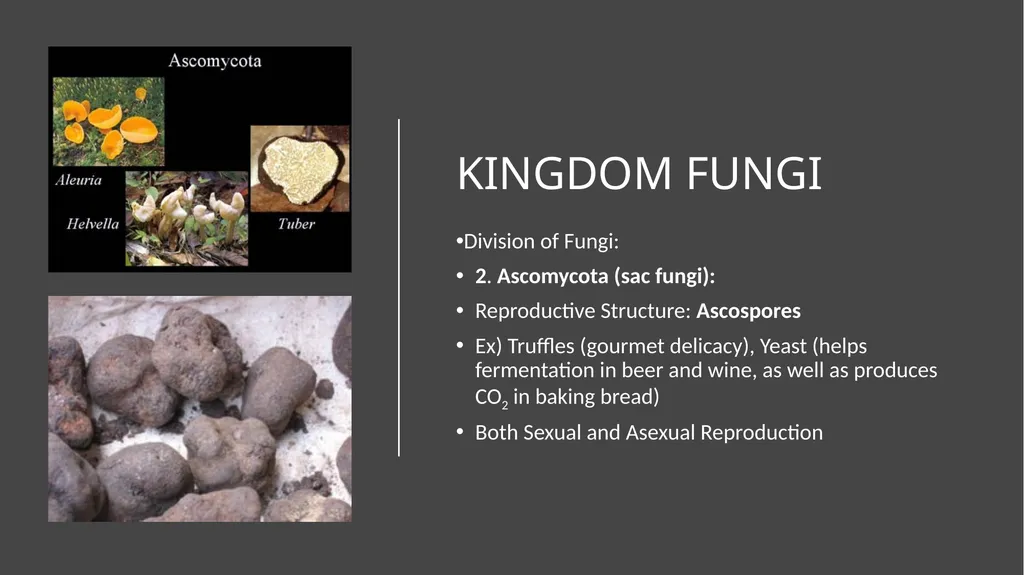
KINGDOM FUNGI Division of Fungi:
2. Ascomycota (sac fungi):
Reproductive Structure: Ascospores
Ex) Truffles (gourmet delicacy), Yeast (helps fermentation in beer and wine, as well as produces CO2 in baking bread)
Both Sexual and Asexual Reproduction<br>
30
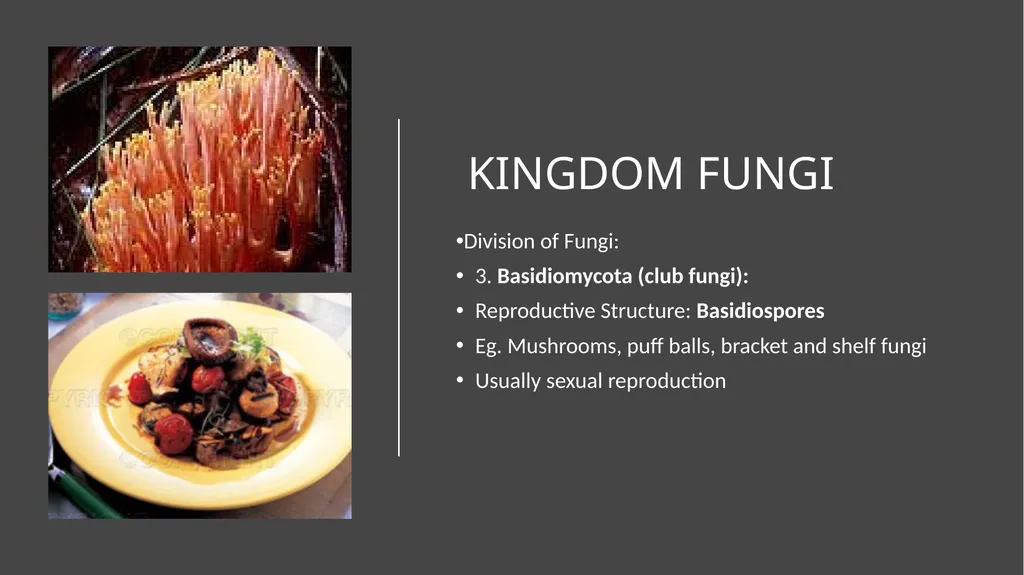
KINGDOM FUNGI Division of Fungi:
3. Basidiomycota (club fungi):
Reproductive Structure: Basidiospores
Eg. Mushrooms, puff balls, bracket and shelf fungi
Usually sexual reproduction<br>
31
KINGDOM FUNGI Division of Fungi:
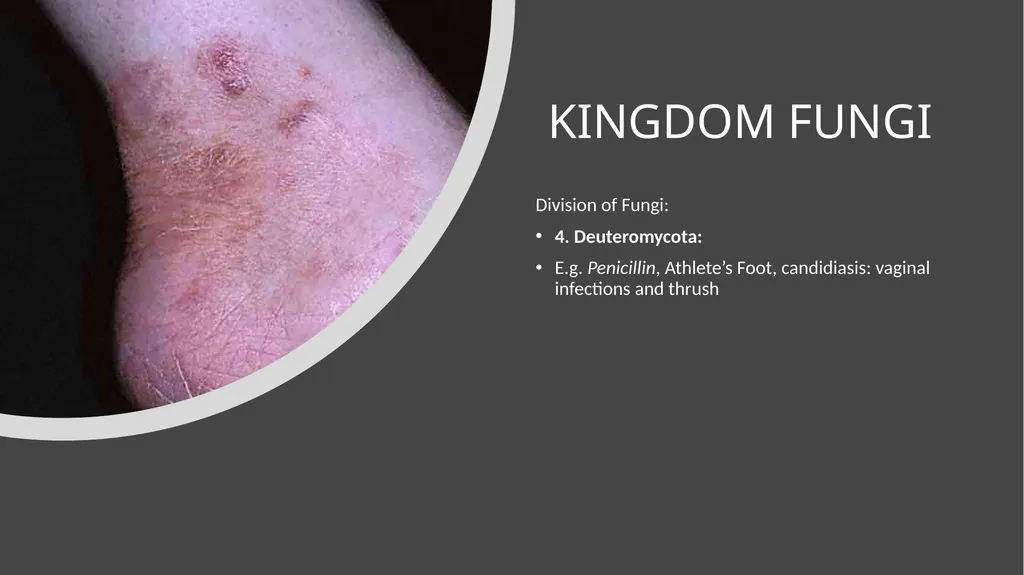
4. Deuteromycota:
E.g. Penicillin, Athlete’s Foot, candidiasis: vaginal infections and thrush<br>
32
KINGDOM FUNGI Division of Fungi:
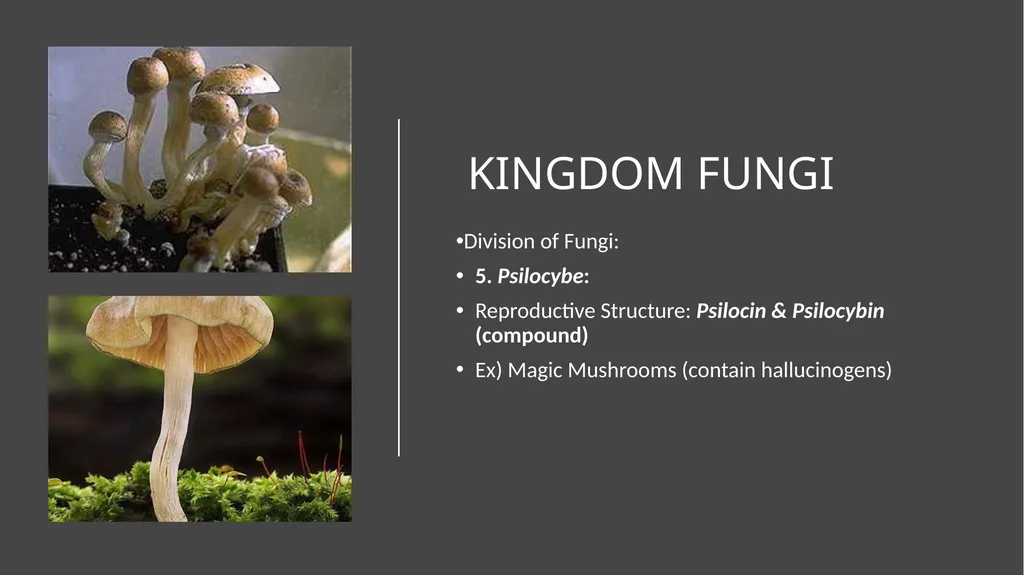
5. Psilocybe:
Reproductive Structure: Psilocin & Psilocybin (compound)
Ex) Magic Mushrooms (contain hallucinogens)<br>
33
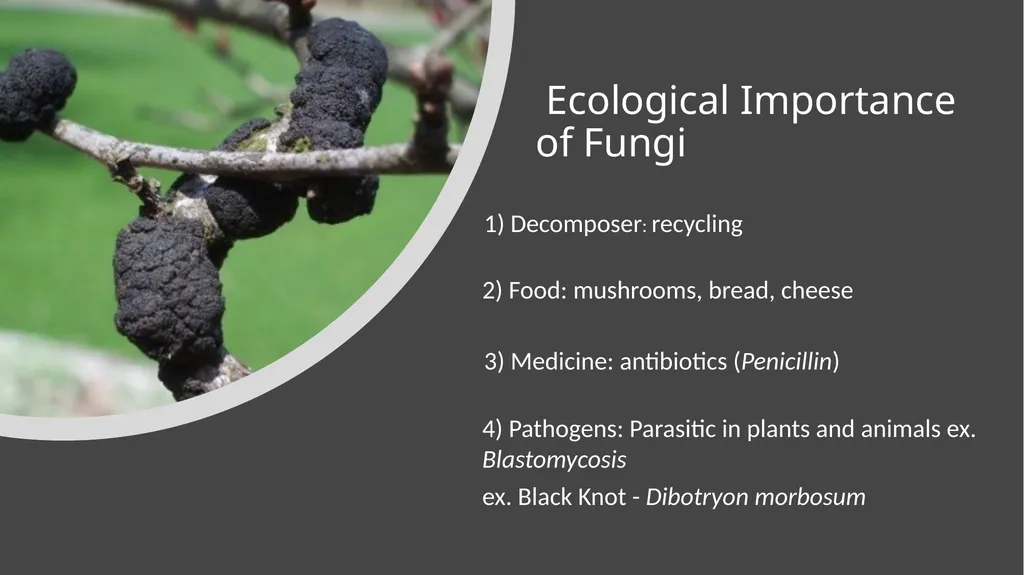
Ecological Importance of Fungi 1) Decomposer: recycling 2) Food: mushrooms, bread, cheese 3) Medicine: antibiotics (Penicillin) 4) Pathogens: Parasitic in plants and animals ex. Blastomycosis
ex. Black Knot - Dibotryon morbosum<br>
34
Ecological Importance of Fungi continued… Carcinogens: cancer causing fungal spores
- Mycotoxins (toxic substances produced by mold) also tend to affect more biological systems in your body than do pesticides or heavy metals, partly because fungi have the ability to dodge your immune system by rapidly mutating, while at the same time producing chemicals that suppress your immune system. 6) House Damage after flooding or high humidity 7) Symbiotic Environment: the mycorrhizae supplies plant roots with inorganic nutrients while roots supply the fungus with organic nutrients
- Plants surrounded by mycorrhizae grow very well in poor soils.<br>
35
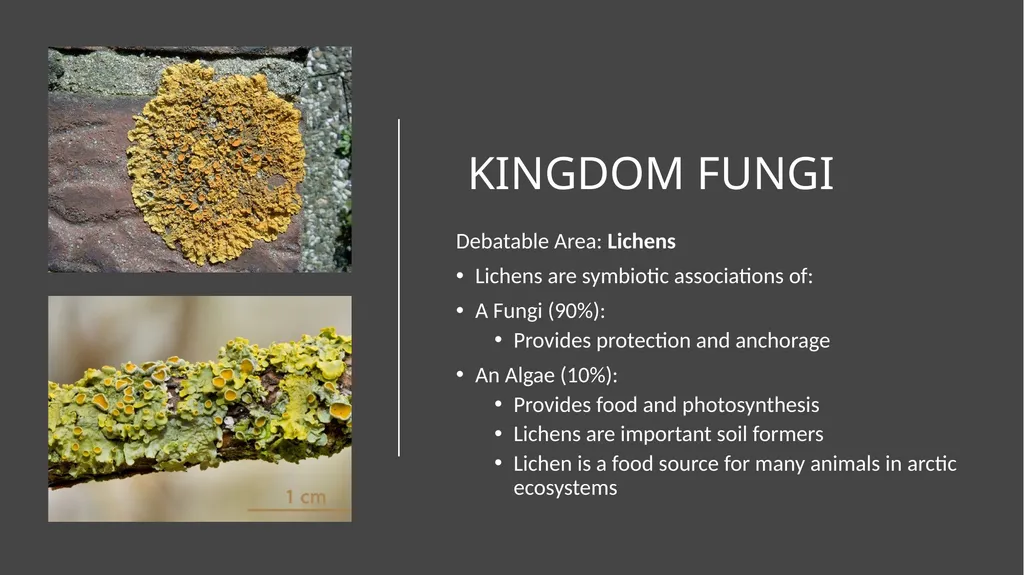
KINGDOM FUNGI Debatable Area: Lichens
Lichens are symbiotic associations of:
A Fungi (90%):
Provides protection and anchorage
An Algae (10%):
Provides food and photosynthesis
Lichens are important soil formers
Lichen is a food source for many animals in arctic ecosystems<br>
36
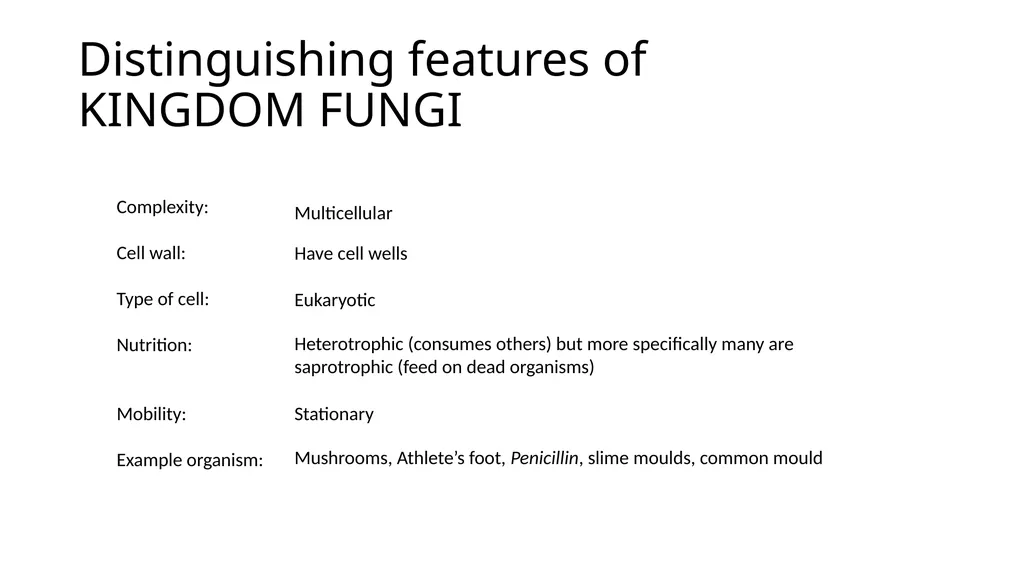
Distinguishing features of �KINGDOM FUNGI Complexity:
Cell wall:
Type of cell:
Nutrition:
Mobility:
Example organism: Multicellular Have cell wells Eukaryotic Heterotrophic (consumes others) but more specifically many are saprotrophic (feed on dead organisms) Stationary Mushrooms, Athlete’s foot, Penicillin, slime moulds, common mould<br>
37
Planet Earth DVD Fungus discussion with David Attenborough
Jungles section of DVD #3 - Start at 23min:30<br>