
UNIT-5 ANIMAL WELFARE By- Dr. MAMTA Assistant
CB
Published · 15 slides · 0 views

1 / 1
Description
UNIT-5 ANIMAL WELFARE By- Dr. MAMTA Assistant Professor LPM Definition of animal welfare and ethics. Human and animal welfare in relation to ecosystem and environmental factors. Role of veterinarians in animal welfare. Animal welfare
Related Topics
Share
Embed code
Download this presentation From Below
"UNIT-5 ANIMAL WELFARE By- Dr. MAMTA Assistant" is the property of its rightful owner. Permission is granted to download and print the materials on this website for personal, non-commercial use only, and to display it on your personal computer provided you do not modify the materials and that you retain all copyright notices contained in the materials. By downloading content from our website, you accept the terms of this agreement.
Presentation Transcript
01
UNIT-5
ANIMAL WELFARE By-
Dr. MAMTA
Assistant Professor
LPM<br>
Dr. MAMTA
Assistant Professor
LPM<br>
02
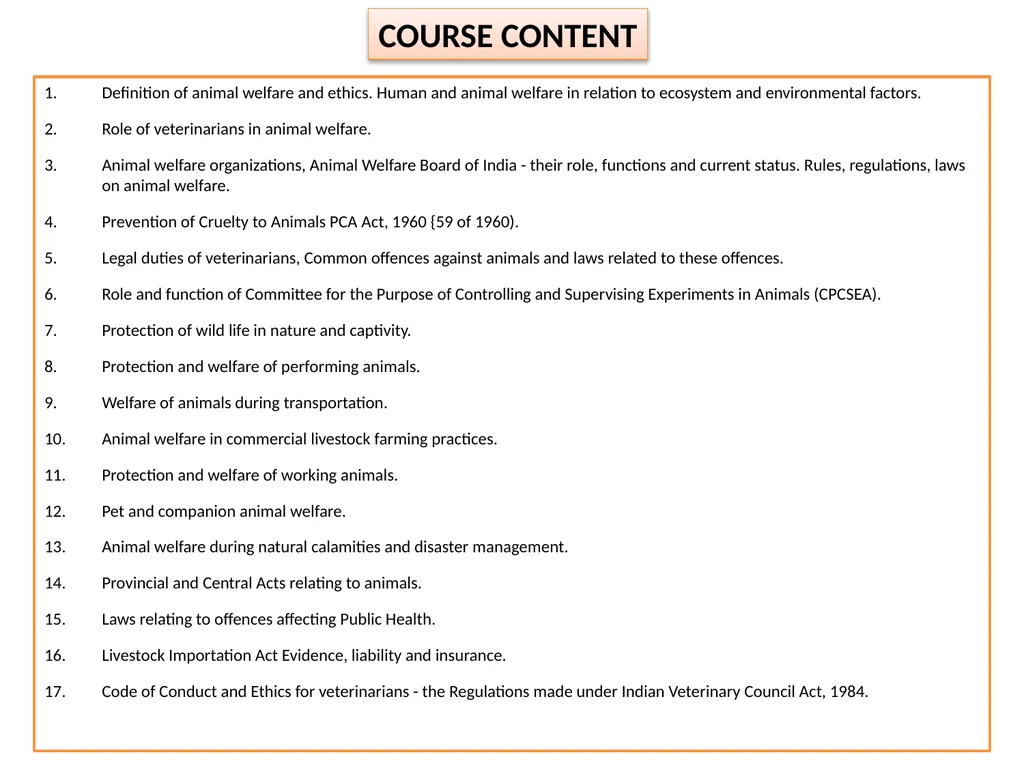
Definition of animal welfare and ethics. Human and animal welfare in relation to ecosystem and environmental factors.
Role of veterinarians in animal welfare.
Animal welfare organizations, Animal Welfare Board of India - their role, functions and current status. Rules, regulations, laws on animal welfare.
Prevention of Cruelty to Animals PCA Act, 1960 {59 of 1960).
Legal duties of veterinarians, Common offences against animals and laws related to these offences.
Role and function of Committee for the Purpose of Controlling and Supervising Experiments in Animals (CPCSEA).
Protection of wild life in nature and captivity.
Protection and welfare of performing animals.
Welfare of animals during transportation.
Animal welfare in commercial livestock farming practices.
Protection and welfare of working animals.
Pet and companion animal welfare.
Animal welfare during natural calamities and disaster management.
Provincial and Central Acts relating to animals.
Laws relating to offences affecting Public Health.
Livestock Importation Act Evidence, liability and insurance.
Code of Conduct and Ethics for veterinarians - the Regulations made under Indian Veterinary Council Act, 1984. COURSE CONTENT<br>
Role of veterinarians in animal welfare.
Animal welfare organizations, Animal Welfare Board of India - their role, functions and current status. Rules, regulations, laws on animal welfare.
Prevention of Cruelty to Animals PCA Act, 1960 {59 of 1960).
Legal duties of veterinarians, Common offences against animals and laws related to these offences.
Role and function of Committee for the Purpose of Controlling and Supervising Experiments in Animals (CPCSEA).
Protection of wild life in nature and captivity.
Protection and welfare of performing animals.
Welfare of animals during transportation.
Animal welfare in commercial livestock farming practices.
Protection and welfare of working animals.
Pet and companion animal welfare.
Animal welfare during natural calamities and disaster management.
Provincial and Central Acts relating to animals.
Laws relating to offences affecting Public Health.
Livestock Importation Act Evidence, liability and insurance.
Code of Conduct and Ethics for veterinarians - the Regulations made under Indian Veterinary Council Act, 1984. COURSE CONTENT<br>
03
Definition of animal welfare and ethics.
Human and animal welfare in relation to ecosystem and environmental factors. Lecture-1<br>
04
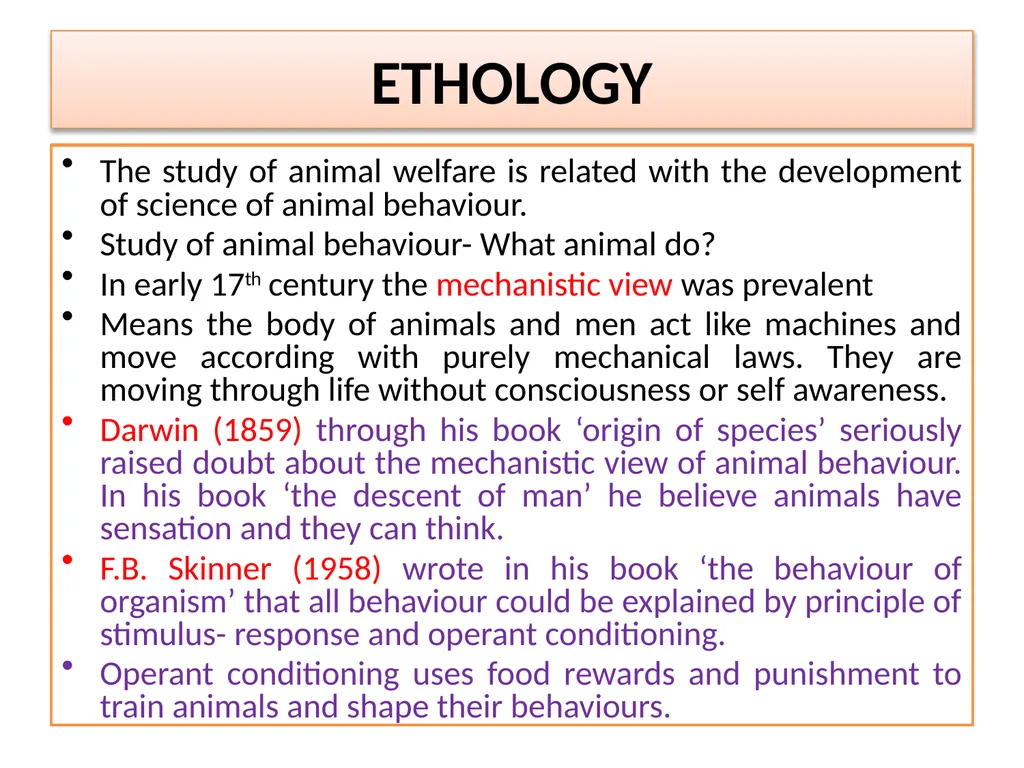
ETHOLOGY The study of animal welfare is related with the development of science of animal behaviour.
Study of animal behaviour- What animal do?
In early 17th century the mechanistic view was prevalent
Means the body of animals and men act like machines and move according with purely mechanical laws. They are moving through life without consciousness or self awareness.
Darwin (1859) through his book ‘origin of species’ seriously raised doubt about the mechanistic view of animal behaviour. In his book ‘the descent of man’ he believe animals have sensation and they can think.
F.B. Skinner (1958) wrote in his book ‘the behaviour of organism’ that all behaviour could be explained by principle of stimulus- response and operant conditioning.
Operant conditioning uses food rewards and punishment to train animals and shape their behaviours.<br>
Study of animal behaviour- What animal do?
In early 17th century the mechanistic view was prevalent
Means the body of animals and men act like machines and move according with purely mechanical laws. They are moving through life without consciousness or self awareness.
Darwin (1859) through his book ‘origin of species’ seriously raised doubt about the mechanistic view of animal behaviour. In his book ‘the descent of man’ he believe animals have sensation and they can think.
F.B. Skinner (1958) wrote in his book ‘the behaviour of organism’ that all behaviour could be explained by principle of stimulus- response and operant conditioning.
Operant conditioning uses food rewards and punishment to train animals and shape their behaviours.<br>
05
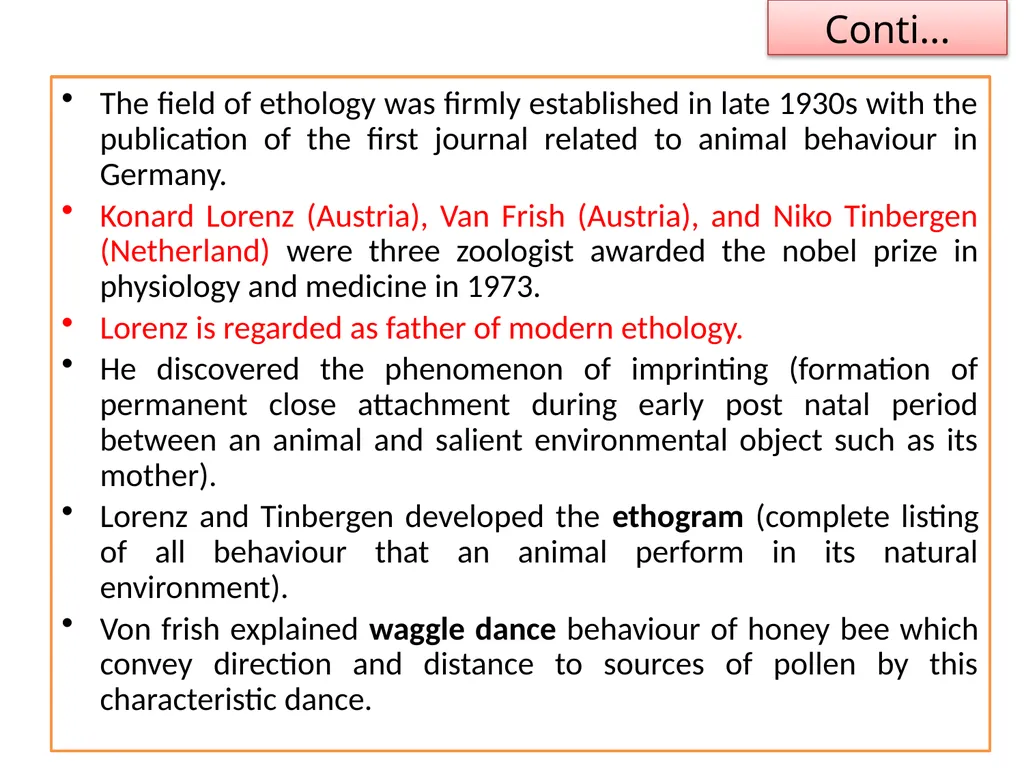
Conti... The field of ethology was firmly established in late 1930s with the publication of the first journal related to animal behaviour in Germany.
Konard Lorenz (Austria), Van Frish (Austria), and Niko Tinbergen (Netherland) were three zoologist awarded the nobel prize in physiology and medicine in 1973.
Lorenz is regarded as father of modern ethology.
He discovered the phenomenon of imprinting (formation of permanent close attachment during early post natal period between an animal and salient environmental object such as its mother).
Lorenz and Tinbergen developed the ethogram (complete listing of all behaviour that an animal perform in its natural environment).
Von frish explained waggle dance behaviour of honey bee which convey direction and distance to sources of pollen by this characteristic dance.<br>
Konard Lorenz (Austria), Van Frish (Austria), and Niko Tinbergen (Netherland) were three zoologist awarded the nobel prize in physiology and medicine in 1973.
Lorenz is regarded as father of modern ethology.
He discovered the phenomenon of imprinting (formation of permanent close attachment during early post natal period between an animal and salient environmental object such as its mother).
Lorenz and Tinbergen developed the ethogram (complete listing of all behaviour that an animal perform in its natural environment).
Von frish explained waggle dance behaviour of honey bee which convey direction and distance to sources of pollen by this characteristic dance.<br>
06
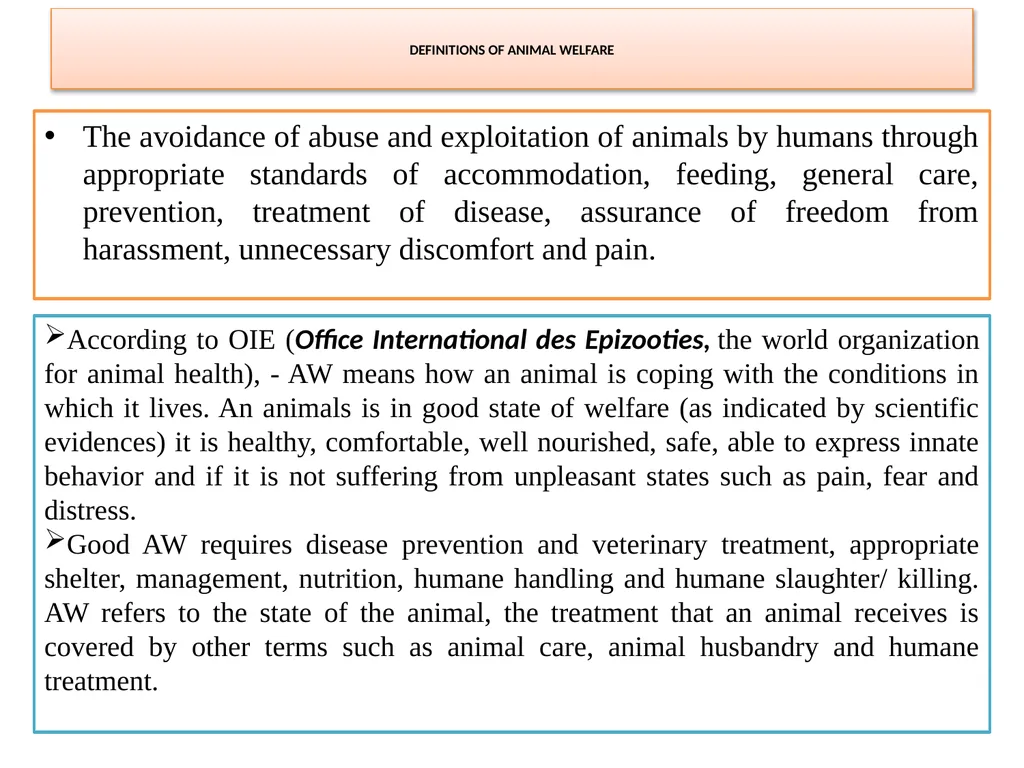
DEFINITIONS OF ANIMAL WELFARE The avoidance of abuse and exploitation of animals by humans through appropriate standards of accommodation, feeding, general care, prevention, treatment of disease, assurance of freedom from harassment, unnecessary discomfort and pain. According to OIE (Office International des Epizooties, the world organization for animal health), - AW means how an animal is coping with the conditions in which it lives. An animals is in good state of welfare (as indicated by scientific evidences) it is healthy, comfortable, well nourished, safe, able to express innate behavior and if it is not suffering from unpleasant states such as pain, fear and distress.
Good AW requires disease prevention and veterinary treatment, appropriate shelter, management, nutrition, humane handling and humane slaughter/ killing. AW refers to the state of the animal, the treatment that an animal receives is covered by other terms such as animal care, animal husbandry and humane treatment.<br>
Good AW requires disease prevention and veterinary treatment, appropriate shelter, management, nutrition, humane handling and humane slaughter/ killing. AW refers to the state of the animal, the treatment that an animal receives is covered by other terms such as animal care, animal husbandry and humane treatment.<br>
07
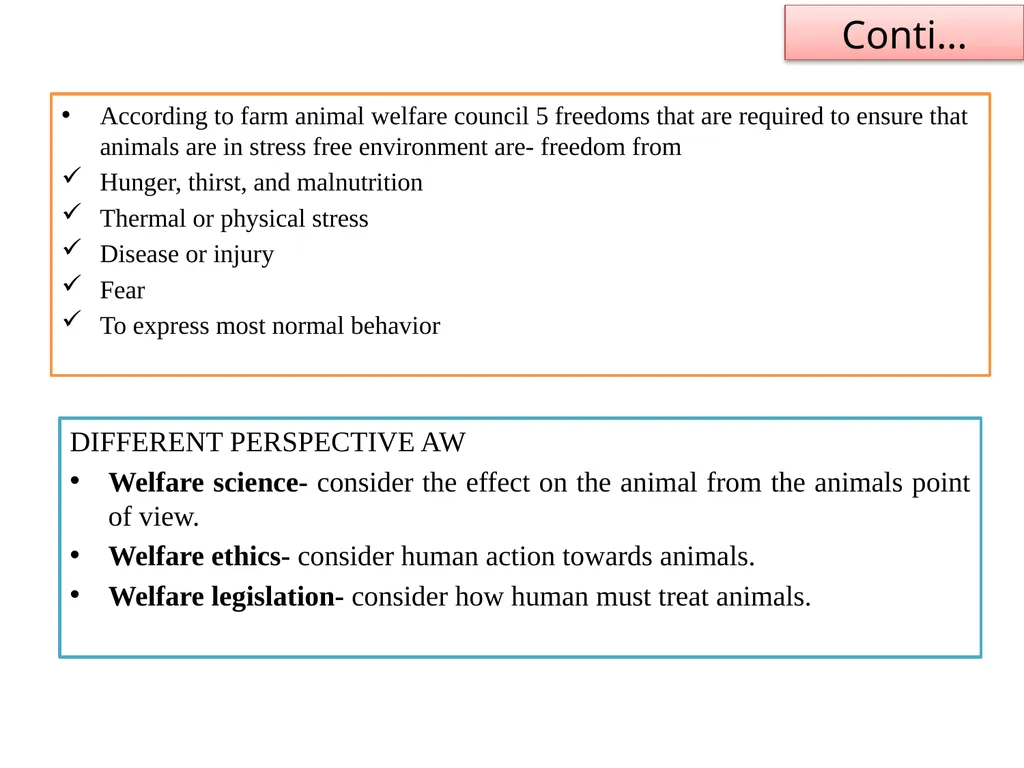
According to farm animal welfare council 5 freedoms that are required to ensure that animals are in stress free environment are- freedom from
Hunger, thirst, and malnutrition
Thermal or physical stress
Disease or injury
Fear
To express most normal behavior Conti... DIFFERENT PERSPECTIVE AW
Welfare science- consider the effect on the animal from the animals point of view.
Welfare ethics- consider human action towards animals.
Welfare legislation- consider how human must treat animals.<br>
Hunger, thirst, and malnutrition
Thermal or physical stress
Disease or injury
Fear
To express most normal behavior Conti... DIFFERENT PERSPECTIVE AW
Welfare science- consider the effect on the animal from the animals point of view.
Welfare ethics- consider human action towards animals.
Welfare legislation- consider how human must treat animals.<br>
08
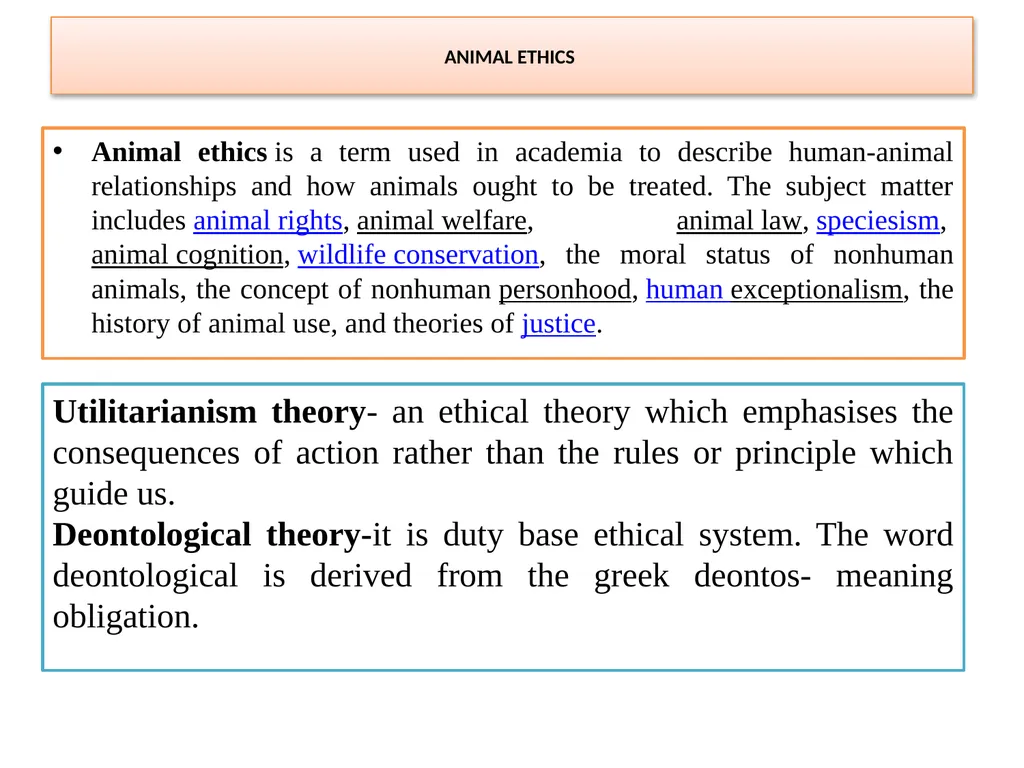
ANIMAL ETHICS Animal ethics is a term used in academia to describe human-animal relationships and how animals ought to be treated. The subject matter includes animal rights, animal welfare, animal law, speciesism, animal cognition, wildlife conservation, the moral status of nonhuman animals, the concept of nonhuman personhood, human exceptionalism, the history of animal use, and theories of justice. Utilitarianism theory- an ethical theory which emphasises the consequences of action rather than the rules or principle which guide us.
Deontological theory-it is duty base ethical system. The word deontological is derived from the greek deontos- meaning obligation.<br>
Deontological theory-it is duty base ethical system. The word deontological is derived from the greek deontos- meaning obligation.<br>
09
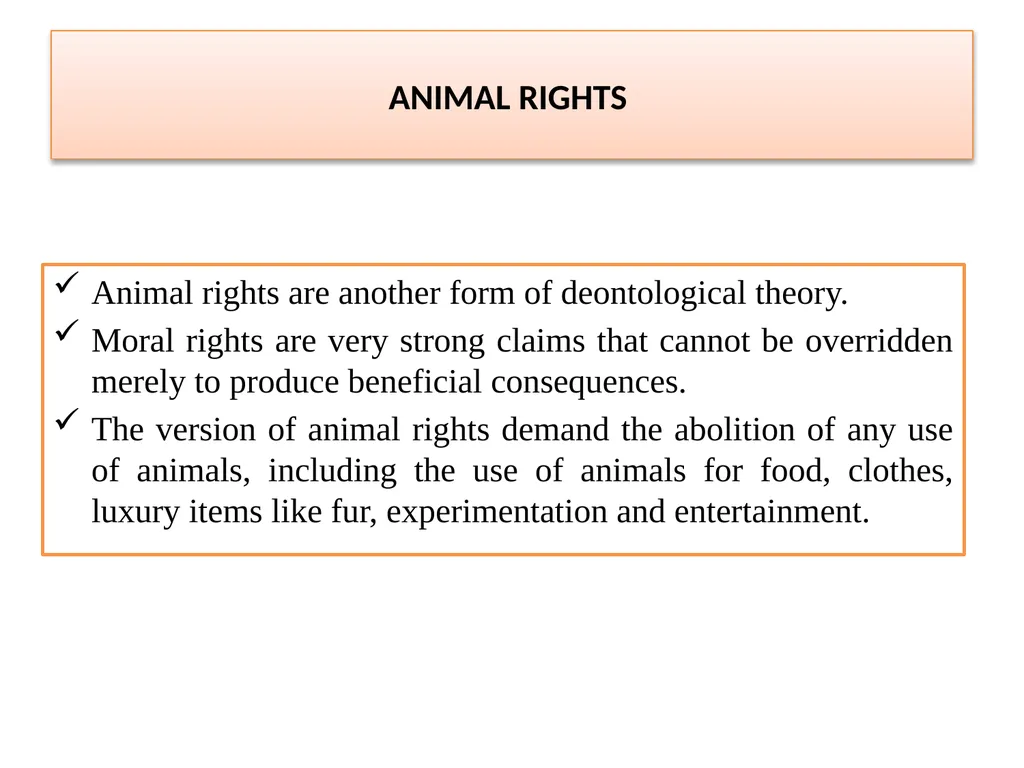
ANIMAL RIGHTS Animal rights are another form of deontological theory.
Moral rights are very strong claims that cannot be overridden merely to produce beneficial consequences.
The version of animal rights demand the abolition of any use of animals, including the use of animals for food, clothes, luxury items like fur, experimentation and entertainment.<br>
Moral rights are very strong claims that cannot be overridden merely to produce beneficial consequences.
The version of animal rights demand the abolition of any use of animals, including the use of animals for food, clothes, luxury items like fur, experimentation and entertainment.<br>
10
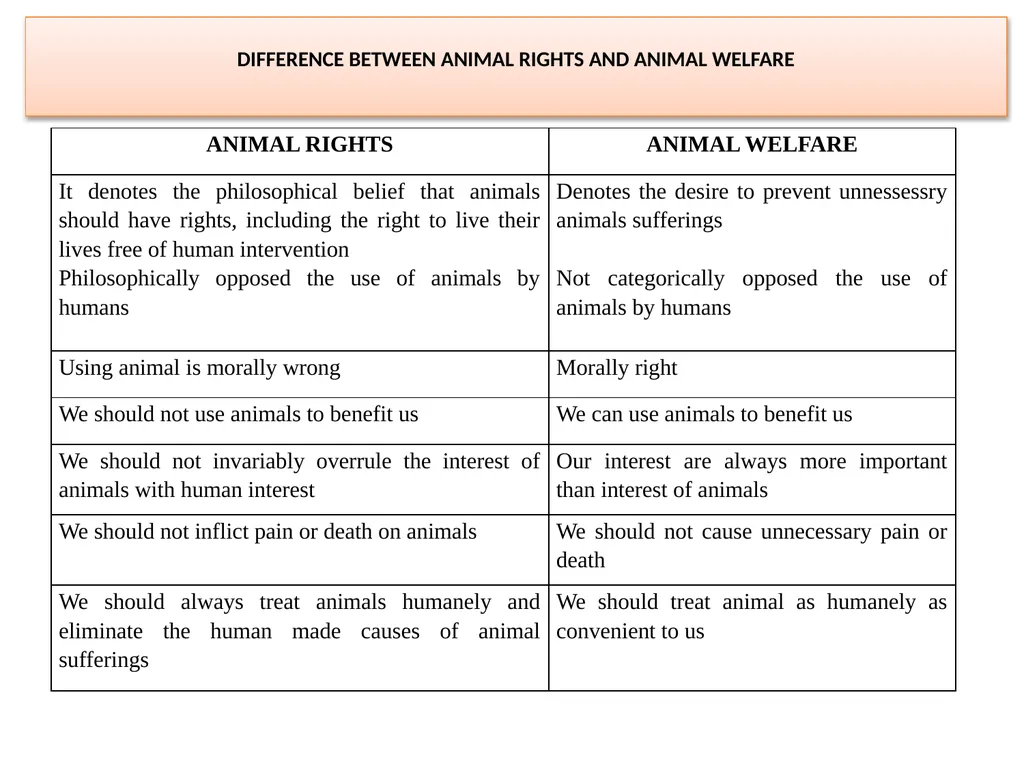
DIFFERENCE BETWEEN ANIMAL RIGHTS AND ANIMAL WELFARE<br>
11
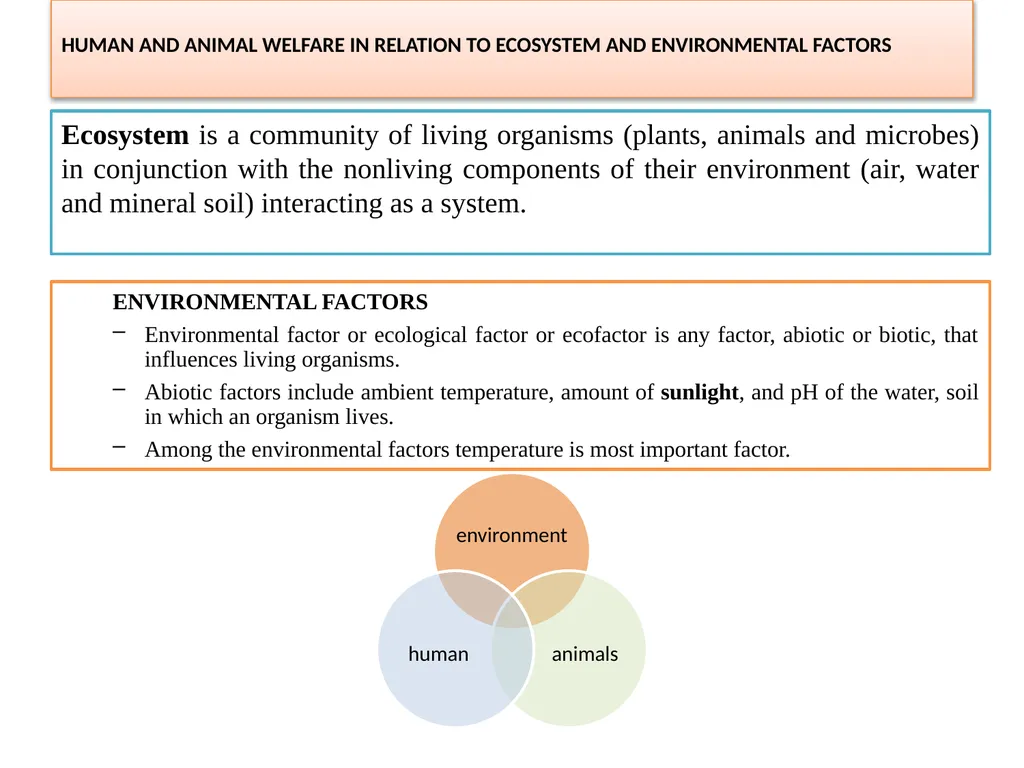
HUMAN AND ANIMAL WELFARE IN RELATION TO ECOSYSTEM AND ENVIRONMENTAL FACTORS ENVIRONMENTAL FACTORS
Environmental factor or ecological factor or ecofactor is any factor, abiotic or biotic, that influences living organisms.
Abiotic factors include ambient temperature, amount of sunlight, and pH of the water, soil in which an organism lives.
Among the environmental factors temperature is most important factor. Ecosystem is a community of living organisms (plants, animals and microbes) in conjunction with the nonliving components of their environment (air, water and mineral soil) interacting as a system.<br>
Environmental factor or ecological factor or ecofactor is any factor, abiotic or biotic, that influences living organisms.
Abiotic factors include ambient temperature, amount of sunlight, and pH of the water, soil in which an organism lives.
Among the environmental factors temperature is most important factor. Ecosystem is a community of living organisms (plants, animals and microbes) in conjunction with the nonliving components of their environment (air, water and mineral soil) interacting as a system.<br>
12
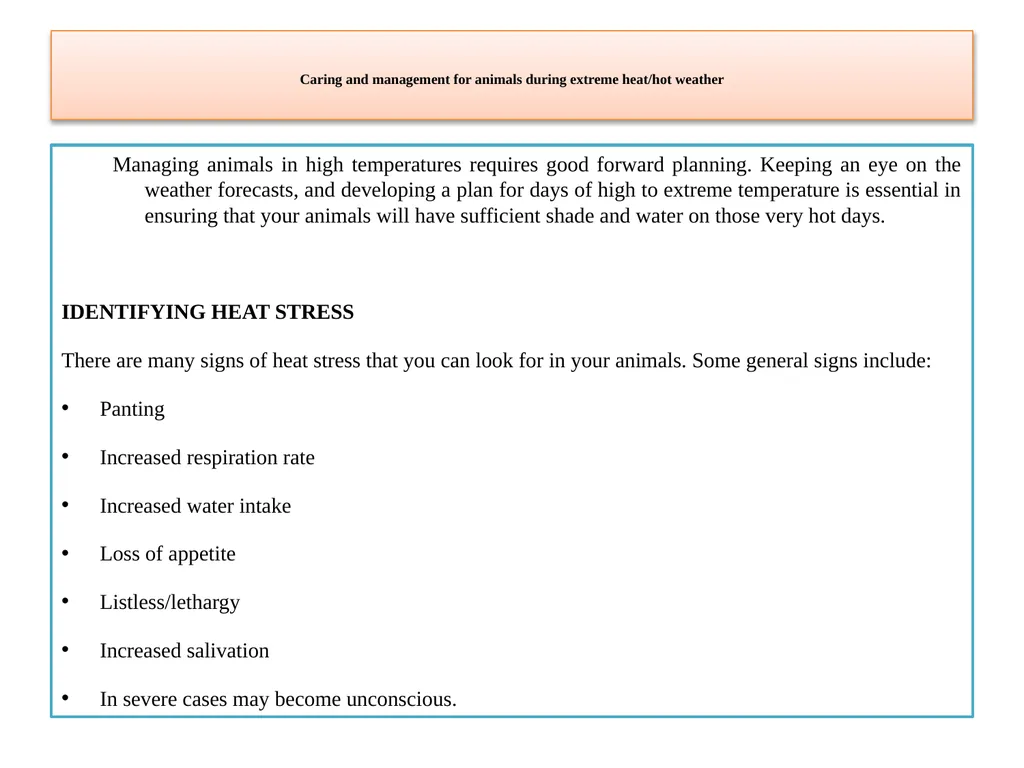
Caring and management for animals during extreme heat/hot weather Managing animals in high temperatures requires good forward planning. Keeping an eye on the weather forecasts, and developing a plan for days of high to extreme temperature is essential in ensuring that your animals will have sufficient shade and water on those very hot days.
IDENTIFYING HEAT STRESS
There are many signs of heat stress that you can look for in your animals. Some general signs include:
Panting
Increased respiration rate
Increased water intake
Loss of appetite
Listless/lethargy
Increased salivation
In severe cases may become unconscious.<br>
IDENTIFYING HEAT STRESS
There are many signs of heat stress that you can look for in your animals. Some general signs include:
Panting
Increased respiration rate
Increased water intake
Loss of appetite
Listless/lethargy
Increased salivation
In severe cases may become unconscious.<br>
13
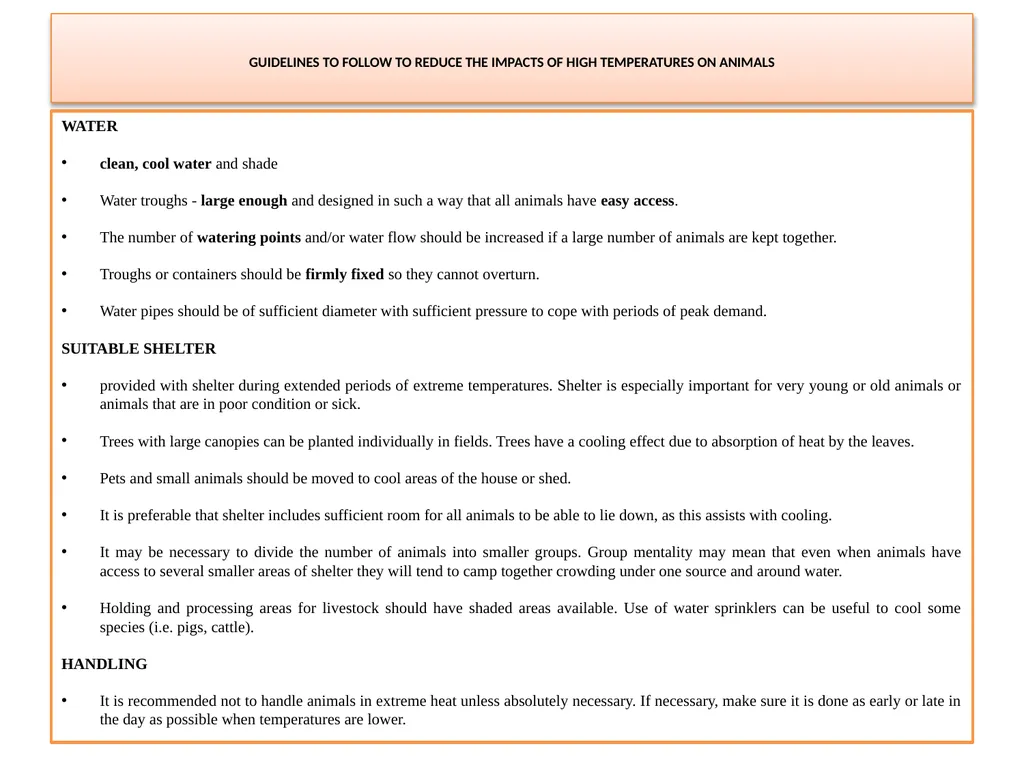
GUIDELINES TO FOLLOW TO REDUCE THE IMPACTS OF HIGH TEMPERATURES ON ANIMALS WATER
clean, cool water and shade
Water troughs - large enough and designed in such a way that all animals have easy access.
The number of watering points and/or water flow should be increased if a large number of animals are kept together.
Troughs or containers should be firmly fixed so they cannot overturn.
Water pipes should be of sufficient diameter with sufficient pressure to cope with periods of peak demand.
SUITABLE SHELTER
provided with shelter during extended periods of extreme temperatures. Shelter is especially important for very young or old animals or animals that are in poor condition or sick.
Trees with large canopies can be planted individually in fields. Trees have a cooling effect due to absorption of heat by the leaves.
Pets and small animals should be moved to cool areas of the house or shed.
It is preferable that shelter includes sufficient room for all animals to be able to lie down, as this assists with cooling.
It may be necessary to divide the number of animals into smaller groups. Group mentality may mean that even when animals have access to several smaller areas of shelter they will tend to camp together crowding under one source and around water.
Holding and processing areas for livestock should have shaded areas available. Use of water sprinklers can be useful to cool some species (i.e. pigs, cattle).
HANDLING
It is recommended not to handle animals in extreme heat unless absolutely necessary. If necessary, make sure it is done as early or late in the day as possible when temperatures are lower.<br>
clean, cool water and shade
Water troughs - large enough and designed in such a way that all animals have easy access.
The number of watering points and/or water flow should be increased if a large number of animals are kept together.
Troughs or containers should be firmly fixed so they cannot overturn.
Water pipes should be of sufficient diameter with sufficient pressure to cope with periods of peak demand.
SUITABLE SHELTER
provided with shelter during extended periods of extreme temperatures. Shelter is especially important for very young or old animals or animals that are in poor condition or sick.
Trees with large canopies can be planted individually in fields. Trees have a cooling effect due to absorption of heat by the leaves.
Pets and small animals should be moved to cool areas of the house or shed.
It is preferable that shelter includes sufficient room for all animals to be able to lie down, as this assists with cooling.
It may be necessary to divide the number of animals into smaller groups. Group mentality may mean that even when animals have access to several smaller areas of shelter they will tend to camp together crowding under one source and around water.
Holding and processing areas for livestock should have shaded areas available. Use of water sprinklers can be useful to cool some species (i.e. pigs, cattle).
HANDLING
It is recommended not to handle animals in extreme heat unless absolutely necessary. If necessary, make sure it is done as early or late in the day as possible when temperatures are lower.<br>
14
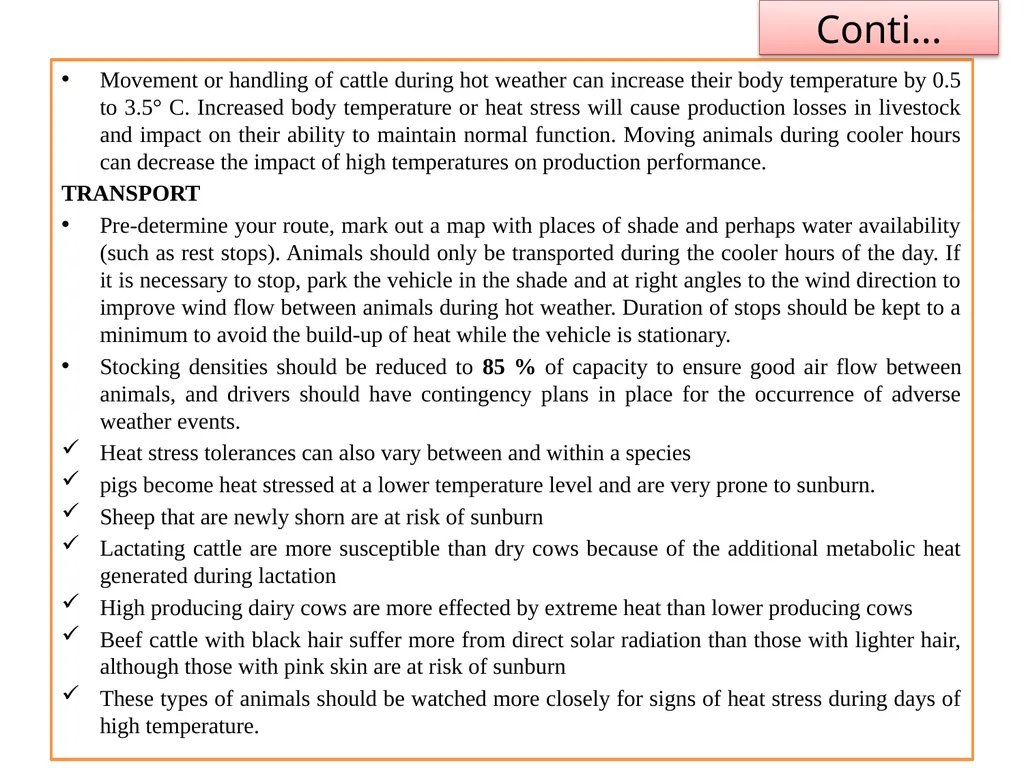
Movement or handling of cattle during hot weather can increase their body temperature by 0.5 to 3.5° C. Increased body temperature or heat stress will cause production losses in livestock and impact on their ability to maintain normal function. Moving animals during cooler hours can decrease the impact of high temperatures on production performance.
TRANSPORT
Pre-determine your route, mark out a map with places of shade and perhaps water availability (such as rest stops). Animals should only be transported during the cooler hours of the day. If it is necessary to stop, park the vehicle in the shade and at right angles to the wind direction to improve wind flow between animals during hot weather. Duration of stops should be kept to a minimum to avoid the build-up of heat while the vehicle is stationary.
Stocking densities should be reduced to 85 % of capacity to ensure good air flow between animals, and drivers should have contingency plans in place for the occurrence of adverse weather events.
Heat stress tolerances can also vary between and within a species
pigs become heat stressed at a lower temperature level and are very prone to sunburn.
Sheep that are newly shorn are at risk of sunburn
Lactating cattle are more susceptible than dry cows because of the additional metabolic heat generated during lactation
High producing dairy cows are more effected by extreme heat than lower producing cows
Beef cattle with black hair suffer more from direct solar radiation than those with lighter hair, although those with pink skin are at risk of sunburn
These types of animals should be watched more closely for signs of heat stress during days of high temperature. Conti...<br>
TRANSPORT
Pre-determine your route, mark out a map with places of shade and perhaps water availability (such as rest stops). Animals should only be transported during the cooler hours of the day. If it is necessary to stop, park the vehicle in the shade and at right angles to the wind direction to improve wind flow between animals during hot weather. Duration of stops should be kept to a minimum to avoid the build-up of heat while the vehicle is stationary.
Stocking densities should be reduced to 85 % of capacity to ensure good air flow between animals, and drivers should have contingency plans in place for the occurrence of adverse weather events.
Heat stress tolerances can also vary between and within a species
pigs become heat stressed at a lower temperature level and are very prone to sunburn.
Sheep that are newly shorn are at risk of sunburn
Lactating cattle are more susceptible than dry cows because of the additional metabolic heat generated during lactation
High producing dairy cows are more effected by extreme heat than lower producing cows
Beef cattle with black hair suffer more from direct solar radiation than those with lighter hair, although those with pink skin are at risk of sunburn
These types of animals should be watched more closely for signs of heat stress during days of high temperature. Conti...<br>
15
Thank you Animal Welfare & Management
by BHM Patel, SB Prasanna, Mahadevappa D Gouri (Author),
New India Publishing Agency (Publisher)<br>
by BHM Patel, SB Prasanna, Mahadevappa D Gouri (Author),
New India Publishing Agency (Publisher)<br>