
UNIT 7: BUSINESS LAW UNIT CODE: H/617/0736 UNIT 7:
TF
Published · 43 slides · 0 views
1 / 1
Description
UNIT 7: BUSINESS LAW UNIT CODE: H6170736 UNIT 7: BUSINESS LAW LO 3: EXAMINE THE FORMATION OF DIFFERENT TYPES OF BUSINESS ORGANISATION 2 UNIT 7: BUSINESS LAW P5 : EXPLAIN HOW BUSINESS ORGANISATIONS ARE MANAGE AND FUNDED 3 FORMING DIFFERENT
Related Topics
Share
Embed code
Download this presentation From Below
"UNIT 7: BUSINESS LAW UNIT CODE: H/617/0736 UNIT 7:" is the property of its rightful owner. Permission is granted to download and print the materials on this website for personal, non-commercial use only, and to display it on your personal computer provided you do not modify the materials and that you retain all copyright notices contained in the materials. By downloading content from our website, you accept the terms of this agreement.
Presentation Transcript
01
UNIT 7: BUSINESS LAW UNIT CODE: H/617/0736<br>
02
UNIT 7: BUSINESS LAW LO 3: EXAMINE THE FORMATION OF DIFFERENT TYPES OF BUSINESS ORGANISATION 2<br>
03
UNIT 7: BUSINESS LAW P5 : EXPLAIN HOW BUSINESS ORGANISATIONS ARE MANAGE AND FUNDED 3<br>
04
FORMING DIFFERENT TYPES OF BUSINESS ORGANISATIONS AND COMPANIES There are four main types of business formations, and each one has its own advantages and disadvantages. Some are easy and inexpensive to form while others provide you limited liability protection that protects your personal assets from creditor claims and lawsuits stemming from your business operations. 4<br>
05
FORMING DIFFERENT TYPES OF BUSINESS ORGANISATIONS AND COMPANIES Some business owners start off using one type of business formation and then change to a different form as their businesses grow. 5<br>
06
FORMING DIFFERENT TYPES OF BUSINESS ORGANISATIONS AND COMPANIES Business names are registered with the Companies Office of Jamaica (COJ) and are placed on the Public Record maintained
by COJ for public disclosure. Anyone may search business name information contained on the Public Record for a fee to find the owners or principals behind a business name. 6<br>
by COJ for public disclosure. Anyone may search business name information contained on the Public Record for a fee to find the owners or principals behind a business name. 6<br>
07
FORMING DIFFERENT TYPES OF BUSINESS ORGANISATIONS AND COMPANIES The Registration of Business Names Act administered by the COJ applies to:
• Sole proprietorships (one owner) carrying on business under a name other than the individual’s name;
• Partnerships carrying on business under a firm name other than the names of all the partners;
• Corporations carrying on business under a name other than their corporate name; 7<br>
• Sole proprietorships (one owner) carrying on business under a name other than the individual’s name;
• Partnerships carrying on business under a firm name other than the names of all the partners;
• Corporations carrying on business under a name other than their corporate name; 7<br>
08
FORMING DIFFERENT TYPES OF BUSINESS ORGANISATIONS AND COMPANIES • Individuals or firms that have changed their names
• Traders Some business owners start off using one type of business formation and then change to a different form as their businesses grow. 8<br>
• Traders Some business owners start off using one type of business formation and then change to a different form as their businesses grow. 8<br>
09
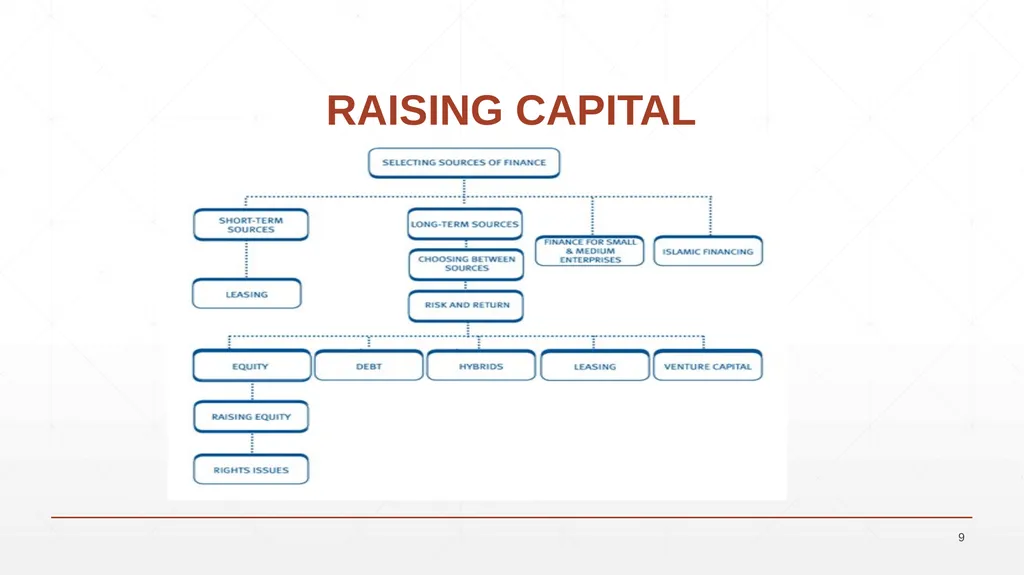
RAISING CAPITAL 9<br>
10
RAISING CAPITAL Raising financing from third party capital providers and investors may be the right choice for your business if:
You need to finance the buyout of fellow shareholders who wish to retire, or perhaps due to a buy-sell clause in the shareholders agreement (sometimes referred to as a "shotgun" arrangement). 10<br>
You need to finance the buyout of fellow shareholders who wish to retire, or perhaps due to a buy-sell clause in the shareholders agreement (sometimes referred to as a "shotgun" arrangement). 10<br>
11
RAISING CAPITAL Your company needs capital to fund an acquisition, shareholder distribution, management buyout, or a transaction to take the company private. 11<br>
12
RAISING CAPITAL Your company requires financing to support internal growth opportunities such as working capital or a plant expansion.
Internally generated profits together with senior debt are insufficient to meet the needs of the company. 12<br>
Internally generated profits together with senior debt are insufficient to meet the needs of the company. 12<br>
13
RAISING CAPITAL The need for finance
Firms need funds to:
provide working capital
invest in non-current assets.
The main source of funds available is retained earnings, but these are unlikely to be sufficient to finance all business needs.
Criteria for choosing between sources of finance
. 13<br>
Firms need funds to:
provide working capital
invest in non-current assets.
The main source of funds available is retained earnings, but these are unlikely to be sufficient to finance all business needs.
Criteria for choosing between sources of finance
. 13<br>
14
RAISING CAPITAL A vast range of funding alternatives is open to companies and new developments occur every day. Before examining the various sources of finance available it is useful to consider some of the criteria which may be used to choose between them.
Venture capital is the provision of risk bearing capital, usually in the form of a participation in equity, to companies with high growth potential.
Venture capitalists provide start-up and late stage growth finance, usually for smaller firms. 14<br>
Venture capital is the provision of risk bearing capital, usually in the form of a participation in equity, to companies with high growth potential.
Venture capitalists provide start-up and late stage growth finance, usually for smaller firms. 14<br>
15
RAISING CAPITAL Venture capitalists will assess an investment prospect on the basis of its:
financial outlook
management credibility
depth of market research
technical abilities
degree of influence offered:
controlling stake?
board seat?
exit route. 15<br>
financial outlook
management credibility
depth of market research
technical abilities
degree of influence offered:
controlling stake?
board seat?
exit route. 15<br>
16
RAISING CAPITAL Finance for small and medium enterprises
Small and medium-sized entities (SMEs) tend to be unquoted with ownership of the business usually being restricted to a small number of individuals. Often the financing needs are beyond the levels of initial seed capital invested by the owner when the business is formed. Capital will be required to invest in non-current assets as well as financing the working capital requirements of the business. 16<br>
Small and medium-sized entities (SMEs) tend to be unquoted with ownership of the business usually being restricted to a small number of individuals. Often the financing needs are beyond the levels of initial seed capital invested by the owner when the business is formed. Capital will be required to invest in non-current assets as well as financing the working capital requirements of the business. 16<br>
17
RAISING CAPITAL SMEs can often face difficulties when raising finance since investing in an SME is inherently more risky than investing in a larger company due to:
the lack of business history or proven track record
the lower level of public scrutiny over accounts and records.
Despite accounting for a significant proportion of economic activity around the world, many SMEs will fail within their first two years of trading, often due to an inability to secure sufficient finance. 17<br>
the lack of business history or proven track record
the lower level of public scrutiny over accounts and records.
Despite accounting for a significant proportion of economic activity around the world, many SMEs will fail within their first two years of trading, often due to an inability to secure sufficient finance. 17<br>
18
RAISING CAPITAL The funding gap
As smaller companies tend to be unquoted, it is more difficult for equity investors to liquidate their investment. Typically therefore small firms rely on finance from retentions, rights issues and bank borrowings.
However, Initial ('seed') capital is often from family and friends, seriously limiting the scope for further rights issues. 18<br>
As smaller companies tend to be unquoted, it is more difficult for equity investors to liquidate their investment. Typically therefore small firms rely on finance from retentions, rights issues and bank borrowings.
However, Initial ('seed') capital is often from family and friends, seriously limiting the scope for further rights issues. 18<br>
19
RAISING CAPITAL Bank borrowing doesn't always provide a solution either. To control their exposure, banks will often use credit scoring systems, effectively creating competition amongst SMEs for the available funds. 19<br>
20
RAISING CAPITAL Additional information in the form of business plans will have to be submitted and lenders will very often require additional security to be provided (which the owners may be unwilling or unable to give). Lenders will also want to monitor their investment more closely. 20<br>
21
RAISING CAPITAL As a result, a funding gap often arises when they want to expand beyond these means of finance but are not yet ready for a listing on the Stock Exchange or Alternative Investment Market (AIM).
This gap may be bridged with in a number of ways:
Financial investors including:
Business angels
Venture capitalists
Various government solutions including:
increasing the marketability of shares
provision of tax incentives
other specific forms of assistance 21<br>
This gap may be bridged with in a number of ways:
Financial investors including:
Business angels
Venture capitalists
Various government solutions including:
increasing the marketability of shares
provision of tax incentives
other specific forms of assistance 21<br>
22
RAISING CAPITAL Venture capital funds
The combination of increasing the prospective marketability of SME shares and tax relief schemes has led to the proliferation of venture capital funds, which provide equity capital for small and growing businesses.
However, in recent years, most major providers of business finance have in some way become involved in the provision of venture capital, usually by setting up or participating in specialist venture capital funds. 22<br>
The combination of increasing the prospective marketability of SME shares and tax relief schemes has led to the proliferation of venture capital funds, which provide equity capital for small and growing businesses.
However, in recent years, most major providers of business finance have in some way become involved in the provision of venture capital, usually by setting up or participating in specialist venture capital funds. 22<br>
23
RAISING CAPITAL The main spur to their growth has come from the incentives described above.
The result is that there is now no real shortage of venture capital for viable projects. The range of possible funds includes those run by merchant and other banks, pension funds, individuals and local authorities. 23<br>
The result is that there is now no real shortage of venture capital for viable projects. The range of possible funds includes those run by merchant and other banks, pension funds, individuals and local authorities. 23<br>
24
RAISING CAPITAL Business Angels
Although venture capital companies are the main providers of equity finance to small businesses, they are highly selective. An alternative source of smaller amounts of equity capital are private individuals, sometimes known as business angels, who normally have a business background. 24<br>
Although venture capital companies are the main providers of equity finance to small businesses, they are highly selective. An alternative source of smaller amounts of equity capital are private individuals, sometimes known as business angels, who normally have a business background. 24<br>
25
RAISING CAPITAL Business angels are willing to make investments in small businesses in return for an equity stake. They can also offer the businesses the benefits of their own management expertise. A number of business angel networks operate in different countries and they seek to match businesses seeking equity finance with potential investors. 25<br>
26
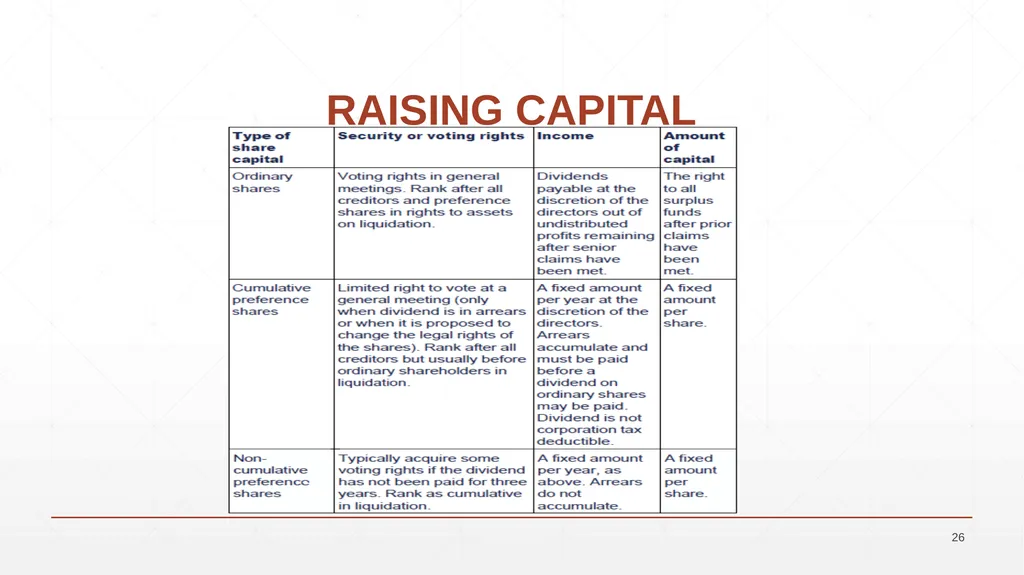
RAISING CAPITAL 26<br>
27
LIQUIDATION What is liquidation?
Liquidation is the dissolution or 'winding up' of a company.
Liquidation means that the company must be dissolved and its affairs 'wound up', or brought to an end.
The assets are realised, debts are paid out of the proceeds, and any surplus amounts are returned to members. Liquidation leads on to dissolution of the company. It is sometimes referred to as winding up. 27<br>
Liquidation is the dissolution or 'winding up' of a company.
Liquidation means that the company must be dissolved and its affairs 'wound up', or brought to an end.
The assets are realised, debts are paid out of the proceeds, and any surplus amounts are returned to members. Liquidation leads on to dissolution of the company. It is sometimes referred to as winding up. 27<br>
28
LIQUIDATION Who decides to liquidate?
There are three different methods of liquidation; compulsory, members' voluntary and creditors‘ voluntary. Compulsory liquidation and creditors' voluntary liquidation are proceedings for insolvent companies, and members' voluntary liquidation is for solvent companies.
The parties most likely to be involved in the decision to liquidate are:
The directors
The creditors
The members 28<br>
There are three different methods of liquidation; compulsory, members' voluntary and creditors‘ voluntary. Compulsory liquidation and creditors' voluntary liquidation are proceedings for insolvent companies, and members' voluntary liquidation is for solvent companies.
The parties most likely to be involved in the decision to liquidate are:
The directors
The creditors
The members 28<br>
29
LIQUIDATION The directors are best placed to know the financial position and difficulty that the company is in. The creditors may become aware that the company is in financial difficulty when their invoices do not get paid on a timely basis, or at all.
The members are likely to be the last people to know that the company is in financial difficulty, as they rely on the directors to tell them. In public companies, there is a rule that the directors must call a general
meeting of members if the net assets of the company fall to half or less of the amount of its called-up share capital. There is no such rule for private companies. 29<br>
The members are likely to be the last people to know that the company is in financial difficulty, as they rely on the directors to tell them. In public companies, there is a rule that the directors must call a general
meeting of members if the net assets of the company fall to half or less of the amount of its called-up share capital. There is no such rule for private companies. 29<br>
30
LIQUIDATION As we shall see in the next two sections, there are three methods of winding up. They depend on who has instigated the proceedings. Directors cannot formally instigate proceedings for winding up, they can only make recommendations to the members. A special resolution must be passed if the company is being wound up for any other reason.
There are two types of voluntary liquidation:
A members' voluntary liquidation is used where the company is solvent.
A creditors' voluntary liquidation is used where the company is insolvent. 30<br>
There are two types of voluntary liquidation:
A members' voluntary liquidation is used where the company is solvent.
A creditors' voluntary liquidation is used where the company is insolvent. 30<br>
31
LIQUIDATION Once the decision to liquidate has been taken, the company goes under the control of a liquidator who must be a qualified and authorised insolvency practitioner.
We shall look at the procedures that the liquidator carries out in the next two sections. However, the liquidator also has a statutory duty to report to the relevant Government authority where he feels that any director of the insolvent company is unfit to be involved in the management of a company. 31<br>
We shall look at the procedures that the liquidator carries out in the next two sections. However, the liquidator also has a statutory duty to report to the relevant Government authority where he feels that any director of the insolvent company is unfit to be involved in the management of a company. 31<br>
32
LIQUIDATION Regardless of what method of liquidation is used, similar legal problems may arise in each of them. In addition, the following factors are true at the start of any liquidation:
No share dealings or changes in members are allowed
All company documents (eg invoices, letters, emails) and the website must state the company is in liquidation
The directors' power to manage ceases 32<br>
No share dealings or changes in members are allowed
All company documents (eg invoices, letters, emails) and the website must state the company is in liquidation
The directors' power to manage ceases 32<br>
33
LIQUIDATION A winding up is voluntary where the decision to wind up is taken by the company's members, although if
the company is insolvent, the creditors will be heavily involved in the proceedings. 33<br>
the company is insolvent, the creditors will be heavily involved in the proceedings. 33<br>
34
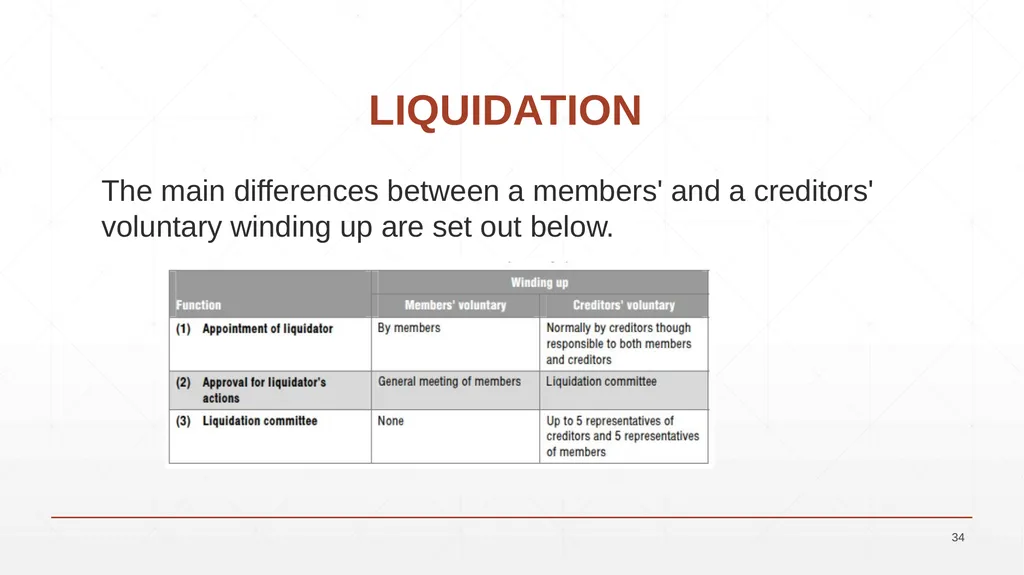
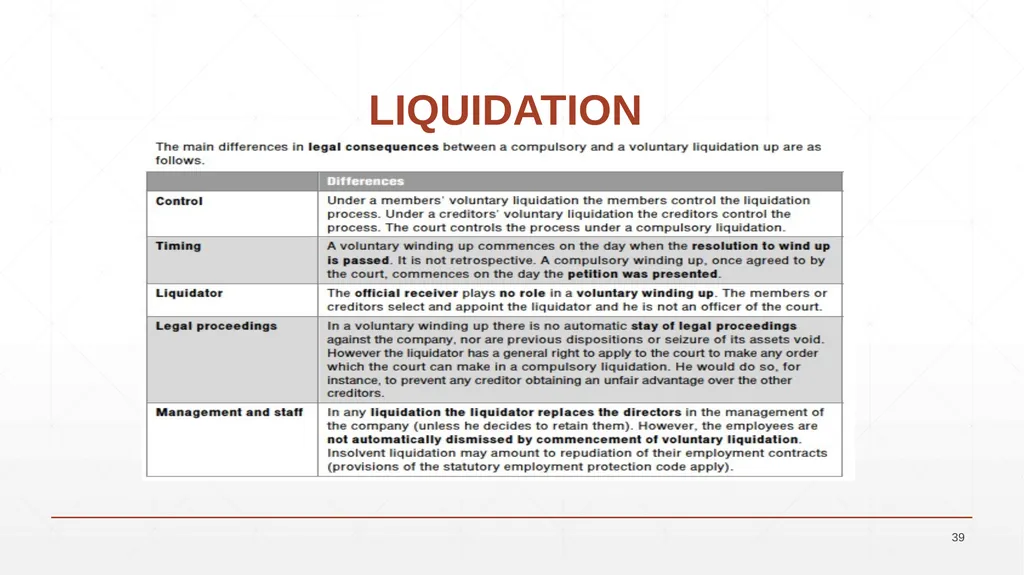
LIQUIDATION The main differences between a members' and a creditors' voluntary winding up are set out below. 34<br>
35
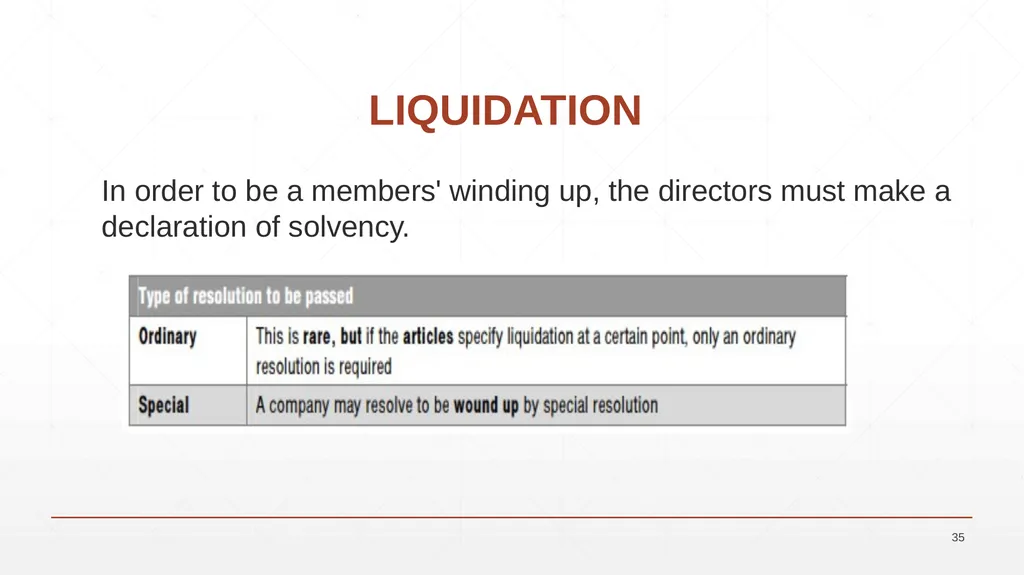
LIQUIDATION In order to be a members' winding up, the directors must make a declaration of solvency. 35<br>
36
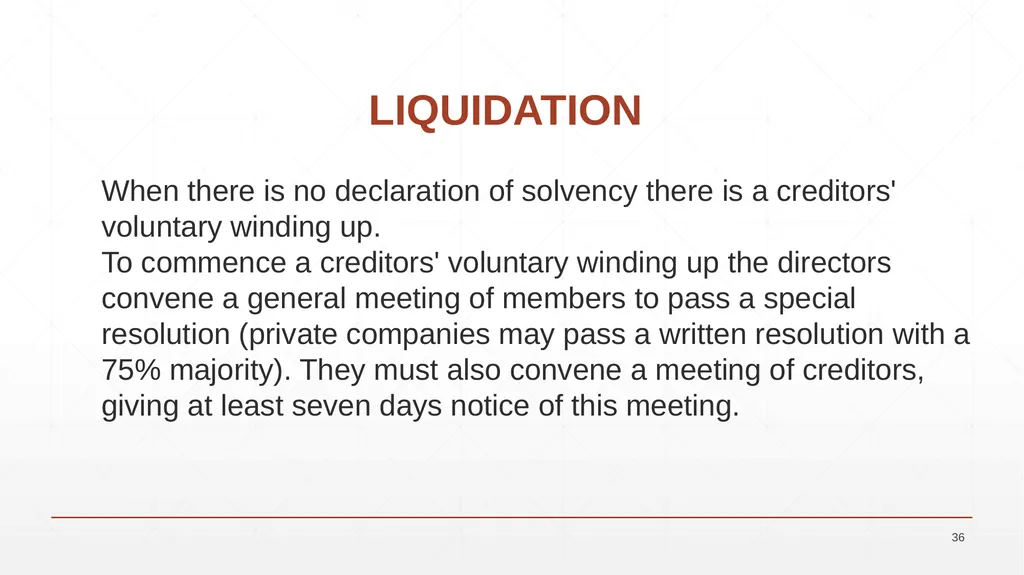
LIQUIDATION When there is no declaration of solvency there is a creditors' voluntary winding up.
To commence a creditors' voluntary winding up the directors convene a general meeting of members to pass a special resolution (private companies may pass a written resolution with a 75% majority). They must also convene a meeting of creditors, giving at least seven days notice of this meeting. 36<br>
To commence a creditors' voluntary winding up the directors convene a general meeting of members to pass a special resolution (private companies may pass a written resolution with a 75% majority). They must also convene a meeting of creditors, giving at least seven days notice of this meeting. 36<br>
37
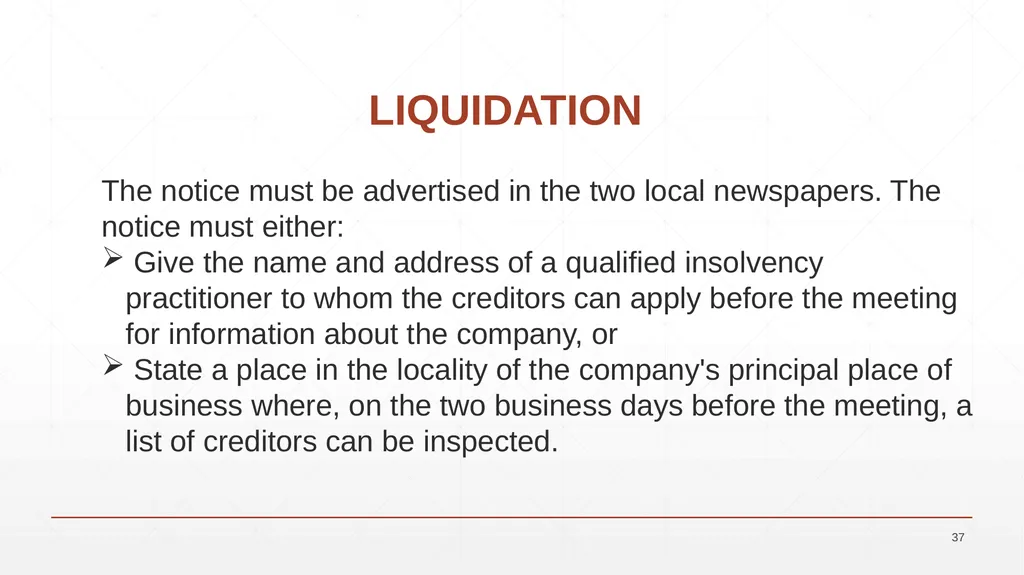
LIQUIDATION The notice must be advertised in the two local newspapers. The notice must either:
Give the name and address of a qualified insolvency practitioner to whom the creditors can apply before the meeting for information about the company, or
State a place in the locality of the company's principal place of business where, on the two business days before the meeting, a list of creditors can be inspected. 37<br>
Give the name and address of a qualified insolvency practitioner to whom the creditors can apply before the meeting for information about the company, or
State a place in the locality of the company's principal place of business where, on the two business days before the meeting, a list of creditors can be inspected. 37<br>
38
LIQUIDATION A creditor may apply to the court to wind up the company, primarily if the company is unable to pay its debts. There are statutory tests to prove that a company is unable to pay its debts. 38<br>
39
LIQUIDATION 39<br>
40
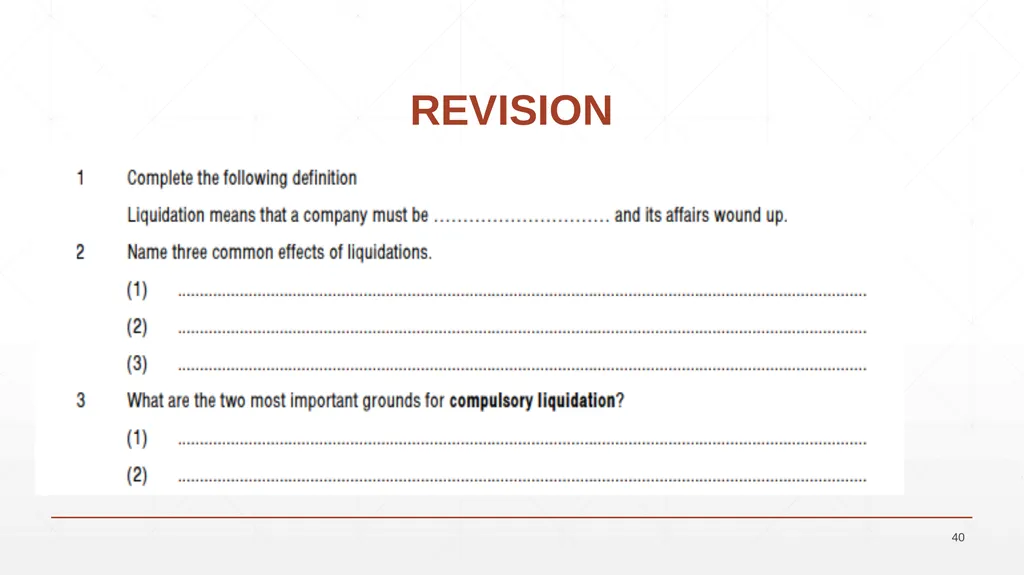
REVISION 40<br>
41
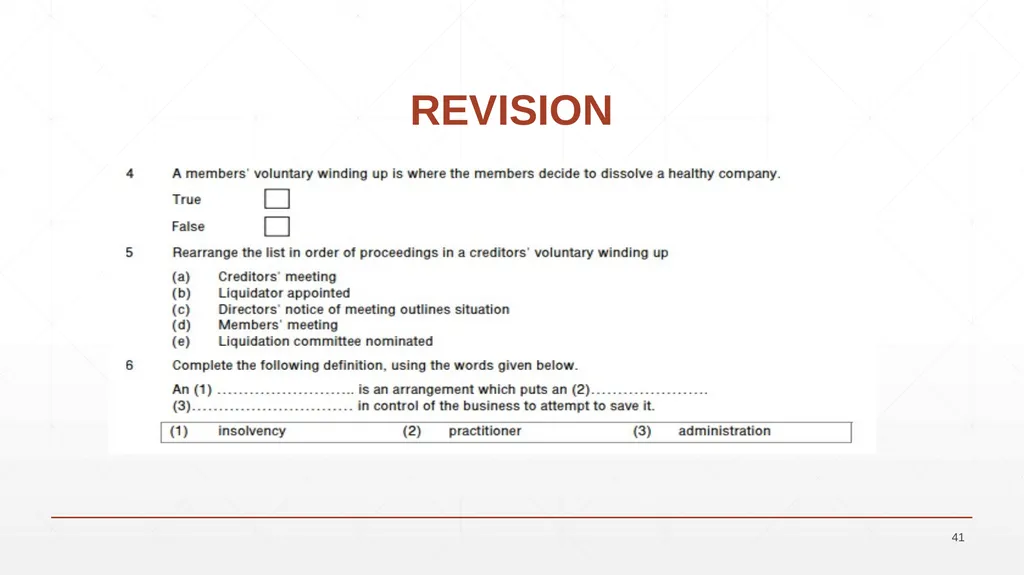
REVISION 41<br>
42
REFERENCES Smallbusiness.chron.com. (2019). Types of Business Formations. [online] Available at: https://smallbusiness.chron.com/types-business-formations-74118.html [Accessed 1 Mar. 2019
Cibc.com. (2019). Raising Capital for Your Business | Commercial and Corporate | CIBC. [online] Available at: https://www.cibc.com/en/commercial-corporate/business-solutions/mid-market-investment-banking/raising-capital.html [Accessed 1 Mar. 2019].
http://www.jdic.org/files/seminars/jdic_financial_markets_fair_-_shellie_leon.pdf
Kfknowledgebank.kaplan.co.uk. (2019). [online] Available at: http://kfknowledgebank.kaplan.co.uk/kfkb/wiki%20pages/acca%20f9%20chapter%2014.aspx [Accessed 1 Mar. 2019]. 42<br>
Cibc.com. (2019). Raising Capital for Your Business | Commercial and Corporate | CIBC. [online] Available at: https://www.cibc.com/en/commercial-corporate/business-solutions/mid-market-investment-banking/raising-capital.html [Accessed 1 Mar. 2019].
http://www.jdic.org/files/seminars/jdic_financial_markets_fair_-_shellie_leon.pdf
Kfknowledgebank.kaplan.co.uk. (2019). [online] Available at: http://kfknowledgebank.kaplan.co.uk/kfkb/wiki%20pages/acca%20f9%20chapter%2014.aspx [Accessed 1 Mar. 2019]. 42<br>
43
REFERENCES 2016-2017, A. (2019). Acca F4 Corporate and Business Law Bpp Study Text 2016-2017 - Acca Study Material. [online] Acca Study Material. Available at: https://accastudymaterial.com/acca-study-texts/acca-f4-corporate-and-business-law-bpp-study-text-2016-2017/ [Accessed 1 Mar. 2019]. 43<br>