
United Nations Workshop on Revision 3 of
KL
Published · 29 slides · 0 views

1 / 1

Description
United Nations Workshop on Revision 3 of Principles and Recommendations for Population and Housing Censuses and Evaluation of Census Data, Amman 19 23 October 2014 Planning, Organization and Management of Population and Housing Censuses
Related Topics
Share
Embed code
Download this presentation From Below
"United Nations Workshop on Revision 3 of" is the property of its rightful owner. Permission is granted to download and print the materials on this website for personal, non-commercial use only, and to display it on your personal computer provided you do not modify the materials and that you retain all copyright notices contained in the materials. By downloading content from our website, you accept the terms of this agreement.
Presentation Transcript
01
United Nations Workshop on Revision 3 of Principles and Recommendations for Population and Housing Censuses and Evaluation of Census Data, Amman 19 – 23 October 2014 Planning, Organization and Management of Population and Housing Censuses
Part I United Nations Statistics Division<br>
02
United Nations Workshop on Revision 3 of Principles and Recommendations for Population and Housing Censuses and Evaluation of Census Data, Amman 19 – 23 October 2014 Overview Main processes for planning, organization and management
Overall census planning
Strategic objectives
Legal basis
Financial management
Administrative organization
User consultation, communication and publicity
Human resource management
Census calendar
Logistics management
Contracting out
Quality assurance<br>
Overall census planning
Strategic objectives
Legal basis
Financial management
Administrative organization
User consultation, communication and publicity
Human resource management
Census calendar
Logistics management
Contracting out
Quality assurance<br>
03
United Nations Workshop on Revision 3 of Principles and Recommendations for Population and Housing Censuses and Evaluation of Census Data, Amman 19 – 23 October 2014 Overall census planning Census planning require multi-dimensional and simultaneous approach as it is:
The most complicated and expensive operation
Consisting of a complex series of interrelated steps
In general, census operations can be divided into the following phases- census questionnaire, mapping, testing, enumeration, data processing, evaluation, dissemination and analysis
For successful census operation, sufficient and appropriate weights should be given to a wide range of subject-matter and statistical requirements particularly for cross-cutting issues such as technology used for many essential phases of the census<br>
The most complicated and expensive operation
Consisting of a complex series of interrelated steps
In general, census operations can be divided into the following phases- census questionnaire, mapping, testing, enumeration, data processing, evaluation, dissemination and analysis
For successful census operation, sufficient and appropriate weights should be given to a wide range of subject-matter and statistical requirements particularly for cross-cutting issues such as technology used for many essential phases of the census<br>
04
Overall census planning Main questions for overall planning
What are main innovations for the upcoming censuses
Census methodology?
Technological options?
Realistic approaches according to country` conditions
How the benefits from the census can be improved? United Nations Workshop on Revision 3 of Principles and Recommendations for Population and Housing Censuses and Evaluation of Census Data, Amman 19 – 23 October 2014<br>
What are main innovations for the upcoming censuses
Census methodology?
Technological options?
Realistic approaches according to country` conditions
How the benefits from the census can be improved? United Nations Workshop on Revision 3 of Principles and Recommendations for Population and Housing Censuses and Evaluation of Census Data, Amman 19 – 23 October 2014<br>
05
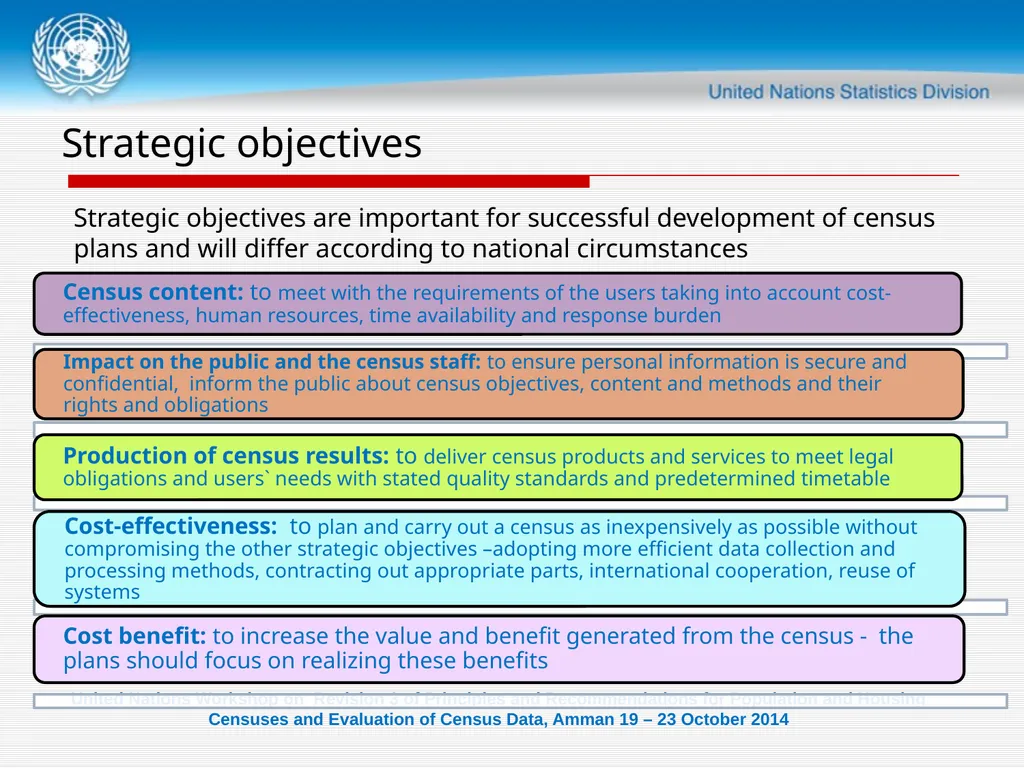
United Nations Workshop on Revision 3 of Principles and Recommendations for Population and Housing Censuses and Evaluation of Census Data, Amman 19 – 23 October 2014 Strategic objectives Strategic objectives are important for successful development of census plans and will differ according to national circumstances<br>
06
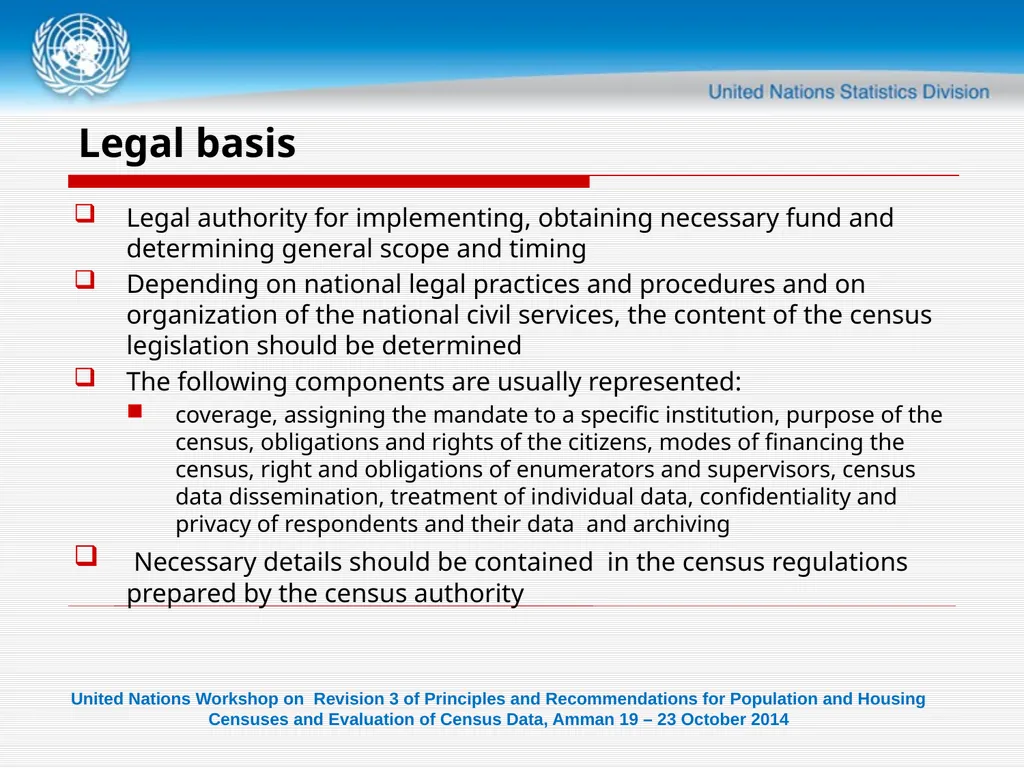
Legal authority for implementing, obtaining necessary fund and determining general scope and timing
Depending on national legal practices and procedures and on organization of the national civil services, the content of the census legislation should be determined
The following components are usually represented:
coverage, assigning the mandate to a specific institution, purpose of the census, obligations and rights of the citizens, modes of financing the census, right and obligations of enumerators and supervisors, census data dissemination, treatment of individual data, confidentiality and privacy of respondents and their data and archiving
Necessary details should be contained in the census regulations prepared by the census authority United Nations Workshop on Revision 3 of Principles and Recommendations for Population and Housing Censuses and Evaluation of Census Data, Amman 19 – 23 October 2014 Legal basis<br>
Depending on national legal practices and procedures and on organization of the national civil services, the content of the census legislation should be determined
The following components are usually represented:
coverage, assigning the mandate to a specific institution, purpose of the census, obligations and rights of the citizens, modes of financing the census, right and obligations of enumerators and supervisors, census data dissemination, treatment of individual data, confidentiality and privacy of respondents and their data and archiving
Necessary details should be contained in the census regulations prepared by the census authority United Nations Workshop on Revision 3 of Principles and Recommendations for Population and Housing Censuses and Evaluation of Census Data, Amman 19 – 23 October 2014 Legal basis<br>
07
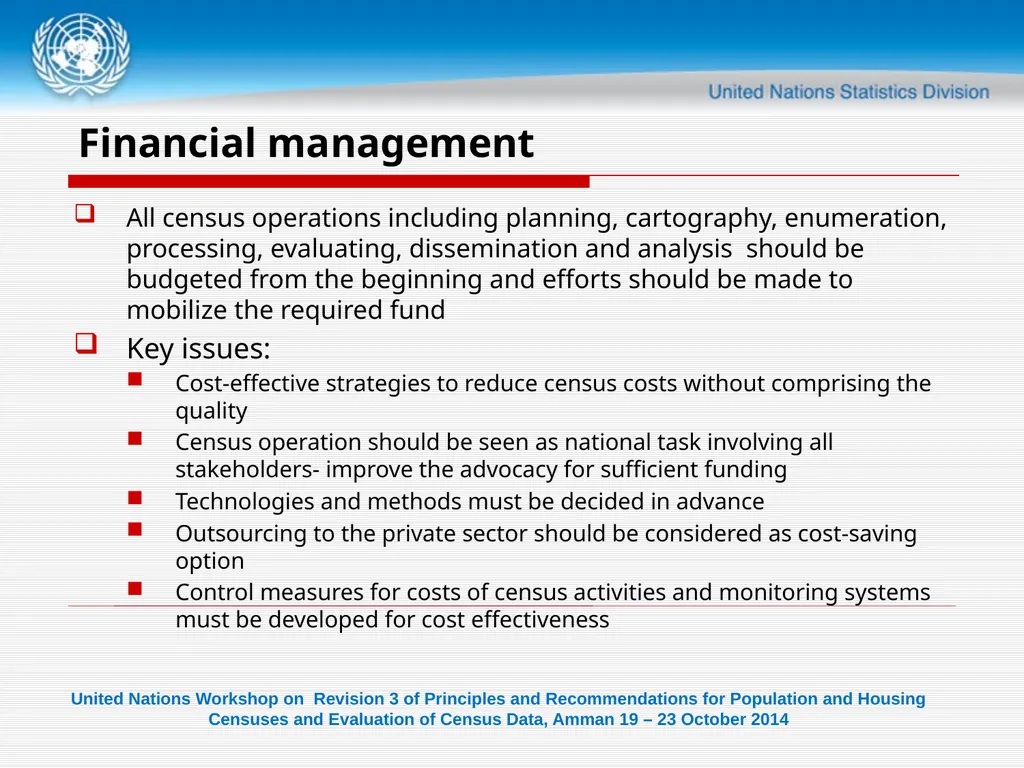
All census operations including planning, cartography, enumeration, processing, evaluating, dissemination and analysis should be budgeted from the beginning and efforts should be made to mobilize the required fund
Key issues:
Cost-effective strategies to reduce census costs without comprising the quality
Census operation should be seen as national task involving all stakeholders- improve the advocacy for sufficient funding
Technologies and methods must be decided in advance
Outsourcing to the private sector should be considered as cost-saving option
Control measures for costs of census activities and monitoring systems must be developed for cost effectiveness United Nations Workshop on Revision 3 of Principles and Recommendations for Population and Housing Censuses and Evaluation of Census Data, Amman 19 – 23 October 2014 Financial management<br>
Key issues:
Cost-effective strategies to reduce census costs without comprising the quality
Census operation should be seen as national task involving all stakeholders- improve the advocacy for sufficient funding
Technologies and methods must be decided in advance
Outsourcing to the private sector should be considered as cost-saving option
Control measures for costs of census activities and monitoring systems must be developed for cost effectiveness United Nations Workshop on Revision 3 of Principles and Recommendations for Population and Housing Censuses and Evaluation of Census Data, Amman 19 – 23 October 2014 Financial management<br>
08
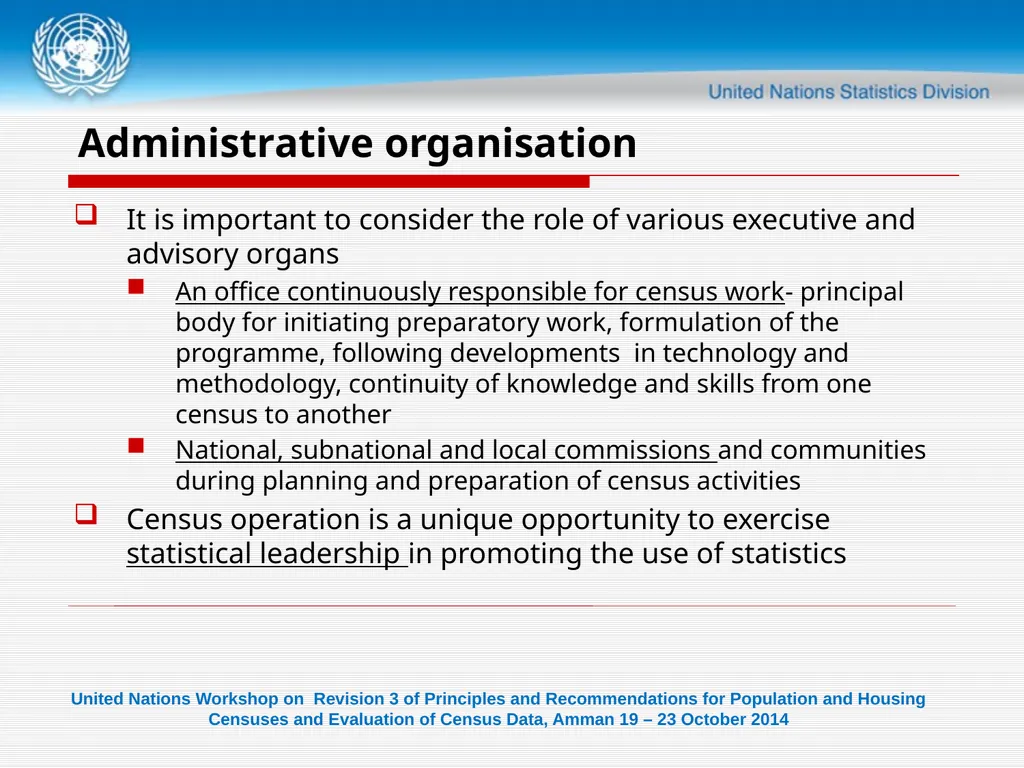
It is important to consider the role of various executive and advisory organs
An office continuously responsible for census work- principal body for initiating preparatory work, formulation of the programme, following developments in technology and methodology, continuity of knowledge and skills from one census to another
National, subnational and local commissions and communities during planning and preparation of census activities
Census operation is a unique opportunity to exercise statistical leadership in promoting the use of statistics United Nations Workshop on Revision 3 of Principles and Recommendations for Population and Housing Censuses and Evaluation of Census Data, Amman 19 – 23 October 2014 Administrative organisation<br>
An office continuously responsible for census work- principal body for initiating preparatory work, formulation of the programme, following developments in technology and methodology, continuity of knowledge and skills from one census to another
National, subnational and local commissions and communities during planning and preparation of census activities
Census operation is a unique opportunity to exercise statistical leadership in promoting the use of statistics United Nations Workshop on Revision 3 of Principles and Recommendations for Population and Housing Censuses and Evaluation of Census Data, Amman 19 – 23 October 2014 Administrative organisation<br>
09
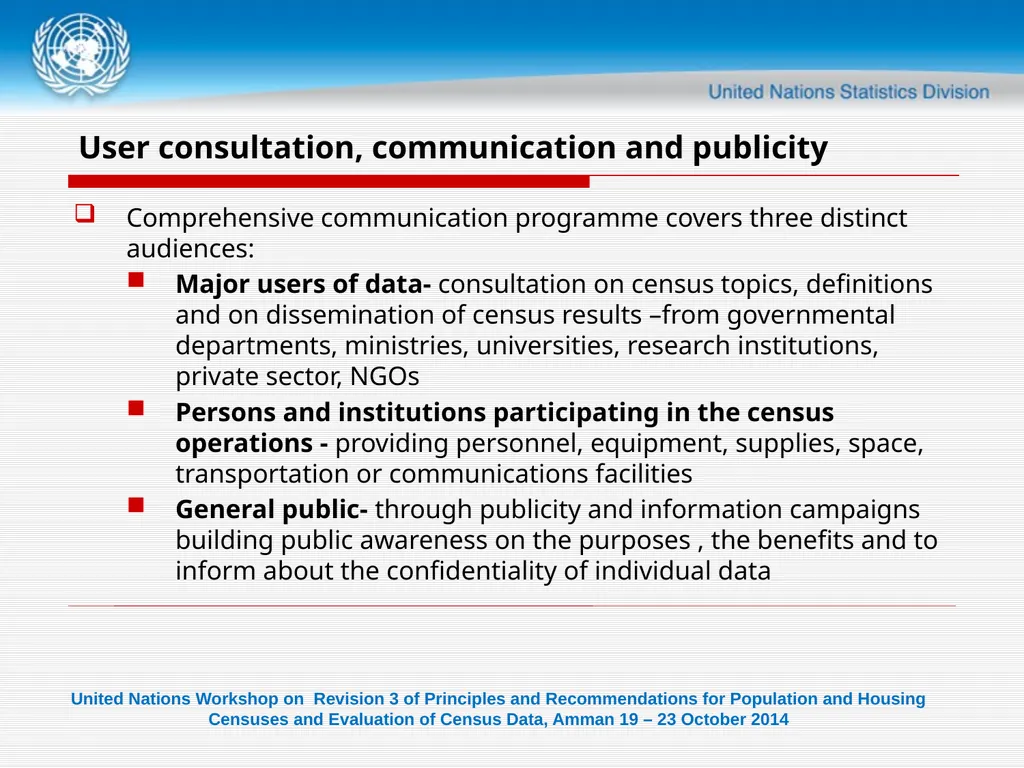
Comprehensive communication programme covers three distinct audiences:
Major users of data- consultation on census topics, definitions and on dissemination of census results –from governmental departments, ministries, universities, research institutions, private sector, NGOs
Persons and institutions participating in the census operations - providing personnel, equipment, supplies, space, transportation or communications facilities
General public- through publicity and information campaigns building public awareness on the purposes , the benefits and to inform about the confidentiality of individual data United Nations Workshop on Revision 3 of Principles and Recommendations for Population and Housing Censuses and Evaluation of Census Data, Amman 19 – 23 October 2014 User consultation, communication and publicity<br>
Major users of data- consultation on census topics, definitions and on dissemination of census results –from governmental departments, ministries, universities, research institutions, private sector, NGOs
Persons and institutions participating in the census operations - providing personnel, equipment, supplies, space, transportation or communications facilities
General public- through publicity and information campaigns building public awareness on the purposes , the benefits and to inform about the confidentiality of individual data United Nations Workshop on Revision 3 of Principles and Recommendations for Population and Housing Censuses and Evaluation of Census Data, Amman 19 – 23 October 2014 User consultation, communication and publicity<br>
10
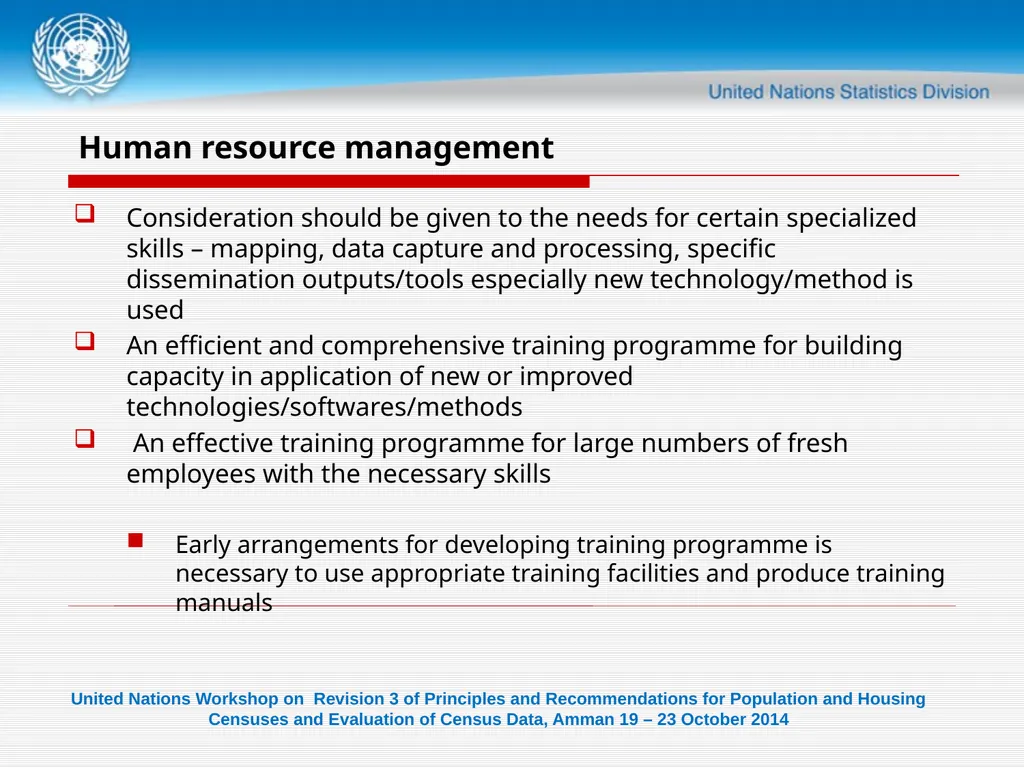
Consideration should be given to the needs for certain specialized skills – mapping, data capture and processing, specific dissemination outputs/tools especially new technology/method is used
An efficient and comprehensive training programme for building capacity in application of new or improved technologies/softwares/methods
An effective training programme for large numbers of fresh employees with the necessary skills
Early arrangements for developing training programme is necessary to use appropriate training facilities and produce training manuals United Nations Workshop on Revision 3 of Principles and Recommendations for Population and Housing Censuses and Evaluation of Census Data, Amman 19 – 23 October 2014 Human resource management<br>
An efficient and comprehensive training programme for building capacity in application of new or improved technologies/softwares/methods
An effective training programme for large numbers of fresh employees with the necessary skills
Early arrangements for developing training programme is necessary to use appropriate training facilities and produce training manuals United Nations Workshop on Revision 3 of Principles and Recommendations for Population and Housing Censuses and Evaluation of Census Data, Amman 19 – 23 October 2014 Human resource management<br>
11
Census calendar indicating the sequence and estimated duration of each of the component operations of the census is necessary at the early stage of census planning
The calendar should be shared with all stakeholders in advance for advise and support
The calendar should be revised and made more detailed as planning proceeds , with the aim of establishing final dates as soon as practicable United Nations Workshop on Revision 3 of Principles and Recommendations for Population and Housing Censuses and Evaluation of Census Data, Amman 19 – 23 October 2014 Census calendar<br>
The calendar should be shared with all stakeholders in advance for advise and support
The calendar should be revised and made more detailed as planning proceeds , with the aim of establishing final dates as soon as practicable United Nations Workshop on Revision 3 of Principles and Recommendations for Population and Housing Censuses and Evaluation of Census Data, Amman 19 – 23 October 2014 Census calendar<br>
12
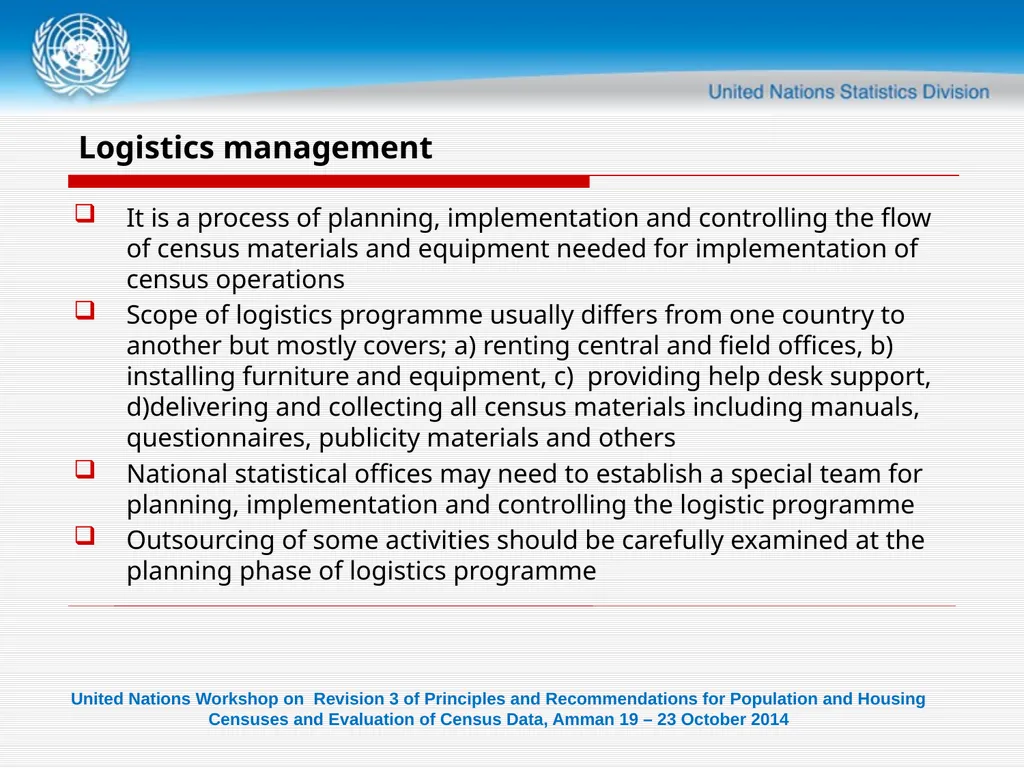
It is a process of planning, implementation and controlling the flow of census materials and equipment needed for implementation of census operations
Scope of logistics programme usually differs from one country to another but mostly covers; a) renting central and field offices, b) installing furniture and equipment, c) providing help desk support, d)delivering and collecting all census materials including manuals, questionnaires, publicity materials and others
National statistical offices may need to establish a special team for planning, implementation and controlling the logistic programme
Outsourcing of some activities should be carefully examined at the planning phase of logistics programme United Nations Workshop on Revision 3 of Principles and Recommendations for Population and Housing Censuses and Evaluation of Census Data, Amman 19 – 23 October 2014 Logistics management<br>
Scope of logistics programme usually differs from one country to another but mostly covers; a) renting central and field offices, b) installing furniture and equipment, c) providing help desk support, d)delivering and collecting all census materials including manuals, questionnaires, publicity materials and others
National statistical offices may need to establish a special team for planning, implementation and controlling the logistic programme
Outsourcing of some activities should be carefully examined at the planning phase of logistics programme United Nations Workshop on Revision 3 of Principles and Recommendations for Population and Housing Censuses and Evaluation of Census Data, Amman 19 – 23 October 2014 Logistics management<br>
13
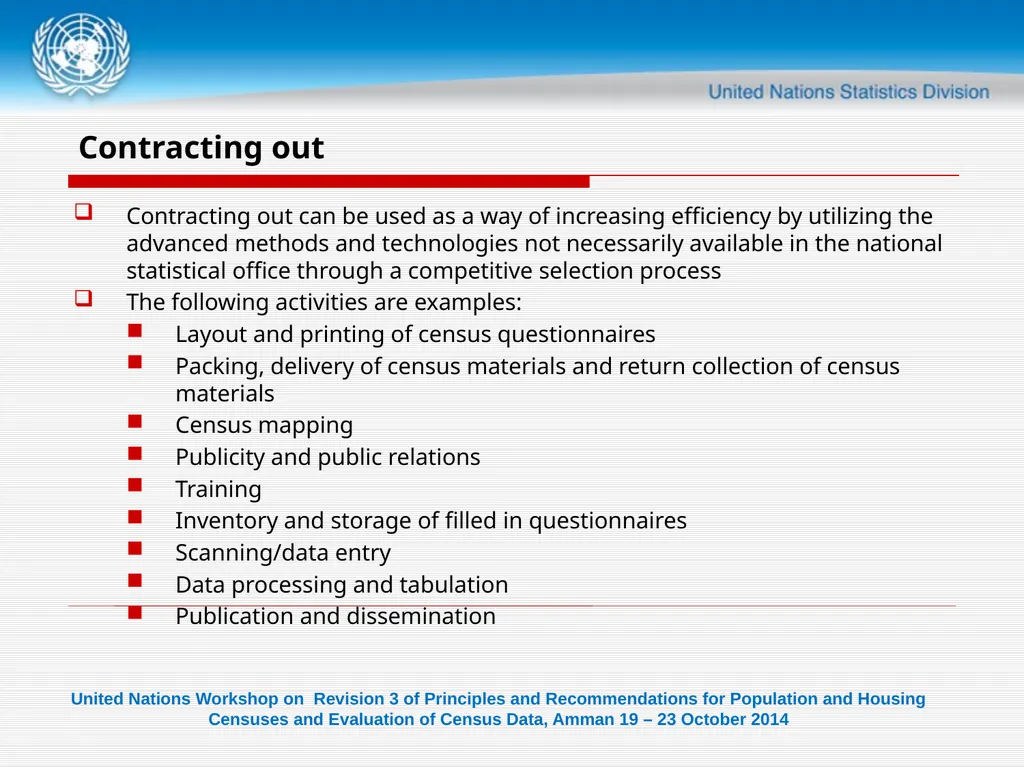
Contracting out can be used as a way of increasing efficiency by utilizing the advanced methods and technologies not necessarily available in the national statistical office through a competitive selection process
The following activities are examples:
Layout and printing of census questionnaires
Packing, delivery of census materials and return collection of census materials
Census mapping
Publicity and public relations
Training
Inventory and storage of filled in questionnaires
Scanning/data entry
Data processing and tabulation
Publication and dissemination United Nations Workshop on Revision 3 of Principles and Recommendations for Population and Housing Censuses and Evaluation of Census Data, Amman 19 – 23 October 2014 Contracting out<br>
The following activities are examples:
Layout and printing of census questionnaires
Packing, delivery of census materials and return collection of census materials
Census mapping
Publicity and public relations
Training
Inventory and storage of filled in questionnaires
Scanning/data entry
Data processing and tabulation
Publication and dissemination United Nations Workshop on Revision 3 of Principles and Recommendations for Population and Housing Censuses and Evaluation of Census Data, Amman 19 – 23 October 2014 Contracting out<br>
14
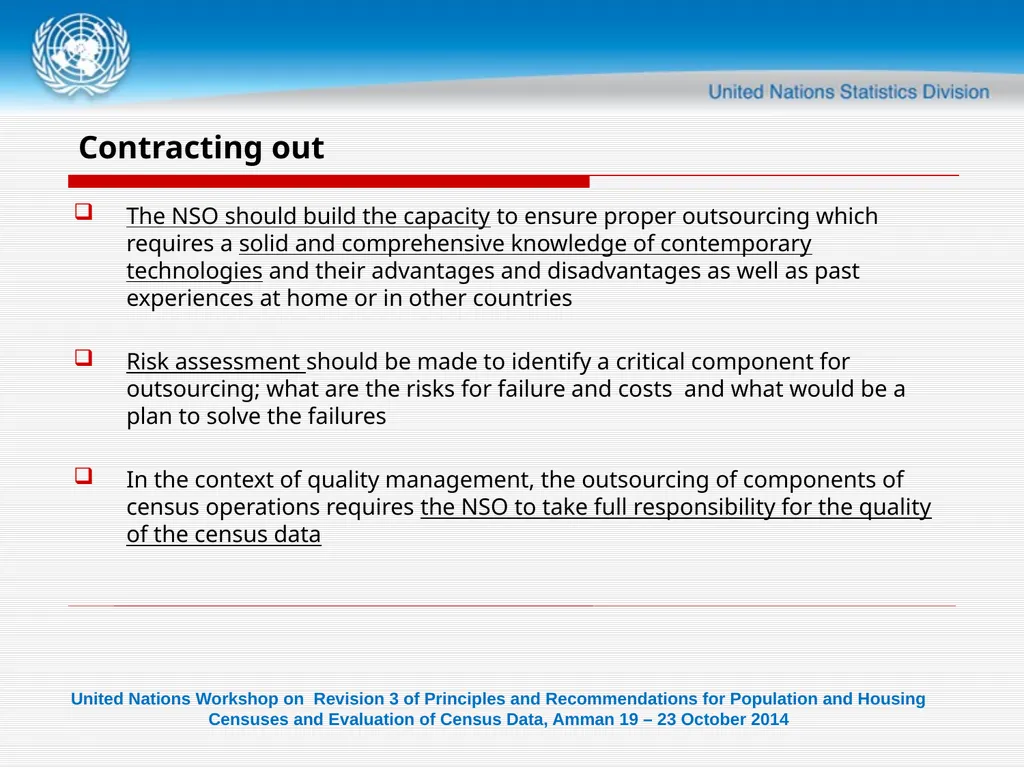
The NSO should build the capacity to ensure proper outsourcing which requires a solid and comprehensive knowledge of contemporary technologies and their advantages and disadvantages as well as past experiences at home or in other countries
Risk assessment should be made to identify a critical component for outsourcing; what are the risks for failure and costs and what would be a plan to solve the failures
In the context of quality management, the outsourcing of components of census operations requires the NSO to take full responsibility for the quality of the census data United Nations Workshop on Revision 3 of Principles and Recommendations for Population and Housing Censuses and Evaluation of Census Data, Amman 19 – 23 October 2014 Contracting out<br>
Risk assessment should be made to identify a critical component for outsourcing; what are the risks for failure and costs and what would be a plan to solve the failures
In the context of quality management, the outsourcing of components of census operations requires the NSO to take full responsibility for the quality of the census data United Nations Workshop on Revision 3 of Principles and Recommendations for Population and Housing Censuses and Evaluation of Census Data, Amman 19 – 23 October 2014 Contracting out<br>
15
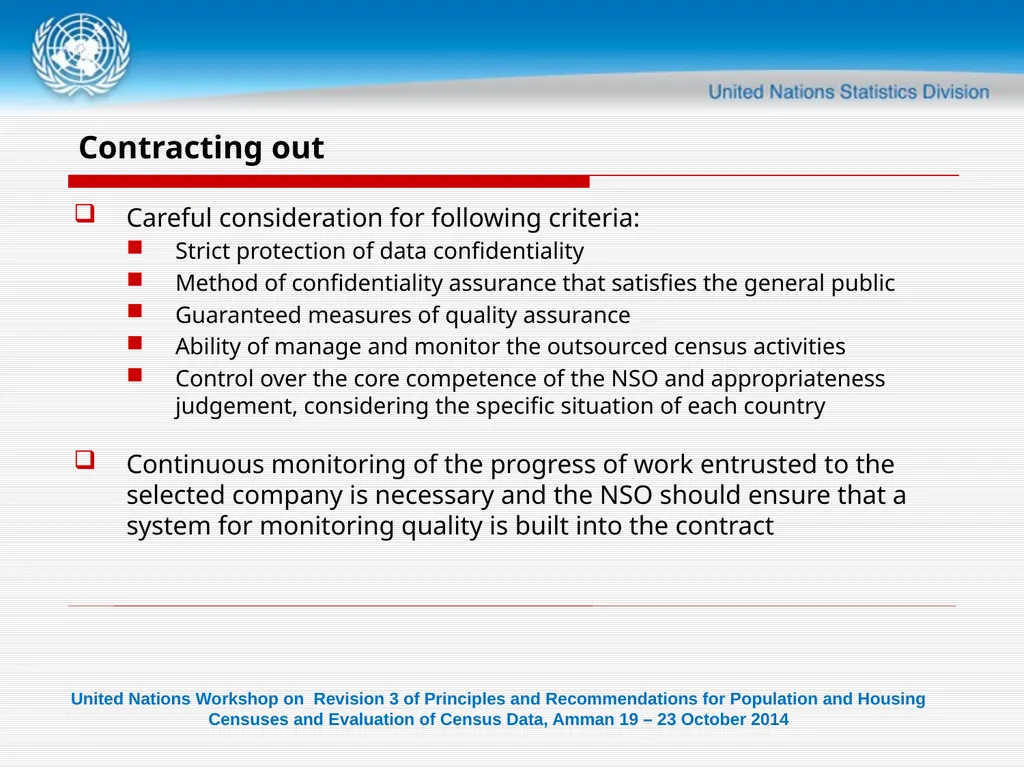
Careful consideration for following criteria:
Strict protection of data confidentiality
Method of confidentiality assurance that satisfies the general public
Guaranteed measures of quality assurance
Ability of manage and monitor the outsourced census activities
Control over the core competence of the NSO and appropriateness judgement, considering the specific situation of each country
Continuous monitoring of the progress of work entrusted to the selected company is necessary and the NSO should ensure that a system for monitoring quality is built into the contract United Nations Workshop on Revision 3 of Principles and Recommendations for Population and Housing Censuses and Evaluation of Census Data, Amman 19 – 23 October 2014 Contracting out<br>
Strict protection of data confidentiality
Method of confidentiality assurance that satisfies the general public
Guaranteed measures of quality assurance
Ability of manage and monitor the outsourced census activities
Control over the core competence of the NSO and appropriateness judgement, considering the specific situation of each country
Continuous monitoring of the progress of work entrusted to the selected company is necessary and the NSO should ensure that a system for monitoring quality is built into the contract United Nations Workshop on Revision 3 of Principles and Recommendations for Population and Housing Censuses and Evaluation of Census Data, Amman 19 – 23 October 2014 Contracting out<br>
16
A major goal of quality assurance programme is to detect errors during the process and take remedial actions- a quality improvement programme
The system should be established at all phases of census operations including planning, pre-enumeration activities, enumeration, document flow, data capture, coding, editing, tabulation and dissemination United Nations Workshop on Revision 3 of Principles and Recommendations for Population and Housing Censuses and Evaluation of Census Data, Amman 19 – 23 October 2014 Importance of quality assurance programme Without such a programme, the census data may contain many errors which can severely diminish the usefulness of the results<br>
The system should be established at all phases of census operations including planning, pre-enumeration activities, enumeration, document flow, data capture, coding, editing, tabulation and dissemination United Nations Workshop on Revision 3 of Principles and Recommendations for Population and Housing Censuses and Evaluation of Census Data, Amman 19 – 23 October 2014 Importance of quality assurance programme Without such a programme, the census data may contain many errors which can severely diminish the usefulness of the results<br>
17
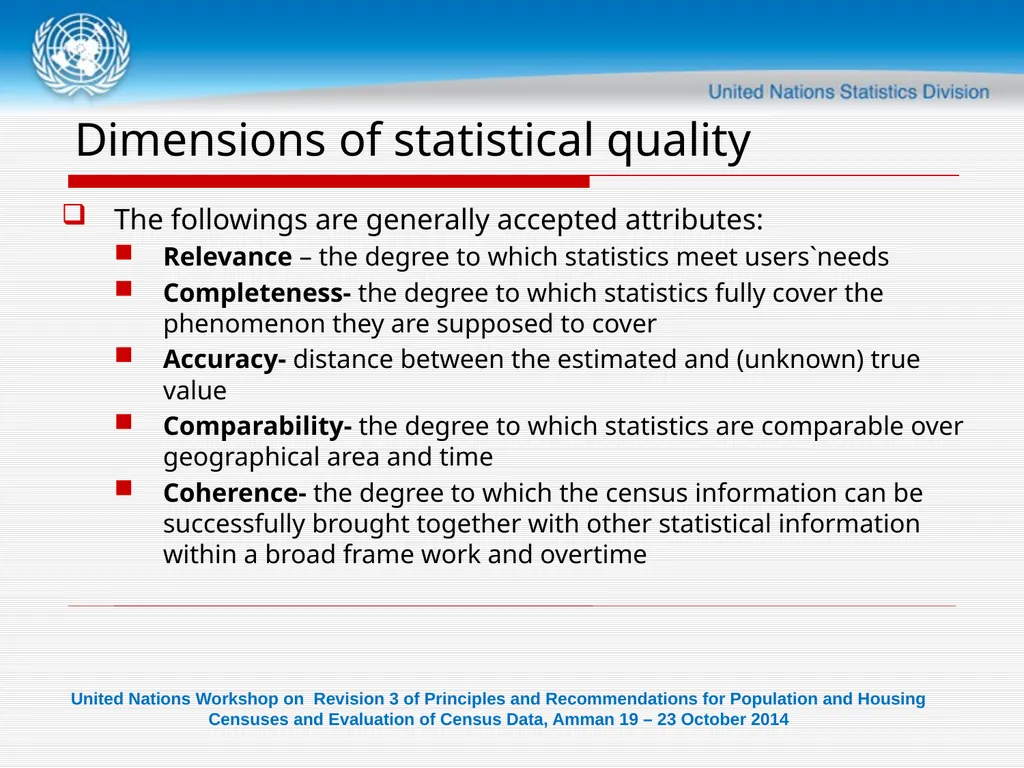
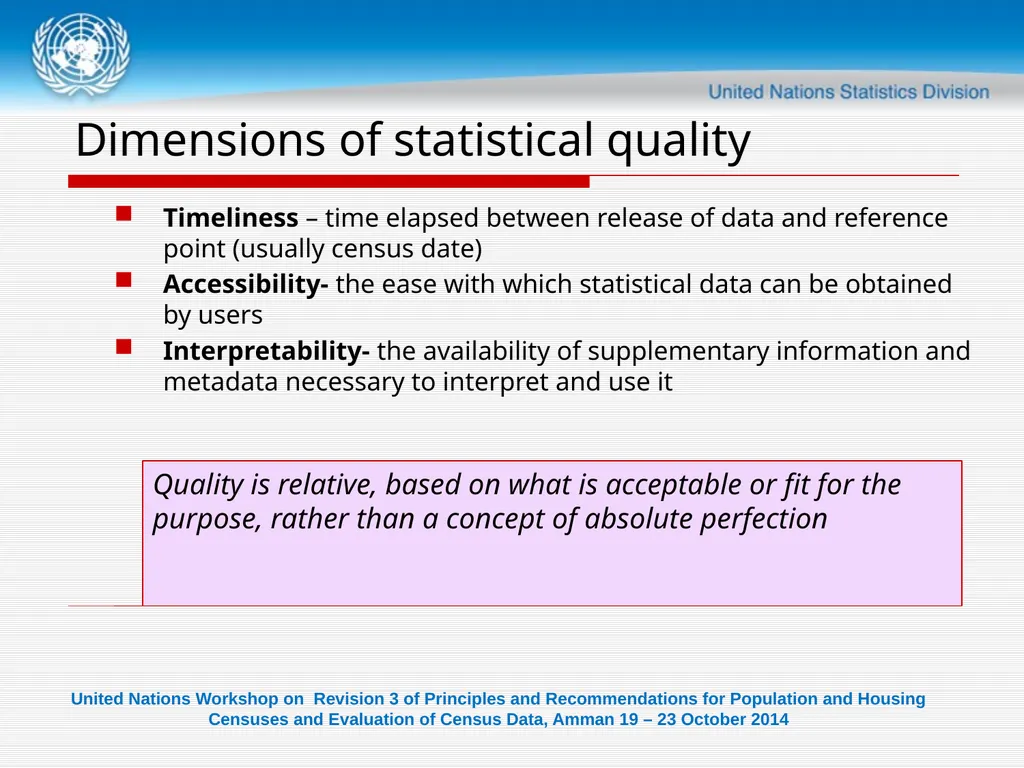
Dimensions of statistical quality The followings are generally accepted attributes:
Relevance – the degree to which statistics meet users`needs
Completeness- the degree to which statistics fully cover the phenomenon they are supposed to cover
Accuracy- distance between the estimated and (unknown) true value
Comparability- the degree to which statistics are comparable over geographical area and time
Coherence- the degree to which the census information can be successfully brought together with other statistical information within a broad frame work and overtime United Nations Workshop on Revision 3 of Principles and Recommendations for Population and Housing Censuses and Evaluation of Census Data, Amman 19 – 23 October 2014<br>
Relevance – the degree to which statistics meet users`needs
Completeness- the degree to which statistics fully cover the phenomenon they are supposed to cover
Accuracy- distance between the estimated and (unknown) true value
Comparability- the degree to which statistics are comparable over geographical area and time
Coherence- the degree to which the census information can be successfully brought together with other statistical information within a broad frame work and overtime United Nations Workshop on Revision 3 of Principles and Recommendations for Population and Housing Censuses and Evaluation of Census Data, Amman 19 – 23 October 2014<br>
18
Dimensions of statistical quality Timeliness – time elapsed between release of data and reference point (usually census date)
Accessibility- the ease with which statistical data can be obtained by users
Interpretability- the availability of supplementary information and metadata necessary to interpret and use it United Nations Workshop on Revision 3 of Principles and Recommendations for Population and Housing Censuses and Evaluation of Census Data, Amman 19 – 23 October 2014 Quality is relative, based on what is acceptable or fit for the purpose, rather than a concept of absolute perfection<br>
Accessibility- the ease with which statistical data can be obtained by users
Interpretability- the availability of supplementary information and metadata necessary to interpret and use it United Nations Workshop on Revision 3 of Principles and Recommendations for Population and Housing Censuses and Evaluation of Census Data, Amman 19 – 23 October 2014 Quality is relative, based on what is acceptable or fit for the purpose, rather than a concept of absolute perfection<br>
19
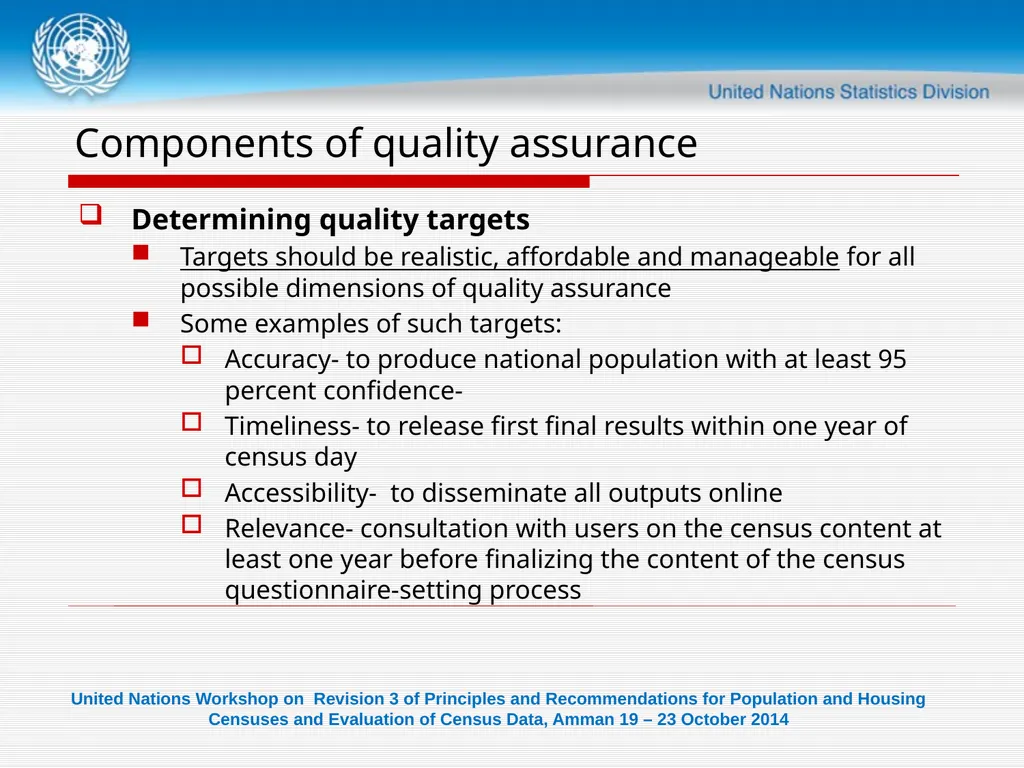
Components of quality assurance Determining quality targets
Targets should be realistic, affordable and manageable for all possible dimensions of quality assurance
Some examples of such targets:
Accuracy- to produce national population with at least 95 percent confidence-
Timeliness- to release first final results within one year of census day
Accessibility- to disseminate all outputs online
Relevance- consultation with users on the census content at least one year before finalizing the content of the census questionnaire-setting process United Nations Workshop on Revision 3 of Principles and Recommendations for Population and Housing Censuses and Evaluation of Census Data, Amman 19 – 23 October 2014<br>
Targets should be realistic, affordable and manageable for all possible dimensions of quality assurance
Some examples of such targets:
Accuracy- to produce national population with at least 95 percent confidence-
Timeliness- to release first final results within one year of census day
Accessibility- to disseminate all outputs online
Relevance- consultation with users on the census content at least one year before finalizing the content of the census questionnaire-setting process United Nations Workshop on Revision 3 of Principles and Recommendations for Population and Housing Censuses and Evaluation of Census Data, Amman 19 – 23 October 2014<br>
20
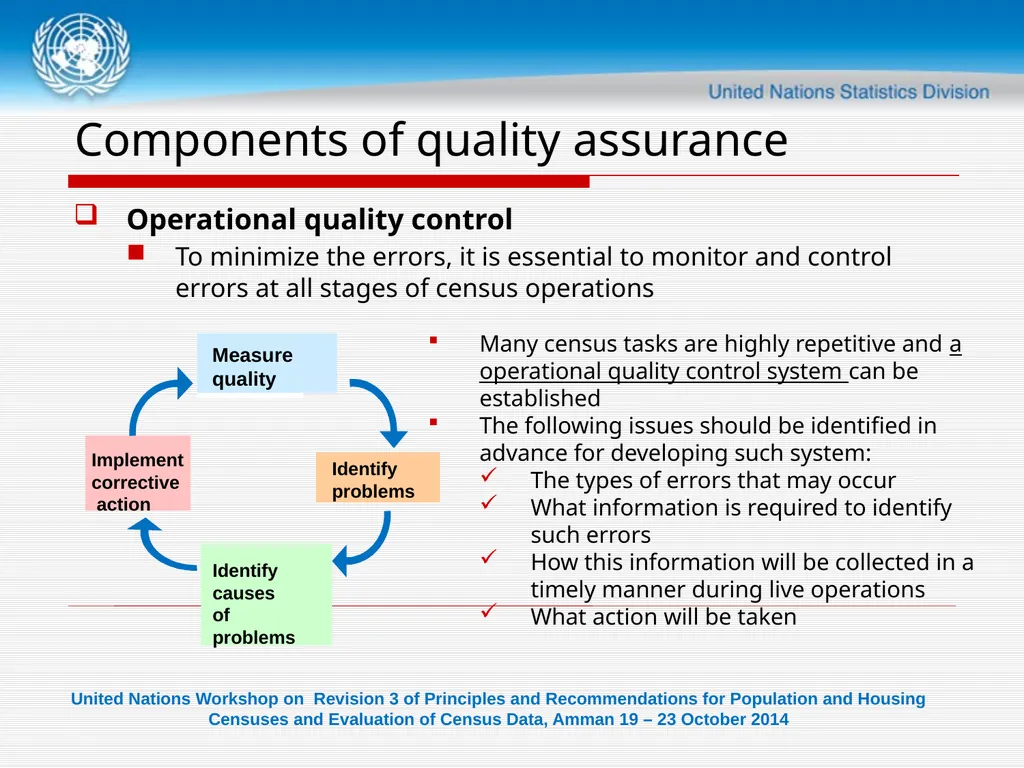
Components of quality assurance Operational quality control
To minimize the errors, it is essential to monitor and control errors at all stages of census operations United Nations Workshop on Revision 3 of Principles and Recommendations for Population and Housing Censuses and Evaluation of Census Data, Amman 19 – 23 October 2014 Many census tasks are highly repetitive and a operational quality control system can be established
The following issues should be identified in advance for developing such system:
The types of errors that may occur
What information is required to identify such errors
How this information will be collected in a timely manner during live operations
What action will be taken<br>
To minimize the errors, it is essential to monitor and control errors at all stages of census operations United Nations Workshop on Revision 3 of Principles and Recommendations for Population and Housing Censuses and Evaluation of Census Data, Amman 19 – 23 October 2014 Many census tasks are highly repetitive and a operational quality control system can be established
The following issues should be identified in advance for developing such system:
The types of errors that may occur
What information is required to identify such errors
How this information will be collected in a timely manner during live operations
What action will be taken<br>
21
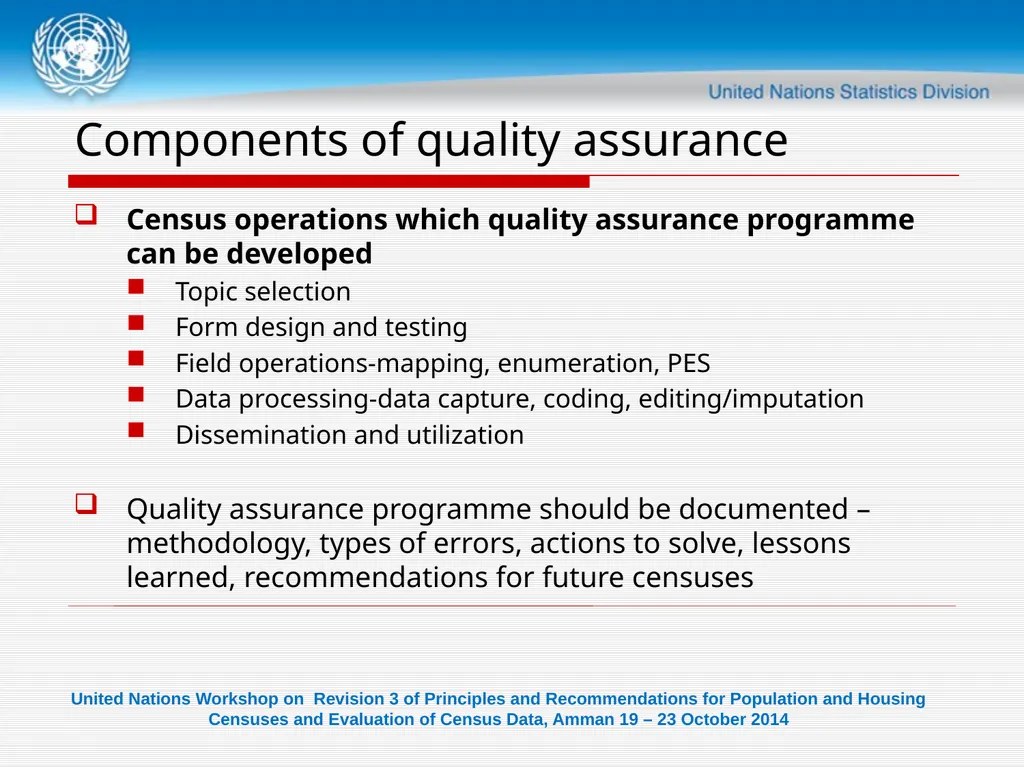
Components of quality assurance Census operations which quality assurance programme can be developed
Topic selection
Form design and testing
Field operations-mapping, enumeration, PES
Data processing-data capture, coding, editing/imputation
Dissemination and utilization
Quality assurance programme should be documented – methodology, types of errors, actions to solve, lessons learned, recommendations for future censuses United Nations Workshop on Revision 3 of Principles and Recommendations for Population and Housing Censuses and Evaluation of Census Data, Amman 19 – 23 October 2014<br>
Topic selection
Form design and testing
Field operations-mapping, enumeration, PES
Data processing-data capture, coding, editing/imputation
Dissemination and utilization
Quality assurance programme should be documented – methodology, types of errors, actions to solve, lessons learned, recommendations for future censuses United Nations Workshop on Revision 3 of Principles and Recommendations for Population and Housing Censuses and Evaluation of Census Data, Amman 19 – 23 October 2014<br>
22
United Nations Workshop on Revision 3 of Principles and Recommendations for Population and Housing Censuses and Evaluation of Census Data, Amman 19 – 23 October 2014 Units, Place and Time
of Enumeration<br>
of Enumeration<br>
23
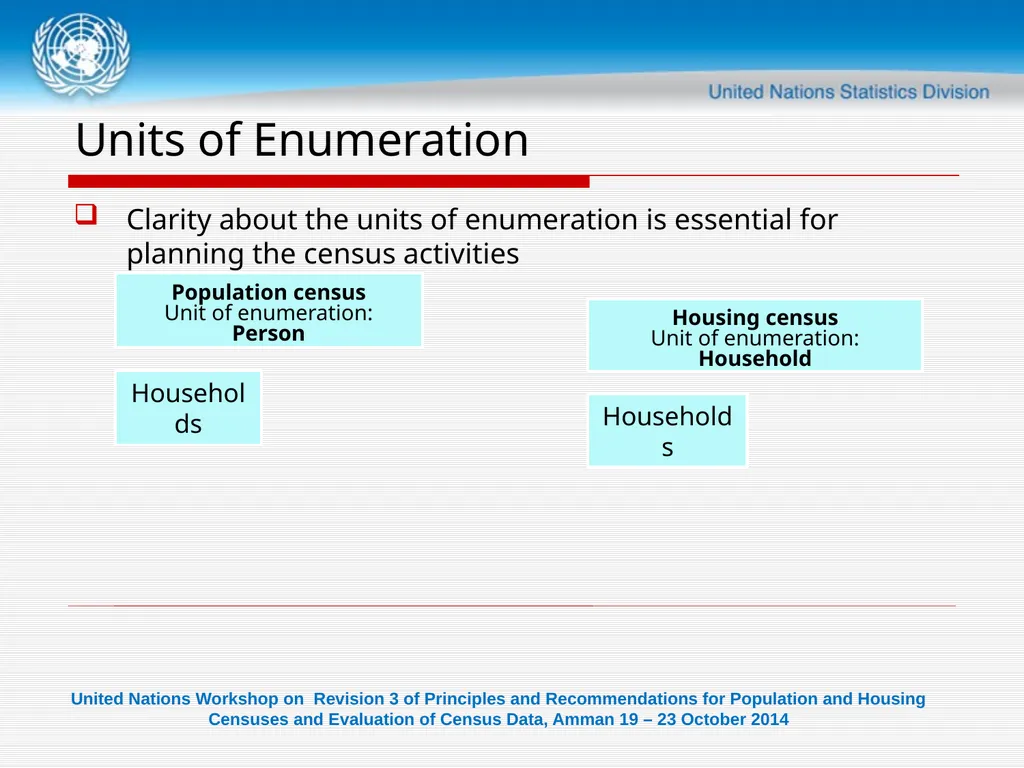
Units of Enumeration Clarity about the units of enumeration is essential for planning the census activities United Nations Workshop on Revision 3 of Principles and Recommendations for Population and Housing Censuses and Evaluation of Census Data, Amman 19 – 23 October 2014<br>
24
Place of enumeration The place of enumeration would be either the place where the person is found or the place of usual residence of the person at the census reference moment
It should be ensured that each person should have only one place of enumeration United Nations Workshop on Revision 3 of Principles and Recommendations for Population and Housing Censuses and Evaluation of Census Data, Amman 19 – 23 October 2014 In general, “usual residence” is defined for census purposes as the place at which the person lives at the time of the census, and has been there for some time or intends to stay there for some time.<br>
It should be ensured that each person should have only one place of enumeration United Nations Workshop on Revision 3 of Principles and Recommendations for Population and Housing Censuses and Evaluation of Census Data, Amman 19 – 23 October 2014 In general, “usual residence” is defined for census purposes as the place at which the person lives at the time of the census, and has been there for some time or intends to stay there for some time.<br>
25
Place of enumeration It is recommended that countries apply a threshold of 12 months when considering place of usual residence according to one of the following two criteria:
The place at which the person has lived continuously for most of the last 12 months (that is, for at least six months and one day), not including temporary absences for holidays or work assignments, or intends to live for at least six months;
The place at which the person has lived continuously for at least the last 12 months, not including temporary absences for holidays or work assignments, or intends to live for at least 12 months. United Nations Workshop on Revision 3 of Principles and Recommendations for Population and Housing Censuses and Evaluation of Census Data, Amman 19 – 23 October 2014<br>
The place at which the person has lived continuously for most of the last 12 months (that is, for at least six months and one day), not including temporary absences for holidays or work assignments, or intends to live for at least six months;
The place at which the person has lived continuously for at least the last 12 months, not including temporary absences for holidays or work assignments, or intends to live for at least 12 months. United Nations Workshop on Revision 3 of Principles and Recommendations for Population and Housing Censuses and Evaluation of Census Data, Amman 19 – 23 October 2014<br>
26
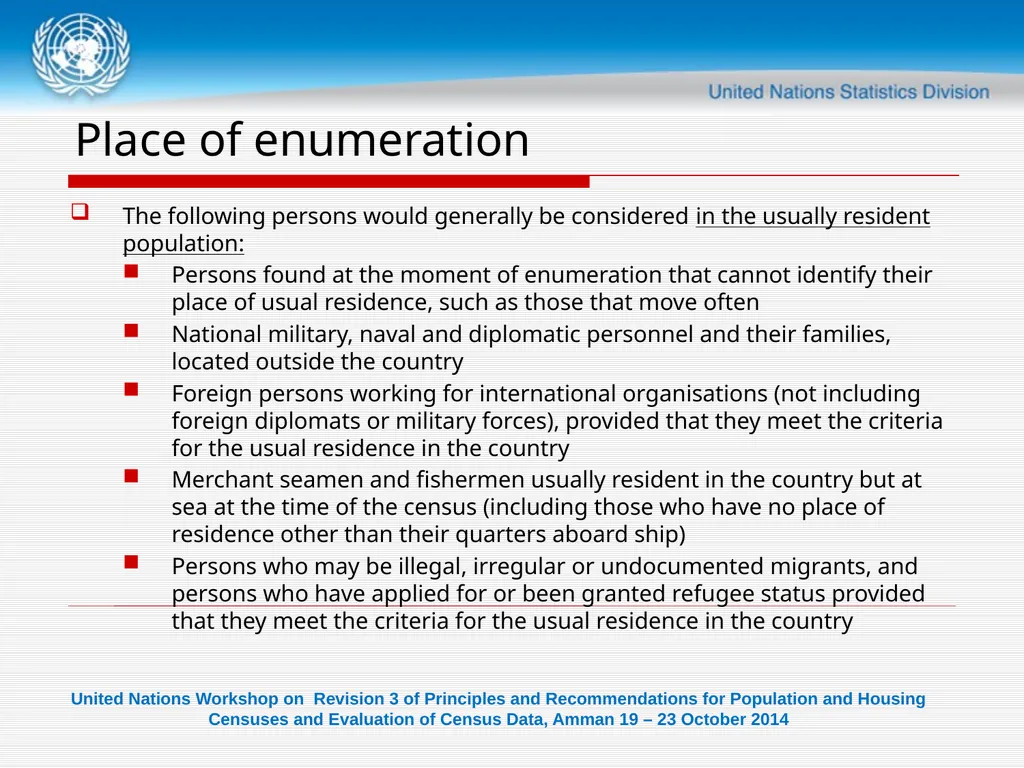
Place of enumeration The following persons would generally be considered in the usually resident population:
Persons found at the moment of enumeration that cannot identify their place of usual residence, such as those that move often
National military, naval and diplomatic personnel and their families, located outside the country
Foreign persons working for international organisations (not including foreign diplomats or military forces), provided that they meet the criteria for the usual residence in the country
Merchant seamen and fishermen usually resident in the country but at sea at the time of the census (including those who have no place of residence other than their quarters aboard ship)
Persons who may be illegal, irregular or undocumented migrants, and persons who have applied for or been granted refugee status provided that they meet the criteria for the usual residence in the country United Nations Workshop on Revision 3 of Principles and Recommendations for Population and Housing Censuses and Evaluation of Census Data, Amman 19 – 23 October 2014<br>
Persons found at the moment of enumeration that cannot identify their place of usual residence, such as those that move often
National military, naval and diplomatic personnel and their families, located outside the country
Foreign persons working for international organisations (not including foreign diplomats or military forces), provided that they meet the criteria for the usual residence in the country
Merchant seamen and fishermen usually resident in the country but at sea at the time of the census (including those who have no place of residence other than their quarters aboard ship)
Persons who may be illegal, irregular or undocumented migrants, and persons who have applied for or been granted refugee status provided that they meet the criteria for the usual residence in the country United Nations Workshop on Revision 3 of Principles and Recommendations for Population and Housing Censuses and Evaluation of Census Data, Amman 19 – 23 October 2014<br>
27
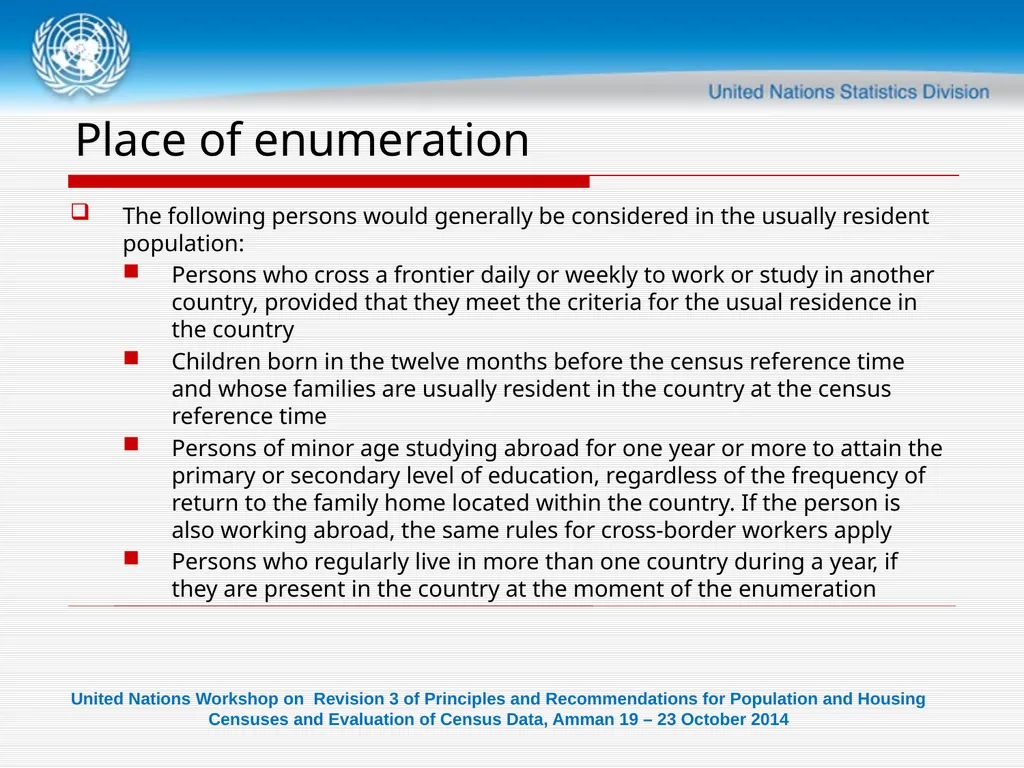
Place of enumeration The following persons would generally be considered in the usually resident population:
Persons who cross a frontier daily or weekly to work or study in another country, provided that they meet the criteria for the usual residence in the country
Children born in the twelve months before the census reference time and whose families are usually resident in the country at the census reference time
Persons of minor age studying abroad for one year or more to attain the primary or secondary level of education, regardless of the frequency of return to the family home located within the country. If the person is also working abroad, the same rules for cross-border workers apply
Persons who regularly live in more than one country during a year, if they are present in the country at the moment of the enumeration United Nations Workshop on Revision 3 of Principles and Recommendations for Population and Housing Censuses and Evaluation of Census Data, Amman 19 – 23 October 2014<br>
Persons who cross a frontier daily or weekly to work or study in another country, provided that they meet the criteria for the usual residence in the country
Children born in the twelve months before the census reference time and whose families are usually resident in the country at the census reference time
Persons of minor age studying abroad for one year or more to attain the primary or secondary level of education, regardless of the frequency of return to the family home located within the country. If the person is also working abroad, the same rules for cross-border workers apply
Persons who regularly live in more than one country during a year, if they are present in the country at the moment of the enumeration United Nations Workshop on Revision 3 of Principles and Recommendations for Population and Housing Censuses and Evaluation of Census Data, Amman 19 – 23 October 2014<br>
28
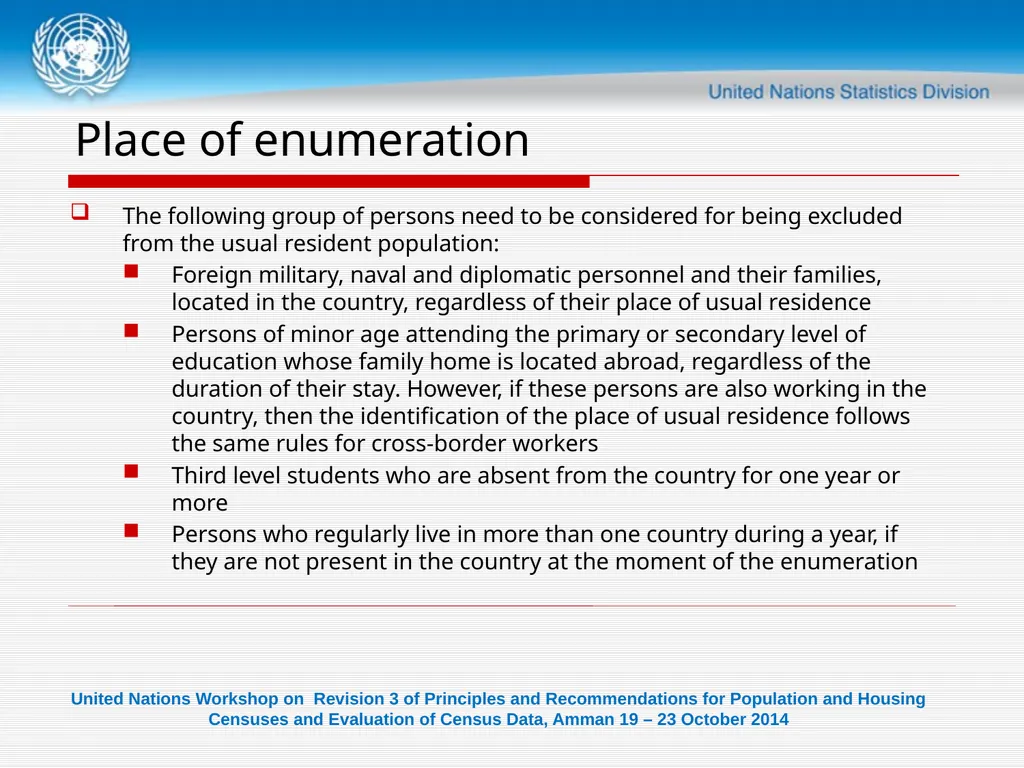
Place of enumeration The following group of persons need to be considered for being excluded from the usual resident population:
Foreign military, naval and diplomatic personnel and their families, located in the country, regardless of their place of usual residence
Persons of minor age attending the primary or secondary level of education whose family home is located abroad, regardless of the duration of their stay. However, if these persons are also working in the country, then the identification of the place of usual residence follows the same rules for cross-border workers
Third level students who are absent from the country for one year or more
Persons who regularly live in more than one country during a year, if they are not present in the country at the moment of the enumeration United Nations Workshop on Revision 3 of Principles and Recommendations for Population and Housing Censuses and Evaluation of Census Data, Amman 19 – 23 October 2014<br>
Foreign military, naval and diplomatic personnel and their families, located in the country, regardless of their place of usual residence
Persons of minor age attending the primary or secondary level of education whose family home is located abroad, regardless of the duration of their stay. However, if these persons are also working in the country, then the identification of the place of usual residence follows the same rules for cross-border workers
Third level students who are absent from the country for one year or more
Persons who regularly live in more than one country during a year, if they are not present in the country at the moment of the enumeration United Nations Workshop on Revision 3 of Principles and Recommendations for Population and Housing Censuses and Evaluation of Census Data, Amman 19 – 23 October 2014<br>
29
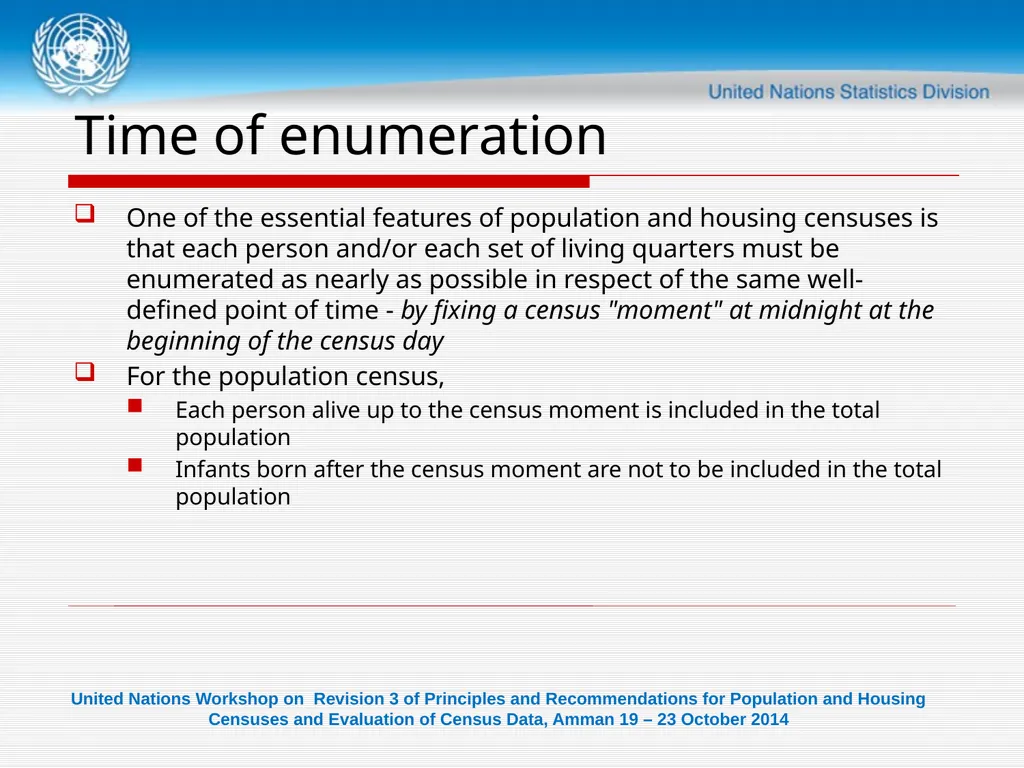
Time of enumeration One of the essential features of population and housing censuses is that each person and/or each set of living quarters must be enumerated as nearly as possible in respect of the same well-defined point of time - by fixing a census "moment" at midnight at the beginning of the census day
For the population census,
Each person alive up to the census moment is included in the total population
Infants born after the census moment are not to be included in the total population United Nations Workshop on Revision 3 of Principles and Recommendations for Population and Housing Censuses and Evaluation of Census Data, Amman 19 – 23 October 2014<br>
For the population census,
Each person alive up to the census moment is included in the total population
Infants born after the census moment are not to be included in the total population United Nations Workshop on Revision 3 of Principles and Recommendations for Population and Housing Censuses and Evaluation of Census Data, Amman 19 – 23 October 2014<br>