
Unleashing People Potential - UP Unleashing
DJ
Published · 68 slides · 0 views

1 / 1






Description
Unleashing People Potential - UP Unleashing Results F1C International since 2004 2 Copyright F1C International 2013 What if rapid transformation was really possible? What if you could take a rather dull team 4 Mercedes-Benz Before 5
Related Topics
Share
Embed code
Download this presentation From Below
"Unleashing People Potential - UP Unleashing" is the property of its rightful owner. Permission is granted to download and print the materials on this website for personal, non-commercial use only, and to display it on your personal computer provided you do not modify the materials and that you retain all copyright notices contained in the materials. By downloading content from our website, you accept the terms of this agreement.
Presentation Transcript
01
Unleashing People Potential - UP
Unleashing Results F1C International
since 2004 2 Copyright F1C International 2013<br>
Unleashing Results F1C International
since 2004 2 Copyright F1C International 2013<br>
02
What if …
rapid transformation
was really possible?<br>
03
What if … …you could take a rather dull team<br>
04
4 Mercedes-Benz Before …<br>
05
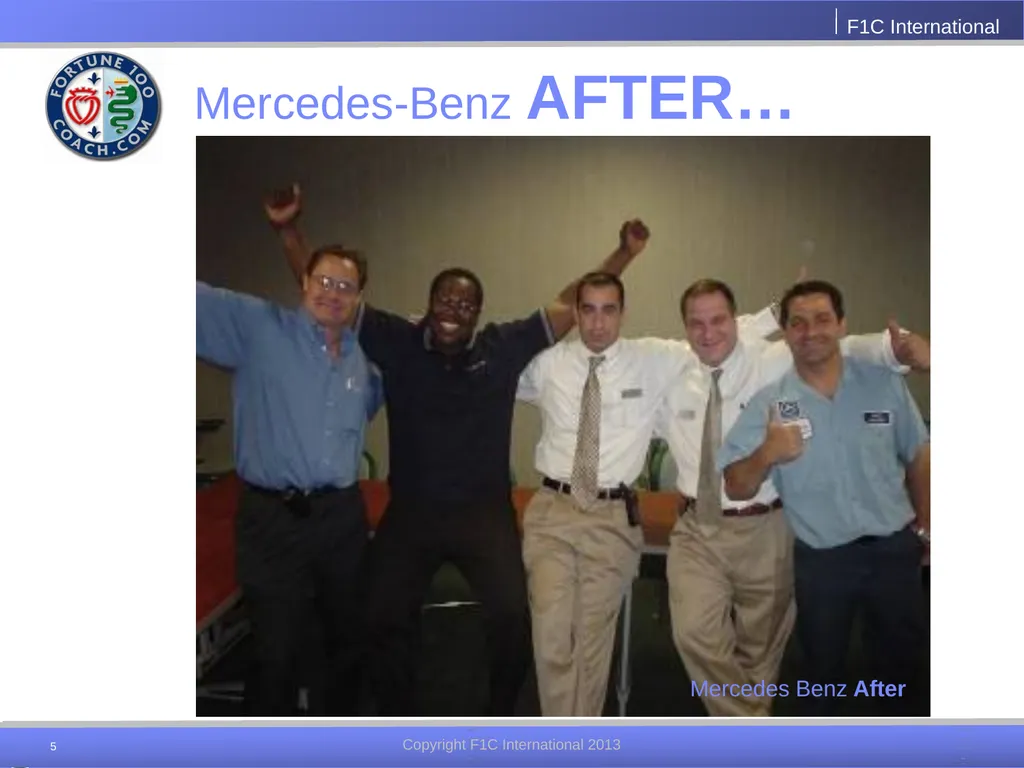
5 Mercedes Benz After Mercedes-Benz AFTER…<br>
06
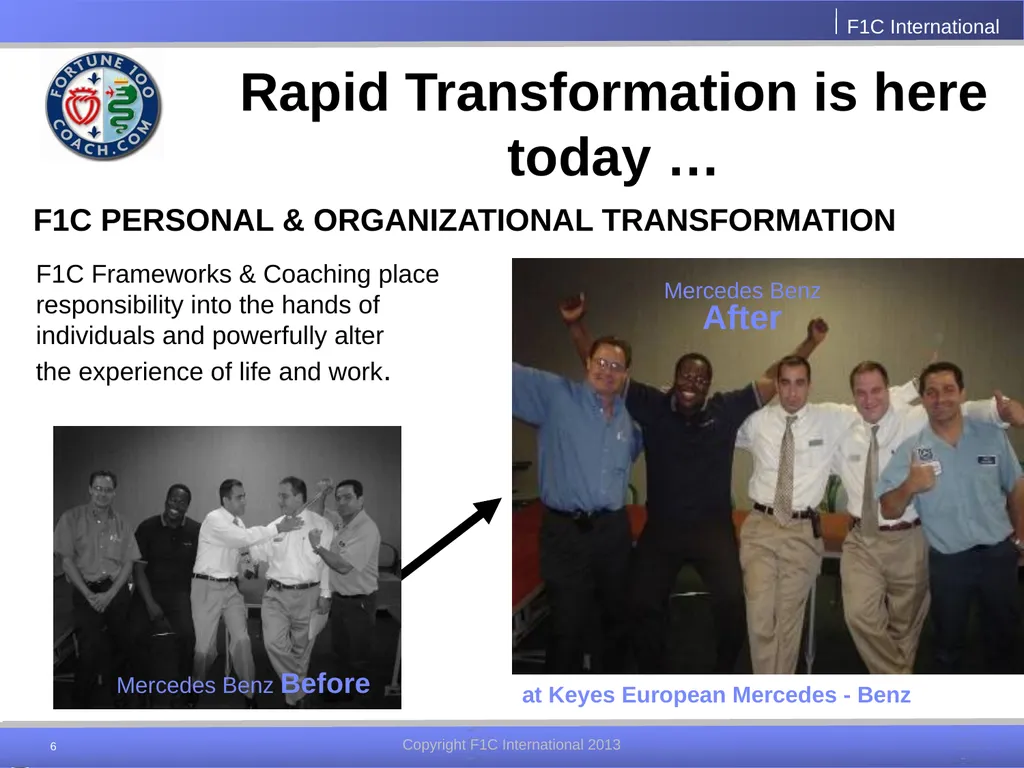
6 F1C Frameworks & Coaching place responsibility into the hands of individuals and powerfully alter
the experience of life and work. F1C PERSONAL & ORGANIZATIONAL TRANSFORMATION Rapid Transformation is here today … Mercedes Benz Before at Keyes European Mercedes - Benz Mercedes Benz After<br>
the experience of life and work. F1C PERSONAL & ORGANIZATIONAL TRANSFORMATION Rapid Transformation is here today … Mercedes Benz Before at Keyes European Mercedes - Benz Mercedes Benz After<br>
07
7 CLIENTS & ENGAGEMENTS HISTORY<br>
08
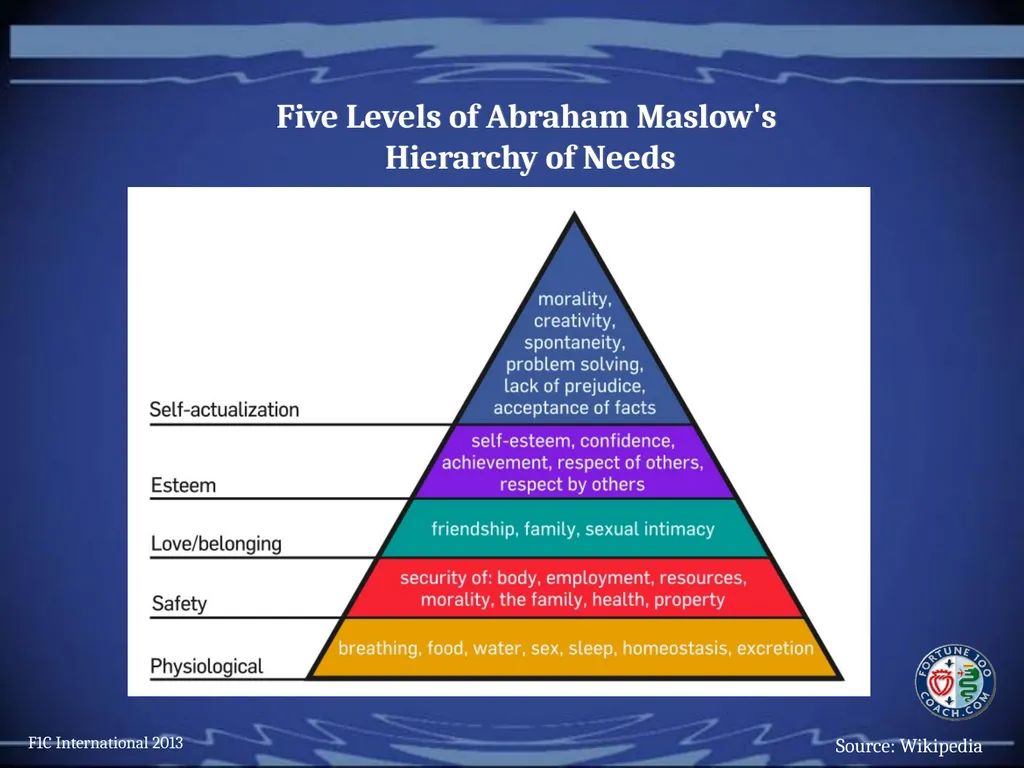
Five Levels of Abraham Maslow's
Hierarchy of Needs Source: Wikipedia F1C International 2013<br>
09
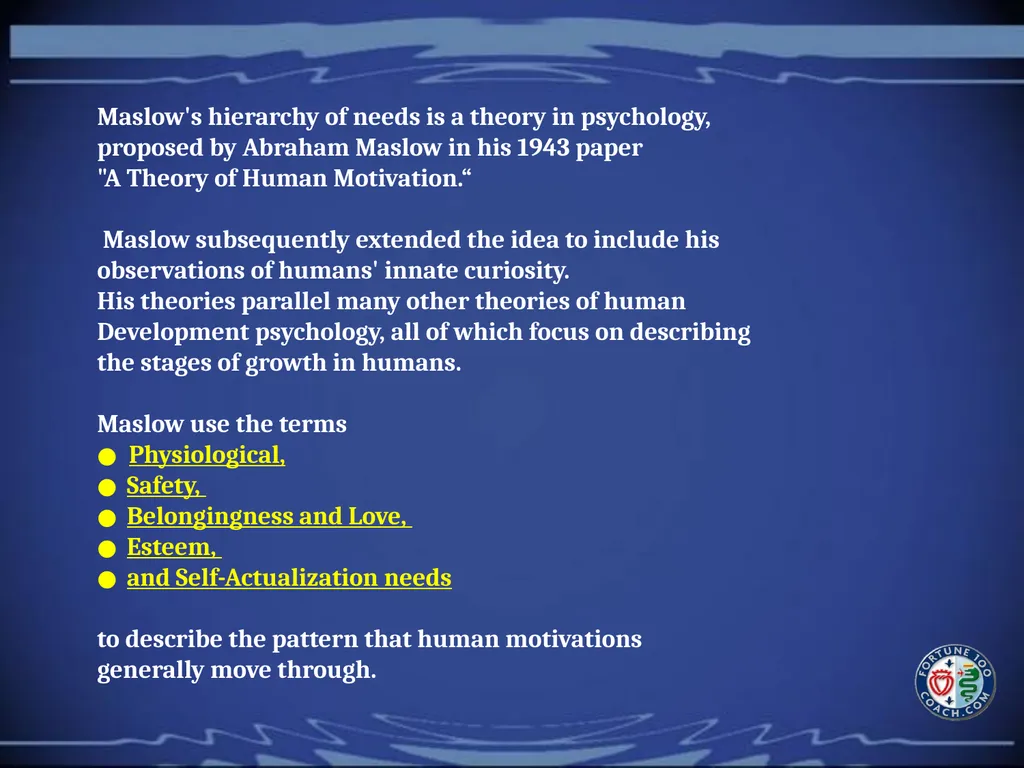
Maslow's hierarchy of needs is a theory in psychology,
proposed by Abraham Maslow in his 1943 paper
"A Theory of Human Motivation.“ Maslow subsequently extended the idea to include his
observations of humans' innate curiosity.
His theories parallel many other theories of human
Development psychology, all of which focus on describing
the stages of growth in humans.
Maslow use the terms
● Physiological,
● Safety,
● Belongingness and Love,
● Esteem,
● and Self-Actualization needs
to describe the pattern that human motivations
generally move through.<br>
proposed by Abraham Maslow in his 1943 paper
"A Theory of Human Motivation.“ Maslow subsequently extended the idea to include his
observations of humans' innate curiosity.
His theories parallel many other theories of human
Development psychology, all of which focus on describing
the stages of growth in humans.
Maslow use the terms
● Physiological,
● Safety,
● Belongingness and Love,
● Esteem,
● and Self-Actualization needs
to describe the pattern that human motivations
generally move through.<br>
10
The Law Of
Six Emotional Needs Adapted from Anthony Robbins and others …<br>
Six Emotional Needs Adapted from Anthony Robbins and others …<br>
11
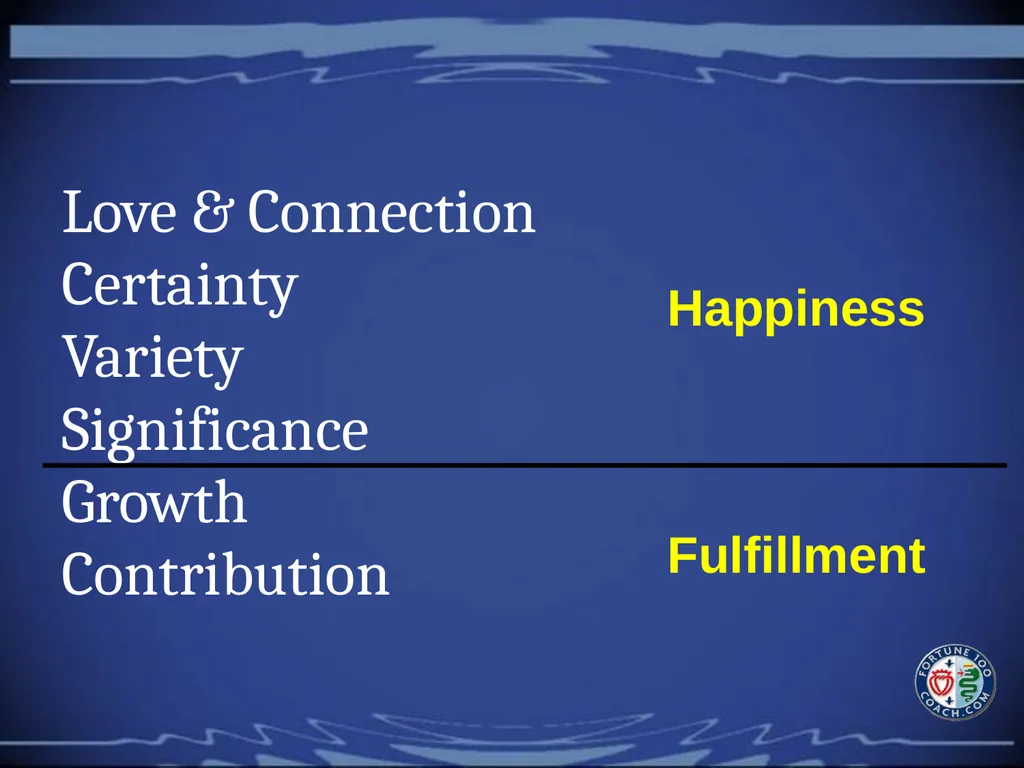
Love & Connection
Certainty
Variety
Significance
Growth
Contribution Happiness Fulfillment<br>
Certainty
Variety
Significance
Growth
Contribution Happiness Fulfillment<br>
12
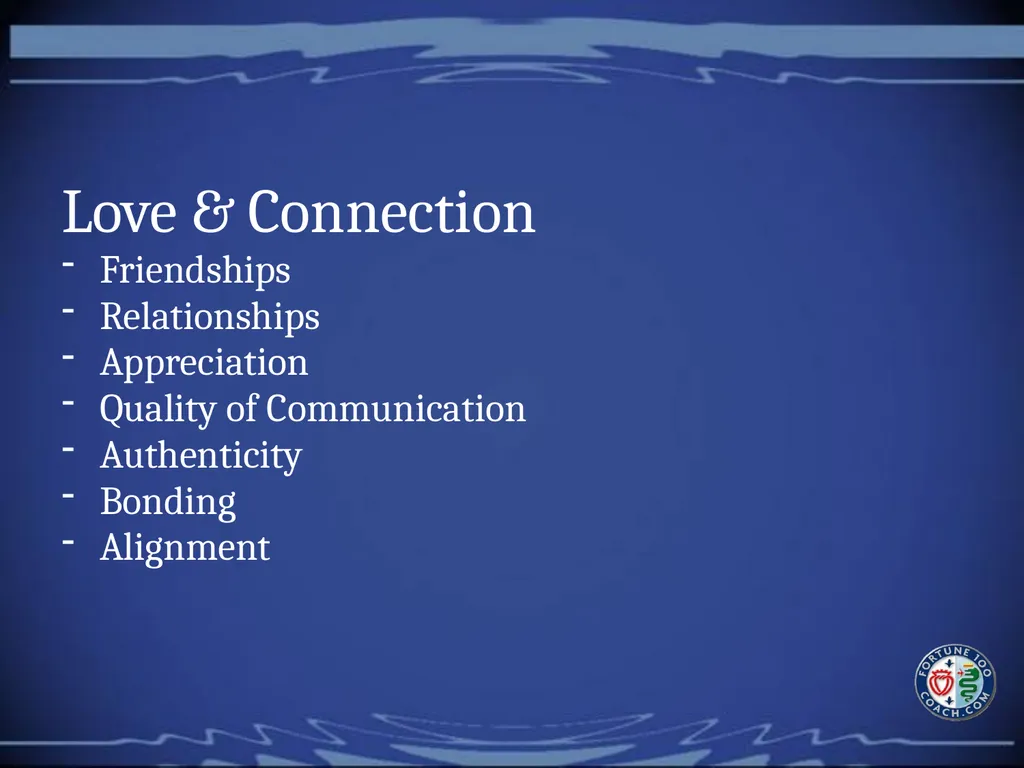
Love & Connection
Friendships
Relationships
Appreciation
Quality of Communication
Authenticity
Bonding
Alignment<br>
Friendships
Relationships
Appreciation
Quality of Communication
Authenticity
Bonding
Alignment<br>
13
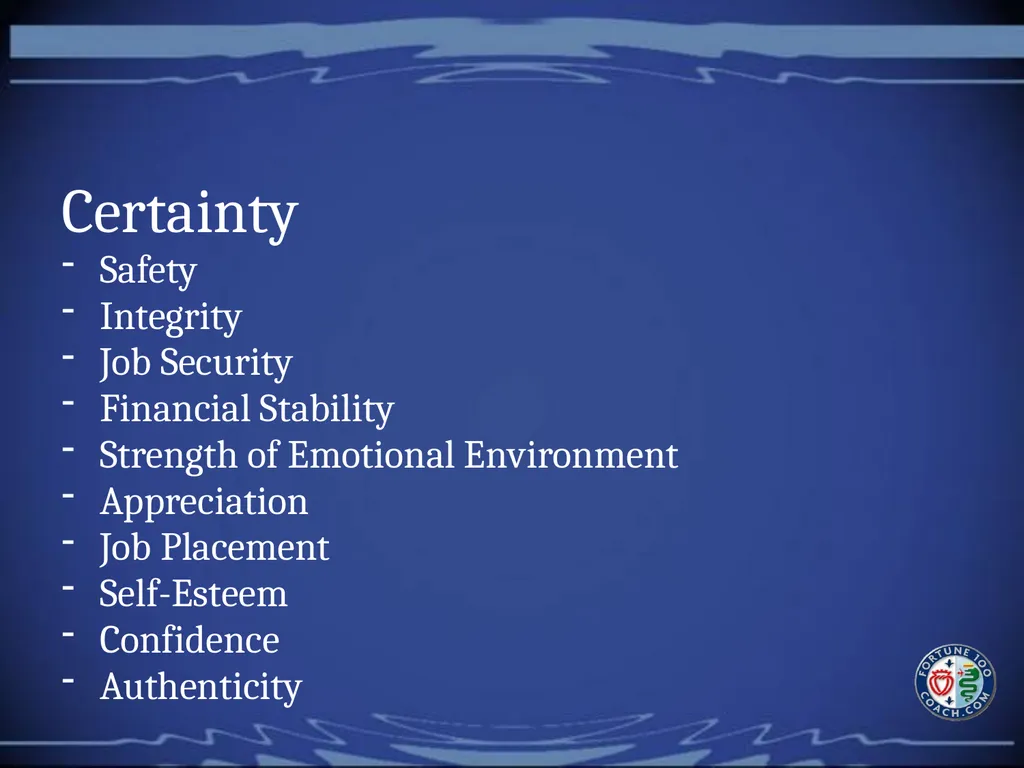
Certainty
Safety
Integrity
Job Security
Financial Stability
Strength of Emotional Environment
Appreciation
Job Placement
Self-Esteem
Confidence
Authenticity<br>
Safety
Integrity
Job Security
Financial Stability
Strength of Emotional Environment
Appreciation
Job Placement
Self-Esteem
Confidence
Authenticity<br>
14
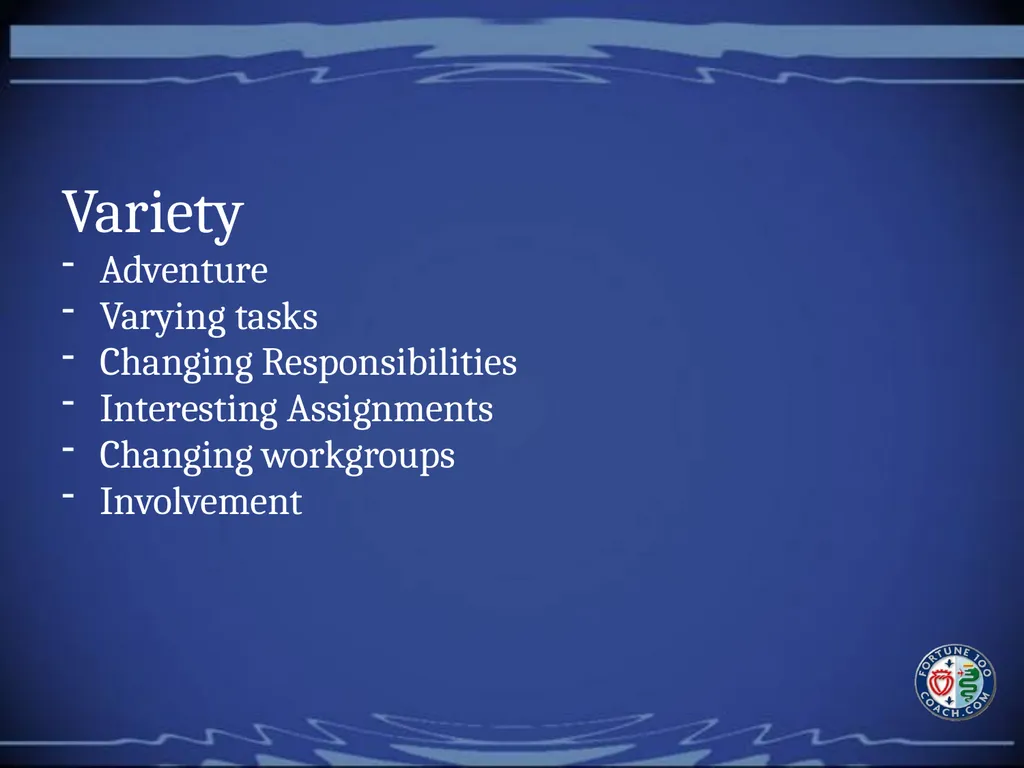
Variety
Adventure
Varying tasks
Changing Responsibilities
Interesting Assignments
Changing workgroups
Involvement<br>
Adventure
Varying tasks
Changing Responsibilities
Interesting Assignments
Changing workgroups
Involvement<br>
15
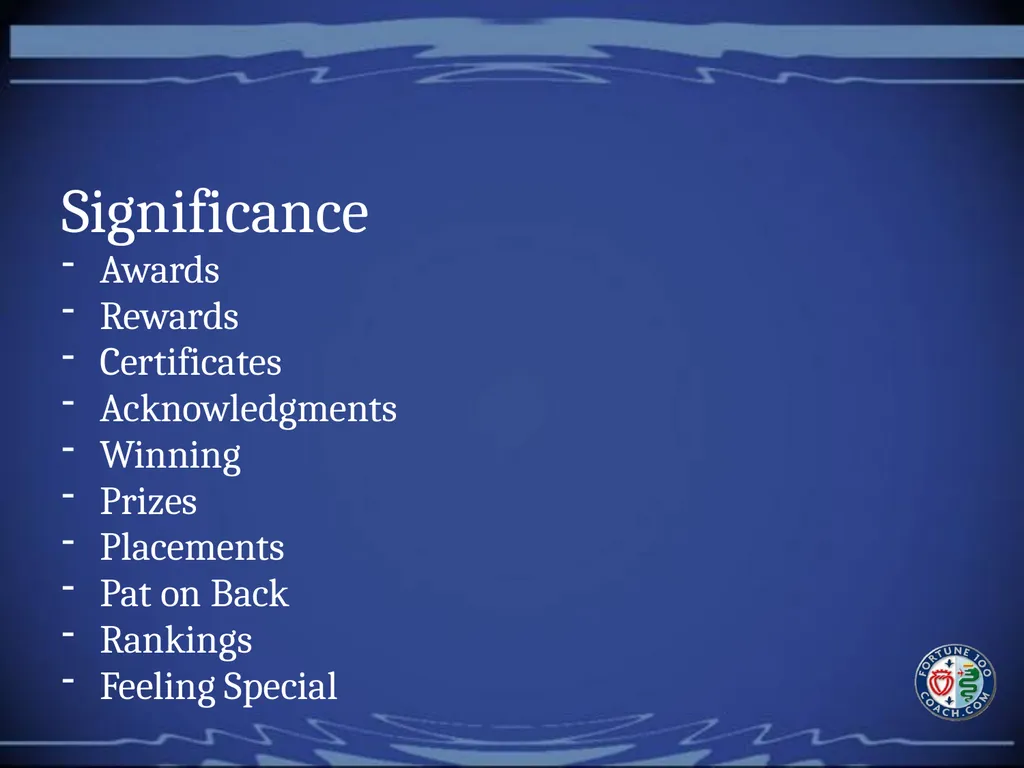
Significance
Awards
Rewards
Certificates
Acknowledgments
Winning
Prizes
Placements
Pat on Back
Rankings
Feeling Special<br>
Awards
Rewards
Certificates
Acknowledgments
Winning
Prizes
Placements
Pat on Back
Rankings
Feeling Special<br>
16
Growth
Learning all types
Classes
Seminars
Books
Trainings
Self-or-Company Driven
Promotions
Raises<br>
Learning all types
Classes
Seminars
Books
Trainings
Self-or-Company Driven
Promotions
Raises<br>
17
Contribution
Making a Difference
Contributing Ideas
Helping
Charity
Teaching
Coaching
Developing
Donating
Volunteering
Being involved on an Inclusive Team<br>
Making a Difference
Contributing Ideas
Helping
Charity
Teaching
Coaching
Developing
Donating
Volunteering
Being involved on an Inclusive Team<br>
18
‘EMPLOYEE & CUSTOMER
ENGAGEMENT’<br>
ENGAGEMENT’<br>
19
EMPLOYEE ENGAGEMENT
Employee engagement, also called worker engagement, is a business
management concept. An "engaged employee" is one who is fully involved in,
and enthusiastic about their work, and thus will act in a way that furthers
their organization's interests.<br>
Employee engagement, also called worker engagement, is a business
management concept. An "engaged employee" is one who is fully involved in,
and enthusiastic about their work, and thus will act in a way that furthers
their organization's interests.<br>
20
EMPLOYEE ENGAGEMENT
According to Scarlett Surveys, "Employee Engagement is a measurable
degree of an employee's positive or negative emotional attachment
to their job, colleagues and organization that profoundly influences
their willingness to learn and perform is at work".
Thus engagement is distinctively different from employee satisfaction,
motivation and organizational culture.<br>
According to Scarlett Surveys, "Employee Engagement is a measurable
degree of an employee's positive or negative emotional attachment
to their job, colleagues and organization that profoundly influences
their willingness to learn and perform is at work".
Thus engagement is distinctively different from employee satisfaction,
motivation and organizational culture.<br>
21
EMPLOYEE ENGAGEMENT
Employee engagement is derived from studies of morale or a group's
willingness to accomplish organizational objectives which began in the 1920s.
The value of morale to organizations was matured by US Army researchers
during WWII to predict unity of effort and attitudinal battle-readiness
before combat.
In the postwar mass production society that required unity of effort in
execution, (group) morale scores were used as predictors of speed,
quality and militancy.<br>
willingness to accomplish organizational objectives which began in the 1920s.
The value of morale to organizations was matured by US Army researchers
during WWII to predict unity of effort and attitudinal battle-readiness
before combat.
In the postwar mass production society that required unity of effort in
execution, (group) morale scores were used as predictors of speed,
quality and militancy.<br>
22
EMPLOYEE ENGAGEMENT
With the advent of the knowledge worker and emphasis on individual
talent management (stars), a term was needed to describe an individual's
emotional attachment to the organization, fellow associates and the job.
Thus the birth of the term "employee engagement" which is an individual
emotional phenomenon whereas morale is a group emotional phenomenon
of similar characteristics.
In other words, employee engagement is the raw material of morale
composed of 15 intrinsic and extrinsic attitudinal drivers.
(e.g. Scarlett Surveys 2001).<br>
With the advent of the knowledge worker and emphasis on individual
talent management (stars), a term was needed to describe an individual's
emotional attachment to the organization, fellow associates and the job.
Thus the birth of the term "employee engagement" which is an individual
emotional phenomenon whereas morale is a group emotional phenomenon
of similar characteristics.
In other words, employee engagement is the raw material of morale
composed of 15 intrinsic and extrinsic attitudinal drivers.
(e.g. Scarlett Surveys 2001).<br>
23
RESEARCH STUDIES
Engaged employees care about the future of the company and are willing
to invest discretionary effort.
Engaged employees feel a strong emotional bond to the organization that
employs them (Robinson), which results in higher retention levels and
productivity levels and lower absenteeism.
When reliably measured, positive employee engagement can be causally
related or correlated to specific positive business outcomes by workgroup
and job type.
Scarlett Surveys refers to these statistical relationships as
engageonomics.<br>
Engaged employees care about the future of the company and are willing
to invest discretionary effort.
Engaged employees feel a strong emotional bond to the organization that
employs them (Robinson), which results in higher retention levels and
productivity levels and lower absenteeism.
When reliably measured, positive employee engagement can be causally
related or correlated to specific positive business outcomes by workgroup
and job type.
Scarlett Surveys refers to these statistical relationships as
engageonomics.<br>
24
EMOTIONAL ATTACHMENT
Only 31% of employees are actively engaged in their jobs.
These employees work with passion and feel a profound connection to
their company.
People that are actively engaged help move the organization forward.
88% of highly engaged employees believe they can positively impact
quality of their organization's products, compared with only 38%
of the disengaged.<br>
Only 31% of employees are actively engaged in their jobs.
These employees work with passion and feel a profound connection to
their company.
People that are actively engaged help move the organization forward.
88% of highly engaged employees believe they can positively impact
quality of their organization's products, compared with only 38%
of the disengaged.<br>
25
EMOTIONAL ATTACHMENT
72% of highly engaged employees believe they can positively affect
customer service, versus 27% of the disengaged.
68% of highly engaged employees believe they can positively impact
costs in their job or unit, compared with just 19% of the disengaged.<br>
72% of highly engaged employees believe they can positively affect
customer service, versus 27% of the disengaged.
68% of highly engaged employees believe they can positively impact
costs in their job or unit, compared with just 19% of the disengaged.<br>
26
EMOTIONAL ATTACHMENT
Engaged employees feel a strong emotional bond to the organization that
employs them.
This is associated with people demonstrating a willingness to recommend
the organization to others and commit time and effort to help the
organization succeed.
It suggests that people are motivated by intrinsic factors
(e.g. personal growth, working to a common purpose, being part
of a larger process) rather than simply focusing on extrinsic factors
(e.g., pay/reward).<br>
Engaged employees feel a strong emotional bond to the organization that
employs them.
This is associated with people demonstrating a willingness to recommend
the organization to others and commit time and effort to help the
organization succeed.
It suggests that people are motivated by intrinsic factors
(e.g. personal growth, working to a common purpose, being part
of a larger process) rather than simply focusing on extrinsic factors
(e.g., pay/reward).<br>
27
INVOLVEMENT
Eileen Appelbaum and her colleagues (2000) studied 15 steel mills,
17 apparel manufacturers, and 10 electronic instrument and imaging
equipment producers.
Their purpose was to compare traditional production systems with
flexible high-performance production systems involving teams,
training, and incentive pay systems.<br>
Eileen Appelbaum and her colleagues (2000) studied 15 steel mills,
17 apparel manufacturers, and 10 electronic instrument and imaging
equipment producers.
Their purpose was to compare traditional production systems with
flexible high-performance production systems involving teams,
training, and incentive pay systems.<br>
28
INVOLVEMENT
In all three industries, the plants utilizing high-involvement practices
showed superior performance.
In addition, workers in the high-involvement plants showed more
positive attitudes, including trust, organizational commitment and
intrinsic enjoyment of the work.
The concept has gained popularity as various studies have demonstrated links
with productivity.
It is often linked to the notion of employee voice and empowerment.<br>
In all three industries, the plants utilizing high-involvement practices
showed superior performance.
In addition, workers in the high-involvement plants showed more
positive attitudes, including trust, organizational commitment and
intrinsic enjoyment of the work.
The concept has gained popularity as various studies have demonstrated links
with productivity.
It is often linked to the notion of employee voice and empowerment.<br>
29
COMMITMENT
It has been routinely found that employee engagement scores account for
as much as half of the variance in customer satisfaction scores.
This translates into millions of dollars for companies if they can improve
their scores.
Studies have statistically demonstrated that engaged employees are more
productive, more profitable, more customer-focused, safer, and less likely
to leave their employer.<br>
It has been routinely found that employee engagement scores account for
as much as half of the variance in customer satisfaction scores.
This translates into millions of dollars for companies if they can improve
their scores.
Studies have statistically demonstrated that engaged employees are more
productive, more profitable, more customer-focused, safer, and less likely
to leave their employer.<br>
30
COMMITMENT
Employees with the highest level of commitment perform 20% better
and are 87% less likely to leave the organization,
which indicates that engagement is linked to organizational performance.
For example, at the beverage company of MolsonCoors, it was found that
engaged employees were five times less likely than non-engaged employees
to have a safety incident and seven times less likely to have a lost-time
safety incident.<br>
Employees with the highest level of commitment perform 20% better
and are 87% less likely to leave the organization,
which indicates that engagement is linked to organizational performance.
For example, at the beverage company of MolsonCoors, it was found that
engaged employees were five times less likely than non-engaged employees
to have a safety incident and seven times less likely to have a lost-time
safety incident.<br>
31
COMMITMENT
In fact, the average cost of a safety incident for an engaged employee was $63,
compared with an average of $392 for a non-engaged employee.
Consequently, through strengthening employee engagement, the company
saved $1,721,760 in safety costs in 2002.
In addition, savings were found in sales performance teams through
engagement. In 2005, for example, low-engagement teams were seen falling
behind engaged teams, with a difference in performance-related costs of
low- versus high-engagement teams totaling $2,104,823.3 (Lockwood).<br>
In fact, the average cost of a safety incident for an engaged employee was $63,
compared with an average of $392 for a non-engaged employee.
Consequently, through strengthening employee engagement, the company
saved $1,721,760 in safety costs in 2002.
In addition, savings were found in sales performance teams through
engagement. In 2005, for example, low-engagement teams were seen falling
behind engaged teams, with a difference in performance-related costs of
low- versus high-engagement teams totaling $2,104,823.3 (Lockwood).<br>
32
PRODUCTIVITY
In a study of professional service firms, the Hay Group found that offices with
engaged employees were up to 43% more productive.
The most striking finding is the almost 52% gaps in operating incomes
between companies with highly engaged employees and companies whose
employees have low-engagement scores.
High-engagement companies improved 19.2% while low-engagement
companies declined 32.7% in operating income during the study period.<br>
In a study of professional service firms, the Hay Group found that offices with
engaged employees were up to 43% more productive.
The most striking finding is the almost 52% gaps in operating incomes
between companies with highly engaged employees and companies whose
employees have low-engagement scores.
High-engagement companies improved 19.2% while low-engagement
companies declined 32.7% in operating income during the study period.<br>
33
PRODUCTIVITY
For example, New Century Financial Corporation, a U.S. specialty mortgage
banking company, found that account executives in the wholesale division
who were actively disengaged produced 28% less revenue than their
colleagues who were engaged. Furthermore, those not engaged generated 23%
less revenue than their engaged counterparts.
Engaged employees also outperformed the not engaged and actively
disengaged employees in other divisions.<br>
For example, New Century Financial Corporation, a U.S. specialty mortgage
banking company, found that account executives in the wholesale division
who were actively disengaged produced 28% less revenue than their
colleagues who were engaged. Furthermore, those not engaged generated 23%
less revenue than their engaged counterparts.
Engaged employees also outperformed the not engaged and actively
disengaged employees in other divisions.<br>
34
GENERATING ENGAGEMENT
Commitment theories are rather based on creating conditions, under which
the employee will feel compelled to work for an organization,
whereas engagement theories aim to bring about a situation in which the
employee by free choice has an intrinsic desire to work in the best interests
of the organization.<br>
Commitment theories are rather based on creating conditions, under which
the employee will feel compelled to work for an organization,
whereas engagement theories aim to bring about a situation in which the
employee by free choice has an intrinsic desire to work in the best interests
of the organization.<br>
35
DRIVERS OF ENGAGEMENT
While it is possible to measure engagement itself through employee surveys,
this does not assist in identifying areas for improvement within
organizations.
There are a range of factors, known as drivers, that are thought to increase
overall engagement.
By managing the drivers, an organization can effectively manage engagement
levels of its employees.<br>
While it is possible to measure engagement itself through employee surveys,
this does not assist in identifying areas for improvement within
organizations.
There are a range of factors, known as drivers, that are thought to increase
overall engagement.
By managing the drivers, an organization can effectively manage engagement
levels of its employees.<br>
36
DRIVERS OF ENGAGEMENT
Drivers such as communication, performance clarity and feedback,
organizational culture, rewards and recognition, relationships with
managers and peers, career development opportunities and knowledge
of the organization's goals and vision are some of the factors that
facilitate employee engagement.<br>
Drivers such as communication, performance clarity and feedback,
organizational culture, rewards and recognition, relationships with
managers and peers, career development opportunities and knowledge
of the organization's goals and vision are some of the factors that
facilitate employee engagement.<br>
37
SOME POINTS FROM RESEARCH
ARE PRESENTED BELOW:
Employee perceptions of job importance Employee clarity of job expectations
Career advancement/improvement opportunities
Regular feedback and dialogue with superiors
Quality of working relationships with peers, superiors, and subordinates
Perceptions of the ethos and values of the organization
Effective Internal Employee Communications
Reward to engage<br>
ARE PRESENTED BELOW:
Employee perceptions of job importance Employee clarity of job expectations
Career advancement/improvement opportunities
Regular feedback and dialogue with superiors
Quality of working relationships with peers, superiors, and subordinates
Perceptions of the ethos and values of the organization
Effective Internal Employee Communications
Reward to engage<br>
38
EMPLOYEE PERCEPTIONS OF JOB IMPORTANCE
an employee's attitude toward the job's importance and the company had
the greatest impact on loyalty and customer service than all other employee
factors combined.<br>
an employee's attitude toward the job's importance and the company had
the greatest impact on loyalty and customer service than all other employee
factors combined.<br>
39
EMPLOYEE CLARITY OF JOB EXPECTATIONS
If expectations are not clear and basic materials and equipment are not
provided, negative emotions such as boredom or resentment may result,
and the employee may then become focused on surviving more than thinking
about how he can help the organization succeed.<br>
If expectations are not clear and basic materials and equipment are not
provided, negative emotions such as boredom or resentment may result,
and the employee may then become focused on surviving more than thinking
about how he can help the organization succeed.<br>
40
CAREER ADVANCEMENT/
IMPROVEMENT OPPORTUNITIES
Plant supervisors and managers indicated that many plant improvements
were being made outside the suggestion system, where employees
initiated changes in order to reap the bonuses generated by the
subsequent cost savings.<br>
IMPROVEMENT OPPORTUNITIES
Plant supervisors and managers indicated that many plant improvements
were being made outside the suggestion system, where employees
initiated changes in order to reap the bonuses generated by the
subsequent cost savings.<br>
41
REGULAR FEEDBACK AND DIALOGUE
WITH SUPERIORS
Feedback is the key to giving employees a sense of where they’re going,
but many organizations are remarkably bad at giving it.
“'What I really wanted to hear was 'Thanks. You did a good job.'
But all my boss did was hand me a check.'"<br>
Feedback is the key to giving employees a sense of where they’re going,
but many organizations are remarkably bad at giving it.
“'What I really wanted to hear was 'Thanks. You did a good job.'
But all my boss did was hand me a check.'"<br>
42
QUALITY OF WORKING RELATIONSHIPS
WITH PEERS, SUPERIORS, AND SUBORDINATES
...if employees' relationship with their managers is fractured, then no
amount of perks will persuade the employees to perform at top levels.
Employee engagement is a direct reflection of how employees feel about
their relationship with the boss."<br>
...if employees' relationship with their managers is fractured, then no
amount of perks will persuade the employees to perform at top levels.
Employee engagement is a direct reflection of how employees feel about
their relationship with the boss."<br>
43
PERCEPTIONS OF THE ETHOS AND VALUES
OF THE ORGANIZATION
Inspiration and values are the most important of the six drivers in our
Engaged Performance model.
Inspirational leadership is the ultimate perk.
In its absence, [it] is unlikely to engage employees.<br>
Inspiration and values are the most important of the six drivers in our
Engaged Performance model.
Inspirational leadership is the ultimate perk.
In its absence, [it] is unlikely to engage employees.<br>
44
EFFECTIVE INTERNAL EMPLOYEE
COMMUNICATIONS
which convey a clear description of "what's going on".
If you accept that employees want to be involved in what they are doing then
this trend is clear (from small businesses to large global organizations).
The effect of poor internal communications is seen as its most destructive in
global organizations which suffer from employee annexation
where the head office in one country is buoyant (since they are closest to
the action, know what is going on, and are heavily engaged) but its annexes
(who are furthest away from the action and know little about what is
happening) are dis-engaged.<br>
which convey a clear description of "what's going on".
If you accept that employees want to be involved in what they are doing then
this trend is clear (from small businesses to large global organizations).
The effect of poor internal communications is seen as its most destructive in
global organizations which suffer from employee annexation
where the head office in one country is buoyant (since they are closest to
the action, know what is going on, and are heavily engaged) but its annexes
(who are furthest away from the action and know little about what is
happening) are dis-engaged.<br>
45
EFFECTIVE INTERNAL EMPLOYEE
COMMUNICATIONS
In the worst case, employee annexation can be very destructive when the
head office attributes the annex's low engagement to its poor performance…
when its poor performance is really due to its poor communications.<br>
In the worst case, employee annexation can be very destructive when the
head office attributes the annex's low engagement to its poor performance…
when its poor performance is really due to its poor communications.<br>
46
REWARD TO ENGAGE
Look at employee benefits and acknowledge the role of incentives.
An incentive to reward good work is a tried and test way of boosting
staff morale and enhancing engagement.
There are a range of tactics you can employ to ensure your incentive scheme
hits the mark with your workforce such as: Setting realistic targets, selecting
the right rewards for your incentive program, communicating the scheme
effectively and frequently, have lots of winners and reward all achievers,
encouraging sustained effort, present awards publicly and evaluate the
incentive scheme regularly.<br>
Look at employee benefits and acknowledge the role of incentives.
An incentive to reward good work is a tried and test way of boosting
staff morale and enhancing engagement.
There are a range of tactics you can employ to ensure your incentive scheme
hits the mark with your workforce such as: Setting realistic targets, selecting
the right rewards for your incentive program, communicating the scheme
effectively and frequently, have lots of winners and reward all achievers,
encouraging sustained effort, present awards publicly and evaluate the
incentive scheme regularly.<br>
47
POTENTIAL RED FLAGS<br>
48
POTENTIAL RED FLAGS
Inappropriate use of Benchmark Data - some of the more well established
employee Engagement survey companies will state that the most important
part of post survey follow up is related to comparison of internal survey data
to numerous external benchmarks.
This seems to have rubbed off onto internal sponsors who demand very
specific benchmarks. Whilst some research analysts claim that the standard
comparisons by industry sector are flawed others disagree.<br>
Inappropriate use of Benchmark Data - some of the more well established
employee Engagement survey companies will state that the most important
part of post survey follow up is related to comparison of internal survey data
to numerous external benchmarks.
This seems to have rubbed off onto internal sponsors who demand very
specific benchmarks. Whilst some research analysts claim that the standard
comparisons by industry sector are flawed others disagree.<br>
49
POTENTIAL RED FLAGS
Is it right to compare a Bentley employee to one from Vauxhall (GM) because
they are in the same automotive sector?
The alternative argument is that both organizations would likely draw from
similar worker pools and would as such wish to better understand
expectations of workers in that industry and how they compare to
competing employers.<br>
Is it right to compare a Bentley employee to one from Vauxhall (GM) because
they are in the same automotive sector?
The alternative argument is that both organizations would likely draw from
similar worker pools and would as such wish to better understand
expectations of workers in that industry and how they compare to
competing employers.<br>
50
POTENTIAL RED FLAGS
A focus on data gathering rather than taking action may also damage engagement efforts. Organizations that survey their workforce without acting on the feedback appear to negatively impact engagement scores.<br>
A focus on data gathering rather than taking action may also damage engagement efforts. Organizations that survey their workforce without acting on the feedback appear to negatively impact engagement scores.<br>
51
POTENTIAL RED FLAGS
According to the Conference Board and other recent studies, employee engagement has deteriorated significantly in the US and the UK over the last five years. Measuring and managing the wrong or incomplete set of engagement drivers is partly if not mostly to blame. Rigorous engagement measurement encompasses 15 attitudinal drivers formed by employee experiences. <reference ScarlettSurveys><br>
According to the Conference Board and other recent studies, employee engagement has deteriorated significantly in the US and the UK over the last five years. Measuring and managing the wrong or incomplete set of engagement drivers is partly if not mostly to blame. Rigorous engagement measurement encompasses 15 attitudinal drivers formed by employee experiences. <reference ScarlettSurveys><br>
52
KEY INGREDIENTS OF EMPLOYEE ENGAGEMENT<br>
53
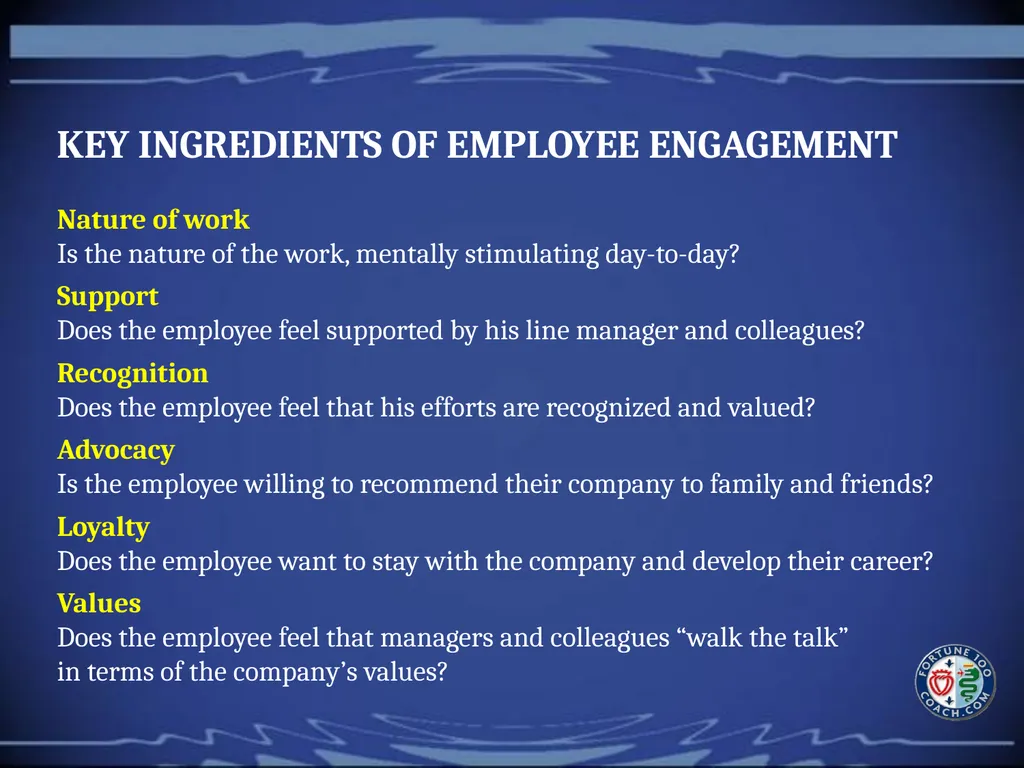
KEY INGREDIENTS OF EMPLOYEE ENGAGEMENT
Nature of work
Is the nature of the work, mentally stimulating day-to-day?
Support
Does the employee feel supported by his line manager and colleagues?
Recognition
Does the employee feel that his efforts are recognized and valued?
Advocacy
Is the employee willing to recommend their company to family and friends?
Loyalty
Does the employee want to stay with the company and develop their career?
Values
Does the employee feel that managers and colleagues “walk the talk”
in terms of the company’s values?<br>
Nature of work
Is the nature of the work, mentally stimulating day-to-day?
Support
Does the employee feel supported by his line manager and colleagues?
Recognition
Does the employee feel that his efforts are recognized and valued?
Advocacy
Is the employee willing to recommend their company to family and friends?
Loyalty
Does the employee want to stay with the company and develop their career?
Values
Does the employee feel that managers and colleagues “walk the talk”
in terms of the company’s values?<br>
54
INITIATIVES<br>
55
INITIATIVES
Some of the initiatives commonly undertaken by HR departments towards
employee engagement are:
On-boarding
Learning and development events<br>
Some of the initiatives commonly undertaken by HR departments towards
employee engagement are:
On-boarding
Learning and development events<br>
56
INITIATIVES
Some of the initiatives commonly undertaken by HR departments towards
employee engagement are:
On-boarding: When an employee joins the organizations/he needs to
be exposed to the organizations policies and culture. There may be some fresh out of campuses that need to know the basics of communication skills and job related skills. During the induction program itself, they can be given an exposure about these aspects, skills sets and the expectations. The on-boarding event experience itself leaves a mark on the minds of the new recruits about the company’s desire to enhance their skills.<br>
Some of the initiatives commonly undertaken by HR departments towards
employee engagement are:
On-boarding: When an employee joins the organizations/he needs to
be exposed to the organizations policies and culture. There may be some fresh out of campuses that need to know the basics of communication skills and job related skills. During the induction program itself, they can be given an exposure about these aspects, skills sets and the expectations. The on-boarding event experience itself leaves a mark on the minds of the new recruits about the company’s desire to enhance their skills.<br>
57
INITIATIVES
Some of the initiatives commonly undertaken by HR departments towards
employee engagement are:
2. Learning and development events: When business practices and processes are changing. In this environment, there is an acute necessity for enhancing the skill levels of employees already discharging various functions.<br>
Some of the initiatives commonly undertaken by HR departments towards
employee engagement are:
2. Learning and development events: When business practices and processes are changing. In this environment, there is an acute necessity for enhancing the skill levels of employees already discharging various functions.<br>
58
ENGAGEMENT LEVELS<br>
59
ENGAGEMENT LEVELS
Organizations that believe in increasing employee engagement levels concentrate on the following levels:
Culture Cooperation Taking responsibility<br>
Organizations that believe in increasing employee engagement levels concentrate on the following levels:
Culture Cooperation Taking responsibility<br>
60
ENGAGEMENT LEVELS
Organizations that believe in increasing employee engagement levels concentrate on the following levels:
Culture: It consists of a foundation of leadership, vision, values, effective communication, a strategic plan and HR policies that are focused on the employee. Commitment - It is the foundation of engagement. Employees with high level of organizational commitment are willing to exert considerable
effort for the organization and make discretionary contributions.<br>
Organizations that believe in increasing employee engagement levels concentrate on the following levels:
Culture: It consists of a foundation of leadership, vision, values, effective communication, a strategic plan and HR policies that are focused on the employee. Commitment - It is the foundation of engagement. Employees with high level of organizational commitment are willing to exert considerable
effort for the organization and make discretionary contributions.<br>
61
ENGAGEMENT LEVELS
Organizations that believe in increasing employee engagement levels concentrate on the following levels:
Cooperation: It encompasses positive relationship among employees within a group. It is the inherent willingness of individuals working in a team to pull in the same direction and achieve organizational goals.<br>
Organizations that believe in increasing employee engagement levels concentrate on the following levels:
Cooperation: It encompasses positive relationship among employees within a group. It is the inherent willingness of individuals working in a team to pull in the same direction and achieve organizational goals.<br>
62
ENGAGEMENT LEVELS
Organizations that believe in increasing employee engagement levels concentrate on the following levels:
Taking responsibility: Taking initiative and responsibility to become a part of the solutions is an important ingredient of engagement. For an employee to display loyalty towards his organization, the first thing he needs to do is to take responsibility. “Taking responsibility” refer to feeling empowered. Employees who feel empowered have a sense of belonging and excitement about their jobs, they feel engaged at an emotional level and are willing to give their best all the time.<br>
Organizations that believe in increasing employee engagement levels concentrate on the following levels:
Taking responsibility: Taking initiative and responsibility to become a part of the solutions is an important ingredient of engagement. For an employee to display loyalty towards his organization, the first thing he needs to do is to take responsibility. “Taking responsibility” refer to feeling empowered. Employees who feel empowered have a sense of belonging and excitement about their jobs, they feel engaged at an emotional level and are willing to give their best all the time.<br>
63
ADVANTAGES OF ENGAGED EMPLOYEES<br>
64
ADVANTAGES OF ENGAGED EMPLOYEES
They will perform better and are more motivated
There is a significant link between employee engagement and profitability
Engaged employees will stay with the company, be an advocate of the company and its products and services, and contribute to bottom line business success.
Creates a sense of loyalty in a competitive environment.
Provides a high energy working environment.
Engaged employees serve as a brand ambassador of the organization.<br>
They will perform better and are more motivated
There is a significant link between employee engagement and profitability
Engaged employees will stay with the company, be an advocate of the company and its products and services, and contribute to bottom line business success.
Creates a sense of loyalty in a competitive environment.
Provides a high energy working environment.
Engaged employees serve as a brand ambassador of the organization.<br>
65
67 Architecture & Design Firm
Recovery from near Bankruptcy during Financial Crisis
Top Five Global Food Company
Revenue increase of nearly 40percent up from market share losses in prior five years
Top Five Global Food Company
Recovery from impact of Financial Crisis in only eight months
Business Process Outsourcing Site
Increased sales by over 50% in seven weeks saving 800 jobs Success Stories<br>
Recovery from near Bankruptcy during Financial Crisis
Top Five Global Food Company
Revenue increase of nearly 40percent up from market share losses in prior five years
Top Five Global Food Company
Recovery from impact of Financial Crisis in only eight months
Business Process Outsourcing Site
Increased sales by over 50% in seven weeks saving 800 jobs Success Stories<br>
66
Internationally convenient numbers: F1C International Philippines
Makati City 1208
Tel. Nos. +63-2-478-3844
Fax No. +63-2-895-4601
SMS/Mobile: +63 917-930-0062
Email: info@fortune100coach.com F1C International Access Numbers/Emails
United States:
+1-310-933-5845
Email: f1c.us@fortune100coach.com
Bangkok - Thailand:
+66-8-1753-3921
Email: f1c.th@fortune100coach.com Websites:
www.fortune100coach.com
www.f1c-international.com<br>
Makati City 1208
Tel. Nos. +63-2-478-3844
Fax No. +63-2-895-4601
SMS/Mobile: +63 917-930-0062
Email: info@fortune100coach.com F1C International Access Numbers/Emails
United States:
+1-310-933-5845
Email: f1c.us@fortune100coach.com
Bangkok - Thailand:
+66-8-1753-3921
Email: f1c.th@fortune100coach.com Websites:
www.fortune100coach.com
www.f1c-international.com<br>