Urinary system The urinary system comprise paired kidneys that form the urine from the blood , ureters that convey the urine from the kidneys , the bladder where urine is stored until it can be discharged and the urethra through which it
"Urinary system The urinary system comprise paired" is the property of its rightful owner. Permission is granted to
download and print the materials on this website for personal, non-commercial use only, and to display it
on your personal computer provided you do not modify the materials and that you retain all copyright
notices contained in the materials. By downloading content from our website, you accept the terms of this
agreement.
Presentation Transcript
01
Urinary system The urinary system comprise paired kidneys that form the urine from the blood , ureters that convey the urine from the kidneys , the bladder where urine is stored until it can be discharged and the urethra through which it finally the urine passes to the exterior . In male , urethra conveys the reproductive products .<br>
02
Kidneys Function of the kidneys
Filtration of urine
Production and release of two hormones , renin which play a vital role in the regulation of systematic blood pressure and erythropoietin which enter in blood cells production .<br>
03
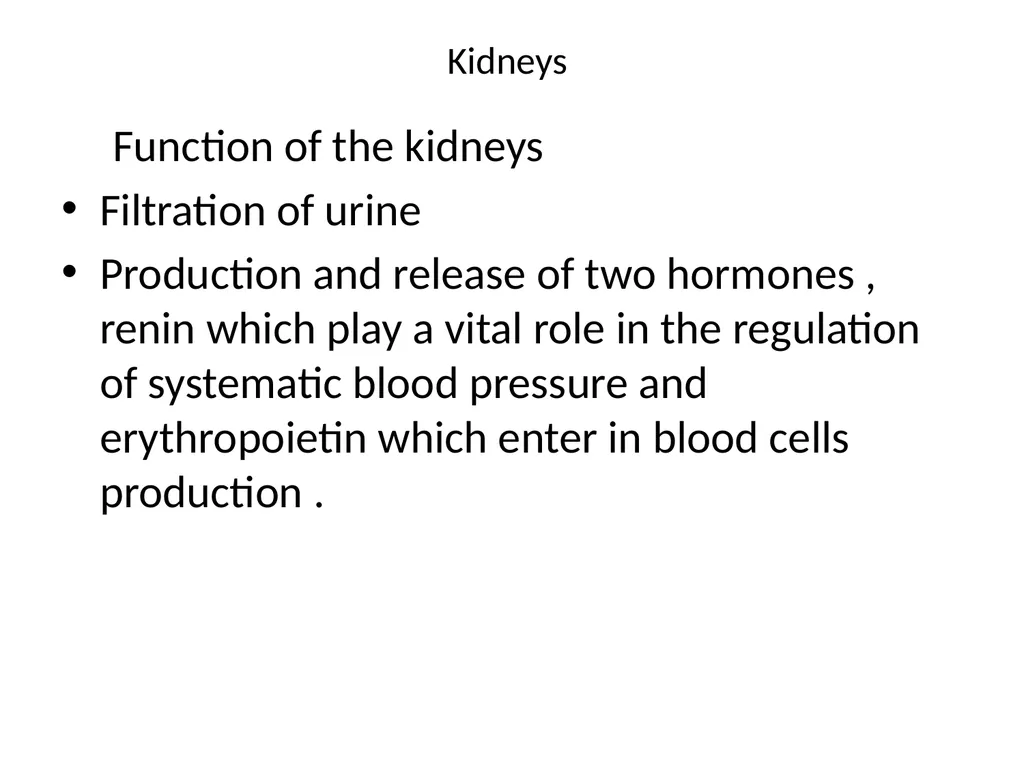
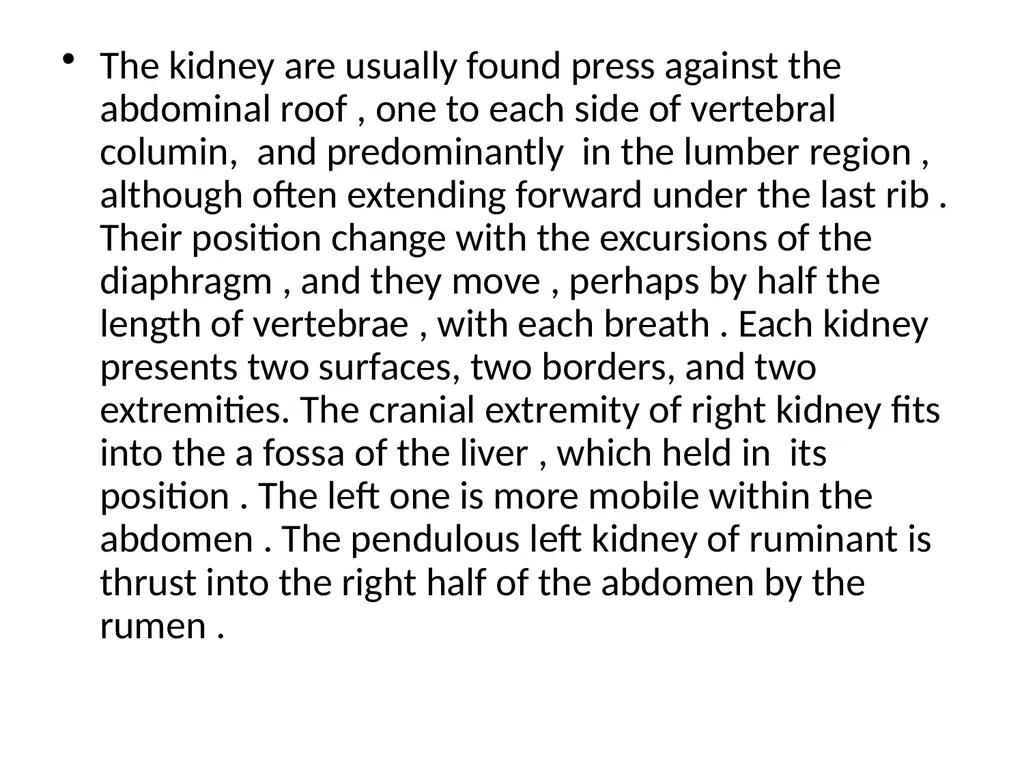
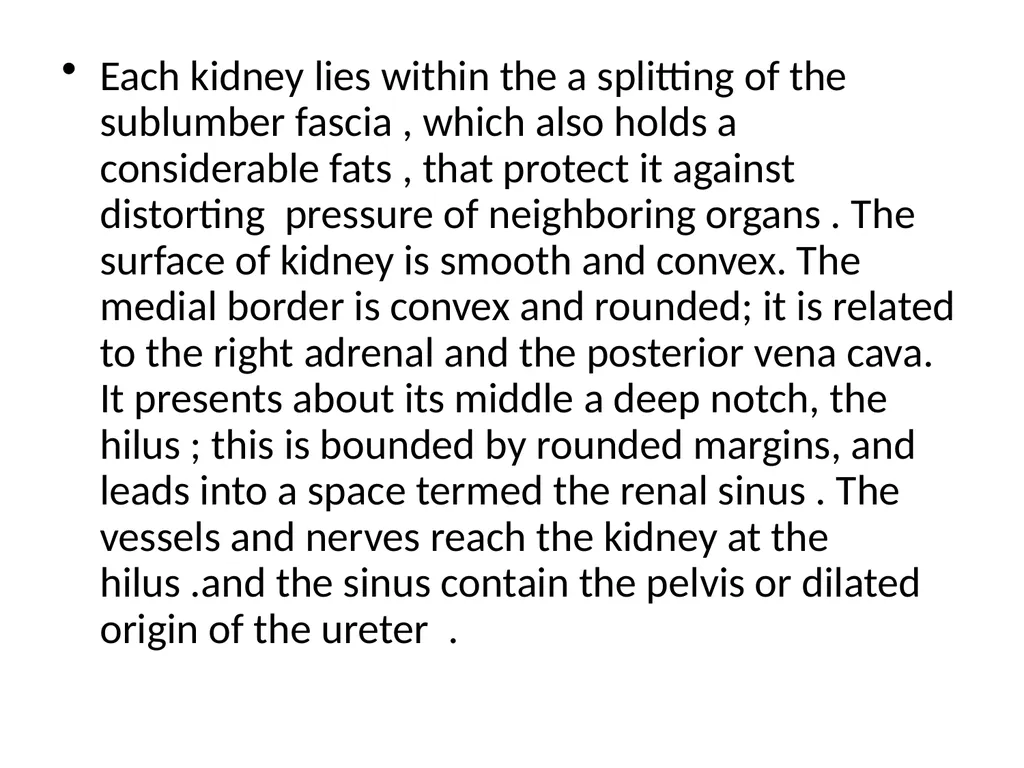
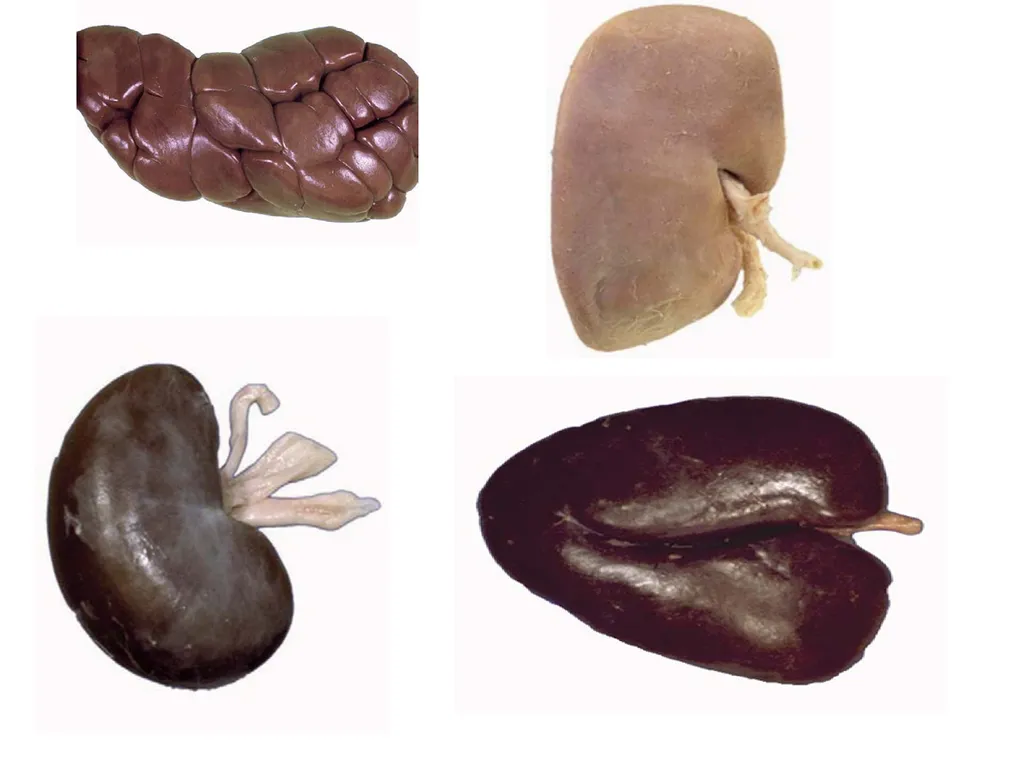
The kidneys are firm reddish – brown glands whose appearance varies among mammals . The most familiar shape is bean – shaped that common on dog , cat and small ruminants . The kidneys of pig are much flattened version , where those of the horse are heart shaped in right kidney while the left kidney is bean shaped .In contrast the bovine kidney are lobulated .<br>
04
The kidney are usually found press against the abdominal roof , one to each side of vertebral columin, and predominantly in the lumber region , although often extending forward under the last rib . Their position change with the excursions of the diaphragm , and they move , perhaps by half the length of vertebrae , with each breath . Each kidney presents two surfaces, two borders, and two extremities. The cranial extremity of right kidney fits into the a fossa of the liver , which held in its position . The left one is more mobile within the abdomen . The pendulous left kidney of ruminant is thrust into the right half of the abdomen by the rumen .<br>
05
Each kidney lies within the a splitting of the sublumber fascia , which also holds a considerable fats , that protect it against distorting pressure of neighboring organs . The surface of kidney is smooth and convex. The medial border is convex and rounded; it is related to the right adrenal and the posterior vena cava. It presents about its middle a deep notch, the hilus ; this is bounded by rounded margins, and leads into a space termed the renal sinus . The vessels and nerves reach the kidney at the hilus .and the sinus contain the pelvis or dilated origin of the ureter .<br>
06
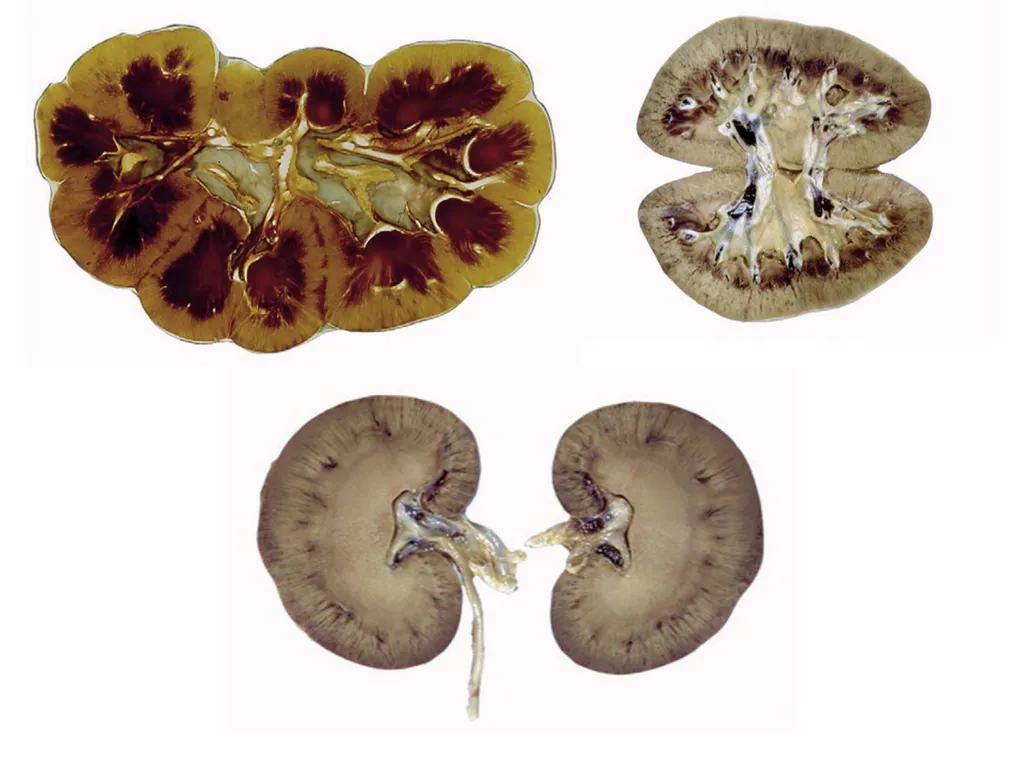
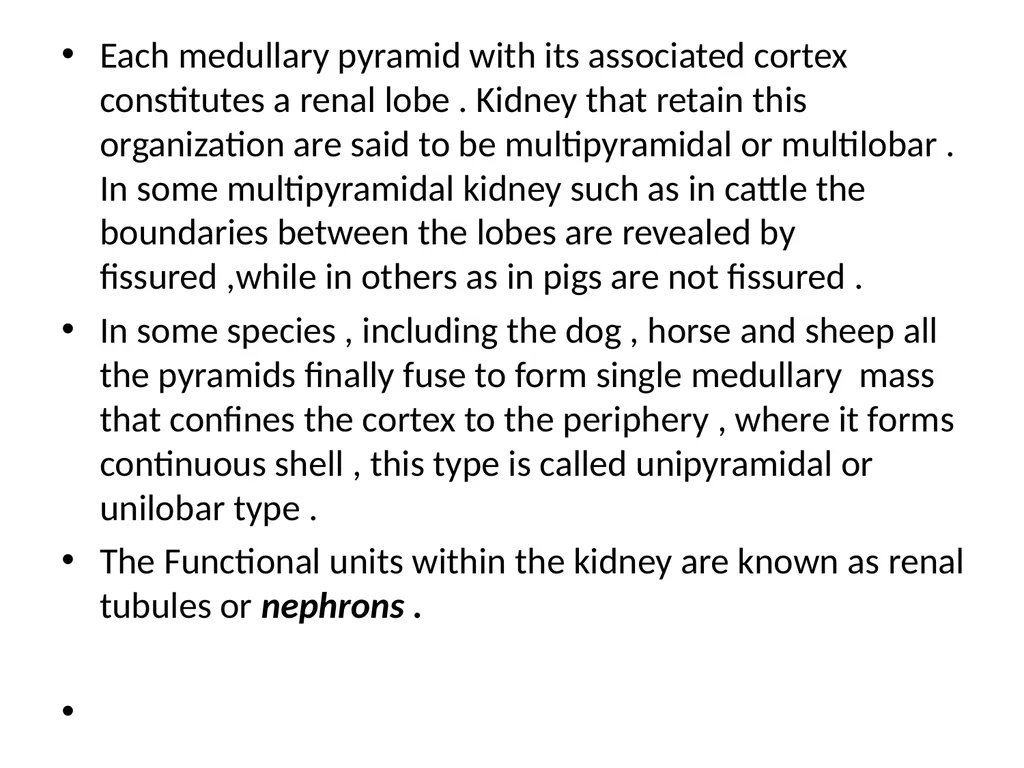
Structures The surface of the kidney is covered by a thin but strong fibrous , which is in general easily stripped off the healthy kidney. It is continued along the hilus and lines the renal sinus. Two distinct regions can be identified on the cut surface of a bisected kidney: a pale outer region, the cortex, and a darker inner region, the medulla . The medulla is divided into striated conical masses, the renal pyramids. The base of each pyramid is positioned at the corticomedullary boundary, and the apex extends toward the renal pelvis to form a papilla , that fit on a cup like expansion (calyx)of the renal pelvis .<br>
07
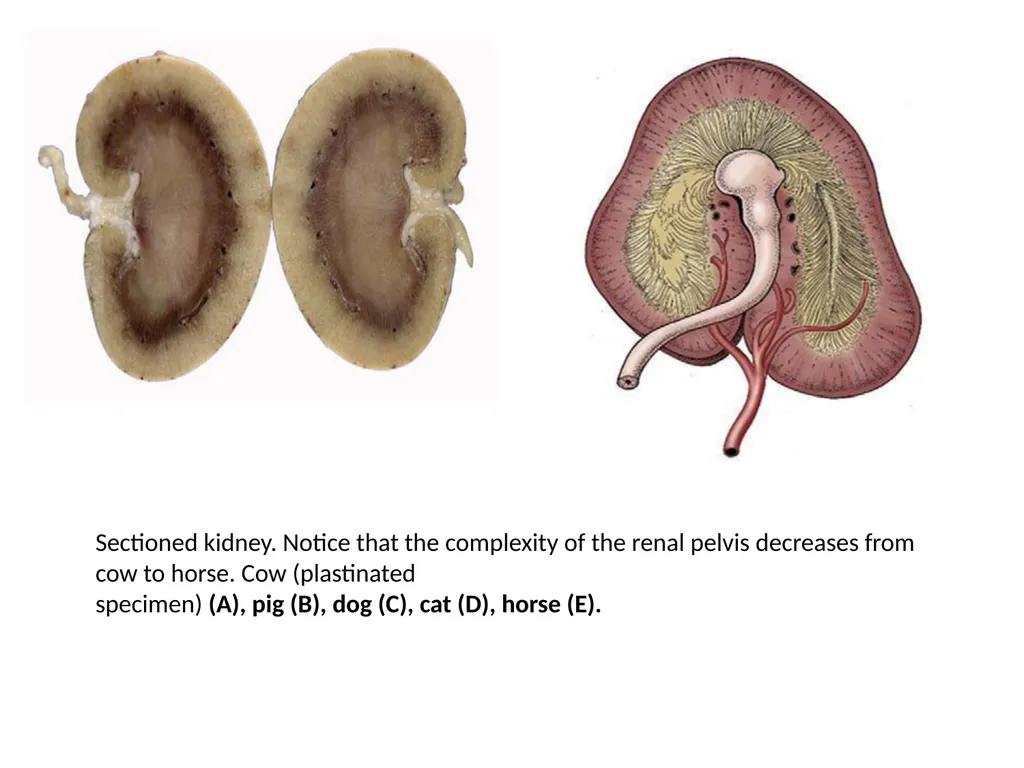
Sectioned kidney. Notice that the complexity of the renal pelvis decreases from cow to horse. Cow (plastinated
specimen) (A), pig (B), dog (C), cat (D), horse (E).<br>
08
Each medullary pyramid with its associated cortex constitutes a renal lobe . Kidney that retain this organization are said to be multipyramidal or multilobar . In some multipyramidal kidney such as in cattle the boundaries between the lobes are revealed by fissured ,while in others as in pigs are not fissured .
In some species , including the dog , horse and sheep all the pyramids finally fuse to form single medullary mass that confines the cortex to the periphery , where it forms continuous shell , this type is called unipyramidal or unilobar type .
The Functional units within the kidney are known as renal tubules or nephrons .<br>