
US-EU relations a delicate rebalancing act Liesbet
TD
Published · 33 slides · 0 views

1 / 1



Description
US-EU relations a delicate rebalancing act Liesbet Hooghe Kenan Professor in Political Science University of North Carolina MARSHALL PLAN (1948-1952) Trade a transatlantic single market? imagined and real obstacles Security Bush legacy soft
Related Topics
Share
Embed code
Download this presentation From Below
"US-EU relations a delicate rebalancing act Liesbet" is the property of its rightful owner. Permission is granted to download and print the materials on this website for personal, non-commercial use only, and to display it on your personal computer provided you do not modify the materials and that you retain all copyright notices contained in the materials. By downloading content from our website, you accept the terms of this agreement.
Presentation Transcript
01
US-EU relations
a delicate rebalancing act Liesbet Hooghe
Kenan Professor in Political Science
University of North Carolina<br>
Kenan Professor in Political Science
University of North Carolina<br>
02
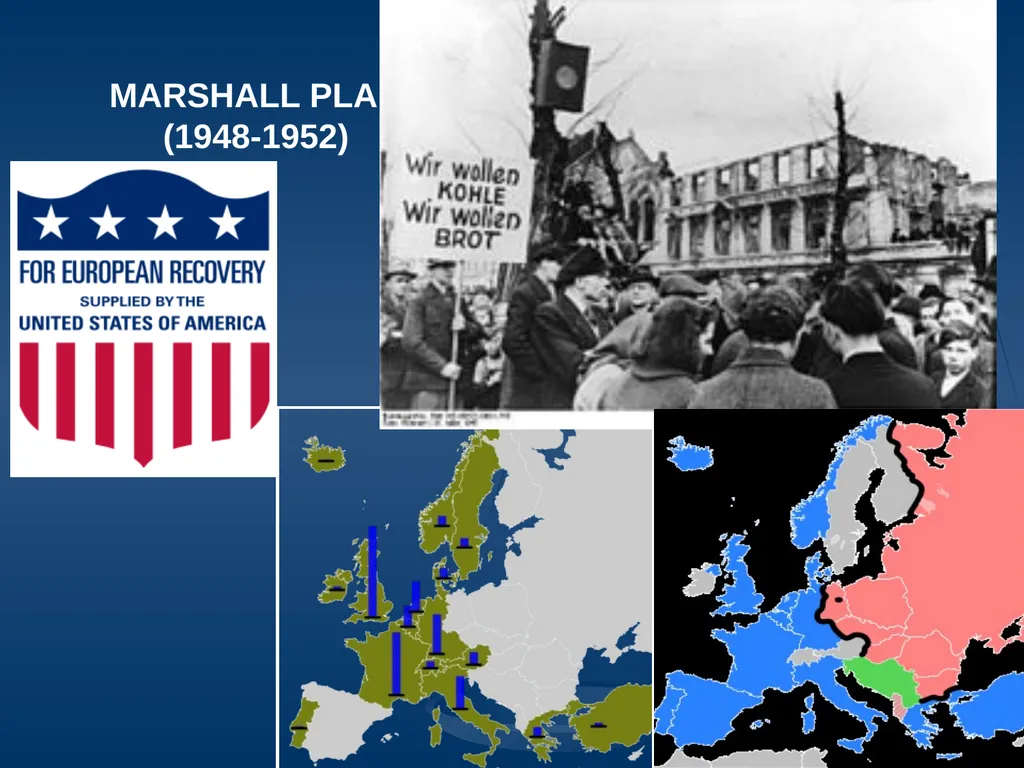
MARSHALL PLAN (1948-1952)<br>
03
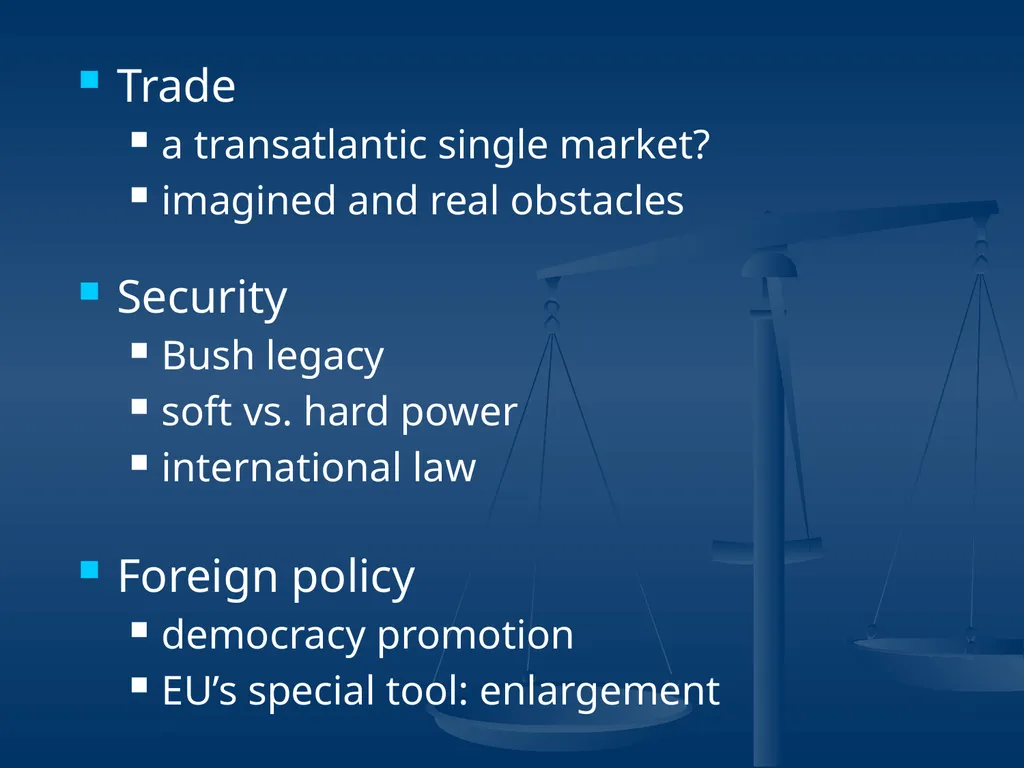
Trade
a transatlantic single market?
imagined and real obstacles
Security
Bush legacy
soft vs. hard power
international law
Foreign policy
democracy promotion
EU’s special tool: enlargement<br>
a transatlantic single market?
imagined and real obstacles
Security
Bush legacy
soft vs. hard power
international law
Foreign policy
democracy promotion
EU’s special tool: enlargement<br>
04
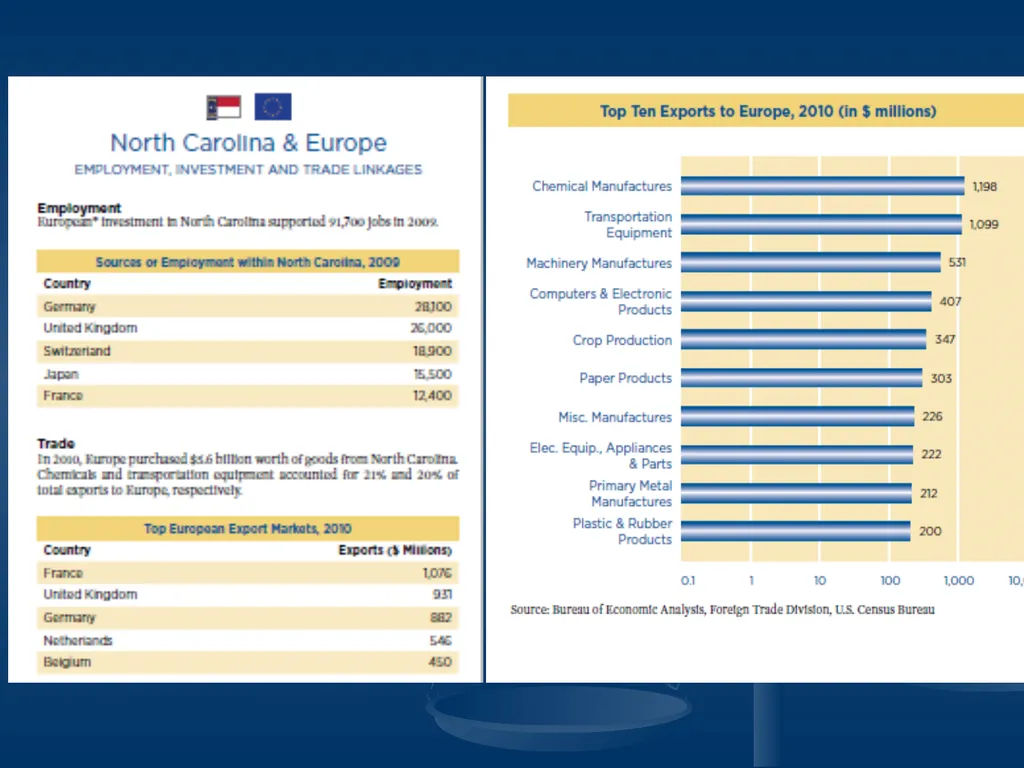
Trade<br>
05
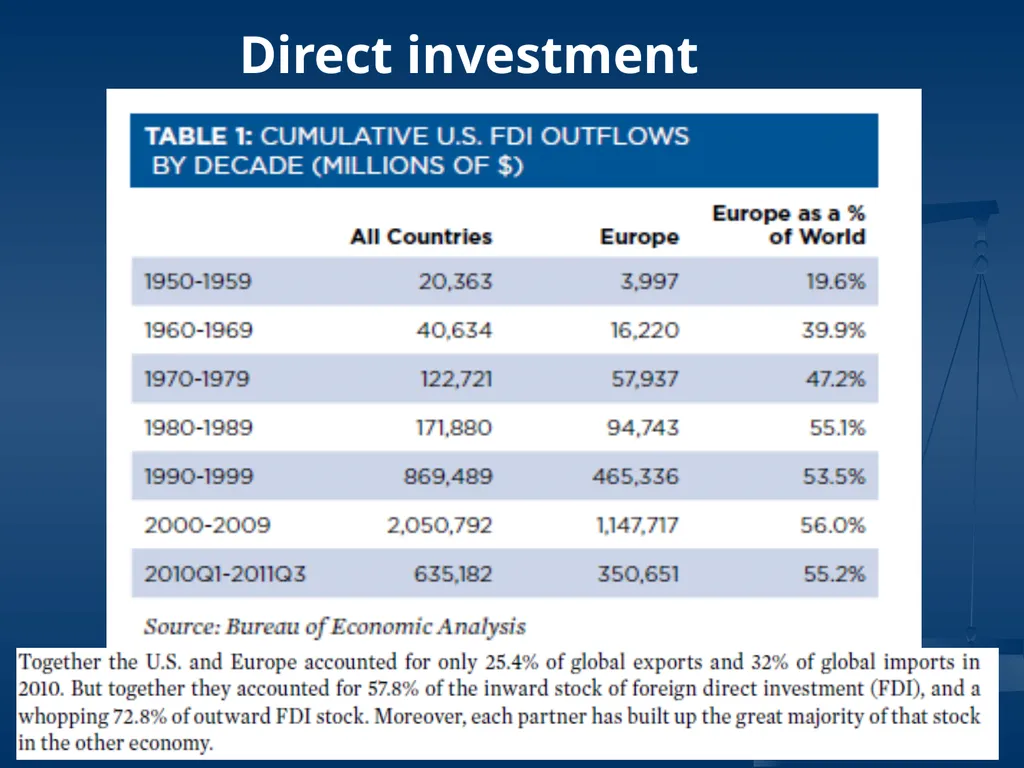
Direct investment<br>
06
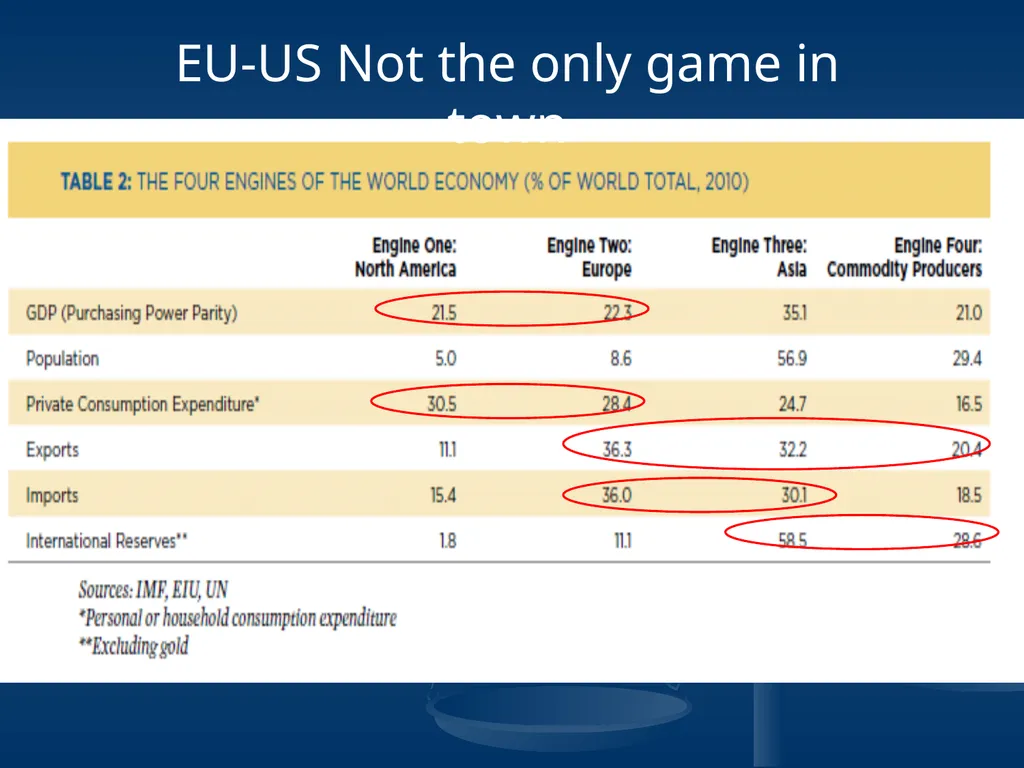
EU-US Not the only game in town<br>
07
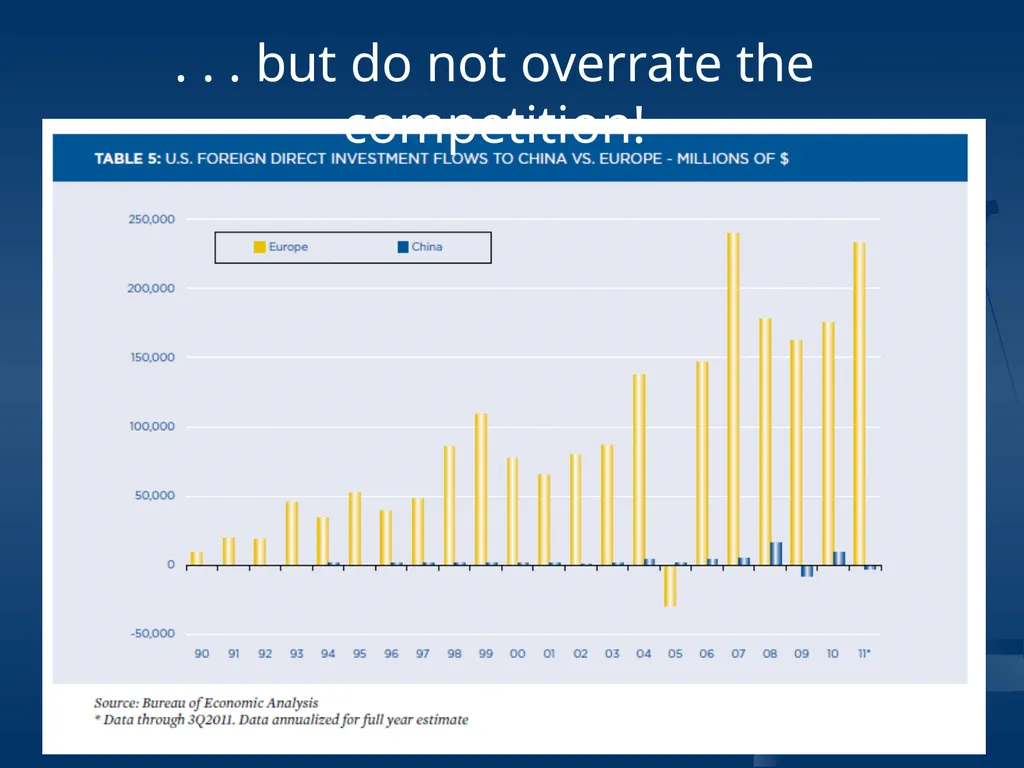
. . . but do not overrate the competition!<br>
08
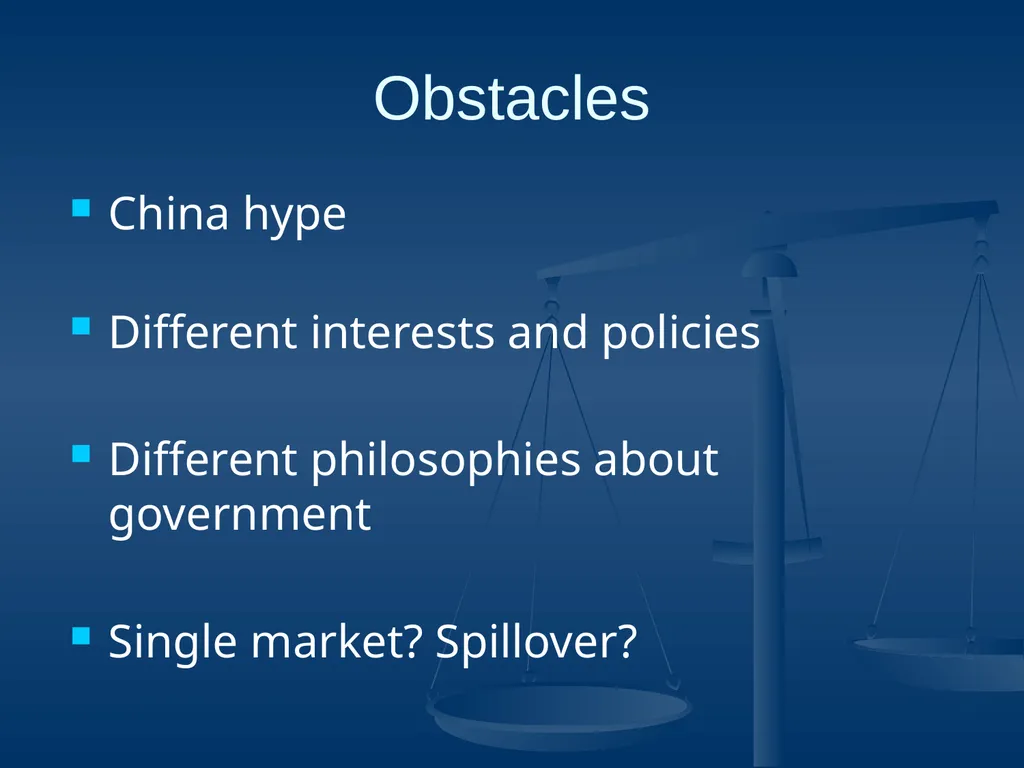
Obstacles China hype
Different interests and policies
Different philosophies about government
Single market? Spillover?<br>
Different interests and policies
Different philosophies about government
Single market? Spillover?<br>
09
Security<br>
10
The Twin Towers
Shared grief
Common resolve NATO invokes Article V The Parties agree that an armed attack against one or more of them in Europe or North America shall be considered an attack against them all and consequently they agree that, if such an armed attack occurs, each of them, in exercise of the right of individual or collective self-defence recognised by Article 51 of the Charter of the United Nations, will assist the Party or Parties so attacked by taking forthwith, individually and in concert with the other Parties, such action as it deems necessary, including the use of armed force, to restore and maintain the security of the North Atlantic area.<br>
11
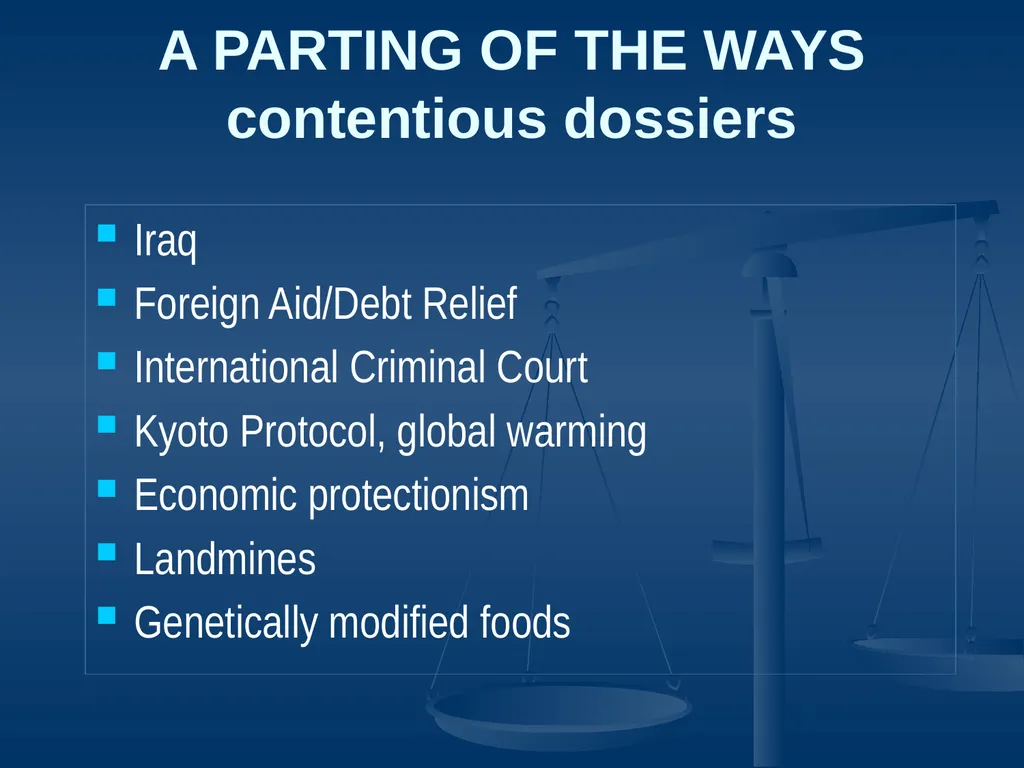
A PARTING OF THE WAYS
contentious dossiers Iraq
Foreign Aid/Debt Relief
International Criminal Court
Kyoto Protocol, global warming
Economic protectionism
Landmines
Genetically modified foods<br>
Foreign Aid/Debt Relief
International Criminal Court
Kyoto Protocol, global warming
Economic protectionism
Landmines
Genetically modified foods<br>
12
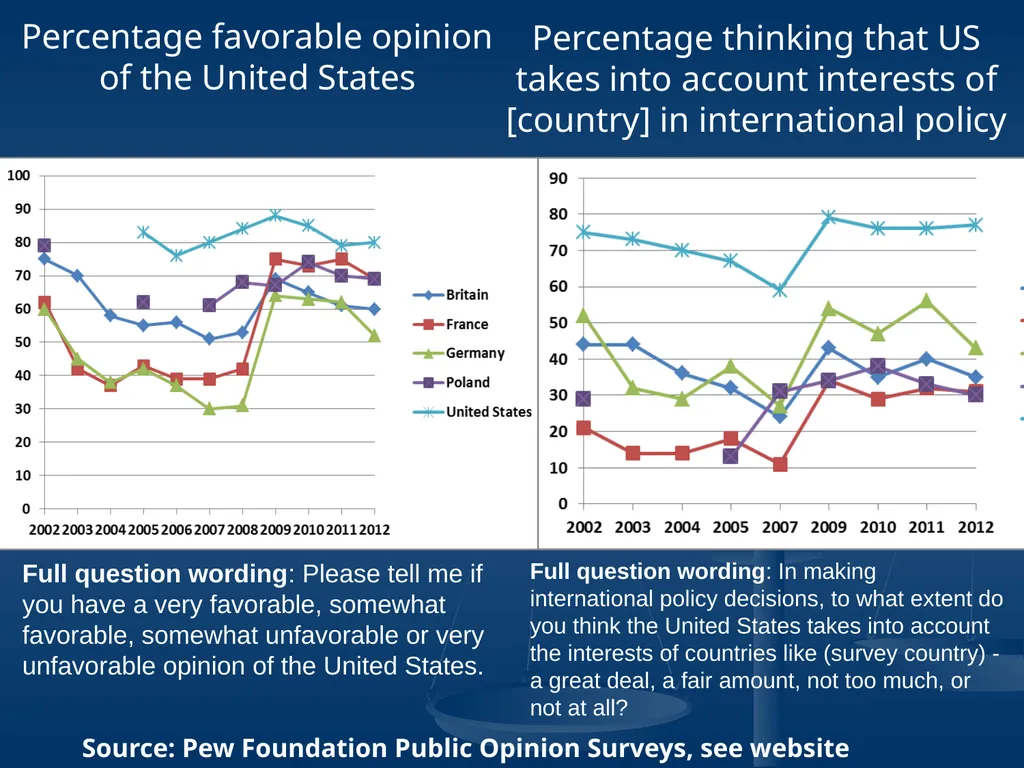
Full question wording: Please tell me if you have a very favorable, somewhat favorable, somewhat unfavorable or very unfavorable opinion of the United States. Percentage favorable opinion
of the United States Source: Pew Foundation Public Opinion Surveys, see website Full question wording: In making international policy decisions, to what extent do you think the United States takes into account the interests of countries like (survey country) - a great deal, a fair amount, not too much, or not at all? Percentage thinking that US takes into account interests of [country] in international policy<br>
13
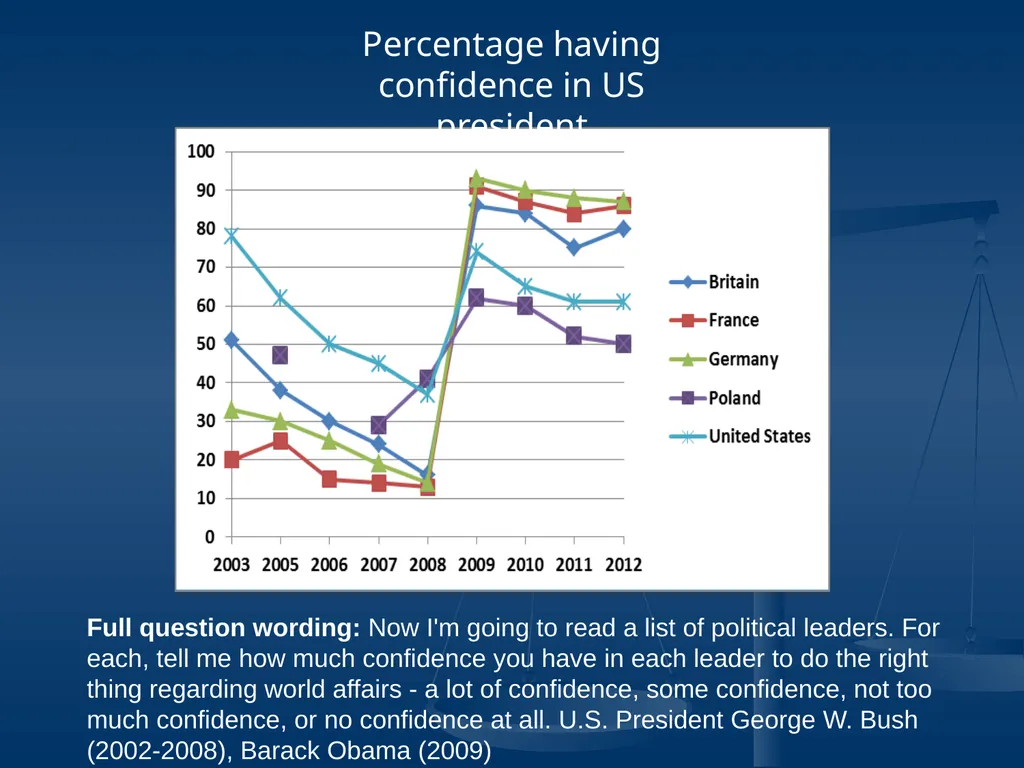
Full question wording: Now I'm going to read a list of political leaders. For each, tell me how much confidence you have in each leader to do the right thing regarding world affairs - a lot of confidence, some confidence, not too much confidence, or no confidence at all. U.S. President George W. Bush (2002-2008), Barack Obama (2009) Percentage having confidence in US president<br>
14
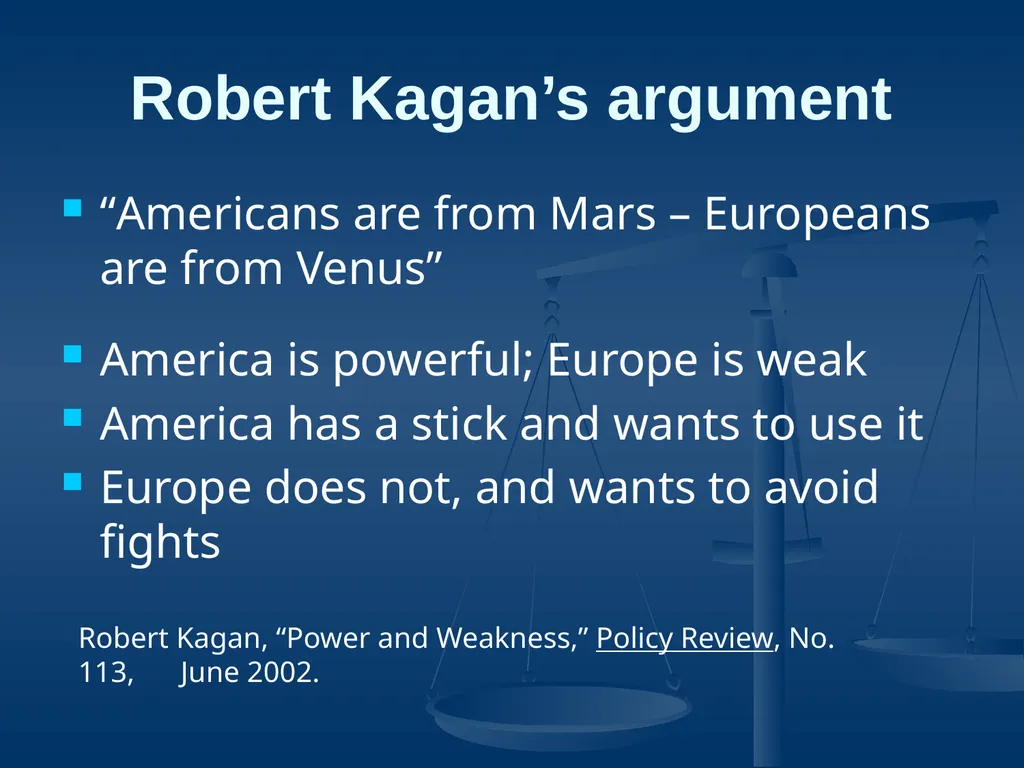
Robert Kagan’s argument “Americans are from Mars – Europeans are from Venus”
America is powerful; Europe is weak
America has a stick and wants to use it
Europe does not, and wants to avoid fights Robert Kagan, “Power and Weakness,” Policy Review, No. 113, June 2002.<br>
America is powerful; Europe is weak
America has a stick and wants to use it
Europe does not, and wants to avoid fights Robert Kagan, “Power and Weakness,” Policy Review, No. 113, June 2002.<br>
15
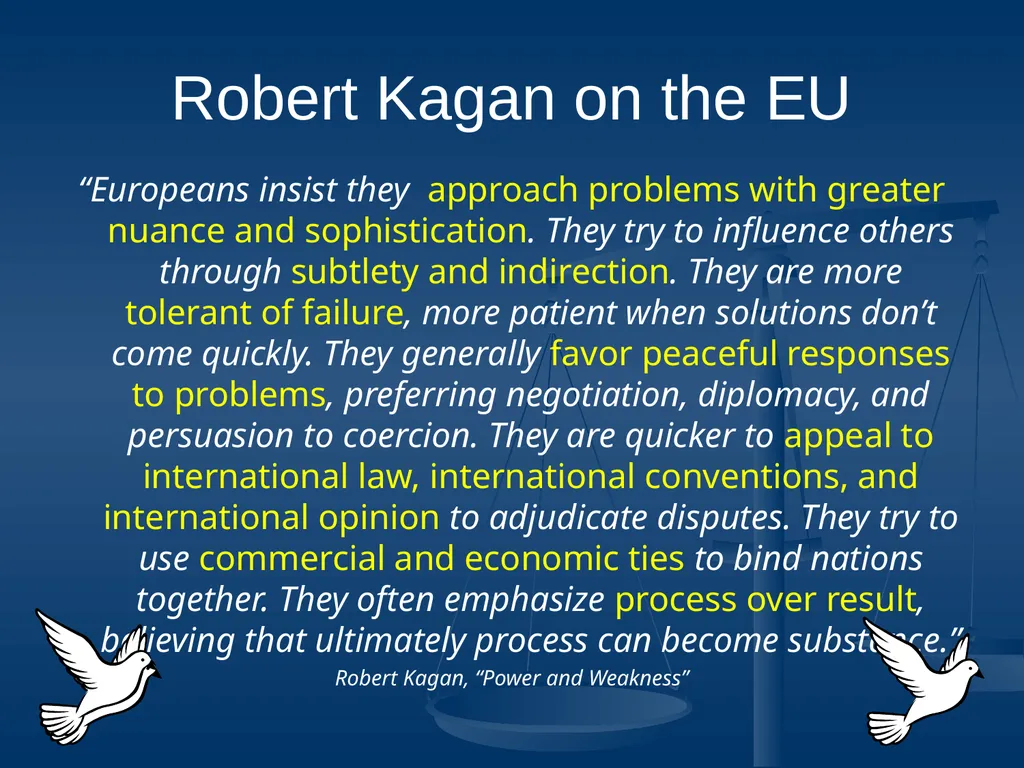
Robert Kagan on the EU “Europeans insist they approach problems with greater nuance and sophistication. They try to influence others through subtlety and indirection. They are more tolerant of failure, more patient when solutions don’t come quickly. They generally favor peaceful responses to problems, preferring negotiation, diplomacy, and persuasion to coercion. They are quicker to appeal to international law, international conventions, and international opinion to adjudicate disputes. They try to use commercial and economic ties to bind nations together. They often emphasize process over result, believing that ultimately process can become substance.”
Robert Kagan, “Power and Weakness”<br>
Robert Kagan, “Power and Weakness”<br>
16
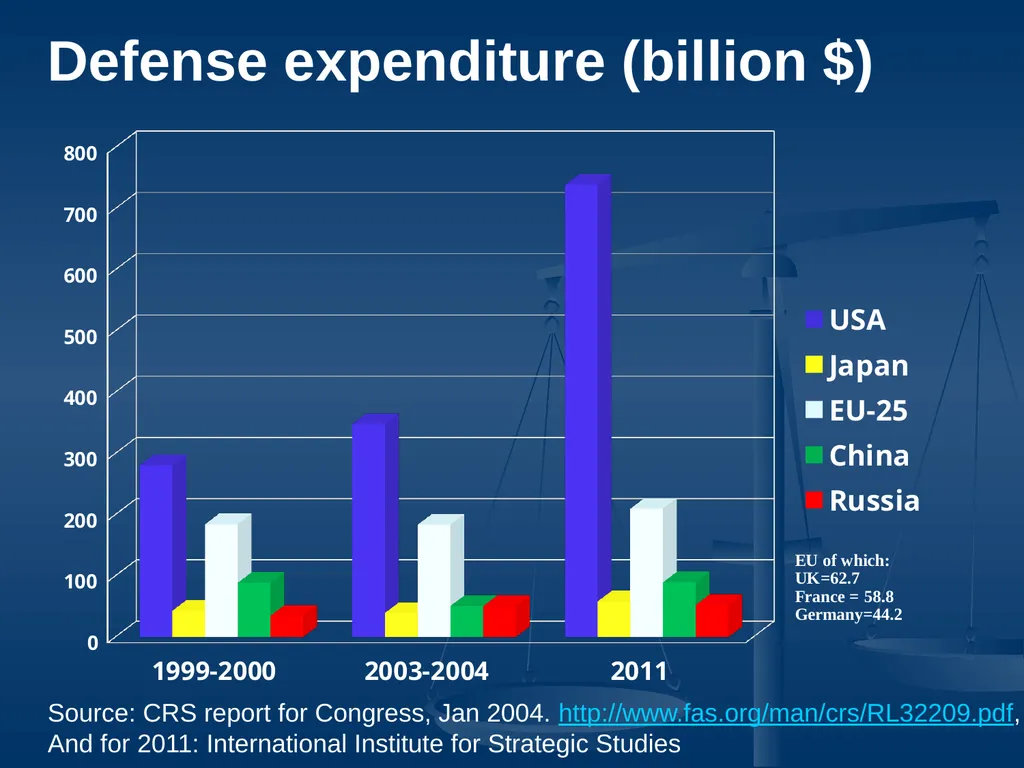
Defense expenditure (billion $) Source: CRS report for Congress, Jan 2004. http://www.fas.org/man/crs/RL32209.pdf,
And for 2011: International Institute for Strategic Studies<br>
And for 2011: International Institute for Strategic Studies<br>
17
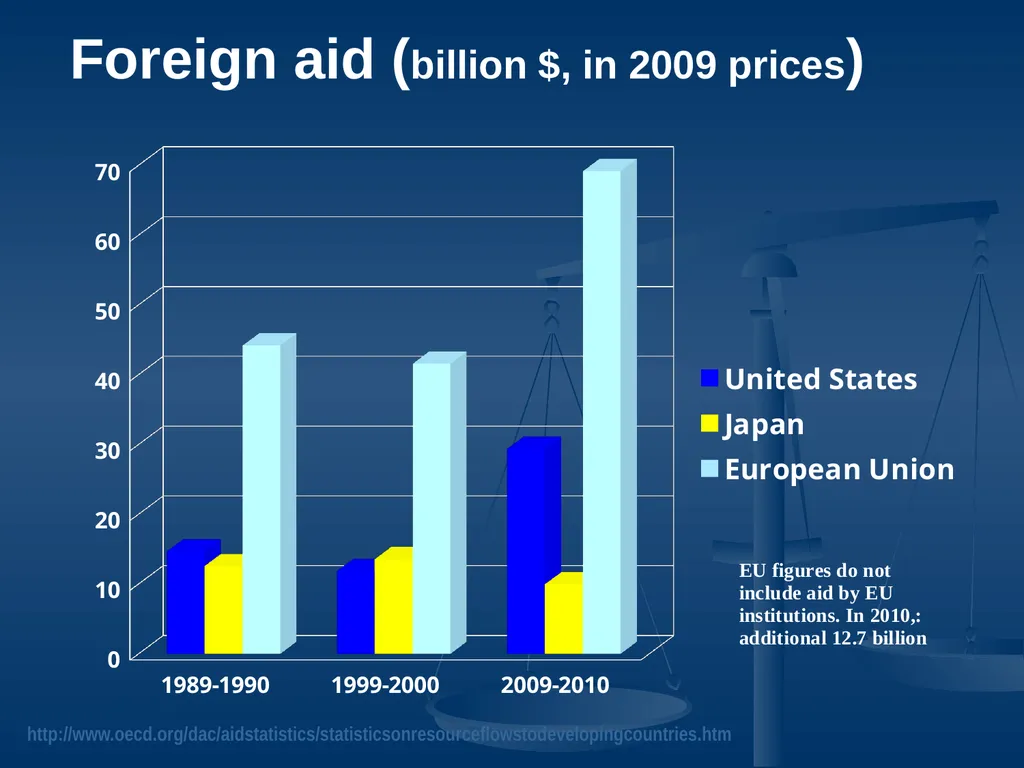
http://www.oecd.org/dac/aidstatistics/statisticsonresourceflowstodevelopingcountries.htm Foreign aid (billion $, in 2009 prices)<br>
18
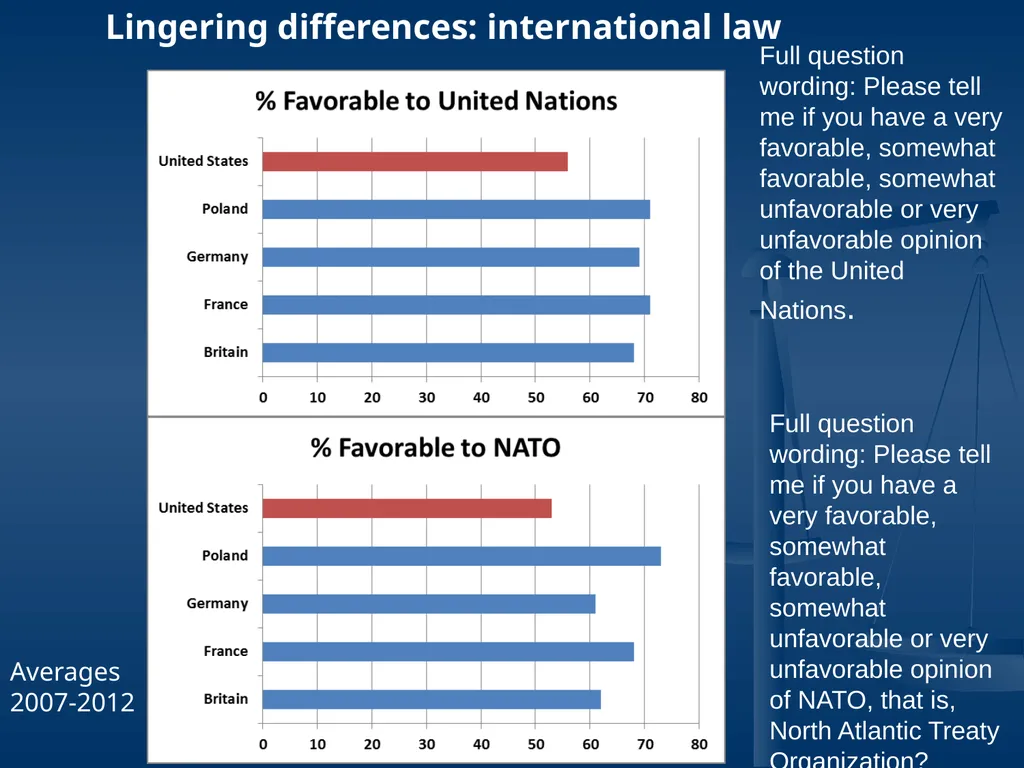
Averages 2007-2012 Full question wording: Please tell me if you have a very favorable, somewhat favorable, somewhat unfavorable or very unfavorable opinion of the United Nations. Full question wording: Please tell me if you have a very favorable, somewhat favorable, somewhat unfavorable or very unfavorable opinion of NATO, that is, North Atlantic Treaty Organization? Lingering differences: international law<br>
19
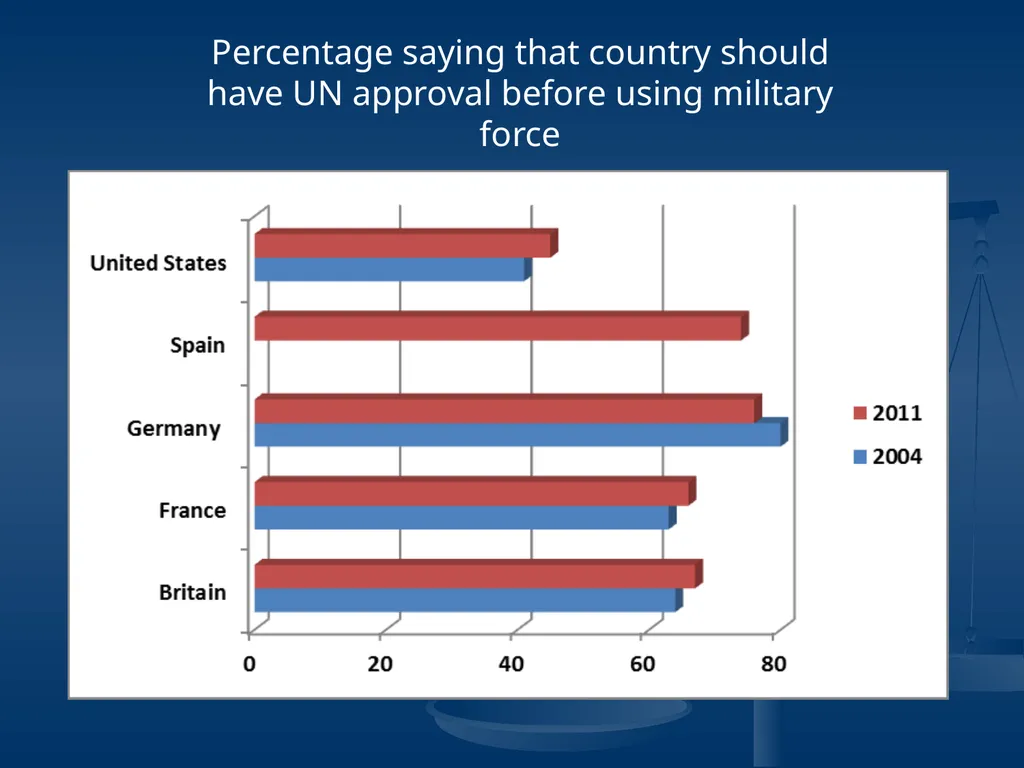
Percentage saying that country should have UN approval before using military force<br>
20
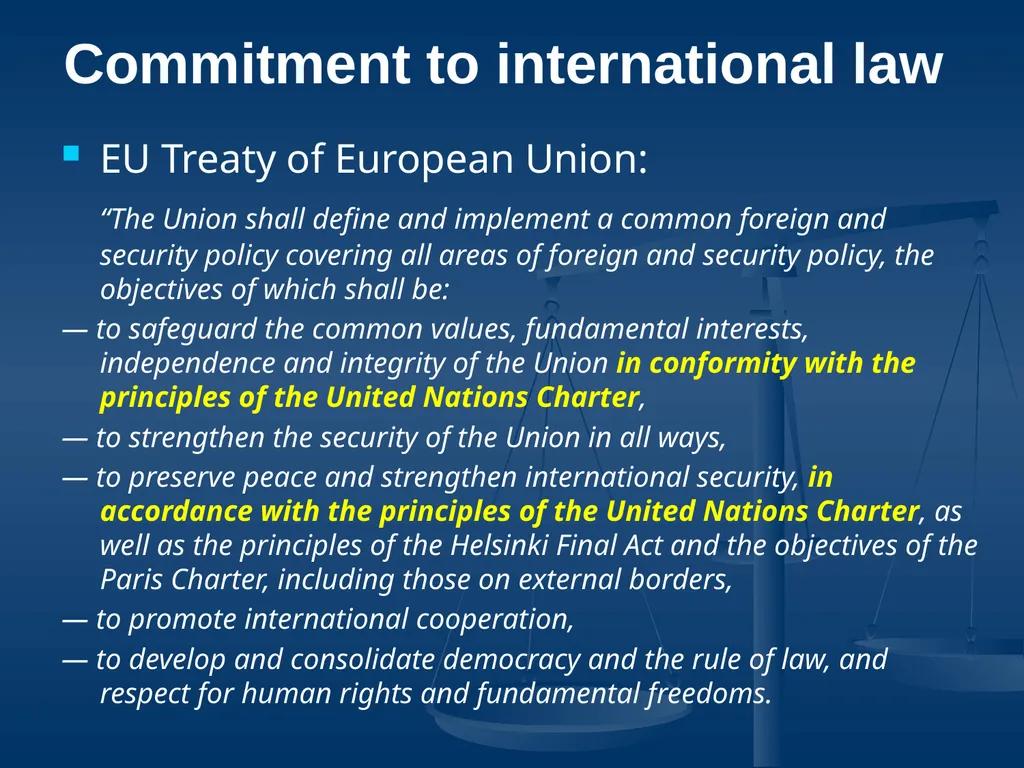
Commitment to international law EU Treaty of European Union:
“The Union shall define and implement a common foreign and security policy covering all areas of foreign and security policy, the objectives of which shall be:
— to safeguard the common values, fundamental interests, independence and integrity of the Union in conformity with the principles of the United Nations Charter,
— to strengthen the security of the Union in all ways,
— to preserve peace and strengthen international security, in accordance with the principles of the United Nations Charter, as well as the principles of the Helsinki Final Act and the objectives of the Paris Charter, including those on external borders,
— to promote international cooperation,
— to develop and consolidate democracy and the rule of law, and respect for human rights and fundamental freedoms.<br>
“The Union shall define and implement a common foreign and security policy covering all areas of foreign and security policy, the objectives of which shall be:
— to safeguard the common values, fundamental interests, independence and integrity of the Union in conformity with the principles of the United Nations Charter,
— to strengthen the security of the Union in all ways,
— to preserve peace and strengthen international security, in accordance with the principles of the United Nations Charter, as well as the principles of the Helsinki Final Act and the objectives of the Paris Charter, including those on external borders,
— to promote international cooperation,
— to develop and consolidate democracy and the rule of law, and respect for human rights and fundamental freedoms.<br>
21
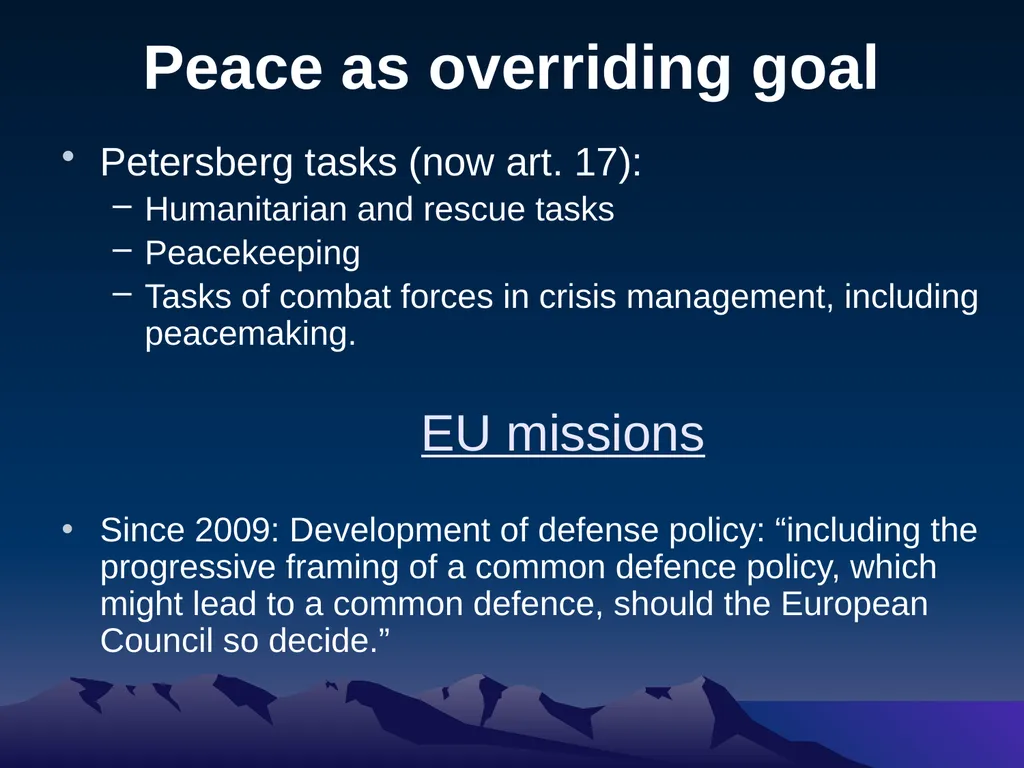
Peace as overriding goal Petersberg tasks (now art. 17):
Humanitarian and rescue tasks
Peacekeeping
Tasks of combat forces in crisis management, including peacemaking.
EU missions
Since 2009: Development of defense policy: “including the progressive framing of a common defence policy, which might lead to a common defence, should the European Council so decide.”<br>
Humanitarian and rescue tasks
Peacekeeping
Tasks of combat forces in crisis management, including peacemaking.
EU missions
Since 2009: Development of defense policy: “including the progressive framing of a common defence policy, which might lead to a common defence, should the European Council so decide.”<br>
22
Foreign policy<br>
23
Europe and the United States Liberal democracy
Liberal:
rule of law (i.e. impartiality before law, anti-corruption); freedom of expression; freedom of association, human rights
Democracy:
competitive elections<br>
Liberal:
rule of law (i.e. impartiality before law, anti-corruption); freedom of expression; freedom of association, human rights
Democracy:
competitive elections<br>
24
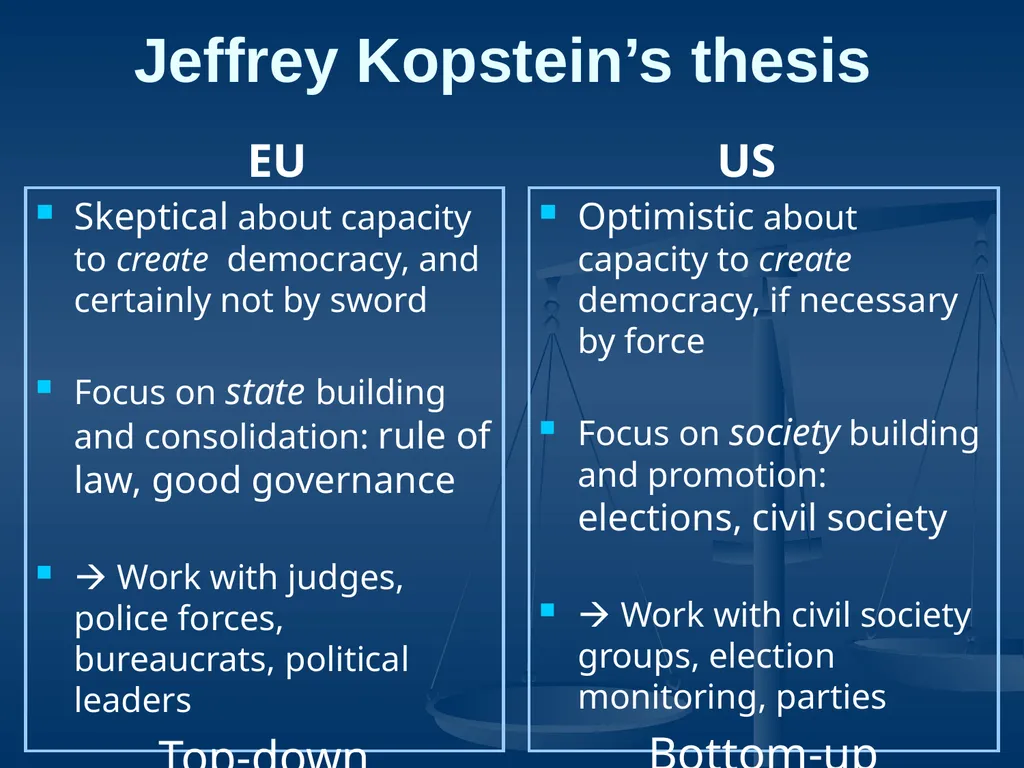
Jeffrey Kopstein’s thesis EU Skeptical about capacity to create democracy, and certainly not by sword
Focus on state building and consolidation: rule of law, good governance
Work with judges, police forces, bureaucrats, political leaders
Top-down US Optimistic about capacity to create democracy, if necessary by force
Focus on society building and promotion: elections, civil society
Work with civil society groups, election monitoring, parties
Bottom-up<br>
Focus on state building and consolidation: rule of law, good governance
Work with judges, police forces, bureaucrats, political leaders
Top-down US Optimistic about capacity to create democracy, if necessary by force
Focus on society building and promotion: elections, civil society
Work with civil society groups, election monitoring, parties
Bottom-up<br>
25
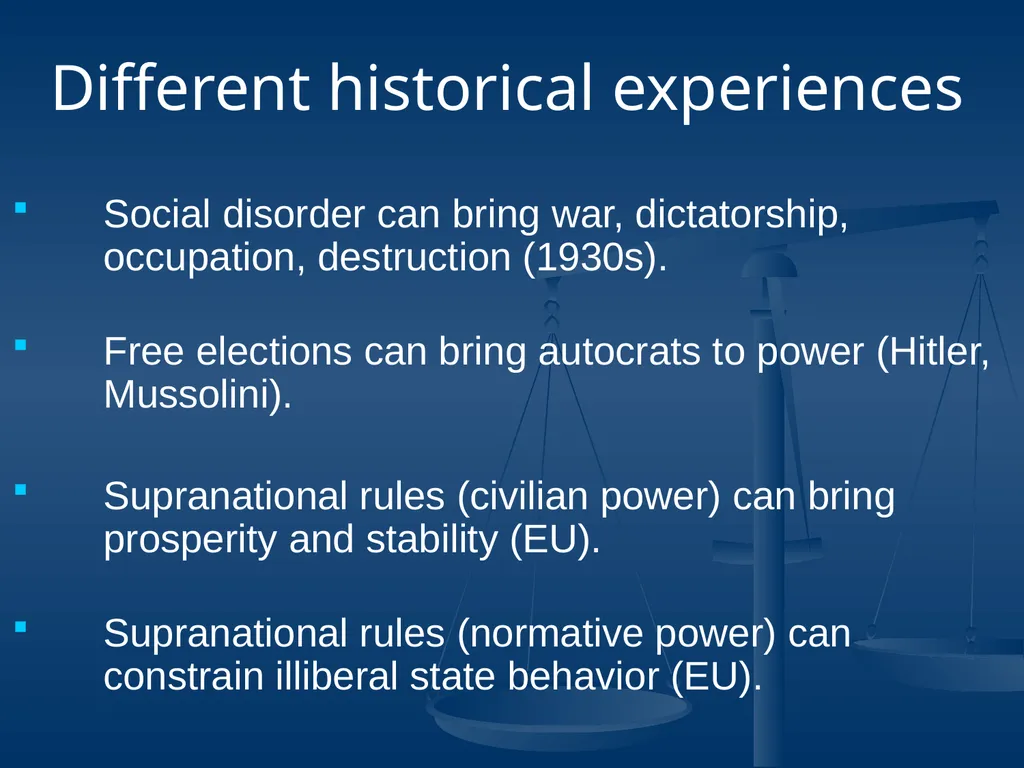
Different historical experiences
Social disorder can bring war, dictatorship, occupation, destruction (1930s).
Free elections can bring autocrats to power (Hitler, Mussolini).
Supranational rules (civilian power) can bring prosperity and stability (EU).
Supranational rules (normative power) can constrain illiberal state behavior (EU).<br>
Social disorder can bring war, dictatorship, occupation, destruction (1930s).
Free elections can bring autocrats to power (Hitler, Mussolini).
Supranational rules (civilian power) can bring prosperity and stability (EU).
Supranational rules (normative power) can constrain illiberal state behavior (EU).<br>
26
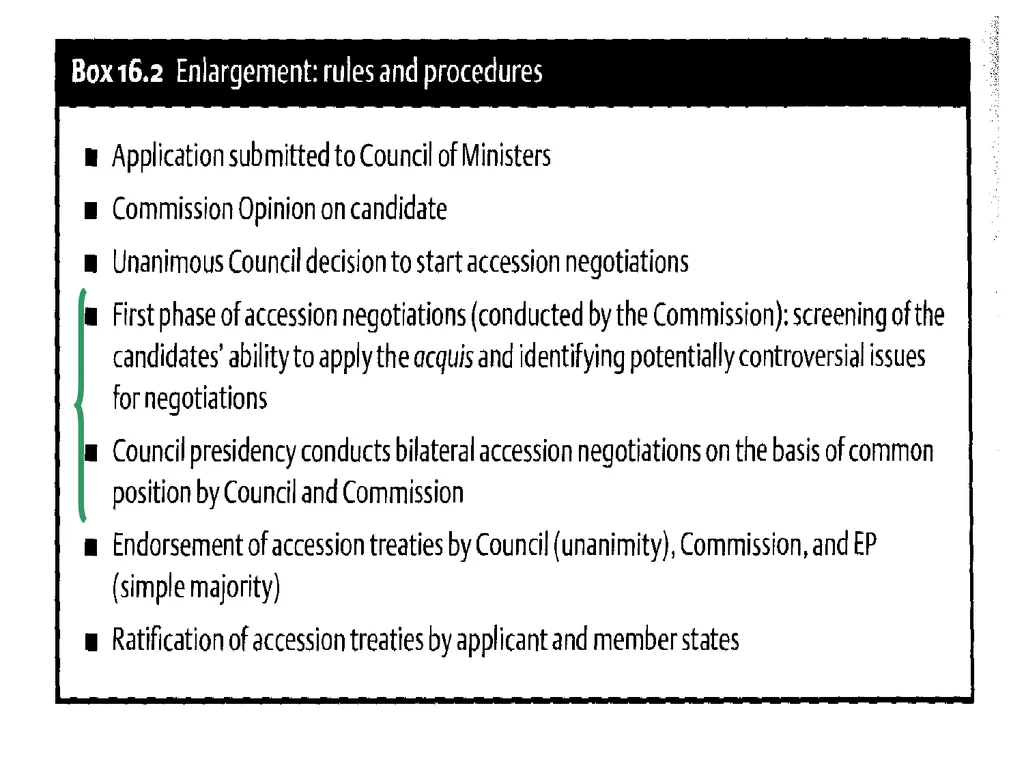
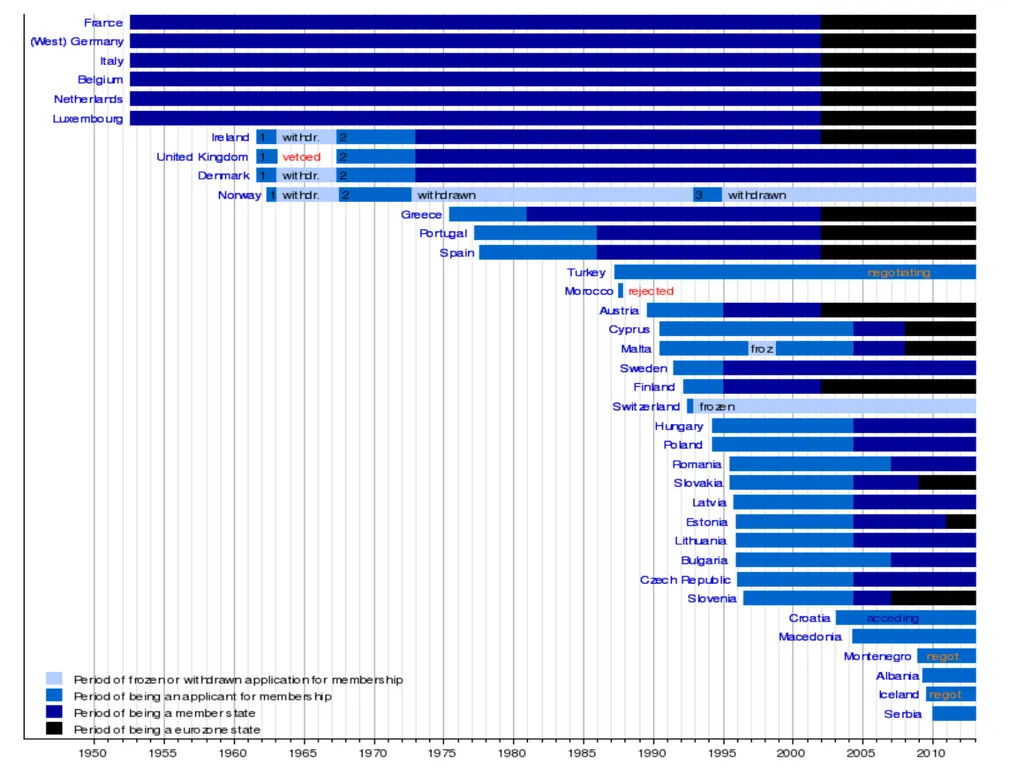
EU Enlargement<br>
27
Copenhagen criteria
(since 1993) “Membership requires that the candidate country has achieved stability of institutions guaranteeing . . .”
1) the rule of law, human rights and respect for, and protection of minorities
2) democracy
3) the existence of a functioning market economy<br>
1) the rule of law, human rights and respect for, and protection of minorities
2) democracy
3) the existence of a functioning market economy<br>
28
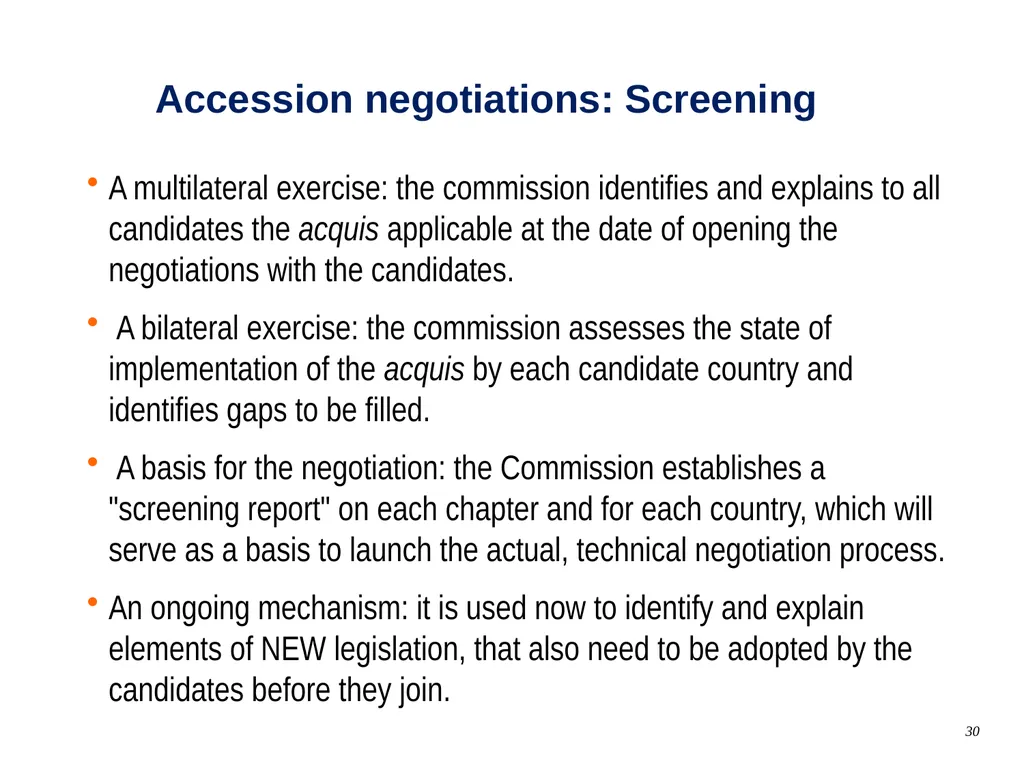
30 Accession negotiations: Screening A multilateral exercise: the commission identifies and explains to all candidates the acquis applicable at the date of opening the negotiations with the candidates.
A bilateral exercise: the commission assesses the state of implementation of the acquis by each candidate country and identifies gaps to be filled.
A basis for the negotiation: the Commission establishes a "screening report" on each chapter and for each country, which will serve as a basis to launch the actual, technical negotiation process.
An ongoing mechanism: it is used now to identify and explain elements of NEW legislation, that also need to be adopted by the candidates before they join.<br>
A bilateral exercise: the commission assesses the state of implementation of the acquis by each candidate country and identifies gaps to be filled.
A basis for the negotiation: the Commission establishes a "screening report" on each chapter and for each country, which will serve as a basis to launch the actual, technical negotiation process.
An ongoing mechanism: it is used now to identify and explain elements of NEW legislation, that also need to be adopted by the candidates before they join.<br>
29
31<br>
30
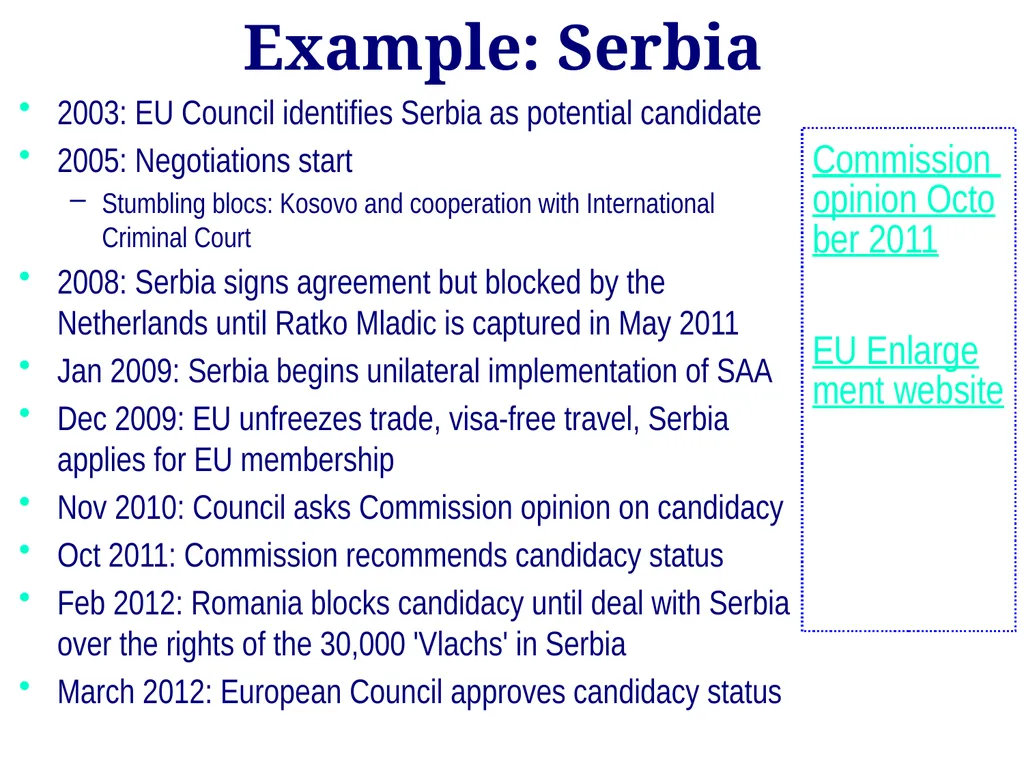
Example: Serbia 2003: EU Council identifies Serbia as potential candidate
2005: Negotiations start
Stumbling blocs: Kosovo and cooperation with International Criminal Court
2008: Serbia signs agreement but blocked by the Netherlands until Ratko Mladic is captured in May 2011
Jan 2009: Serbia begins unilateral implementation of SAA
Dec 2009: EU unfreezes trade, visa-free travel, Serbia applies for EU membership
Nov 2010: Council asks Commission opinion on candidacy
Oct 2011: Commission recommends candidacy status
Feb 2012: Romania blocks candidacy until deal with Serbia over the rights of the 30,000 'Vlachs' in Serbia
March 2012: European Council approves candidacy status Commission opinion October 2011
EU Enlargement website 32<br>
2005: Negotiations start
Stumbling blocs: Kosovo and cooperation with International Criminal Court
2008: Serbia signs agreement but blocked by the Netherlands until Ratko Mladic is captured in May 2011
Jan 2009: Serbia begins unilateral implementation of SAA
Dec 2009: EU unfreezes trade, visa-free travel, Serbia applies for EU membership
Nov 2010: Council asks Commission opinion on candidacy
Oct 2011: Commission recommends candidacy status
Feb 2012: Romania blocks candidacy until deal with Serbia over the rights of the 30,000 'Vlachs' in Serbia
March 2012: European Council approves candidacy status Commission opinion October 2011
EU Enlargement website 32<br>
31
Brief history of EU foreign & security policy 1950-1970
1970-1990
1990-1998
1998-now
2009 Failed attempts to create classical foreign & defense policy
Cautious foreign policy coordination, e.g. on Middle East; development aid
Common foreign and security policy (but defense remains in NATO and WEU)
West European Union incorporated in EU
2000: EU High Representative in Council; Commission controls EU delegations and funds
2003: EU rapid reaction force of 60,000 to implement Petersberg tasks;
EU civilian and military missions begin in 2003
military coordination strengthened
EU High Representative for Foreign Affairs and Security Policy
European External Action Service created<br>
1970-1990
1990-1998
1998-now
2009 Failed attempts to create classical foreign & defense policy
Cautious foreign policy coordination, e.g. on Middle East; development aid
Common foreign and security policy (but defense remains in NATO and WEU)
West European Union incorporated in EU
2000: EU High Representative in Council; Commission controls EU delegations and funds
2003: EU rapid reaction force of 60,000 to implement Petersberg tasks;
EU civilian and military missions begin in 2003
military coordination strengthened
EU High Representative for Foreign Affairs and Security Policy
European External Action Service created<br>
32
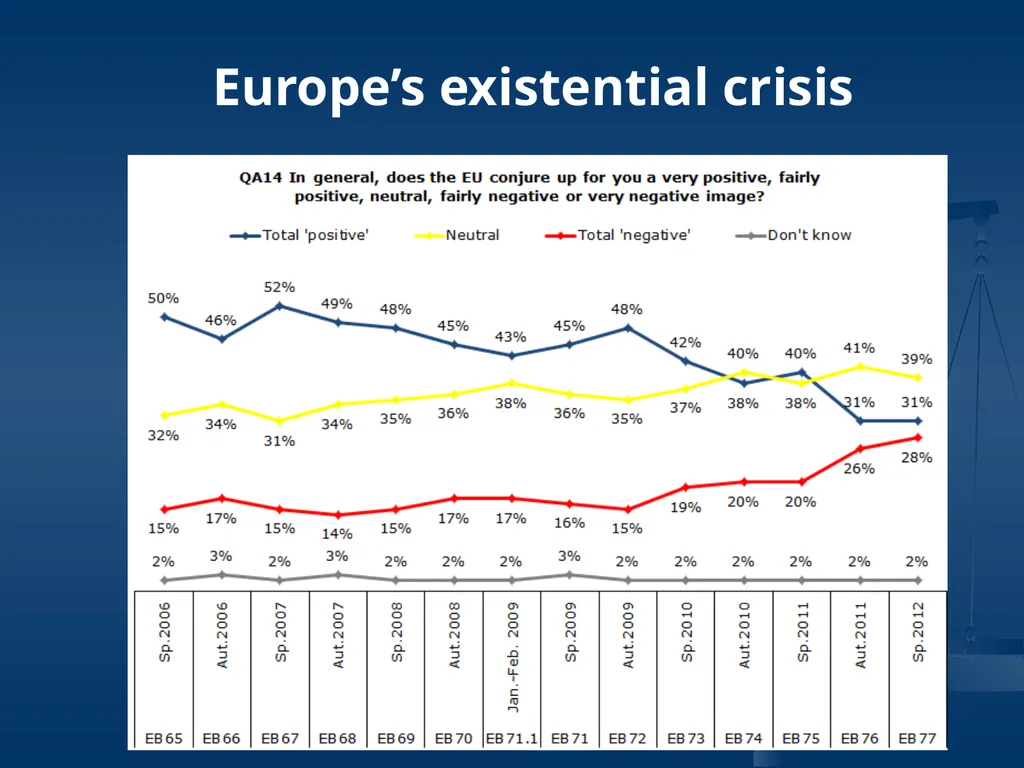
Europe’s existential crisis<br>