USDA- Natural Resources Conservation Service (NRCS) Zack Davis Soil Conservationist Jefferson, NC Who is NRCS? The Natural Resources Conservation Service (NRCS) is part of the U.S. Department of Agriculture and principal agency for
"USDA- Natural Resources Conservation Service" is the property of its rightful owner. Permission is granted to
download and print the materials on this website for personal, non-commercial use only, and to display it
on your personal computer provided you do not modify the materials and that you retain all copyright
notices contained in the materials. By downloading content from our website, you accept the terms of this
agreement.
Presentation Transcript
01
USDA- Natural Resources Conservation Service (NRCS) Zack Davis
Soil Conservationist
Jefferson, NC<br>
02
Who is NRCS? The Natural Resources Conservation Service (NRCS) is part of the U.S. Department of Agriculture and principal agency for providing conservation technical assistance to farmers, ranchers and landowners of non-industrial forest land to conserve the nation’s soil, water, air and other natural resources.
All NRCS programs are voluntary and offer science-based solutions that benefit both the landowner and the environment.<br>
03
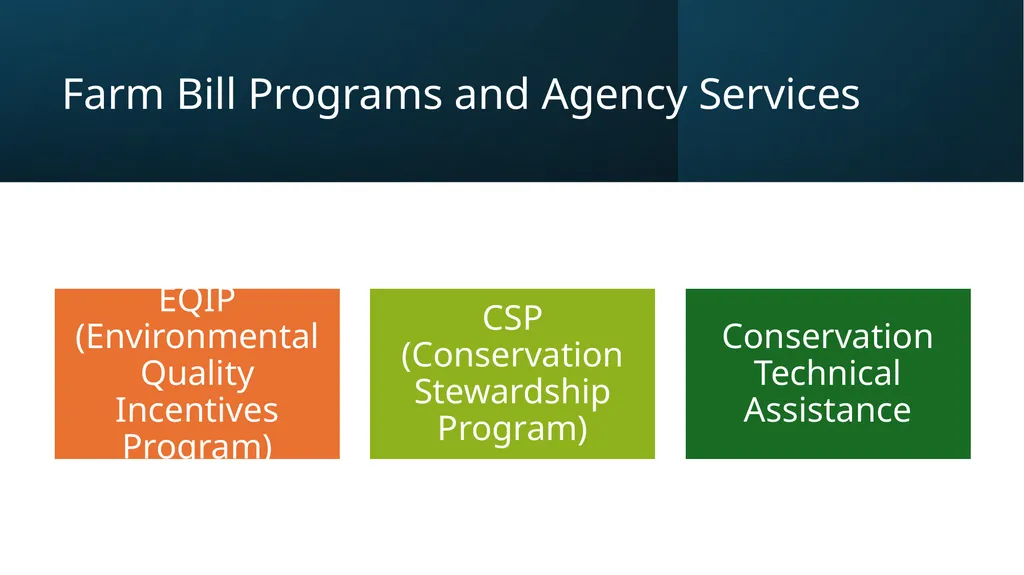
Farm Bill Programs and Agency Services<br>
04
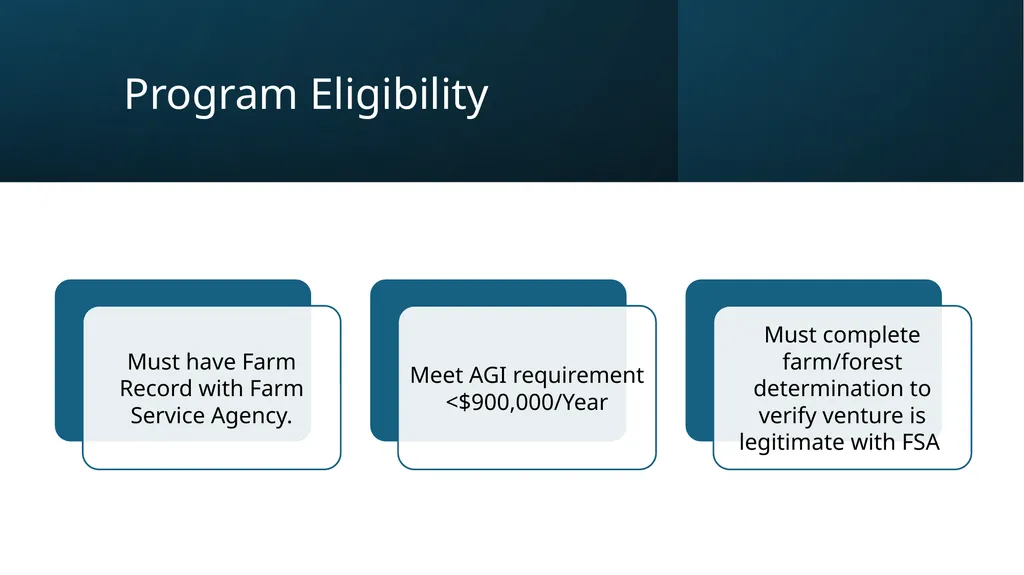
Program Eligibility<br>
05
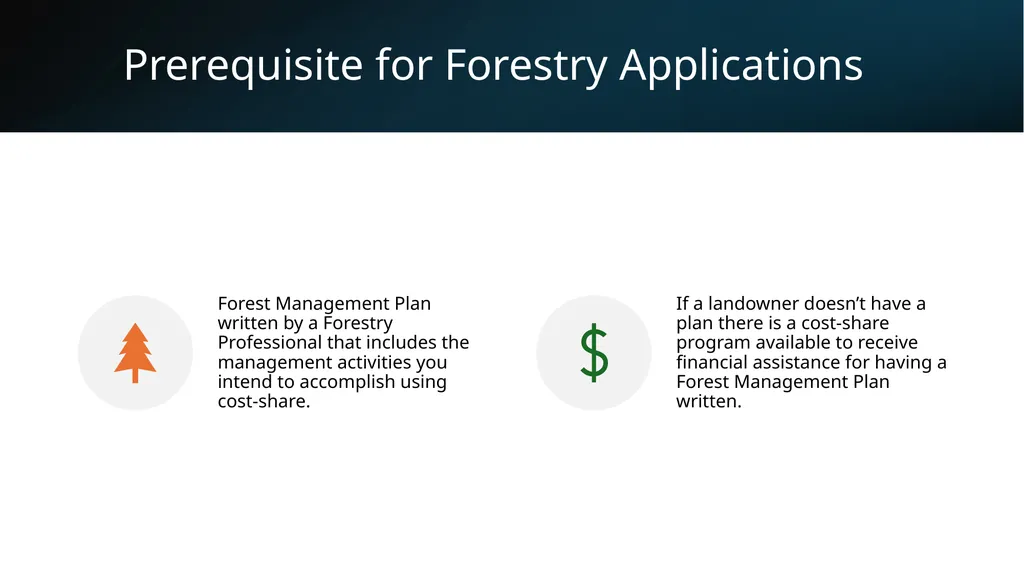
Prerequisite for Forestry Applications<br>
06
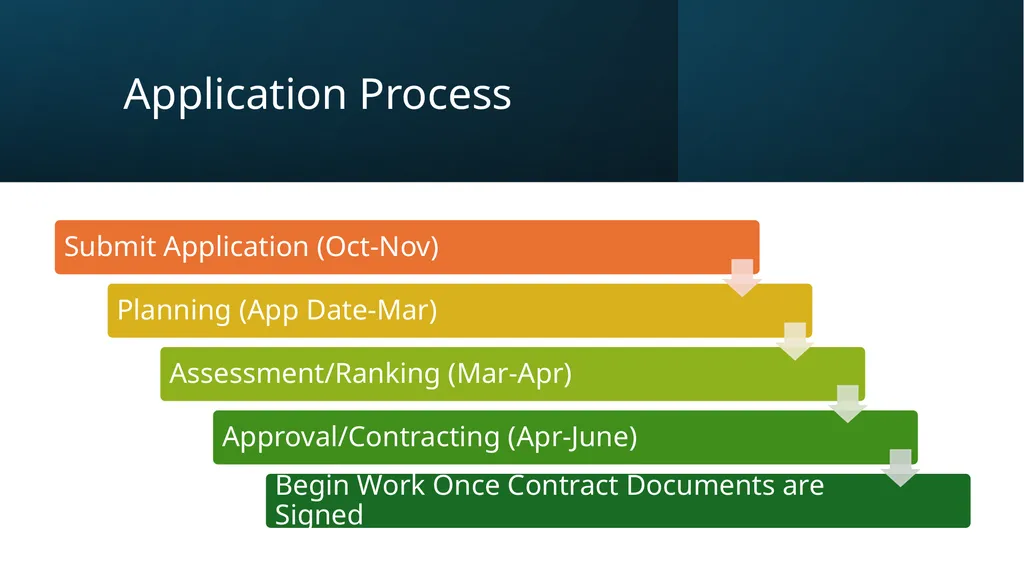
Application Process<br>
07
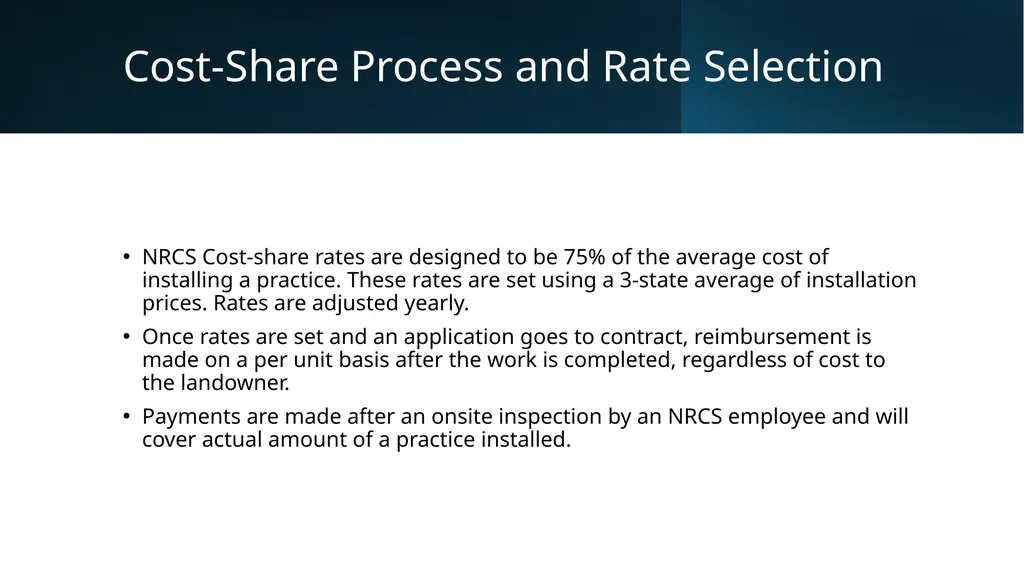
Cost-Share Process and Rate Selection NRCS Cost-share rates are designed to be 75% of the average cost of installing a practice. These rates are set using a 3-state average of installation prices. Rates are adjusted yearly.
Once rates are set and an application goes to contract, reimbursement is made on a per unit basis after the work is completed, regardless of cost to the landowner.
Payments are made after an onsite inspection by an NRCS employee and will cover actual amount of a practice installed.<br>
08
Forestry Practices for Wildfire Mitigation<br>
09
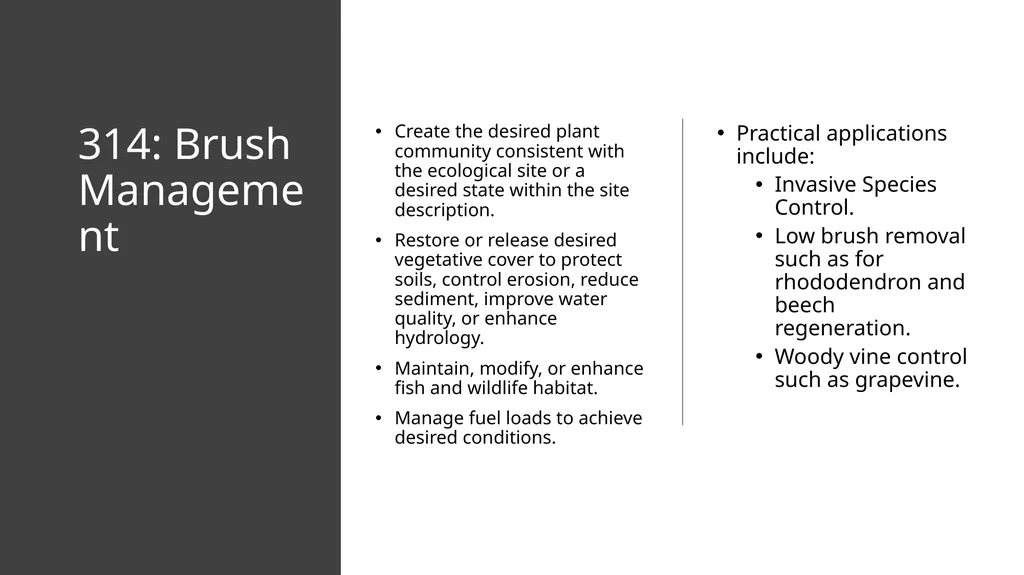
314: Brush Management Create the desired plant community consistent with the ecological site or a desired state within the site description.
Restore or release desired vegetative cover to protect soils, control erosion, reduce sediment, improve water quality, or enhance hydrology.
Maintain, modify, or enhance fish and wildlife habitat.
Manage fuel loads to achieve desired conditions. Practical applications include:
Invasive Species Control.
Low brush removal such as for rhododendron and beech regeneration.
Woody vine control such as grapevine.<br>
10
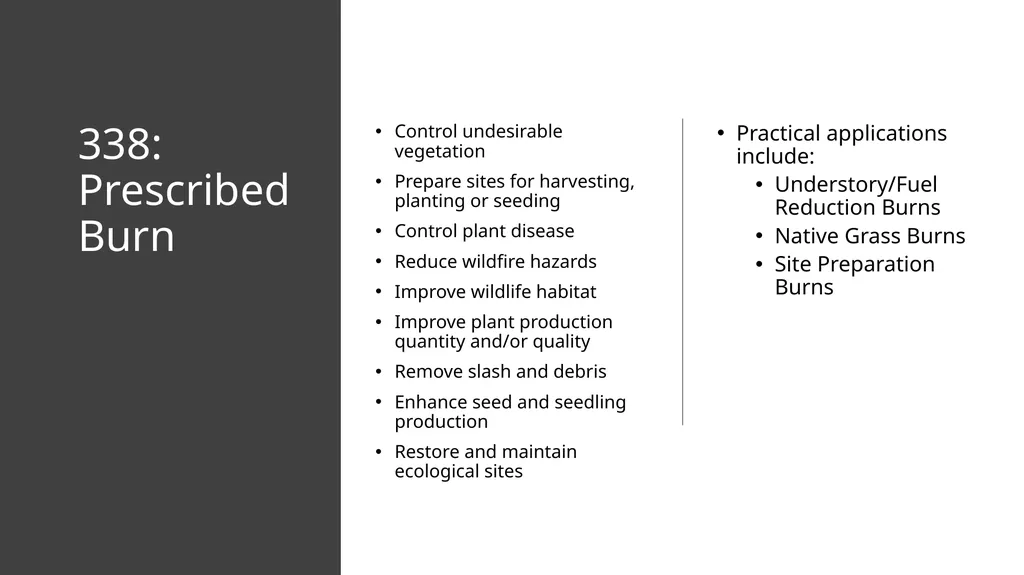
338: Prescribed Burn Control undesirable vegetation
Prepare sites for harvesting, planting or seeding
Control plant disease
Reduce wildfire hazards
Improve wildlife habitat
Improve plant production quantity and/or quality
Remove slash and debris
Enhance seed and seedling production
Restore and maintain ecological sites Practical applications include:
Understory/Fuel Reduction Burns
Native Grass Burns
Site Preparation Burns<br>
11
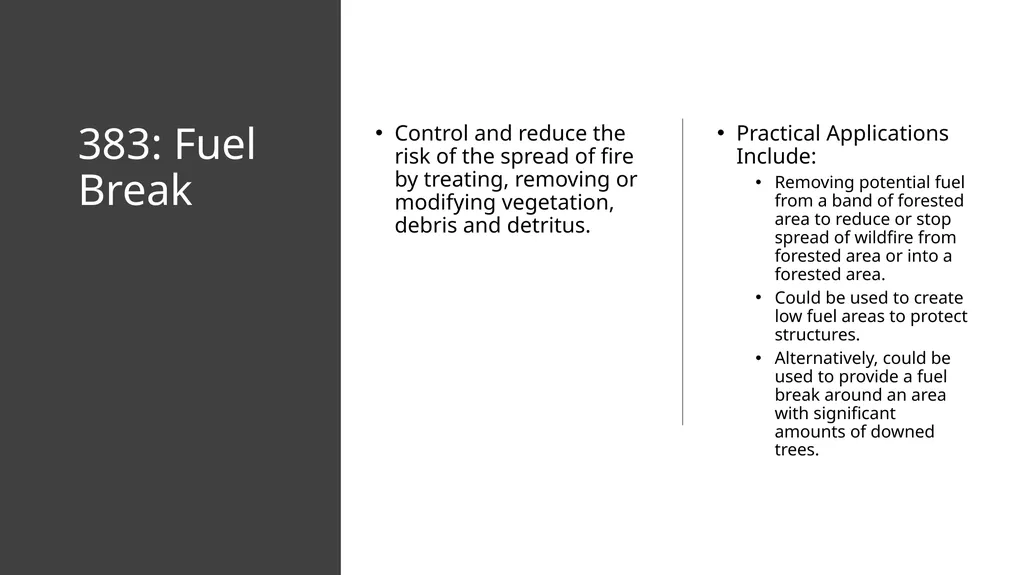
383: Fuel Break Control and reduce the risk of the spread of fire by treating, removing or modifying vegetation, debris and detritus. Practical Applications Include:
Removing potential fuel from a band of forested area to reduce or stop spread of wildfire from forested area or into a forested area.
Could be used to create low fuel areas to protect structures.
Alternatively, could be used to provide a fuel break around an area with significant amounts of downed trees.<br>
12
394: Firebreak Reduce the spread of wildfire
Contain prescribed burns Practical Applications:
Constructed break
Vegetated fire break
Disked fire break
Handline<br>
13
655: Forest Trails and Landings This practice is used to accomplish the following purpose–
• Providing unimproved or seasonal routes for temporary or infrequent travel by people or equipment for forest management activities. Practical Applications:
Rehabilitating failed logging roads through erosion control structures and gravel armoring.
Regaining access to blocked roads through clearing of downed trees and debris.<br>
14
666: Forest Stand Improvement Increase the quantity and quality of forest products by manipulating stand density and structure.
Timely harvest of forest products.
Reduce wildfire hazard
Improve forest health - reducing the potential of damage from pests and moisture stress.
Improve wildlife habitat. Practical applications:
Pre-commercial thinning
Crop-tree release
Patch clear-cutting
Reducing competition reduces stress on individuals making forest more resilient to disturbance events.<br>
15
Conclusion<br>
16
How to Contact Us I encourage you to reach out to your local NRCS office to see what we can do to help you reach your land management goals!
NRCS Service Centers can be found using the Online Service Center Locator.
Non- Discrimination Statement In accordance with Federal civil rights law and U.S. Department of Agriculture (USDA) civil rights regulations and policies, the USDA, its Agencies, offices, and employees, and institutions participating in or administering USDA programs are prohibited from discriminating based on race, color, national origin, religion, sex, gender identity (including gender expression), sexual orientation, disability, age, marital status, family/parental status, income derived from a public assistance program, political beliefs, or reprisal or retaliation for prior civil rights activity, in any program or activity conducted or funded by USDA (not all bases apply to all
programs). Remedies and complaint filing deadlines vary by program or incident.
Persons with disabilities who require alternative means of communication for program information (e.g., Braille, large print, audiotape, American Sign Language, etc.) should contact the responsible Agency or USDA’s TARGET Center at (202) 720-2600 (voice and TTY) or contact USDA through the Federal Relay Service at (800) 877-8339. Additionally, program information may be made available in languages other than English.
To file a program discrimination complaint, complete the USDA Program Discrimination Complaint Form, AD-3027, found online at How to File a Program Discrimination Complaint and at any USDA office or write a letter addressed to USDA and provide in the letter all of the information requested in the form. To request a copy of the complaint form, call (866) 632-9992. Submit your completed form or letter to USDA by:
mail: U.S. Department of Agriculture
Office of the Assistant Secretary for Civil Rights 1400 Independence Avenue, SW
Washington, D.C. 20250-9410;
fax: (202) 690-7442; or
email: program.intake@usda.gov.
USDA is an equal opportunity provider, employer, and lender.<br>