Using Cool-Bottom Processing in RGB and AGB stars
Description: Using Cool-Bottom Processing in RGB and AGB stars to Explain Isotopic Ratios in Presolar Grains By: Maeve Cockshutt With: Pavel Denissenkov, Falk Herwig, and Nan Liu 1 Presolar Grains Presolar grains are dust which predate the formation of
Related Topics
Download Presentation
"Using Cool-Bottom Processing in RGB and AGB stars" is the property of its rightful owner. Permission is granted to download and print the materials on this website for personal, non-commercial use only, and to display it on your personal computer provided you do not modify the materials and that you retain all copyright notices contained in the materials. By downloading content from our website, you accept the terms of this agreement.
Presentation Transcript
slide1. Using Cool-Bottom Processing in RGB and AGB stars to Explain Isotopic Ratios in Presolar Grains By: Maeve Cockshutt
With: Pavel Denissenkov, Falk Herwig, and Nan Liu 1<br>
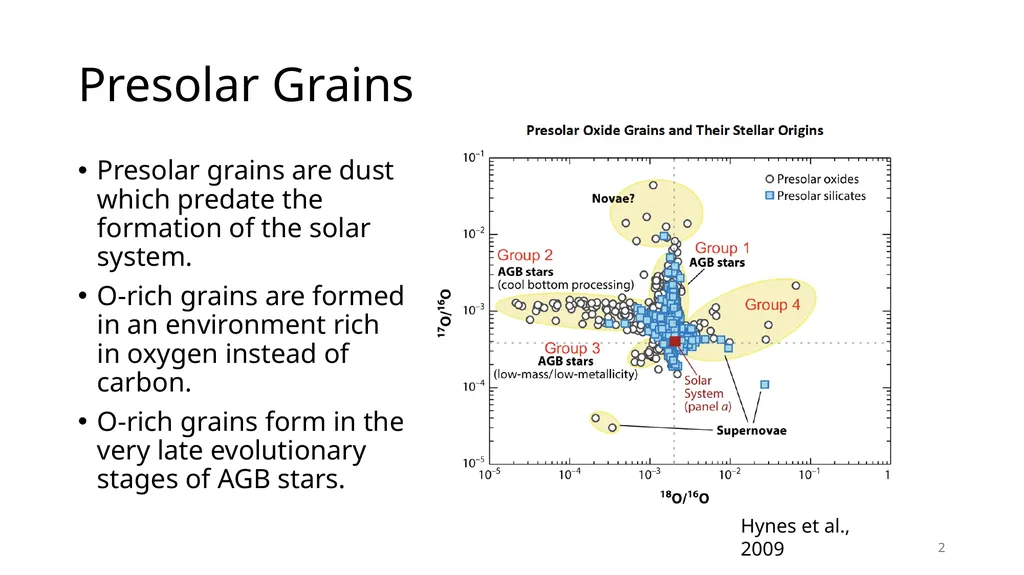
slide2. Presolar Grains Presolar grains are dust which predate the formation of the solar system.
O-rich grains are formed in an environment rich in oxygen instead of carbon.
O-rich grains form in the very late evolutionary stages of AGB stars. 2 Hynes et al., 2009<br>
slide3. Problem Definition The isotopic ratios found in Group 2 O-rich presolar grains do not match current stellar models.
This discrepancy can only be explained by extra mixing.
An improved mixing model could explain other isotopic abundances and improve our understanding of nucleosynthesis and stellar evolution. 3<br>
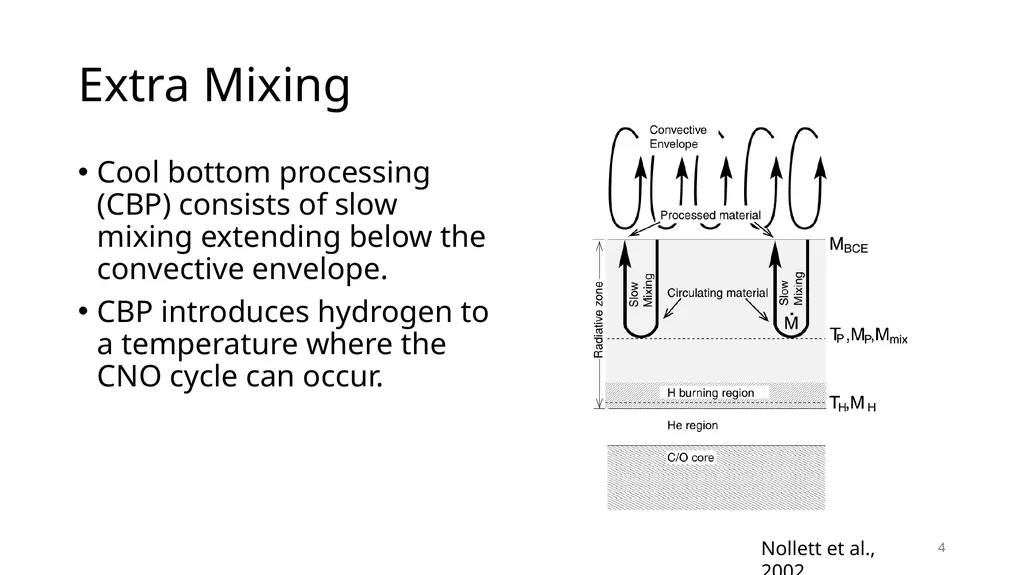
slide4. Extra Mixing Cool bottom processing (CBP) consists of slow mixing extending below the convective envelope.
CBP introduces hydrogen to a temperature where the CNO cycle can occur. 4 Nollett et al., 2002<br>
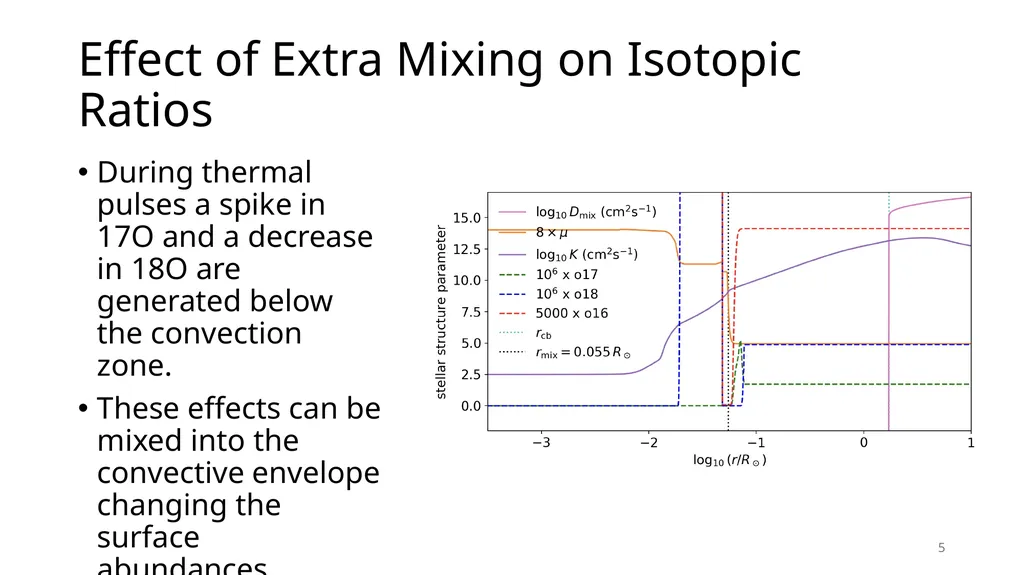
slide5. Effect of Extra Mixing on Isotopic Ratios During thermal pulses a spike in 17O and a decrease in 18O are generated below the convection zone.
These effects can be mixed into the convective envelope changing the surface abundances. 5<br>
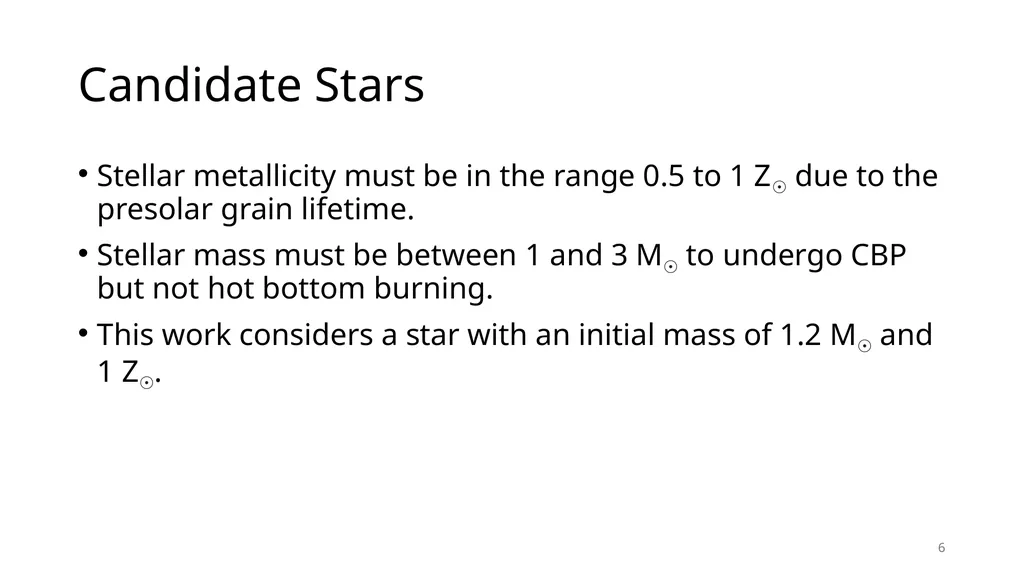
slide6. Candidate Stars Stellar metallicity must be in the range 0.5 to 1 Z☉︎ due to the presolar grain lifetime.
Stellar mass must be between 1 and 3 M☉︎ to undergo CBP but not hot bottom burning.
This work considers a star with an initial mass of 1.2 M☉︎ and 1 Z☉︎. 6<br>
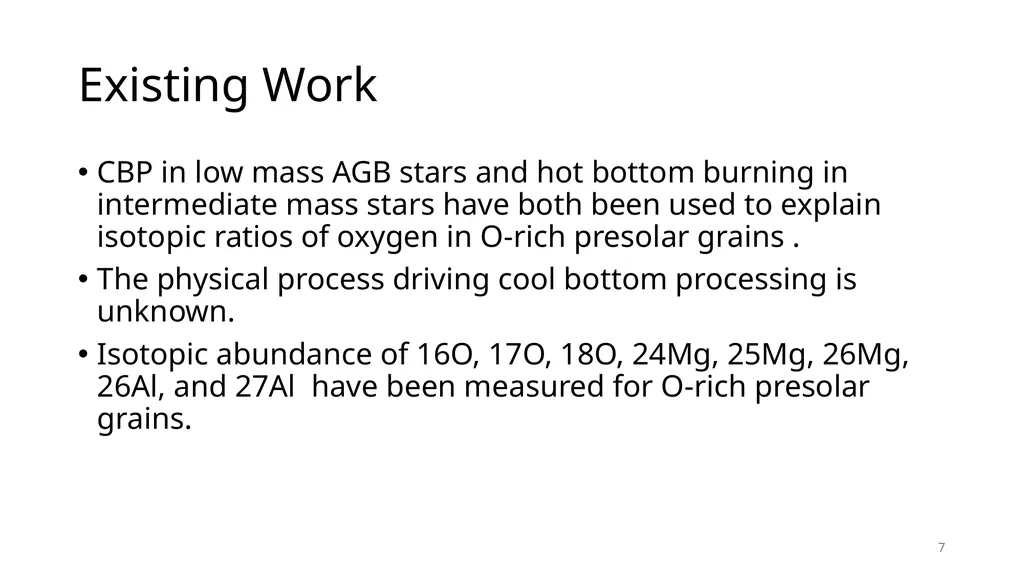
slide7. Existing Work CBP in low mass AGB stars and hot bottom burning in intermediate mass stars have both been used to explain isotopic ratios of oxygen in O-rich presolar grains .
The physical process driving cool bottom processing is unknown.
Isotopic abundance of 16O, 17O, 18O, 24Mg, 25Mg, 26Mg, 26Al, and 27Al have been measured for O-rich presolar grains. 7<br>
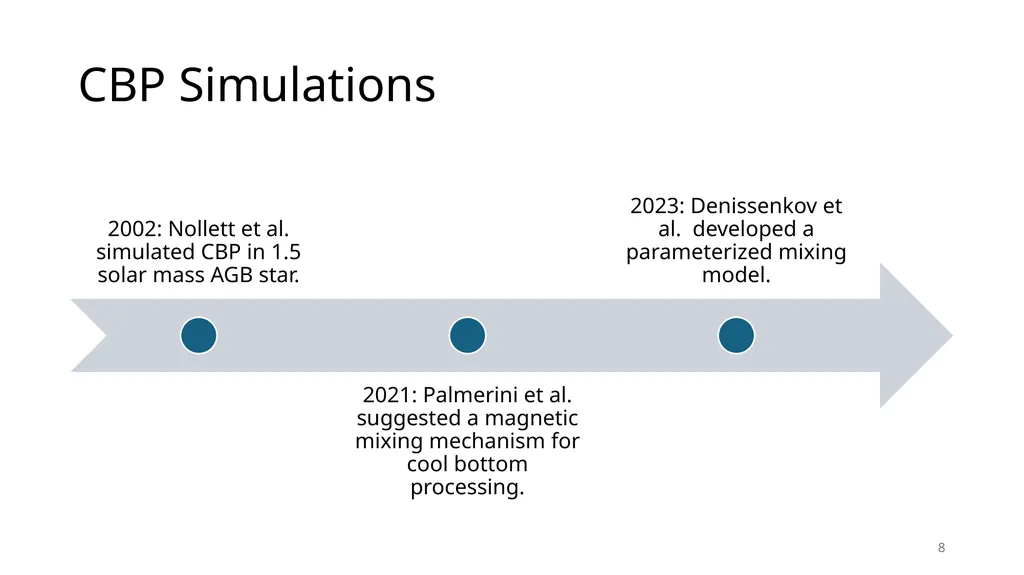
slide8. CBP Simulations 8<br>
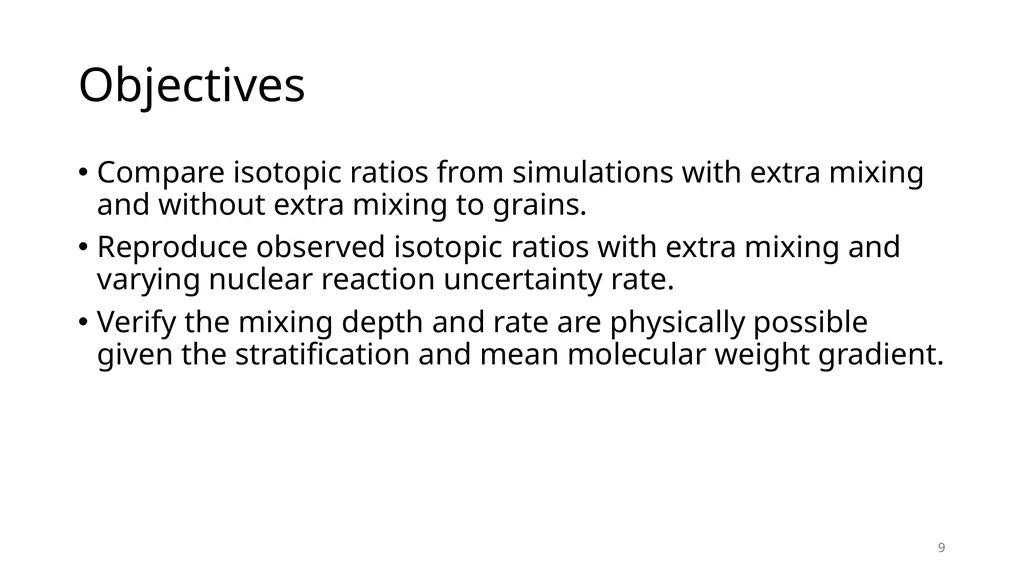
slide9. Objectives Compare isotopic ratios from simulations with extra mixing and without extra mixing to grains.
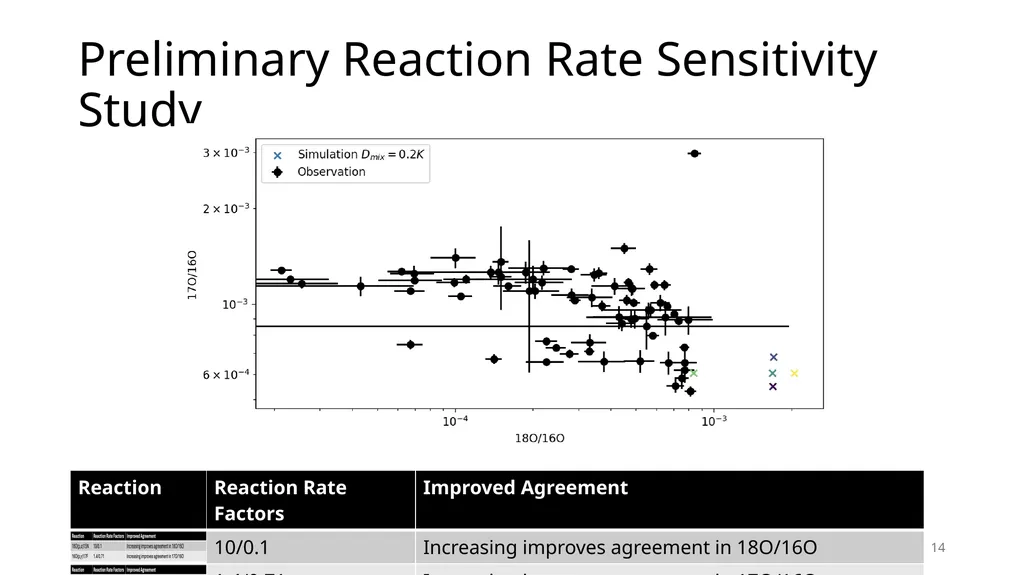
Reproduce observed isotopic ratios with extra mixing and varying nuclear reaction uncertainty rate.
Verify the mixing depth and rate are physically possible given the stratification and mean molecular weight gradient. 9<br>
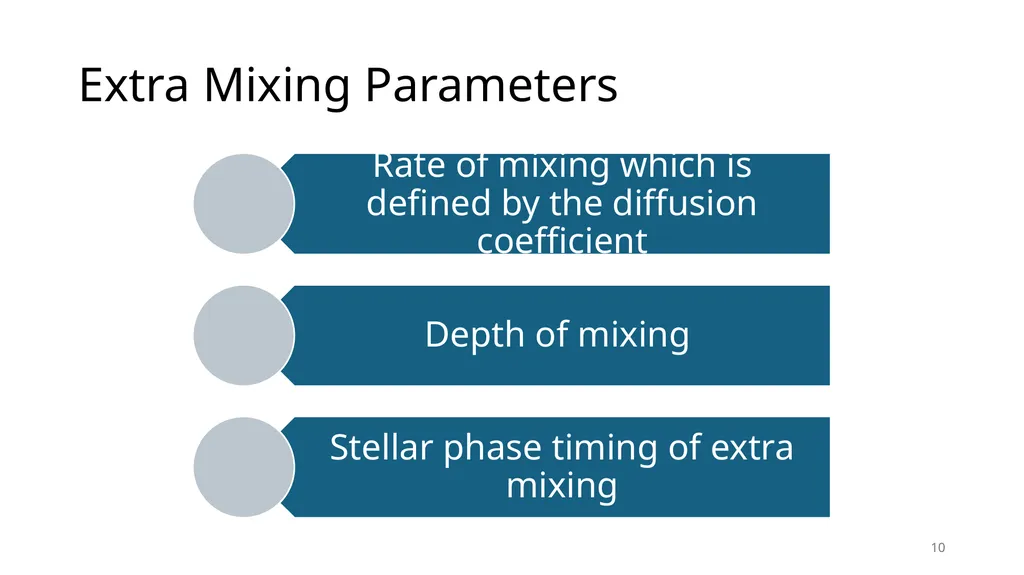
slide10. Extra Mixing Parameters 10<br>
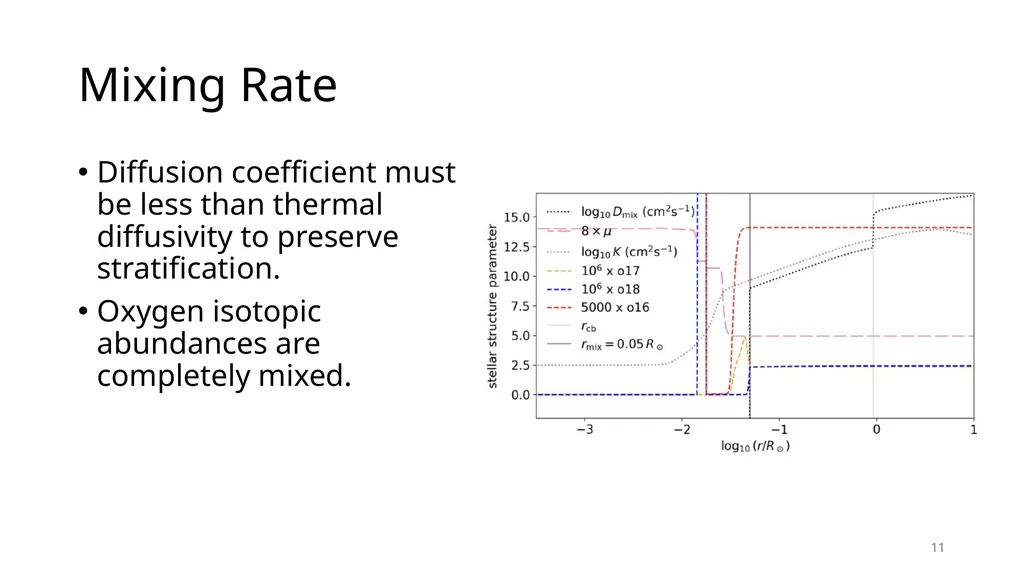
slide11. Mixing Rate Diffusion coefficient must be less than thermal diffusivity to preserve stratification.
Oxygen isotopic abundances are completely mixed. 11<br>
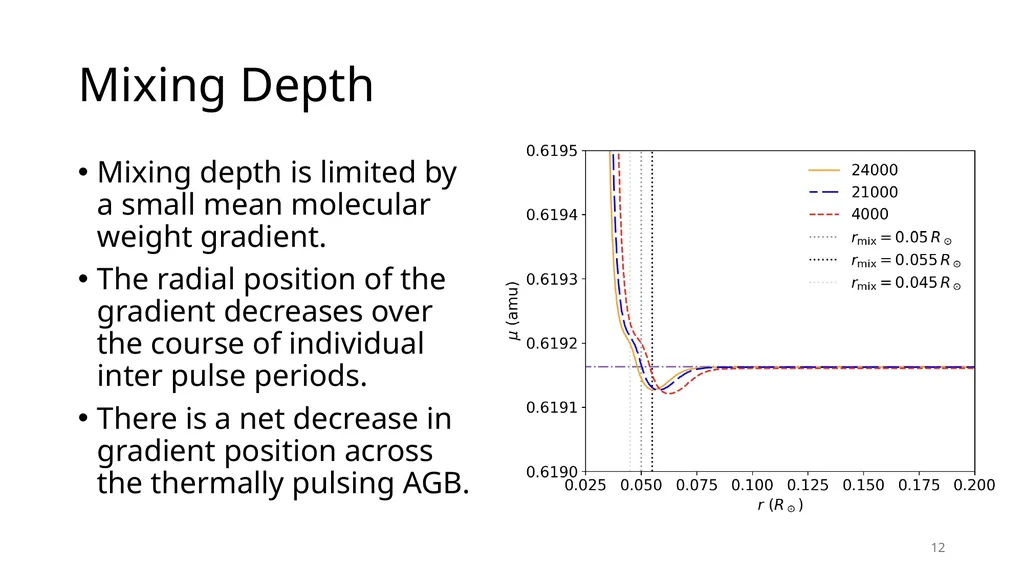
slide12. Mixing Depth Mixing depth is limited by a small mean molecular weight gradient.
The radial position of the gradient decreases over the course of individual inter pulse periods.
There is a net decrease in gradient position across the thermally pulsing AGB. 12<br>
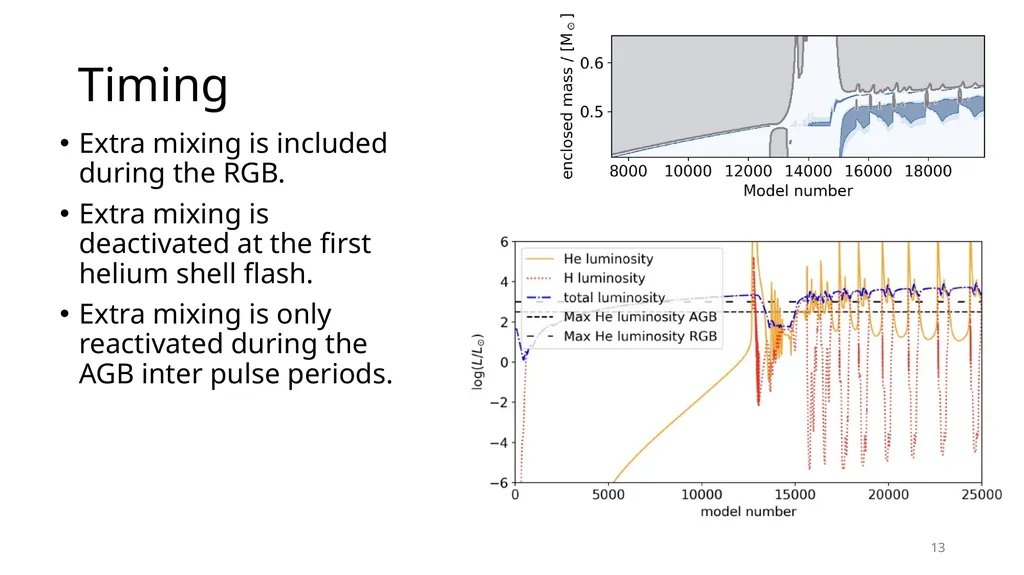
slide13. Timing 13 Extra mixing is included during the RGB.
Extra mixing is deactivated at the first helium shell flash.
Extra mixing is only reactivated during the AGB inter pulse periods.<br>
slide14. Preliminary Reaction Rate Sensitivity Study 14<br>
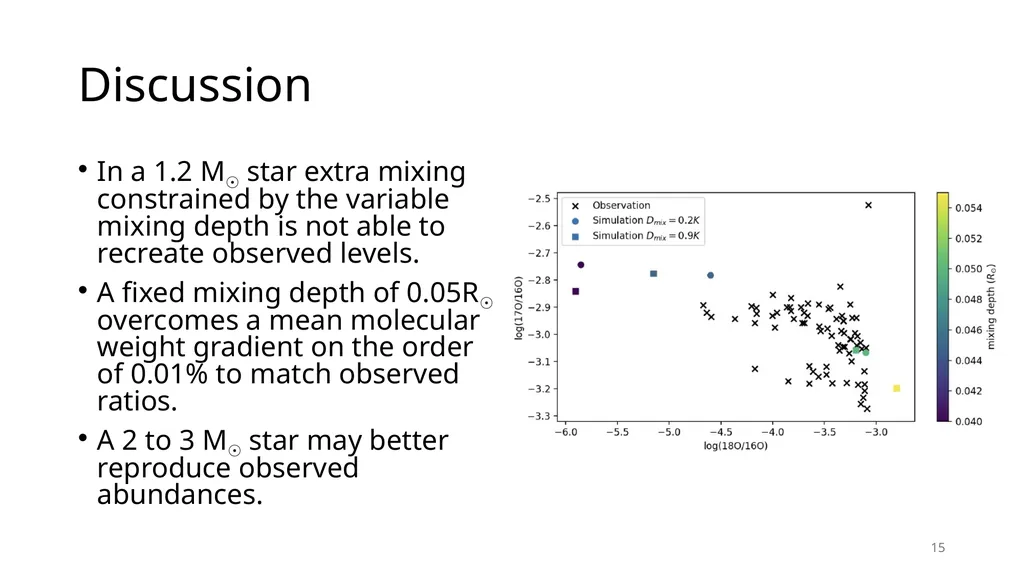
slide15. Discussion In a 1.2 M☉︎ star extra mixing constrained by the variable mixing depth is not able to recreate observed levels.
A fixed mixing depth of 0.05R☉︎ overcomes a mean molecular weight gradient on the order of 0.01% to match observed ratios.
A 2 to 3 M☉︎ star may better reproduce observed abundances. 15<br>
slide16. Next Steps Monte Carlo impact studies on a range of reaction rates.
Simulate extra mixing in 2 and 3 M☉︎ stars.
Compare simulated 26Al/27Al, 25Mg/24Mg, and 26Mg/24Mg ratios to observations.
Investigate very late stage effects with longer runs. 16<br>
slide17. References Busso, M., Wasserburg, G. J., Nollett, K. M., & Calandra, A. 2007, The Astrophysical Journal, 671, 802, doi: 10.1086/522616
Denissenkov, P. A., Blouin, S., Herwig, F., Stott, J., & Woodward, P. R. 2023, Enhanced Extra Mixing in Low-Mass Stars Approaching the RGB Tip and the Problem of Li-rich Red-Clump Stars, arXiv, doi: 10.48550/arXiv.2309.04634
Herwig, F. 2013, in Planets, Stars and Stellar Systems: Volume 4: Stellar Structure and Evolution, ed. T. D.Oswalt & M. A. Barstow (Dordrecht: Springer Netherlands), 397–445, doi: 10.1007/978-94-007-5615-1 8
Hynes, K., & Gyngard, F. 2009, Presolar Grain Database –Laboratory for Space Sciences @ Wash U Physics
Nittler, L. R. 2009, Publications of the Astronomical Society of Australia, 26, 271, doi: 10.1071/AS08071
Nittler, L. R., & Ciesla, F. 2016, Annual Review of Astronomy and Astrophysics, 54, 53, doi: 10.1146/annurev-astro-082214-122505
Nollett, K., Busso, M., & Wasserburg, G. 2002
Palmerini, S., Cristallo, S., Piersanti, L., Vescovi, D., & Busso, M. 2021, Universe, 7, 175, doi: 10.3390/universe7060175
Varghese, A., Ratnasingam, R. P., Vanon, R., Edelmann, P.V. F., & Rogers, T. M. 2023, The Astrophysical Journal, 942, 53, doi: 10.3847/1538-4357/aca092 17<br>
With: Pavel Denissenkov, Falk Herwig, and Nan Liu 1<br>
slide2. Presolar Grains Presolar grains are dust which predate the formation of the solar system.
O-rich grains are formed in an environment rich in oxygen instead of carbon.
O-rich grains form in the very late evolutionary stages of AGB stars. 2 Hynes et al., 2009<br>
slide3. Problem Definition The isotopic ratios found in Group 2 O-rich presolar grains do not match current stellar models.
This discrepancy can only be explained by extra mixing.
An improved mixing model could explain other isotopic abundances and improve our understanding of nucleosynthesis and stellar evolution. 3<br>
slide4. Extra Mixing Cool bottom processing (CBP) consists of slow mixing extending below the convective envelope.
CBP introduces hydrogen to a temperature where the CNO cycle can occur. 4 Nollett et al., 2002<br>
slide5. Effect of Extra Mixing on Isotopic Ratios During thermal pulses a spike in 17O and a decrease in 18O are generated below the convection zone.
These effects can be mixed into the convective envelope changing the surface abundances. 5<br>
slide6. Candidate Stars Stellar metallicity must be in the range 0.5 to 1 Z☉︎ due to the presolar grain lifetime.
Stellar mass must be between 1 and 3 M☉︎ to undergo CBP but not hot bottom burning.
This work considers a star with an initial mass of 1.2 M☉︎ and 1 Z☉︎. 6<br>
slide7. Existing Work CBP in low mass AGB stars and hot bottom burning in intermediate mass stars have both been used to explain isotopic ratios of oxygen in O-rich presolar grains .
The physical process driving cool bottom processing is unknown.
Isotopic abundance of 16O, 17O, 18O, 24Mg, 25Mg, 26Mg, 26Al, and 27Al have been measured for O-rich presolar grains. 7<br>
slide8. CBP Simulations 8<br>
slide9. Objectives Compare isotopic ratios from simulations with extra mixing and without extra mixing to grains.
Reproduce observed isotopic ratios with extra mixing and varying nuclear reaction uncertainty rate.
Verify the mixing depth and rate are physically possible given the stratification and mean molecular weight gradient. 9<br>
slide10. Extra Mixing Parameters 10<br>
slide11. Mixing Rate Diffusion coefficient must be less than thermal diffusivity to preserve stratification.
Oxygen isotopic abundances are completely mixed. 11<br>
slide12. Mixing Depth Mixing depth is limited by a small mean molecular weight gradient.
The radial position of the gradient decreases over the course of individual inter pulse periods.
There is a net decrease in gradient position across the thermally pulsing AGB. 12<br>
slide13. Timing 13 Extra mixing is included during the RGB.
Extra mixing is deactivated at the first helium shell flash.
Extra mixing is only reactivated during the AGB inter pulse periods.<br>
slide14. Preliminary Reaction Rate Sensitivity Study 14<br>
slide15. Discussion In a 1.2 M☉︎ star extra mixing constrained by the variable mixing depth is not able to recreate observed levels.
A fixed mixing depth of 0.05R☉︎ overcomes a mean molecular weight gradient on the order of 0.01% to match observed ratios.
A 2 to 3 M☉︎ star may better reproduce observed abundances. 15<br>
slide16. Next Steps Monte Carlo impact studies on a range of reaction rates.
Simulate extra mixing in 2 and 3 M☉︎ stars.
Compare simulated 26Al/27Al, 25Mg/24Mg, and 26Mg/24Mg ratios to observations.
Investigate very late stage effects with longer runs. 16<br>
slide17. References Busso, M., Wasserburg, G. J., Nollett, K. M., & Calandra, A. 2007, The Astrophysical Journal, 671, 802, doi: 10.1086/522616
Denissenkov, P. A., Blouin, S., Herwig, F., Stott, J., & Woodward, P. R. 2023, Enhanced Extra Mixing in Low-Mass Stars Approaching the RGB Tip and the Problem of Li-rich Red-Clump Stars, arXiv, doi: 10.48550/arXiv.2309.04634
Herwig, F. 2013, in Planets, Stars and Stellar Systems: Volume 4: Stellar Structure and Evolution, ed. T. D.Oswalt & M. A. Barstow (Dordrecht: Springer Netherlands), 397–445, doi: 10.1007/978-94-007-5615-1 8
Hynes, K., & Gyngard, F. 2009, Presolar Grain Database –Laboratory for Space Sciences @ Wash U Physics
Nittler, L. R. 2009, Publications of the Astronomical Society of Australia, 26, 271, doi: 10.1071/AS08071
Nittler, L. R., & Ciesla, F. 2016, Annual Review of Astronomy and Astrophysics, 54, 53, doi: 10.1146/annurev-astro-082214-122505
Nollett, K., Busso, M., & Wasserburg, G. 2002
Palmerini, S., Cristallo, S., Piersanti, L., Vescovi, D., & Busso, M. 2021, Universe, 7, 175, doi: 10.3390/universe7060175
Varghese, A., Ratnasingam, R. P., Vanon, R., Edelmann, P.V. F., & Rogers, T. M. 2023, The Astrophysical Journal, 942, 53, doi: 10.3847/1538-4357/aca092 17<br>