
Using The Office to Teach Business Ethics Robert
DJ
Published · 35 slides · 0 views

1 / 1
Description
Using The Office to Teach Business Ethics Robert G. DelCampo, Ph.D. Anderson School of Management University of New Mexico Summary Deliver a lecture that your students will remember by connecting business ethics concepts to a pop culture
Related Topics
Share
Embed code
Download this presentation From Below
"Using The Office to Teach Business Ethics Robert" is the property of its rightful owner. Permission is granted to download and print the materials on this website for personal, non-commercial use only, and to display it on your personal computer provided you do not modify the materials and that you retain all copyright notices contained in the materials. By downloading content from our website, you accept the terms of this agreement.
Presentation Transcript
01
Using The Office to Teach Business Ethics Robert G. DelCampo, Ph.D.
Anderson School of Management
University of New Mexico<br>
Anderson School of Management
University of New Mexico<br>
02
Summary Deliver a lecture that your students will remember by connecting business ethics concepts to a pop culture sitcom your students are sure to know.
Using traditional cases might be pedagogically helpful, but they are often easily forgotten. To enrich case-based learning for business ethics instruction, we will discuss sample cases that feature popular culture television, and you will learn how to use sample episodes from the television show The Office to engage and motivate students in your classroom.<br>
Using traditional cases might be pedagogically helpful, but they are often easily forgotten. To enrich case-based learning for business ethics instruction, we will discuss sample cases that feature popular culture television, and you will learn how to use sample episodes from the television show The Office to engage and motivate students in your classroom.<br>
03
Use of Case Studies When lecturing is the prime mode of instruction, students typically forget as much as 50 percent of the course content within a few months [Christensen et al., 1991; Desiraju & Gopinath, 2001].
Case teaching can do much to make theories come alive, especially in settings where students have little practical experience. Mauffette-Leenders, Erskijne, & Leenders [1999, p. 2] note that “a case is a description of an actual situation, commonly involving a decision, a challenge, an opportunity, a problem or an issue faced by a person (or persons) in an organization.”<br>
Case teaching can do much to make theories come alive, especially in settings where students have little practical experience. Mauffette-Leenders, Erskijne, & Leenders [1999, p. 2] note that “a case is a description of an actual situation, commonly involving a decision, a challenge, an opportunity, a problem or an issue faced by a person (or persons) in an organization.”<br>
04
Use of Video We propose multimedia delivery of a “case” that features popular culture television to better engage a student generation that grew up watching television regularly [Hunt, 2001].
Increasingly, business educators use Hollywood films or television shows to make concrete OB theories or principles [Champoux, 2001; Corner, 2001; Hunt, 2001].
The educational psychology literature notes that creating an entertaining or interesting “cue” that is associated with a particular topic can improve student retention of subject matter [Hayes & Reinking, 1991].<br>
Increasingly, business educators use Hollywood films or television shows to make concrete OB theories or principles [Champoux, 2001; Corner, 2001; Hunt, 2001].
The educational psychology literature notes that creating an entertaining or interesting “cue” that is associated with a particular topic can improve student retention of subject matter [Hayes & Reinking, 1991].<br>
05
Lack of Student Work Experience The Office is a unique sitcom that presents a dysfunctional corporate setting in a comedic fashion.
The presentation of a mock-corporate experience within the show often illustrates the violations of norms commonly taken for granted in a work setting and taught in typical business classes.<br>
The presentation of a mock-corporate experience within the show often illustrates the violations of norms commonly taken for granted in a work setting and taught in typical business classes.<br>
06
Engaging the Student As competition for the attention of business school students becomes more and more intense with the rise of cell phone usage, text messaging, iPods and the like, instructors must respond to student needs by making information as accessible and entertaining as possible.
“Infotainment” is becoming the norm.<br>
“Infotainment” is becoming the norm.<br>
07
Creating a Common Experience The violation of norms can be particularly helpful for teaching organizational behavior, as corporate culture and interpersonal relationships are central to understanding any work environment.
This program can serve as a valuable tool to teach management topics that are often difficult for students to grasp.<br>
This program can serve as a valuable tool to teach management topics that are often difficult for students to grasp.<br>
08
What is “The Office”? Basic norms of the American work environment are tested in each episode.
The Emmy Award winning sitcom develops unique characterizations through individuals’ actions in their shared work environment.<br>
The Emmy Award winning sitcom develops unique characterizations through individuals’ actions in their shared work environment.<br>
09
Teaching Students “What NOT To Do” As evidenced in many life experiences, sometimes demonstrating “what not to do” can be just as effective as demonstrating “best practices.” While comical, and many times obvious in retrospect, these “what not to do” situations are time and again excellent discussion starters and can begin thoughtful discussion with even the most disinterested students.
Can always be reframed as “what could you do instead?” or “what were some other options that might be more appropriate?” to reframe behavior rather than simply identify what behavior is inappropriate.<br>
Can always be reframed as “what could you do instead?” or “what were some other options that might be more appropriate?” to reframe behavior rather than simply identify what behavior is inappropriate.<br>
10
Benefits of Popular Culture Creates a bond between student and teacher
Allows for new level of comfort for student
Creates this “common experience”
Adds levity to the class
Is more likely to be remembered
Makes a situation “real” for students<br>
Allows for new level of comfort for student
Creates this “common experience”
Adds levity to the class
Is more likely to be remembered
Makes a situation “real” for students<br>
11
Specifics of In-Class Use As you will see, the U.S. version of NBC’s The Office offers a 22-minute (with the exception of some longer “special” episodes) case study for student exploration. At the end of this presentation, each episode description has:
Summary
a summary of the plot points
Topics
relevant business topics covered in the episode
Clip Description-Start/Stop
detailed information about particularly poignant scenes with DVD time codes
Questions for Discussion
to start discussion about either specific portions of the episode or the episode as a whole
Answers to Look For (italicized portion of discussion questions)
in order to help instructors either “pull out” information from their students or to evaluate the quality of their responses; while these suggested responses hit on many OB/HR theories, they are not intended to be exhaustive of all of the possible quality responses from students.<br>
Summary
a summary of the plot points
Topics
relevant business topics covered in the episode
Clip Description-Start/Stop
detailed information about particularly poignant scenes with DVD time codes
Questions for Discussion
to start discussion about either specific portions of the episode or the episode as a whole
Answers to Look For (italicized portion of discussion questions)
in order to help instructors either “pull out” information from their students or to evaluate the quality of their responses; while these suggested responses hit on many OB/HR theories, they are not intended to be exhaustive of all of the possible quality responses from students.<br>
12
What Are Some Common Themes? Issues of accountability
At branch level
At corporate level
By HR representatives
Issues of appropriate workplace behavior
Issues of gender/race/ethnicity/equality
Issue of “who does the problem belong to?” or “who needs to ‘fix it’?”<br>
At branch level
At corporate level
By HR representatives
Issues of appropriate workplace behavior
Issues of gender/race/ethnicity/equality
Issue of “who does the problem belong to?” or “who needs to ‘fix it’?”<br>
13
Some generic questions You can truly ask these questions in regard to ANY scenario/episode of The Office:
What did Michael (or other character) do “right”?
What did Michael (or other character) do “wrong”?
What could Michael (or other character) have done differently to make it “okay”?
How?<br>
What did Michael (or other character) do “right”?
What did Michael (or other character) do “wrong”?
What could Michael (or other character) have done differently to make it “okay”?
How?<br>
14
Scenario #1 THE OFFICE: SEASON ONE
Episode 4–The Alliance
Summary: Morale is low, so Michael decides to plan a birthday party for Meredith, whose birthday is the closest available. Michael wants to come up with the funniest saying for the card. The downsizing rumors continue, so Dwight attempts to form a strategic alliance with Jim. Oscar solicits donations for a nephew with cerebral palsy participating in a walkathon.
Topics: Downsizing, Appropriate Workplace Behavior, Gender Issues<br>
Episode 4–The Alliance
Summary: Morale is low, so Michael decides to plan a birthday party for Meredith, whose birthday is the closest available. Michael wants to come up with the funniest saying for the card. The downsizing rumors continue, so Dwight attempts to form a strategic alliance with Jim. Oscar solicits donations for a nephew with cerebral palsy participating in a walkathon.
Topics: Downsizing, Appropriate Workplace Behavior, Gender Issues<br>
15
Clip Description #1 Start/Stop
Michael harasses Pam for a lack of enthusiasm regarding the party. The women of the office are assigned the task of planning the party. He refers to them as his “party planning beyothches.” 2:27–5:05
Michael is trying to come up with a witty saying for Meredith’s card. Dwight offers a lot of information as well as her personal medical information. 11:02–12:01
Michael pledges $25 to Oscar’s charity trying to outdo everyone. In this clip Michael “undonates,” referring to the “ethics of the thing.” 15:10–16:40
The reading of the card. Michael offends Meredith with the card and his comments regarding her age and personal history. 17:03–20:28<br>
Michael harasses Pam for a lack of enthusiasm regarding the party. The women of the office are assigned the task of planning the party. He refers to them as his “party planning beyothches.” 2:27–5:05
Michael is trying to come up with a witty saying for Meredith’s card. Dwight offers a lot of information as well as her personal medical information. 11:02–12:01
Michael pledges $25 to Oscar’s charity trying to outdo everyone. In this clip Michael “undonates,” referring to the “ethics of the thing.” 15:10–16:40
The reading of the card. Michael offends Meredith with the card and his comments regarding her age and personal history. 17:03–20:28<br>
16
Questions to Students Michael is very keen on the concept of having parties at the office. What are the pros and cons of such a precedent? Do you really think employees are fond of this practice?
Michael donates a significant amount of money at Oscar’s request and then attempts to back out of the commitment when he realizes how much money is actually involved. How appropriate is this behavior? How could Michael approach it better? Is it Michael’s responsibility as the “boss” to contribute? Is it appropriate to solicit donations at work at all?<br>
Michael donates a significant amount of money at Oscar’s request and then attempts to back out of the commitment when he realizes how much money is actually involved. How appropriate is this behavior? How could Michael approach it better? Is it Michael’s responsibility as the “boss” to contribute? Is it appropriate to solicit donations at work at all?<br>
17
Debrief Students will note that sometimes having a party for every birthday, big event, holiday, etc. gets in the way of productivity and can sometimes become a chore. Additionally, when companies celebrate birthdays or “person-specific” holidays, a precedent is set, and when it is not followed, certain individuals who are not recognized may become increasingly upset and decrease their level of productivity. Furthermore, some employees truly do come to work just to “work,” and their privacy needs to be respected. It should also be noted that certain religions do not approve of “celebrations” for certain events (i.e., birthdays, etc.).
Student opinions will vary in response to these issues and how the situation should have been handled. It should be noted that certain workplaces have policies about solicitation of fellow employees, and it is paramount that employees act in accordance with these policies. If no policy is in place, then the best judgment of the employee should take precedent.<br>
Student opinions will vary in response to these issues and how the situation should have been handled. It should be noted that certain workplaces have policies about solicitation of fellow employees, and it is paramount that employees act in accordance with these policies. If no policy is in place, then the best judgment of the employee should take precedent.<br>
18
Scenario #2 THE OFFICE: SEASON 5
Episode 2–Business Ethics
Summary: Holly presides over a business ethics meeting in the wake of Ryan's corporate scandal, but the seminar breaks into chaos when Michael allows the staffers to opine openly about workplace malfeasance. Elsewhere, Jim coerces Dwight to adhere to Dunder Mifflin's "time theft" policy.
Topics: Ethics, Development, Impression Management, Employee Feedback, Organizational Culture, Quality Management, Contemporary Management Techniques<br>
Episode 2–Business Ethics
Summary: Holly presides over a business ethics meeting in the wake of Ryan's corporate scandal, but the seminar breaks into chaos when Michael allows the staffers to opine openly about workplace malfeasance. Elsewhere, Jim coerces Dwight to adhere to Dunder Mifflin's "time theft" policy.
Topics: Ethics, Development, Impression Management, Employee Feedback, Organizational Culture, Quality Management, Contemporary Management Techniques<br>
19
Clip Description #2 Start/Stop
Michael tries to spice up Holly’s boring business ethics meeting. Meredith reveals that she’s been sleeping with suppliers to get discounts. Michael tries to defuse the situation. 1:28–8:55
Meredith meets with Michael and Holly to discuss her business practices. Michael doesn’t take Holly’s concern about the situation seriously. Meanwhile, Jim times Dwight’s personal time during work. 8:55–14:38
Jim continues to time Dwight’s personal time, which in turn causes Jim to not get any work done. Michael continues to strike out against Holly while trying to sway her away from the Meredith situation. 14:38–17:08
Michael and Holly hold a conference call with corporate to discuss the office’s HR issues. Holly gets scolded because she is not doing what corporate wants her to do, which is nothing. 17:08–20:35<br>
Michael tries to spice up Holly’s boring business ethics meeting. Meredith reveals that she’s been sleeping with suppliers to get discounts. Michael tries to defuse the situation. 1:28–8:55
Meredith meets with Michael and Holly to discuss her business practices. Michael doesn’t take Holly’s concern about the situation seriously. Meanwhile, Jim times Dwight’s personal time during work. 8:55–14:38
Jim continues to time Dwight’s personal time, which in turn causes Jim to not get any work done. Michael continues to strike out against Holly while trying to sway her away from the Meredith situation. 14:38–17:08
Michael and Holly hold a conference call with corporate to discuss the office’s HR issues. Holly gets scolded because she is not doing what corporate wants her to do, which is nothing. 17:08–20:35<br>
20
Questions to Students The issue of “time theft” is an interesting proposition. How should companies approach this issue? Ethically, who has the responsibility to monitor such an issue? What are the advantages/disadvantages to such a policy.
Meredith obviously makes a poor decision in her attempts to get discounts from suppliers. How should this situation be handled? Is this an ethical dilemma?
Holly is scolded by corporate for attempting to rectify the statutory and ethical lapses in the office. What are the ethical implications of such behavior? Is this commonplace? While having an HR presence may protect corporate from legal or regulatory issues, is that enough? Why/why not?<br>
Meredith obviously makes a poor decision in her attempts to get discounts from suppliers. How should this situation be handled? Is this an ethical dilemma?
Holly is scolded by corporate for attempting to rectify the statutory and ethical lapses in the office. What are the ethical implications of such behavior? Is this commonplace? While having an HR presence may protect corporate from legal or regulatory issues, is that enough? Why/why not?<br>
21
Debrief The issue of “time theft” has become more pertinent with the rise of electronic monitoring. A discussion about the concept of “who owns your time” might be interesting—to kick off the discussion, consider the idea that if your employer is paying you to work 40 hours a week, shouldn’t you work every second of those 40 hours? If your employer only wanted 27 hours of work, wouldn’t they only pay you for 27 hours? Discuss the ethical implications of monitoring time and its use.
Student opinions and responses will vary. It should be pointed out that Meredith’s tactics for lowering supplier costs are inappropriate, but allow the discussion to evolve into an opportunity to discuss some common unethical behavior that occurs in the corporate world. How is this different than buying suppliers gifts? Buying them meals? Providing other personal favors? Where do we “draw the line” in these instances? What is the difference between the “cost of doing business” and unethical behavior?
The practice of protecting corporate interests should be discussed. Oftentimes, cursory attention or the appearance of corporate interest is used as an opportunity to avoid legal action but is obviously an attempt to act in an ethical and just manner. Use this opportunity to discuss the responsibilities of corporate to balance their legal defensibility and ethical responsibilities.<br>
Student opinions and responses will vary. It should be pointed out that Meredith’s tactics for lowering supplier costs are inappropriate, but allow the discussion to evolve into an opportunity to discuss some common unethical behavior that occurs in the corporate world. How is this different than buying suppliers gifts? Buying them meals? Providing other personal favors? Where do we “draw the line” in these instances? What is the difference between the “cost of doing business” and unethical behavior?
The practice of protecting corporate interests should be discussed. Oftentimes, cursory attention or the appearance of corporate interest is used as an opportunity to avoid legal action but is obviously an attempt to act in an ethical and just manner. Use this opportunity to discuss the responsibilities of corporate to balance their legal defensibility and ethical responsibilities.<br>
22
Scenario #3 THE OFFICE: SEASON 2
Episode 3: Office Olympics
Summary: Michael and Dwight are out of the office for the day to close on Michael’s condo. Jim discovers that Oscar and Kevin play a made-up game called “Hateball” that leads him to discover Toby made up a game called Dunderball. At this point, Jim decides that the day should be devoted to Office Olympics. He and Pam organize what turns out to be a very festive and morale boosting day—even to Michael and Dwight, who have no idea what is happening.
Topics: Job Descriptions, Motivation, Work-Life Balance, Team Building, Morale, Job Satisfaction, Extra-Role Behavior, OCB, Psychological Contracts<br>
Episode 3: Office Olympics
Summary: Michael and Dwight are out of the office for the day to close on Michael’s condo. Jim discovers that Oscar and Kevin play a made-up game called “Hateball” that leads him to discover Toby made up a game called Dunderball. At this point, Jim decides that the day should be devoted to Office Olympics. He and Pam organize what turns out to be a very festive and morale boosting day—even to Michael and Dwight, who have no idea what is happening.
Topics: Job Descriptions, Motivation, Work-Life Balance, Team Building, Morale, Job Satisfaction, Extra-Role Behavior, OCB, Psychological Contracts<br>
23
Clip Description #3 Start/Stop
Michael and Ryan are at the office very, very early. Ryan realizes that the only reason he is in at that hour is to deliver Michael’s breakfast sandwich. Michael makes an inappropriate comment about Ryan removing his pants. 0:00–0:49
This clip includes Michael speaking offensively but states that it is not offensive because “they talk like that in the movies.” Michael questions Pam about changing his personal magazine subscriptions. 3:33–4:21
Oscar and Kevin play a paper football game called “Hate Ball” when Michael is out of the office or when they are bored. Jim plays a game. It is called Hate Ball because Angela hates it. 4:52–5:46
Dwight asks numerous questions. The real estate agent and association president mistake Michael and Dwight for a gay couple. 6:2–7:38
Michael and Dwight return to the office in time for the last lap of “don’t spill the coffee.” Everyone returns to their desk, and the office returns to normal. Jim and Pam conduct closing ceremonies that include Michael and Dwight. Michael is moved to tears. 16:52 – 20:57
NOTES: This episode could be broken down to support team building and morale.<br>
Michael and Ryan are at the office very, very early. Ryan realizes that the only reason he is in at that hour is to deliver Michael’s breakfast sandwich. Michael makes an inappropriate comment about Ryan removing his pants. 0:00–0:49
This clip includes Michael speaking offensively but states that it is not offensive because “they talk like that in the movies.” Michael questions Pam about changing his personal magazine subscriptions. 3:33–4:21
Oscar and Kevin play a paper football game called “Hate Ball” when Michael is out of the office or when they are bored. Jim plays a game. It is called Hate Ball because Angela hates it. 4:52–5:46
Dwight asks numerous questions. The real estate agent and association president mistake Michael and Dwight for a gay couple. 6:2–7:38
Michael and Dwight return to the office in time for the last lap of “don’t spill the coffee.” Everyone returns to their desk, and the office returns to normal. Jim and Pam conduct closing ceremonies that include Michael and Dwight. Michael is moved to tears. 16:52 – 20:57
NOTES: This episode could be broken down to support team building and morale.<br>
24
Questions to Students Michael has created an environment in which his employees are uncertain as to how “far” their job descriptions go. What are the potential problems with this sort of arrangement (i.e., Ryan bringing the breakfast sandwich, Pam changing magazine subscriptions, etc.)? What recourse do the employees have in this situation if they are uncomfortable performing such tasks? What would you do in a similar situation?
The Office Olympics may be viewed as a waste of time or to infringe on productivity, but what are the positive outcomes of such activities? Ethically, if employees are being paid to “work,” shouldn’t they be actually “working?” Is it possible that unexpected fun breaks could actually increase later productivity and in turn provide a great return on investment? Where do we draw the line? Why are so many office “fun” activities sometimes dreaded by employees?
At the end of the episode, Michael is moved to tears by the bonding that has occurred in the office through the day’s events. There are many similar instances throughout the series in which Michael stresses his interest in bonding with the employees and bonding them together as a team. Is this really a good idea? What level of emotional involvement from management is necessary to have a functioning work unit? If management has a strong emotional attachment, does this increase or decrease their ability to avoid ethical misgivings at work?<br>
The Office Olympics may be viewed as a waste of time or to infringe on productivity, but what are the positive outcomes of such activities? Ethically, if employees are being paid to “work,” shouldn’t they be actually “working?” Is it possible that unexpected fun breaks could actually increase later productivity and in turn provide a great return on investment? Where do we draw the line? Why are so many office “fun” activities sometimes dreaded by employees?
At the end of the episode, Michael is moved to tears by the bonding that has occurred in the office through the day’s events. There are many similar instances throughout the series in which Michael stresses his interest in bonding with the employees and bonding them together as a team. Is this really a good idea? What level of emotional involvement from management is necessary to have a functioning work unit? If management has a strong emotional attachment, does this increase or decrease their ability to avoid ethical misgivings at work?<br>
25
Debrief This is an interesting discussion to have with students when covering job descriptions. This sort of dilemma occurs many times for “entry level” workers. For example, you have a good job that you are happy to have but your boss expects you to get them coffee every morning…what do you do? Or alternatively, on the first day your boss asks for a cup of coffee, you get it, you have now set up the expectation that this is something you will do…how dangerous is this? Thought provoking discussion on these issues should develop from these types of questions. While there is no one particular answer that fits these questions, it is important to think about the extra-role behaviors that individuals deem acceptable.
Students will undoubtedly respond that they find it essential to have both a fun and rewarding job in which they are productive. In this discussion it is essential to focus on realistic expectations of how to balance a “fun” workplace and a productive workplace. Instructors may focus on the concepts of autonomy, task variety, skill variety, etc. in order to make the actual tasks of one’s job more rewarding and fun. While it is essential to have a committed, bonded group of workers, it is important to focus on how to achieve this without offending or infringing on others’ needs to be productive and professional in the workplace.
Responses will vary to these questions; however it should be noted that depending on the type of work being done, supervisors may be more or less emotionally involved. This is especially the case in non-profit organizations—i.e., perhaps the supervisor is particularly committed to the cause, etc.—which can pose issues when employees treat the experience as “just a job,” wherein the differing opinions can cause strife.<br>
Students will undoubtedly respond that they find it essential to have both a fun and rewarding job in which they are productive. In this discussion it is essential to focus on realistic expectations of how to balance a “fun” workplace and a productive workplace. Instructors may focus on the concepts of autonomy, task variety, skill variety, etc. in order to make the actual tasks of one’s job more rewarding and fun. While it is essential to have a committed, bonded group of workers, it is important to focus on how to achieve this without offending or infringing on others’ needs to be productive and professional in the workplace.
Responses will vary to these questions; however it should be noted that depending on the type of work being done, supervisors may be more or less emotionally involved. This is especially the case in non-profit organizations—i.e., perhaps the supervisor is particularly committed to the cause, etc.—which can pose issues when employees treat the experience as “just a job,” wherein the differing opinions can cause strife.<br>
26
Scenario #4 THE OFFICE: SEASON 3
Episode 19—Product Recall
Summary: Lack of quality assurance has allowed the delivery of 500 boxes of paper embossed with an obscene watermark. Michael calls a press conference to record his apology to an important client. The client is very upset, declines the apology, and insists that he resign. Michael makes an apology tape refusing to resign and threatening to put the “f” word on all copy paper if he is fired. Jim and Dwight impersonate each other and “Drew” (formerly Andy) discovers that his girlfriend is a high school student.
Topics: Crisis Management, Backlash, Quality Management, Managing Work Flows, Customer Service<br>
Episode 19—Product Recall
Summary: Lack of quality assurance has allowed the delivery of 500 boxes of paper embossed with an obscene watermark. Michael calls a press conference to record his apology to an important client. The client is very upset, declines the apology, and insists that he resign. Michael makes an apology tape refusing to resign and threatening to put the “f” word on all copy paper if he is fired. Jim and Dwight impersonate each other and “Drew” (formerly Andy) discovers that his girlfriend is a high school student.
Topics: Crisis Management, Backlash, Quality Management, Managing Work Flows, Customer Service<br>
27
Clip Description #4 Start/Stop
Jim impersonates Dwight both in dress and mannerisms. Dwight gets really upset when he sees Jim’s bobble head doll. 0:00–1:16
500 boxes of paper have been sent out with an obscene watermark. This clip includes a meeting conducted by Michael setting out the damage control plan. He tells Creed that “hereally screwed the pooch on this one.” Even though Michael is upset, he is still able to get a “that’s what she said” included in his address to the staff. 1:4 –6:00
The accountants take telephone customer complaints. Mrs. Allen, a very important client, arrives for the meeting/press conference. She declines Michael’s apology. 10:18–12:31
Angela’s customer service skills are lacking. Mrs. Allen wants Michael to resign. Michael kicks her out of the office and, in response to her threat to call the Better Business Bureau, he threatens to call the “ungrateful beyotch hotline.” 13:21–15:09
Michael makes a tape setting out why he will not resign. He feels that they are trying to make him an “escape goat,” and if he is fired he will make sure the “f” word is on all the copy paper. 17:28–18:30
Dwight comes to work dressed as Jim and attempts to imitate his mannerisms. 19: 50-20:35<br>
Jim impersonates Dwight both in dress and mannerisms. Dwight gets really upset when he sees Jim’s bobble head doll. 0:00–1:16
500 boxes of paper have been sent out with an obscene watermark. This clip includes a meeting conducted by Michael setting out the damage control plan. He tells Creed that “hereally screwed the pooch on this one.” Even though Michael is upset, he is still able to get a “that’s what she said” included in his address to the staff. 1:4 –6:00
The accountants take telephone customer complaints. Mrs. Allen, a very important client, arrives for the meeting/press conference. She declines Michael’s apology. 10:18–12:31
Angela’s customer service skills are lacking. Mrs. Allen wants Michael to resign. Michael kicks her out of the office and, in response to her threat to call the Better Business Bureau, he threatens to call the “ungrateful beyotch hotline.” 13:21–15:09
Michael makes a tape setting out why he will not resign. He feels that they are trying to make him an “escape goat,” and if he is fired he will make sure the “f” word is on all the copy paper. 17:28–18:30
Dwight comes to work dressed as Jim and attempts to imitate his mannerisms. 19: 50-20:35<br>
28
Questions to Students Dunder-Mifflin Scranton is in crisis due to the obscene watermark. While Michael isn’t always the prototypical manager, he swiftly takes action to address the situation. What does he do that is positive? Negative?
Creed is in charge of quality control for the Scranton branch. While there are obvious problems with Creed’s credibility, is it a good idea to have only one person in charge of quality control? Whose responsibility should it be? Why?
In crisis, accounting has been transferred to fielding customer service inquiries. Is this the best choice of personnel to field customer service calls? Why/Why not? What characteristics of accounting make them ill-suited for such tasks? Angela is especially poor at answering calls, while Kelly tries to improve her technique. What other solutions might work? Are Kelly’s methods working?<br>
Creed is in charge of quality control for the Scranton branch. While there are obvious problems with Creed’s credibility, is it a good idea to have only one person in charge of quality control? Whose responsibility should it be? Why?
In crisis, accounting has been transferred to fielding customer service inquiries. Is this the best choice of personnel to field customer service calls? Why/Why not? What characteristics of accounting make them ill-suited for such tasks? Angela is especially poor at answering calls, while Kelly tries to improve her technique. What other solutions might work? Are Kelly’s methods working?<br>
29
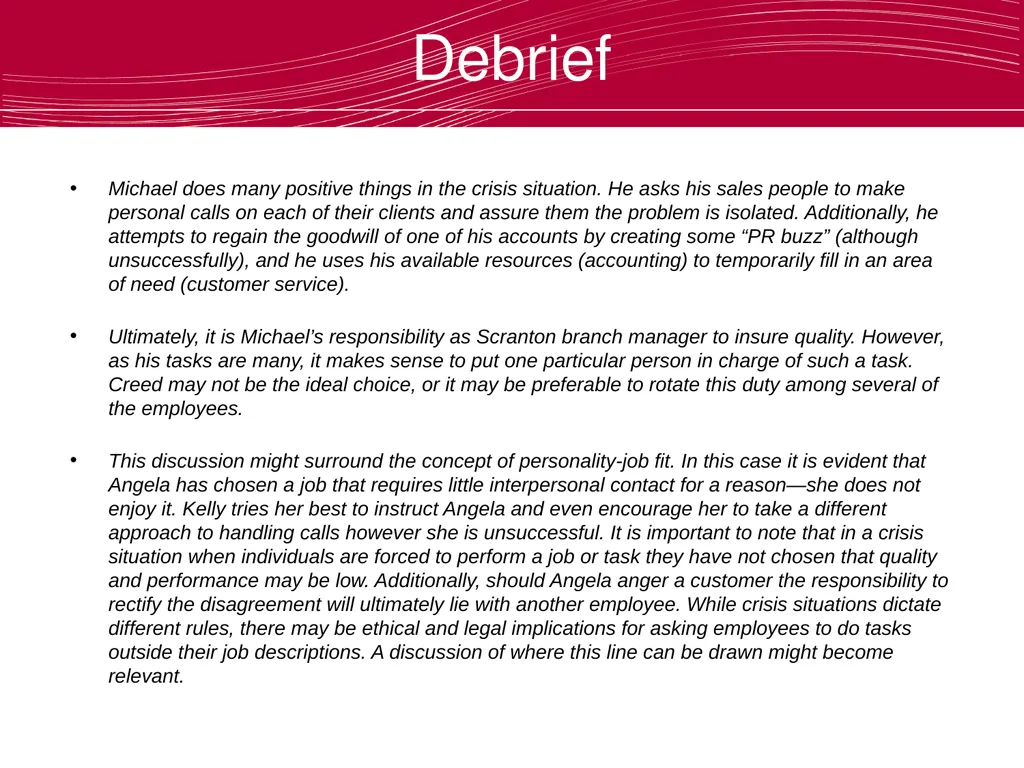
Debrief Michael does many positive things in the crisis situation. He asks his sales people to make personal calls on each of their clients and assure them the problem is isolated. Additionally, he attempts to regain the goodwill of one of his accounts by creating some “PR buzz” (although unsuccessfully), and he uses his available resources (accounting) to temporarily fill in an area of need (customer service).
Ultimately, it is Michael’s responsibility as Scranton branch manager to insure quality. However, as his tasks are many, it makes sense to put one particular person in charge of such a task. Creed may not be the ideal choice, or it may be preferable to rotate this duty among several of the employees.
This discussion might surround the concept of personality-job fit. In this case it is evident that Angela has chosen a job that requires little interpersonal contact for a reason—she does not enjoy it. Kelly tries her best to instruct Angela and even encourage her to take a different approach to handling calls however she is unsuccessful. It is important to note that in a crisis situation when individuals are forced to perform a job or task they have not chosen that quality and performance may be low. Additionally, should Angela anger a customer the responsibility to rectify the disagreement will ultimately lie with another employee. While crisis situations dictate different rules, there may be ethical and legal implications for asking employees to do tasks outside their job descriptions. A discussion of where this line can be drawn might become relevant.<br>
Ultimately, it is Michael’s responsibility as Scranton branch manager to insure quality. However, as his tasks are many, it makes sense to put one particular person in charge of such a task. Creed may not be the ideal choice, or it may be preferable to rotate this duty among several of the employees.
This discussion might surround the concept of personality-job fit. In this case it is evident that Angela has chosen a job that requires little interpersonal contact for a reason—she does not enjoy it. Kelly tries her best to instruct Angela and even encourage her to take a different approach to handling calls however she is unsuccessful. It is important to note that in a crisis situation when individuals are forced to perform a job or task they have not chosen that quality and performance may be low. Additionally, should Angela anger a customer the responsibility to rectify the disagreement will ultimately lie with another employee. While crisis situations dictate different rules, there may be ethical and legal implications for asking employees to do tasks outside their job descriptions. A discussion of where this line can be drawn might become relevant.<br>
30
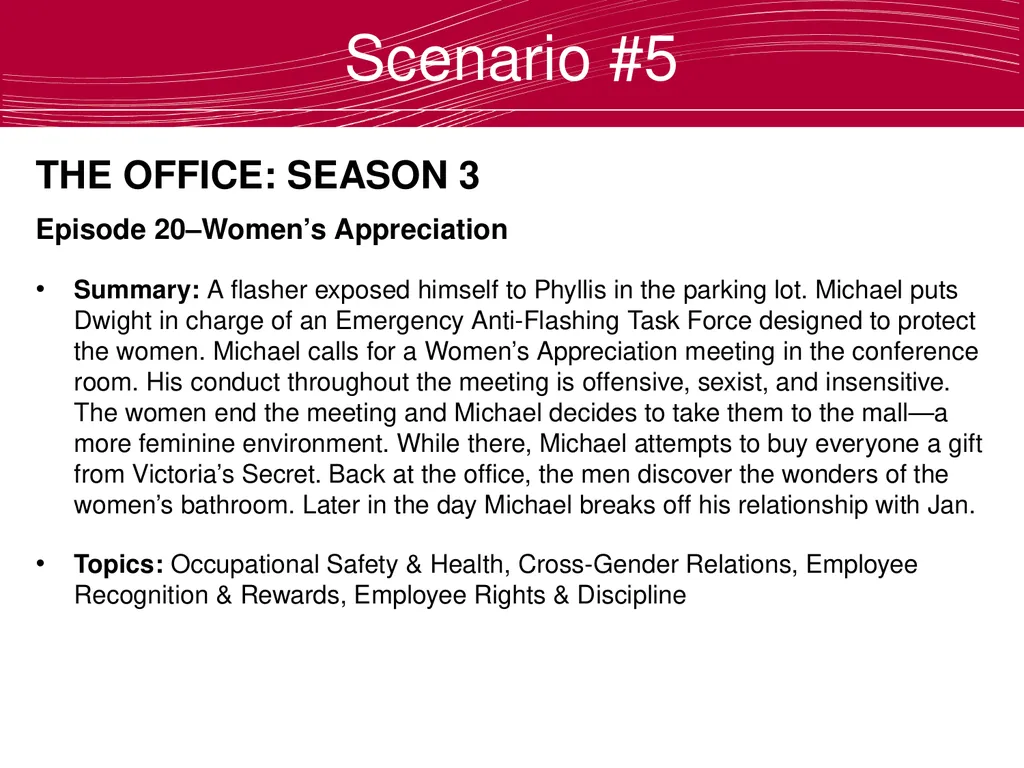
Scenario #5 THE OFFICE: SEASON 3
Episode 20–Women’s Appreciation
Summary: A flasher exposed himself to Phyllis in the parking lot. Michael puts Dwight in charge of an Emergency Anti-Flashing Task Force designed to protect the women. Michael calls for a Women’s Appreciation meeting in the conference room. His conduct throughout the meeting is offensive, sexist, and insensitive. The women end the meeting and Michael decides to take them to the mall—a more feminine environment. While there, Michael attempts to buy everyone a gift from Victoria’s Secret. Back at the office, the men discover the wonders of the women’s bathroom. Later in the day Michael breaks off his relationship with Jan.
Topics: Occupational Safety & Health, Cross-Gender Relations, Employee Recognition & Rewards, Employee Rights & Discipline<br>
Episode 20–Women’s Appreciation
Summary: A flasher exposed himself to Phyllis in the parking lot. Michael puts Dwight in charge of an Emergency Anti-Flashing Task Force designed to protect the women. Michael calls for a Women’s Appreciation meeting in the conference room. His conduct throughout the meeting is offensive, sexist, and insensitive. The women end the meeting and Michael decides to take them to the mall—a more feminine environment. While there, Michael attempts to buy everyone a gift from Victoria’s Secret. Back at the office, the men discover the wonders of the women’s bathroom. Later in the day Michael breaks off his relationship with Jan.
Topics: Occupational Safety & Health, Cross-Gender Relations, Employee Recognition & Rewards, Employee Rights & Discipline<br>
31
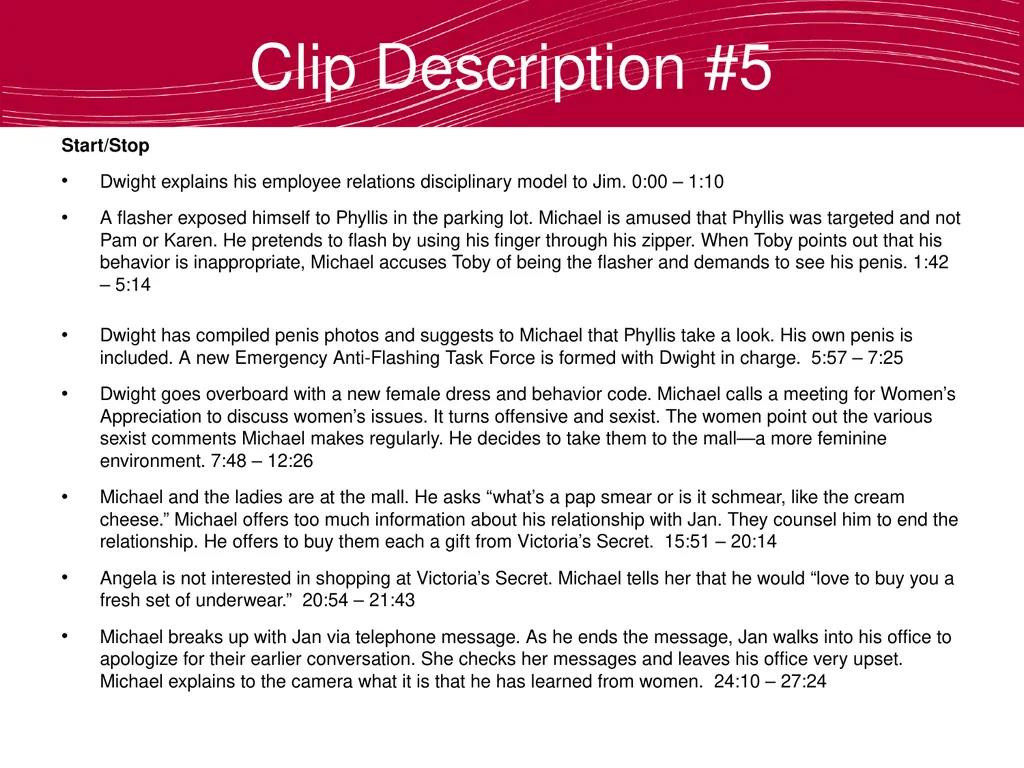
Clip Description #5 Start/Stop
Dwight explains his employee relations disciplinary model to Jim. 0:00 – 1:10
A flasher exposed himself to Phyllis in the parking lot. Michael is amused that Phyllis was targeted and not Pam or Karen. He pretends to flash by using his finger through his zipper. When Toby points out that his behavior is inappropriate, Michael accuses Toby of being the flasher and demands to see his penis. 1:42 – 5:14
Dwight has compiled penis photos and suggests to Michael that Phyllis take a look. His own penis is included. A new Emergency Anti-Flashing Task Force is formed with Dwight in charge. 5:57 – 7:25
Dwight goes overboard with a new female dress and behavior code. Michael calls a meeting for Women’s Appreciation to discuss women’s issues. It turns offensive and sexist. The women point out the various sexist comments Michael makes regularly. He decides to take them to the mall—a more feminine environment. 7:48 – 12:26
Michael and the ladies are at the mall. He asks “what’s a pap smear or is it schmear, like the cream cheese.” Michael offers too much information about his relationship with Jan. They counsel him to end the relationship. He offers to buy them each a gift from Victoria’s Secret. 15:51 – 20:14
Angela is not interested in shopping at Victoria’s Secret. Michael tells her that he would “love to buy you a fresh set of underwear.” 20:54 – 21:43
Michael breaks up with Jan via telephone message. As he ends the message, Jan walks into his office to apologize for their earlier conversation. She checks her messages and leaves his office very upset. Michael explains to the camera what it is that he has learned from women. 24:10 – 27:24<br>
Dwight explains his employee relations disciplinary model to Jim. 0:00 – 1:10
A flasher exposed himself to Phyllis in the parking lot. Michael is amused that Phyllis was targeted and not Pam or Karen. He pretends to flash by using his finger through his zipper. When Toby points out that his behavior is inappropriate, Michael accuses Toby of being the flasher and demands to see his penis. 1:42 – 5:14
Dwight has compiled penis photos and suggests to Michael that Phyllis take a look. His own penis is included. A new Emergency Anti-Flashing Task Force is formed with Dwight in charge. 5:57 – 7:25
Dwight goes overboard with a new female dress and behavior code. Michael calls a meeting for Women’s Appreciation to discuss women’s issues. It turns offensive and sexist. The women point out the various sexist comments Michael makes regularly. He decides to take them to the mall—a more feminine environment. 7:48 – 12:26
Michael and the ladies are at the mall. He asks “what’s a pap smear or is it schmear, like the cream cheese.” Michael offers too much information about his relationship with Jan. They counsel him to end the relationship. He offers to buy them each a gift from Victoria’s Secret. 15:51 – 20:14
Angela is not interested in shopping at Victoria’s Secret. Michael tells her that he would “love to buy you a fresh set of underwear.” 20:54 – 21:43
Michael breaks up with Jan via telephone message. As he ends the message, Jan walks into his office to apologize for their earlier conversation. She checks her messages and leaves his office very upset. Michael explains to the camera what it is that he has learned from women. 24:10 – 27:24<br>
32
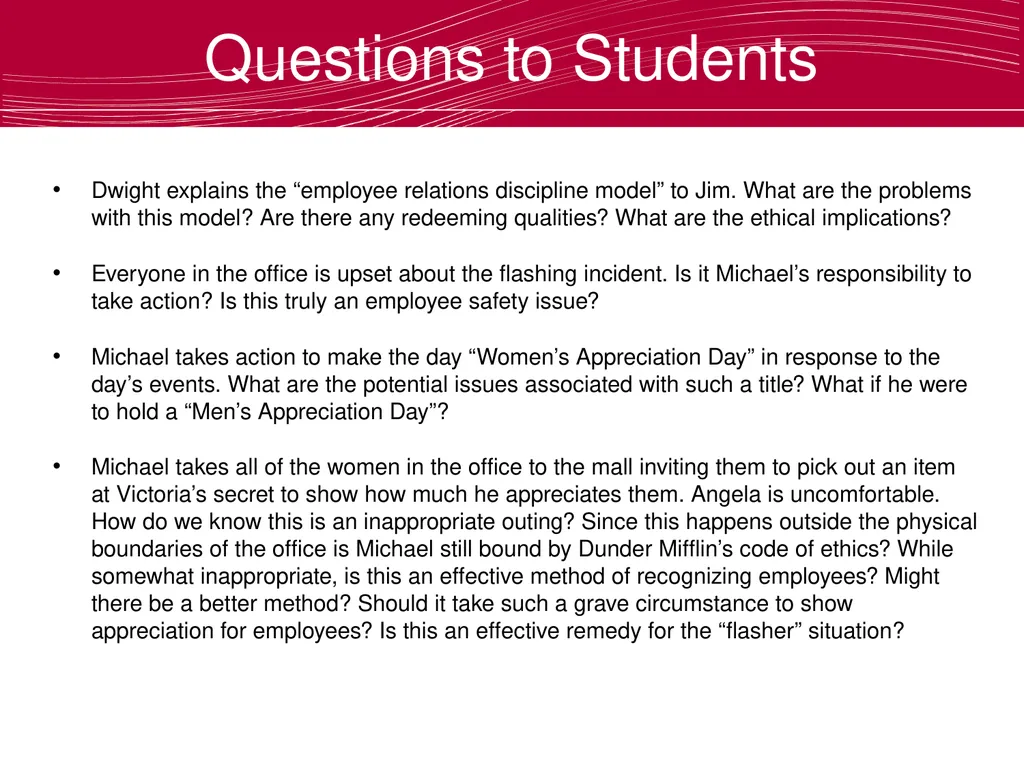
Questions to Students Dwight explains the “employee relations discipline model” to Jim. What are the problems with this model? Are there any redeeming qualities? What are the ethical implications?
Everyone in the office is upset about the flashing incident. Is it Michael’s responsibility to take action? Is this truly an employee safety issue?
Michael takes action to make the day “Women’s Appreciation Day” in response to the day’s events. What are the potential issues associated with such a title? What if he were to hold a “Men’s Appreciation Day”?
Michael takes all of the women in the office to the mall inviting them to pick out an item at Victoria’s secret to show how much he appreciates them. Angela is uncomfortable. How do we know this is an inappropriate outing? Since this happens outside the physical boundaries of the office is Michael still bound by Dunder Mifflin’s code of ethics? While somewhat inappropriate, is this an effective method of recognizing employees? Might there be a better method? Should it take such a grave circumstance to show appreciation for employees? Is this an effective remedy for the “flasher” situation?<br>
Everyone in the office is upset about the flashing incident. Is it Michael’s responsibility to take action? Is this truly an employee safety issue?
Michael takes action to make the day “Women’s Appreciation Day” in response to the day’s events. What are the potential issues associated with such a title? What if he were to hold a “Men’s Appreciation Day”?
Michael takes all of the women in the office to the mall inviting them to pick out an item at Victoria’s secret to show how much he appreciates them. Angela is uncomfortable. How do we know this is an inappropriate outing? Since this happens outside the physical boundaries of the office is Michael still bound by Dunder Mifflin’s code of ethics? While somewhat inappropriate, is this an effective method of recognizing employees? Might there be a better method? Should it take such a grave circumstance to show appreciation for employees? Is this an effective remedy for the “flasher” situation?<br>
33
Debrief Responses will vary. It is important to note that most firms will have their own very specific model of employee discipline although many will follow a familiar “progressive discipline” model.
If the event is perceived as a safety issue by the staff, then it IS a safety issue. Regardless of the feelings of management it is important as well as a requirement to provide an environment conducive to work. If someone feels unsafe, the environment is not conducive to work.
Discussion here will focus on the concept of a double standard, sort of similar to previous conversations about the “glass ceiling”, etc., except from a different angle. It is interesting to note the differences in these two conversations and discuss why they are different.
Michael’s attempt at recognition is admirable. His attempts do make some employees (Angela) uncomfortable and perhaps he should find a less provocative outlet for his reward behavior. While it was a great idea to remove a group of people (rather than just the one singular person “attacked” by the flasher) from the workplace to shift their focus, a longer term, more equitable program of recognition might have greater impact on the office. However, by recognizing this group at a tough time and attempting to make them feel more comfortable, Michael sends a message to all employees that he is concerned for their welfare.<br>
If the event is perceived as a safety issue by the staff, then it IS a safety issue. Regardless of the feelings of management it is important as well as a requirement to provide an environment conducive to work. If someone feels unsafe, the environment is not conducive to work.
Discussion here will focus on the concept of a double standard, sort of similar to previous conversations about the “glass ceiling”, etc., except from a different angle. It is interesting to note the differences in these two conversations and discuss why they are different.
Michael’s attempt at recognition is admirable. His attempts do make some employees (Angela) uncomfortable and perhaps he should find a less provocative outlet for his reward behavior. While it was a great idea to remove a group of people (rather than just the one singular person “attacked” by the flasher) from the workplace to shift their focus, a longer term, more equitable program of recognition might have greater impact on the office. However, by recognizing this group at a tough time and attempting to make them feel more comfortable, Michael sends a message to all employees that he is concerned for their welfare.<br>
34
Summary Use of “The Office” only limited by one’s imagination
Implications spread far beyond business ethics
Sample assignments
In class viewing/discussion
Semester end paper
choose 2 episodes and evaluate the ethical issues, apply theory, solve problems, etc.
Weekly “homework” assignment
watch this week’s episode and come to class prepared to discuss how the situation relates to the assigned reading<br>
Implications spread far beyond business ethics
Sample assignments
In class viewing/discussion
Semester end paper
choose 2 episodes and evaluate the ethical issues, apply theory, solve problems, etc.
Weekly “homework” assignment
watch this week’s episode and come to class prepared to discuss how the situation relates to the assigned reading<br>
35
For further reading… DelCampo, R.G., Rogers, K.M.& Van Buren, H.J. (2010). “A Mockumentary as a Mock-experience: Using ‘The Office’ to Solidify Understanding of Organizational Behavior Topics.” Journal of Organizational Behavior Education. Vol. 3 No.1. In press.
DelCampo, R.G., Boudwin, K.M. & Hines, S.L. (2008). “THAT’S WHAT SHE SAID!” A Guide to using “The Office” to Demonstrate Management Parables, Organizational Behavior and Human Resource Management Topics in the Management Classroom. Dubuque, IA: Kendall/Hunt.<br>
DelCampo, R.G., Boudwin, K.M. & Hines, S.L. (2008). “THAT’S WHAT SHE SAID!” A Guide to using “The Office” to Demonstrate Management Parables, Organizational Behavior and Human Resource Management Topics in the Management Classroom. Dubuque, IA: Kendall/Hunt.<br>