
Utility Assistance - What You Need to Know! July
EM
Published · 32 slides · 0 views

1 / 1



Description
Utility Assistance - What You Need to Know! July 26, 2023 Webinar for the Housing Alliance of Pennsylvania Gio Ortiz-Brackbill, Utility Justice Project Manager, GBrackbillpautilitylawproject.org Ria Pereira, Esq., Supervising Attorney,
Related Topics
Share
Embed code
Download this presentation From Below
"Utility Assistance - What You Need to Know! July" is the property of its rightful owner. Permission is granted to download and print the materials on this website for personal, non-commercial use only, and to display it on your personal computer provided you do not modify the materials and that you retain all copyright notices contained in the materials. By downloading content from our website, you accept the terms of this agreement.
Presentation Transcript
01
Utility Assistance - What You Need to Know!
July 26, 2023
Webinar for the Housing Alliance of Pennsylvania Gio Ortiz-Brackbill, Utility Justice Project Manager, GBrackbill@pautilitylawproject.org
Ria Pereira, Esq., Supervising Attorney, RPereira@pautilitylawproject.org
Pennsylvania Utility Law Project 1<br>
Ria Pereira, Esq., Supervising Attorney, RPereira@pautilitylawproject.org
Pennsylvania Utility Law Project 1<br>
02
Pennsylvania Utility Law Project PULP is a statewide legal services project of Regional Housing Legal Services and is a member of the Pennsylvania Legal Aid Network.
PULP’s mission is to secure just and equitable access to safe and affordable utility services for Pennsylvanians experiencing poverty.
We work to achieve our mission by empowering individuals and communities through:
Legal Representation, Groups, and Individuals
Education and Training
Policy Advocacy
Supportive Services
Consultation 2<br>
PULP’s mission is to secure just and equitable access to safe and affordable utility services for Pennsylvanians experiencing poverty.
We work to achieve our mission by empowering individuals and communities through:
Legal Representation, Groups, and Individuals
Education and Training
Policy Advocacy
Supportive Services
Consultation 2<br>
03
Agenda Regulated vs. Unregulated Utilities
Utility Affordability
Preventing Termination
Connecting / Reconnecting Service
Tenant Protections
PUC Dispute Process
Resources/Referrals 3<br>
Utility Affordability
Preventing Termination
Connecting / Reconnecting Service
Tenant Protections
PUC Dispute Process
Resources/Referrals 3<br>
04
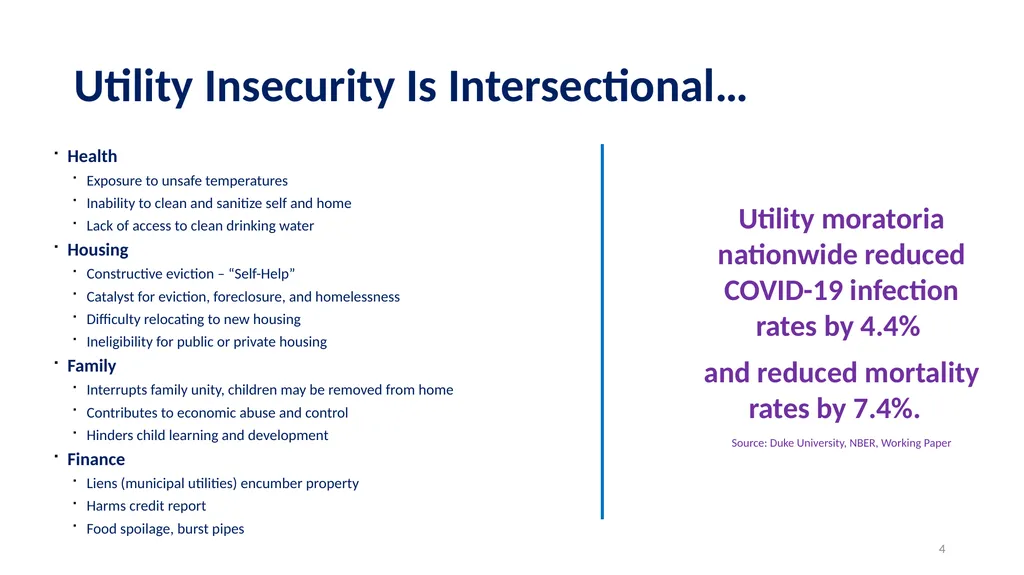
Utility moratoria nationwide reduced COVID-19 infection rates by 4.4%
and reduced mortality rates by 7.4%.
Source: Duke University, NBER, Working Paper Health
Exposure to unsafe temperatures
Inability to clean and sanitize self and home
Lack of access to clean drinking water
Housing
Constructive eviction – “Self-Help”
Catalyst for eviction, foreclosure, and homelessness
Difficulty relocating to new housing
Ineligibility for public or private housing
Family
Interrupts family unity, children may be removed from home
Contributes to economic abuse and control
Hinders child learning and development
Finance
Liens (municipal utilities) encumber property
Harms credit report
Food spoilage, burst pipes Utility Insecurity Is Intersectional… 4<br>
and reduced mortality rates by 7.4%.
Source: Duke University, NBER, Working Paper Health
Exposure to unsafe temperatures
Inability to clean and sanitize self and home
Lack of access to clean drinking water
Housing
Constructive eviction – “Self-Help”
Catalyst for eviction, foreclosure, and homelessness
Difficulty relocating to new housing
Ineligibility for public or private housing
Family
Interrupts family unity, children may be removed from home
Contributes to economic abuse and control
Hinders child learning and development
Finance
Liens (municipal utilities) encumber property
Harms credit report
Food spoilage, burst pipes Utility Insecurity Is Intersectional… 4<br>
05
Utility Affordability 5<br>
06
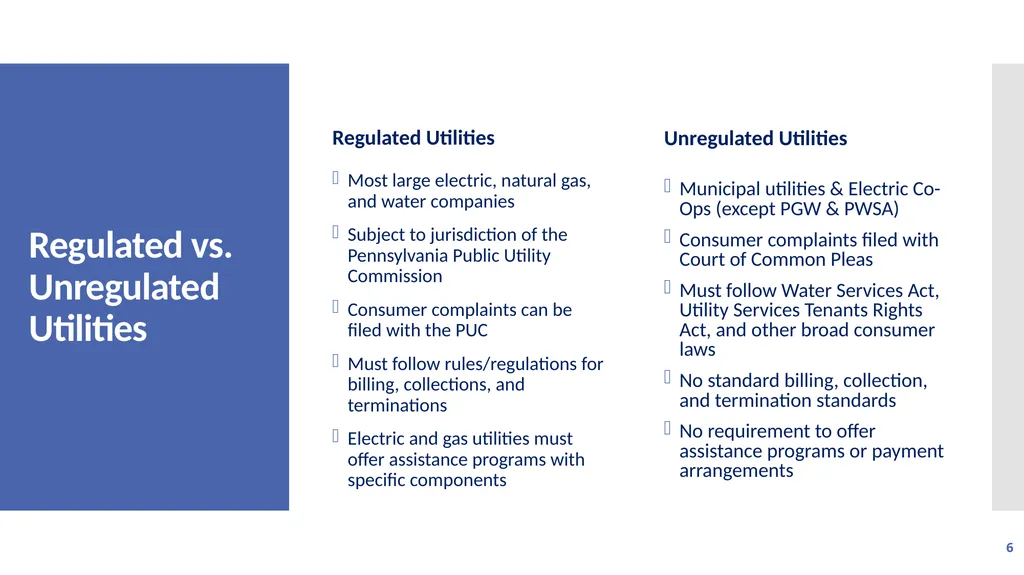
Regulated vs. Unregulated Utilities Regulated Utilities Most large electric, natural gas, and water companies
Subject to jurisdiction of the Pennsylvania Public Utility Commission
Consumer complaints can be filed with the PUC
Must follow rules/regulations for billing, collections, and terminations
Electric and gas utilities must offer assistance programs with specific components Unregulated Utilities Municipal utilities & Electric Co-Ops (except PGW & PWSA)
Consumer complaints filed with Court of Common Pleas
Must follow Water Services Act, Utility Services Tenants Rights Act, and other broad consumer laws
No standard billing, collection, and termination standards
No requirement to offer assistance programs or payment arrangements 6<br>
Subject to jurisdiction of the Pennsylvania Public Utility Commission
Consumer complaints can be filed with the PUC
Must follow rules/regulations for billing, collections, and terminations
Electric and gas utilities must offer assistance programs with specific components Unregulated Utilities Municipal utilities & Electric Co-Ops (except PGW & PWSA)
Consumer complaints filed with Court of Common Pleas
Must follow Water Services Act, Utility Services Tenants Rights Act, and other broad consumer laws
No standard billing, collection, and termination standards
No requirement to offer assistance programs or payment arrangements 6<br>
07
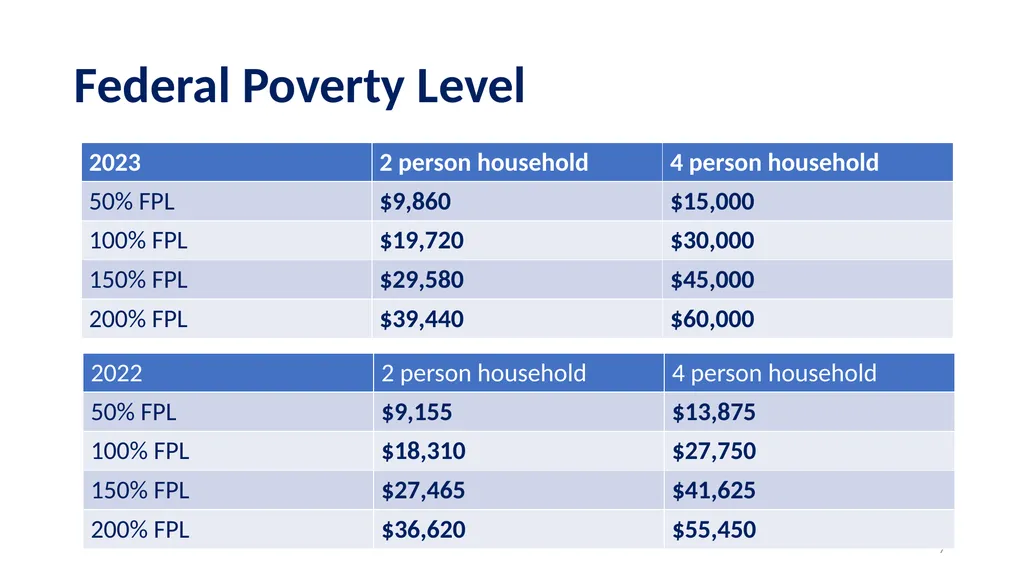
Federal Poverty Level 7<br>
08
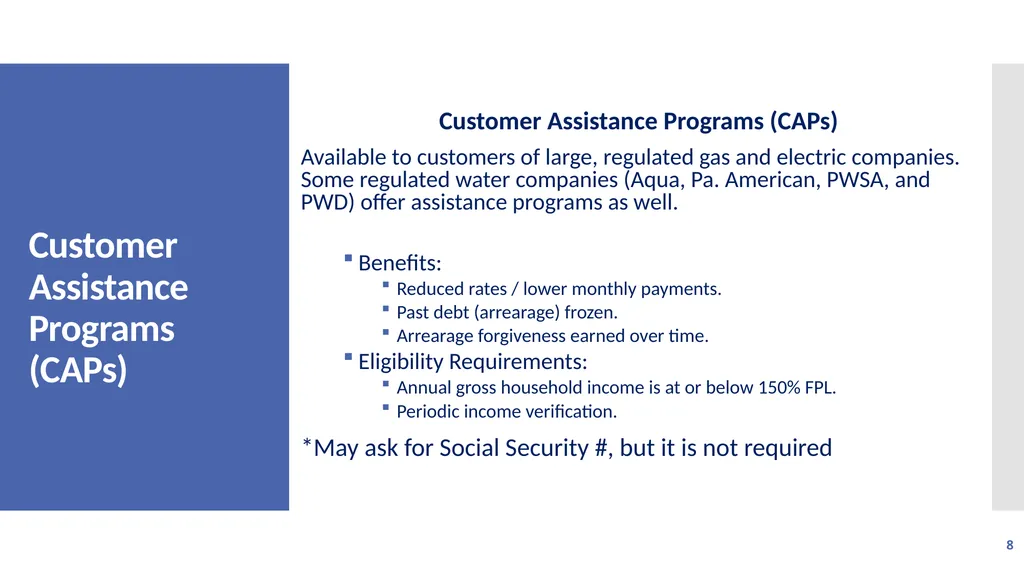
Customer Assistance Programs (CAPs) Customer Assistance Programs (CAPs)
Available to customers of large, regulated gas and electric companies. Some regulated water companies (Aqua, Pa. American, PWSA, and PWD) offer assistance programs as well.
Benefits:
Reduced rates / lower monthly payments.
Past debt (arrearage) frozen.
Arrearage forgiveness earned over time.
Eligibility Requirements:
Annual gross household income is at or below 150% FPL.
Periodic income verification.
*May ask for Social Security #, but it is not required 8<br>
Available to customers of large, regulated gas and electric companies. Some regulated water companies (Aqua, Pa. American, PWSA, and PWD) offer assistance programs as well.
Benefits:
Reduced rates / lower monthly payments.
Past debt (arrearage) frozen.
Arrearage forgiveness earned over time.
Eligibility Requirements:
Annual gross household income is at or below 150% FPL.
Periodic income verification.
*May ask for Social Security #, but it is not required 8<br>
09
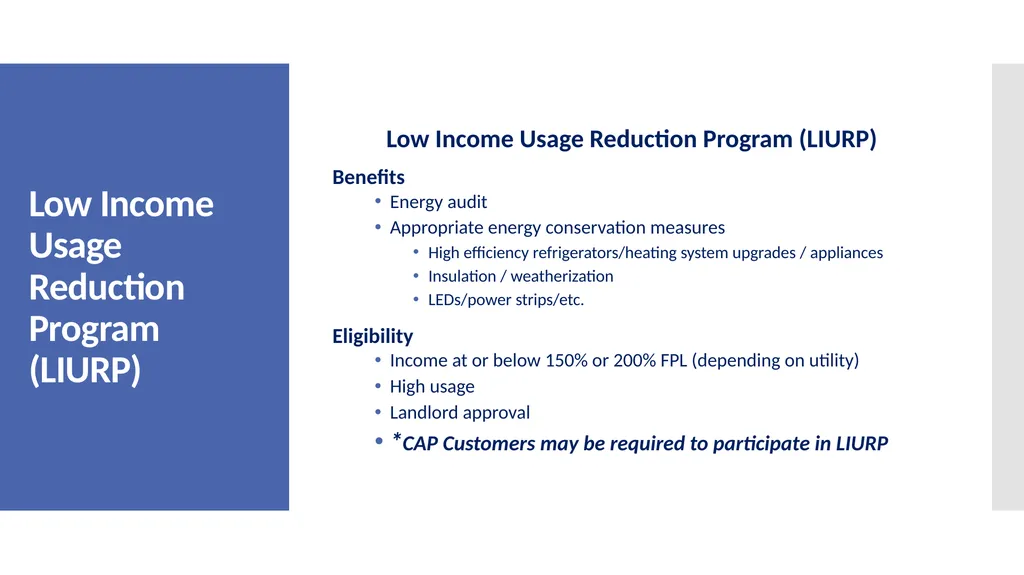
Low Income Usage Reduction Program (LIURP) Low Income Usage Reduction Program (LIURP)
Benefits
Energy audit
Appropriate energy conservation measures
High efficiency refrigerators/heating system upgrades / appliances
Insulation / weatherization
LEDs/power strips/etc.
Eligibility
Income at or below 150% or 200% FPL (depending on utility)
High usage
Landlord approval
*CAP Customers may be required to participate in LIURP Low Income Usage Reduction Program (LIURP)<br>
Benefits
Energy audit
Appropriate energy conservation measures
High efficiency refrigerators/heating system upgrades / appliances
Insulation / weatherization
LEDs/power strips/etc.
Eligibility
Income at or below 150% or 200% FPL (depending on utility)
High usage
Landlord approval
*CAP Customers may be required to participate in LIURP Low Income Usage Reduction Program (LIURP)<br>
10
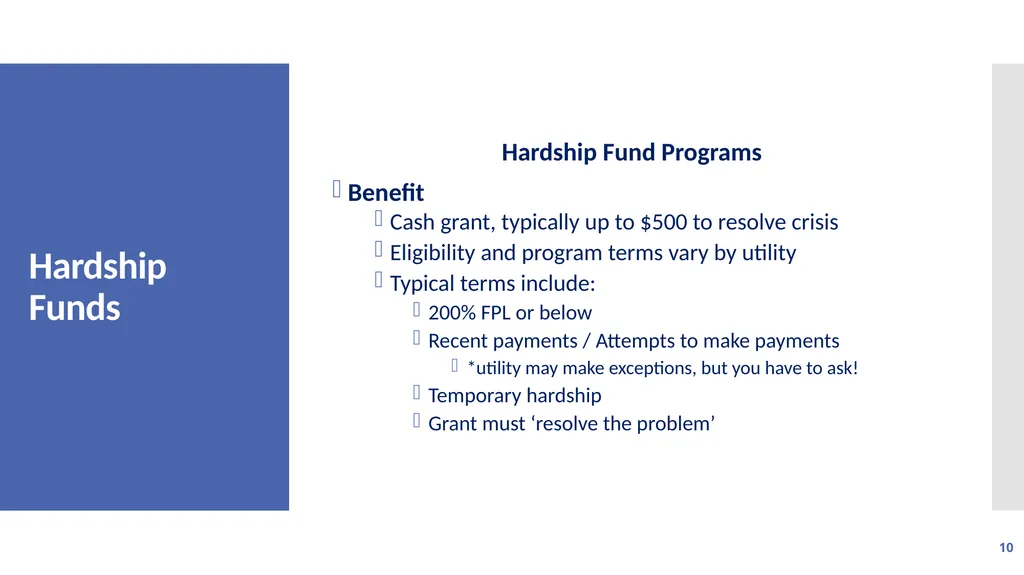
Hardship Funds Hardship Fund Programs
Benefit
Cash grant, typically up to $500 to resolve crisis
Eligibility and program terms vary by utility
Typical terms include:
200% FPL or below
Recent payments / Attempts to make payments
*utility may make exceptions, but you have to ask!
Temporary hardship
Grant must ‘resolve the problem’ 10<br>
Benefit
Cash grant, typically up to $500 to resolve crisis
Eligibility and program terms vary by utility
Typical terms include:
200% FPL or below
Recent payments / Attempts to make payments
*utility may make exceptions, but you have to ask!
Temporary hardship
Grant must ‘resolve the problem’ 10<br>
11
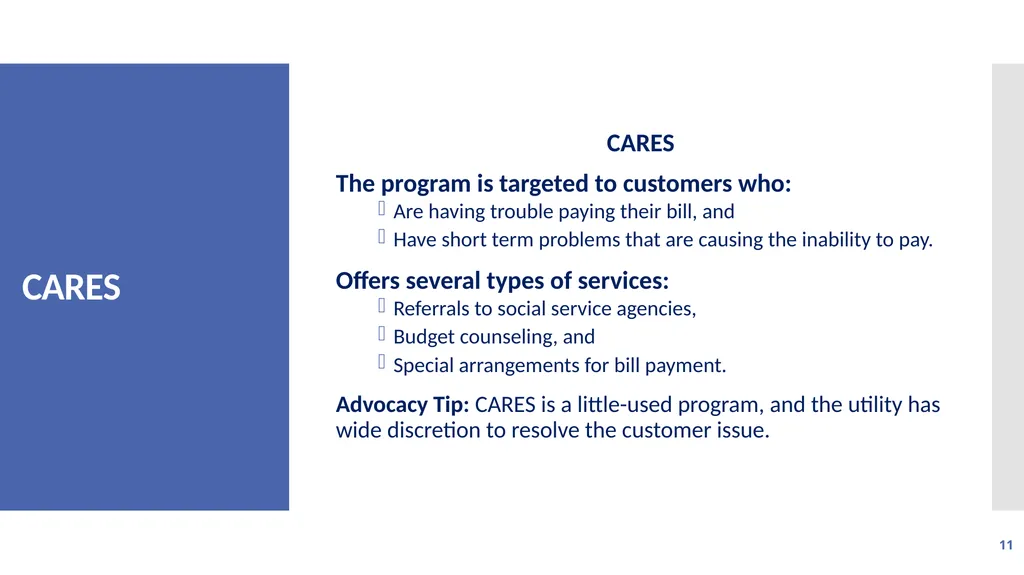
CARES
The program is targeted to customers who:
Are having trouble paying their bill, and
Have short term problems that are causing the inability to pay.
Offers several types of services:
Referrals to social service agencies,
Budget counseling, and
Special arrangements for bill payment.
Advocacy Tip: CARES is a little-used program, and the utility has wide discretion to resolve the customer issue. CARES 11<br>
The program is targeted to customers who:
Are having trouble paying their bill, and
Have short term problems that are causing the inability to pay.
Offers several types of services:
Referrals to social service agencies,
Budget counseling, and
Special arrangements for bill payment.
Advocacy Tip: CARES is a little-used program, and the utility has wide discretion to resolve the customer issue. CARES 11<br>
12
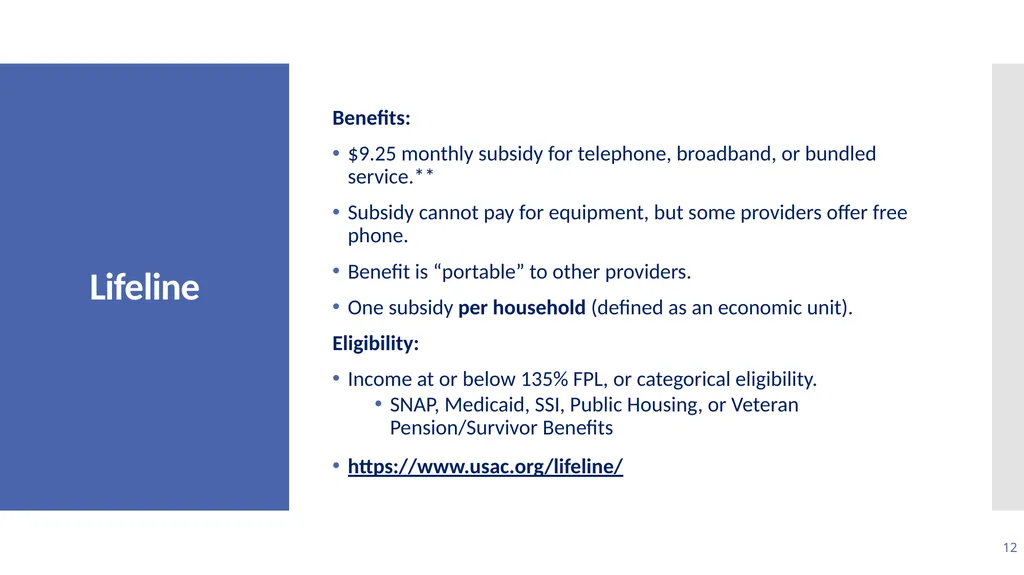
Lifeline Benefits:
$9.25 monthly subsidy for telephone, broadband, or bundled service.**
Subsidy cannot pay for equipment, but some providers offer free phone.
Benefit is “portable” to other providers.
One subsidy per household (defined as an economic unit).
Eligibility:
Income at or below 135% FPL, or categorical eligibility.
SNAP, Medicaid, SSI, Public Housing, or Veteran Pension/Survivor Benefits
https://www.usac.org/lifeline/ 12<br>
$9.25 monthly subsidy for telephone, broadband, or bundled service.**
Subsidy cannot pay for equipment, but some providers offer free phone.
Benefit is “portable” to other providers.
One subsidy per household (defined as an economic unit).
Eligibility:
Income at or below 135% FPL, or categorical eligibility.
SNAP, Medicaid, SSI, Public Housing, or Veteran Pension/Survivor Benefits
https://www.usac.org/lifeline/ 12<br>
13
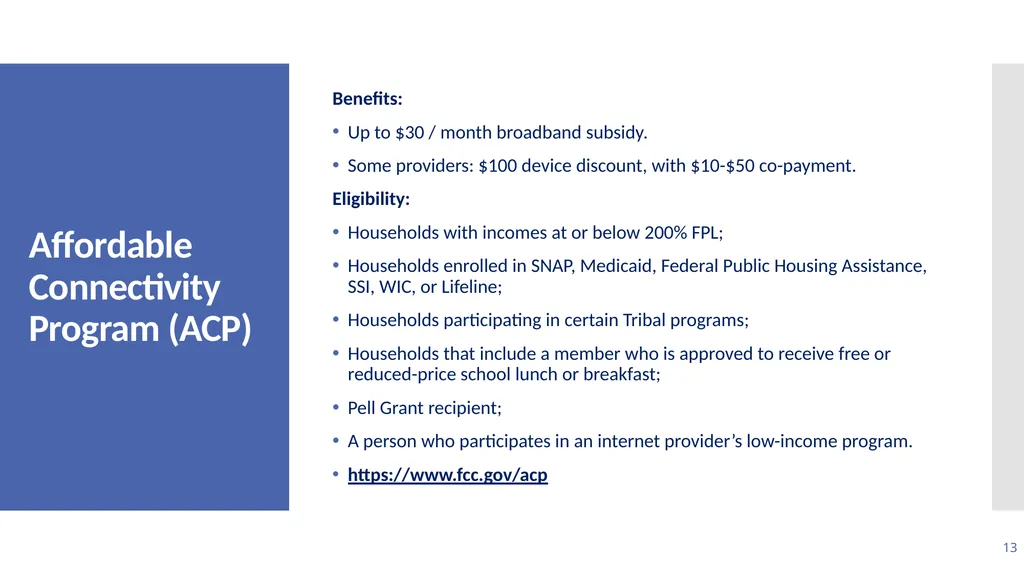
Affordable Connectivity Program (ACP) Benefits:
Up to $30 / month broadband subsidy.
Some providers: $100 device discount, with $10-$50 co-payment.
Eligibility:
Households with incomes at or below 200% FPL;
Households enrolled in SNAP, Medicaid, Federal Public Housing Assistance, SSI, WIC, or Lifeline;
Households participating in certain Tribal programs;
Households that include a member who is approved to receive free or reduced-price school lunch or breakfast;
Pell Grant recipient;
A person who participates in an internet provider’s low-income program.
https://www.fcc.gov/acp 13<br>
Up to $30 / month broadband subsidy.
Some providers: $100 device discount, with $10-$50 co-payment.
Eligibility:
Households with incomes at or below 200% FPL;
Households enrolled in SNAP, Medicaid, Federal Public Housing Assistance, SSI, WIC, or Lifeline;
Households participating in certain Tribal programs;
Households that include a member who is approved to receive free or reduced-price school lunch or breakfast;
Pell Grant recipient;
A person who participates in an internet provider’s low-income program.
https://www.fcc.gov/acp 13<br>
14
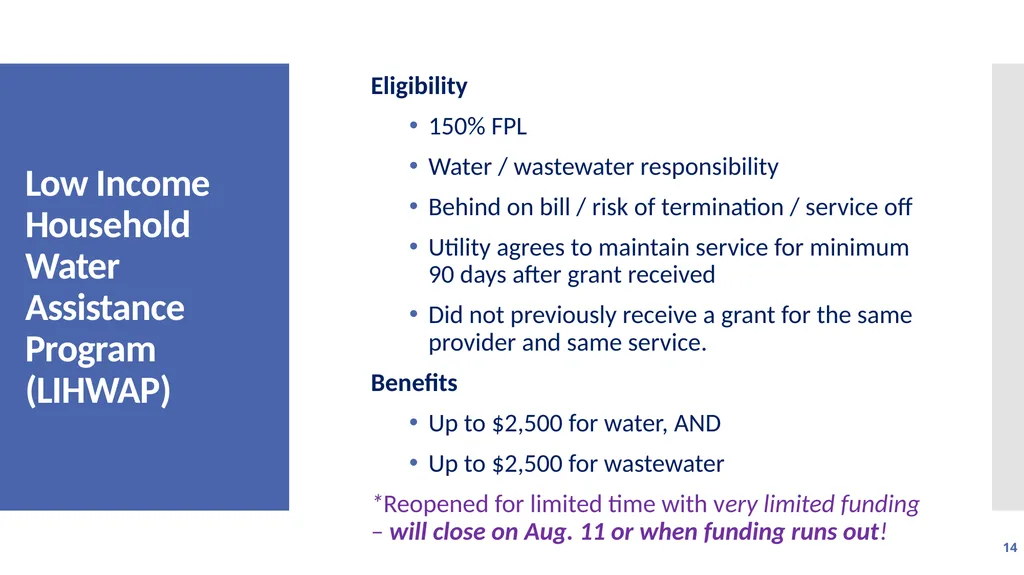
Low Income Household Water Assistance Program (LIHWAP) Eligibility
150% FPL
Water / wastewater responsibility
Behind on bill / risk of termination / service off
Utility agrees to maintain service for minimum 90 days after grant received
Did not previously receive a grant for the same provider and same service.
Benefits
Up to $2,500 for water, AND
Up to $2,500 for wastewater
*Reopened for limited time with very limited funding – will close on Aug. 11 or when funding runs out! 14<br>
150% FPL
Water / wastewater responsibility
Behind on bill / risk of termination / service off
Utility agrees to maintain service for minimum 90 days after grant received
Did not previously receive a grant for the same provider and same service.
Benefits
Up to $2,500 for water, AND
Up to $2,500 for wastewater
*Reopened for limited time with very limited funding – will close on Aug. 11 or when funding runs out! 14<br>
15
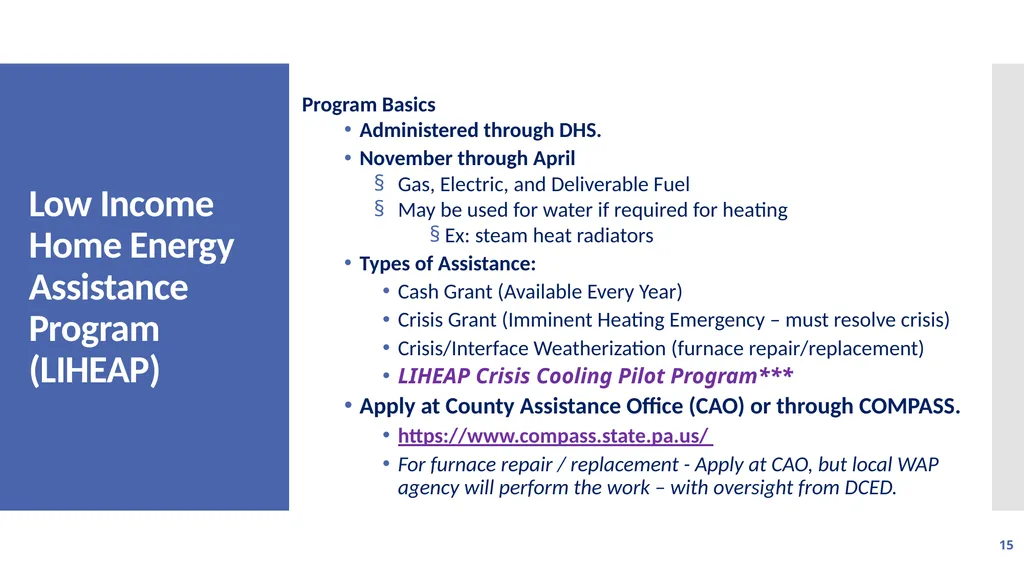
Low Income Home Energy Assistance Program (LIHEAP) Program Basics
Administered through DHS.
November through April
Gas, Electric, and Deliverable Fuel
May be used for water if required for heating
Ex: steam heat radiators
Types of Assistance:
Cash Grant (Available Every Year)
Crisis Grant (Imminent Heating Emergency – must resolve crisis)
Crisis/Interface Weatherization (furnace repair/replacement)
LIHEAP Crisis Cooling Pilot Program***
Apply at County Assistance Office (CAO) or through COMPASS.
https://www.compass.state.pa.us/
For furnace repair / replacement - Apply at CAO, but local WAP agency will perform the work – with oversight from DCED. 15<br>
Administered through DHS.
November through April
Gas, Electric, and Deliverable Fuel
May be used for water if required for heating
Ex: steam heat radiators
Types of Assistance:
Cash Grant (Available Every Year)
Crisis Grant (Imminent Heating Emergency – must resolve crisis)
Crisis/Interface Weatherization (furnace repair/replacement)
LIHEAP Crisis Cooling Pilot Program***
Apply at County Assistance Office (CAO) or through COMPASS.
https://www.compass.state.pa.us/
For furnace repair / replacement - Apply at CAO, but local WAP agency will perform the work – with oversight from DCED. 15<br>
16
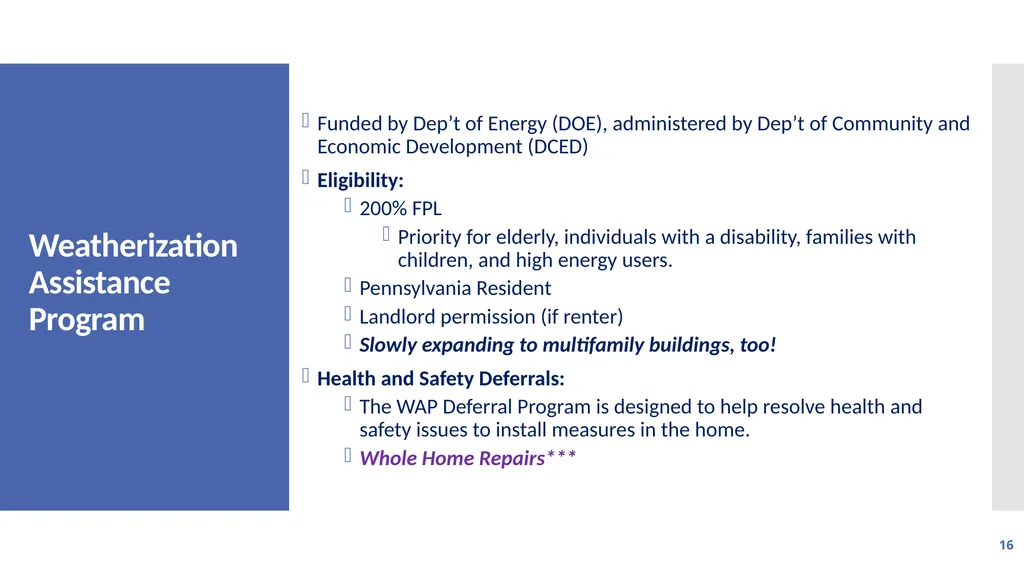
Weatherization Assistance Program Funded by Dep’t of Energy (DOE), administered by Dep’t of Community and Economic Development (DCED)
Eligibility:
200% FPL
Priority for elderly, individuals with a disability, families with children, and high energy users.
Pennsylvania Resident
Landlord permission (if renter)
Slowly expanding to multifamily buildings, too!
Health and Safety Deferrals:
The WAP Deferral Program is designed to help resolve health and safety issues to install measures in the home.
Whole Home Repairs*** 16<br>
Eligibility:
200% FPL
Priority for elderly, individuals with a disability, families with children, and high energy users.
Pennsylvania Resident
Landlord permission (if renter)
Slowly expanding to multifamily buildings, too!
Health and Safety Deferrals:
The WAP Deferral Program is designed to help resolve health and safety issues to install measures in the home.
Whole Home Repairs*** 16<br>
17
Connecting / Reconnecting Service 17<br>
18
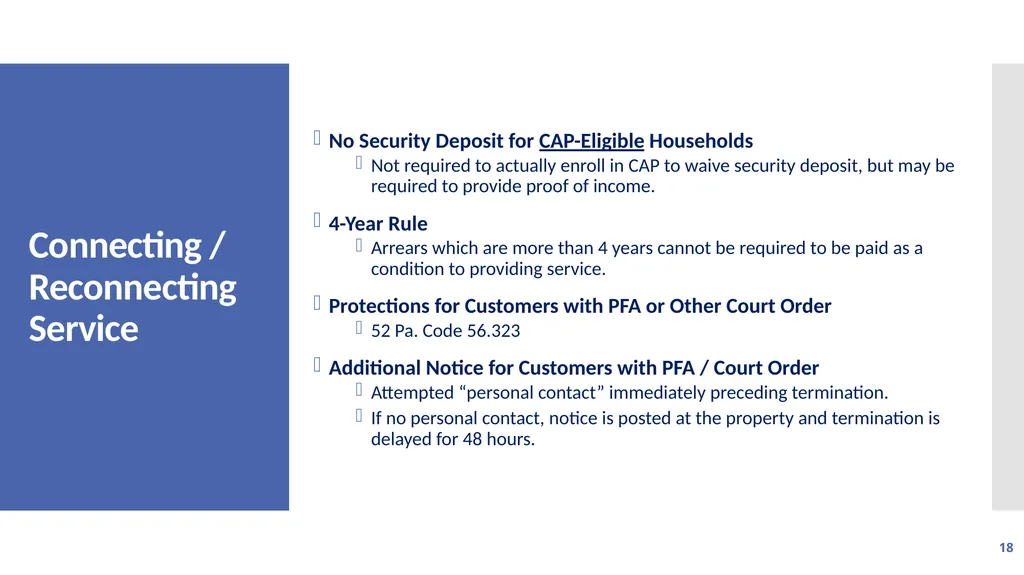
Connecting / Reconnecting Service No Security Deposit for CAP-Eligible Households
Not required to actually enroll in CAP to waive security deposit, but may be required to provide proof of income.
4-Year Rule
Arrears which are more than 4 years cannot be required to be paid as a condition to providing service.
Protections for Customers with PFA or Other Court Order
52 Pa. Code 56.323
Additional Notice for Customers with PFA / Court Order
Attempted “personal contact” immediately preceding termination.
If no personal contact, notice is posted at the property and termination is delayed for 48 hours. 18<br>
Not required to actually enroll in CAP to waive security deposit, but may be required to provide proof of income.
4-Year Rule
Arrears which are more than 4 years cannot be required to be paid as a condition to providing service.
Protections for Customers with PFA or Other Court Order
52 Pa. Code 56.323
Additional Notice for Customers with PFA / Court Order
Attempted “personal contact” immediately preceding termination.
If no personal contact, notice is posted at the property and termination is delayed for 48 hours. 18<br>
19
Preventing Termination 19<br>
20
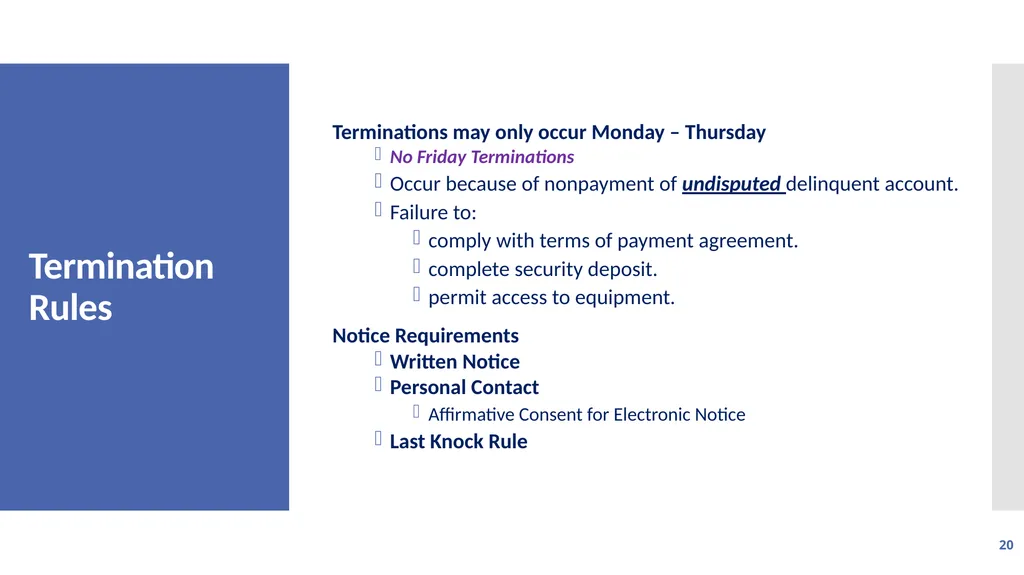
Termination Rules Terminations may only occur Monday – Thursday
No Friday Terminations
Occur because of nonpayment of undisputed delinquent account.
Failure to:
comply with terms of payment agreement.
complete security deposit.
permit access to equipment.
Notice Requirements
Written Notice
Personal Contact
Affirmative Consent for Electronic Notice
Last Knock Rule 20<br>
No Friday Terminations
Occur because of nonpayment of undisputed delinquent account.
Failure to:
comply with terms of payment agreement.
complete security deposit.
permit access to equipment.
Notice Requirements
Written Notice
Personal Contact
Affirmative Consent for Electronic Notice
Last Knock Rule 20<br>
21
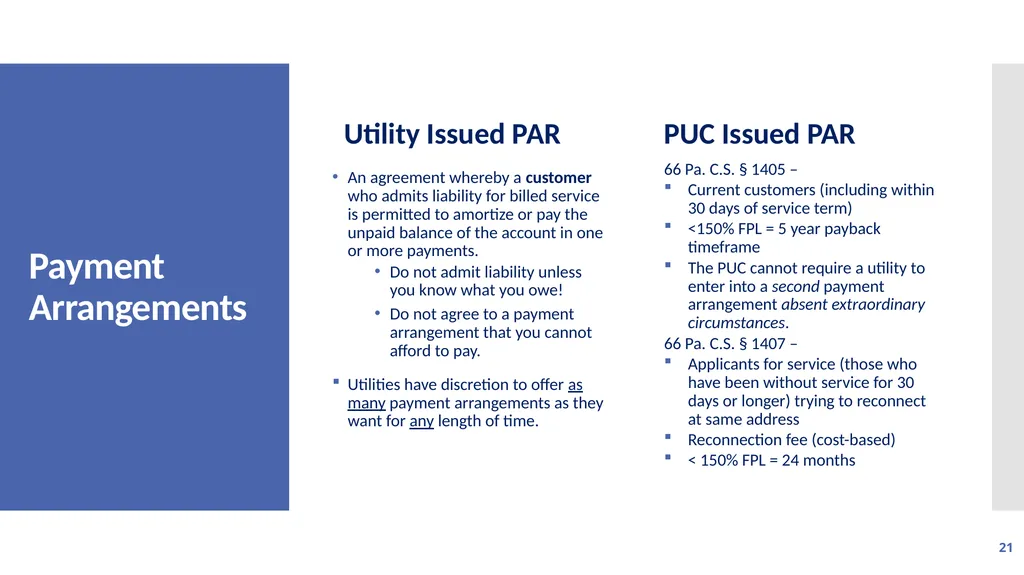
Payment Arrangements An agreement whereby a customer who admits liability for billed service is permitted to amortize or pay the unpaid balance of the account in one or more payments.
Do not admit liability unless you know what you owe!
Do not agree to a payment arrangement that you cannot afford to pay.
Utilities have discretion to offer as many payment arrangements as they want for any length of time. PUC Issued PAR 66 Pa. C.S. § 1405 –
Current customers (including within 30 days of service term)
<150% FPL = 5 year payback timeframe
The PUC cannot require a utility to enter into a second payment arrangement absent extraordinary circumstances.
66 Pa. C.S. § 1407 –
Applicants for service (those who have been without service for 30 days or longer) trying to reconnect at same address
Reconnection fee (cost-based)
< 150% FPL = 24 months Utility Issued PAR 21<br>
Do not admit liability unless you know what you owe!
Do not agree to a payment arrangement that you cannot afford to pay.
Utilities have discretion to offer as many payment arrangements as they want for any length of time. PUC Issued PAR 66 Pa. C.S. § 1405 –
Current customers (including within 30 days of service term)
<150% FPL = 5 year payback timeframe
The PUC cannot require a utility to enter into a second payment arrangement absent extraordinary circumstances.
66 Pa. C.S. § 1407 –
Applicants for service (those who have been without service for 30 days or longer) trying to reconnect at same address
Reconnection fee (cost-based)
< 150% FPL = 24 months Utility Issued PAR 21<br>
22
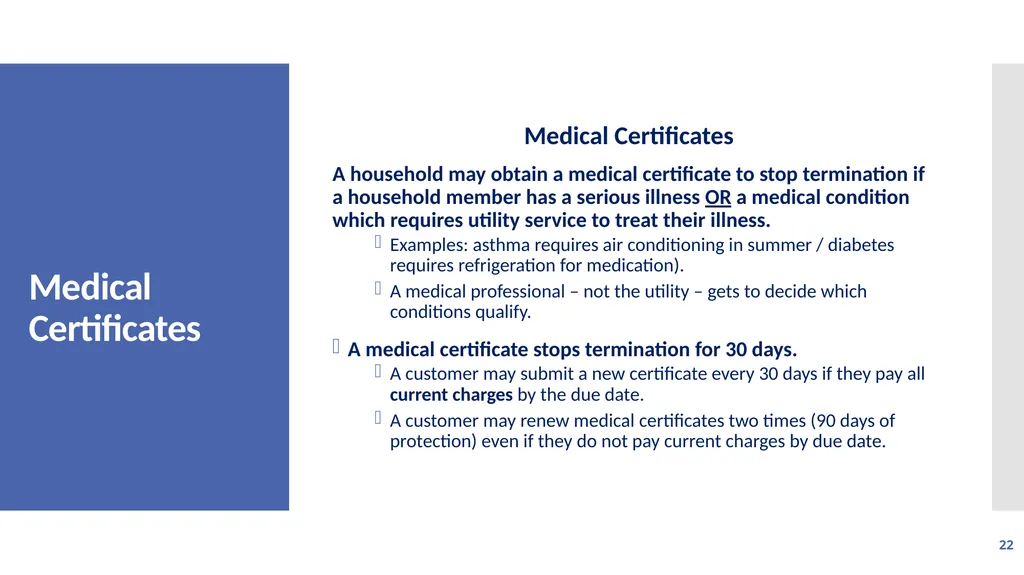
Medical Certificates Medical Certificates
A household may obtain a medical certificate to stop termination if a household member has a serious illness OR a medical condition which requires utility service to treat their illness.
Examples: asthma requires air conditioning in summer / diabetes requires refrigeration for medication).
A medical professional – not the utility – gets to decide which conditions qualify.
A medical certificate stops termination for 30 days.
A customer may submit a new certificate every 30 days if they pay all current charges by the due date.
A customer may renew medical certificates two times (90 days of protection) even if they do not pay current charges by due date. 22<br>
A household may obtain a medical certificate to stop termination if a household member has a serious illness OR a medical condition which requires utility service to treat their illness.
Examples: asthma requires air conditioning in summer / diabetes requires refrigeration for medication).
A medical professional – not the utility – gets to decide which conditions qualify.
A medical certificate stops termination for 30 days.
A customer may submit a new certificate every 30 days if they pay all current charges by the due date.
A customer may renew medical certificates two times (90 days of protection) even if they do not pay current charges by due date. 22<br>
23
Tenant Protections 23<br>
24
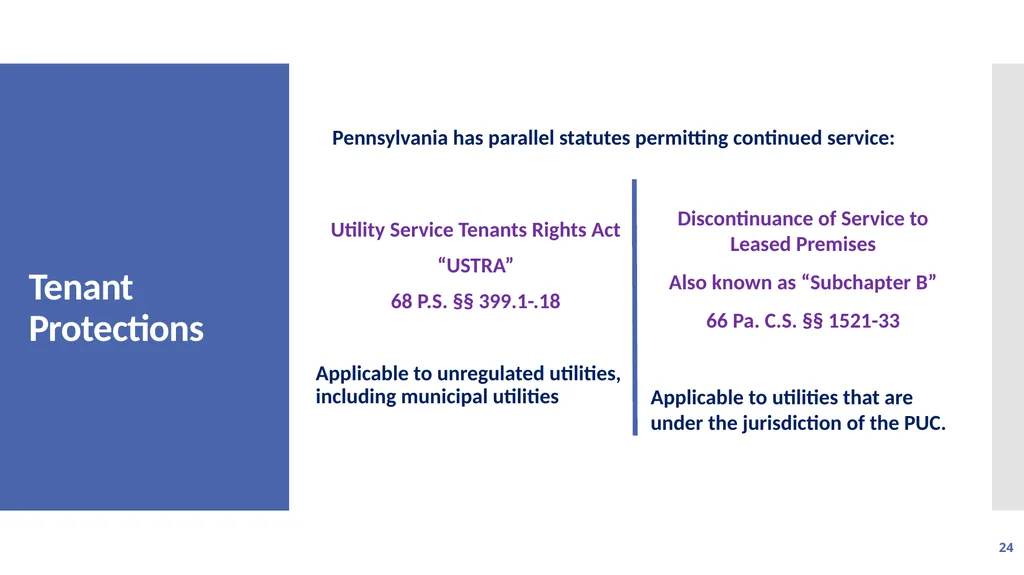
Tenant Protections Pennsylvania has parallel statutes permitting continued service: Utility Service Tenants Rights Act
“USTRA”
68 P.S. §§ 399.1-.18
Applicable to unregulated utilities, including municipal utilities Discontinuance of Service to Leased Premises
Also known as “Subchapter B”
66 Pa. C.S. §§ 1521-33
Applicable to utilities that are under the jurisdiction of the PUC. 24<br>
“USTRA”
68 P.S. §§ 399.1-.18
Applicable to unregulated utilities, including municipal utilities Discontinuance of Service to Leased Premises
Also known as “Subchapter B”
66 Pa. C.S. §§ 1521-33
Applicable to utilities that are under the jurisdiction of the PUC. 24<br>
25
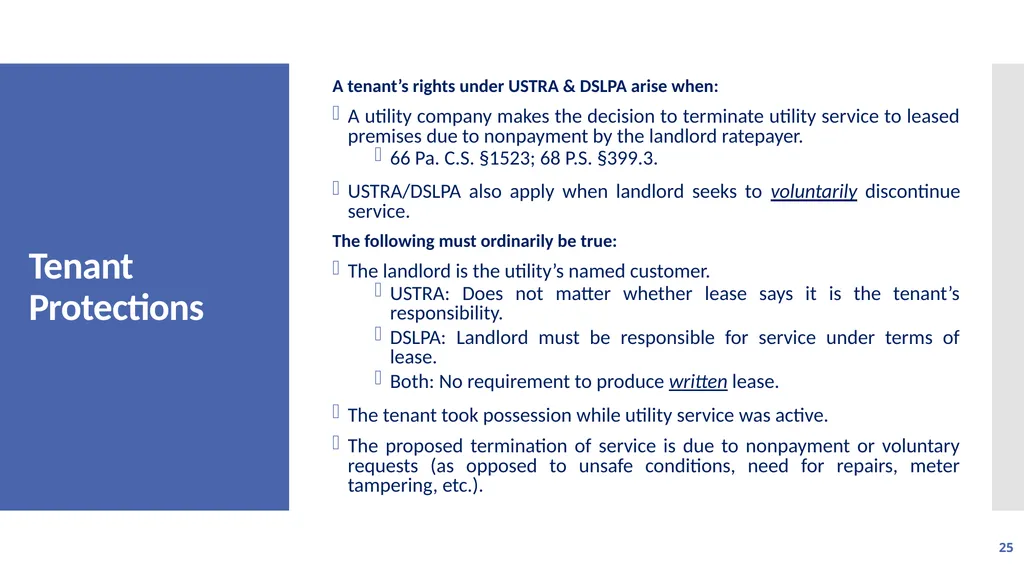
Tenant Protections A tenant’s rights under USTRA & DSLPA arise when:
A utility company makes the decision to terminate utility service to leased premises due to nonpayment by the landlord ratepayer.
66 Pa. C.S. §1523; 68 P.S. §399.3.
USTRA/DSLPA also apply when landlord seeks to voluntarily discontinue service.
The following must ordinarily be true:
The landlord is the utility’s named customer.
USTRA: Does not matter whether lease says it is the tenant’s responsibility.
DSLPA: Landlord must be responsible for service under terms of lease.
Both: No requirement to produce written lease.
The tenant took possession while utility service was active.
The proposed termination of service is due to nonpayment or voluntary requests (as opposed to unsafe conditions, need for repairs, meter tampering, etc.). 25<br>
A utility company makes the decision to terminate utility service to leased premises due to nonpayment by the landlord ratepayer.
66 Pa. C.S. §1523; 68 P.S. §399.3.
USTRA/DSLPA also apply when landlord seeks to voluntarily discontinue service.
The following must ordinarily be true:
The landlord is the utility’s named customer.
USTRA: Does not matter whether lease says it is the tenant’s responsibility.
DSLPA: Landlord must be responsible for service under terms of lease.
Both: No requirement to produce written lease.
The tenant took possession while utility service was active.
The proposed termination of service is due to nonpayment or voluntary requests (as opposed to unsafe conditions, need for repairs, meter tampering, etc.). 25<br>
26
Tenant’s Right to Notice and Continued Service If a utility is in the landlord’s name, and the landlord does not pay, a renter must be:
Notified of the landlord’s arrearages 30 days in advance of termination.
Given an opportunity to pay the last 30 day bill
Allowed to pay utility bills going forward and deduct from rent, without taking on the debt of the landlord
Protection from retaliation
A landlord/owner may not voluntarily shut off service while occupied by a tenant without notarized consent – or in emergencies.
Tenant must be given notice and ability to keep service on going forward. 26<br>
Notified of the landlord’s arrearages 30 days in advance of termination.
Given an opportunity to pay the last 30 day bill
Allowed to pay utility bills going forward and deduct from rent, without taking on the debt of the landlord
Protection from retaliation
A landlord/owner may not voluntarily shut off service while occupied by a tenant without notarized consent – or in emergencies.
Tenant must be given notice and ability to keep service on going forward. 26<br>
27
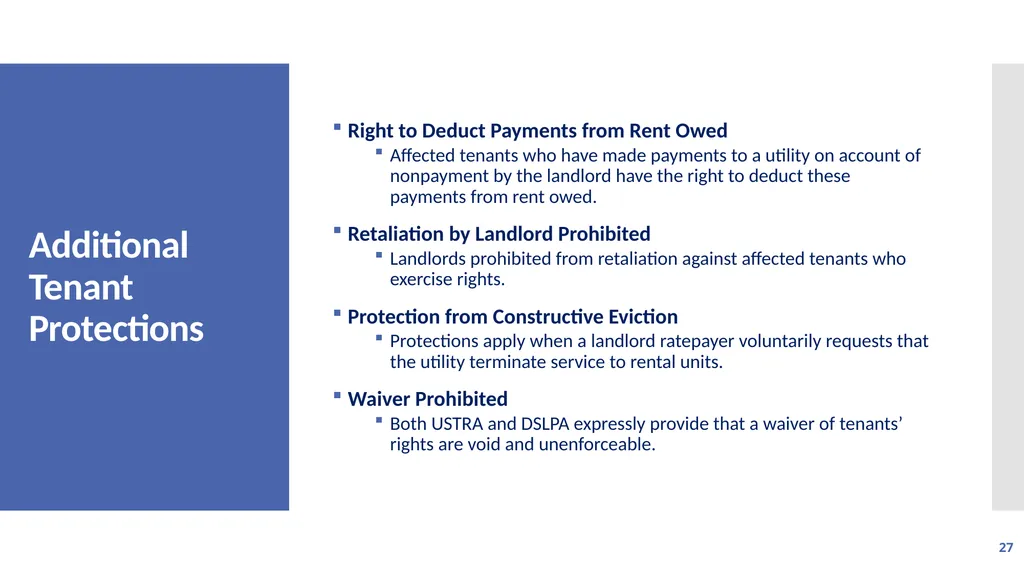
Additional Tenant Protections Right to Deduct Payments from Rent Owed
Affected tenants who have made payments to a utility on account of nonpayment by the landlord have the right to deduct these payments from rent owed.
Retaliation by Landlord Prohibited
Landlords prohibited from retaliation against affected tenants who exercise rights.
Protection from Constructive Eviction
Protections apply when a landlord ratepayer voluntarily requests that the utility terminate service to rental units.
Waiver Prohibited
Both USTRA and DSLPA expressly provide that a waiver of tenants’ rights are void and unenforceable. 27<br>
Affected tenants who have made payments to a utility on account of nonpayment by the landlord have the right to deduct these payments from rent owed.
Retaliation by Landlord Prohibited
Landlords prohibited from retaliation against affected tenants who exercise rights.
Protection from Constructive Eviction
Protections apply when a landlord ratepayer voluntarily requests that the utility terminate service to rental units.
Waiver Prohibited
Both USTRA and DSLPA expressly provide that a waiver of tenants’ rights are void and unenforceable. 27<br>
28
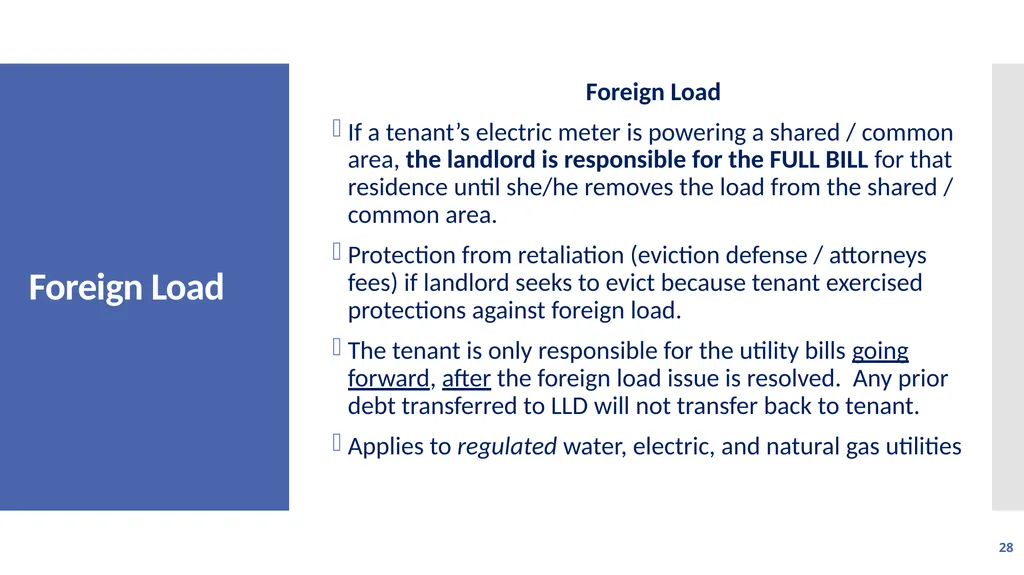
Foreign Load Foreign Load
If a tenant’s electric meter is powering a shared / common area, the landlord is responsible for the FULL BILL for that residence until she/he removes the load from the shared / common area.
Protection from retaliation (eviction defense / attorneys fees) if landlord seeks to evict because tenant exercised protections against foreign load.
The tenant is only responsible for the utility bills going forward, after the foreign load issue is resolved. Any prior debt transferred to LLD will not transfer back to tenant.
Applies to regulated water, electric, and natural gas utilities 28<br>
If a tenant’s electric meter is powering a shared / common area, the landlord is responsible for the FULL BILL for that residence until she/he removes the load from the shared / common area.
Protection from retaliation (eviction defense / attorneys fees) if landlord seeks to evict because tenant exercised protections against foreign load.
The tenant is only responsible for the utility bills going forward, after the foreign load issue is resolved. Any prior debt transferred to LLD will not transfer back to tenant.
Applies to regulated water, electric, and natural gas utilities 28<br>
29
PUC Dispute Process 29<br>
30
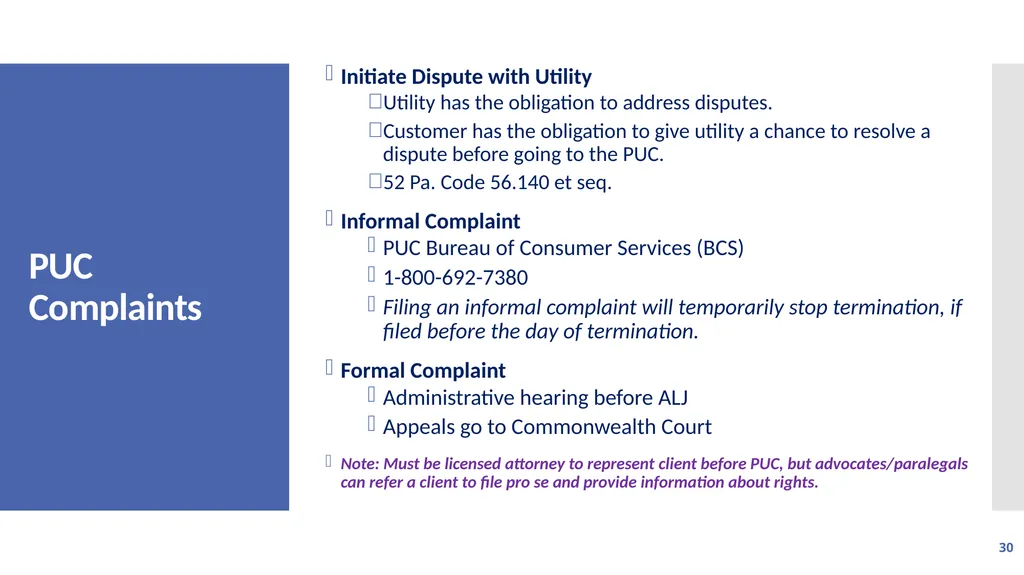
PUC Complaints Initiate Dispute with Utility
Utility has the obligation to address disputes.
Customer has the obligation to give utility a chance to resolve a dispute before going to the PUC.
52 Pa. Code 56.140 et seq.
Informal Complaint
PUC Bureau of Consumer Services (BCS)
1-800-692-7380
Filing an informal complaint will temporarily stop termination, if filed before the day of termination.
Formal Complaint
Administrative hearing before ALJ
Appeals go to Commonwealth Court
Note: Must be licensed attorney to represent client before PUC, but advocates/paralegals can refer a client to file pro se and provide information about rights. 30<br>
Utility has the obligation to address disputes.
Customer has the obligation to give utility a chance to resolve a dispute before going to the PUC.
52 Pa. Code 56.140 et seq.
Informal Complaint
PUC Bureau of Consumer Services (BCS)
1-800-692-7380
Filing an informal complaint will temporarily stop termination, if filed before the day of termination.
Formal Complaint
Administrative hearing before ALJ
Appeals go to Commonwealth Court
Note: Must be licensed attorney to represent client before PUC, but advocates/paralegals can refer a client to file pro se and provide information about rights. 30<br>
31
Questions / Comments? 31<br>
32
Thank you! Contact Information:
Gio Ortiz-Brackbill: (484) 282-4447, GBrackbill@pautilitylawproject.org
Ria Pereira: (407) 922-5172
RPereira@pautilitylawproject.org 32<br>
Gio Ortiz-Brackbill: (484) 282-4447, GBrackbill@pautilitylawproject.org
Ria Pereira: (407) 922-5172
RPereira@pautilitylawproject.org 32<br>