
VALUATION 3/19/2014 Dr.Amit Bagga Chartered
NS
Published · 68 slides · 0 views

1 / 1


Description
VALUATION 3192014 Dr.Amit Bagga Chartered Accountant, Cost Accountant,amitbaggausgmail.com 1 Why valuation is Important 3192014 Dr.Amit Bagga Chartered Accountant, Cost Accountant,amitbaggausgmail.com 2 Importance of Valuation in
Related Topics
Share
Embed code
Download this presentation From Below
"VALUATION 3/19/2014 Dr.Amit Bagga Chartered" is the property of its rightful owner. Permission is granted to download and print the materials on this website for personal, non-commercial use only, and to display it on your personal computer provided you do not modify the materials and that you retain all copyright notices contained in the materials. By downloading content from our website, you accept the terms of this agreement.
Presentation Transcript
01
VALUATION 3/19/2014 Dr.Amit Bagga Chartered Accountant, Cost Accountant,amitbaggaus@gmail.com 1<br>
02
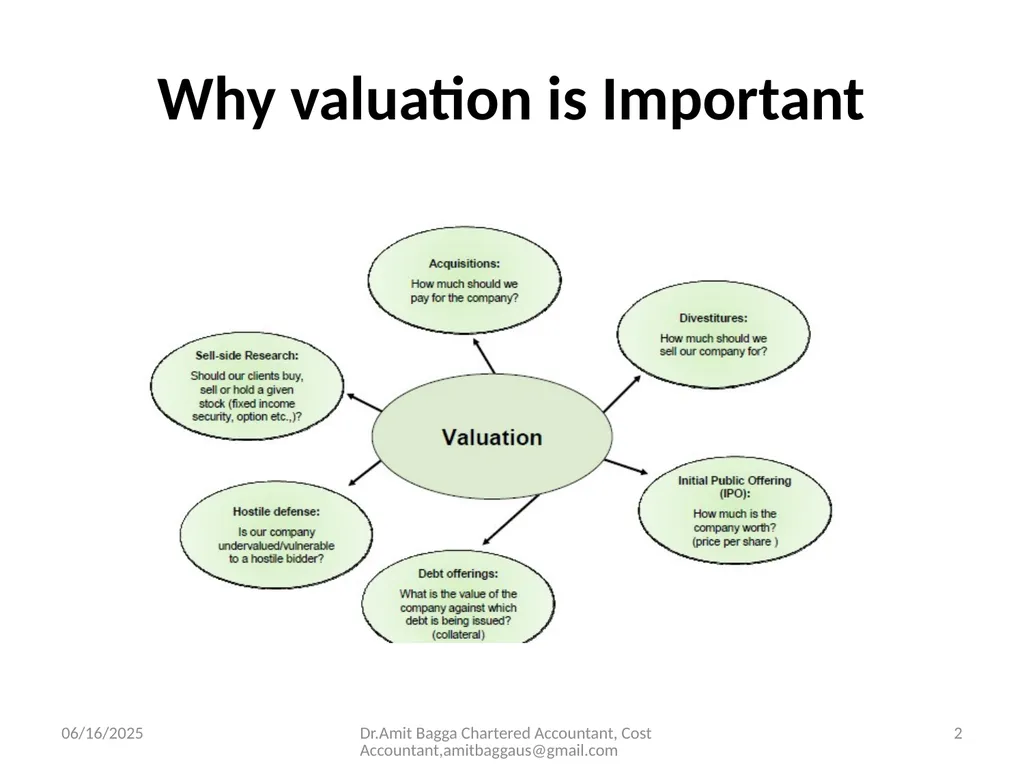
Why valuation is Important 3/19/2014 Dr.Amit Bagga Chartered Accountant, Cost Accountant,amitbaggaus@gmail.com 2<br>
03
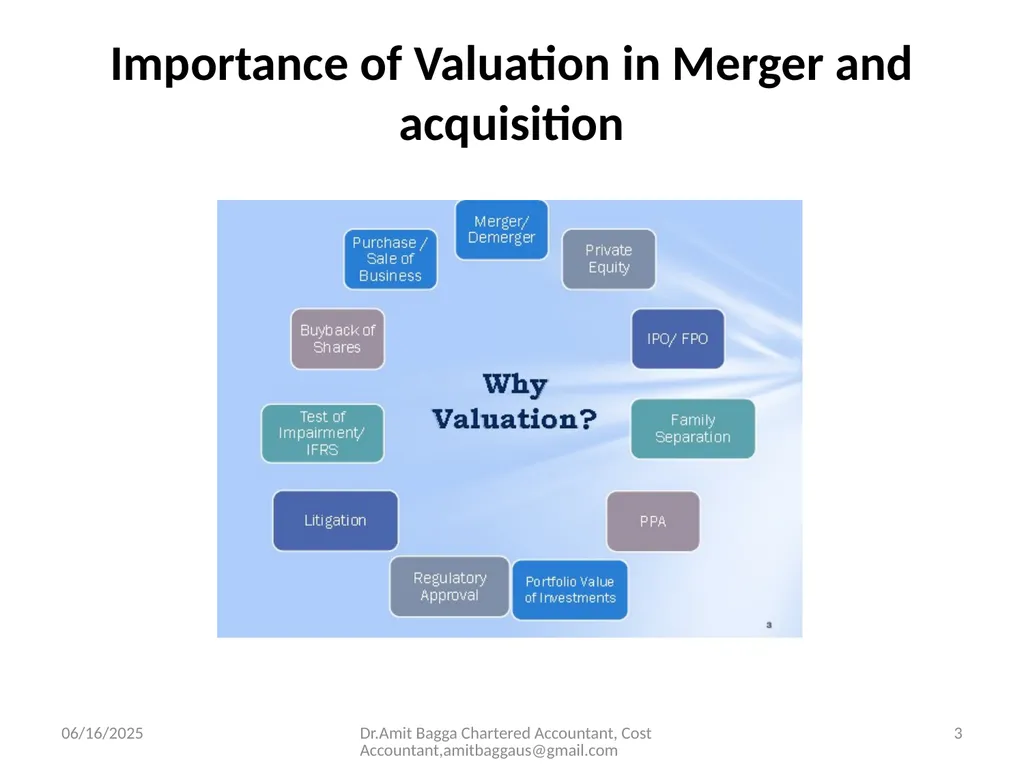
Importance of Valuation in Merger and acquisition 3/19/2014 Dr.Amit Bagga Chartered Accountant, Cost Accountant,amitbaggaus@gmail.com 3<br>
04
INTRINSIC VALUE Basic premise is Market generally doesn't value stocks fairly (mismatch between intrinsic value and market price)
• Objective of Valuation is to estimate the real or intrinsic value of the company’s stock 3/19/2014 Dr.Amit Bagga Chartered Accountant, Cost Accountant,amitbaggaus@gmail.com 4<br>
• Objective of Valuation is to estimate the real or intrinsic value of the company’s stock 3/19/2014 Dr.Amit Bagga Chartered Accountant, Cost Accountant,amitbaggaus@gmail.com 4<br>
05
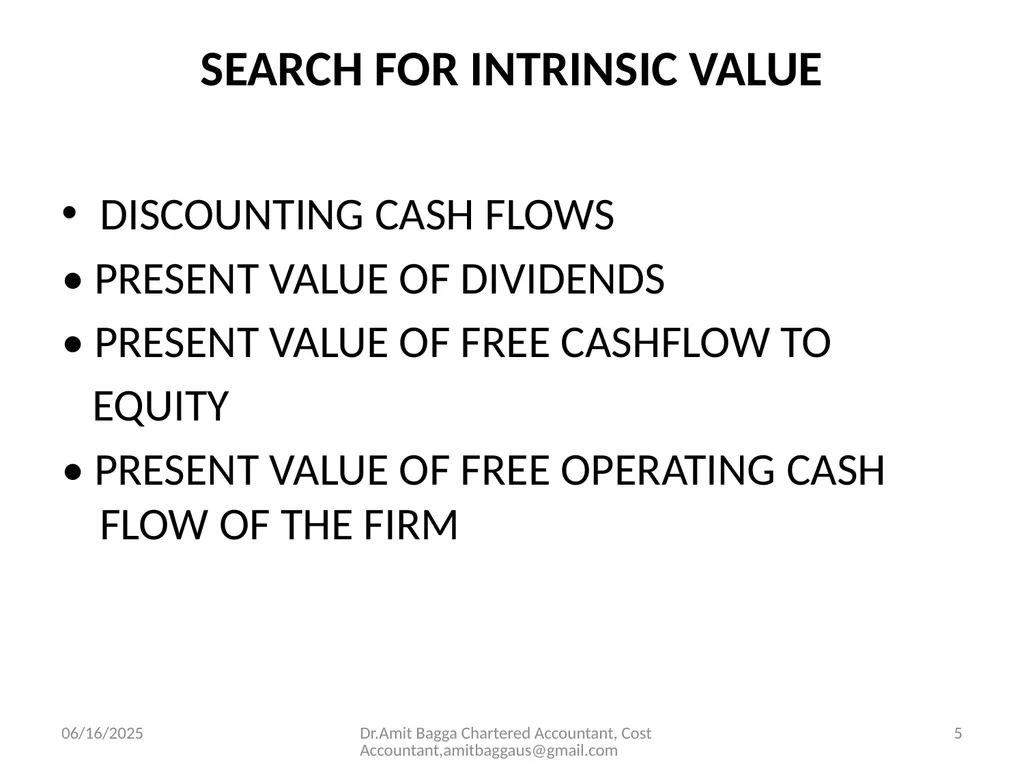
SEARCH FOR INTRINSIC VALUE DISCOUNTING CASH FLOWS
• PRESENT VALUE OF DIVIDENDS
• PRESENT VALUE OF FREE CASHFLOW TO
EQUITY
• PRESENT VALUE OF FREE OPERATING CASH FLOW OF THE FIRM 3/19/2014 Dr.Amit Bagga Chartered Accountant, Cost Accountant,amitbaggaus@gmail.com 5<br>
• PRESENT VALUE OF DIVIDENDS
• PRESENT VALUE OF FREE CASHFLOW TO
EQUITY
• PRESENT VALUE OF FREE OPERATING CASH FLOW OF THE FIRM 3/19/2014 Dr.Amit Bagga Chartered Accountant, Cost Accountant,amitbaggaus@gmail.com 5<br>
06
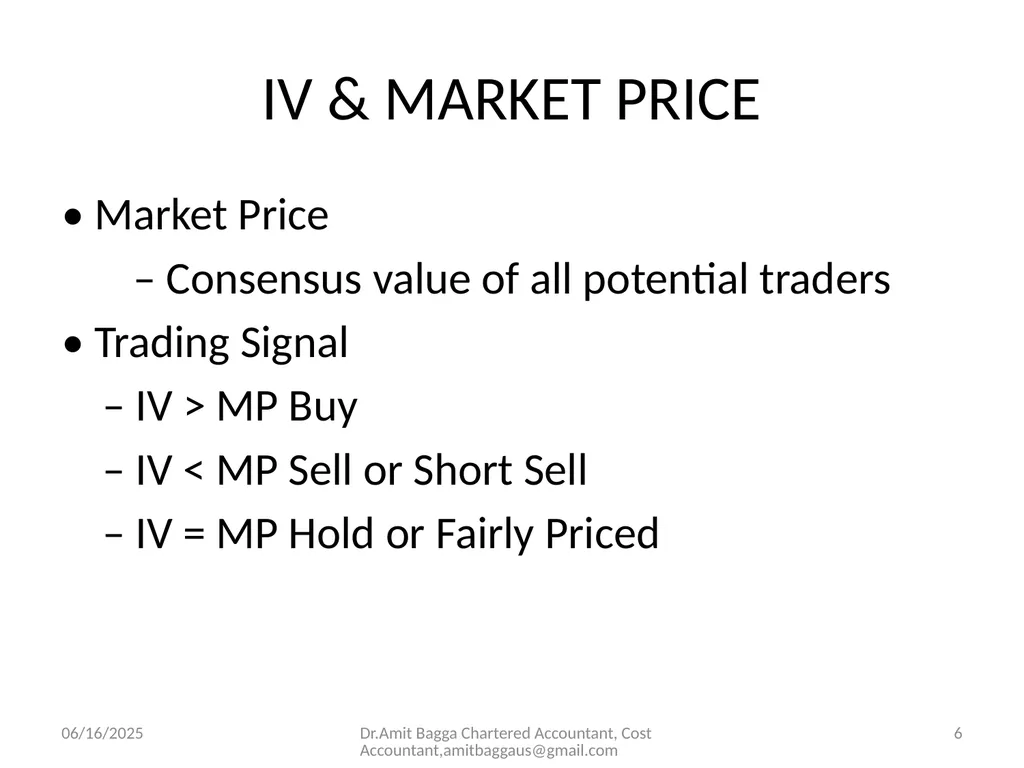
IV & MARKET PRICE • Market Price
– Consensus value of all potential traders
• Trading Signal
– IV > MP Buy
– IV < MP Sell or Short Sell
– IV = MP Hold or Fairly Priced 3/19/2014 Dr.Amit Bagga Chartered Accountant, Cost Accountant,amitbaggaus@gmail.com 6<br>
– Consensus value of all potential traders
• Trading Signal
– IV > MP Buy
– IV < MP Sell or Short Sell
– IV = MP Hold or Fairly Priced 3/19/2014 Dr.Amit Bagga Chartered Accountant, Cost Accountant,amitbaggaus@gmail.com 6<br>
07
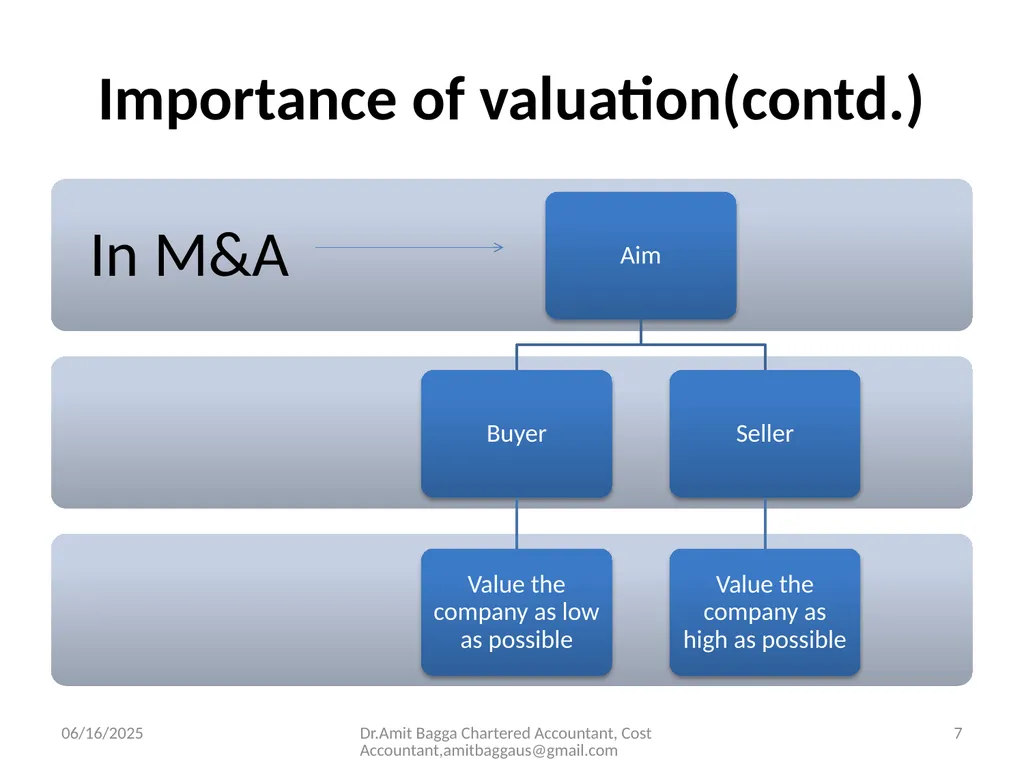
Importance of valuation(contd.) 3/19/2014 Dr.Amit Bagga Chartered Accountant, Cost Accountant,amitbaggaus@gmail.com 7<br>
08
3/19/2014 Dr.Amit Bagga Chartered Accountant, Cost Accountant,amitbaggaus@gmail.com 8<br>
09
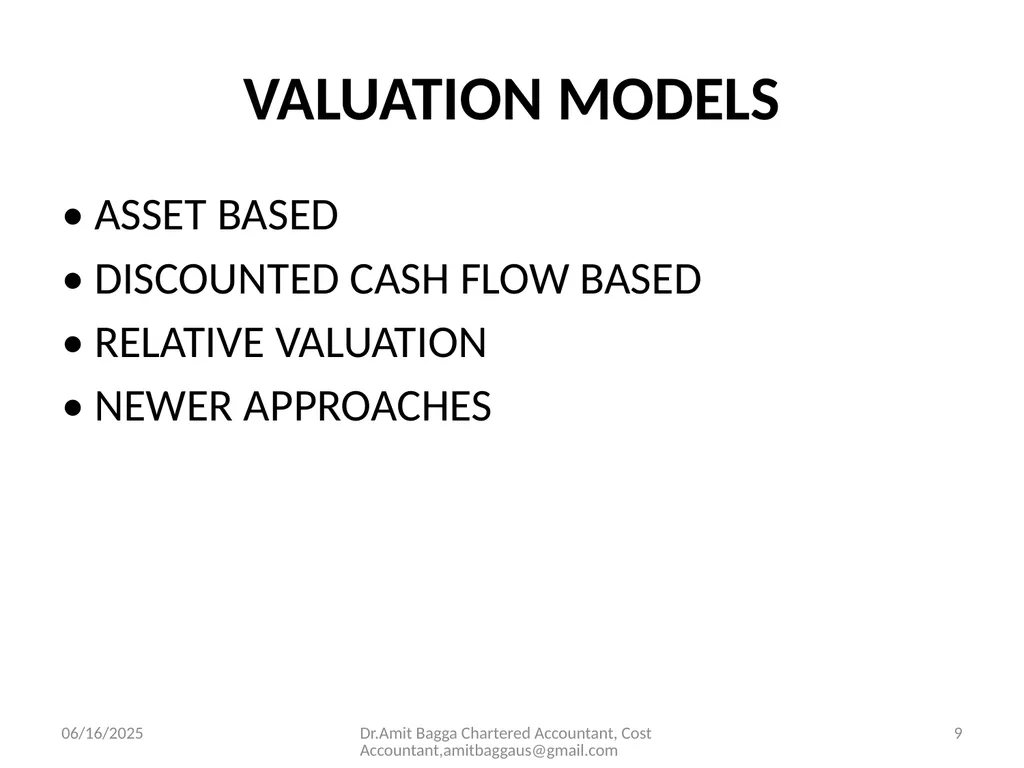
VALUATION MODELS • ASSET BASED
• DISCOUNTED CASH FLOW BASED
• RELATIVE VALUATION
• NEWER APPROACHES 3/19/2014 Dr.Amit Bagga Chartered Accountant, Cost Accountant,amitbaggaus@gmail.com 9<br>
• DISCOUNTED CASH FLOW BASED
• RELATIVE VALUATION
• NEWER APPROACHES 3/19/2014 Dr.Amit Bagga Chartered Accountant, Cost Accountant,amitbaggaus@gmail.com 9<br>
10
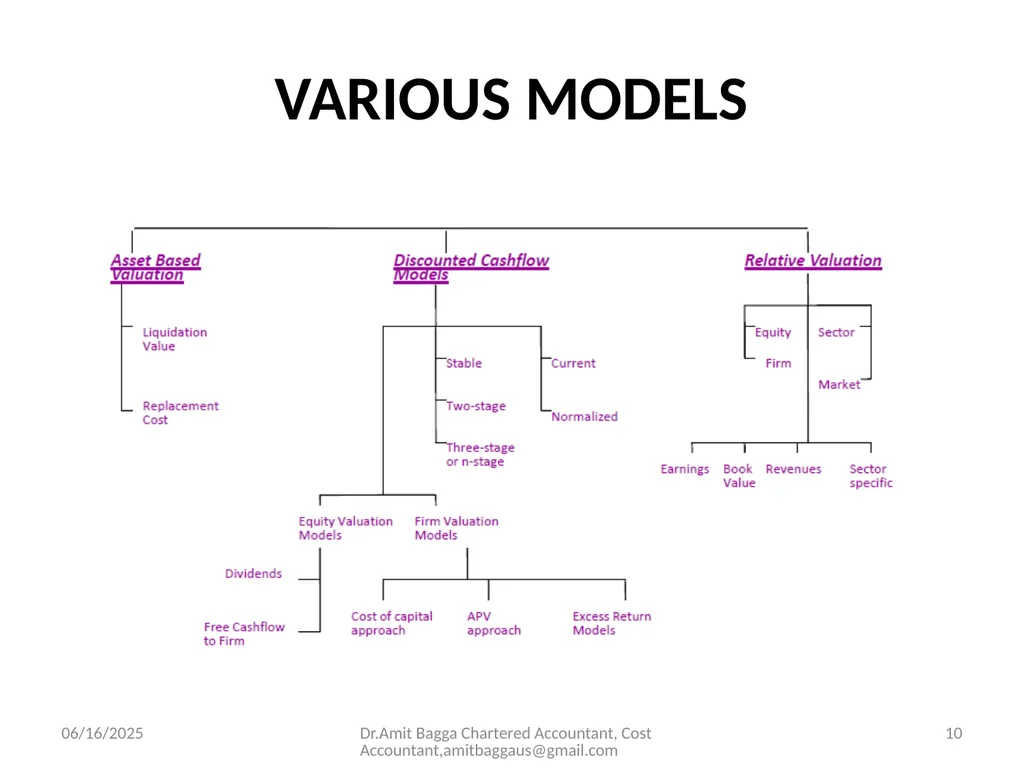
VARIOUS MODELS 3/19/2014 Dr.Amit Bagga Chartered Accountant, Cost Accountant,amitbaggaus@gmail.com 10<br>
11
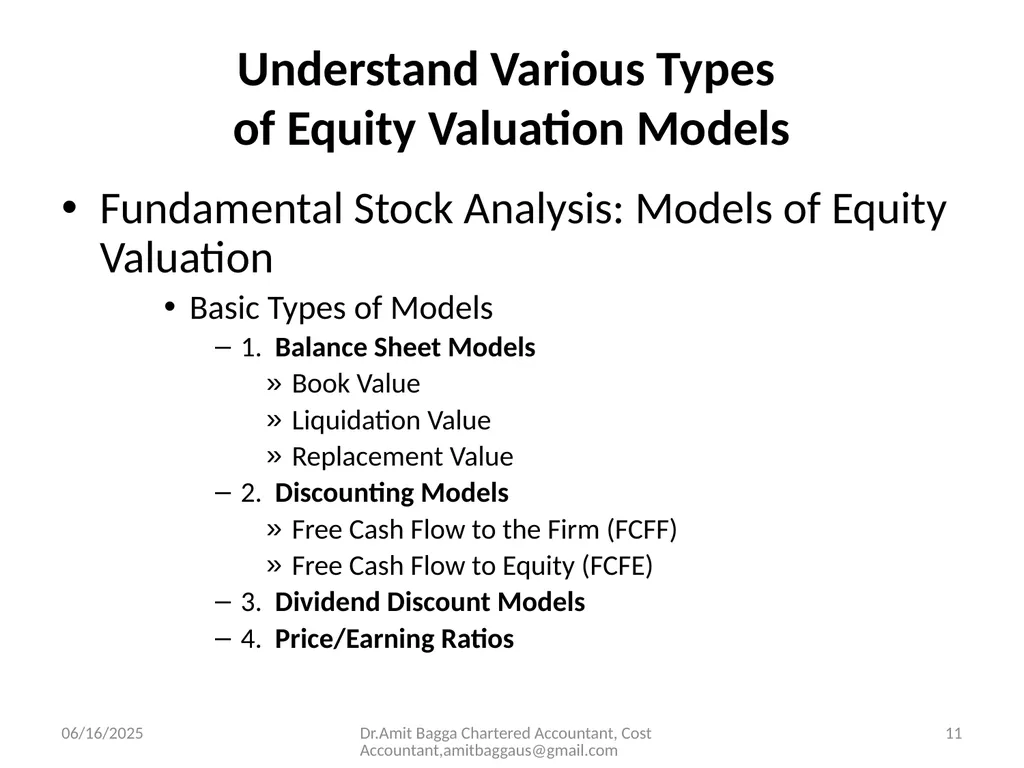
Understand Various Types
of Equity Valuation Models Fundamental Stock Analysis: Models of Equity Valuation
Basic Types of Models
1. Balance Sheet Models
Book Value
Liquidation Value
Replacement Value
2. Discounting Models
Free Cash Flow to the Firm (FCFF)
Free Cash Flow to Equity (FCFE)
3. Dividend Discount Models
4. Price/Earning Ratios 3/19/2014 Dr.Amit Bagga Chartered Accountant, Cost Accountant,amitbaggaus@gmail.com 11<br>
Basic Types of Models
1. Balance Sheet Models
Book Value
Liquidation Value
Replacement Value
2. Discounting Models
Free Cash Flow to the Firm (FCFF)
Free Cash Flow to Equity (FCFE)
3. Dividend Discount Models
4. Price/Earning Ratios 3/19/2014 Dr.Amit Bagga Chartered Accountant, Cost Accountant,amitbaggaus@gmail.com 11<br>
12
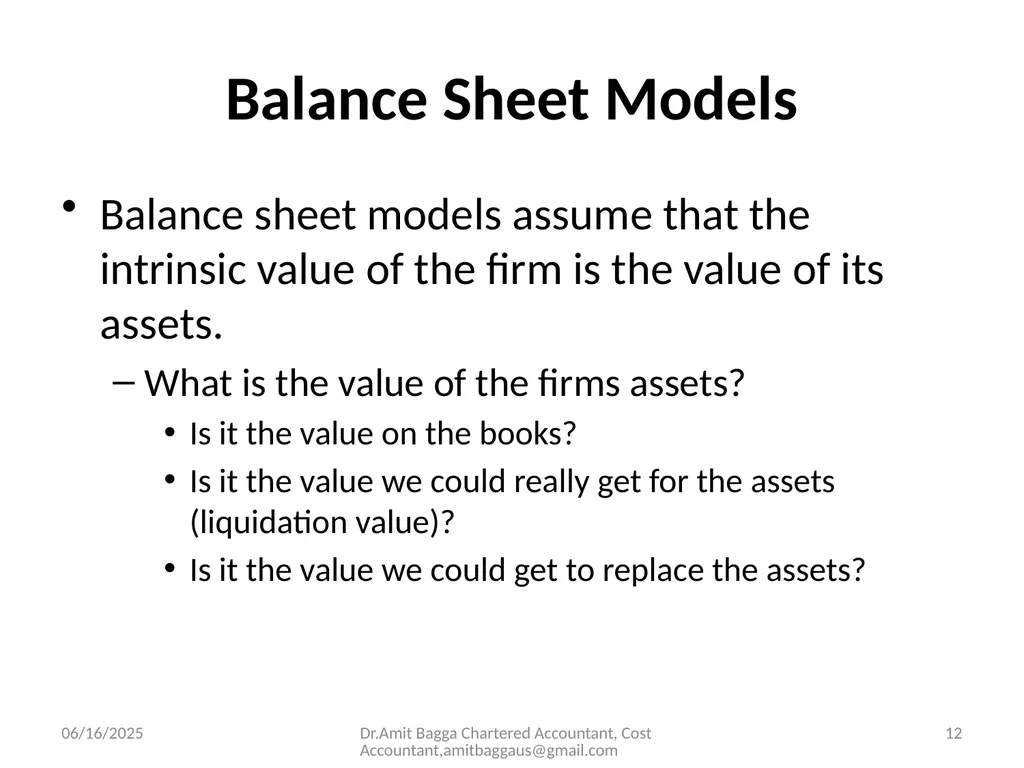
Balance Sheet Models Balance sheet models assume that the intrinsic value of the firm is the value of its assets.
What is the value of the firms assets?
Is it the value on the books?
Is it the value we could really get for the assets (liquidation value)?
Is it the value we could get to replace the assets? 3/19/2014 Dr.Amit Bagga Chartered Accountant, Cost Accountant,amitbaggaus@gmail.com 12<br>
What is the value of the firms assets?
Is it the value on the books?
Is it the value we could really get for the assets (liquidation value)?
Is it the value we could get to replace the assets? 3/19/2014 Dr.Amit Bagga Chartered Accountant, Cost Accountant,amitbaggaus@gmail.com 12<br>
13
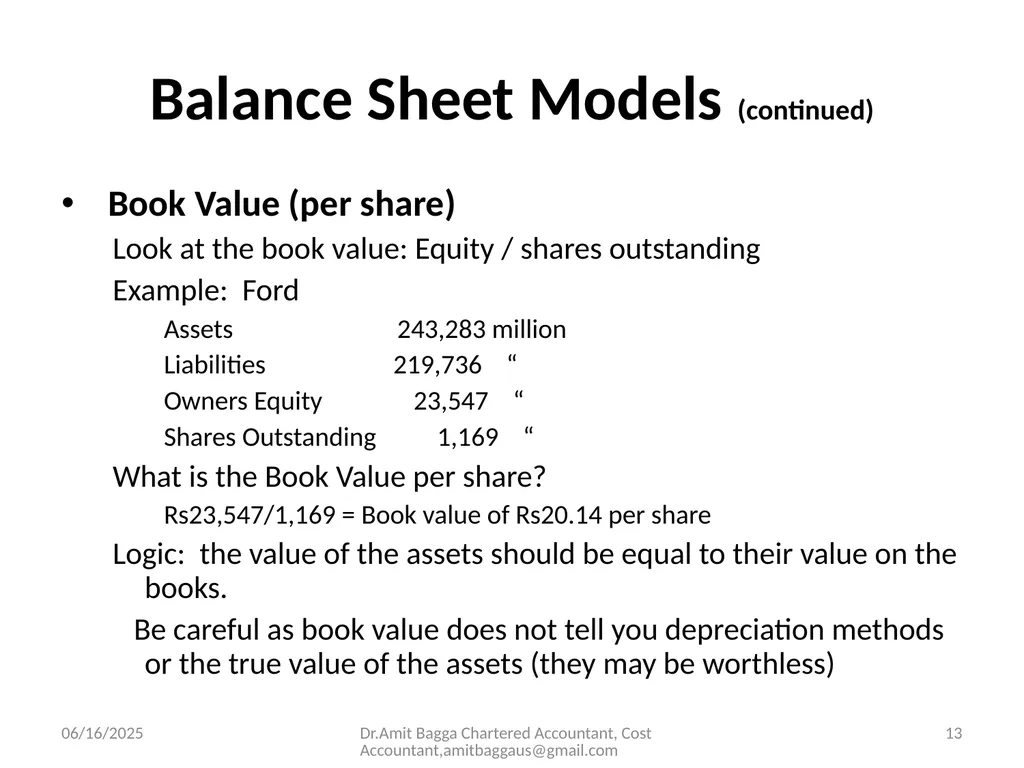
Balance Sheet Models (continued) Book Value (per share)
Look at the book value: Equity / shares outstanding
Example: Ford
Assets 243,283 million
Liabilities 219,736 “
Owners Equity 23,547 “
Shares Outstanding 1,169 “
What is the Book Value per share?
Rs23,547/1,169 = Book value of Rs20.14 per share
Logic: the value of the assets should be equal to their value on the books.
Be careful as book value does not tell you depreciation methods or the true value of the assets (they may be worthless) 3/19/2014 Dr.Amit Bagga Chartered Accountant, Cost Accountant,amitbaggaus@gmail.com 13<br>
Look at the book value: Equity / shares outstanding
Example: Ford
Assets 243,283 million
Liabilities 219,736 “
Owners Equity 23,547 “
Shares Outstanding 1,169 “
What is the Book Value per share?
Rs23,547/1,169 = Book value of Rs20.14 per share
Logic: the value of the assets should be equal to their value on the books.
Be careful as book value does not tell you depreciation methods or the true value of the assets (they may be worthless) 3/19/2014 Dr.Amit Bagga Chartered Accountant, Cost Accountant,amitbaggaus@gmail.com 13<br>
14
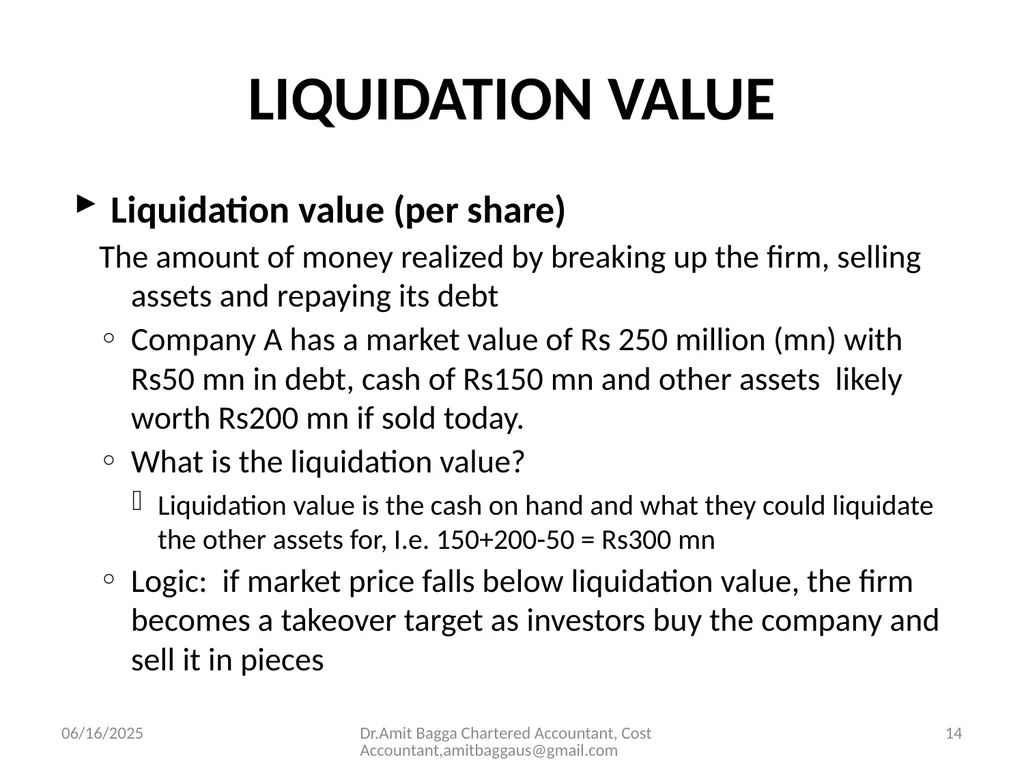
LIQUIDATION VALUE Liquidation value (per share)
The amount of money realized by breaking up the firm, selling assets and repaying its debt
Company A has a market value of Rs 250 million (mn) with Rs50 mn in debt, cash of Rs150 mn and other assets likely worth Rs200 mn if sold today.
What is the liquidation value?
Liquidation value is the cash on hand and what they could liquidate the other assets for, I.e. 150+200-50 = Rs300 mn
Logic: if market price falls below liquidation value, the firm becomes a takeover target as investors buy the company and sell it in pieces 3/19/2014 Dr.Amit Bagga Chartered Accountant, Cost Accountant,amitbaggaus@gmail.com 14<br>
The amount of money realized by breaking up the firm, selling assets and repaying its debt
Company A has a market value of Rs 250 million (mn) with Rs50 mn in debt, cash of Rs150 mn and other assets likely worth Rs200 mn if sold today.
What is the liquidation value?
Liquidation value is the cash on hand and what they could liquidate the other assets for, I.e. 150+200-50 = Rs300 mn
Logic: if market price falls below liquidation value, the firm becomes a takeover target as investors buy the company and sell it in pieces 3/19/2014 Dr.Amit Bagga Chartered Accountant, Cost Accountant,amitbaggaus@gmail.com 14<br>
15
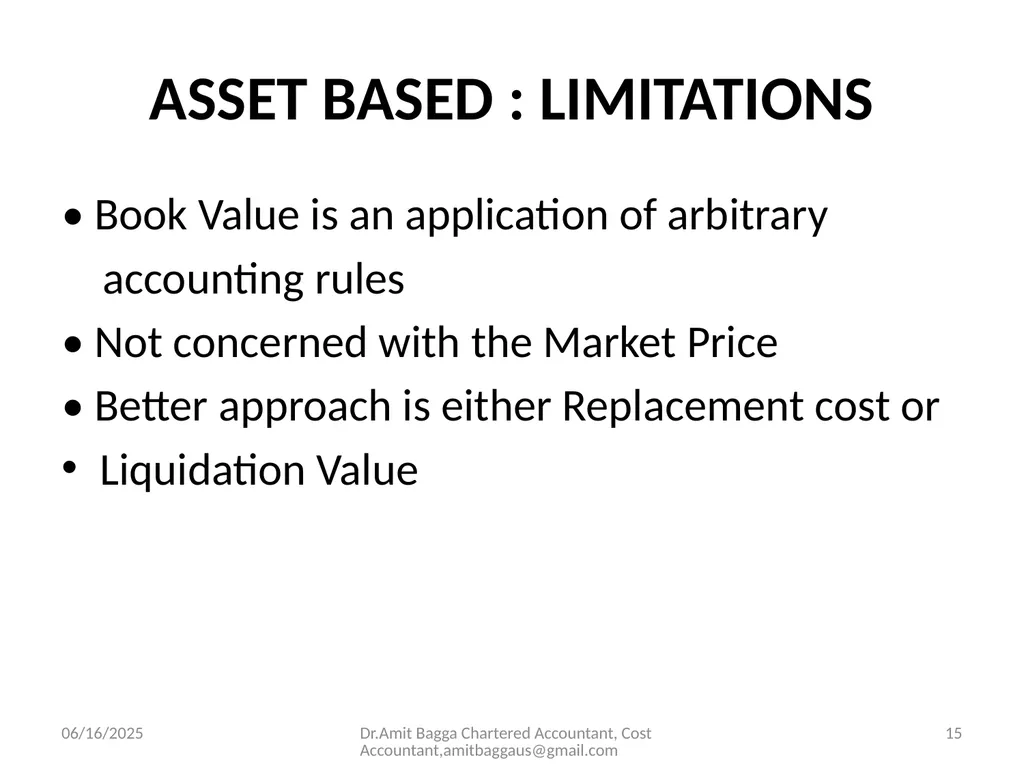
ASSET BASED : LIMITATIONS • Book Value is an application of arbitrary
accounting rules
• Not concerned with the Market Price
• Better approach is either Replacement cost or
Liquidation Value 3/19/2014 Dr.Amit Bagga Chartered Accountant, Cost Accountant,amitbaggaus@gmail.com 15<br>
accounting rules
• Not concerned with the Market Price
• Better approach is either Replacement cost or
Liquidation Value 3/19/2014 Dr.Amit Bagga Chartered Accountant, Cost Accountant,amitbaggaus@gmail.com 15<br>
16
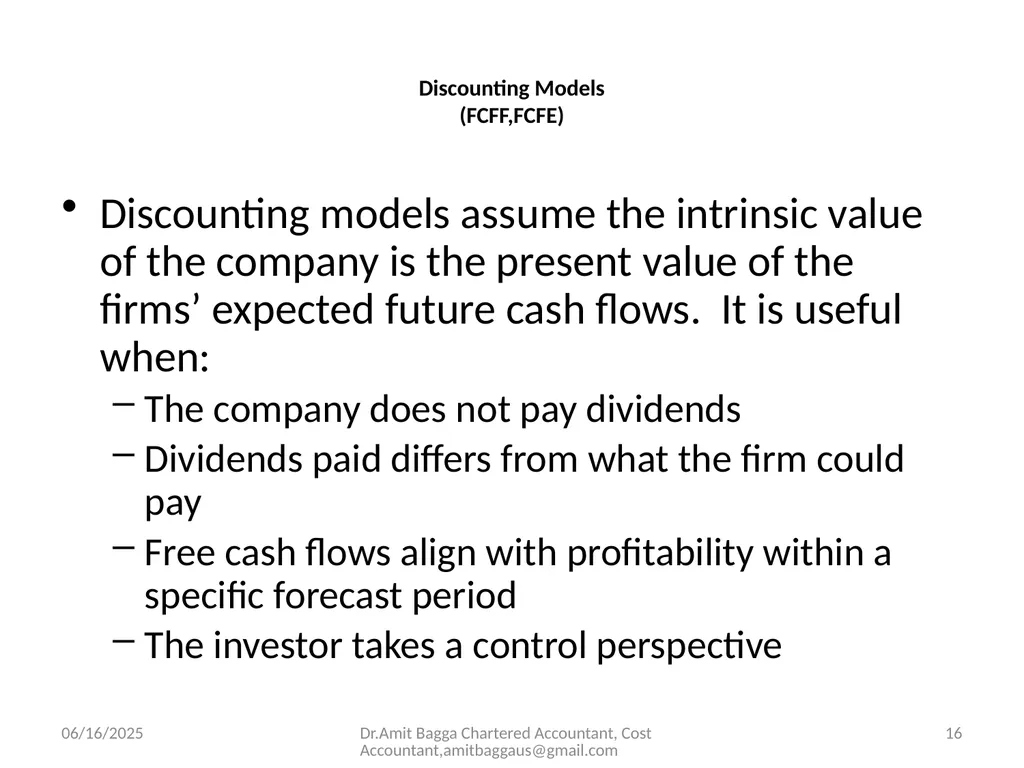
Discounting Models
(FCFF,FCFE) Discounting models assume the intrinsic value of the company is the present value of the firms’ expected future cash flows. It is useful when:
The company does not pay dividends
Dividends paid differs from what the firm could pay
Free cash flows align with profitability within a specific forecast period
The investor takes a control perspective 3/19/2014 Dr.Amit Bagga Chartered Accountant, Cost Accountant,amitbaggaus@gmail.com 16<br>
The company does not pay dividends
Dividends paid differs from what the firm could pay
Free cash flows align with profitability within a specific forecast period
The investor takes a control perspective 3/19/2014 Dr.Amit Bagga Chartered Accountant, Cost Accountant,amitbaggaus@gmail.com 16<br>
17
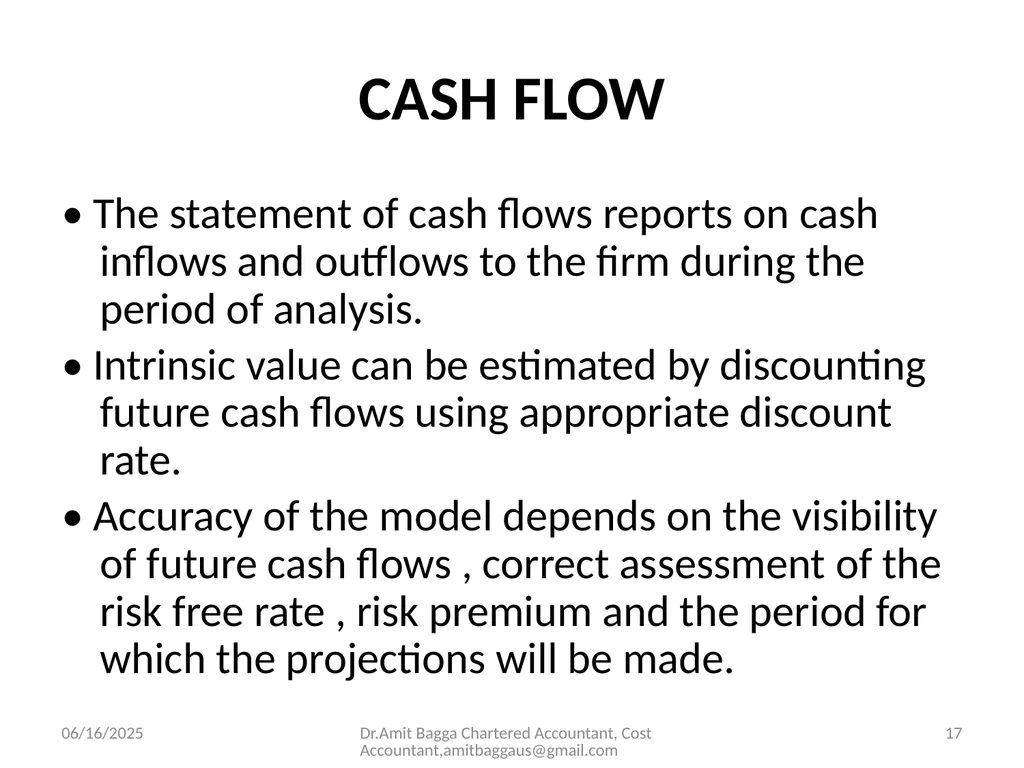
CASH FLOW • The statement of cash flows reports on cash inflows and outflows to the firm during the period of analysis.
• Intrinsic value can be estimated by discounting future cash flows using appropriate discount rate.
• Accuracy of the model depends on the visibility of future cash flows , correct assessment of the risk free rate , risk premium and the period for which the projections will be made. 3/19/2014 Dr.Amit Bagga Chartered Accountant, Cost Accountant,amitbaggaus@gmail.com 17<br>
• Intrinsic value can be estimated by discounting future cash flows using appropriate discount rate.
• Accuracy of the model depends on the visibility of future cash flows , correct assessment of the risk free rate , risk premium and the period for which the projections will be made. 3/19/2014 Dr.Amit Bagga Chartered Accountant, Cost Accountant,amitbaggaus@gmail.com 17<br>
18
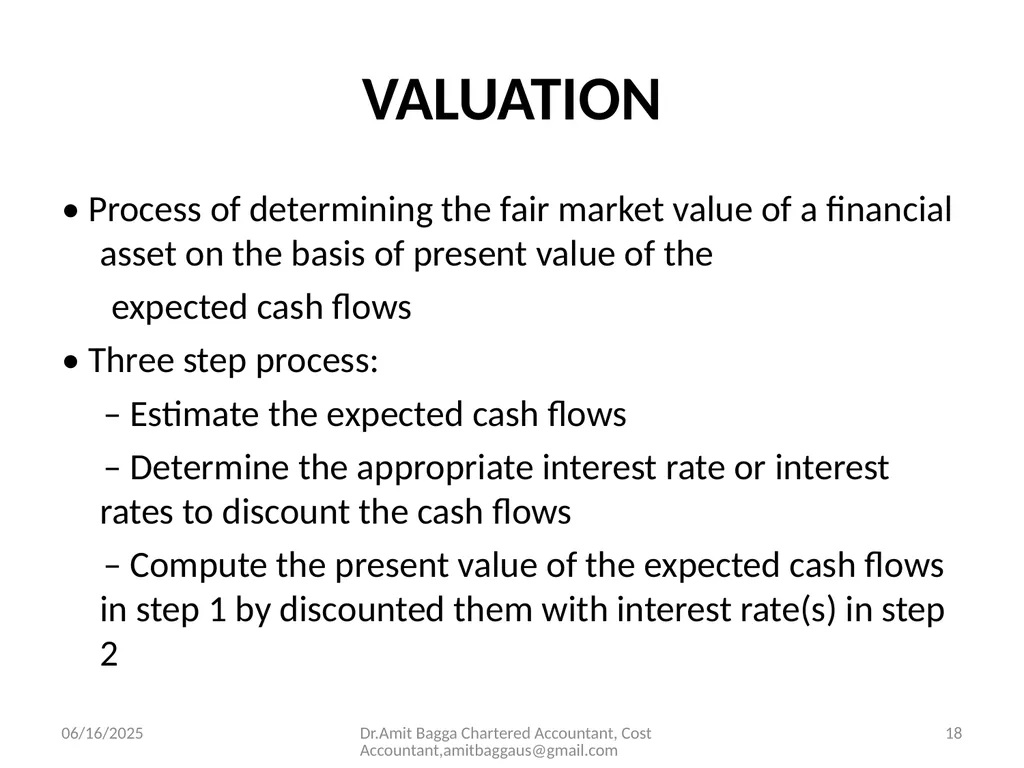
VALUATION • Process of determining the fair market value of a financial asset on the basis of present value of the
expected cash flows
• Three step process:
– Estimate the expected cash flows
– Determine the appropriate interest rate or interest rates to discount the cash flows
– Compute the present value of the expected cash flows in step 1 by discounted them with interest rate(s) in step 2 3/19/2014 Dr.Amit Bagga Chartered Accountant, Cost Accountant,amitbaggaus@gmail.com 18<br>
expected cash flows
• Three step process:
– Estimate the expected cash flows
– Determine the appropriate interest rate or interest rates to discount the cash flows
– Compute the present value of the expected cash flows in step 1 by discounted them with interest rate(s) in step 2 3/19/2014 Dr.Amit Bagga Chartered Accountant, Cost Accountant,amitbaggaus@gmail.com 18<br>
19
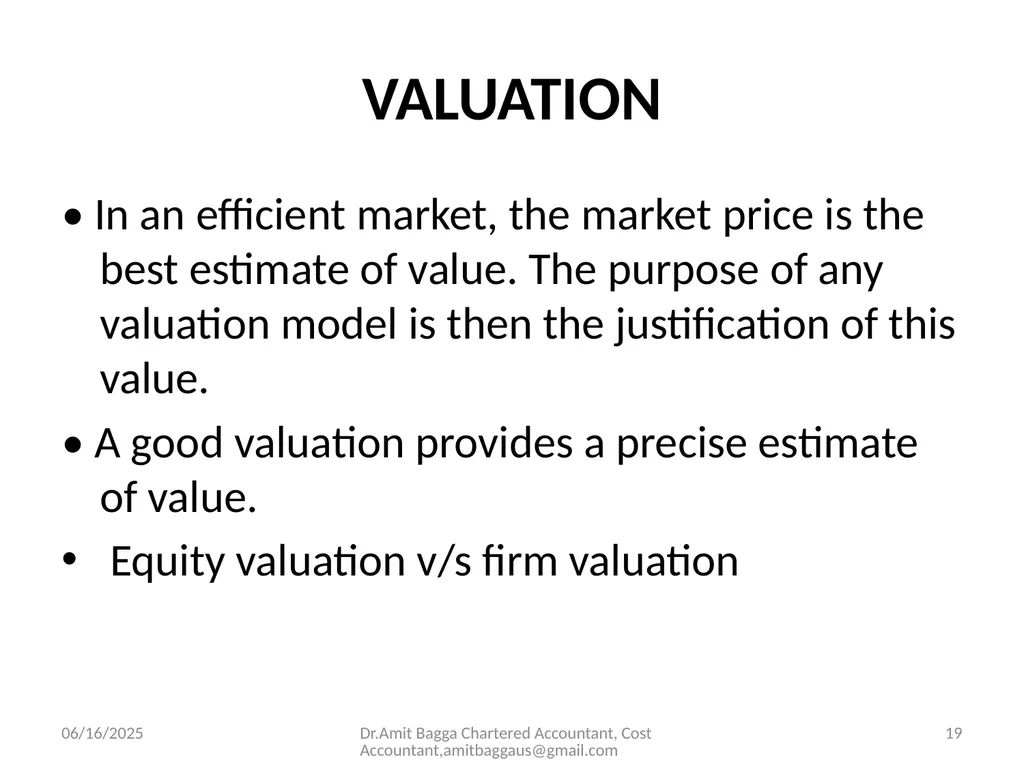
VALUATION • In an efficient market, the market price is the best estimate of value. The purpose of any valuation model is then the justification of this value.
• A good valuation provides a precise estimate of value.
Equity valuation v/s firm valuation 3/19/2014 Dr.Amit Bagga Chartered Accountant, Cost Accountant,amitbaggaus@gmail.com 19<br>
• A good valuation provides a precise estimate of value.
Equity valuation v/s firm valuation 3/19/2014 Dr.Amit Bagga Chartered Accountant, Cost Accountant,amitbaggaus@gmail.com 19<br>
20
Importance of valuation continued 3/19/2014 Dr.Amit Bagga Chartered Accountant, Cost Accountant,amitbaggaus@gmail.com 20<br>
21
3/19/2014 Dr.Amit Bagga Chartered Accountant, Cost Accountant,amitbaggaus@gmail.com 21<br>
22
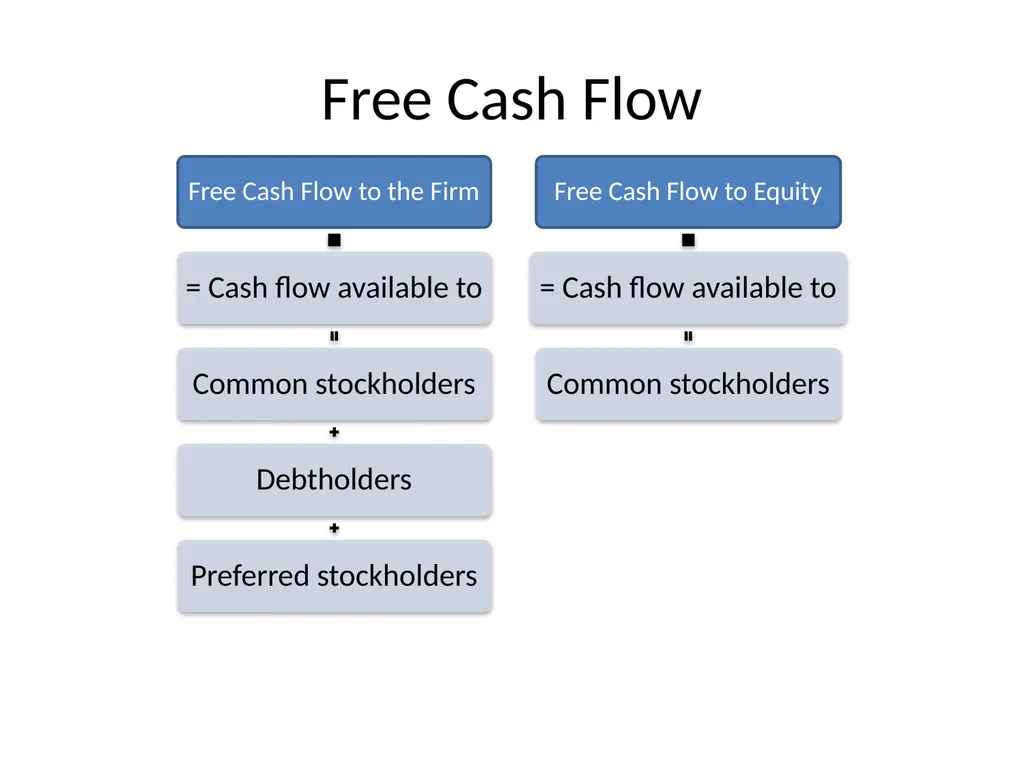
Free Cash Flow<br>
23
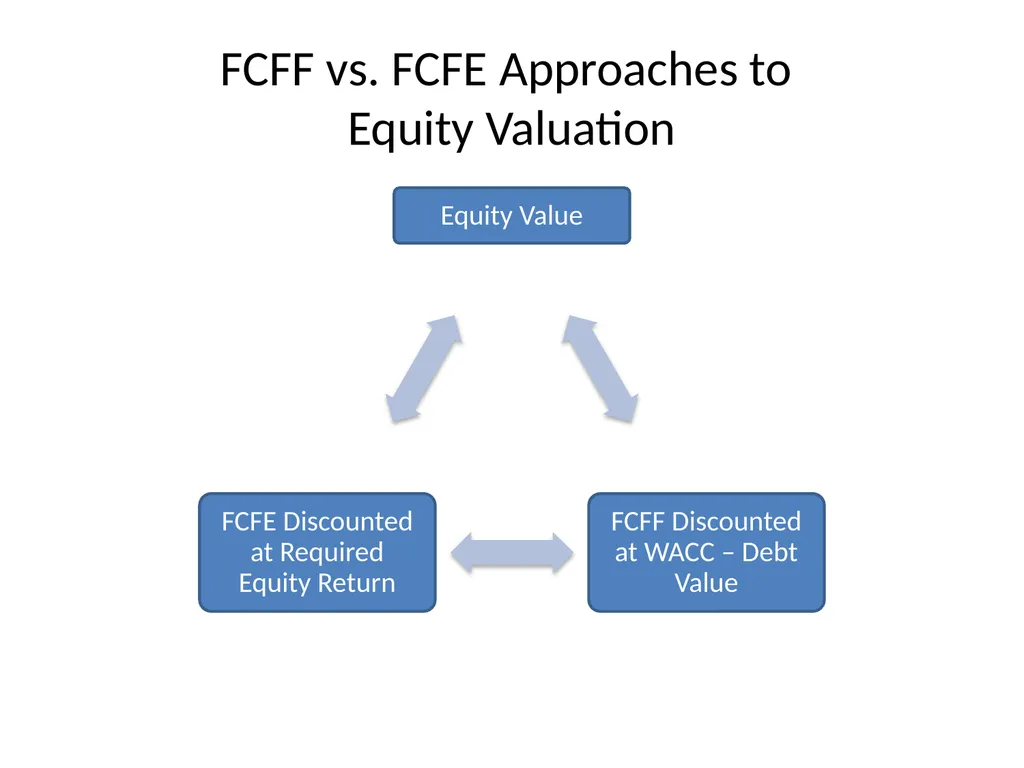
FCFF vs. FCFE Approaches to
Equity Valuation<br>
24
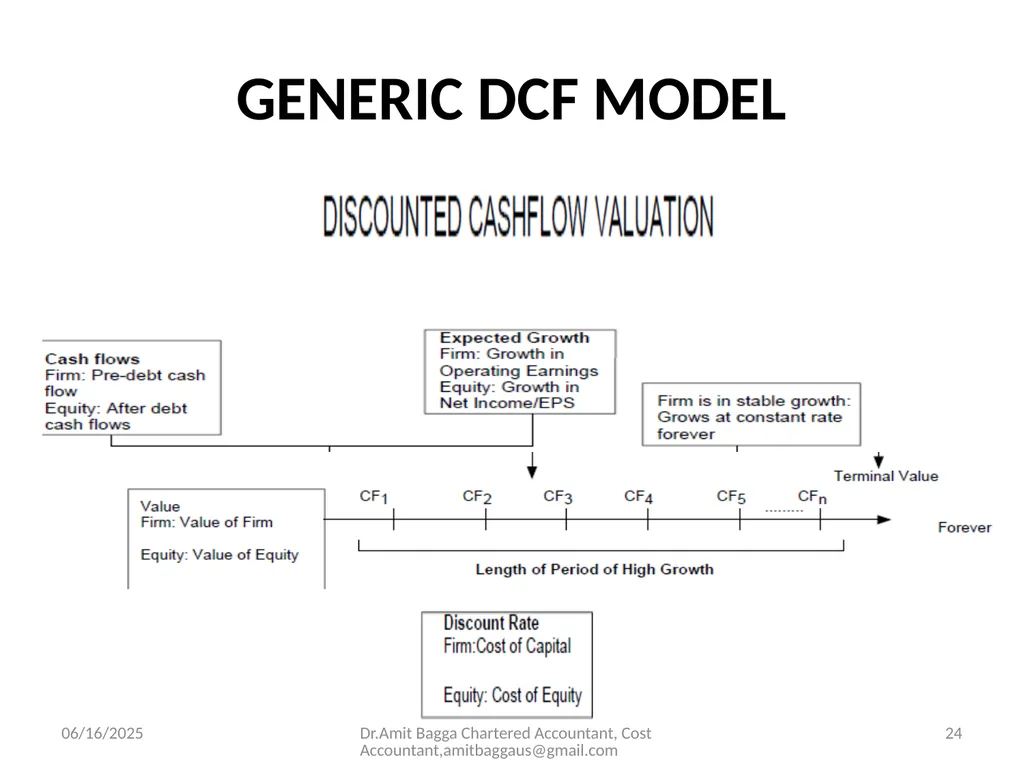
GENERIC DCF MODEL 3/19/2014 Dr.Amit Bagga Chartered Accountant, Cost Accountant,amitbaggaus@gmail.com 24<br>
25
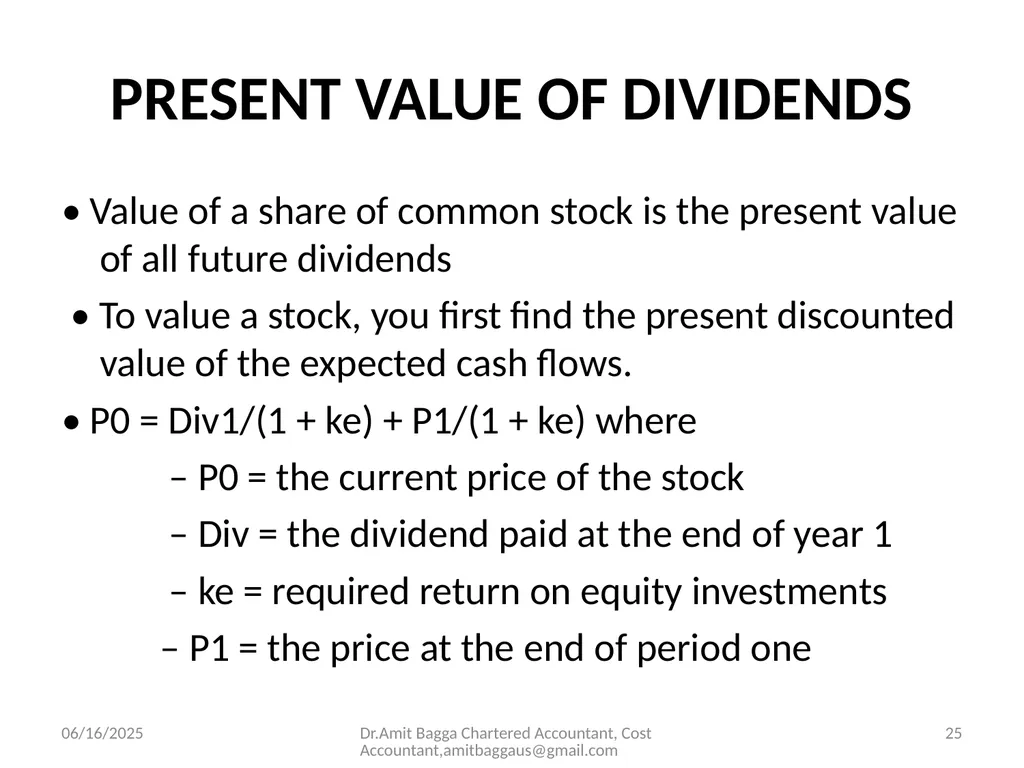
PRESENT VALUE OF DIVIDENDS • Value of a share of common stock is the present value of all future dividends
• To value a stock, you first find the present discounted value of the expected cash flows.
• P0 = Div1/(1 + ke) + P1/(1 + ke) where
– P0 = the current price of the stock
– Div = the dividend paid at the end of year 1
– ke = required return on equity investments
– P1 = the price at the end of period one 3/19/2014 Dr.Amit Bagga Chartered Accountant, Cost Accountant,amitbaggaus@gmail.com 25<br>
• To value a stock, you first find the present discounted value of the expected cash flows.
• P0 = Div1/(1 + ke) + P1/(1 + ke) where
– P0 = the current price of the stock
– Div = the dividend paid at the end of year 1
– ke = required return on equity investments
– P1 = the price at the end of period one 3/19/2014 Dr.Amit Bagga Chartered Accountant, Cost Accountant,amitbaggaus@gmail.com 25<br>
26
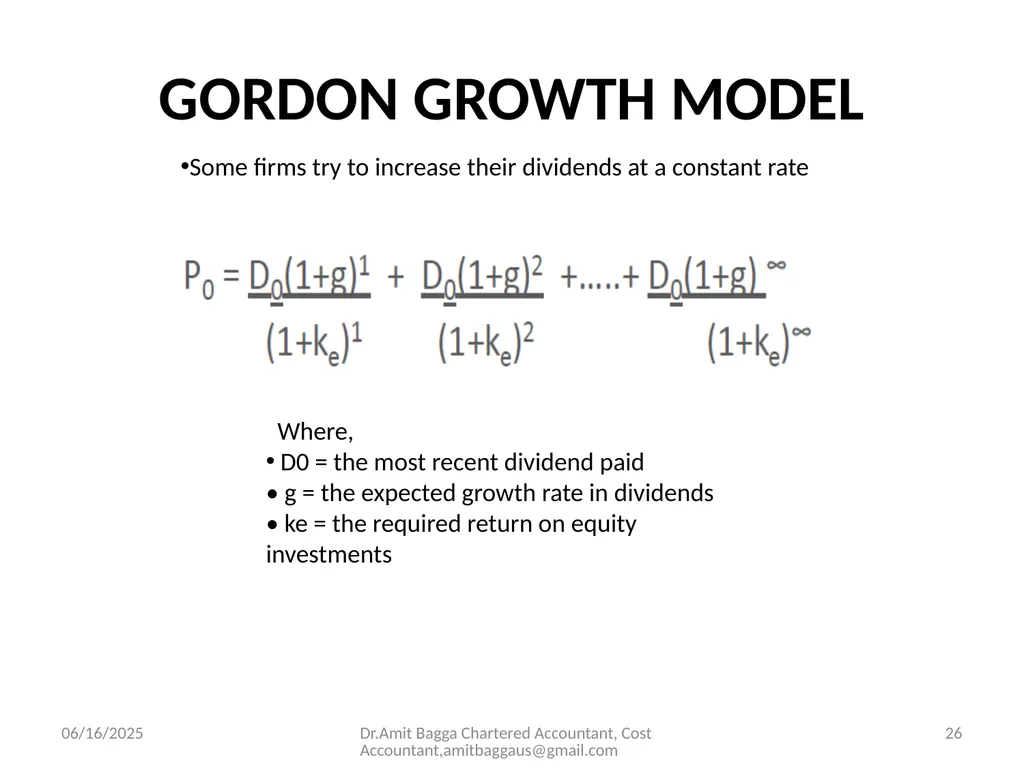
GORDON GROWTH MODEL Where,
D0 = the most recent dividend paid
• g = the expected growth rate in dividends
• ke = the required return on equity investments Some firms try to increase their dividends at a constant rate 3/19/2014 Dr.Amit Bagga Chartered Accountant, Cost Accountant,amitbaggaus@gmail.com 26<br>
D0 = the most recent dividend paid
• g = the expected growth rate in dividends
• ke = the required return on equity investments Some firms try to increase their dividends at a constant rate 3/19/2014 Dr.Amit Bagga Chartered Accountant, Cost Accountant,amitbaggaus@gmail.com 26<br>
27
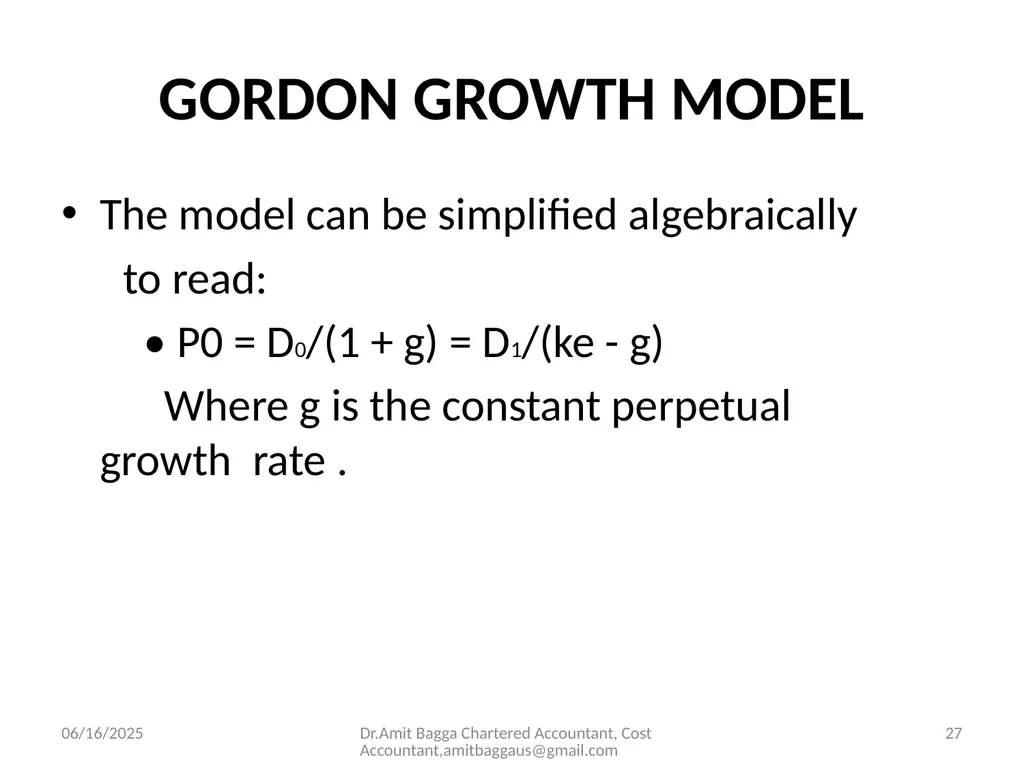
GORDON GROWTH MODEL The model can be simplified algebraically
to read:
• P0 = D0/(1 + g) = D1/(ke - g)
Where g is the constant perpetual growth rate . 3/19/2014 Dr.Amit Bagga Chartered Accountant, Cost Accountant,amitbaggaus@gmail.com 27<br>
to read:
• P0 = D0/(1 + g) = D1/(ke - g)
Where g is the constant perpetual growth rate . 3/19/2014 Dr.Amit Bagga Chartered Accountant, Cost Accountant,amitbaggaus@gmail.com 27<br>
28
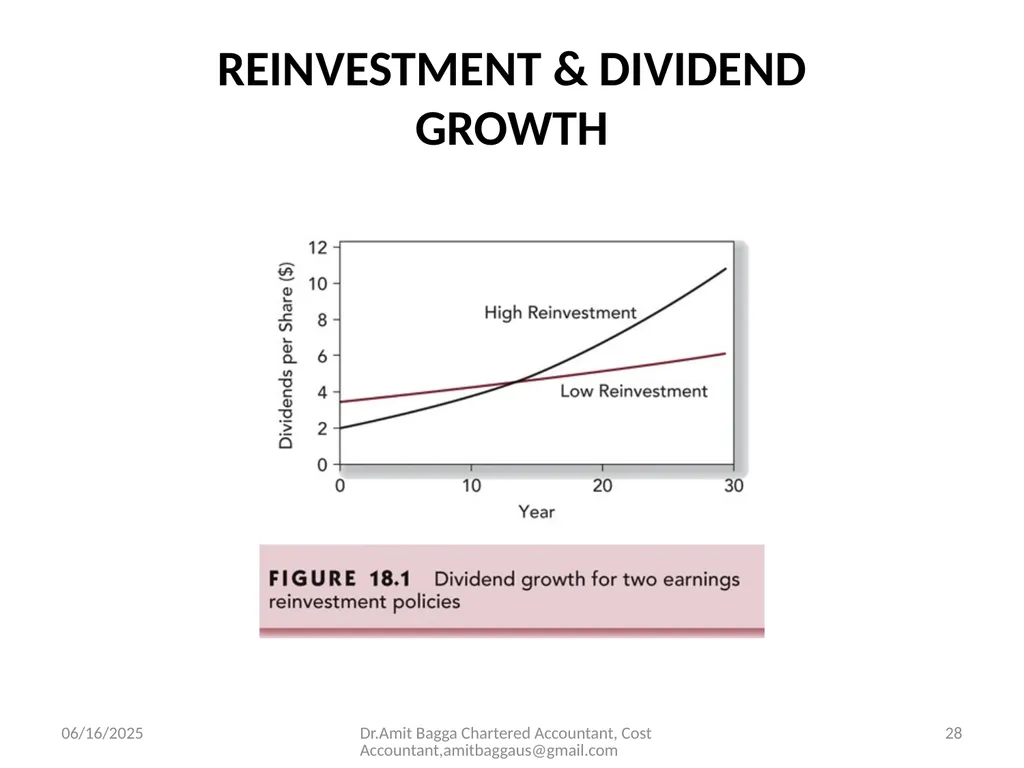
REINVESTMENT & DIVIDEND
GROWTH 3/19/2014 Dr.Amit Bagga Chartered Accountant, Cost Accountant,amitbaggaus@gmail.com 28<br>
29
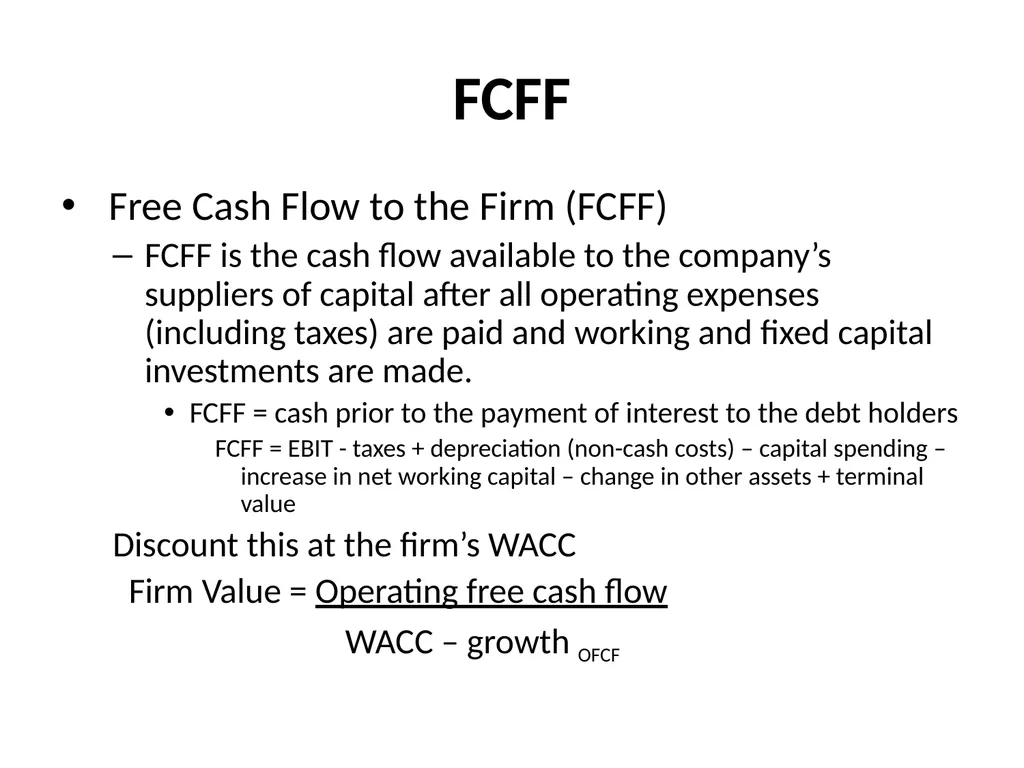
FCFF Free Cash Flow to the Firm (FCFF)
FCFF is the cash flow available to the company’s suppliers of capital after all operating expenses (including taxes) are paid and working and fixed capital investments are made.
FCFF = cash prior to the payment of interest to the debt holders
FCFF = EBIT - taxes + depreciation (non-cash costs) – capital spending – increase in net working capital – change in other assets + terminal value
Discount this at the firm’s WACC
Firm Value = Operating free cash flow
WACC – growth OFCF<br>
FCFF is the cash flow available to the company’s suppliers of capital after all operating expenses (including taxes) are paid and working and fixed capital investments are made.
FCFF = cash prior to the payment of interest to the debt holders
FCFF = EBIT - taxes + depreciation (non-cash costs) – capital spending – increase in net working capital – change in other assets + terminal value
Discount this at the firm’s WACC
Firm Value = Operating free cash flow
WACC – growth OFCF<br>
30
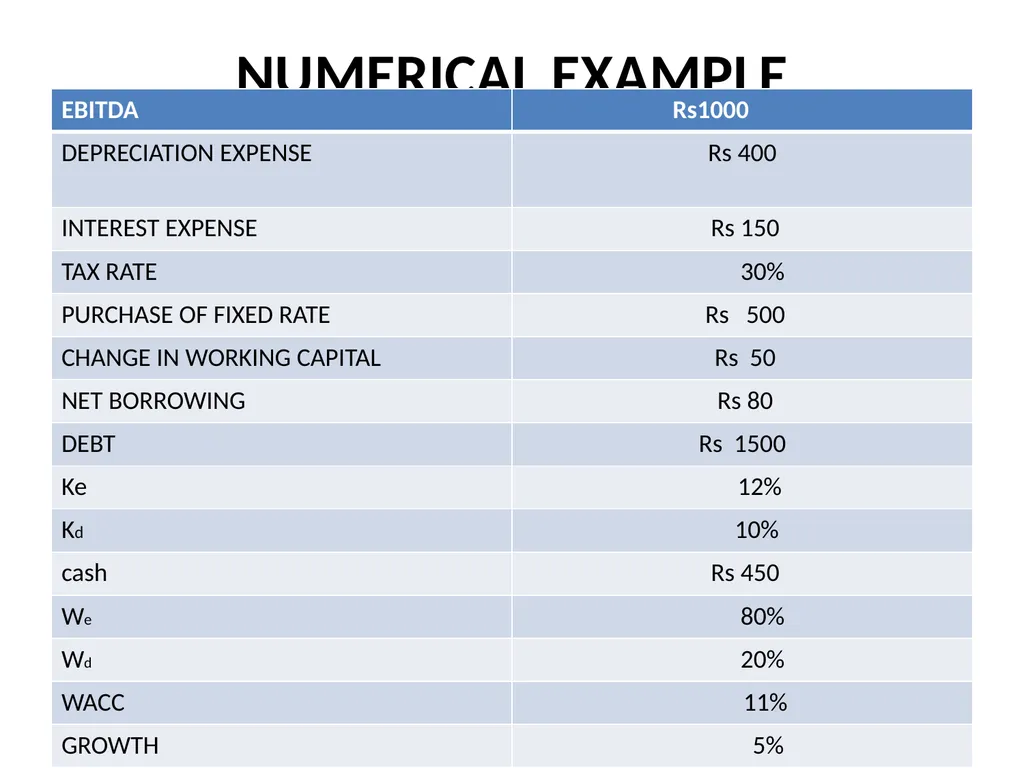
NUMERICAL EXAMPLE 3/19/2014 Dr.Amit Bagga Chartered Accountant, Cost Accountant,amitbaggaus@gmail.com 30<br>
31
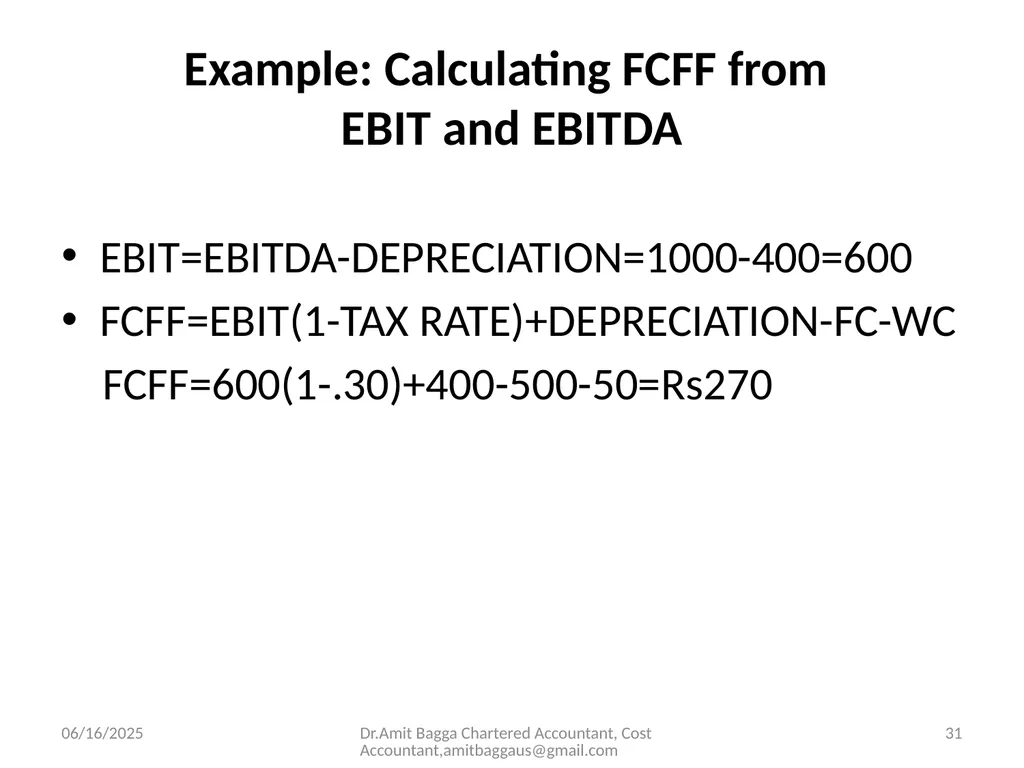
Example: Calculating FCFF from
EBIT and EBITDA EBIT=EBITDA-DEPRECIATION=1000-400=600
FCFF=EBIT(1-TAX RATE)+DEPRECIATION-FC-WC
FCFF=600(1-.30)+400-500-50=Rs270 3/19/2014 Dr.Amit Bagga Chartered Accountant, Cost Accountant,amitbaggaus@gmail.com 31<br>
FCFF=EBIT(1-TAX RATE)+DEPRECIATION-FC-WC
FCFF=600(1-.30)+400-500-50=Rs270 3/19/2014 Dr.Amit Bagga Chartered Accountant, Cost Accountant,amitbaggaus@gmail.com 31<br>
32
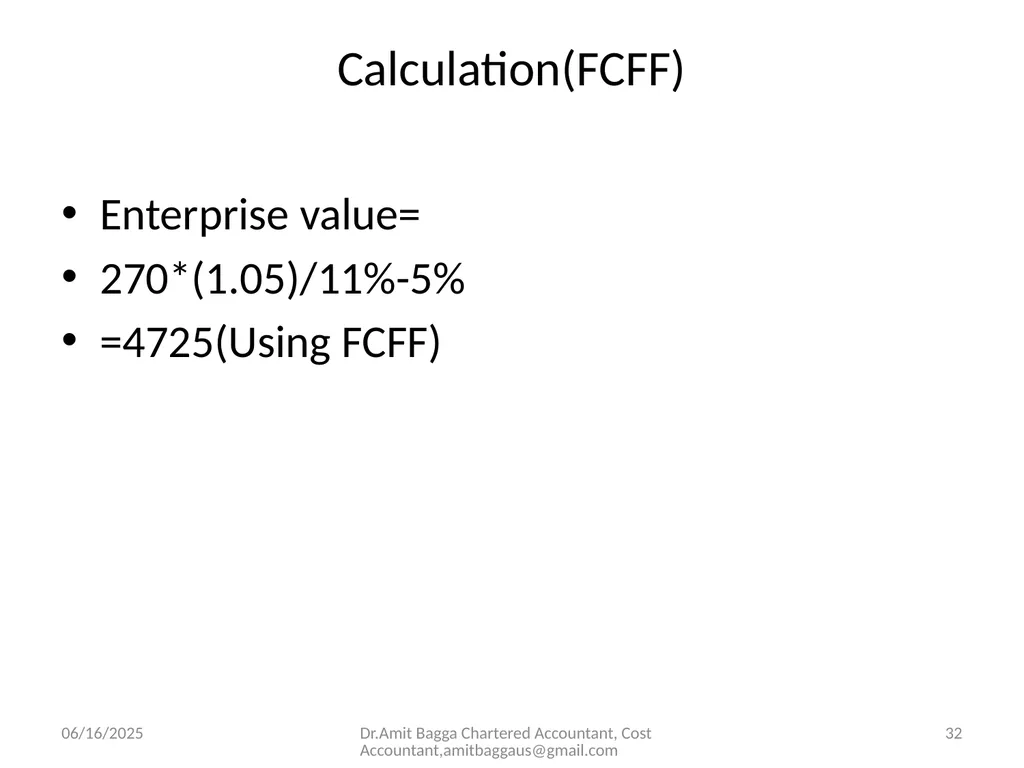
Calculation(FCFF) Enterprise value=
270*(1.05)/11%-5%
=4725(Using FCFF) 3/19/2014 Dr.Amit Bagga Chartered Accountant, Cost Accountant,amitbaggaus@gmail.com 32<br>
270*(1.05)/11%-5%
=4725(Using FCFF) 3/19/2014 Dr.Amit Bagga Chartered Accountant, Cost Accountant,amitbaggaus@gmail.com 32<br>
33
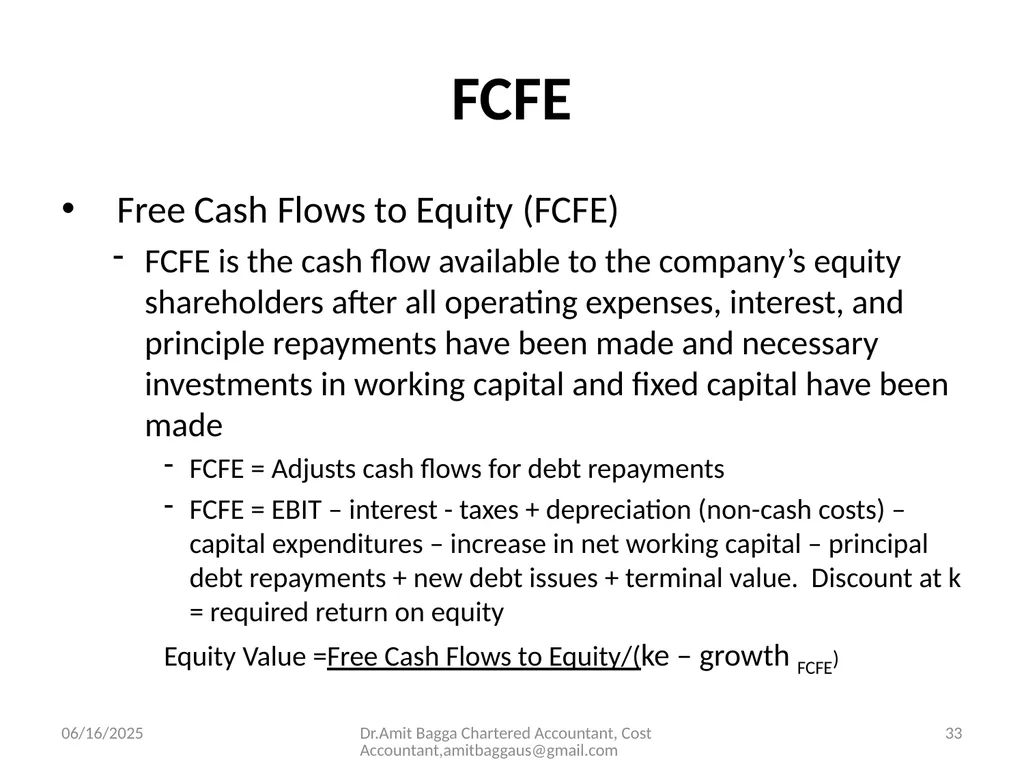
FCFE Free Cash Flows to Equity (FCFE)
FCFE is the cash flow available to the company’s equity shareholders after all operating expenses, interest, and principle repayments have been made and necessary investments in working capital and fixed capital have been made
FCFE = Adjusts cash flows for debt repayments
FCFE = EBIT – interest - taxes + depreciation (non-cash costs) – capital expenditures – increase in net working capital – principal debt repayments + new debt issues + terminal value. Discount at k = required return on equity
Equity Value =Free Cash Flows to Equity/(ke – growth FCFE) 3/19/2014 Dr.Amit Bagga Chartered Accountant, Cost Accountant,amitbaggaus@gmail.com 33<br>
FCFE is the cash flow available to the company’s equity shareholders after all operating expenses, interest, and principle repayments have been made and necessary investments in working capital and fixed capital have been made
FCFE = Adjusts cash flows for debt repayments
FCFE = EBIT – interest - taxes + depreciation (non-cash costs) – capital expenditures – increase in net working capital – principal debt repayments + new debt issues + terminal value. Discount at k = required return on equity
Equity Value =Free Cash Flows to Equity/(ke – growth FCFE) 3/19/2014 Dr.Amit Bagga Chartered Accountant, Cost Accountant,amitbaggaus@gmail.com 33<br>
34
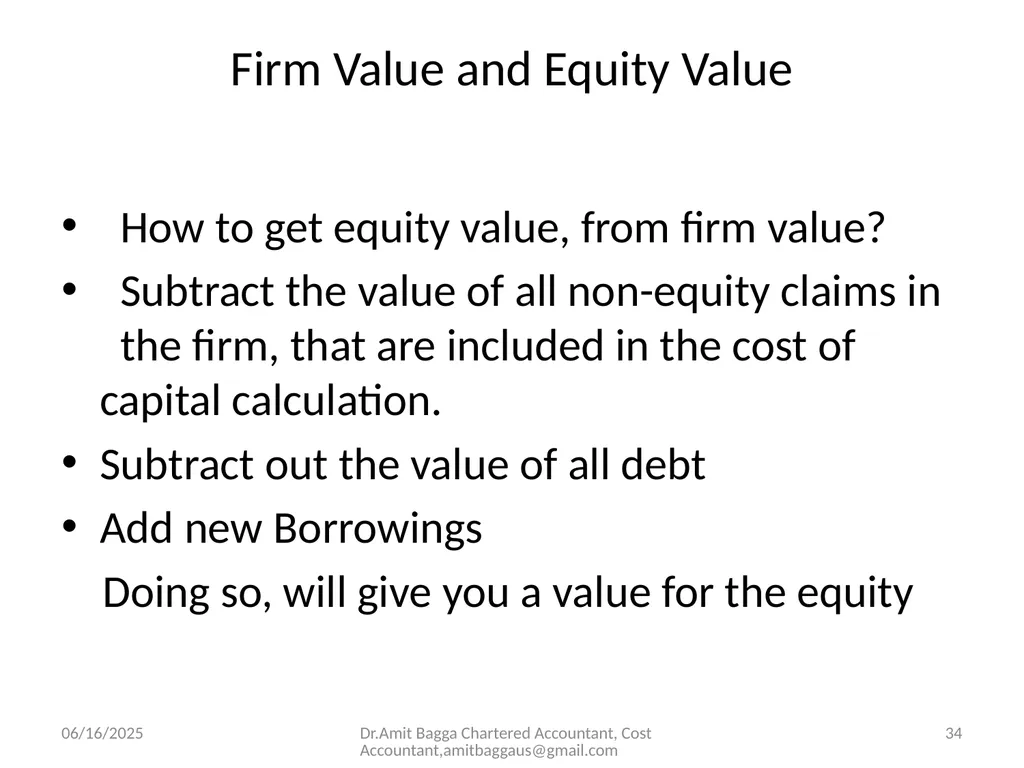
Firm Value and Equity Value How to get equity value, from firm value?
Subtract the value of all non-equity claims in the firm, that are included in the cost of capital calculation.
Subtract out the value of all debt
Add new Borrowings
Doing so, will give you a value for the equity 3/19/2014 Dr.Amit Bagga Chartered Accountant, Cost Accountant,amitbaggaus@gmail.com 34<br>
Subtract the value of all non-equity claims in the firm, that are included in the cost of capital calculation.
Subtract out the value of all debt
Add new Borrowings
Doing so, will give you a value for the equity 3/19/2014 Dr.Amit Bagga Chartered Accountant, Cost Accountant,amitbaggaus@gmail.com 34<br>
35
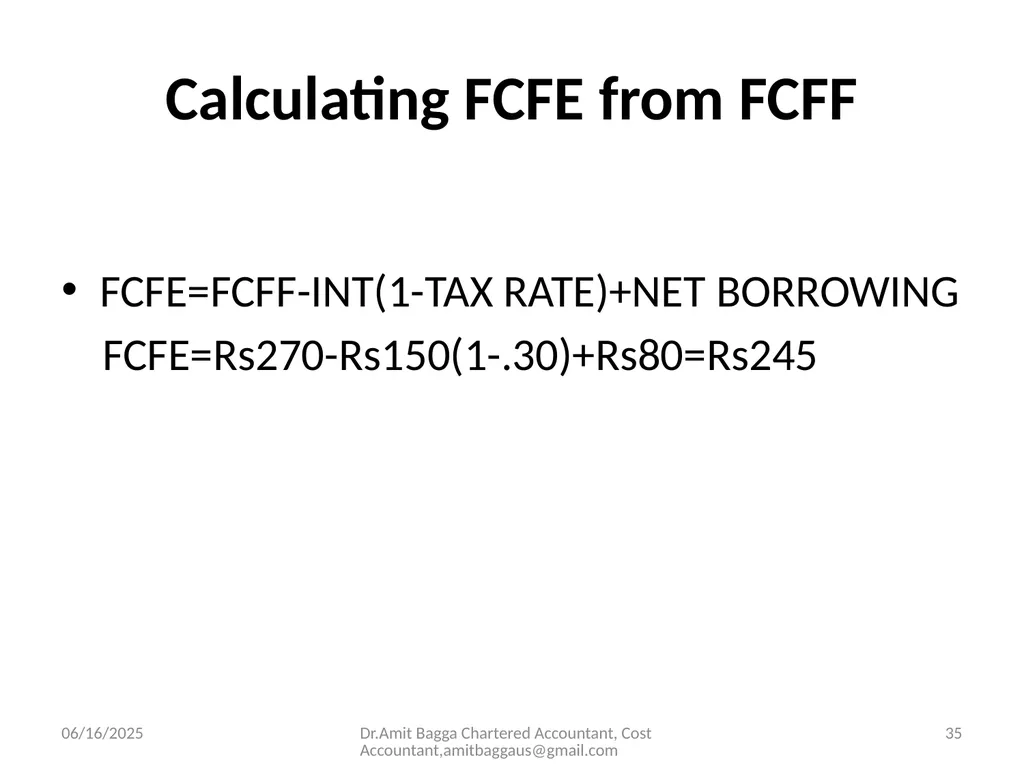
Calculating FCFE from FCFF FCFE=FCFF-INT(1-TAX RATE)+NET BORROWING
FCFE=Rs270-Rs150(1-.30)+Rs80=Rs245 3/19/2014 Dr.Amit Bagga Chartered Accountant, Cost Accountant,amitbaggaus@gmail.com 35<br>
FCFE=Rs270-Rs150(1-.30)+Rs80=Rs245 3/19/2014 Dr.Amit Bagga Chartered Accountant, Cost Accountant,amitbaggaus@gmail.com 35<br>
36
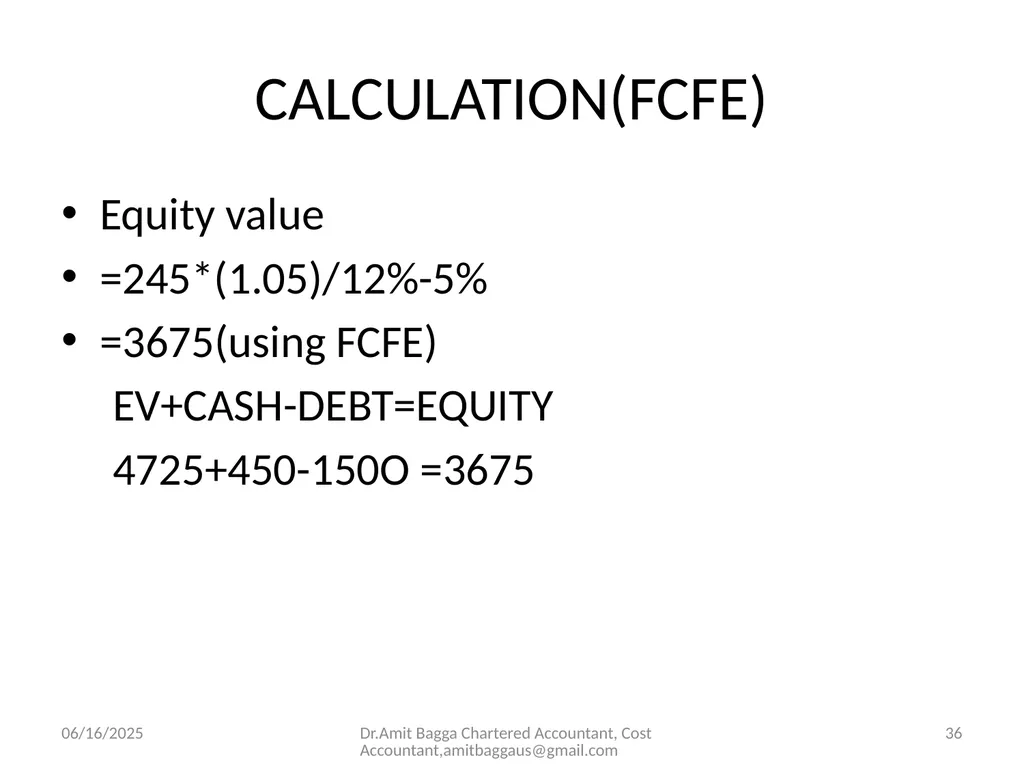
CALCULATION(FCFE) Equity value
=245*(1.05)/12%-5%
=3675(using FCFE)
EV+CASH-DEBT=EQUITY
4725+450-150O =3675 3/19/2014 Dr.Amit Bagga Chartered Accountant, Cost Accountant,amitbaggaus@gmail.com 36<br>
=245*(1.05)/12%-5%
=3675(using FCFE)
EV+CASH-DEBT=EQUITY
4725+450-150O =3675 3/19/2014 Dr.Amit Bagga Chartered Accountant, Cost Accountant,amitbaggaus@gmail.com 36<br>
37
Relative Valuation 3/19/2014 Dr.Amit Bagga Chartered Accountant, Cost Accountant,amitbaggaus@gmail.com 37<br>
38
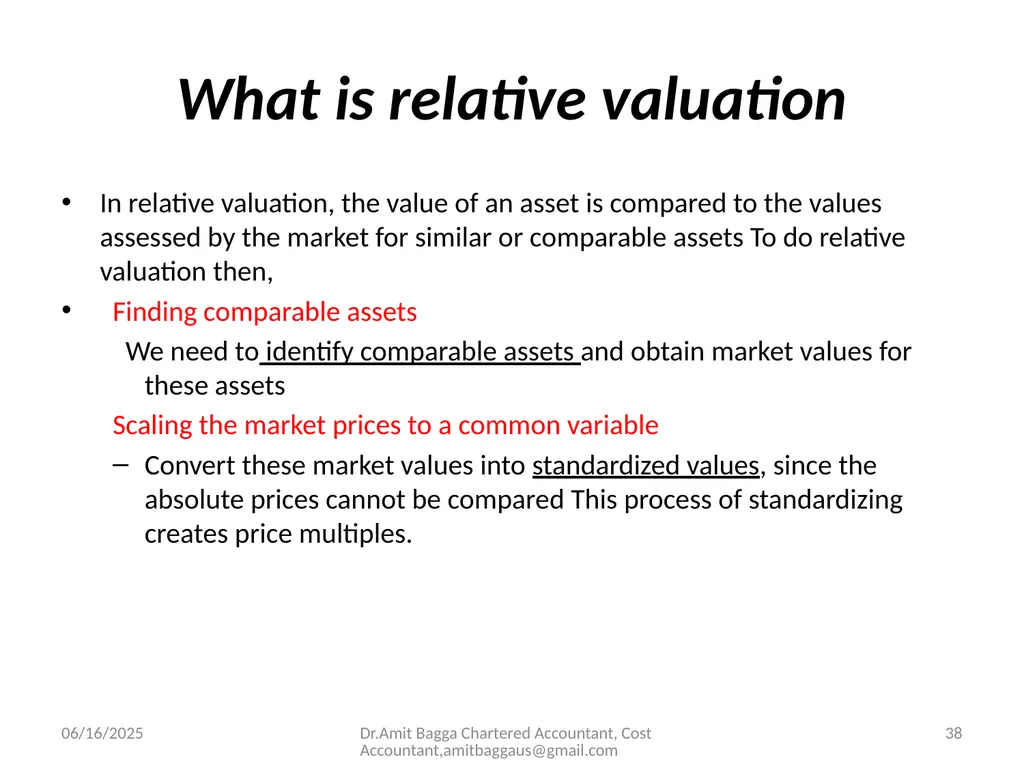
What is relative valuation In relative valuation, the value of an asset is compared to the values assessed by the market for similar or comparable assets To do relative valuation then,
Finding comparable assets
We need to identify comparable assets and obtain market values for these assets
Scaling the market prices to a common variable
Convert these market values into standardized values, since the absolute prices cannot be compared This process of standardizing creates price multiples. 3/19/2014 Dr.Amit Bagga Chartered Accountant, Cost Accountant,amitbaggaus@gmail.com 38<br>
Finding comparable assets
We need to identify comparable assets and obtain market values for these assets
Scaling the market prices to a common variable
Convert these market values into standardized values, since the absolute prices cannot be compared This process of standardizing creates price multiples. 3/19/2014 Dr.Amit Bagga Chartered Accountant, Cost Accountant,amitbaggaus@gmail.com 38<br>
39
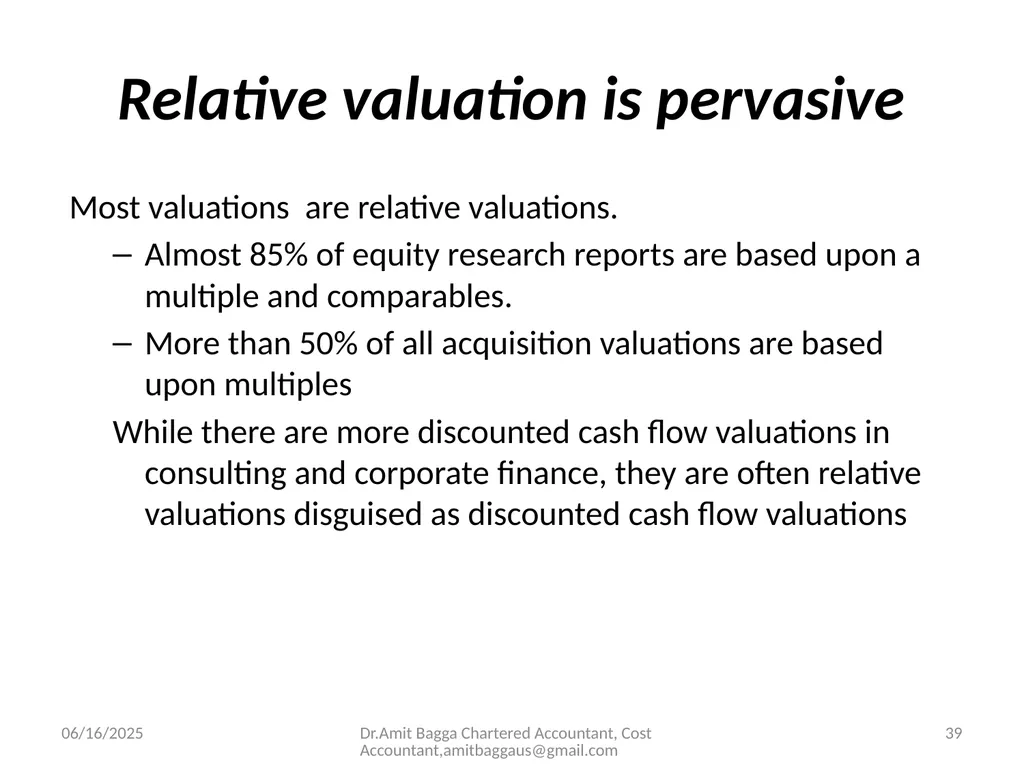
Relative valuation is pervasive Most valuations are relative valuations.
Almost 85% of equity research reports are based upon a multiple and comparables.
More than 50% of all acquisition valuations are based upon multiples
While there are more discounted cash flow valuations in consulting and corporate finance, they are often relative valuations disguised as discounted cash flow valuations 3/19/2014 Dr.Amit Bagga Chartered Accountant, Cost Accountant,amitbaggaus@gmail.com 39<br>
Almost 85% of equity research reports are based upon a multiple and comparables.
More than 50% of all acquisition valuations are based upon multiples
While there are more discounted cash flow valuations in consulting and corporate finance, they are often relative valuations disguised as discounted cash flow valuations 3/19/2014 Dr.Amit Bagga Chartered Accountant, Cost Accountant,amitbaggaus@gmail.com 39<br>
40
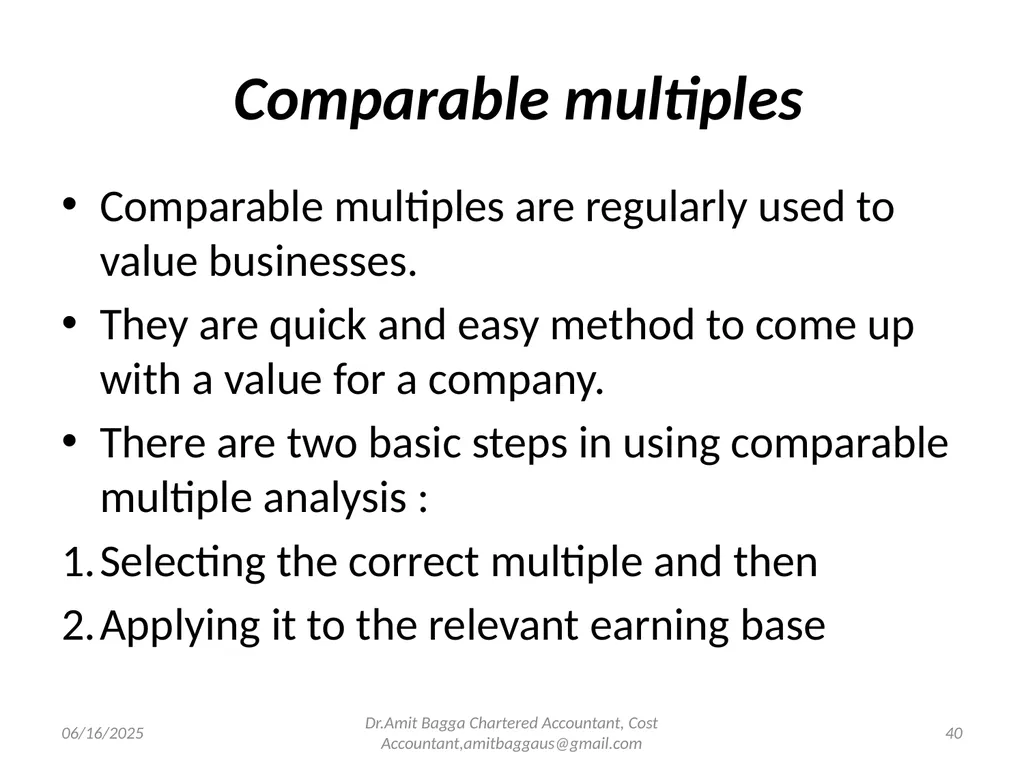
Comparable multiples Comparable multiples are regularly used to value businesses.
They are quick and easy method to come up with a value for a company.
There are two basic steps in using comparable multiple analysis :
Selecting the correct multiple and then
Applying it to the relevant earning base 3/19/2014 Dr.Amit Bagga Chartered Accountant, Cost Accountant,amitbaggaus@gmail.com 40<br>
They are quick and easy method to come up with a value for a company.
There are two basic steps in using comparable multiple analysis :
Selecting the correct multiple and then
Applying it to the relevant earning base 3/19/2014 Dr.Amit Bagga Chartered Accountant, Cost Accountant,amitbaggaus@gmail.com 40<br>
41
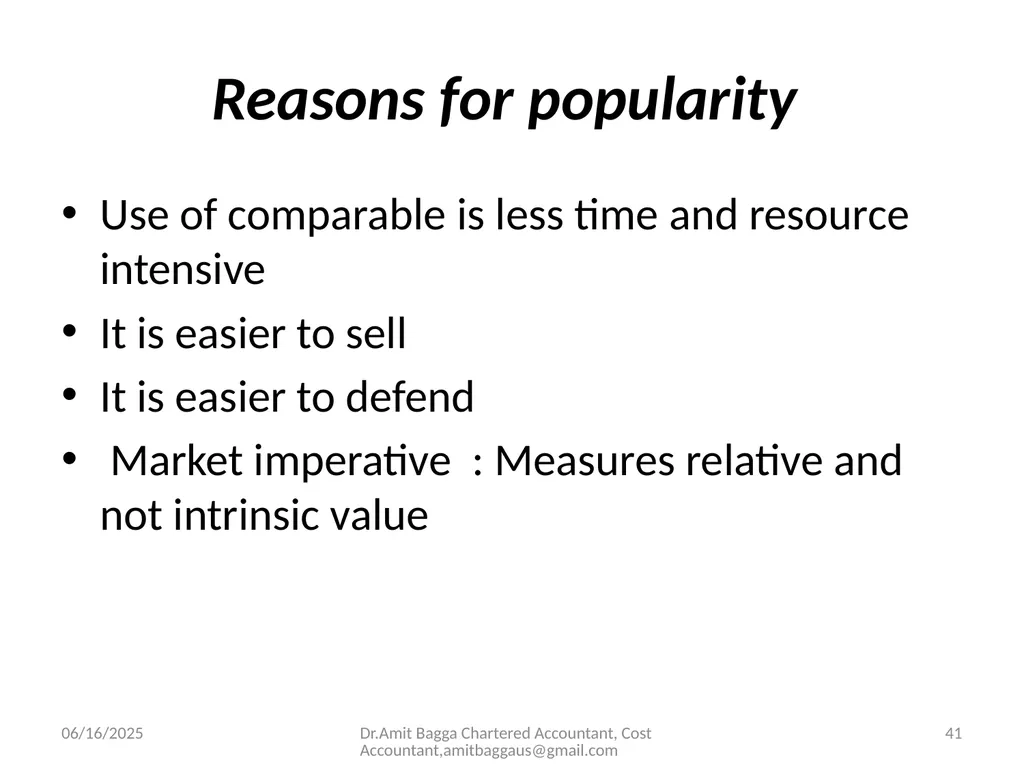
Reasons for popularity Use of comparable is less time and resource intensive
It is easier to sell
It is easier to defend
Market imperative : Measures relative and not intrinsic value 3/19/2014 Dr.Amit Bagga Chartered Accountant, Cost Accountant,amitbaggaus@gmail.com 41<br>
It is easier to sell
It is easier to defend
Market imperative : Measures relative and not intrinsic value 3/19/2014 Dr.Amit Bagga Chartered Accountant, Cost Accountant,amitbaggaus@gmail.com 41<br>
42
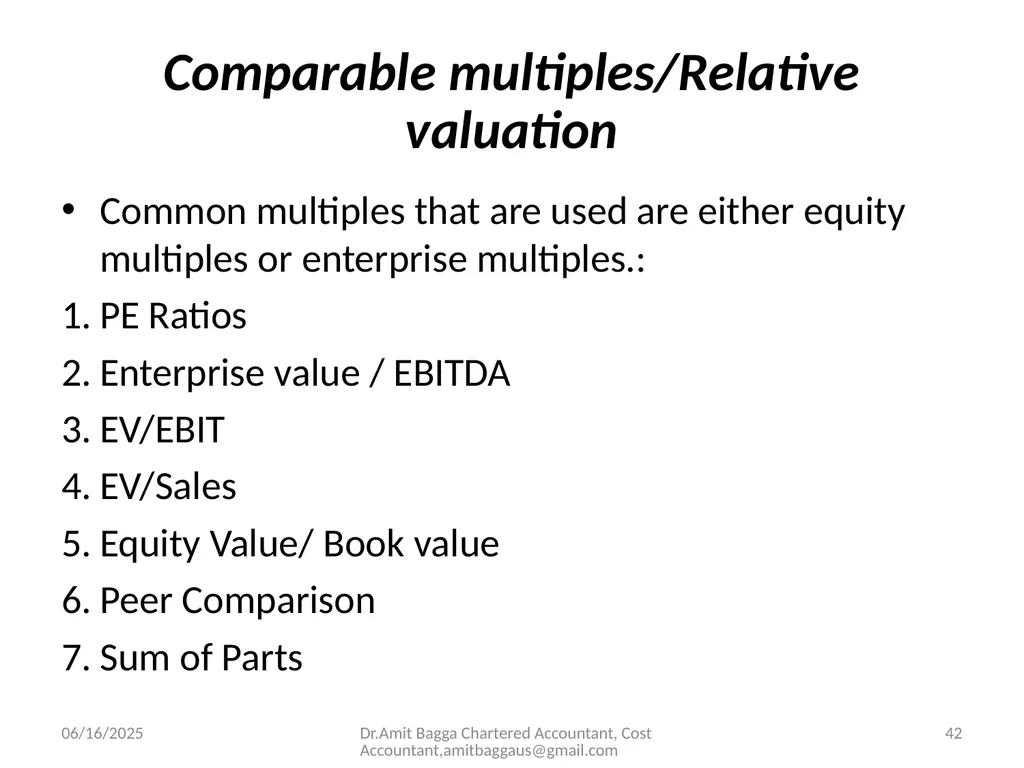
Comparable multiples/Relative valuation Common multiples that are used are either equity multiples or enterprise multiples.:
PE Ratios
Enterprise value / EBITDA
EV/EBIT
EV/Sales
Equity Value/ Book value
Peer Comparison
Sum of Parts 3/19/2014 Dr.Amit Bagga Chartered Accountant, Cost Accountant,amitbaggaus@gmail.com 42<br>
PE Ratios
Enterprise value / EBITDA
EV/EBIT
EV/Sales
Equity Value/ Book value
Peer Comparison
Sum of Parts 3/19/2014 Dr.Amit Bagga Chartered Accountant, Cost Accountant,amitbaggaus@gmail.com 42<br>
43
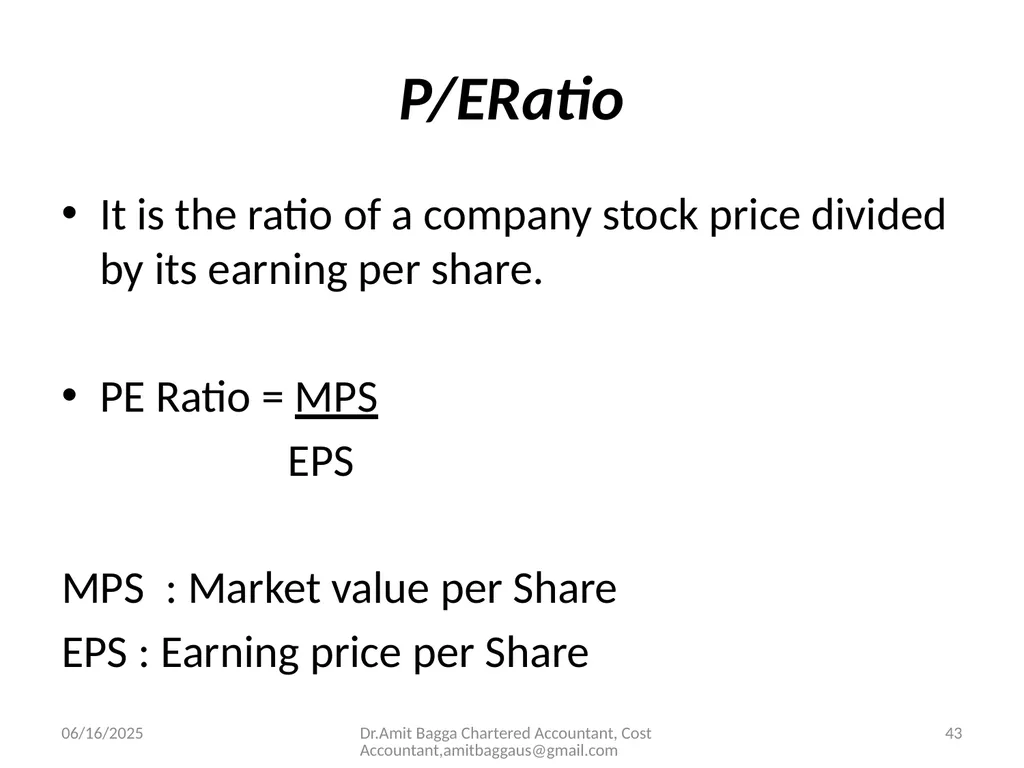
P/ERatio It is the ratio of a company stock price divided by its earning per share.
PE Ratio = MPS
EPS
MPS : Market value per Share
EPS : Earning price per Share 3/19/2014 Dr.Amit Bagga Chartered Accountant, Cost Accountant,amitbaggaus@gmail.com 43<br>
PE Ratio = MPS
EPS
MPS : Market value per Share
EPS : Earning price per Share 3/19/2014 Dr.Amit Bagga Chartered Accountant, Cost Accountant,amitbaggaus@gmail.com 43<br>
44
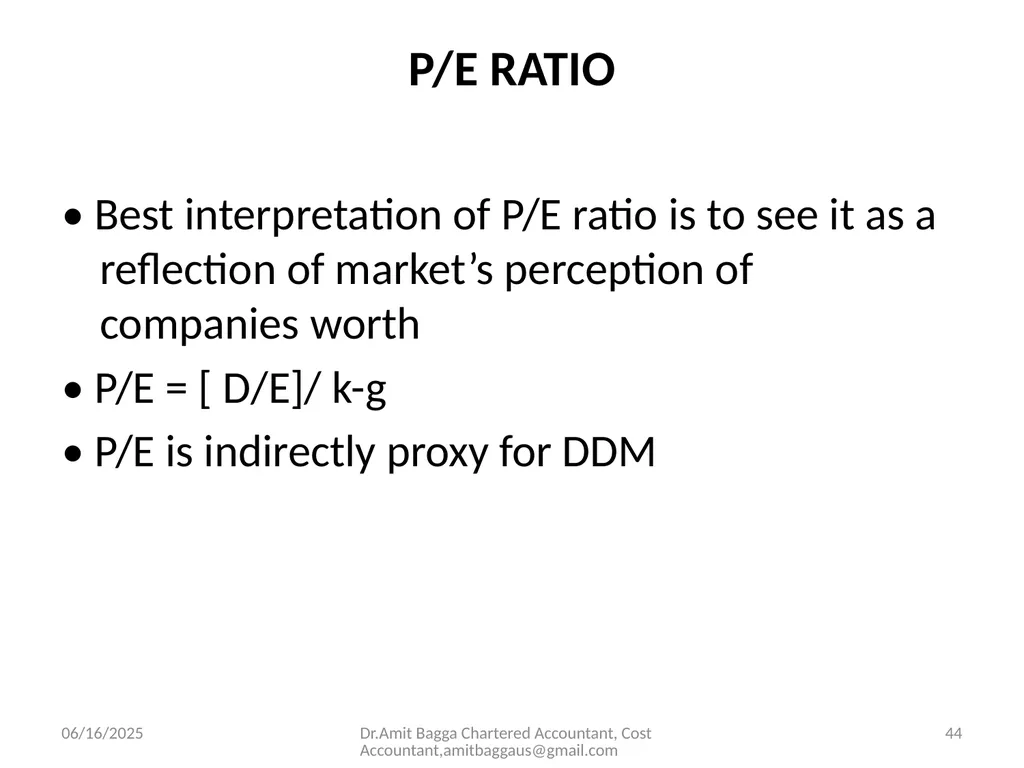
P/E RATIO • Best interpretation of P/E ratio is to see it as a reflection of market’s perception of companies worth
• P/E = [ D/E]/ k-g
• P/E is indirectly proxy for DDM 3/19/2014 Dr.Amit Bagga Chartered Accountant, Cost Accountant,amitbaggaus@gmail.com 44<br>
• P/E = [ D/E]/ k-g
• P/E is indirectly proxy for DDM 3/19/2014 Dr.Amit Bagga Chartered Accountant, Cost Accountant,amitbaggaus@gmail.com 44<br>
45
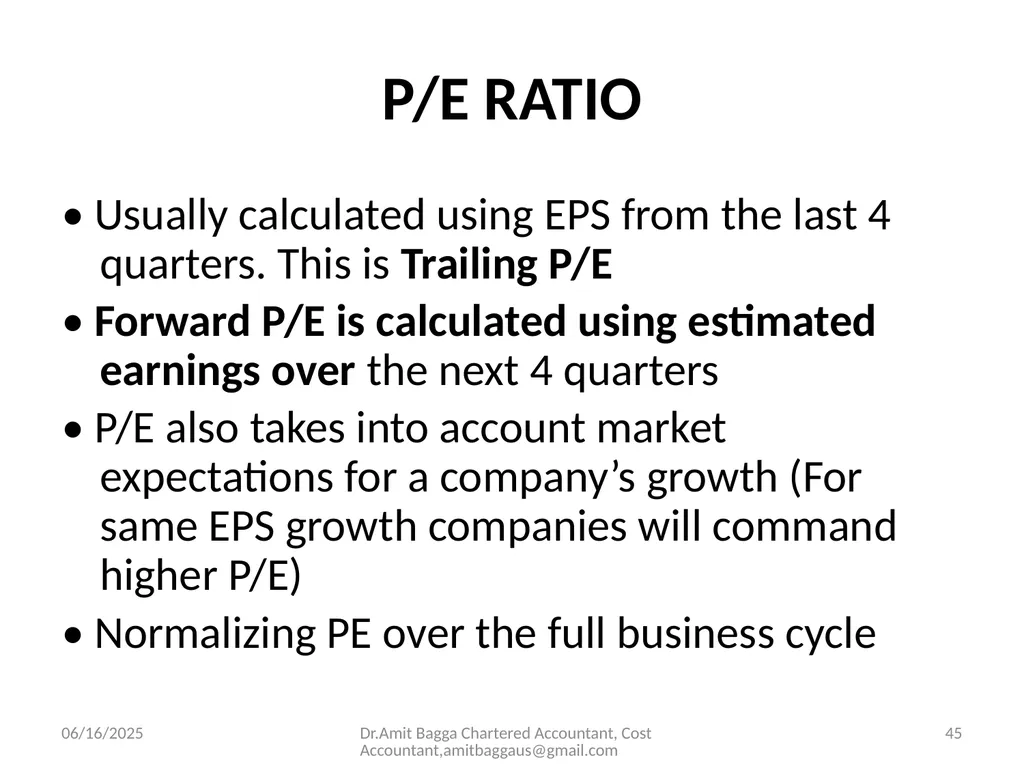
P/E RATIO • Usually calculated using EPS from the last 4 quarters. This is Trailing P/E
• Forward P/E is calculated using estimated earnings over the next 4 quarters
• P/E also takes into account market expectations for a company’s growth (For same EPS growth companies will command higher P/E)
• Normalizing PE over the full business cycle 3/19/2014 Dr.Amit Bagga Chartered Accountant, Cost Accountant,amitbaggaus@gmail.com 45<br>
• Forward P/E is calculated using estimated earnings over the next 4 quarters
• P/E also takes into account market expectations for a company’s growth (For same EPS growth companies will command higher P/E)
• Normalizing PE over the full business cycle 3/19/2014 Dr.Amit Bagga Chartered Accountant, Cost Accountant,amitbaggaus@gmail.com 45<br>
46
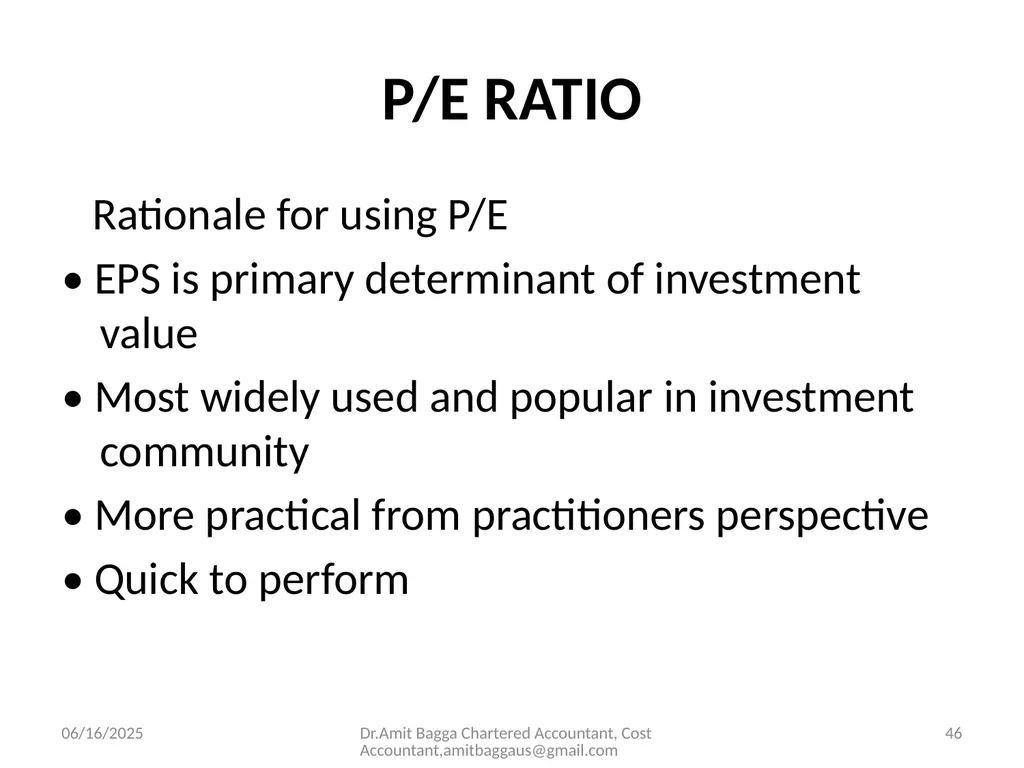
P/E RATIO Rationale for using P/E
• EPS is primary determinant of investment value
• Most widely used and popular in investment community
• More practical from practitioners perspective
• Quick to perform 3/19/2014 Dr.Amit Bagga Chartered Accountant, Cost Accountant,amitbaggaus@gmail.com 46<br>
• EPS is primary determinant of investment value
• Most widely used and popular in investment community
• More practical from practitioners perspective
• Quick to perform 3/19/2014 Dr.Amit Bagga Chartered Accountant, Cost Accountant,amitbaggaus@gmail.com 46<br>
47
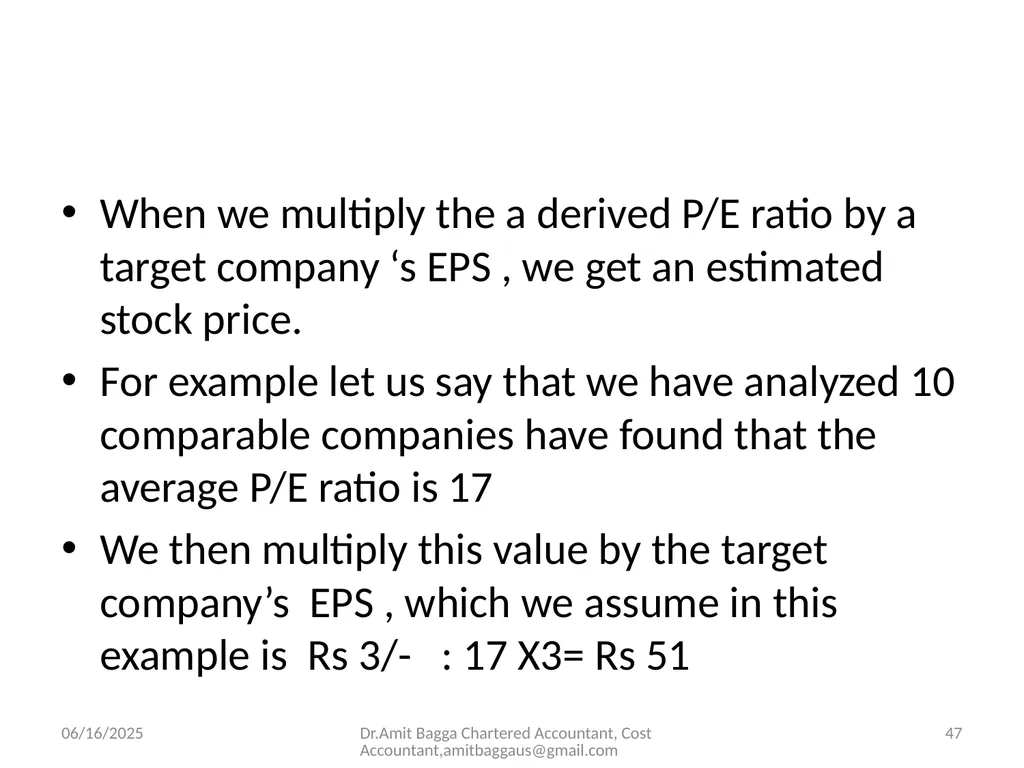
When we multiply the a derived P/E ratio by a target company ‘s EPS , we get an estimated stock price.
For example let us say that we have analyzed 10 comparable companies have found that the average P/E ratio is 17
We then multiply this value by the target company’s EPS , which we assume in this example is Rs 3/- : 17 X3= Rs 51 3/19/2014 Dr.Amit Bagga Chartered Accountant, Cost Accountant,amitbaggaus@gmail.com 47<br>
For example let us say that we have analyzed 10 comparable companies have found that the average P/E ratio is 17
We then multiply this value by the target company’s EPS , which we assume in this example is Rs 3/- : 17 X3= Rs 51 3/19/2014 Dr.Amit Bagga Chartered Accountant, Cost Accountant,amitbaggaus@gmail.com 47<br>
48
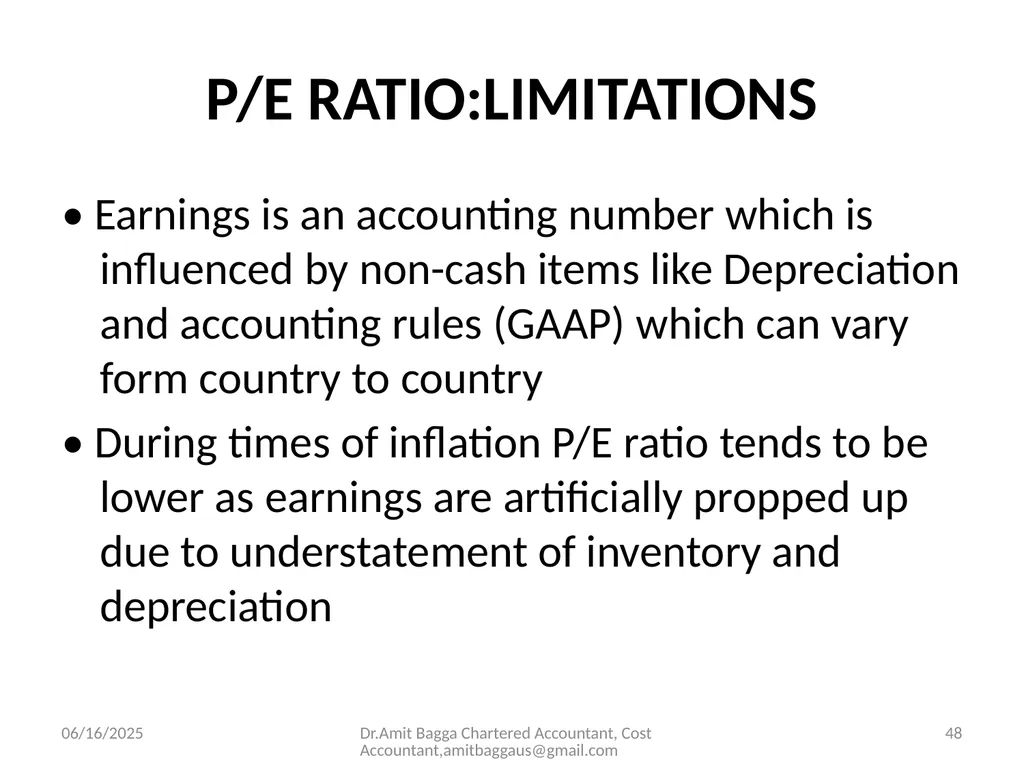
P/E RATIO:LIMITATIONS • Earnings is an accounting number which is influenced by non-cash items like Depreciation and accounting rules (GAAP) which can vary form country to country
• During times of inflation P/E ratio tends to be lower as earnings are artificially propped up due to understatement of inventory and depreciation 3/19/2014 Dr.Amit Bagga Chartered Accountant, Cost Accountant,amitbaggaus@gmail.com 48<br>
• During times of inflation P/E ratio tends to be lower as earnings are artificially propped up due to understatement of inventory and depreciation 3/19/2014 Dr.Amit Bagga Chartered Accountant, Cost Accountant,amitbaggaus@gmail.com 48<br>
49
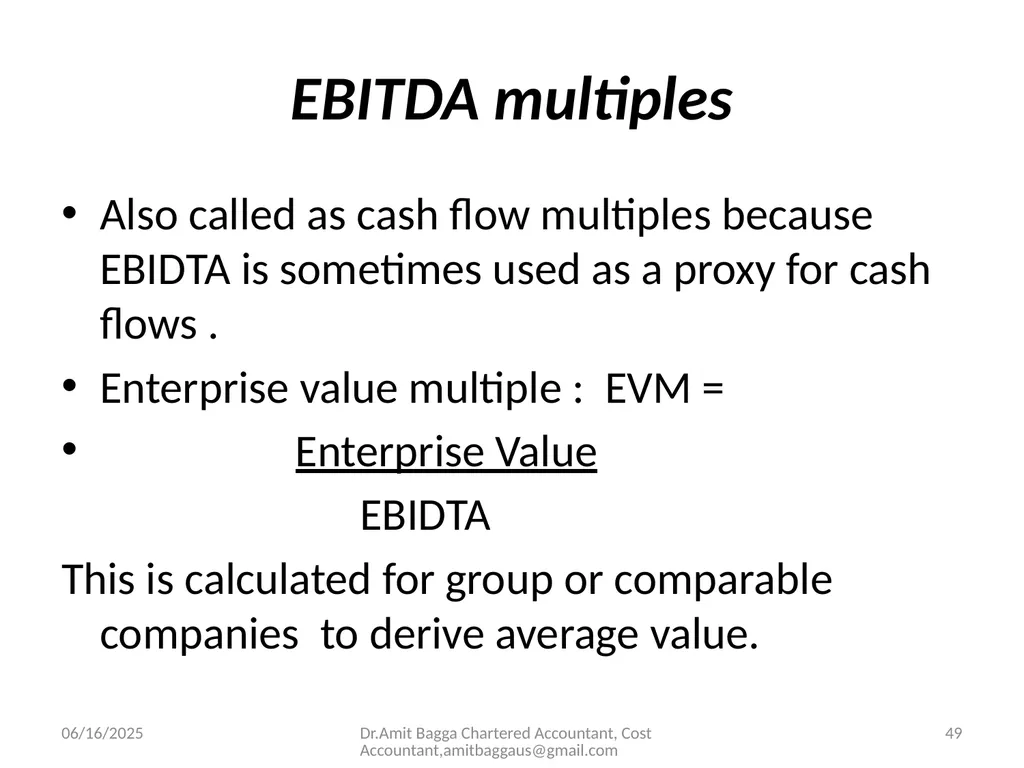
EBITDA multiples Also called as cash flow multiples because EBIDTA is sometimes used as a proxy for cash flows .
Enterprise value multiple : EVM =
Enterprise Value
EBIDTA
This is calculated for group or comparable companies to derive average value. 3/19/2014 Dr.Amit Bagga Chartered Accountant, Cost Accountant,amitbaggaus@gmail.com 49<br>
Enterprise value multiple : EVM =
Enterprise Value
EBIDTA
This is calculated for group or comparable companies to derive average value. 3/19/2014 Dr.Amit Bagga Chartered Accountant, Cost Accountant,amitbaggaus@gmail.com 49<br>
50
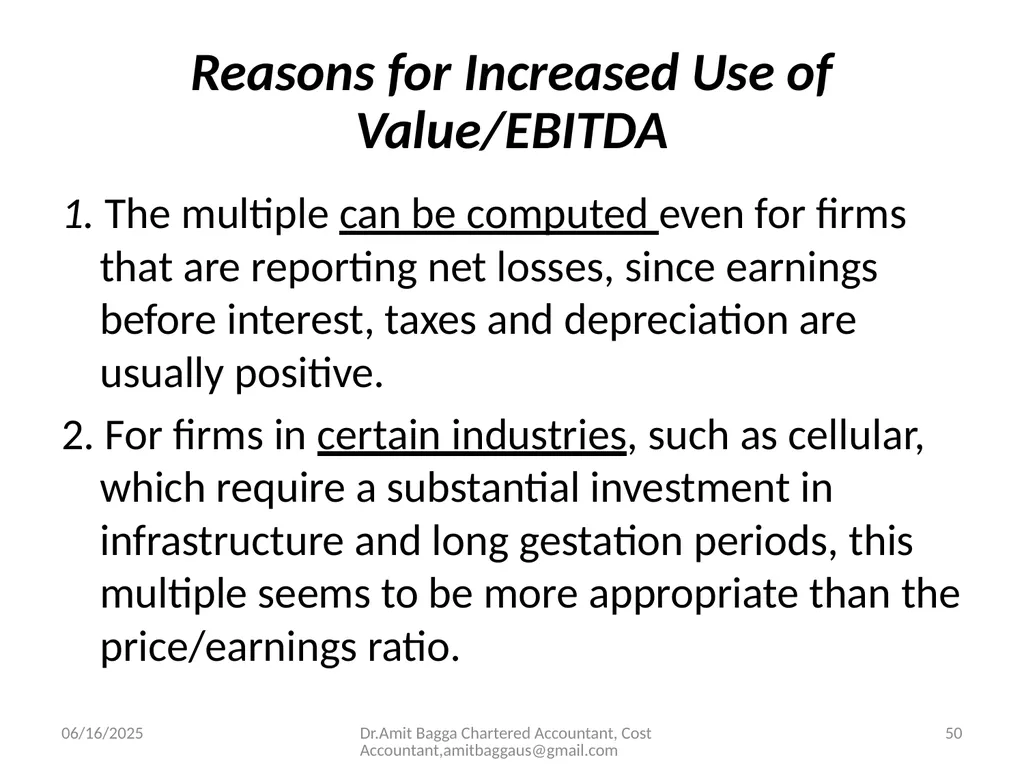
Reasons for Increased Use of Value/EBITDA 1. The multiple can be computed even for firms that are reporting net losses, since earnings before interest, taxes and depreciation are usually positive.
2. For firms in certain industries, such as cellular, which require a substantial investment in infrastructure and long gestation periods, this multiple seems to be more appropriate than the price/earnings ratio. 3/19/2014 Dr.Amit Bagga Chartered Accountant, Cost Accountant,amitbaggaus@gmail.com 50<br>
2. For firms in certain industries, such as cellular, which require a substantial investment in infrastructure and long gestation periods, this multiple seems to be more appropriate than the price/earnings ratio. 3/19/2014 Dr.Amit Bagga Chartered Accountant, Cost Accountant,amitbaggaus@gmail.com 50<br>
51
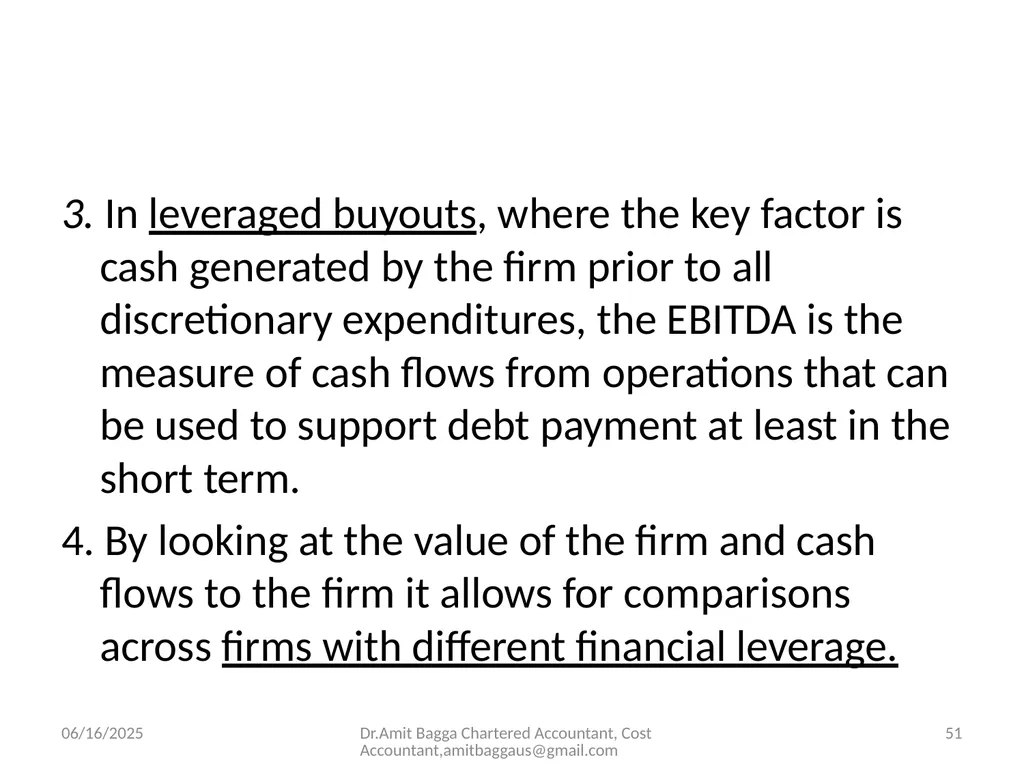
3. In leveraged buyouts, where the key factor is cash generated by the firm prior to all discretionary expenditures, the EBITDA is the measure of cash flows from operations that can be used to support debt payment at least in the short term.
4. By looking at the value of the firm and cash flows to the firm it allows for comparisons across firms with different financial leverage. 3/19/2014 Dr.Amit Bagga Chartered Accountant, Cost Accountant,amitbaggaus@gmail.com 51<br>
4. By looking at the value of the firm and cash flows to the firm it allows for comparisons across firms with different financial leverage. 3/19/2014 Dr.Amit Bagga Chartered Accountant, Cost Accountant,amitbaggaus@gmail.com 51<br>
52
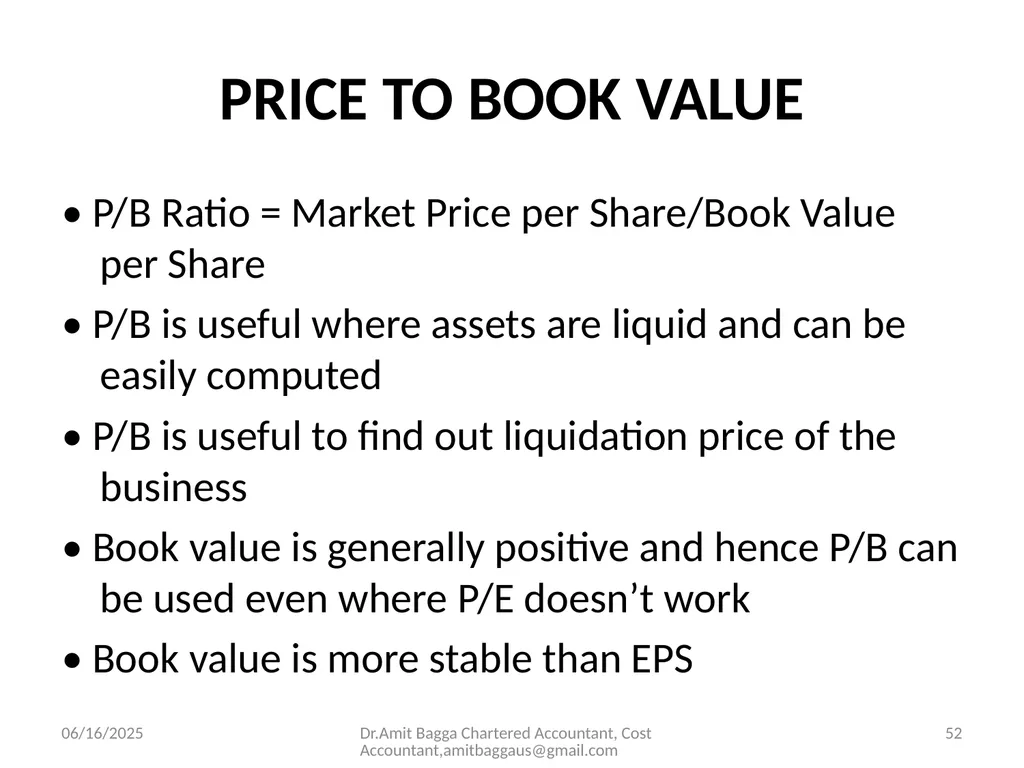
PRICE TO BOOK VALUE • P/B Ratio = Market Price per Share/Book Value per Share
• P/B is useful where assets are liquid and can be easily computed
• P/B is useful to find out liquidation price of the business
• Book value is generally positive and hence P/B can be used even where P/E doesn’t work
• Book value is more stable than EPS 3/19/2014 Dr.Amit Bagga Chartered Accountant, Cost Accountant,amitbaggaus@gmail.com 52<br>
• P/B is useful where assets are liquid and can be easily computed
• P/B is useful to find out liquidation price of the business
• Book value is generally positive and hence P/B can be used even where P/E doesn’t work
• Book value is more stable than EPS 3/19/2014 Dr.Amit Bagga Chartered Accountant, Cost Accountant,amitbaggaus@gmail.com 52<br>
53
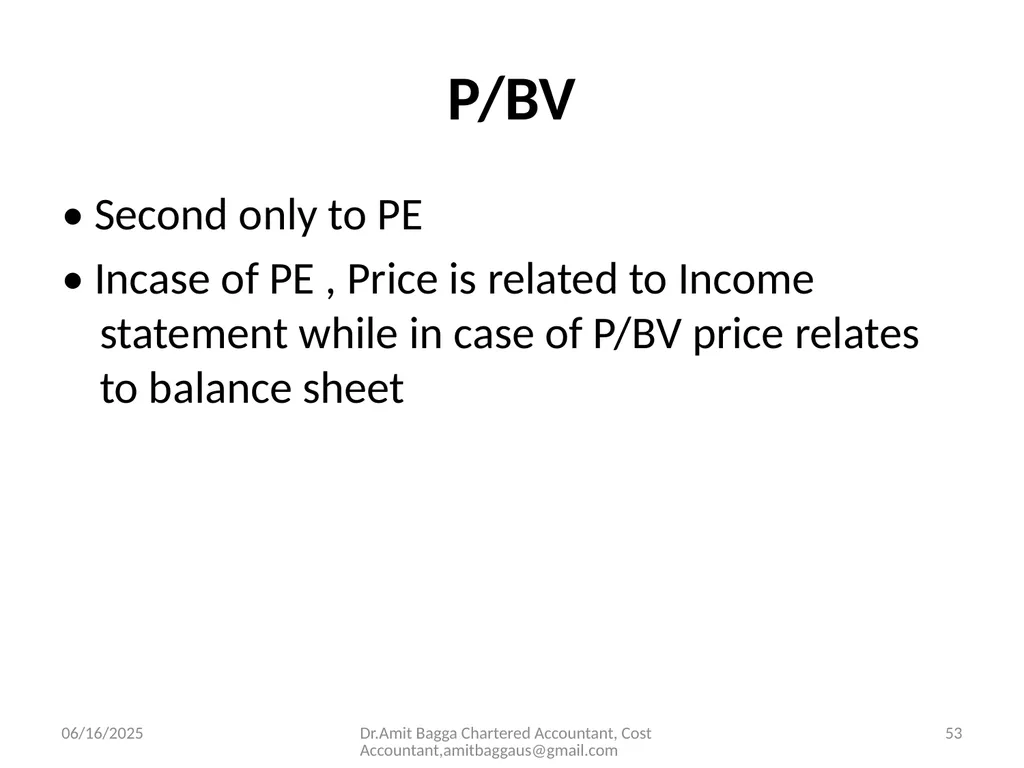
P/BV • Second only to PE
• Incase of PE , Price is related to Income statement while in case of P/BV price relates to balance sheet 3/19/2014 Dr.Amit Bagga Chartered Accountant, Cost Accountant,amitbaggaus@gmail.com 53<br>
• Incase of PE , Price is related to Income statement while in case of P/BV price relates to balance sheet 3/19/2014 Dr.Amit Bagga Chartered Accountant, Cost Accountant,amitbaggaus@gmail.com 53<br>
54
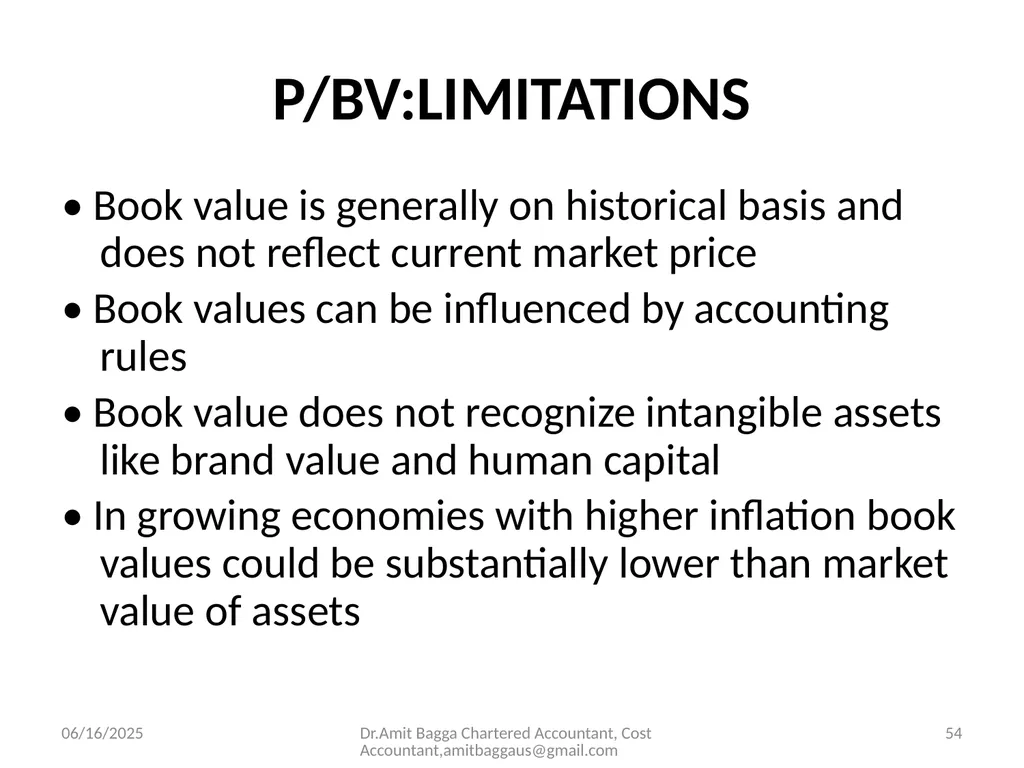
P/BV:LIMITATIONS • Book value is generally on historical basis and does not reflect current market price
• Book values can be influenced by accounting rules
• Book value does not recognize intangible assets like brand value and human capital
• In growing economies with higher inflation book values could be substantially lower than market value of assets 3/19/2014 Dr.Amit Bagga Chartered Accountant, Cost Accountant,amitbaggaus@gmail.com 54<br>
• Book values can be influenced by accounting rules
• Book value does not recognize intangible assets like brand value and human capital
• In growing economies with higher inflation book values could be substantially lower than market value of assets 3/19/2014 Dr.Amit Bagga Chartered Accountant, Cost Accountant,amitbaggaus@gmail.com 54<br>
55
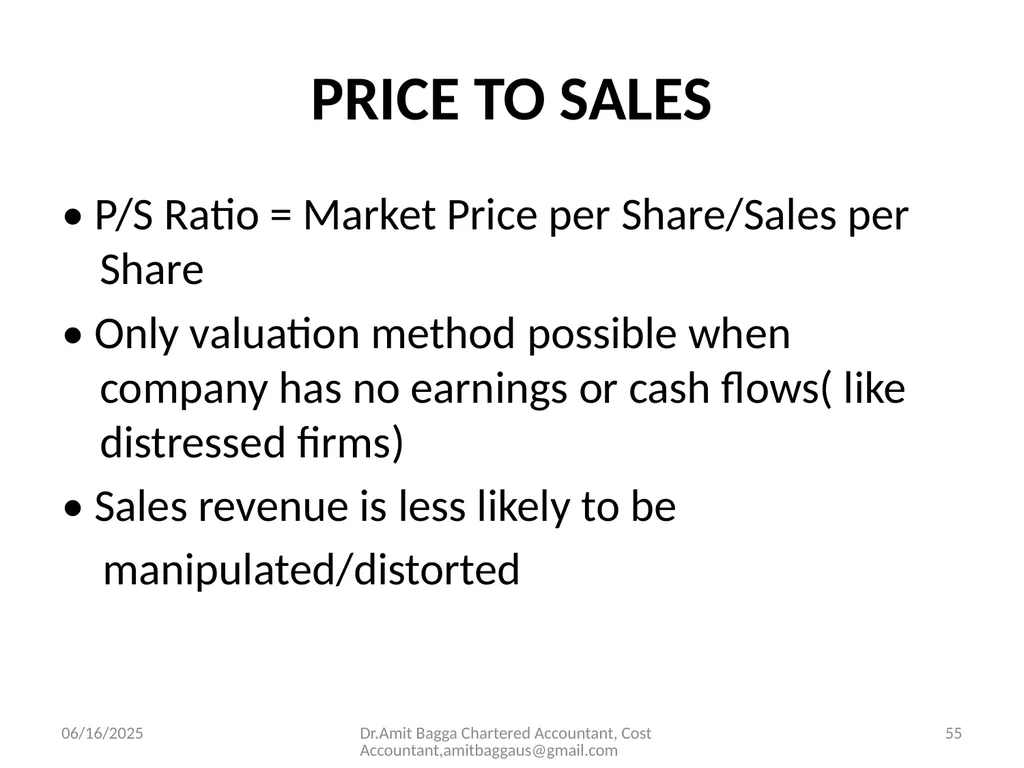
PRICE TO SALES • P/S Ratio = Market Price per Share/Sales per Share
• Only valuation method possible when company has no earnings or cash flows( like distressed firms)
• Sales revenue is less likely to be
manipulated/distorted 3/19/2014 Dr.Amit Bagga Chartered Accountant, Cost Accountant,amitbaggaus@gmail.com 55<br>
• Only valuation method possible when company has no earnings or cash flows( like distressed firms)
• Sales revenue is less likely to be
manipulated/distorted 3/19/2014 Dr.Amit Bagga Chartered Accountant, Cost Accountant,amitbaggaus@gmail.com 55<br>
56
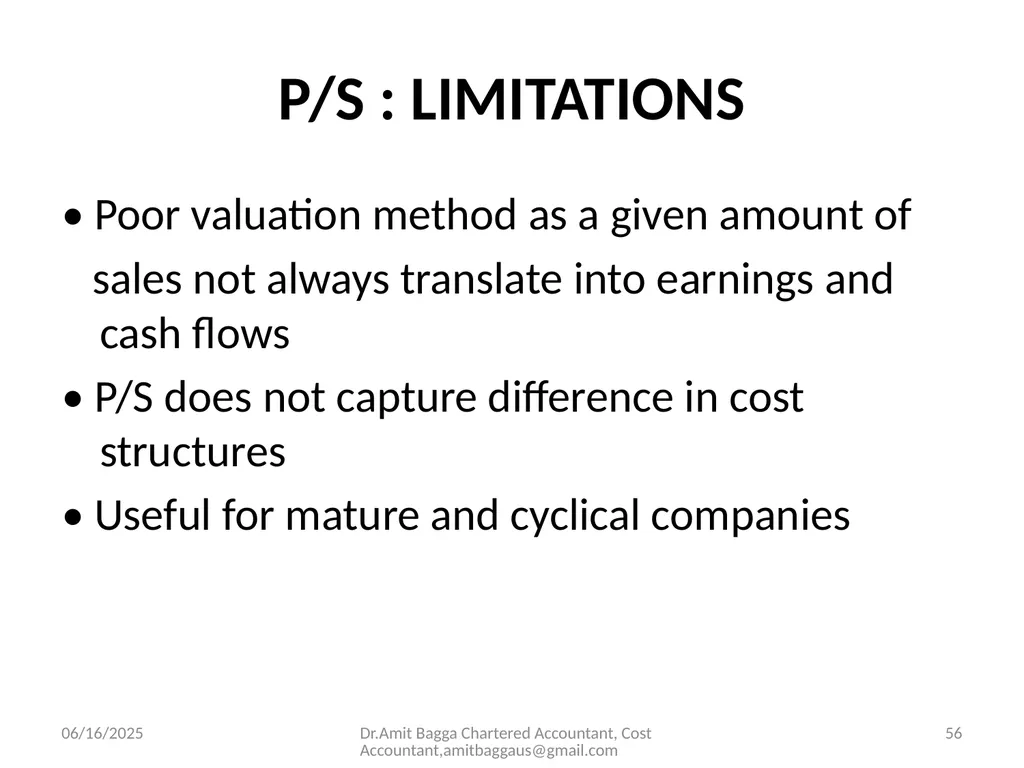
P/S : LIMITATIONS • Poor valuation method as a given amount of
sales not always translate into earnings and cash flows
• P/S does not capture difference in cost structures
• Useful for mature and cyclical companies 3/19/2014 Dr.Amit Bagga Chartered Accountant, Cost Accountant,amitbaggaus@gmail.com 56<br>
sales not always translate into earnings and cash flows
• P/S does not capture difference in cost structures
• Useful for mature and cyclical companies 3/19/2014 Dr.Amit Bagga Chartered Accountant, Cost Accountant,amitbaggaus@gmail.com 56<br>
57
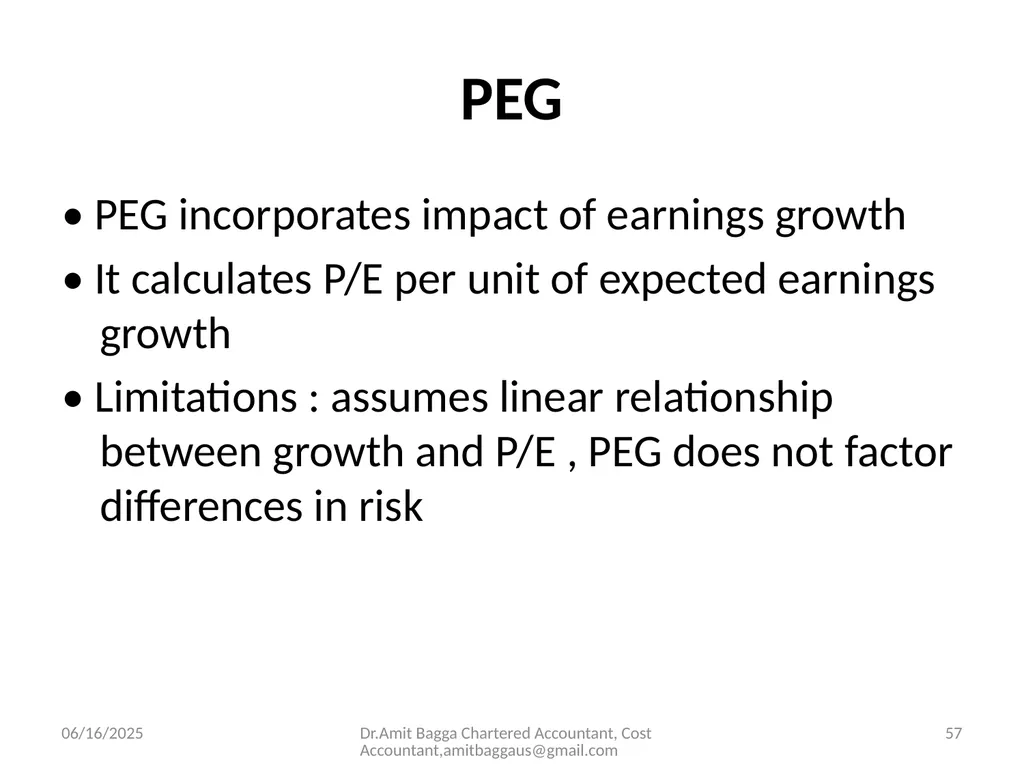
PEG • PEG incorporates impact of earnings growth
• It calculates P/E per unit of expected earnings growth
• Limitations : assumes linear relationship between growth and P/E , PEG does not factor differences in risk 3/19/2014 Dr.Amit Bagga Chartered Accountant, Cost Accountant,amitbaggaus@gmail.com 57<br>
• It calculates P/E per unit of expected earnings growth
• Limitations : assumes linear relationship between growth and P/E , PEG does not factor differences in risk 3/19/2014 Dr.Amit Bagga Chartered Accountant, Cost Accountant,amitbaggaus@gmail.com 57<br>
58
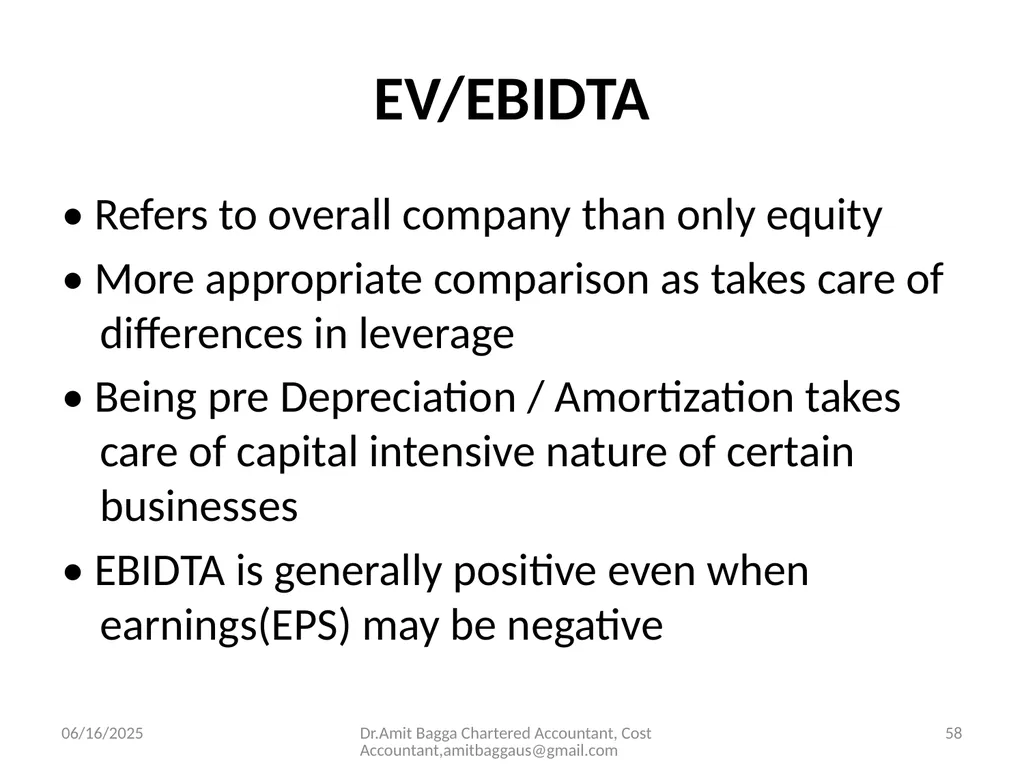
EV/EBIDTA • Refers to overall company than only equity
• More appropriate comparison as takes care of differences in leverage
• Being pre Depreciation / Amortization takes care of capital intensive nature of certain businesses
• EBIDTA is generally positive even when earnings(EPS) may be negative 3/19/2014 Dr.Amit Bagga Chartered Accountant, Cost Accountant,amitbaggaus@gmail.com 58<br>
• More appropriate comparison as takes care of differences in leverage
• Being pre Depreciation / Amortization takes care of capital intensive nature of certain businesses
• EBIDTA is generally positive even when earnings(EPS) may be negative 3/19/2014 Dr.Amit Bagga Chartered Accountant, Cost Accountant,amitbaggaus@gmail.com 58<br>
59
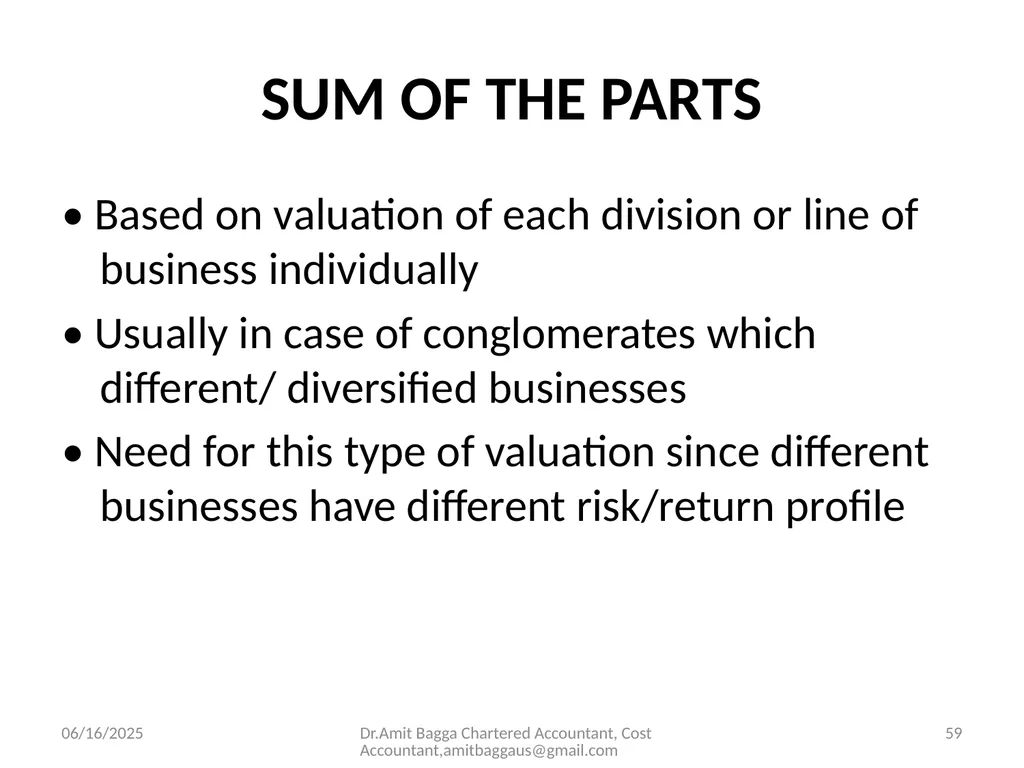
SUM OF THE PARTS • Based on valuation of each division or line of business individually
• Usually in case of conglomerates which different/ diversified businesses
• Need for this type of valuation since different businesses have different risk/return profile 3/19/2014 Dr.Amit Bagga Chartered Accountant, Cost Accountant,amitbaggaus@gmail.com 59<br>
• Usually in case of conglomerates which different/ diversified businesses
• Need for this type of valuation since different businesses have different risk/return profile 3/19/2014 Dr.Amit Bagga Chartered Accountant, Cost Accountant,amitbaggaus@gmail.com 59<br>
60
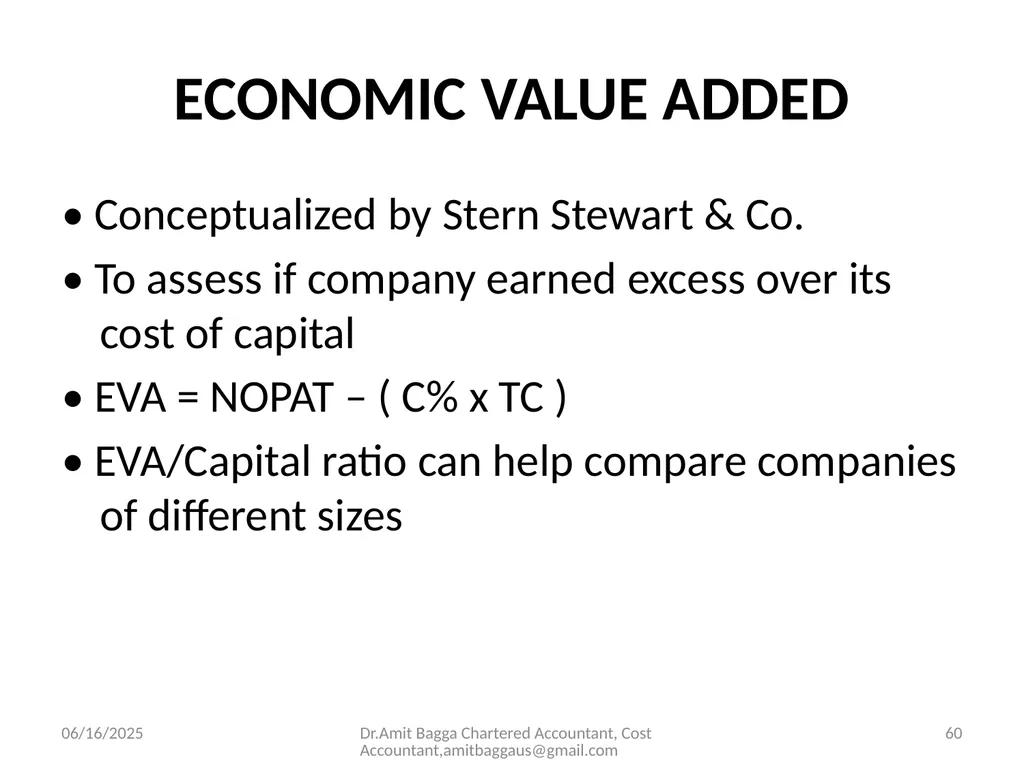
ECONOMIC VALUE ADDED • Conceptualized by Stern Stewart & Co.
• To assess if company earned excess over its cost of capital
• EVA = NOPAT – ( C% x TC )
• EVA/Capital ratio can help compare companies of different sizes 3/19/2014 Dr.Amit Bagga Chartered Accountant, Cost Accountant,amitbaggaus@gmail.com 60<br>
• To assess if company earned excess over its cost of capital
• EVA = NOPAT – ( C% x TC )
• EVA/Capital ratio can help compare companies of different sizes 3/19/2014 Dr.Amit Bagga Chartered Accountant, Cost Accountant,amitbaggaus@gmail.com 60<br>
61
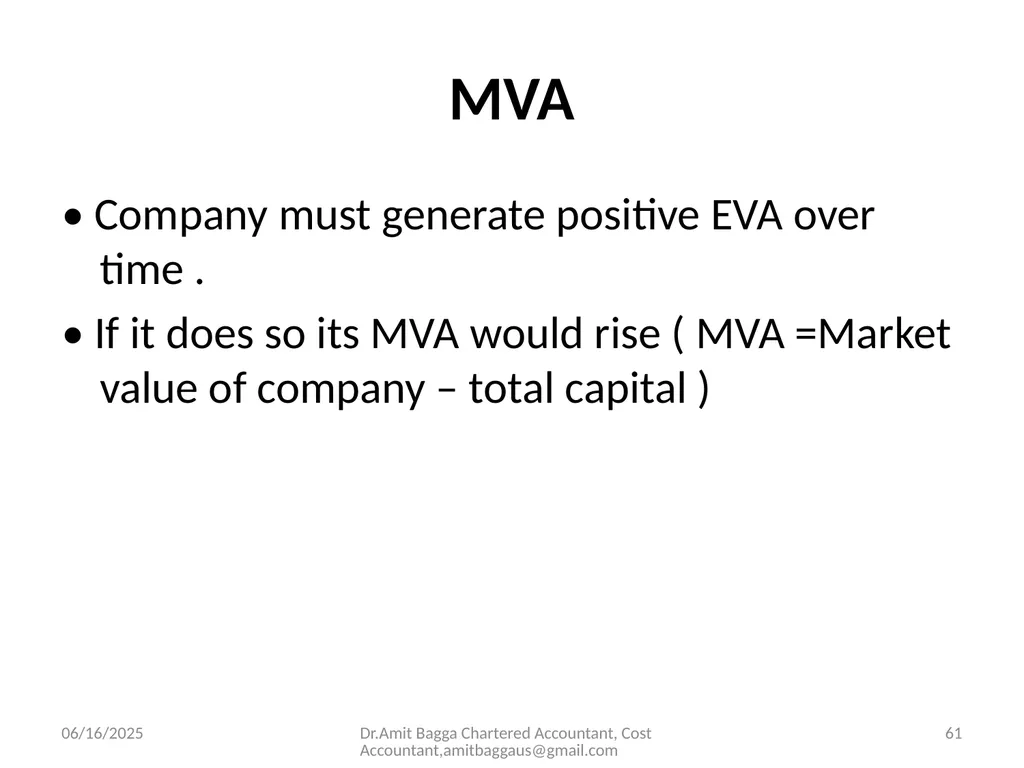
MVA • Company must generate positive EVA over time .
• If it does so its MVA would rise ( MVA =Market value of company – total capital ) 3/19/2014 Dr.Amit Bagga Chartered Accountant, Cost Accountant,amitbaggaus@gmail.com 61<br>
• If it does so its MVA would rise ( MVA =Market value of company – total capital ) 3/19/2014 Dr.Amit Bagga Chartered Accountant, Cost Accountant,amitbaggaus@gmail.com 61<br>
62
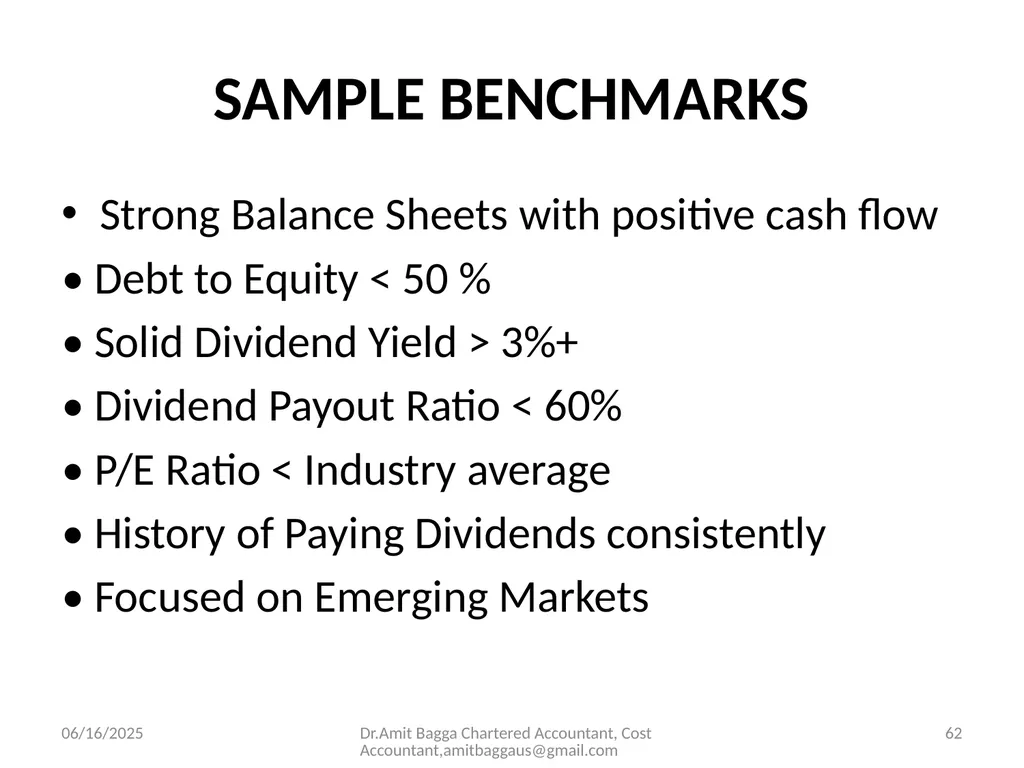
SAMPLE BENCHMARKS Strong Balance Sheets with positive cash flow
• Debt to Equity < 50 %
• Solid Dividend Yield > 3%+
• Dividend Payout Ratio < 60%
• P/E Ratio < Industry average
• History of Paying Dividends consistently
• Focused on Emerging Markets 3/19/2014 Dr.Amit Bagga Chartered Accountant, Cost Accountant,amitbaggaus@gmail.com 62<br>
• Debt to Equity < 50 %
• Solid Dividend Yield > 3%+
• Dividend Payout Ratio < 60%
• P/E Ratio < Industry average
• History of Paying Dividends consistently
• Focused on Emerging Markets 3/19/2014 Dr.Amit Bagga Chartered Accountant, Cost Accountant,amitbaggaus@gmail.com 62<br>
63
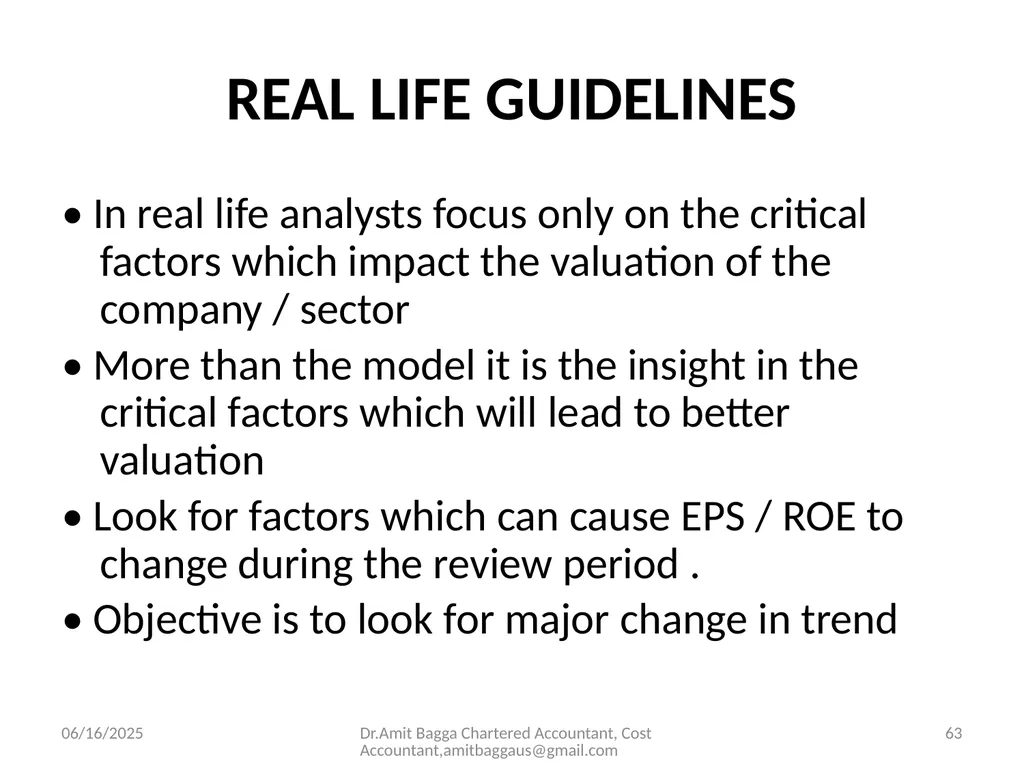
REAL LIFE GUIDELINES • In real life analysts focus only on the critical factors which impact the valuation of the company / sector
• More than the model it is the insight in the critical factors which will lead to better valuation
• Look for factors which can cause EPS / ROE to change during the review period .
• Objective is to look for major change in trend 3/19/2014 Dr.Amit Bagga Chartered Accountant, Cost Accountant,amitbaggaus@gmail.com 63<br>
• More than the model it is the insight in the critical factors which will lead to better valuation
• Look for factors which can cause EPS / ROE to change during the review period .
• Objective is to look for major change in trend 3/19/2014 Dr.Amit Bagga Chartered Accountant, Cost Accountant,amitbaggaus@gmail.com 63<br>
64
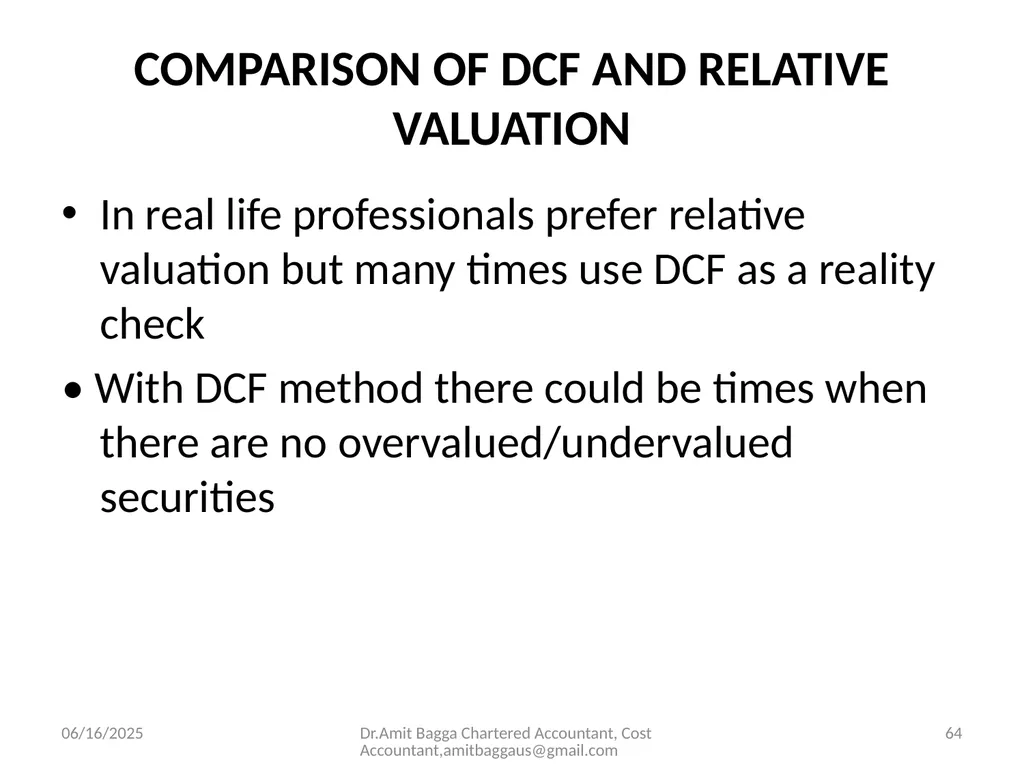
COMPARISON OF DCF AND RELATIVE
VALUATION In real life professionals prefer relative valuation but many times use DCF as a reality check
• With DCF method there could be times when there are no overvalued/undervalued securities 3/19/2014 Dr.Amit Bagga Chartered Accountant, Cost Accountant,amitbaggaus@gmail.com 64<br>
• With DCF method there could be times when there are no overvalued/undervalued securities 3/19/2014 Dr.Amit Bagga Chartered Accountant, Cost Accountant,amitbaggaus@gmail.com 64<br>
65
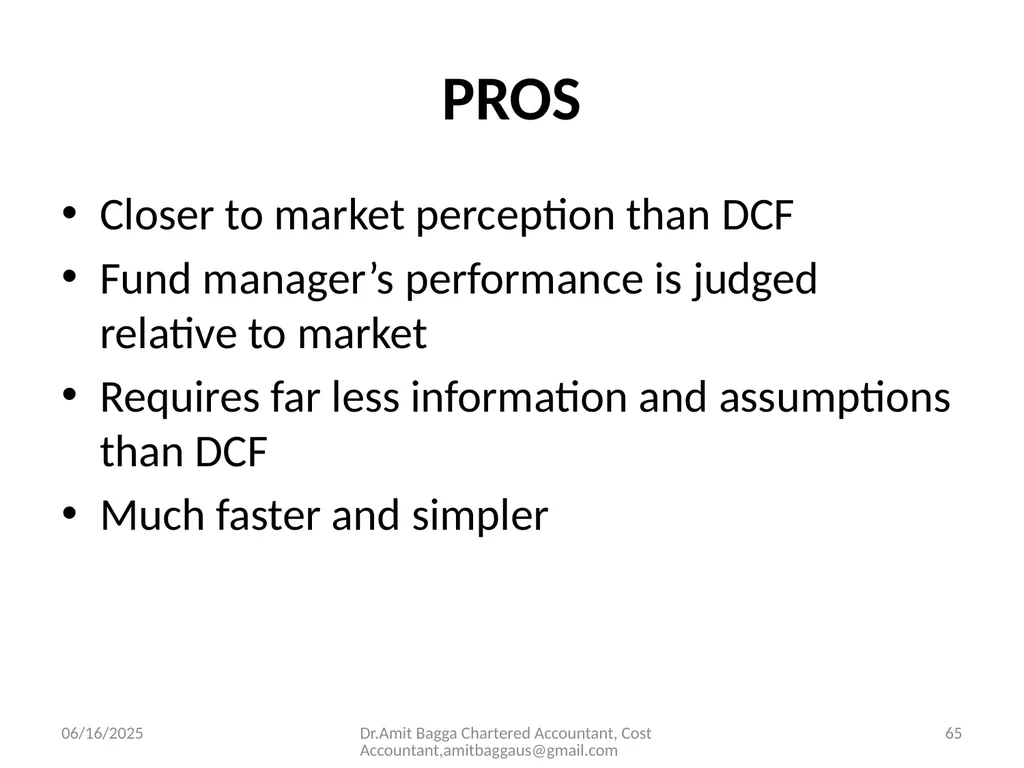
PROS Closer to market perception than DCF
Fund manager’s performance is judged relative to market
Requires far less information and assumptions than DCF
Much faster and simpler 3/19/2014 Dr.Amit Bagga Chartered Accountant, Cost Accountant,amitbaggaus@gmail.com 65<br>
Fund manager’s performance is judged relative to market
Requires far less information and assumptions than DCF
Much faster and simpler 3/19/2014 Dr.Amit Bagga Chartered Accountant, Cost Accountant,amitbaggaus@gmail.com 65<br>
66
CONS No two businesses are strictly comparables
Undervalued stock on relative basis may still be overvalued. 3/19/2014 Dr.Amit Bagga Chartered Accountant, Cost Accountant,amitbaggaus@gmail.com 66<br>
Undervalued stock on relative basis may still be overvalued. 3/19/2014 Dr.Amit Bagga Chartered Accountant, Cost Accountant,amitbaggaus@gmail.com 66<br>
67
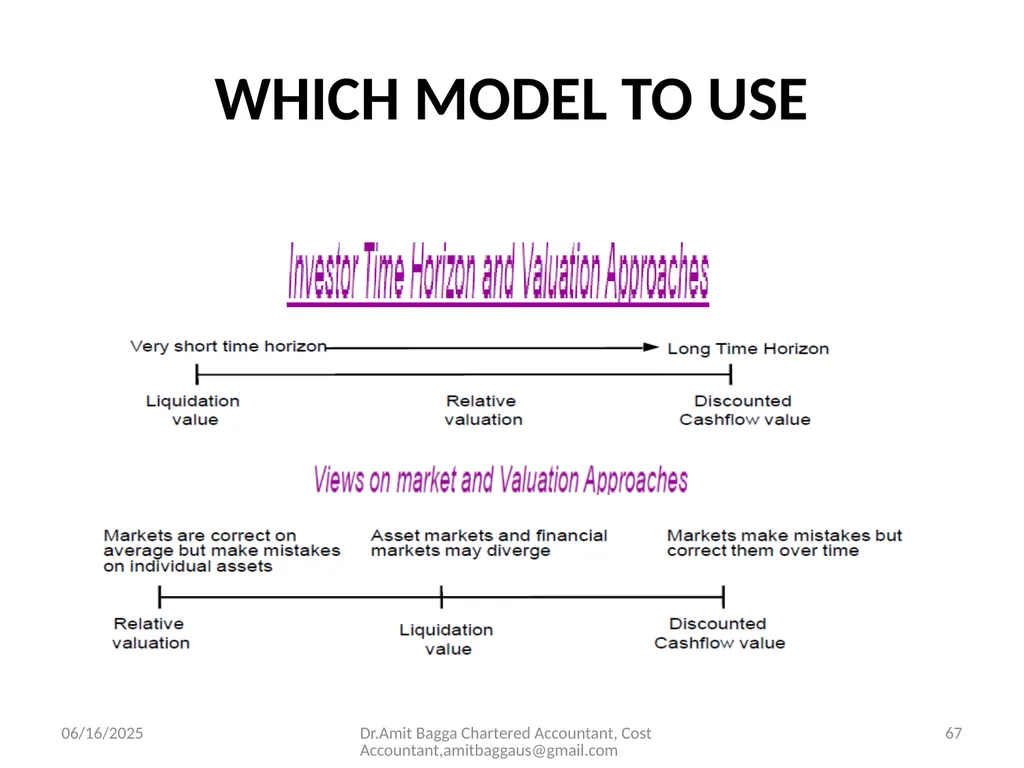
WHICH MODEL TO USE 3/19/2014 Dr.Amit Bagga Chartered Accountant, Cost Accountant,amitbaggaus@gmail.com 67<br>
68
THANKS 3/19/2014 Dr.Amit Bagga Chartered Accountant, Cost Accountant,amitbaggaus@gmail.com 68<br>