Vehicle categories associated with Automated Driving Systems (ADS) Sheets copied from; Informal document WP29-194-31 and Informal document WP29-194-16 TF-AVRS-19-05 TASK FORCE ON AUTOMATED VEHICLE CATEGORISATION (TF-AVC) Submitted by the
"Vehicle categories associated with Automated" is the property of its rightful owner. Permission is granted to
download and print the materials on this website for personal, non-commercial use only, and to display it
on your personal computer provided you do not modify the materials and that you retain all copyright
notices contained in the materials. By downloading content from our website, you accept the terms of this
agreement.
Presentation Transcript
01
Vehicle categories associated with Automated Driving Systems (ADS) Sheets copied from; Informal document WP29-194-31 and Informal document WP29-194-16 TF-AVRS-19-05<br>
02
TASK FORCE ON AUTOMATED VEHICLE CATEGORISATION (TF-AVC) Submitted by the Chairs of the Task Force on Automated Vehicle Categorisation (TF-AVC) Informal document WP29-194-31 194th WP.29, 12-15 November 2024
Provisional agenda item 2.3 WP29 STATUS REPORT II All relevant documents can be found on the TF-AVC UNECE Wikipage.<br>
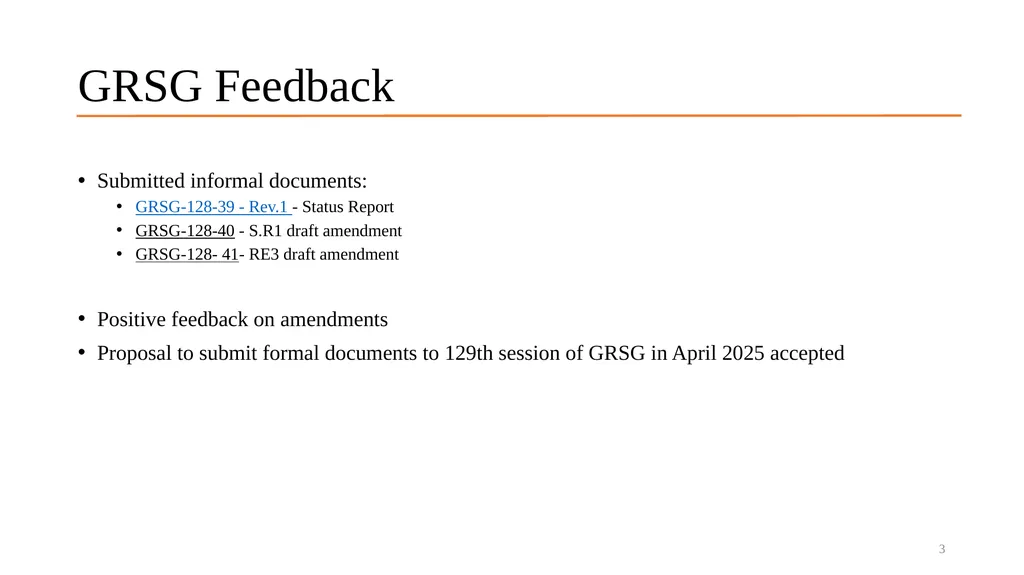
Positive feedback on amendments
Proposal to submit formal documents to 129th session of GRSG in April 2025 accepted 3<br>
04
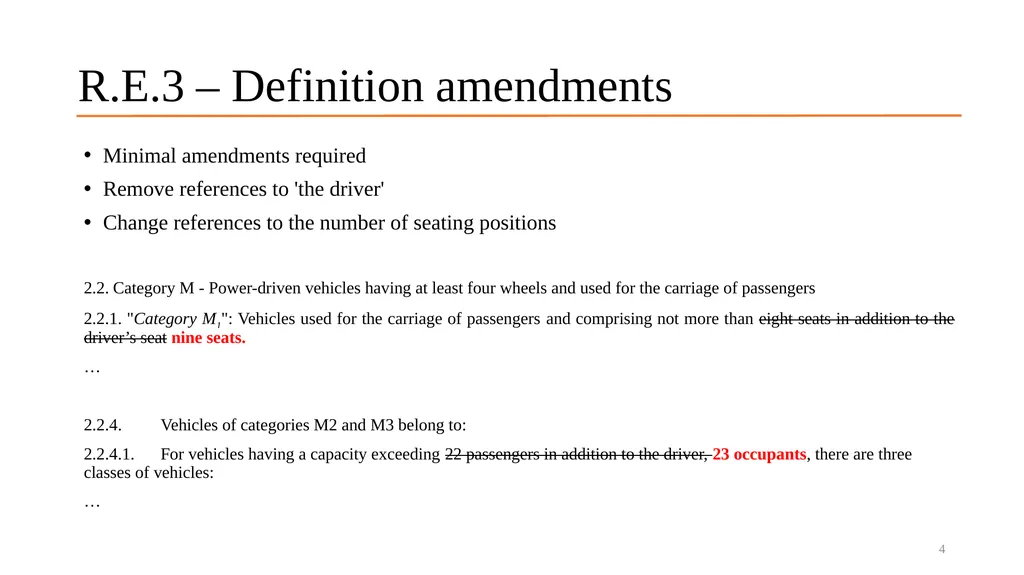
R.E.3 – Definition amendments Minimal amendments required
Remove references to 'the driver'
Change references to the number of seating positions
2.2. Category M - Power-driven vehicles having at least four wheels and used for the carriage of passengers
2.2.1. "Category M1": Vehicles used for the carriage of passengers and comprising not more than eight seats in addition to the driver’s seat nine seats.
…
2.2.4. Vehicles of categories M2 and M3 belong to:
2.2.4.1. For vehicles having a capacity exceeding 22 passengers in addition to the driver, 23 occupants, there are three classes of vehicles:
… 4<br>
05
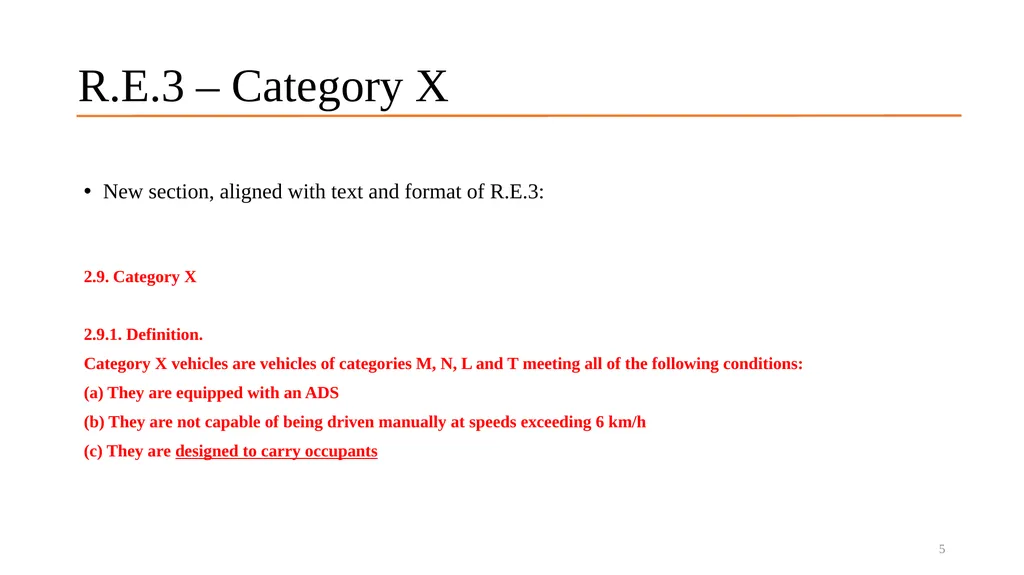
R.E.3 – Category X New section, aligned with text and format of R.E.3:
2.9. Category X
2.9.1. Definition.
Category X vehicles are vehicles of categories M, N, L and T meeting all of the following conditions:
(a) They are equipped with an ADS
(b) They are not capable of being driven manually at speeds exceeding 6 km/h
(c) They are designed to carry occupants 5<br>
06
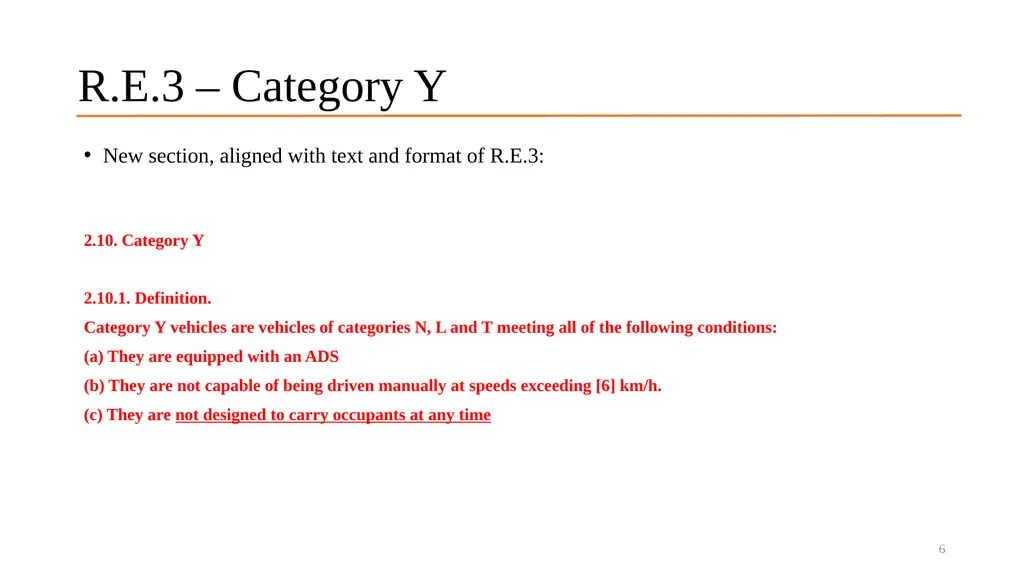
R.E.3 – Category Y New section, aligned with text and format of R.E.3:
2.10. Category Y
2.10.1. Definition.
Category Y vehicles are vehicles of categories N, L and T meeting all of the following conditions:
(a) They are equipped with an ADS
(b) They are not capable of being driven manually at speeds exceeding [6] km/h.
(c) They are not designed to carry occupants at any time 6<br>
07
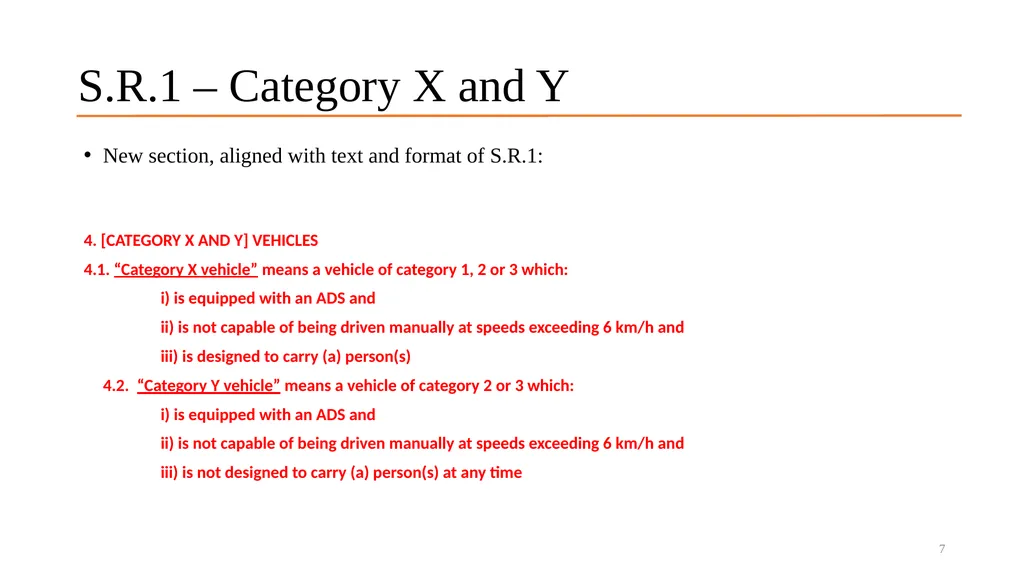
S.R.1 – Category X and Y New section, aligned with text and format of S.R.1:
4. [CATEGORY X AND Y] VEHICLES
4.1. “Category X vehicle” means a vehicle of category 1, 2 or 3 which:
i) is equipped with an ADS and
ii) is not capable of being driven manually at speeds exceeding 6 km/h and
iii) is designed to carry (a) person(s)
4.2. “Category Y vehicle” means a vehicle of category 2 or 3 which:
i) is equipped with an ADS and
ii) is not capable of being driven manually at speeds exceeding 6 km/h and
iii) is not designed to carry (a) person(s) at any time 7<br>
08
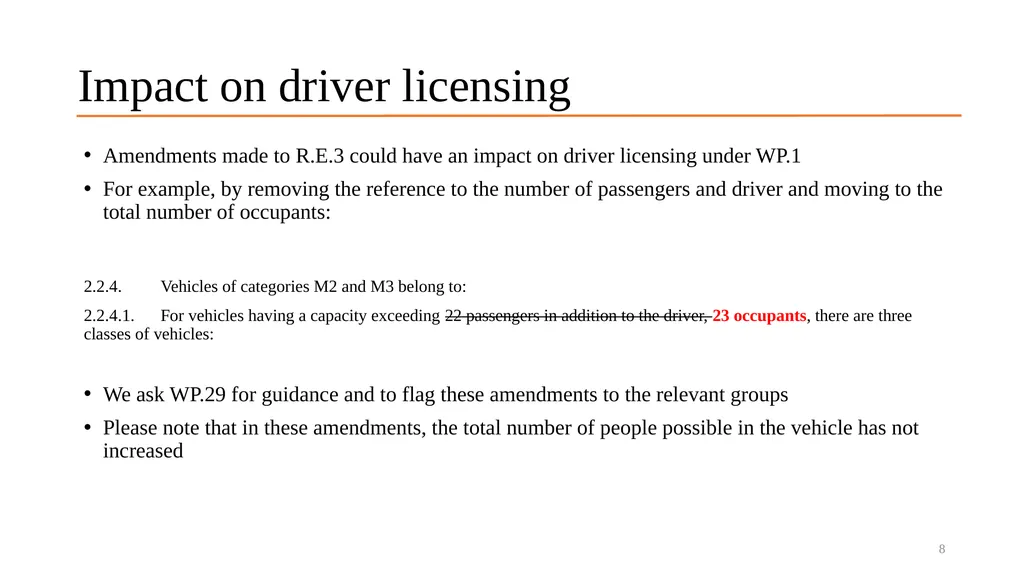
Impact on driver licensing Amendments made to R.E.3 could have an impact on driver licensing under WP.1
For example, by removing the reference to the number of passengers and driver and moving to the total number of occupants:
2.2.4. Vehicles of categories M2 and M3 belong to:
2.2.4.1. For vehicles having a capacity exceeding 22 passengers in addition to the driver, 23 occupants, there are three classes of vehicles:
We ask WP.29 for guidance and to flag these amendments to the relevant groups
Please note that in these amendments, the total number of people possible in the vehicle has not increased 8<br>
09
Regulatory fitness for Automated Driving Systems Status report
GRBP TF AVRS — GRE TF AVSR — GRE IWG EMC — GRPE TF AVRS — GRSG TF AVRS — GRSP TF AVRS — GRVA TF FADS Informal document WP.29-194-xx
194th WP.29, 12 to 15 November 2024
Agenda item 2.3 Transmitted by the chairs of the expert groups on regulatory fitness for Automated Driving Systems<br>
10
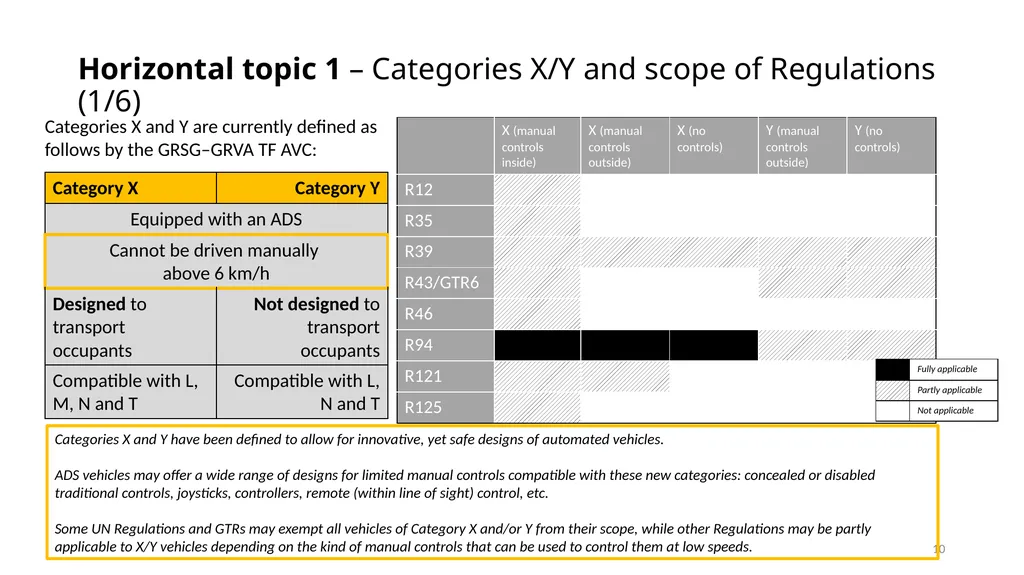
Horizontal topic 1 – Categories X/Y and scope of Regulations (1/6) 10 Categories X and Y are currently defined as follows by the GRSG–GRVA TF AVC: Categories X and Y have been defined to allow for innovative, yet safe designs of automated vehicles.
ADS vehicles may offer a wide range of designs for limited manual controls compatible with these new categories: concealed or disabled traditional controls, joysticks, controllers, remote (within line of sight) control, etc.
Some UN Regulations and GTRs may exempt all vehicles of Category X and/or Y from their scope, while other Regulations may be partly applicable to X/Y vehicles depending on the kind of manual controls that can be used to control them at low speeds.<br>
11
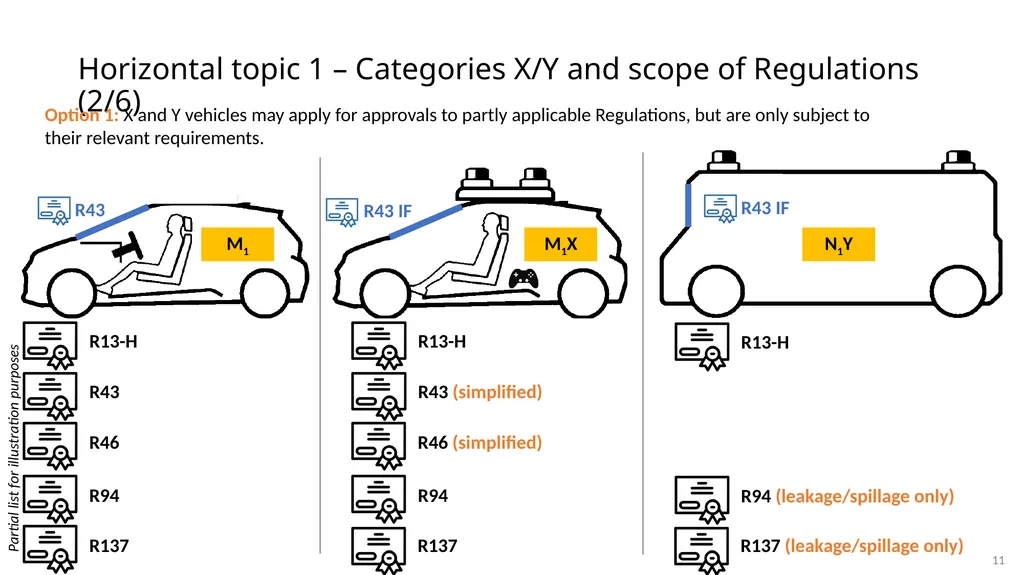
Horizontal topic 1 – Categories X/Y and scope of Regulations (2/6) 11 Option 1: X and Y vehicles may apply for approvals to partly applicable Regulations, but are only subject to their relevant requirements. R43 R46 R94 R13-H M1 M1X N1Y R43 (simplified) R46 (simplified) R94 R13-H R94 (leakage/spillage only) R13-H R137 R137 R137 (leakage/spillage only) R43 R43 IF R43 IF Partial list for illustration purposes<br>
12
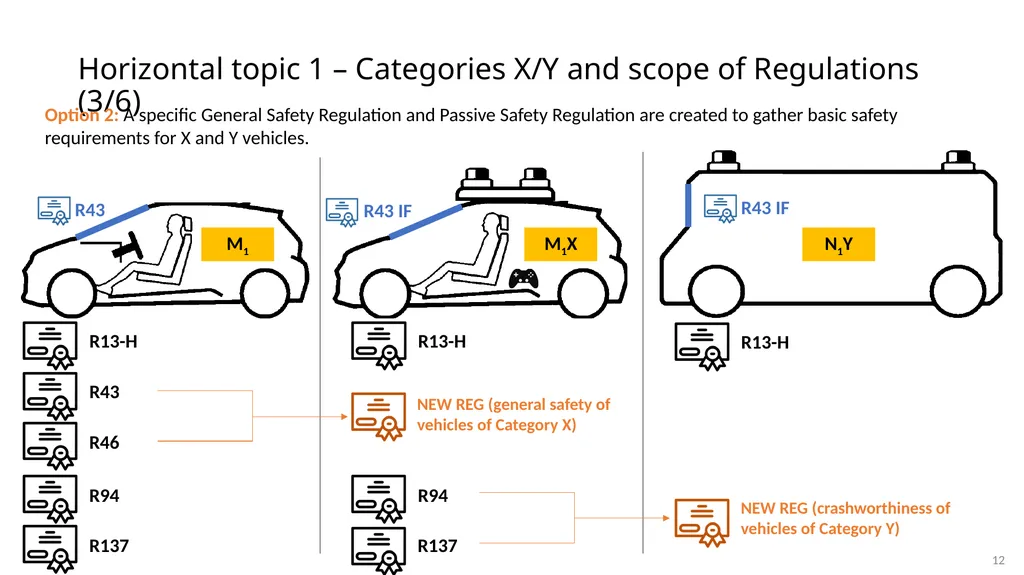
Horizontal topic 1 – Categories X/Y and scope of Regulations (3/6) 12 Option 2: A specific General Safety Regulation and Passive Safety Regulation are created to gather basic safety requirements for X and Y vehicles. R43 R46 R94 R13-H M1 M1X N1Y NEW REG (general safety of vehicles of Category X) R94 R13-H NEW REG (crashworthiness of vehicles of Category Y) R13-H R137 R137 R43 R43 IF R43 IF<br>
13
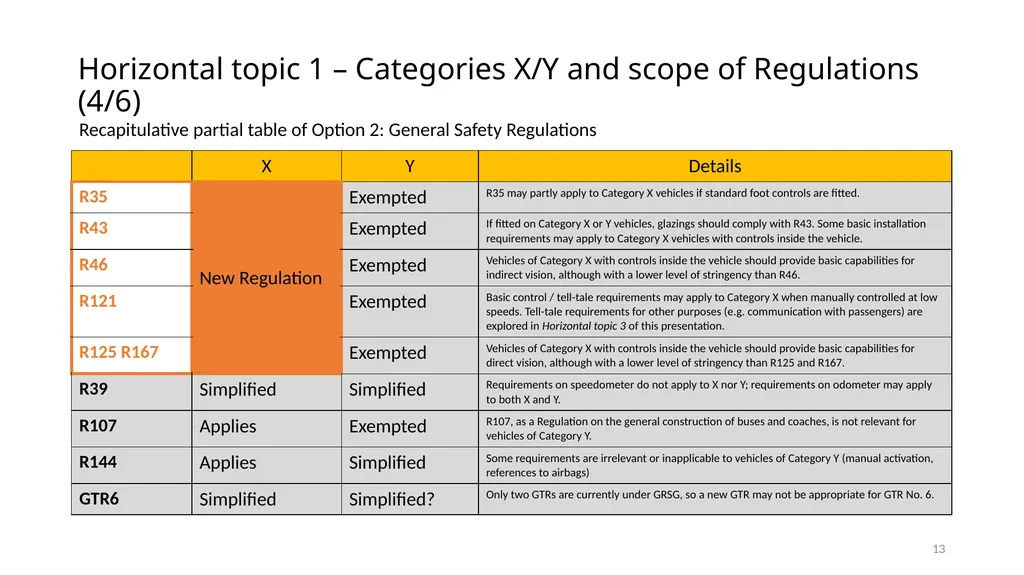
Horizontal topic 1 – Categories X/Y and scope of Regulations (4/6) 13 Recapitulative partial table of Option 2: General Safety Regulations<br>
14
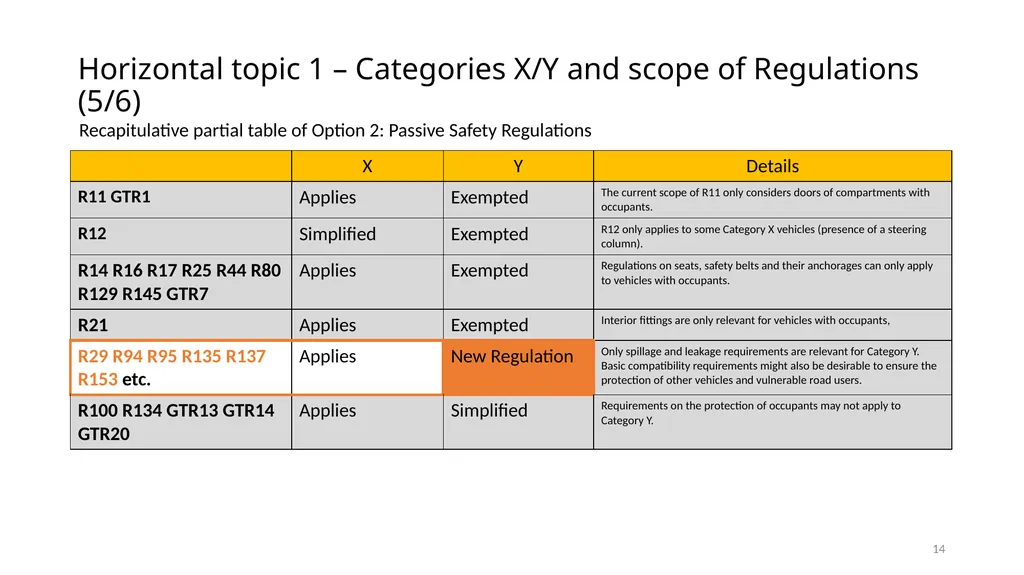
Horizontal topic 1 – Categories X/Y and scope of Regulations (5/6) 14 Recapitulative partial table of Option 2: Passive Safety Regulations<br>
15
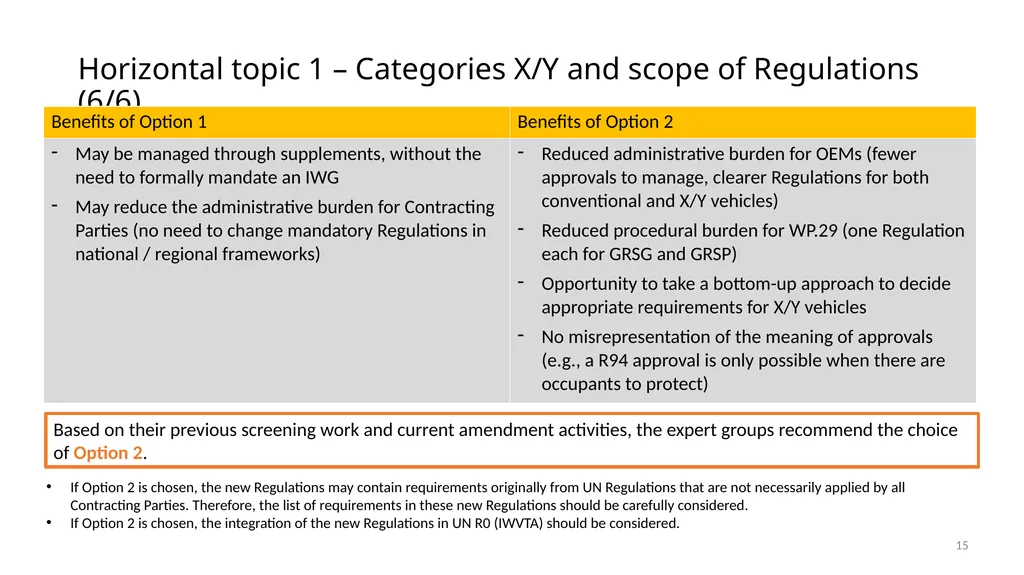
Horizontal topic 1 – Categories X/Y and scope of Regulations (6/6) 15 Based on their previous screening work and current amendment activities, the expert groups recommend the choice of Option 2. If Option 2 is chosen, the new Regulations may contain requirements originally from UN Regulations that are not necessarily applied by all Contracting Parties. Therefore, the list of requirements in these new Regulations should be carefully considered.
If Option 2 is chosen, the integration of the new Regulations in UN R0 (IWVTA) should be considered.<br>