
Vilnius June 2022 During and after the war:
CM
Published · 8 slides · 0 views

1 / 1

Description
Vilnius June 2022 During and after the war: rethinking the role of community networks of PLHIV and key groups and other civil society organizations meeting results Purpose: to form the regional unity and preserve the influence of
Related Topics
Share
Embed code
Download this presentation From Below
"Vilnius June 2022 During and after the war:" is the property of its rightful owner. Permission is granted to download and print the materials on this website for personal, non-commercial use only, and to display it on your personal computer provided you do not modify the materials and that you retain all copyright notices contained in the materials. By downloading content from our website, you accept the terms of this agreement.
Presentation Transcript
01
Vilnius June 2022
During and after the war: rethinking the role of community networks of PLHIV and key groups and other civil society organizations
meeting results<br>
02
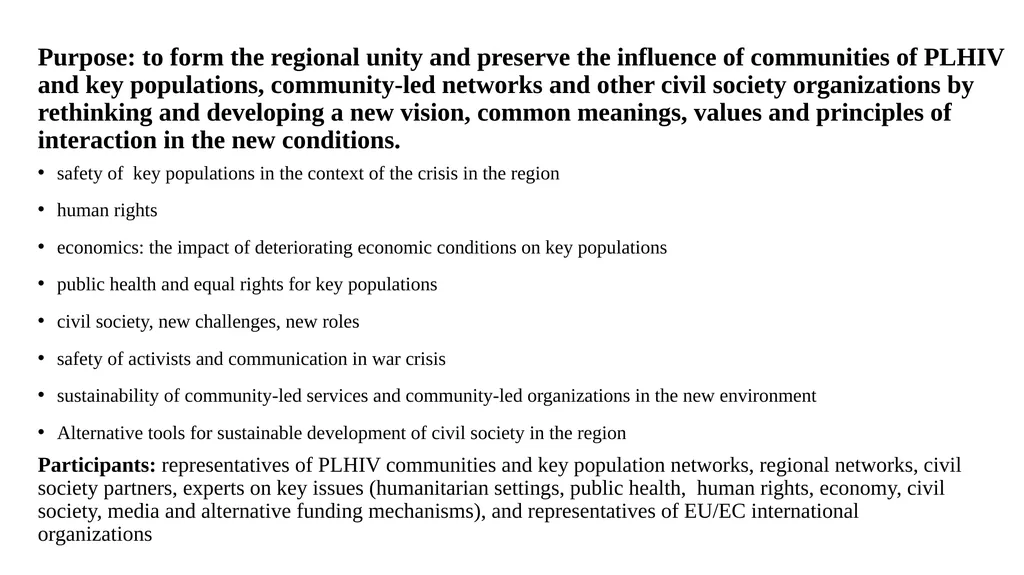
Purpose: to form the regional unity and preserve the influence of communities of PLHIV and key populations, community-led networks and other civil society organizations by rethinking and developing a new vision, common meanings, values and principles of interaction in the new conditions. safety of key populations in the context of the crisis in the region
human rights
economics: the impact of deteriorating economic conditions on key populations
public health and equal rights for key populations
civil society, new challenges, new roles
safety of activists and communication in war crisis
sustainability of community-led services and community-led organizations in the new environment
Alternative tools for sustainable development of civil society in the region
Participants: representatives of PLHIV communities and key population networks, regional networks, civil society partners, experts on key issues (humanitarian settings, public health, human rights, economy, civil society, media and alternative funding mechanisms), and representatives of EU/EC international organizations<br>
human rights
economics: the impact of deteriorating economic conditions on key populations
public health and equal rights for key populations
civil society, new challenges, new roles
safety of activists and communication in war crisis
sustainability of community-led services and community-led organizations in the new environment
Alternative tools for sustainable development of civil society in the region
Participants: representatives of PLHIV communities and key population networks, regional networks, civil society partners, experts on key issues (humanitarian settings, public health, human rights, economy, civil society, media and alternative funding mechanisms), and representatives of EU/EC international organizations<br>
03
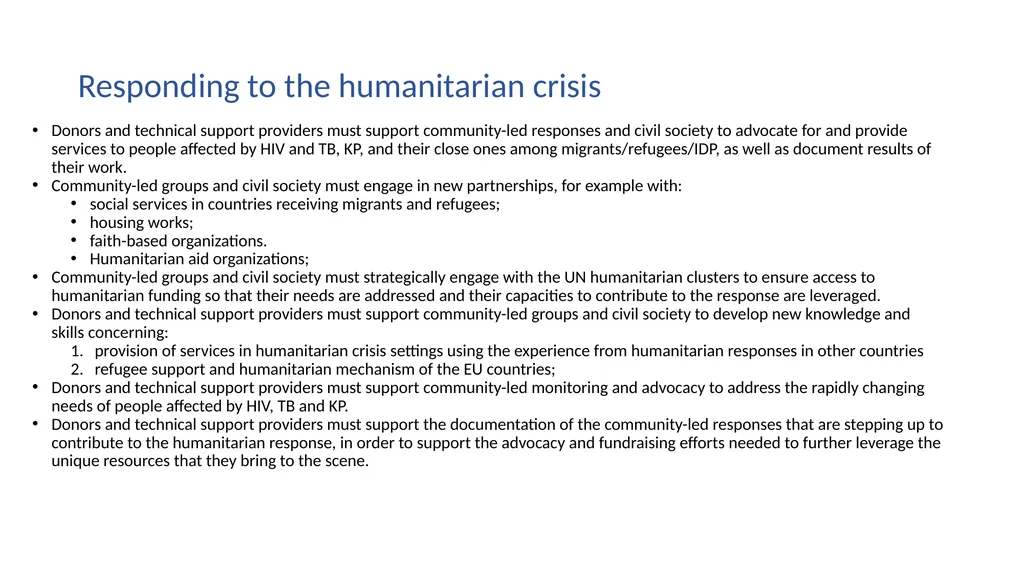
Responding to the humanitarian crisis Donors and technical support providers must support community-led responses and civil society to advocate for and provide services to people affected by HIV and TB, KP, and their close ones among migrants/refugees/IDP, as well as document results of their work.
Community-led groups and civil society must engage in new partnerships, for example with:
social services in countries receiving migrants and refugees;
housing works;
faith-based organizations.
Humanitarian aid organizations;
Community-led groups and civil society must strategically engage with the UN humanitarian clusters to ensure access to humanitarian funding so that their needs are addressed and their capacities to contribute to the response are leveraged.
Donors and technical support providers must support community-led groups and civil society to develop new knowledge and skills concerning:
provision of services in humanitarian crisis settings using the experience from humanitarian responses in other countries
refugee support and humanitarian mechanism of the EU countries;
Donors and technical support providers must support community-led monitoring and advocacy to address the rapidly changing needs of people affected by HIV, TB and KP.
Donors and technical support providers must support the documentation of the community-led responses that are stepping up to contribute to the humanitarian response, in order to support the advocacy and fundraising efforts needed to further leverage the unique resources that they bring to the scene.<br>
Community-led groups and civil society must engage in new partnerships, for example with:
social services in countries receiving migrants and refugees;
housing works;
faith-based organizations.
Humanitarian aid organizations;
Community-led groups and civil society must strategically engage with the UN humanitarian clusters to ensure access to humanitarian funding so that their needs are addressed and their capacities to contribute to the response are leveraged.
Donors and technical support providers must support community-led groups and civil society to develop new knowledge and skills concerning:
provision of services in humanitarian crisis settings using the experience from humanitarian responses in other countries
refugee support and humanitarian mechanism of the EU countries;
Donors and technical support providers must support community-led monitoring and advocacy to address the rapidly changing needs of people affected by HIV, TB and KP.
Donors and technical support providers must support the documentation of the community-led responses that are stepping up to contribute to the humanitarian response, in order to support the advocacy and fundraising efforts needed to further leverage the unique resources that they bring to the scene.<br>
04
Supporting HIV, TB and health programming Governments must support integrated people-centered services to expand the packages of services they offer to address mental health, housing, employment to address new needs caused by trauma and displacement. Health donors must expand the packages they offer to add mental health and additional social services.
Countries that are receiving refugees and migrants must take care to ensure that their work to achieve UHC addresses the needs of migrants and refugees.
Partners must continue to seek solutions for ensuring access to services in active conflict zones, newly-occupied territories and non-government controlled areas.
Countries should make permanent the innovative solutions that eased access to services during the COVID-19 pandemic , such as: self-testing; task-shifting enabling community-led groups to deliver medicines or receive licences to provide testing, etc.; or providing OST patients 30-day supply of their medicine (which is now both policy and practice in hotspots in Ukraine).
Donors, community-led groups and civil society must support documentation, research and advocacy showing that civil society and community-led services are integral to optimization and integration of services.
Countries should implement digitalization of medical information systems for both patients and medics such as on-line medicine, and, digital patient maps, digital health systems, online clinics; digital applications, use of artificial intelligence capabilities add to efficiency and remote access to information. Efforts to digitalize must be mindful of the fact that many KP do not readily have access to digital programming or are fearful that accessing it could lead to a violation of their confidentiality.
Protecting human rights within the digitalization approach, including rights of key populations, is a must.
Security measures, including confidentiality of data will be essential so that it is not used to harass or persecute people
The locus of information should be decentralized so that a problem at one site would not lead to loss of information.
Blockchain might be used for security.<br>
Countries that are receiving refugees and migrants must take care to ensure that their work to achieve UHC addresses the needs of migrants and refugees.
Partners must continue to seek solutions for ensuring access to services in active conflict zones, newly-occupied territories and non-government controlled areas.
Countries should make permanent the innovative solutions that eased access to services during the COVID-19 pandemic , such as: self-testing; task-shifting enabling community-led groups to deliver medicines or receive licences to provide testing, etc.; or providing OST patients 30-day supply of their medicine (which is now both policy and practice in hotspots in Ukraine).
Donors, community-led groups and civil society must support documentation, research and advocacy showing that civil society and community-led services are integral to optimization and integration of services.
Countries should implement digitalization of medical information systems for both patients and medics such as on-line medicine, and, digital patient maps, digital health systems, online clinics; digital applications, use of artificial intelligence capabilities add to efficiency and remote access to information. Efforts to digitalize must be mindful of the fact that many KP do not readily have access to digital programming or are fearful that accessing it could lead to a violation of their confidentiality.
Protecting human rights within the digitalization approach, including rights of key populations, is a must.
Security measures, including confidentiality of data will be essential so that it is not used to harass or persecute people
The locus of information should be decentralized so that a problem at one site would not lead to loss of information.
Blockchain might be used for security.<br>
05
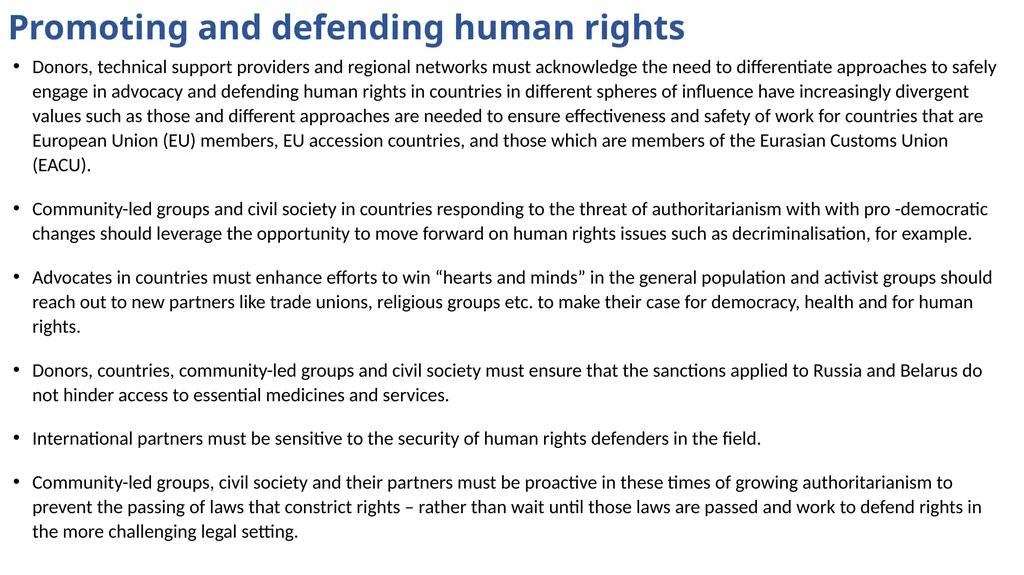
Promoting and defending human rights Donors, technical support providers and regional networks must acknowledge the need to differentiate approaches to safely engage in advocacy and defending human rights in countries in different spheres of influence have increasingly divergent values such as those and different approaches are needed to ensure effectiveness and safety of work for countries that are European Union (EU) members, EU accession countries, and those which are members of the Eurasian Customs Union (EACU).
Community-led groups and civil society in countries responding to the threat of authoritarianism with with pro -democratic changes should leverage the opportunity to move forward on human rights issues such as decriminalisation, for example.
Advocates in countries must enhance efforts to win “hearts and minds” in the general population and activist groups should reach out to new partners like trade unions, religious groups etc. to make their case for democracy, health and for human rights.
Donors, countries, community-led groups and civil society must ensure that the sanctions applied to Russia and Belarus do not hinder access to essential medicines and services.
International partners must be sensitive to the security of human rights defenders in the field.
Community-led groups, civil society and their partners must be proactive in these times of growing authoritarianism to prevent the passing of laws that constrict rights – rather than wait until those laws are passed and work to defend rights in the more challenging legal setting.<br>
Community-led groups and civil society in countries responding to the threat of authoritarianism with with pro -democratic changes should leverage the opportunity to move forward on human rights issues such as decriminalisation, for example.
Advocates in countries must enhance efforts to win “hearts and minds” in the general population and activist groups should reach out to new partners like trade unions, religious groups etc. to make their case for democracy, health and for human rights.
Donors, countries, community-led groups and civil society must ensure that the sanctions applied to Russia and Belarus do not hinder access to essential medicines and services.
International partners must be sensitive to the security of human rights defenders in the field.
Community-led groups, civil society and their partners must be proactive in these times of growing authoritarianism to prevent the passing of laws that constrict rights – rather than wait until those laws are passed and work to defend rights in the more challenging legal setting.<br>
06
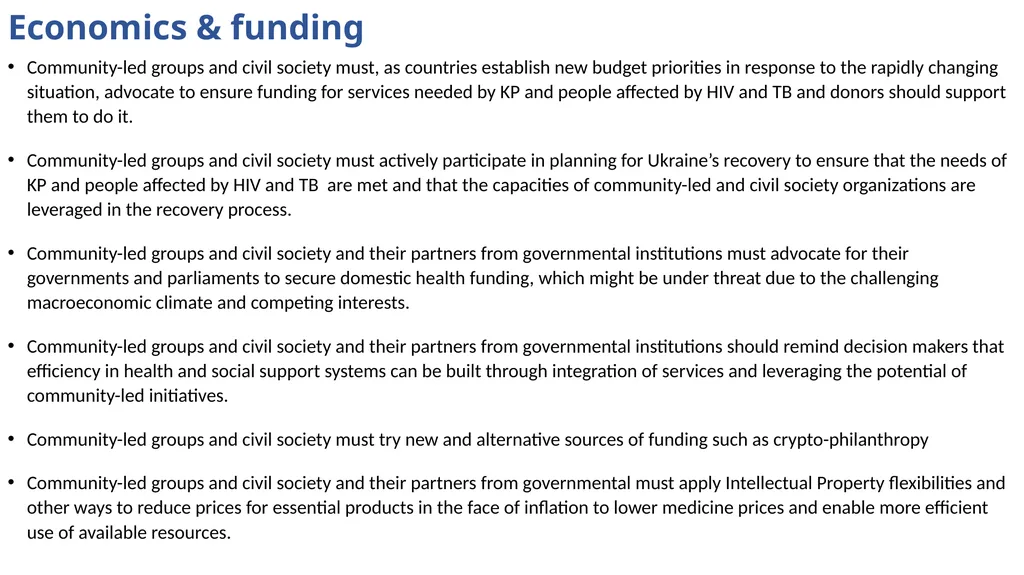
Economics & funding Community-led groups and civil society must, as countries establish new budget priorities in response to the rapidly changing situation, advocate to ensure funding for services needed by KP and people affected by HIV and TB and donors should support them to do it.
Community-led groups and civil society must actively participate in planning for Ukraine’s recovery to ensure that the needs of KP and people affected by HIV and TB are met and that the capacities of community-led and civil society organizations are leveraged in the recovery process.
Community-led groups and civil society and their partners from governmental institutions must advocate for their governments and parliaments to secure domestic health funding, which might be under threat due to the challenging macroeconomic climate and competing interests.
Community-led groups and civil society and their partners from governmental institutions should remind decision makers that efficiency in health and social support systems can be built through integration of services and leveraging the potential of community-led initiatives.
Community-led groups and civil society must try new and alternative sources of funding such as crypto-philanthropy
Community-led groups and civil society and their partners from governmental must apply Intellectual Property flexibilities and other ways to reduce prices for essential products in the face of inflation to lower medicine prices and enable more efficient use of available resources.<br>
Community-led groups and civil society must actively participate in planning for Ukraine’s recovery to ensure that the needs of KP and people affected by HIV and TB are met and that the capacities of community-led and civil society organizations are leveraged in the recovery process.
Community-led groups and civil society and their partners from governmental institutions must advocate for their governments and parliaments to secure domestic health funding, which might be under threat due to the challenging macroeconomic climate and competing interests.
Community-led groups and civil society and their partners from governmental institutions should remind decision makers that efficiency in health and social support systems can be built through integration of services and leveraging the potential of community-led initiatives.
Community-led groups and civil society must try new and alternative sources of funding such as crypto-philanthropy
Community-led groups and civil society and their partners from governmental must apply Intellectual Property flexibilities and other ways to reduce prices for essential products in the face of inflation to lower medicine prices and enable more efficient use of available resources.<br>
07
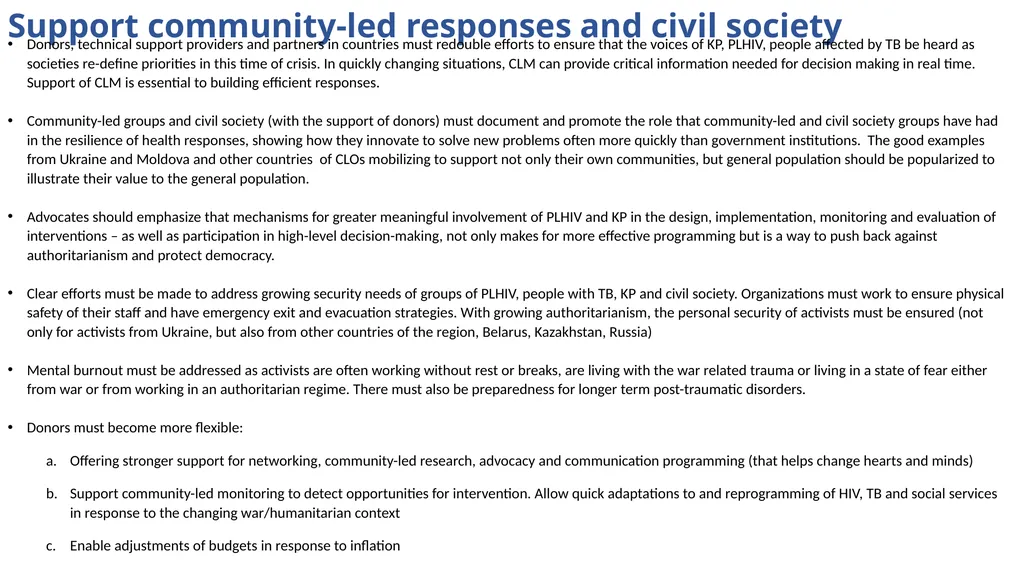
Support community-led responses and civil society Donors, technical support providers and partners in countries must redouble efforts to ensure that the voices of KP, PLHIV, people affected by TB be heard as societies re-define priorities in this time of crisis. In quickly changing situations, CLM can provide critical information needed for decision making in real time. Support of CLM is essential to building efficient responses.
Community-led groups and civil society (with the support of donors) must document and promote the role that community-led and civil society groups have had in the resilience of health responses, showing how they innovate to solve new problems often more quickly than government institutions. The good examples from Ukraine and Moldova and other countries of CLOs mobilizing to support not only their own communities, but general population should be popularized to illustrate their value to the general population.
Advocates should emphasize that mechanisms for greater meaningful involvement of PLHIV and KP in the design, implementation, monitoring and evaluation of interventions – as well as participation in high-level decision-making, not only makes for more effective programming but is a way to push back against authoritarianism and protect democracy.
Clear efforts must be made to address growing security needs of groups of PLHIV, people with TB, KP and civil society. Organizations must work to ensure physical safety of their staff and have emergency exit and evacuation strategies. With growing authoritarianism, the personal security of activists must be ensured (not only for activists from Ukraine, but also from other countries of the region, Belarus, Kazakhstan, Russia)
Mental burnout must be addressed as activists are often working without rest or breaks, are living with the war related trauma or living in a state of fear either from war or from working in an authoritarian regime. There must also be preparedness for longer term post-traumatic disorders.
Donors must become more flexible:
Offering stronger support for networking, community-led research, advocacy and communication programming (that helps change hearts and minds)
Support community-led monitoring to detect opportunities for intervention. Allow quick adaptations to and reprogramming of HIV, TB and social services in response to the changing war/humanitarian context
Enable adjustments of budgets in response to inflation<br>
Community-led groups and civil society (with the support of donors) must document and promote the role that community-led and civil society groups have had in the resilience of health responses, showing how they innovate to solve new problems often more quickly than government institutions. The good examples from Ukraine and Moldova and other countries of CLOs mobilizing to support not only their own communities, but general population should be popularized to illustrate their value to the general population.
Advocates should emphasize that mechanisms for greater meaningful involvement of PLHIV and KP in the design, implementation, monitoring and evaluation of interventions – as well as participation in high-level decision-making, not only makes for more effective programming but is a way to push back against authoritarianism and protect democracy.
Clear efforts must be made to address growing security needs of groups of PLHIV, people with TB, KP and civil society. Organizations must work to ensure physical safety of their staff and have emergency exit and evacuation strategies. With growing authoritarianism, the personal security of activists must be ensured (not only for activists from Ukraine, but also from other countries of the region, Belarus, Kazakhstan, Russia)
Mental burnout must be addressed as activists are often working without rest or breaks, are living with the war related trauma or living in a state of fear either from war or from working in an authoritarian regime. There must also be preparedness for longer term post-traumatic disorders.
Donors must become more flexible:
Offering stronger support for networking, community-led research, advocacy and communication programming (that helps change hearts and minds)
Support community-led monitoring to detect opportunities for intervention. Allow quick adaptations to and reprogramming of HIV, TB and social services in response to the changing war/humanitarian context
Enable adjustments of budgets in response to inflation<br>
08
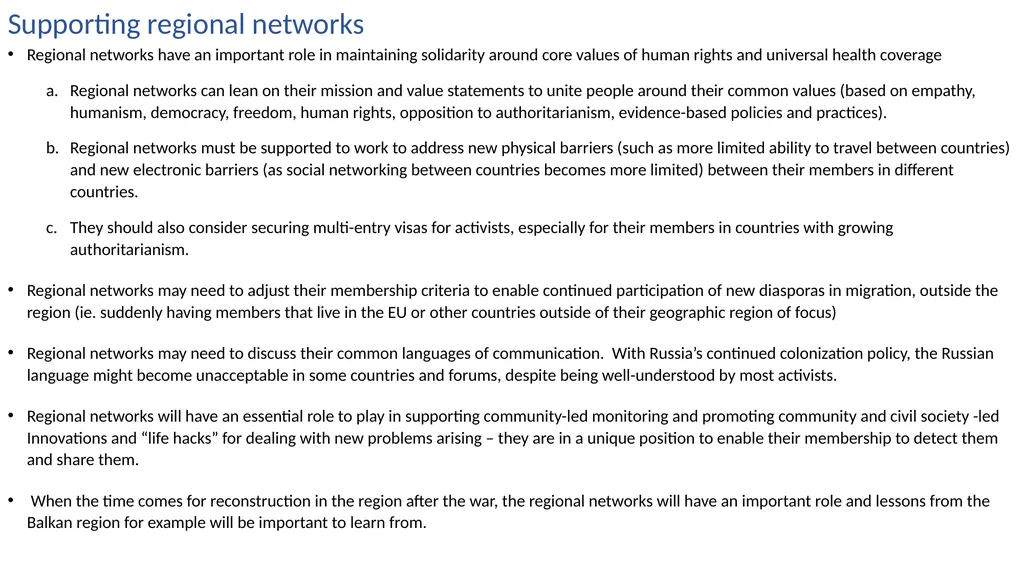
Supporting regional networks Regional networks have an important role in maintaining solidarity around core values of human rights and universal health coverage
Regional networks can lean on their mission and value statements to unite people around their common values (based on empathy, humanism, democracy, freedom, human rights, opposition to authoritarianism, evidence-based policies and practices).
Regional networks must be supported to work to address new physical barriers (such as more limited ability to travel between countries) and new electronic barriers (as social networking between countries becomes more limited) between their members in different countries.
They should also consider securing multi-entry visas for activists, especially for their members in countries with growing authoritarianism.
Regional networks may need to adjust their membership criteria to enable continued participation of new diasporas in migration, outside the region (ie. suddenly having members that live in the EU or other countries outside of their geographic region of focus)
Regional networks may need to discuss their common languages of communication. With Russia’s continued colonization policy, the Russian language might become unacceptable in some countries and forums, despite being well-understood by most activists.
Regional networks will have an essential role to play in supporting community-led monitoring and promoting community and civil society -led Innovations and “life hacks” for dealing with new problems arising – they are in a unique position to enable their membership to detect them and share them.
When the time comes for reconstruction in the region after the war, the regional networks will have an important role and lessons from the Balkan region for example will be important to learn from.<br>
Regional networks can lean on their mission and value statements to unite people around their common values (based on empathy, humanism, democracy, freedom, human rights, opposition to authoritarianism, evidence-based policies and practices).
Regional networks must be supported to work to address new physical barriers (such as more limited ability to travel between countries) and new electronic barriers (as social networking between countries becomes more limited) between their members in different countries.
They should also consider securing multi-entry visas for activists, especially for their members in countries with growing authoritarianism.
Regional networks may need to adjust their membership criteria to enable continued participation of new diasporas in migration, outside the region (ie. suddenly having members that live in the EU or other countries outside of their geographic region of focus)
Regional networks may need to discuss their common languages of communication. With Russia’s continued colonization policy, the Russian language might become unacceptable in some countries and forums, despite being well-understood by most activists.
Regional networks will have an essential role to play in supporting community-led monitoring and promoting community and civil society -led Innovations and “life hacks” for dealing with new problems arising – they are in a unique position to enable their membership to detect them and share them.
When the time comes for reconstruction in the region after the war, the regional networks will have an important role and lessons from the Balkan region for example will be important to learn from.<br>