
Vinta: Verification with INTerpolation and
Description: Vinta: Verification with INTerpolation and Abstract interpretation Arie Gurfinkel (SEICMU) with Aws Albarghouthi and Marsha Chechik (U. of Toronto) and Sagar Chaki (SEICMU), and Yi Li (U. of Toronto) TexPoint fonts used in EMF. Read the
Related Topics
Download Presentation
"Vinta: Verification with INTerpolation and" is the property of its rightful owner. Permission is granted to download and print the materials on this website for personal, non-commercial use only, and to display it on your personal computer provided you do not modify the materials and that you retain all copyright notices contained in the materials. By downloading content from our website, you accept the terms of this agreement.
Presentation Transcript
slide1. Vinta: Verification with INTerpolation and Abstract interpretation Arie Gurfinkel (SEI/CMU)
with Aws Albarghouthi and Marsha Chechik (U. of Toronto)
and Sagar Chaki (SEI/CMU), and Yi Li (U. of Toronto) TexPoint fonts used in EMF.
Read the TexPoint manual before you delete this box.: AAAA<br>
slide2. Copyright 2013 Carnegie Mellon University
This material is based upon work funded and supported by the Department of Defense under Contract No. FA8721-05-C-0003 with Carnegie Mellon University for the operation of the Software Engineering Institute, a federally funded research and development center.
Any opinions, findings and conclusions or recommendations expressed in this material are those of the author(s) and do not necessarily reflect the views of the United States Department of Defense.
NO WARRANTY. THIS CARNEGIE MELLON UNIVERSITY AND SOFTWARE ENGINEERING INSTITUTE MATERIAL IS FURNISHED ON AN AS-IS BASIS. CARNEGIE MELLON UNIVERSITY MAKES NO WARRANTIES OF ANY KIND, EITHER EXPRESSED OR IMPLIED, AS TO ANY MATTER INCLUDING, BUT NOT LIMITED TO, WARRANTY OF FITNESS FOR PURPOSE OR MERCHANTABILITY, EXCLUSIVITY, OR RESULTS OBTAINED FROM USE OF THE MATERIAL. CARNEGIE MELLON UNIVERSITY DOES NOT MAKE ANY WARRANTY OF ANY KIND WITH RESPECT TO FREEDOM FROM PATENT, TRADEMARK, OR COPYRIGHT INFRINGEMENT.
This material has been approved for public release and unlimited distribution. This material may be reproduced in its entirety, without modification, and freely distributed in written or electronic form without requesting formal permission. Permission is required for any other use. Requests for permission should be directed to the Software Engineering Institute at permission@sei.cmu.edu.
DM-0000450<br>
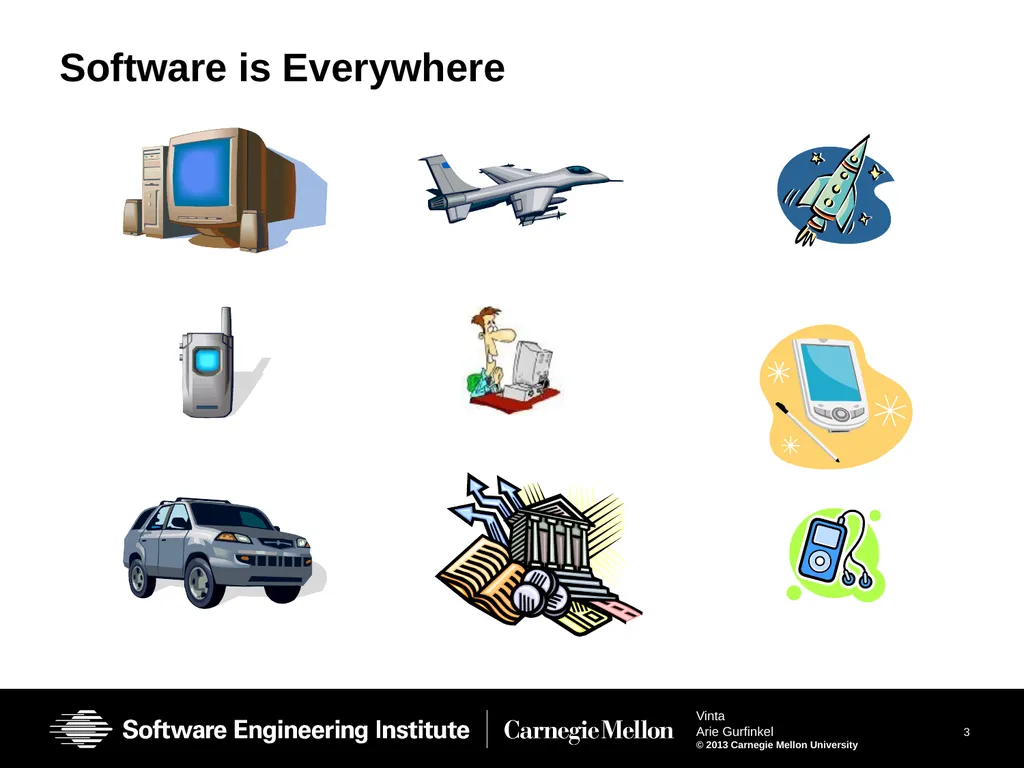
slide3. Software is Everywhere<br>
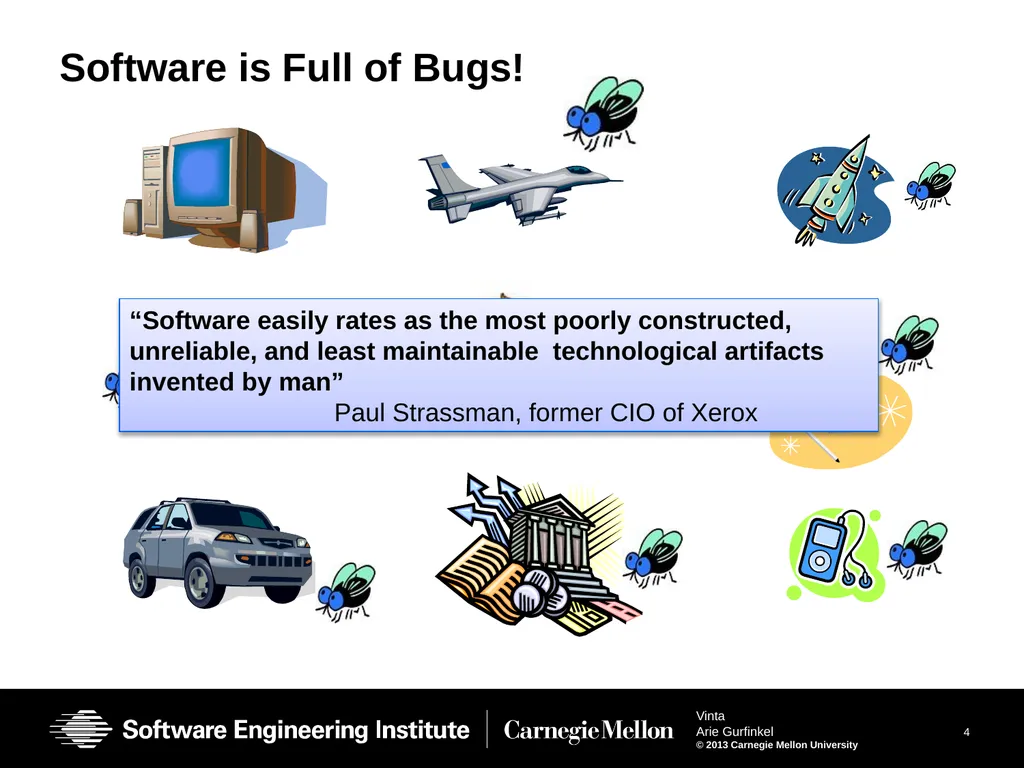
slide4. Software is Full of Bugs! “Software easily rates as the most poorly constructed, unreliable, and least maintainable technological artifacts invented by man”
Paul Strassman, former CIO of Xerox<br>
slide5. Software Engineering is very complex
Complicated algorithms
Many interconnected components
Legacy systems
Huge programming APIs
…
Software Engineers need better tools to deal with this complexity! Why so many bugs?<br>
slide6. What Software Engineers Need Are … Tools that give better confidence than testing while remaining easy to use
And at the same time, are
… fully automatic
… (reasonably) easy to use
… provide (measurable) guarantees
… come with guidelines and methodologies to apply effectively
… apply to real software systems<br>
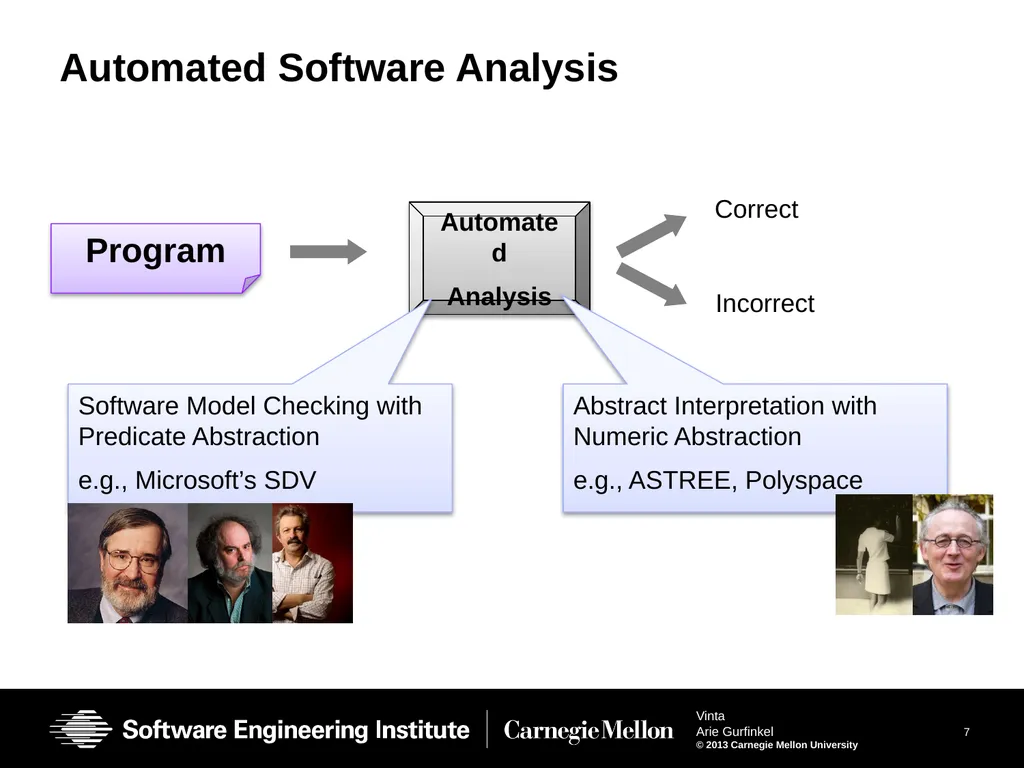
slide7. Automated
Analysis Software Model Checking with Predicate Abstraction
e.g., Microsoft’s SDV Automated Software Analysis Program Correct Incorrect Abstract Interpretation with Numeric Abstraction
e.g., ASTREE, Polyspace<br>
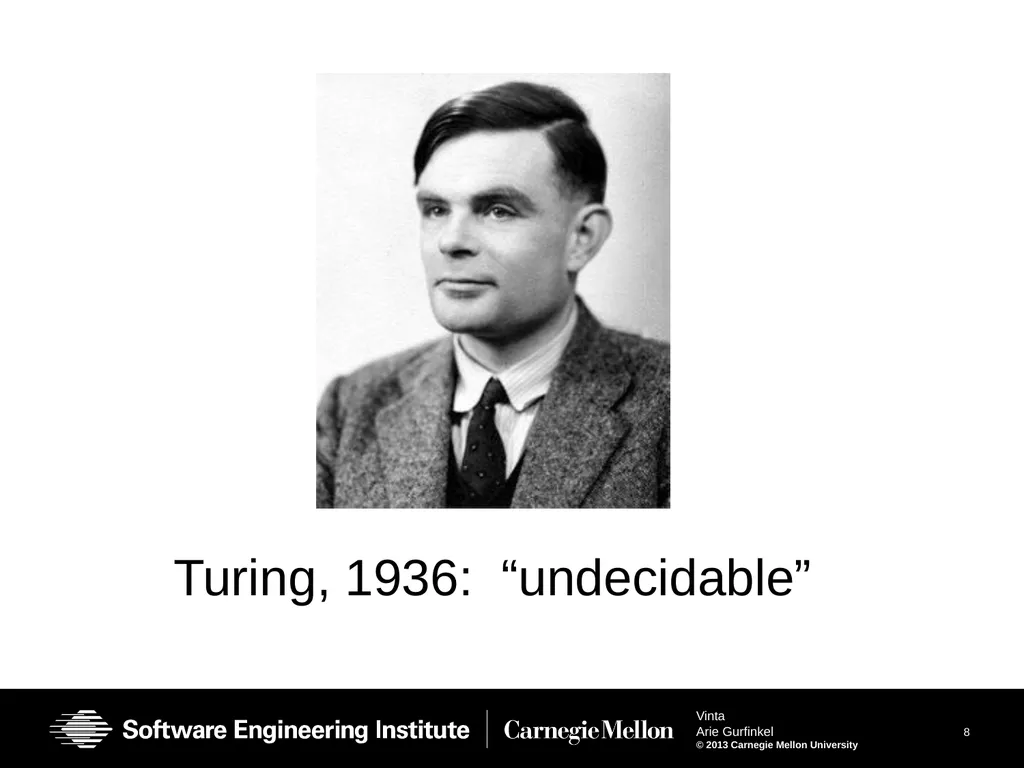
slide8. Turing, 1936: “undecidable”<br>
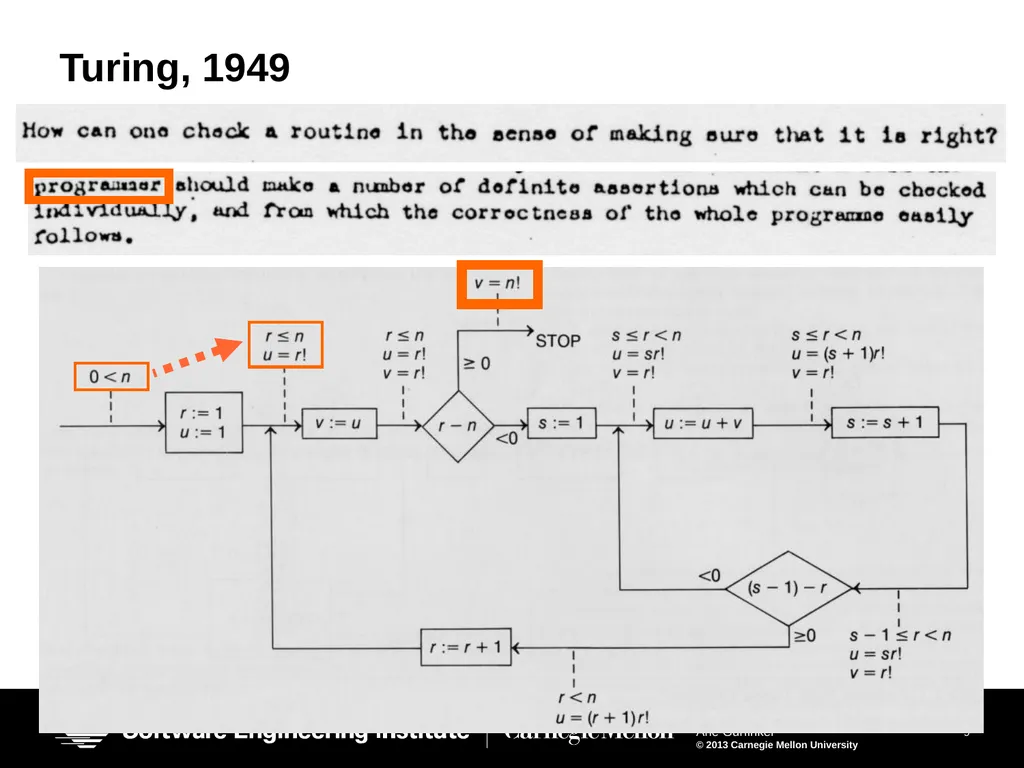
slide9. 9 Turing, 1949<br>
slide10. Motivation Abstract Interpretation is one of the most scalable approaches for program verification
But, in practice, AI suffers from many false positives due to
imprecise operations: join, widen
imprecise semantics of operations: abstract post
in-expressivity of abstract domains: weakly relational facts, …
No CounterExamples and No Refinement Goal: Enhance Abstract Interpretation with Interpolation-based refinement strategy<br>
slide11. Outline (of the rest of the talk) Numeric Abstract Interpretation
Vinta illustrated
Abstract Interpretation with Unfoldings
Abstract-Interpretation guided DAG-Interpolation Refinement
Implementation
Results of Software Verification Competition
Secret Sauce
Conclusions and Future Directions<br>
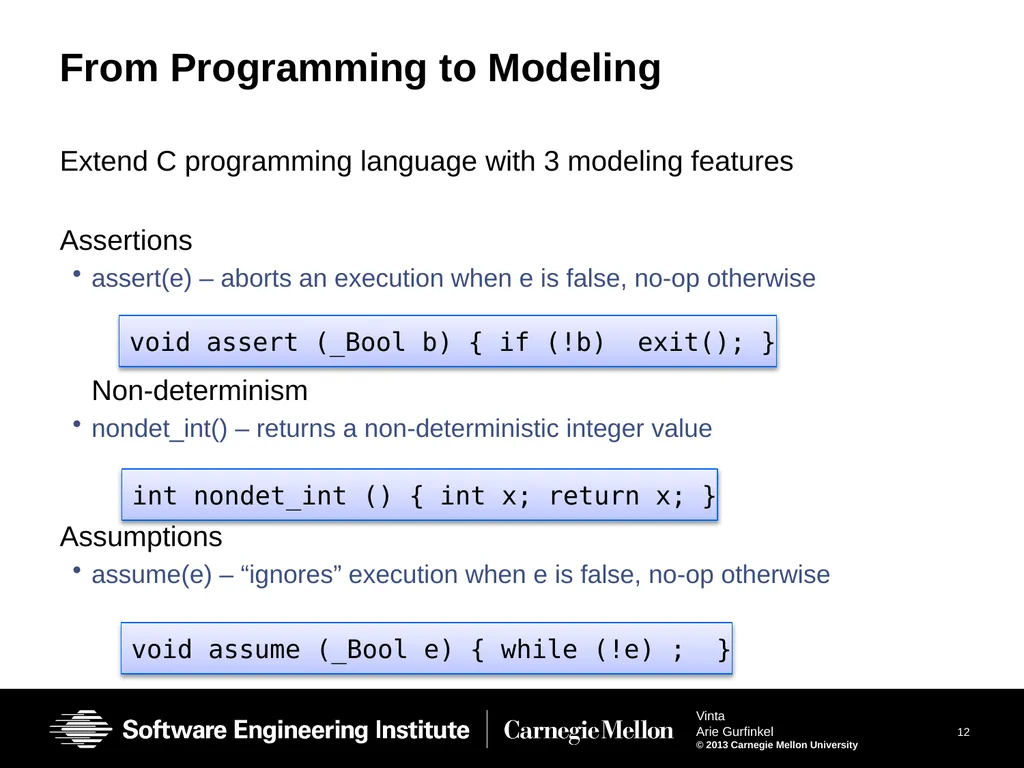
slide12. From Programming to Modeling Extend C programming language with 3 modeling features
Assertions
assert(e) – aborts an execution when e is false, no-op otherwise
Non-determinism
nondet_int() – returns a non-deterministic integer value
Assumptions
assume(e) – “ignores” execution when e is false, no-op otherwise void assert (_Bool b) { if (!b) exit(); } int nondet_int () { int x; return x; } void assume (_Bool e) { while (!e) ; }<br>
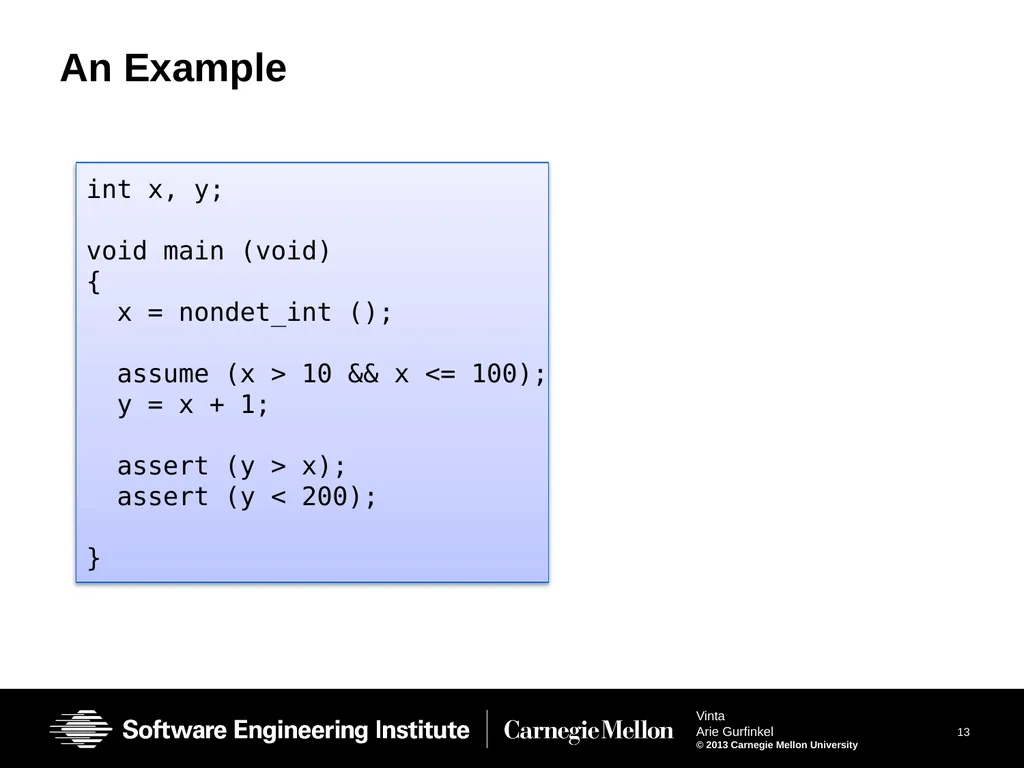
slide13. An Example int x, y;
void main (void)
{
x = nondet_int ();
assume (x > 10 && x <= 100);
y = x + 1;
assert (y > x);
assert (y < 200);
}<br>
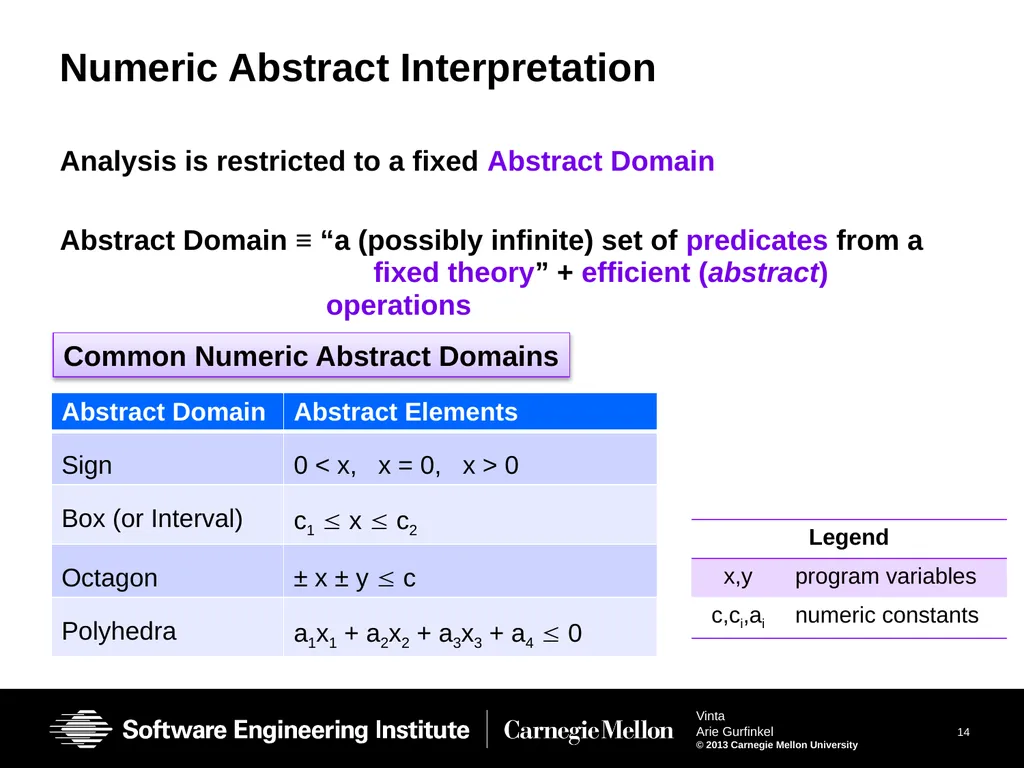
slide14. Numeric Abstract Interpretation Analysis is restricted to a fixed Abstract Domain
Abstract Domain ≡ “a (possibly infinite) set of predicates from a fixed theory” + efficient (abstract) operations Common Numeric Abstract Domains<br>
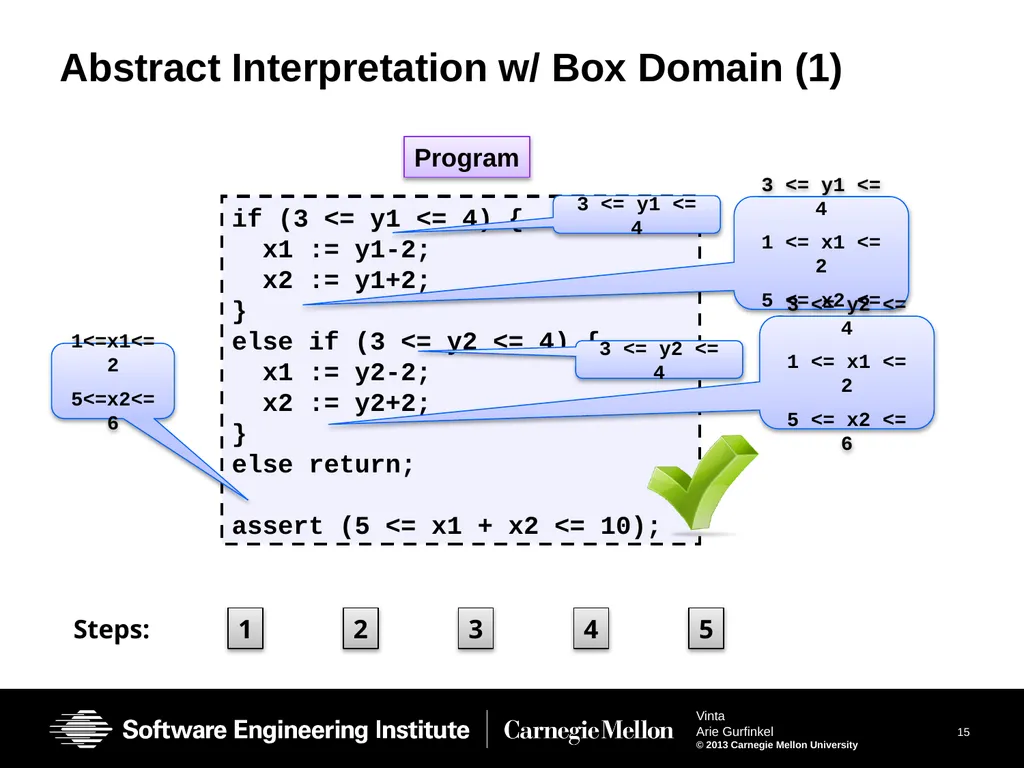
slide15. Abstract Interpretation w/ Box Domain (1) if (3 <= y1 <= 4) {
x1 := y1-2;
x2 := y1+2;
}
else if (3 <= y2 <= 4) {
x1 := y2-2;
x2 := y2+2;
}
else return;
assert (5 <= x1 + x2 <= 10); 3 <= y1 <= 4 3 <= y1 <= 4
1 <= x1 <= 2
5 <= x2 <= 6 3 <= y2 <= 4 3 <= y2 <= 4
1 <= x1 <= 2
5 <= x2 <= 6 1<=x1<=2
5<=x2<=6 Program 1 2 3 4 5 Steps:<br>
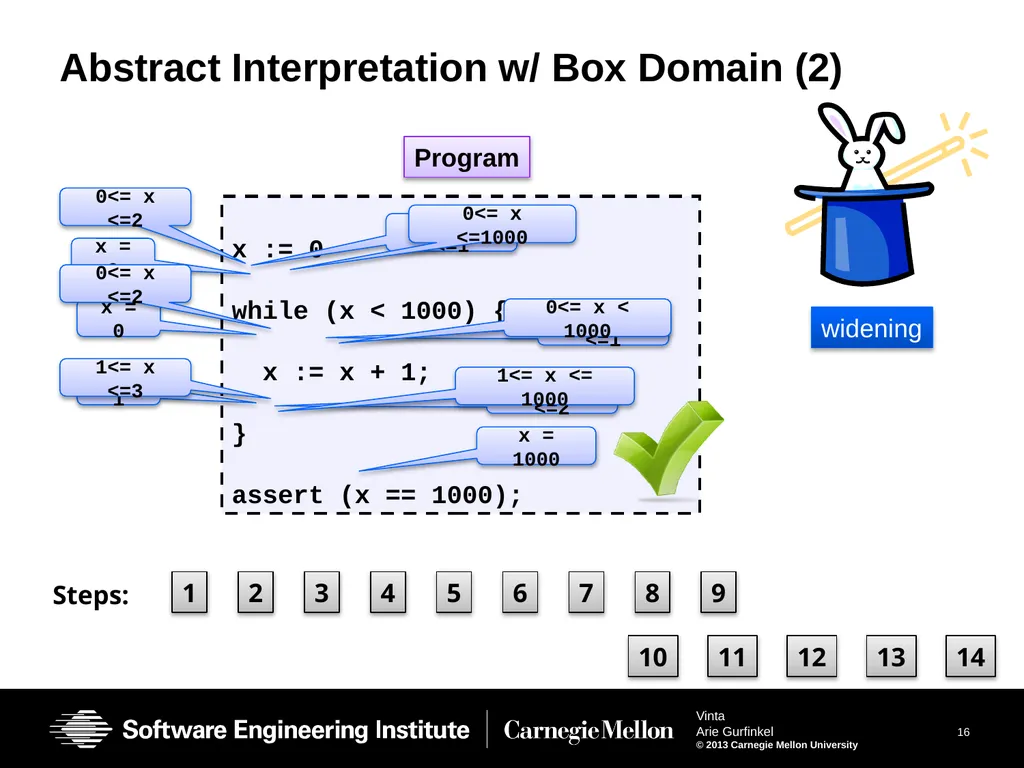
slide16. Abstract Interpretation w/ Box Domain (2) x := 0
while (x < 1000) {
x := x + 1;
}
assert (x == 1000); Program x = 0 x = 0 x = 1 0<= x <=1 0<= x <=1 1<= x <=2 0<= x <=2 0<= x <=2 1<= x <=3 0<= x <=1000 0<= x < 1000 1<= x <= 1000 x = 1000 widening 1 2 3 4 5 Steps: 6 7 8 9 10 11 12 13 14<br>
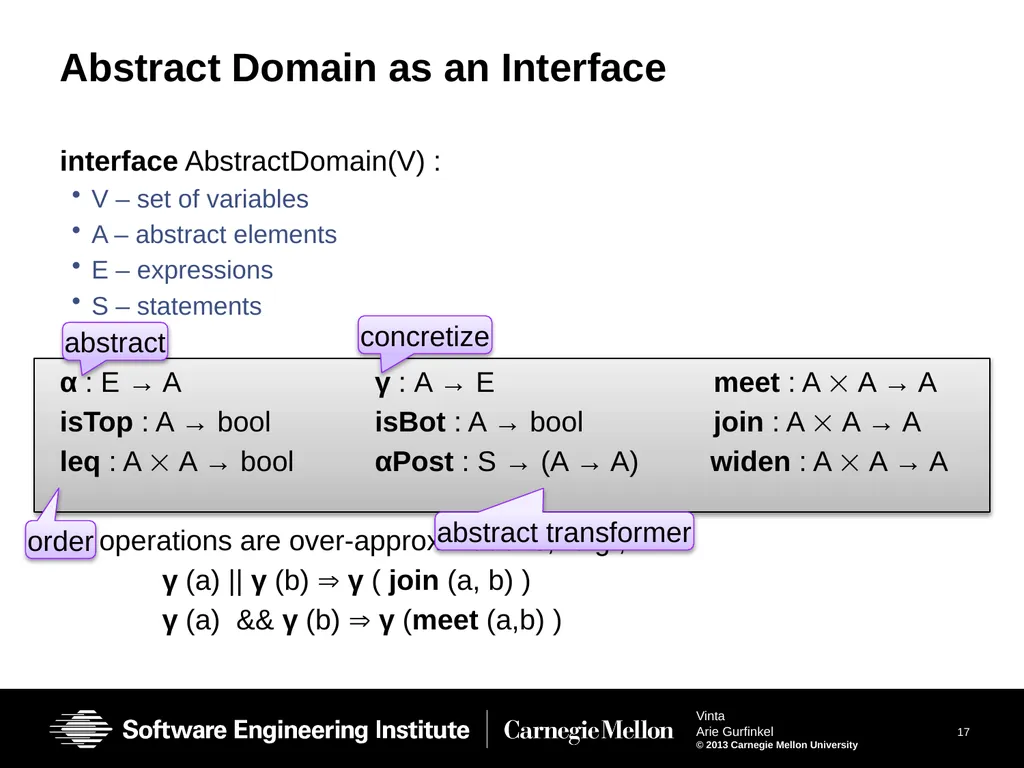
slide17. Abstract Domain as an Interface interface AbstractDomain(V) :
V – set of variables
A – abstract elements
E – expressions
S – statements
α : E → A γ : A → E meet : A A → A
isTop : A → bool isBot : A → bool join : A A → A
leq : A A → bool αPost : S → (A → A) widen : A A → A
All operations are over-approximations, e.g.,
γ (a) || γ (b) γ ( join (a, b) )
γ (a) && γ (b) γ (meet (a,b) ) abstract concretize abstract transformer order<br>
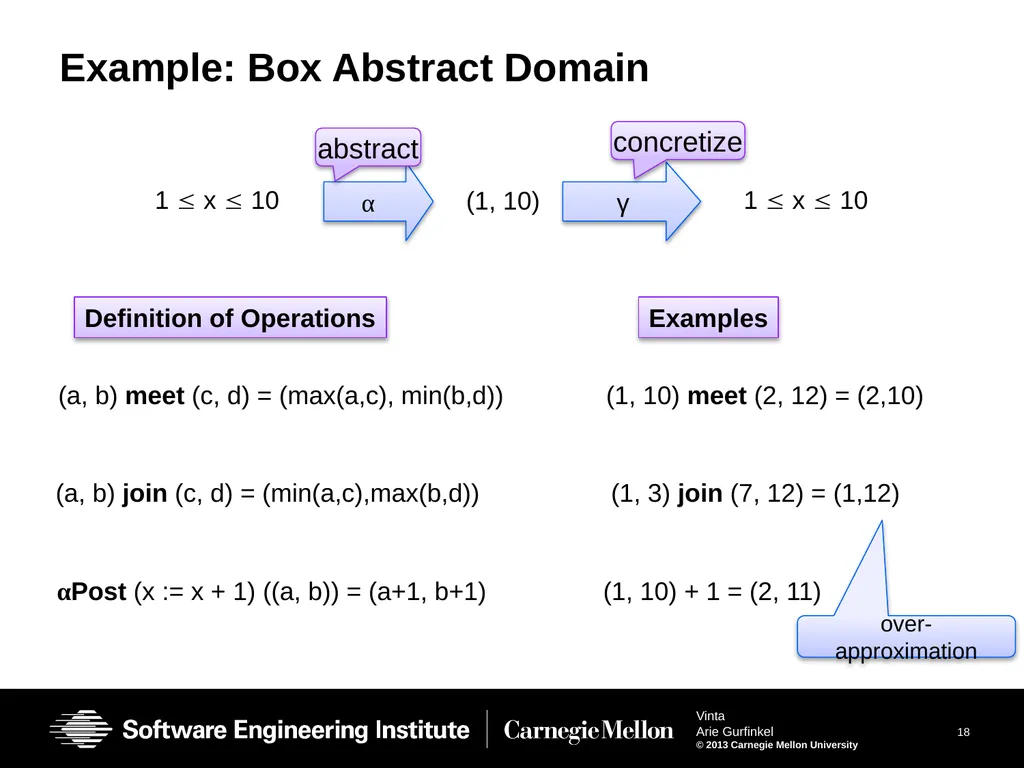
slide18. Example: Box Abstract Domain (1, 10) meet (2, 12) = (2,10) (1, 3) join (7, 12) = (1,12) (a, b) meet (c, d) = (max(a,c), min(b,d)) (a, b) join (c, d) = (min(a,c),max(b,d)) αPost (x := x + 1) ((a, b)) = (a+1, b+1) (1, 10) + 1 = (2, 11) Definition of Operations Examples over-approximation abstract concretize<br>
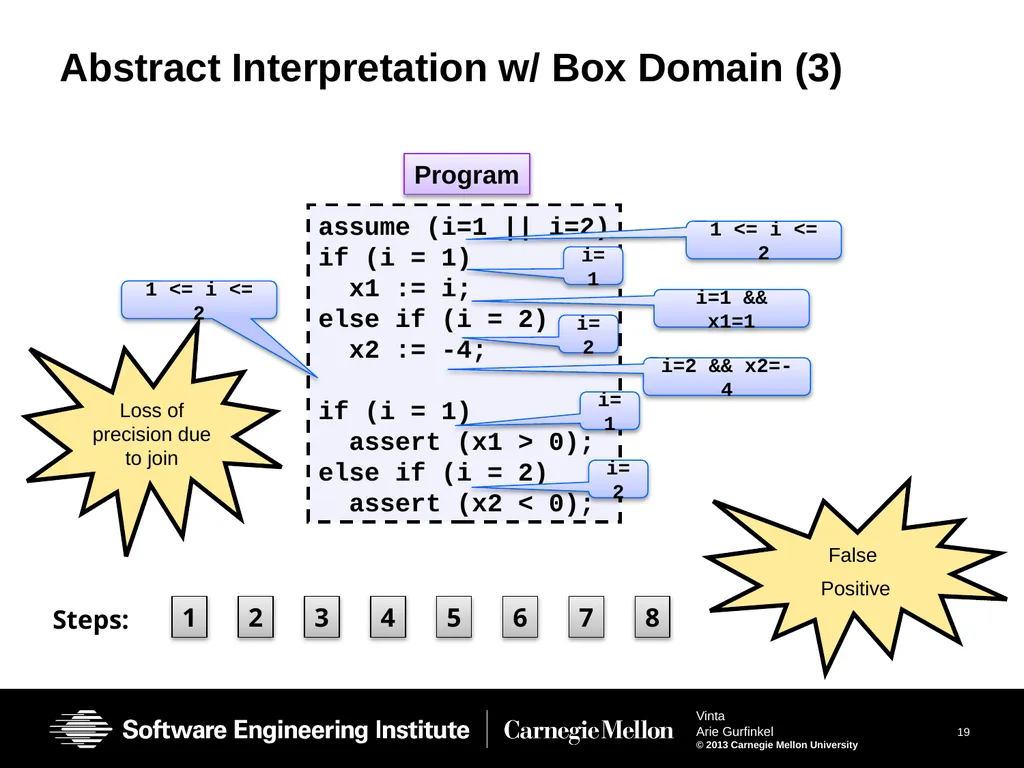
slide19. Abstract Interpretation w/ Box Domain (3) assume (i=1 || i=2)
if (i = 1)
x1 := i;
else if (i = 2)
x2 := -4;
if (i = 1)
assert (x1 > 0);
else if (i = 2)
assert (x2 < 0); 1 <= i <= 2 i=1 i=1 && x1=1 i=2 i=2 && x2=-4 1 <= i <= 2 i=1 i=2 Loss of precision due to join False
Positive Program 1 2 3 4 5 Steps: 6 7 8<br>
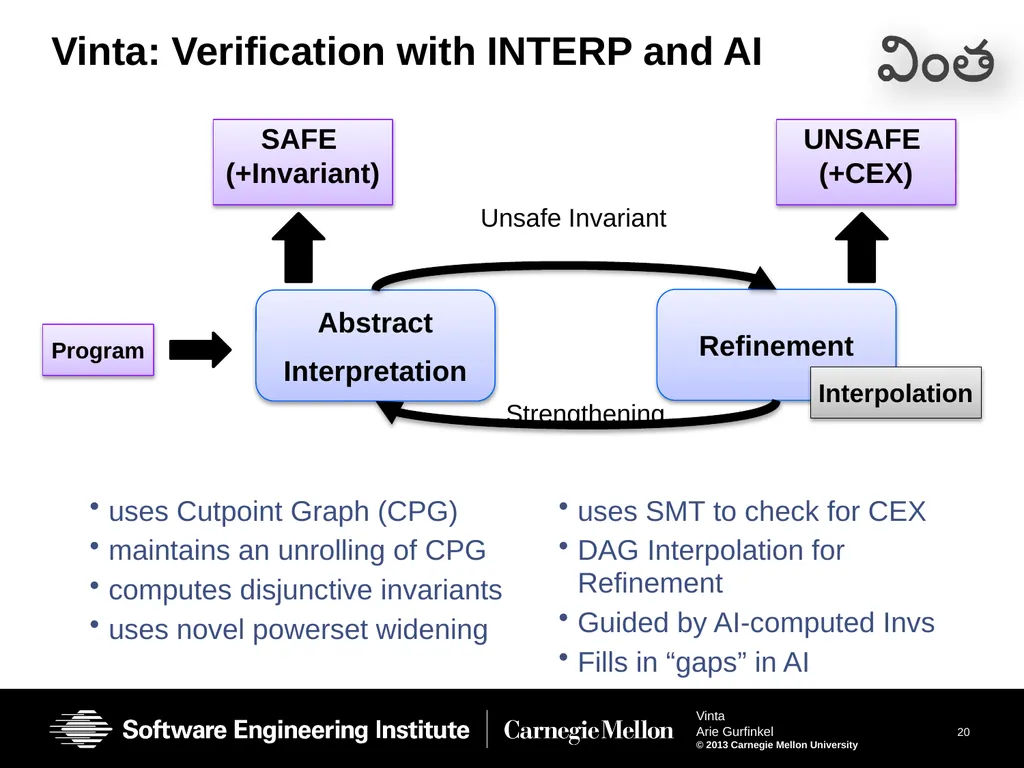
slide20. Vinta: Verification with INTERP and AI uses Cutpoint Graph (CPG)
maintains an unrolling of CPG
computes disjunctive invariants
uses novel powerset widening uses SMT to check for CEX
DAG Interpolation for Refinement
Guided by AI-computed Invs
Fills in “gaps” in AI Abstract
Interpretation Refinement Program SAFE
(+Invariant) UNSAFE
(+CEX) Interpolation Unsafe Invariant Strengthening<br>
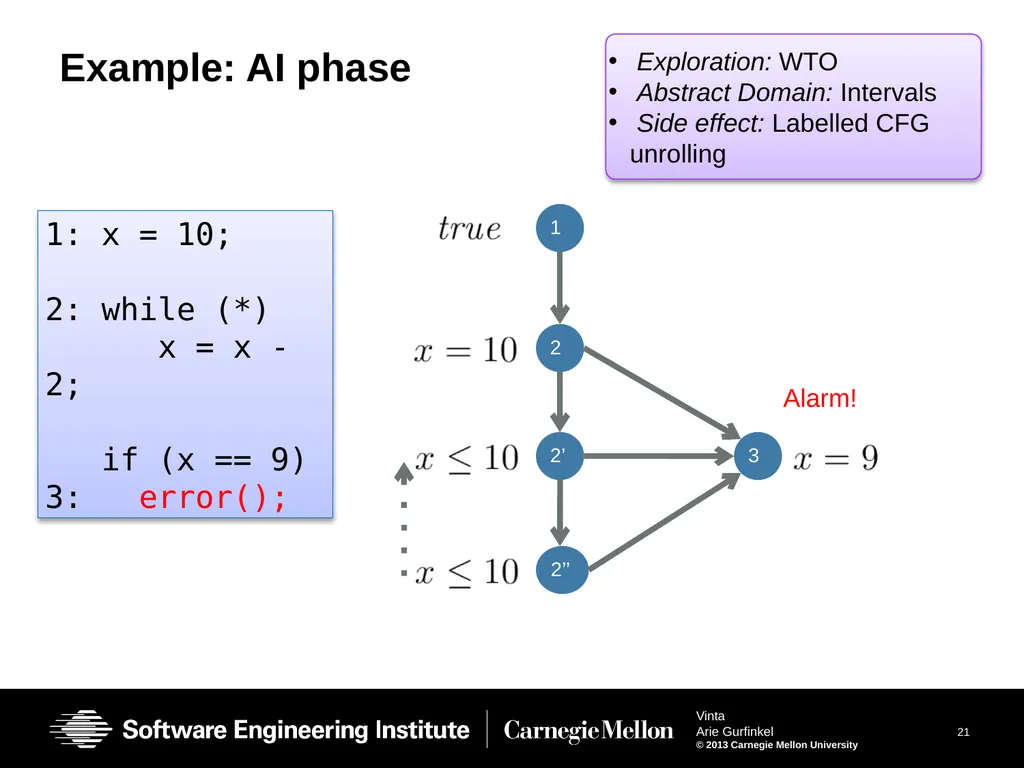
slide21. Example: AI phase 1: x = 10;
2: while (*)
x = x - 2;
if (x == 9)
3: error(); 1 2 2’ 2’’ 3 Alarm! Exploration: WTO
Abstract Domain: Intervals
Side effect: Labelled CFG unrolling<br>
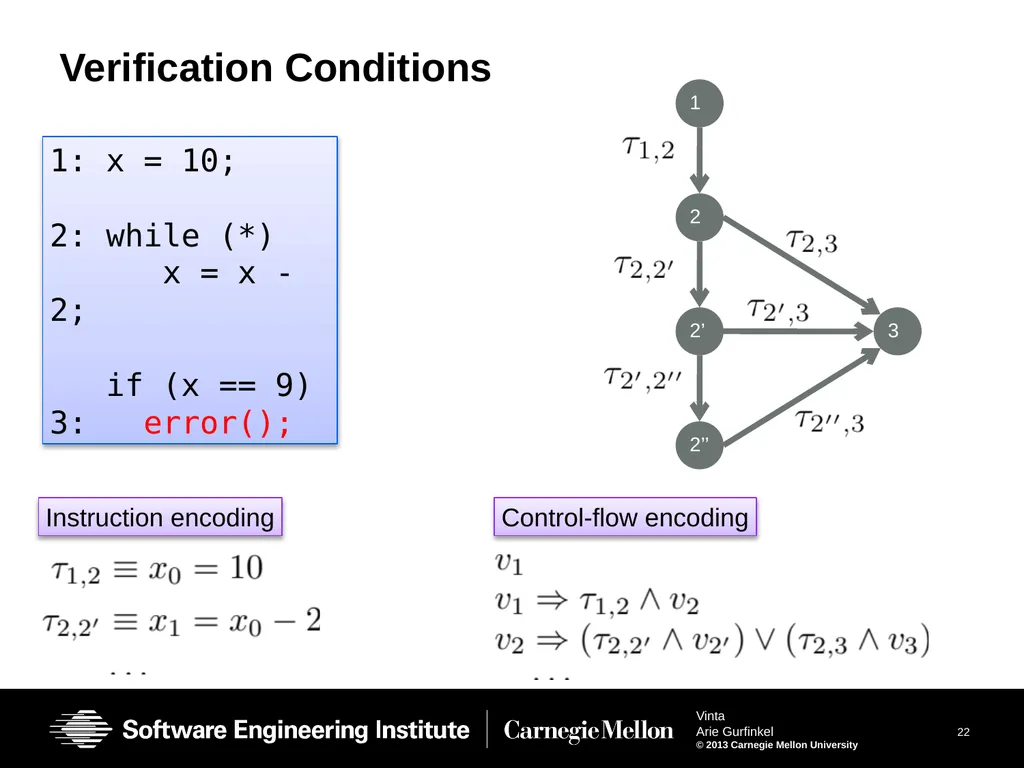
slide22. Verification Conditions 1 2 2’ 2’’ 3 Instruction encoding Control-flow encoding 1: x = 10;
2: while (*)
x = x - 2;
if (x == 9)
3: error();<br>
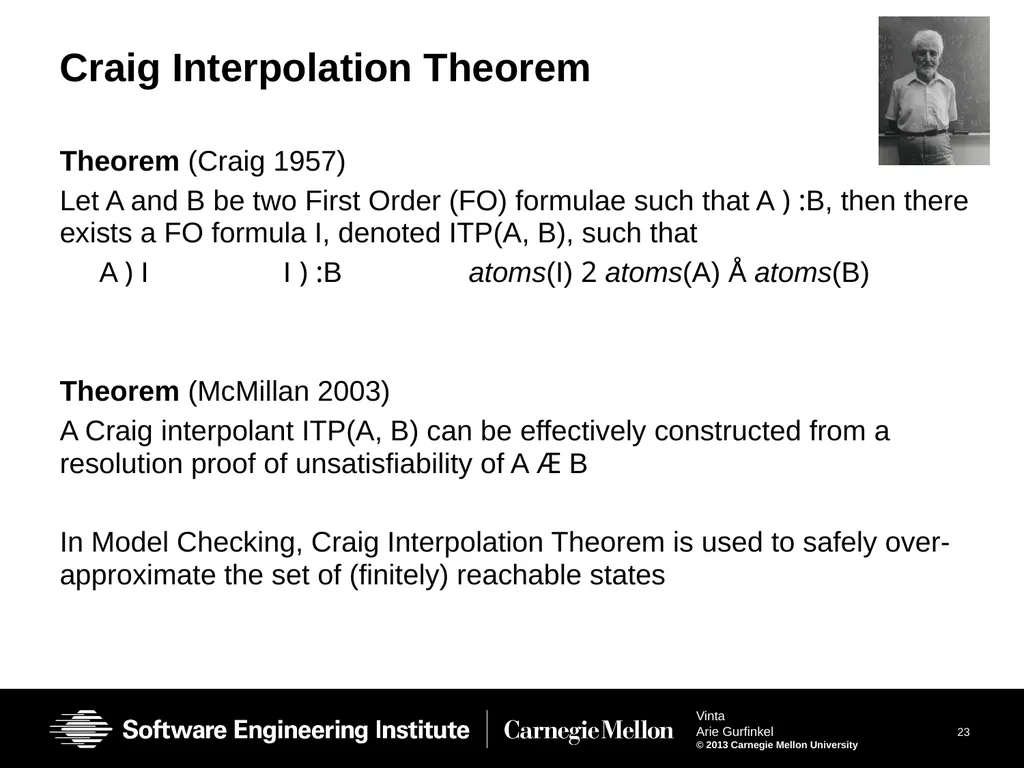
slide23. Craig Interpolation Theorem Theorem (Craig 1957)
Let A and B be two First Order (FO) formulae such that A ) :B, then there exists a FO formula I, denoted ITP(A, B), such that
A ) I I ) :B atoms(I) 2 atoms(A) Å atoms(B)
Theorem (McMillan 2003)
A Craig interpolant ITP(A, B) can be effectively constructed from a resolution proof of unsatisfiability of A Æ B
In Model Checking, Craig Interpolation Theorem is used to safely over-approximate the set of (finitely) reachable states<br>
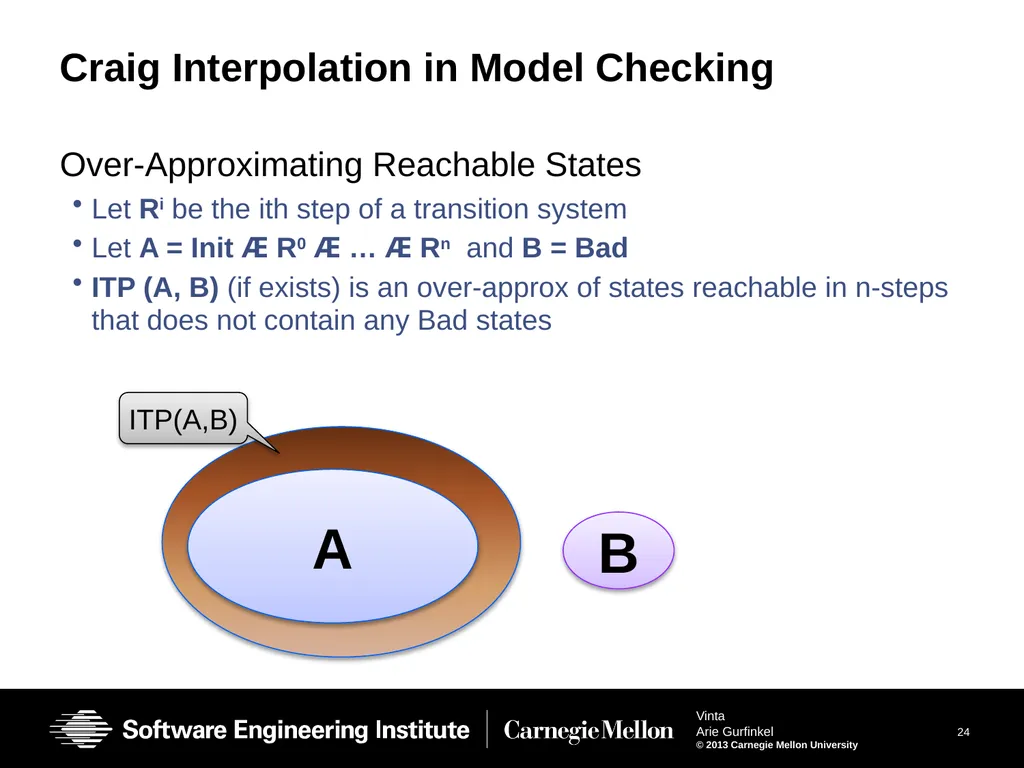
slide24. Craig Interpolation in Model Checking Over-Approximating Reachable States
Let Ri be the ith step of a transition system
Let A = Init Æ R0 Æ … Æ Rn and B = Bad
ITP (A, B) (if exists) is an over-approx of states reachable in n-steps that does not contain any Bad states A B ITP(A,B)<br>
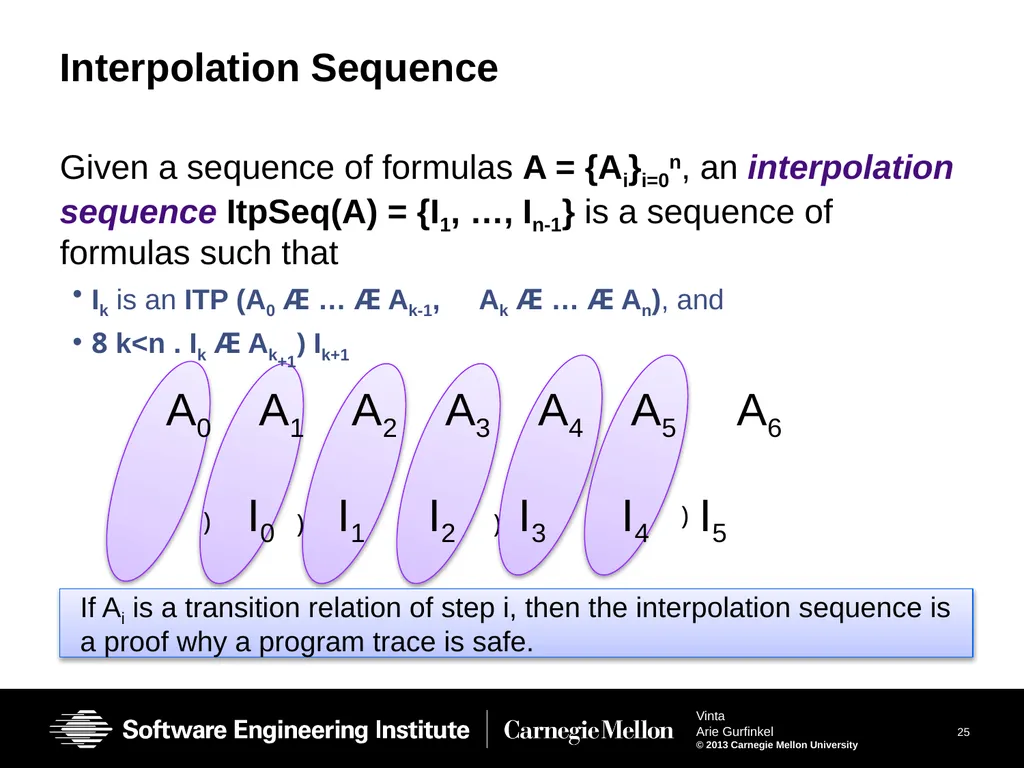
slide25. Interpolation Sequence Given a sequence of formulas A = {Ai}i=0n, an interpolation sequence ItpSeq(A) = {I1, …, In-1} is a sequence of formulas such that
Ik is an ITP (A0 Æ … Æ Ak-1, Ak Æ … Æ An), and
8 k<n . Ik Æ Ak+1) Ik+1 A0 A1 A2 A3 A4 A5 A6 I0 I1 I2 I3 I4 I5 If Ai is a transition relation of step i, then the interpolation sequence is a proof why a program trace is safe.<br>
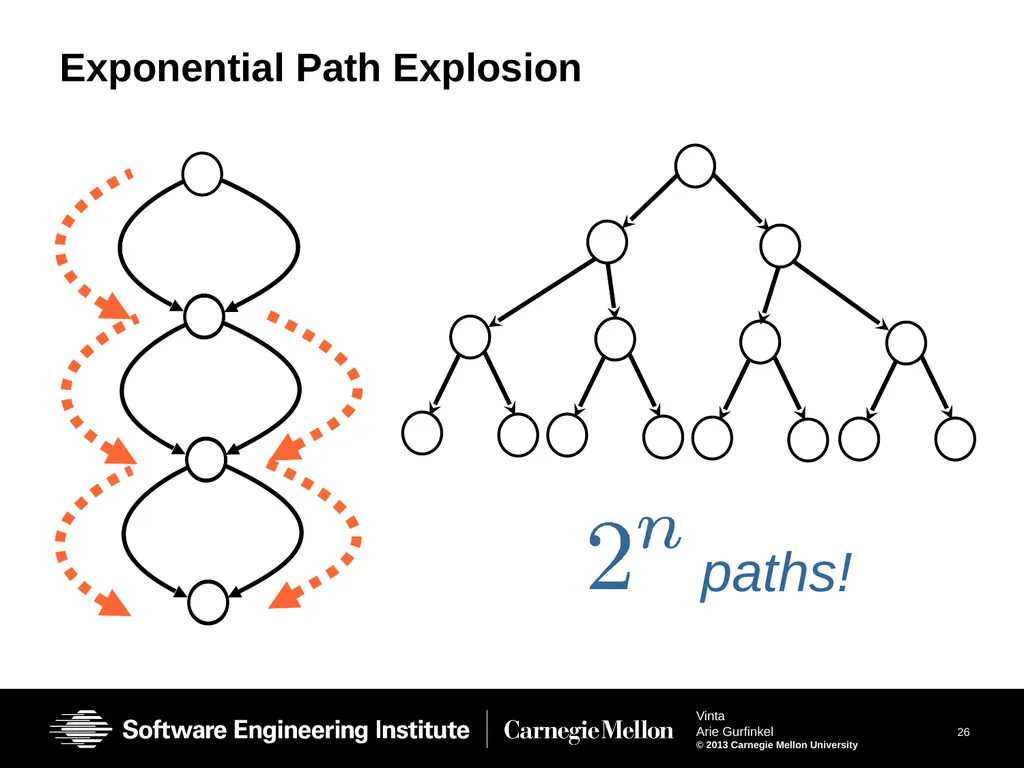
slide26. Exponential Path Explosion paths!<br>
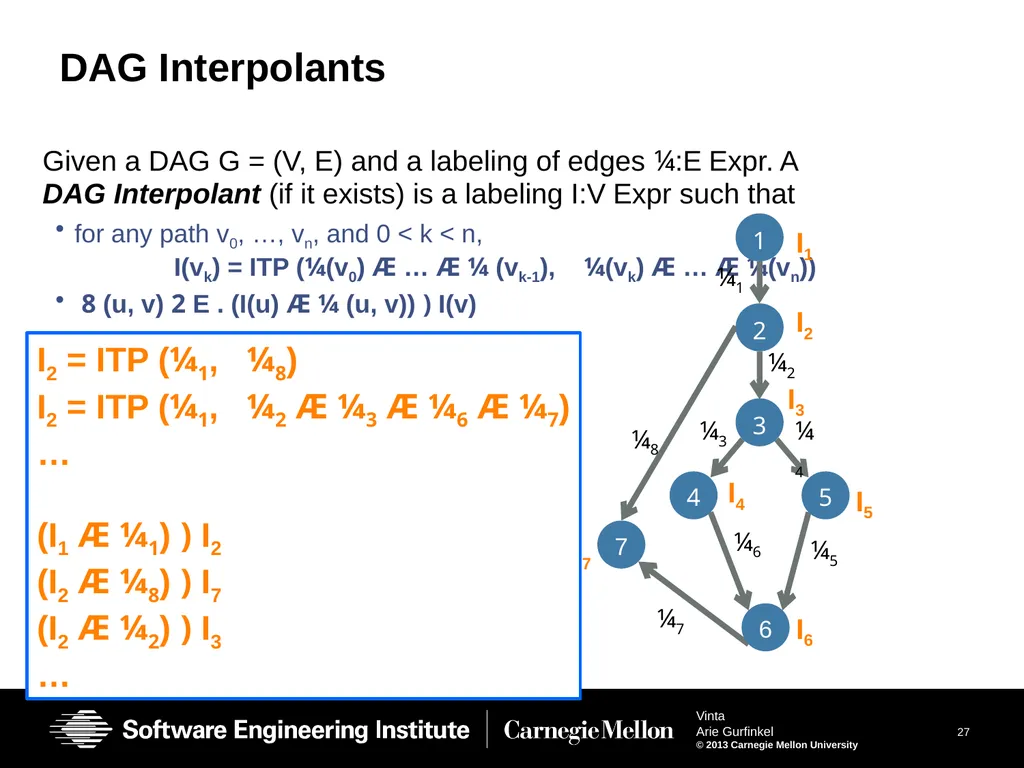
slide27. DAG Interpolants Given a DAG G = (V, E) and a labeling of edges ¼:EExpr. A DAG Interpolant (if it exists) is a labeling I:VExpr such that
for any path v0, …, vn, and 0 < k < n, I(vk) = ITP (¼(v0) Æ … Æ ¼ (vk-1), ¼(vk) Æ … Æ ¼(vn))
8 (u, v) 2 E . (I(u) Æ ¼ (u, v)) ) I(v) ¼1 ¼2 ¼3 ¼4 ¼5 ¼6 ¼7 ¼8 I1 I2 I3 I4 I5 I6 I7 I2 = ITP (¼1, ¼8)
I2 = ITP (¼1, ¼2 Æ ¼3 Æ ¼6 Æ ¼7)
…
(I1 Æ ¼1) ) I2
(I2 Æ ¼8) ) I7
(I2 Æ ¼2) ) I3
…<br>
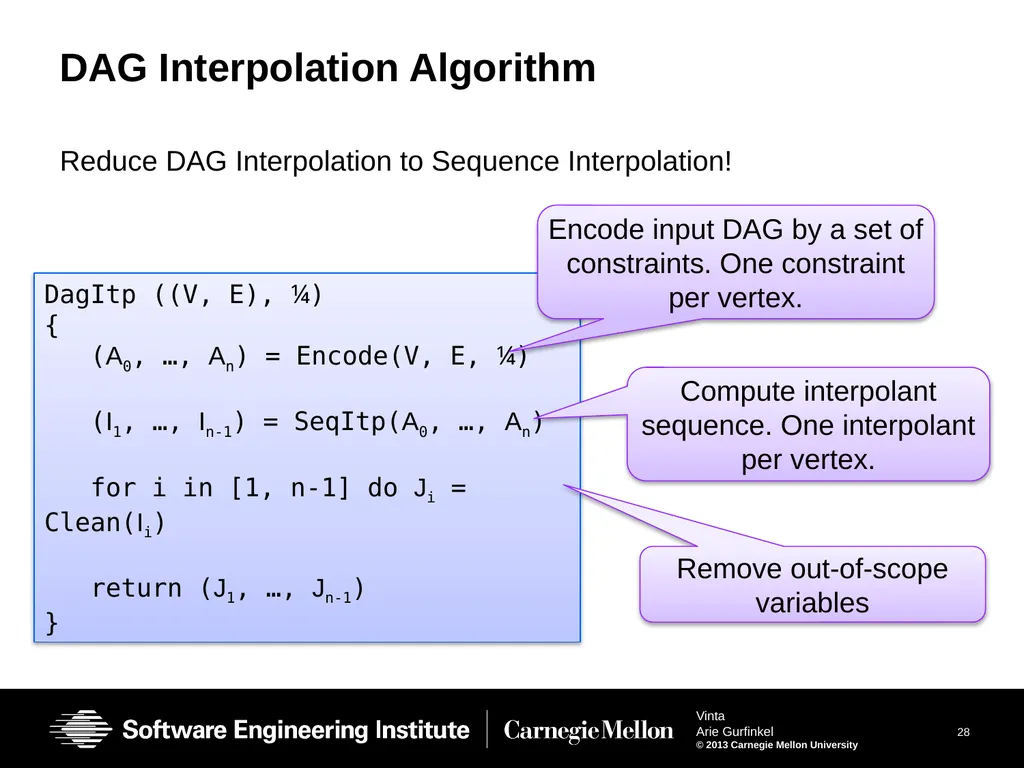
slide28. DAG Interpolation Algorithm Reduce DAG Interpolation to Sequence Interpolation! DagItp ((V, E), ¼)
{
(A0, …, An) = Encode(V, E, ¼)
(I1, …, In-1) = SeqItp(A0, …, An)
for i in [1, n-1] do Ji = Clean(Ii)
return (J1, …, Jn-1)
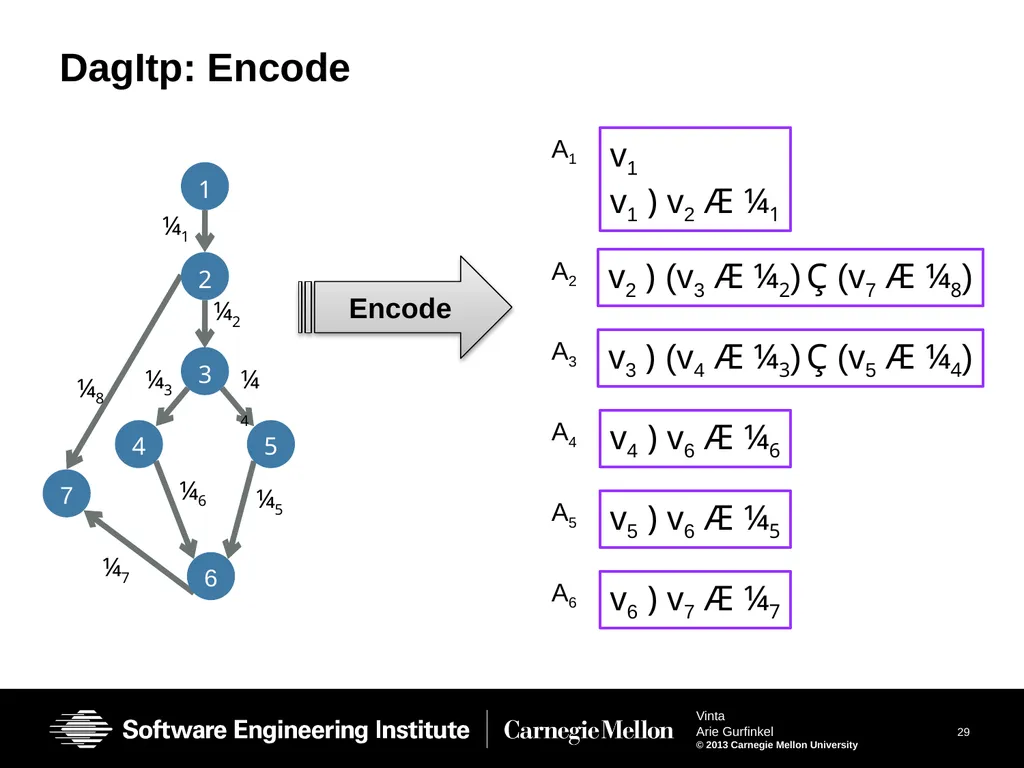
} Encode input DAG by a set of constraints. One constraint per vertex. Compute interpolant sequence. One interpolant per vertex. Remove out-of-scope variables<br>
slide29. DagItp: Encode Encode ¼1 ¼2 ¼3 ¼4 ¼5 ¼6 ¼7 ¼8<br>
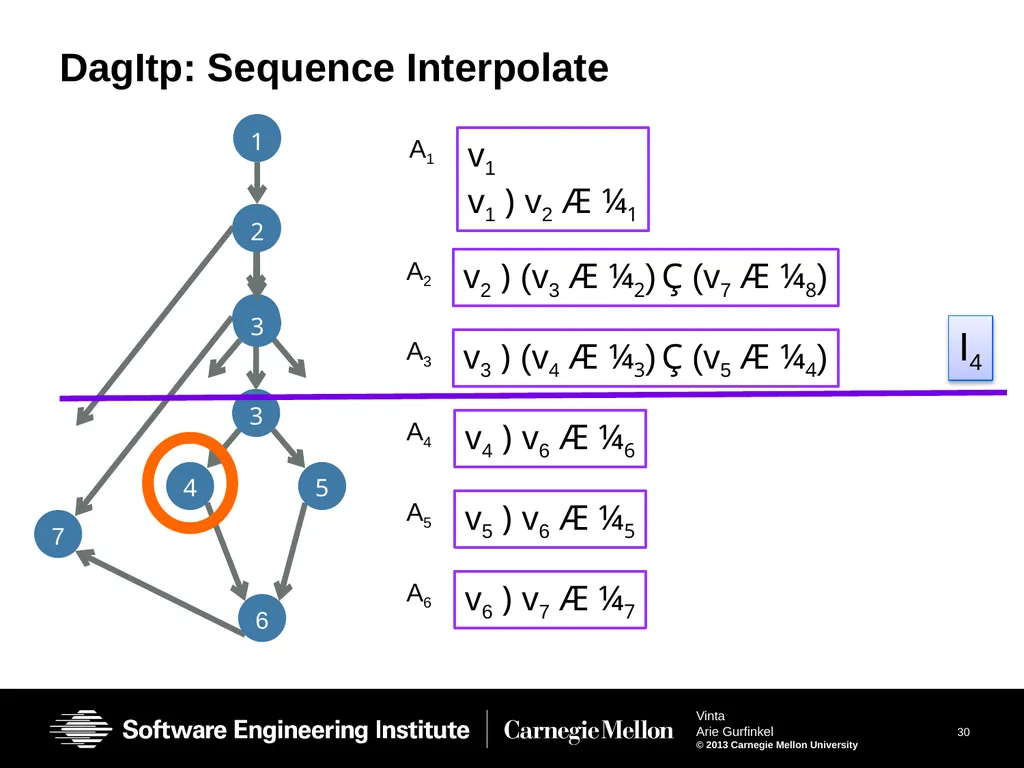
slide30. DagItp: Sequence Interpolate 4 5 7 6 I4<br>
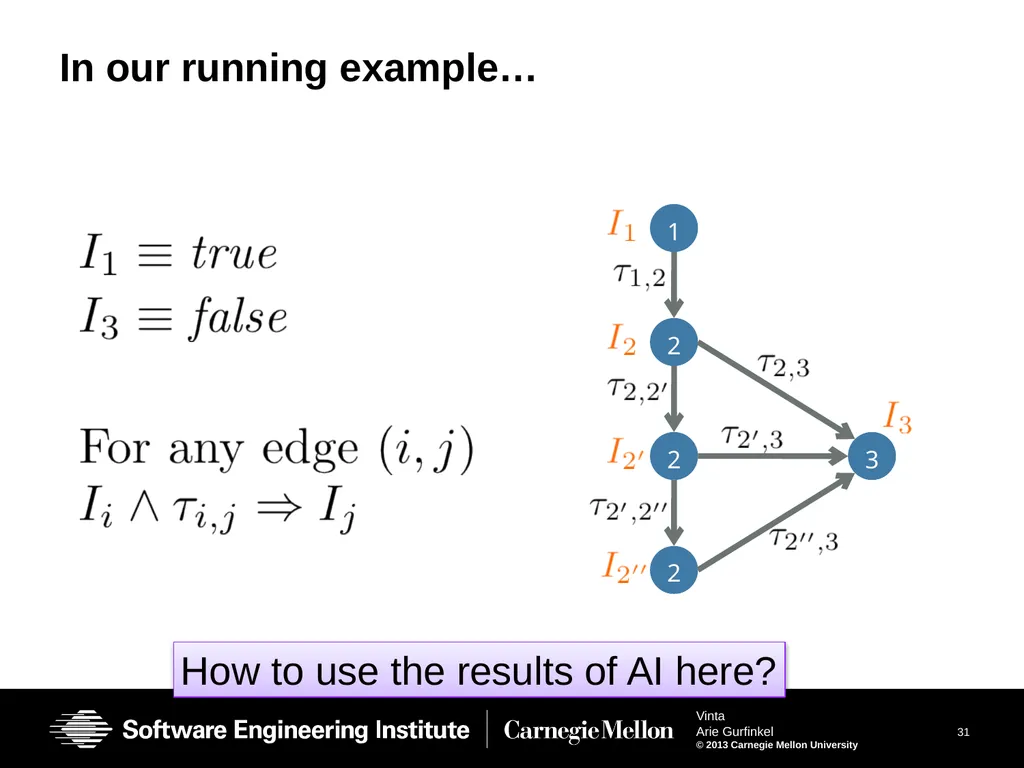
slide31. In our running example… 31 1 2 2’ 2’’ 3 How to use the results of AI here?<br>
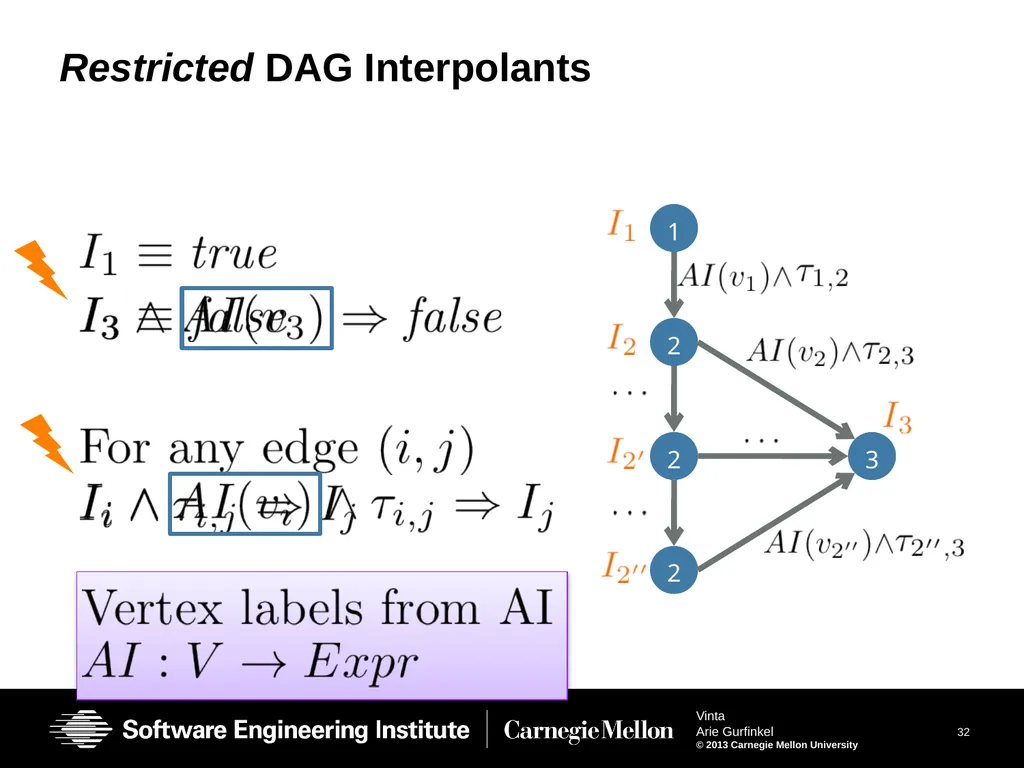
slide32. Restricted DAG Interpolants 1 2 2’ 2’’ 3<br>
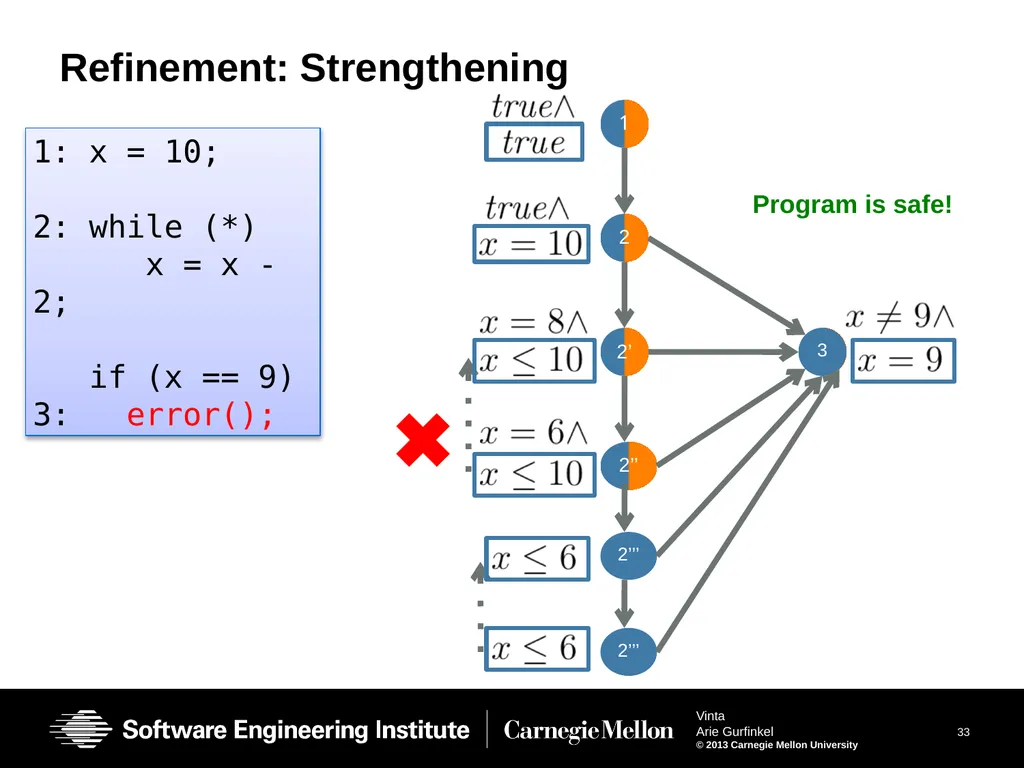
slide33. Refinement: Strengthening 1 2 2’ 2’’ 2’’’ 2’’’ Program is safe! 3 3 1: x = 10;
2: while (*)
x = x - 2;
if (x == 9)
3: error();<br>
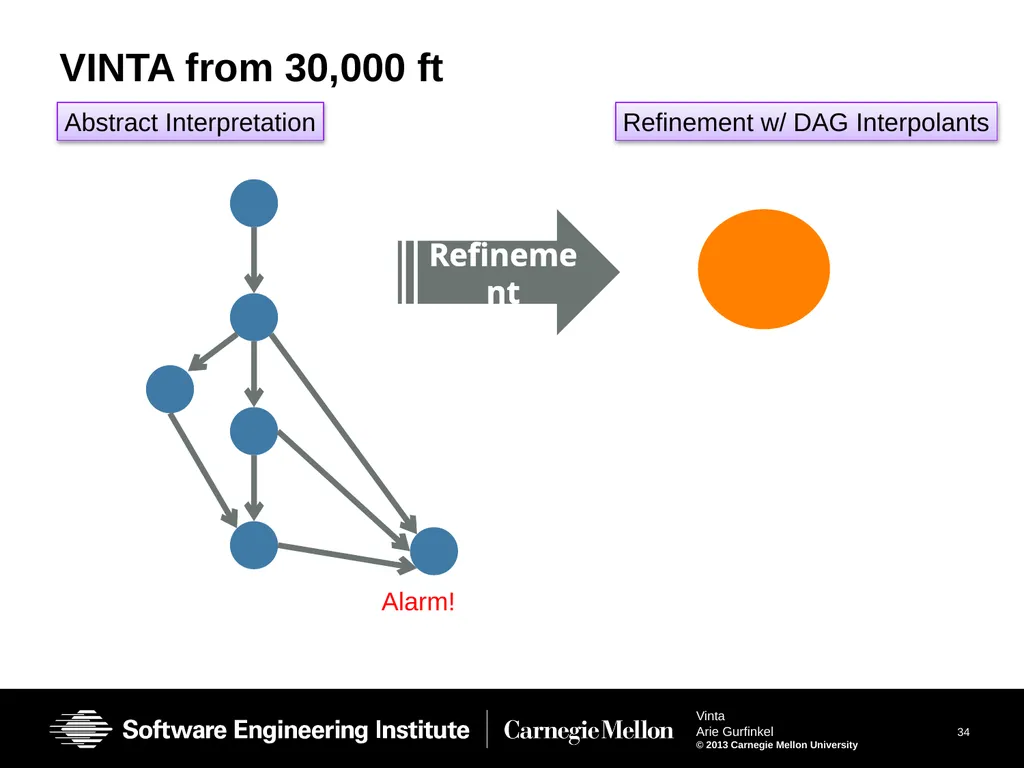
slide34. VINTA from 30,000 ft Abstract Interpretation Alarm! Refinement Refinement w/ DAG Interpolants<br>
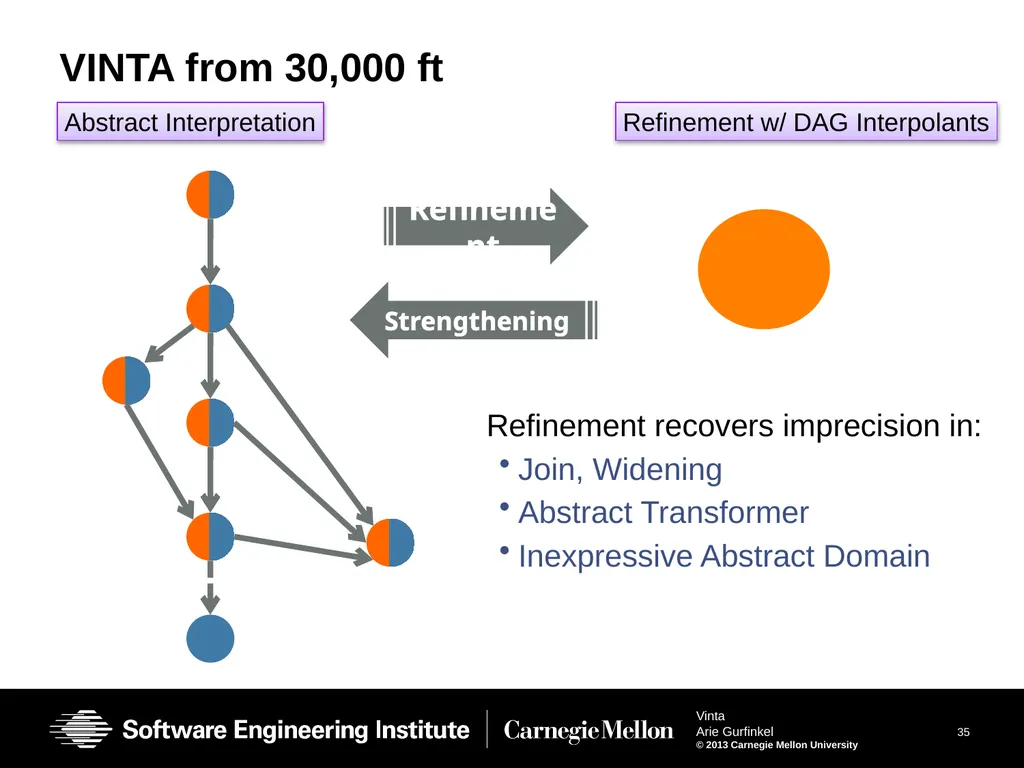
slide35. VINTA from 30,000 ft Abstract Interpretation Refinement Refinement w/ DAG Interpolants Refinement recovers imprecision in:
Join, Widening
Abstract Transformer
Inexpressive Abstract Domain Strengthening<br>
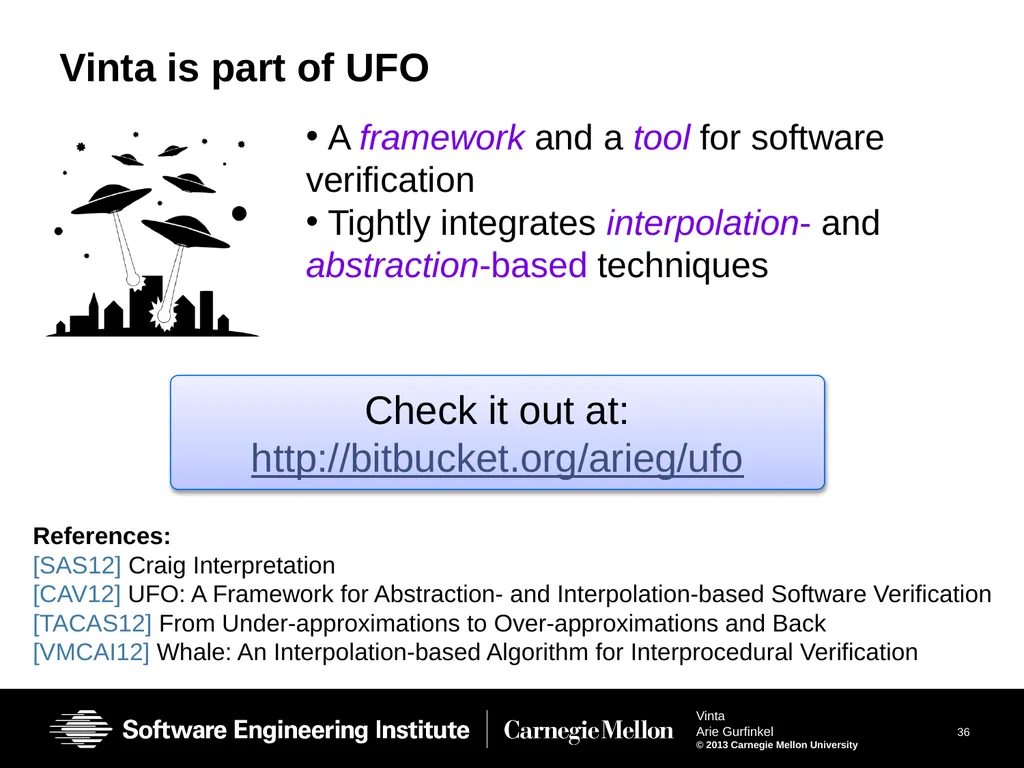
slide36. Vinta is part of UFO 36 A framework and a tool for software verification
Tightly integrates interpolation- and abstraction-based techniques References:
[SAS12] Craig Interpretation
[CAV12] UFO: A Framework for Abstraction- and Interpolation-based Software Verification
[TACAS12] From Under-approximations to Over-approximations and Back
[VMCAI12] Whale: An Interpolation-based Algorithm for Interprocedural Verification Check it out at:
http://bitbucket.org/arieg/ufo<br>
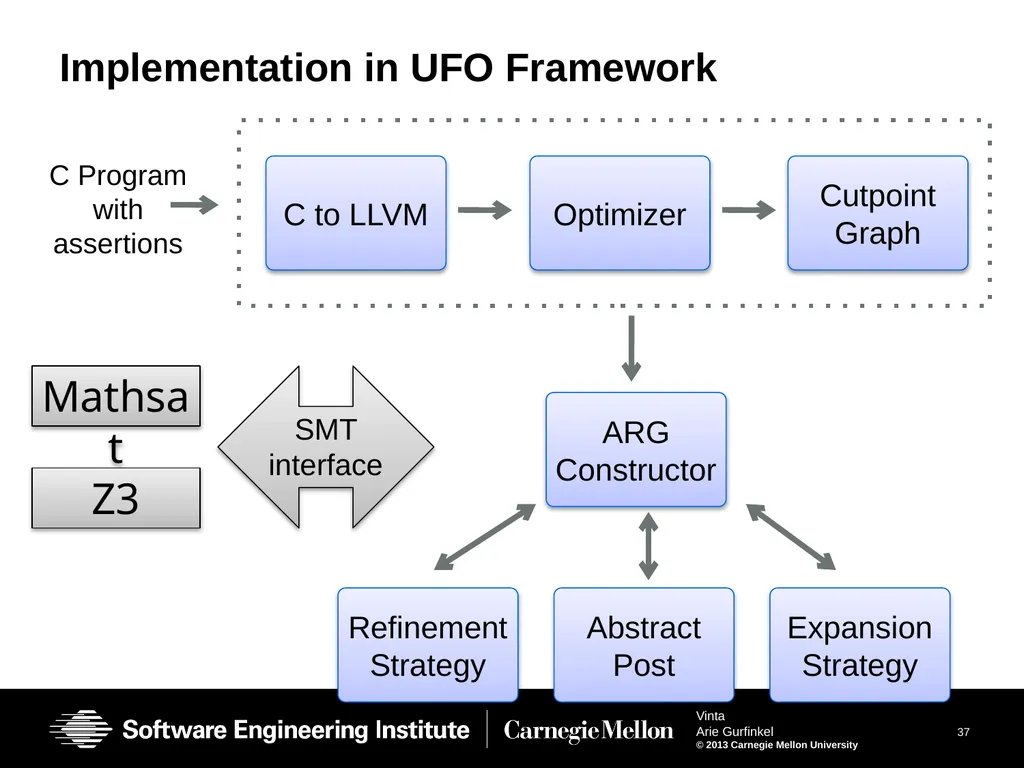
slide37. Implementation in UFO Framework C to LLVM C Program
with assertions ARG Constructor Abstract Post Expansion Strategy Refinement Strategy Optimizer Cutpoint Graph SMT interface Mathsat Z3<br>
slide38. Software Verification Competition (SV-COMP 2013)<br>
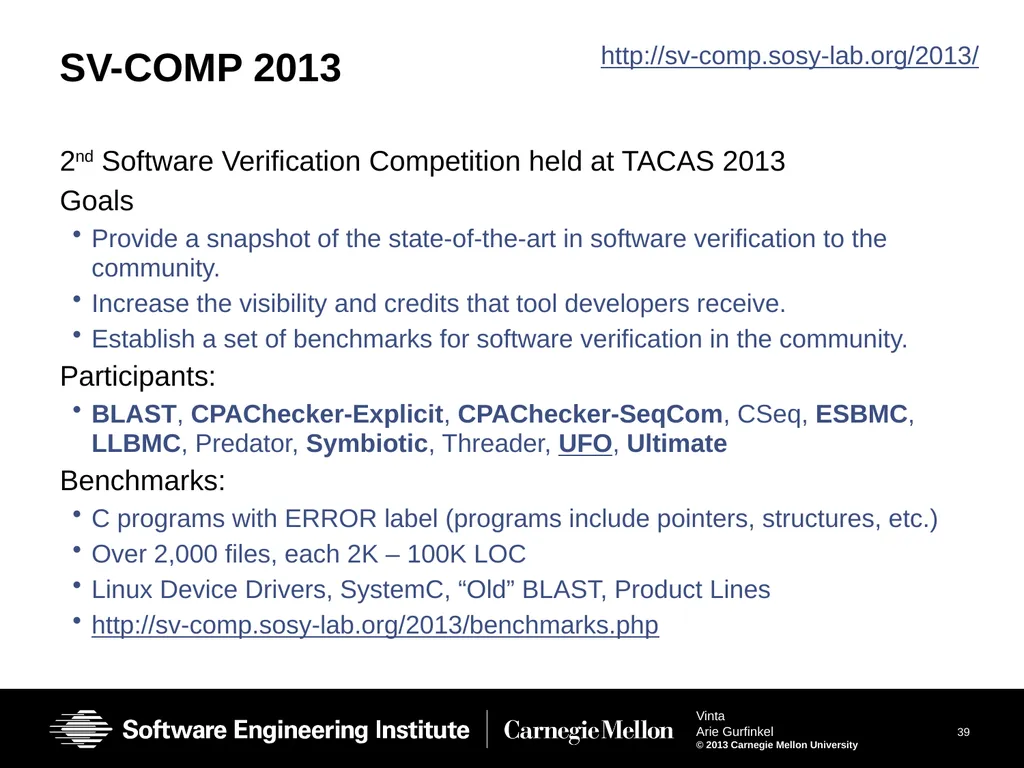
slide39. SV-COMP 2013 2nd Software Verification Competition held at TACAS 2013
Goals
Provide a snapshot of the state-of-the-art in software verification to the community.
Increase the visibility and credits that tool developers receive.
Establish a set of benchmarks for software verification in the community.
Participants:
BLAST, CPAChecker-Explicit, CPAChecker-SeqCom, CSeq, ESBMC, LLBMC, Predator, Symbiotic, Threader, UFO, Ultimate
Benchmarks:
C programs with ERROR label (programs include pointers, structures, etc.)
Over 2,000 files, each 2K – 100K LOC
Linux Device Drivers, SystemC, “Old” BLAST, Product Lines
http://sv-comp.sosy-lab.org/2013/benchmarks.php http://sv-comp.sosy-lab.org/2013/<br>
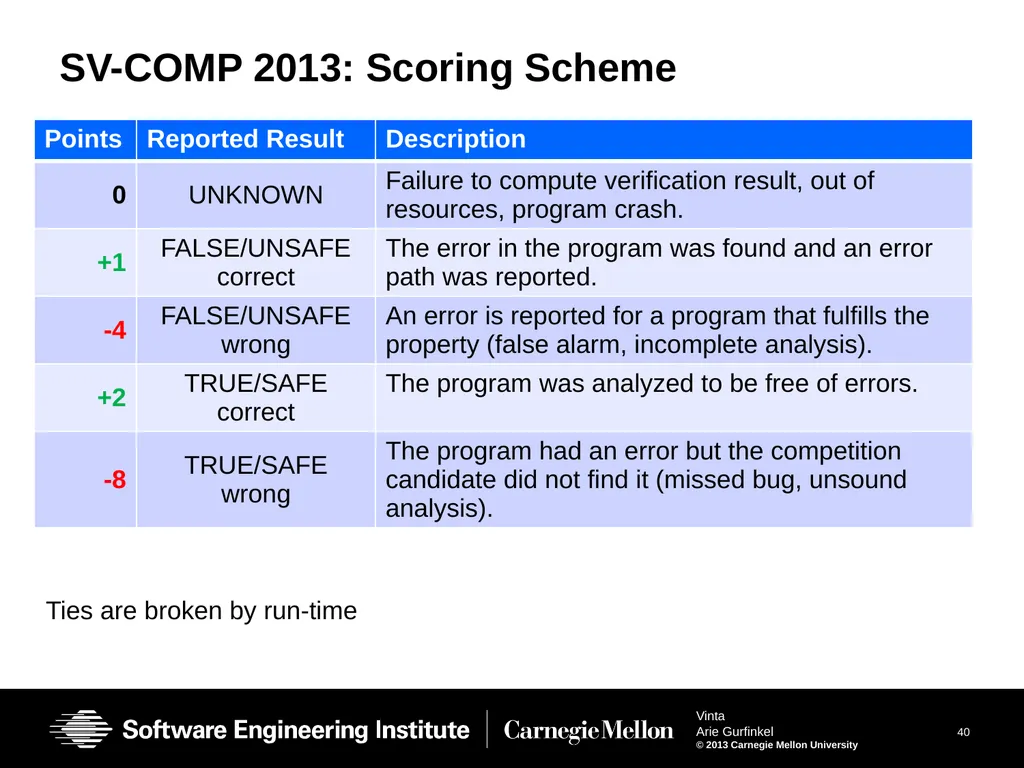
slide40. SV-COMP 2013: Scoring Scheme Ties are broken by run-time<br>
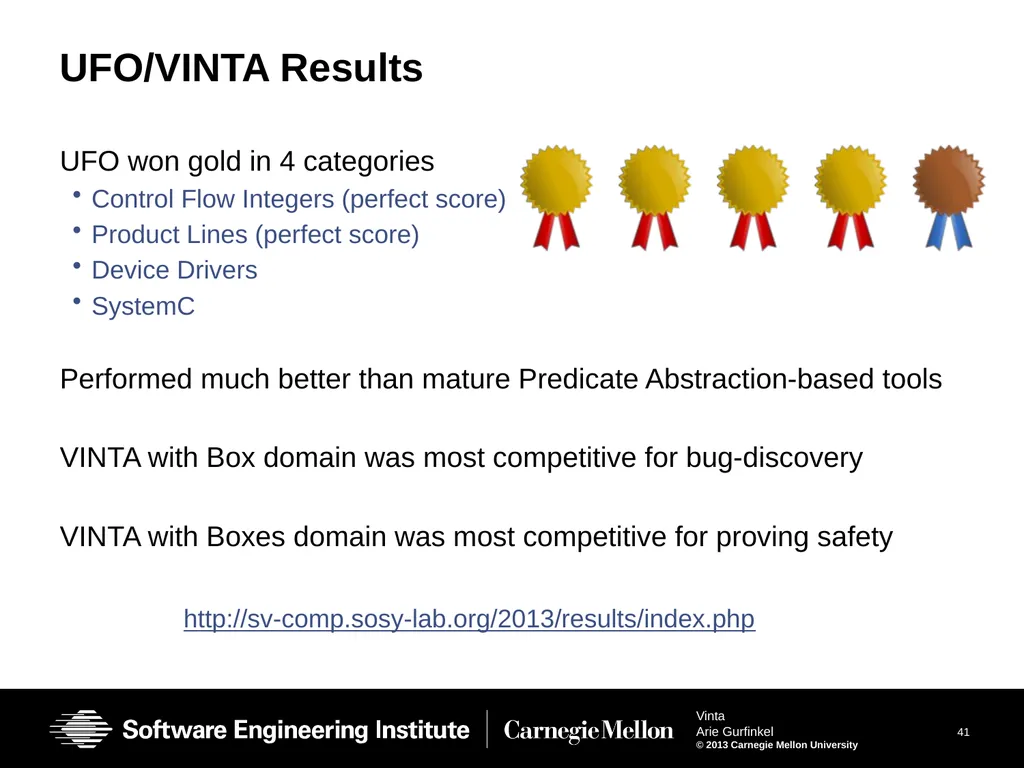
slide41. UFO/VINTA Results UFO won gold in 4 categories
Control Flow Integers (perfect score)
Product Lines (perfect score)
Device Drivers
SystemC
Performed much better than mature Predicate Abstraction-based tools
VINTA with Box domain was most competitive for bug-discovery
VINTA with Boxes domain was most competitive for proving safety http://sv-comp.sosy-lab.org/2013/results/index.php<br>
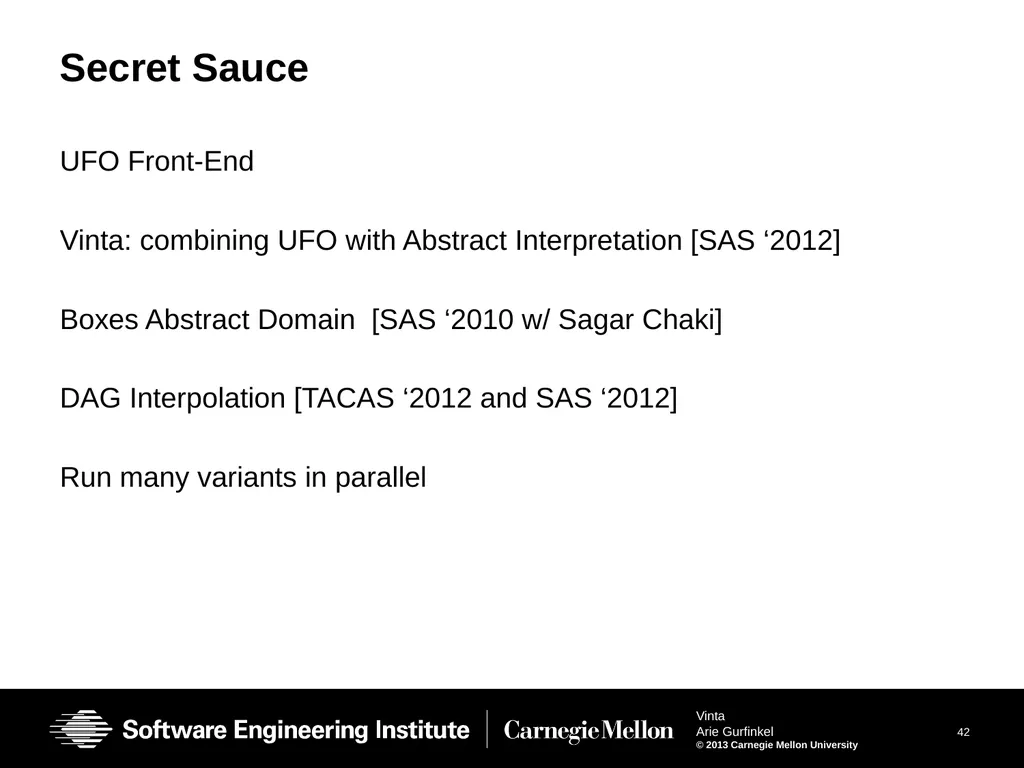
slide42. Secret Sauce UFO Front-End
Vinta: combining UFO with Abstract Interpretation [SAS ‘2012]
Boxes Abstract Domain [SAS ‘2010 w/ Sagar Chaki]
DAG Interpolation [TACAS ‘2012 and SAS ‘2012]
Run many variants in parallel<br>
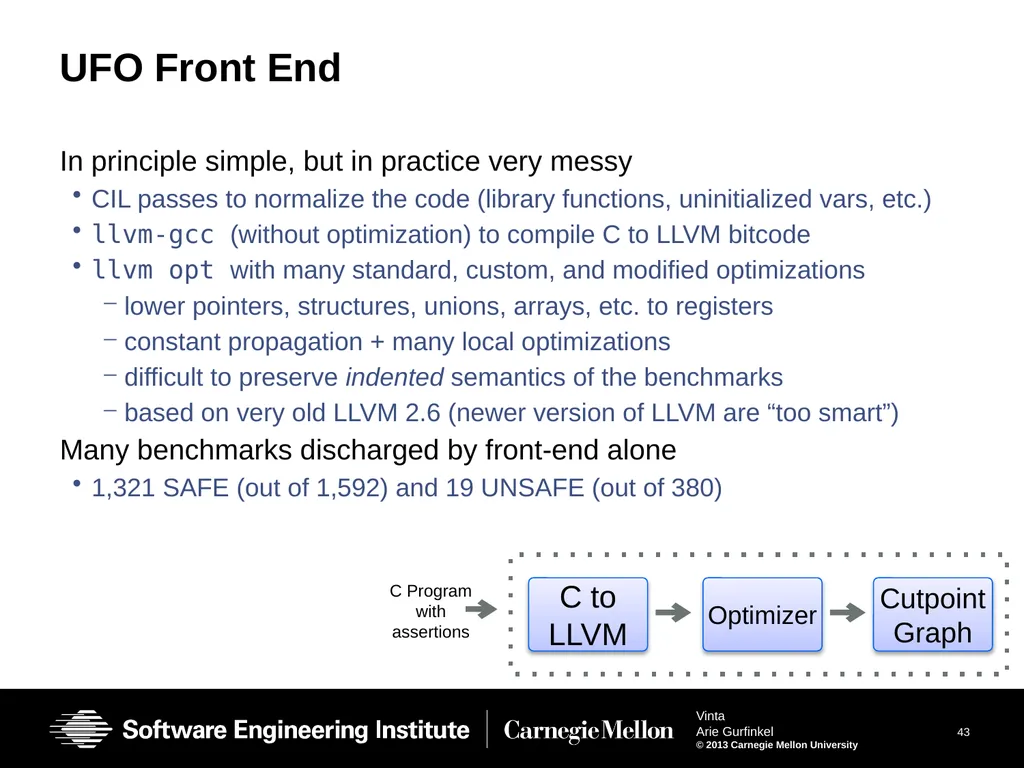
slide43. UFO Front End In principle simple, but in practice very messy
CIL passes to normalize the code (library functions, uninitialized vars, etc.)
llvm-gcc (without optimization) to compile C to LLVM bitcode
llvm opt with many standard, custom, and modified optimizations
lower pointers, structures, unions, arrays, etc. to registers
constant propagation + many local optimizations
difficult to preserve indented semantics of the benchmarks
based on very old LLVM 2.6 (newer version of LLVM are “too smart”)
Many benchmarks discharged by front-end alone
1,321 SAFE (out of 1,592) and 19 UNSAFE (out of 380)<br>
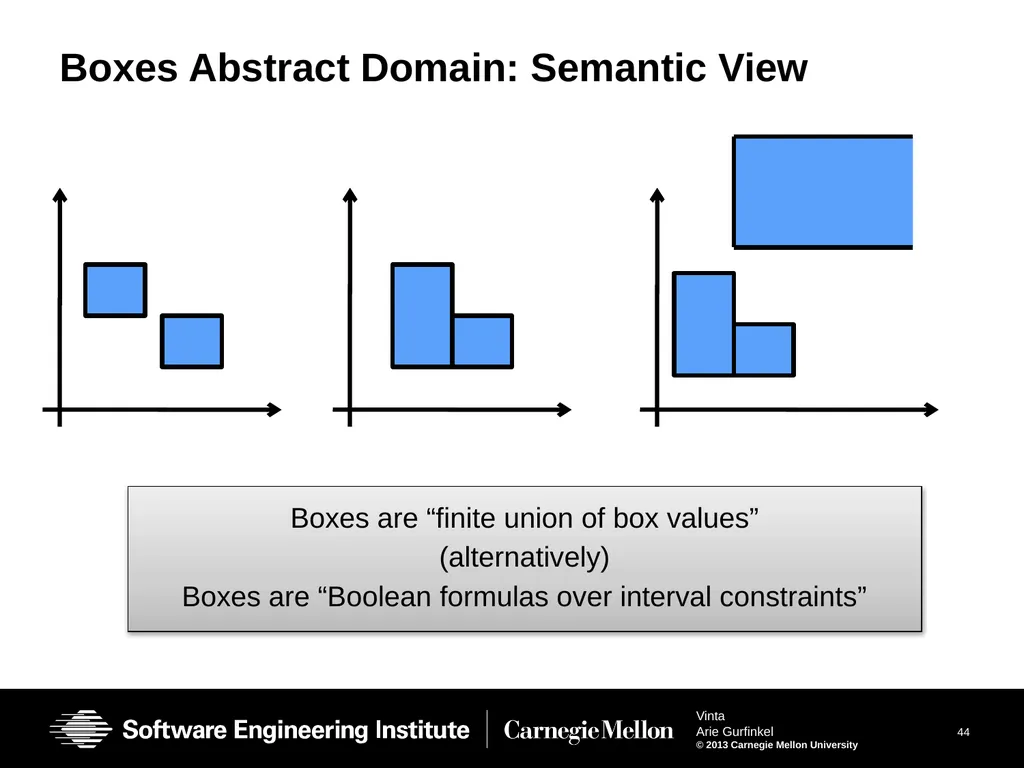
slide44. Boxes Abstract Domain: Semantic View Boxes are “finite union of box values”
(alternatively)
Boxes are “Boolean formulas over interval constraints”<br>
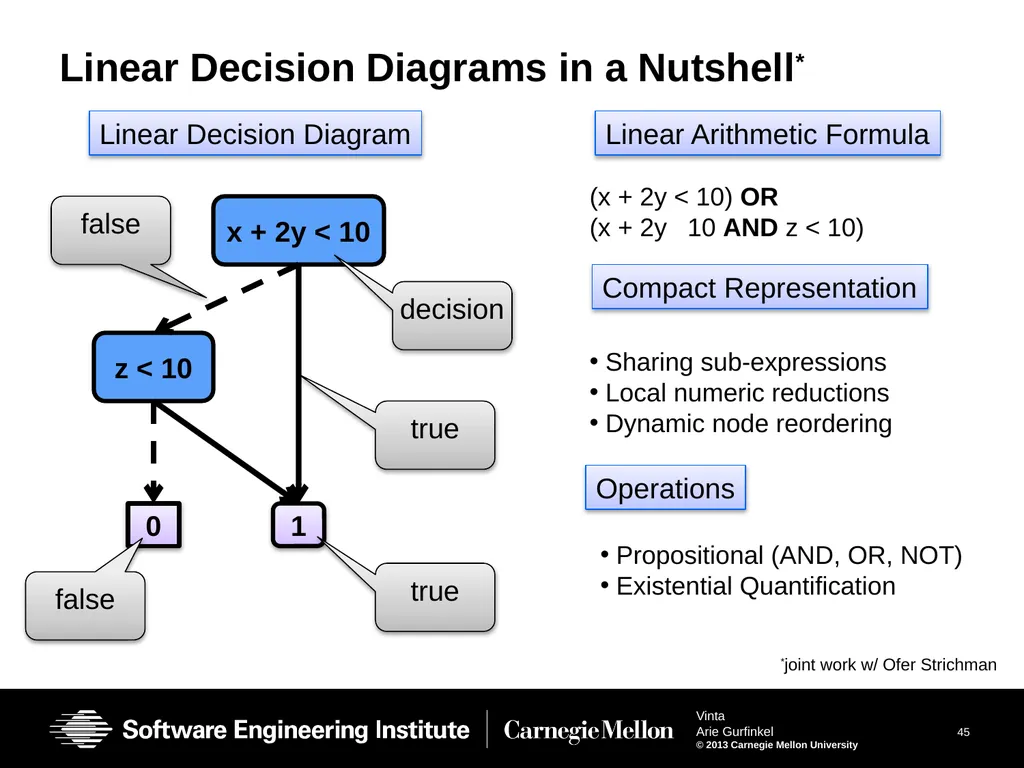
slide45. Linear Decision Diagrams in a Nutshell* x + 2y < 10 z < 10 1 0 Linear Decision Diagram decision
node true
terminal false
edge (x + 2y < 10) OR
(x + 2y 10 AND z < 10) Linear Arithmetic Formula Operations Propositional (AND, OR, NOT)
Existential Quantification false
terminal true
edge Compact Representation Sharing sub-expressions
Local numeric reductions
Dynamic node reordering *joint work w/ Ofer Strichman<br>
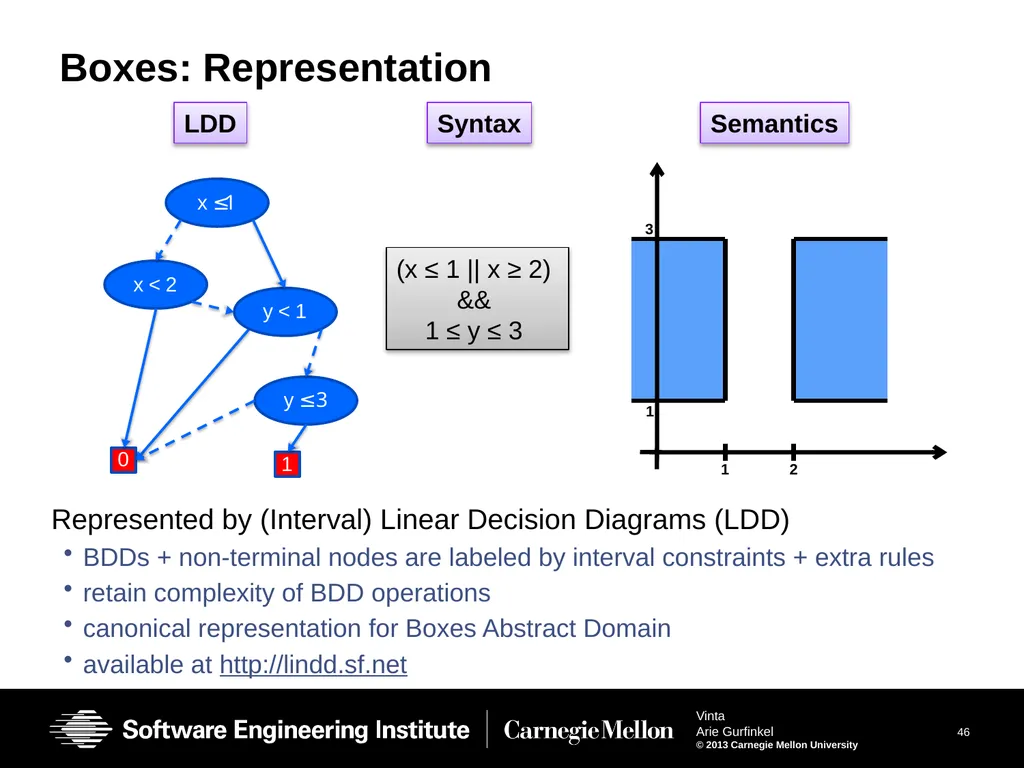
slide46. Boxes: Representation Represented by (Interval) Linear Decision Diagrams (LDD)
BDDs + non-terminal nodes are labeled by interval constraints + extra rules
retain complexity of BDD operations
canonical representation for Boxes Abstract Domain
available at http://lindd.sf.net LDD Semantics 1 2 1 3 (x ≤ 1 || x ≥ 2)
&&
1 ≤ y ≤ 3 Syntax<br>
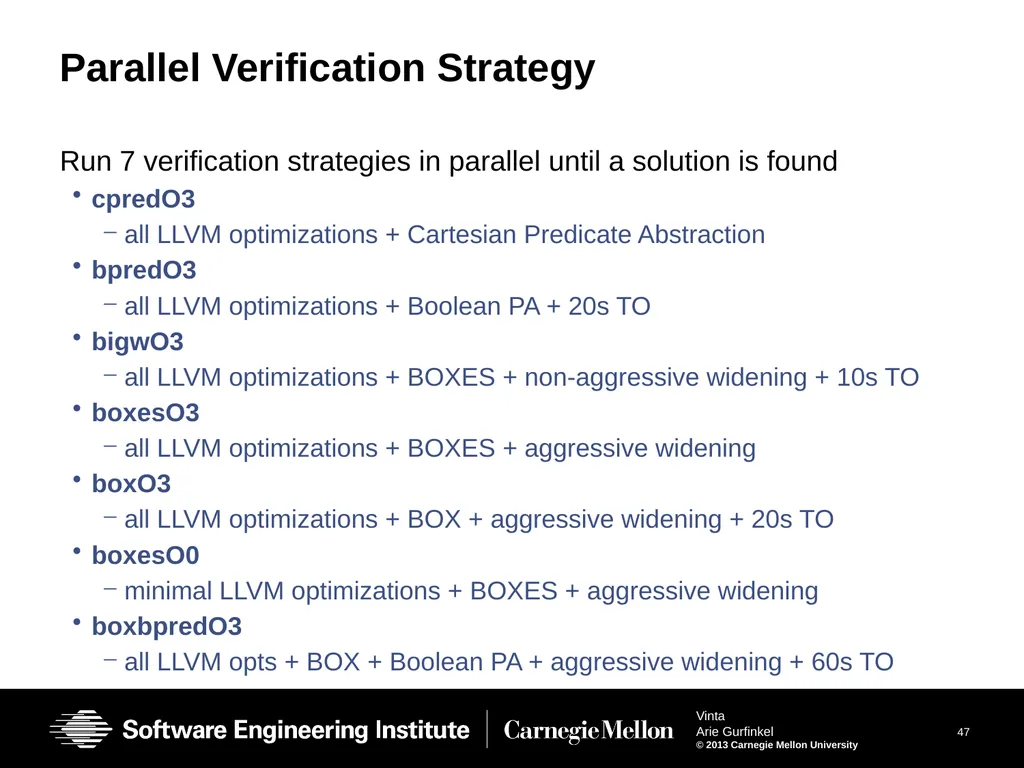
slide47. Parallel Verification Strategy Run 7 verification strategies in parallel until a solution is found
cpredO3
all LLVM optimizations + Cartesian Predicate Abstraction
bpredO3
all LLVM optimizations + Boolean PA + 20s TO
bigwO3
all LLVM optimizations + BOXES + non-aggressive widening + 10s TO
boxesO3
all LLVM optimizations + BOXES + aggressive widening
boxO3
all LLVM optimizations + BOX + aggressive widening + 20s TO
boxesO0
minimal LLVM optimizations + BOXES + aggressive widening
boxbpredO3
all LLVM opts + BOX + Boolean PA + aggressive widening + 60s TO<br>
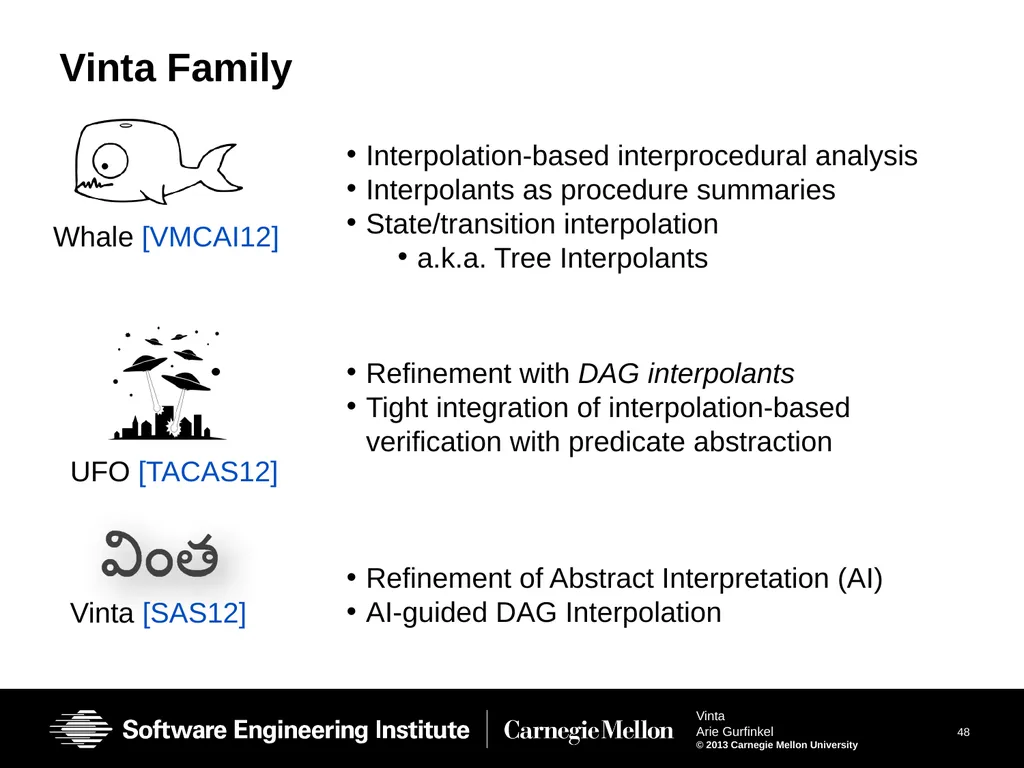
slide48. Vinta Family<br>
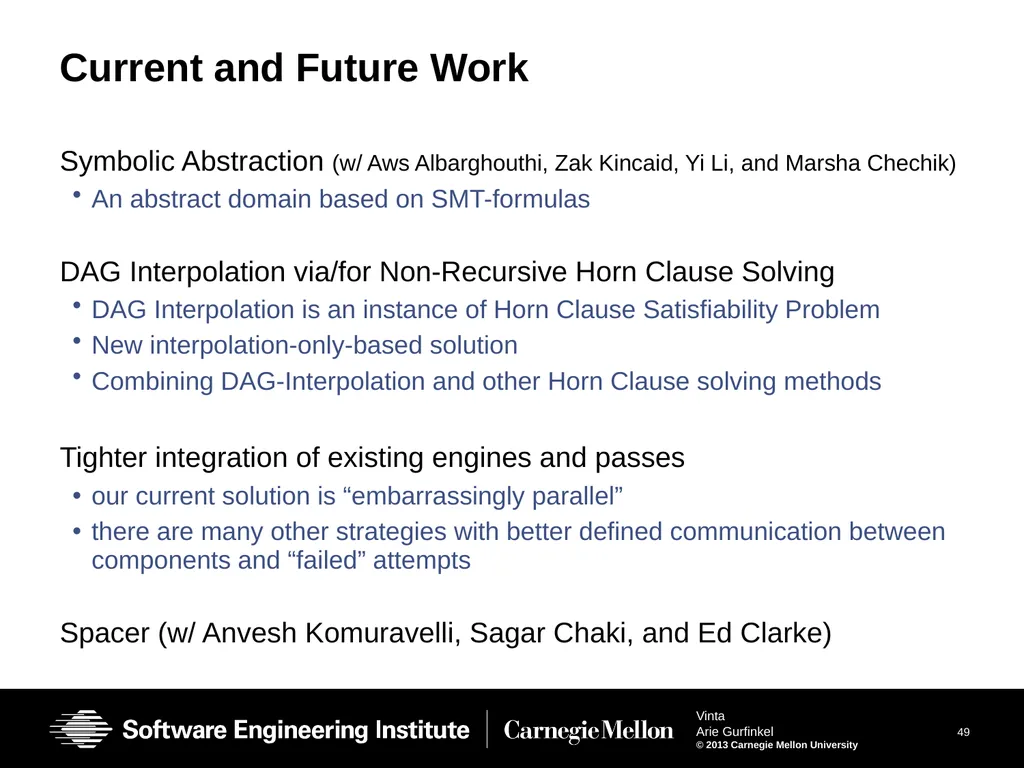
slide49. Current and Future Work Symbolic Abstraction (w/ Aws Albarghouthi, Zak Kincaid, Yi Li, and Marsha Chechik)
An abstract domain based on SMT-formulas
DAG Interpolation via/for Non-Recursive Horn Clause Solving
DAG Interpolation is an instance of Horn Clause Satisfiability Problem
New interpolation-only-based solution
Combining DAG-Interpolation and other Horn Clause solving methods
Tighter integration of existing engines and passes
our current solution is “embarrassingly parallel”
there are many other strategies with better defined communication between components and “failed” attempts
Spacer (w/ Anvesh Komuravelli, Sagar Chaki, and Ed Clarke)<br>
slide50. Contact Information<br>
slide51. THE END<br>
with Aws Albarghouthi and Marsha Chechik (U. of Toronto)
and Sagar Chaki (SEI/CMU), and Yi Li (U. of Toronto) TexPoint fonts used in EMF.
Read the TexPoint manual before you delete this box.: AAAA<br>
slide2. Copyright 2013 Carnegie Mellon University
This material is based upon work funded and supported by the Department of Defense under Contract No. FA8721-05-C-0003 with Carnegie Mellon University for the operation of the Software Engineering Institute, a federally funded research and development center.
Any opinions, findings and conclusions or recommendations expressed in this material are those of the author(s) and do not necessarily reflect the views of the United States Department of Defense.
NO WARRANTY. THIS CARNEGIE MELLON UNIVERSITY AND SOFTWARE ENGINEERING INSTITUTE MATERIAL IS FURNISHED ON AN AS-IS BASIS. CARNEGIE MELLON UNIVERSITY MAKES NO WARRANTIES OF ANY KIND, EITHER EXPRESSED OR IMPLIED, AS TO ANY MATTER INCLUDING, BUT NOT LIMITED TO, WARRANTY OF FITNESS FOR PURPOSE OR MERCHANTABILITY, EXCLUSIVITY, OR RESULTS OBTAINED FROM USE OF THE MATERIAL. CARNEGIE MELLON UNIVERSITY DOES NOT MAKE ANY WARRANTY OF ANY KIND WITH RESPECT TO FREEDOM FROM PATENT, TRADEMARK, OR COPYRIGHT INFRINGEMENT.
This material has been approved for public release and unlimited distribution. This material may be reproduced in its entirety, without modification, and freely distributed in written or electronic form without requesting formal permission. Permission is required for any other use. Requests for permission should be directed to the Software Engineering Institute at permission@sei.cmu.edu.
DM-0000450<br>
slide3. Software is Everywhere<br>
slide4. Software is Full of Bugs! “Software easily rates as the most poorly constructed, unreliable, and least maintainable technological artifacts invented by man”
Paul Strassman, former CIO of Xerox<br>
slide5. Software Engineering is very complex
Complicated algorithms
Many interconnected components
Legacy systems
Huge programming APIs
…
Software Engineers need better tools to deal with this complexity! Why so many bugs?<br>
slide6. What Software Engineers Need Are … Tools that give better confidence than testing while remaining easy to use
And at the same time, are
… fully automatic
… (reasonably) easy to use
… provide (measurable) guarantees
… come with guidelines and methodologies to apply effectively
… apply to real software systems<br>
slide7. Automated
Analysis Software Model Checking with Predicate Abstraction
e.g., Microsoft’s SDV Automated Software Analysis Program Correct Incorrect Abstract Interpretation with Numeric Abstraction
e.g., ASTREE, Polyspace<br>
slide8. Turing, 1936: “undecidable”<br>
slide9. 9 Turing, 1949<br>
slide10. Motivation Abstract Interpretation is one of the most scalable approaches for program verification
But, in practice, AI suffers from many false positives due to
imprecise operations: join, widen
imprecise semantics of operations: abstract post
in-expressivity of abstract domains: weakly relational facts, …
No CounterExamples and No Refinement Goal: Enhance Abstract Interpretation with Interpolation-based refinement strategy<br>
slide11. Outline (of the rest of the talk) Numeric Abstract Interpretation
Vinta illustrated
Abstract Interpretation with Unfoldings
Abstract-Interpretation guided DAG-Interpolation Refinement
Implementation
Results of Software Verification Competition
Secret Sauce
Conclusions and Future Directions<br>
slide12. From Programming to Modeling Extend C programming language with 3 modeling features
Assertions
assert(e) – aborts an execution when e is false, no-op otherwise
Non-determinism
nondet_int() – returns a non-deterministic integer value
Assumptions
assume(e) – “ignores” execution when e is false, no-op otherwise void assert (_Bool b) { if (!b) exit(); } int nondet_int () { int x; return x; } void assume (_Bool e) { while (!e) ; }<br>
slide13. An Example int x, y;
void main (void)
{
x = nondet_int ();
assume (x > 10 && x <= 100);
y = x + 1;
assert (y > x);
assert (y < 200);
}<br>
slide14. Numeric Abstract Interpretation Analysis is restricted to a fixed Abstract Domain
Abstract Domain ≡ “a (possibly infinite) set of predicates from a fixed theory” + efficient (abstract) operations Common Numeric Abstract Domains<br>
slide15. Abstract Interpretation w/ Box Domain (1) if (3 <= y1 <= 4) {
x1 := y1-2;
x2 := y1+2;
}
else if (3 <= y2 <= 4) {
x1 := y2-2;
x2 := y2+2;
}
else return;
assert (5 <= x1 + x2 <= 10); 3 <= y1 <= 4 3 <= y1 <= 4
1 <= x1 <= 2
5 <= x2 <= 6 3 <= y2 <= 4 3 <= y2 <= 4
1 <= x1 <= 2
5 <= x2 <= 6 1<=x1<=2
5<=x2<=6 Program 1 2 3 4 5 Steps:<br>
slide16. Abstract Interpretation w/ Box Domain (2) x := 0
while (x < 1000) {
x := x + 1;
}
assert (x == 1000); Program x = 0 x = 0 x = 1 0<= x <=1 0<= x <=1 1<= x <=2 0<= x <=2 0<= x <=2 1<= x <=3 0<= x <=1000 0<= x < 1000 1<= x <= 1000 x = 1000 widening 1 2 3 4 5 Steps: 6 7 8 9 10 11 12 13 14<br>
slide17. Abstract Domain as an Interface interface AbstractDomain(V) :
V – set of variables
A – abstract elements
E – expressions
S – statements
α : E → A γ : A → E meet : A A → A
isTop : A → bool isBot : A → bool join : A A → A
leq : A A → bool αPost : S → (A → A) widen : A A → A
All operations are over-approximations, e.g.,
γ (a) || γ (b) γ ( join (a, b) )
γ (a) && γ (b) γ (meet (a,b) ) abstract concretize abstract transformer order<br>
slide18. Example: Box Abstract Domain (1, 10) meet (2, 12) = (2,10) (1, 3) join (7, 12) = (1,12) (a, b) meet (c, d) = (max(a,c), min(b,d)) (a, b) join (c, d) = (min(a,c),max(b,d)) αPost (x := x + 1) ((a, b)) = (a+1, b+1) (1, 10) + 1 = (2, 11) Definition of Operations Examples over-approximation abstract concretize<br>
slide19. Abstract Interpretation w/ Box Domain (3) assume (i=1 || i=2)
if (i = 1)
x1 := i;
else if (i = 2)
x2 := -4;
if (i = 1)
assert (x1 > 0);
else if (i = 2)
assert (x2 < 0); 1 <= i <= 2 i=1 i=1 && x1=1 i=2 i=2 && x2=-4 1 <= i <= 2 i=1 i=2 Loss of precision due to join False
Positive Program 1 2 3 4 5 Steps: 6 7 8<br>
slide20. Vinta: Verification with INTERP and AI uses Cutpoint Graph (CPG)
maintains an unrolling of CPG
computes disjunctive invariants
uses novel powerset widening uses SMT to check for CEX
DAG Interpolation for Refinement
Guided by AI-computed Invs
Fills in “gaps” in AI Abstract
Interpretation Refinement Program SAFE
(+Invariant) UNSAFE
(+CEX) Interpolation Unsafe Invariant Strengthening<br>
slide21. Example: AI phase 1: x = 10;
2: while (*)
x = x - 2;
if (x == 9)
3: error(); 1 2 2’ 2’’ 3 Alarm! Exploration: WTO
Abstract Domain: Intervals
Side effect: Labelled CFG unrolling<br>
slide22. Verification Conditions 1 2 2’ 2’’ 3 Instruction encoding Control-flow encoding 1: x = 10;
2: while (*)
x = x - 2;
if (x == 9)
3: error();<br>
slide23. Craig Interpolation Theorem Theorem (Craig 1957)
Let A and B be two First Order (FO) formulae such that A ) :B, then there exists a FO formula I, denoted ITP(A, B), such that
A ) I I ) :B atoms(I) 2 atoms(A) Å atoms(B)
Theorem (McMillan 2003)
A Craig interpolant ITP(A, B) can be effectively constructed from a resolution proof of unsatisfiability of A Æ B
In Model Checking, Craig Interpolation Theorem is used to safely over-approximate the set of (finitely) reachable states<br>
slide24. Craig Interpolation in Model Checking Over-Approximating Reachable States
Let Ri be the ith step of a transition system
Let A = Init Æ R0 Æ … Æ Rn and B = Bad
ITP (A, B) (if exists) is an over-approx of states reachable in n-steps that does not contain any Bad states A B ITP(A,B)<br>
slide25. Interpolation Sequence Given a sequence of formulas A = {Ai}i=0n, an interpolation sequence ItpSeq(A) = {I1, …, In-1} is a sequence of formulas such that
Ik is an ITP (A0 Æ … Æ Ak-1, Ak Æ … Æ An), and
8 k<n . Ik Æ Ak+1) Ik+1 A0 A1 A2 A3 A4 A5 A6 I0 I1 I2 I3 I4 I5 If Ai is a transition relation of step i, then the interpolation sequence is a proof why a program trace is safe.<br>
slide26. Exponential Path Explosion paths!<br>
slide27. DAG Interpolants Given a DAG G = (V, E) and a labeling of edges ¼:EExpr. A DAG Interpolant (if it exists) is a labeling I:VExpr such that
for any path v0, …, vn, and 0 < k < n, I(vk) = ITP (¼(v0) Æ … Æ ¼ (vk-1), ¼(vk) Æ … Æ ¼(vn))
8 (u, v) 2 E . (I(u) Æ ¼ (u, v)) ) I(v) ¼1 ¼2 ¼3 ¼4 ¼5 ¼6 ¼7 ¼8 I1 I2 I3 I4 I5 I6 I7 I2 = ITP (¼1, ¼8)
I2 = ITP (¼1, ¼2 Æ ¼3 Æ ¼6 Æ ¼7)
…
(I1 Æ ¼1) ) I2
(I2 Æ ¼8) ) I7
(I2 Æ ¼2) ) I3
…<br>
slide28. DAG Interpolation Algorithm Reduce DAG Interpolation to Sequence Interpolation! DagItp ((V, E), ¼)
{
(A0, …, An) = Encode(V, E, ¼)
(I1, …, In-1) = SeqItp(A0, …, An)
for i in [1, n-1] do Ji = Clean(Ii)
return (J1, …, Jn-1)
} Encode input DAG by a set of constraints. One constraint per vertex. Compute interpolant sequence. One interpolant per vertex. Remove out-of-scope variables<br>
slide29. DagItp: Encode Encode ¼1 ¼2 ¼3 ¼4 ¼5 ¼6 ¼7 ¼8<br>
slide30. DagItp: Sequence Interpolate 4 5 7 6 I4<br>
slide31. In our running example… 31 1 2 2’ 2’’ 3 How to use the results of AI here?<br>
slide32. Restricted DAG Interpolants 1 2 2’ 2’’ 3<br>
slide33. Refinement: Strengthening 1 2 2’ 2’’ 2’’’ 2’’’ Program is safe! 3 3 1: x = 10;
2: while (*)
x = x - 2;
if (x == 9)
3: error();<br>
slide34. VINTA from 30,000 ft Abstract Interpretation Alarm! Refinement Refinement w/ DAG Interpolants<br>
slide35. VINTA from 30,000 ft Abstract Interpretation Refinement Refinement w/ DAG Interpolants Refinement recovers imprecision in:
Join, Widening
Abstract Transformer
Inexpressive Abstract Domain Strengthening<br>
slide36. Vinta is part of UFO 36 A framework and a tool for software verification
Tightly integrates interpolation- and abstraction-based techniques References:
[SAS12] Craig Interpretation
[CAV12] UFO: A Framework for Abstraction- and Interpolation-based Software Verification
[TACAS12] From Under-approximations to Over-approximations and Back
[VMCAI12] Whale: An Interpolation-based Algorithm for Interprocedural Verification Check it out at:
http://bitbucket.org/arieg/ufo<br>
slide37. Implementation in UFO Framework C to LLVM C Program
with assertions ARG Constructor Abstract Post Expansion Strategy Refinement Strategy Optimizer Cutpoint Graph SMT interface Mathsat Z3<br>
slide38. Software Verification Competition (SV-COMP 2013)<br>
slide39. SV-COMP 2013 2nd Software Verification Competition held at TACAS 2013
Goals
Provide a snapshot of the state-of-the-art in software verification to the community.
Increase the visibility and credits that tool developers receive.
Establish a set of benchmarks for software verification in the community.
Participants:
BLAST, CPAChecker-Explicit, CPAChecker-SeqCom, CSeq, ESBMC, LLBMC, Predator, Symbiotic, Threader, UFO, Ultimate
Benchmarks:
C programs with ERROR label (programs include pointers, structures, etc.)
Over 2,000 files, each 2K – 100K LOC
Linux Device Drivers, SystemC, “Old” BLAST, Product Lines
http://sv-comp.sosy-lab.org/2013/benchmarks.php http://sv-comp.sosy-lab.org/2013/<br>
slide40. SV-COMP 2013: Scoring Scheme Ties are broken by run-time<br>
slide41. UFO/VINTA Results UFO won gold in 4 categories
Control Flow Integers (perfect score)
Product Lines (perfect score)
Device Drivers
SystemC
Performed much better than mature Predicate Abstraction-based tools
VINTA with Box domain was most competitive for bug-discovery
VINTA with Boxes domain was most competitive for proving safety http://sv-comp.sosy-lab.org/2013/results/index.php<br>
slide42. Secret Sauce UFO Front-End
Vinta: combining UFO with Abstract Interpretation [SAS ‘2012]
Boxes Abstract Domain [SAS ‘2010 w/ Sagar Chaki]
DAG Interpolation [TACAS ‘2012 and SAS ‘2012]
Run many variants in parallel<br>
slide43. UFO Front End In principle simple, but in practice very messy
CIL passes to normalize the code (library functions, uninitialized vars, etc.)
llvm-gcc (without optimization) to compile C to LLVM bitcode
llvm opt with many standard, custom, and modified optimizations
lower pointers, structures, unions, arrays, etc. to registers
constant propagation + many local optimizations
difficult to preserve indented semantics of the benchmarks
based on very old LLVM 2.6 (newer version of LLVM are “too smart”)
Many benchmarks discharged by front-end alone
1,321 SAFE (out of 1,592) and 19 UNSAFE (out of 380)<br>
slide44. Boxes Abstract Domain: Semantic View Boxes are “finite union of box values”
(alternatively)
Boxes are “Boolean formulas over interval constraints”<br>
slide45. Linear Decision Diagrams in a Nutshell* x + 2y < 10 z < 10 1 0 Linear Decision Diagram decision
node true
terminal false
edge (x + 2y < 10) OR
(x + 2y 10 AND z < 10) Linear Arithmetic Formula Operations Propositional (AND, OR, NOT)
Existential Quantification false
terminal true
edge Compact Representation Sharing sub-expressions
Local numeric reductions
Dynamic node reordering *joint work w/ Ofer Strichman<br>
slide46. Boxes: Representation Represented by (Interval) Linear Decision Diagrams (LDD)
BDDs + non-terminal nodes are labeled by interval constraints + extra rules
retain complexity of BDD operations
canonical representation for Boxes Abstract Domain
available at http://lindd.sf.net LDD Semantics 1 2 1 3 (x ≤ 1 || x ≥ 2)
&&
1 ≤ y ≤ 3 Syntax<br>
slide47. Parallel Verification Strategy Run 7 verification strategies in parallel until a solution is found
cpredO3
all LLVM optimizations + Cartesian Predicate Abstraction
bpredO3
all LLVM optimizations + Boolean PA + 20s TO
bigwO3
all LLVM optimizations + BOXES + non-aggressive widening + 10s TO
boxesO3
all LLVM optimizations + BOXES + aggressive widening
boxO3
all LLVM optimizations + BOX + aggressive widening + 20s TO
boxesO0
minimal LLVM optimizations + BOXES + aggressive widening
boxbpredO3
all LLVM opts + BOX + Boolean PA + aggressive widening + 60s TO<br>
slide48. Vinta Family<br>
slide49. Current and Future Work Symbolic Abstraction (w/ Aws Albarghouthi, Zak Kincaid, Yi Li, and Marsha Chechik)
An abstract domain based on SMT-formulas
DAG Interpolation via/for Non-Recursive Horn Clause Solving
DAG Interpolation is an instance of Horn Clause Satisfiability Problem
New interpolation-only-based solution
Combining DAG-Interpolation and other Horn Clause solving methods
Tighter integration of existing engines and passes
our current solution is “embarrassingly parallel”
there are many other strategies with better defined communication between components and “failed” attempts
Spacer (w/ Anvesh Komuravelli, Sagar Chaki, and Ed Clarke)<br>
slide50. Contact Information<br>
slide51. THE END<br>