
Virginia Legislative Update 2019 for Law













Description: Virginia Legislative Update 2019 for Law Enforcement Agencies Materials This PowerPoint attempts to identify the legislation from the 2019 General Assembly session that has the greatest impact on law enforcement and public safety. Consult
Related Topics
Download Presentation
"Virginia Legislative Update 2019 for Law" is the property of its rightful owner. Permission is granted to download and print the materials on this website for personal, non-commercial use only, and to display it on your personal computer provided you do not modify the materials and that you retain all copyright notices contained in the materials. By downloading content from our website, you accept the terms of this agreement.
Presentation Transcript
slide1. Virginia
Legislative Update
2019 for Law Enforcement Agencies<br>
slide2. Materials This PowerPoint attempts to identify the legislation from the 2019 General Assembly session that has the greatest impact on law enforcement and public safety.
Consult the 2019 Legislative Update Master List for full listing of bills of interest.<br>
slide3. Materials You must rely only upon the language of the bill after final passage.
You can find the final version of the bill on the LIS website at: http://lis.virginia.gov/lis.htm.<br>
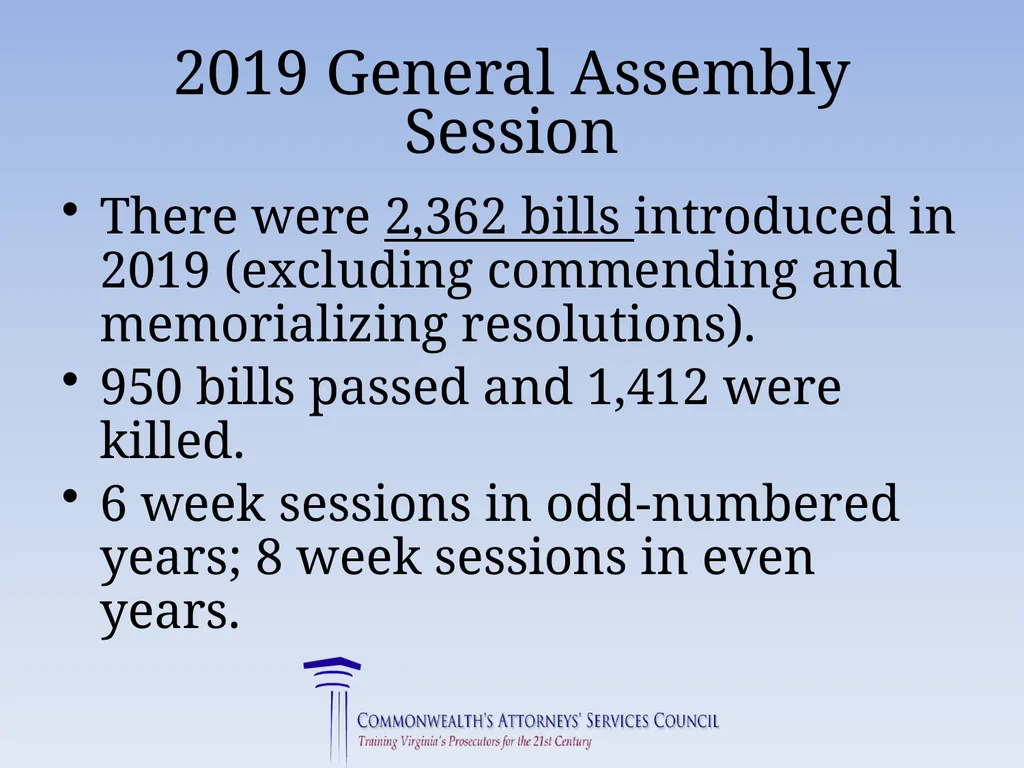
slide4. 2019 General Assembly Session There were 2,362 bills introduced in 2019 (excluding commending and memorializing resolutions).
950 bills passed and 1,412 were killed.
6 week sessions in odd-numbered years; 8 week sessions in even years.<br>
slide5. Animals & Hunting<br>
slide6. Penalty for Wanton Waste HB 1613 (Edmunds)
Changes the penalty from a Class 3 misdemeanor to a Class 2 misdemeanor for a killed or crippled game animal or non-migratory game bird to be wasted without making a reasonable effort to retrieve the animal.
Virginia Code §29.1-553.1<br>
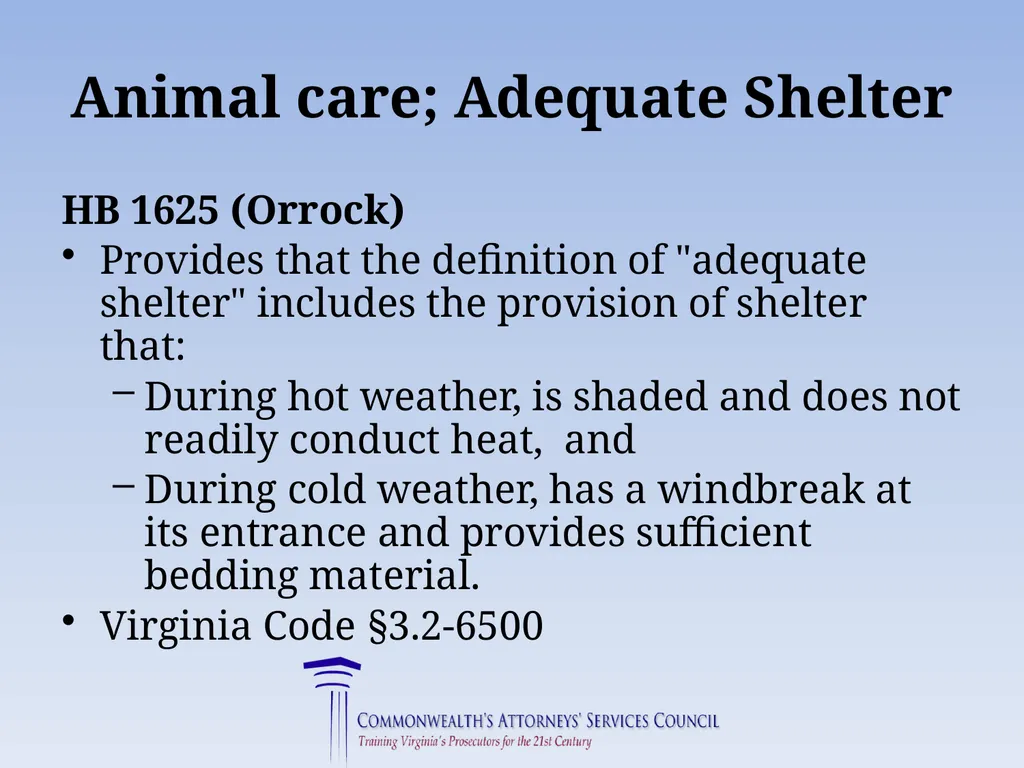
slide7. Animal care; Adequate Shelter HB 1625 (Orrock)
Provides that the definition of "adequate shelter" includes the provision of shelter that:
During hot weather, is shaded and does not readily conduct heat, and
During cold weather, has a windbreak at its entrance and provides sufficient bedding material.
Virginia Code §3.2-6500<br>
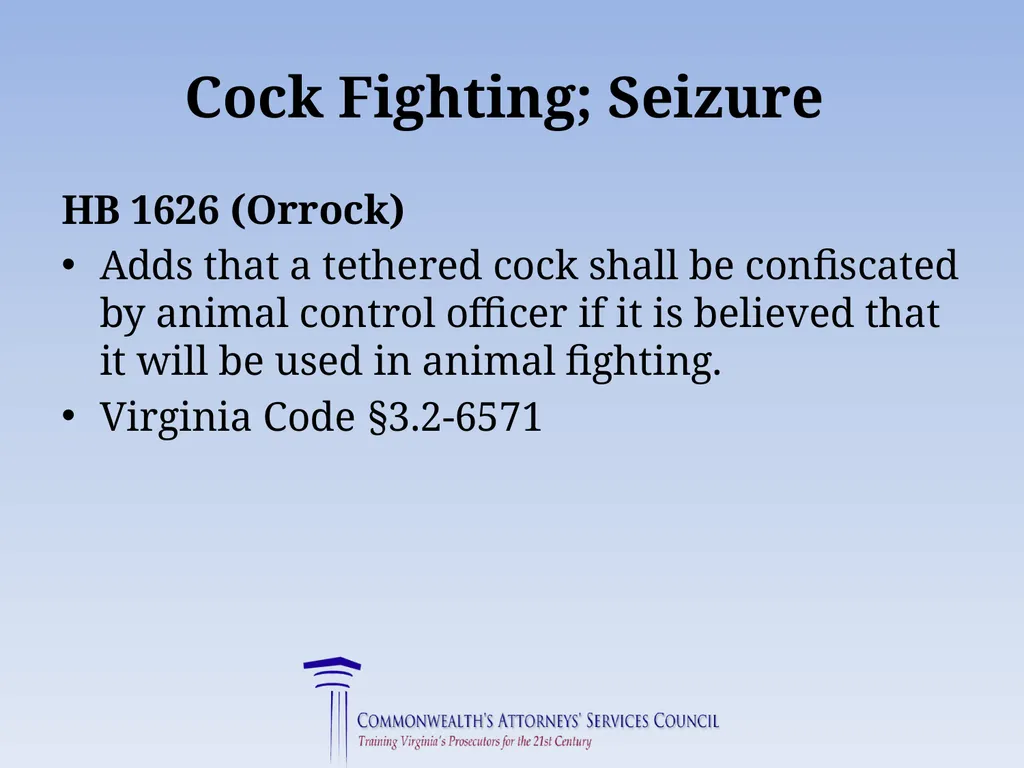
slide8. Cock Fighting; Seizure HB 1626 (Orrock)
Adds that a tethered cock shall be confiscated by animal control officer if it is believed that it will be used in animal fighting.
Virginia Code §3.2-6571<br>
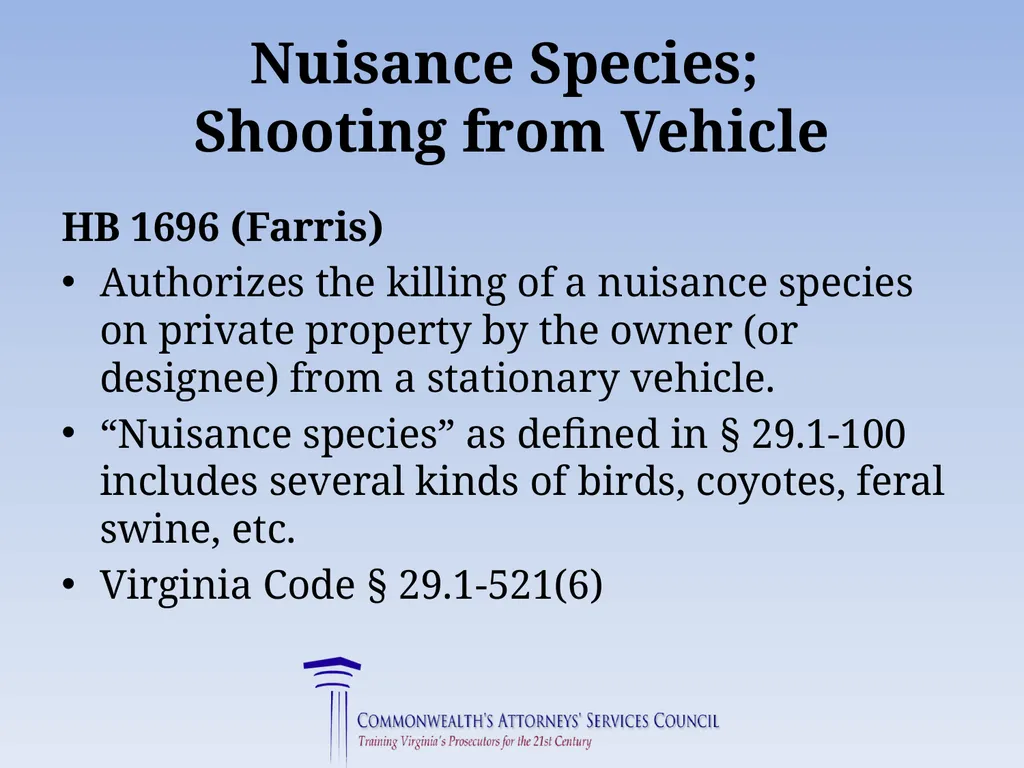
slide9. Nuisance Species; Shooting from Vehicle HB 1696 (Farris)
Authorizes the killing of a nuisance species on private property by the owner (or designee) from a stationary vehicle.
“Nuisance species” as defined in § 29.1-100 includes several kinds of birds, coyotes, feral swine, etc.
Virginia Code § 29.1-521(6)<br>
slide10. Animal Abuse; Felony for Serious Injury HB 1874 (Ransone)/SB 1604 (DeSteph)
Expands the Class 6 felony for abuse of a companion animal to include when the animal is seriously injured but does not die.
§3.2-6570 (F) creates a Class 6 felony for when a dog or cat dies as a result of abuse. This bill adds that when “serious physical injury” results, it is also a Class 6 felony.
Filed in response to a case in which a dog owner tied his dog to a pole, threw gasoline on the dog and lit the dog on fire. The fire was put out by a bystander. The dog initially survived but had serious injury.
Virginia Code §3.2-6570<br>
slide11. Dangerous Dog; Deferred Finding HB 2745 (Hope)
Authorizes a court to defer proceedings in the adjudication of an animal as a dangerous dog.
Requires the court to place conditions upon the owner of the animal, the violation of which shall authorize the court to proceed as it otherwise would have.
Upon the fulfillment of the conditions, the court shall dismiss the proceedings against the animal and the owner.
Virginia Code §3.2-6540<br>
slide12. Animal Tethering; Adequate Space SB 1025 (Spruill)
Provides that a tether must:
Be at least three times the length of the animal or 10 feet in length, whichever is greater,
Not cause injury or pain,
Not weigh more than one-tenth of the animal's body weight, or
Have weights or heavy objects attached to it.
Bill exempts agricultural animals.
Virginia Code §3.2-6500<br>
slide13. Correctional Facilities<br>
slide14. Inmate Workforces HB 1935 (Collins)
Clarifies eligibility for voluntary participation in an inmate workforce with the approval of, and under the supervision of, the sheriff or his designee.
Changes “non-violent criminal offense” to “an offense not listed in § 19.2-297.1” (3 strikes law)
Virginia Code §53.1-128.<br>
slide15. Restraint of Pregnant Offenders SB 1772 (Saslaw)
Requires the Board of Corrections to review standards for allowable restraint practices for pregnant inmates to ensure:
Humane treatment that accounts for specific health needs, and
Provides adequate safety protection for others.
Virginia Code Chapter 725<br>
slide16. Exchange of Records; Local Probation Officers HB 2213 (Heretick)
Adds local probation officers to list of persons among whom medical & mental health information and records of anyone committed to jail, and transferred to another correctional facility, may be exchanged.
Virginia Code § 53.1-133.03<br>
slide17. Crimes & Offenses
Miscellaneous<br>
slide18. Hoax Crimes; Reports to Police HB 2056 (Yancey)/SB 1031 (Chase)
Creates a Class 1 misdemeanor to publicly fake a crime with the intent to induce a person to call in a report to police thinking that a real crime was occurring.
The current law for false report does not apply because the offender did not make the false report. Instead, the person caused the false report to be made by tricking a Good Samaritan.
Virginia Code §18.2-461<br>
slide19. False Caller ID; Spoofing HB 2170 (Brewer)
Creates a Class 3 misdemeanor for a 1st offense, and a Class 2 misdemeanor for a 2nd or subsequent offense, when:
A person causes a phone to ring and display false caller ID
With the intent to defraud, intimidate or harass.
Intent element designed to avoid criminalizing prank calls and to comply with federal case law and the Federal Truth in Calling Act.
Does not apply to law enforcement engaged in official duties.
Virginia Code §18.2-429.1<br>
slide20. Failure to Appear; Contempt of Court HB 2452 (Adams)
Adds failure to appear as behavior punished as contempt under §18.2-456.
Requires the Court to specify which subsection in §18.2-456 the person has been punished under.
Specifies that failure to appear shall not be punished as contempt under §16.1-69.24.
The purpose of this bill is to create better record keeping to track when a defendant failed to appear.
Recommendation of Crime Commission.
Virginia Code §§16.1-69.24, 18.2-456<br>
slide21. Timber Sales; Theft HB 2411 (Adams) / SB 1469 (Chafin)
Creates Class 1 misdemeanor for persons who buy or remove timber and fail to pay the landowner by agreed date or, if no agreed date, within 60 days.
Those convicted must pay 3 times the value of the timber.
It can be a Class 3 misdemeanor for a timber buyer to fail to provide an accounting of each load removed from the property.
Additional provisions. See Virginia Code §55-334.2 & 55-334.3<br>
slide22. Revenge Porn; Photo-shopped Image HB 2678 (Del. Simon)/SB 1736 (Ebbin)
Adds sending a photo-shopped pornographic picture or video of someone to revenge porn law.
The current law prohibits maliciously disseminating a pornographic picture of someone with the intent to coerce, harass, or intimidate that person.
Requires that the actual person be recognizable in the image, whether by face, likeness or other distinguishing characteristic.
Virginia Code § 18.2-386.2<br>
slide23. Threats to Healthcare Worker SB 1395 (Howell)
Class 1 misdemeanor to orally threaten to kill or injure health care worker engaged in their duties.
Exception for patients who are at medical facility under an ECO, involuntary TDO, or involuntary hospitalization order.
Virginia Code § 18.2-60<br>
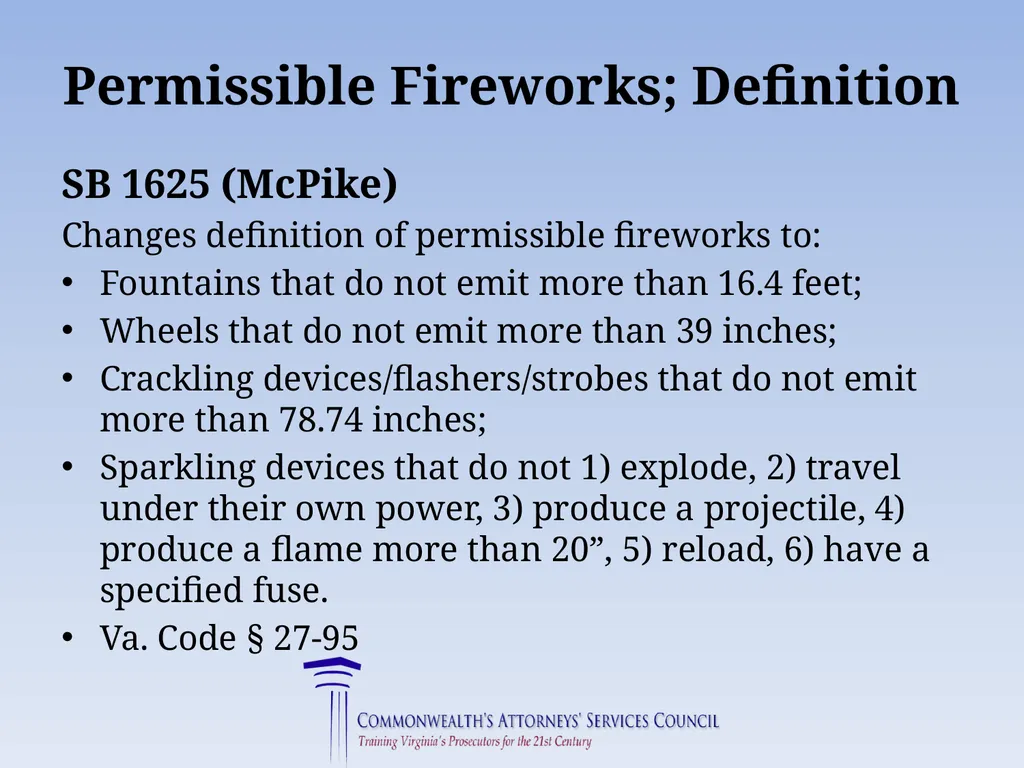
slide24. Permissible Fireworks; Definition SB 1625 (McPike)
Changes definition of permissible fireworks to:
Fountains that do not emit more than 16.4 feet;
Wheels that do not emit more than 39 inches;
Crackling devices/flashers/strobes that do not emit more than 78.74 inches;
Sparkling devices that do not 1) explode, 2) travel under their own power, 3) produce a projectile, 4) produce a flame more than 20”, 5) reload, 6) have a specified fuse.
Va. Code § 27-95<br>
slide25. Illegal Gambling; Definition SB 1738 (Reeves)
Modifies definition of gambling to make it easier to prosecute those participating in “sham sweepstakes”.
“Sham sweepstakes” are when a business allows a customer to purchase something of value and, in exchange, the customer has a right to use the establishment’s gaming machines.
Examples: Selling “vaping session” in exchange for using gambling machine; selling phone cards in exchange for use of gaming machine.
Old definition did not address current technology or gaming machine practices.
Virginia Code §18.2-325(1)<br>
slide26. Criminal Procedure<br>
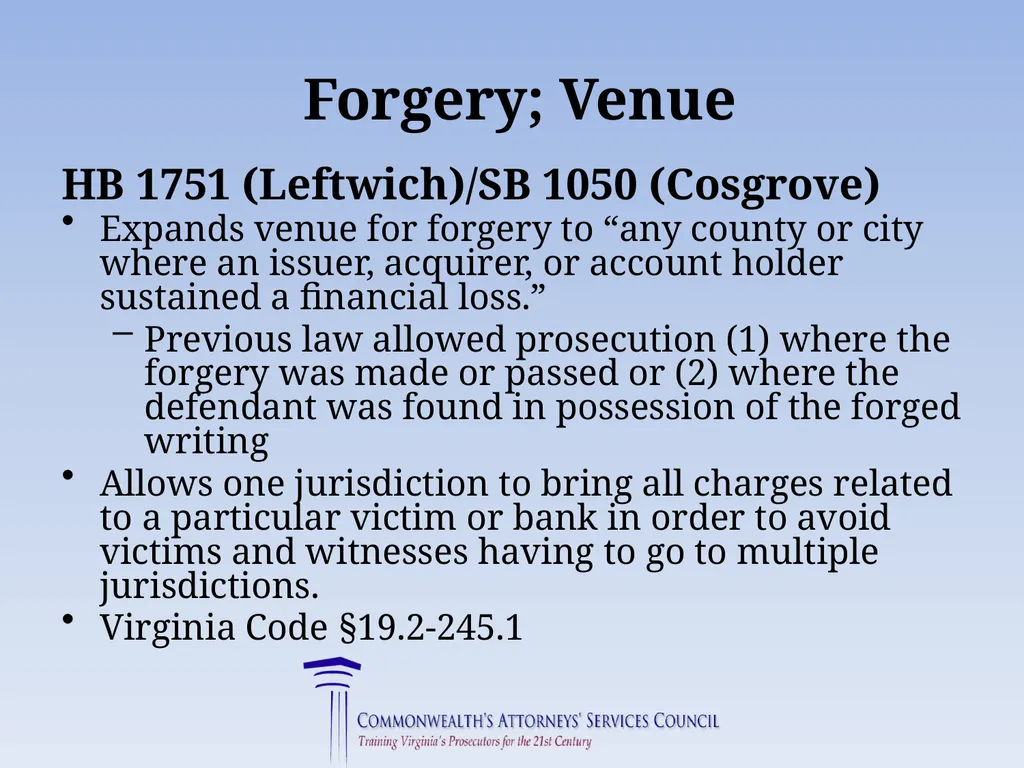
slide27. Forgery; Venue HB 1751 (Leftwich)/SB 1050 (Cosgrove)
Expands venue for forgery to “any county or city where an issuer, acquirer, or account holder sustained a financial loss.”
Previous law allowed prosecution (1) where the forgery was made or passed or (2) where the defendant was found in possession of the forged writing
Allows one jurisdiction to bring all charges related to a particular victim or bank in order to avoid victims and witnesses having to go to multiple jurisdictions.
Virginia Code §19.2-245.1<br>
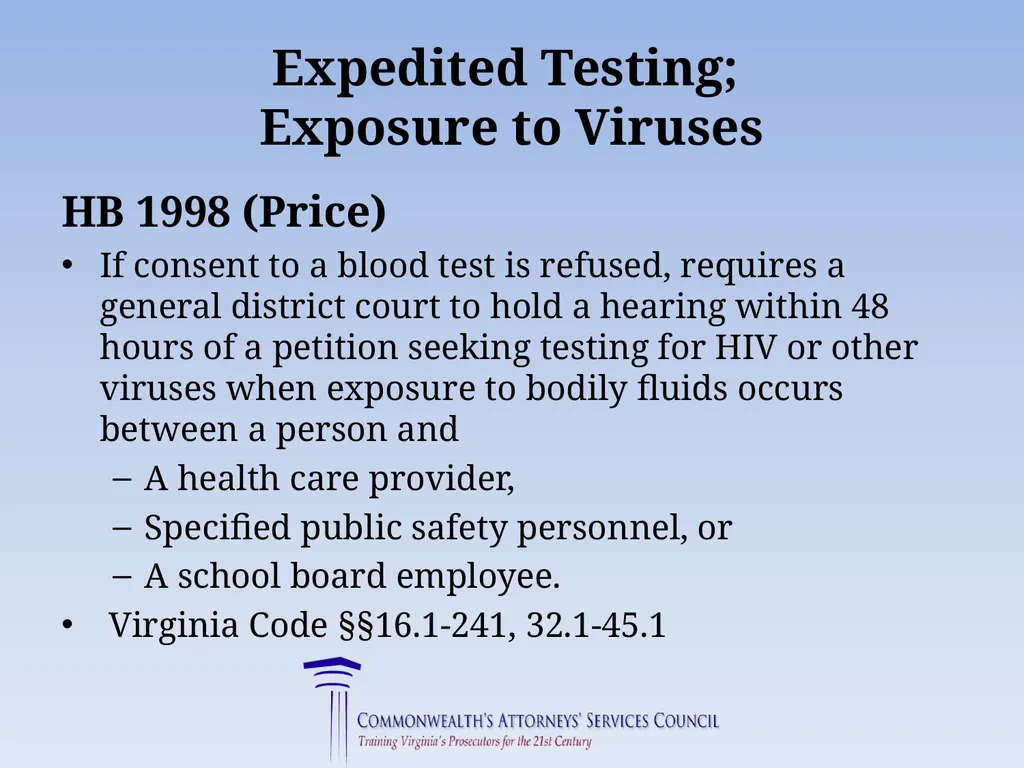
slide28. Expedited Testing; Exposure to Viruses HB 1998 (Price)
If consent to a blood test is refused, requires a general district court to hold a hearing within 48 hours of a petition seeking testing for HIV or other viruses when exposure to bodily fluids occurs between a person and
A health care provider,
Specified public safety personnel, or
A school board employee.
Virginia Code §§16.1-241, 32.1-45.1<br>
slide29. Bail; Court’s Authority to Hear HB 2320 (VanValkenburg)
Addresses mechanics and weight of decisions of bail rulings on appeal:
Higher court that makes decision on appeal shall remand the case to the court where the case is pending for enforcement & modification.
The lower court is prohibited from changing the higher court’s decision unless there is a subsequent change in circumstances.
Virginia Code §§19.2-124, 19.2-130, 19.2-132<br>
slide30. Fingerprint Bill HB 2343 (Bell)/SB 1602 (Obenshain)
Addresses incomplete criminal records in CCRE
More than 675,000 offenses, including 318 murder and 1,308 rape convictions, have not been entered into Virginia’s main criminal record database, mainly because of missing fingerprints.
Firearms background checks, employment, sentencing decisions, etc., rely on the accuracy of criminal records.
Primary responsibility on the courts, judges and probation to confirm that defendants have been fingerprinted and their criminal records updated.
Involves multiple Virginia Code sections.
See 2019 CASC Legislative Update for Law Enforcement ~ Supplement on Omnibus Fingerprinting Bill<br>
slide31. Multi-Jurisdiction Grand Jury HB 2413 (Adams)
Requires secrecy from those permitted to take notes or make copies of evidence from Multi-Jurisdictional Grand Jury proceedings.
Requires CA to provide notice to defendant when MJGJ was used to obtain evidence for prosecution.
Virginia Code §19.2-215.9<br>
slide32. Collection of DNA upon Conviction HB 2439 (Campbell)/SB 1166 (Chafin)
Clean up language:
Provides that the law requiring the taking of DNA samples after conviction apply to convictions under locality’s ordinances as well as equivalent state laws.
Virginia Code §19.2-310.2<br>
slide33. Bail; Magistrate’s Checklist HB 2453 (Adams)
Requires magistrates to forward to the court the completed checklist used to consider factors for bail.
This is a standard form provided by the Office of the Executive Secretary at the Supreme Court.
Some magistrates were forwarding it to the Court but it was not required.
Jurisdictions who receive these checklists find that they contain valuable information.
Virginia Code §§19.2-121 & 19.2-149<br>
slide34. Credit Card Offenses; Venue HB 2484 (Hodges)
Expands venue for credit card offenses to where the cardholder resides.
Current law allows prosecution where (i) any act in furtherance occurred or (ii) where a financial loss was sustained.
Allows one jurisdiction to bring all charges related to a particular victim and avoids the victim from having to go to multiple jurisdictions when his credit card was used in several jurisdictions.
Virginia Code §18.2-198.1<br>
slide35. CCRE; Background Checks through Live Scan HB 2746 (Head)
Requires VSP to accept background check requests through the use of a Live Scan device from any authorized Virginia agency that:
serves children or the elderly and is authorized to receive criminal histories, or
uses fingerprint background checks as a condition of employment or service.
VSP may deny request under certain circumstances.
Virginia Code 19.2-388.1<br>
slide36. Adding Offenses to CCRE SB 1529 (Chafin)
Adds criminal offenses to the list of offenses that are to be reported to CCRE:
§3.2-6570: Cruelty to Animals
§46.2-339: Sex Offender Driving School Bus
§46.2-341.21: Drive CMV after disqualified
§46.2-341.24: Drive CMV while drunk
§46.2-341.26:3: CDL holder refusal
§46.2-817: Elude law enforcement
Virginia Code §19.2-390<br>
slide37. Spoliation of Evidence SB 1619 (Obenshain)
Establishes a duty to preserve evidence that may be relevant to reasonably foreseeable civil litigation.
If evidence is lost, or otherwise disposed of, the court may order measures necessary to cure prejudice, or if done recklessly or intentionally, the court may 1) presume evidence unfavorable and so instruct the jury, 2) dismiss the action or 3) enter a default judgment.
This could apply to potential civil lawsuits. For example, in a use of force/unlawful arrest law suit, deleting a body camera video could have serious ramifications.
Virginia Code § 8.01-379.2:1 (a civil Code section)<br>
slide38. Domestic Violence/ Family Abuse<br>
slide39. PPO’s; Full Hearings; Court Closures HB 1673 (Mullin)
Allows full hearings on preliminary protective orders to be heard on the next business day if a lawful court closure prevented it from occurring within the required 15 days.
Arises out of a situation in Hampton Roads during a hurricane shutdown in which preliminary protective orders expired because they were not heard within 15 days.
Virginia Code §§16.1-253.1, 19.2-152.9.<br>
slide40. Protective Orders; Contents of PPO’s; Appeals SB 1540 (Surovell)
Provides that if a PPO is issued in an ex parte hearing where the petition for the order is supported by sworn testimony (not an affidavit completed by a law-enforcement officer), the court issuing the order shall state in the order the basis on which the order was entered, including a summary of the allegations made and the court's findings.
Requires that an appeal of a permanent protective order be docketed within 2 business days.
Virginia Code §§16.2-112, 16.2-253.1, 16.2-296, 19.2-152.9<br>
slide41. Drones<br>
slide42. Drones; Trespass; Prohibited Take Off and Landing HB 1636 (Knight)
Adds a Class 1 misdemeanor to the drone trespass statute:
To knowingly & intentionally take off or land a drone in violation of FAA or UAS Security Sensitive Airspace restrictions.
Addresses take off and landing but not flying the drone because Virginia doesn’t have jurisdiction over airspace.
This behavior already is a felony in violation of federal law but the Feds do not enforce it. Needed a local solution.
Virginia Code §18.2-121.3<br>
slide43. Drones; Persons Sought for Arrest; Hot Pursuit SB 1507 (Carrico)
Adds exceptions to the requirement that a search warrant be issued before law enforcement may use a drone:
When needed to formulate a plan to execute an arrest at the primary residence of someone for whom an arrest warrant or capias has been issued;
To find a person who has fled from a law-enforcement and the officer remains in hot pursuit of such person.
Virginia Code §19.2-60.1(C)<br>
slide44. Drones; Search Warrant Exceptions Already existing exceptions to drone search warrant requirement – Virginia Code § 19.2-60.1(C):
(i) during Amber Alert;
(ii) during Senior Alert;
(iii) during Blue Alert;
(iv) where use of a drone is “determined to be necessary to alleviate an immediate danger to any person”;
(v) to collect evidence for certain motor vehicle accidents;
(vi) by DOT when helping law-enforcement to prepare MV accident reports;
(vii) for training exercises related to such uses; or
(viii) by consent of person with authority.<br>
slide45. Drugs<br>
slide46. Schools; Permission to Possess CBD & ThC-A Oils HB 1720 (Jones)/SB 1632 (Sturtevant)
Exempts school nurses from prosecution under §§18.2-248, 18.2-248.1, 18.2-250, 18.2-250.1 or 18.2-255 for possession or distribution of CBD or ThC-A oils when:
Student has a valid certification, and
Nurse is in compliance with school board policy.
Provides that schools are not required to suspend or expel students with valid certification for CBD and ThC-A oils for possessing or using the oils so long as the student has a health plan requiring the use of the oils and is complying with school board policy.
Virginia Code §§18.2-251.1:1 & 22.1-277<br>
slide47. Controlled Substances; Schedule I & II HB 1803 (Garrett)
Adds long list of unpronounceable chemicals to Schedule I and Schedule II of the Controlled Substances Act, including various Fentanyl-like compounds and “designer” drugs.
Virginia Code §§54.1-3446 & 54.1-3448<br>
slide48. Industrial Hemp; Farm Bill HB 1839 (Marshall)/SB 1692 (Ruff)
Conforms Virginia law to the federal 2018 Farm Bill by amending the definitions of cannabidiol oil, marijuana, and THC to exclude:
industrial hemp in the possession of a registered person,
hemp products or
an oil containing no more than 0.3% THC.
This bill is lengthy, complicated and involves multiple Code changes. Seek guidance from DFS and your Commonwealth’s Attorney.
Became effective on March 21, 2019.<br>
slide49. Naloxone; Regional Jail Employees HB 1878 (Garrett)
Adds employees of regionals jails to list of people who may possess and administer naloxone, provided that they have completed a training program.
Virginia Code §54.1-3408(X)<br>
slide50. Huffing; Noxious Chemicals, Add Ingredients HB 2138 (Thomas)
Adds “fluorinated hydrocarbons” and “hydrogenated fluorocarbons” to the list of ingredients that can be considered noxious chemicals.
Fredericksburg case: Defendant was charged with huffing but was found not guilty because the intoxicating ingredient (fluorinated hydrocarbons) was not on the list of prohibited noxious chemicals. He later was captured on video with 20 cans around him saying that he could not be arrested for huffing this substance because he had already been acquitted. He died later that day.
Virginia Code § 18.2-264 (C)<br>
slide51. Dispensing Naloxone HB 2158 (Plum)
Expands list of health care providers who can dispense naloxone.
Establishes requirements for dispensing naloxone in an injectable form with needle or syringe.
Allows for recovery of actual cost of dispensing naloxone.
Virginia Code §54.1-3408 (X)(Y)<br>
slide52. Drug Control Act; Schedule V; Gabapentin HB 2557 (Pillion)
Classifies gabapentin as a Schedule V controlled substance.
Virginia Code § 54.1-3454 (3)<br>
slide53. Drug Paraphernalia; Fentanyl Testing Products HB 2563 (Robinson)
Clarifies that fentanyl testing products are not drug paraphernalia or controlled paraphernalia.
Virginia Code §§ 18.2-265.1 (4), 54.1-3466 (A)<br>
slide54. Cigarettes, E-Cigs & Vapes– Increase Age to 21 HB 2748 (Stolle)/SB 1727 (Norment)
Raises the age to buy or possess tobacco, nicotine vapor and alternative nicotine products from 18 to 21.
Provides an exception for active duty military 18 or older.
Adds “nicotine vapor products, and alternative nicotine products” to the restricted vending machine rules.
Virginia Code §§18.2-246.8, 18.2-246.10,18.2-371.2<br>
slide55. Pharmacy Board; Seizure of Controlled Substances SB 1289 (Edwards)
Establishes a process by which the Board of Pharmacy or law enforcement can seize and place under seal controlled substances and prescription devices when registration/license/permit authorizing possession is suspended or revoked.
Provides procedures for transfer and disposal of such items if subject to forfeiture.
Reduces from 6 months to 60 days the time required before disposing of unclaimed seized items.
Virginia Code §§ 54.1-2408.1, 54.1-3424, 54.1-3434.<br>
slide56. Safe Reporting of Overdoses; No Cooperation Requirement SB 1349 (McDougle)
Eliminates the “substantial cooperation with law enforcement” requirement in the safe reporting statute.
This bill passed as part of a compromise to pass a felony homicide bill for drug overdose deaths; however, the felony homicide part of the deal was vetoed by the Governor.
Also known as “Dillon’s Law”.
Virginia Code §18.2-251.03<br>
slide57. Board of Pharmacy; CBD & THC-A Oil SB 1557 (Dunnavant)
Authorizes licensed physician’s assistants and nurse practitioners to issue written certifications for the use of CBD and ThC-A oils.
Board of Pharmacy to establish dose limitations.
Virginia Code §§54.1-3408.3, 54.1-3442.6<br>
slide58. CBD & THC-A Oils; Registered Agents & Processors SB 1719 (Marsden)
Authorizes a patient or their guardian to designate an agent to receive CBD or ThC-A oil pursuant to a written certification.
Agents must register with Board of Pharmacy.
Board of Pharmacy can set limit on the number of patients for whom agents can act.
Creates an affirmative defense to possession for registered agents.
§§18.2-250.1, 54.1-3408.3, 54.1-3442.5, 54.1-3442.6, 54.1-3442.7<br>
slide59. DUI<br>
slide60. DUI Maiming HB 1941 (Bell)
Creates a Class 6 felony for DUI resulting in serious bodily injury.
Creates a Class 4 felony if the serious bodily injury results in permanent and significant physical impairment.
Also applies to intoxicated boating.
Virginia Code §§ 18.2-51.4, 18.2-51.5<br>
slide61. Elder Abuse<br>
slide62. Elder Abuse; Informed Consent HB 1674 (Mullin)
The statute states that the caretaker is not responsible for the elder’s condition if their actions were in accordance with the decisions “of the incapacitated person”.
Clarifies that, in order for this exemption to elder abuse to apply, the informed consent by the incapacitated adult must have been given at a time when the adult was not incapacitated.
Virginia Code §18.2-369<br>
slide63. Elder Abuse; Banks May Refuse Transaction HB 1987 (Toscano)/SB 1490 (Obenshain)
Authorizes financial institutions to refuse a transaction when they believe the transaction involves financial exploitation of an aged or incapacitated adult.
Authorizes staff to report information and records related to an investigation.
Financial institutions are immune from liability absent gross negligence or willful misconduct.
Virginia Code §63.2-1606<br>
slide64. Elder Abuse; Banks May Report HB 2225 (O’Quinn)
Any financial institution staff who suspects that an adult has been financially exploited may report and provide supporting information and records to the local department of social services or the adult protective services hotline.
Virginia Code §63.2-1606 (C)<br>
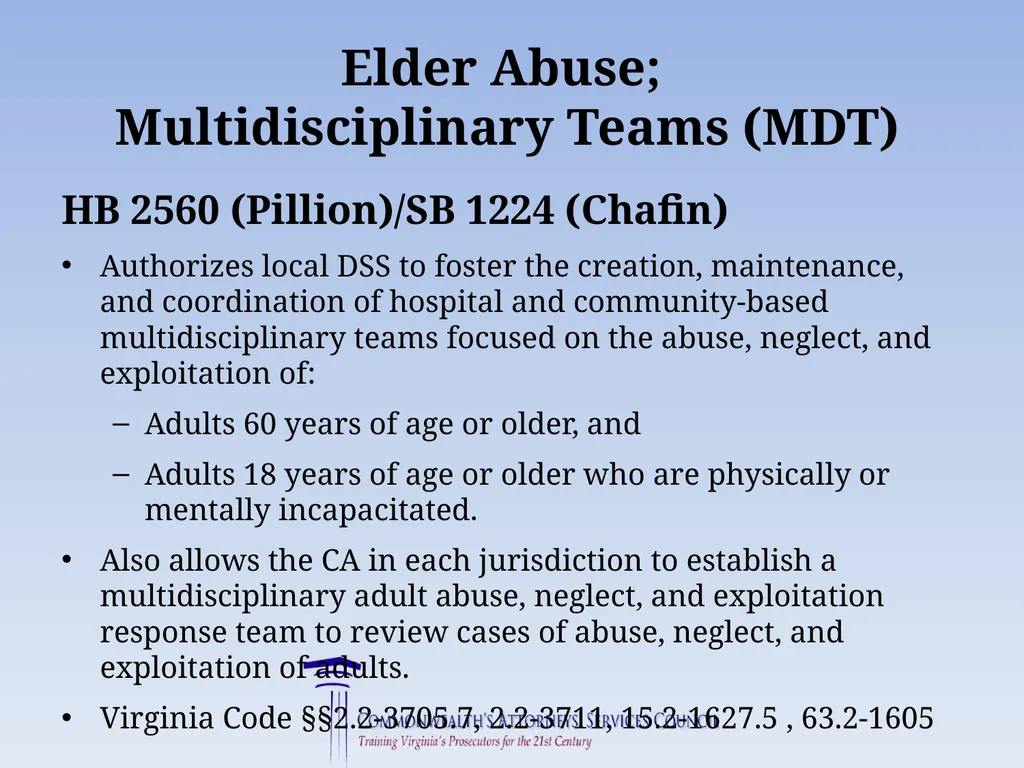
slide65. Elder Abuse; Multidisciplinary Teams (MDT) HB 2560 (Pillion)/SB 1224 (Chafin)
Authorizes local DSS to foster the creation, maintenance, and coordination of hospital and community-based multidisciplinary teams focused on the abuse, neglect, and exploitation of:
Adults 60 years of age or older, and
Adults 18 years of age or older who are physically or mentally incapacitated.
Also allows the CA in each jurisdiction to establish a multidisciplinary adult abuse, neglect, and exploitation response team to review cases of abuse, neglect, and exploitation of adults.
Virginia Code §§2.2-3705.7, 2.2-3711, 15.2-1627.5 , 63.2-1605<br>
slide66. Firearms<br>
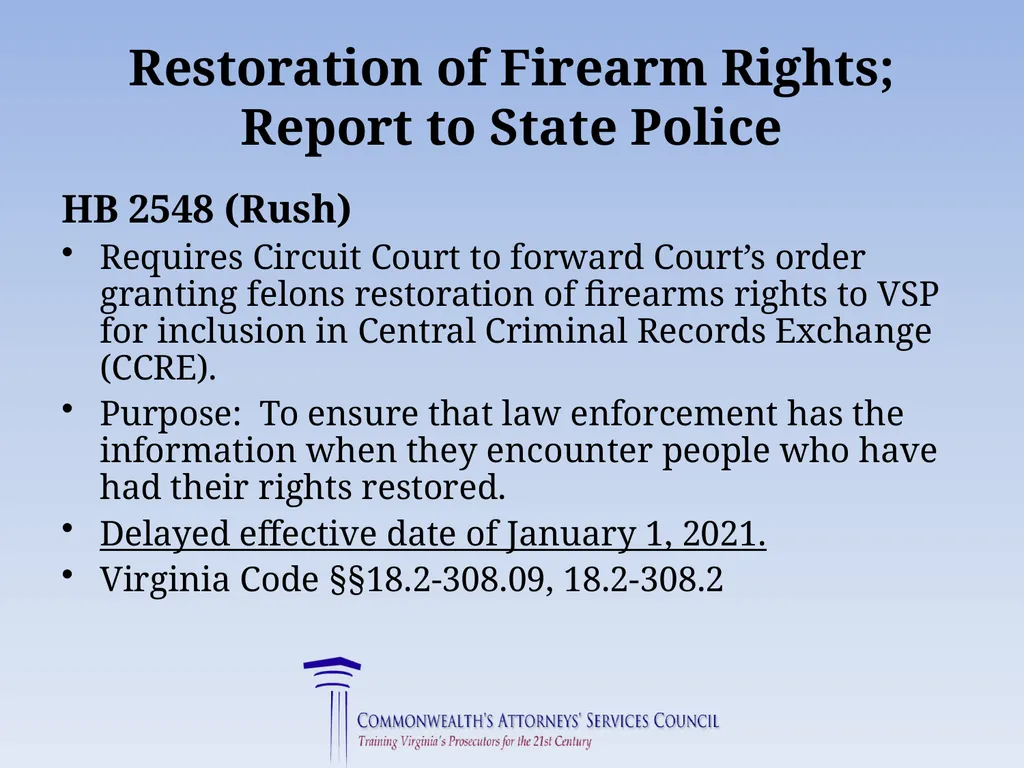
slide67. Restoration of Firearm Rights; Report to State Police HB 2548 (Rush)
Requires Circuit Court to forward Court’s order granting felons restoration of firearms rights to VSP for inclusion in Central Criminal Records Exchange (CCRE).
Purpose: To ensure that law enforcement has the information when they encounter people who have had their rights restored.
Delayed effective date of January 1, 2021.
Virginia Code §§18.2-308.09, 18.2-308.2<br>
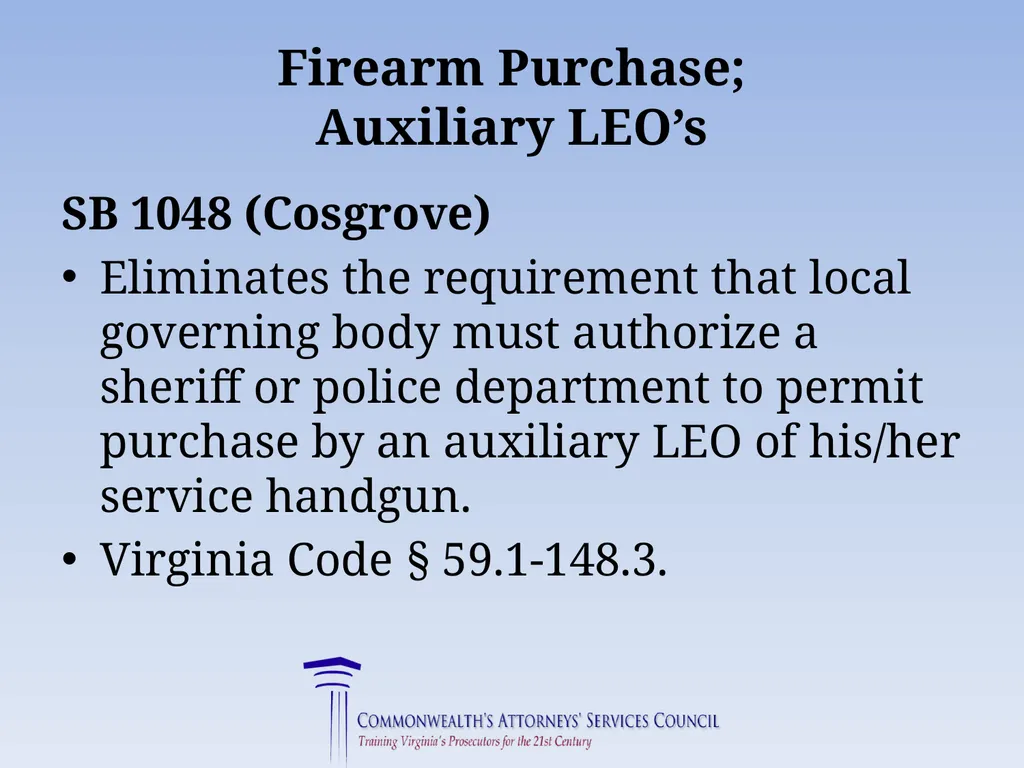
slide68. Firearm Purchase; Auxiliary LEO’s SB 1048 (Cosgrove)
Eliminates the requirement that local governing body must authorize a sheriff or police department to permit purchase by an auxiliary LEO of his/her service handgun.
Virginia Code § 59.1-148.3.<br>
slide69. FOIA<br>
slide70. FOIA; Exemption for SART’s & Child Sexual Abuse MDT’s SB 1184 (Stuart)
Provides that FOIA shall not apply to sexual assault response teams, with the exception of records relating to (i) protocols and policies of the sexual assault response team and (ii) guidelines for the community's response established by the sexual assault response team, which the bill provides shall be public records and subject to the provisions of FOIA.
The bill also provides that FOIA shall not apply to multidisciplinary child sexual abuse response teams.
Virginia Code §§2.2-3703, 2.2-3705.7, 2.2-3711<br>
slide71. Homicide<br>
slide72. Capital Murder of LEO; Mandatory Minimum; Life HB 2615 (Pillion)/SB 1501 (Carrico)
Requires a mandatory minimum sentence of life without parole for anyone 18 or over who commits capital murder of a law enforcement officer or fire marshal.
Filed in response to Jones v. Commonwealth, 293 Va. 29 (2017), in which court found that the life sentence in §18.2-31 is not mandatory and a judge could suspend any or all of the life sentence.
Virginia Code §18.2-31 (B)<br>
slide73. Human Trafficking<br>
slide74. Human Trafficking; Sex Tourism HB 1817 (Delaney)
Creates a Class 1 misdemeanor for a travel agent to promote travel services to someone who intends to engage in 1) prostitution, or 2) sexually violent offenses as defined in subsection §9.1-902 E(1).
The law requires that the travel agent know that the purpose of travel is to engage in prostitution or a sexually violent offense as defined in Virginia.
This law applies when the agent promotes travel services:
To engage in prostitution with minor or adult,
To engage in sex acts that may be legal in the place where the “John” is traveling,
Whether or not the “John” engages in any of the named sex acts.
Virginia Code §18.2-348.1<br>
slide75. Testimony by CCTV; Adds Child Sex Trafficking HB 2464 (Collins)
Allows a court to order, upon application by the attorney for the Commonwealth or the defendant, that the testimony of a child victim of an offense of commercial sex trafficking or prostitution be taken by two-way closed-circuit television.
Virginia Code §18.2-67.9<br>
slide76. DCJS; Sex Trafficking Coordinator HB 2576 (Krizek)/SB 1669 (Vogel)
Creates within DCJS a Sex Trafficking Response Coordinator.
Coordinator to create standards, guidelines and plans for local and state agencies to help victims of sex trafficking and educate consumers of sex trafficking.
Recommendation of the Crime Commission.
Virginia Code §9.1-116.4<br>
slide77. Sex Trafficking; Minors HB 2586 (Bell)
Creates Class 6 felonies for aiding in, or using vehicle to promote, prostitution with a minor (previously Class 1 misdemeanors).
Adds these felonies to definitions of 1) violent felony, 2) barrier crimes, 3) predicate acts, 4) racketeering, 5) offenses that can be investigated by multijurisdictional grand jury, 6) offenses for the sex offender registry.
Each violation of commercial sex trafficking is a separate and distinct felony.
Virginia Code §§ 9.1-902, 17.1-805, 18.2-46.1, 18.2-347 -50, 18.2-357.1, 18.2-513, 19.2-215.1, 19.2-392.02<br>
slide78. DSS; Sex Trafficking Assessment HB 2597 (Herring)/SB 1661 (Peake)
Requires the Dept. of Social Services to do a sex trafficking assessment upon complaint that child is a sex trafficking victim.
Allows CPS worker to take custody of a child victim for up to 72 hours without approval of parent or guardian.
Recommendation of the Crime Commission.
Virginia Code §§63.2-1506.1, 63.2-1508 & 63.2-1517<br>
slide79. DCJS; Sex Trafficking Fund HB 2651 (Yancey)
Creates a fund to be administered by DCJS to promote awareness, prevention training and education related to sex trafficking.
People convicted of sex trafficking crimes will be assessed fines that will be placed in the Virginia Prevention of Sex Trafficking Fund.
Recommendation of the Crime Commission.
Virginia Code §§9.1-116.4, 16.1-69.48:6, 17.1-275.13<br>
slide80. Juvenile –
Victims & Offenders<br>
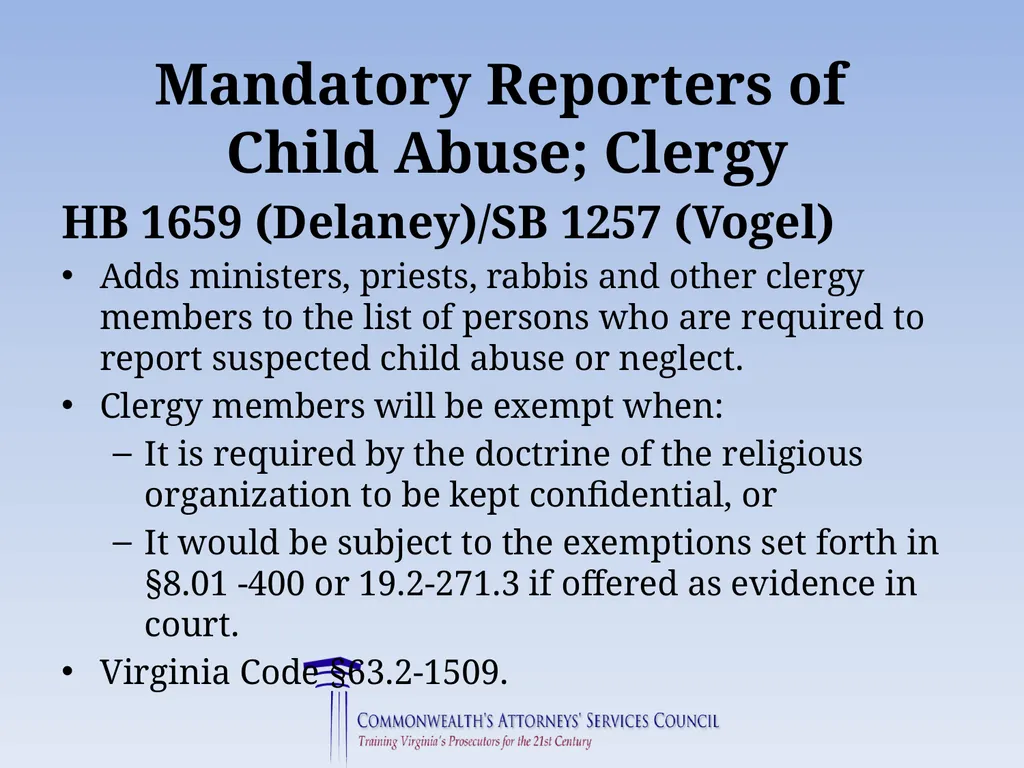
slide81. Mandatory Reporters of Child Abuse; Clergy HB 1659 (Delaney)/SB 1257 (Vogel)
Adds ministers, priests, rabbis and other clergy members to the list of persons who are required to report suspected child abuse or neglect.
Clergy members will be exempt when:
It is required by the doctrine of the religious organization to be kept confidential, or
It would be subject to the exemptions set forth in §8.01 -400 or 19.2-271.3 if offered as evidence in court.
Virginia Code §63.2-1509.<br>
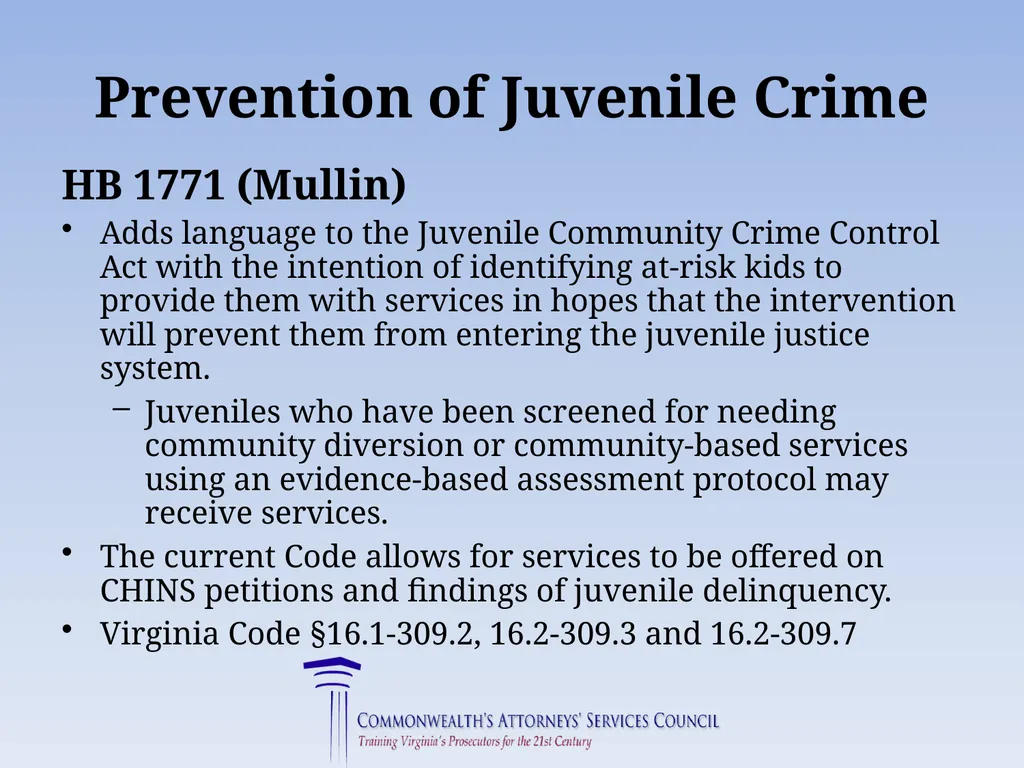
slide82. Prevention of Juvenile Crime HB 1771 (Mullin)
Adds language to the Juvenile Community Crime Control Act with the intention of identifying at-risk kids to provide them with services in hopes that the intervention will prevent them from entering the juvenile justice system.
Juveniles who have been screened for needing community diversion or community-based services using an evidence-based assessment protocol may receive services.
The current Code allows for services to be offered on CHINS petitions and findings of juvenile delinquency.
Virginia Code §16.1-309.2, 16.2-309.3 and 16.2-309.7<br>
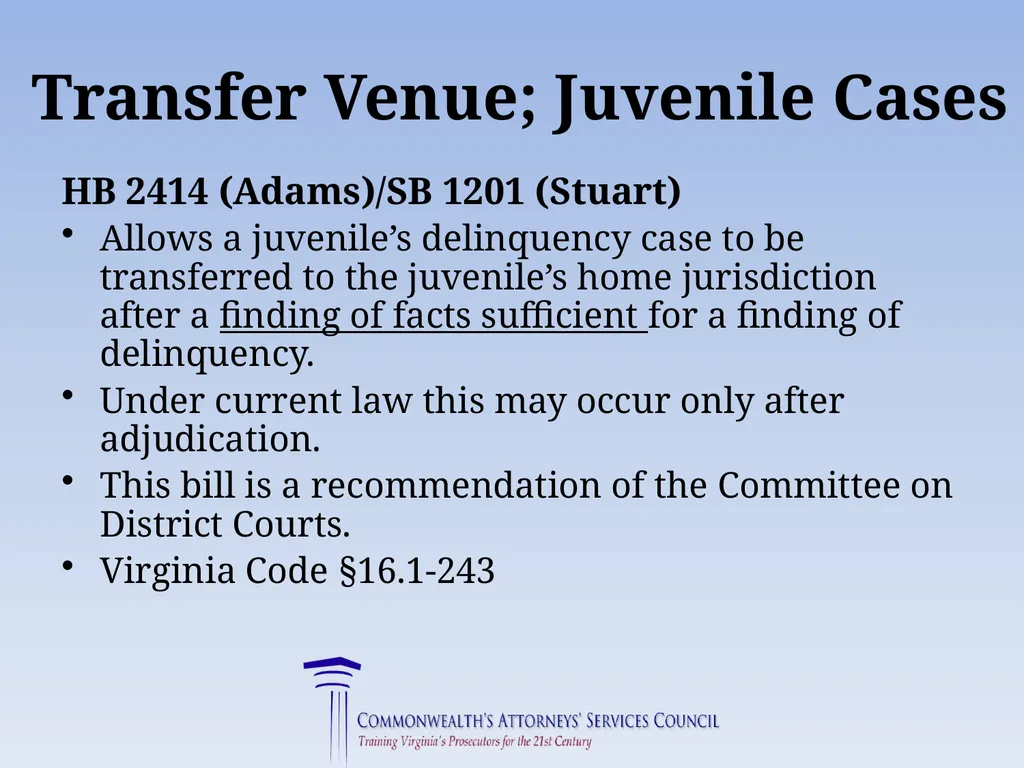
slide83. Transfer Venue; Juvenile Cases HB 2414 (Adams)/SB 1201 (Stuart)
Allows a juvenile’s delinquency case to be transferred to the juvenile’s home jurisdiction after a finding of facts sufficient for a finding of delinquency.
Under current law this may occur only after adjudication.
This bill is a recommendation of the Committee on District Courts.
Virginia Code §16.1-243<br>
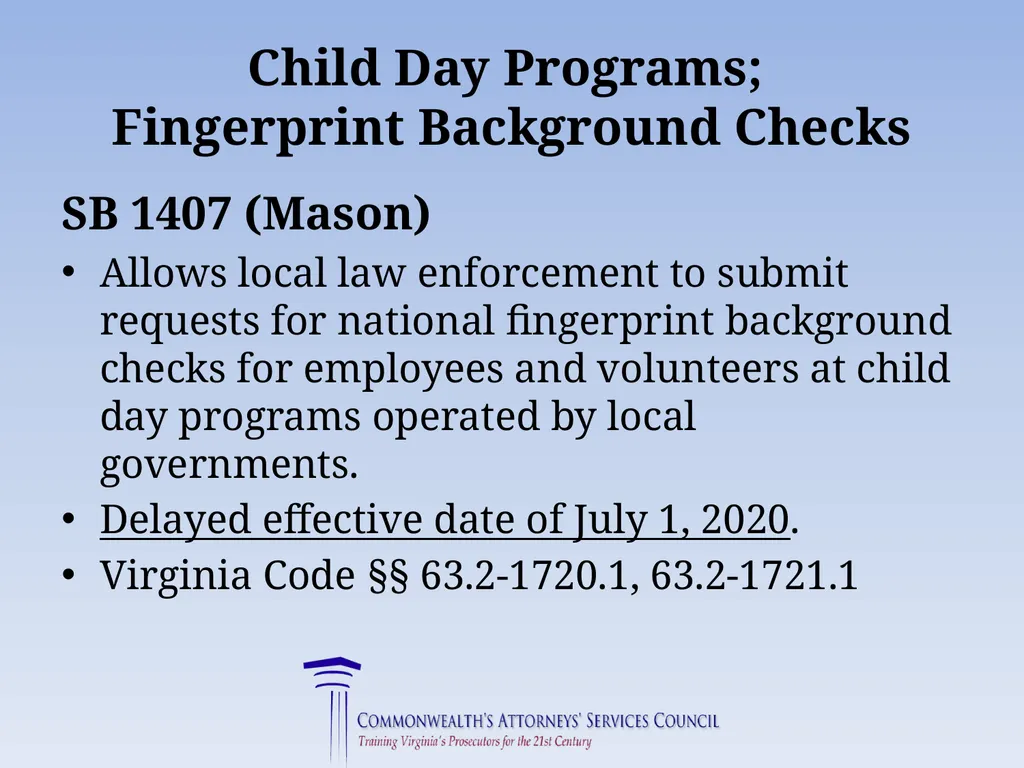
slide84. Child Day Programs; Fingerprint Background Checks SB 1407 (Mason)
Allows local law enforcement to submit requests for national fingerprint background checks for employees and volunteers at child day programs operated by local governments.
Delayed effective date of July 1, 2020.
Virginia Code §§ 63.2-1720.1, 63.2-1721.1<br>
slide85. Landlord-Tenant<br>
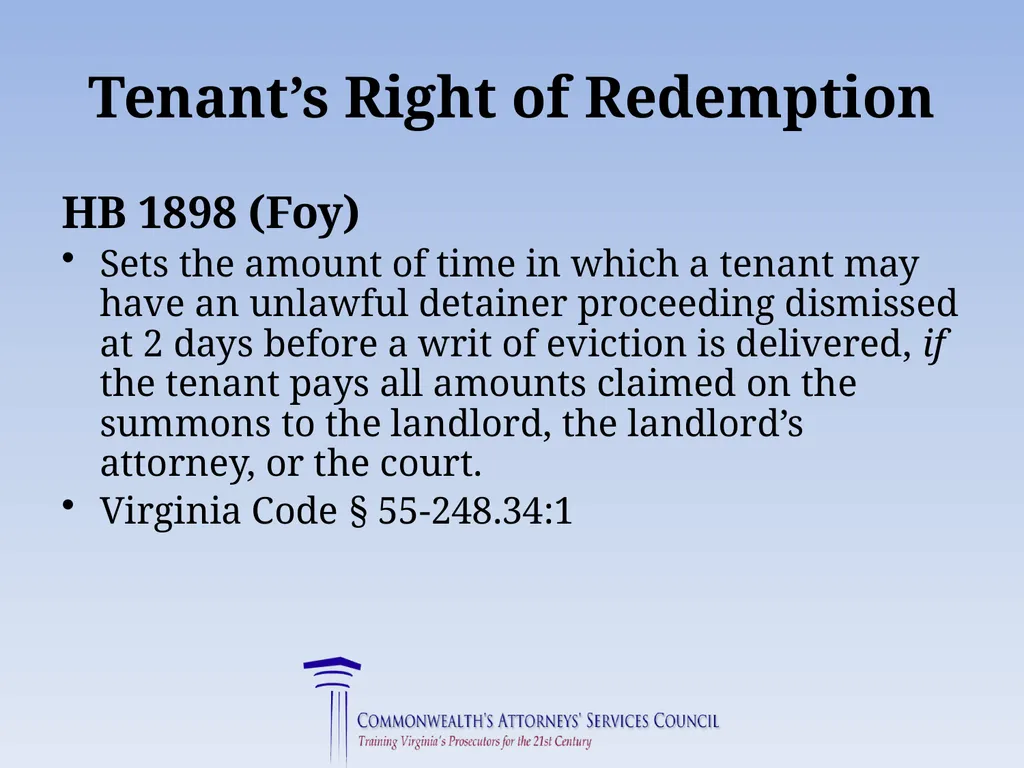
slide86. Tenant’s Right of Redemption HB 1898 (Foy)
Sets the amount of time in which a tenant may have an unlawful detainer proceeding dismissed at 2 days before a writ of eviction is delivered, if the tenant pays all amounts claimed on the summons to the landlord, the landlord’s attorney, or the court.
Virginia Code § 55-248.34:1<br>
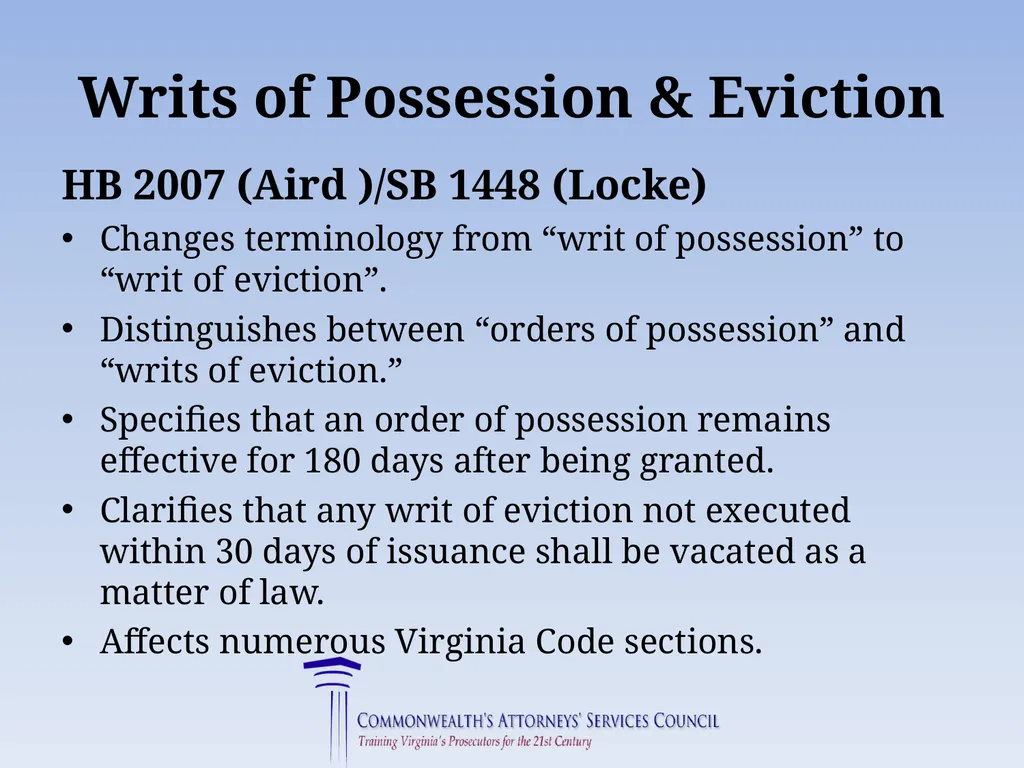
slide87. Writs of Possession & Eviction HB 2007 (Aird )/SB 1448 (Locke)
Changes terminology from “writ of possession” to “writ of eviction”.
Distinguishes between “orders of possession” and “writs of eviction.”
Specifies that an order of possession remains effective for 180 days after being granted.
Clarifies that any writ of eviction not executed within 30 days of issuance shall be vacated as a matter of law.
Affects numerous Virginia Code sections.<br>
slide88. Law Enforcement Officers<br>
slide89. Law-Enforcement Procedural Guarantee Act; Definition; LEO HB 2656 (Collins)
Amends the definition of “law enforcement officer” under the Law-Enforcement Officers Procedural Guarantee Act.
Reduces the number of officers that each department, bureau or force is required to have to qualify from 10 to 3.
Virginia Code § 9.1-500<br>
slide90. Firearm Purchase; Auxiliary LEO’s SB 1048 (Cosgrove)
Eliminates the requirement that local governing body must authorize a sheriff or police department to permit purchase by an auxiliary LEO of his/her service handgun.
Virginia Code § 59.1-148.3.<br>
slide91. Memorials<br>
slide92. Memorials HB 2011 – MOVE OVER license plates; issued in memory of Lt. Bradford T. Clark
HB 2226/SB 1690 – Trooper Mark Barrett Memorial Bridge
SB 1789 – Trooper Lucas B. Dowell Bridge
HR 367 – Celebrating the life of Officer Hunter Edwards<br>
slide93. Mental Health<br>
slide94. Treatment of Prisoners Incapable of Consent HB 1933 (Hope)
Establishes a process for the sheriff or jail administrator to petition the court to authorize medical or mental health treatment for prisoners incapable of informed consent.
Virginia Code §§ 17.1-406, 17.1-410, 37.2-803, 53.1-133.04, 53.1-133.05.<br>
slide95. Jails; Mental Health Treatment HB 1942 (Bell)
The State Board of Corrections will create minimum standards for behavioral health services.
Correctional facilities will have access to more mental health and medical records.
This comprehensive measure was passed in response to death of Jamycheal Mitchell in Hampton Roads Regional Jail.
Virginia Code §§53.1-40.10, 53.1-68, 53.1-133.03<br>
slide96. Notification; Release of NGRI and Incompetent Defendants HB 2648 (Orrock)
Requires the Dept. of Behavioral Health to notify victim when a defendant is being released from mental health commitment after finding of Unrestorably Incompetent or Not Guilty by Reason of Insanity (NGRI).
Duty to notify triggered by written request of victim to Commissioner.
Virginia Code §19.2-11.01<br>
slide97. Capital Murder; Unrestorably Incompetent Defendant SB 1231 (Ebbin)
Clarifies that the Dept. of Behavioral Health does not have the authority to release a capital murder defendant without a court order.
It extends the time to hold competency review hearings from every 6 months to every year for 5 years, and then biennially thereafter, when there is no change in the competency of the defendant.
Virginia Code §19.2-169.3 (F)<br>
slide98. Miscellaneous<br>
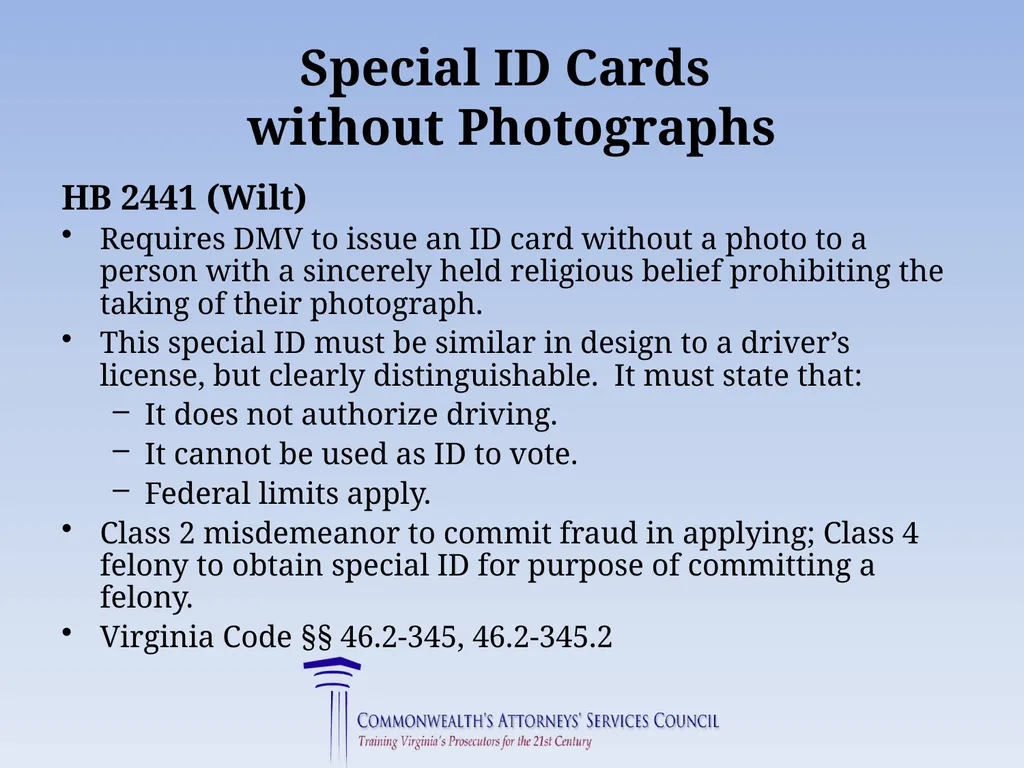
slide99. Special ID Cards without Photographs HB 2441 (Wilt)
Requires DMV to issue an ID card without a photo to a person with a sincerely held religious belief prohibiting the taking of their photograph.
This special ID must be similar in design to a driver’s license, but clearly distinguishable. It must state that:
It does not authorize driving.
It cannot be used as ID to vote.
Federal limits apply.
Class 2 misdemeanor to commit fraud in applying; Class 4 felony to obtain special ID for purpose of committing a felony.
Virginia Code §§ 46.2-345, 46.2-345.2<br>
slide100. Motor Vehicles & Highway Safety<br>
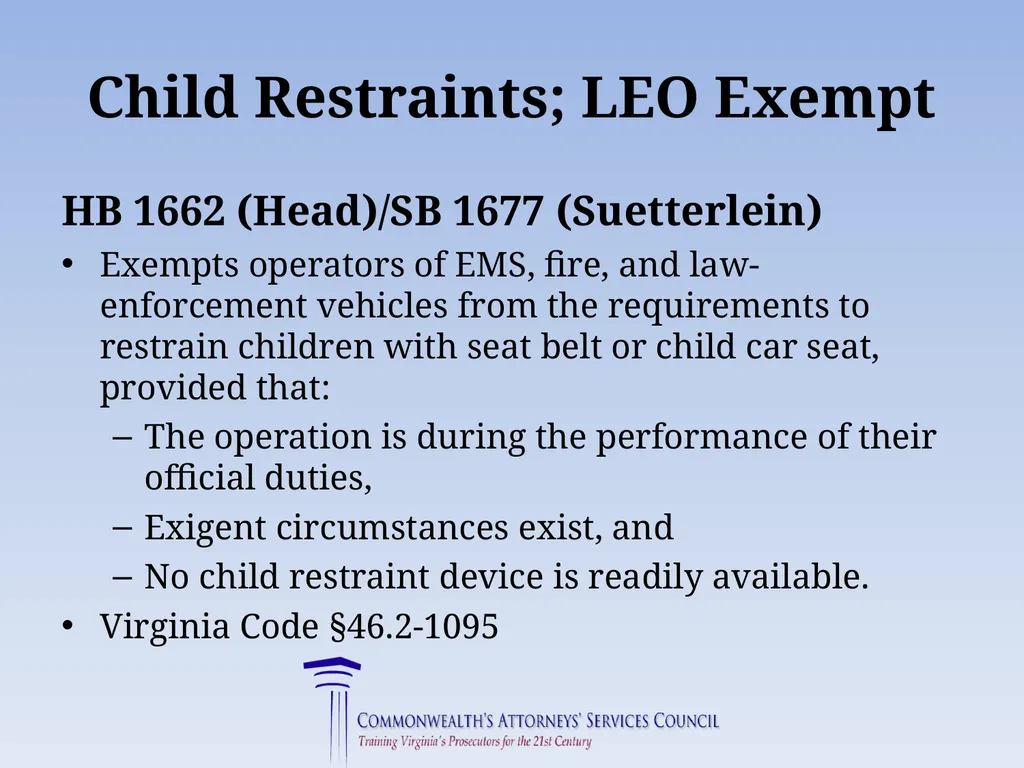
slide101. Child Restraints; LEO Exempt HB 1662 (Head)/SB 1677 (Suetterlein)
Exempts operators of EMS, fire, and law-enforcement vehicles from the requirements to restrain children with seat belt or child car seat, provided that:
The operation is during the performance of their official duties,
Exigent circumstances exist, and
No child restraint device is readily available.
Virginia Code §46.2-1095<br>
slide102. Restricted OL for Out-of-state Drug Convictions HB 1664 (Jones)/SB 1181 (Stuart)
Permits Virginia residents convicted of drug offenses out-of-state to petition Virginia courts for a restricted license.
Exception for operating commercial vehicles.
Virginia Code §18.2-259.1<br>
slide103. Driving Distance for Testing Certain Vehicles HB 1677 (Delaney)
Extends from 5 miles to 10 miles the distance:
Allowable for using license plates intended for unladen vehicles;
That a prospective buyer can test drive a vehicle from an auto auction without a safety inspection.
Virginia Code §§ 46.2-733, 46.2-1158.01<br>
slide104. Re-organizing Registration & Licensing Laws HB 1711 (Herring)/SB 1382 (McDougle)
Takes provisions of §46.2-613 that are criminal and moves them into §46.2-612.
Takes provisions of §46.2-612 that are traffic offenses and moves them into §46.2-613.
By moving the criminal sections into §46.2-613, they are no longer eligible for dismissal of charges upon proof of compliance as provided in §46.2-612.
Recommendation of the Committee on District Courts.
Virginia Code §§46.2-612, 46.2-613<br>
slide105. Expired Registration Summons, Dismissal upon Compliance HB 1712 (Herring)/SB 1383 (McDougle)
Allows dismissal of charges for expired registration under § 46.2-646 when proof of compliance with the section is provided to the court.
Recommendation of the Committee on District Courts.
Virginia Code §§16.2-69.48:1, 46.2-646<br>
slide106. Amber Warning Lights; Hauling Forest Products HB 1802 (Tyler)/SB 1254 (Ruff)
Authorizes vehicle hauling forest products to use amber warning lights, provided that they are mounted so as to be visible from behind the vehicle.
Virginia Code § 46.2-1025<br>
slide107. Move-over Law HB 1911 (Peace)
Changes 1st offense violation of the “move-over” law from a fine of up to $250 to Class 1 misdemeanor Reckless Driving.
Previously, only a 2nd or subsequent offense was a Class 1 misdemeanor.
Moves the offense from §46.2-921.1 to §46.2-861.1 by repealing §46.2-921.1 and creating §46.2-861.1.
The law was moved to Chapter 8, Article 7 in § 46.2 in order to allow improper driving to be a lesser included offense for less culpable conduct.
Virginia Code §46.2-861.1<br>
slide108. Air Bag Fraud HB 2143 (Bell)
Creates a Class 1 misdemeanor to
Install counterfeit or nonfunctional air bag or supplemental restraint component; or
Knowingly sell or install any device that causes the vehicle’s diagnostic system to fail to warn of counterfeit components or nonfunctional air bags; or
Knowingly manufacture or distribute a counterfeit supplemental restraint system component, nonfunctional air bag or other device that does not meet federal safety standards.
Virginia Code §46.2-1088.3<br>
slide109. Sheriffs; Vehicle Markings HB 2585 (Gilbert)
Requires all marked sheriff vehicles to conspicuously display on each front side door the words:
“Sheriff’s Office” or “Sheriff”, and
Name of the city or county.
Removes the requirements about color, 5-pointed stars and the state seal.
Virginia Code § 15.2-1610<br>
slide110. Parking for Disabled HB 2805 (LaRock)
Prohibits parking any vehicle in any striped access aisle adjacent to a parking space reserved for persons with disabilities.
Punishable by a fine of $100-$500.
Virginia Code §46.2-1242<br>
slide111. Window Tinting; Canine Handlers SB 1174 (McPike)
Exempts from window tinting limitations vehicles operated in the performance of private security duties by a licensed security canine handler.
Definitions clarified.
Virginia Code § 46.2-1052<br>
slide112. Immobilization of Vehicles SB 1432 (Obenshain)
Allows owner/operator of a parking lot or building to immobilize a trespassing vehicle by any device that prevents its removal or lawful operation, provided the device does not damage the vehicle.
Current law limits immobilization devices to those that prevent a wheel from turning, such as a boot.
Code of Virginia §§ 46.2-1054, 46.2-1216, 46.2-1231<br>
slide113. Hands-free Driving; Highway Work Zone SB 1768 (Mason)
Prohibits any person from holding a phone or personal communications device in their hand while driving in a highway work zone.
Imposes a mandatory $250 fine.
If not in a highway work zone, a driver can hold the phone in their hand but can’t read or write emails or texts, as provided in current law.
Virginia Code §46.2-1078.1<br>
slide114. Pawn Brokers<br>
slide115. Pawning Goods; Current Government ID Required HB 1774 (Mullin)
Persons pawning, pledging or selling goods or precious metals/gems must present an unexpired government ID card bearing a current legal address.
If address not current, seller must present other documentation to prove current legal address.
Virginia Code §§ 54.1-4009, 54.1-4101, 54.1-4102<br>
slide116. Post-Trial
Provisions<br>
slide117. Presentence Reports; Parole HB 1833 (Tyler)
Allows a parole-eligible inmate or his attorney to get a copy of his pre-sentence report without a court order.
Virginia Code §19.2-299<br>
slide118. Expungement; Absolute Pardon for Innocent Person HB 2278 (Cole)
Allows automatic expungement when someone is absolutely pardoned for a crime for which he has been found to be actually innocent.
The only change from current law is that it would no longer require the person who has been deemed wrongfully convicted to file a petition in court for expungement.
Virginia Code §§2.2-402, 19.2-392.2<br>
slide119. Criminal Injury Compensation Fund (CICF) HB 2773 (Bell)
Removes the current $600 limit that may be awarded to a crime victim for total loss of earnings resulting from incapacity.
Increases from $5,000 to $10,000 the maximum award from CICF for expenses directly related to funeral or burial costs.
Increases from $25,000 to $35,000 the maximum aggregate award receivable as a result of an injury or death.
CICF also known as the Virginia Victims’ Fund.
Virginia Code §18.2-254.2<br>
slide120. Schools<br>
slide121. Carrying a Firearm; Private School Security Officers HB 1656 (Cole)
Allows private and religious schools to have armed security officers in the same manner as public schools.
Virginia Code §§ 9.1-101, 18.2-57, 22.1-280.2:1<br>
slide122. School Safety; Emergencies; Annual Training HB 1732 (O’Quinn)/SB 1215 (Newman)
Requires each school board to develop school emergency safety training.
This training to be provided to every student and employee at least once a school year.
Virginia Code § 22.1-137.3<br>
slide123. MOU; Schools & Law Enforcement HB 1733 (Gilbert)/SB 1214 (Newman)
Requires:
The Virginia Center for School and Campus Safety to develop a model memorandum of understanding (MOU) for use with local law enforcement, and
The school board in each school division that has SROs to enter into an MOU based upon the model.
Must be reviewed at least every 5 years.
Virginia Code §§9.1-184, 22.1-280.2:3<br>
slide124. Development of Emergency Response Plans HB 1737 (Wright)/SB 1220 (Newman)
Requires school boards to include first responders in the development and review of school emergency response plans.
Previously, the school board only had to provide copies of the plans to first responders.
Virginia Code § 22.1-279.8<br>
slide125. Schools; Protective Orders; Notification HB 1997 (Price)
Requires any school principal who is notified of a protective or no-contact order protecting a student to notify certain school personnel that such order has been issued.
Virginia Code § 22.1-279.3:2<br>
slide126. Public Schools; Use of Seclusion or Restraints HB 2599 (Bell)
Requires the Board of Education to:
Identify and prohibit the use of any method of restraint or seclusion that it determines poses a significant danger to students, and
Establish safety standards for seclusion.
Virginia Code § 22.1-279.1:1<br>
slide127. DCJS; Training; SRO’S HB 2609 (Jones)/SB 1130 (Locke)
Requires DCJS to establish, and every SRO after 7/1/2020 to comply with, compulsory minimum training standards for SRO’s.
Training must be specific to SRO’s and be available across the Commonwealth.
Each public school must employ at least 1 administrator who has completed school safety training for public school personnel provided that it is available online.
Virginia Code §§ 9.1-102, 22.1-279.8(E), 9.1-114.1, 9.1-184<br>
slide128. School Security Officers; Prior Employment; Firearms HB 2721 (Freitas)
Allows a school security officer to carry a firearm if, within 10 years immediately prior to employment, he was employed as an LEO elsewhere in the U.S. with duties substantially similar to those of an LEO in Virginia.
Previously, only prior Virginia service counted.
DCJS’s obligation to establish minimum training standards for school security officers includes training for former out-of-state LEO’s.
Virginia Code §§ 9.1-102, 22.1-280.2:1<br>
slide129. Sex Offenders<br>
slide130. Child Pornography Registry HB 1940 (Bell)/SB 1379 (McDougle)
Requires copies of all child pornography obtained in the course of criminal investigations to be included in the Child Pornography Registry.
Currently the Registry only includes images that were introduced into evidence.
Also provides that Registry information may be used for victim identification.
VSP required to submit report detailing implementation to Secretary of Public Safety, House Appropriations & Senate Finance Committees by January 1, 2020.
Virginia Code § 19.2-390.3<br>
slide131. Sex Offender Registry; Reregistration Schedule HB 2089 (Watts)/SB 1418 (Mason)
This bill makes changes to the sex offender registration schedule in an effort to make it more uniform and easier to keep up with by VSP & the offender.
Re-registration is tied for most offenders to the offender’s birth month.
Becomes effective July 1, 2020.
Virginia Code §9.1-904<br>
slide132. Sex Offenders; Prohibited from Operating Taxicab HB 2300 (Collins)
Prohibits any person who is required to register as a sex offender from operating a taxicab for the transportation of passengers for hire.
Virginia Code §46.2-2011.33<br>
slide133. Sexual Assault<br>
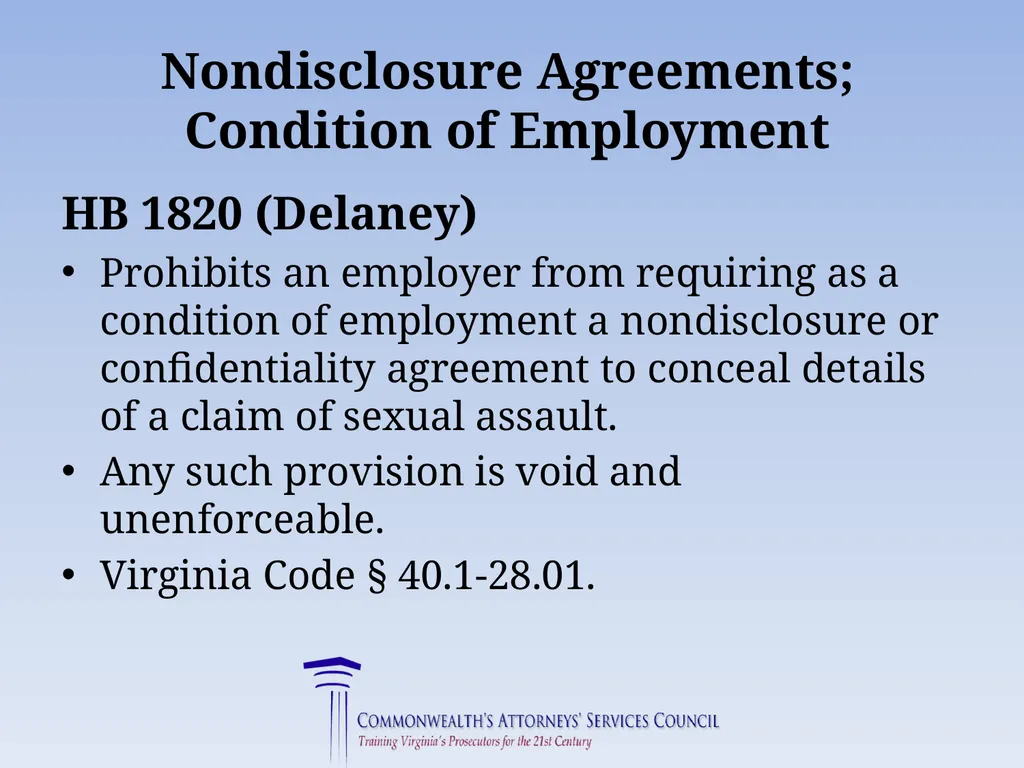
slide134. Nondisclosure Agreements; Condition of Employment HB 1820 (Delaney)
Prohibits an employer from requiring as a condition of employment a nondisclosure or confidentiality agreement to conceal details of a claim of sexual assault.
Any such provision is void and unenforceable.
Virginia Code § 40.1-28.01.<br>
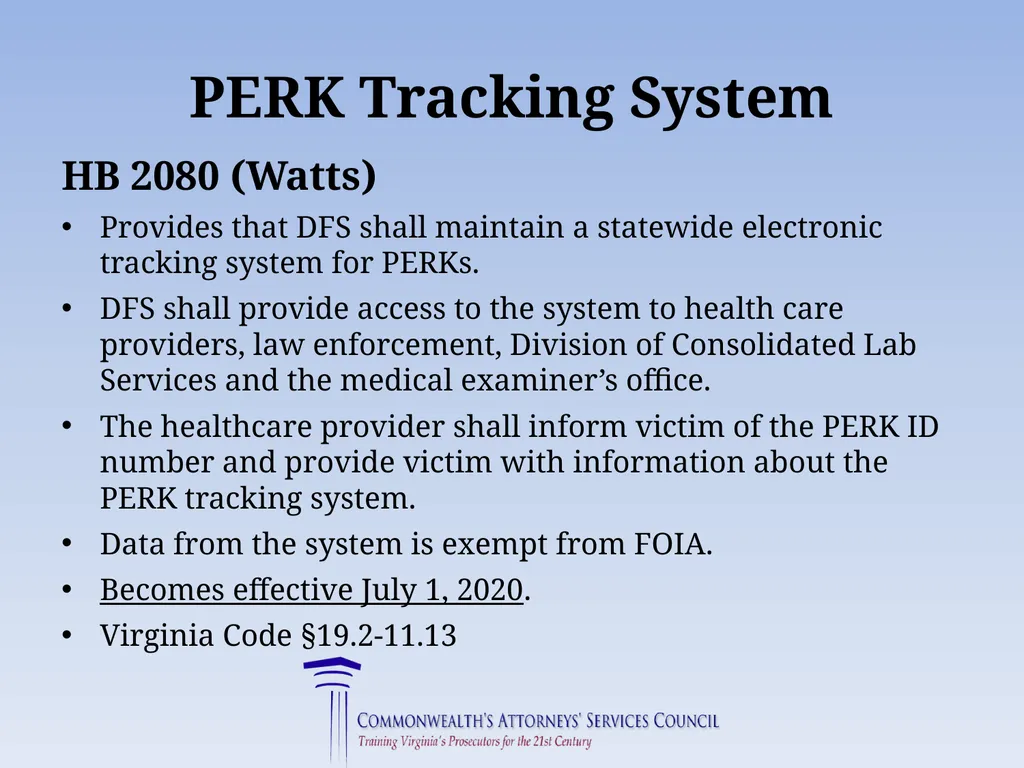
slide135. PERK Tracking System HB 2080 (Watts)
Provides that DFS shall maintain a statewide electronic tracking system for PERKs.
DFS shall provide access to the system to health care providers, law enforcement, Division of Consolidated Lab Services and the medical examiner’s office.
The healthcare provider shall inform victim of the PERK ID number and provide victim with information about the PERK tracking system.
Data from the system is exempt from FOIA.
Becomes effective July 1, 2020.
Virginia Code §19.2-11.13<br>
slide136. REMINDER! This PowerPoint attempts to identify the legislation from the 2019 General Assembly session that has the greatest impact on law enforcement and public safety.
Consult the 2019 Legislative Update Master List for full listing of bills of interest. 136<br>
slide137. Jane Sherman Chambers, Director
Commonwealth’s Attorneys’ Services Council
jscham@wm.edu
757-253-5124
Many thanks to:
Lori DiGiosia
Chief Deputy Commonwealth’s Attorney
Stafford County
Kenneth Adcock
Department of Criminal Justice Services
Lt. Keenon Hook
Virginia State Police 137<br>
slide2. Materials This PowerPoint attempts to identify the legislation from the 2019 General Assembly session that has the greatest impact on law enforcement and public safety.
Consult the 2019 Legislative Update Master List for full listing of bills of interest.<br>
slide3. Materials You must rely only upon the language of the bill after final passage.
You can find the final version of the bill on the LIS website at: http://lis.virginia.gov/lis.htm.<br>
slide4. 2019 General Assembly Session There were 2,362 bills introduced in 2019 (excluding commending and memorializing resolutions).
950 bills passed and 1,412 were killed.
6 week sessions in odd-numbered years; 8 week sessions in even years.<br>
slide5. Animals & Hunting<br>
slide6. Penalty for Wanton Waste HB 1613 (Edmunds)
Changes the penalty from a Class 3 misdemeanor to a Class 2 misdemeanor for a killed or crippled game animal or non-migratory game bird to be wasted without making a reasonable effort to retrieve the animal.
Virginia Code §29.1-553.1<br>
slide7. Animal care; Adequate Shelter HB 1625 (Orrock)
Provides that the definition of "adequate shelter" includes the provision of shelter that:
During hot weather, is shaded and does not readily conduct heat, and
During cold weather, has a windbreak at its entrance and provides sufficient bedding material.
Virginia Code §3.2-6500<br>
slide8. Cock Fighting; Seizure HB 1626 (Orrock)
Adds that a tethered cock shall be confiscated by animal control officer if it is believed that it will be used in animal fighting.
Virginia Code §3.2-6571<br>
slide9. Nuisance Species; Shooting from Vehicle HB 1696 (Farris)
Authorizes the killing of a nuisance species on private property by the owner (or designee) from a stationary vehicle.
“Nuisance species” as defined in § 29.1-100 includes several kinds of birds, coyotes, feral swine, etc.
Virginia Code § 29.1-521(6)<br>
slide10. Animal Abuse; Felony for Serious Injury HB 1874 (Ransone)/SB 1604 (DeSteph)
Expands the Class 6 felony for abuse of a companion animal to include when the animal is seriously injured but does not die.
§3.2-6570 (F) creates a Class 6 felony for when a dog or cat dies as a result of abuse. This bill adds that when “serious physical injury” results, it is also a Class 6 felony.
Filed in response to a case in which a dog owner tied his dog to a pole, threw gasoline on the dog and lit the dog on fire. The fire was put out by a bystander. The dog initially survived but had serious injury.
Virginia Code §3.2-6570<br>
slide11. Dangerous Dog; Deferred Finding HB 2745 (Hope)
Authorizes a court to defer proceedings in the adjudication of an animal as a dangerous dog.
Requires the court to place conditions upon the owner of the animal, the violation of which shall authorize the court to proceed as it otherwise would have.
Upon the fulfillment of the conditions, the court shall dismiss the proceedings against the animal and the owner.
Virginia Code §3.2-6540<br>
slide12. Animal Tethering; Adequate Space SB 1025 (Spruill)
Provides that a tether must:
Be at least three times the length of the animal or 10 feet in length, whichever is greater,
Not cause injury or pain,
Not weigh more than one-tenth of the animal's body weight, or
Have weights or heavy objects attached to it.
Bill exempts agricultural animals.
Virginia Code §3.2-6500<br>
slide13. Correctional Facilities<br>
slide14. Inmate Workforces HB 1935 (Collins)
Clarifies eligibility for voluntary participation in an inmate workforce with the approval of, and under the supervision of, the sheriff or his designee.
Changes “non-violent criminal offense” to “an offense not listed in § 19.2-297.1” (3 strikes law)
Virginia Code §53.1-128.<br>
slide15. Restraint of Pregnant Offenders SB 1772 (Saslaw)
Requires the Board of Corrections to review standards for allowable restraint practices for pregnant inmates to ensure:
Humane treatment that accounts for specific health needs, and
Provides adequate safety protection for others.
Virginia Code Chapter 725<br>
slide16. Exchange of Records; Local Probation Officers HB 2213 (Heretick)
Adds local probation officers to list of persons among whom medical & mental health information and records of anyone committed to jail, and transferred to another correctional facility, may be exchanged.
Virginia Code § 53.1-133.03<br>
slide17. Crimes & Offenses
Miscellaneous<br>
slide18. Hoax Crimes; Reports to Police HB 2056 (Yancey)/SB 1031 (Chase)
Creates a Class 1 misdemeanor to publicly fake a crime with the intent to induce a person to call in a report to police thinking that a real crime was occurring.
The current law for false report does not apply because the offender did not make the false report. Instead, the person caused the false report to be made by tricking a Good Samaritan.
Virginia Code §18.2-461<br>
slide19. False Caller ID; Spoofing HB 2170 (Brewer)
Creates a Class 3 misdemeanor for a 1st offense, and a Class 2 misdemeanor for a 2nd or subsequent offense, when:
A person causes a phone to ring and display false caller ID
With the intent to defraud, intimidate or harass.
Intent element designed to avoid criminalizing prank calls and to comply with federal case law and the Federal Truth in Calling Act.
Does not apply to law enforcement engaged in official duties.
Virginia Code §18.2-429.1<br>
slide20. Failure to Appear; Contempt of Court HB 2452 (Adams)
Adds failure to appear as behavior punished as contempt under §18.2-456.
Requires the Court to specify which subsection in §18.2-456 the person has been punished under.
Specifies that failure to appear shall not be punished as contempt under §16.1-69.24.
The purpose of this bill is to create better record keeping to track when a defendant failed to appear.
Recommendation of Crime Commission.
Virginia Code §§16.1-69.24, 18.2-456<br>
slide21. Timber Sales; Theft HB 2411 (Adams) / SB 1469 (Chafin)
Creates Class 1 misdemeanor for persons who buy or remove timber and fail to pay the landowner by agreed date or, if no agreed date, within 60 days.
Those convicted must pay 3 times the value of the timber.
It can be a Class 3 misdemeanor for a timber buyer to fail to provide an accounting of each load removed from the property.
Additional provisions. See Virginia Code §55-334.2 & 55-334.3<br>
slide22. Revenge Porn; Photo-shopped Image HB 2678 (Del. Simon)/SB 1736 (Ebbin)
Adds sending a photo-shopped pornographic picture or video of someone to revenge porn law.
The current law prohibits maliciously disseminating a pornographic picture of someone with the intent to coerce, harass, or intimidate that person.
Requires that the actual person be recognizable in the image, whether by face, likeness or other distinguishing characteristic.
Virginia Code § 18.2-386.2<br>
slide23. Threats to Healthcare Worker SB 1395 (Howell)
Class 1 misdemeanor to orally threaten to kill or injure health care worker engaged in their duties.
Exception for patients who are at medical facility under an ECO, involuntary TDO, or involuntary hospitalization order.
Virginia Code § 18.2-60<br>
slide24. Permissible Fireworks; Definition SB 1625 (McPike)
Changes definition of permissible fireworks to:
Fountains that do not emit more than 16.4 feet;
Wheels that do not emit more than 39 inches;
Crackling devices/flashers/strobes that do not emit more than 78.74 inches;
Sparkling devices that do not 1) explode, 2) travel under their own power, 3) produce a projectile, 4) produce a flame more than 20”, 5) reload, 6) have a specified fuse.
Va. Code § 27-95<br>
slide25. Illegal Gambling; Definition SB 1738 (Reeves)
Modifies definition of gambling to make it easier to prosecute those participating in “sham sweepstakes”.
“Sham sweepstakes” are when a business allows a customer to purchase something of value and, in exchange, the customer has a right to use the establishment’s gaming machines.
Examples: Selling “vaping session” in exchange for using gambling machine; selling phone cards in exchange for use of gaming machine.
Old definition did not address current technology or gaming machine practices.
Virginia Code §18.2-325(1)<br>
slide26. Criminal Procedure<br>
slide27. Forgery; Venue HB 1751 (Leftwich)/SB 1050 (Cosgrove)
Expands venue for forgery to “any county or city where an issuer, acquirer, or account holder sustained a financial loss.”
Previous law allowed prosecution (1) where the forgery was made or passed or (2) where the defendant was found in possession of the forged writing
Allows one jurisdiction to bring all charges related to a particular victim or bank in order to avoid victims and witnesses having to go to multiple jurisdictions.
Virginia Code §19.2-245.1<br>
slide28. Expedited Testing; Exposure to Viruses HB 1998 (Price)
If consent to a blood test is refused, requires a general district court to hold a hearing within 48 hours of a petition seeking testing for HIV or other viruses when exposure to bodily fluids occurs between a person and
A health care provider,
Specified public safety personnel, or
A school board employee.
Virginia Code §§16.1-241, 32.1-45.1<br>
slide29. Bail; Court’s Authority to Hear HB 2320 (VanValkenburg)
Addresses mechanics and weight of decisions of bail rulings on appeal:
Higher court that makes decision on appeal shall remand the case to the court where the case is pending for enforcement & modification.
The lower court is prohibited from changing the higher court’s decision unless there is a subsequent change in circumstances.
Virginia Code §§19.2-124, 19.2-130, 19.2-132<br>
slide30. Fingerprint Bill HB 2343 (Bell)/SB 1602 (Obenshain)
Addresses incomplete criminal records in CCRE
More than 675,000 offenses, including 318 murder and 1,308 rape convictions, have not been entered into Virginia’s main criminal record database, mainly because of missing fingerprints.
Firearms background checks, employment, sentencing decisions, etc., rely on the accuracy of criminal records.
Primary responsibility on the courts, judges and probation to confirm that defendants have been fingerprinted and their criminal records updated.
Involves multiple Virginia Code sections.
See 2019 CASC Legislative Update for Law Enforcement ~ Supplement on Omnibus Fingerprinting Bill<br>
slide31. Multi-Jurisdiction Grand Jury HB 2413 (Adams)
Requires secrecy from those permitted to take notes or make copies of evidence from Multi-Jurisdictional Grand Jury proceedings.
Requires CA to provide notice to defendant when MJGJ was used to obtain evidence for prosecution.
Virginia Code §19.2-215.9<br>
slide32. Collection of DNA upon Conviction HB 2439 (Campbell)/SB 1166 (Chafin)
Clean up language:
Provides that the law requiring the taking of DNA samples after conviction apply to convictions under locality’s ordinances as well as equivalent state laws.
Virginia Code §19.2-310.2<br>
slide33. Bail; Magistrate’s Checklist HB 2453 (Adams)
Requires magistrates to forward to the court the completed checklist used to consider factors for bail.
This is a standard form provided by the Office of the Executive Secretary at the Supreme Court.
Some magistrates were forwarding it to the Court but it was not required.
Jurisdictions who receive these checklists find that they contain valuable information.
Virginia Code §§19.2-121 & 19.2-149<br>
slide34. Credit Card Offenses; Venue HB 2484 (Hodges)
Expands venue for credit card offenses to where the cardholder resides.
Current law allows prosecution where (i) any act in furtherance occurred or (ii) where a financial loss was sustained.
Allows one jurisdiction to bring all charges related to a particular victim and avoids the victim from having to go to multiple jurisdictions when his credit card was used in several jurisdictions.
Virginia Code §18.2-198.1<br>
slide35. CCRE; Background Checks through Live Scan HB 2746 (Head)
Requires VSP to accept background check requests through the use of a Live Scan device from any authorized Virginia agency that:
serves children or the elderly and is authorized to receive criminal histories, or
uses fingerprint background checks as a condition of employment or service.
VSP may deny request under certain circumstances.
Virginia Code 19.2-388.1<br>
slide36. Adding Offenses to CCRE SB 1529 (Chafin)
Adds criminal offenses to the list of offenses that are to be reported to CCRE:
§3.2-6570: Cruelty to Animals
§46.2-339: Sex Offender Driving School Bus
§46.2-341.21: Drive CMV after disqualified
§46.2-341.24: Drive CMV while drunk
§46.2-341.26:3: CDL holder refusal
§46.2-817: Elude law enforcement
Virginia Code §19.2-390<br>
slide37. Spoliation of Evidence SB 1619 (Obenshain)
Establishes a duty to preserve evidence that may be relevant to reasonably foreseeable civil litigation.
If evidence is lost, or otherwise disposed of, the court may order measures necessary to cure prejudice, or if done recklessly or intentionally, the court may 1) presume evidence unfavorable and so instruct the jury, 2) dismiss the action or 3) enter a default judgment.
This could apply to potential civil lawsuits. For example, in a use of force/unlawful arrest law suit, deleting a body camera video could have serious ramifications.
Virginia Code § 8.01-379.2:1 (a civil Code section)<br>
slide38. Domestic Violence/ Family Abuse<br>
slide39. PPO’s; Full Hearings; Court Closures HB 1673 (Mullin)
Allows full hearings on preliminary protective orders to be heard on the next business day if a lawful court closure prevented it from occurring within the required 15 days.
Arises out of a situation in Hampton Roads during a hurricane shutdown in which preliminary protective orders expired because they were not heard within 15 days.
Virginia Code §§16.1-253.1, 19.2-152.9.<br>
slide40. Protective Orders; Contents of PPO’s; Appeals SB 1540 (Surovell)
Provides that if a PPO is issued in an ex parte hearing where the petition for the order is supported by sworn testimony (not an affidavit completed by a law-enforcement officer), the court issuing the order shall state in the order the basis on which the order was entered, including a summary of the allegations made and the court's findings.
Requires that an appeal of a permanent protective order be docketed within 2 business days.
Virginia Code §§16.2-112, 16.2-253.1, 16.2-296, 19.2-152.9<br>
slide41. Drones<br>
slide42. Drones; Trespass; Prohibited Take Off and Landing HB 1636 (Knight)
Adds a Class 1 misdemeanor to the drone trespass statute:
To knowingly & intentionally take off or land a drone in violation of FAA or UAS Security Sensitive Airspace restrictions.
Addresses take off and landing but not flying the drone because Virginia doesn’t have jurisdiction over airspace.
This behavior already is a felony in violation of federal law but the Feds do not enforce it. Needed a local solution.
Virginia Code §18.2-121.3<br>
slide43. Drones; Persons Sought for Arrest; Hot Pursuit SB 1507 (Carrico)
Adds exceptions to the requirement that a search warrant be issued before law enforcement may use a drone:
When needed to formulate a plan to execute an arrest at the primary residence of someone for whom an arrest warrant or capias has been issued;
To find a person who has fled from a law-enforcement and the officer remains in hot pursuit of such person.
Virginia Code §19.2-60.1(C)<br>
slide44. Drones; Search Warrant Exceptions Already existing exceptions to drone search warrant requirement – Virginia Code § 19.2-60.1(C):
(i) during Amber Alert;
(ii) during Senior Alert;
(iii) during Blue Alert;
(iv) where use of a drone is “determined to be necessary to alleviate an immediate danger to any person”;
(v) to collect evidence for certain motor vehicle accidents;
(vi) by DOT when helping law-enforcement to prepare MV accident reports;
(vii) for training exercises related to such uses; or
(viii) by consent of person with authority.<br>
slide45. Drugs<br>
slide46. Schools; Permission to Possess CBD & ThC-A Oils HB 1720 (Jones)/SB 1632 (Sturtevant)
Exempts school nurses from prosecution under §§18.2-248, 18.2-248.1, 18.2-250, 18.2-250.1 or 18.2-255 for possession or distribution of CBD or ThC-A oils when:
Student has a valid certification, and
Nurse is in compliance with school board policy.
Provides that schools are not required to suspend or expel students with valid certification for CBD and ThC-A oils for possessing or using the oils so long as the student has a health plan requiring the use of the oils and is complying with school board policy.
Virginia Code §§18.2-251.1:1 & 22.1-277<br>
slide47. Controlled Substances; Schedule I & II HB 1803 (Garrett)
Adds long list of unpronounceable chemicals to Schedule I and Schedule II of the Controlled Substances Act, including various Fentanyl-like compounds and “designer” drugs.
Virginia Code §§54.1-3446 & 54.1-3448<br>
slide48. Industrial Hemp; Farm Bill HB 1839 (Marshall)/SB 1692 (Ruff)
Conforms Virginia law to the federal 2018 Farm Bill by amending the definitions of cannabidiol oil, marijuana, and THC to exclude:
industrial hemp in the possession of a registered person,
hemp products or
an oil containing no more than 0.3% THC.
This bill is lengthy, complicated and involves multiple Code changes. Seek guidance from DFS and your Commonwealth’s Attorney.
Became effective on March 21, 2019.<br>
slide49. Naloxone; Regional Jail Employees HB 1878 (Garrett)
Adds employees of regionals jails to list of people who may possess and administer naloxone, provided that they have completed a training program.
Virginia Code §54.1-3408(X)<br>
slide50. Huffing; Noxious Chemicals, Add Ingredients HB 2138 (Thomas)
Adds “fluorinated hydrocarbons” and “hydrogenated fluorocarbons” to the list of ingredients that can be considered noxious chemicals.
Fredericksburg case: Defendant was charged with huffing but was found not guilty because the intoxicating ingredient (fluorinated hydrocarbons) was not on the list of prohibited noxious chemicals. He later was captured on video with 20 cans around him saying that he could not be arrested for huffing this substance because he had already been acquitted. He died later that day.
Virginia Code § 18.2-264 (C)<br>
slide51. Dispensing Naloxone HB 2158 (Plum)
Expands list of health care providers who can dispense naloxone.
Establishes requirements for dispensing naloxone in an injectable form with needle or syringe.
Allows for recovery of actual cost of dispensing naloxone.
Virginia Code §54.1-3408 (X)(Y)<br>
slide52. Drug Control Act; Schedule V; Gabapentin HB 2557 (Pillion)
Classifies gabapentin as a Schedule V controlled substance.
Virginia Code § 54.1-3454 (3)<br>
slide53. Drug Paraphernalia; Fentanyl Testing Products HB 2563 (Robinson)
Clarifies that fentanyl testing products are not drug paraphernalia or controlled paraphernalia.
Virginia Code §§ 18.2-265.1 (4), 54.1-3466 (A)<br>
slide54. Cigarettes, E-Cigs & Vapes– Increase Age to 21 HB 2748 (Stolle)/SB 1727 (Norment)
Raises the age to buy or possess tobacco, nicotine vapor and alternative nicotine products from 18 to 21.
Provides an exception for active duty military 18 or older.
Adds “nicotine vapor products, and alternative nicotine products” to the restricted vending machine rules.
Virginia Code §§18.2-246.8, 18.2-246.10,18.2-371.2<br>
slide55. Pharmacy Board; Seizure of Controlled Substances SB 1289 (Edwards)
Establishes a process by which the Board of Pharmacy or law enforcement can seize and place under seal controlled substances and prescription devices when registration/license/permit authorizing possession is suspended or revoked.
Provides procedures for transfer and disposal of such items if subject to forfeiture.
Reduces from 6 months to 60 days the time required before disposing of unclaimed seized items.
Virginia Code §§ 54.1-2408.1, 54.1-3424, 54.1-3434.<br>
slide56. Safe Reporting of Overdoses; No Cooperation Requirement SB 1349 (McDougle)
Eliminates the “substantial cooperation with law enforcement” requirement in the safe reporting statute.
This bill passed as part of a compromise to pass a felony homicide bill for drug overdose deaths; however, the felony homicide part of the deal was vetoed by the Governor.
Also known as “Dillon’s Law”.
Virginia Code §18.2-251.03<br>
slide57. Board of Pharmacy; CBD & THC-A Oil SB 1557 (Dunnavant)
Authorizes licensed physician’s assistants and nurse practitioners to issue written certifications for the use of CBD and ThC-A oils.
Board of Pharmacy to establish dose limitations.
Virginia Code §§54.1-3408.3, 54.1-3442.6<br>
slide58. CBD & THC-A Oils; Registered Agents & Processors SB 1719 (Marsden)
Authorizes a patient or their guardian to designate an agent to receive CBD or ThC-A oil pursuant to a written certification.
Agents must register with Board of Pharmacy.
Board of Pharmacy can set limit on the number of patients for whom agents can act.
Creates an affirmative defense to possession for registered agents.
§§18.2-250.1, 54.1-3408.3, 54.1-3442.5, 54.1-3442.6, 54.1-3442.7<br>
slide59. DUI<br>
slide60. DUI Maiming HB 1941 (Bell)
Creates a Class 6 felony for DUI resulting in serious bodily injury.
Creates a Class 4 felony if the serious bodily injury results in permanent and significant physical impairment.
Also applies to intoxicated boating.
Virginia Code §§ 18.2-51.4, 18.2-51.5<br>
slide61. Elder Abuse<br>
slide62. Elder Abuse; Informed Consent HB 1674 (Mullin)
The statute states that the caretaker is not responsible for the elder’s condition if their actions were in accordance with the decisions “of the incapacitated person”.
Clarifies that, in order for this exemption to elder abuse to apply, the informed consent by the incapacitated adult must have been given at a time when the adult was not incapacitated.
Virginia Code §18.2-369<br>
slide63. Elder Abuse; Banks May Refuse Transaction HB 1987 (Toscano)/SB 1490 (Obenshain)
Authorizes financial institutions to refuse a transaction when they believe the transaction involves financial exploitation of an aged or incapacitated adult.
Authorizes staff to report information and records related to an investigation.
Financial institutions are immune from liability absent gross negligence or willful misconduct.
Virginia Code §63.2-1606<br>
slide64. Elder Abuse; Banks May Report HB 2225 (O’Quinn)
Any financial institution staff who suspects that an adult has been financially exploited may report and provide supporting information and records to the local department of social services or the adult protective services hotline.
Virginia Code §63.2-1606 (C)<br>
slide65. Elder Abuse; Multidisciplinary Teams (MDT) HB 2560 (Pillion)/SB 1224 (Chafin)
Authorizes local DSS to foster the creation, maintenance, and coordination of hospital and community-based multidisciplinary teams focused on the abuse, neglect, and exploitation of:
Adults 60 years of age or older, and
Adults 18 years of age or older who are physically or mentally incapacitated.
Also allows the CA in each jurisdiction to establish a multidisciplinary adult abuse, neglect, and exploitation response team to review cases of abuse, neglect, and exploitation of adults.
Virginia Code §§2.2-3705.7, 2.2-3711, 15.2-1627.5 , 63.2-1605<br>
slide66. Firearms<br>
slide67. Restoration of Firearm Rights; Report to State Police HB 2548 (Rush)
Requires Circuit Court to forward Court’s order granting felons restoration of firearms rights to VSP for inclusion in Central Criminal Records Exchange (CCRE).
Purpose: To ensure that law enforcement has the information when they encounter people who have had their rights restored.
Delayed effective date of January 1, 2021.
Virginia Code §§18.2-308.09, 18.2-308.2<br>
slide68. Firearm Purchase; Auxiliary LEO’s SB 1048 (Cosgrove)
Eliminates the requirement that local governing body must authorize a sheriff or police department to permit purchase by an auxiliary LEO of his/her service handgun.
Virginia Code § 59.1-148.3.<br>
slide69. FOIA<br>
slide70. FOIA; Exemption for SART’s & Child Sexual Abuse MDT’s SB 1184 (Stuart)
Provides that FOIA shall not apply to sexual assault response teams, with the exception of records relating to (i) protocols and policies of the sexual assault response team and (ii) guidelines for the community's response established by the sexual assault response team, which the bill provides shall be public records and subject to the provisions of FOIA.
The bill also provides that FOIA shall not apply to multidisciplinary child sexual abuse response teams.
Virginia Code §§2.2-3703, 2.2-3705.7, 2.2-3711<br>
slide71. Homicide<br>
slide72. Capital Murder of LEO; Mandatory Minimum; Life HB 2615 (Pillion)/SB 1501 (Carrico)
Requires a mandatory minimum sentence of life without parole for anyone 18 or over who commits capital murder of a law enforcement officer or fire marshal.
Filed in response to Jones v. Commonwealth, 293 Va. 29 (2017), in which court found that the life sentence in §18.2-31 is not mandatory and a judge could suspend any or all of the life sentence.
Virginia Code §18.2-31 (B)<br>
slide73. Human Trafficking<br>
slide74. Human Trafficking; Sex Tourism HB 1817 (Delaney)
Creates a Class 1 misdemeanor for a travel agent to promote travel services to someone who intends to engage in 1) prostitution, or 2) sexually violent offenses as defined in subsection §9.1-902 E(1).
The law requires that the travel agent know that the purpose of travel is to engage in prostitution or a sexually violent offense as defined in Virginia.
This law applies when the agent promotes travel services:
To engage in prostitution with minor or adult,
To engage in sex acts that may be legal in the place where the “John” is traveling,
Whether or not the “John” engages in any of the named sex acts.
Virginia Code §18.2-348.1<br>
slide75. Testimony by CCTV; Adds Child Sex Trafficking HB 2464 (Collins)
Allows a court to order, upon application by the attorney for the Commonwealth or the defendant, that the testimony of a child victim of an offense of commercial sex trafficking or prostitution be taken by two-way closed-circuit television.
Virginia Code §18.2-67.9<br>
slide76. DCJS; Sex Trafficking Coordinator HB 2576 (Krizek)/SB 1669 (Vogel)
Creates within DCJS a Sex Trafficking Response Coordinator.
Coordinator to create standards, guidelines and plans for local and state agencies to help victims of sex trafficking and educate consumers of sex trafficking.
Recommendation of the Crime Commission.
Virginia Code §9.1-116.4<br>
slide77. Sex Trafficking; Minors HB 2586 (Bell)
Creates Class 6 felonies for aiding in, or using vehicle to promote, prostitution with a minor (previously Class 1 misdemeanors).
Adds these felonies to definitions of 1) violent felony, 2) barrier crimes, 3) predicate acts, 4) racketeering, 5) offenses that can be investigated by multijurisdictional grand jury, 6) offenses for the sex offender registry.
Each violation of commercial sex trafficking is a separate and distinct felony.
Virginia Code §§ 9.1-902, 17.1-805, 18.2-46.1, 18.2-347 -50, 18.2-357.1, 18.2-513, 19.2-215.1, 19.2-392.02<br>
slide78. DSS; Sex Trafficking Assessment HB 2597 (Herring)/SB 1661 (Peake)
Requires the Dept. of Social Services to do a sex trafficking assessment upon complaint that child is a sex trafficking victim.
Allows CPS worker to take custody of a child victim for up to 72 hours without approval of parent or guardian.
Recommendation of the Crime Commission.
Virginia Code §§63.2-1506.1, 63.2-1508 & 63.2-1517<br>
slide79. DCJS; Sex Trafficking Fund HB 2651 (Yancey)
Creates a fund to be administered by DCJS to promote awareness, prevention training and education related to sex trafficking.
People convicted of sex trafficking crimes will be assessed fines that will be placed in the Virginia Prevention of Sex Trafficking Fund.
Recommendation of the Crime Commission.
Virginia Code §§9.1-116.4, 16.1-69.48:6, 17.1-275.13<br>
slide80. Juvenile –
Victims & Offenders<br>
slide81. Mandatory Reporters of Child Abuse; Clergy HB 1659 (Delaney)/SB 1257 (Vogel)
Adds ministers, priests, rabbis and other clergy members to the list of persons who are required to report suspected child abuse or neglect.
Clergy members will be exempt when:
It is required by the doctrine of the religious organization to be kept confidential, or
It would be subject to the exemptions set forth in §8.01 -400 or 19.2-271.3 if offered as evidence in court.
Virginia Code §63.2-1509.<br>
slide82. Prevention of Juvenile Crime HB 1771 (Mullin)
Adds language to the Juvenile Community Crime Control Act with the intention of identifying at-risk kids to provide them with services in hopes that the intervention will prevent them from entering the juvenile justice system.
Juveniles who have been screened for needing community diversion or community-based services using an evidence-based assessment protocol may receive services.
The current Code allows for services to be offered on CHINS petitions and findings of juvenile delinquency.
Virginia Code §16.1-309.2, 16.2-309.3 and 16.2-309.7<br>
slide83. Transfer Venue; Juvenile Cases HB 2414 (Adams)/SB 1201 (Stuart)
Allows a juvenile’s delinquency case to be transferred to the juvenile’s home jurisdiction after a finding of facts sufficient for a finding of delinquency.
Under current law this may occur only after adjudication.
This bill is a recommendation of the Committee on District Courts.
Virginia Code §16.1-243<br>
slide84. Child Day Programs; Fingerprint Background Checks SB 1407 (Mason)
Allows local law enforcement to submit requests for national fingerprint background checks for employees and volunteers at child day programs operated by local governments.
Delayed effective date of July 1, 2020.
Virginia Code §§ 63.2-1720.1, 63.2-1721.1<br>
slide85. Landlord-Tenant<br>
slide86. Tenant’s Right of Redemption HB 1898 (Foy)
Sets the amount of time in which a tenant may have an unlawful detainer proceeding dismissed at 2 days before a writ of eviction is delivered, if the tenant pays all amounts claimed on the summons to the landlord, the landlord’s attorney, or the court.
Virginia Code § 55-248.34:1<br>
slide87. Writs of Possession & Eviction HB 2007 (Aird )/SB 1448 (Locke)
Changes terminology from “writ of possession” to “writ of eviction”.
Distinguishes between “orders of possession” and “writs of eviction.”
Specifies that an order of possession remains effective for 180 days after being granted.
Clarifies that any writ of eviction not executed within 30 days of issuance shall be vacated as a matter of law.
Affects numerous Virginia Code sections.<br>
slide88. Law Enforcement Officers<br>
slide89. Law-Enforcement Procedural Guarantee Act; Definition; LEO HB 2656 (Collins)
Amends the definition of “law enforcement officer” under the Law-Enforcement Officers Procedural Guarantee Act.
Reduces the number of officers that each department, bureau or force is required to have to qualify from 10 to 3.
Virginia Code § 9.1-500<br>
slide90. Firearm Purchase; Auxiliary LEO’s SB 1048 (Cosgrove)
Eliminates the requirement that local governing body must authorize a sheriff or police department to permit purchase by an auxiliary LEO of his/her service handgun.
Virginia Code § 59.1-148.3.<br>
slide91. Memorials<br>
slide92. Memorials HB 2011 – MOVE OVER license plates; issued in memory of Lt. Bradford T. Clark
HB 2226/SB 1690 – Trooper Mark Barrett Memorial Bridge
SB 1789 – Trooper Lucas B. Dowell Bridge
HR 367 – Celebrating the life of Officer Hunter Edwards<br>
slide93. Mental Health<br>
slide94. Treatment of Prisoners Incapable of Consent HB 1933 (Hope)
Establishes a process for the sheriff or jail administrator to petition the court to authorize medical or mental health treatment for prisoners incapable of informed consent.
Virginia Code §§ 17.1-406, 17.1-410, 37.2-803, 53.1-133.04, 53.1-133.05.<br>
slide95. Jails; Mental Health Treatment HB 1942 (Bell)
The State Board of Corrections will create minimum standards for behavioral health services.
Correctional facilities will have access to more mental health and medical records.
This comprehensive measure was passed in response to death of Jamycheal Mitchell in Hampton Roads Regional Jail.
Virginia Code §§53.1-40.10, 53.1-68, 53.1-133.03<br>
slide96. Notification; Release of NGRI and Incompetent Defendants HB 2648 (Orrock)
Requires the Dept. of Behavioral Health to notify victim when a defendant is being released from mental health commitment after finding of Unrestorably Incompetent or Not Guilty by Reason of Insanity (NGRI).
Duty to notify triggered by written request of victim to Commissioner.
Virginia Code §19.2-11.01<br>
slide97. Capital Murder; Unrestorably Incompetent Defendant SB 1231 (Ebbin)
Clarifies that the Dept. of Behavioral Health does not have the authority to release a capital murder defendant without a court order.
It extends the time to hold competency review hearings from every 6 months to every year for 5 years, and then biennially thereafter, when there is no change in the competency of the defendant.
Virginia Code §19.2-169.3 (F)<br>
slide98. Miscellaneous<br>
slide99. Special ID Cards without Photographs HB 2441 (Wilt)
Requires DMV to issue an ID card without a photo to a person with a sincerely held religious belief prohibiting the taking of their photograph.
This special ID must be similar in design to a driver’s license, but clearly distinguishable. It must state that:
It does not authorize driving.
It cannot be used as ID to vote.
Federal limits apply.
Class 2 misdemeanor to commit fraud in applying; Class 4 felony to obtain special ID for purpose of committing a felony.
Virginia Code §§ 46.2-345, 46.2-345.2<br>
slide100. Motor Vehicles & Highway Safety<br>
slide101. Child Restraints; LEO Exempt HB 1662 (Head)/SB 1677 (Suetterlein)
Exempts operators of EMS, fire, and law-enforcement vehicles from the requirements to restrain children with seat belt or child car seat, provided that:
The operation is during the performance of their official duties,
Exigent circumstances exist, and
No child restraint device is readily available.
Virginia Code §46.2-1095<br>
slide102. Restricted OL for Out-of-state Drug Convictions HB 1664 (Jones)/SB 1181 (Stuart)
Permits Virginia residents convicted of drug offenses out-of-state to petition Virginia courts for a restricted license.
Exception for operating commercial vehicles.
Virginia Code §18.2-259.1<br>
slide103. Driving Distance for Testing Certain Vehicles HB 1677 (Delaney)
Extends from 5 miles to 10 miles the distance:
Allowable for using license plates intended for unladen vehicles;
That a prospective buyer can test drive a vehicle from an auto auction without a safety inspection.
Virginia Code §§ 46.2-733, 46.2-1158.01<br>
slide104. Re-organizing Registration & Licensing Laws HB 1711 (Herring)/SB 1382 (McDougle)
Takes provisions of §46.2-613 that are criminal and moves them into §46.2-612.
Takes provisions of §46.2-612 that are traffic offenses and moves them into §46.2-613.
By moving the criminal sections into §46.2-613, they are no longer eligible for dismissal of charges upon proof of compliance as provided in §46.2-612.
Recommendation of the Committee on District Courts.
Virginia Code §§46.2-612, 46.2-613<br>
slide105. Expired Registration Summons, Dismissal upon Compliance HB 1712 (Herring)/SB 1383 (McDougle)
Allows dismissal of charges for expired registration under § 46.2-646 when proof of compliance with the section is provided to the court.
Recommendation of the Committee on District Courts.
Virginia Code §§16.2-69.48:1, 46.2-646<br>
slide106. Amber Warning Lights; Hauling Forest Products HB 1802 (Tyler)/SB 1254 (Ruff)
Authorizes vehicle hauling forest products to use amber warning lights, provided that they are mounted so as to be visible from behind the vehicle.
Virginia Code § 46.2-1025<br>
slide107. Move-over Law HB 1911 (Peace)
Changes 1st offense violation of the “move-over” law from a fine of up to $250 to Class 1 misdemeanor Reckless Driving.
Previously, only a 2nd or subsequent offense was a Class 1 misdemeanor.
Moves the offense from §46.2-921.1 to §46.2-861.1 by repealing §46.2-921.1 and creating §46.2-861.1.
The law was moved to Chapter 8, Article 7 in § 46.2 in order to allow improper driving to be a lesser included offense for less culpable conduct.
Virginia Code §46.2-861.1<br>
slide108. Air Bag Fraud HB 2143 (Bell)
Creates a Class 1 misdemeanor to
Install counterfeit or nonfunctional air bag or supplemental restraint component; or
Knowingly sell or install any device that causes the vehicle’s diagnostic system to fail to warn of counterfeit components or nonfunctional air bags; or
Knowingly manufacture or distribute a counterfeit supplemental restraint system component, nonfunctional air bag or other device that does not meet federal safety standards.
Virginia Code §46.2-1088.3<br>
slide109. Sheriffs; Vehicle Markings HB 2585 (Gilbert)
Requires all marked sheriff vehicles to conspicuously display on each front side door the words:
“Sheriff’s Office” or “Sheriff”, and
Name of the city or county.
Removes the requirements about color, 5-pointed stars and the state seal.
Virginia Code § 15.2-1610<br>
slide110. Parking for Disabled HB 2805 (LaRock)
Prohibits parking any vehicle in any striped access aisle adjacent to a parking space reserved for persons with disabilities.
Punishable by a fine of $100-$500.
Virginia Code §46.2-1242<br>
slide111. Window Tinting; Canine Handlers SB 1174 (McPike)
Exempts from window tinting limitations vehicles operated in the performance of private security duties by a licensed security canine handler.
Definitions clarified.
Virginia Code § 46.2-1052<br>
slide112. Immobilization of Vehicles SB 1432 (Obenshain)
Allows owner/operator of a parking lot or building to immobilize a trespassing vehicle by any device that prevents its removal or lawful operation, provided the device does not damage the vehicle.
Current law limits immobilization devices to those that prevent a wheel from turning, such as a boot.
Code of Virginia §§ 46.2-1054, 46.2-1216, 46.2-1231<br>
slide113. Hands-free Driving; Highway Work Zone SB 1768 (Mason)
Prohibits any person from holding a phone or personal communications device in their hand while driving in a highway work zone.
Imposes a mandatory $250 fine.
If not in a highway work zone, a driver can hold the phone in their hand but can’t read or write emails or texts, as provided in current law.
Virginia Code §46.2-1078.1<br>
slide114. Pawn Brokers<br>
slide115. Pawning Goods; Current Government ID Required HB 1774 (Mullin)
Persons pawning, pledging or selling goods or precious metals/gems must present an unexpired government ID card bearing a current legal address.
If address not current, seller must present other documentation to prove current legal address.
Virginia Code §§ 54.1-4009, 54.1-4101, 54.1-4102<br>
slide116. Post-Trial
Provisions<br>
slide117. Presentence Reports; Parole HB 1833 (Tyler)
Allows a parole-eligible inmate or his attorney to get a copy of his pre-sentence report without a court order.
Virginia Code §19.2-299<br>
slide118. Expungement; Absolute Pardon for Innocent Person HB 2278 (Cole)
Allows automatic expungement when someone is absolutely pardoned for a crime for which he has been found to be actually innocent.
The only change from current law is that it would no longer require the person who has been deemed wrongfully convicted to file a petition in court for expungement.
Virginia Code §§2.2-402, 19.2-392.2<br>
slide119. Criminal Injury Compensation Fund (CICF) HB 2773 (Bell)
Removes the current $600 limit that may be awarded to a crime victim for total loss of earnings resulting from incapacity.
Increases from $5,000 to $10,000 the maximum award from CICF for expenses directly related to funeral or burial costs.
Increases from $25,000 to $35,000 the maximum aggregate award receivable as a result of an injury or death.
CICF also known as the Virginia Victims’ Fund.
Virginia Code §18.2-254.2<br>
slide120. Schools<br>
slide121. Carrying a Firearm; Private School Security Officers HB 1656 (Cole)
Allows private and religious schools to have armed security officers in the same manner as public schools.
Virginia Code §§ 9.1-101, 18.2-57, 22.1-280.2:1<br>
slide122. School Safety; Emergencies; Annual Training HB 1732 (O’Quinn)/SB 1215 (Newman)
Requires each school board to develop school emergency safety training.
This training to be provided to every student and employee at least once a school year.
Virginia Code § 22.1-137.3<br>
slide123. MOU; Schools & Law Enforcement HB 1733 (Gilbert)/SB 1214 (Newman)
Requires:
The Virginia Center for School and Campus Safety to develop a model memorandum of understanding (MOU) for use with local law enforcement, and
The school board in each school division that has SROs to enter into an MOU based upon the model.
Must be reviewed at least every 5 years.
Virginia Code §§9.1-184, 22.1-280.2:3<br>
slide124. Development of Emergency Response Plans HB 1737 (Wright)/SB 1220 (Newman)
Requires school boards to include first responders in the development and review of school emergency response plans.
Previously, the school board only had to provide copies of the plans to first responders.
Virginia Code § 22.1-279.8<br>
slide125. Schools; Protective Orders; Notification HB 1997 (Price)
Requires any school principal who is notified of a protective or no-contact order protecting a student to notify certain school personnel that such order has been issued.
Virginia Code § 22.1-279.3:2<br>
slide126. Public Schools; Use of Seclusion or Restraints HB 2599 (Bell)
Requires the Board of Education to:
Identify and prohibit the use of any method of restraint or seclusion that it determines poses a significant danger to students, and
Establish safety standards for seclusion.
Virginia Code § 22.1-279.1:1<br>
slide127. DCJS; Training; SRO’S HB 2609 (Jones)/SB 1130 (Locke)
Requires DCJS to establish, and every SRO after 7/1/2020 to comply with, compulsory minimum training standards for SRO’s.
Training must be specific to SRO’s and be available across the Commonwealth.
Each public school must employ at least 1 administrator who has completed school safety training for public school personnel provided that it is available online.
Virginia Code §§ 9.1-102, 22.1-279.8(E), 9.1-114.1, 9.1-184<br>
slide128. School Security Officers; Prior Employment; Firearms HB 2721 (Freitas)
Allows a school security officer to carry a firearm if, within 10 years immediately prior to employment, he was employed as an LEO elsewhere in the U.S. with duties substantially similar to those of an LEO in Virginia.
Previously, only prior Virginia service counted.
DCJS’s obligation to establish minimum training standards for school security officers includes training for former out-of-state LEO’s.
Virginia Code §§ 9.1-102, 22.1-280.2:1<br>
slide129. Sex Offenders<br>
slide130. Child Pornography Registry HB 1940 (Bell)/SB 1379 (McDougle)
Requires copies of all child pornography obtained in the course of criminal investigations to be included in the Child Pornography Registry.
Currently the Registry only includes images that were introduced into evidence.
Also provides that Registry information may be used for victim identification.
VSP required to submit report detailing implementation to Secretary of Public Safety, House Appropriations & Senate Finance Committees by January 1, 2020.
Virginia Code § 19.2-390.3<br>
slide131. Sex Offender Registry; Reregistration Schedule HB 2089 (Watts)/SB 1418 (Mason)
This bill makes changes to the sex offender registration schedule in an effort to make it more uniform and easier to keep up with by VSP & the offender.
Re-registration is tied for most offenders to the offender’s birth month.
Becomes effective July 1, 2020.
Virginia Code §9.1-904<br>
slide132. Sex Offenders; Prohibited from Operating Taxicab HB 2300 (Collins)
Prohibits any person who is required to register as a sex offender from operating a taxicab for the transportation of passengers for hire.
Virginia Code §46.2-2011.33<br>
slide133. Sexual Assault<br>
slide134. Nondisclosure Agreements; Condition of Employment HB 1820 (Delaney)
Prohibits an employer from requiring as a condition of employment a nondisclosure or confidentiality agreement to conceal details of a claim of sexual assault.
Any such provision is void and unenforceable.
Virginia Code § 40.1-28.01.<br>
slide135. PERK Tracking System HB 2080 (Watts)
Provides that DFS shall maintain a statewide electronic tracking system for PERKs.
DFS shall provide access to the system to health care providers, law enforcement, Division of Consolidated Lab Services and the medical examiner’s office.
The healthcare provider shall inform victim of the PERK ID number and provide victim with information about the PERK tracking system.
Data from the system is exempt from FOIA.
Becomes effective July 1, 2020.
Virginia Code §19.2-11.13<br>
slide136. REMINDER! This PowerPoint attempts to identify the legislation from the 2019 General Assembly session that has the greatest impact on law enforcement and public safety.
Consult the 2019 Legislative Update Master List for full listing of bills of interest. 136<br>
slide137. Jane Sherman Chambers, Director
Commonwealth’s Attorneys’ Services Council
jscham@wm.edu
757-253-5124
Many thanks to:
Lori DiGiosia
Chief Deputy Commonwealth’s Attorney
Stafford County
Kenneth Adcock
Department of Criminal Justice Services
Lt. Keenon Hook
Virginia State Police 137<br>