
Virtual Functions Binding Binding refers to the
PC
Published · 32 slides · 0 views
1 / 1
Description
Virtual Functions Binding Binding refers to the process of converting identifiers (such as variable and performance names) into addresses. Binding is done for each variable and functions. For functions, it means that matching the call with
Related Topics
Share
Embed code
Download this presentation From Below
"Virtual Functions Binding Binding refers to the" is the property of its rightful owner. Permission is granted to download and print the materials on this website for personal, non-commercial use only, and to display it on your personal computer provided you do not modify the materials and that you retain all copyright notices contained in the materials. By downloading content from our website, you accept the terms of this agreement.
Presentation Transcript
01
Virtual Functions<br>
02
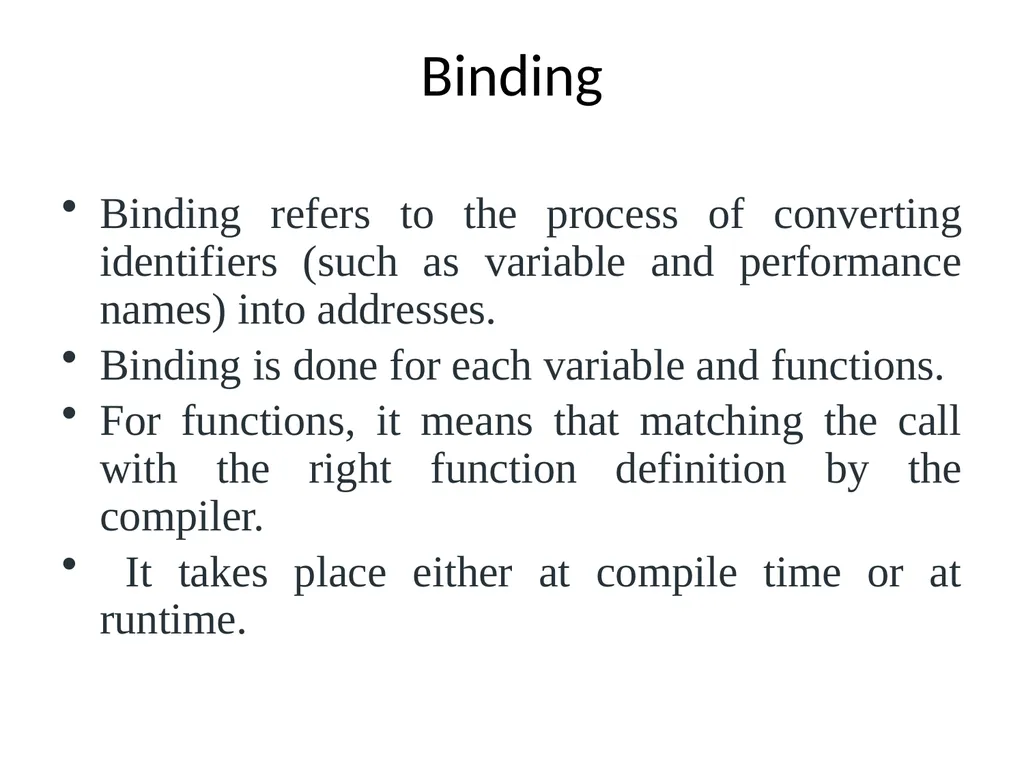
Binding Binding refers to the process of converting identifiers (such as variable and performance names) into addresses.
Binding is done for each variable and functions.
For functions, it means that matching the call with the right function definition by the compiler.
It takes place either at compile time or at runtime.<br>
Binding is done for each variable and functions.
For functions, it means that matching the call with the right function definition by the compiler.
It takes place either at compile time or at runtime.<br>
03
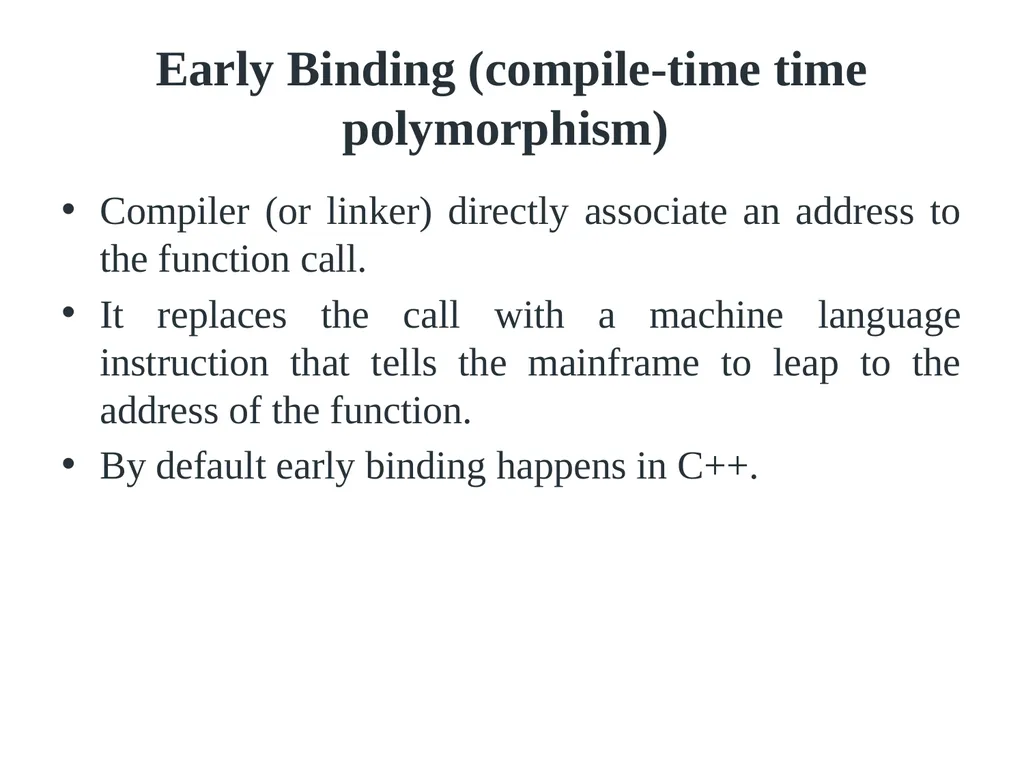
Early Binding (compile-time time polymorphism) Compiler (or linker) directly associate an address to the function call.
It replaces the call with a machine language instruction that tells the mainframe to leap to the address of the function.
By default early binding happens in C++.<br>
It replaces the call with a machine language instruction that tells the mainframe to leap to the address of the function.
By default early binding happens in C++.<br>
04
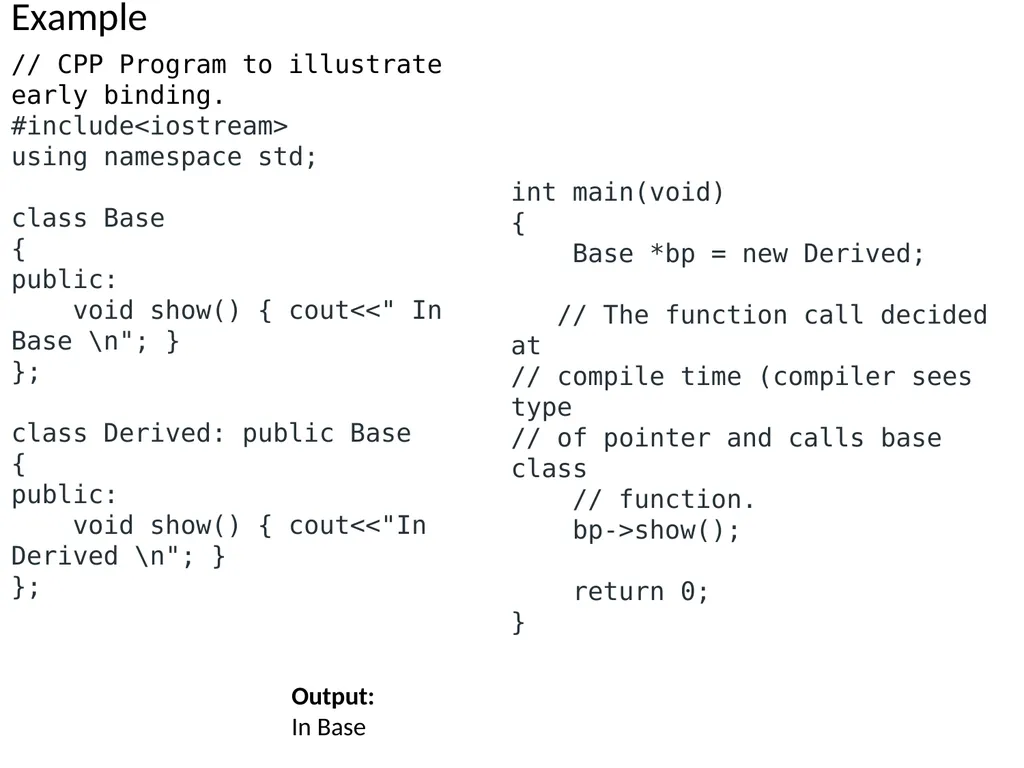
Example // CPP Program to illustrate early binding.
#include<iostream>
using namespace std;
class Base
{
public:
void show() { cout<<" In Base \n"; }
};
class Derived: public Base
{
public:
void show() { cout<<"In Derived \n"; }
}; int main(void)
{
Base *bp = new Derived;
// The function call decided at
// compile time (compiler sees type
// of pointer and calls base class
// function.
bp->show();
return 0;
} Output:
In Base<br>
#include<iostream>
using namespace std;
class Base
{
public:
void show() { cout<<" In Base \n"; }
};
class Derived: public Base
{
public:
void show() { cout<<"In Derived \n"; }
}; int main(void)
{
Base *bp = new Derived;
// The function call decided at
// compile time (compiler sees type
// of pointer and calls base class
// function.
bp->show();
return 0;
} Output:
In Base<br>
05
Late Binding : (Run time polymorphism) In this, the compiler adds code that identifies the kind of object at runtime then matches the call with the right function definition.<br>
06
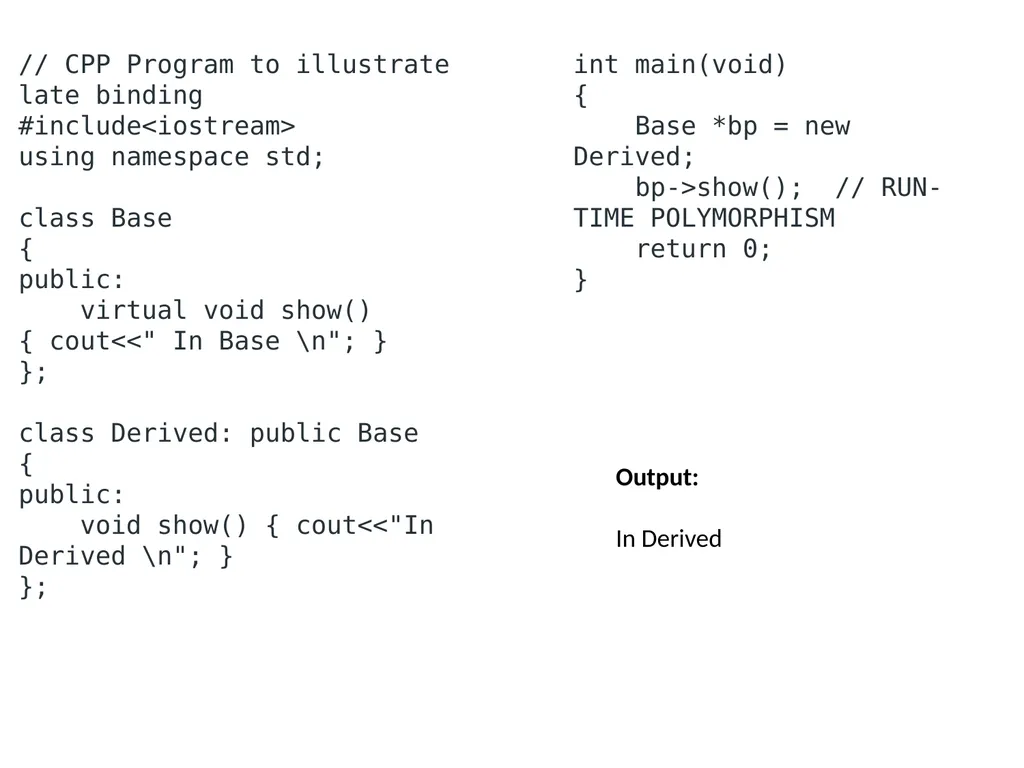
// CPP Program to illustrate late binding
#include<iostream>
using namespace std;
class Base
{
public:
virtual void show() { cout<<" In Base \n"; }
};
class Derived: public Base
{
public:
void show() { cout<<"In Derived \n"; }
}; int main(void)
{
Base *bp = new Derived;
bp->show(); // RUN-TIME POLYMORPHISM
return 0;
} Output:
In Derived<br>
#include<iostream>
using namespace std;
class Base
{
public:
virtual void show() { cout<<" In Base \n"; }
};
class Derived: public Base
{
public:
void show() { cout<<"In Derived \n"; }
}; int main(void)
{
Base *bp = new Derived;
bp->show(); // RUN-TIME POLYMORPHISM
return 0;
} Output:
In Derived<br>
07
Virtual Function A virtual function is a member function in the base class that we expect to redefine in derived classes.
A 'virtual' is a keyword preceding the normal declaration of a function.
When the function is made virtual, C++ determines which function is to be invoked at the runtime based on the type of the object pointed by the base class pointer.<br>
A 'virtual' is a keyword preceding the normal declaration of a function.
When the function is made virtual, C++ determines which function is to be invoked at the runtime based on the type of the object pointed by the base class pointer.<br>
08
A virtual function is a member function which is declared within a base class and is overridden by a derived class. Now, when you refer to a derived class object using a pointer to the base class, you can call a virtual function for that object and execute the derived class’s version of that particular function.<br>
09
Rules of Virtual Function Virtual functions must be members of some class.
Virtual functions cannot be static members.
They are accessed through object pointers.
They can be a friend of another class.
A virtual function must be defined in the base class, even though it is not used.
The prototypes of a virtual function of the base class and all the derived classes must be identical. If the two functions with the same name but different prototypes, C++ will consider them as the overloaded functions.
We cannot have a virtual constructor, but we can have a virtual destructor<br>
Virtual functions cannot be static members.
They are accessed through object pointers.
They can be a friend of another class.
A virtual function must be defined in the base class, even though it is not used.
The prototypes of a virtual function of the base class and all the derived classes must be identical. If the two functions with the same name but different prototypes, C++ will consider them as the overloaded functions.
We cannot have a virtual constructor, but we can have a virtual destructor<br>
10
#include <iostream>
using namespace std;
class Base {
public:
virtual void print() {
cout << "Base Function" << endl;
}
};
class Derived : public Base {
public:
void print() {
cout << "Derived Function" << endl;
}
}; int main() {
Derived derived1;
// pointer of Base type that points to derived1
Base* base1 = &derived1;
// calls member function of Derived class
base1->print();
return 0;
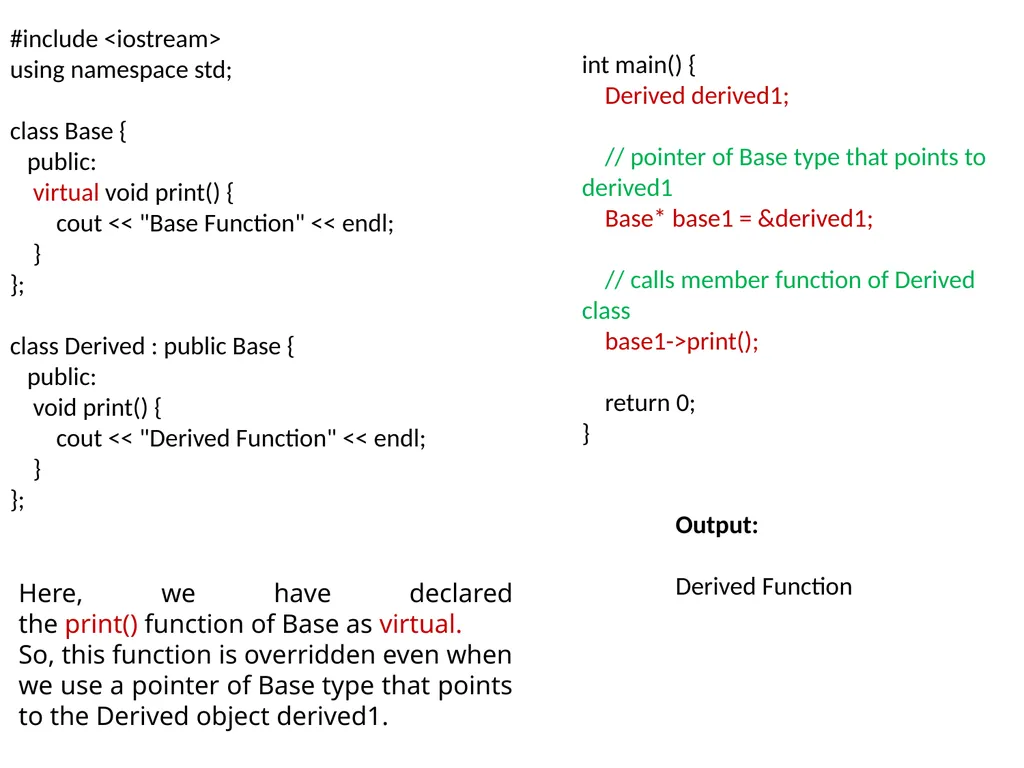
} Here, we have declared the print() function of Base as virtual.
So, this function is overridden even when we use a pointer of Base type that points to the Derived object derived1. Output:
Derived Function<br>
using namespace std;
class Base {
public:
virtual void print() {
cout << "Base Function" << endl;
}
};
class Derived : public Base {
public:
void print() {
cout << "Derived Function" << endl;
}
}; int main() {
Derived derived1;
// pointer of Base type that points to derived1
Base* base1 = &derived1;
// calls member function of Derived class
base1->print();
return 0;
} Here, we have declared the print() function of Base as virtual.
So, this function is overridden even when we use a pointer of Base type that points to the Derived object derived1. Output:
Derived Function<br>
11
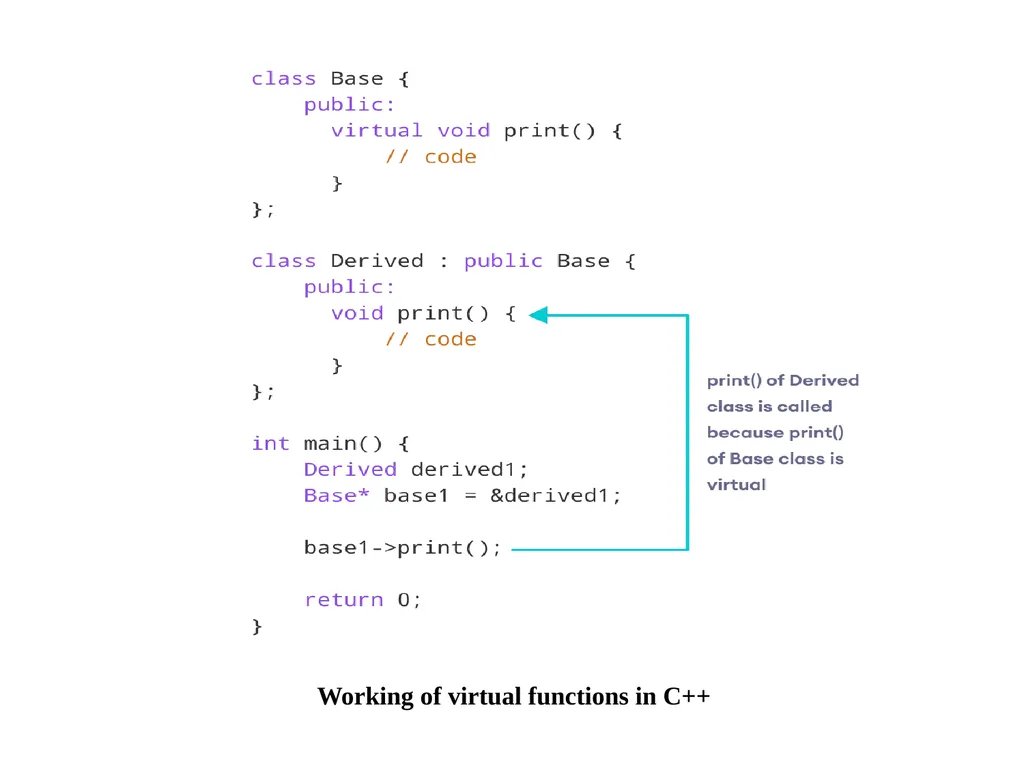
Working of virtual functions in C++<br>
12
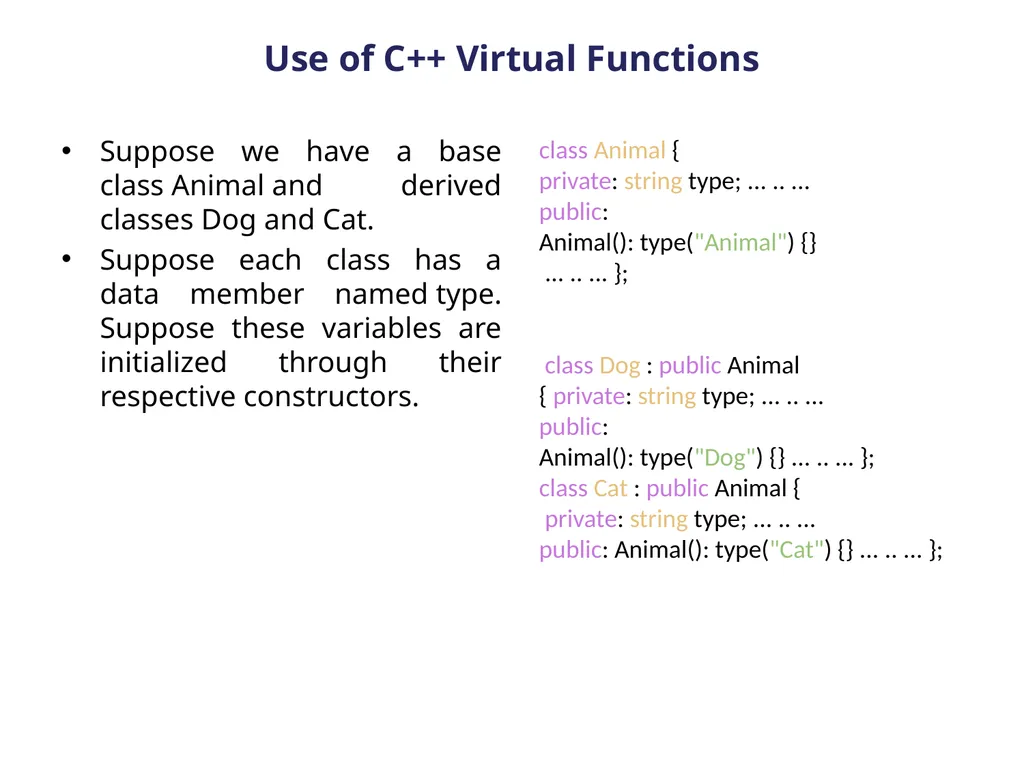
Use of C++ Virtual Functions Suppose we have a base class Animal and derived classes Dog and Cat.
Suppose each class has a data member named type. Suppose these variables are initialized through their respective constructors. class Animal {
private: string type; ... .. ...
public:
Animal(): type("Animal") {}
... .. ... };
class Dog : public Animal
{ private: string type; ... .. ...
public:
Animal(): type("Dog") {} ... .. ... };
class Cat : public Animal {
private: string type; ... .. ...
public: Animal(): type("Cat") {} ... .. ... };<br>
Suppose each class has a data member named type. Suppose these variables are initialized through their respective constructors. class Animal {
private: string type; ... .. ...
public:
Animal(): type("Animal") {}
... .. ... };
class Dog : public Animal
{ private: string type; ... .. ...
public:
Animal(): type("Dog") {} ... .. ... };
class Cat : public Animal {
private: string type; ... .. ...
public: Animal(): type("Cat") {} ... .. ... };<br>
13
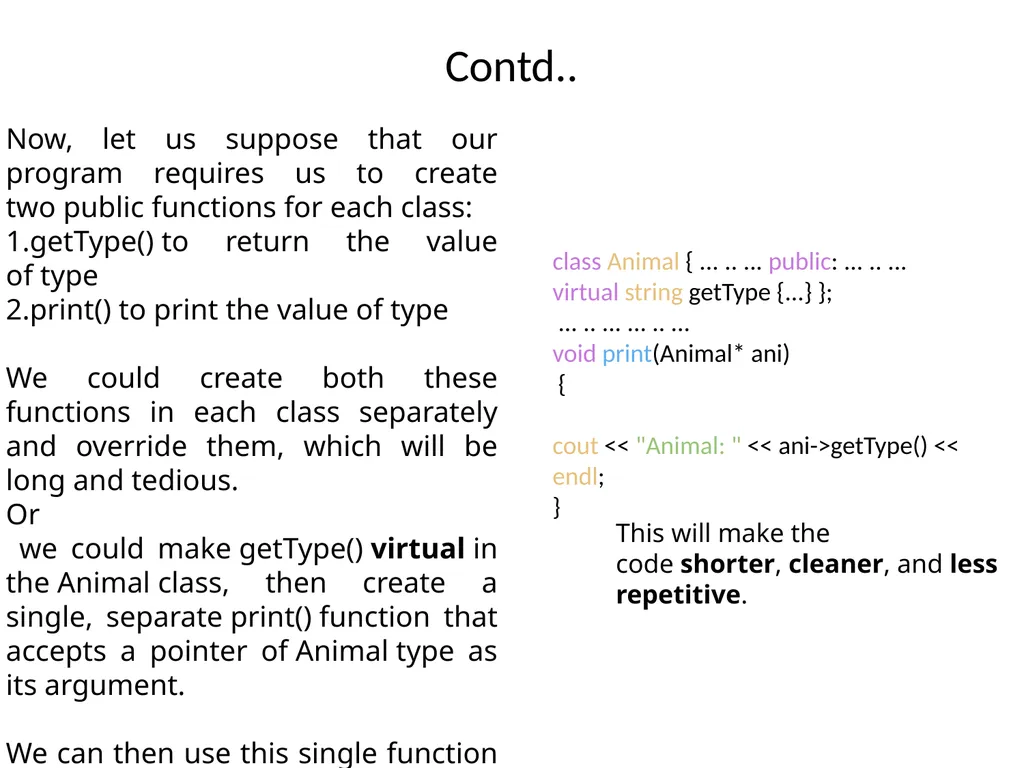
Contd.. Now, let us suppose that our program requires us to create two public functions for each class:
getType() to return the value of type
print() to print the value of type
We could create both these functions in each class separately and override them, which will be long and tedious.
Or
we could make getType() virtual in the Animal class, then create a single, separate print() function that accepts a pointer of Animal type as its argument.
We can then use this single function to override the virtual function. class Animal { ... .. ... public: ... .. ...
virtual string getType {...} };
... .. ... ... .. ...
void print(Animal* ani)
{
cout << "Animal: " << ani->getType() << endl;
} This will make the code shorter, cleaner, and less repetitive.<br>
getType() to return the value of type
print() to print the value of type
We could create both these functions in each class separately and override them, which will be long and tedious.
Or
we could make getType() virtual in the Animal class, then create a single, separate print() function that accepts a pointer of Animal type as its argument.
We can then use this single function to override the virtual function. class Animal { ... .. ... public: ... .. ...
virtual string getType {...} };
... .. ... ... .. ...
void print(Animal* ani)
{
cout << "Animal: " << ani->getType() << endl;
} This will make the code shorter, cleaner, and less repetitive.<br>
14
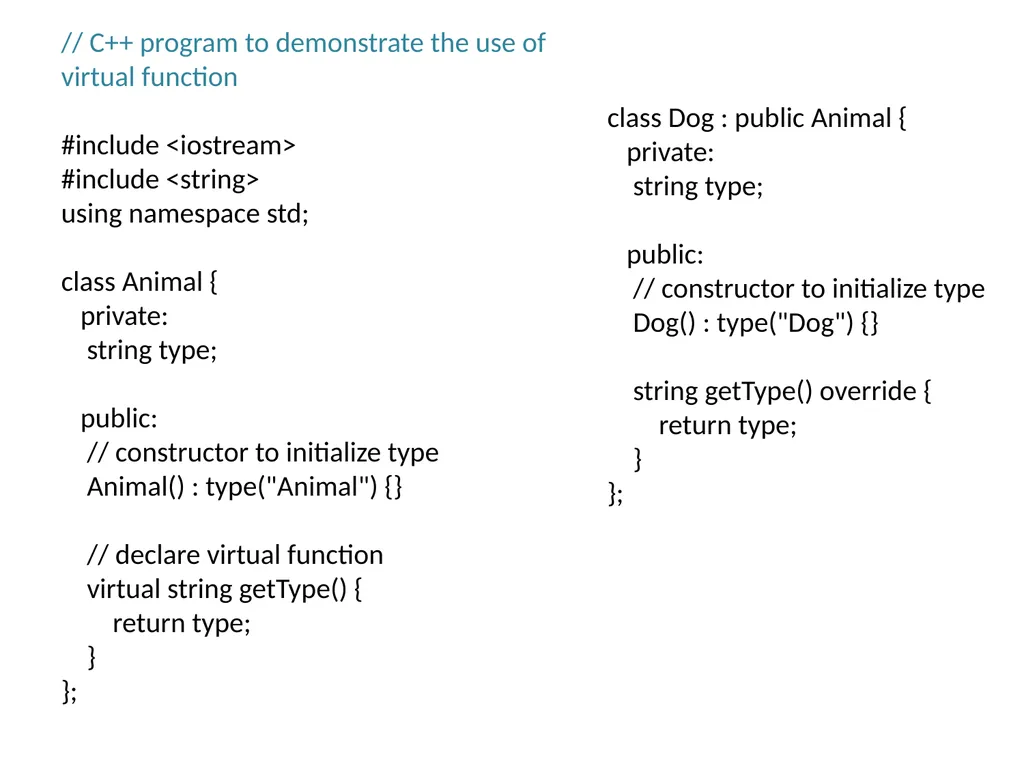
// C++ program to demonstrate the use of virtual function
#include <iostream>
#include <string>
using namespace std;
class Animal {
private:
string type;
public:
// constructor to initialize type
Animal() : type("Animal") {}
// declare virtual function
virtual string getType() {
return type;
}
}; class Dog : public Animal {
private:
string type;
public:
// constructor to initialize type
Dog() : type("Dog") {}
string getType() override {
return type;
}
};<br>
#include <iostream>
#include <string>
using namespace std;
class Animal {
private:
string type;
public:
// constructor to initialize type
Animal() : type("Animal") {}
// declare virtual function
virtual string getType() {
return type;
}
}; class Dog : public Animal {
private:
string type;
public:
// constructor to initialize type
Dog() : type("Dog") {}
string getType() override {
return type;
}
};<br>
15
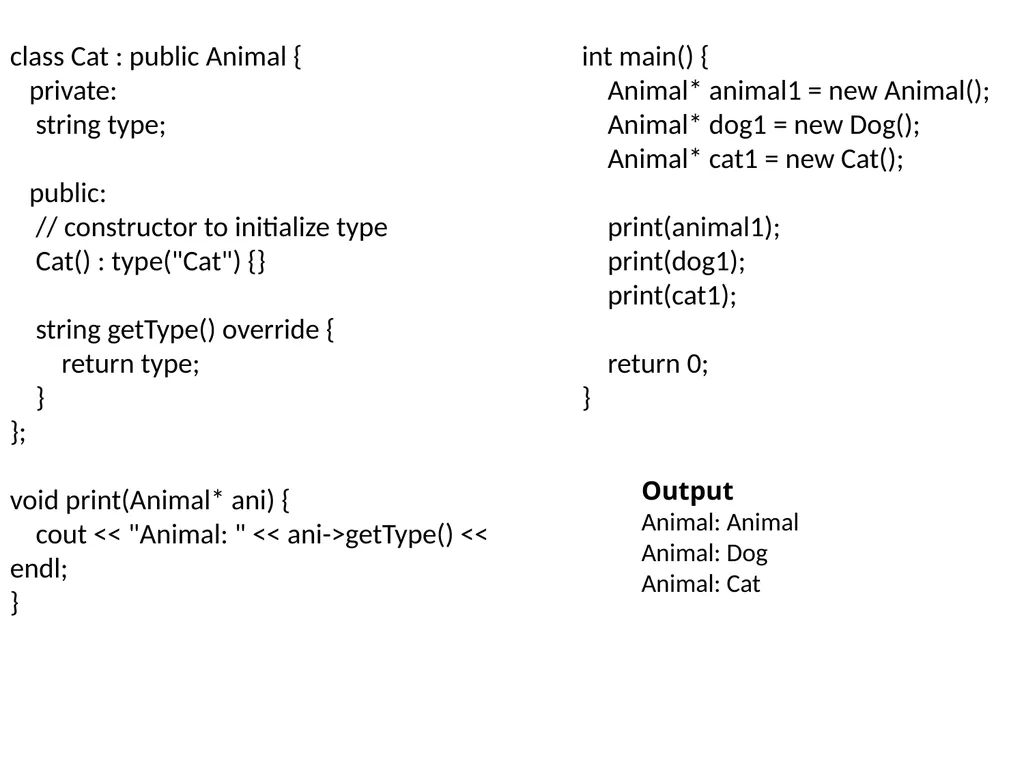
class Cat : public Animal {
private:
string type;
public:
// constructor to initialize type
Cat() : type("Cat") {}
string getType() override {
return type;
}
};
void print(Animal* ani) {
cout << "Animal: " << ani->getType() << endl;
} int main() {
Animal* animal1 = new Animal();
Animal* dog1 = new Dog();
Animal* cat1 = new Cat();
print(animal1);
print(dog1);
print(cat1);
return 0;
} Output
Animal: Animal
Animal: Dog
Animal: Cat<br>
private:
string type;
public:
// constructor to initialize type
Cat() : type("Cat") {}
string getType() override {
return type;
}
};
void print(Animal* ani) {
cout << "Animal: " << ani->getType() << endl;
} int main() {
Animal* animal1 = new Animal();
Animal* dog1 = new Dog();
Animal* cat1 = new Cat();
print(animal1);
print(dog1);
print(cat1);
return 0;
} Output
Animal: Animal
Animal: Dog
Animal: Cat<br>
16
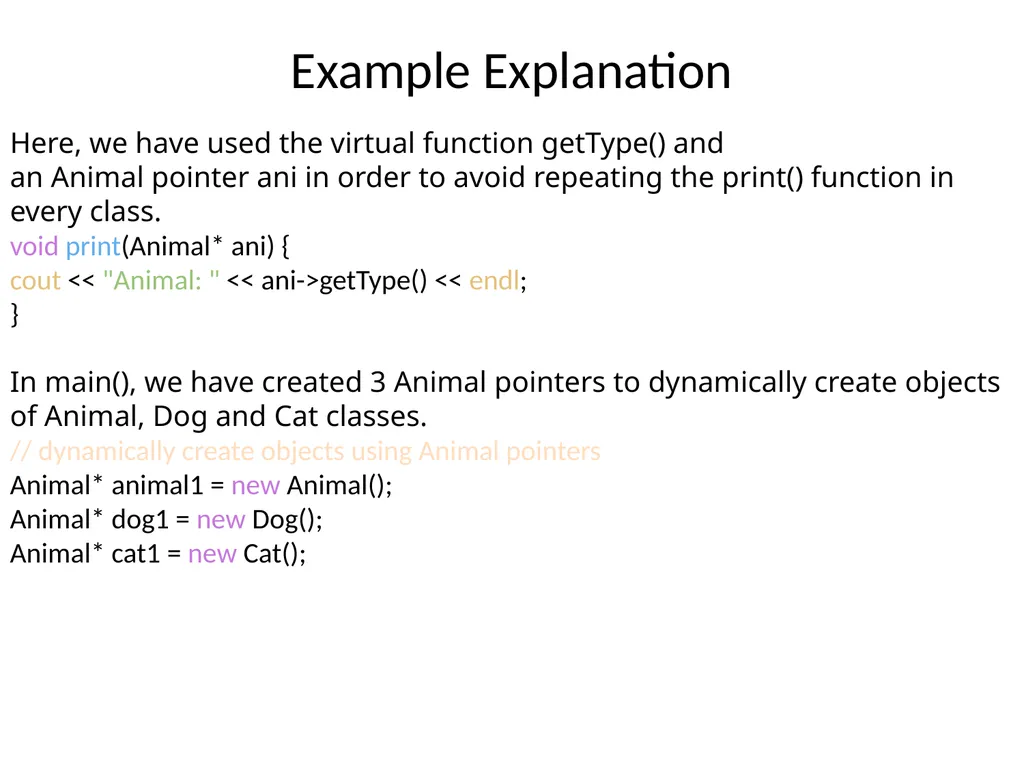
Example Explanation Here, we have used the virtual function getType() and an Animal pointer ani in order to avoid repeating the print() function in every class.
void print(Animal* ani) {
cout << "Animal: " << ani->getType() << endl;
}
In main(), we have created 3 Animal pointers to dynamically create objects of Animal, Dog and Cat classes.
// dynamically create objects using Animal pointers
Animal* animal1 = new Animal();
Animal* dog1 = new Dog();
Animal* cat1 = new Cat();<br>
void print(Animal* ani) {
cout << "Animal: " << ani->getType() << endl;
}
In main(), we have created 3 Animal pointers to dynamically create objects of Animal, Dog and Cat classes.
// dynamically create objects using Animal pointers
Animal* animal1 = new Animal();
Animal* dog1 = new Dog();
Animal* cat1 = new Cat();<br>
17
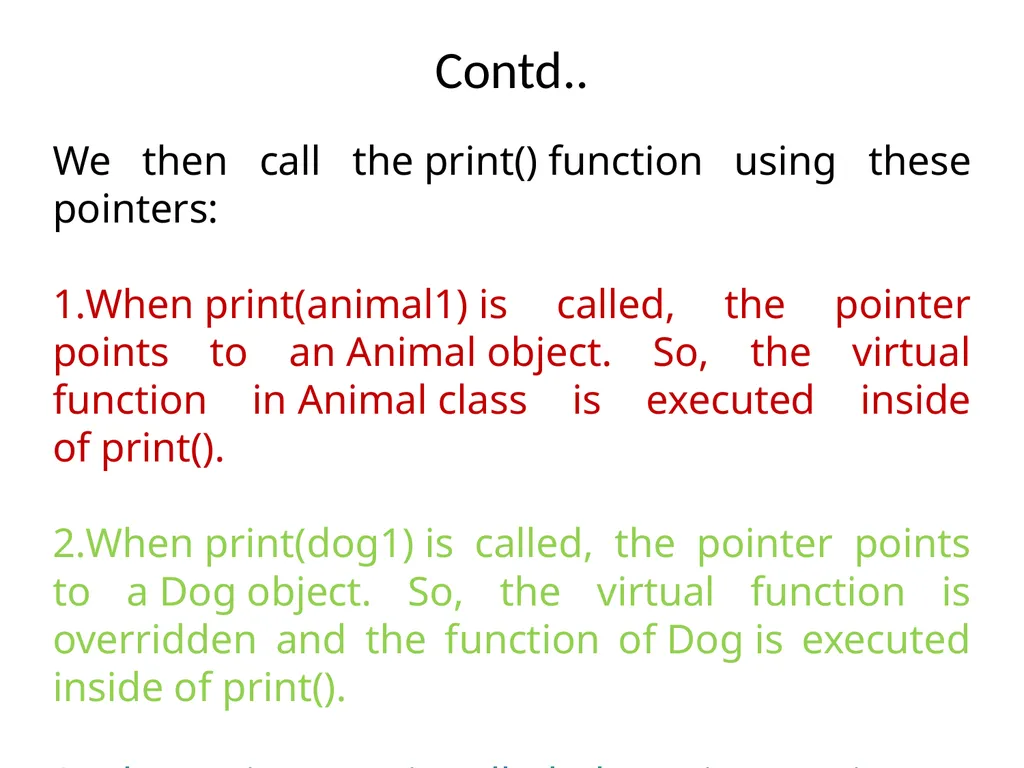
Contd.. We then call the print() function using these pointers:
When print(animal1) is called, the pointer points to an Animal object. So, the virtual function in Animal class is executed inside of print().
When print(dog1) is called, the pointer points to a Dog object. So, the virtual function is overridden and the function of Dog is executed inside of print().
When print(cat1) is called, the pointer points to a Cat object. So, the virtual function is overridden and the function of Cat is executed inside of print().<br>
When print(animal1) is called, the pointer points to an Animal object. So, the virtual function in Animal class is executed inside of print().
When print(dog1) is called, the pointer points to a Dog object. So, the virtual function is overridden and the function of Dog is executed inside of print().
When print(cat1) is called, the pointer points to a Cat object. So, the virtual function is overridden and the function of Cat is executed inside of print().<br>
18
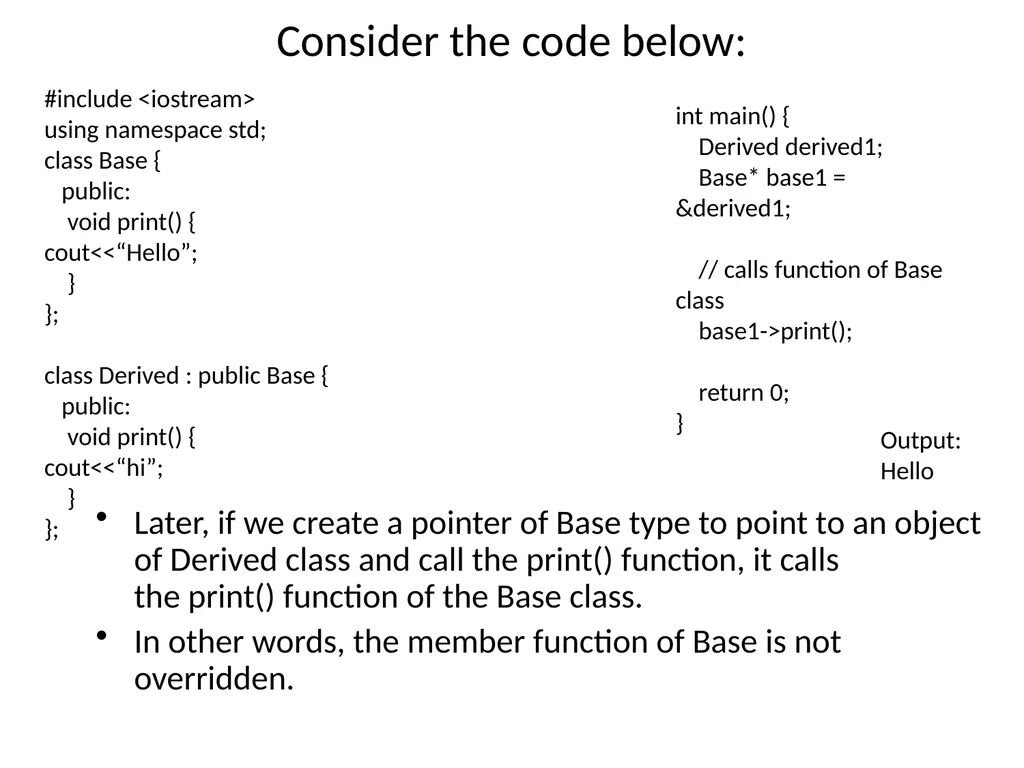
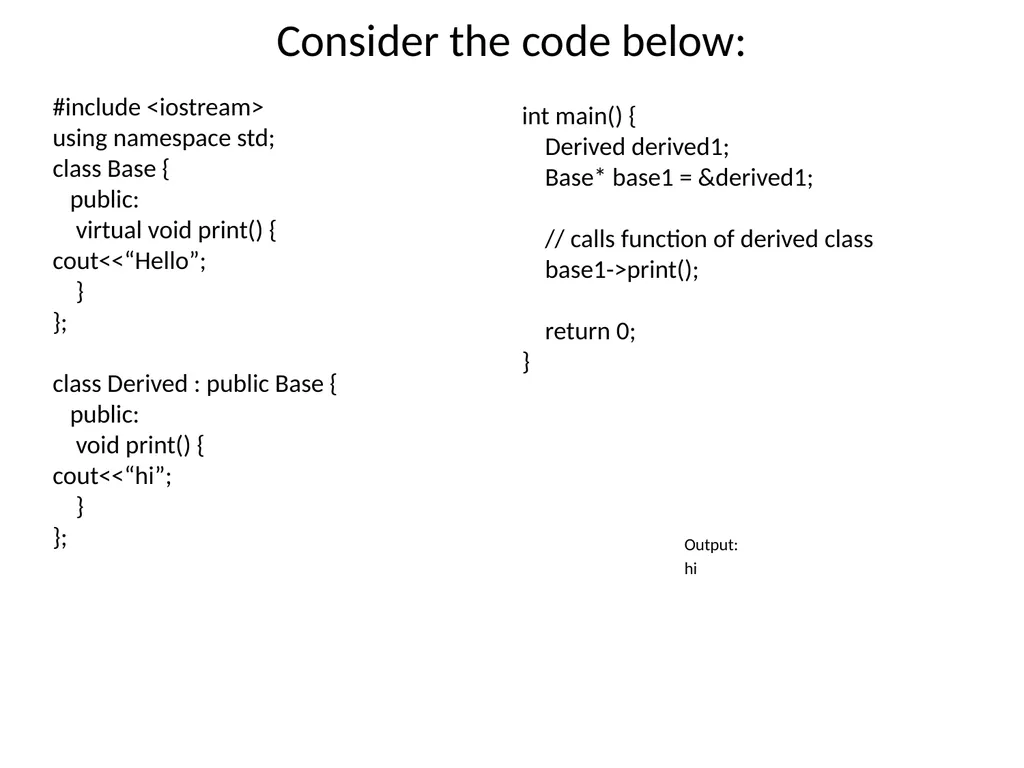
Consider the code below: Later, if we create a pointer of Base type to point to an object of Derived class and call the print() function, it calls the print() function of the Base class.
In other words, the member function of Base is not overridden. #include <iostream>
using namespace std;
class Base {
public:
void print() {
cout<<“Hello”;
}
};
class Derived : public Base {
public:
void print() {
cout<<“hi”;
}
}; int main() {
Derived derived1;
Base* base1 = &derived1;
// calls function of Base class
base1->print();
return 0;
} Output:
Hello<br>
In other words, the member function of Base is not overridden. #include <iostream>
using namespace std;
class Base {
public:
void print() {
cout<<“Hello”;
}
};
class Derived : public Base {
public:
void print() {
cout<<“hi”;
}
}; int main() {
Derived derived1;
Base* base1 = &derived1;
// calls function of Base class
base1->print();
return 0;
} Output:
Hello<br>
19
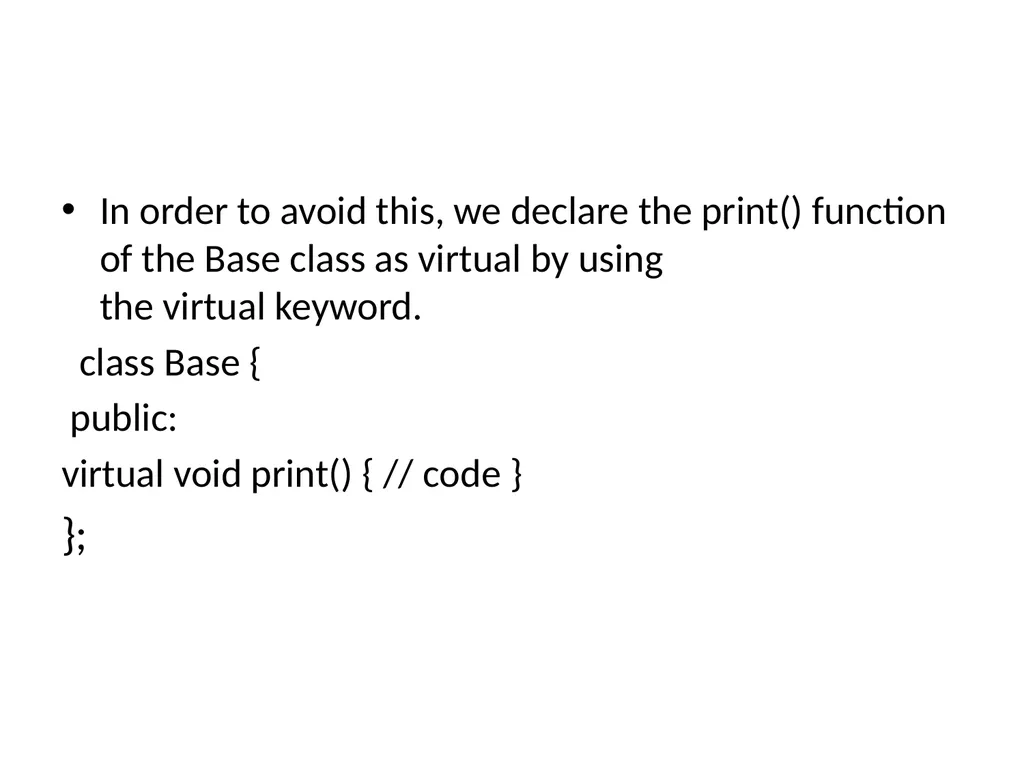
In order to avoid this, we declare the print() function of the Base class as virtual by using the virtual keyword.
class Base {
public:
virtual void print() { // code }
};<br>
class Base {
public:
virtual void print() { // code }
};<br>
20
Consider the code below: Output:
hi #include <iostream>
using namespace std;
class Base {
public:
virtual void print() {
cout<<“Hello”;
}
};
class Derived : public Base {
public:
void print() {
cout<<“hi”;
}
}; int main() {
Derived derived1;
Base* base1 = &derived1;
// calls function of derived class
base1->print();
return 0;
}<br>
hi #include <iostream>
using namespace std;
class Base {
public:
virtual void print() {
cout<<“Hello”;
}
};
class Derived : public Base {
public:
void print() {
cout<<“hi”;
}
}; int main() {
Derived derived1;
Base* base1 = &derived1;
// calls function of derived class
base1->print();
return 0;
}<br>
21
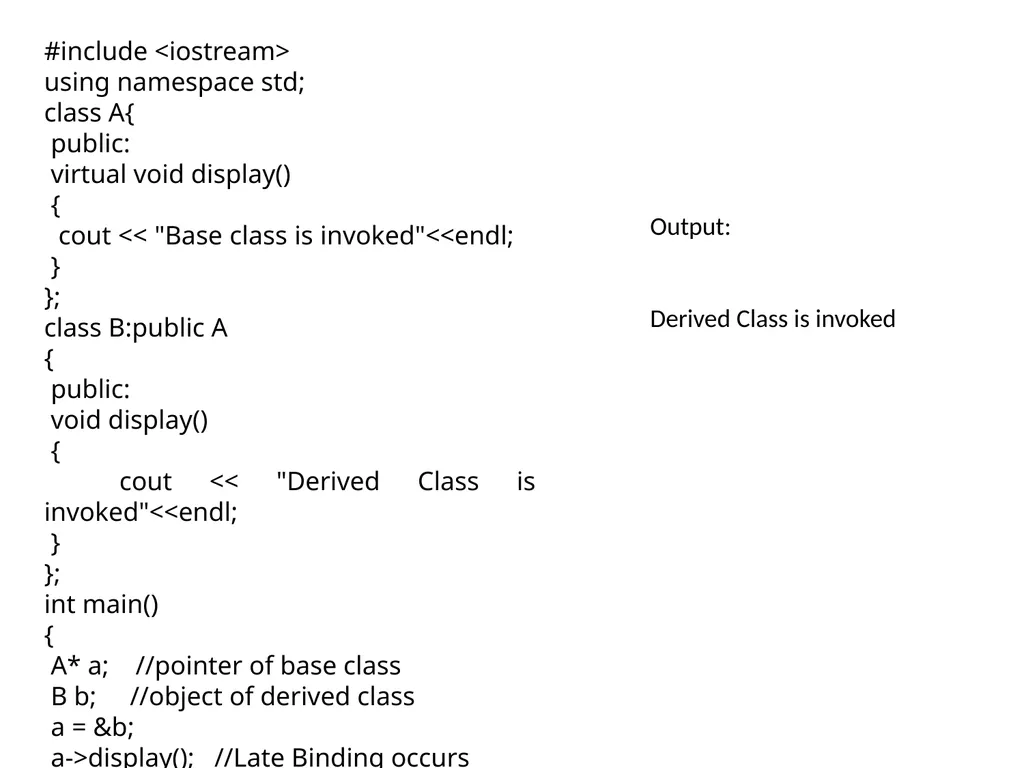
#include <iostream>
using namespace std;
class A{
public:
virtual void display()
{
cout << "Base class is invoked"<<endl;
}
};
class B:public A
{
public:
void display()
{
cout << "Derived Class is invoked"<<endl;
}
};
int main()
{
A* a; //pointer of base class
B b; //object of derived class
a = &b;
a->display(); //Late Binding occurs
} Output:
Derived Class is invoked<br>
using namespace std;
class A{
public:
virtual void display()
{
cout << "Base class is invoked"<<endl;
}
};
class B:public A
{
public:
void display()
{
cout << "Derived Class is invoked"<<endl;
}
};
int main()
{
A* a; //pointer of base class
B b; //object of derived class
a = &b;
a->display(); //Late Binding occurs
} Output:
Derived Class is invoked<br>
22
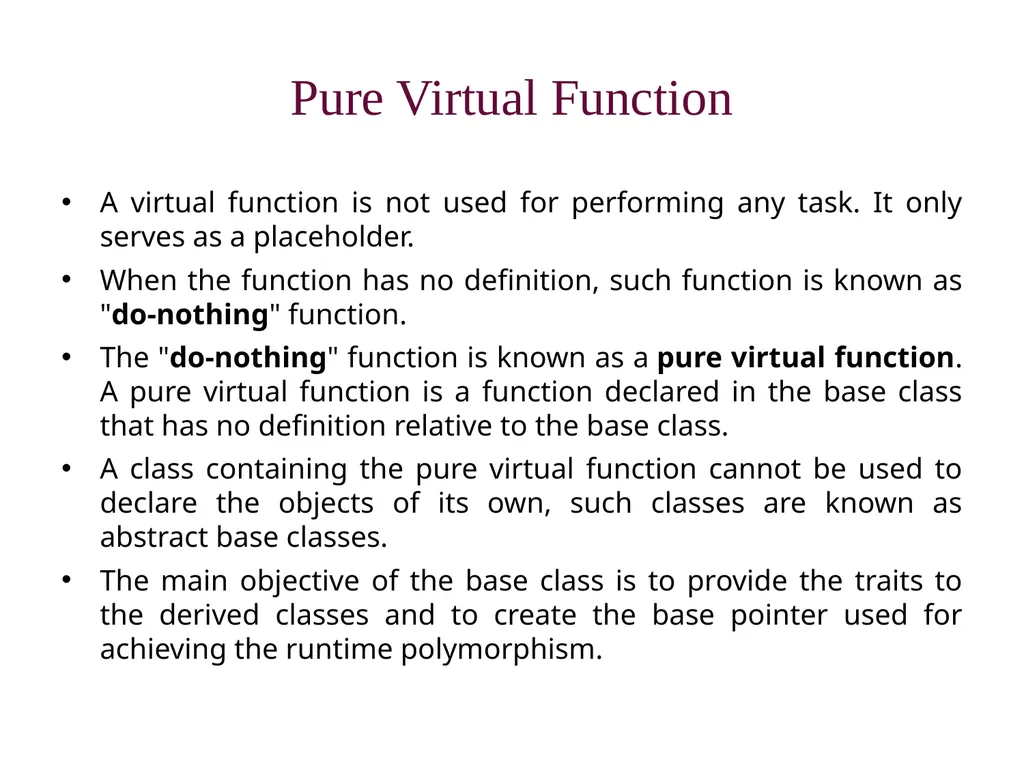
Pure Virtual Function A virtual function is not used for performing any task. It only serves as a placeholder.
When the function has no definition, such function is known as "do-nothing" function.
The "do-nothing" function is known as a pure virtual function. A pure virtual function is a function declared in the base class that has no definition relative to the base class.
A class containing the pure virtual function cannot be used to declare the objects of its own, such classes are known as abstract base classes.
The main objective of the base class is to provide the traits to the derived classes and to create the base pointer used for achieving the runtime polymorphism.<br>
When the function has no definition, such function is known as "do-nothing" function.
The "do-nothing" function is known as a pure virtual function. A pure virtual function is a function declared in the base class that has no definition relative to the base class.
A class containing the pure virtual function cannot be used to declare the objects of its own, such classes are known as abstract base classes.
The main objective of the base class is to provide the traits to the derived classes and to create the base pointer used for achieving the runtime polymorphism.<br>
23
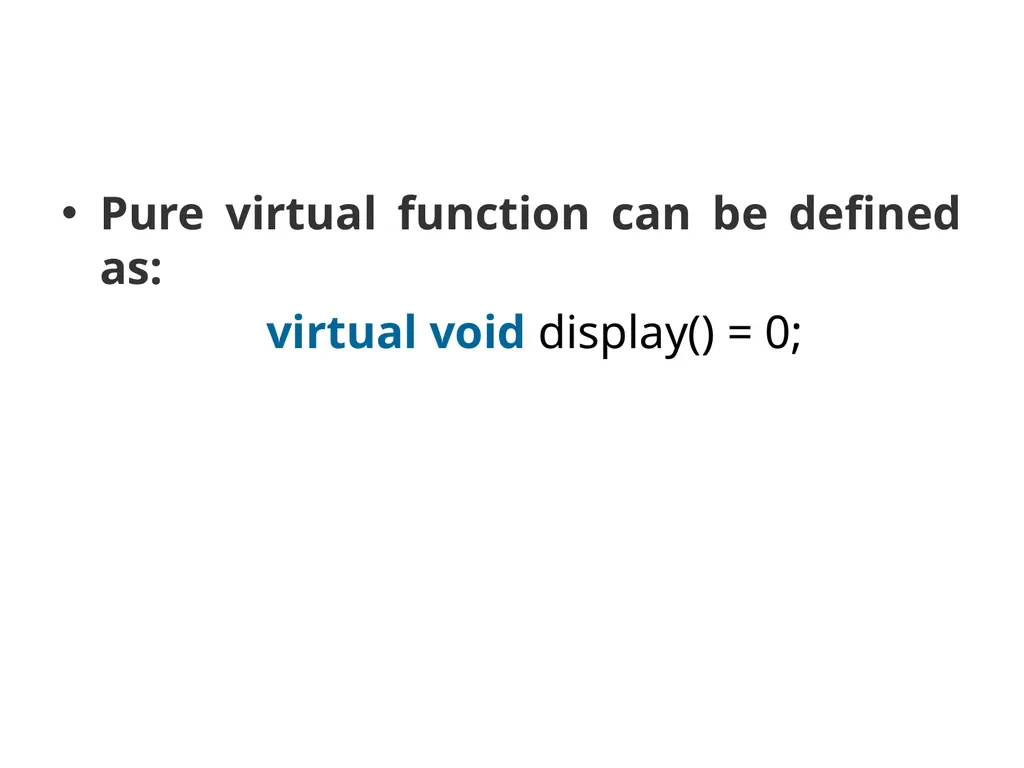
Pure virtual function can be defined as:
virtual void display() = 0;<br>
virtual void display() = 0;<br>
24
#include <iostream>
using namespace std;
class Base
{
public:
virtual void show() = 0;
};
class Derived : public Base
{
public:
void show()
{
std::cout << "Derived class is derived from the base class." << std::endl;
}
};
int main()
{
Base *bptr;
//Base b;
Derived d;
bptr = &d;
bptr->show();
return 0;
} Output:
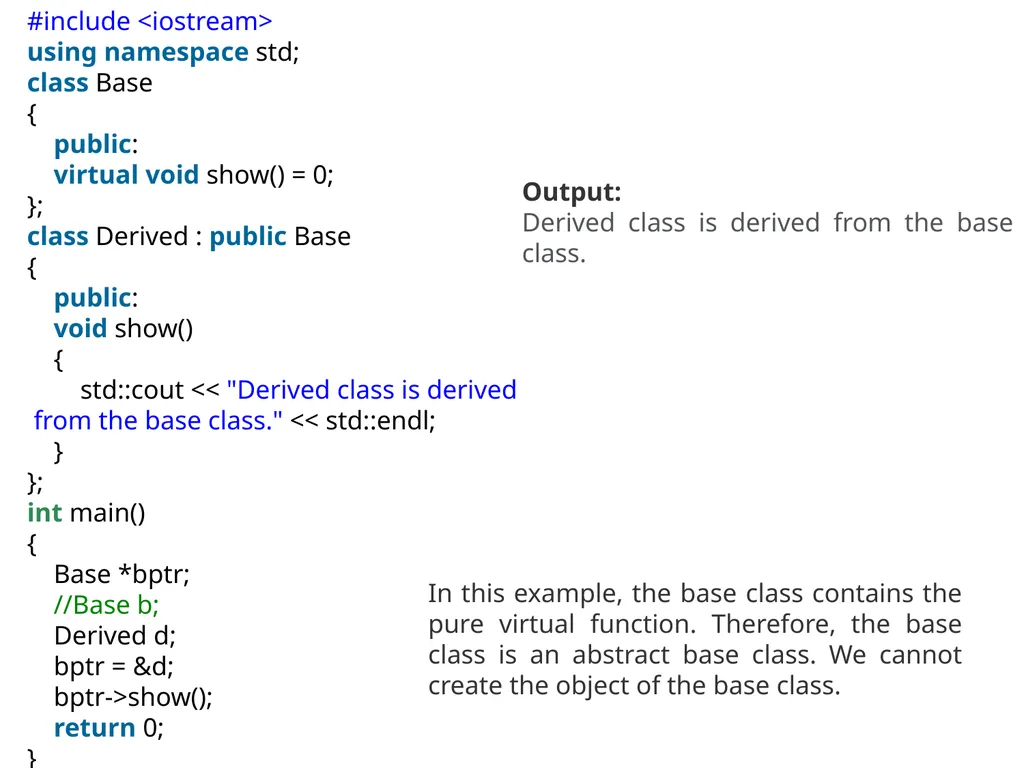
Derived class is derived from the base class. In this example, the base class contains the pure virtual function. Therefore, the base class is an abstract base class. We cannot create the object of the base class.<br>
using namespace std;
class Base
{
public:
virtual void show() = 0;
};
class Derived : public Base
{
public:
void show()
{
std::cout << "Derived class is derived from the base class." << std::endl;
}
};
int main()
{
Base *bptr;
//Base b;
Derived d;
bptr = &d;
bptr->show();
return 0;
} Output:
Derived class is derived from the base class. In this example, the base class contains the pure virtual function. Therefore, the base class is an abstract base class. We cannot create the object of the base class.<br>
25
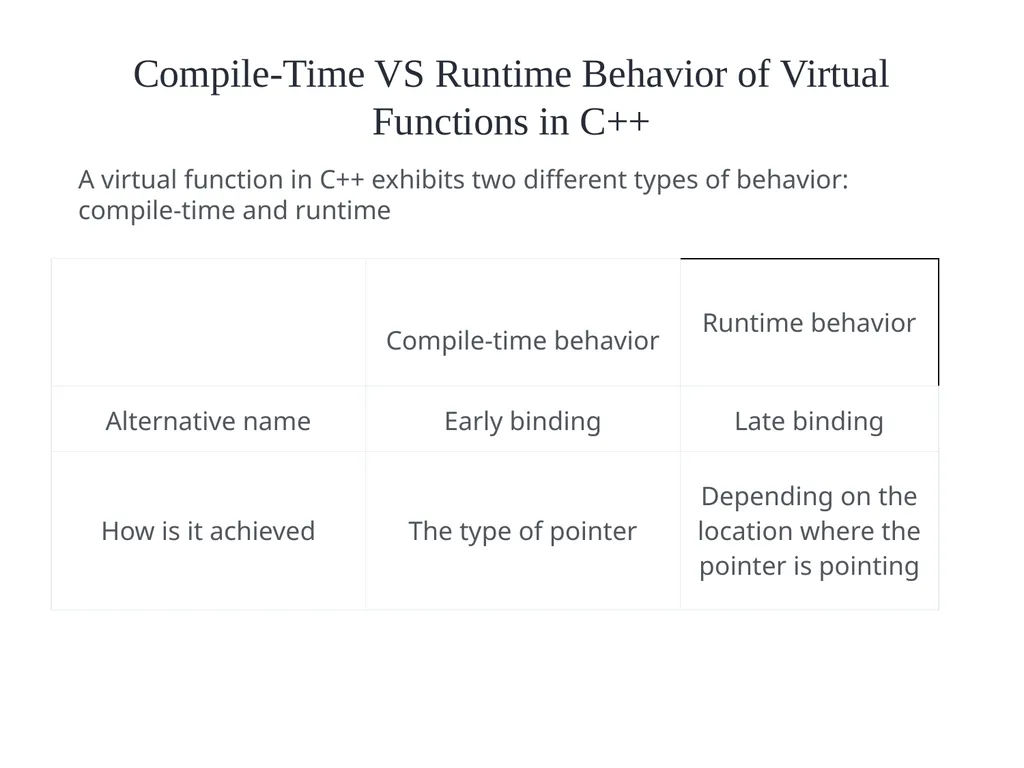
Compile-Time VS Runtime Behavior of Virtual Functions in C++ A virtual function in C++ exhibits two different types of behavior: compile-time and runtime<br>
26
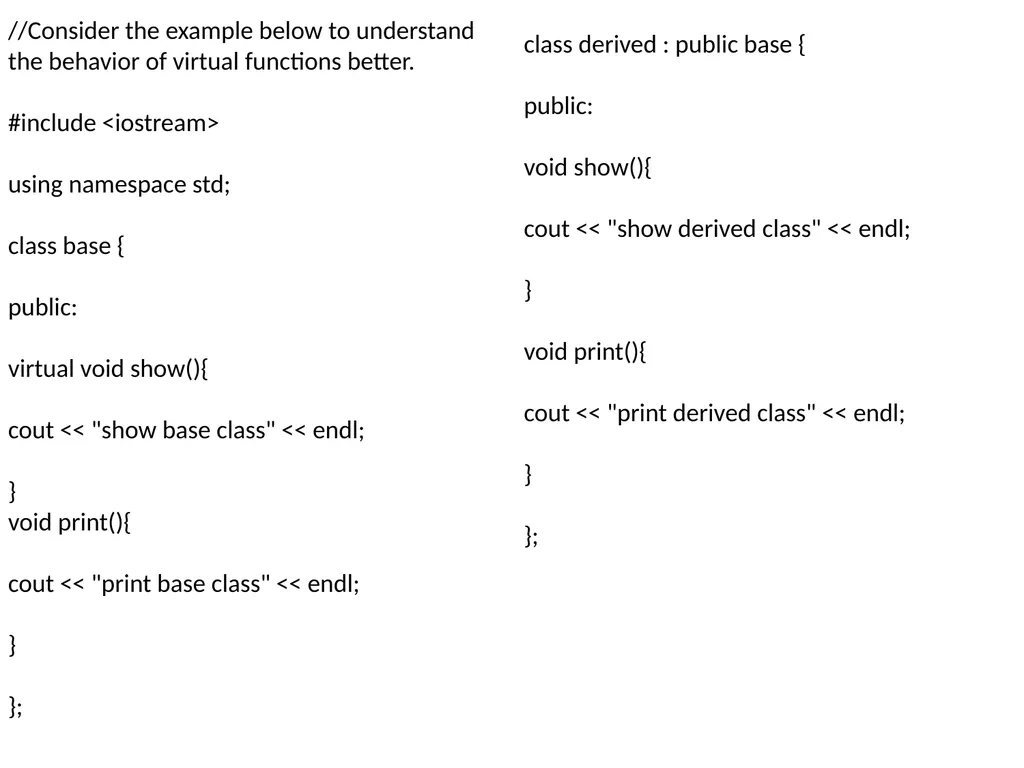
//Consider the example below to understand the behavior of virtual functions better.
#include <iostream>
using namespace std;
class base {
public:
virtual void show(){
cout << "show base class" << endl;
}
void print(){
cout << "print base class" << endl;
}
}; class derived : public base {
public:
void show(){
cout << "show derived class" << endl;
}
void print(){
cout << "print derived class" << endl;
}
};<br>
#include <iostream>
using namespace std;
class base {
public:
virtual void show(){
cout << "show base class" << endl;
}
void print(){
cout << "print base class" << endl;
}
}; class derived : public base {
public:
void show(){
cout << "show derived class" << endl;
}
void print(){
cout << "print derived class" << endl;
}
};<br>
27
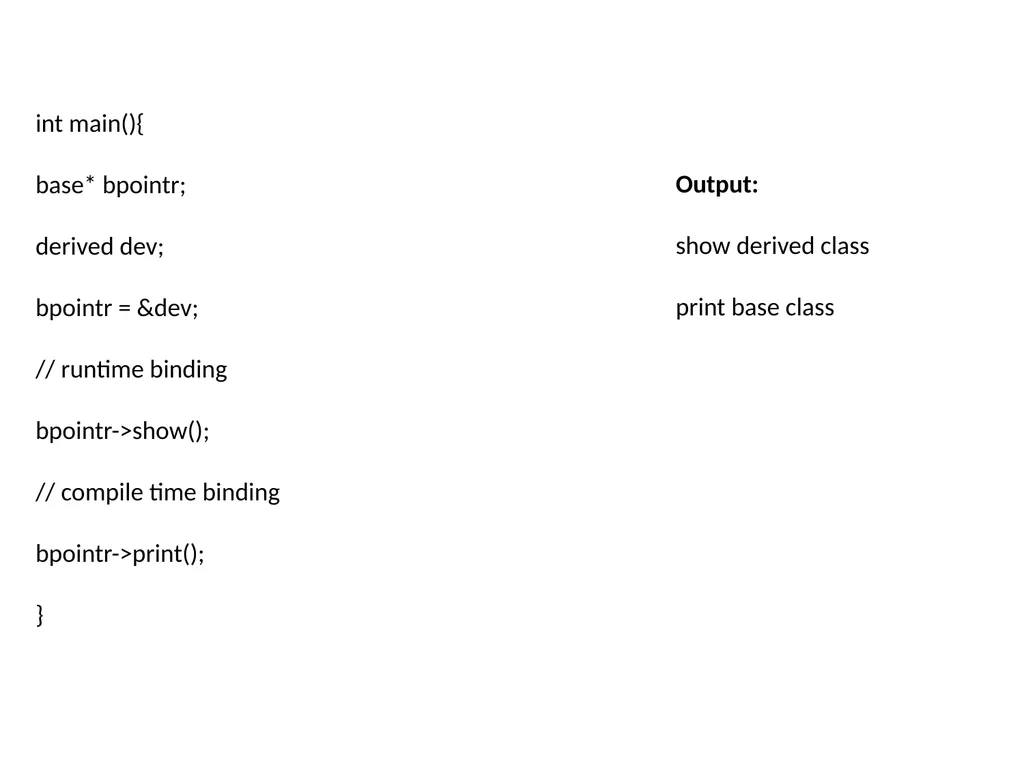
int main(){
base* bpointr;
derived dev;
bpointr = &dev;
// runtime binding
bpointr->show();
// compile time binding
bpointr->print();
} Output:
show derived class
print base class<br>
base* bpointr;
derived dev;
bpointr = &dev;
// runtime binding
bpointr->show();
// compile time binding
bpointr->print();
} Output:
show derived class
print base class<br>
28
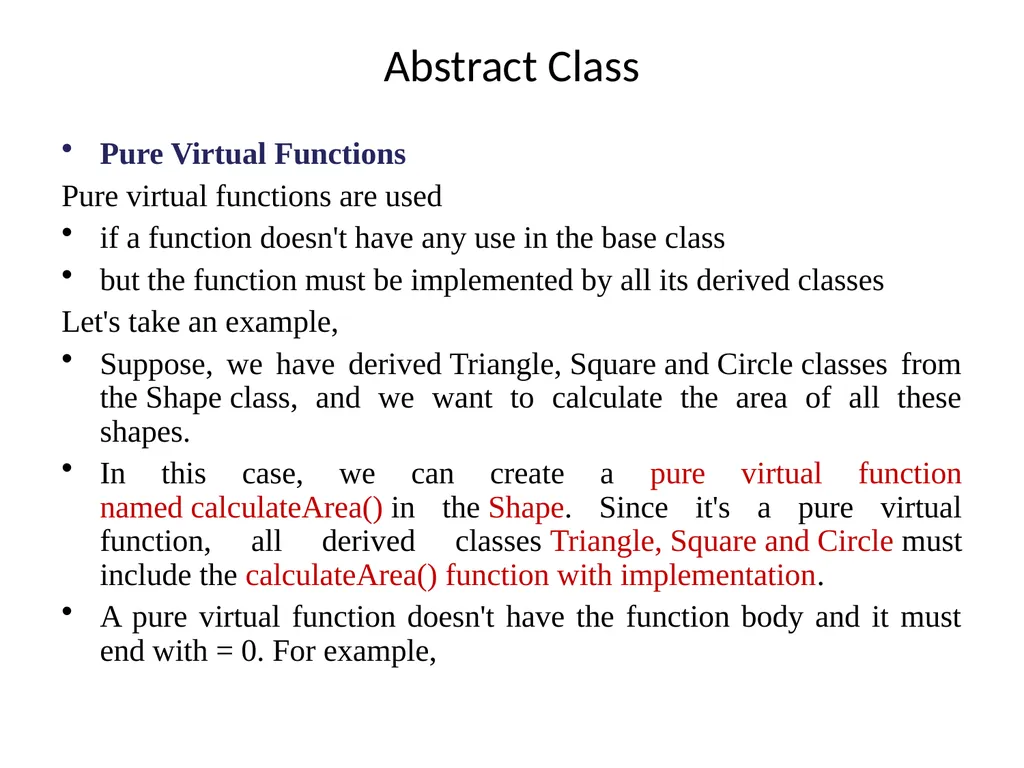
Abstract Class Pure Virtual Functions
Pure virtual functions are used
if a function doesn't have any use in the base class
but the function must be implemented by all its derived classes
Let's take an example,
Suppose, we have derived Triangle, Square and Circle classes from the Shape class, and we want to calculate the area of all these shapes.
In this case, we can create a pure virtual function named calculateArea() in the Shape. Since it's a pure virtual function, all derived classes Triangle, Square and Circle must include the calculateArea() function with implementation.
A pure virtual function doesn't have the function body and it must end with = 0. For example,<br>
Pure virtual functions are used
if a function doesn't have any use in the base class
but the function must be implemented by all its derived classes
Let's take an example,
Suppose, we have derived Triangle, Square and Circle classes from the Shape class, and we want to calculate the area of all these shapes.
In this case, we can create a pure virtual function named calculateArea() in the Shape. Since it's a pure virtual function, all derived classes Triangle, Square and Circle must include the calculateArea() function with implementation.
A pure virtual function doesn't have the function body and it must end with = 0. For example,<br>
29
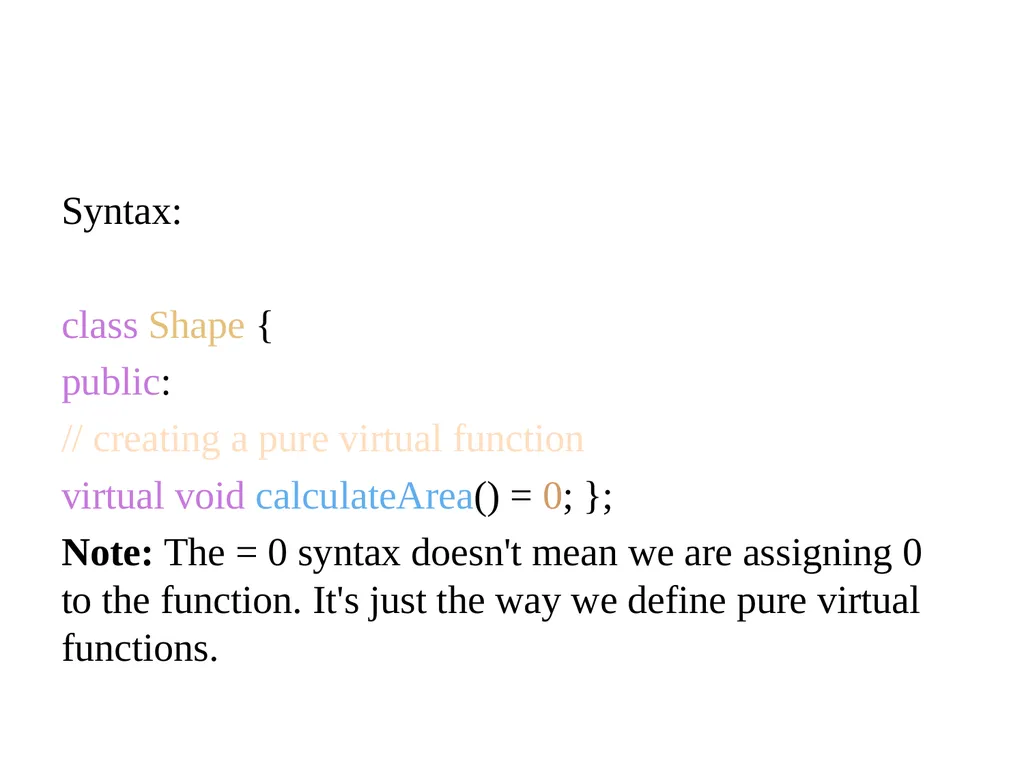
Syntax:
class Shape {
public:
// creating a pure virtual function
virtual void calculateArea() = 0; };
Note: The = 0 syntax doesn't mean we are assigning 0 to the function. It's just the way we define pure virtual functions.<br>
class Shape {
public:
// creating a pure virtual function
virtual void calculateArea() = 0; };
Note: The = 0 syntax doesn't mean we are assigning 0 to the function. It's just the way we define pure virtual functions.<br>
30
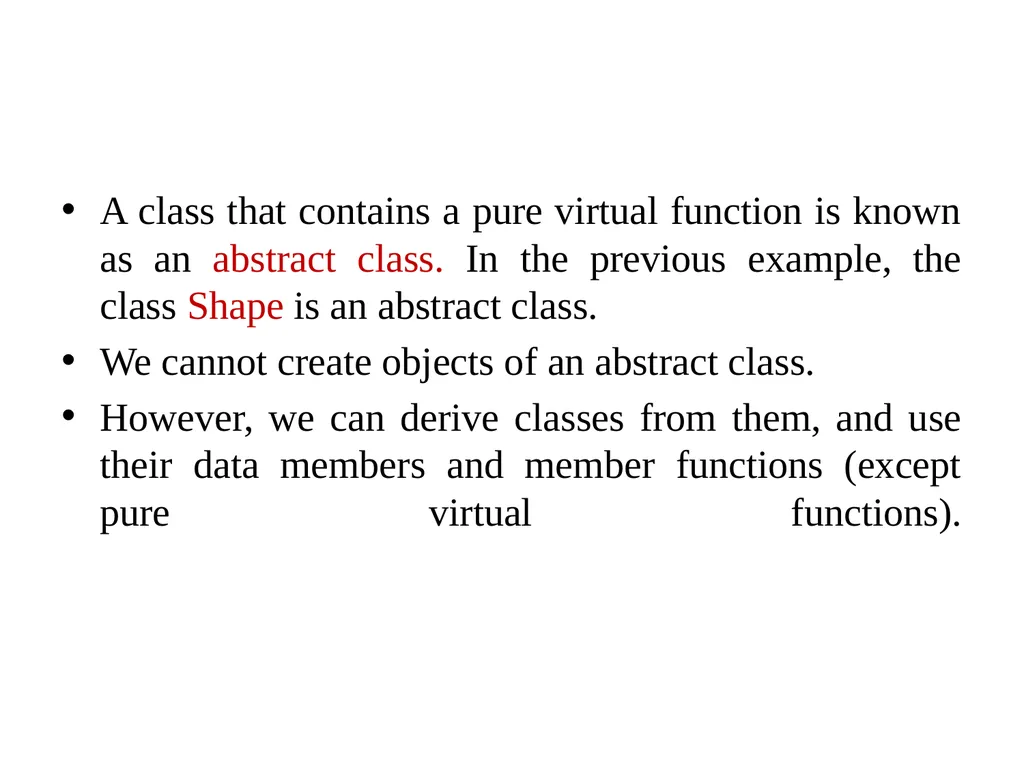
A class that contains a pure virtual function is known as an abstract class. In the previous example, the class Shape is an abstract class.
We cannot create objects of an abstract class.
However, we can derive classes from them, and use their data members and member functions (except pure virtual functions).<br>
We cannot create objects of an abstract class.
However, we can derive classes from them, and use their data members and member functions (except pure virtual functions).<br>
31
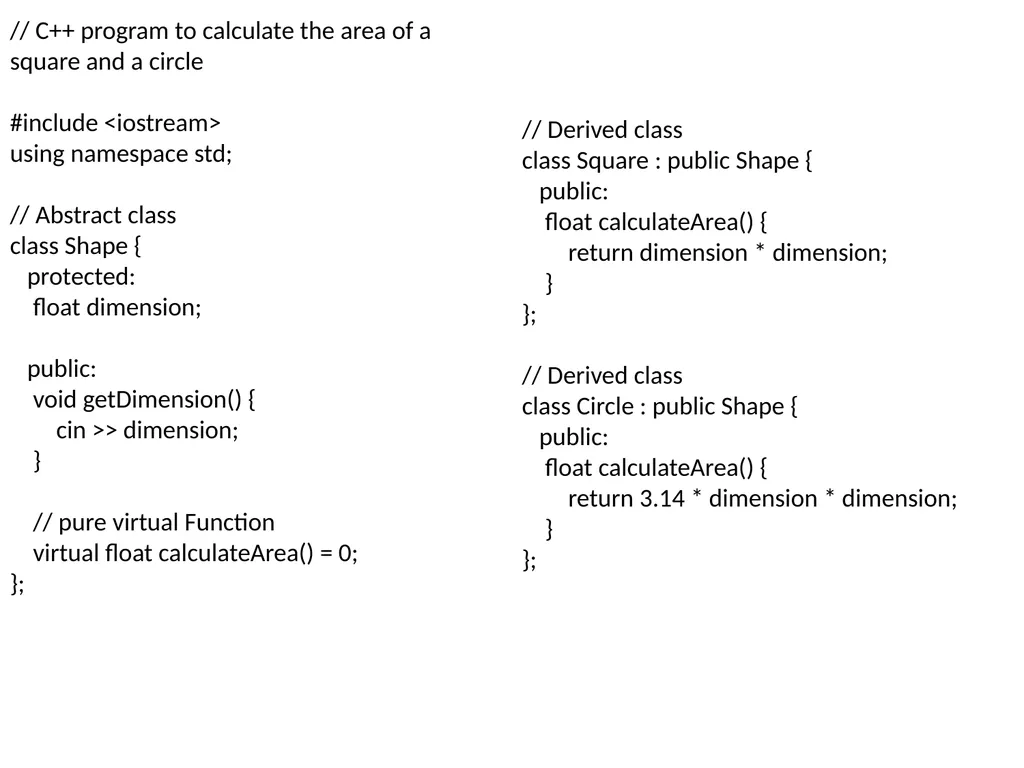
// C++ program to calculate the area of a square and a circle
#include <iostream>
using namespace std;
// Abstract class
class Shape {
protected:
float dimension;
public:
void getDimension() {
cin >> dimension;
}
// pure virtual Function
virtual float calculateArea() = 0;
}; // Derived class
class Square : public Shape {
public:
float calculateArea() {
return dimension * dimension;
}
};
// Derived class
class Circle : public Shape {
public:
float calculateArea() {
return 3.14 * dimension * dimension;
}
};<br>
#include <iostream>
using namespace std;
// Abstract class
class Shape {
protected:
float dimension;
public:
void getDimension() {
cin >> dimension;
}
// pure virtual Function
virtual float calculateArea() = 0;
}; // Derived class
class Square : public Shape {
public:
float calculateArea() {
return dimension * dimension;
}
};
// Derived class
class Circle : public Shape {
public:
float calculateArea() {
return 3.14 * dimension * dimension;
}
};<br>
32
int main() {
Square square;
Circle circle;
cout << "Enter the length of the square: ";
square.getDimension();
cout << "Area of square: " << square.calculateArea() << endl;
cout << "\nEnter radius of the circle: ";
circle.getDimension();
cout << "Area of circle: " << circle.calculateArea() << endl;
return 0;
} Output:
Enter the length of the square: 4
Area of square: 16
Enter radius of the circle: 2
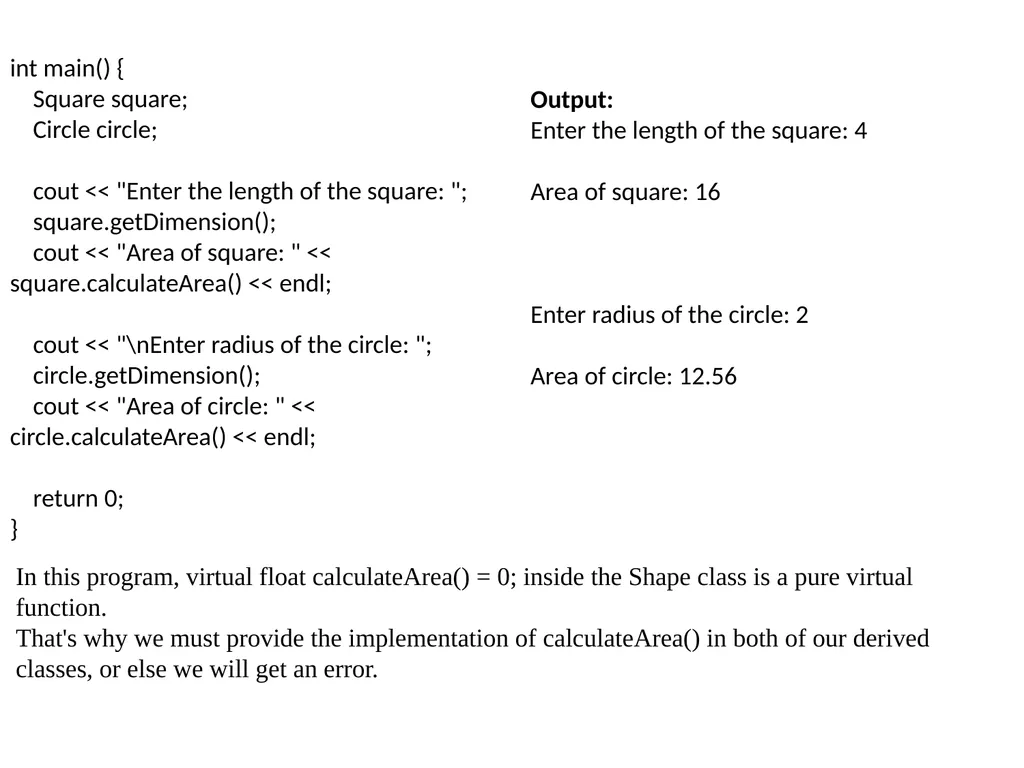
Area of circle: 12.56 In this program, virtual float calculateArea() = 0; inside the Shape class is a pure virtual function.
That's why we must provide the implementation of calculateArea() in both of our derived classes, or else we will get an error.<br>
Square square;
Circle circle;
cout << "Enter the length of the square: ";
square.getDimension();
cout << "Area of square: " << square.calculateArea() << endl;
cout << "\nEnter radius of the circle: ";
circle.getDimension();
cout << "Area of circle: " << circle.calculateArea() << endl;
return 0;
} Output:
Enter the length of the square: 4
Area of square: 16
Enter radius of the circle: 2
Area of circle: 12.56 In this program, virtual float calculateArea() = 0; inside the Shape class is a pure virtual function.
That's why we must provide the implementation of calculateArea() in both of our derived classes, or else we will get an error.<br>