
Virtual Praxis Review Workshop : Core Mathematics
LD
Published · 59 slides · 0 views
1 / 1
Description
Virtual Praxis Review Workshop : Core Mathematics Exam Part II Jonathan D. Watkins, Ph.D. REACH Math Resources Agenda Exam Overview AlgebraFunctions Geometry Formulas to Know Homework Closing Thoughts 2 Exam Overview Old (5732) Core
Related Topics
Share
Embed code
Download this presentation From Below
"Virtual Praxis Review Workshop : Core Mathematics" is the property of its rightful owner. Permission is granted to download and print the materials on this website for personal, non-commercial use only, and to display it on your personal computer provided you do not modify the materials and that you retain all copyright notices contained in the materials. By downloading content from our website, you accept the terms of this agreement.
Presentation Transcript
01
Virtual Praxis Review Workshop :
Core Mathematics Exam
Part II Jonathan D. Watkins, Ph.D.
REACH Math Resources<br>
Core Mathematics Exam
Part II Jonathan D. Watkins, Ph.D.
REACH Math Resources<br>
02
Agenda Exam Overview
Algebra/Functions
Geometry
Formulas to Know
“Homework”
Closing Thoughts 2<br>
Algebra/Functions
Geometry
Formulas to Know
“Homework”
Closing Thoughts 2<br>
03
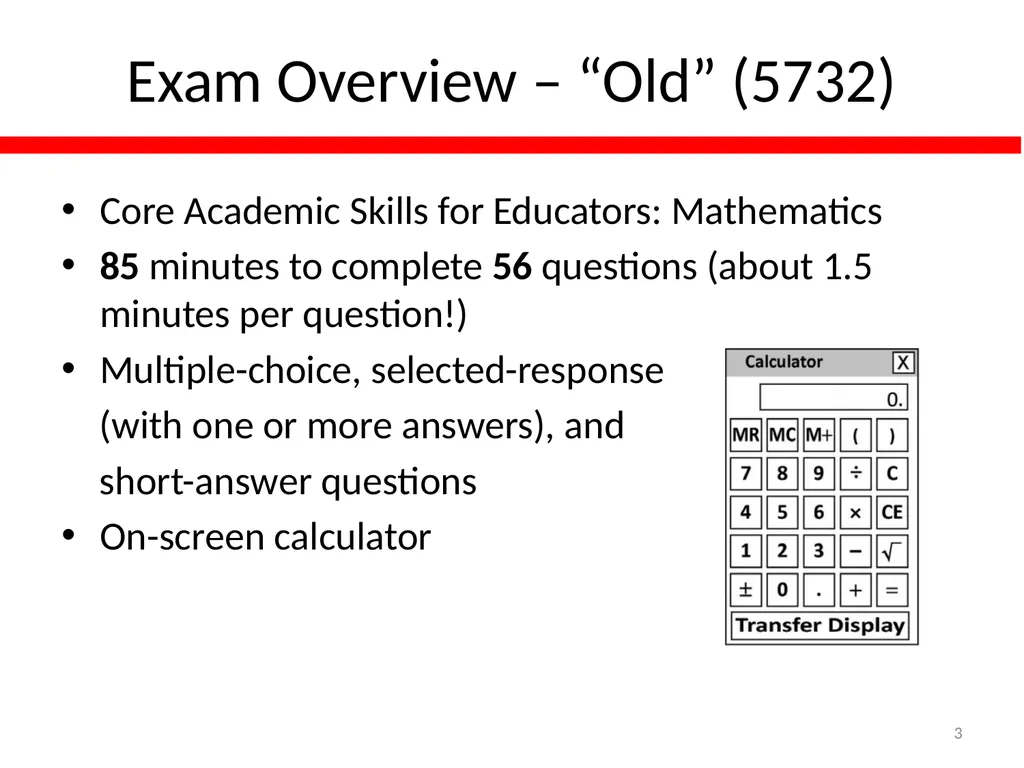
Exam Overview – “Old” (5732) Core Academic Skills for Educators: Mathematics
85 minutes to complete 56 questions (about 1.5 minutes per question!)
Multiple-choice, selected-response
(with one or more answers), and
short-answer questions
On-screen calculator 3<br>
85 minutes to complete 56 questions (about 1.5 minutes per question!)
Multiple-choice, selected-response
(with one or more answers), and
short-answer questions
On-screen calculator 3<br>
04
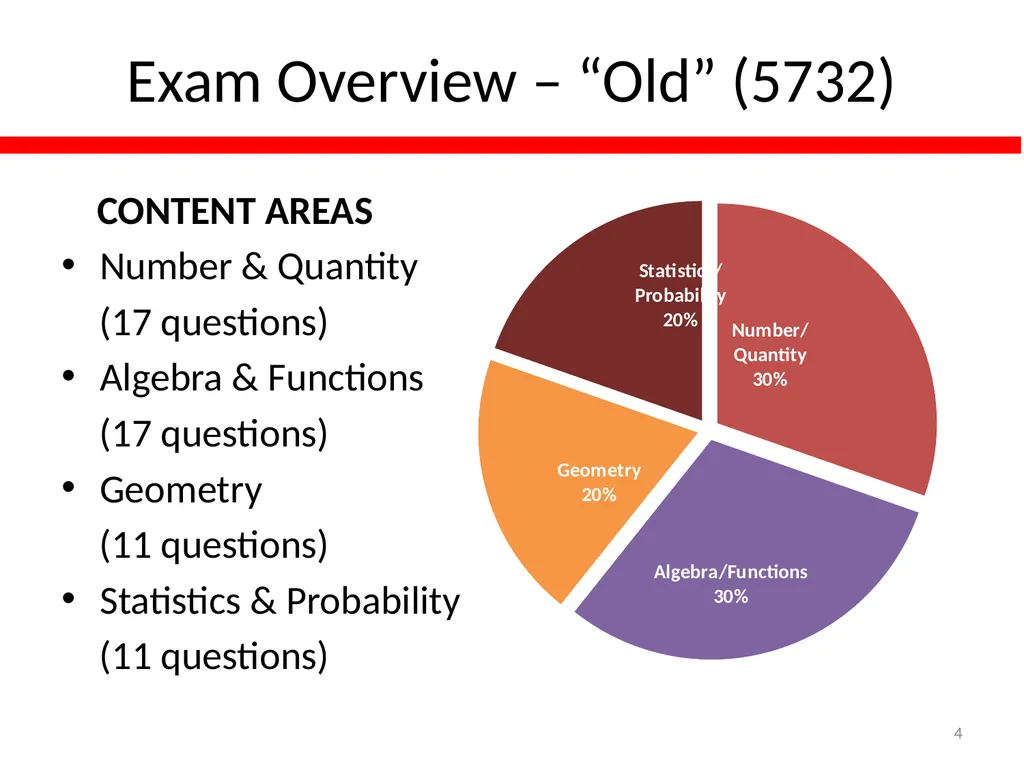
Exam Overview – “Old” (5732) CONTENT AREAS
Number & Quantity
(17 questions)
Algebra & Functions
(17 questions)
Geometry
(11 questions)
Statistics & Probability
(11 questions) 4<br>
Number & Quantity
(17 questions)
Algebra & Functions
(17 questions)
Geometry
(11 questions)
Statistics & Probability
(11 questions) 4<br>
05
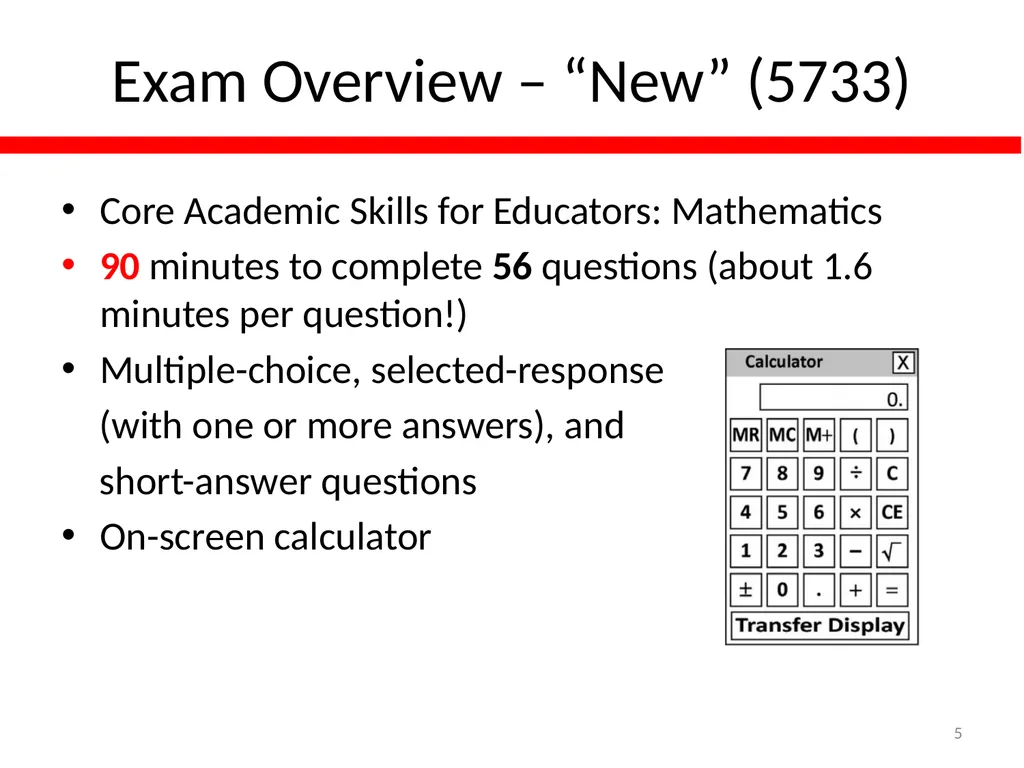
Exam Overview – “New” (5733) Core Academic Skills for Educators: Mathematics
90 minutes to complete 56 questions (about 1.6 minutes per question!)
Multiple-choice, selected-response
(with one or more answers), and
short-answer questions
On-screen calculator 5<br>
90 minutes to complete 56 questions (about 1.6 minutes per question!)
Multiple-choice, selected-response
(with one or more answers), and
short-answer questions
On-screen calculator 5<br>
06
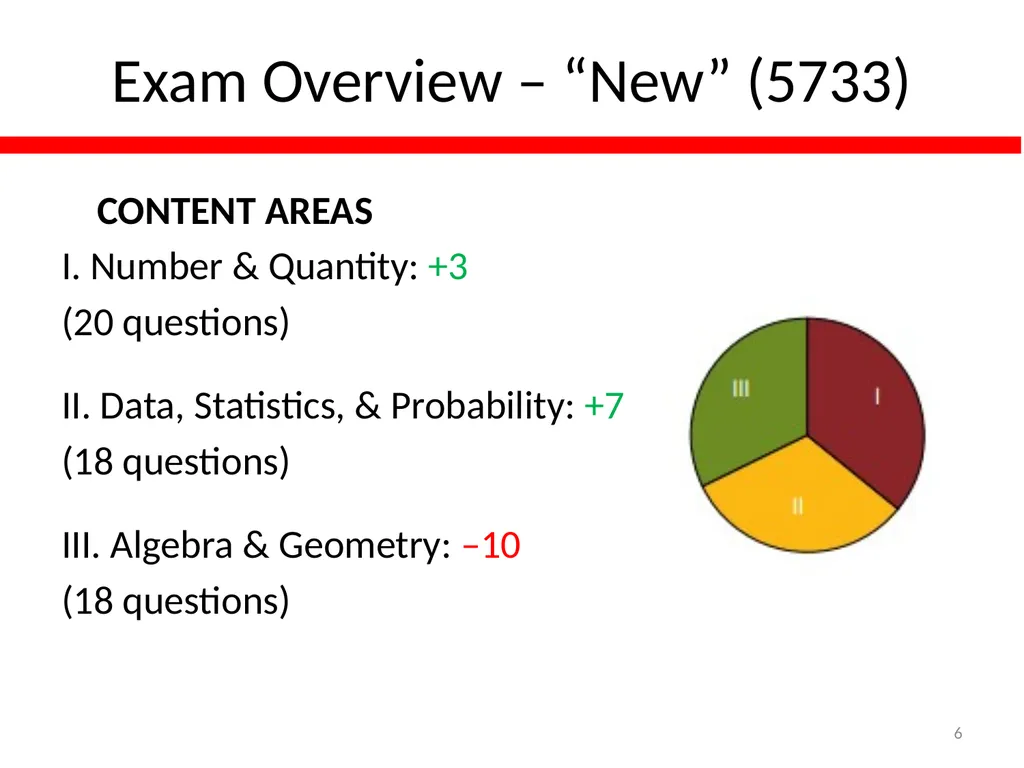
Exam Overview – “New” (5733) CONTENT AREAS
I. Number & Quantity: +3
(20 questions)
II. Data, Statistics, & Probability: +7
(18 questions)
III. Algebra & Geometry: –10
(18 questions) 6<br>
I. Number & Quantity: +3
(20 questions)
II. Data, Statistics, & Probability: +7
(18 questions)
III. Algebra & Geometry: –10
(18 questions) 6<br>
07
Exam Overview LAST WEEK (Recording available)
Number & Quantity
Statistics & Probability (& Data)
THIS WEEK
Algebra & Functions
Geometry 7<br>
Number & Quantity
Statistics & Probability (& Data)
THIS WEEK
Algebra & Functions
Geometry 7<br>
08
Exam Overview Questions so far?
Now, let’s get started! =) 8<br>
Now, let’s get started! =) 8<br>
09
Algebra & Functions Algebra & Functions Major Topics
(Not an Exhaustive List!) 9<br>
(Not an Exhaustive List!) 9<br>
10
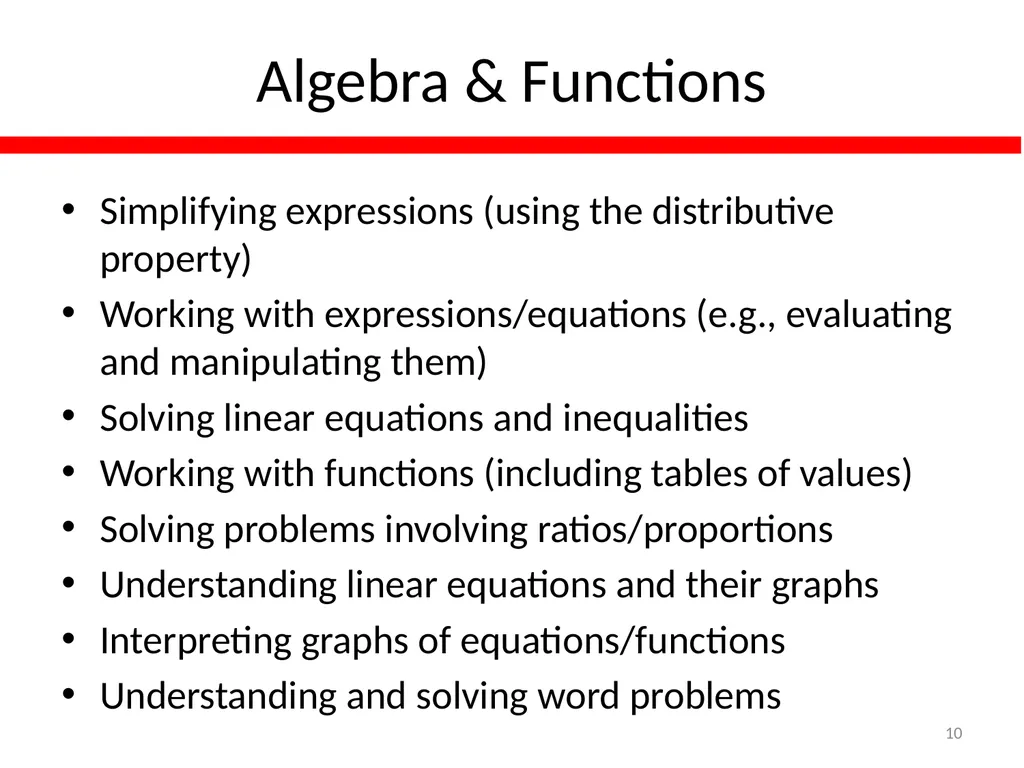
Algebra & Functions Simplifying expressions (using the distributive property)
Working with expressions/equations (e.g., evaluating and manipulating them)
Solving linear equations and inequalities
Working with functions (including tables of values)
Solving problems involving ratios/proportions
Understanding linear equations and their graphs
Interpreting graphs of equations/functions
Understanding and solving word problems 10<br>
11
Algebra & Functions Algebra & Functions Questions 11<br>
12
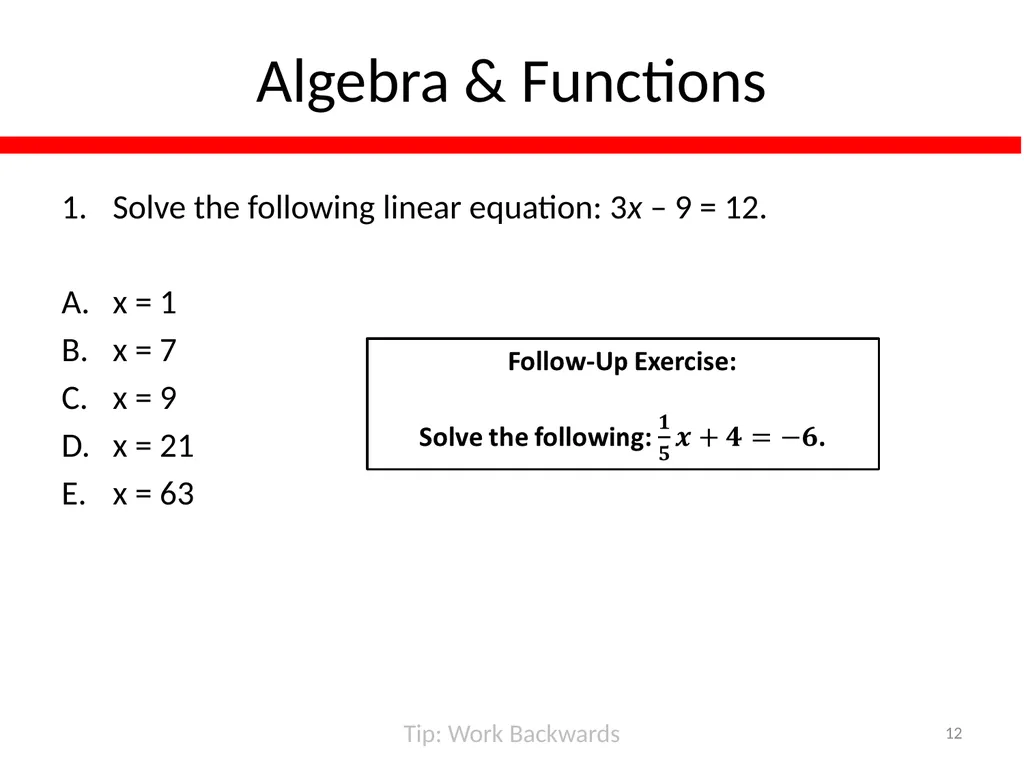
Algebra & Functions Solve the following linear equation: 3x – 9 = 12.
x = 1
x = 7
x = 9
x = 21
x = 63 12 Tip: Work Backwards<br>
x = 1
x = 7
x = 9
x = 21
x = 63 12 Tip: Work Backwards<br>
13
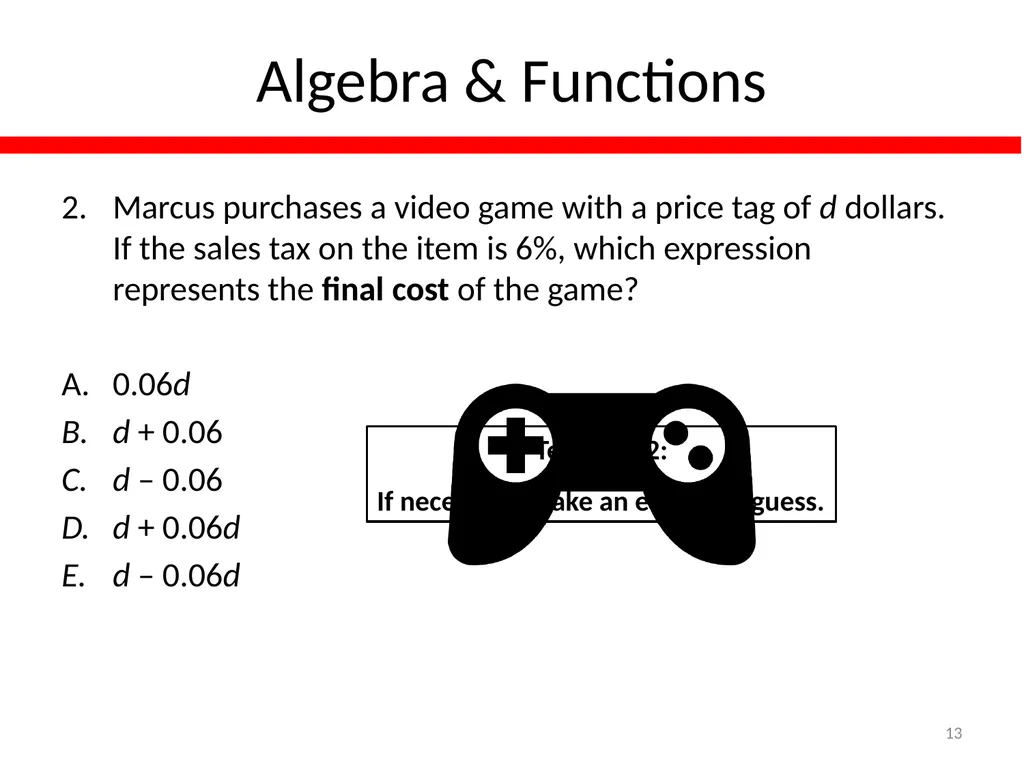
Algebra & Functions Marcus purchases a video game with a price tag of d dollars. If the sales tax on the item is 6%, which expression represents the final cost of the game?
0.06d
d + 0.06
d – 0.06
d + 0.06d
d – 0.06d 13 Test Tip 12:
If necessary, make an educated guess.<br>
0.06d
d + 0.06
d – 0.06
d + 0.06d
d – 0.06d 13 Test Tip 12:
If necessary, make an educated guess.<br>
14
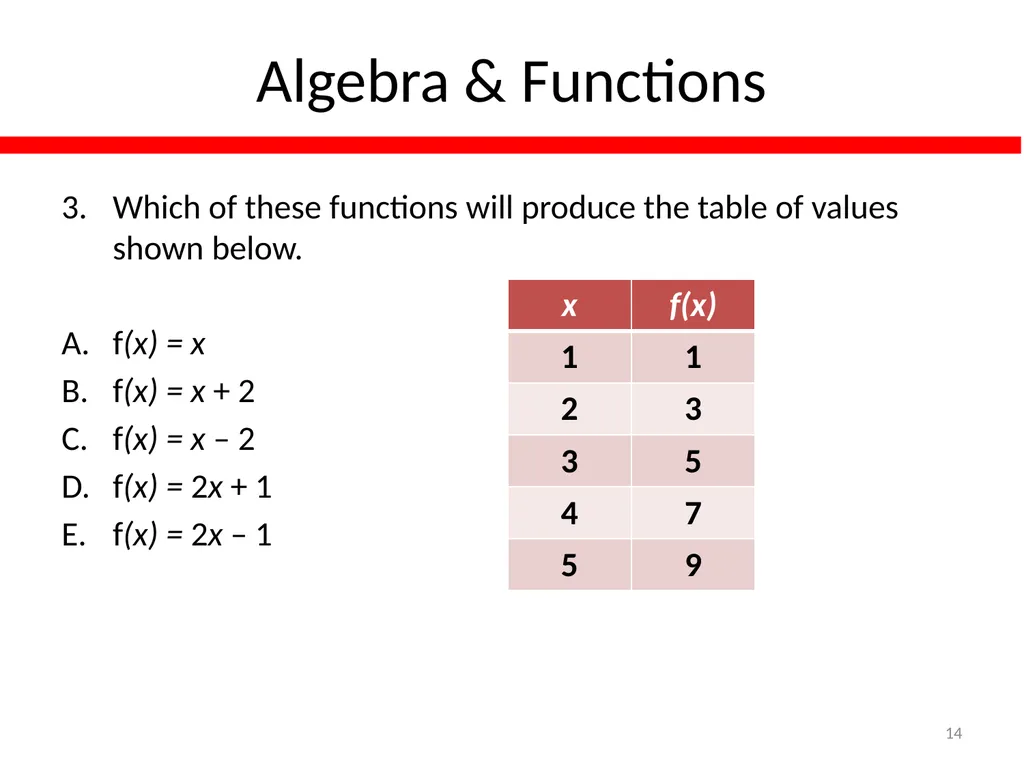
Algebra & Functions Which of these functions will produce the table of values shown below.
f(x) = x
f(x) = x + 2
f(x) = x – 2
f(x) = 2x + 1
f(x) = 2x – 1 14<br>
f(x) = x
f(x) = x + 2
f(x) = x – 2
f(x) = 2x + 1
f(x) = 2x – 1 14<br>
15
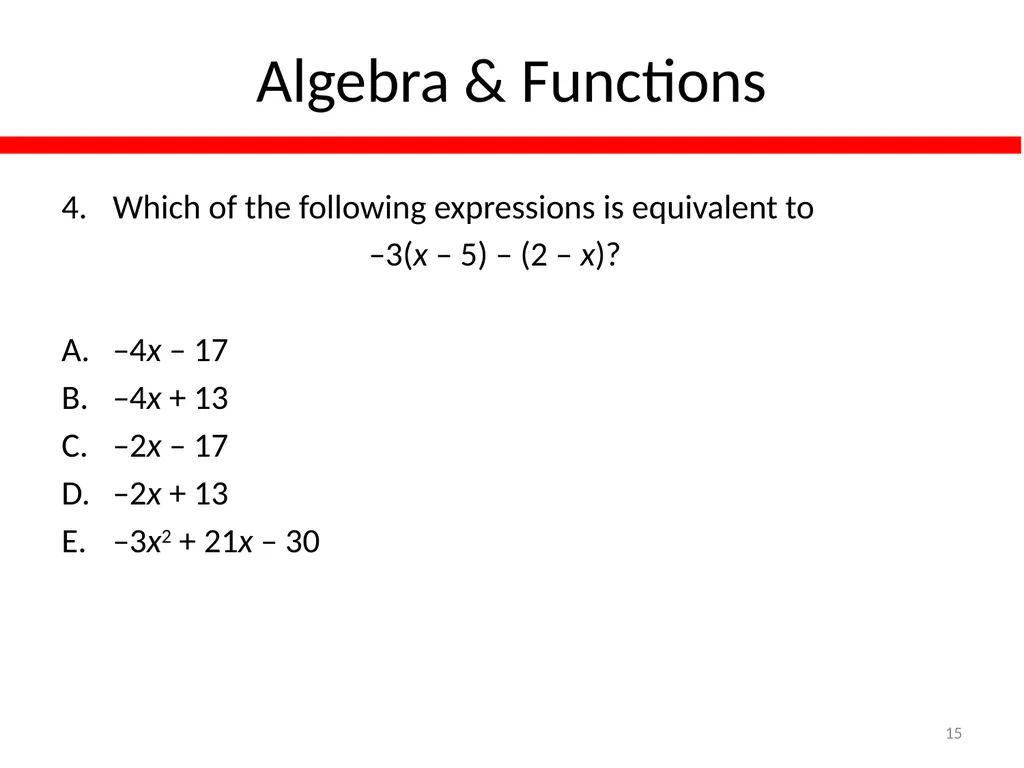
Algebra & Functions Which of the following expressions is equivalent to
–3(x – 5) – (2 – x)?
–4x – 17
–4x + 13
–2x – 17
–2x + 13
–3x2 + 21x – 30 15<br>
–3(x – 5) – (2 – x)?
–4x – 17
–4x + 13
–2x – 17
–2x + 13
–3x2 + 21x – 30 15<br>
16
Algebra & Functions 16 Test Tip 13:
Whenever possible, check your answers!<br>
Whenever possible, check your answers!<br>
17
Algebra & Functions 17<br>
18
Algebra & Functions 18 Test Tip 14:
Be skeptical of answers that are “too good to be true.” Don’t fall into a trap!<br>
Be skeptical of answers that are “too good to be true.” Don’t fall into a trap!<br>
19
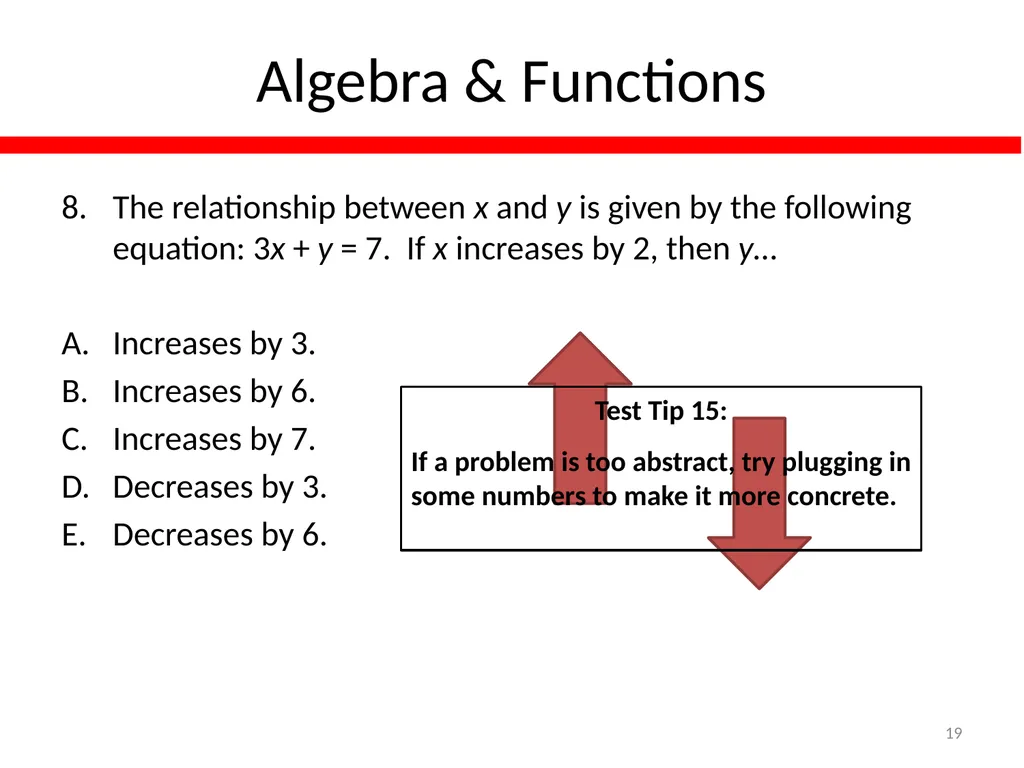
Algebra & Functions The relationship between x and y is given by the following equation: 3x + y = 7. If x increases by 2, then y…
Increases by 3.
Increases by 6.
Increases by 7.
Decreases by 3.
Decreases by 6. 19 Test Tip 15:
If a problem is too abstract, try plugging in some numbers to make it more concrete.<br>
Increases by 3.
Increases by 6.
Increases by 7.
Decreases by 3.
Decreases by 6. 19 Test Tip 15:
If a problem is too abstract, try plugging in some numbers to make it more concrete.<br>
20
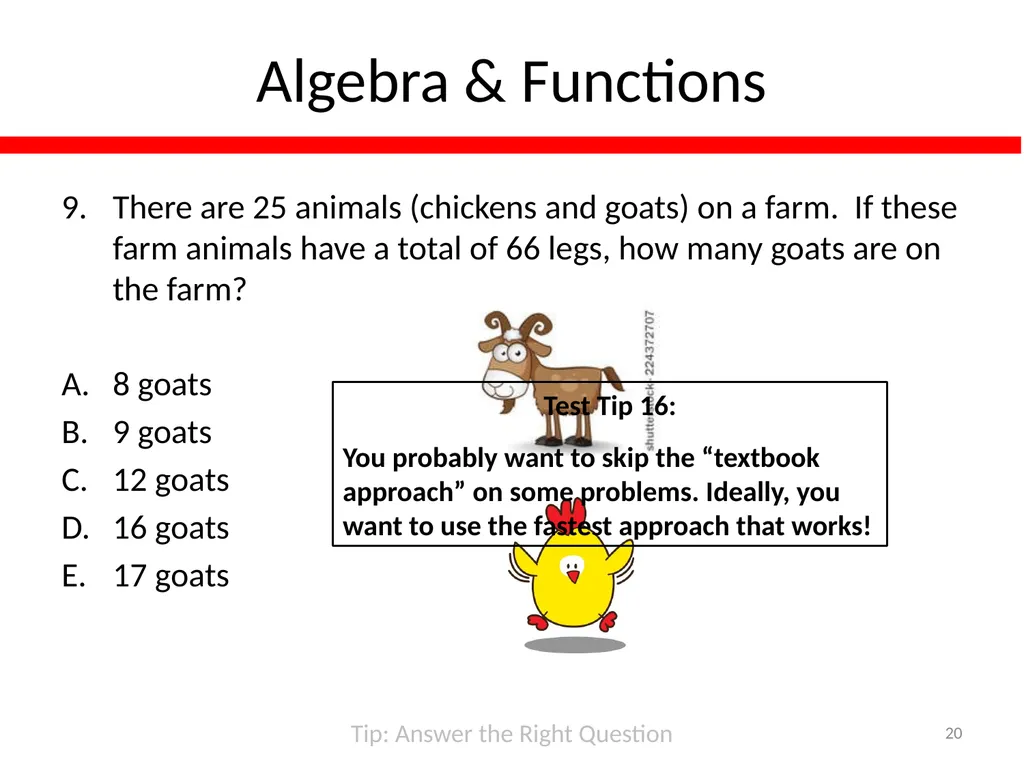
Algebra & Functions There are 25 animals (chickens and goats) on a farm. If these farm animals have a total of 66 legs, how many goats are on the farm?
8 goats
9 goats
12 goats
16 goats
17 goats 20 Test Tip 16:
You probably want to skip the “textbook approach” on some problems. Ideally, you want to use the fastest approach that works! Tip: Answer the Right Question<br>
8 goats
9 goats
12 goats
16 goats
17 goats 20 Test Tip 16:
You probably want to skip the “textbook approach” on some problems. Ideally, you want to use the fastest approach that works! Tip: Answer the Right Question<br>
21
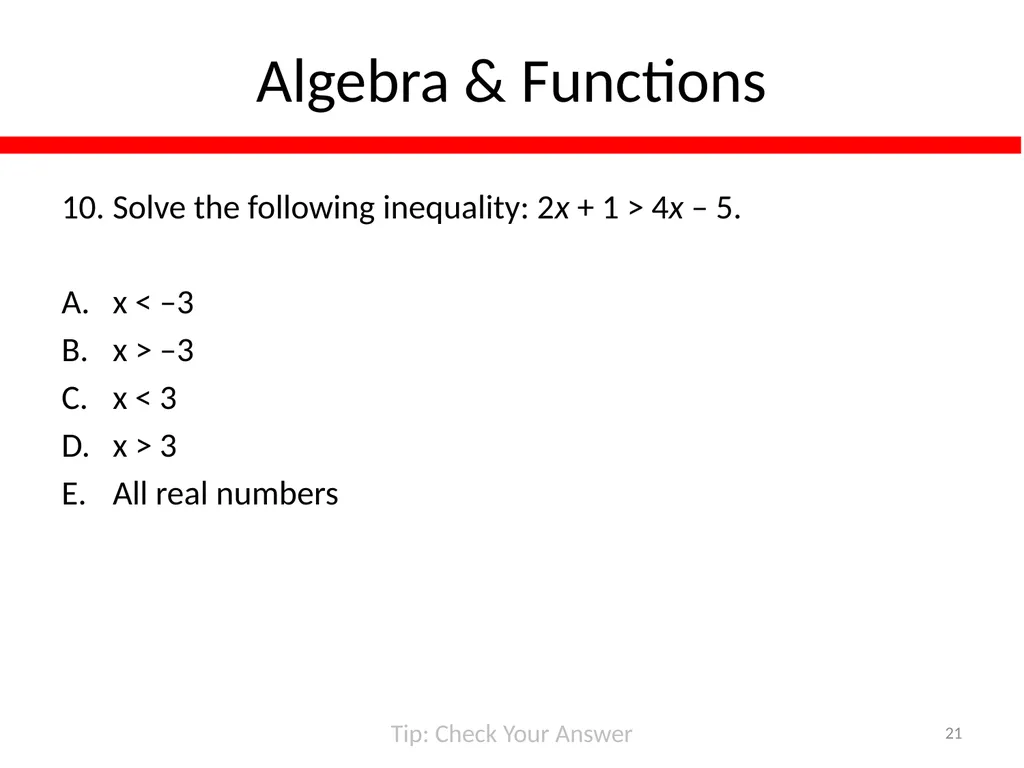
Algebra & Functions Solve the following inequality: 2x + 1 > 4x – 5.
x < –3
x > –3
x < 3
x > 3
All real numbers 21 Tip: Check Your Answer<br>
x < –3
x > –3
x < 3
x > 3
All real numbers 21 Tip: Check Your Answer<br>
22
Algebra & Functions 22 Tip: Answer the Right Question<br>
23
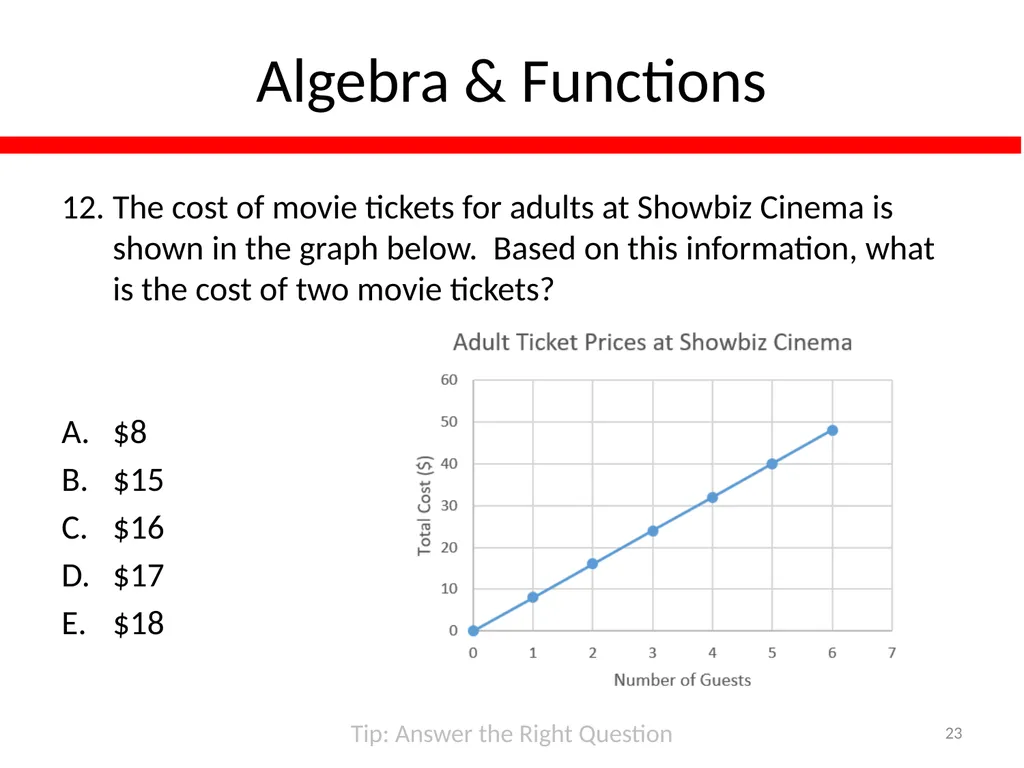
Algebra & Functions The cost of movie tickets for adults at Showbiz Cinema is shown in the graph below. Based on this information, what is the cost of two movie tickets?
$8
$15
$16
$17
$18 23 Tip: Answer the Right Question<br>
$8
$15
$16
$17
$18 23 Tip: Answer the Right Question<br>
24
Geometry Geometry Major Topics
(Not an Exhaustive List!) 24<br>
(Not an Exhaustive List!) 24<br>
25
Geometry Perimeter, area, and volume of various shapes
Transformations in the xy-plane (e.g., translations, rotations, reflections)
Classifying triangles and quadrilaterals
Triangle Inequality Theorem
Pythagorean Theorem
Parallel lines cut by a transversal (angle relationships)
Circles (Circumference, arc length, area, and sector area) 25<br>
Transformations in the xy-plane (e.g., translations, rotations, reflections)
Classifying triangles and quadrilaterals
Triangle Inequality Theorem
Pythagorean Theorem
Parallel lines cut by a transversal (angle relationships)
Circles (Circumference, arc length, area, and sector area) 25<br>
26
Geometry Geometry Questions 26<br>
27
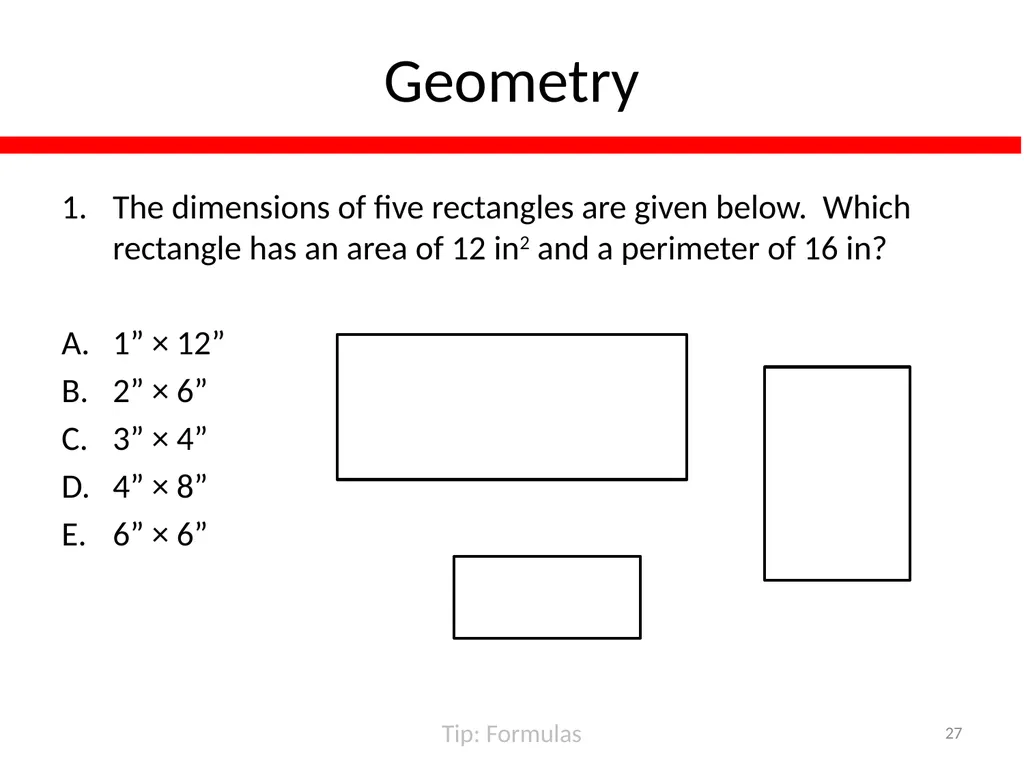
Geometry The dimensions of five rectangles are given below. Which rectangle has an area of 12 in2 and a perimeter of 16 in?
1” × 12”
2” × 6”
3” × 4”
4” × 8”
6” × 6” 27 Tip: Formulas<br>
1” × 12”
2” × 6”
3” × 4”
4” × 8”
6” × 6” 27 Tip: Formulas<br>
28
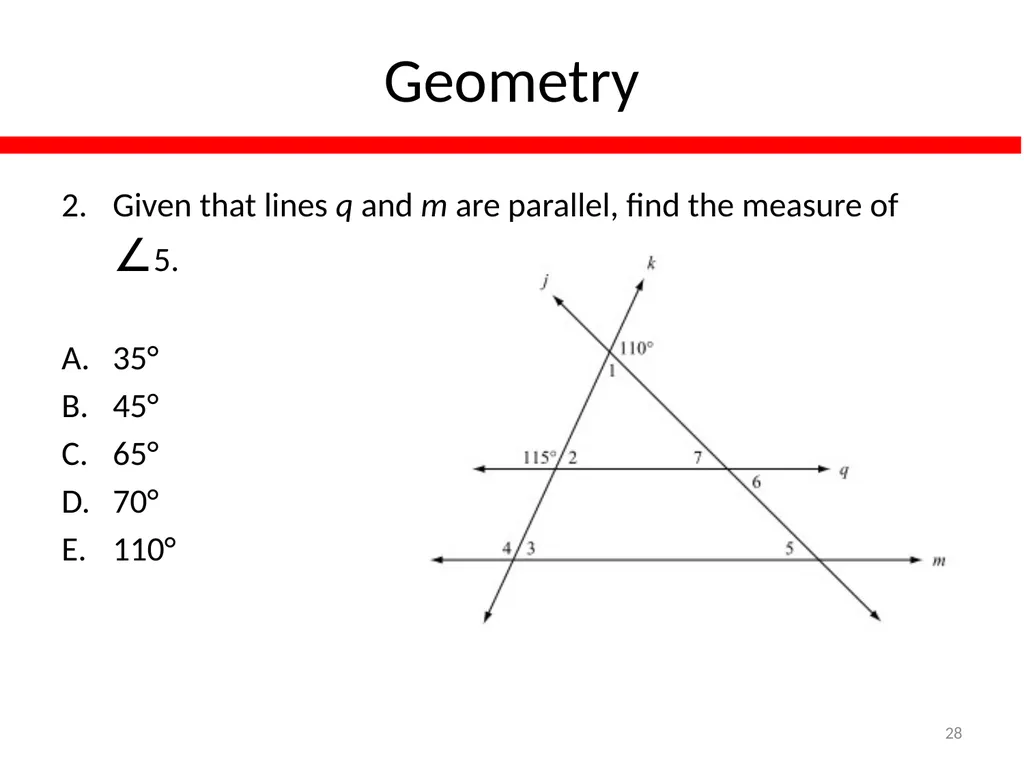
Geometry Given that lines q and m are parallel, find the measure of ∠5.
35°
45°
65°
70°
110° 28<br>
35°
45°
65°
70°
110° 28<br>
29
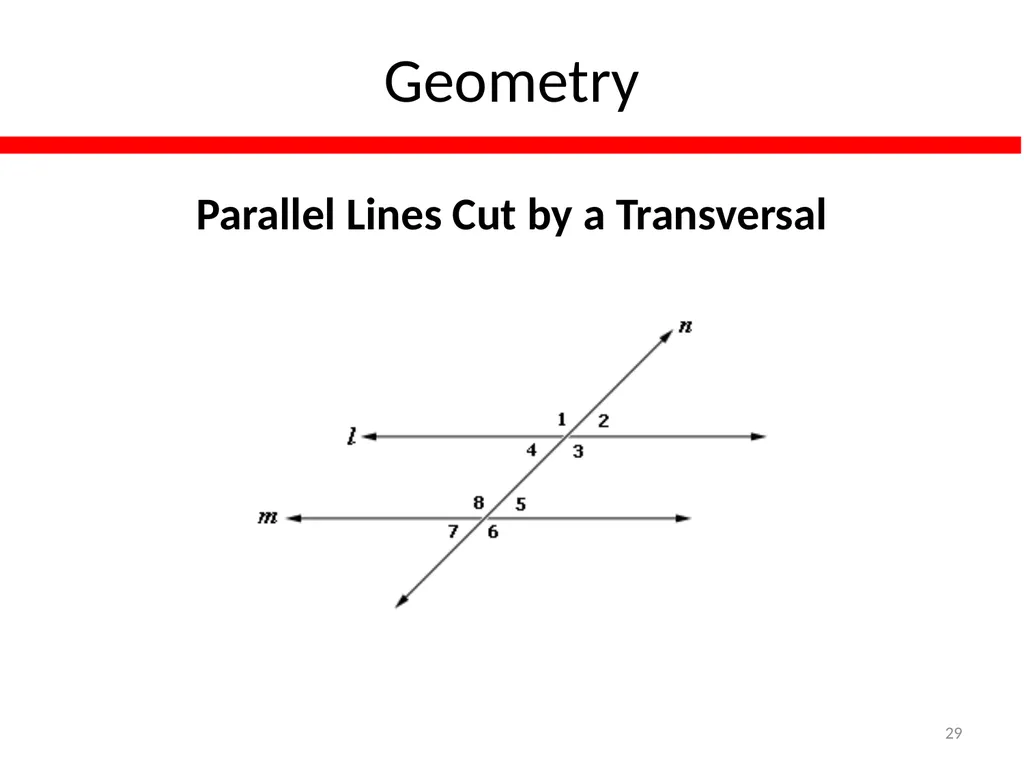
Geometry Parallel Lines Cut by a Transversal 29<br>
30
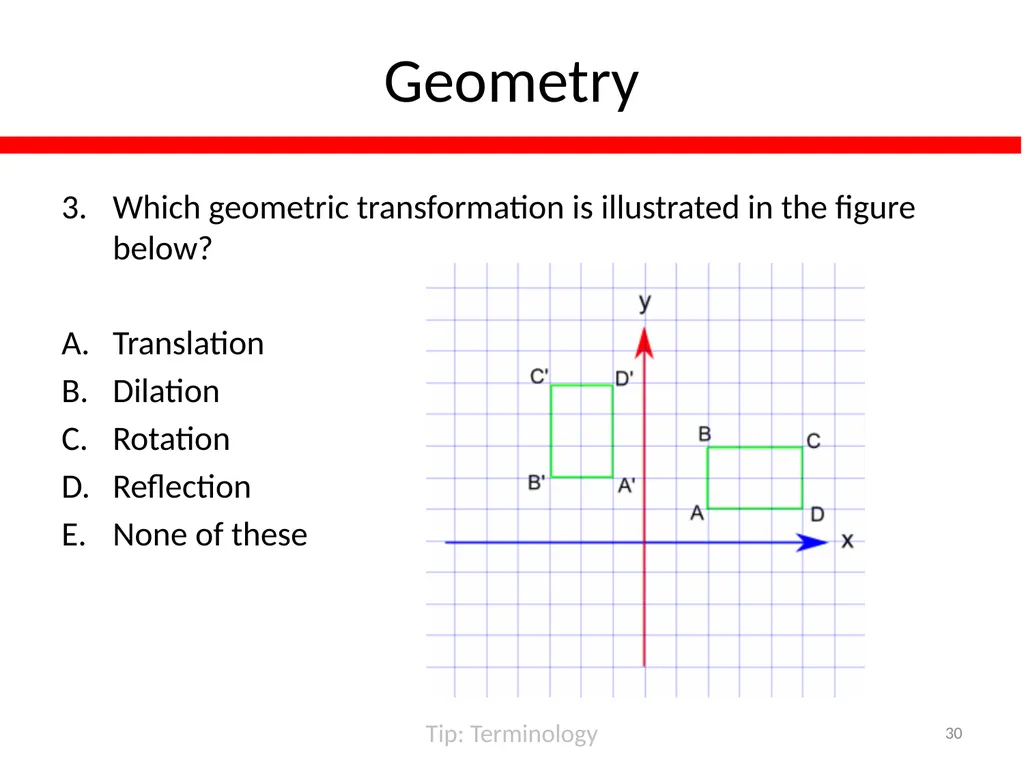
Geometry Which geometric transformation is illustrated in the figure below?
Translation
Dilation
Rotation
Reflection
None of these 30 Tip: Terminology<br>
Translation
Dilation
Rotation
Reflection
None of these 30 Tip: Terminology<br>
31
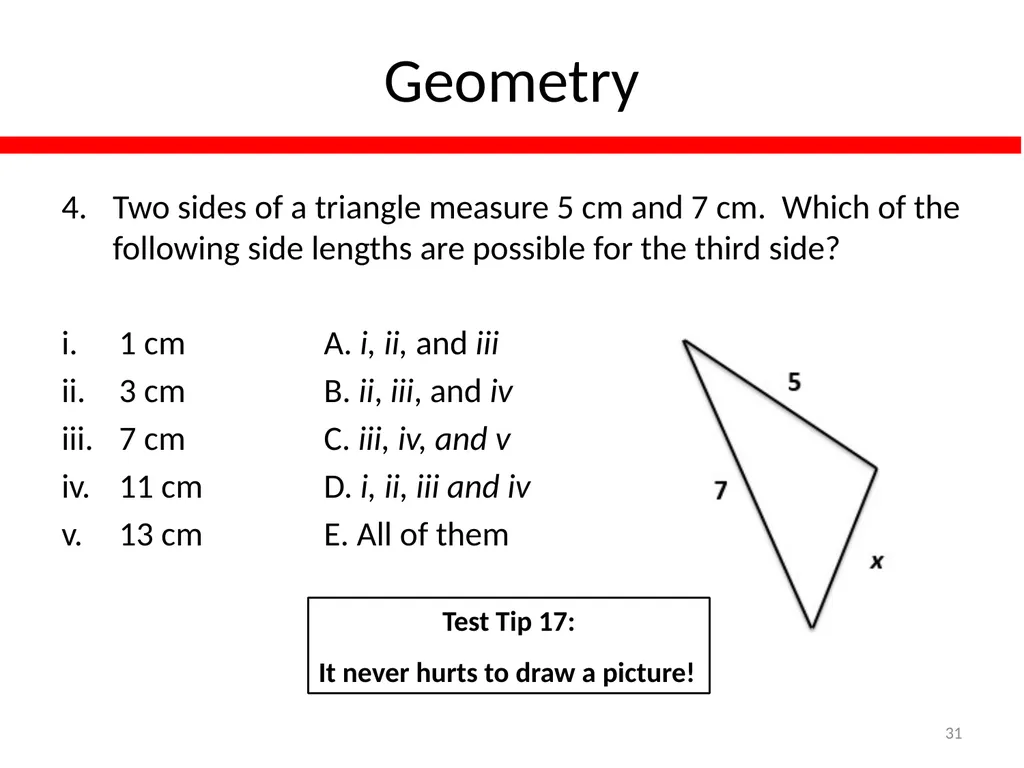
Geometry Two sides of a triangle measure 5 cm and 7 cm. Which of the following side lengths are possible for the third side?
1 cm A. i, ii, and iii
3 cm B. ii, iii, and iv
7 cm C. iii, iv, and v
11 cm D. i, ii, iii and iv
13 cm E. All of them 31 Test Tip 17:
It never hurts to draw a picture!<br>
1 cm A. i, ii, and iii
3 cm B. ii, iii, and iv
7 cm C. iii, iv, and v
11 cm D. i, ii, iii and iv
13 cm E. All of them 31 Test Tip 17:
It never hurts to draw a picture!<br>
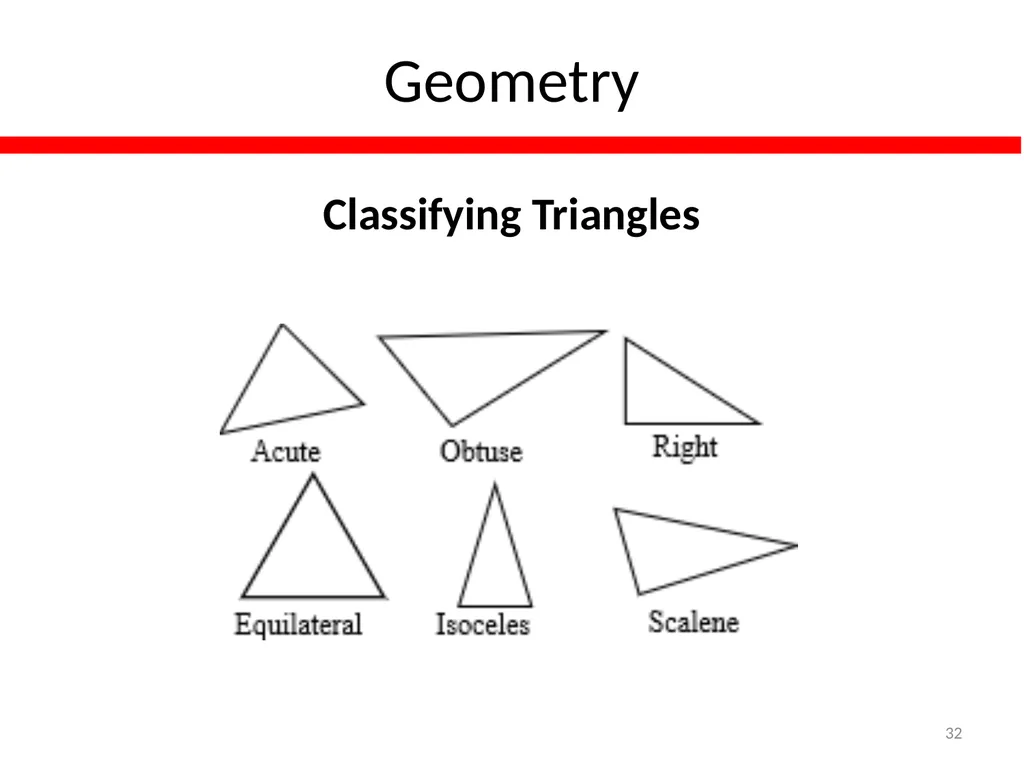
32
Geometry Classifying Triangles 32<br>
33
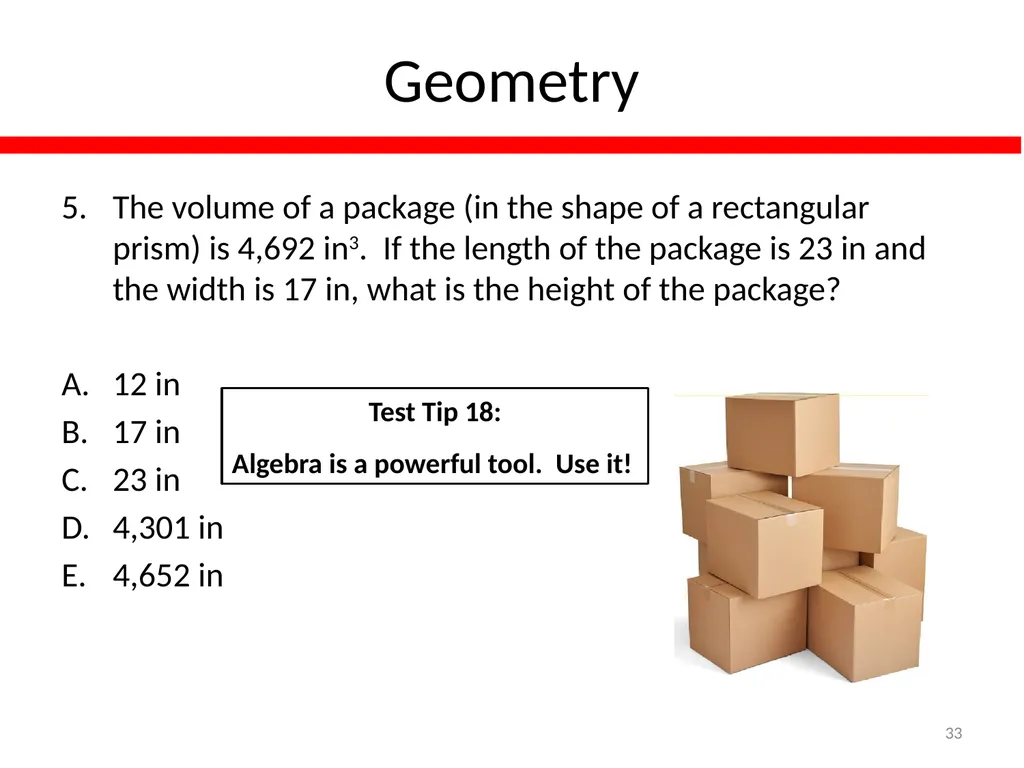
Geometry The volume of a package (in the shape of a rectangular prism) is 4,692 in3. If the length of the package is 23 in and the width is 17 in, what is the height of the package?
12 in
17 in
23 in
4,301 in
4,652 in 33 Test Tip 18:
Algebra is a powerful tool. Use it!<br>
12 in
17 in
23 in
4,301 in
4,652 in 33 Test Tip 18:
Algebra is a powerful tool. Use it!<br>
34
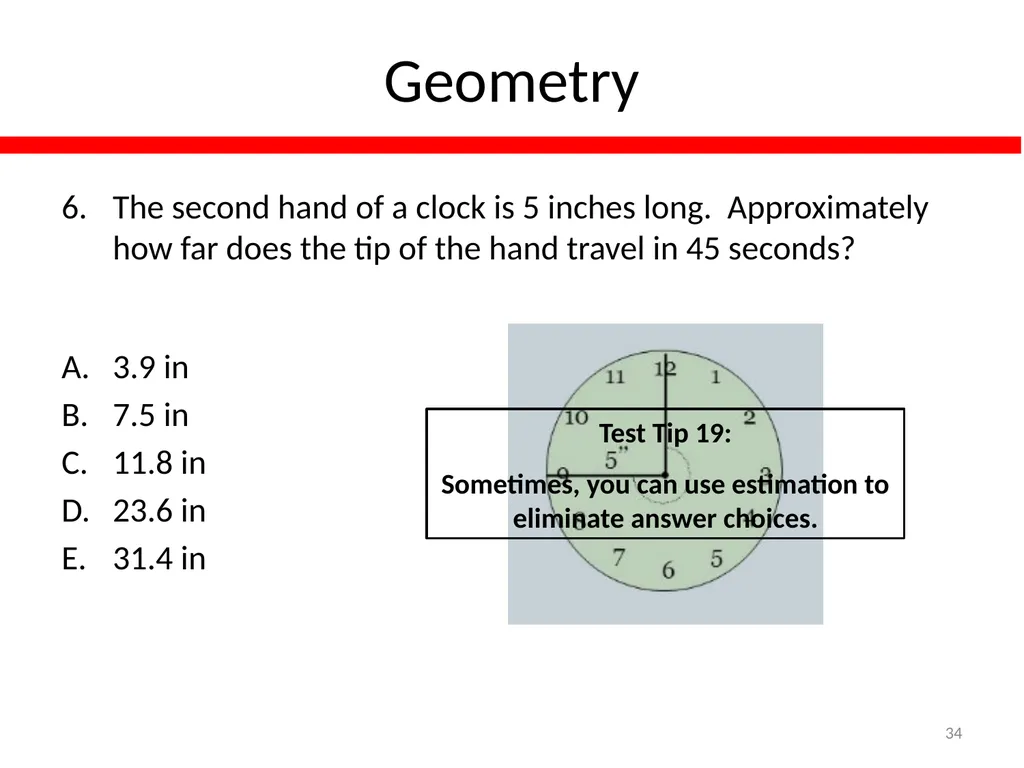
Geometry The second hand of a clock is 5 inches long. Approximately how far does the tip of the hand travel in 45 seconds?
3.9 in
7.5 in
11.8 in
23.6 in
31.4 in 34 Test Tip 19:
Sometimes, you can use estimation to eliminate answer choices.<br>
3.9 in
7.5 in
11.8 in
23.6 in
31.4 in 34 Test Tip 19:
Sometimes, you can use estimation to eliminate answer choices.<br>
35
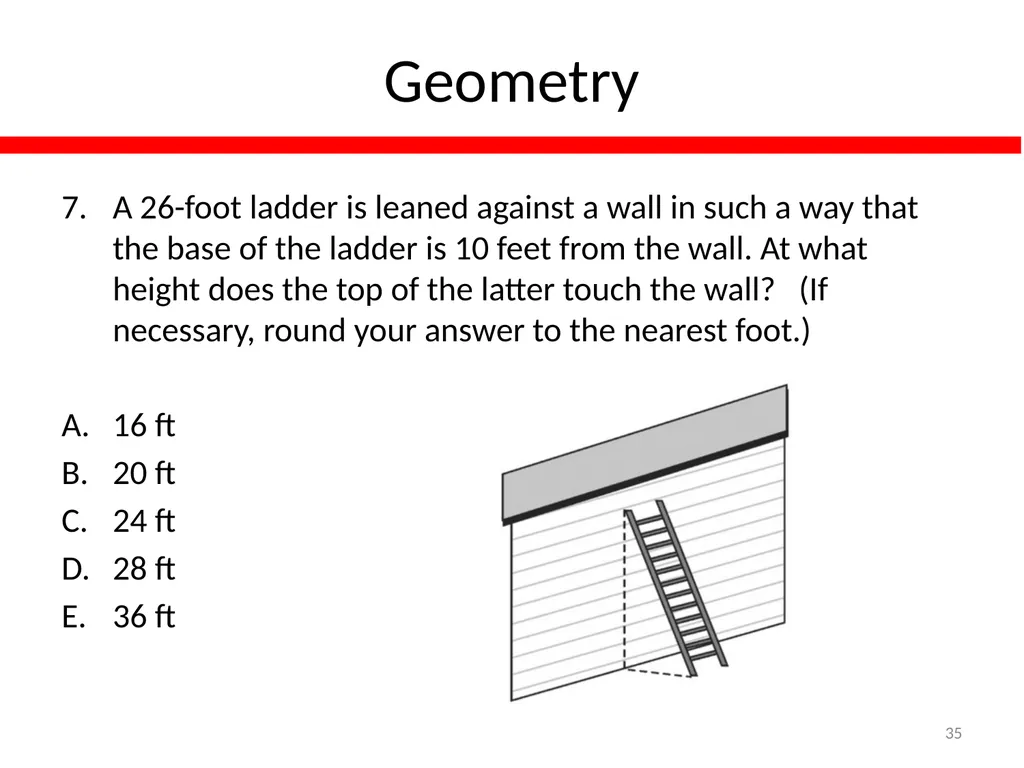
Geometry A 26-foot ladder is leaned against a wall in such a way that the base of the ladder is 10 feet from the wall. At what height does the top of the latter touch the wall? (If necessary, round your answer to the nearest foot.)
16 ft
20 ft
24 ft
28 ft
36 ft 35<br>
16 ft
20 ft
24 ft
28 ft
36 ft 35<br>
36
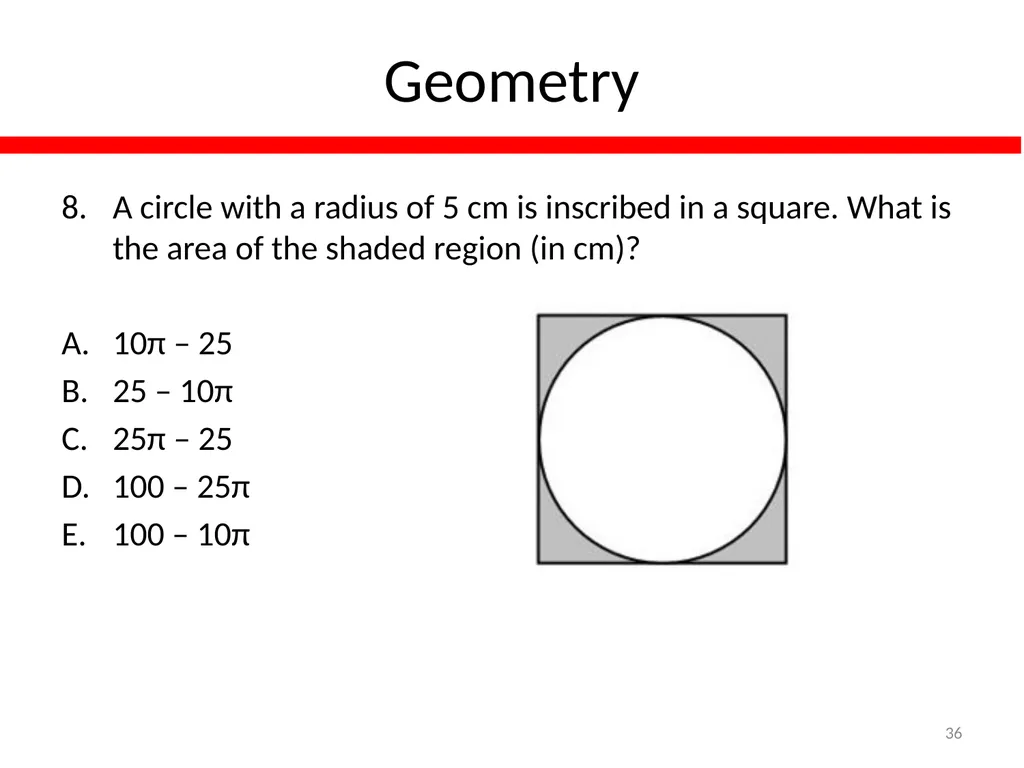
Geometry A circle with a radius of 5 cm is inscribed in a square. What is the area of the shaded region (in cm)?
10π – 25
25 – 10π
25π – 25
100 – 25π
100 – 10π 36<br>
10π – 25
25 – 10π
25π – 25
100 – 25π
100 – 10π 36<br>
37
Some Formulas to Know Percent increase/decrease
Slope-intercept form of a linear equation
Pythagorean Theorem
Area of a triangle and rectangle
Circumference and area of a circle
Volume of a rectangular prism/cylinder
Distance-rate-time formula 37<br>
Slope-intercept form of a linear equation
Pythagorean Theorem
Area of a triangle and rectangle
Circumference and area of a circle
Volume of a rectangular prism/cylinder
Distance-rate-time formula 37<br>
38
Tips/Strategies from Week 1 Review important mathematical terminology.
Memorize key formulas. (See handout.)
Take time to understand the problem.
Read all of the questions very carefully, and be sure to answer the question that is being asked.
Read all of the choices before answering.
Pace yourself (≈ 1.5 minutes per question).
If you don’t know how to answer a question, skip it and return to it later. 38<br>
39
Tips/Strategies from Week 1 If you get stuck, try to work backwards.
To find the probability of two or more events, use the multiplication rule:
P(A and B) = P(A)×P(B given A).
Review the most common representations of data, including dot plots, scatterplots, box plots, and histograms.
Sometimes, creating an organized list or table can help you solve a problem. 39<br>
40
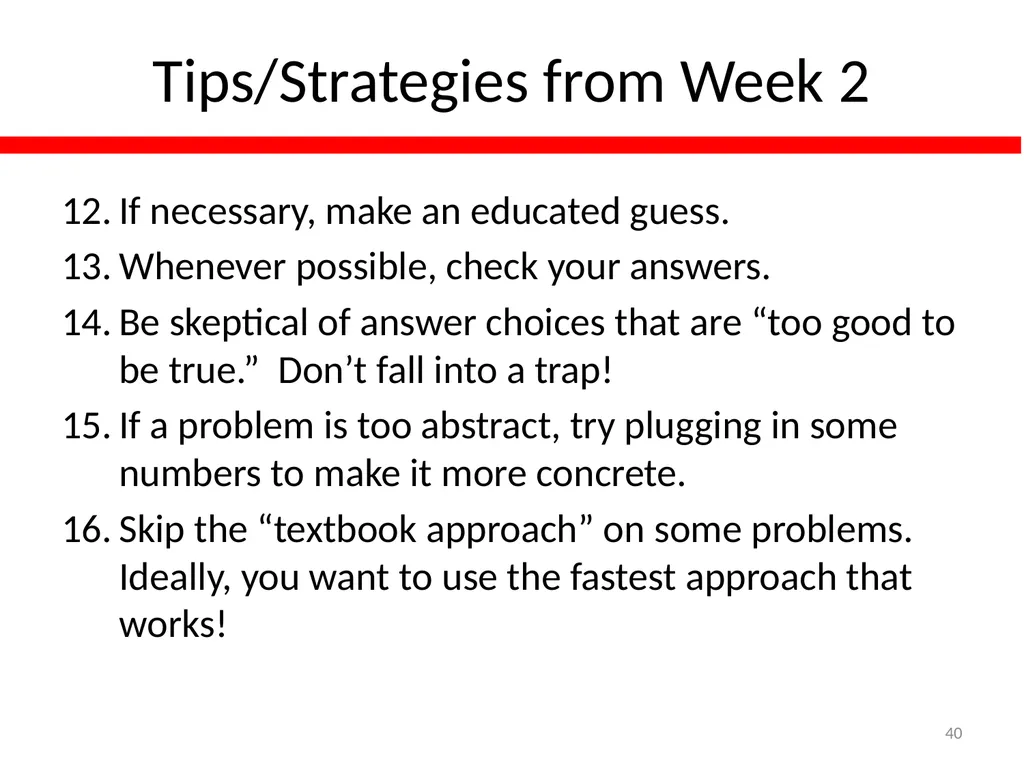
Tips/Strategies from Week 2 If necessary, make an educated guess.
Whenever possible, check your answers.
Be skeptical of answer choices that are “too good to be true.” Don’t fall into a trap!
If a problem is too abstract, try plugging in some numbers to make it more concrete.
Skip the “textbook approach” on some problems. Ideally, you want to use the fastest approach that works! 40<br>
41
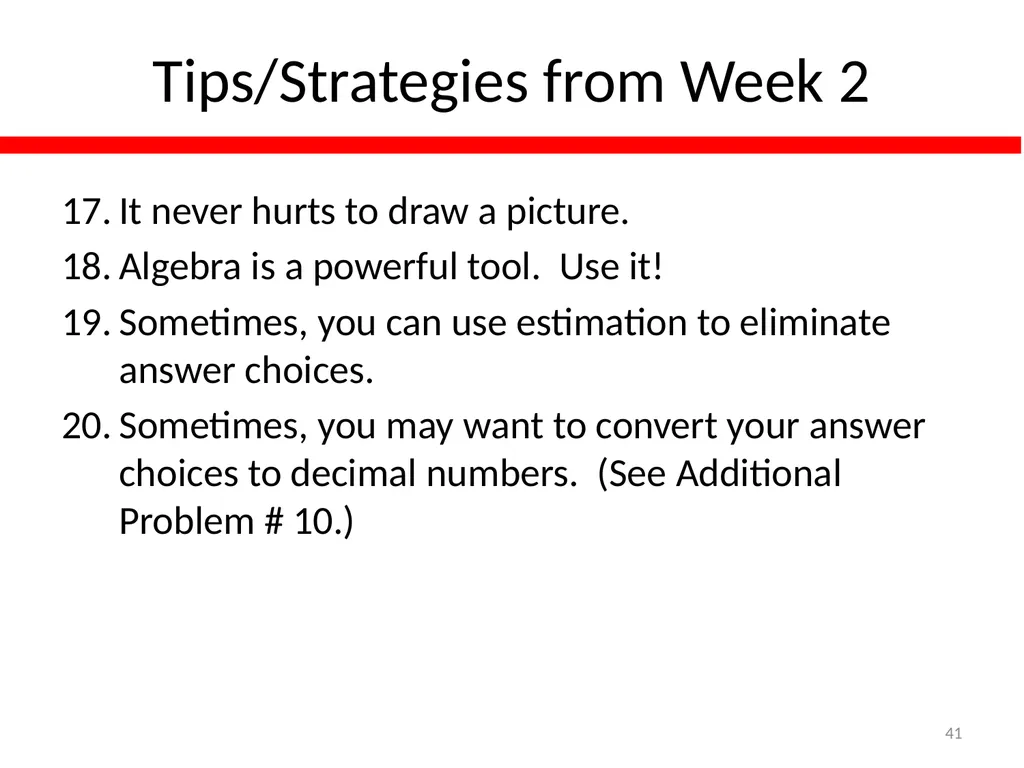
Tips/Strategies from Week 2 It never hurts to draw a picture.
Algebra is a powerful tool. Use it!
Sometimes, you can use estimation to eliminate answer choices.
Sometimes, you may want to convert your answer choices to decimal numbers. (See Additional Problem # 10.) 41<br>
Algebra is a powerful tool. Use it!
Sometimes, you can use estimation to eliminate answer choices.
Sometimes, you may want to convert your answer choices to decimal numbers. (See Additional Problem # 10.) 41<br>
42
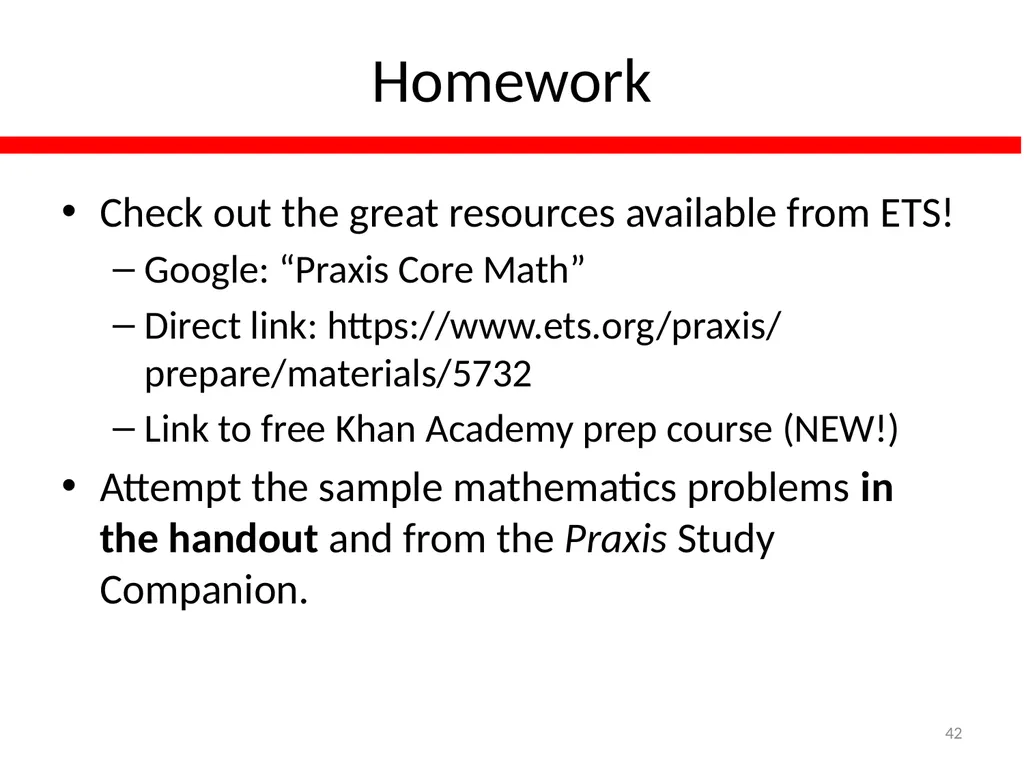
Homework Check out the great resources available from ETS!
Google: “Praxis Core Math”
Direct link: https://www.ets.org/praxis/ prepare/materials/5732
Link to free Khan Academy prep course (NEW!)
Attempt the sample mathematics problems in the handout and from the Praxis Study Companion. 42<br>
Google: “Praxis Core Math”
Direct link: https://www.ets.org/praxis/ prepare/materials/5732
Link to free Khan Academy prep course (NEW!)
Attempt the sample mathematics problems in the handout and from the Praxis Study Companion. 42<br>
43
Homework C
C
C
E
A
E
B
E
A
E
D
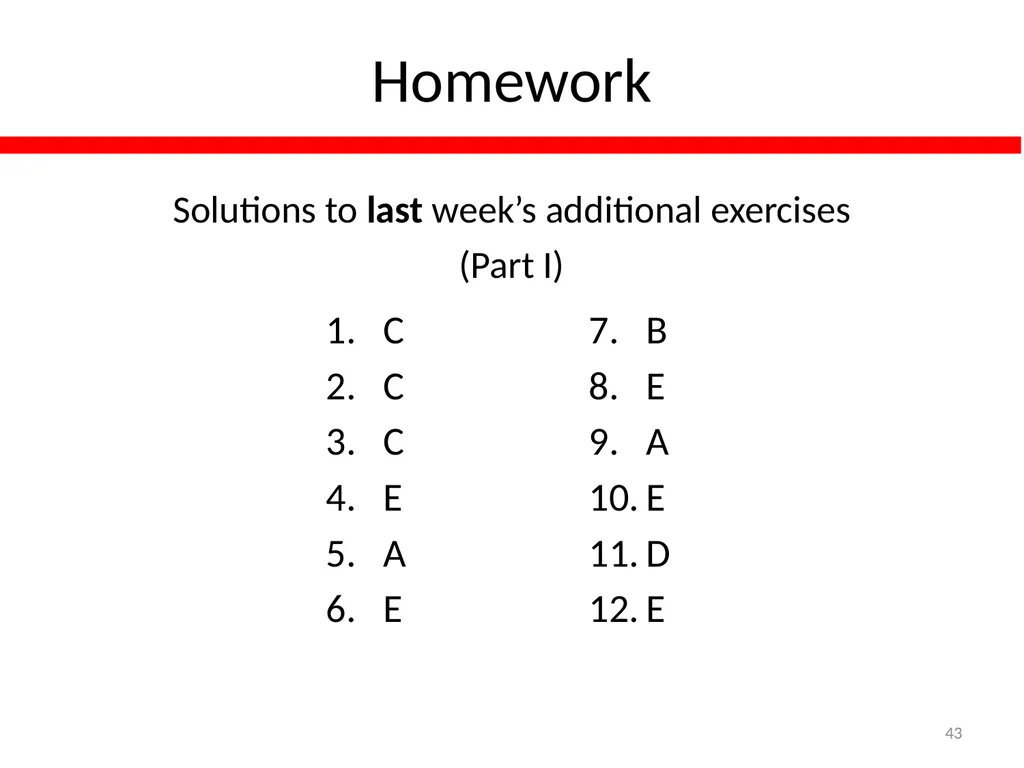
E 43 Solutions to last week’s additional exercises
(Part I)<br>
C
C
E
A
E
B
E
A
E
D
E 43 Solutions to last week’s additional exercises
(Part I)<br>
44
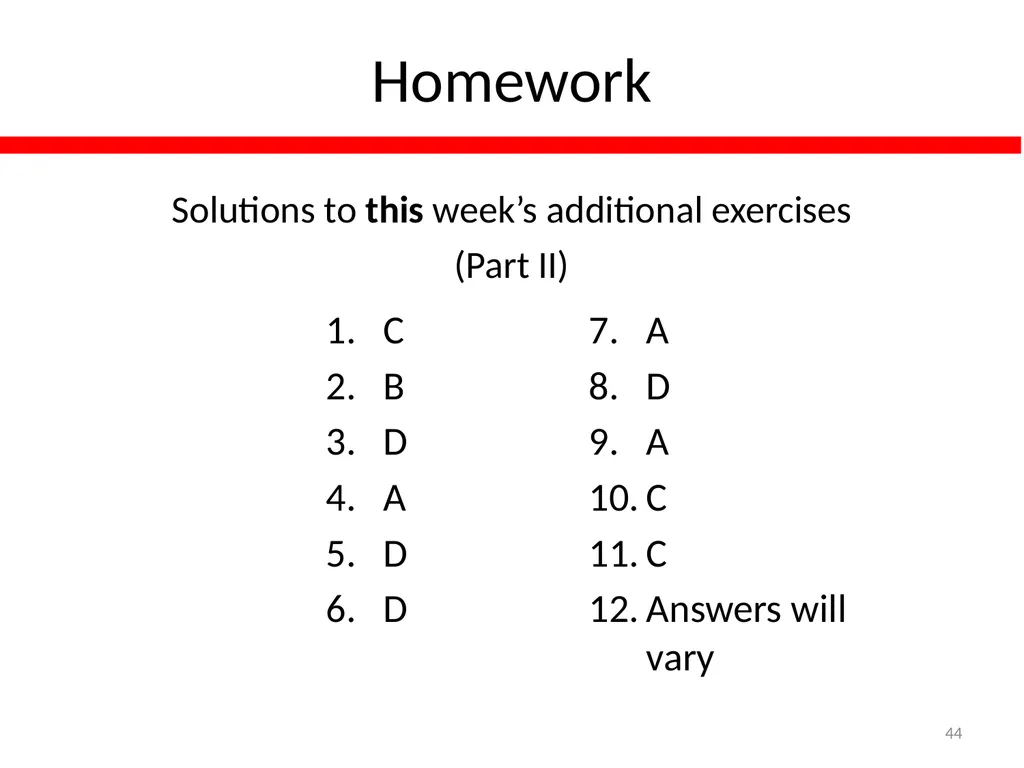
Homework C
B
D
A
D
D
A
D
A
C
C
Answers will vary 44 Solutions to this week’s additional exercises
(Part II)<br>
B
D
A
D
D
A
D
A
C
C
Answers will vary 44 Solutions to this week’s additional exercises
(Part II)<br>
45
Math Resource Center UofL student? Need additional help?
Visit the REACH Math Resource Center!
https://reach.louisville.edu/tutoring/
Belknap Academic Building, Room 241 45<br>
Visit the REACH Math Resource Center!
https://reach.louisville.edu/tutoring/
Belknap Academic Building, Room 241 45<br>
46
Closing Thoughts You can pass the Praxis Core in Math! Stay positive.
Practice, practice, practice! (Rework all of the problems that we have discussed.)
Use the free resources that are available on the ETS website! (Google Praxis CASE Math.)
Find other good resources online.
Use the REACH Math Resource
Center. (We’re on MS Teams!) 46<br>
Practice, practice, practice! (Rework all of the problems that we have discussed.)
Use the free resources that are available on the ETS website! (Google Praxis CASE Math.)
Find other good resources online.
Use the REACH Math Resource
Center. (We’re on MS Teams!) 46<br>
47
Additional Practice Here are some additional practice problems related to Algebra & Functions and Geometry! 47<br>
48
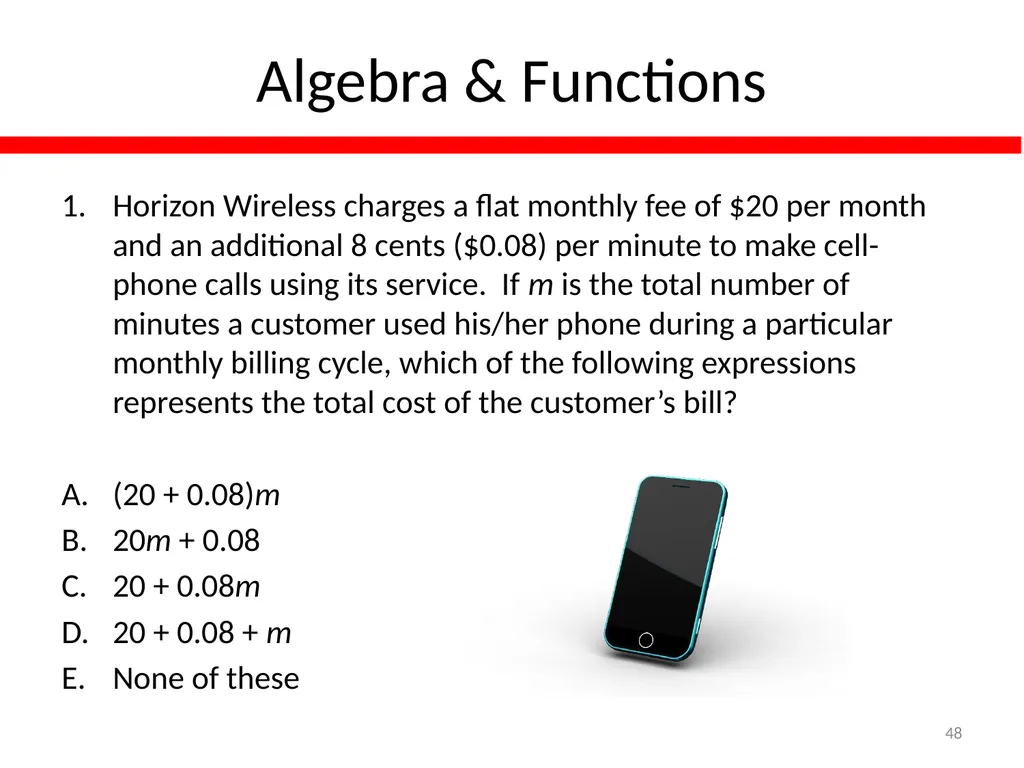
Algebra & Functions Horizon Wireless charges a flat monthly fee of $20 per month and an additional 8 cents ($0.08) per minute to make cell-phone calls using its service. If m is the total number of minutes a customer used his/her phone during a particular monthly billing cycle, which of the following expressions represents the total cost of the customer’s bill?
(20 + 0.08)m
20m + 0.08
20 + 0.08m
20 + 0.08 + m
None of these 48<br>
(20 + 0.08)m
20m + 0.08
20 + 0.08m
20 + 0.08 + m
None of these 48<br>
49
Algebra & Functions Which of the following statements about the linear equation y = 4x – 1 is false?
The slope (m) of the line is 4.
The x-intercept of the line is –1.
The point (2, 7) is on the line.
The point (–1, 2) is above the line.
The point (3, 0) is below the line. 49 Tip: Terminology<br>
The slope (m) of the line is 4.
The x-intercept of the line is –1.
The point (2, 7) is on the line.
The point (–1, 2) is above the line.
The point (3, 0) is below the line. 49 Tip: Terminology<br>
50
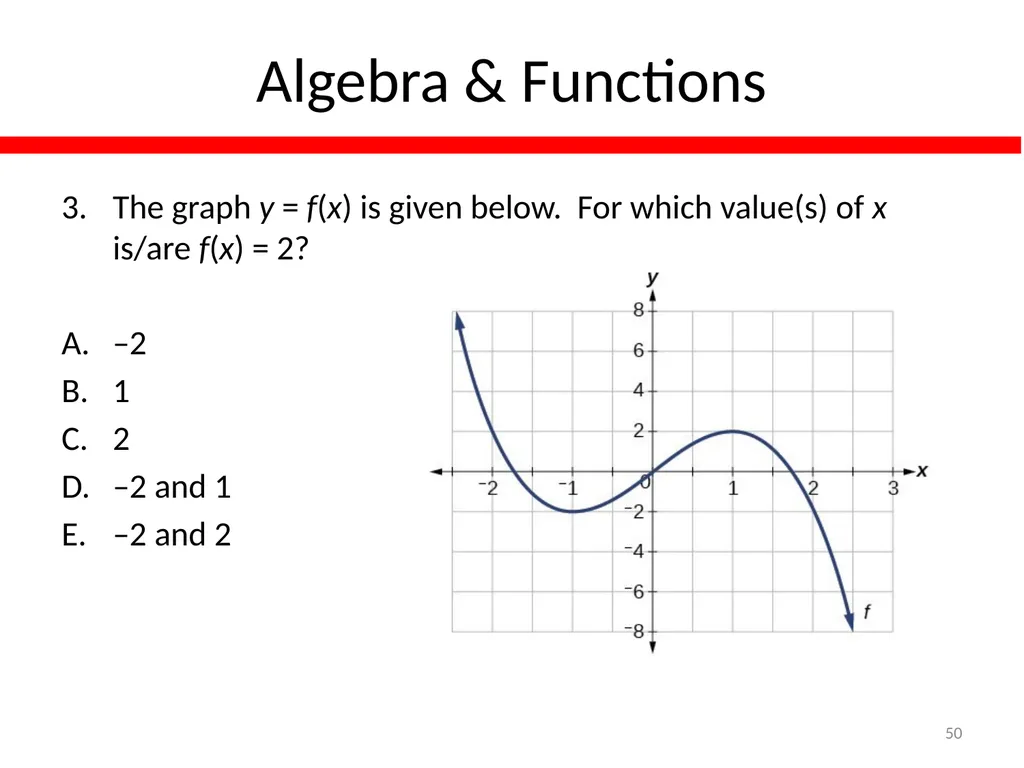
Algebra & Functions The graph y = f(x) is given below. For which value(s) of x is/are f(x) = 2?
–2
1
2
–2 and 1
–2 and 2 50<br>
–2
1
2
–2 and 1
–2 and 2 50<br>
51
Algebra & Functions 51<br>
52
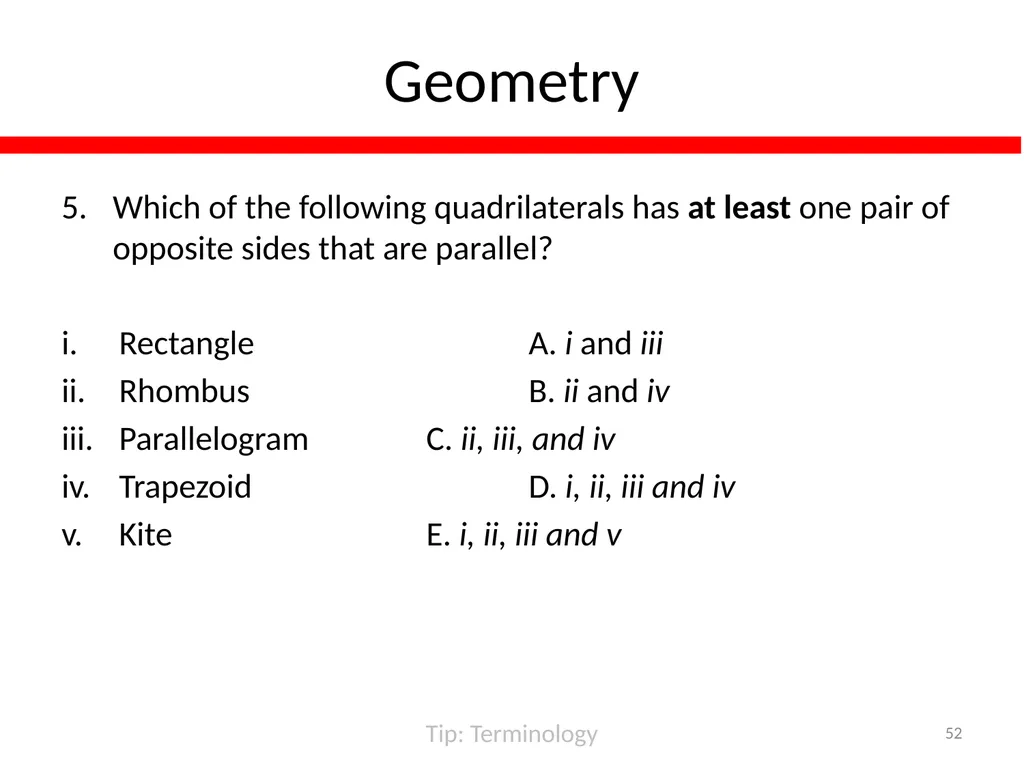
Geometry Which of the following quadrilaterals has at least one pair of opposite sides that are parallel?
Rectangle A. i and iii
Rhombus B. ii and iv
Parallelogram C. ii, iii, and iv
Trapezoid D. i, ii, iii and iv
Kite E. i, ii, iii and v 52 Tip: Terminology<br>
Rectangle A. i and iii
Rhombus B. ii and iv
Parallelogram C. ii, iii, and iv
Trapezoid D. i, ii, iii and iv
Kite E. i, ii, iii and v 52 Tip: Terminology<br>
53
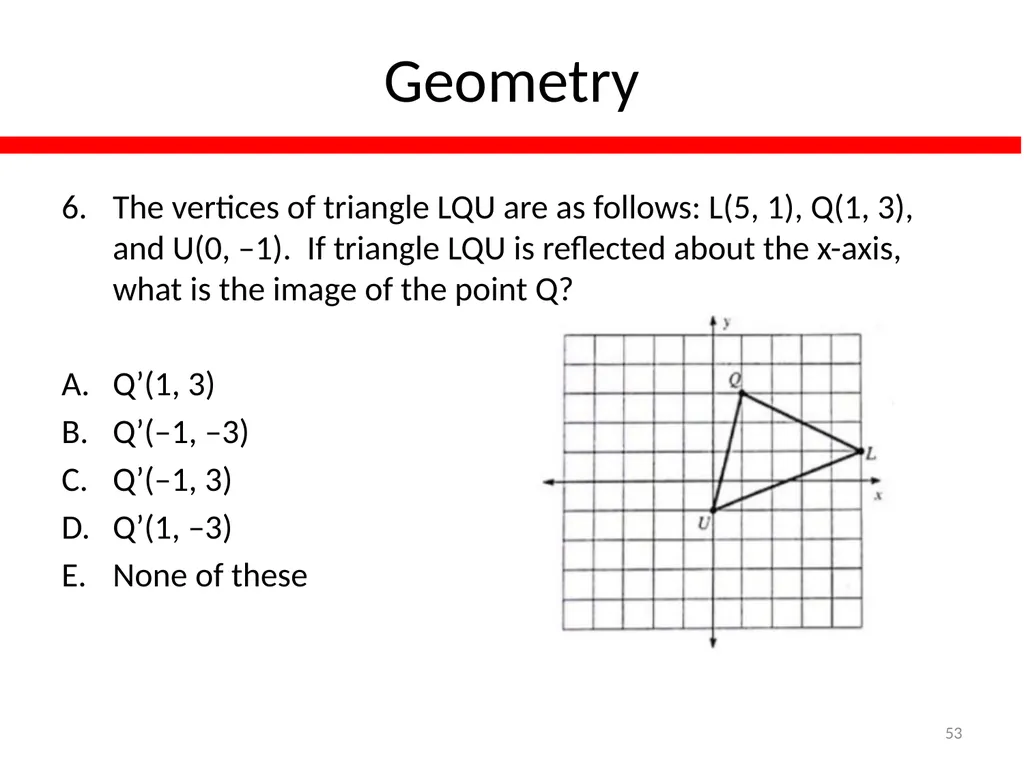
Geometry The vertices of triangle LQU are as follows: L(5, 1), Q(1, 3), and U(0, –1). If triangle LQU is reflected about the x-axis, what is the image of the point Q?
Q’(1, 3)
Q’(–1, –3)
Q’(–1, 3)
Q’(1, –3)
None of these 53<br>
Q’(1, 3)
Q’(–1, –3)
Q’(–1, 3)
Q’(1, –3)
None of these 53<br>
54
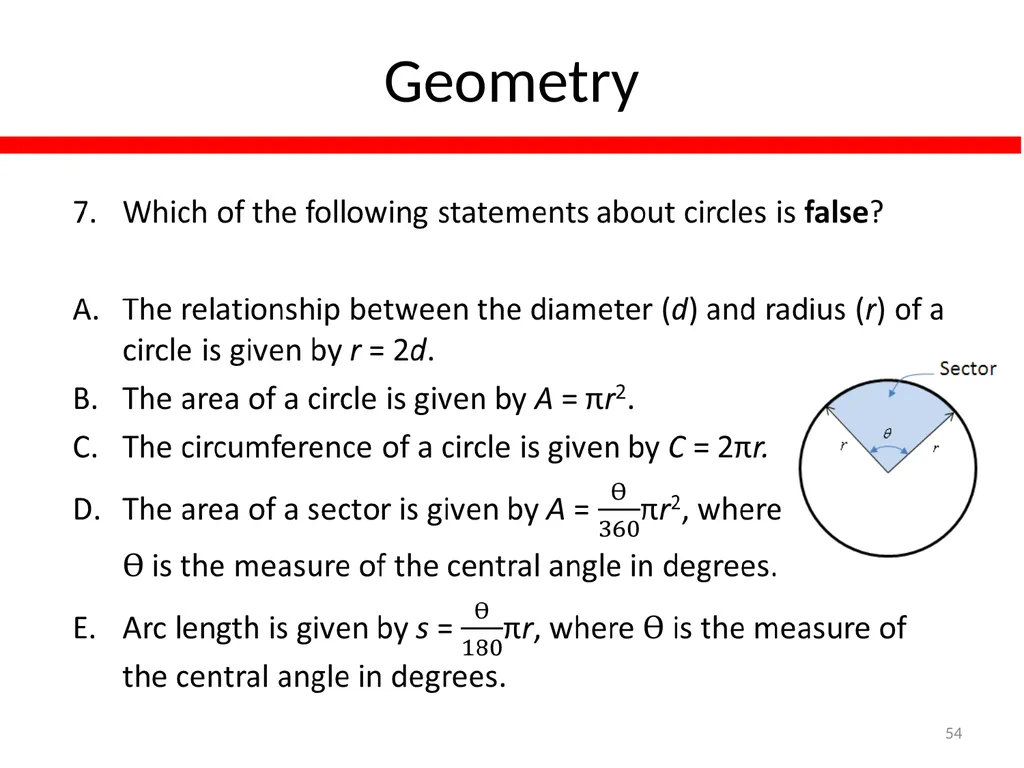
Geometry 54<br>
55
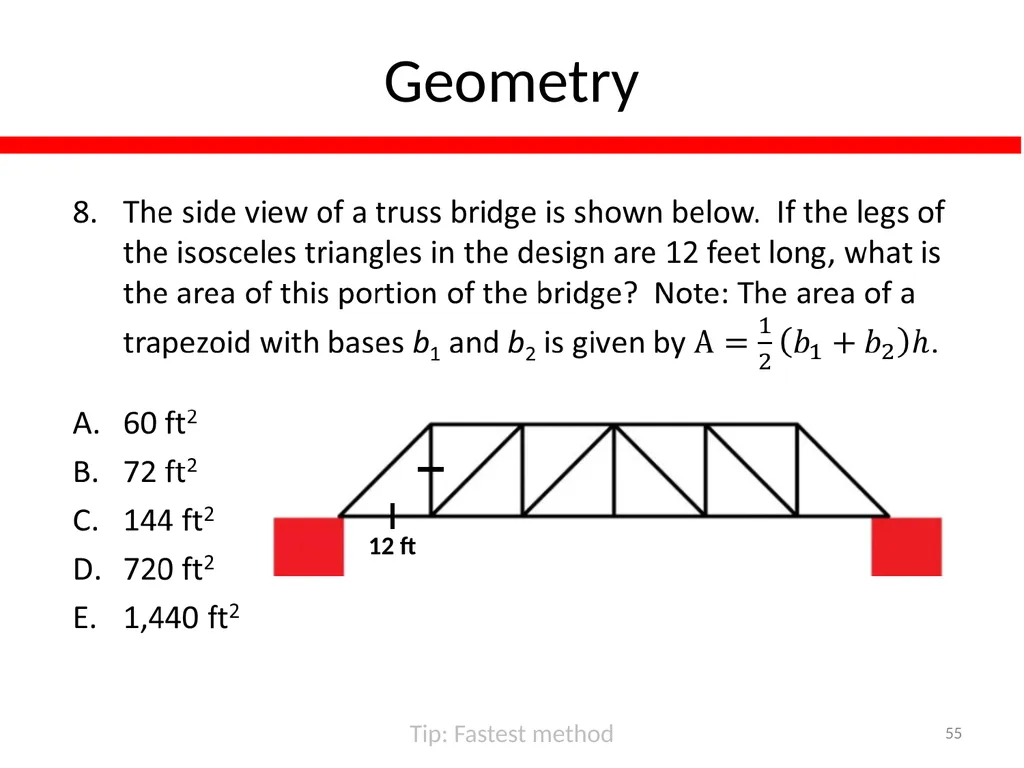
Geometry 55 12 ft Tip: Fastest method<br>
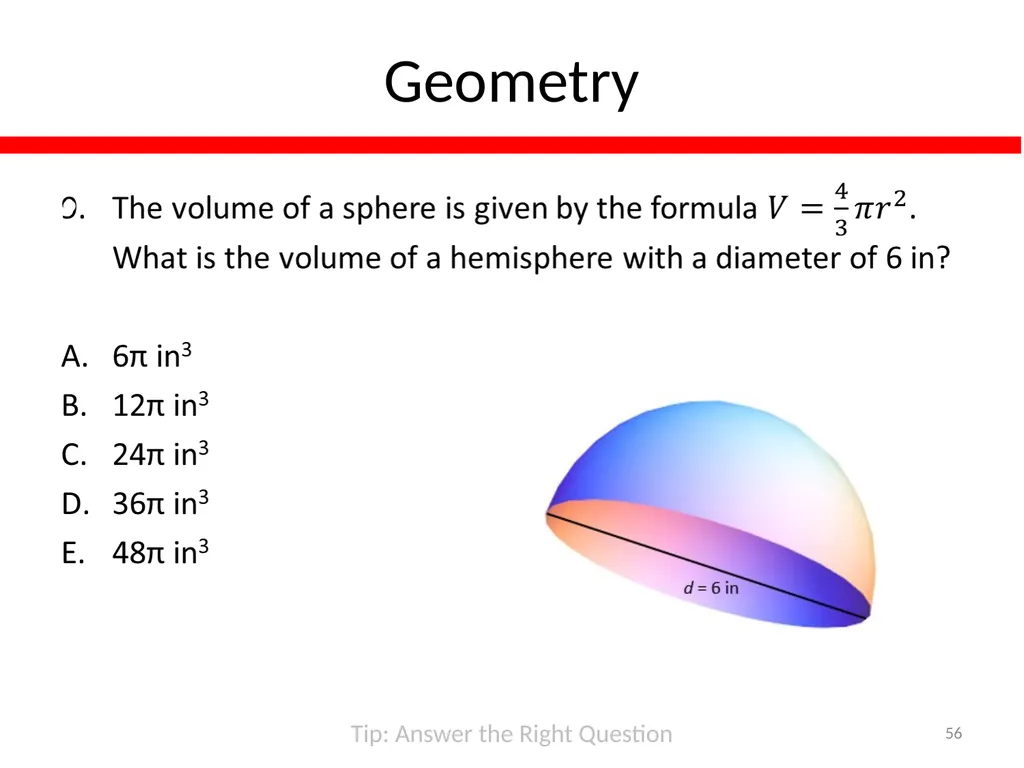
56
Geometry 56 Tip: Answer the Right Question<br>
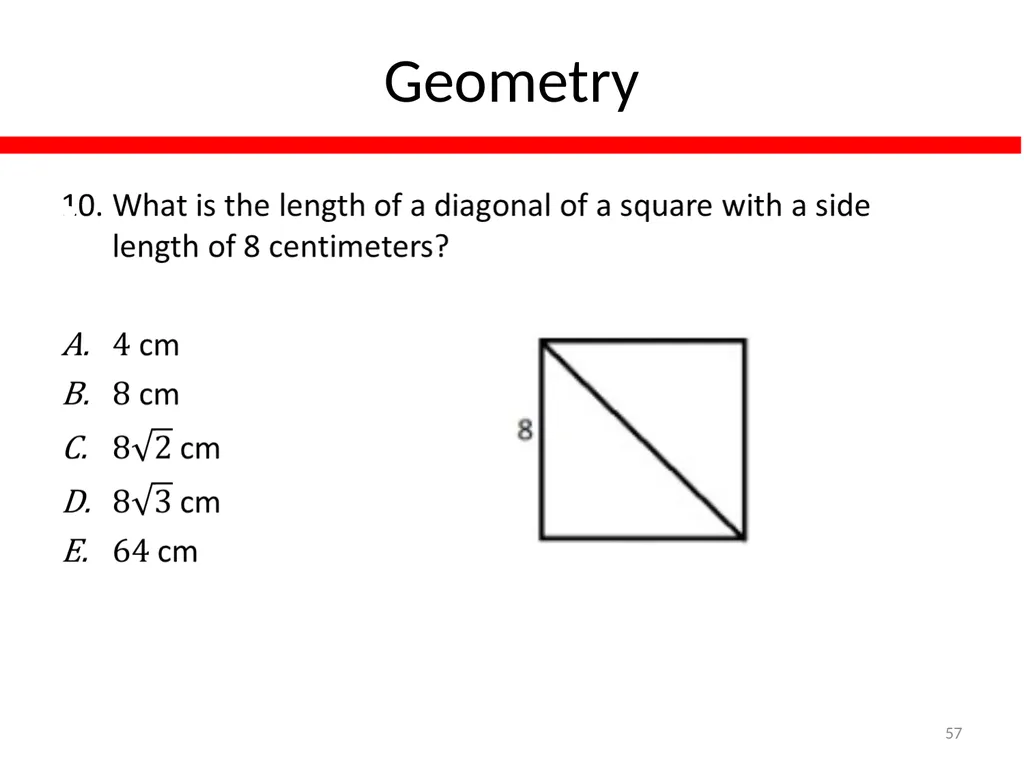
57
Geometry 57<br>
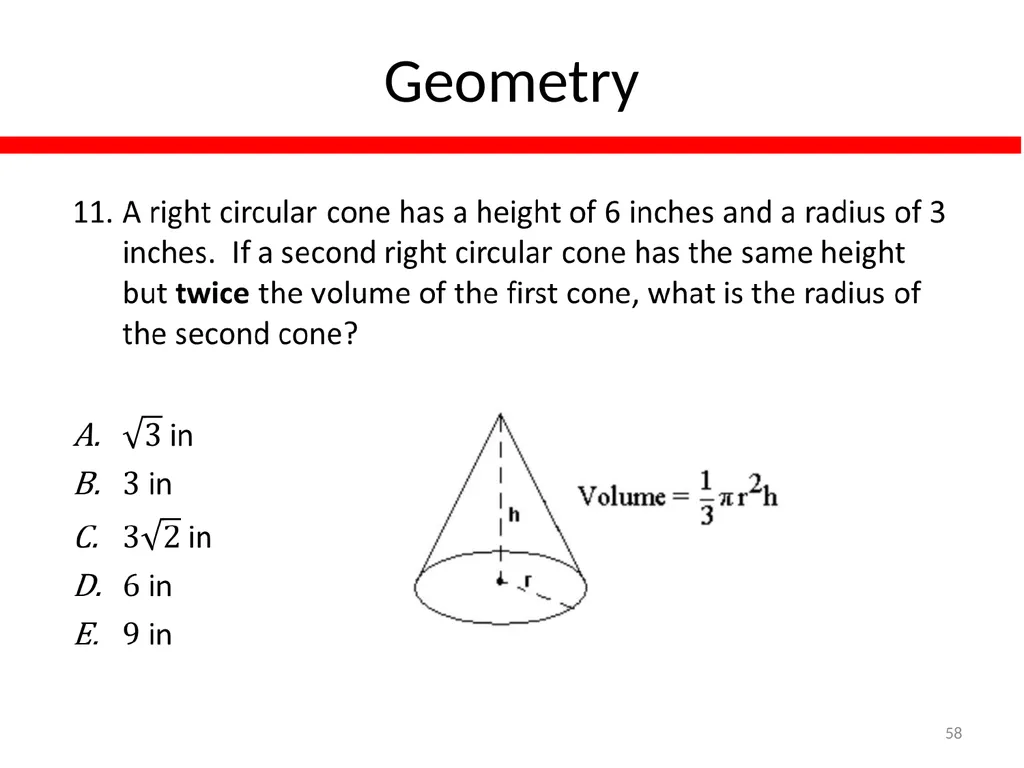
58
Geometry 58<br>
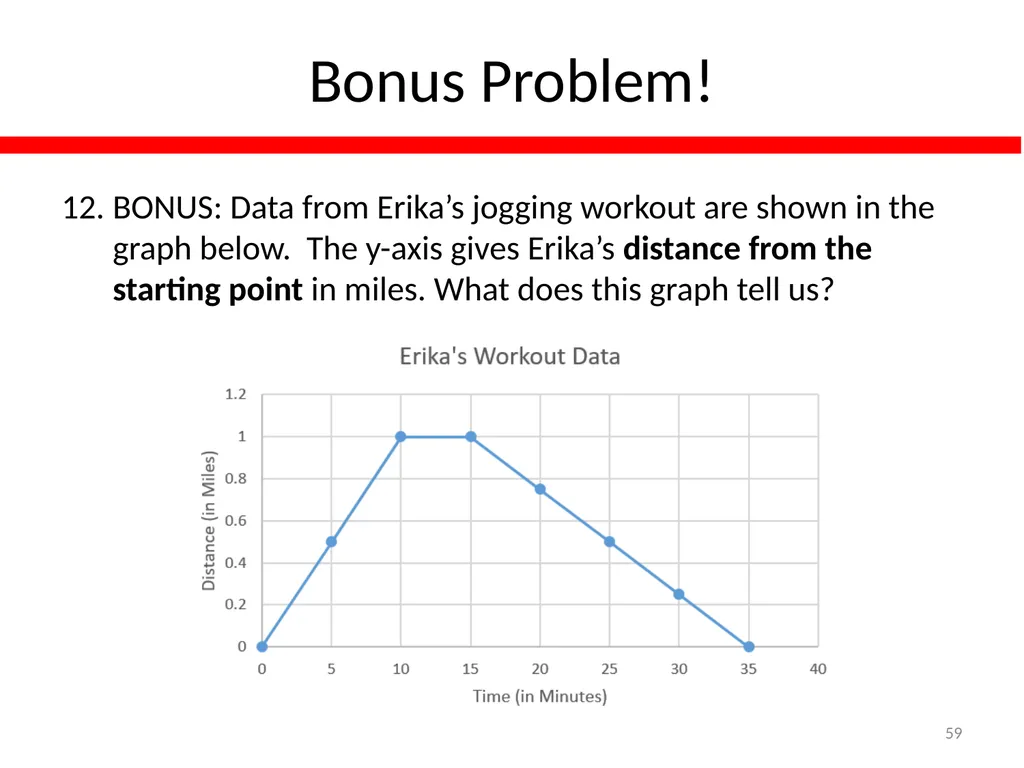
59
Bonus Problem! BONUS: Data from Erika’s jogging workout are shown in the graph below. The y-axis gives Erika’s distance from the starting point in miles. What does this graph tell us? 59<br>