03
Sources and daily requirements Daily requirement: 2 mg/d.
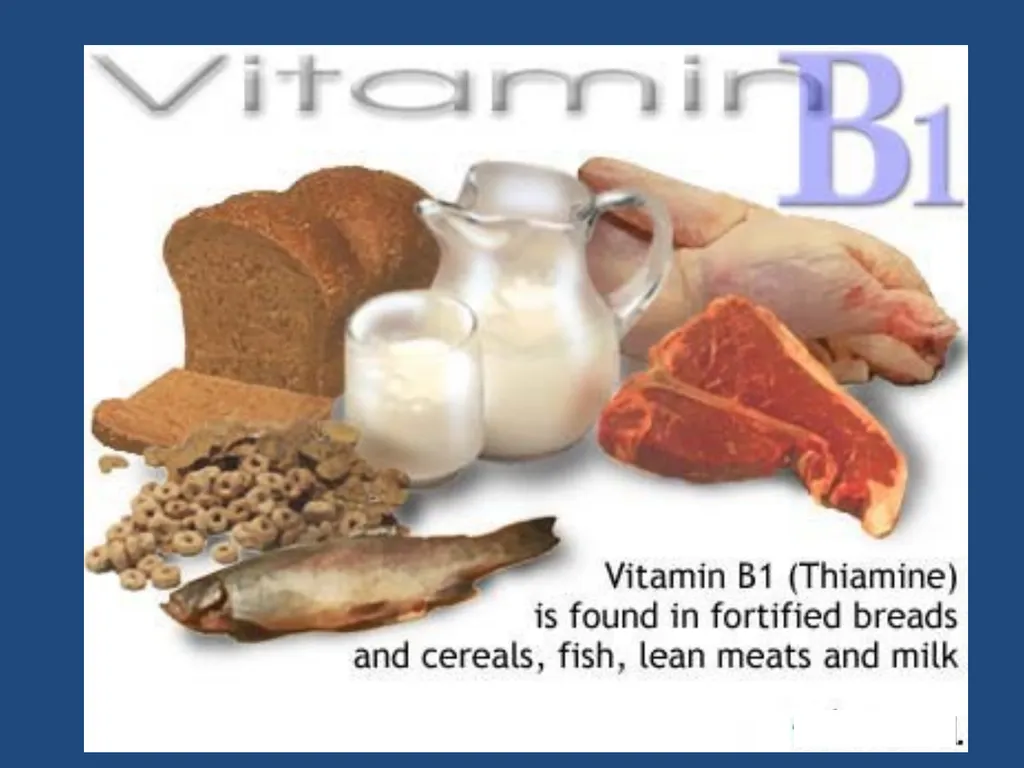
Food sources: yeast, meat, legumes, whole grains, and nuts. Milled rice or grains contain little thiamine.
Tea and coffee contain thiaminases, which can destroy the vitamin.
The body have limited stores of B1 so deficiency occur after one month of B1 free diet.<br>
04
Thiamine deficiency Causes :
Alcoholism.
Poor dietary intake(rice based diet).
Long-term parenteral nutrition.
Chronic illnesses.
Pregnancy.
Chronic diuretics therapy.
Heavy coffee and tea consumption.<br>
05
Clinical features of thiamine deficiency In early stage anorexia, irritability and decrease in short-term memory.
Prolonged thiamine deficiency causes “beriberi”, tow types of beriberi:
Wet beriberi.
Dry beriberi.<br>
06
Clinical features of thiamine deficiency Wet beriberi : presents primarily with cardiovascular symptoms, due to impaired myocardial energy metabolism and dysautonomia, and can occur after 3 months of a thiamine-deficient diet.
Patients present with an enlarged heart, tachycardia, high-output CHF and peripheral edema.<br>
07
Clinical features of thiamine deficiency Dry beriberi : present with a symmetric peripheral neuropathy of the motor and sensory systems with diminished reflexes. The neuropathy affects the legs more than the arms.<br>
08
Clinical features of thiamine deficiency Wernicke's encephalopathy: is a CNS syndrome caused by thiamine deficiency in alcoholics; nystagmus, ophthalmoplegia, ataxia, and mental impairment, it can be precipitated by large CHO dose without B1.
Wernicke-Korsakoff syndrome : occurs when there is an additional loss of memory and a confabulatory psychosis.<br>
09
Diagnosis of thiamin deficiency Assay of transketolase activity measured before and after the addition of thiamine pyrophosphate.
Thiamine in serum or blood can also be measured by HPLC.
Urinary thiamine excretion.<br>
10
Treatment of thiamine deficiency Acute thiamine deficiency is an emergency whether cardiovascular or neurological.
Treatment is 100 mg/d of thiamine parenterally for 7 days, followed by 10 mg/d orally until there is complete recovery.
Improvement occurs within 24 hours. But Wernicke-Korsakoff psychosis may be permanent.<br>
11
Riboflavin (Vitamin B2) Functions of riboflavin :
Coenzyme in metabolism of fat , carbohydrate, and protein.
Plays a role in drugs and steroid metabolism, including detoxification reactions.<br>
12
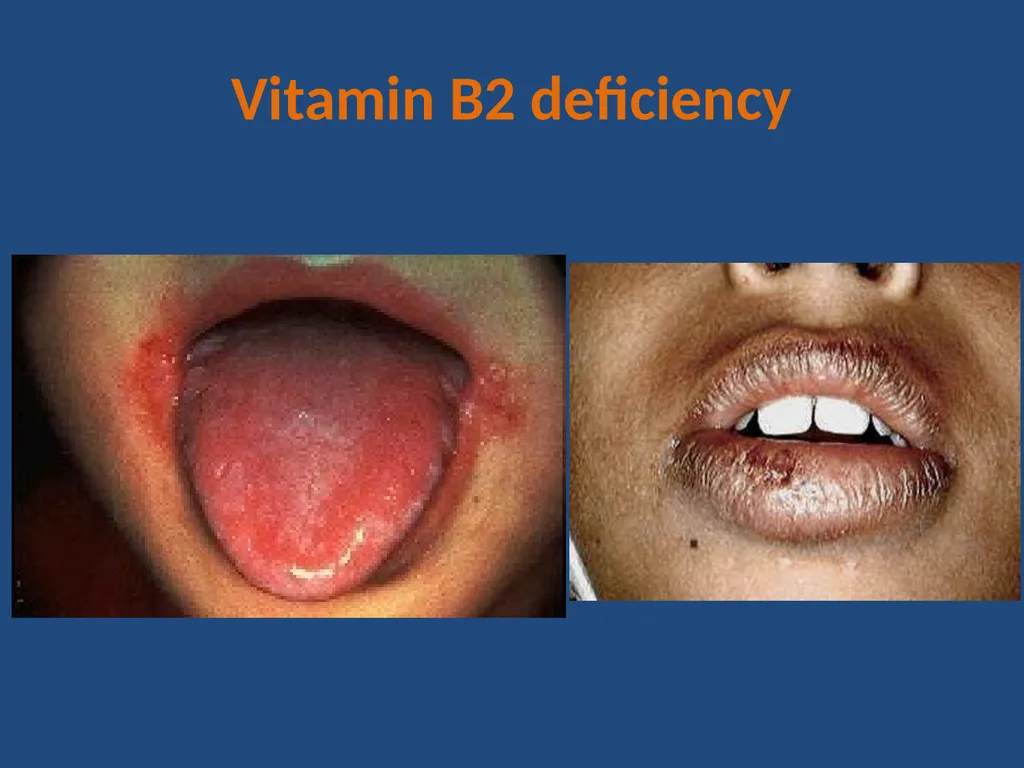
Vitamin B2 deficiency Causes : rare in developed countries, mainly caused by under-nutrition and alcoholism, occurs together with other vitamins deficiencies.
Clinical features : glossitis, angular stomatitis, cheilosis, skin lesions, corneal vascularization, anemia, and personality changes.<br>
13
Vitamin B2 deficiency<br>
14
Diagnosis and treatment Diagnosis : measurement of red blood cell or urinary riboflavin concentrations.
Treatment : B2 replacement usually together with other vitamin B complex<br>
15
Niacin (Vitamin B3) Niacin refers to nicotinic acid and nicotinamide and their metabolites.
It is a precursor of NAD and NADP which are important in :
Numerous oxidation- reduction reactions and in DNA repair.
High doses of nicotinic acid (2 g/d) are used for the treatment of hyperlipidemia.<br>
16
Sources and daily requirement Sources : milk, meat, fish, poultry, nuts and eggs.
Niacin can be synthesized from tryptophan from vegetables sources but this reaction requires B6 and B2
Daily requirement : 15 -20 mg /day.
Requirement increase in pregnancy and lactation.<br>
17
Niacin deficiency (Pellagra) Causes of niacin deficiency:
Dietary deficiency ( corn based diet).
Alcoholism.
Hartnup disease ( defect in tryptophan absorption)
Carcinoid syndrome( increase consumption of tryptophan).
B6 and B2 deficiency.<br>
18
Clinical features of Pellagra Loss of appetite, generalized weakness and irritability, abdominal pain, and vomiting.
Bright red glossitis.
Dermatitis
Diarrhea (in part due to proctitis and in part due to malabsorption).
depression, seizures, and dementia.<br>
19
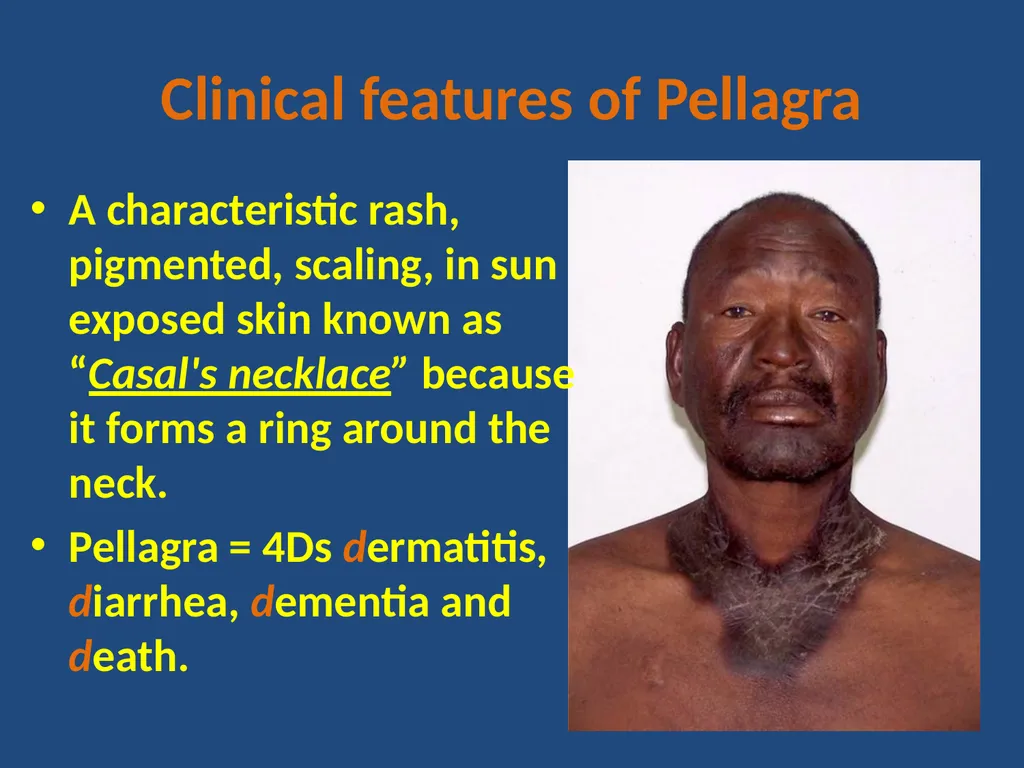
Clinical features of Pellagra A characteristic rash, pigmented, scaling, in sun exposed skin known as “Casal's necklace” because it forms a ring around the neck.
Pellagra = 4Ds dermatitis, diarrhea, dementia and death.<br>
20
Diagnosis and treatment Diagnosis:
Clinical features.
Niacin metabolites assay in urine.
Treatment :
100–200 mg of niacin three times daily for 5 days.<br>
21
Niacin toxicity Doses > 50 mg may cause flushing, skin dryness, itching, parasthesia, headache, nausea, vomiting, and abdominal pain.
Hepatic toxicity is the most serious toxic reaction due to niacin and may present as jaundice with elevated AST and ALT levels.<br>