
vSMT-IO: Improving I/O Performance and Efficiency
KB
Published · 31 slides · 0 views
1 / 1

Description
vSMT-IO: Improving IO Performance and Efficiency on SMT Processors in Virtualized Clouds Weiwei Jia, Jianchen Shan, Tsz On Li, Xiaowei Shang, Heming Cui, Xiaoning Ding New Jersey Institute of Technology, Hofstra University, Hong Kong
Related Topics
Share
Embed code
Download this presentation From Below
"vSMT-IO: Improving I/O Performance and Efficiency" is the property of its rightful owner. Permission is granted to download and print the materials on this website for personal, non-commercial use only, and to display it on your personal computer provided you do not modify the materials and that you retain all copyright notices contained in the materials. By downloading content from our website, you accept the terms of this agreement.
Presentation Transcript
01
vSMT-IO: Improving I/O Performance and Efficiency on SMT Processors in Virtualized Clouds Weiwei Jia, Jianchen Shan, Tsz On Li, Xiaowei Shang, Heming Cui, Xiaoning Ding
New Jersey Institute of Technology, Hofstra University, Hong Kong University 1<br>
New Jersey Institute of Technology, Hofstra University, Hong Kong University 1<br>
02
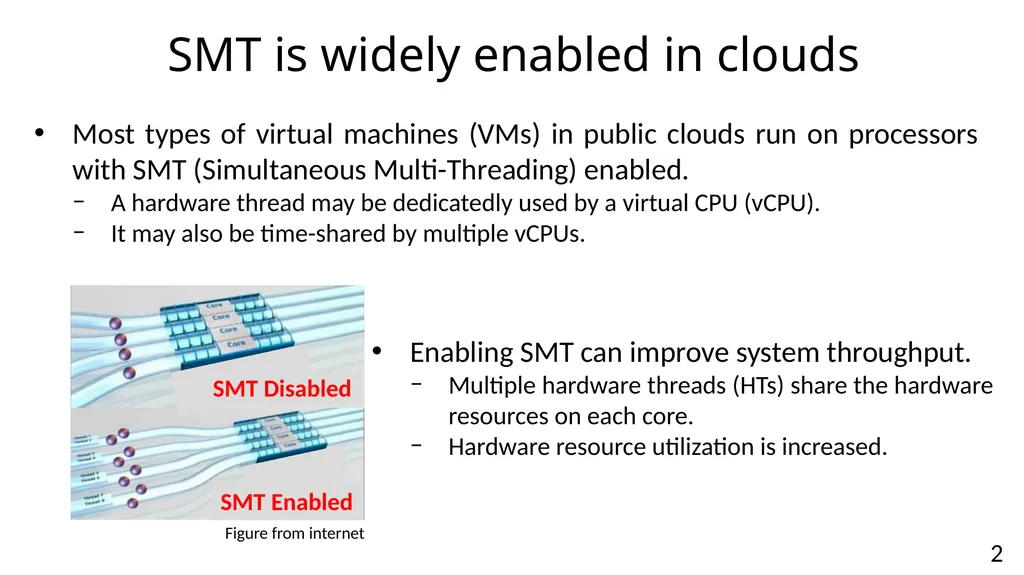
SMT is widely enabled in clouds 2 Most types of virtual machines (VMs) in public clouds run on processors with SMT (Simultaneous Multi-Threading) enabled.
A hardware thread may be dedicatedly used by a virtual CPU (vCPU).
It may also be time-shared by multiple vCPUs. Figure from internet Enabling SMT can improve system throughput.
Multiple hardware threads (HTs) share the hardware resources on each core.
Hardware resource utilization is increased.<br>
A hardware thread may be dedicatedly used by a virtual CPU (vCPU).
It may also be time-shared by multiple vCPUs. Figure from internet Enabling SMT can improve system throughput.
Multiple hardware threads (HTs) share the hardware resources on each core.
Hardware resource utilization is increased.<br>
03
3 To achieve high throughput, CPU scheduler must be optimized to maximize CPU utilization and minimize overhead.
Extensively studied: symbiotic scheduling focuses on maximizing utilization for computation intensive workloads (SOS[ASPLOS’00], cycle accounting[ASPLOS’09, HPCA'16], ...).
Co-schedule on the same core the threads with high symbiosis levels.
Symbiosis level: how well threads can fully utilize hardware resources with minimal conflicts.
Under-studied: Scheduling I/O workloads with low overhead on SMT processors.
I/O workloads incur high scheduling overhead due to frequent I/O operations.
The overhead reduces throughput when there are computation workloads on the same SMT core. CPU scheduler is crucial for SMT processors<br>
Extensively studied: symbiotic scheduling focuses on maximizing utilization for computation intensive workloads (SOS[ASPLOS’00], cycle accounting[ASPLOS’09, HPCA'16], ...).
Co-schedule on the same core the threads with high symbiosis levels.
Symbiosis level: how well threads can fully utilize hardware resources with minimal conflicts.
Under-studied: Scheduling I/O workloads with low overhead on SMT processors.
I/O workloads incur high scheduling overhead due to frequent I/O operations.
The overhead reduces throughput when there are computation workloads on the same SMT core. CPU scheduler is crucial for SMT processors<br>
04
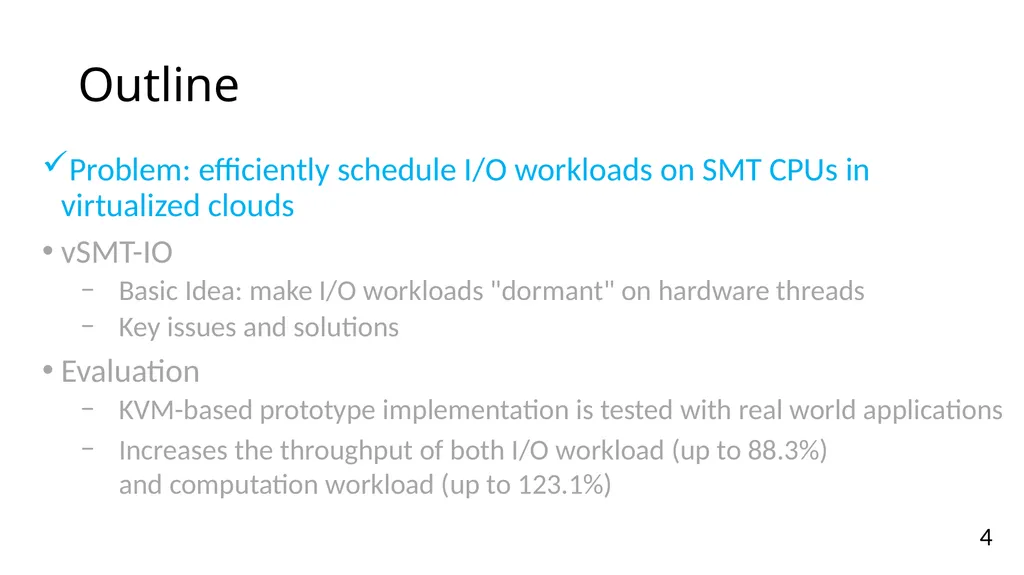
Outline Problem: efficiently schedule I/O workloads on SMT CPUs in virtualized clouds
vSMT-IO
Basic Idea: make I/O workloads "dormant" on hardware threads
Key issues and solutions
Evaluation
KVM-based prototype implementation is tested with real world applications
Increases the throughput of both I/O workload (up to 88.3%) and computation workload (up to 123.1%) 4<br>
vSMT-IO
Basic Idea: make I/O workloads "dormant" on hardware threads
Key issues and solutions
Evaluation
KVM-based prototype implementation is tested with real world applications
Increases the throughput of both I/O workload (up to 88.3%) and computation workload (up to 123.1%) 4<br>
05
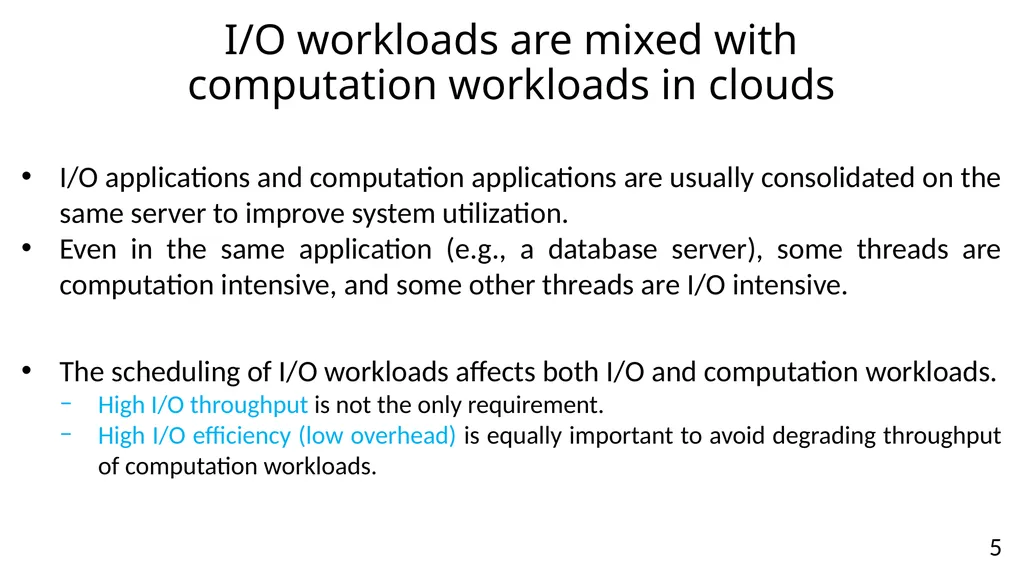
I/O workloads are mixed with computation workloads in clouds 5 I/O applications and computation applications are usually consolidated on the same server to improve system utilization.
Even in the same application (e.g., a database server), some threads are computation intensive, and some other threads are I/O intensive.
The scheduling of I/O workloads affects both I/O and computation workloads.
High I/O throughput is not the only requirement.
High I/O efficiency (low overhead) is equally important to avoid degrading throughput of computation workloads.<br>
Even in the same application (e.g., a database server), some threads are computation intensive, and some other threads are I/O intensive.
The scheduling of I/O workloads affects both I/O and computation workloads.
High I/O throughput is not the only requirement.
High I/O efficiency (low overhead) is equally important to avoid degrading throughput of computation workloads.<br>
06
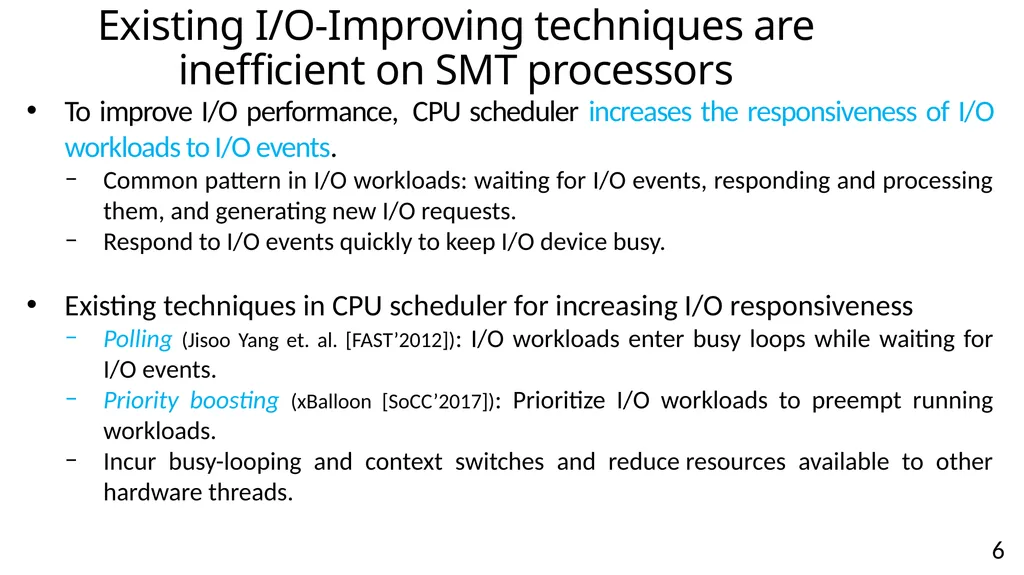
6 To improve I/O performance, CPU scheduler increases the responsiveness of I/O workloads to I/O events.
Common pattern in I/O workloads: waiting for I/O events, responding and processing them, and generating new I/O requests.
Respond to I/O events quickly to keep I/O device busy.
Existing techniques in CPU scheduler for increasing I/O responsiveness
Polling (Jisoo Yang et. al. [FAST’2012]): I/O workloads enter busy loops while waiting for I/O events.
Priority boosting (xBalloon [SoCC’2017]): Prioritize I/O workloads to preempt running workloads.
Incur busy-looping and context switches and reduce resources available to other hardware threads. Existing I/O-Improving techniques are inefficient on SMT processors<br>
Common pattern in I/O workloads: waiting for I/O events, responding and processing them, and generating new I/O requests.
Respond to I/O events quickly to keep I/O device busy.
Existing techniques in CPU scheduler for increasing I/O responsiveness
Polling (Jisoo Yang et. al. [FAST’2012]): I/O workloads enter busy loops while waiting for I/O events.
Priority boosting (xBalloon [SoCC’2017]): Prioritize I/O workloads to preempt running workloads.
Incur busy-looping and context switches and reduce resources available to other hardware threads. Existing I/O-Improving techniques are inefficient on SMT processors<br>
07
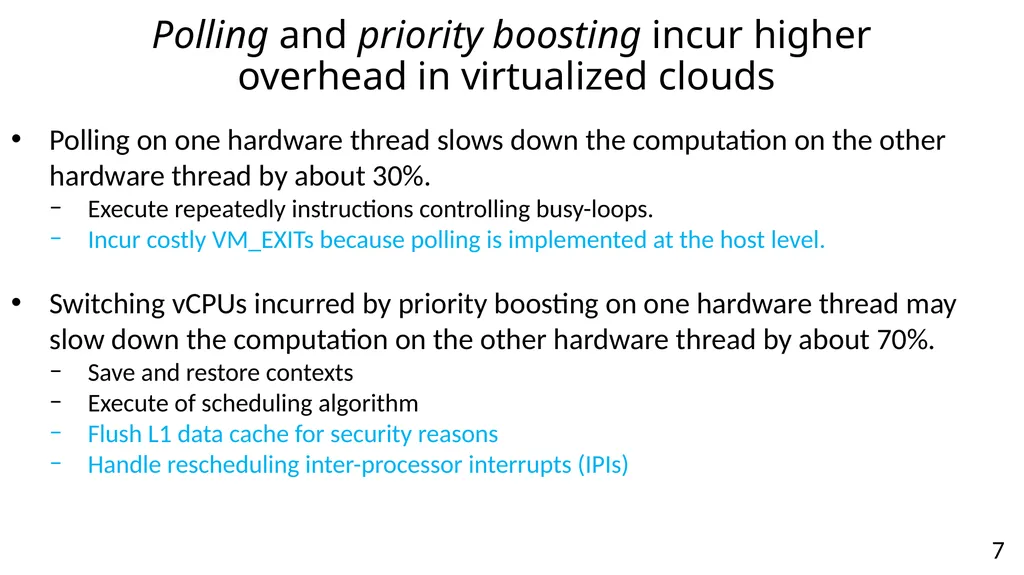
Polling and priority boosting incur higher overhead in virtualized clouds 7 Polling on one hardware thread slows down the computation on the other hardware thread by about 30%.
Execute repeatedly instructions controlling busy-loops.
Incur costly VM_EXITs because polling is implemented at the host level.
Switching vCPUs incurred by priority boosting on one hardware thread may slow down the computation on the other hardware thread by about 70%.
Save and restore contexts
Execute of scheduling algorithm
Flush L1 data cache for security reasons
Handle rescheduling inter-processor interrupts (IPIs)<br>
Execute repeatedly instructions controlling busy-loops.
Incur costly VM_EXITs because polling is implemented at the host level.
Switching vCPUs incurred by priority boosting on one hardware thread may slow down the computation on the other hardware thread by about 70%.
Save and restore contexts
Execute of scheduling algorithm
Flush L1 data cache for security reasons
Handle rescheduling inter-processor interrupts (IPIs)<br>
08
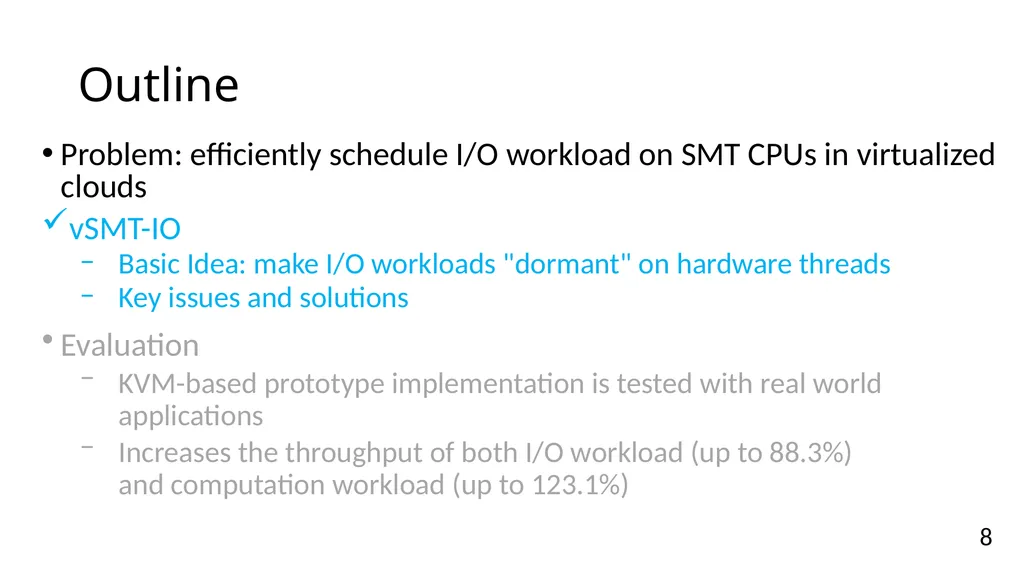
Outline Problem: efficiently schedule I/O workload on SMT CPUs in virtualized clouds
vSMT-IO
Basic Idea: make I/O workloads "dormant" on hardware threads
Key issues and solutions
Evaluation
KVM-based prototype implementation is tested with real world applications
Increases the throughput of both I/O workload (up to 88.3%) and computation workload (up to 123.1%) 8<br>
vSMT-IO
Basic Idea: make I/O workloads "dormant" on hardware threads
Key issues and solutions
Evaluation
KVM-based prototype implementation is tested with real world applications
Increases the throughput of both I/O workload (up to 88.3%) and computation workload (up to 123.1%) 8<br>
09
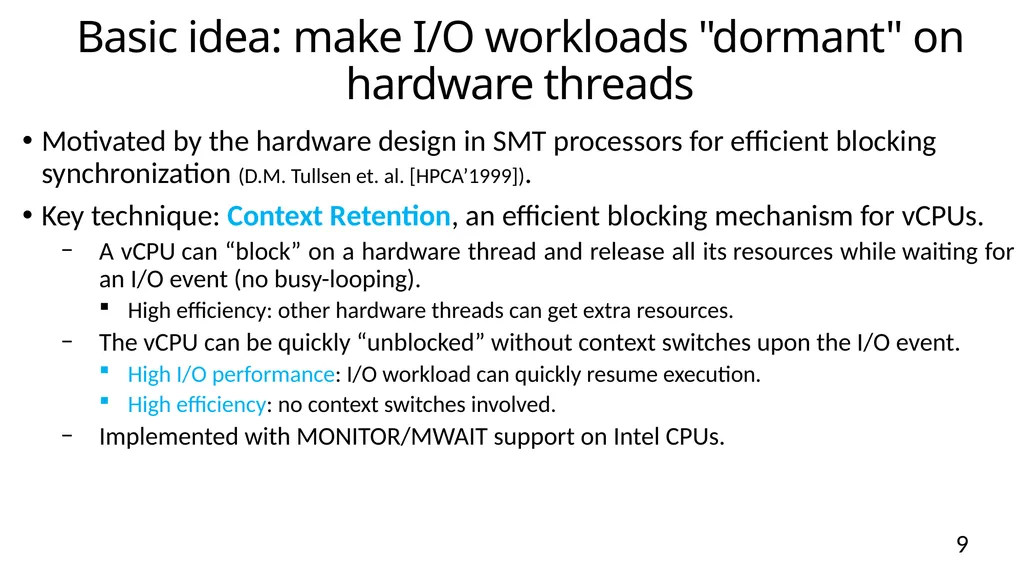
Basic idea: make I/O workloads "dormant" on hardware threads Motivated by the hardware design in SMT processors for efficient blocking synchronization (D.M. Tullsen et. al. [HPCA’1999]).
Key technique: Context Retention, an efficient blocking mechanism for vCPUs.
A vCPU can “block” on a hardware thread and release all its resources while waiting for an I/O event (no busy-looping).
High efficiency: other hardware threads can get extra resources.
The vCPU can be quickly “unblocked” without context switches upon the I/O event.
High I/O performance: I/O workload can quickly resume execution.
High efficiency: no context switches involved.
Implemented with MONITOR/MWAIT support on Intel CPUs. 9<br>
Key technique: Context Retention, an efficient blocking mechanism for vCPUs.
A vCPU can “block” on a hardware thread and release all its resources while waiting for an I/O event (no busy-looping).
High efficiency: other hardware threads can get extra resources.
The vCPU can be quickly “unblocked” without context switches upon the I/O event.
High I/O performance: I/O workload can quickly resume execution.
High efficiency: no context switches involved.
Implemented with MONITOR/MWAIT support on Intel CPUs. 9<br>
10
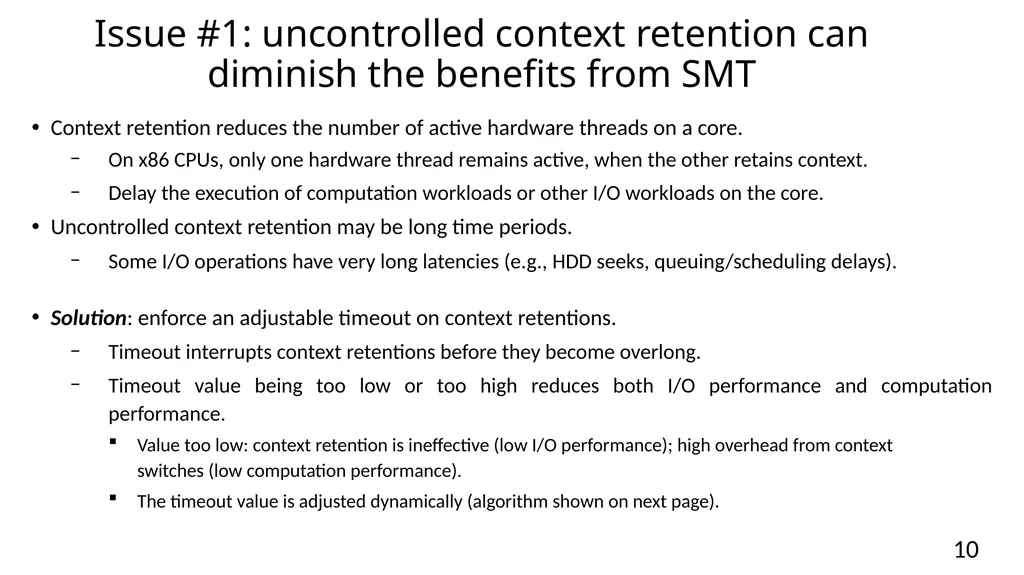
Issue #1: uncontrolled context retention can diminish the benefits from SMT Context retention reduces the number of active hardware threads on a core.
On x86 CPUs, only one hardware thread remains active, when the other retains context.
Delay the execution of computation workloads or other I/O workloads on the core.
Uncontrolled context retention may be long time periods.
Some I/O operations have very long latencies (e.g., HDD seeks, queuing/scheduling delays).
Solution: enforce an adjustable timeout on context retentions.
Timeout interrupts context retentions before they become overlong.
Timeout value being too low or too high reduces both I/O performance and computation performance.
Value too low: context retention is ineffective (low I/O performance); high overhead from context switches (low computation performance).
The timeout value is adjusted dynamically (algorithm shown on next page). 10<br>
On x86 CPUs, only one hardware thread remains active, when the other retains context.
Delay the execution of computation workloads or other I/O workloads on the core.
Uncontrolled context retention may be long time periods.
Some I/O operations have very long latencies (e.g., HDD seeks, queuing/scheduling delays).
Solution: enforce an adjustable timeout on context retentions.
Timeout interrupts context retentions before they become overlong.
Timeout value being too low or too high reduces both I/O performance and computation performance.
Value too low: context retention is ineffective (low I/O performance); high overhead from context switches (low computation performance).
The timeout value is adjusted dynamically (algorithm shown on next page). 10<br>
11
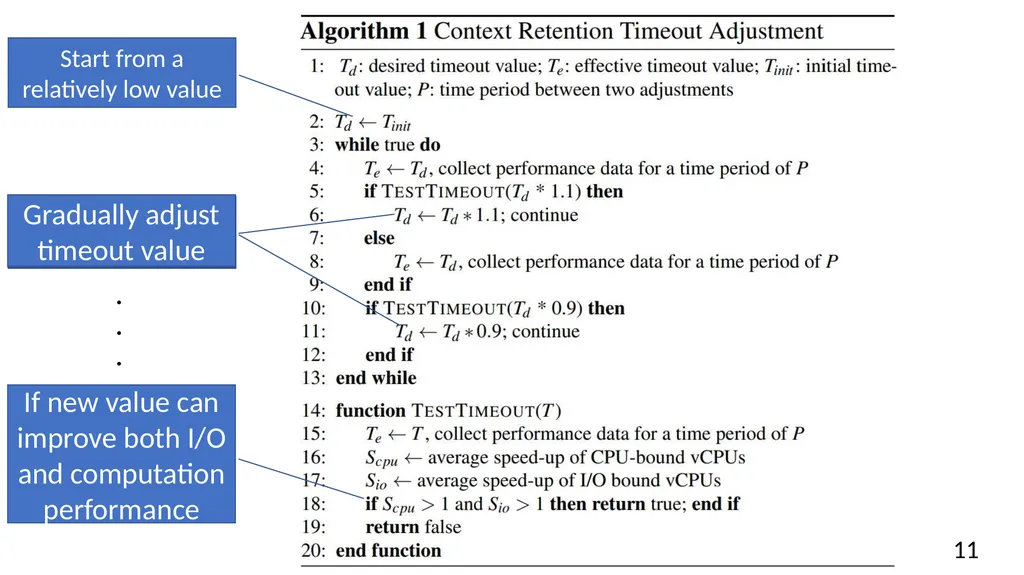
11 Start from a relatively low value Gradually adjust timeout value .
.
. Gradually adjust timeout value If new value can improve both I/O and computation performance<br>
.
. Gradually adjust timeout value If new value can improve both I/O and computation performance<br>
12
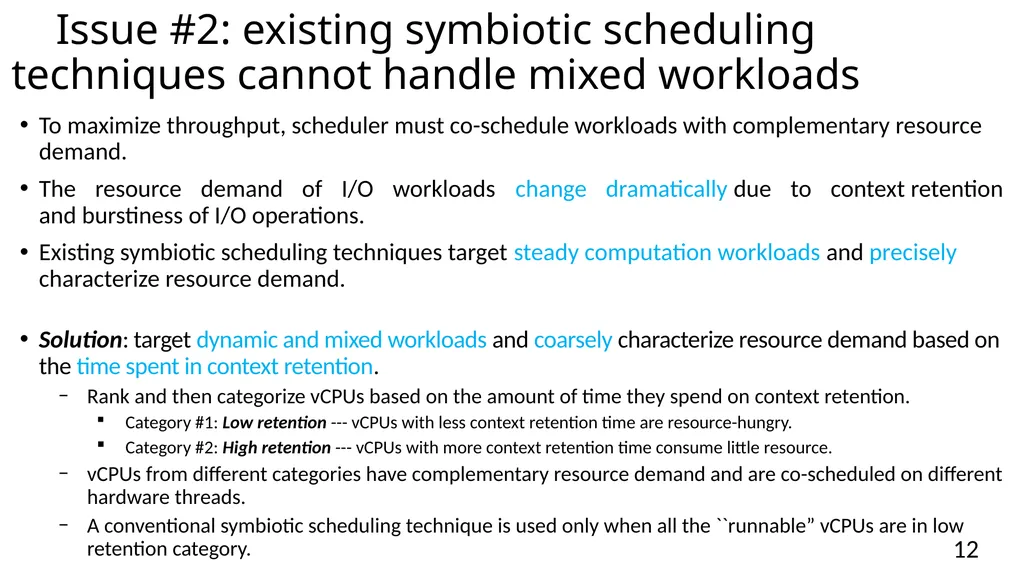
Issue #2: existing symbiotic scheduling techniques cannot handle mixed workloads 12 To maximize throughput, scheduler must co-schedule workloads with complementary resource demand.
The resource demand of I/O workloads change dramatically due to context retention and burstiness of I/O operations.
Existing symbiotic scheduling techniques target steady computation workloads and precisely characterize resource demand.
Solution: target dynamic and mixed workloads and coarsely characterize resource demand based on the time spent in context retention.
Rank and then categorize vCPUs based on the amount of time they spend on context retention.
Category #1: Low retention --- vCPUs with less context retention time are resource-hungry.
Category #2: High retention --- vCPUs with more context retention time consume little resource.
vCPUs from different categories have complementary resource demand and are co-scheduled on different hardware threads.
A conventional symbiotic scheduling technique is used only when all the ``runnable” vCPUs are in low retention category.<br>
The resource demand of I/O workloads change dramatically due to context retention and burstiness of I/O operations.
Existing symbiotic scheduling techniques target steady computation workloads and precisely characterize resource demand.
Solution: target dynamic and mixed workloads and coarsely characterize resource demand based on the time spent in context retention.
Rank and then categorize vCPUs based on the amount of time they spend on context retention.
Category #1: Low retention --- vCPUs with less context retention time are resource-hungry.
Category #2: High retention --- vCPUs with more context retention time consume little resource.
vCPUs from different categories have complementary resource demand and are co-scheduled on different hardware threads.
A conventional symbiotic scheduling technique is used only when all the ``runnable” vCPUs are in low retention category.<br>
13
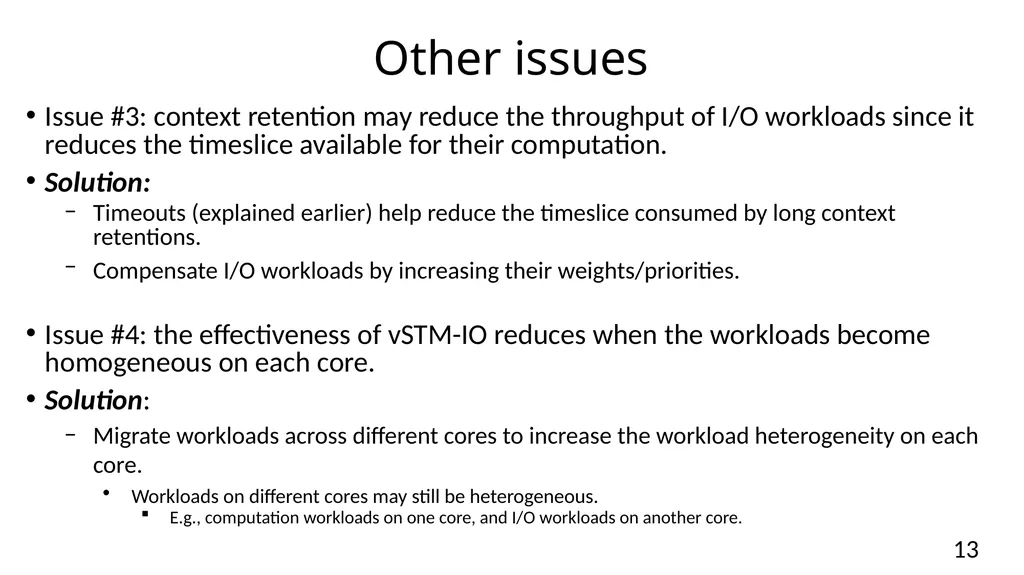
Other issues 13 Issue #3: context retention may reduce the throughput of I/O workloads since it reduces the timeslice available for their computation.
Solution:
Timeouts (explained earlier) help reduce the timeslice consumed by long context retentions.
Compensate I/O workloads by increasing their weights/priorities.
Issue #4: the effectiveness of vSTM-IO reduces when the workloads become homogeneous on each core.
Solution:
Migrate workloads across different cores to increase the workload heterogeneity on each core.
Workloads on different cores may still be heterogeneous.
E.g., computation workloads on one core, and I/O workloads on another core.<br>
Solution:
Timeouts (explained earlier) help reduce the timeslice consumed by long context retentions.
Compensate I/O workloads by increasing their weights/priorities.
Issue #4: the effectiveness of vSTM-IO reduces when the workloads become homogeneous on each core.
Solution:
Migrate workloads across different cores to increase the workload heterogeneity on each core.
Workloads on different cores may still be heterogeneous.
E.g., computation workloads on one core, and I/O workloads on another core.<br>
14
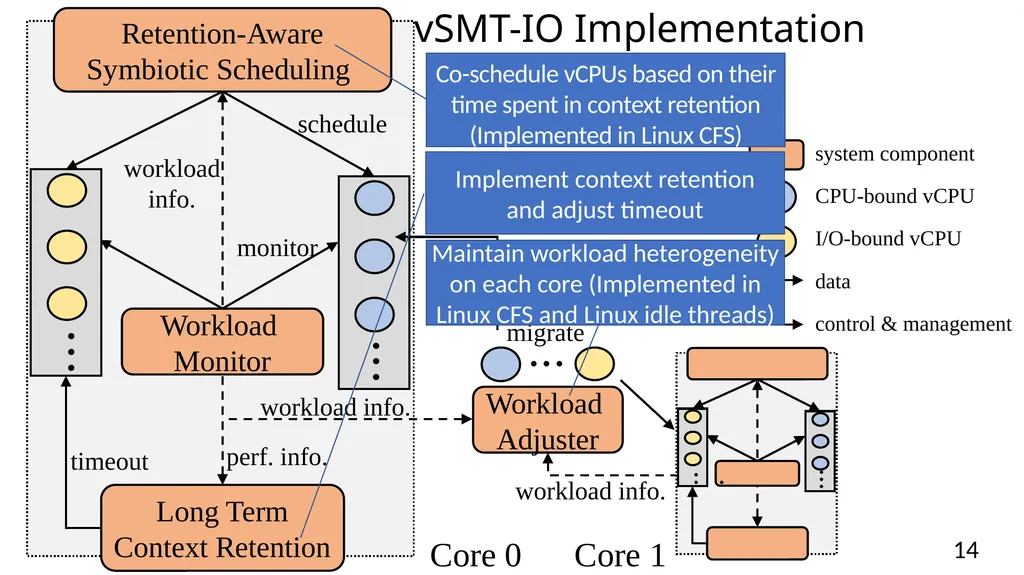
Core 0 Retention-Aware
Symbiotic Scheduling Workload
Monitor Long Term Context Retention schedule monitor workload info. perf. info. timeout Workload
Adjuster workload info. Core 1 . . . migrate workload info. system component CPU-bound vCPU I/O-bound vCPU data control & management 14 vSMT-IO Implementation Co-schedule vCPUs based on their time spent in context retention
(Implemented in Linux CFS) Implement context retention and adjust timeout Maintain workload heterogeneity on each core (Implemented in Linux CFS and Linux idle threads)<br>
Symbiotic Scheduling Workload
Monitor Long Term Context Retention schedule monitor workload info. perf. info. timeout Workload
Adjuster workload info. Core 1 . . . migrate workload info. system component CPU-bound vCPU I/O-bound vCPU data control & management 14 vSMT-IO Implementation Co-schedule vCPUs based on their time spent in context retention
(Implemented in Linux CFS) Implement context retention and adjust timeout Maintain workload heterogeneity on each core (Implemented in Linux CFS and Linux idle threads)<br>
15
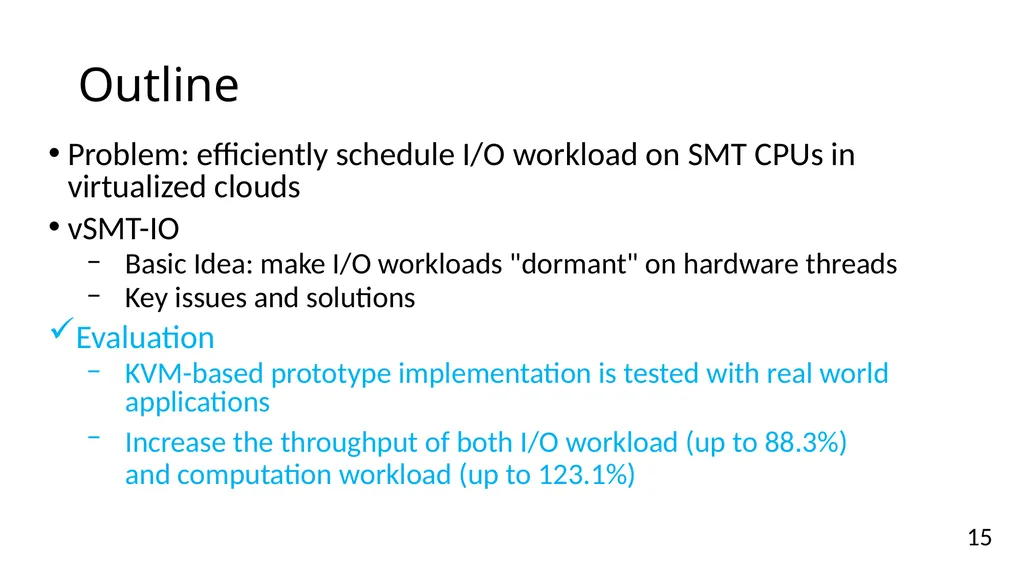
Outline Problem: efficiently schedule I/O workload on SMT CPUs in virtualized clouds
vSMT-IO
Basic Idea: make I/O workloads "dormant" on hardware threads
Key issues and solutions
Evaluation
KVM-based prototype implementation is tested with real world applications
Increase the throughput of both I/O workload (up to 88.3%) and computation workload (up to 123.1%) 15<br>
vSMT-IO
Basic Idea: make I/O workloads "dormant" on hardware threads
Key issues and solutions
Evaluation
KVM-based prototype implementation is tested with real world applications
Increase the throughput of both I/O workload (up to 88.3%) and computation workload (up to 123.1%) 15<br>
16
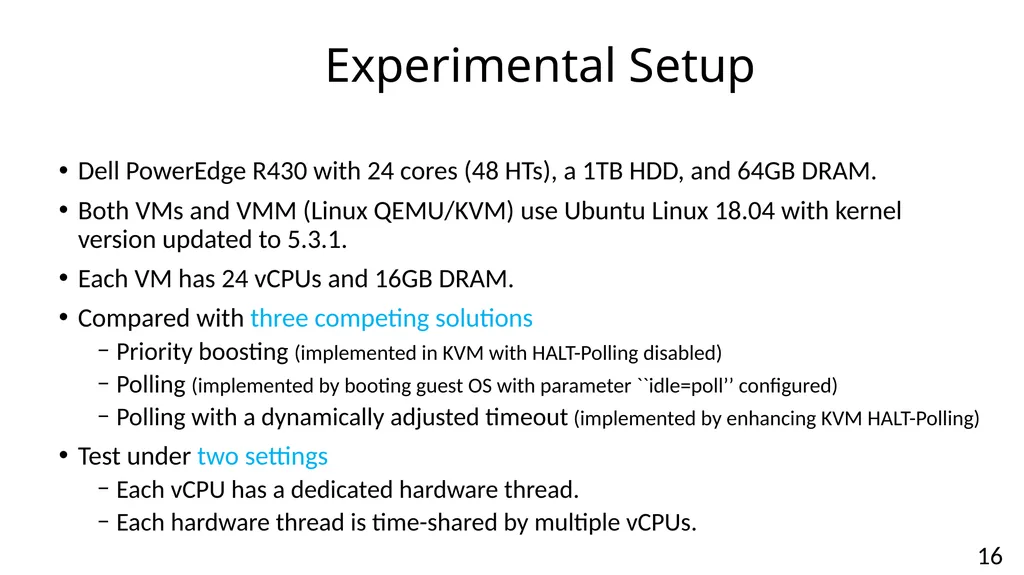
Experimental Setup Dell PowerEdge R430 with 24 cores (48 HTs), a 1TB HDD, and 64GB DRAM.
Both VMs and VMM (Linux QEMU/KVM) use Ubuntu Linux 18.04 with kernel version updated to 5.3.1.
Each VM has 24 vCPUs and 16GB DRAM.
Compared with three competing solutions
Priority boosting (implemented in KVM with HALT-Polling disabled)
Polling (implemented by booting guest OS with parameter ``idle=poll’’ configured)
Polling with a dynamically adjusted timeout (implemented by enhancing KVM HALT-Polling)
Test under two settings
Each vCPU has a dedicated hardware thread.
Each hardware thread is time-shared by multiple vCPUs. 16<br>
Both VMs and VMM (Linux QEMU/KVM) use Ubuntu Linux 18.04 with kernel version updated to 5.3.1.
Each VM has 24 vCPUs and 16GB DRAM.
Compared with three competing solutions
Priority boosting (implemented in KVM with HALT-Polling disabled)
Polling (implemented by booting guest OS with parameter ``idle=poll’’ configured)
Polling with a dynamically adjusted timeout (implemented by enhancing KVM HALT-Polling)
Test under two settings
Each vCPU has a dedicated hardware thread.
Each hardware thread is time-shared by multiple vCPUs. 16<br>
17
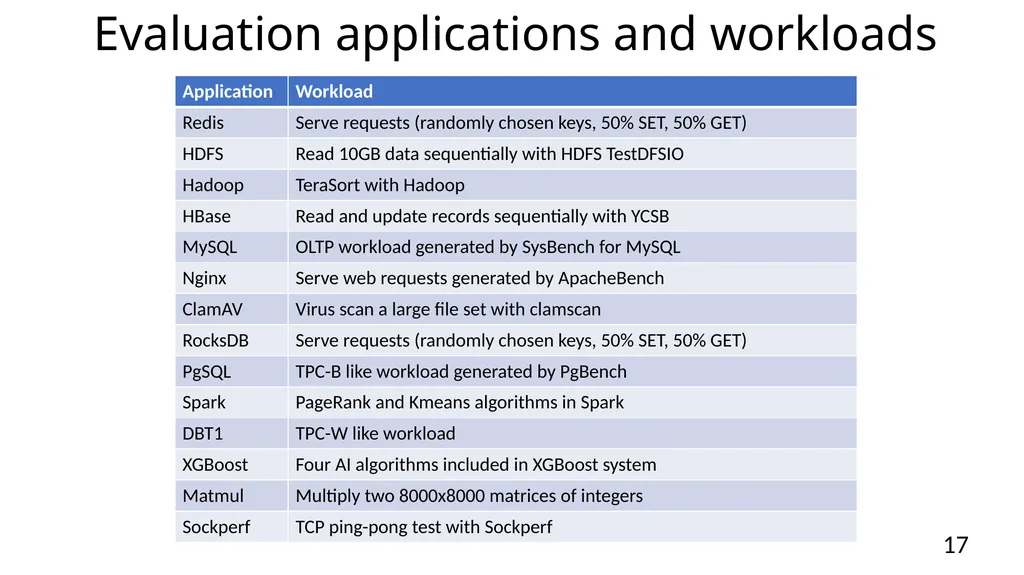
Evaluation applications and workloads 17<br>
18
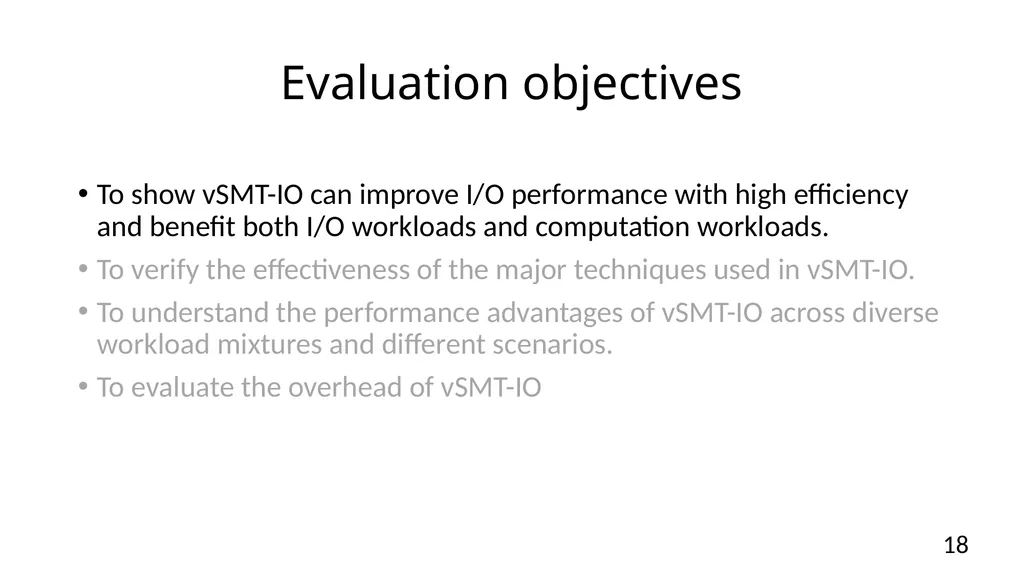
Evaluation objectives To show vSMT-IO can improve I/O performance with high efficiency and benefit both I/O workloads and computation workloads.
To verify the effectiveness of the major techniques used in vSMT-IO.
To understand the performance advantages of vSMT-IO across diverse workload mixtures and different scenarios.
To evaluate the overhead of vSMT-IO 18<br>
To verify the effectiveness of the major techniques used in vSMT-IO.
To understand the performance advantages of vSMT-IO across diverse workload mixtures and different scenarios.
To evaluate the overhead of vSMT-IO 18<br>
19
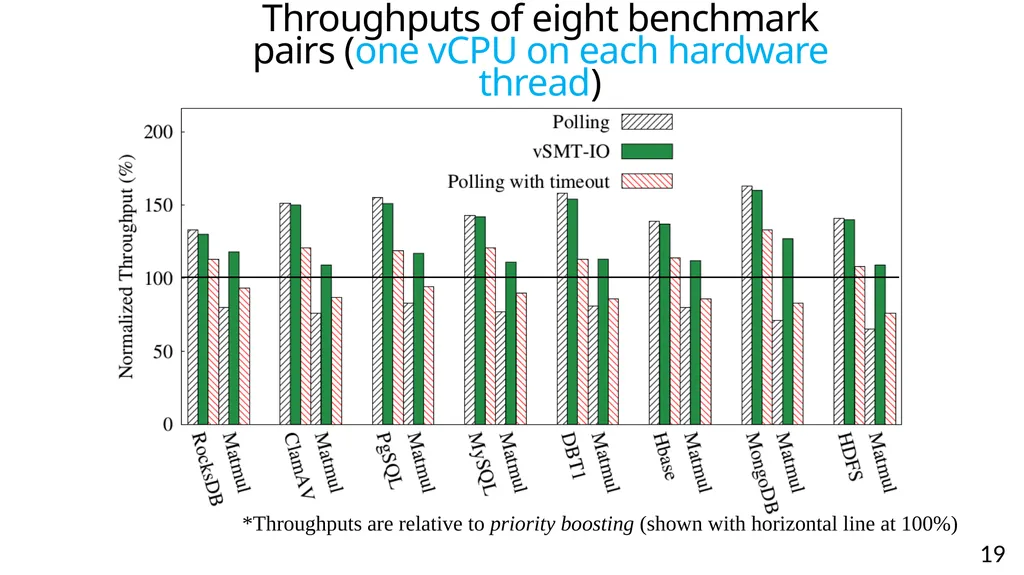
Throughputs of eight benchmark pairs (one vCPU on each hardware thread) 19 *Throughputs are relative to priority boosting (shown with horizontal line at 100%)<br>
20
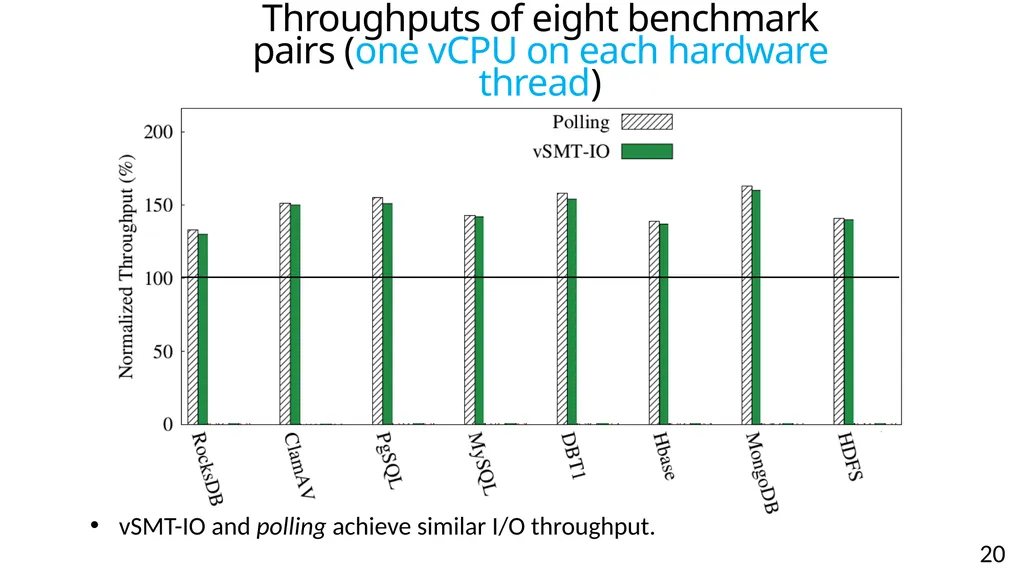
20 vSMT-IO and polling achieve similar I/O throughput. Throughputs of eight benchmark pairs (one vCPU on each hardware thread)<br>
21
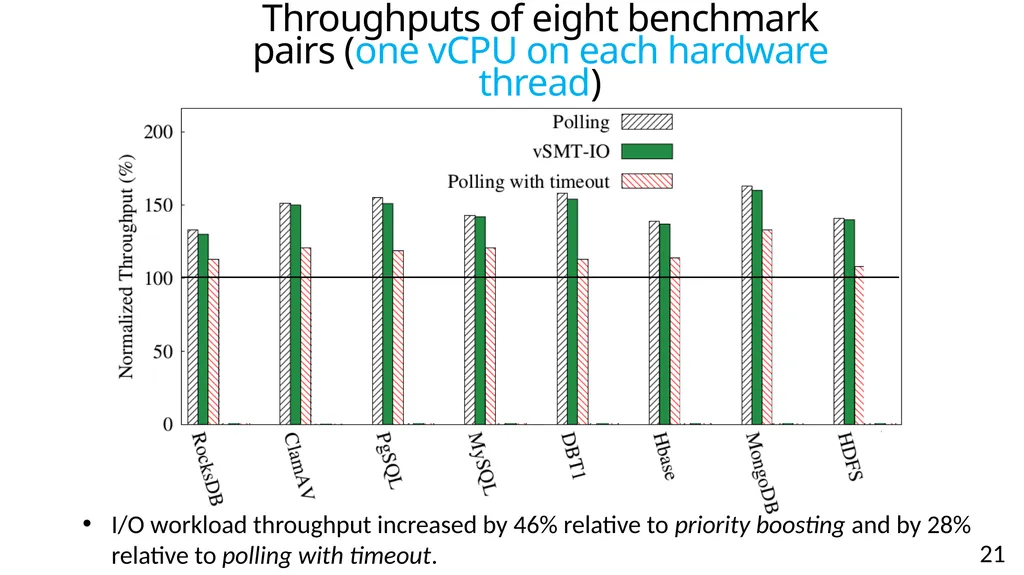
21 I/O workload throughput increased by 46% relative to priority boosting and by 28% relative to polling with timeout. Throughputs of eight benchmark pairs (one vCPU on each hardware thread)<br>
22
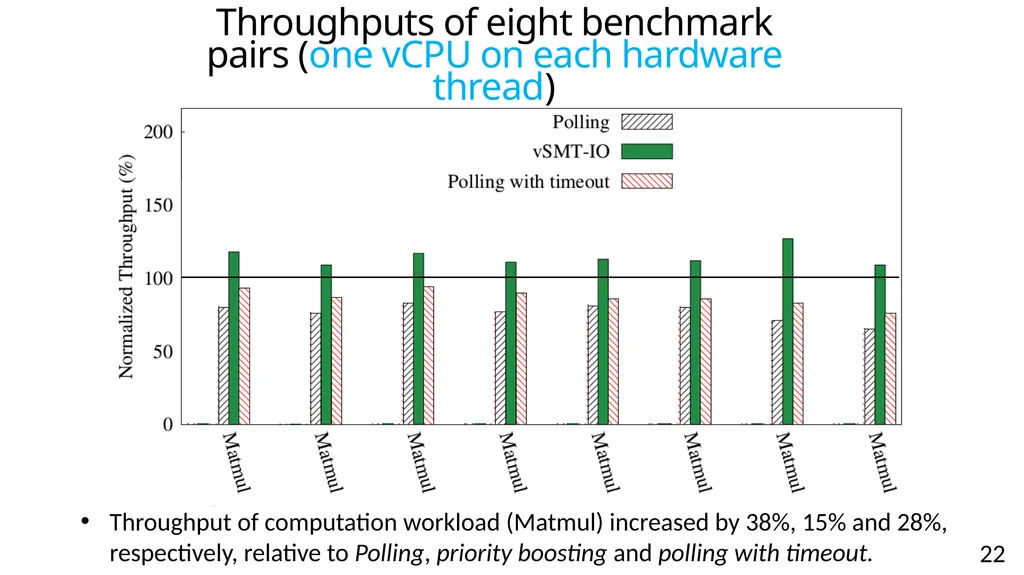
22 Throughput of computation workload (Matmul) increased by 38%, 15% and 28%, respectively, relative to Polling, priority boosting and polling with timeout. Throughputs of eight benchmark pairs (one vCPU on each hardware thread)<br>
23
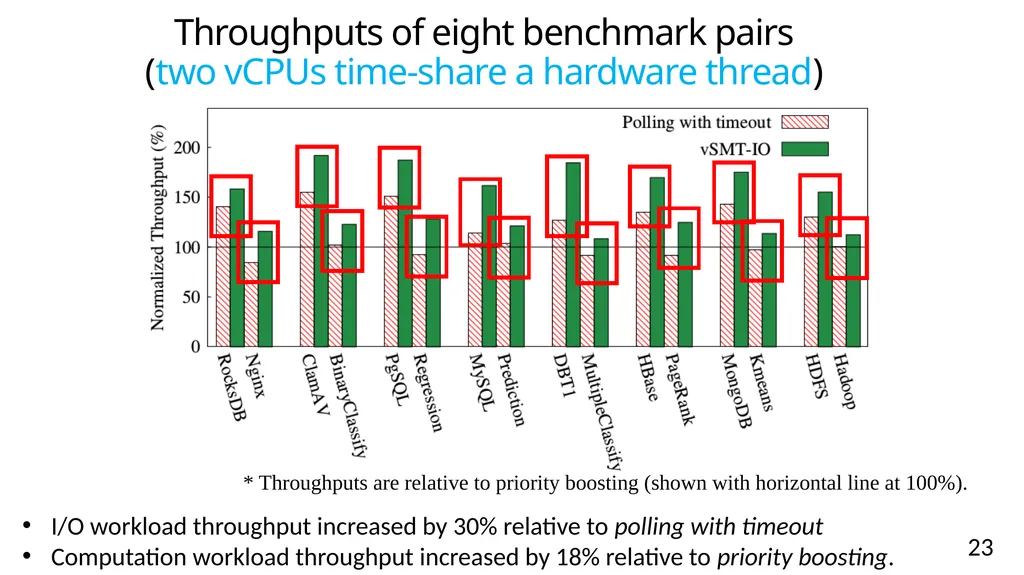
Throughputs of eight benchmark pairs
(two vCPUs time-share a hardware thread) 23 I/O workload throughput increased by 30% relative to polling with timeout
Computation workload throughput increased by 18% relative to priority boosting. * Throughputs are relative to priority boosting (shown with horizontal line at 100%).<br>
Computation workload throughput increased by 18% relative to priority boosting. * Throughputs are relative to priority boosting (shown with horizontal line at 100%).<br>
24
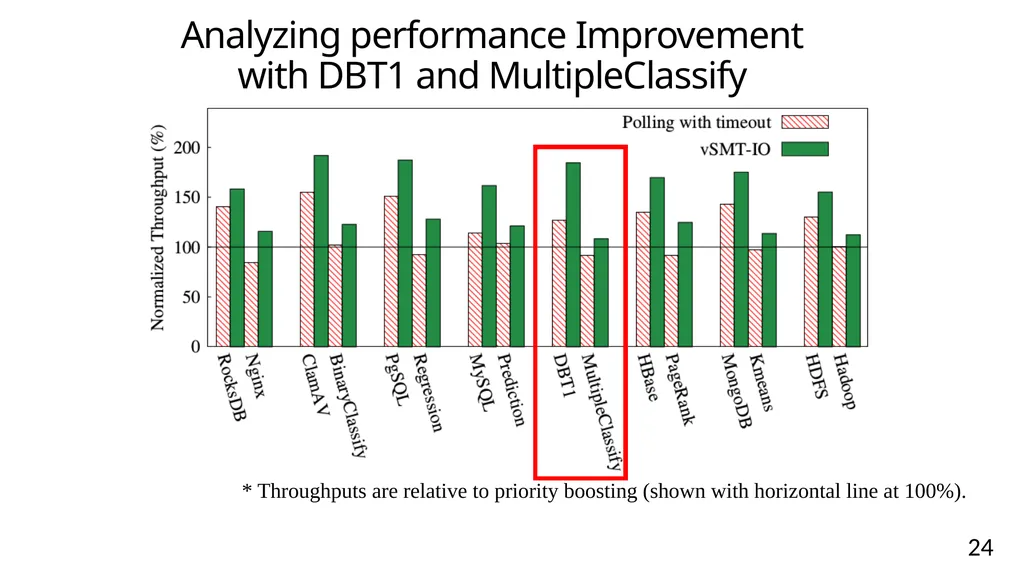
Analyzing performance Improvement
with DBT1 and MultipleClassify 24 * Throughputs are relative to priority boosting (shown with horizontal line at 100%).<br>
25
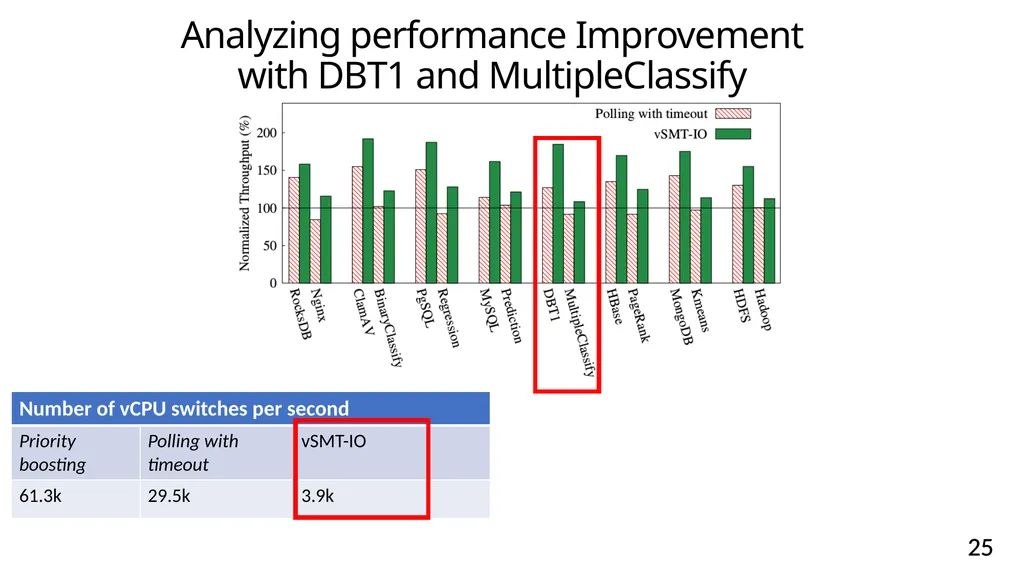
25 25 Analyzing performance Improvement
with DBT1 and MultipleClassify 25<br>
26
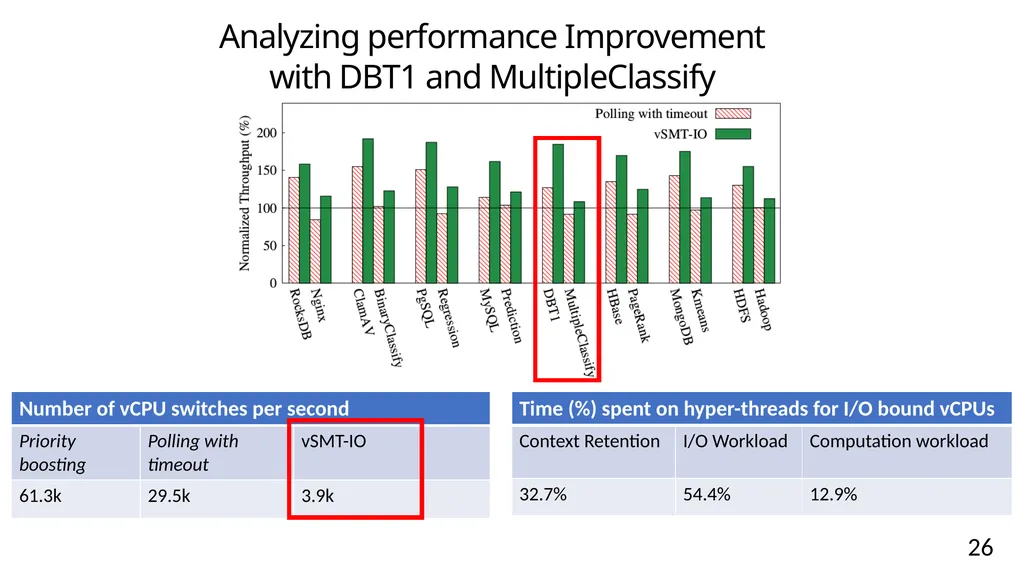
26 Analyzing performance Improvement
with DBT1 and MultipleClassify<br>
27
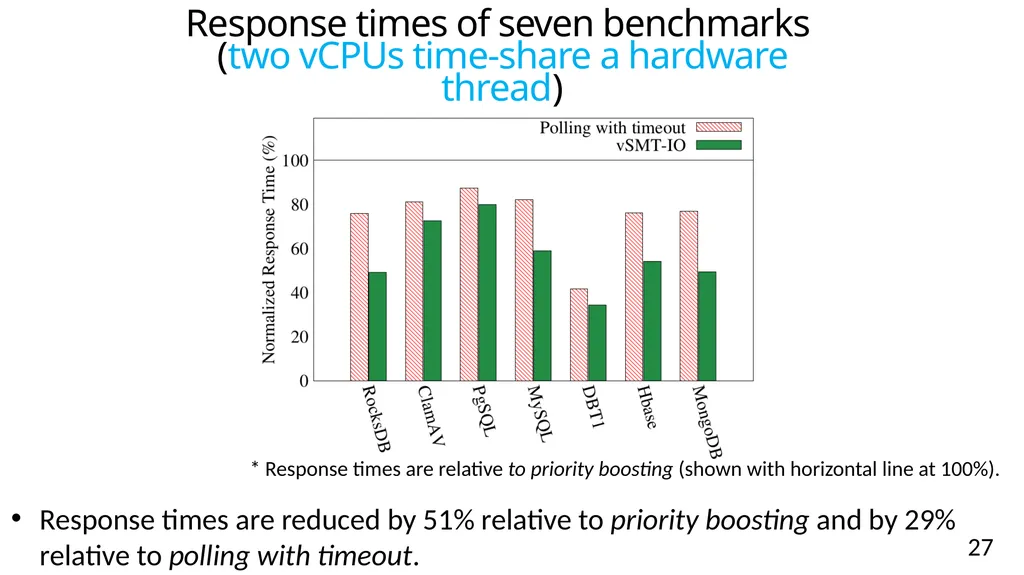
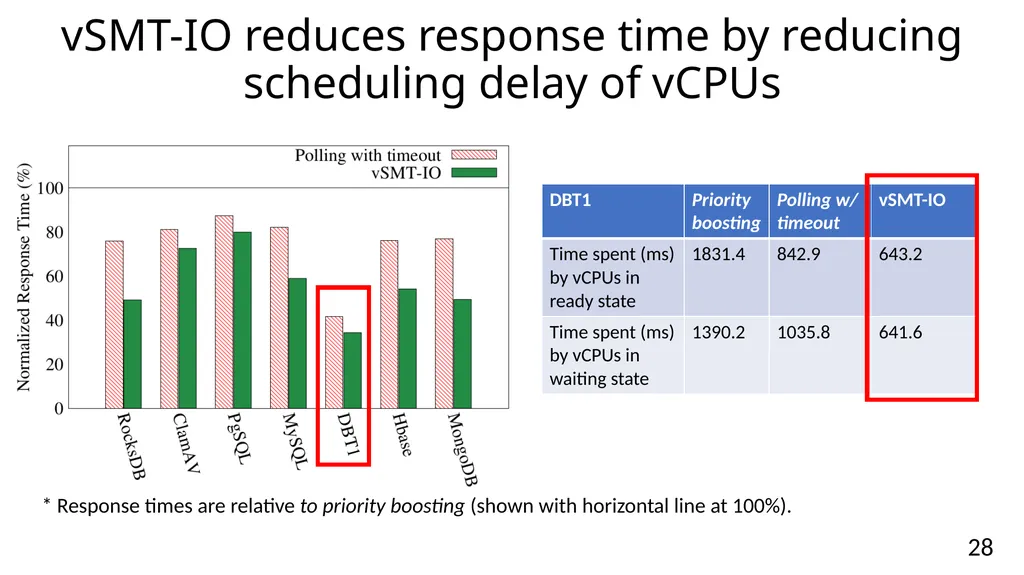
Response times of seven benchmarks
(two vCPUs time-share a hardware thread) 27 Response times are reduced by 51% relative to priority boosting and by 29% relative to polling with timeout. * Response times are relative to priority boosting (shown with horizontal line at 100%).<br>
28
vSMT-IO reduces response time by reducing scheduling delay of vCPUs 28 * Response times are relative to priority boosting (shown with horizontal line at 100%).<br>
29
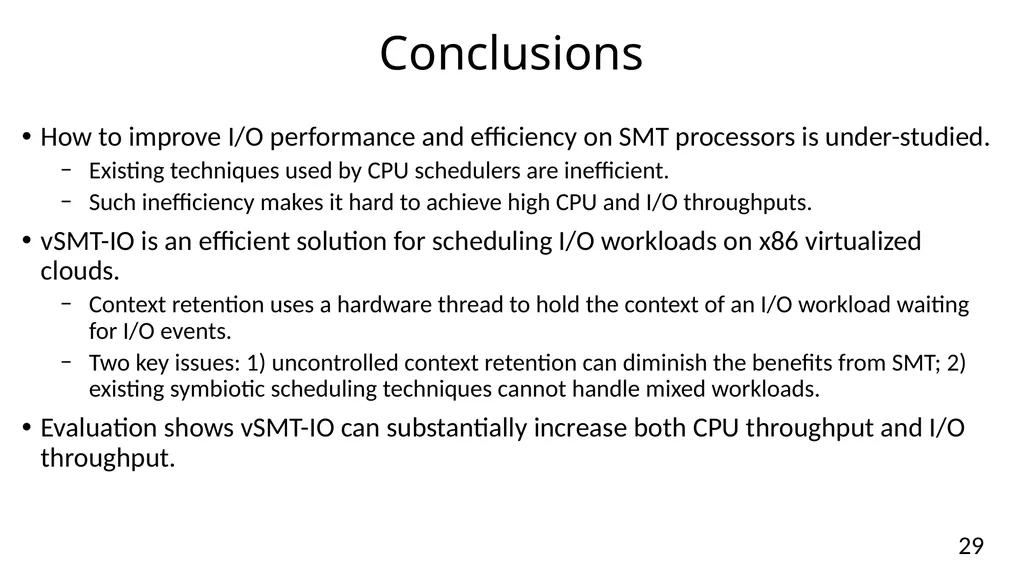
Conclusions How to improve I/O performance and efficiency on SMT processors is under-studied.
Existing techniques used by CPU schedulers are inefficient.
Such inefficiency makes it hard to achieve high CPU and I/O throughputs.
vSMT-IO is an efficient solution for scheduling I/O workloads on x86 virtualized clouds.
Context retention uses a hardware thread to hold the context of an I/O workload waiting for I/O events.
Two key issues: 1) uncontrolled context retention can diminish the benefits from SMT; 2) existing symbiotic scheduling techniques cannot handle mixed workloads.
Evaluation shows vSMT-IO can substantially increase both CPU throughput and I/O throughput. 29<br>
Existing techniques used by CPU schedulers are inefficient.
Such inefficiency makes it hard to achieve high CPU and I/O throughputs.
vSMT-IO is an efficient solution for scheduling I/O workloads on x86 virtualized clouds.
Context retention uses a hardware thread to hold the context of an I/O workload waiting for I/O events.
Two key issues: 1) uncontrolled context retention can diminish the benefits from SMT; 2) existing symbiotic scheduling techniques cannot handle mixed workloads.
Evaluation shows vSMT-IO can substantially increase both CPU throughput and I/O throughput. 29<br>
30
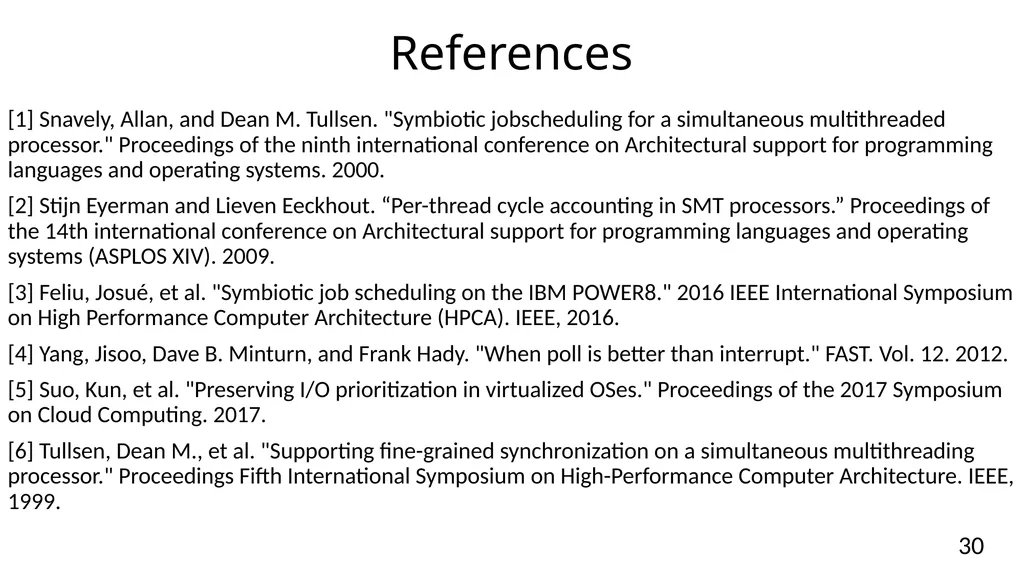
References [1] Snavely, Allan, and Dean M. Tullsen. "Symbiotic jobscheduling for a simultaneous multithreaded processor." Proceedings of the ninth international conference on Architectural support for programming languages and operating systems. 2000.
[2] Stijn Eyerman and Lieven Eeckhout. “Per-thread cycle accounting in SMT processors.” Proceedings of the 14th international conference on Architectural support for programming languages and operating systems (ASPLOS XIV). 2009.
[3] Feliu, Josué, et al. "Symbiotic job scheduling on the IBM POWER8." 2016 IEEE International Symposium on High Performance Computer Architecture (HPCA). IEEE, 2016.
[4] Yang, Jisoo, Dave B. Minturn, and Frank Hady. "When poll is better than interrupt." FAST. Vol. 12. 2012.
[5] Suo, Kun, et al. "Preserving I/O prioritization in virtualized OSes." Proceedings of the 2017 Symposium on Cloud Computing. 2017.
[6] Tullsen, Dean M., et al. "Supporting fine-grained synchronization on a simultaneous multithreading processor." Proceedings Fifth International Symposium on High-Performance Computer Architecture. IEEE, 1999. 30<br>
[2] Stijn Eyerman and Lieven Eeckhout. “Per-thread cycle accounting in SMT processors.” Proceedings of the 14th international conference on Architectural support for programming languages and operating systems (ASPLOS XIV). 2009.
[3] Feliu, Josué, et al. "Symbiotic job scheduling on the IBM POWER8." 2016 IEEE International Symposium on High Performance Computer Architecture (HPCA). IEEE, 2016.
[4] Yang, Jisoo, Dave B. Minturn, and Frank Hady. "When poll is better than interrupt." FAST. Vol. 12. 2012.
[5] Suo, Kun, et al. "Preserving I/O prioritization in virtualized OSes." Proceedings of the 2017 Symposium on Cloud Computing. 2017.
[6] Tullsen, Dean M., et al. "Supporting fine-grained synchronization on a simultaneous multithreading processor." Proceedings Fifth International Symposium on High-Performance Computer Architecture. IEEE, 1999. 30<br>
31
Thank you!
Questions? 31<br>
Questions? 31<br>