VTT beyond the obvious Characterisation and Radionuclide Transport Modelling of SNF from LWR SMRs Sami Naumer, Miiko Pöyhönen, Veli-Matti Pulkkanen, Pirjo Hellä, Anniina Seppälä 17102025 Background VTT beyond the obvious 2 LWR SMRs
"VTT – beyond the obvious Characterisation and" is the property of its rightful owner. Permission is granted to
download and print the materials on this website for personal, non-commercial use only, and to display it
on your personal computer provided you do not modify the materials and that you retain all copyright
notices contained in the materials. By downloading content from our website, you accept the terms of this
agreement.
Presentation Transcript
01
VTT – beyond the obvious Characterisation and Radionuclide Transport Modelling of SNF from LWR SMRs Sami Naumer, Miiko Pöyhönen, Veli-Matti Pulkkanen, Pirjo Hellä, Anniina Seppälä 17/10/2025<br>
02
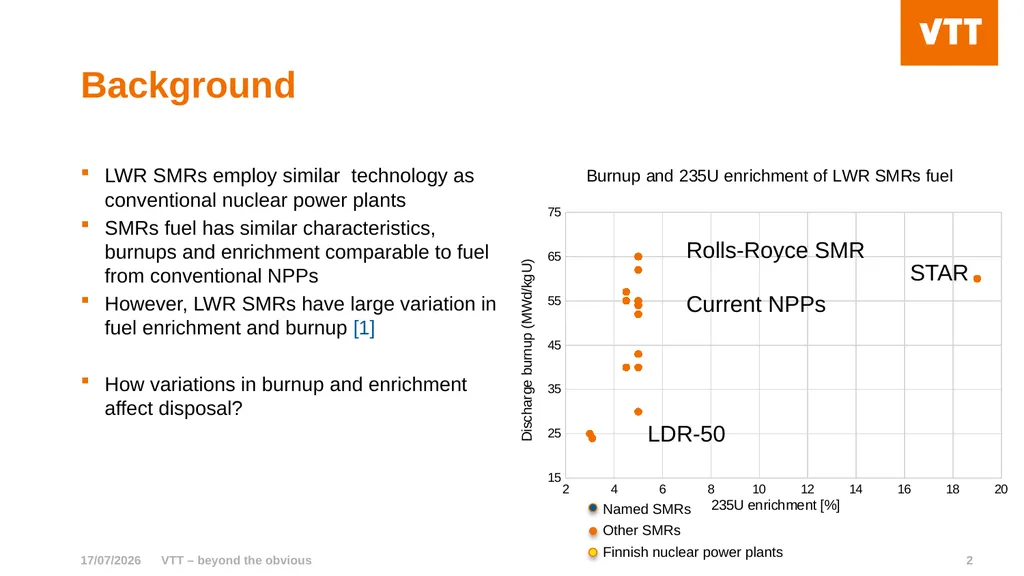
Background VTT – beyond the obvious 2 LWR SMRs employ similar technology as conventional nuclear power plants
SMRs fuel has similar characteristics, burnups and enrichment comparable to fuel from conventional NPPs
However, LWR SMRs have large variation in fuel enrichment and burnup [1]
How variations in burnup and enrichment affect disposal? 17/10/2025 STAR LDR-50 Rolls-Royce SMR Current NPPs Named SMRs
Other SMRs
Finnish nuclear power plants<br>
03
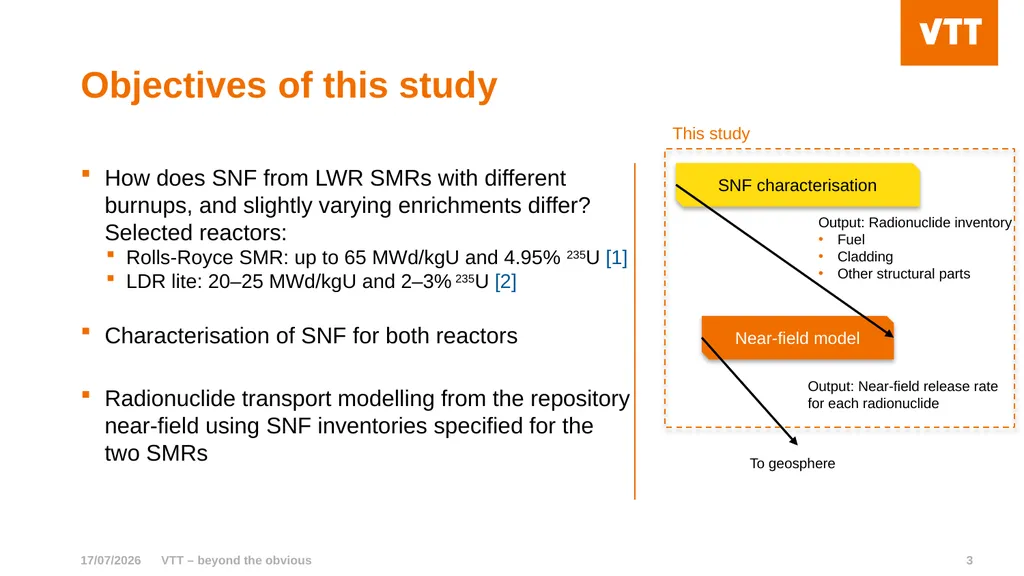
Objectives of this study VTT – beyond the obvious 3 How does SNF from LWR SMRs with different burnups, and slightly varying enrichments differ? Selected reactors:
Rolls-Royce SMR: up to 65 MWd/kgU and 4.95% 235U [1]
LDR lite: 20–25 MWd/kgU and 2–3% 235U [2]
Characterisation of SNF for both reactors
Radionuclide transport modelling from the repository near-field using SNF inventories specified for the two SMRs 17/10/2025 This study<br>
04
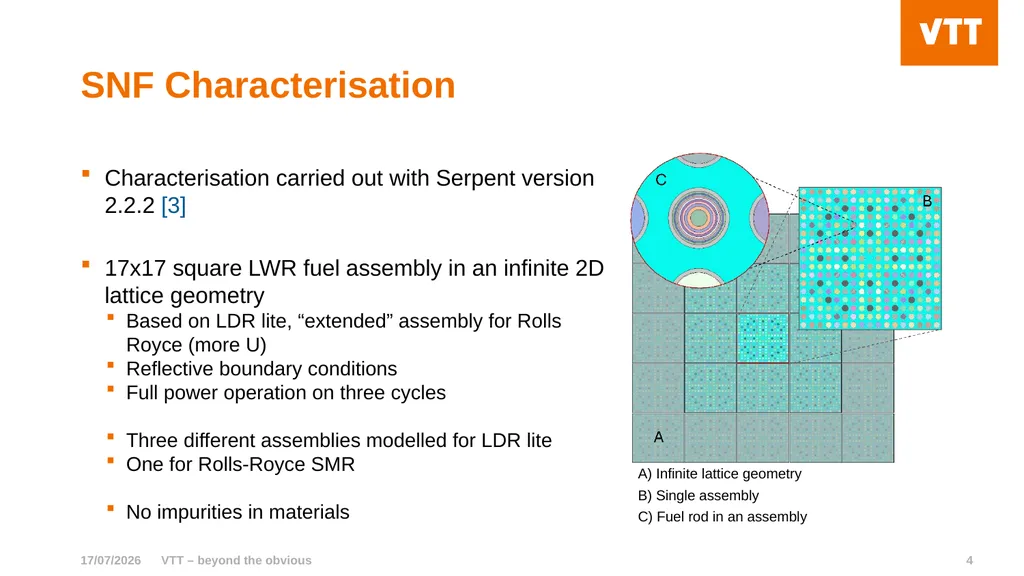
SNF Characterisation VTT – beyond the obvious 4 Characterisation carried out with Serpent version 2.2.2 [3]
17x17 square LWR fuel assembly in an infinite 2D lattice geometry
Based on LDR lite, “extended” assembly for Rolls Royce (more U)
Reflective boundary conditions
Full power operation on three cycles
Three different assemblies modelled for LDR lite
One for Rolls-Royce SMR
No impurities in materials 17/10/2025 A) Infinite lattice geometry
B) Single assembly
C) Fuel rod in an assembly<br>
05
SNF Characterisation VTT – beyond the obvious 5 17/10/2025<br>
06
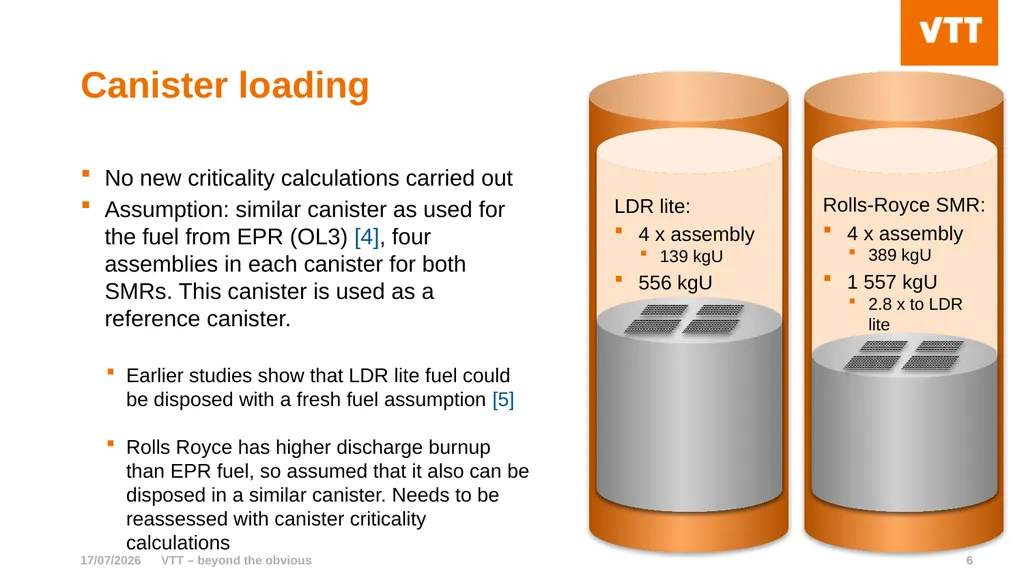
Canister loading VTT – beyond the obvious 6 No new criticality calculations carried out
Assumption: similar canister as used for the fuel from EPR (OL3) [4], four assemblies in each canister for both SMRs. This canister is used as a reference canister.
Earlier studies show that LDR lite fuel could be disposed with a fresh fuel assumption [5]
Rolls Royce has higher discharge burnup than EPR fuel, so assumed that it also can be disposed in a similar canister. Needs to be reassessed with canister criticality calculations 17/10/2025<br>
07
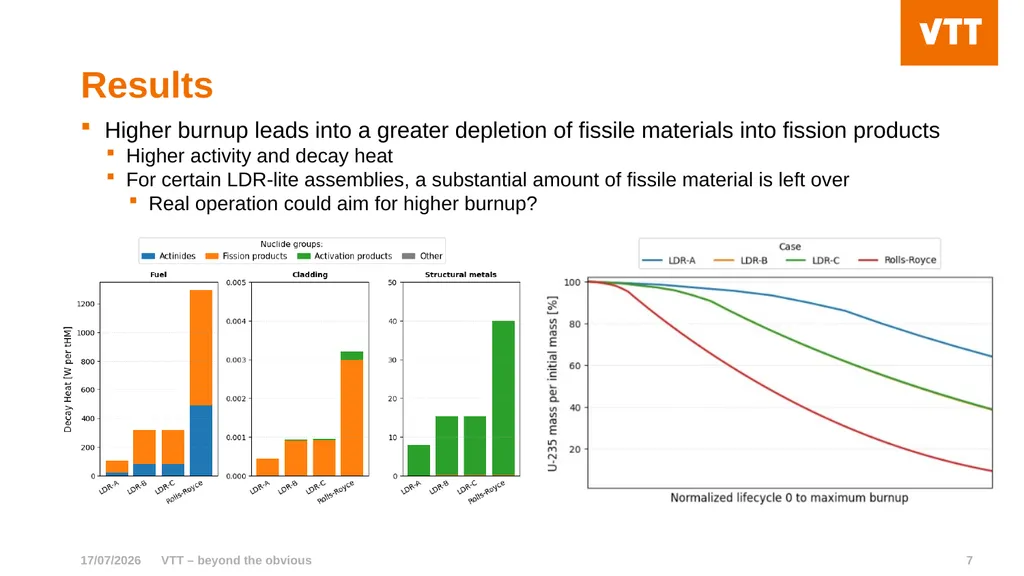
Results VTT – beyond the obvious 7 17/10/2025 Higher burnup leads into a greater depletion of fissile materials into fission products
Higher activity and decay heat
For certain LDR-lite assemblies, a substantial amount of fissile material is left over
Real operation could aim for higher burnup?<br>
08
Radionuclide Transport Modelling VTT – beyond the obvious 8 17/10/2025<br>
09
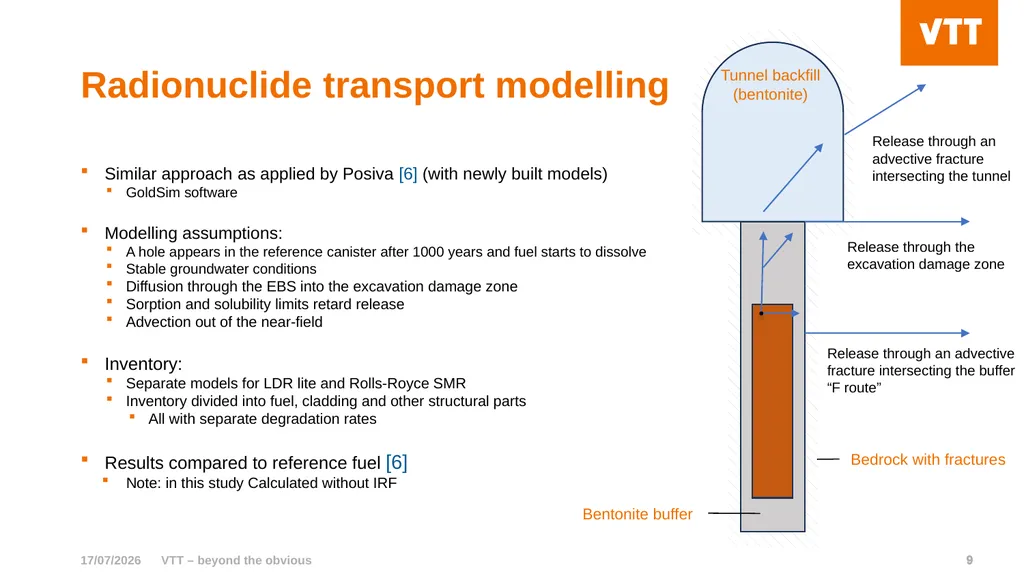
Radionuclide transport modelling VTT – beyond the obvious 9 Similar approach as applied by Posiva [6] (with newly built models)
GoldSim software
Modelling assumptions:
A hole appears in the reference canister after 1000 years and fuel starts to dissolve
Stable groundwater conditions
Diffusion through the EBS into the excavation damage zone
Sorption and solubility limits retard release
Advection out of the near-field
Inventory:
Separate models for LDR lite and Rolls-Royce SMR
Inventory divided into fuel, cladding and other structural parts
All with separate degradation rates
Results compared to reference fuel [6]
Note: in this study Calculated without IRF 17/10/2025 9 Release through an advective fracture intersecting the buffer
“F route” Release through the excavation damage zone Release through an advective fracture intersecting the tunnel Bentonite buffer Tunnel backfill (bentonite) Bedrock with fractures<br>
10
Release rates from the near-field VTT – beyond the obvious 10 17/10/2025 Posiva reference fuel [6]
Total release: 6.8 GBq
Peak annual release 50 200 Bq/yr
Time of peak release rate: 3 300 a
14C largest contributor to release<br>
11
Release rates from the near-field VTT – beyond the obvious 11 17/10/2025 Posiva reference fuel [6]
Total release: 6.8 GBq
Peak annual release 50 200 Bq/yr
Time of peak release rate: 3 300 a
12C largest contributor to release LDR lite
Total release: 2.9 GBq
Peak annual release 8 670 Bq/yr
Time of peak release rate: 140 000 a
59Ni largest contributor to release<br>
12
Release rates from the near-field VTT – beyond the obvious 12 17/10/2025 Rolls-Royce SMR
Total release: 8.9 GBq
Peak annual release 9 880 Bq/yr
Time of peak release rate: 350 000 a
59Ni largest contributor to release LDR lite
Total release: 2.9 GBq
Peak annual release 8 670 Bq/yr
Time of peak release rate: 140 000 a
59Ni largest contributor to release<br>
13
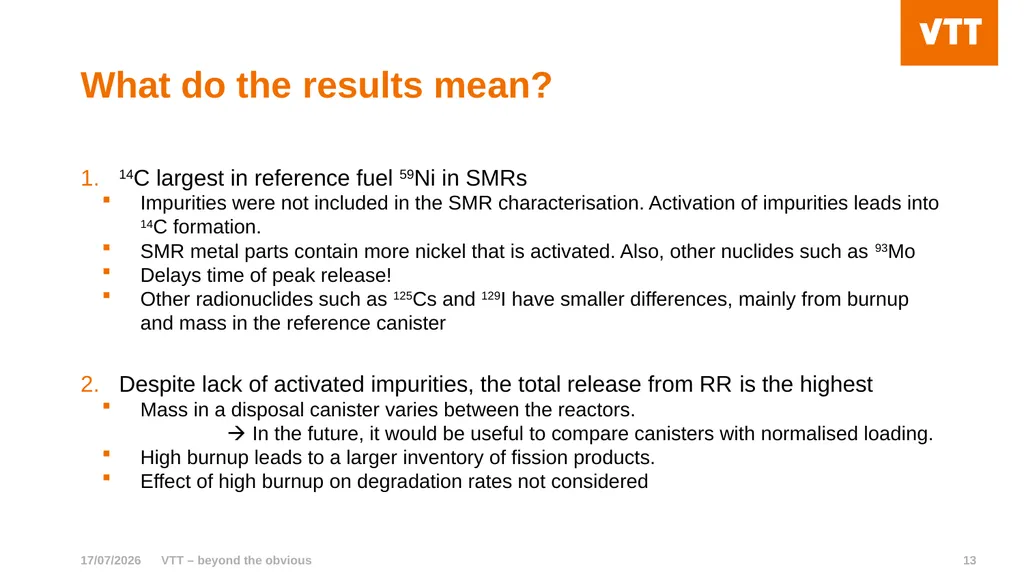
What do the results mean? VTT – beyond the obvious 13 14C largest in reference fuel 59Ni in SMRs
Impurities were not included in the SMR characterisation. Activation of impurities leads into 14C formation.
SMR metal parts contain more nickel that is activated. Also, other nuclides such as 93Mo
Delays time of peak release!
Other radionuclides such as 125Cs and 129I have smaller differences, mainly from burnup and mass in the reference canister
Despite lack of activated impurities, the total release from RR is the highest
Mass in a disposal canister varies between the reactors.
In the future, it would be useful to compare canisters with normalised loading.
High burnup leads to a larger inventory of fission products.
Effect of high burnup on degradation rates not considered 17/10/2025<br>
14
Conclusions VTT – beyond the obvious 14 A framework from reactor to repository for SMR SNF assessments was created
Post-irradiation activities, decay heat and radionuclide inventories determined for two SMRs.
With a lower burnup, less fissile material is converted into fission products when comparing LDR lite to Rolls-Royce SMR
The radionuclide release rates differed significantly between the SMRs and the reference fuel
Highlights importance of including impurities during characterisation. Do the vendors take this into account, especially for advanced SMRs?
Reactor materials also affect the releases. Could the materials be optimised during design phase of SMRs to minimise activation of mobile radionuclides?
Need for normalised canister loading or radionuclide releases per unit of energy produced!
Characterisation and canister loading was done with a lot of assumptions
More data needed from the vendors for detailed analysis! 17/10/2025<br>
15
References VTT – beyond the obvious 15 International Atomic Energy Agency, “Small Modular Reactor Technology Catalogue 2024 Edition”, 2024. [Online]. Available: https://aris.iaea.org/Publications/SMR_catalogue_2024.pdf
R. Komu, R. Tuominen. "LDR lite benchmark specifications." LDR design document, LDR-PUB-VTT-10002-R4, VTT Technical Research Centre of Finland, 2024.
J. Leppänen, V. Valtavirta, A. Rintala and R. Tuominen, ”Status of the Serpent Monte Carlo code in 2024”, EPJ Nuclear Sciences & Technologies, vol 11, 2025. [Online]. Available: https://doi.org/10.1051/epjn/2024031
Posiva, “Käyttölupahakemus Käytetyn Ydinpolttoaineen Kapselointi- ja loppusijoituslaitos” 2021. [Online]. Available: https://tem.fi/documents/1410877/176068401/Kayttolupahakemus.pdf/885eff79-131c-93c3-9b36-afb5f763837c/Kayttolupahakemus.pdf?t=1697608133858
S. Naumer, P. Keto, N. Gotcheva, M. Kojo, P. Juutilainen, N. Kiviluoma, V. Rinta-Hiiro, S. Tornberg, T. Schatz, A. Vainio, M. Airola M. Lehtonen, T. Litmanen, M. Kari, ”SMRSiMa: SMR Waste Management and Siting, Waste Management and Societal Engagement”, 2024, VTT-R-00084-24
A. Poteri, H. Nordman, V-M. Pulkkanen, P. Smith, ”Radionuclide Transport in the Repository Near-Field and Far-Field”, 2014, Posiva 2014-02 17/10/2025<br>