
Vulvodynia: A Common and Under-Recognized Pain
DJ
Published · 85 slides · 0 views

1 / 1












Description
Vulvodynia: A Common and Under-Recognized Pain Disorder in Women and Female Adolescents Integrating Current Knowledge Into Clinical Practice Learning Objectives At the end of this session, learners will be able to: Recognize vulvodynia as a
Related Topics
Share
Embed code
Download this presentation From Below
"Vulvodynia: A Common and Under-Recognized Pain" is the property of its rightful owner. Permission is granted to download and print the materials on this website for personal, non-commercial use only, and to display it on your personal computer provided you do not modify the materials and that you retain all copyright notices contained in the materials. By downloading content from our website, you accept the terms of this agreement.
Presentation Transcript
01
Vulvodynia: A Common and Under-Recognized Pain Disorder in Women and Female Adolescents Integrating Current Knowledge Into Clinical Practice<br>
02
Learning Objectives At the end of this session, learners will be able to:
Recognize vulvodynia as a prevalent, misdiagnosed, and under-researched chronic pain disorder affecting millions of women and adolescent girls
Define vulvodynia and its subtypes
Summarize what is known about the pathophysiology of vulvodynia
Identify the infectious, inflammatory, neoplastic and neurologic
disorders that need to be ruled out in order to make a diagnosis of vulvodynia
Perform a comprehensive exam to diagnose the condition
Implement an individualized, multidisciplinary treatment regimen<br>
Recognize vulvodynia as a prevalent, misdiagnosed, and under-researched chronic pain disorder affecting millions of women and adolescent girls
Define vulvodynia and its subtypes
Summarize what is known about the pathophysiology of vulvodynia
Identify the infectious, inflammatory, neoplastic and neurologic
disorders that need to be ruled out in order to make a diagnosis of vulvodynia
Perform a comprehensive exam to diagnose the condition
Implement an individualized, multidisciplinary treatment regimen<br>
03
Section #: Title
Contents • Contents Historical Perspective Early Descriptions • Current Definition<br>
Contents • Contents Historical Perspective Early Descriptions • Current Definition<br>
04
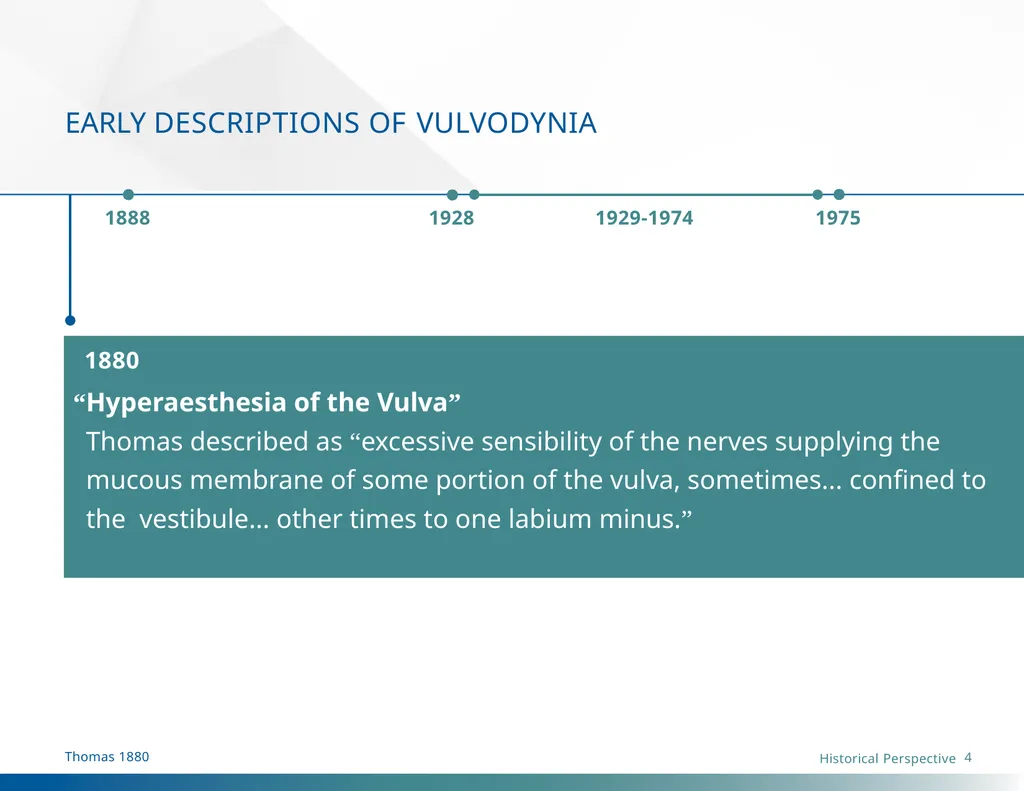
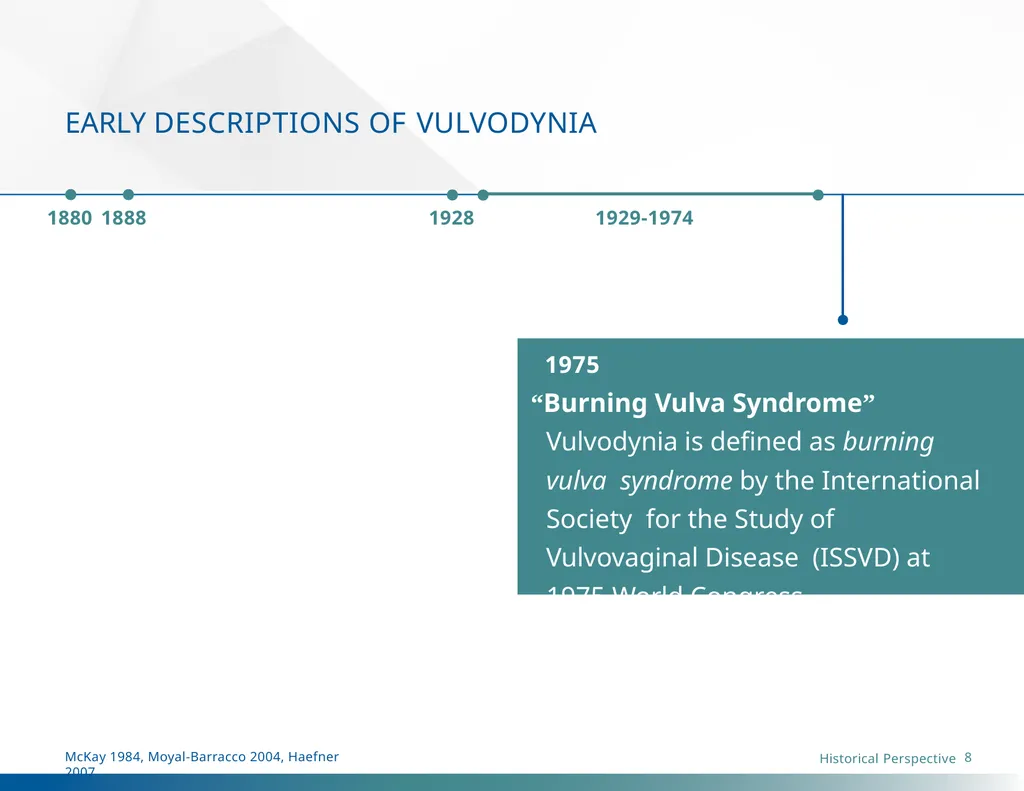
EARLY DESCRIPTIONS OF VULVODYNIA 1888 1928 1929-1974 1975 1880
“Hyperaesthesia of the Vulva”
Thomas described as “excessive sensibility of the nerves supplying the mucous membrane of some portion of the vulva, sometimes... confined to the vestibule... other times to one labium minus.” 4 Historical Perspective Thomas 1880<br>
“Hyperaesthesia of the Vulva”
Thomas described as “excessive sensibility of the nerves supplying the mucous membrane of some portion of the vulva, sometimes... confined to the vestibule... other times to one labium minus.” 4 Historical Perspective Thomas 1880<br>
05
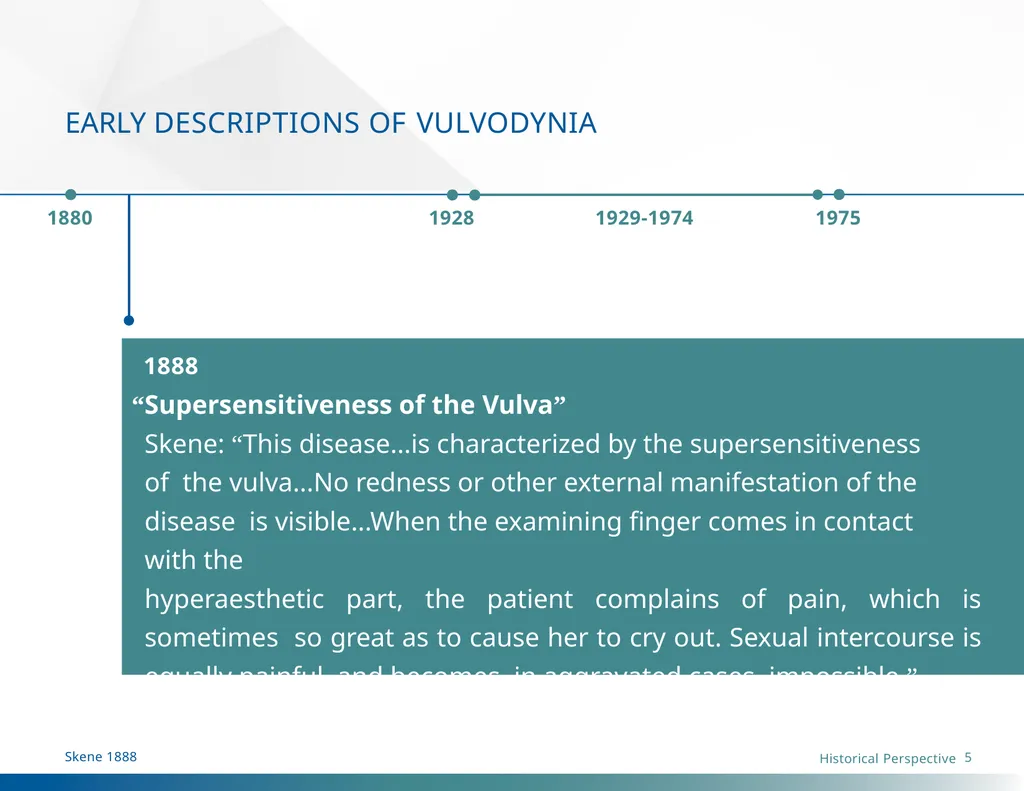
EARLY DESCRIPTIONS OF VULVODYNIA 1880 1928 1929-1974 1975 1888
“Supersensitiveness of the Vulva”
Skene: “This disease...is characterized by the supersensitiveness of the vulva...No redness or other external manifestation of the disease is visible...When the examining finger comes in contact with the
hyperaesthetic part, the patient complains of pain, which is sometimes so great as to cause her to cry out. Sexual intercourse is equally painful and becomes, in aggravated cases, impossible.” 5 Historical Perspective Skene 1888<br>
“Supersensitiveness of the Vulva”
Skene: “This disease...is characterized by the supersensitiveness of the vulva...No redness or other external manifestation of the disease is visible...When the examining finger comes in contact with the
hyperaesthetic part, the patient complains of pain, which is sometimes so great as to cause her to cry out. Sexual intercourse is equally painful and becomes, in aggravated cases, impossible.” 5 Historical Perspective Skene 1888<br>
06
EARLY DESCRIPTIONS OF VULVODYNIA 1929-1974 1975 1880 1888 1928
“Sensitive Deep Red Spots”
Kelly described “exquisitely sensitive deep- red spots in the mucosa of the hymenal ring as a fruitful source of dyspareunia.” 6 Historical Perspective Kelly 1928<br>
“Sensitive Deep Red Spots”
Kelly described “exquisitely sensitive deep- red spots in the mucosa of the hymenal ring as a fruitful source of dyspareunia.” 6 Historical Perspective Kelly 1928<br>
07
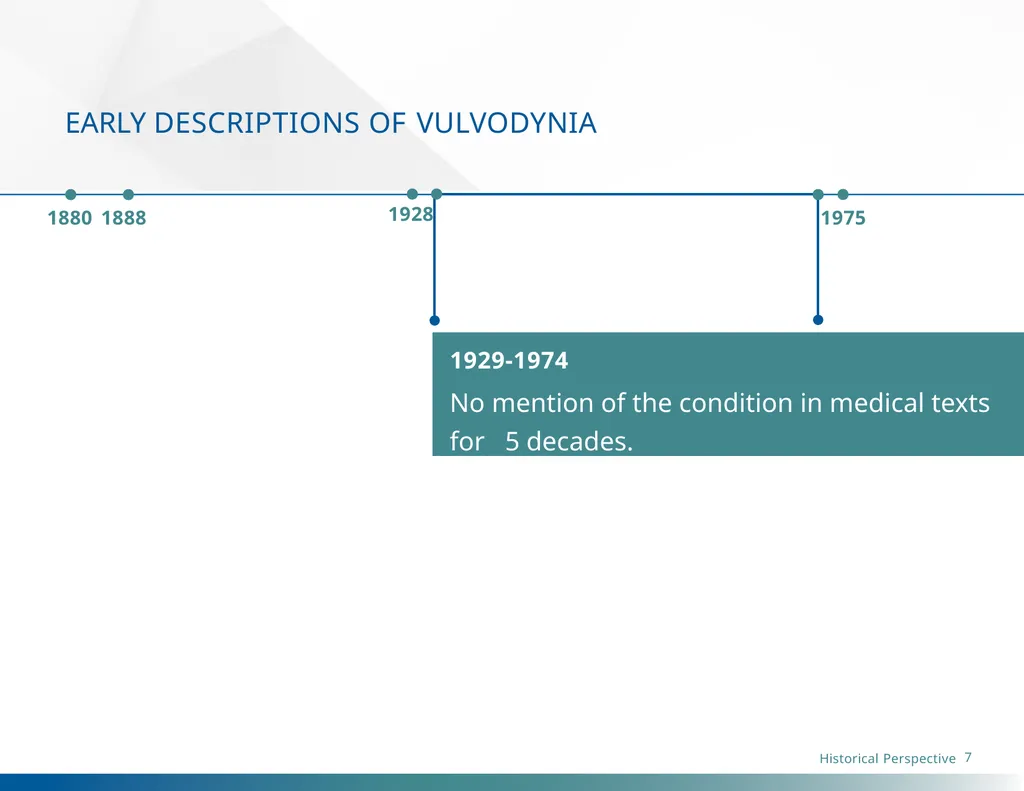
EARLY DESCRIPTIONS OF VULVODYNIA 1975 1880 1888 1929-1974
No mention of the condition in medical texts for 5 decades. 7 Historical Perspective 1928<br>
No mention of the condition in medical texts for 5 decades. 7 Historical Perspective 1928<br>
08
EARLY DESCRIPTIONS OF VULVODYNIA 1880 1888 1928 1929-1974 1975
“Burning Vulva Syndrome”
Vulvodynia is defined as burning vulva syndrome by the International Society for the Study of Vulvovaginal Disease (ISSVD) at 1975 World Congress. 8 Historical Perspective McKay 1984, Moyal-Barracco 2004, Haefner 2007<br>
“Burning Vulva Syndrome”
Vulvodynia is defined as burning vulva syndrome by the International Society for the Study of Vulvovaginal Disease (ISSVD) at 1975 World Congress. 8 Historical Perspective McKay 1984, Moyal-Barracco 2004, Haefner 2007<br>
09
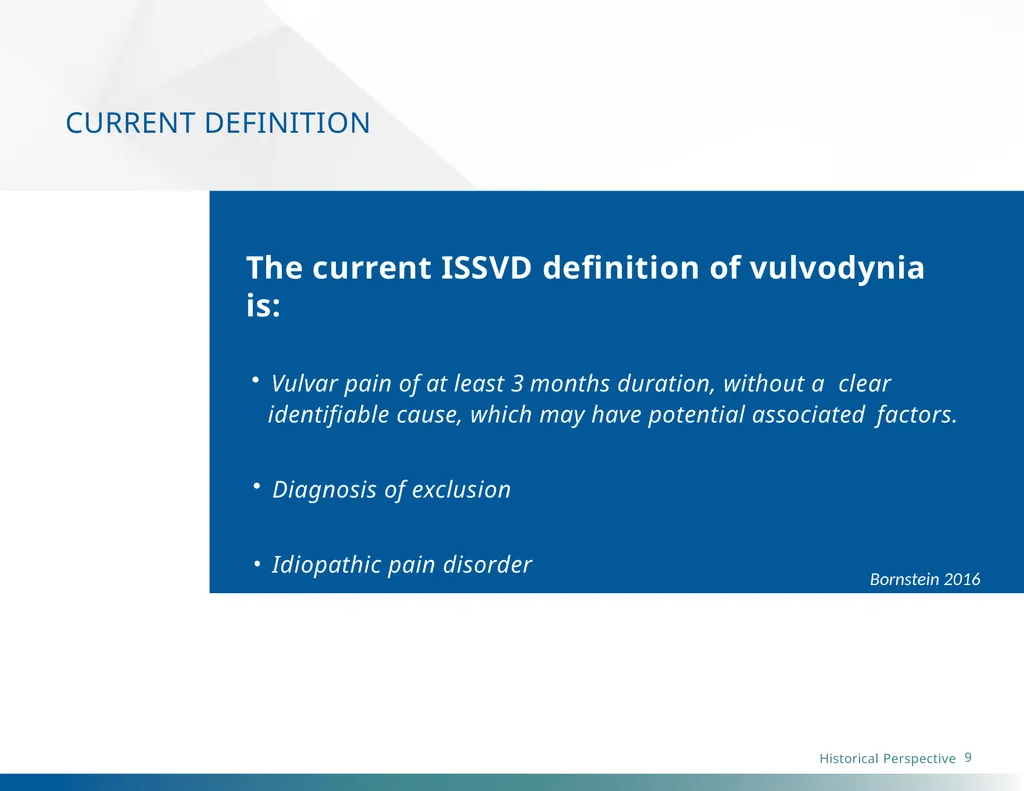
CURRENT DEFINITION The current ISSVD definition of vulvodynia is:
Vulvar pain of at least 3 months duration, without a clear
identifiable cause, which may have potential associated factors.
Diagnosis of exclusion
Idiopathic pain disorder 9 Historical Perspective Bornstein 2016<br>
Vulvar pain of at least 3 months duration, without a clear
identifiable cause, which may have potential associated factors.
Diagnosis of exclusion
Idiopathic pain disorder 9 Historical Perspective Bornstein 2016<br>
10
Prevalence • Incidence • Remission
Misdiagnosis • Economic impact • Quality of life Magnitude of the Problem<br>
Misdiagnosis • Economic impact • Quality of life Magnitude of the Problem<br>
11
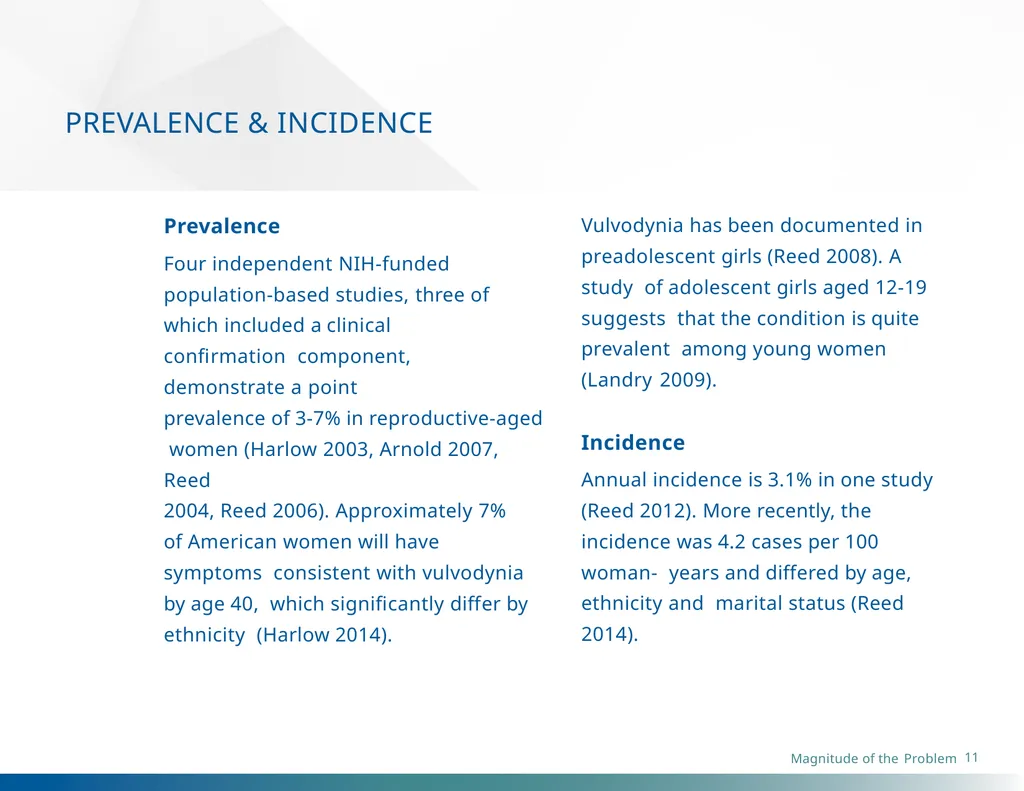
PREVALENCE & INCIDENCE Prevalence
Four independent NIH-funded
population-based studies, three of which included a clinical confirmation component, demonstrate a point
prevalence of 3-7% in reproductive-aged women (Harlow 2003, Arnold 2007, Reed
2004, Reed 2006). Approximately 7% of American women will have symptoms consistent with vulvodynia by age 40, which significantly differ by ethnicity (Harlow 2014). Vulvodynia has been documented in preadolescent girls (Reed 2008). A study of adolescent girls aged 12-19 suggests that the condition is quite prevalent among young women (Landry 2009).
Incidence
Annual incidence is 3.1% in one study (Reed 2012). More recently, the incidence was 4.2 cases per 100 woman- years and differed by age, ethnicity and marital status (Reed 2014). 11 Magnitude of the Problem<br>
Four independent NIH-funded
population-based studies, three of which included a clinical confirmation component, demonstrate a point
prevalence of 3-7% in reproductive-aged women (Harlow 2003, Arnold 2007, Reed
2004, Reed 2006). Approximately 7% of American women will have symptoms consistent with vulvodynia by age 40, which significantly differ by ethnicity (Harlow 2014). Vulvodynia has been documented in preadolescent girls (Reed 2008). A study of adolescent girls aged 12-19 suggests that the condition is quite prevalent among young women (Landry 2009).
Incidence
Annual incidence is 3.1% in one study (Reed 2012). More recently, the incidence was 4.2 cases per 100 woman- years and differed by age, ethnicity and marital status (Reed 2014). 11 Magnitude of the Problem<br>
12
REMISSION RATES 12 Magnitude of the Problem Remission
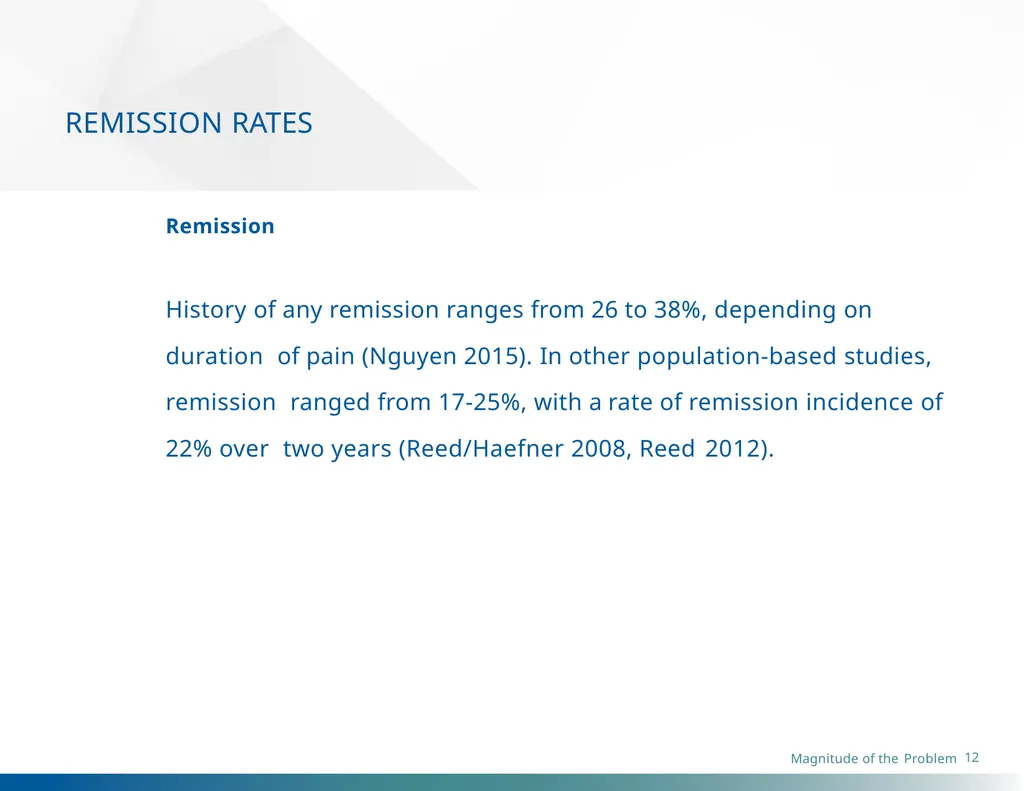
History of any remission ranges from 26 to 38%, depending on duration of pain (Nguyen 2015). In other population-based studies, remission ranged from 17-25%, with a rate of remission incidence of 22% over two years (Reed/Haefner 2008, Reed 2012).<br>
History of any remission ranges from 26 to 38%, depending on duration of pain (Nguyen 2015). In other population-based studies, remission ranged from 17-25%, with a rate of remission incidence of 22% over two years (Reed/Haefner 2008, Reed 2012).<br>
13
Affected Populations
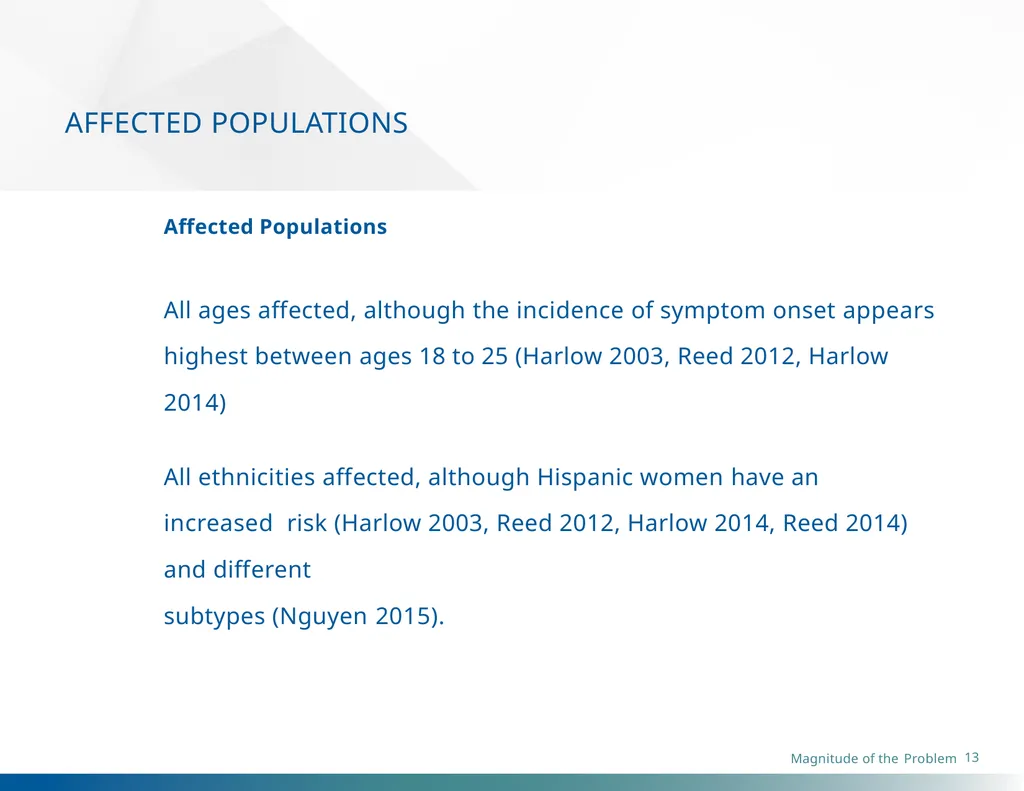
All ages affected, although the incidence of symptom onset appears highest between ages 18 to 25 (Harlow 2003, Reed 2012, Harlow 2014)
All ethnicities affected, although Hispanic women have an increased risk (Harlow 2003, Reed 2012, Harlow 2014, Reed 2014) and different
subtypes (Nguyen 2015). 13 Magnitude of the Problem AFFECTED POPULATIONS<br>
All ages affected, although the incidence of symptom onset appears highest between ages 18 to 25 (Harlow 2003, Reed 2012, Harlow 2014)
All ethnicities affected, although Hispanic women have an increased risk (Harlow 2003, Reed 2012, Harlow 2014, Reed 2014) and different
subtypes (Nguyen 2015). 13 Magnitude of the Problem AFFECTED POPULATIONS<br>
14
Misdiagnosis is Common
2003: First NIH-funded population-based study (Harlow 2003)
• 60% of women consulted at least 3 doctors in seeking a diagnosis; 40% of them
remained undiagnosed after 3 medical consultations.
2012: Recent NIH-funded population-based study (Reed 2012)
• Only 1.4% of women seeking medical care were accurately diagnosed. 14 Magnitude of the Problem Significant Economic Impact
US direct/indirect cost is $31-$72 billion (Xie 2012). MISDIAGNOSIS & ECONOMIC IMPACT<br>
2003: First NIH-funded population-based study (Harlow 2003)
• 60% of women consulted at least 3 doctors in seeking a diagnosis; 40% of them
remained undiagnosed after 3 medical consultations.
2012: Recent NIH-funded population-based study (Reed 2012)
• Only 1.4% of women seeking medical care were accurately diagnosed. 14 Magnitude of the Problem Significant Economic Impact
US direct/indirect cost is $31-$72 billion (Xie 2012). MISDIAGNOSIS & ECONOMIC IMPACT<br>
15
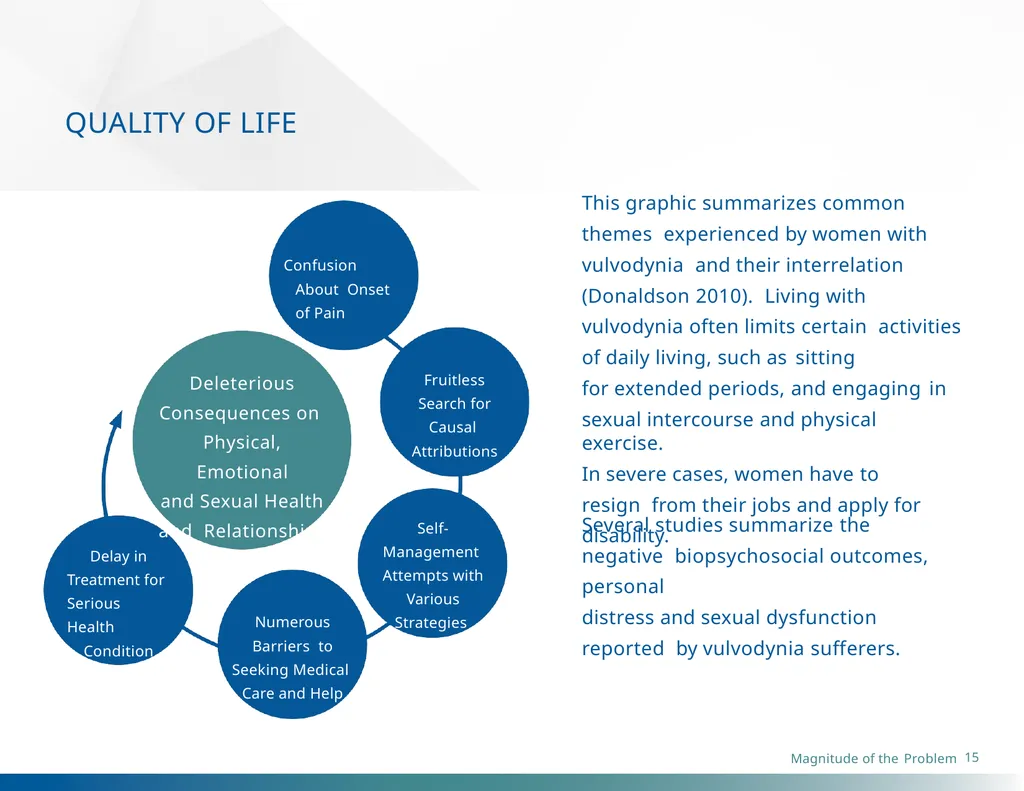
QUALITY OF LIFE Deleterious
Consequences on Physical, Emotional
and Sexual Health and Relationships 15 Magnitude of the Problem Numerous Barriers to Seeking Medical Care and Help Fruitless
Search for Causal Attributions Confusion About Onset of Pain Self-Management Attempts with
Various Strategies Provide Little Relief Delay in Treatment for Serious Health
Condition This graphic summarizes common themes experienced by women with vulvodynia and their interrelation (Donaldson 2010). Living with vulvodynia often limits certain activities of daily living, such as sitting
for extended periods, and engaging in
sexual intercourse and physical exercise.
In severe cases, women have to resign from their jobs and apply for disability. Several studies summarize the negative biopsychosocial outcomes, personal
distress and sexual dysfunction reported by vulvodynia sufferers.<br>
Consequences on Physical, Emotional
and Sexual Health and Relationships 15 Magnitude of the Problem Numerous Barriers to Seeking Medical Care and Help Fruitless
Search for Causal Attributions Confusion About Onset of Pain Self-Management Attempts with
Various Strategies Provide Little Relief Delay in Treatment for Serious Health
Condition This graphic summarizes common themes experienced by women with vulvodynia and their interrelation (Donaldson 2010). Living with vulvodynia often limits certain activities of daily living, such as sitting
for extended periods, and engaging in
sexual intercourse and physical exercise.
In severe cases, women have to resign from their jobs and apply for disability. Several studies summarize the negative biopsychosocial outcomes, personal
distress and sexual dysfunction reported by vulvodynia sufferers.<br>
16
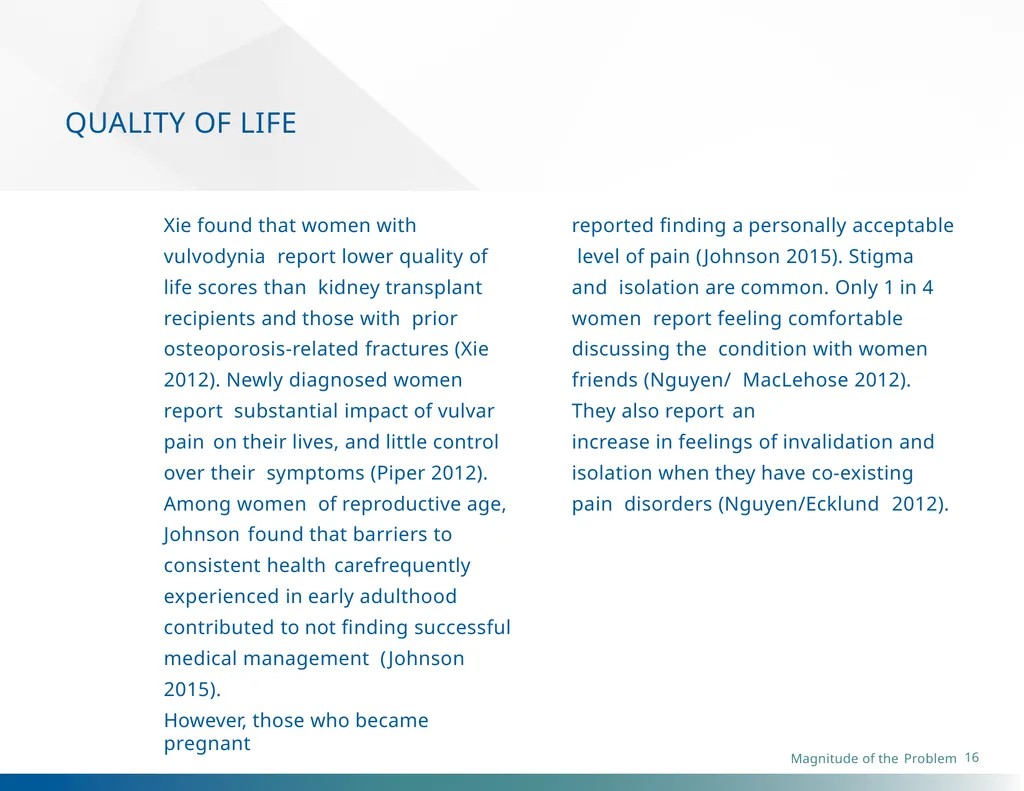
QUALITY OF LIFE 16 Magnitude of the Problem Xie found that women with vulvodynia report lower quality of life scores than kidney transplant recipients and those with prior osteoporosis-related fractures (Xie 2012). Newly diagnosed women report substantial impact of vulvar pain on their lives, and little control over their symptoms (Piper 2012). Among women of reproductive age, Johnson found that barriers to consistent health carefrequently experienced in early adulthood contributed to not finding successful medical management (Johnson 2015).
However, those who became pregnant reported finding a personally acceptable level of pain (Johnson 2015). Stigma and isolation are common. Only 1 in 4 women report feeling comfortable discussing the condition with women friends (Nguyen/ MacLehose 2012). They also report an
increase in feelings of invalidation and isolation when they have co-existing pain disorders (Nguyen/Ecklund 2012).<br>
However, those who became pregnant reported finding a personally acceptable level of pain (Johnson 2015). Stigma and isolation are common. Only 1 in 4 women report feeling comfortable discussing the condition with women friends (Nguyen/ MacLehose 2012). They also report an
increase in feelings of invalidation and isolation when they have co-existing pain disorders (Nguyen/Ecklund 2012).<br>
17
Vulva and Vulvar Vestibule • Innervation of the Vulva
Pelvic Floor Musculature Anatomy and Neurobiology of the Urogenital Tract<br>
Pelvic Floor Musculature Anatomy and Neurobiology of the Urogenital Tract<br>
18
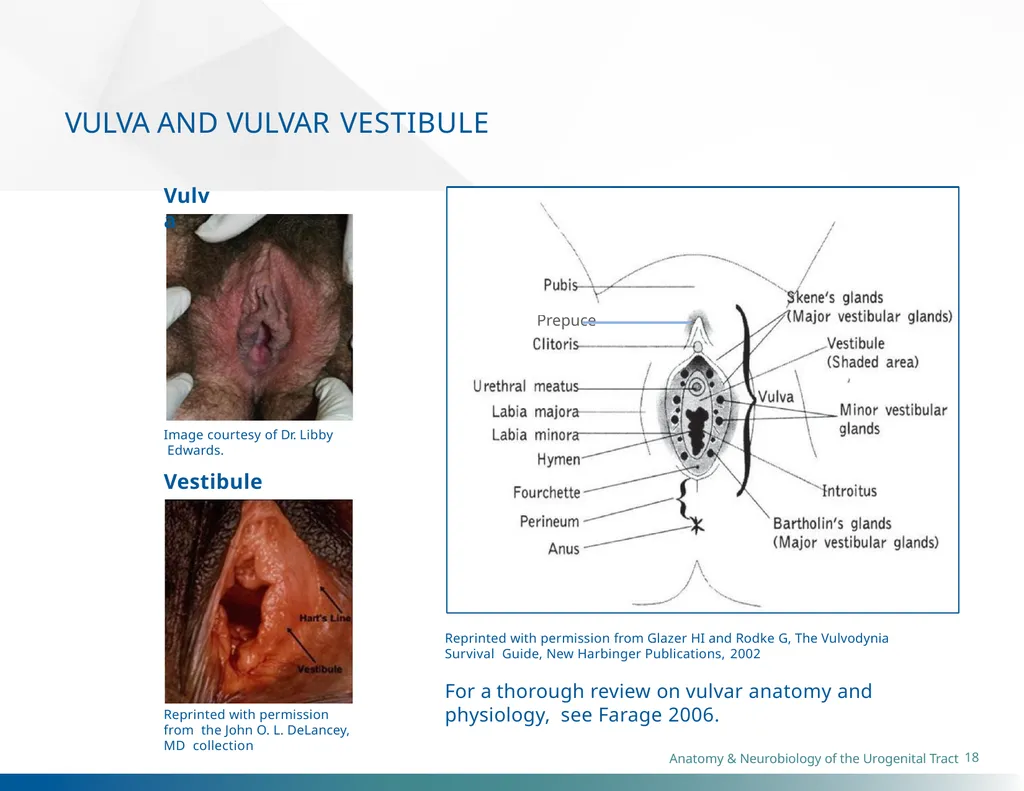
VULVA AND VULVAR VESTIBULE Reprinted with permission from Glazer HI and Rodke G, The Vulvodynia Survival Guide, New Harbinger Publications, 2002 For a thorough review on vulvar anatomy and physiology, see Farage 2006. Reprinted with permission from the John O. L. DeLancey, MD collection Image courtesy of Dr. Libby Edwards.
Vestibule 18 Anatomy & Neurobiology of the Urogenital Tract Vulva Prepuce<br>
Vestibule 18 Anatomy & Neurobiology of the Urogenital Tract Vulva Prepuce<br>
19
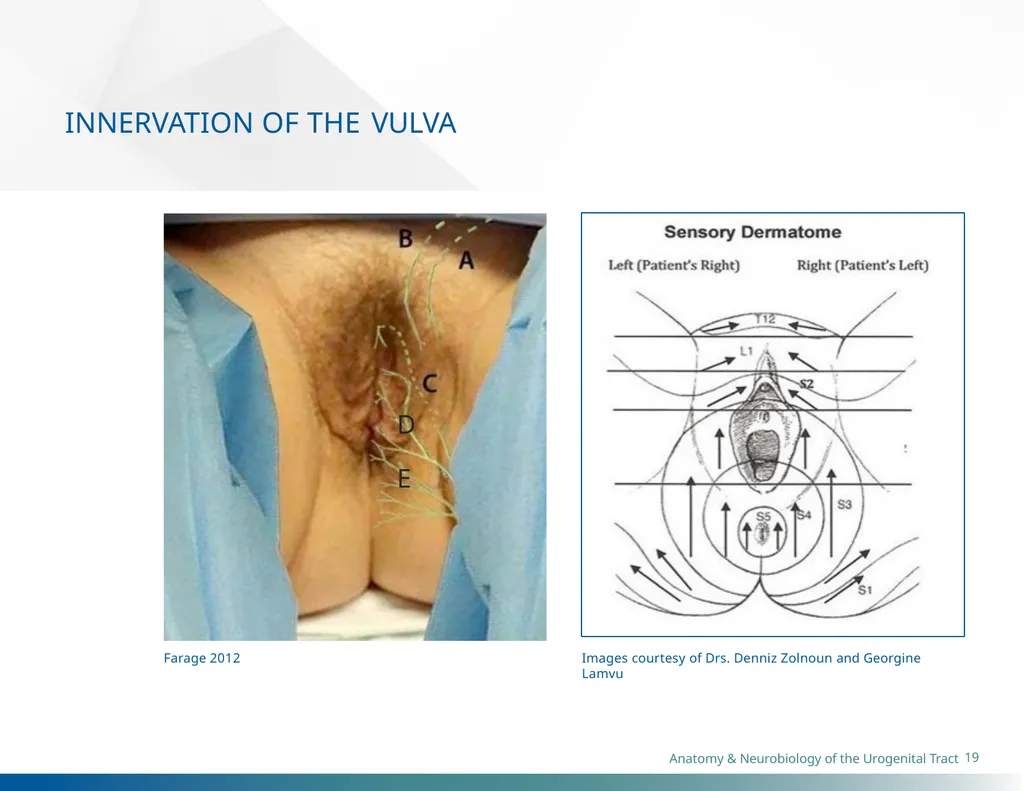
INNERVATION OF THE VULVA Farage 2012 19 Anatomy & Neurobiology of the Urogenital Tract Images courtesy of Drs. Denniz Zolnoun and Georgine Lamvu E D<br>
20
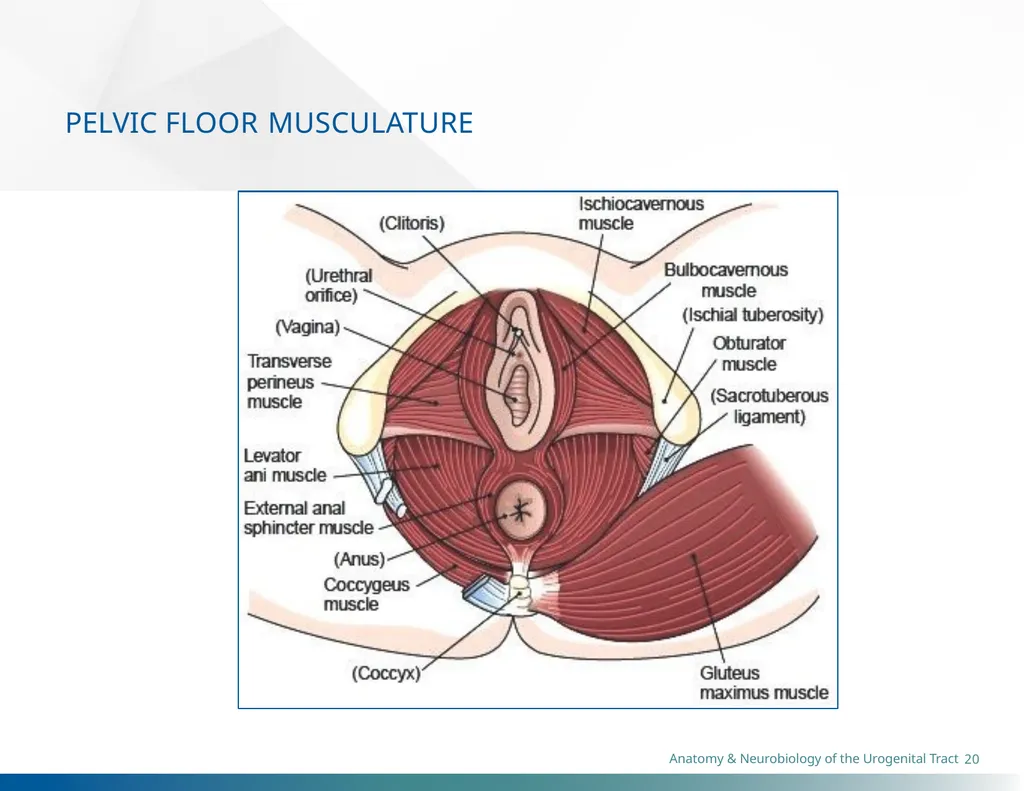
PELVIC FLOOR MUSCULATURE 20 Anatomy & Neurobiology of the Urogenital Tract<br>
21
ISSVD Classification: Vulvar Pain and Vulvodynia
Other Terms Terminology and Classification<br>
Other Terms Terminology and Classification<br>
22
Vulvar pain related to a specific disorder, i.e., NOT vulvodynia
Infectious (recurrent candidiasis, herpes)
Inflammatory (lichen sclerosus, lichen planus, immunobullous disorders)
Neoplastic (Paget’s disease, squamous cell carcinoma)
Neurologic (post-herpetic neuralgia, nerve compression or injury, neuroma)
Trauma (female genital cutting, obstetrical)
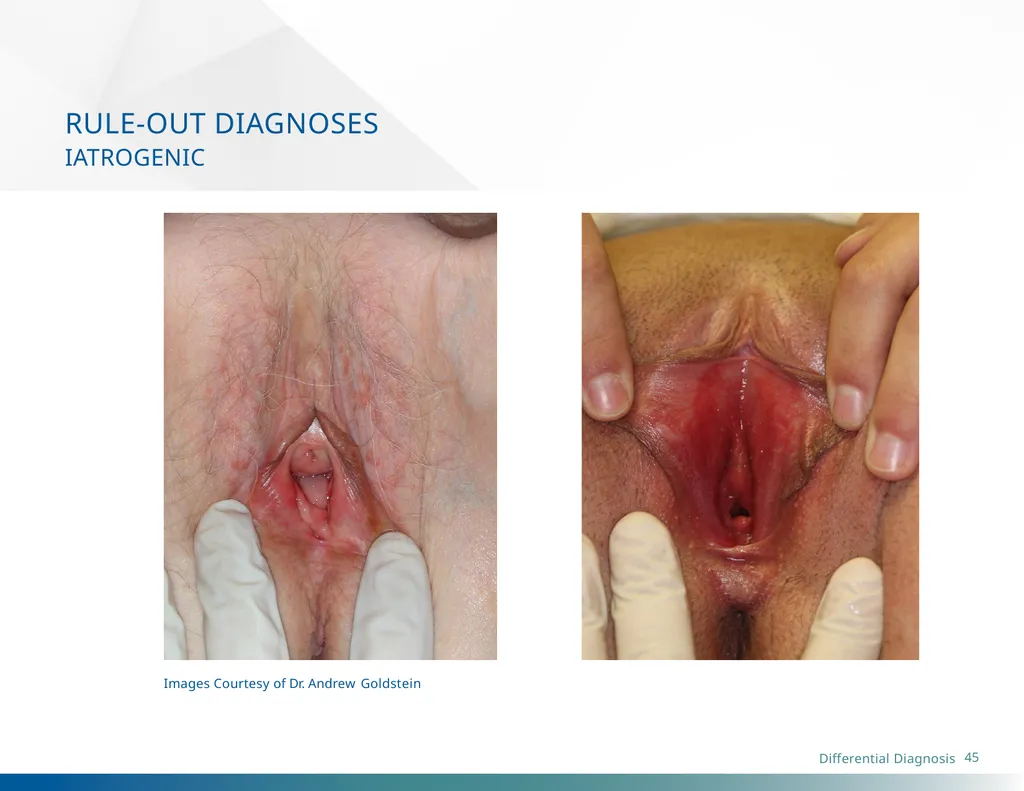
Iatrogenic (post-operative, chemotherapy, radiation)
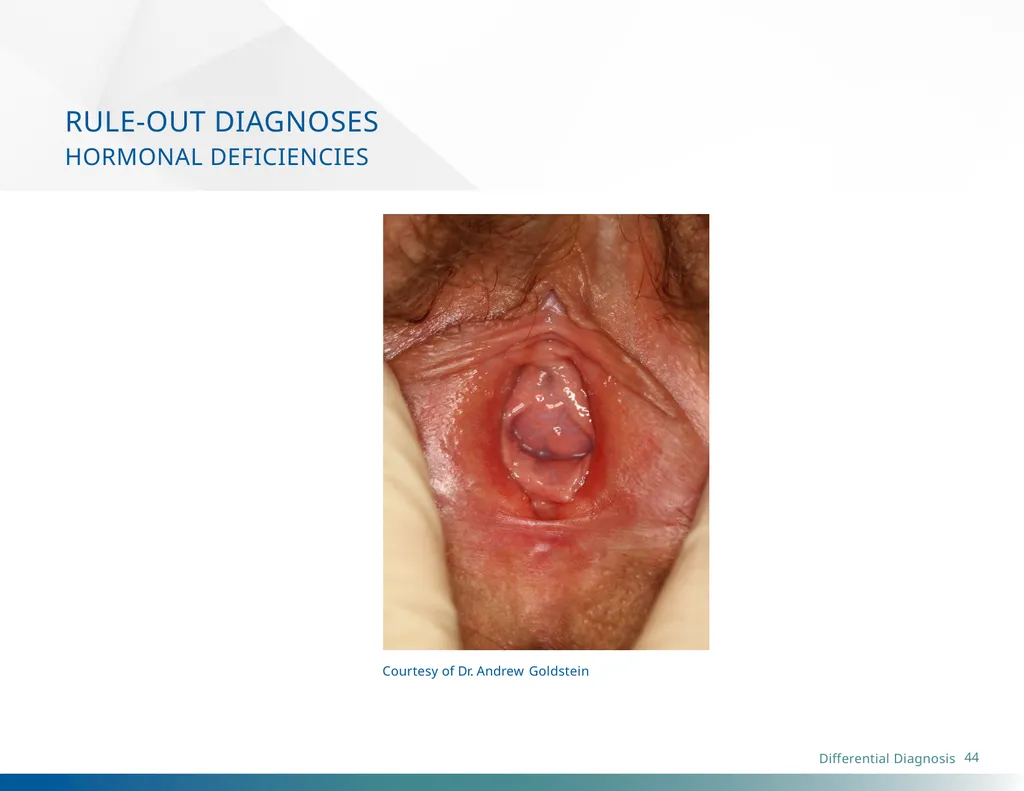
Hormonal deficiencies (genito-urinary syndrome of menopause, lactational amenorrhea) 22 Terminology and Classification ISSVD CLASSIFICATION: VULVAR PAIN Bornstein 2016<br>
Infectious (recurrent candidiasis, herpes)
Inflammatory (lichen sclerosus, lichen planus, immunobullous disorders)
Neoplastic (Paget’s disease, squamous cell carcinoma)
Neurologic (post-herpetic neuralgia, nerve compression or injury, neuroma)
Trauma (female genital cutting, obstetrical)
Iatrogenic (post-operative, chemotherapy, radiation)
Hormonal deficiencies (genito-urinary syndrome of menopause, lactational amenorrhea) 22 Terminology and Classification ISSVD CLASSIFICATION: VULVAR PAIN Bornstein 2016<br>
23
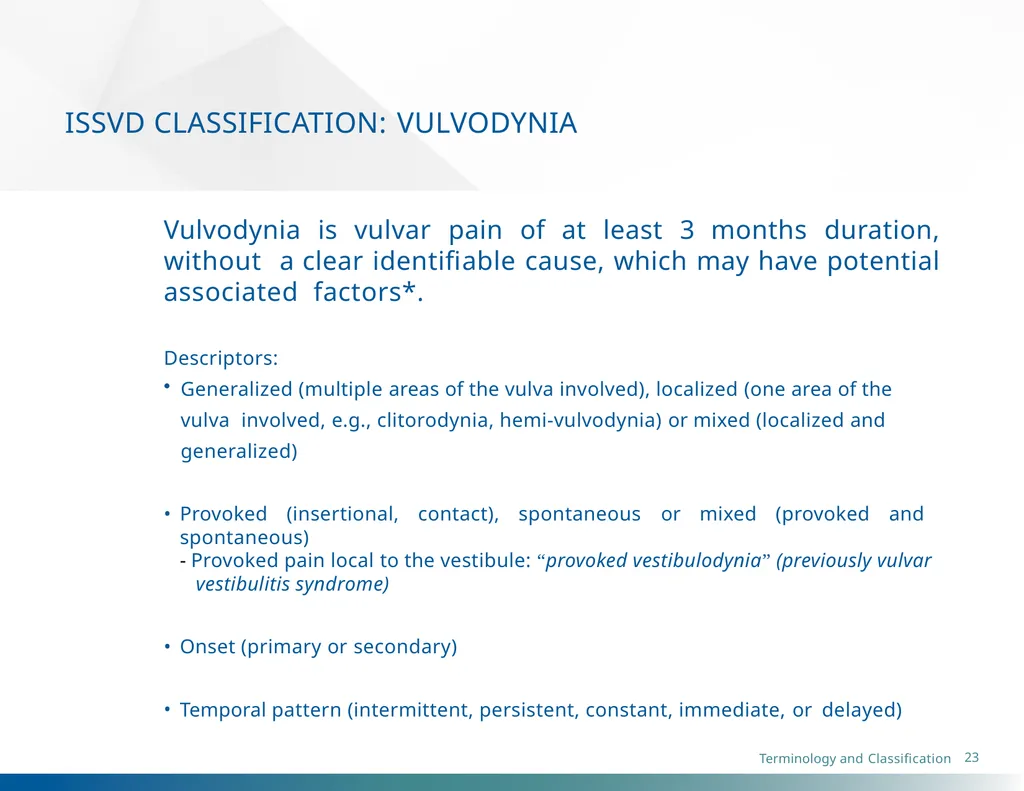
ISSVD CLASSIFICATION: VULVODYNIA 23 Terminology and Classification Vulvodynia is vulvar pain of at least 3 months duration, without a clear identifiable cause, which may have potential associated factors*.
Descriptors:
Generalized (multiple areas of the vulva involved), localized (one area of the vulva involved, e.g., clitorodynia, hemi-vulvodynia) or mixed (localized and generalized)
Provoked (insertional, contact), spontaneous or mixed (provoked and spontaneous) - Provoked pain local to the vestibule: “provoked vestibulodynia” (previously vulvar vestibulitis syndrome)
Onset (primary or secondary)
Temporal pattern (intermittent, persistent, constant, immediate, or delayed)<br>
Descriptors:
Generalized (multiple areas of the vulva involved), localized (one area of the vulva involved, e.g., clitorodynia, hemi-vulvodynia) or mixed (localized and generalized)
Provoked (insertional, contact), spontaneous or mixed (provoked and spontaneous) - Provoked pain local to the vestibule: “provoked vestibulodynia” (previously vulvar vestibulitis syndrome)
Onset (primary or secondary)
Temporal pattern (intermittent, persistent, constant, immediate, or delayed)<br>
24
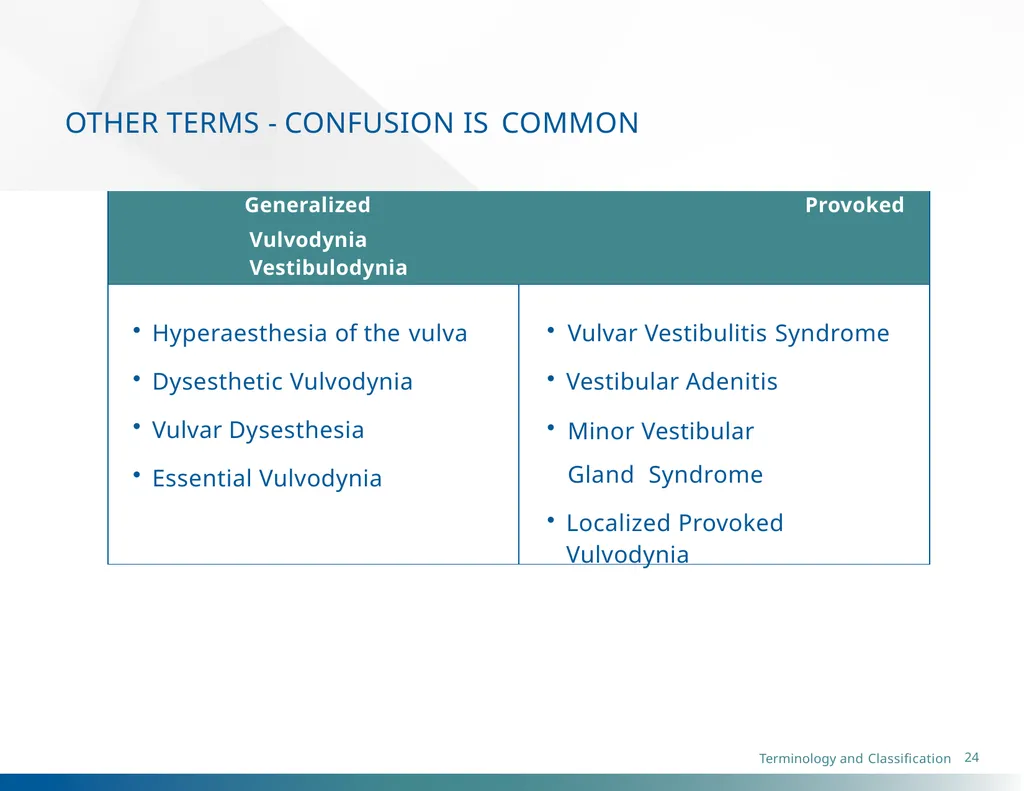
OTHER TERMS - CONFUSION IS COMMON 24 Terminology and Classification<br>
25
Potential Factors Associated with Vulvodynia • Pain Transmission
Neuroproliferation • Mast Cells Pathophysiology<br>
Neuroproliferation • Mast Cells Pathophysiology<br>
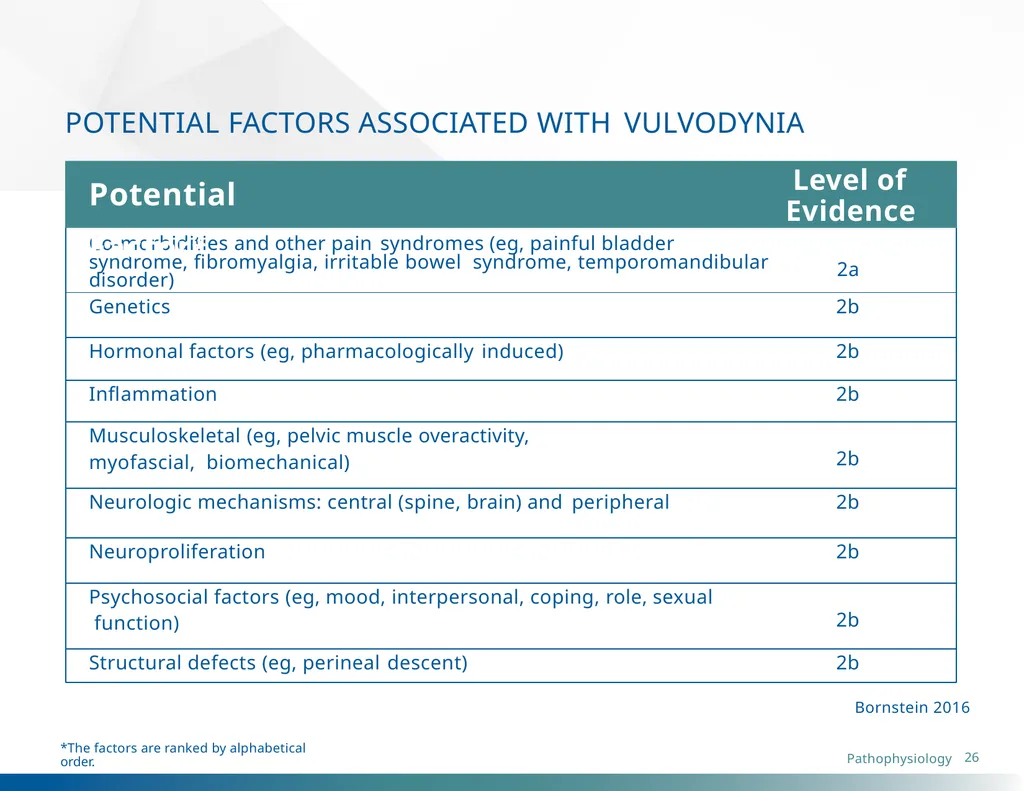
26
POTENTIAL FACTORS ASSOCIATED WITH VULVODYNIA Potential Factor* *The factors are ranked by alphabetical order. 26 Pathophysiology Level of Evidence Bornstein 2016<br>
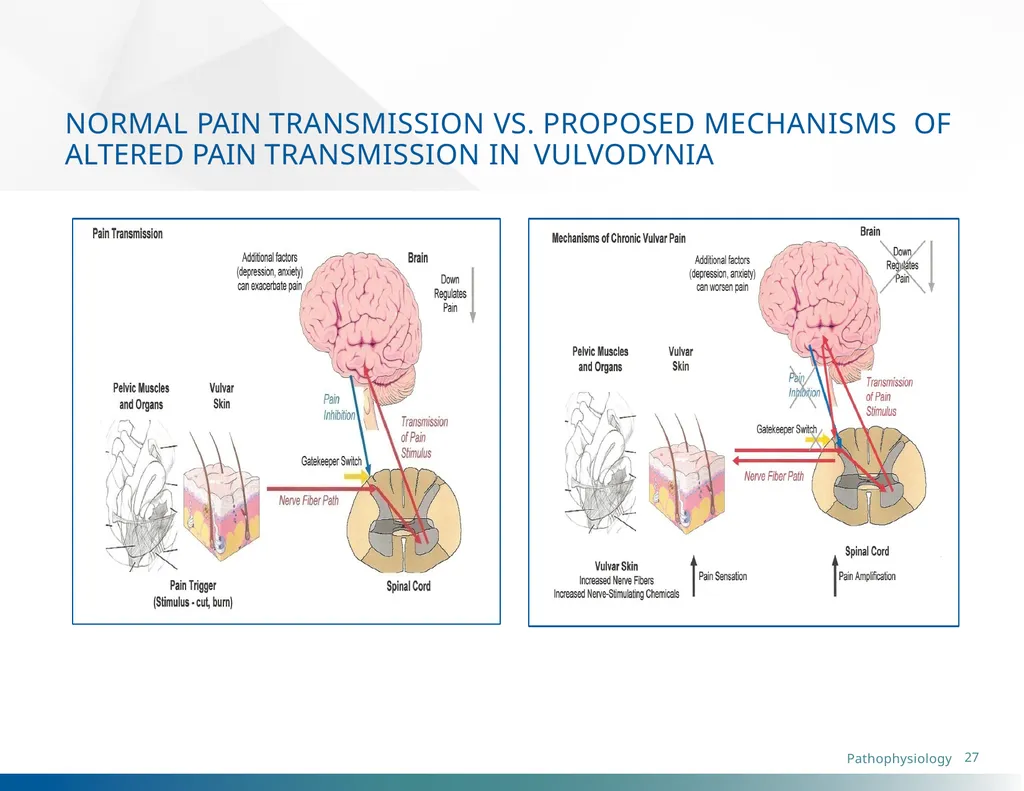
27
NORMAL PAIN TRANSMISSION VS. PROPOSED MECHANISMS OF ALTERED PAIN TRANSMISSION IN VULVODYNIA 27 Pathophysiology<br>
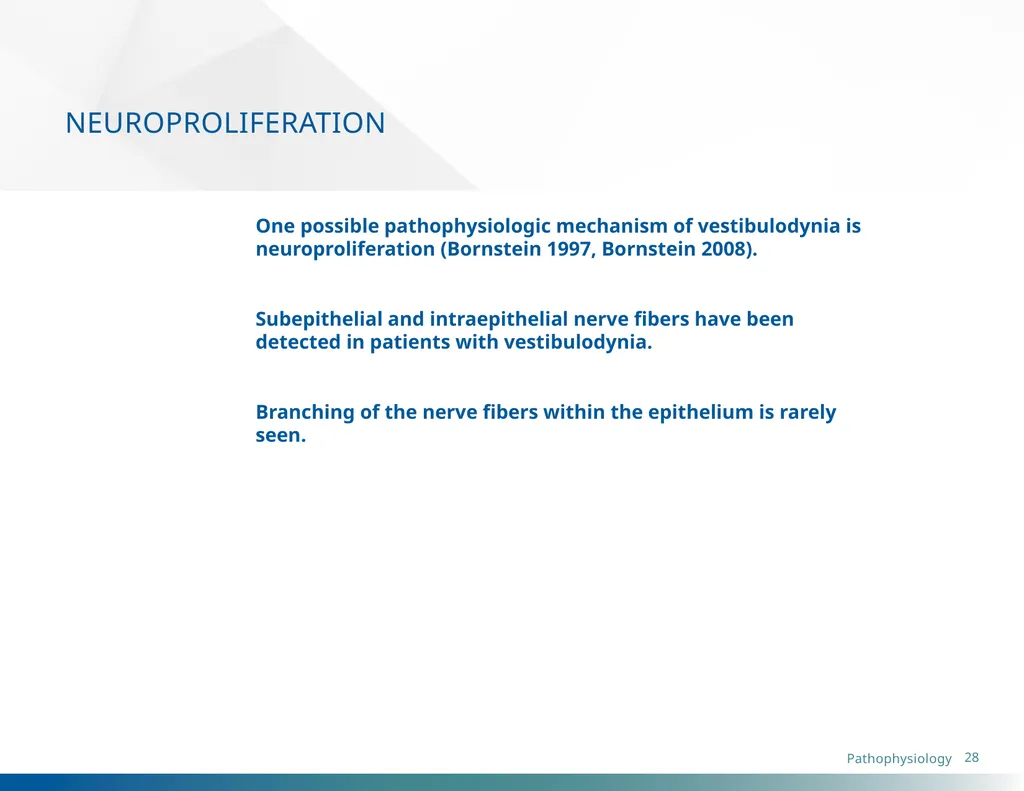
28
NEUROPROLIFERATION One possible pathophysiologic mechanism of vestibulodynia is neuroproliferation (Bornstein 1997, Bornstein 2008).
Subepithelial and intraepithelial nerve fibers have been detected in patients with vestibulodynia.
Branching of the nerve fibers within the epithelium is rarely seen. 28 Pathophysiology<br>
Subepithelial and intraepithelial nerve fibers have been detected in patients with vestibulodynia.
Branching of the nerve fibers within the epithelium is rarely seen. 28 Pathophysiology<br>
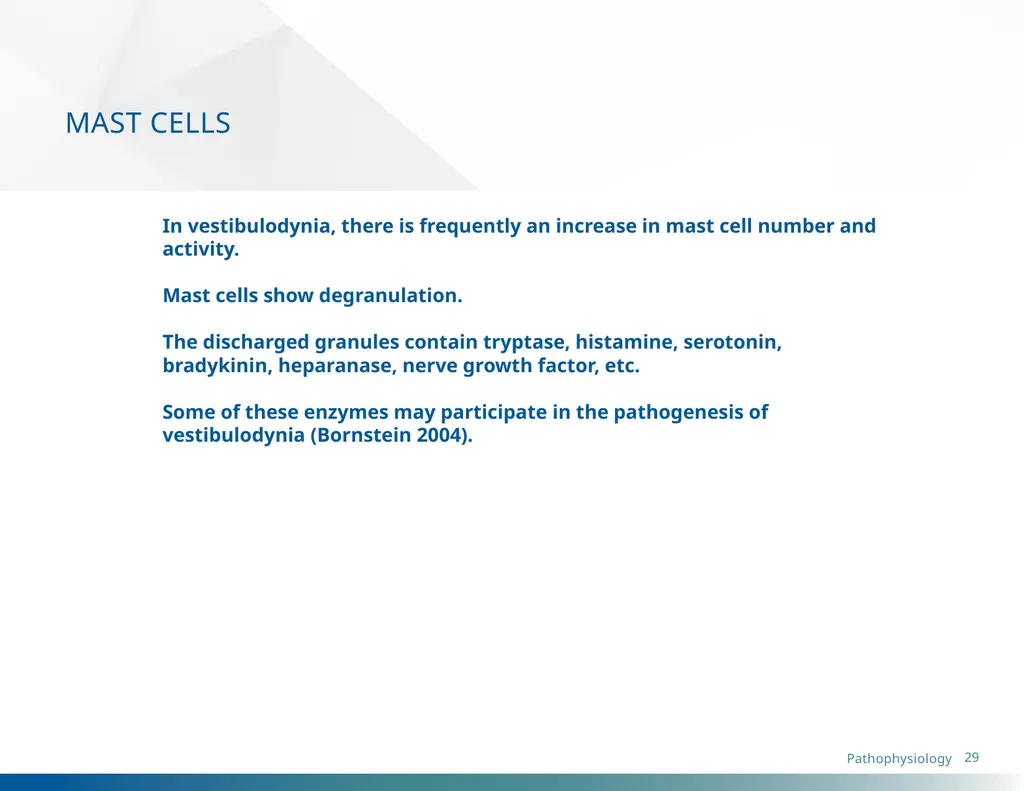
29
MAST CELLS In vestibulodynia, there is frequently an increase in mast cell number and activity.
Mast cells show degranulation.
The discharged granules contain tryptase, histamine, serotonin, bradykinin, heparanase, nerve growth factor, etc.
Some of these enzymes may participate in the pathogenesis of vestibulodynia (Bornstein 2004). 29 Pathophysiology<br>
Mast cells show degranulation.
The discharged granules contain tryptase, histamine, serotonin, bradykinin, heparanase, nerve growth factor, etc.
Some of these enzymes may participate in the pathogenesis of vestibulodynia (Bornstein 2004). 29 Pathophysiology<br>
30
Disorders known to cause vulvar pain (rule-out diagnoses)
vs.
Vulvodynia Differential Diagnosis<br>
vs.
Vulvodynia Differential Diagnosis<br>
31
Postulated risk factors reported in the literature to date:
Vulvovaginal infection Oral contraceptive use Genetic variability
Dysmenorrhea, chronic pain in other areas of the body
Autoimmune disease, altered immuno- inflammatory response
Allergies, vulvar dermatologic disorders 31 Differential Diagnosis Early age of first intercourse, pain with first intercourse, pain with/after sex
Early menarche Nulliparity
Childhood enuresis, nocturnal urination, Urinary burning, pain with wiping
Pain with bike riding
Difficulty or severe pain with first tampon use
Adverse life experiences POSSIBLE RISK FACTORS FOR VULVODYNIA<br>
Vulvovaginal infection Oral contraceptive use Genetic variability
Dysmenorrhea, chronic pain in other areas of the body
Autoimmune disease, altered immuno- inflammatory response
Allergies, vulvar dermatologic disorders 31 Differential Diagnosis Early age of first intercourse, pain with first intercourse, pain with/after sex
Early menarche Nulliparity
Childhood enuresis, nocturnal urination, Urinary burning, pain with wiping
Pain with bike riding
Difficulty or severe pain with first tampon use
Adverse life experiences POSSIBLE RISK FACTORS FOR VULVODYNIA<br>
32
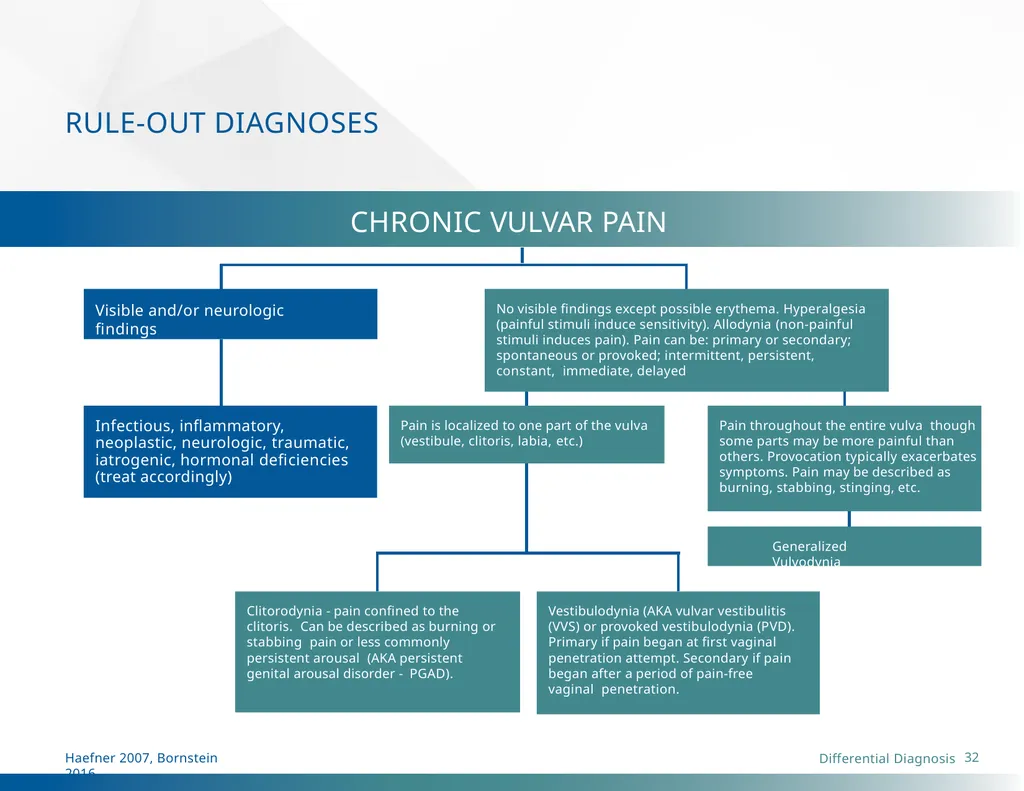
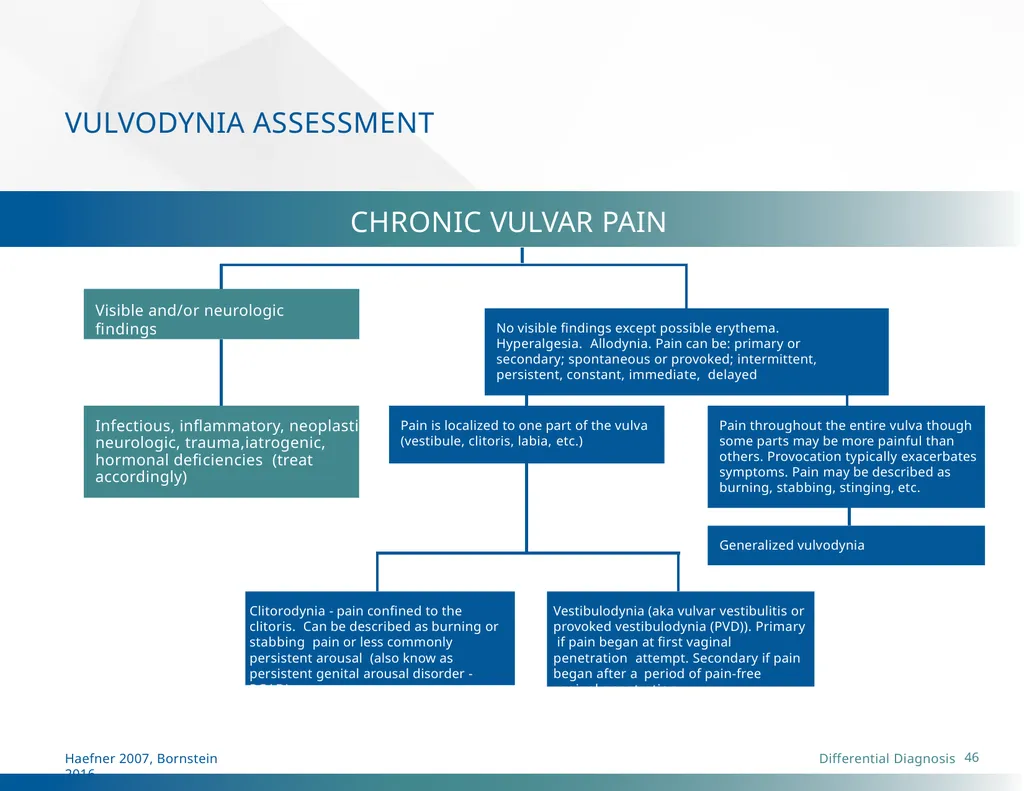
RULE-OUT DIAGNOSES Haefner 2007, Bornstein 2016 No visible findings except possible erythema. Hyperalgesia (painful stimuli induce sensitivity). Allodynia (non-painful stimuli induces pain). Pain can be: primary or secondary; spontaneous or provoked; intermittent, persistent, constant, immediate, delayed Pain throughout the entire vulva though some parts may be more painful than others. Provocation typically exacerbates symptoms. Pain may be described as burning, stabbing, stinging, etc. Pain is localized to one part of the vulva (vestibule, clitoris, labia, etc.) Clitorodynia - pain confined to the clitoris. Can be described as burning or stabbing pain or less commonly persistent arousal (AKA persistent genital arousal disorder - PGAD). Vestibulodynia (AKA vulvar vestibulitis (VVS) or provoked vestibulodynia (PVD). Primary if pain began at first vaginal penetration attempt. Secondary if pain began after a period of pain-free vaginal penetration. Generalized Vulvodynia Infectious, inflammatory, neoplastic, neurologic, traumatic, iatrogenic, hormonal deficiencies (treat accordingly) Visible and/or neurologic findings CHRONIC VULVAR PAIN 32 Differential Diagnosis<br>
33
RULE-OUT DIAGNOSES
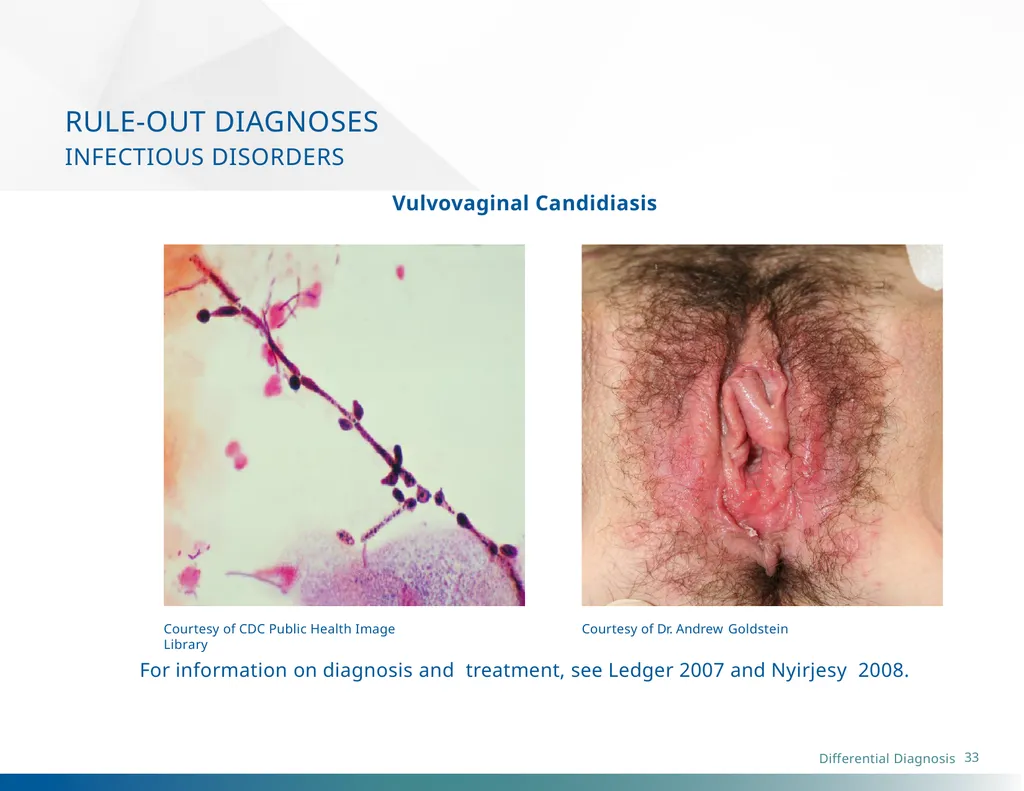
INFECTIOUS DISORDERS Vulvovaginal Candidiasis Courtesy of CDC Public Health Image Library 33 Differential Diagnosis Courtesy of Dr. Andrew Goldstein For information on diagnosis and treatment, see Ledger 2007 and Nyirjesy 2008.<br>
INFECTIOUS DISORDERS Vulvovaginal Candidiasis Courtesy of CDC Public Health Image Library 33 Differential Diagnosis Courtesy of Dr. Andrew Goldstein For information on diagnosis and treatment, see Ledger 2007 and Nyirjesy 2008.<br>
34
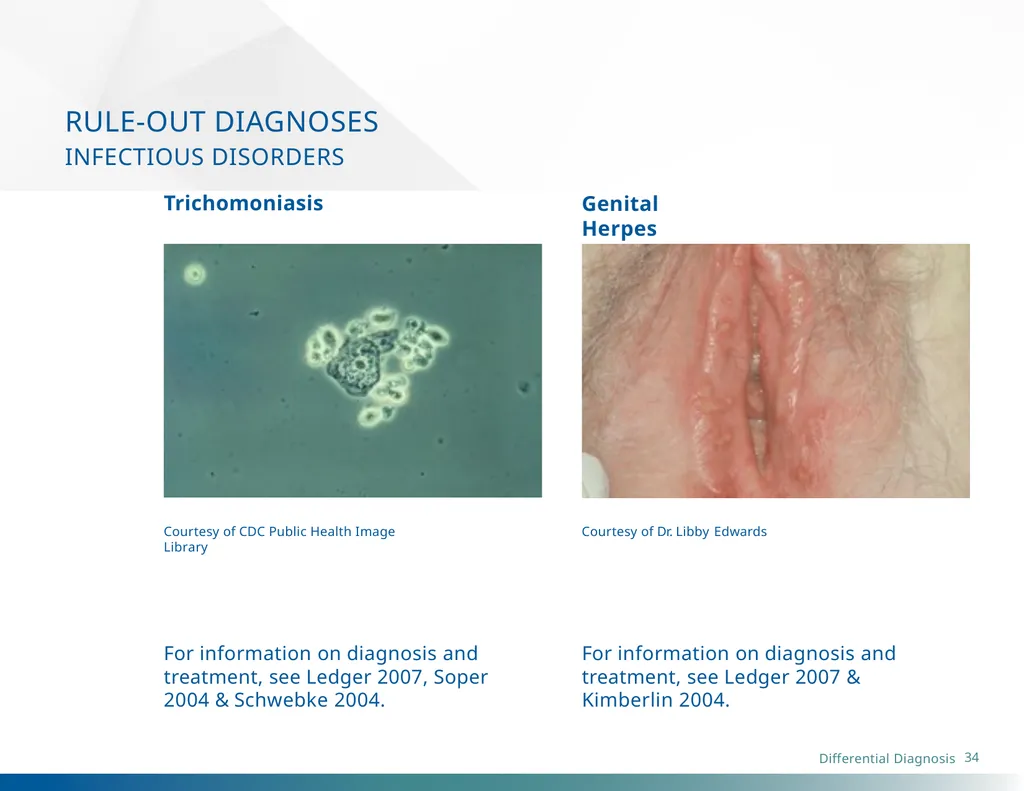
RULE-OUT DIAGNOSES
INFECTIOUS DISORDERS Trichomoniasis Courtesy of CDC Public Health Image Library Courtesy of Dr. Libby Edwards For information on diagnosis and treatment, see Ledger 2007, Soper
2004 & Schwebke 2004. Genital Herpes For information on diagnosis and treatment, see Ledger 2007 & Kimberlin 2004. 34 Differential Diagnosis<br>
INFECTIOUS DISORDERS Trichomoniasis Courtesy of CDC Public Health Image Library Courtesy of Dr. Libby Edwards For information on diagnosis and treatment, see Ledger 2007, Soper
2004 & Schwebke 2004. Genital Herpes For information on diagnosis and treatment, see Ledger 2007 & Kimberlin 2004. 34 Differential Diagnosis<br>
35
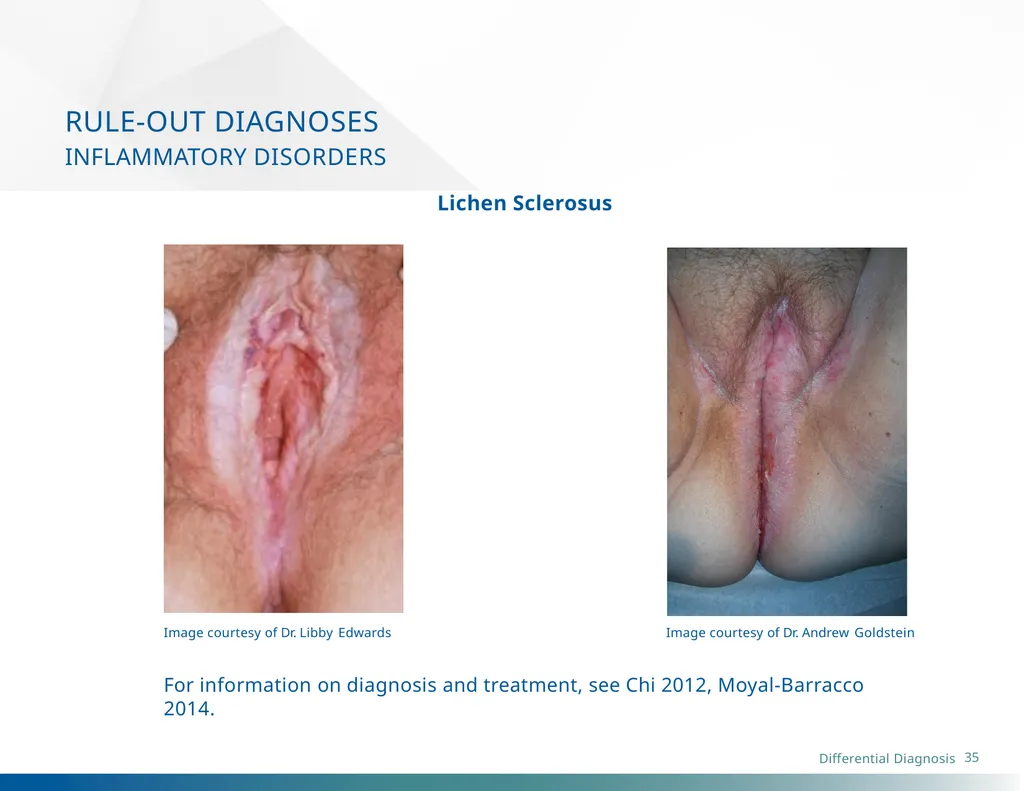
RULE-OUT DIAGNOSES
INFLAMMATORY DISORDERS Lichen Sclerosus Image courtesy of Dr. Libby Edwards Image courtesy of Dr. Andrew Goldstein For information on diagnosis and treatment, see Chi 2012, Moyal-Barracco 2014. 35 Differential Diagnosis<br>
INFLAMMATORY DISORDERS Lichen Sclerosus Image courtesy of Dr. Libby Edwards Image courtesy of Dr. Andrew Goldstein For information on diagnosis and treatment, see Chi 2012, Moyal-Barracco 2014. 35 Differential Diagnosis<br>
36
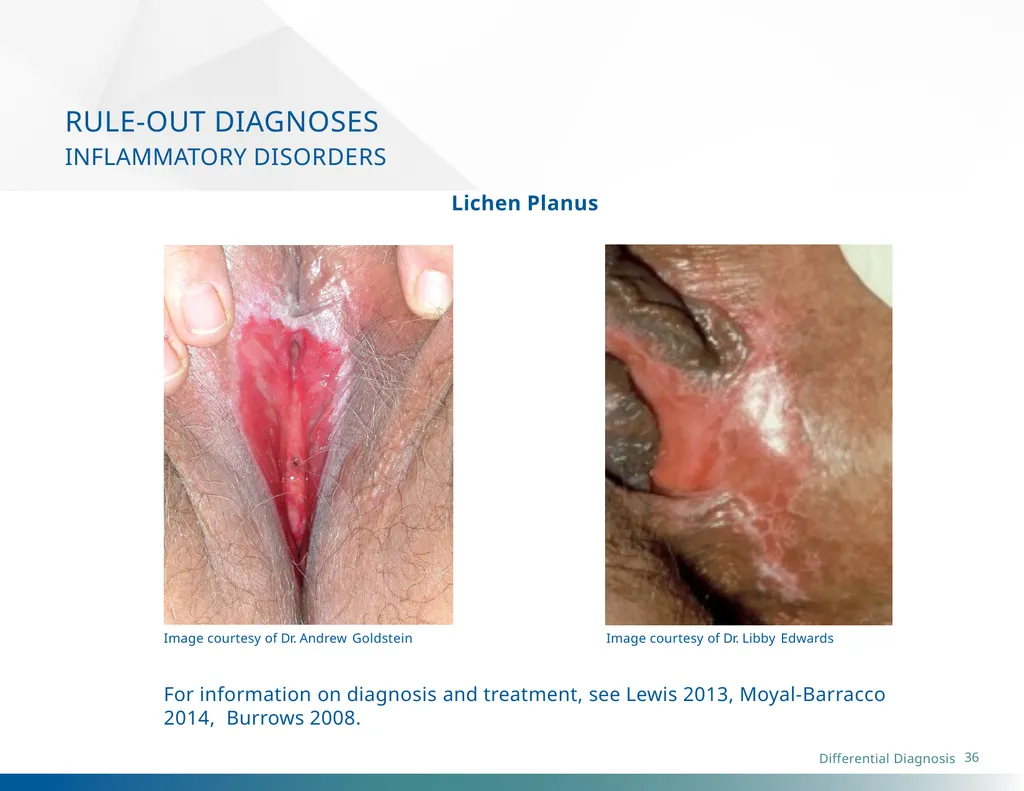
RULE-OUT DIAGNOSES
INFLAMMATORY DISORDERS Lichen Planus Image courtesy of Dr. Andrew Goldstein For information on diagnosis and treatment, see Lewis 2013, Moyal-Barracco 2014, Burrows 2008. Image courtesy of Dr. Libby Edwards 36 Differential Diagnosis<br>
INFLAMMATORY DISORDERS Lichen Planus Image courtesy of Dr. Andrew Goldstein For information on diagnosis and treatment, see Lewis 2013, Moyal-Barracco 2014, Burrows 2008. Image courtesy of Dr. Libby Edwards 36 Differential Diagnosis<br>
37
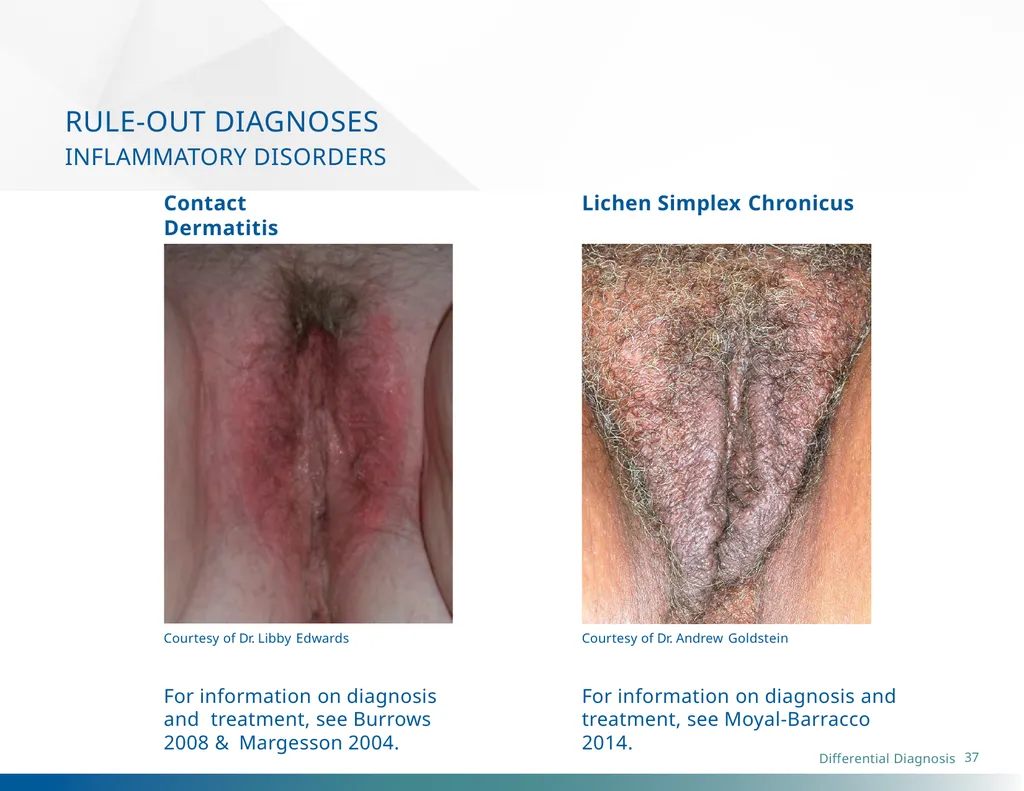
RULE-OUT DIAGNOSES
INFLAMMATORY DISORDERS Contact Dermatitis Courtesy of Dr. Libby Edwards
For information on diagnosis and treatment, see Burrows 2008 & Margesson 2004. Courtesy of Dr. Andrew Goldstein
For information on diagnosis and treatment, see Moyal-Barracco 2014. 37 Differential Diagnosis Lichen Simplex Chronicus<br>
INFLAMMATORY DISORDERS Contact Dermatitis Courtesy of Dr. Libby Edwards
For information on diagnosis and treatment, see Burrows 2008 & Margesson 2004. Courtesy of Dr. Andrew Goldstein
For information on diagnosis and treatment, see Moyal-Barracco 2014. 37 Differential Diagnosis Lichen Simplex Chronicus<br>
38
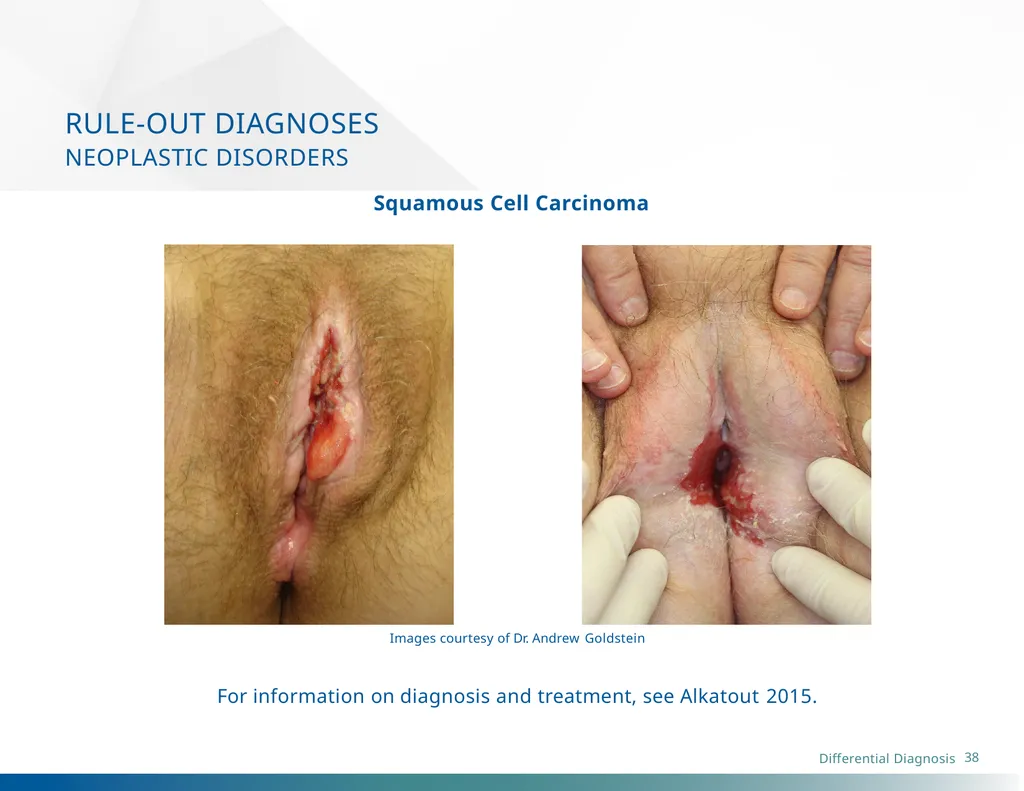
RULE-OUT DIAGNOSES NEOPLASTIC DISORDERS 38 Differential Diagnosis Squamous Cell Carcinoma Images courtesy of Dr. Andrew Goldstein
For information on diagnosis and treatment, see Alkatout 2015.<br>
For information on diagnosis and treatment, see Alkatout 2015.<br>
39
Pudendal, Genitofemoral and/or Ilioinguinal Nerve Injury
Can be caused by several different insults including: childbirth, sports injuries, trauma and surgery (for incontinence or for vaginal vault prolapse) (see Paulson 2011, Masata 2012, Parnell 2012, Bekker 2012) 39 Differential Diagnosis RULE-OUT DIAGNOSES
NEUROLOGIC DISORDERS<br>
Can be caused by several different insults including: childbirth, sports injuries, trauma and surgery (for incontinence or for vaginal vault prolapse) (see Paulson 2011, Masata 2012, Parnell 2012, Bekker 2012) 39 Differential Diagnosis RULE-OUT DIAGNOSES
NEUROLOGIC DISORDERS<br>
40
Pudendal Neuralgia due to Nerve Entrapment* (see Peng 2009, Insola 2010)
Diagnosed by presence of all five Nantes Criteria: 1) pain in the anatomical territory of the pudendal nerve, 2) worse on sitting, 3) not usually waking the patient at night, 4) not accompanied by any objective perineal sensory loss, with 5) a positive anesthetic block of
the pudendal nerve at the ischial spine (Labat 2010) *These disorders are many times also diagnoses of exclusion, and can, therefore, be difficult to definitively differentiate from vulvodynia. 40 Differential Diagnosis Patients often present with associated urinary, anorectal, sexual, neuromuscular, and hypersensitization signs, which can complicate the diagnostic approach and therapeutic management (Labat 2010). RULE-OUT DIAGNOSES
NEUROLOGIC DISORDERS<br>
Diagnosed by presence of all five Nantes Criteria: 1) pain in the anatomical territory of the pudendal nerve, 2) worse on sitting, 3) not usually waking the patient at night, 4) not accompanied by any objective perineal sensory loss, with 5) a positive anesthetic block of
the pudendal nerve at the ischial spine (Labat 2010) *These disorders are many times also diagnoses of exclusion, and can, therefore, be difficult to definitively differentiate from vulvodynia. 40 Differential Diagnosis Patients often present with associated urinary, anorectal, sexual, neuromuscular, and hypersensitization signs, which can complicate the diagnostic approach and therapeutic management (Labat 2010). RULE-OUT DIAGNOSES
NEUROLOGIC DISORDERS<br>
41
Peripheral Neuropathy/Neuralgia*
Neuropathy induced by diabetes, chemotherapy, multiple sclerosis (see Stavraka 2012, Loprinzi 2008)
Herpes zoster virus can lead to post-herpetic neuralgia masking as vulvodynia (see Oaklander 2002).
Pharmacologic toxicity, eg, nitrofurantoin (see Tan 2012) *These disorders are many times also diagnoses of exclusion, and can, therefore, be difficult to definitively differentiate from vulvodynia. 41 Differential Diagnosis RULE-OUT DIAGNOSES
NEUROLOGIC DISORDERS<br>
Neuropathy induced by diabetes, chemotherapy, multiple sclerosis (see Stavraka 2012, Loprinzi 2008)
Herpes zoster virus can lead to post-herpetic neuralgia masking as vulvodynia (see Oaklander 2002).
Pharmacologic toxicity, eg, nitrofurantoin (see Tan 2012) *These disorders are many times also diagnoses of exclusion, and can, therefore, be difficult to definitively differentiate from vulvodynia. 41 Differential Diagnosis RULE-OUT DIAGNOSES
NEUROLOGIC DISORDERS<br>
42
RULE-OUT DIAGNOSES
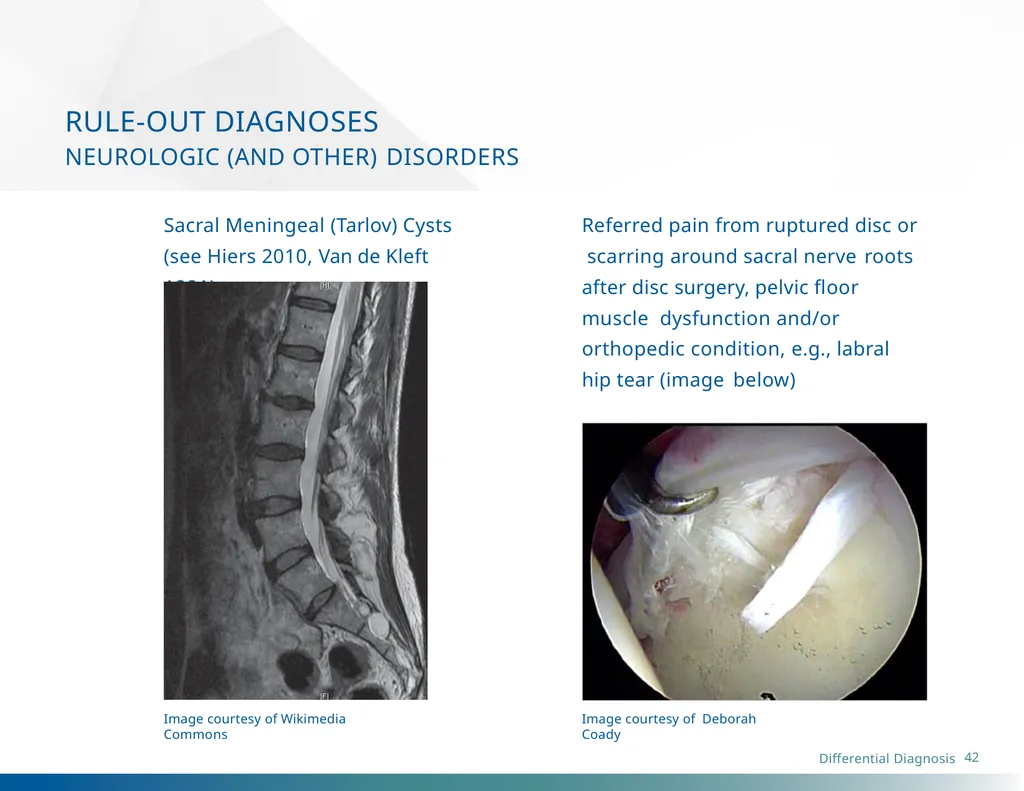
NEUROLOGIC (AND OTHER) DISORDERS Sacral Meningeal (Tarlov) Cysts (see Hiers 2010, Van de Kleft 1991) Referred pain from ruptured disc or scarring around sacral nerve roots after disc surgery, pelvic floor muscle dysfunction and/or orthopedic condition, e.g., labral hip tear (image below) 42 Differential Diagnosis Image courtesy of Wikimedia Commons Image courtesy of Deborah Coady<br>
NEUROLOGIC (AND OTHER) DISORDERS Sacral Meningeal (Tarlov) Cysts (see Hiers 2010, Van de Kleft 1991) Referred pain from ruptured disc or scarring around sacral nerve roots after disc surgery, pelvic floor muscle dysfunction and/or orthopedic condition, e.g., labral hip tear (image below) 42 Differential Diagnosis Image courtesy of Wikimedia Commons Image courtesy of Deborah Coady<br>
43
Trauma to the vulva may lead to chronic vulvar pain.
Female genital cutting
Perineal trauma
Straddle injuries
Bicycles
Falls from climbing
Injuries to pelvis
Motor vehicle accidents 43 Differential Diagnosis RULE-OUT DIAGNOSES TRAUMA<br>
Female genital cutting
Perineal trauma
Straddle injuries
Bicycles
Falls from climbing
Injuries to pelvis
Motor vehicle accidents 43 Differential Diagnosis RULE-OUT DIAGNOSES TRAUMA<br>
44
RULE-OUT DIAGNOSES
HORMONAL DEFICIENCIES Courtesy of Dr. Andrew Goldstein 44 Differential Diagnosis<br>
HORMONAL DEFICIENCIES Courtesy of Dr. Andrew Goldstein 44 Differential Diagnosis<br>
45
RULE-OUT DIAGNOSES IATROGENIC Images Courtesy of Dr. Andrew Goldstein 45 Differential Diagnosis<br>
46
VULVODYNIA ASSESSMENT Haefner 2007, Bornstein 2016 No visible findings except possible erythema. Hyperalgesia. Allodynia. Pain can be: primary or secondary; spontaneous or provoked; intermittent, persistent, constant, immediate, delayed Pain throughout the entire vulva though some parts may be more painful than others. Provocation typically exacerbates symptoms. Pain may be described as burning, stabbing, stinging, etc. Pain is localized to one part of the vulva (vestibule, clitoris, labia, etc.) Clitorodynia - pain confined to the clitoris. Can be described as burning or stabbing pain or less commonly persistent arousal (also know as persistent genital arousal disorder - PGAD). Vestibulodynia (aka vulvar vestibulitis or provoked vestibulodynia (PVD)). Primary if pain began at first vaginal penetration attempt. Secondary if pain began after a period of pain-free vaginal penetration. Generalized vulvodynia Infectious, inflammatory, neoplastic, neurologic, trauma,iatrogenic, hormonal deficiencies (treat accordingly) Visible and/or neurologic findings CHRONIC VULVAR PAIN 46 Differential Diagnosis<br>
47
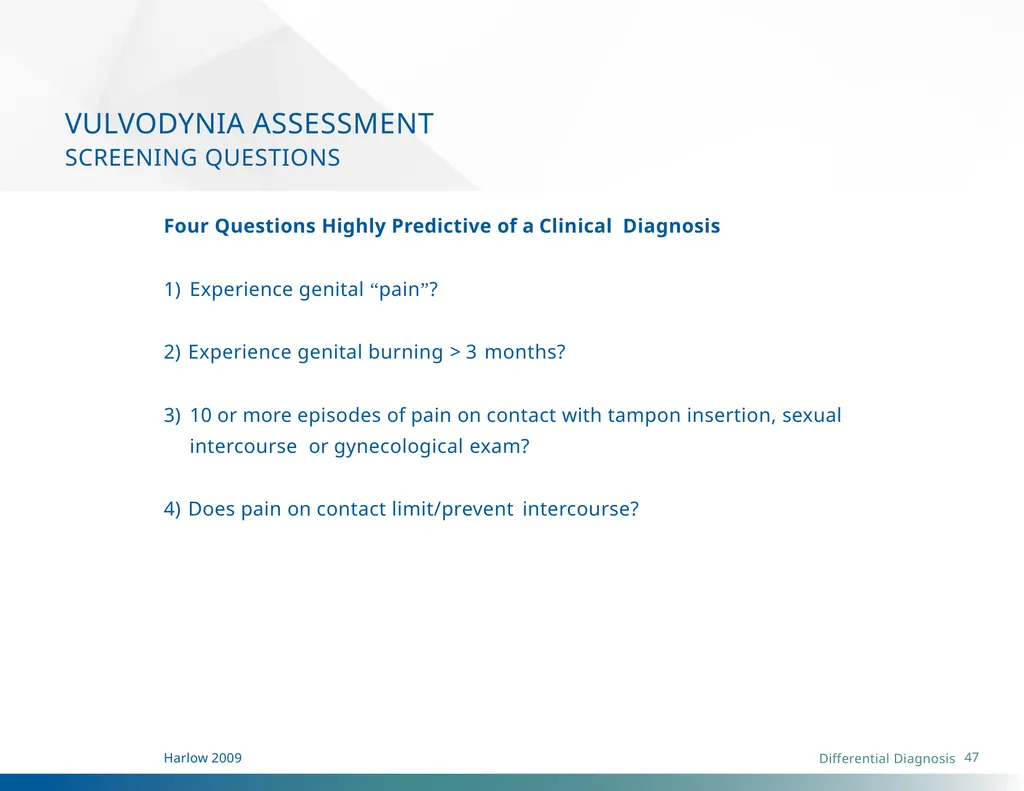
VULVODYNIA ASSESSMENT SCREENING QUESTIONS 47 Differential Diagnosis Four Questions Highly Predictive of a Clinical Diagnosis
Experience genital “pain”?
Experience genital burning > 3 months?
10 or more episodes of pain on contact with tampon insertion, sexual intercourse or gynecological exam?
Does pain on contact limit/prevent intercourse? Harlow 2009<br>
Experience genital “pain”?
Experience genital burning > 3 months?
10 or more episodes of pain on contact with tampon insertion, sexual intercourse or gynecological exam?
Does pain on contact limit/prevent intercourse? Harlow 2009<br>
48
Vulvodynia is vulvar pain of at least 3 months duration, without a clear identifiable cause, which may have potential associated factors.
Descriptors:
Localized (e.g., vestibulodynia, clitorodynia), generalized or mixed (localized and generalized)
Provoked (eg, insertional, contact), spontaneous or mixed (provoked and spontaneous)
Onset (primary or secondary)
Temporal pattern (intermittent, persistent, constant, immediate, delayed) 48 Differential Diagnosis 2015 ISSVD, ISSWSH, IPPS CONSENSUS TERMINOLOGY AND CLASSIFICATION OF VULVODYNIA Bornstein 2016<br>
Descriptors:
Localized (e.g., vestibulodynia, clitorodynia), generalized or mixed (localized and generalized)
Provoked (eg, insertional, contact), spontaneous or mixed (provoked and spontaneous)
Onset (primary or secondary)
Temporal pattern (intermittent, persistent, constant, immediate, delayed) 48 Differential Diagnosis 2015 ISSVD, ISSWSH, IPPS CONSENSUS TERMINOLOGY AND CLASSIFICATION OF VULVODYNIA Bornstein 2016<br>
49
After all infectious, inflammatory, neoplastic, neurologic, and other disorders are identified and treated, women are assessed for vulvodynia through a five-step examination, as described in the following slides.
Step 1: Visual Examination
Step 2: Cotton-Swab Examination of the Vulva and Vulvar Vestibule
Step 3: Neurosensory Examination
Step 4: Pelvic Floor Muscle Examination
Step 5: Evaluation of Pain Comorbidity & Contributing Factors 49 Differential Diagnosis VULVODYNIA ASSESSMENT
COMPONENTS OF THE EXAMINATION<br>
Step 1: Visual Examination
Step 2: Cotton-Swab Examination of the Vulva and Vulvar Vestibule
Step 3: Neurosensory Examination
Step 4: Pelvic Floor Muscle Examination
Step 5: Evaluation of Pain Comorbidity & Contributing Factors 49 Differential Diagnosis VULVODYNIA ASSESSMENT
COMPONENTS OF THE EXAMINATION<br>
50
VULVODYNIA ASSESSMENT
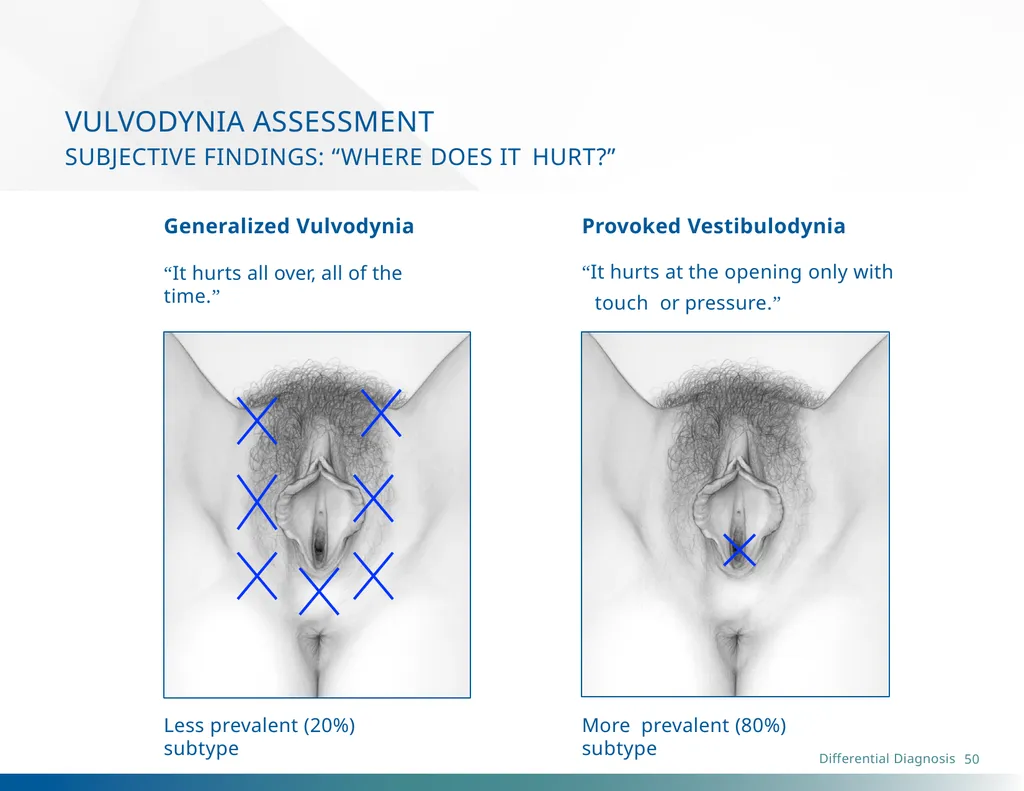
SUBJECTIVE FINDINGS: “WHERE DOES IT HURT?” Generalized Vulvodynia
“It hurts all over, all of the time.” Provoked Vestibulodynia
“It hurts at the opening only with touch or pressure.” Less prevalent (20%) subtype 50 Differential Diagnosis More prevalent (80%) subtype<br>
SUBJECTIVE FINDINGS: “WHERE DOES IT HURT?” Generalized Vulvodynia
“It hurts all over, all of the time.” Provoked Vestibulodynia
“It hurts at the opening only with touch or pressure.” Less prevalent (20%) subtype 50 Differential Diagnosis More prevalent (80%) subtype<br>
51
VULVODYNIA ASSESSMENT
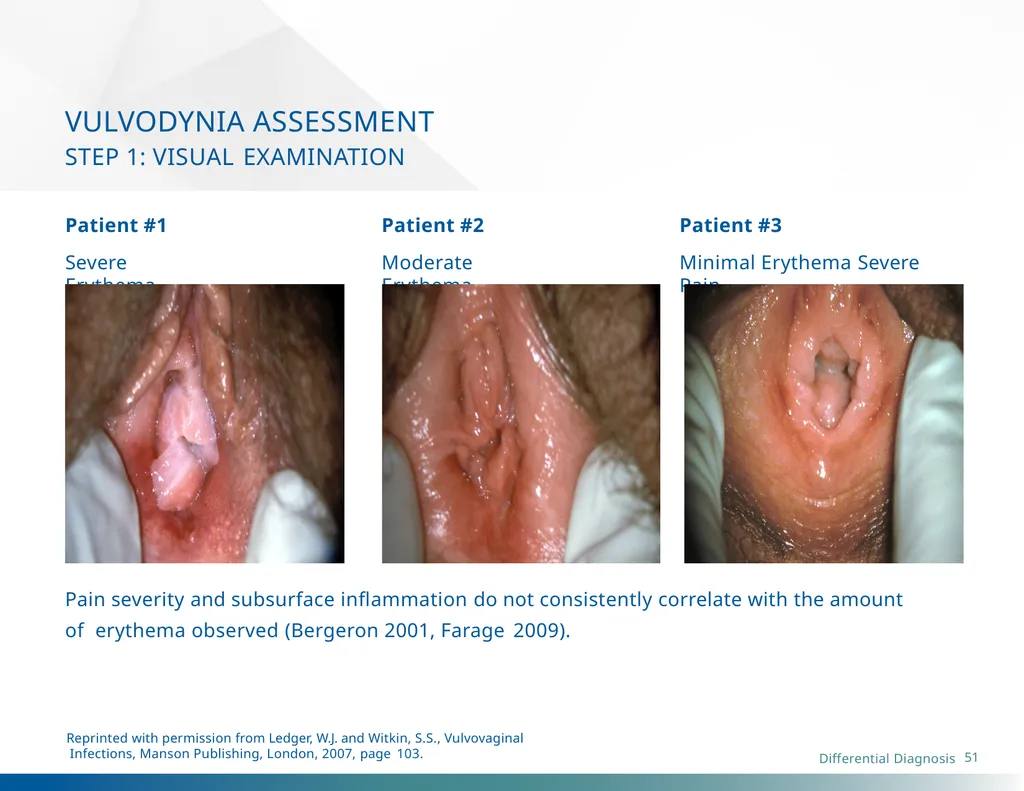
STEP 1: VISUAL EXAMINATION Patient #1
Severe Erythema Patient #2
Moderate Erythema Patient #3
Minimal Erythema Severe Pain Pain severity and subsurface inflammation do not consistently correlate with the amount of erythema observed (Bergeron 2001, Farage 2009). Reprinted with permission from Ledger, W.J. and Witkin, S.S., Vulvovaginal Infections, Manson Publishing, London, 2007, page 103. 51 Differential Diagnosis<br>
STEP 1: VISUAL EXAMINATION Patient #1
Severe Erythema Patient #2
Moderate Erythema Patient #3
Minimal Erythema Severe Pain Pain severity and subsurface inflammation do not consistently correlate with the amount of erythema observed (Bergeron 2001, Farage 2009). Reprinted with permission from Ledger, W.J. and Witkin, S.S., Vulvovaginal Infections, Manson Publishing, London, 2007, page 103. 51 Differential Diagnosis<br>
52
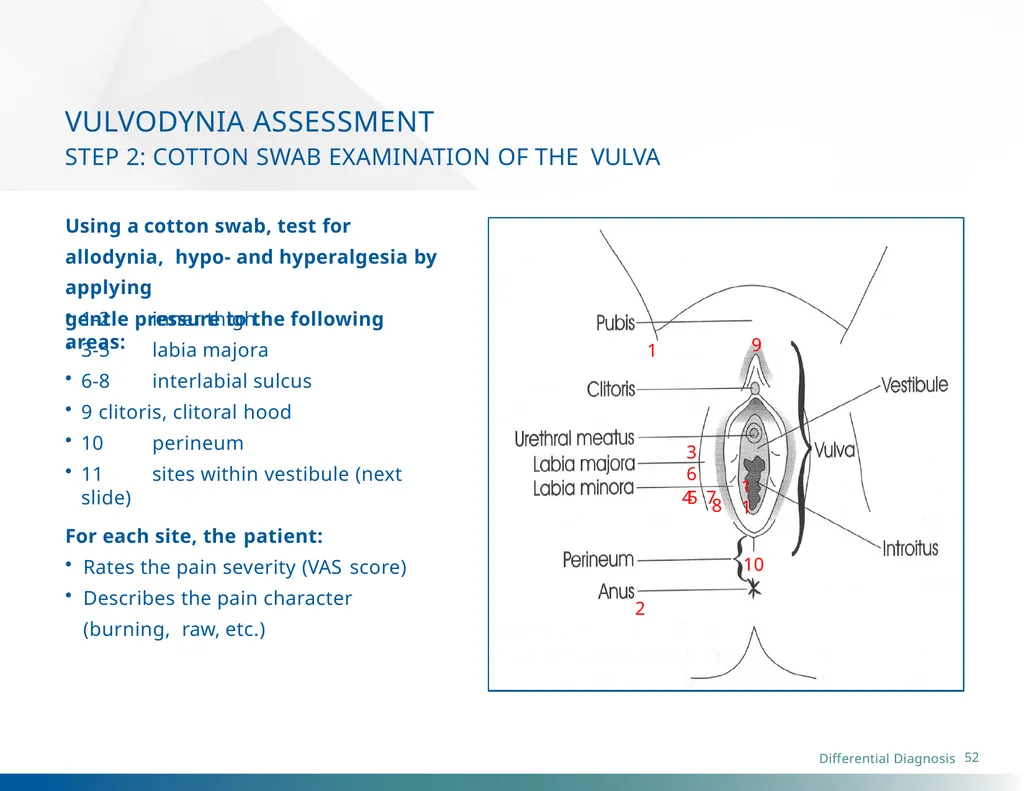
Using a cotton swab, test for allodynia, hypo- and hyperalgesia by applying
gentle pressure to the following areas: 1-2 inner thigh
3-5 labia majora
6-8 interlabial sulcus
9 clitoris, clitoral hood
10 perineum
11 sites within vestibule (next slide) For each site, the patient:
Rates the pain severity (VAS score)
Describes the pain character (burning, raw, etc.) VULVODYNIA ASSESSMENT
STEP 2: COTTON SWAB EXAMINATION OF THE VULVA 1 2 5 3 6
4 7 8 9 10 11 52 Differential Diagnosis<br>
gentle pressure to the following areas: 1-2 inner thigh
3-5 labia majora
6-8 interlabial sulcus
9 clitoris, clitoral hood
10 perineum
11 sites within vestibule (next slide) For each site, the patient:
Rates the pain severity (VAS score)
Describes the pain character (burning, raw, etc.) VULVODYNIA ASSESSMENT
STEP 2: COTTON SWAB EXAMINATION OF THE VULVA 1 2 5 3 6
4 7 8 9 10 11 52 Differential Diagnosis<br>
53
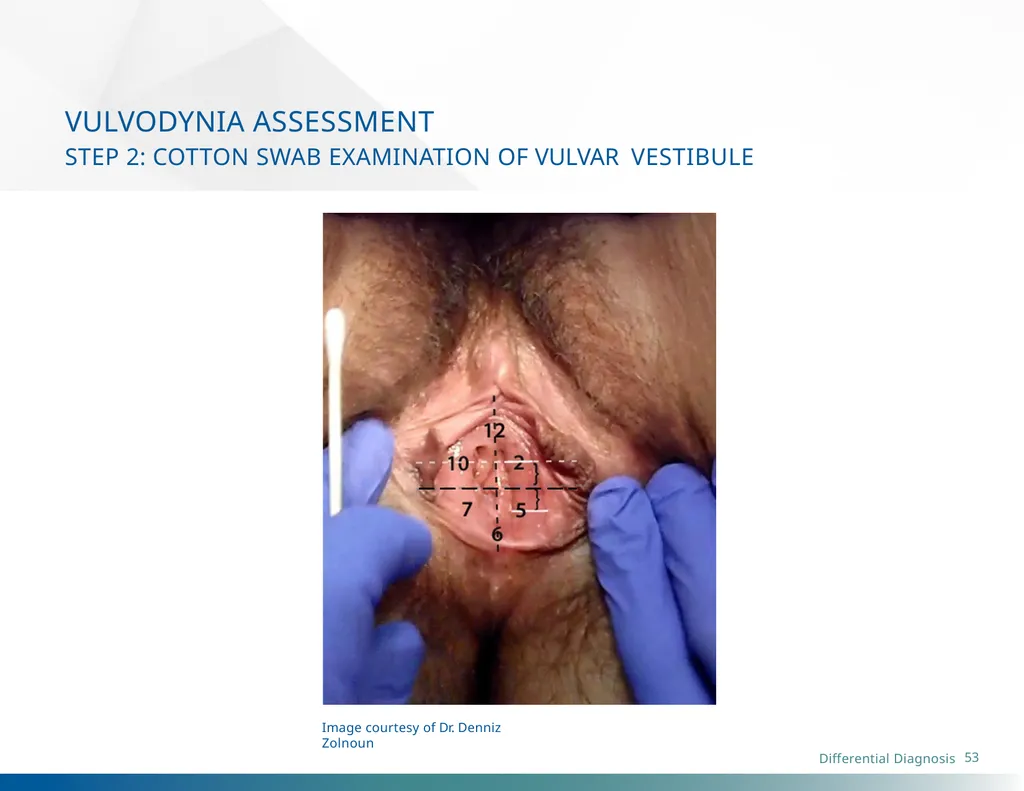
VULVODYNIA ASSESSMENT
STEP 2: COTTON SWAB EXAMINATION OF VULVAR VESTIBULE Image courtesy of Dr. Denniz Zolnoun 53 Differential Diagnosis<br>
STEP 2: COTTON SWAB EXAMINATION OF VULVAR VESTIBULE Image courtesy of Dr. Denniz Zolnoun 53 Differential Diagnosis<br>
54
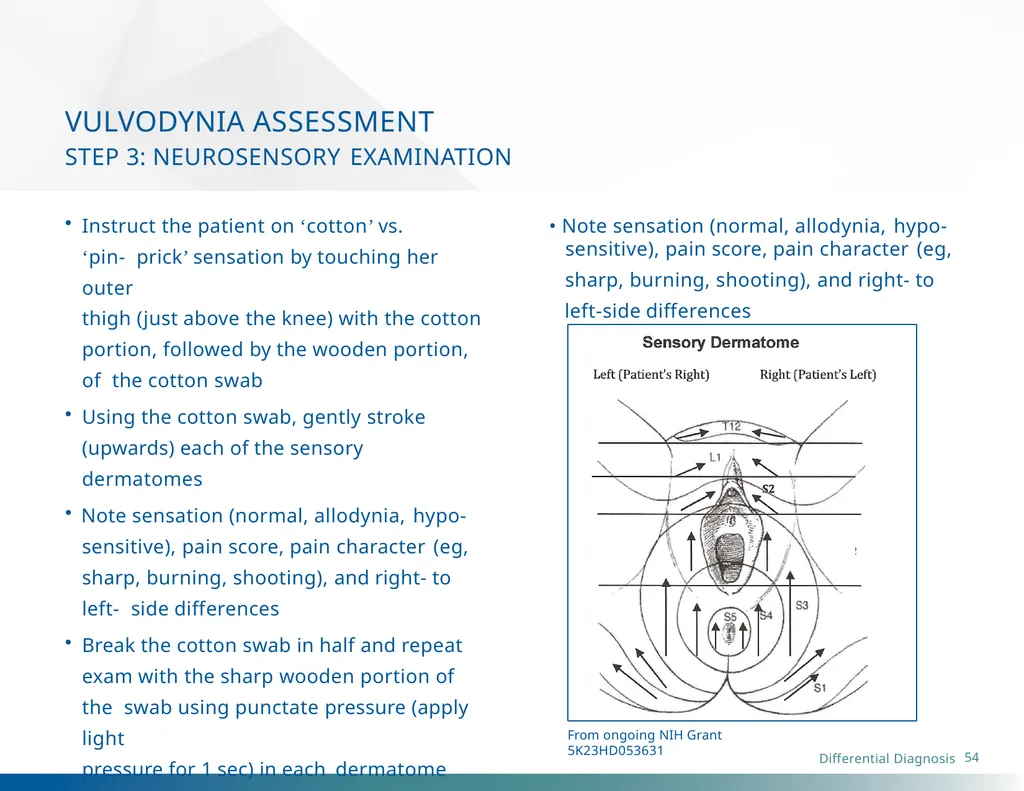
Instruct the patient on ‘cotton’ vs. ‘pin- prick’ sensation by touching her outer
thigh (just above the knee) with the cotton portion, followed by the wooden portion, of the cotton swab
Using the cotton swab, gently stroke (upwards) each of the sensory dermatomes
Note sensation (normal, allodynia, hypo-
sensitive), pain score, pain character (eg,
sharp, burning, shooting), and right- to left- side differences
Break the cotton swab in half and repeat exam with the sharp wooden portion of the swab using punctate pressure (apply light
pressure for 1 sec) in each dermatome • Note sensation (normal, allodynia, hypo-
sensitive), pain score, pain character (eg,
sharp, burning, shooting), and right- to left-side differences VULVODYNIA ASSESSMENT
STEP 3: NEUROSENSORY EXAMINATION From ongoing NIH Grant 5K23HD053631 54 Differential Diagnosis<br>
thigh (just above the knee) with the cotton portion, followed by the wooden portion, of the cotton swab
Using the cotton swab, gently stroke (upwards) each of the sensory dermatomes
Note sensation (normal, allodynia, hypo-
sensitive), pain score, pain character (eg,
sharp, burning, shooting), and right- to left- side differences
Break the cotton swab in half and repeat exam with the sharp wooden portion of the swab using punctate pressure (apply light
pressure for 1 sec) in each dermatome • Note sensation (normal, allodynia, hypo-
sensitive), pain score, pain character (eg,
sharp, burning, shooting), and right- to left-side differences VULVODYNIA ASSESSMENT
STEP 3: NEUROSENSORY EXAMINATION From ongoing NIH Grant 5K23HD053631 54 Differential Diagnosis<br>
55
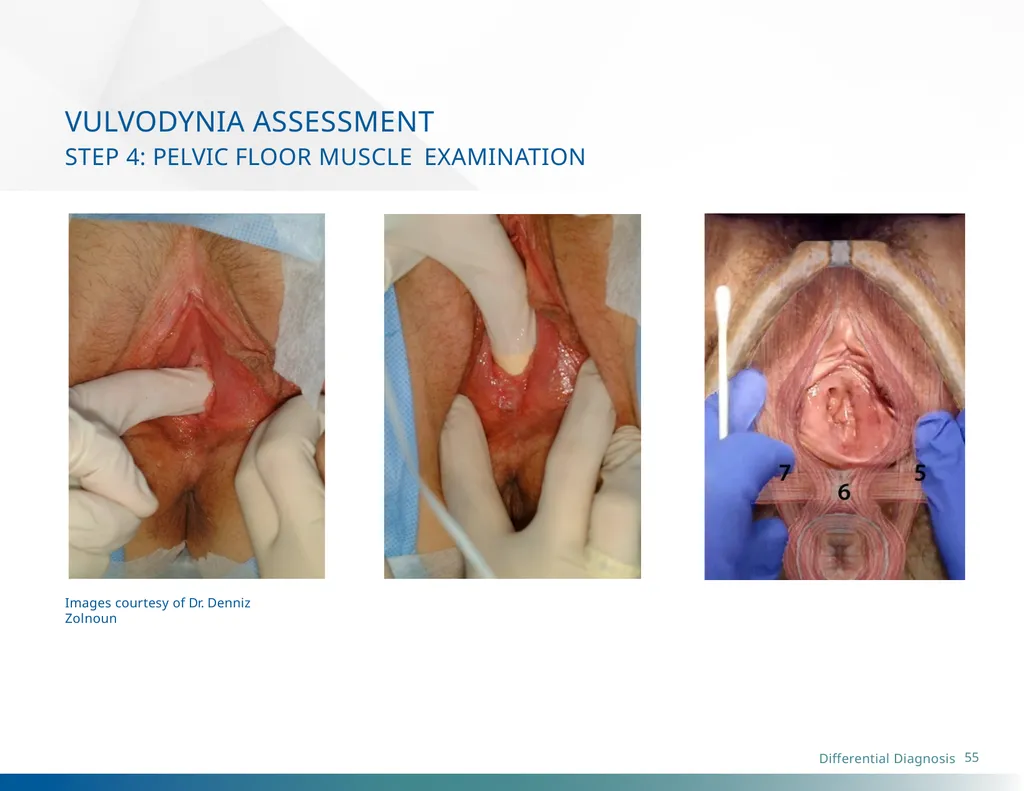
VULVODYNIA ASSESSMENT
STEP 4: PELVIC FLOOR MUSCLE EXAMINATION Images courtesy of Dr. Denniz Zolnoun 55 Differential Diagnosis<br>
STEP 4: PELVIC FLOOR MUSCLE EXAMINATION Images courtesy of Dr. Denniz Zolnoun 55 Differential Diagnosis<br>
56
Comorbid pain syndromes are also common, including:
Interstitial Cystitis | Irritable Bowel Syndrome | Endometriosis
Orofacial Pain (TMJ) | Chronic Headache (Migraine, Tension Type)
Fibromyalgia | Chronic Fatigue Syndrome 56 Differential Diagnosis Assessment of comorbid disorders is important in selecting therapies that target all factors contributing to a woman’s current pain state, including:
Pain (location(s), intensity & interference)
Emotional Functioning
Sleep Interference (both falling asleep & staying asleep)
Physical Functioning
Sexual Functioning VULVODYNIA ASSESSMENT
STEP 5: EVALUATION OF PAIN COMORBIDITY & CONTRIBUTING FACTORS See Comorbidity References. As a consequence of living with a poorly understood, under-recognized genital pain disorder, women commonly report emotional distress and sexual impairment.<br>
Interstitial Cystitis | Irritable Bowel Syndrome | Endometriosis
Orofacial Pain (TMJ) | Chronic Headache (Migraine, Tension Type)
Fibromyalgia | Chronic Fatigue Syndrome 56 Differential Diagnosis Assessment of comorbid disorders is important in selecting therapies that target all factors contributing to a woman’s current pain state, including:
Pain (location(s), intensity & interference)
Emotional Functioning
Sleep Interference (both falling asleep & staying asleep)
Physical Functioning
Sexual Functioning VULVODYNIA ASSESSMENT
STEP 5: EVALUATION OF PAIN COMORBIDITY & CONTRIBUTING FACTORS See Comorbidity References. As a consequence of living with a poorly understood, under-recognized genital pain disorder, women commonly report emotional distress and sexual impairment.<br>
57
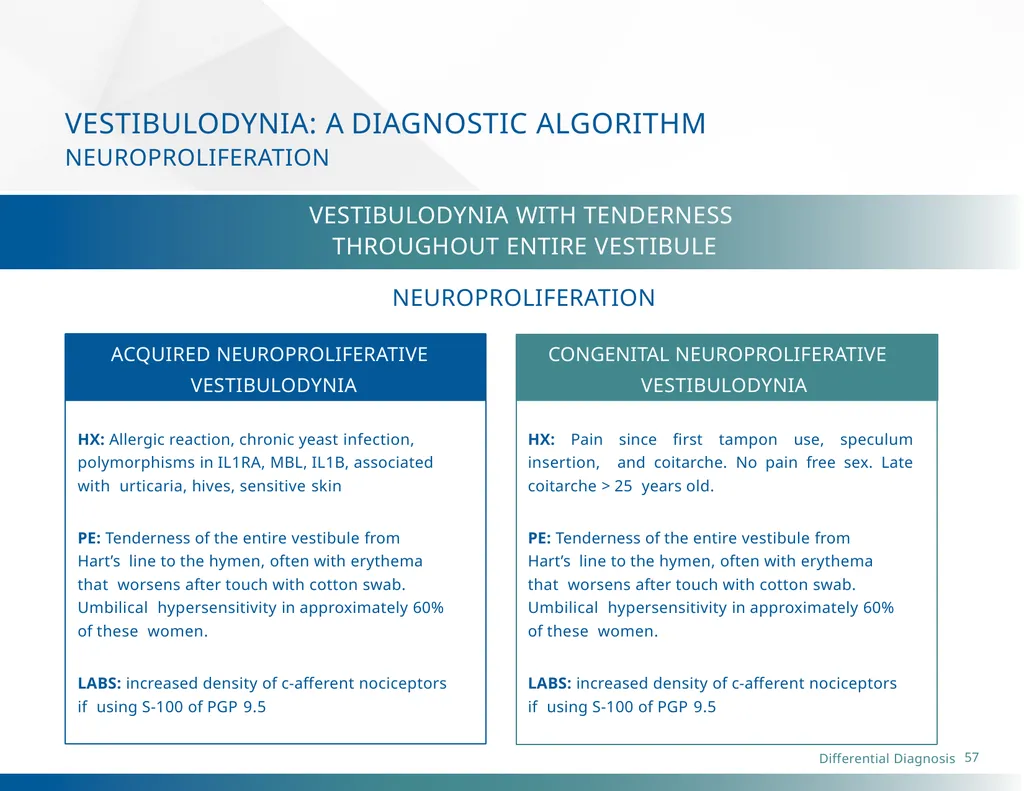
VESTIBULODYNIA: A DIAGNOSTIC ALGORITHM NEUROPROLIFERATION VESTIBULODYNIA WITH TENDERNESS THROUGHOUT ENTIRE VESTIBULE
NEUROPROLIFERATION CONGENITAL NEUROPROLIFERATIVE VESTIBULODYNIA HX: Pain since first tampon use, speculum insertion, and coitarche. No pain free sex. Late coitarche > 25 years old. PE: Tenderness of the entire vestibule from Hart’s line to the hymen, often with erythema that worsens after touch with cotton swab. Umbilical hypersensitivity in approximately 60% of these women. LABS: increased density of c-afferent nociceptors if using S-100 of PGP 9.5 ACQUIRED NEUROPROLIFERATIVE VESTIBULODYNIA HX: Allergic reaction, chronic yeast infection, polymorphisms in IL1RA, MBL, IL1B, associated with urticaria, hives, sensitive skin PE: Tenderness of the entire vestibule from Hart’s line to the hymen, often with erythema that worsens after touch with cotton swab. Umbilical hypersensitivity in approximately 60% of these women. LABS: increased density of c-afferent nociceptors if using S-100 of PGP 9.5 57 Differential Diagnosis<br>
NEUROPROLIFERATION CONGENITAL NEUROPROLIFERATIVE VESTIBULODYNIA HX: Pain since first tampon use, speculum insertion, and coitarche. No pain free sex. Late coitarche > 25 years old. PE: Tenderness of the entire vestibule from Hart’s line to the hymen, often with erythema that worsens after touch with cotton swab. Umbilical hypersensitivity in approximately 60% of these women. LABS: increased density of c-afferent nociceptors if using S-100 of PGP 9.5 ACQUIRED NEUROPROLIFERATIVE VESTIBULODYNIA HX: Allergic reaction, chronic yeast infection, polymorphisms in IL1RA, MBL, IL1B, associated with urticaria, hives, sensitive skin PE: Tenderness of the entire vestibule from Hart’s line to the hymen, often with erythema that worsens after touch with cotton swab. Umbilical hypersensitivity in approximately 60% of these women. LABS: increased density of c-afferent nociceptors if using S-100 of PGP 9.5 57 Differential Diagnosis<br>
58
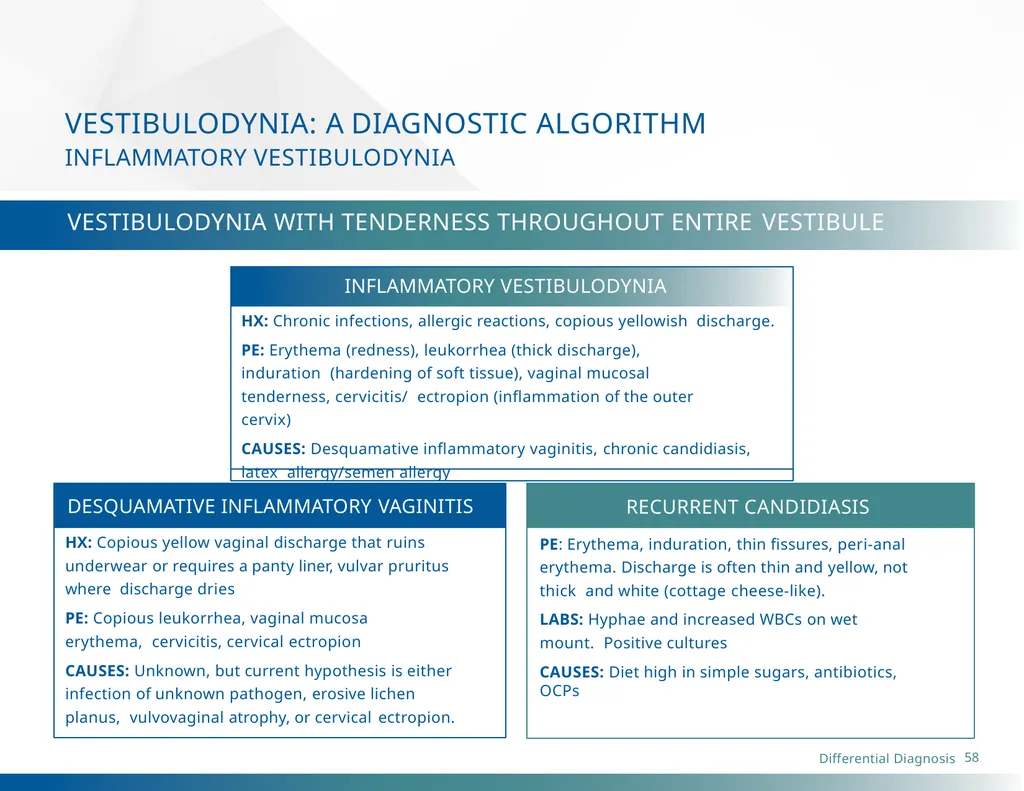
VESTIBULODYNIA: A DIAGNOSTIC ALGORITHM INFLAMMATORY VESTIBULODYNIA VESTIBULODYNIA WITH TENDERNESS THROUGHOUT ENTIRE VESTIBULE DESQUAMATIVE INFLAMMATORY VAGINITIS HX: Copious yellow vaginal discharge that ruins underwear or requires a panty liner, vulvar pruritus where discharge dries
PE: Copious leukorrhea, vaginal mucosa erythema, cervicitis, cervical ectropion
CAUSES: Unknown, but current hypothesis is either infection of unknown pathogen, erosive lichen planus, vulvovaginal atrophy, or cervical ectropion. RECURRENT CANDIDIASIS PE: Erythema, induration, thin fissures, peri-anal erythema. Discharge is often thin and yellow, not thick and white (cottage cheese-like).
LABS: Hyphae and increased WBCs on wet mount. Positive cultures
CAUSES: Diet high in simple sugars, antibiotics, OCPs INFLAMMATORY VESTIBULODYNIA
HX: Chronic infections, allergic reactions, copious yellowish discharge.
PE: Erythema (redness), leukorrhea (thick discharge), induration (hardening of soft tissue), vaginal mucosal tenderness, cervicitis/ ectropion (inflammation of the outer cervix)
CAUSES: Desquamative inflammatory vaginitis, chronic candidiasis, latex allergy/semen allergy 58 Differential Diagnosis<br>
PE: Copious leukorrhea, vaginal mucosa erythema, cervicitis, cervical ectropion
CAUSES: Unknown, but current hypothesis is either infection of unknown pathogen, erosive lichen planus, vulvovaginal atrophy, or cervical ectropion. RECURRENT CANDIDIASIS PE: Erythema, induration, thin fissures, peri-anal erythema. Discharge is often thin and yellow, not thick and white (cottage cheese-like).
LABS: Hyphae and increased WBCs on wet mount. Positive cultures
CAUSES: Diet high in simple sugars, antibiotics, OCPs INFLAMMATORY VESTIBULODYNIA
HX: Chronic infections, allergic reactions, copious yellowish discharge.
PE: Erythema (redness), leukorrhea (thick discharge), induration (hardening of soft tissue), vaginal mucosal tenderness, cervicitis/ ectropion (inflammation of the outer cervix)
CAUSES: Desquamative inflammatory vaginitis, chronic candidiasis, latex allergy/semen allergy 58 Differential Diagnosis<br>
59
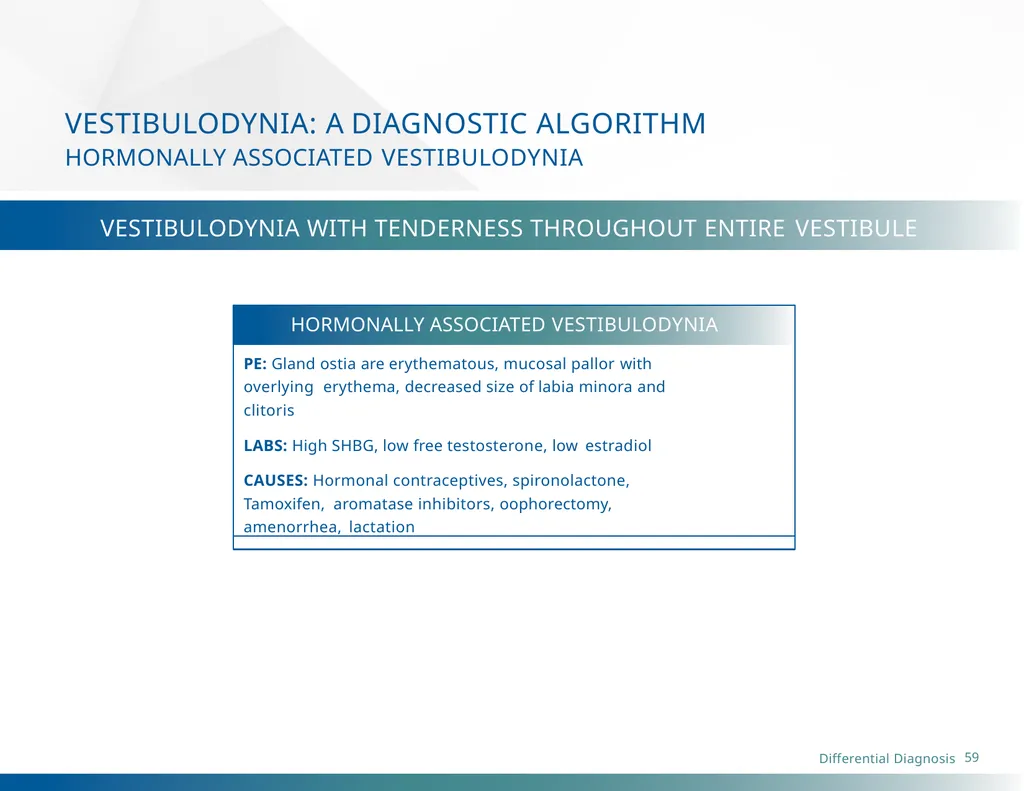
VESTIBULODYNIA: A DIAGNOSTIC ALGORITHM HORMONALLY ASSOCIATED VESTIBULODYNIA VESTIBULODYNIA WITH TENDERNESS THROUGHOUT ENTIRE VESTIBULE HORMONALLY ASSOCIATED VESTIBULODYNIA
PE: Gland ostia are erythematous, mucosal pallor with overlying erythema, decreased size of labia minora and clitoris
LABS: High SHBG, low free testosterone, low estradiol
CAUSES: Hormonal contraceptives, spironolactone, Tamoxifen, aromatase inhibitors, oophorectomy, amenorrhea, lactation 59 Differential Diagnosis<br>
PE: Gland ostia are erythematous, mucosal pallor with overlying erythema, decreased size of labia minora and clitoris
LABS: High SHBG, low free testosterone, low estradiol
CAUSES: Hormonal contraceptives, spironolactone, Tamoxifen, aromatase inhibitors, oophorectomy, amenorrhea, lactation 59 Differential Diagnosis<br>
60
VESTIBULODYNIA: A DIAGNOSTIC ALGORITHM
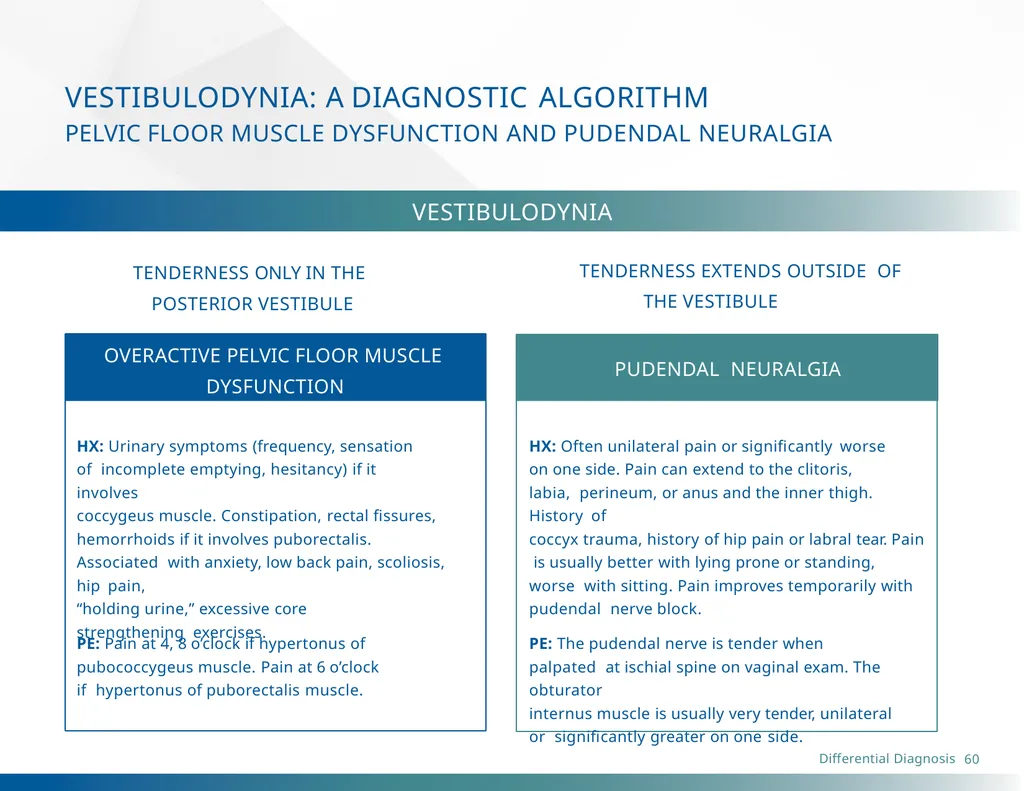
PELVIC FLOOR MUSCLE DYSFUNCTION AND PUDENDAL NEURALGIA TENDERNESS EXTENDS OUTSIDE OF THE VESTIBULE TENDERNESS ONLY IN THE POSTERIOR VESTIBULE VESTIBULODYNIA 60 Differential Diagnosis OVERACTIVE PELVIC FLOOR MUSCLE DYSFUNCTION HX: Urinary symptoms (frequency, sensation of incomplete emptying, hesitancy) if it involves
coccygeus muscle. Constipation, rectal fissures, hemorrhoids if it involves puborectalis. Associated with anxiety, low back pain, scoliosis, hip pain,
“holding urine,” excessive core strengthening exercises. PE: Pain at 4, 8 o’clock if hypertonus of pubococcygeus muscle. Pain at 6 o’clock if hypertonus of puborectalis muscle. PUDENDAL NEURALGIA HX: Often unilateral pain or significantly worse
on one side. Pain can extend to the clitoris, labia, perineum, or anus and the inner thigh. History of
coccyx trauma, history of hip pain or labral tear. Pain is usually better with lying prone or standing, worse with sitting. Pain improves temporarily with pudendal nerve block. PE: The pudendal nerve is tender when palpated at ischial spine on vaginal exam. The obturator
internus muscle is usually very tender, unilateral or significantly greater on one side.<br>
PELVIC FLOOR MUSCLE DYSFUNCTION AND PUDENDAL NEURALGIA TENDERNESS EXTENDS OUTSIDE OF THE VESTIBULE TENDERNESS ONLY IN THE POSTERIOR VESTIBULE VESTIBULODYNIA 60 Differential Diagnosis OVERACTIVE PELVIC FLOOR MUSCLE DYSFUNCTION HX: Urinary symptoms (frequency, sensation of incomplete emptying, hesitancy) if it involves
coccygeus muscle. Constipation, rectal fissures, hemorrhoids if it involves puborectalis. Associated with anxiety, low back pain, scoliosis, hip pain,
“holding urine,” excessive core strengthening exercises. PE: Pain at 4, 8 o’clock if hypertonus of pubococcygeus muscle. Pain at 6 o’clock if hypertonus of puborectalis muscle. PUDENDAL NEURALGIA HX: Often unilateral pain or significantly worse
on one side. Pain can extend to the clitoris, labia, perineum, or anus and the inner thigh. History of
coccyx trauma, history of hip pain or labral tear. Pain is usually better with lying prone or standing, worse with sitting. Pain improves temporarily with pudendal nerve block. PE: The pudendal nerve is tender when palpated at ischial spine on vaginal exam. The obturator
internus muscle is usually very tender, unilateral or significantly greater on one side.<br>
61
Individualized Multidisciplinary Treatment<br>
62
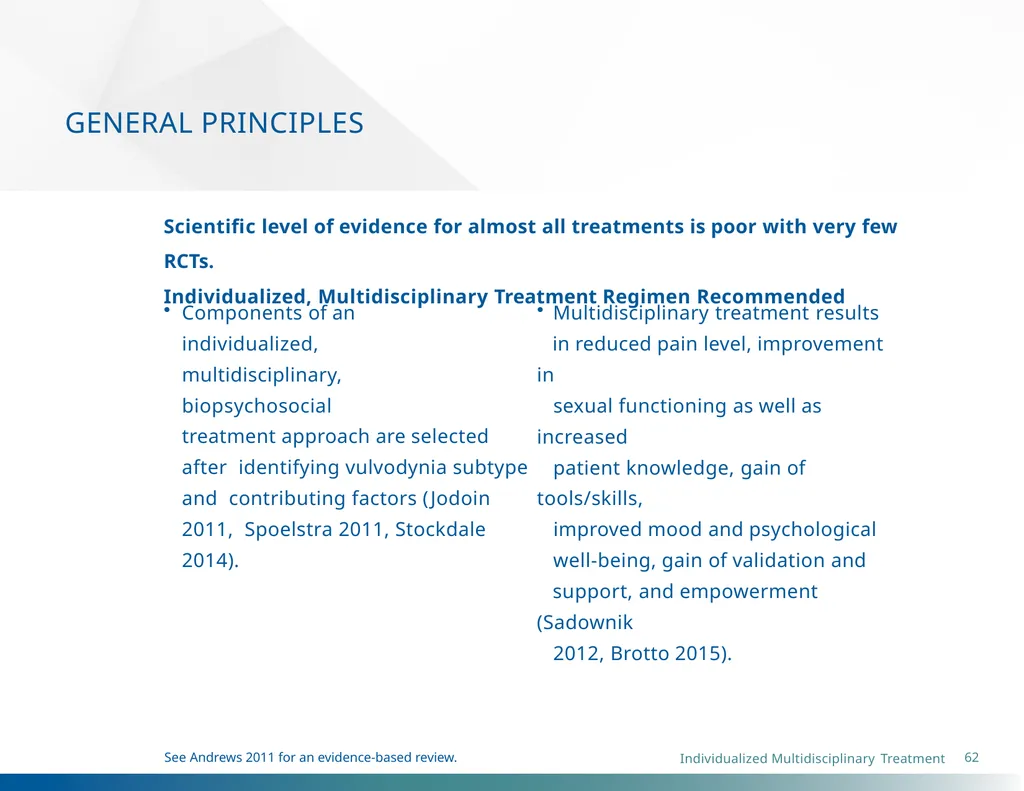
62 Individualized Multidisciplinary Treatment Components of an individualized, multidisciplinary, biopsychosocial
treatment approach are selected after identifying vulvodynia subtype and contributing factors (Jodoin 2011, Spoelstra 2011, Stockdale 2014). Multidisciplinary treatment results
in reduced pain level, improvement in sexual functioning as well as increased patient knowledge, gain of tools/skills, improved mood and psychological well-being, gain of validation and support, and empowerment (Sadownik 2012, Brotto 2015). GENERAL PRINCIPLES Scientific level of evidence for almost all treatments is poor with very few RCTs.
Individualized, Multidisciplinary Treatment Regimen Recommended See Andrews 2011 for an evidence-based review.<br>
treatment approach are selected after identifying vulvodynia subtype and contributing factors (Jodoin 2011, Spoelstra 2011, Stockdale 2014). Multidisciplinary treatment results
in reduced pain level, improvement in sexual functioning as well as increased patient knowledge, gain of tools/skills, improved mood and psychological well-being, gain of validation and support, and empowerment (Sadownik 2012, Brotto 2015). GENERAL PRINCIPLES Scientific level of evidence for almost all treatments is poor with very few RCTs.
Individualized, Multidisciplinary Treatment Regimen Recommended See Andrews 2011 for an evidence-based review.<br>
63
Treatment response varies among
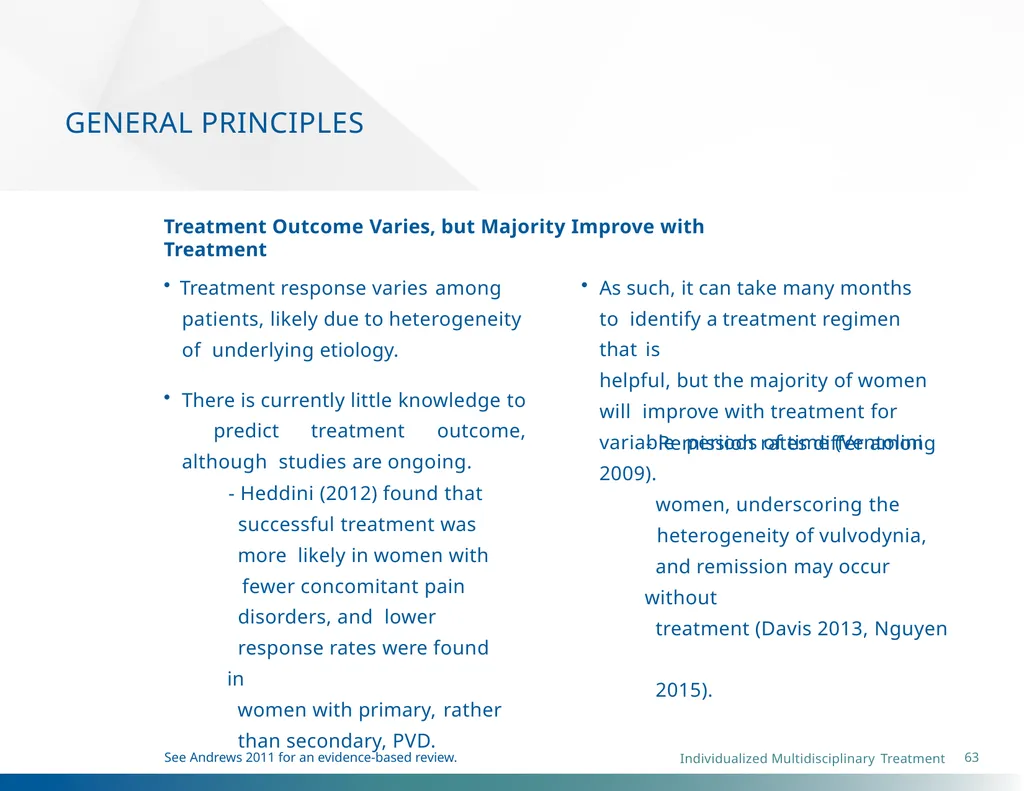
patients, likely due to heterogeneity of underlying etiology. 63 Individualized Multidisciplinary Treatment There is currently little knowledge to predict treatment outcome, although studies are ongoing. - Heddini (2012) found that successful treatment was more likely in women with fewer concomitant pain disorders, and lower response rates were found in women with primary, rather
than secondary, PVD. As such, it can take many months to identify a treatment regimen that is
helpful, but the majority of women will improve with treatment for variable periods of time (Ventolini 2009). - Remission rates differ among women, underscoring the
heterogeneity of vulvodynia, and remission may occur without treatment (Davis 2013, Nguyen 2015). GENERAL PRINCIPLES Treatment Outcome Varies, but Majority Improve with Treatment See Andrews 2011 for an evidence-based review.<br>
patients, likely due to heterogeneity of underlying etiology. 63 Individualized Multidisciplinary Treatment There is currently little knowledge to predict treatment outcome, although studies are ongoing. - Heddini (2012) found that successful treatment was more likely in women with fewer concomitant pain disorders, and lower response rates were found in women with primary, rather
than secondary, PVD. As such, it can take many months to identify a treatment regimen that is
helpful, but the majority of women will improve with treatment for variable periods of time (Ventolini 2009). - Remission rates differ among women, underscoring the
heterogeneity of vulvodynia, and remission may occur without treatment (Davis 2013, Nguyen 2015). GENERAL PRINCIPLES Treatment Outcome Varies, but Majority Improve with Treatment See Andrews 2011 for an evidence-based review.<br>
64
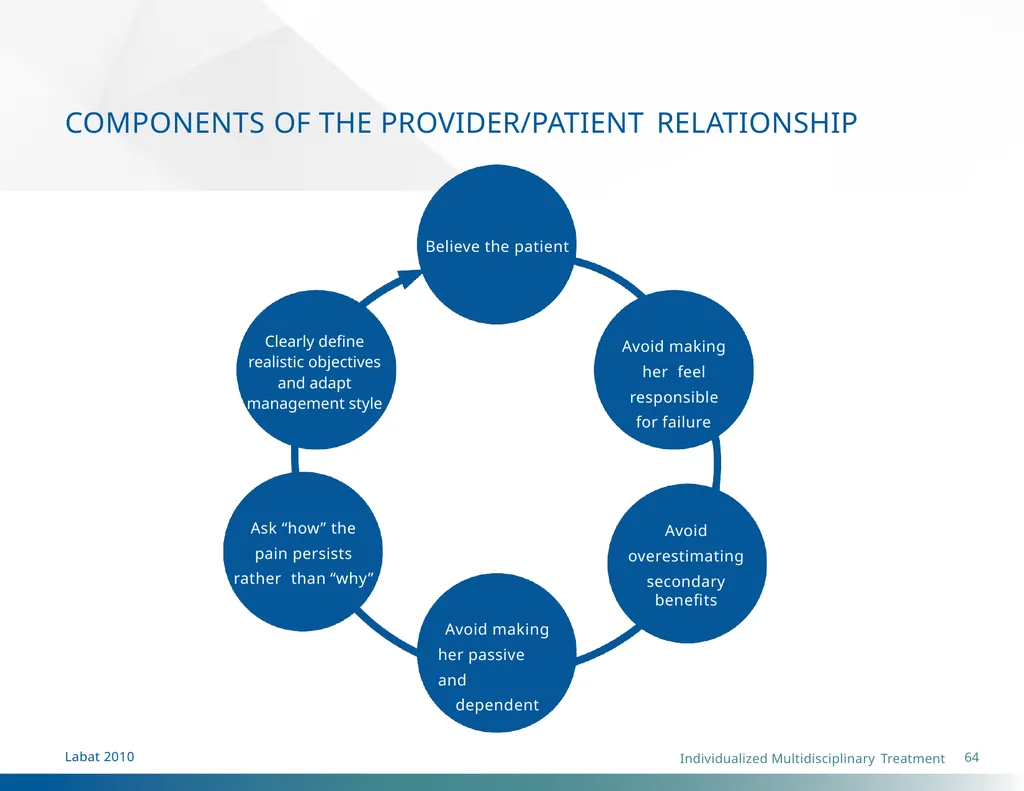
COMPONENTS OF THE PROVIDER/PATIENT RELATIONSHIP Avoid making her passive and
dependent 64 Individualized Multidisciplinary Treatment Avoid making her feel responsible
for failure Believe the patient Avoid
overestimating
secondary benefits Ask “how” the
pain persists rather than “why” Clearly define realistic objectives and adapt management style Labat 2010<br>
dependent 64 Individualized Multidisciplinary Treatment Avoid making her feel responsible
for failure Believe the patient Avoid
overestimating
secondary benefits Ask “how” the
pain persists rather than “why” Clearly define realistic objectives and adapt management style Labat 2010<br>
65
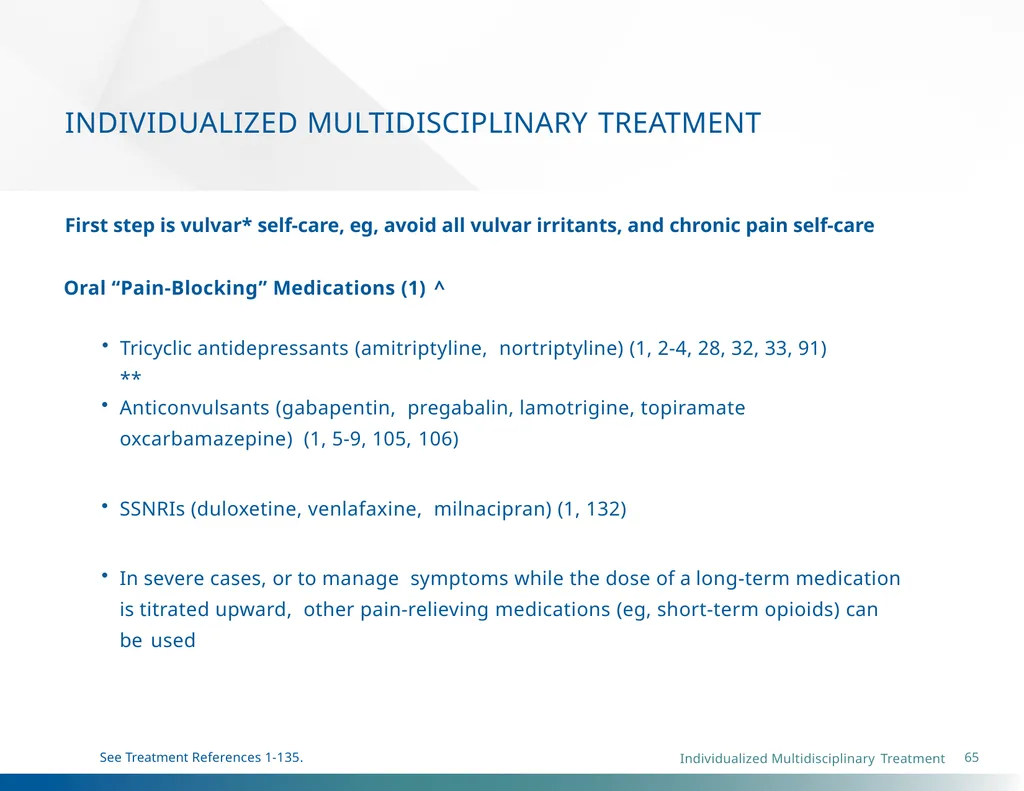
Oral “Pain-Blocking” Medications (1) ^ 65 Individualized Multidisciplinary Treatment Tricyclic antidepressants (amitriptyline, nortriptyline) (1, 2-4, 28, 32, 33, 91) ** Anticonvulsants (gabapentin, pregabalin, lamotrigine, topiramate
oxcarbamazepine) (1, 5-9, 105, 106) SSNRIs (duloxetine, venlafaxine, milnacipran) (1, 132) In severe cases, or to manage symptoms while the dose of a long-term medication is titrated upward, other pain-relieving medications (eg, short-term opioids) can be used INDIVIDUALIZED MULTIDISCIPLINARY TREATMENT See Treatment References 1-135. First step is vulvar* self-care, eg, avoid all vulvar irritants, and chronic pain self-care<br>
oxcarbamazepine) (1, 5-9, 105, 106) SSNRIs (duloxetine, venlafaxine, milnacipran) (1, 132) In severe cases, or to manage symptoms while the dose of a long-term medication is titrated upward, other pain-relieving medications (eg, short-term opioids) can be used INDIVIDUALIZED MULTIDISCIPLINARY TREATMENT See Treatment References 1-135. First step is vulvar* self-care, eg, avoid all vulvar irritants, and chronic pain self-care<br>
66
Topical Formulations
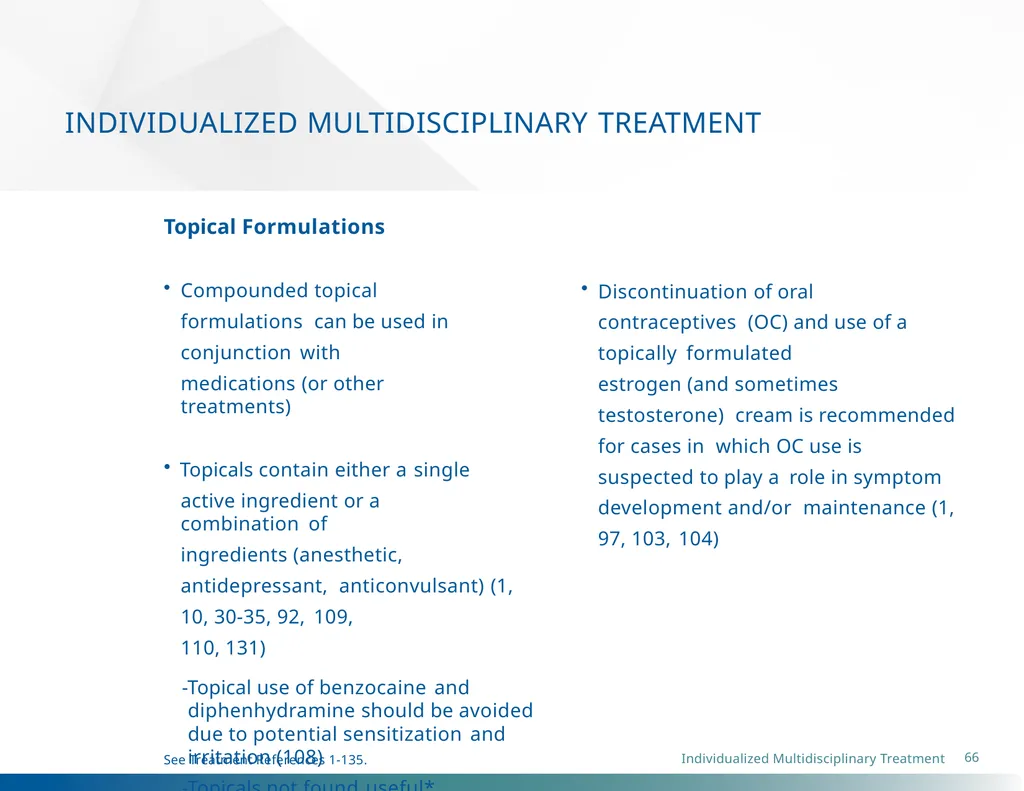
Compounded topical formulations can be used in conjunction with
medications (or other treatments)
Topicals contain either a single
active ingredient or a combination of
ingredients (anesthetic, antidepressant, anticonvulsant) (1, 10, 30-35, 92, 109,
110, 131)
-Topical use of benzocaine and
diphenhydramine should be avoided due to potential sensitization and irritation (108)
-Topicals not found useful* See Treatment References 1-135. 66 Individualized Multidisciplinary Treatment Discontinuation of oral contraceptives (OC) and use of a topically formulated
estrogen (and sometimes testosterone) cream is recommended for cases in which OC use is suspected to play a role in symptom development and/or maintenance (1, 97, 103, 104) INDIVIDUALIZED MULTIDISCIPLINARY TREATMENT<br>
Compounded topical formulations can be used in conjunction with
medications (or other treatments)
Topicals contain either a single
active ingredient or a combination of
ingredients (anesthetic, antidepressant, anticonvulsant) (1, 10, 30-35, 92, 109,
110, 131)
-Topical use of benzocaine and
diphenhydramine should be avoided due to potential sensitization and irritation (108)
-Topicals not found useful* See Treatment References 1-135. 66 Individualized Multidisciplinary Treatment Discontinuation of oral contraceptives (OC) and use of a topically formulated
estrogen (and sometimes testosterone) cream is recommended for cases in which OC use is suspected to play a role in symptom development and/or maintenance (1, 97, 103, 104) INDIVIDUALIZED MULTIDISCIPLINARY TREATMENT<br>
67
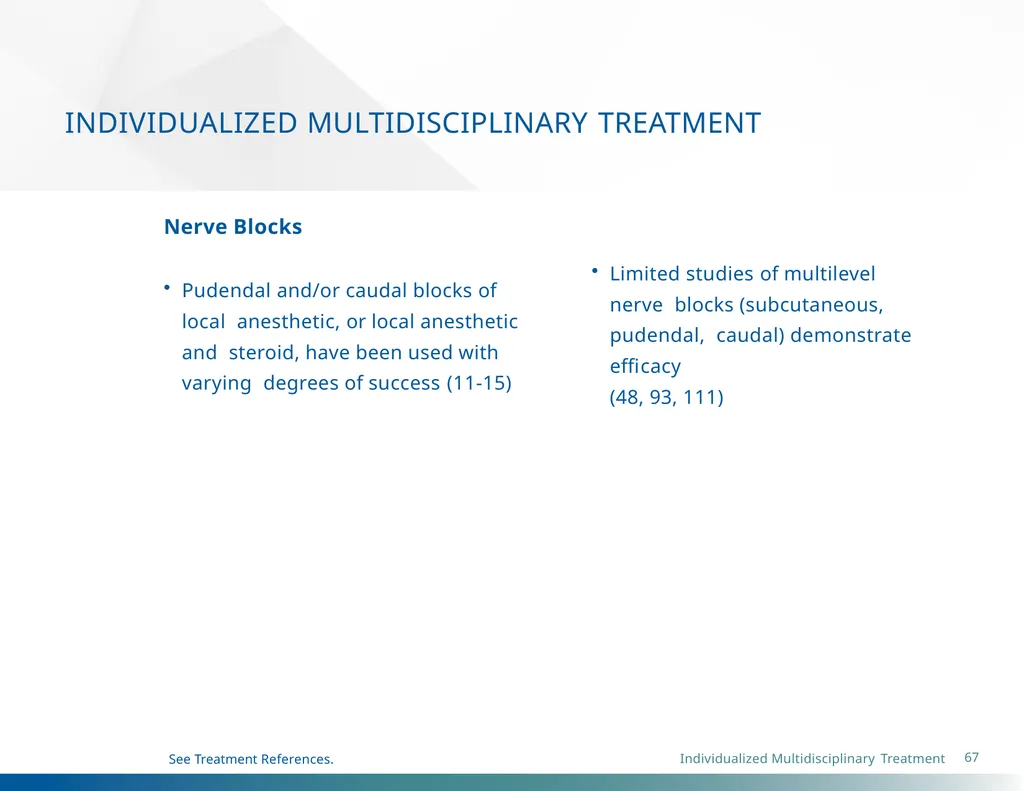
Nerve Blocks
Pudendal and/or caudal blocks of local anesthetic, or local anesthetic and steroid, have been used with varying degrees of success (11-15) See Treatment References. 67 Individualized Multidisciplinary Treatment INDIVIDUALIZED MULTIDISCIPLINARY TREATMENT Limited studies of multilevel nerve blocks (subcutaneous, pudendal, caudal) demonstrate efficacy
(48, 93, 111)<br>
Pudendal and/or caudal blocks of local anesthetic, or local anesthetic and steroid, have been used with varying degrees of success (11-15) See Treatment References. 67 Individualized Multidisciplinary Treatment INDIVIDUALIZED MULTIDISCIPLINARY TREATMENT Limited studies of multilevel nerve blocks (subcutaneous, pudendal, caudal) demonstrate efficacy
(48, 93, 111)<br>
68
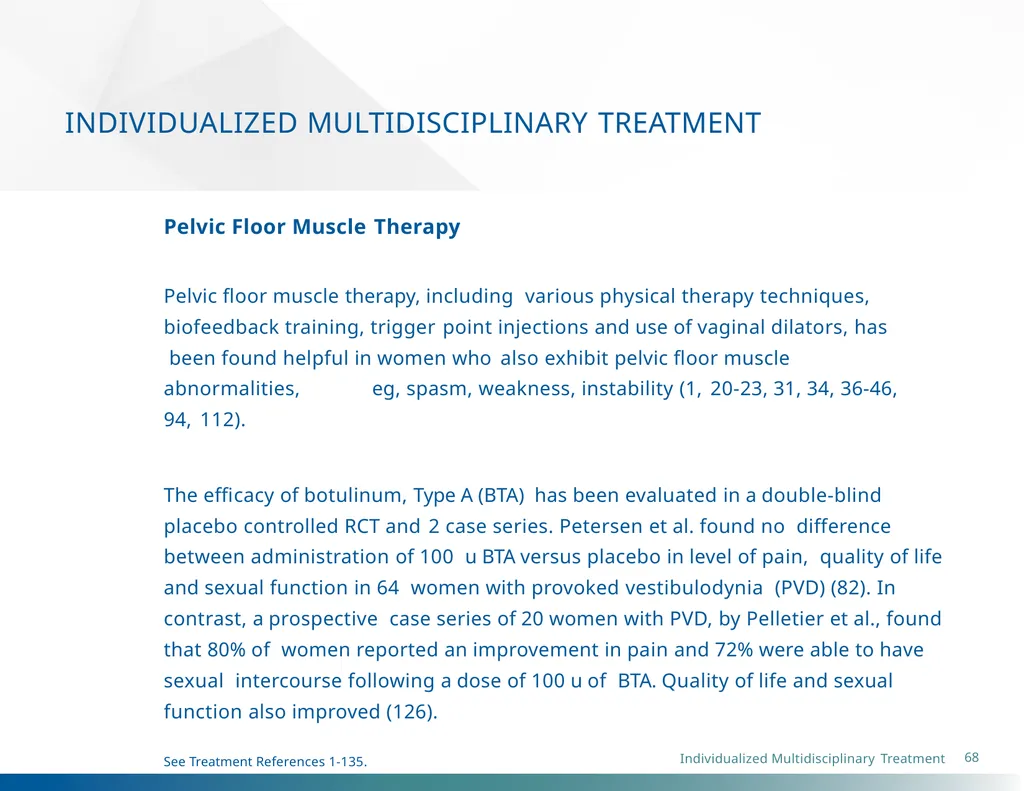
Pelvic Floor Muscle Therapy
Pelvic floor muscle therapy, including various physical therapy techniques, biofeedback training, trigger point injections and use of vaginal dilators, has been found helpful in women who also exhibit pelvic floor muscle abnormalities, eg, spasm, weakness, instability (1, 20-23, 31, 34, 36-46, 94, 112).
The efficacy of botulinum, Type A (BTA) has been evaluated in a double-blind placebo controlled RCT and 2 case series. Petersen et al. found no difference between administration of 100 u BTA versus placebo in level of pain, quality of life and sexual function in 64 women with provoked vestibulodynia (PVD) (82). In contrast, a prospective case series of 20 women with PVD, by Pelletier et al., found that 80% of women reported an improvement in pain and 72% were able to have sexual intercourse following a dose of 100 u of BTA. Quality of life and sexual function also improved (126). See Treatment References 1-135. 68 Individualized Multidisciplinary Treatment INDIVIDUALIZED MULTIDISCIPLINARY TREATMENT<br>
Pelvic floor muscle therapy, including various physical therapy techniques, biofeedback training, trigger point injections and use of vaginal dilators, has been found helpful in women who also exhibit pelvic floor muscle abnormalities, eg, spasm, weakness, instability (1, 20-23, 31, 34, 36-46, 94, 112).
The efficacy of botulinum, Type A (BTA) has been evaluated in a double-blind placebo controlled RCT and 2 case series. Petersen et al. found no difference between administration of 100 u BTA versus placebo in level of pain, quality of life and sexual function in 64 women with provoked vestibulodynia (PVD) (82). In contrast, a prospective case series of 20 women with PVD, by Pelletier et al., found that 80% of women reported an improvement in pain and 72% were able to have sexual intercourse following a dose of 100 u of BTA. Quality of life and sexual function also improved (126). See Treatment References 1-135. 68 Individualized Multidisciplinary Treatment INDIVIDUALIZED MULTIDISCIPLINARY TREATMENT<br>
69
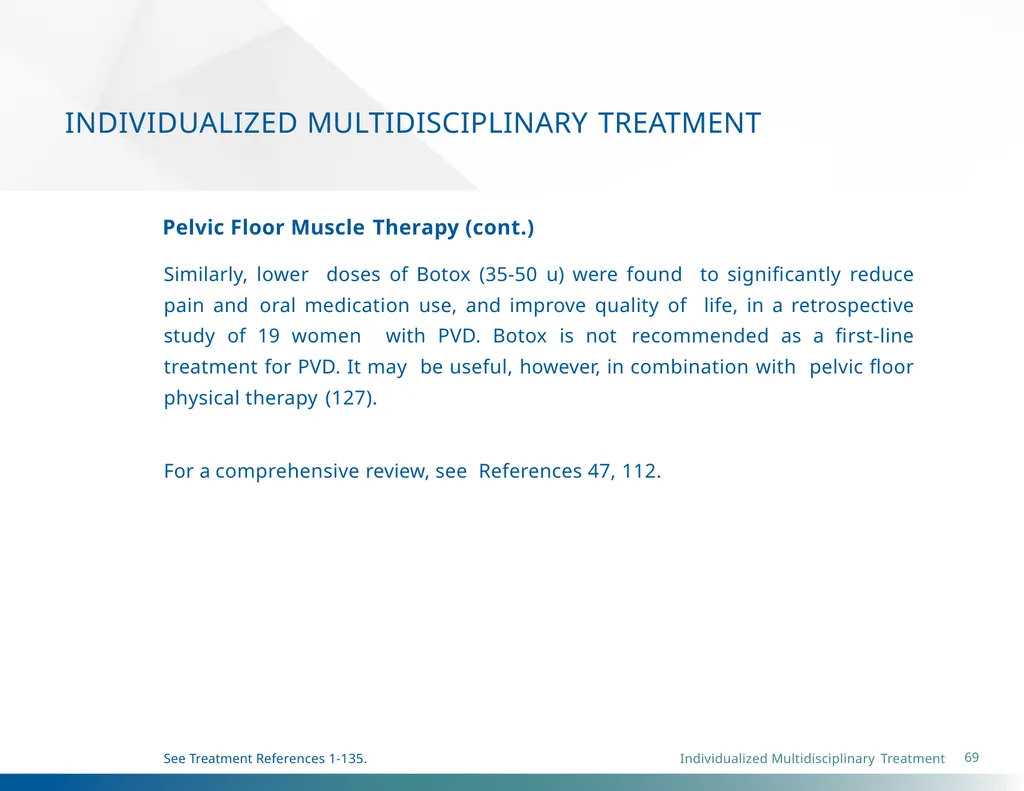
INDIVIDUALIZED MULTIDISCIPLINARY TREATMENT See Treatment References 1-135. 69 Individualized Multidisciplinary Treatment Pelvic Floor Muscle Therapy (cont.)
Similarly, lower doses of Botox (35-50 u) were found to significantly reduce pain and oral medication use, and improve quality of life, in a retrospective study of 19 women with PVD. Botox is not recommended as a first-line treatment for PVD. It may be useful, however, in combination with pelvic floor physical therapy (127).
For a comprehensive review, see References 47, 112.<br>
Similarly, lower doses of Botox (35-50 u) were found to significantly reduce pain and oral medication use, and improve quality of life, in a retrospective study of 19 women with PVD. Botox is not recommended as a first-line treatment for PVD. It may be useful, however, in combination with pelvic floor physical therapy (127).
For a comprehensive review, see References 47, 112.<br>
70
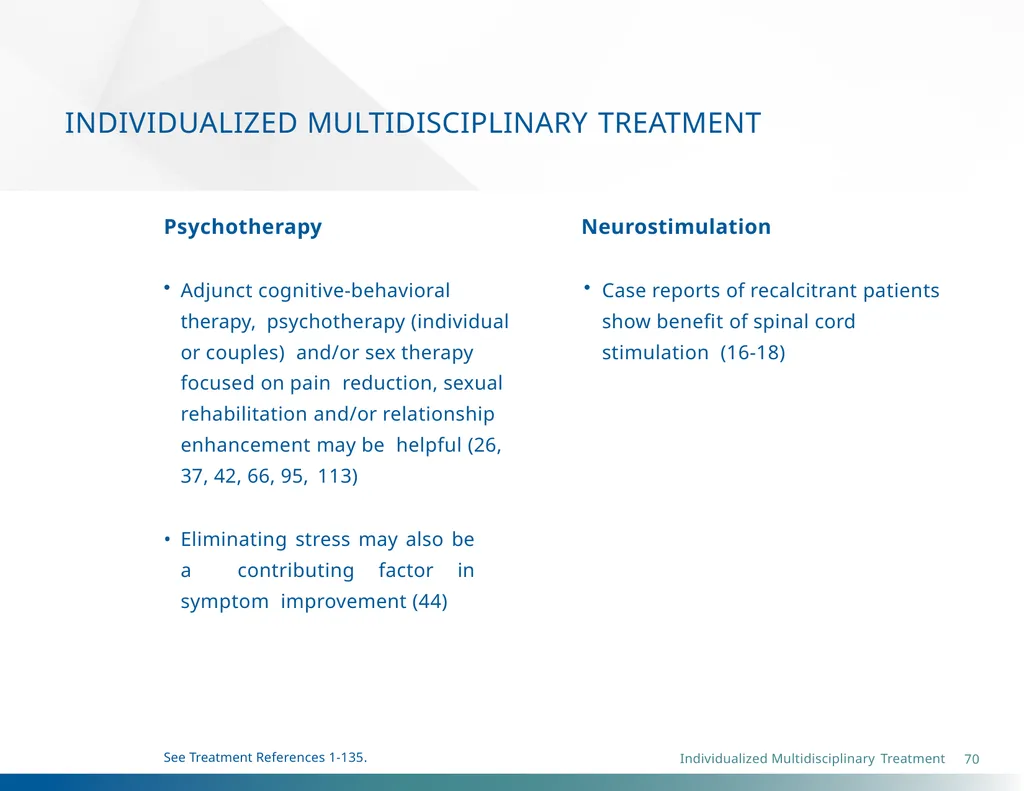
Psychotherapy
Adjunct cognitive-behavioral therapy, psychotherapy (individual or couples) and/or sex therapy focused on pain reduction, sexual rehabilitation and/or relationship enhancement may be helpful (26, 37, 42, 66, 95, 113)
Eliminating stress may also be a contributing factor in symptom improvement (44) See Treatment References 1-135. 70 Individualized Multidisciplinary Treatment Neurostimulation
Case reports of recalcitrant patients show benefit of spinal cord stimulation (16-18) INDIVIDUALIZED MULTIDISCIPLINARY TREATMENT<br>
Adjunct cognitive-behavioral therapy, psychotherapy (individual or couples) and/or sex therapy focused on pain reduction, sexual rehabilitation and/or relationship enhancement may be helpful (26, 37, 42, 66, 95, 113)
Eliminating stress may also be a contributing factor in symptom improvement (44) See Treatment References 1-135. 70 Individualized Multidisciplinary Treatment Neurostimulation
Case reports of recalcitrant patients show benefit of spinal cord stimulation (16-18) INDIVIDUALIZED MULTIDISCIPLINARY TREATMENT<br>
71
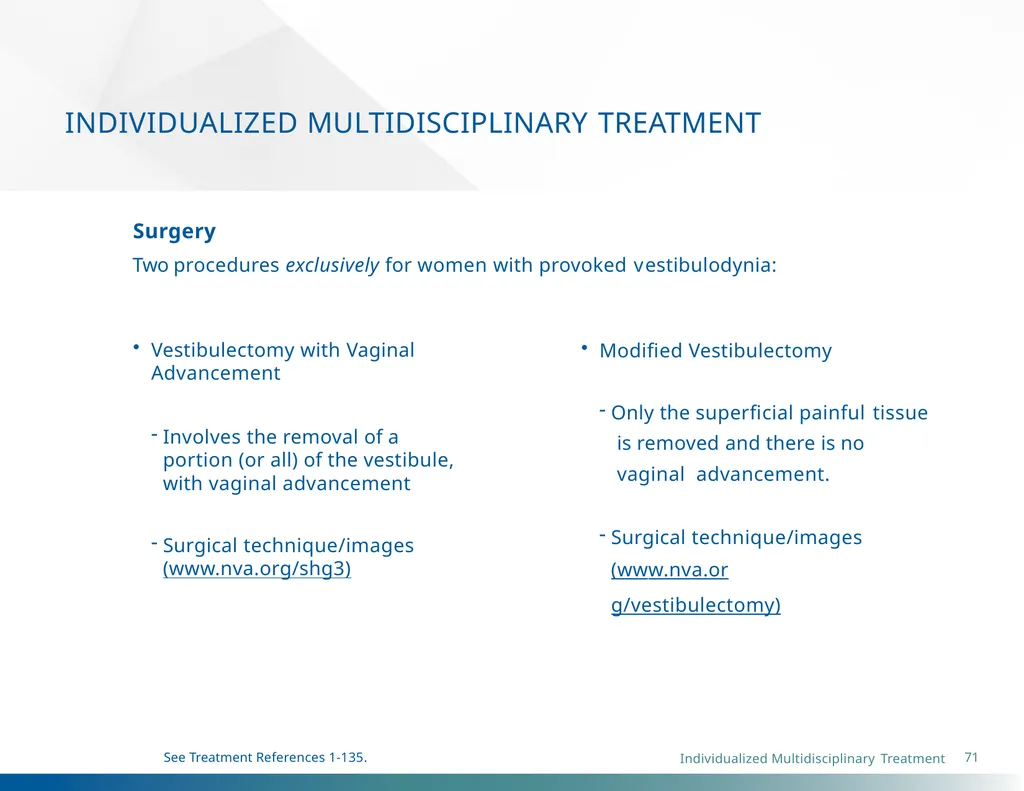
Surgery
Vestibulectomy with Vaginal Advancement
Involves the removal of a portion (or all) of the vestibule, with vaginal advancement
Surgical technique/images (www.nva.org/shg3) 71 Individualized Multidisciplinary Treatment Modified Vestibulectomy
Only the superficial painful tissue
is removed and there is no vaginal advancement.
Surgical technique/images (www.nva.org/vestibulectomy) INDIVIDUALIZED MULTIDISCIPLINARY TREATMENT See Treatment References 1-135. Two procedures exclusively for women with provoked vestibulodynia:<br>
Vestibulectomy with Vaginal Advancement
Involves the removal of a portion (or all) of the vestibule, with vaginal advancement
Surgical technique/images (www.nva.org/shg3) 71 Individualized Multidisciplinary Treatment Modified Vestibulectomy
Only the superficial painful tissue
is removed and there is no vaginal advancement.
Surgical technique/images (www.nva.org/vestibulectomy) INDIVIDUALIZED MULTIDISCIPLINARY TREATMENT See Treatment References 1-135. Two procedures exclusively for women with provoked vestibulodynia:<br>
72
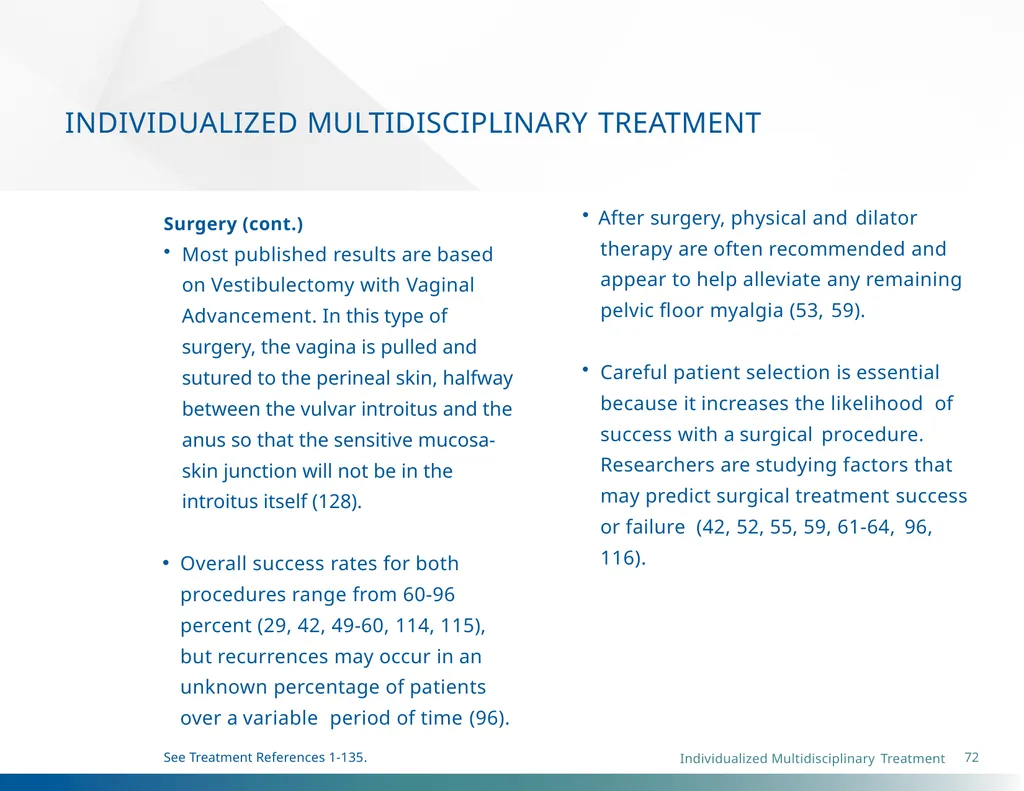
INDIVIDUALIZED MULTIDISCIPLINARY TREATMENT 72 Individualized Multidisciplinary Treatment Surgery (cont.)
Most published results are based on Vestibulectomy with Vaginal Advancement. In this type of surgery, the vagina is pulled and sutured to the perineal skin, halfway between the vulvar introitus and the anus so that the sensitive mucosa-skin junction will not be in the introitus itself (128).
Overall success rates for both procedures range from 60-96 percent (29, 42, 49-60, 114, 115), but recurrences may occur in an unknown percentage of patients over a variable period of time (96). After surgery, physical and dilator
therapy are often recommended and appear to help alleviate any remaining pelvic floor myalgia (53, 59).
Careful patient selection is essential because it increases the likelihood of success with a surgical procedure.
Researchers are studying factors that may predict surgical treatment success or failure (42, 52, 55, 59, 61-64, 96, 116). See Treatment References 1-135.<br>
Most published results are based on Vestibulectomy with Vaginal Advancement. In this type of surgery, the vagina is pulled and sutured to the perineal skin, halfway between the vulvar introitus and the anus so that the sensitive mucosa-skin junction will not be in the introitus itself (128).
Overall success rates for both procedures range from 60-96 percent (29, 42, 49-60, 114, 115), but recurrences may occur in an unknown percentage of patients over a variable period of time (96). After surgery, physical and dilator
therapy are often recommended and appear to help alleviate any remaining pelvic floor myalgia (53, 59).
Careful patient selection is essential because it increases the likelihood of success with a surgical procedure.
Researchers are studying factors that may predict surgical treatment success or failure (42, 52, 55, 59, 61-64, 96, 116). See Treatment References 1-135.<br>
73
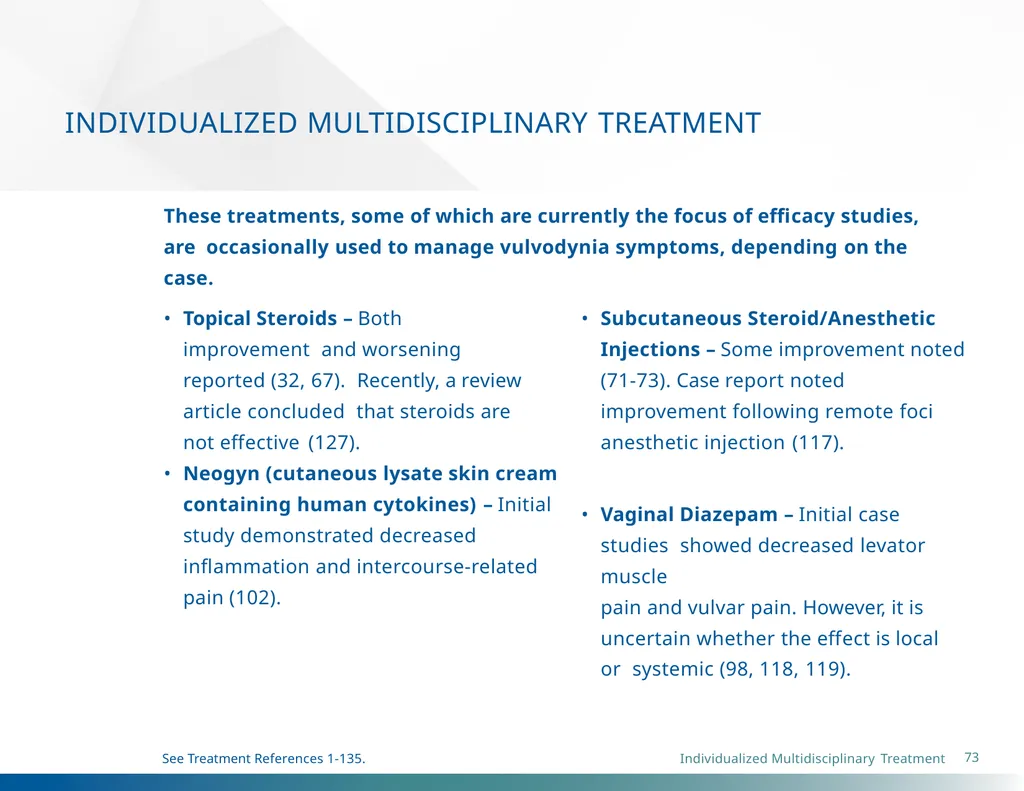
Topical Steroids – Both improvement and worsening reported (32, 67). Recently, a review article concluded that steroids are not effective (127). See Treatment References 1-135. 73 Individualized Multidisciplinary Treatment Neogyn (cutaneous lysate skin cream containing human cytokines) – Initial study demonstrated decreased inflammation and intercourse-related
pain (102). Subcutaneous Steroid/Anesthetic Injections – Some improvement noted (71-73). Case report noted improvement following remote foci anesthetic injection (117). Vaginal Diazepam – Initial case studies showed decreased levator muscle
pain and vulvar pain. However, it is uncertain whether the effect is local or systemic (98, 118, 119). INDIVIDUALIZED MULTIDISCIPLINARY TREATMENT These treatments, some of which are currently the focus of efficacy studies, are occasionally used to manage vulvodynia symptoms, depending on the case.<br>
pain and vulvar pain. However, it is uncertain whether the effect is local or systemic (98, 118, 119). INDIVIDUALIZED MULTIDISCIPLINARY TREATMENT These treatments, some of which are currently the focus of efficacy studies, are occasionally used to manage vulvodynia symptoms, depending on the case.<br>
74
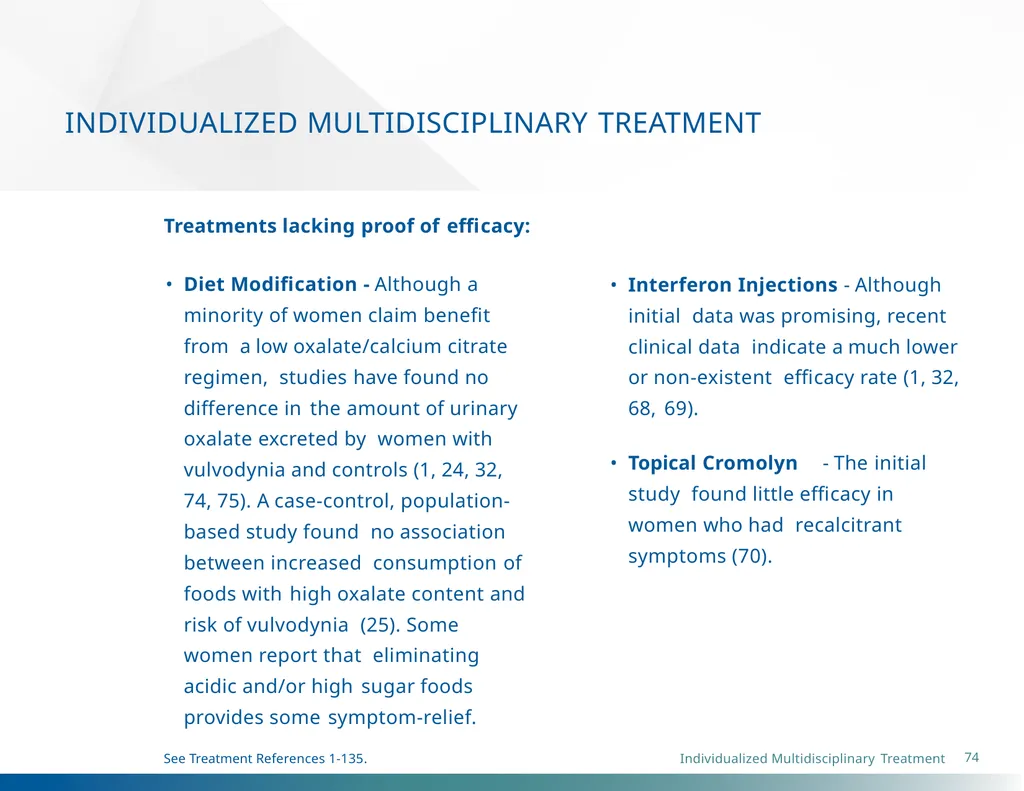
Treatments lacking proof of efficacy: See Treatment References 1-135. 74 Individualized Multidisciplinary Treatment Diet Modification - Although a minority of women claim benefit from a low oxalate/calcium citrate regimen, studies have found no difference in the amount of urinary oxalate excreted by women with vulvodynia and controls (1, 24, 32, 74, 75). A case-control, population-based study found no association between increased consumption of foods with high oxalate content and risk of vulvodynia (25). Some women report that eliminating acidic and/or high sugar foods provides some symptom-relief. INDIVIDUALIZED MULTIDISCIPLINARY TREATMENT Interferon Injections - Although initial data was promising, recent clinical data indicate a much lower or non-existent efficacy rate (1, 32, 68, 69).
Topical Cromolyn - The initial study found little efficacy in women who had recalcitrant symptoms (70).<br>
Topical Cromolyn - The initial study found little efficacy in women who had recalcitrant symptoms (70).<br>
75
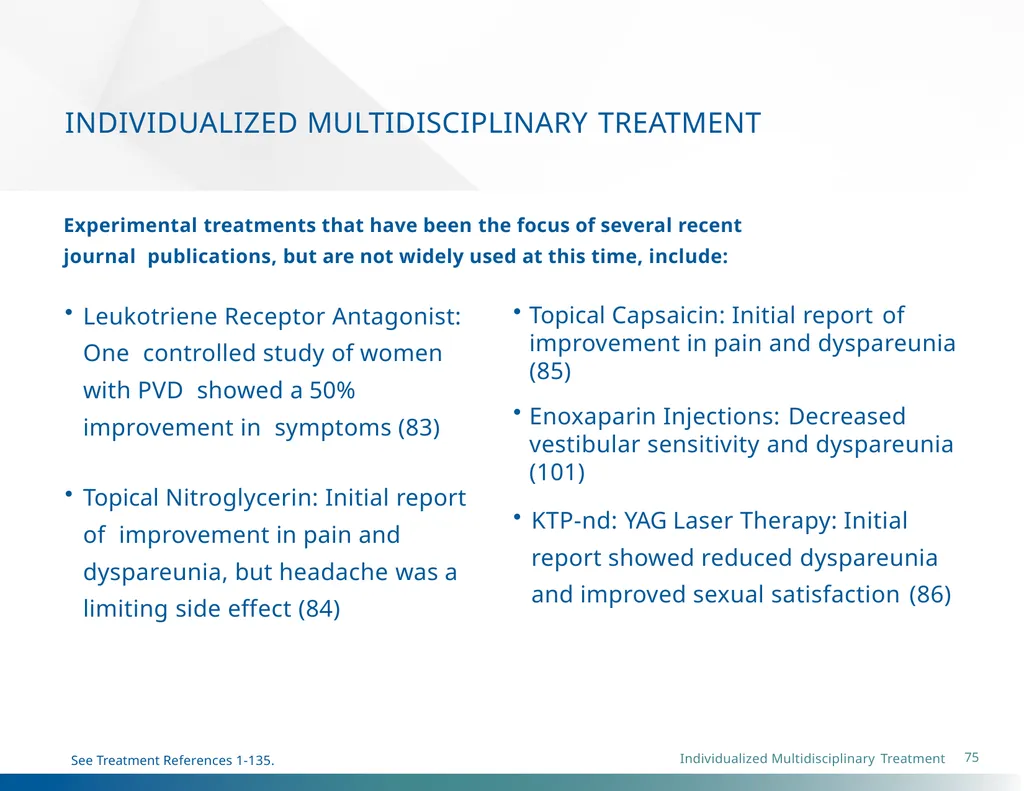
Leukotriene Receptor Antagonist: One controlled study of women with PVD showed a 50% improvement in symptoms (83) See Treatment References 1-135. 75 Individualized Multidisciplinary Treatment Topical Nitroglycerin: Initial report of improvement in pain and dyspareunia, but headache was a limiting side effect (84) Topical Capsaicin: Initial report of improvement in pain and dyspareunia (85) Enoxaparin Injections: Decreased vestibular sensitivity and dyspareunia (101) KTP-nd: YAG Laser Therapy: Initial report showed reduced dyspareunia and improved sexual satisfaction (86) INDIVIDUALIZED MULTIDISCIPLINARY TREATMENT Experimental treatments that have been the focus of several recent journal publications, but are not widely used at this time, include:<br>
76
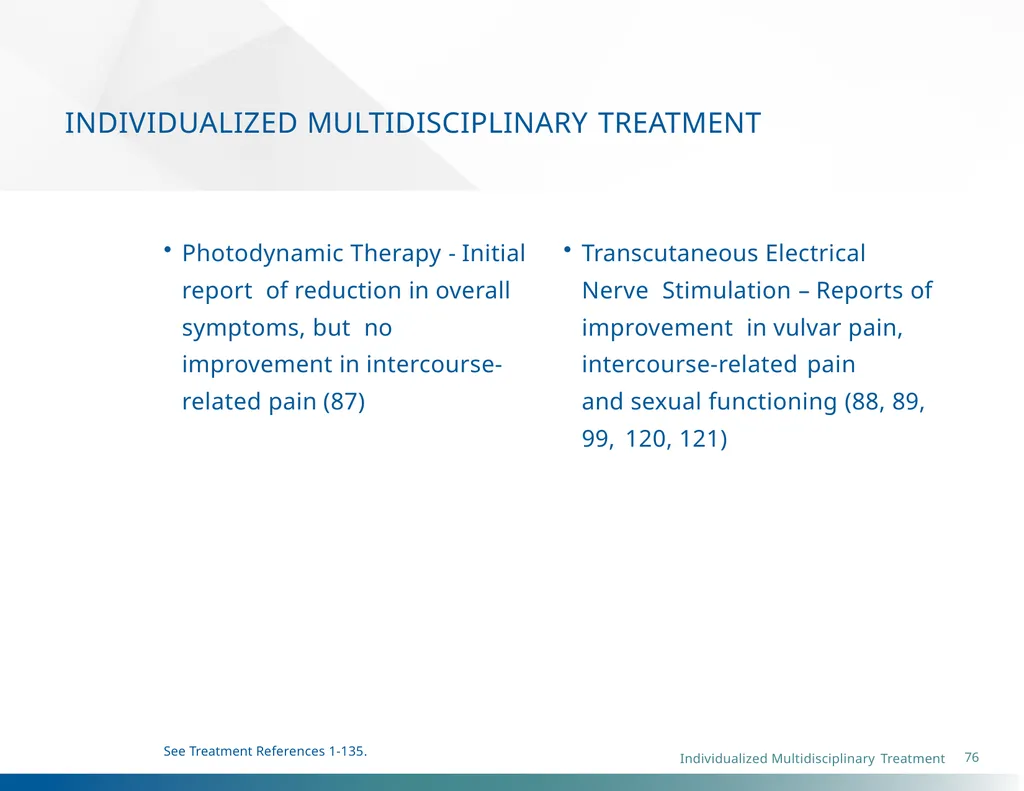
INDIVIDUALIZED MULTIDISCIPLINARY TREATMENT See Treatment References 1-135. 76 Individualized Multidisciplinary Treatment Transcutaneous Electrical Nerve Stimulation – Reports of improvement in vulvar pain, intercourse-related pain
and sexual functioning (88, 89, 99, 120, 121) Photodynamic Therapy - Initial report of reduction in overall symptoms, but no improvement in intercourse-related pain (87)<br>
77
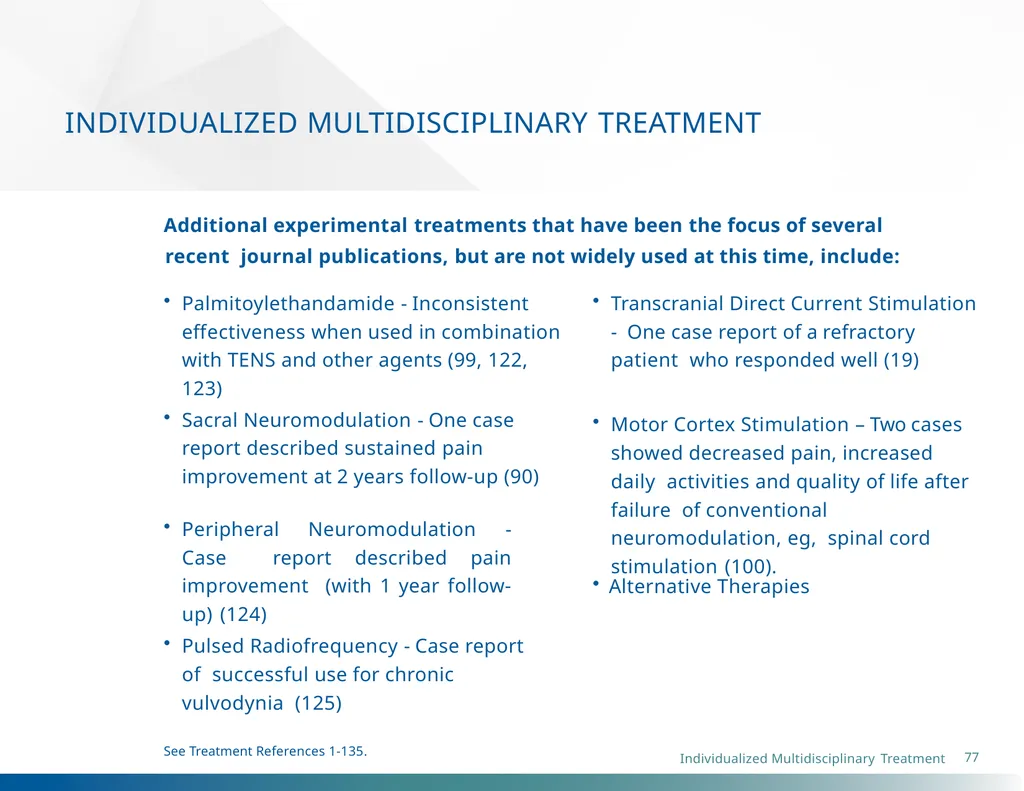
INDIVIDUALIZED MULTIDISCIPLINARY TREATMENT 77 Individualized Multidisciplinary Treatment Additional experimental treatments that have been the focus of several recent journal publications, but are not widely used at this time, include: Palmitoylethandamide - Inconsistent effectiveness when used in combination with TENS and other agents (99, 122, 123) Sacral Neuromodulation - One case report described sustained pain improvement at 2 years follow-up (90) Peripheral Neuromodulation - Case report described pain improvement (with 1 year follow-up) (124) Pulsed Radiofrequency - Case report
of successful use for chronic
vulvodynia (125) Transcranial Direct Current Stimulation - One case report of a refractory patient who responded well (19) Motor Cortex Stimulation – Two cases showed decreased pain, increased daily activities and quality of life after failure of conventional neuromodulation, eg, spinal cord stimulation (100). Alternative Therapies See Treatment References 1-135.<br>
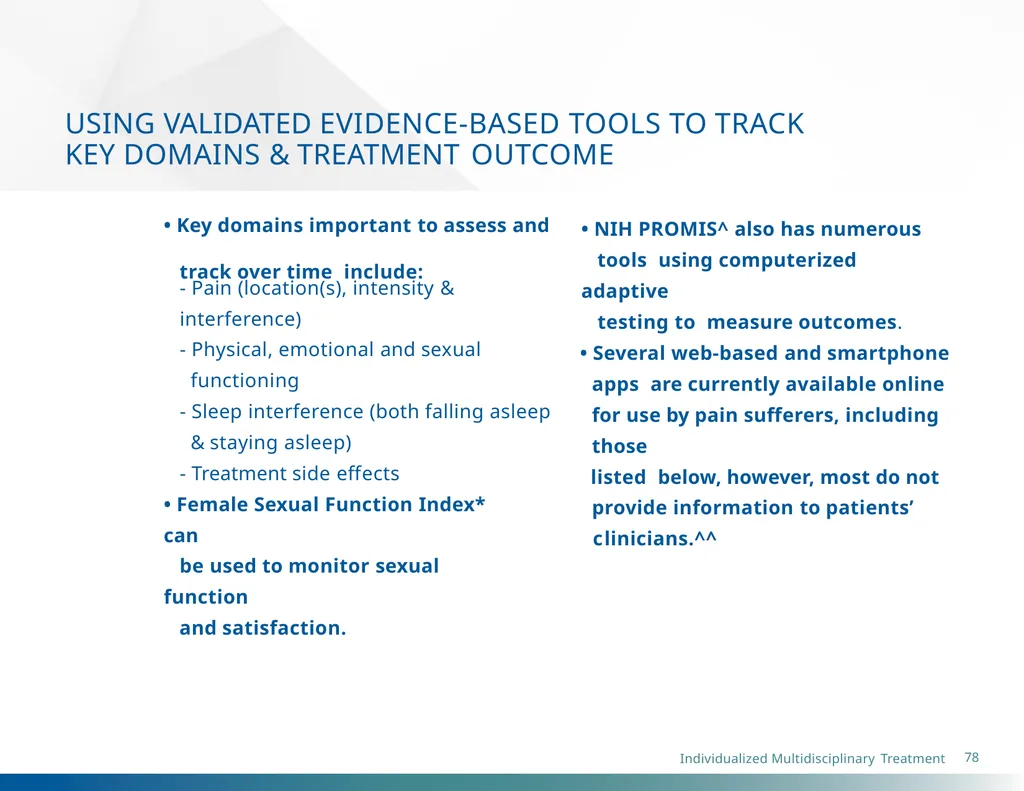
78
- Pain (location(s), intensity & interference)
- Physical, emotional and sexual functioning
- Sleep interference (both falling asleep & staying asleep)
- Treatment side effects 78 Individualized Multidisciplinary Treatment • Female Sexual Function Index* can be used to monitor sexual function and satisfaction. • NIH PROMIS^ also has numerous tools using computerized adaptive testing to measure outcomes. • Several web-based and smartphone apps are currently available online for use by pain sufferers, including those
listed below, however, most do not provide information to patients’
clinicians.^^ USING VALIDATED EVIDENCE-BASED TOOLS TO TRACK KEY DOMAINS & TREATMENT OUTCOME • Key domains important to assess and track over time include:<br>
- Physical, emotional and sexual functioning
- Sleep interference (both falling asleep & staying asleep)
- Treatment side effects 78 Individualized Multidisciplinary Treatment • Female Sexual Function Index* can be used to monitor sexual function and satisfaction. • NIH PROMIS^ also has numerous tools using computerized adaptive testing to measure outcomes. • Several web-based and smartphone apps are currently available online for use by pain sufferers, including those
listed below, however, most do not provide information to patients’
clinicians.^^ USING VALIDATED EVIDENCE-BASED TOOLS TO TRACK KEY DOMAINS & TREATMENT OUTCOME • Key domains important to assess and track over time include:<br>
79
Vulvodynia, defined as chronic vulvar pain of at least 3 months
duration that occurs in the absence of a clear identifiable cause, is a widely prevalent, misdiagnosed, and under-researched pain disorder affecting women of all ages and ethnicities. It negatively affects women’s physical, emotional and sexual health.
The vulva contains tissues derived from both the endoderm and ectoderm. It is innervated by the ilioinguinal, genitofemoral and pudendal nerves. Further, its proper functioning relies on both
superficial and deep pelvic floor musculature. Key Summary Points 79<br>
duration that occurs in the absence of a clear identifiable cause, is a widely prevalent, misdiagnosed, and under-researched pain disorder affecting women of all ages and ethnicities. It negatively affects women’s physical, emotional and sexual health.
The vulva contains tissues derived from both the endoderm and ectoderm. It is innervated by the ilioinguinal, genitofemoral and pudendal nerves. Further, its proper functioning relies on both
superficial and deep pelvic floor musculature. Key Summary Points 79<br>
80
Women/adolescents who are likely to have a clinical diagnosis of vulvodynia report: i) genital pain, ii) genital burning for more than
3 months, iii) 10 or more episodes of pain on contact with tampon insertion, intercourse or gynecologic exam, and iv) pain on contact that limits/prevents intercourse.
Although vulvodynia’s pathophysiology remains inconclusive, research supports the theory that multiple mechanisms predispose, trigger and perpetuate symptoms. Heterogeneous mechanism-based subgroups
demonstrate variable degrees of peripheral and central nervous
system sensitization, vestibular tissue changes and pelvic floor muscle dysfunction. Key Summary Points 80<br>
3 months, iii) 10 or more episodes of pain on contact with tampon insertion, intercourse or gynecologic exam, and iv) pain on contact that limits/prevents intercourse.
Although vulvodynia’s pathophysiology remains inconclusive, research supports the theory that multiple mechanisms predispose, trigger and perpetuate symptoms. Heterogeneous mechanism-based subgroups
demonstrate variable degrees of peripheral and central nervous
system sensitization, vestibular tissue changes and pelvic floor muscle dysfunction. Key Summary Points 80<br>
81
The vulvodynia subtype is first classified by location: generalized (several areas of the vulva) vs. localized (a specific vulvar region) and then by provocation (provoked, spontaneous or mixed). The two most common subtypes of vulvodynia are generalized
vulvodynia (spontaneous pain in several vulvar areas) and provoked vestibulodynia (provoked pain localized to the vulvar vestibule).
After all known infectious, inflammatory, neurologic, neoplastic and other causes of vulvar pain are ruled out, a thorough vulvodynia assessment includes: i) visual exam of the vulva, ii) cotton swab exam of the vulva and vulvar vestibule, iii) neurosensory exam, iv) pelvic
floor muscle evaluation, and v) an evaluation of pain comorbidity and contributing factors. Key Summary Points 81<br>
vulvodynia (spontaneous pain in several vulvar areas) and provoked vestibulodynia (provoked pain localized to the vulvar vestibule).
After all known infectious, inflammatory, neurologic, neoplastic and other causes of vulvar pain are ruled out, a thorough vulvodynia assessment includes: i) visual exam of the vulva, ii) cotton swab exam of the vulva and vulvar vestibule, iii) neurosensory exam, iv) pelvic
floor muscle evaluation, and v) an evaluation of pain comorbidity and contributing factors. Key Summary Points 81<br>
82
Components of an individualized, multidisciplinary, biopsychosocial treatment regimen are selected after identifying the vulvodynia
subtype and contributing factors. Due to vulvodynia’s heterogeneity, treatment response varies among women. As a result, it can take time to identify a helpful regimen, but the majority of women do improve with treatment.
It is vital to assess and track key pain-related domains over time as women undergo treatment. Several validated easy-to-use tools are currently available to track pain intensity and interference; physical, sexual and emotional function; sleep interference; and treatment
side effects. Key Summary Points 82<br>
subtype and contributing factors. Due to vulvodynia’s heterogeneity, treatment response varies among women. As a result, it can take time to identify a helpful regimen, but the majority of women do improve with treatment.
It is vital to assess and track key pain-related domains over time as women undergo treatment. Several validated easy-to-use tools are currently available to track pain intensity and interference; physical, sexual and emotional function; sleep interference; and treatment
side effects. Key Summary Points 82<br>
83
Selected Journal References available at www.nva.org/articles
2015 Consensus Terminology and Classification of Persistent Vulvar Pain and Vulvodynia (Bornstein)
Medical and Physical Predictors of Localized Provoked Vulvodynia (Bohm-Starke)
Vulvodynia: Diagnosis and Management (Reed)
Vulvodynia: An Evidence-Based Approach to Medical Management (Andrews)
Vulvodynia-An Evidence-Based Literature Review and Proposed Treatment Algorithm (De Andres)
The Vulvodynia Guideline (Haefner)
2013 Vulvodynia Guideline Update (Stockdale)
Vulvodynia Interventions – Systematic Review and Evidence Grading (Andrews) 83 SELECTED REFERENCES<br>
2015 Consensus Terminology and Classification of Persistent Vulvar Pain and Vulvodynia (Bornstein)
Medical and Physical Predictors of Localized Provoked Vulvodynia (Bohm-Starke)
Vulvodynia: Diagnosis and Management (Reed)
Vulvodynia: An Evidence-Based Approach to Medical Management (Andrews)
Vulvodynia-An Evidence-Based Literature Review and Proposed Treatment Algorithm (De Andres)
The Vulvodynia Guideline (Haefner)
2013 Vulvodynia Guideline Update (Stockdale)
Vulvodynia Interventions – Systematic Review and Evidence Grading (Andrews) 83 SELECTED REFERENCES<br>
84
Proceedings of the 2003 & 2011 NIH Conferences available at
www.nva.org/nihreports
Selected Reference Textbooks available at www.nva.org/bookstore
Female Sexual Pain Disorders: Evaluation and Management (Goldstein, Pukall, Goldstein)
The Vulva: Anatomy, Physiology and Pathology (Farage, Maibach) 84 SELECTED REFERENCES<br>
Selected Reference Textbooks available at www.nva.org/bookstore
Female Sexual Pain Disorders: Evaluation and Management (Goldstein, Pukall, Goldstein)
The Vulva: Anatomy, Physiology and Pathology (Farage, Maibach) 84 SELECTED REFERENCES<br>
85
Patient Booklets available at www.nva.org/shg
Self-Help Guide: features important self-help strategies for alleviating vulvar pain and maintaining sexual intimacy
Conception to Pregnancy Guide: includes information on conception through the postpartum period
Partner Guide: helps partners to have a better understanding of vulvodynia and the challenge of living with someone who has it
Disability Guide: provides step-by-step guidance that will help vulvodynia sufferers compile and submit a successful disability claim
NVA Brochure available at www.nva.org/publications/ Self-help tips available at www.nva.org/tips
Reference Books available at www.nva.org/bookstore 85 PATIENT RESOURCES<br>
Self-Help Guide: features important self-help strategies for alleviating vulvar pain and maintaining sexual intimacy
Conception to Pregnancy Guide: includes information on conception through the postpartum period
Partner Guide: helps partners to have a better understanding of vulvodynia and the challenge of living with someone who has it
Disability Guide: provides step-by-step guidance that will help vulvodynia sufferers compile and submit a successful disability claim
NVA Brochure available at www.nva.org/publications/ Self-help tips available at www.nva.org/tips
Reference Books available at www.nva.org/bookstore 85 PATIENT RESOURCES<br>