WALK-ON COACHES: CHALLENGES AND SOLUTIONS Randall
Description: WALK-ON COACHES: CHALLENGES AND SOLUTIONS Randall Bell AD, Monrovia High School 2017 CIF-SS Athletic Administrators Summit OBJECTIVES Acknowledge current reality Identify four challenges Suggest potential solutions Along the way: offer
Related Topics
Download Presentation
"WALK-ON COACHES: CHALLENGES AND SOLUTIONS Randall" is the property of its rightful owner. Permission is granted to download and print the materials on this website for personal, non-commercial use only, and to display it on your personal computer provided you do not modify the materials and that you retain all copyright notices contained in the materials. By downloading content from our website, you accept the terms of this agreement.
Presentation Transcript
slide1. WALK-ON COACHES: CHALLENGES AND SOLUTIONS Randall Bell – AD, Monrovia High School
2017 CIF-SS Athletic Administrators’ Summit<br>
slide2. OBJECTIVES Acknowledge current reality
Identify four challenges
Suggest potential solutions
Along the way: offer up various quotes, anecdotes and thoughts<br>
slide3. CERTIFICATED VS. WALK-ON ** Everyone’s preferred scenario: a great Teacher/Coach
Some schools: concerted effort toward hiring only certificated coaches
But…be careful…
Not every teacher is a great coach
Not every coach is a great teacher
Bottom line: hire the best coach you can!
** Varsity HC<br>
slide4. “ Walk-ons don't have the same access to students during the school day as teachers. They can't monitor academics or discipline issues as closely as teachers. If someone wants to make additional money while teaching, anything but coaching is more lucrative, from tutoring to coaching travel teams. The trend toward relying on walk-ons is only going to get stronger.”
Sondheimer, Eric. “LAUSD is Making a Mistake by Relying too Much on Walk-on
Coaches.” 1 March, 2015. www.latimes.com<br>
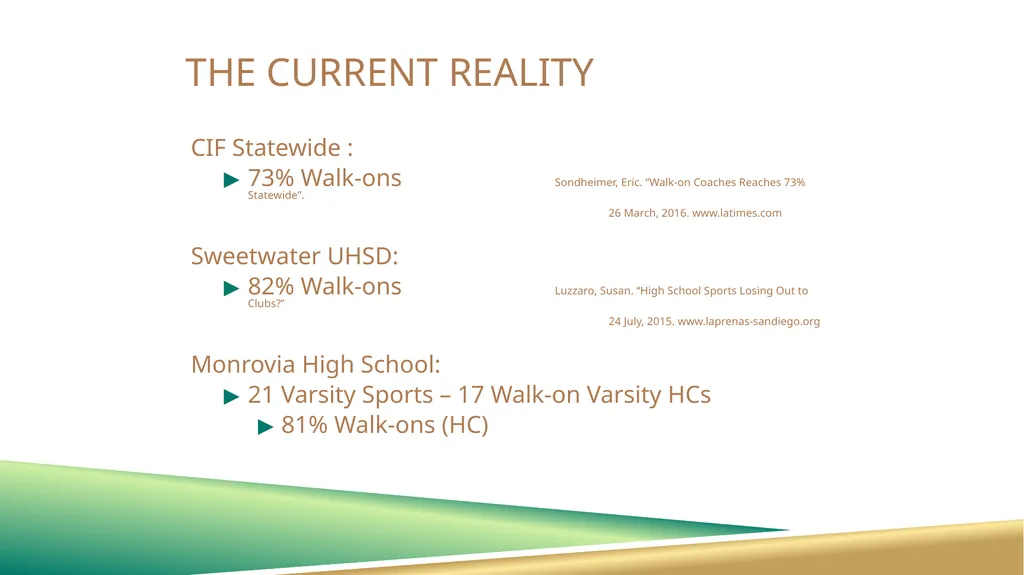
slide5. THE CURRENT REALITY CIF Statewide :
73% Walk-ons Sondheimer, Eric. “Walk-on Coaches Reaches 73% Statewide”.
26 March, 2016. www.latimes.com
Sweetwater UHSD:
82% Walk-ons Luzzaro, Susan. “High School Sports Losing Out to Clubs?”
24 July, 2015. www.laprenas-sandiego.org
Monrovia High School:
21 Varsity Sports – 17 Walk-on Varsity HCs
81% Walk-ons (HC)<br>
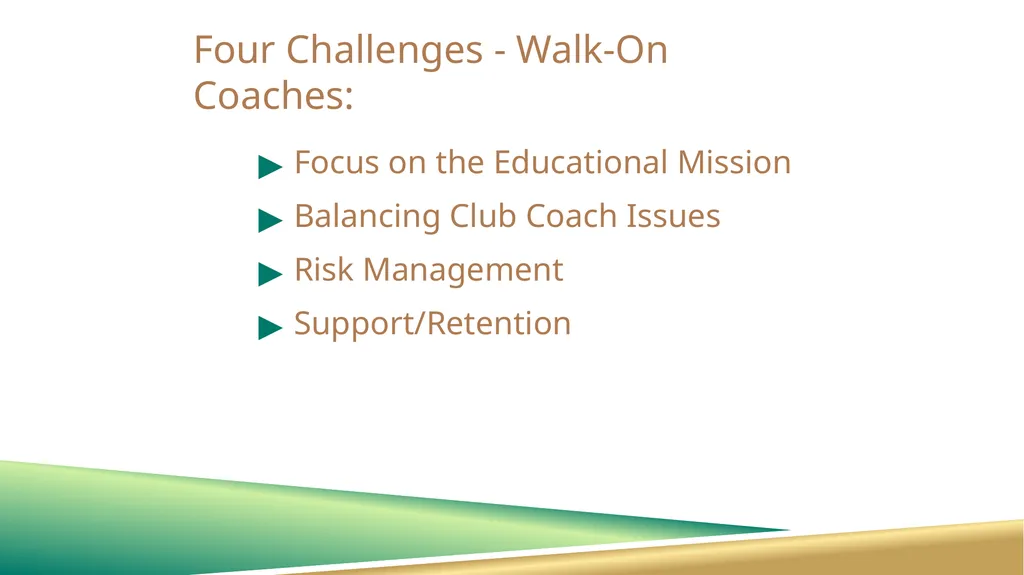
slide6. Four Challenges - Walk-On Coaches: Focus on the Educational Mission
Balancing Club Coach Issues
Risk Management
Support/Retention<br>
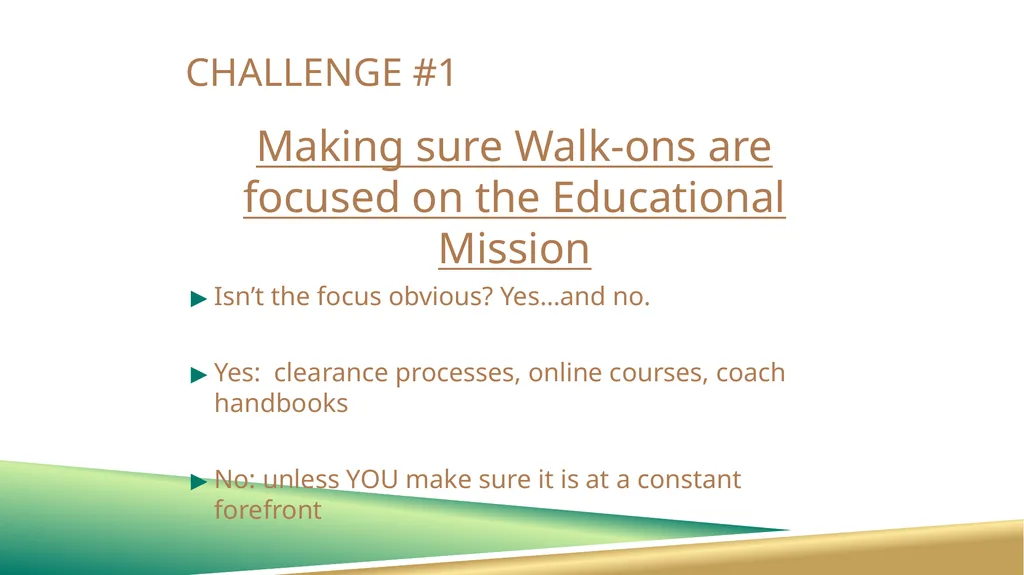
slide7. CHALLENGE #1 Making sure Walk-ons are focused on the Educational Mission
Isn’t the focus obvious? Yes…and no.
Yes: clearance processes, online courses, coach handbooks
No: unless YOU make sure it is at a constant forefront<br>
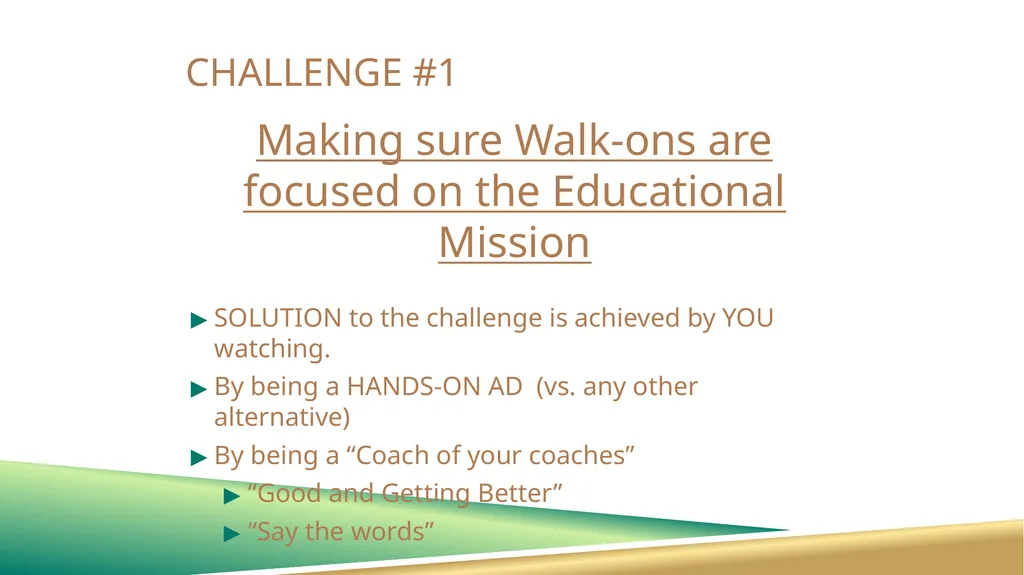
slide8. CHALLENGE #1 Making sure Walk-ons are focused on the Educational Mission
SOLUTION to the challenge is achieved by YOU watching.
By being a HANDS-ON AD (vs. any other alternative)
By being a “Coach of your coaches”
“Good and Getting Better”
“Say the words”<br>
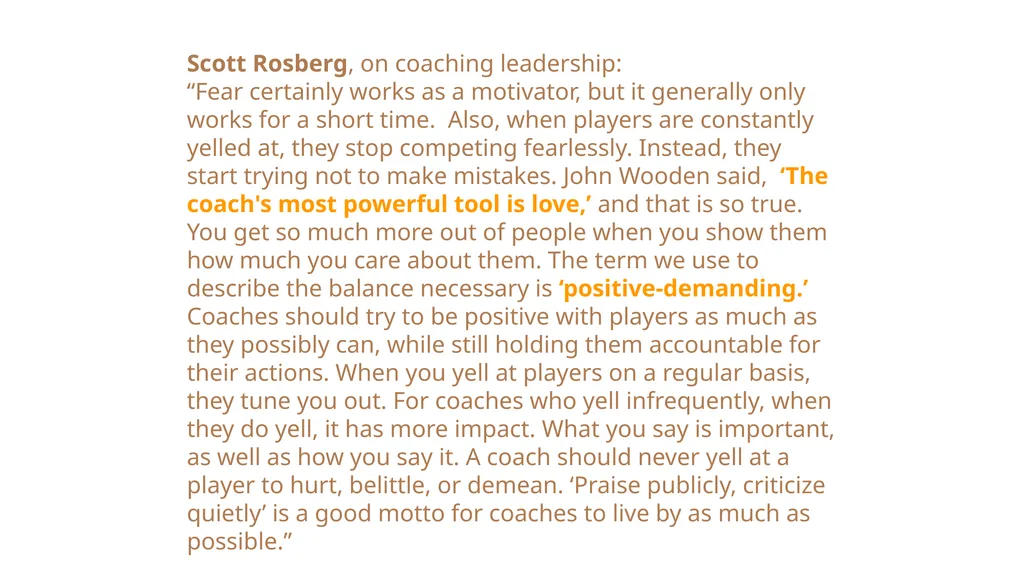
slide9. Scott Rosberg, on coaching leadership:
“Fear certainly works as a motivator, but it generally only works for a short time. Also, when players are constantly yelled at, they stop competing fearlessly. Instead, they start trying not to make mistakes. John Wooden said, ‘The coach's most powerful tool is love,’ and that is so true. You get so much more out of people when you show them how much you care about them. The term we use to describe the balance necessary is ‘positive-demanding.’ Coaches should try to be positive with players as much as they possibly can, while still holding them accountable for their actions. When you yell at players on a regular basis, they tune you out. For coaches who yell infrequently, when they do yell, it has more impact. What you say is important, as well as how you say it. A coach should never yell at a player to hurt, belittle, or demean. ‘Praise publicly, criticize quietly’ is a good motto for coaches to live by as much as possible.”<br>
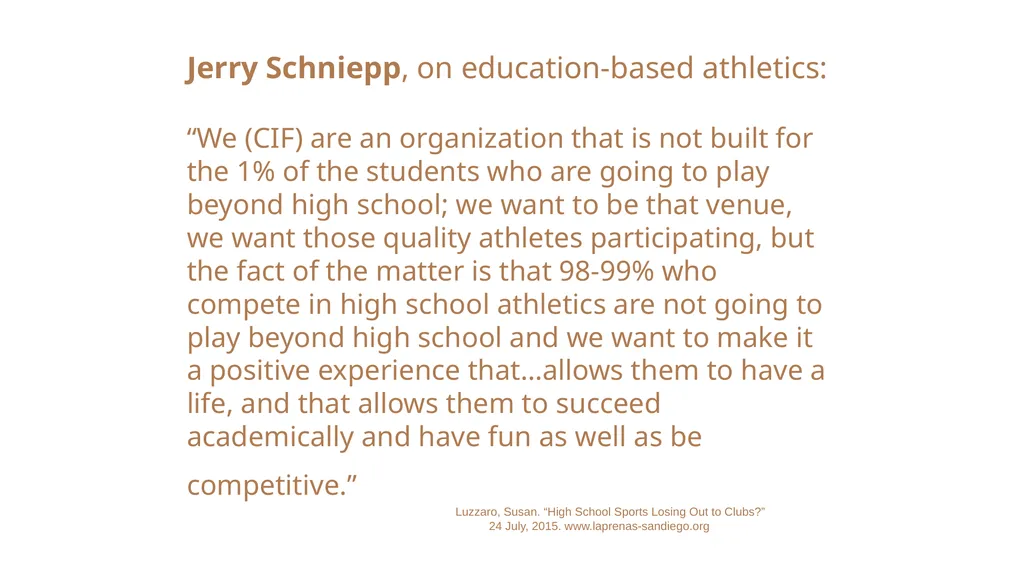
slide10. Jerry Schniepp, on education-based athletics:
“We (CIF) are an organization that is not built for the 1% of the students who are going to play beyond high school; we want to be that venue, we want those quality athletes participating, but the fact of the matter is that 98-99% who compete in high school athletics are not going to play beyond high school and we want to make it a positive experience that…allows them to have a life, and that allows them to succeed academically and have fun as well as be competitive.”
Luzzaro, Susan. “High School Sports Losing Out to Clubs?”
24 July, 2015. www.laprenas-sandiego.org<br>
slide11. Jerry Schniepp, on education-based athletics:
“I get the club world and I think there’s a lot of positive to it, but I also think it’s geared to the individual and the exposure of the individual, increasing their visibility and their skill level. But high school should be, in most cases, about the team and about learning the life skills that athletics teaches students. It’s about putting the team first and seeing that there is life beyond the individual, and ‘this program is bigger than me as an individual.’ It teaches those skills that athletics teach that are difficult to find in any other setting.”
Luzzaro, Susan. “High School Sports Losing Out to Clubs?”
24 July, 2015. www.laprenas-sandiego.org<br>
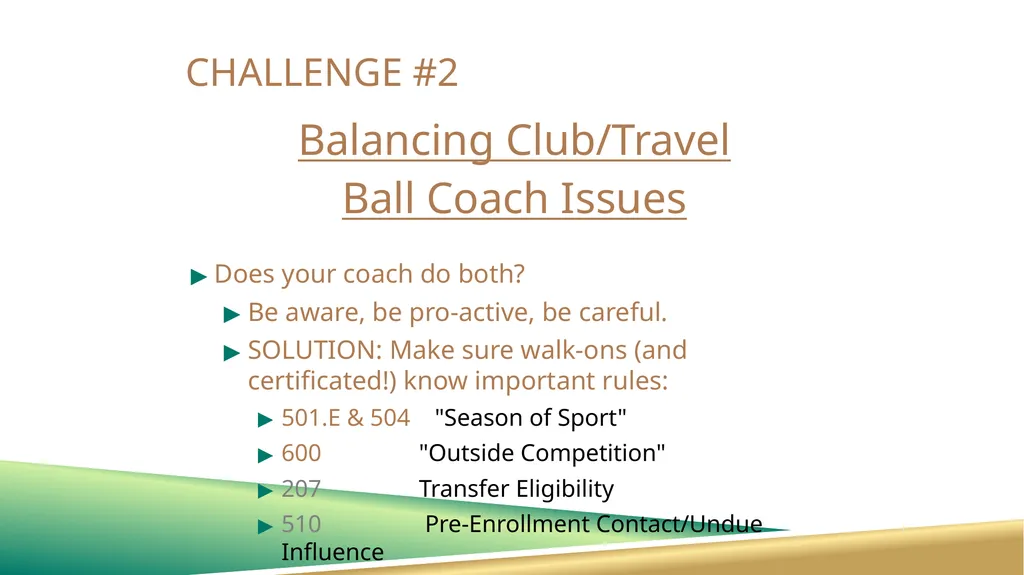
slide12. CHALLENGE #2 Balancing Club/Travel
Ball Coach Issues
Does your coach do both?
Be aware, be pro-active, be careful.
SOLUTION: Make sure walk-ons (and certificated!) know important rules:
501.E & 504 "Season of Sport"
600 "Outside Competition"
207 Transfer Eligibility
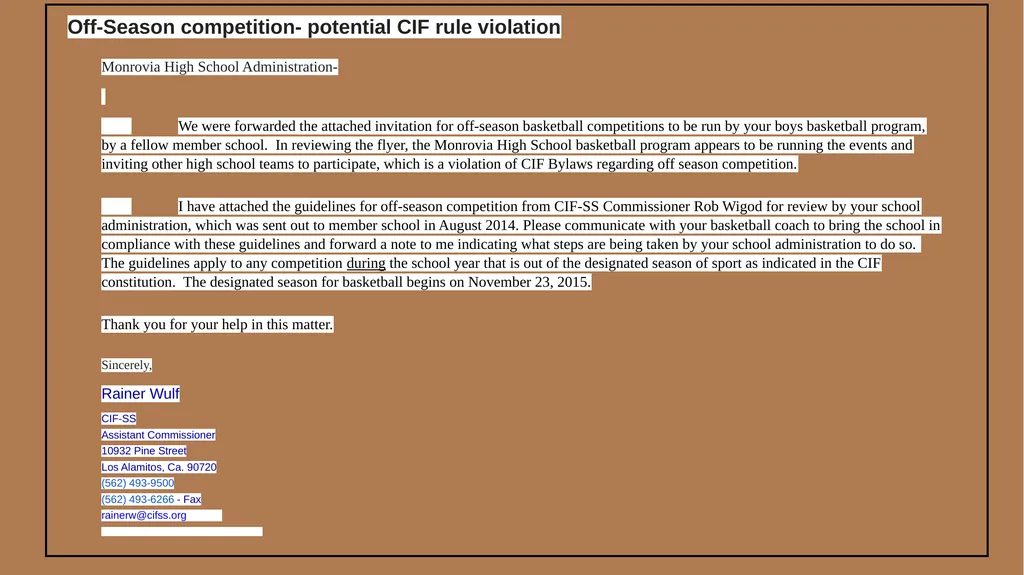
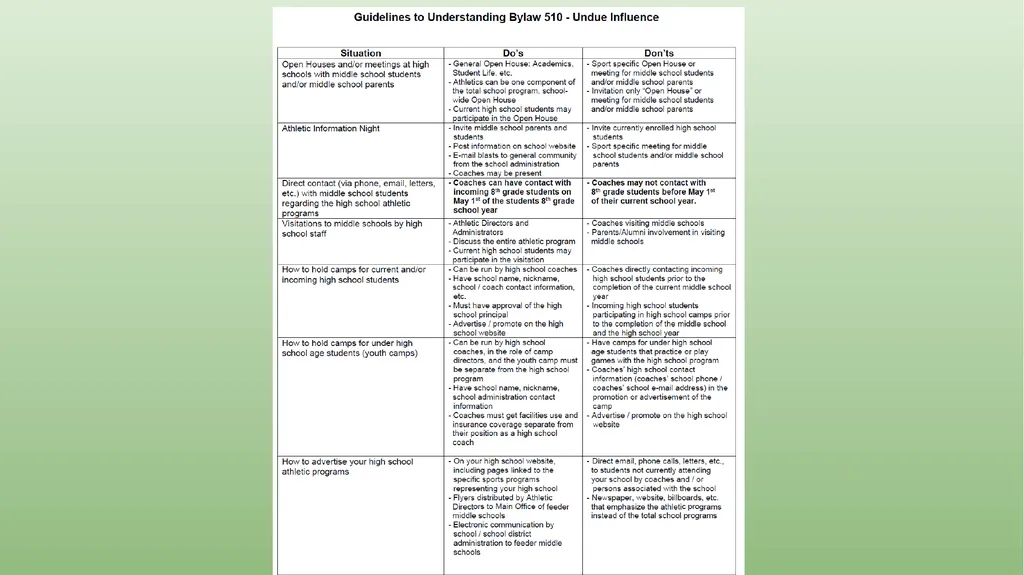
510 Pre-Enrollment Contact/Undue Influence<br>
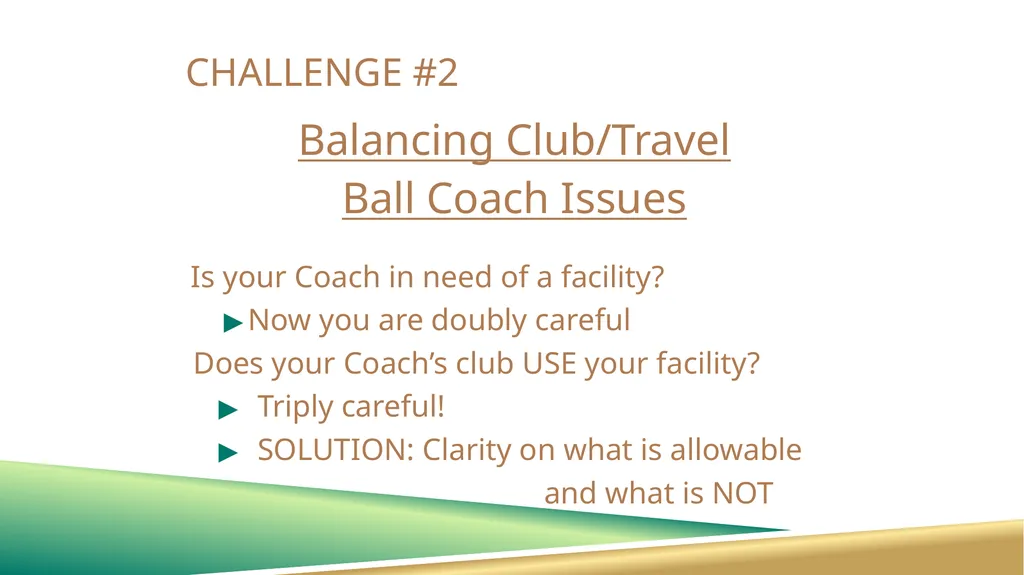
slide16. CHALLENGE #2 Balancing Club/Travel
Ball Coach Issues
Is your Coach in need of a facility?
Now you are doubly careful
Does your Coach’s club USE your facility?
Triply careful!
SOLUTION: Clarity on what is allowable
and what is NOT<br>
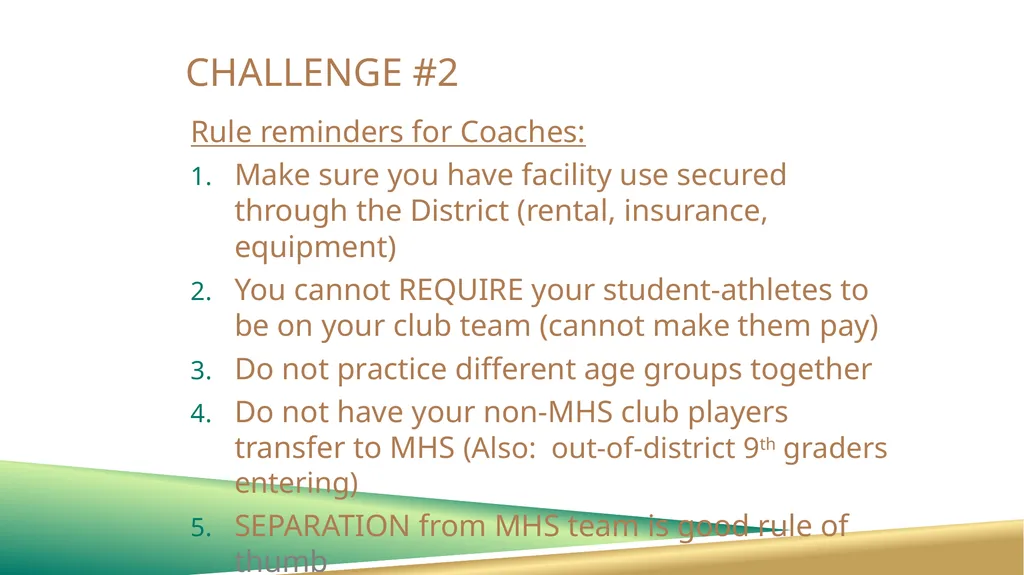
slide17. CHALLENGE #2 Rule reminders for Coaches:
Make sure you have facility use secured through the District (rental, insurance, equipment)
You cannot REQUIRE your student-athletes to be on your club team (cannot make them pay)
Do not practice different age groups together
Do not have your non-MHS club players transfer to MHS (Also: out-of-district 9th graders entering)
SEPARATION from MHS team is good rule of thumb<br>
slide18. CHALLENGE #2 Balancing Club/Travel
Ball Coach Issues
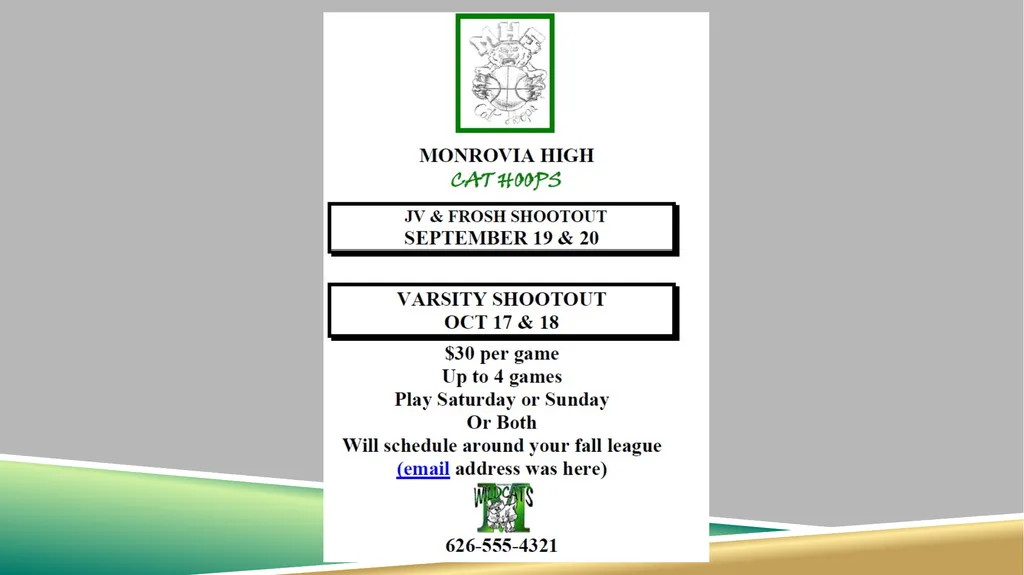
To be fair: there is such a thing as a great coach who comes from the club world
Anecdote from Monrovia HS<br>
slide19. CHALLENGE #3 Risk Management
AD = Compliance Officer!<br>
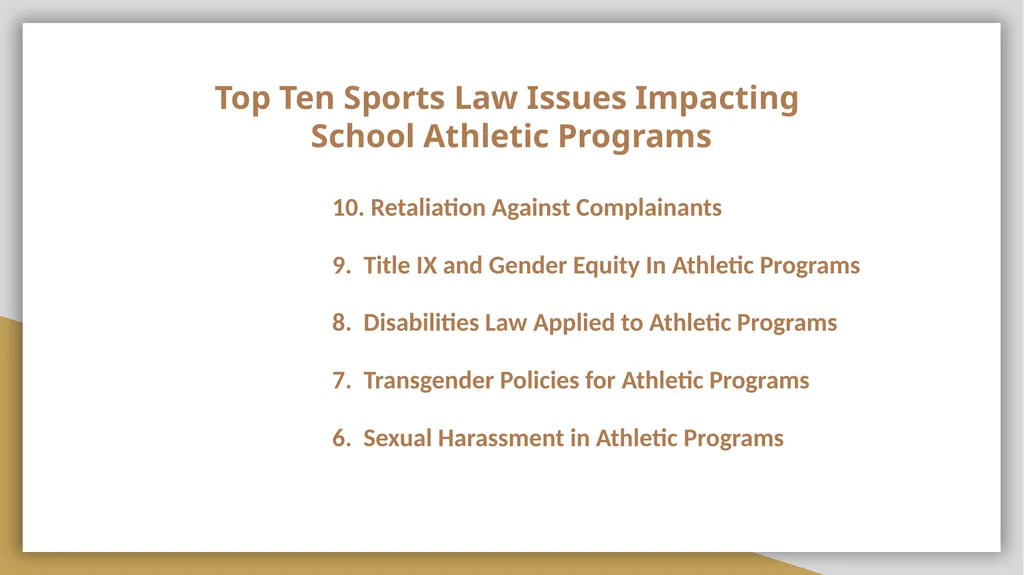
slide20. 10. Retaliation Against Complainants
9. Title IX and Gender Equity In Athletic Programs
8. Disabilities Law Applied to Athletic Programs
7. Transgender Policies for Athletic Programs
6. Sexual Harassment in Athletic Programs Top Ten Sports Law Issues Impacting
School Athletic Programs<br>
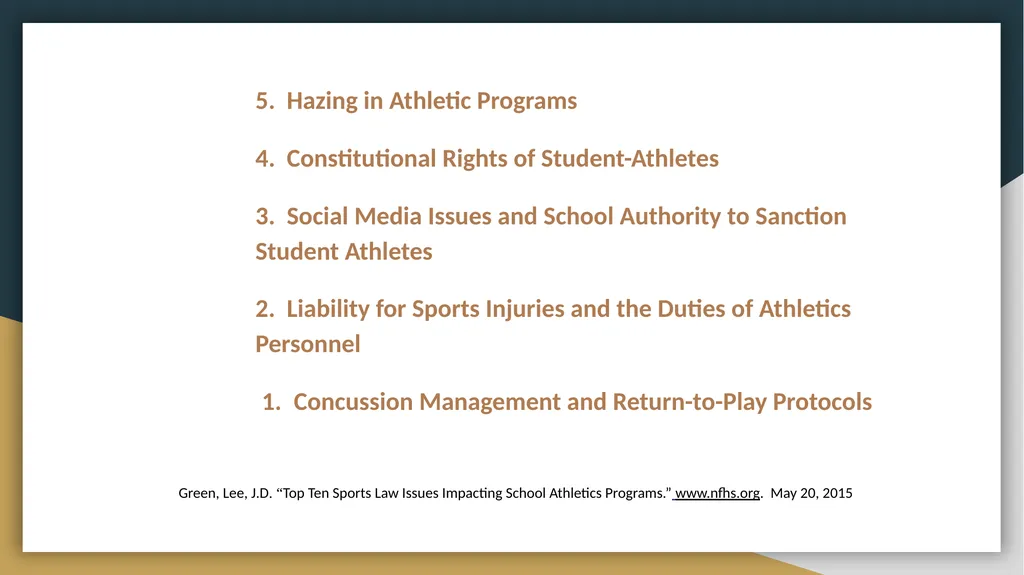
slide21. 5. Hazing in Athletic Programs
4. Constitutional Rights of Student-Athletes
3. Social Media Issues and School Authority to Sanction Student Athletes
2. Liability for Sports Injuries and the Duties of Athletics Personnel
Concussion Management and Return-to-Play Protocols
Green, Lee, J.D. “Top Ten Sports Law Issues Impacting School Athletics Programs.” www.nfhs.org. May 20, 2015<br>
slide22. CHALLENGE #3 Risk Management
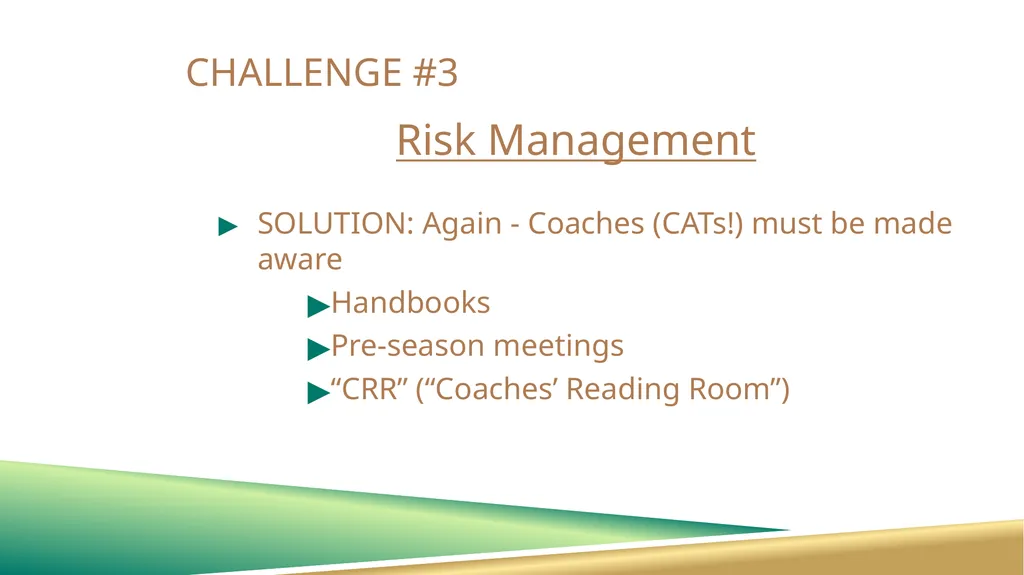
SOLUTION: Again - Coaches (CATs!) must be made aware
Handbooks
Pre-season meetings
“CRR” (“Coaches’ Reading Room”)<br>
slide23. CHALLENGE #4 Support & Retention
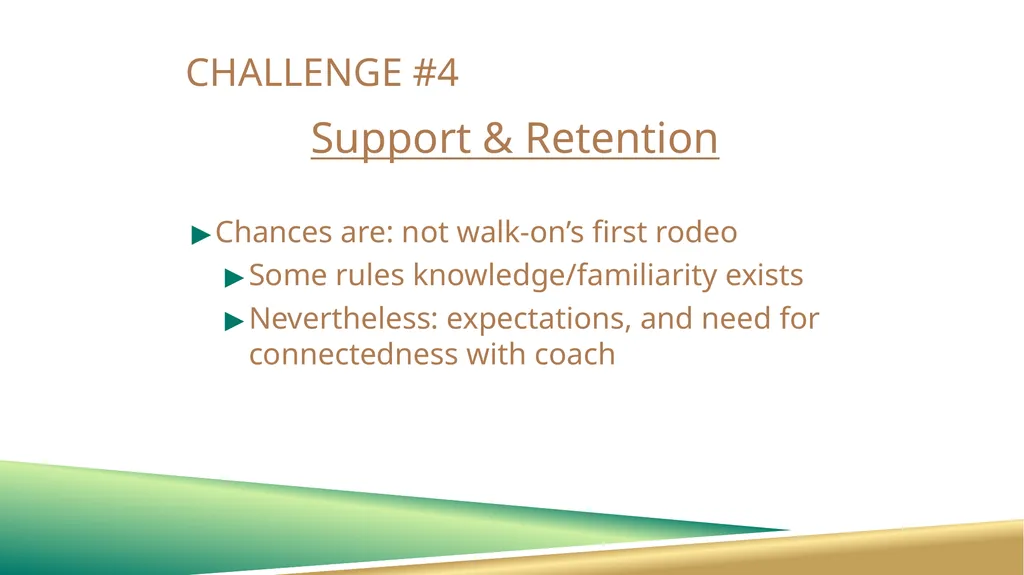
Chances are: not walk-on’s first rodeo
Some rules knowledge/familiarity exists
Nevertheless: expectations, and need for connectedness with coach<br>
slide24. CHALLENGE #4 Support & Retention
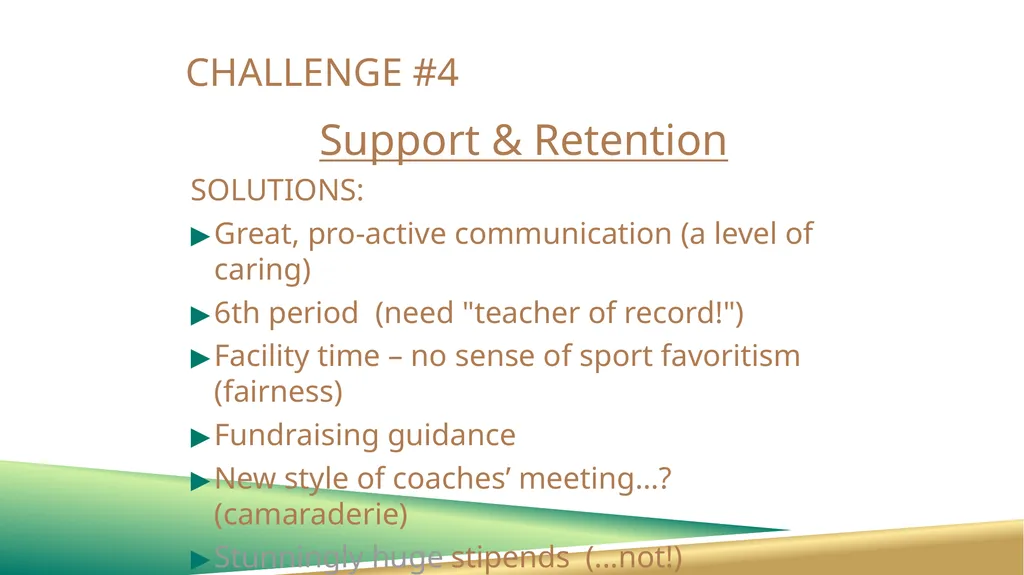
SOLUTIONS:
Great, pro-active communication (a level of caring)
6th period (need "teacher of record!")
Facility time – no sense of sport favoritism (fairness)
Fundraising guidance
New style of coaches’ meeting…? (camaraderie)
Stunningly huge stipends (...not!)<br>
slide25. CHALLENGE #4 Support & Retention
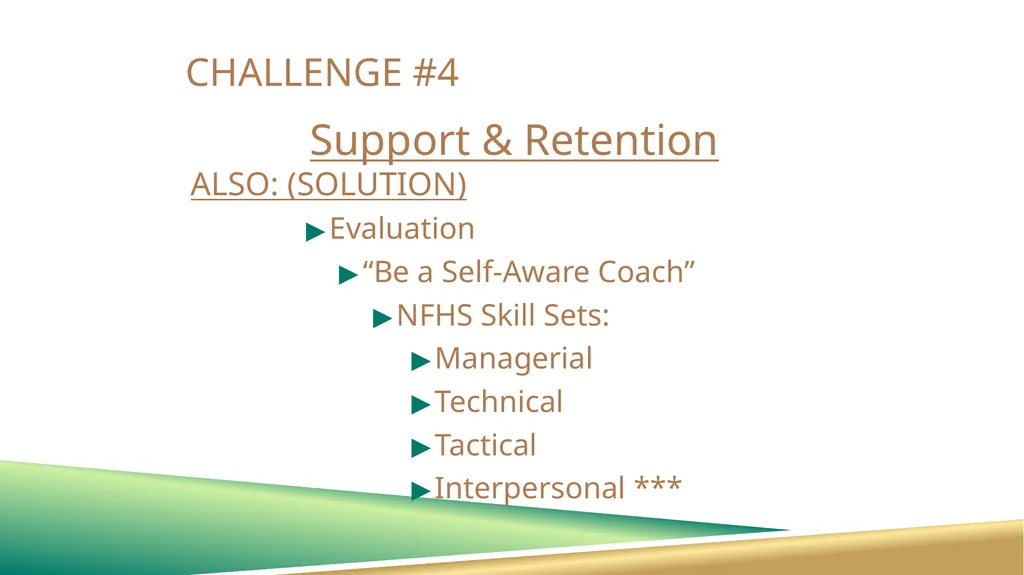
ALSO: (SOLUTION)
Evaluation
“Be a Self-Aware Coach”
NFHS Skill Sets:
Managerial
Technical
Tactical
Interpersonal ***<br>
slide26. “The trend toward relying on walk-ons is only going to get stronger.” (Sondheimer)
C#1: Focus on Education-Based Athletics
AD presence and pro-activity
C#2: Balancing Club Coach Issues
Rules focus
AD presence and pro-activity
C#3: Risk Management
Initial and ongoing awareness; communication
AD presence and pro-activity
C#4: Support/Retention
Multiple supports
Fair and caring
AD presence and pro-activity<br>
slide27. Thank you for being here!
Randall Bell, Monrovia H.S.
626-471-2877
rbell@monroviaschools.net<br>

2017 CIF-SS Athletic Administrators’ Summit<br>
slide2. OBJECTIVES Acknowledge current reality
Identify four challenges
Suggest potential solutions
Along the way: offer up various quotes, anecdotes and thoughts<br>
slide3. CERTIFICATED VS. WALK-ON ** Everyone’s preferred scenario: a great Teacher/Coach
Some schools: concerted effort toward hiring only certificated coaches
But…be careful…
Not every teacher is a great coach
Not every coach is a great teacher
Bottom line: hire the best coach you can!
** Varsity HC<br>
slide4. “ Walk-ons don't have the same access to students during the school day as teachers. They can't monitor academics or discipline issues as closely as teachers. If someone wants to make additional money while teaching, anything but coaching is more lucrative, from tutoring to coaching travel teams. The trend toward relying on walk-ons is only going to get stronger.”
Sondheimer, Eric. “LAUSD is Making a Mistake by Relying too Much on Walk-on
Coaches.” 1 March, 2015. www.latimes.com<br>
slide5. THE CURRENT REALITY CIF Statewide :
73% Walk-ons Sondheimer, Eric. “Walk-on Coaches Reaches 73% Statewide”.
26 March, 2016. www.latimes.com
Sweetwater UHSD:
82% Walk-ons Luzzaro, Susan. “High School Sports Losing Out to Clubs?”
24 July, 2015. www.laprenas-sandiego.org
Monrovia High School:
21 Varsity Sports – 17 Walk-on Varsity HCs
81% Walk-ons (HC)<br>
slide6. Four Challenges - Walk-On Coaches: Focus on the Educational Mission
Balancing Club Coach Issues
Risk Management
Support/Retention<br>
slide7. CHALLENGE #1 Making sure Walk-ons are focused on the Educational Mission
Isn’t the focus obvious? Yes…and no.
Yes: clearance processes, online courses, coach handbooks
No: unless YOU make sure it is at a constant forefront<br>
slide8. CHALLENGE #1 Making sure Walk-ons are focused on the Educational Mission
SOLUTION to the challenge is achieved by YOU watching.
By being a HANDS-ON AD (vs. any other alternative)
By being a “Coach of your coaches”
“Good and Getting Better”
“Say the words”<br>
slide9. Scott Rosberg, on coaching leadership:
“Fear certainly works as a motivator, but it generally only works for a short time. Also, when players are constantly yelled at, they stop competing fearlessly. Instead, they start trying not to make mistakes. John Wooden said, ‘The coach's most powerful tool is love,’ and that is so true. You get so much more out of people when you show them how much you care about them. The term we use to describe the balance necessary is ‘positive-demanding.’ Coaches should try to be positive with players as much as they possibly can, while still holding them accountable for their actions. When you yell at players on a regular basis, they tune you out. For coaches who yell infrequently, when they do yell, it has more impact. What you say is important, as well as how you say it. A coach should never yell at a player to hurt, belittle, or demean. ‘Praise publicly, criticize quietly’ is a good motto for coaches to live by as much as possible.”<br>
slide10. Jerry Schniepp, on education-based athletics:
“We (CIF) are an organization that is not built for the 1% of the students who are going to play beyond high school; we want to be that venue, we want those quality athletes participating, but the fact of the matter is that 98-99% who compete in high school athletics are not going to play beyond high school and we want to make it a positive experience that…allows them to have a life, and that allows them to succeed academically and have fun as well as be competitive.”
Luzzaro, Susan. “High School Sports Losing Out to Clubs?”
24 July, 2015. www.laprenas-sandiego.org<br>
slide11. Jerry Schniepp, on education-based athletics:
“I get the club world and I think there’s a lot of positive to it, but I also think it’s geared to the individual and the exposure of the individual, increasing their visibility and their skill level. But high school should be, in most cases, about the team and about learning the life skills that athletics teaches students. It’s about putting the team first and seeing that there is life beyond the individual, and ‘this program is bigger than me as an individual.’ It teaches those skills that athletics teach that are difficult to find in any other setting.”
Luzzaro, Susan. “High School Sports Losing Out to Clubs?”
24 July, 2015. www.laprenas-sandiego.org<br>
slide12. CHALLENGE #2 Balancing Club/Travel
Ball Coach Issues
Does your coach do both?
Be aware, be pro-active, be careful.
SOLUTION: Make sure walk-ons (and certificated!) know important rules:
501.E & 504 "Season of Sport"
600 "Outside Competition"
207 Transfer Eligibility
510 Pre-Enrollment Contact/Undue Influence<br>
slide16. CHALLENGE #2 Balancing Club/Travel
Ball Coach Issues
Is your Coach in need of a facility?
Now you are doubly careful
Does your Coach’s club USE your facility?
Triply careful!
SOLUTION: Clarity on what is allowable
and what is NOT<br>
slide17. CHALLENGE #2 Rule reminders for Coaches:
Make sure you have facility use secured through the District (rental, insurance, equipment)
You cannot REQUIRE your student-athletes to be on your club team (cannot make them pay)
Do not practice different age groups together
Do not have your non-MHS club players transfer to MHS (Also: out-of-district 9th graders entering)
SEPARATION from MHS team is good rule of thumb<br>
slide18. CHALLENGE #2 Balancing Club/Travel
Ball Coach Issues
To be fair: there is such a thing as a great coach who comes from the club world
Anecdote from Monrovia HS<br>
slide19. CHALLENGE #3 Risk Management
AD = Compliance Officer!<br>
slide20. 10. Retaliation Against Complainants
9. Title IX and Gender Equity In Athletic Programs
8. Disabilities Law Applied to Athletic Programs
7. Transgender Policies for Athletic Programs
6. Sexual Harassment in Athletic Programs Top Ten Sports Law Issues Impacting
School Athletic Programs<br>
slide21. 5. Hazing in Athletic Programs
4. Constitutional Rights of Student-Athletes
3. Social Media Issues and School Authority to Sanction Student Athletes
2. Liability for Sports Injuries and the Duties of Athletics Personnel
Concussion Management and Return-to-Play Protocols
Green, Lee, J.D. “Top Ten Sports Law Issues Impacting School Athletics Programs.” www.nfhs.org. May 20, 2015<br>
slide22. CHALLENGE #3 Risk Management
SOLUTION: Again - Coaches (CATs!) must be made aware
Handbooks
Pre-season meetings
“CRR” (“Coaches’ Reading Room”)<br>
slide23. CHALLENGE #4 Support & Retention
Chances are: not walk-on’s first rodeo
Some rules knowledge/familiarity exists
Nevertheless: expectations, and need for connectedness with coach<br>
slide24. CHALLENGE #4 Support & Retention
SOLUTIONS:
Great, pro-active communication (a level of caring)
6th period (need "teacher of record!")
Facility time – no sense of sport favoritism (fairness)
Fundraising guidance
New style of coaches’ meeting…? (camaraderie)
Stunningly huge stipends (...not!)<br>
slide25. CHALLENGE #4 Support & Retention
ALSO: (SOLUTION)
Evaluation
“Be a Self-Aware Coach”
NFHS Skill Sets:
Managerial
Technical
Tactical
Interpersonal ***<br>
slide26. “The trend toward relying on walk-ons is only going to get stronger.” (Sondheimer)
C#1: Focus on Education-Based Athletics
AD presence and pro-activity
C#2: Balancing Club Coach Issues
Rules focus
AD presence and pro-activity
C#3: Risk Management
Initial and ongoing awareness; communication
AD presence and pro-activity
C#4: Support/Retention
Multiple supports
Fair and caring
AD presence and pro-activity<br>
slide27. Thank you for being here!
Randall Bell, Monrovia H.S.
626-471-2877
rbell@monroviaschools.net<br>