Wall Mural at Caminito, Buenos Aires Central/
Description: Wall Mural at Caminito, Buenos Aires Central South America and Caribbean Latin American Feminisms Definition The definition comes from a group of circumstances: Colonialism Enslavement of African peoples Marginalization of Native peoples
Related Topics
Download Presentation
"Wall Mural at Caminito, Buenos Aires Central/" is the property of its rightful owner. Permission is granted to download and print the materials on this website for personal, non-commercial use only, and to display it on your personal computer provided you do not modify the materials and that you retain all copyright notices contained in the materials. By downloading content from our website, you accept the terms of this agreement.
Presentation Transcript
slide1. Wall Mural at Caminito, Buenos Aires
Central/ South America and Caribbean Latin American Feminisms<br>
slide2. Definition The definition comes from a group of circumstances:
Colonialism
Enslavement of African peoples
Marginalization of Native peoples
FEMINISM then focuses on the critical work done by women fighting the previous circumstances for an equal place in society.<br>
slide3. More than one type of FEMINISM, thus the plural use of FEMINISMS More than one perspective! It becomes harder to generalize and easier to misjudge<br>
slide4. LA Feminisms The work and writings of women as “other” and “otherness”
Re-consider notions of men as the entry point of humanitity – language use here is prominently male, mankind, master and other binary considerations. Popular Culture Before the 19th Century women were celebrated in non-written form but remembered in myths, songs, proverbs and oral histories.
Some are Acacaona, Baraúnda,& Garifuna women. Pre-20th Century<br>
slide5. 18th Century famous feminists Sor Juana Inés de la Cruz (Mexican philosopher + Advocate for women’s intellect)
Teresa Margarida da Silva (Brazilian first woman author + Advocate for women’s interest in science and for native women) Flora Tristrán (Peruvian + Advocate for women as workers)
Juana Manso (Argentine abolitionist + Advocate for women’s education)<br>
slide6. Feminist Thoughts…before Feminism Mexican Revolution
Brought crucial revolutionary ideas (later to be considered Feminist ideas) such as education.
Women deputies on 1916 debated the right to vote/ abortion/contraception. Argentina’s First International Congress
Topics included:
PEACE
EDUCATION
SOCIAL PARTICIPATION<br>
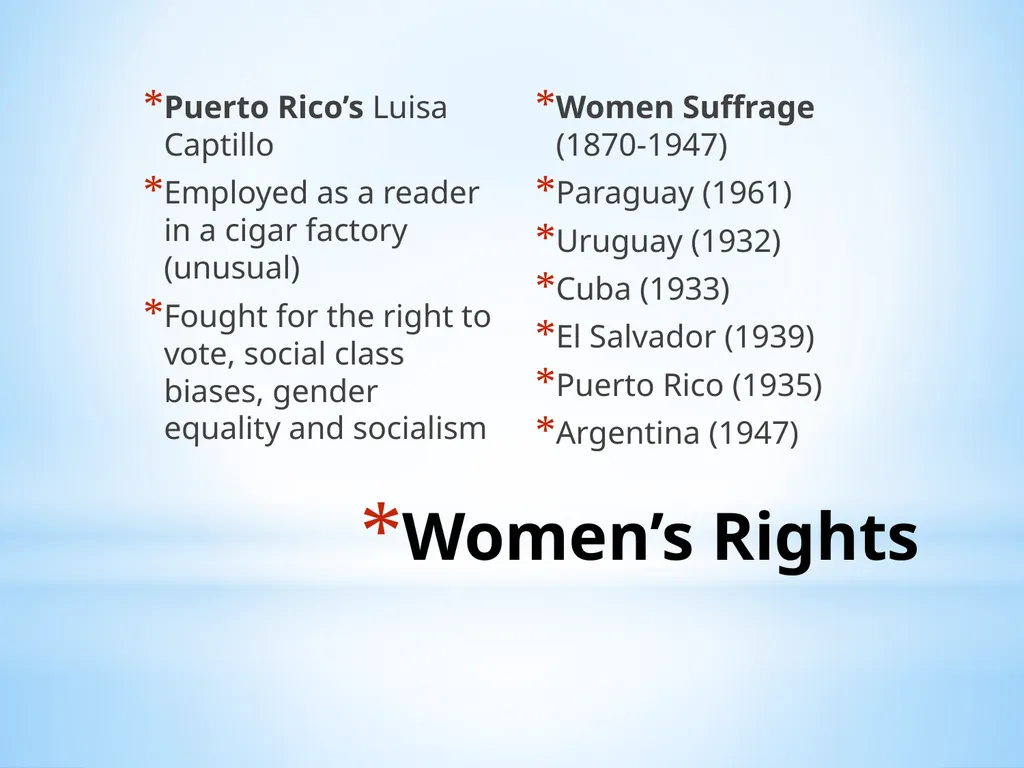
slide7. Women’s Rights Puerto Rico’s Luisa Captillo
Employed as a reader in a cigar factory (unusual)
Fought for the right to vote, social class biases, gender equality and socialism Women Suffrage (1870-1947)
Paraguay (1961)
Uruguay (1932)
Cuba (1933)
El Salvador (1939)
Puerto Rico (1935)
Argentina (1947)<br>
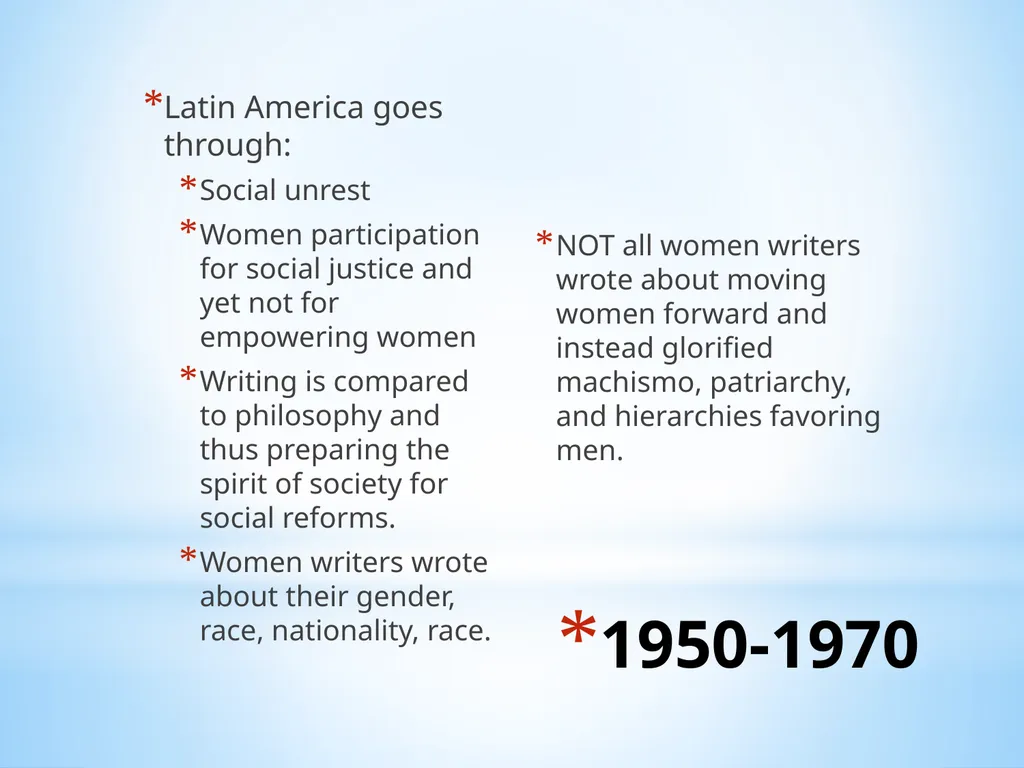
slide8. 1950-1970 Latin America goes through:
Social unrest
Women participation for social justice and yet not for empowering women
Writing is compared to philosophy and thus preparing the spirit of society for social reforms.
Women writers wrote about their gender, race, nationality, race. NOT all women writers wrote about moving women forward and instead glorified machismo, patriarchy, and hierarchies favoring men.<br>
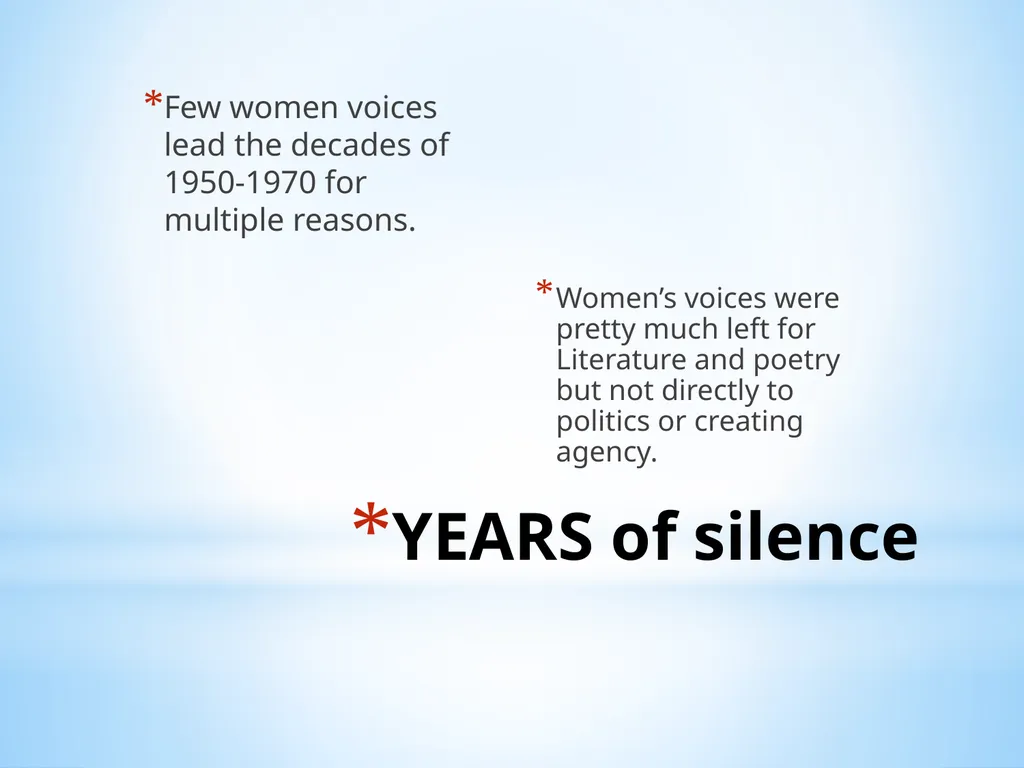
slide9. YEARS of silence Few women voices lead the decades of 1950-1970 for multiple reasons. Women’s voices were pretty much left for Literature and poetry but not directly to politics or creating agency.<br>
slide10. A look at “THE BODY” 1970-1990 Discourse dealing with sexual autonomy, rape, abuse, abortion, motherhood formed neofeminist perspectives among the feminists in Latina America during this time.<br>
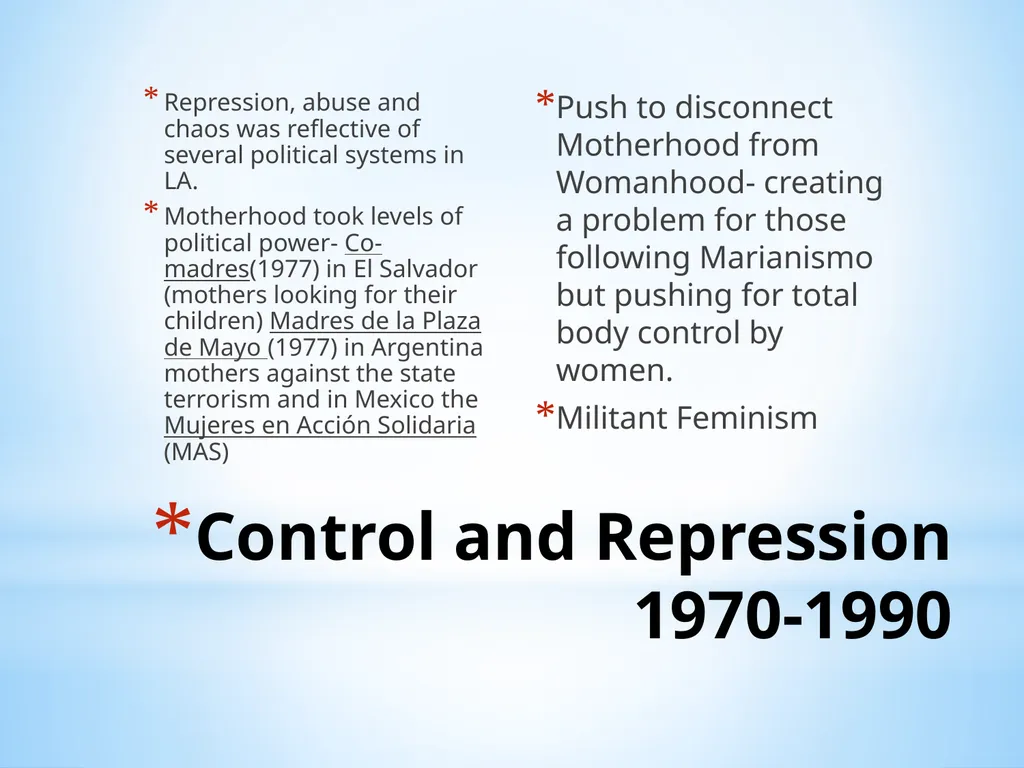
slide11. Control and Repression 1970-1990 Repression, abuse and chaos was reflective of several political systems in LA.
Motherhood took levels of political power- Co-madres(1977) in El Salvador (mothers looking for their children) Madres de la Plaza de Mayo (1977) in Argentina mothers against the state terrorism and in Mexico the Mujeres en Acción Solidaria (MAS) Push to disconnect Motherhood from Womanhood- creating a problem for those following Marianismo but pushing for total body control by women.
Militant Feminism<br>
slide12. Social Activism Increase on
NGOs
Cultural groups
Political groups against government repression
Groups for Gender Discussion and Defense Also more of:
Clinics
Abortion rights
Feminist media (film, magazines, books)
1981 The first Encuentro Feminista Latinoamericano y del Caribe (Bogotá, Colombia)<br>
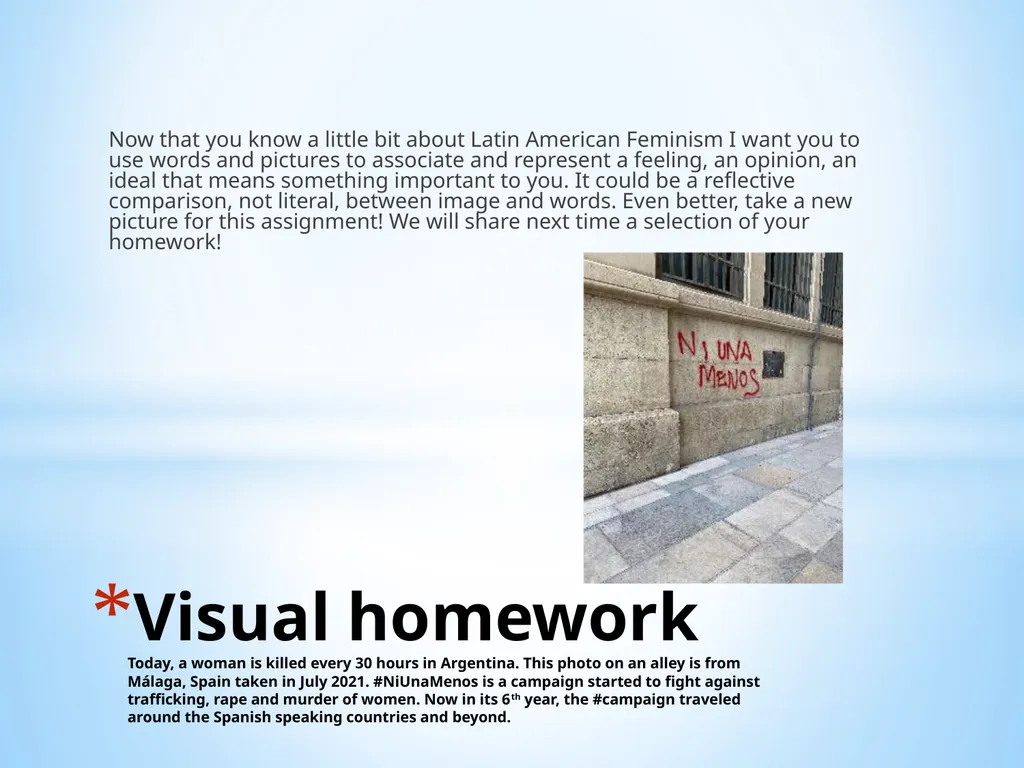
slide13. Now that you know a little bit about Latin American Feminism I want you to use words and pictures to associate and represent a feeling, an opinion, an ideal that means something important to you. It could be a reflective comparison, not literal, between image and words. Even better, take a new picture for this assignment! We will share next time a selection of your homework! Visual homework Today, a woman is killed every 30 hours in Argentina. This photo on an alley is from Málaga, Spain taken in July 2021. #NiUnaMenos is a campaign started to fight against trafficking, rape and murder of women. Now in its 6th year, the #campaign traveled around the Spanish speaking countries and beyond.<br>
slide14. 2 Main positions 1. Neither capitalism nor communism by themselves could end women’s oppression.
2. Feminism alone is not revolutionary due to its commitment to socialism. Thus, Feminism can’t be separated from class struggle. New dynamics Ever growing sentiment against homophobia, transphobia and gender bias.
Growing sentiment to understand race.
Dissolution of feminist groups coming out of church and political parties. Changing times (1980s)<br>
slide15. The war on HIV Due to the immediacy of HIV/AIDS epidemic in the sexuality and sexual lives of many women—sexual politics became very conservative. Sexual narratives moved to “narratives of the risks of sex”.<br>
slide16. 1990s In this decade- focused on gender equality and non-discrimination within institutions guided by neo-liberal policies.
Feminists started combining efforts with organizations that help empower women to fight violence, promote health and human rights.<br>
slide17. Dissident Voices of the 2000s and beyond Rosario Castellanos (Mexico)/ Celia Amorós (Spain) Ofelia Schutte (Cuba & US)/ María Lugones (Argentina)
A must read! Tejiendo de otro modo: feminism, espistemología y apuestas descoloniales en Abya Yala (2014)
Abya Yala in the Kuna language means “land in its full maturity” it is also used instead of “America”.<br>
slide18. Current Feminist Issues Giving voice to those voiceless with less privilege, less education, less opportunities.
Decolonial Feminism- a systemic critique of forms of power and powerless.
Depatriarchialization- resistance to capitalism, racism, homophobia and other forms of domination.
Racial and class differences that cut across the formations of identities in Latin America.<br>
slide19. Resources Bastian, Duarte, A. 2012 “From the Margins of Latin American Feminism: Indigenous and Lesbian Feminisms”, Signs: Journal of Women in Culture and Society, 38 (1): 153-178.
Connell, Raewyn, 2014 “Rethinking Gender from the South”, Feminist Studies, 40 (3): 518-539.
Kirkwood, Julieta, 1986, Ser Política en Chile: las feministas y los partidos, Santiago de Chile: FLASCO.<br>
slide20. Language Homework Please follow this link to the Juana Manso page for K-12 teaching
https://www.argentina.gob.ar/educacion/juana-manso
Please write a 250 word description/analyzis of the web page and some of the offerings. You are not able to sign in to open books but you can mention the selection available.<br>

Central/ South America and Caribbean Latin American Feminisms<br>
slide2. Definition The definition comes from a group of circumstances:
Colonialism
Enslavement of African peoples
Marginalization of Native peoples
FEMINISM then focuses on the critical work done by women fighting the previous circumstances for an equal place in society.<br>
slide3. More than one type of FEMINISM, thus the plural use of FEMINISMS More than one perspective! It becomes harder to generalize and easier to misjudge<br>
slide4. LA Feminisms The work and writings of women as “other” and “otherness”
Re-consider notions of men as the entry point of humanitity – language use here is prominently male, mankind, master and other binary considerations. Popular Culture Before the 19th Century women were celebrated in non-written form but remembered in myths, songs, proverbs and oral histories.
Some are Acacaona, Baraúnda,& Garifuna women. Pre-20th Century<br>
slide5. 18th Century famous feminists Sor Juana Inés de la Cruz (Mexican philosopher + Advocate for women’s intellect)
Teresa Margarida da Silva (Brazilian first woman author + Advocate for women’s interest in science and for native women) Flora Tristrán (Peruvian + Advocate for women as workers)
Juana Manso (Argentine abolitionist + Advocate for women’s education)<br>
slide6. Feminist Thoughts…before Feminism Mexican Revolution
Brought crucial revolutionary ideas (later to be considered Feminist ideas) such as education.
Women deputies on 1916 debated the right to vote/ abortion/contraception. Argentina’s First International Congress
Topics included:
PEACE
EDUCATION
SOCIAL PARTICIPATION<br>
slide7. Women’s Rights Puerto Rico’s Luisa Captillo
Employed as a reader in a cigar factory (unusual)
Fought for the right to vote, social class biases, gender equality and socialism Women Suffrage (1870-1947)
Paraguay (1961)
Uruguay (1932)
Cuba (1933)
El Salvador (1939)
Puerto Rico (1935)
Argentina (1947)<br>
slide8. 1950-1970 Latin America goes through:
Social unrest
Women participation for social justice and yet not for empowering women
Writing is compared to philosophy and thus preparing the spirit of society for social reforms.
Women writers wrote about their gender, race, nationality, race. NOT all women writers wrote about moving women forward and instead glorified machismo, patriarchy, and hierarchies favoring men.<br>
slide9. YEARS of silence Few women voices lead the decades of 1950-1970 for multiple reasons. Women’s voices were pretty much left for Literature and poetry but not directly to politics or creating agency.<br>
slide10. A look at “THE BODY” 1970-1990 Discourse dealing with sexual autonomy, rape, abuse, abortion, motherhood formed neofeminist perspectives among the feminists in Latina America during this time.<br>
slide11. Control and Repression 1970-1990 Repression, abuse and chaos was reflective of several political systems in LA.
Motherhood took levels of political power- Co-madres(1977) in El Salvador (mothers looking for their children) Madres de la Plaza de Mayo (1977) in Argentina mothers against the state terrorism and in Mexico the Mujeres en Acción Solidaria (MAS) Push to disconnect Motherhood from Womanhood- creating a problem for those following Marianismo but pushing for total body control by women.
Militant Feminism<br>
slide12. Social Activism Increase on
NGOs
Cultural groups
Political groups against government repression
Groups for Gender Discussion and Defense Also more of:
Clinics
Abortion rights
Feminist media (film, magazines, books)
1981 The first Encuentro Feminista Latinoamericano y del Caribe (Bogotá, Colombia)<br>
slide13. Now that you know a little bit about Latin American Feminism I want you to use words and pictures to associate and represent a feeling, an opinion, an ideal that means something important to you. It could be a reflective comparison, not literal, between image and words. Even better, take a new picture for this assignment! We will share next time a selection of your homework! Visual homework Today, a woman is killed every 30 hours in Argentina. This photo on an alley is from Málaga, Spain taken in July 2021. #NiUnaMenos is a campaign started to fight against trafficking, rape and murder of women. Now in its 6th year, the #campaign traveled around the Spanish speaking countries and beyond.<br>
slide14. 2 Main positions 1. Neither capitalism nor communism by themselves could end women’s oppression.
2. Feminism alone is not revolutionary due to its commitment to socialism. Thus, Feminism can’t be separated from class struggle. New dynamics Ever growing sentiment against homophobia, transphobia and gender bias.
Growing sentiment to understand race.
Dissolution of feminist groups coming out of church and political parties. Changing times (1980s)<br>
slide15. The war on HIV Due to the immediacy of HIV/AIDS epidemic in the sexuality and sexual lives of many women—sexual politics became very conservative. Sexual narratives moved to “narratives of the risks of sex”.<br>
slide16. 1990s In this decade- focused on gender equality and non-discrimination within institutions guided by neo-liberal policies.
Feminists started combining efforts with organizations that help empower women to fight violence, promote health and human rights.<br>
slide17. Dissident Voices of the 2000s and beyond Rosario Castellanos (Mexico)/ Celia Amorós (Spain) Ofelia Schutte (Cuba & US)/ María Lugones (Argentina)
A must read! Tejiendo de otro modo: feminism, espistemología y apuestas descoloniales en Abya Yala (2014)
Abya Yala in the Kuna language means “land in its full maturity” it is also used instead of “America”.<br>
slide18. Current Feminist Issues Giving voice to those voiceless with less privilege, less education, less opportunities.
Decolonial Feminism- a systemic critique of forms of power and powerless.
Depatriarchialization- resistance to capitalism, racism, homophobia and other forms of domination.
Racial and class differences that cut across the formations of identities in Latin America.<br>
slide19. Resources Bastian, Duarte, A. 2012 “From the Margins of Latin American Feminism: Indigenous and Lesbian Feminisms”, Signs: Journal of Women in Culture and Society, 38 (1): 153-178.
Connell, Raewyn, 2014 “Rethinking Gender from the South”, Feminist Studies, 40 (3): 518-539.
Kirkwood, Julieta, 1986, Ser Política en Chile: las feministas y los partidos, Santiago de Chile: FLASCO.<br>
slide20. Language Homework Please follow this link to the Juana Manso page for K-12 teaching
https://www.argentina.gob.ar/educacion/juana-manso
Please write a 250 word description/analyzis of the web page and some of the offerings. You are not able to sign in to open books but you can mention the selection available.<br>