WALT: - recognise how shadows are formed - investigate which materials block light to form shadows. Think back to what you have learned so far about light and answer the following questions as quickly as you can on a piece of paper! Starter
"WALT: - recognise how shadows are formed -" is the property of its rightful owner. Permission is granted to
download and print the materials on this website for personal, non-commercial use only, and to display it
on your personal computer provided you do not modify the materials and that you retain all copyright
notices contained in the materials. By downloading content from our website, you accept the terms of this
agreement.
Presentation Transcript
01
WALT: - recognise how shadows are formed
- investigate which materials block light to form shadows.<br>
02
Think back to what you have learned so far about light and answer the following questions as quickly as you can on a piece of paper! Starter Task Quick recap! Name at least 3 sources of light Describe how mirrors help us see things Write down three good things that the sun does Write down three dangers of the sun<br>
03
Today, we are going to focus on how shadows are formed and then you are going to use this knowledge to help you work out which materials block light to form shadows.<br>
04
Introduction– Shadow walk! Go into your garden or on a walk with an adult when it is sunny.
Make sure you are wearing sun cream and protecting yourself from the sun with sunglasses and a hat.
How many shadows can you spot?
How do you think the shadows are made?
What is needed to make a shadow?<br>
05
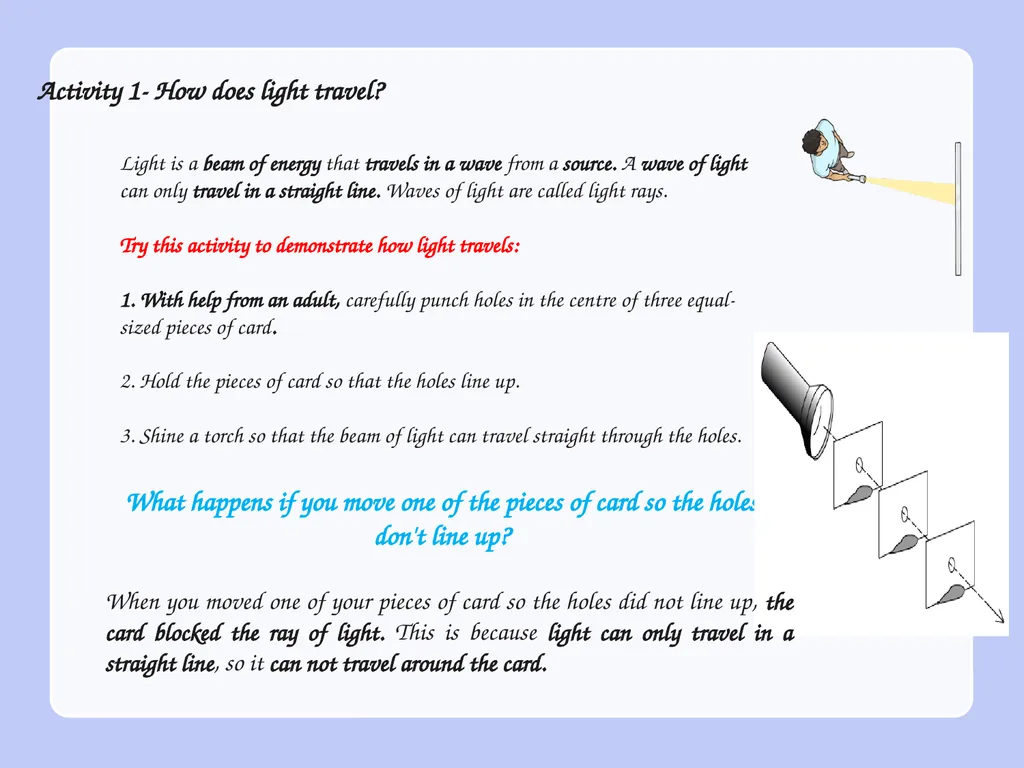
Activity 1- How does light travel? Light is a beam of energy that travels in a wave from a source. A wave of light can only travel in a straight line. Waves of light are called light rays.
Try this activity to demonstrate how light travels:
1. With help from an adult, carefully punch holes in the centre of three equal-sized pieces of card.
2. Hold the pieces of card so that the holes line up.
3. Shine a torch so that the beam of light can travel straight through the holes.
What happens if you move one of the pieces of card so the holes don't line up? When you moved one of your pieces of card so the holes did not line up, the card blocked the ray of light. This is because light can only travel in a straight line, so it can not travel around the card.<br>
06
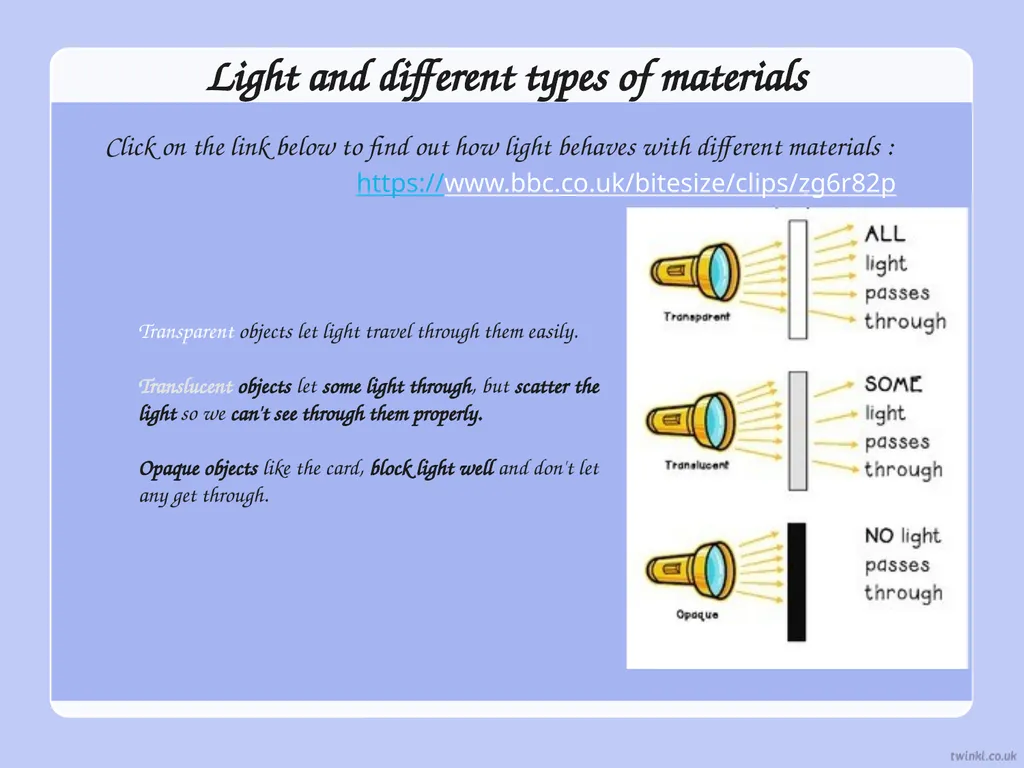
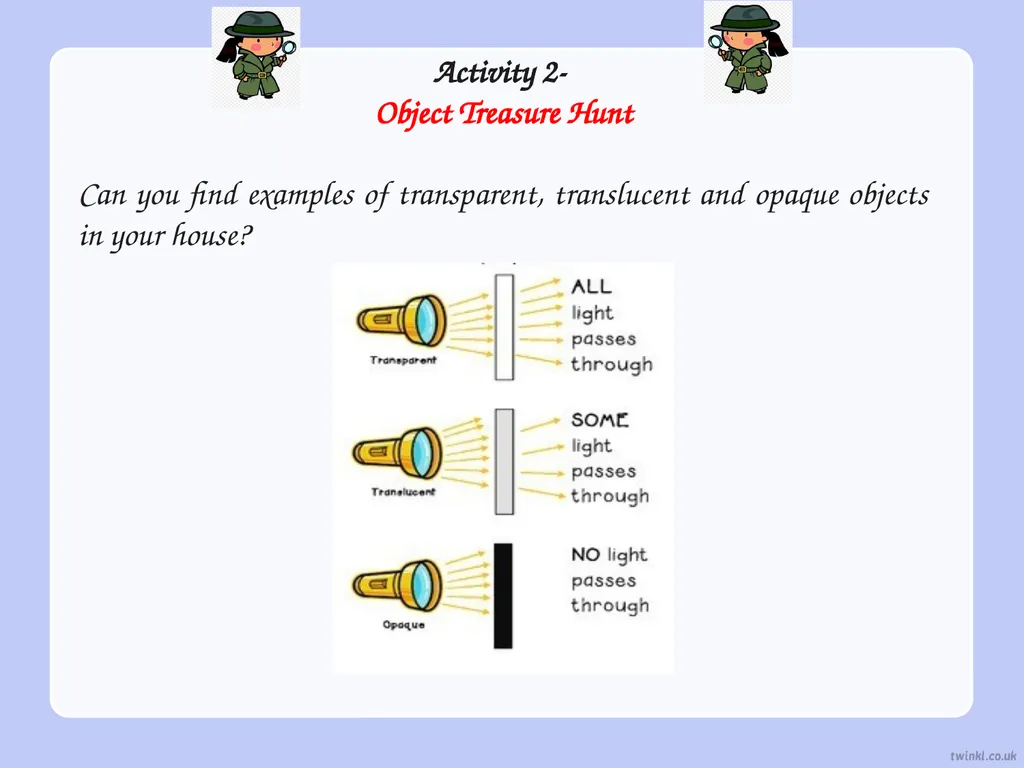
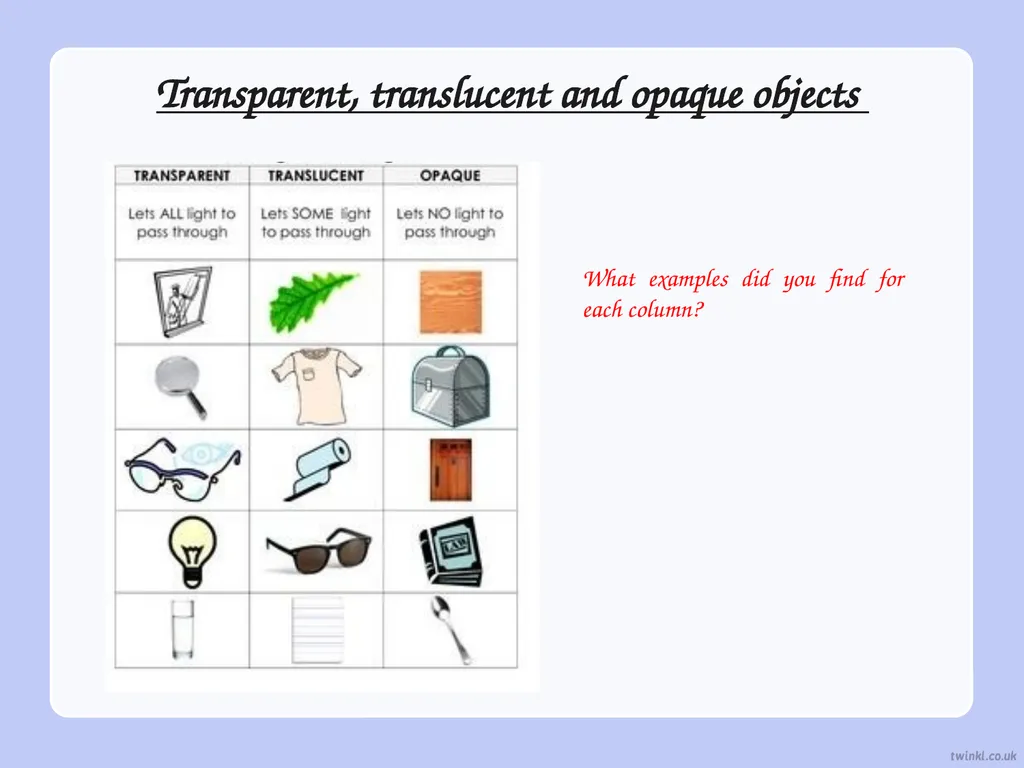
Light and different types of materials Transparent objects let light travel through them easily.
Translucent objects let some light through, but scatter the light so we can't see through them properly.
Opaque objects like the card, block light well and don't let any get through. Click on the link below to find out how light behaves with different materials : https://www.bbc.co.uk/bitesize/clips/zg6r82p<br>
07
Activity 2-
Object Treasure Hunt
Can you find examples of transparent, translucent and opaque objects in your house?<br>
08
Transparent, translucent and opaque objects What examples did you find for each column?<br>
09
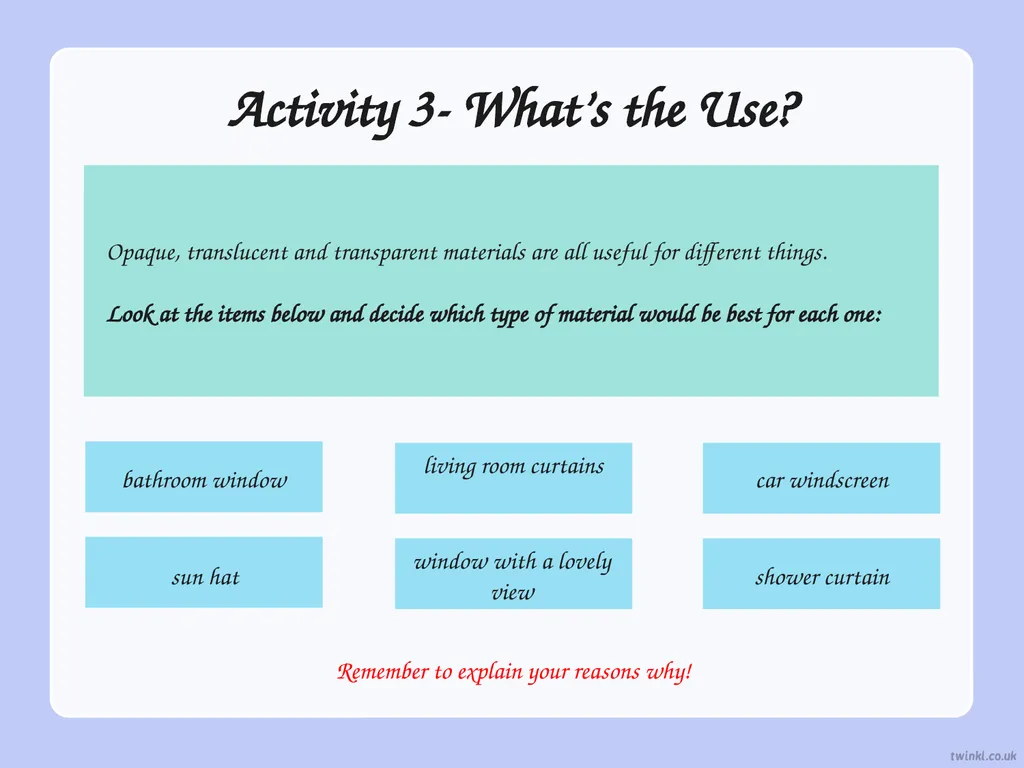
bathroom window living room curtains car windscreen shower curtain window with a lovely view sun hat Activity 3- What’s the Use? Opaque, translucent and transparent materials are all useful for different things.
Look at the items below and decide which type of material would be best for each one: Remember to explain your reasons why!<br>
10
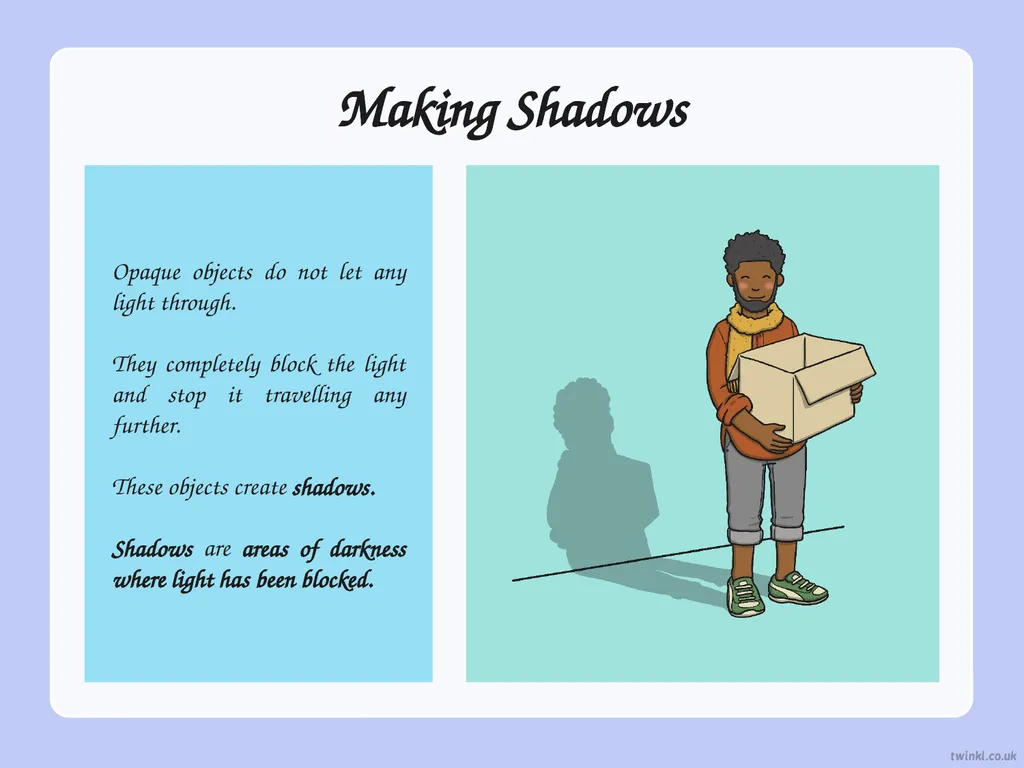
Making Shadows Opaque objects do not let any light through.
They completely block the light and stop it travelling any further.
These objects create shadows.
Shadows are areas of darkness where light has been blocked.<br>
11
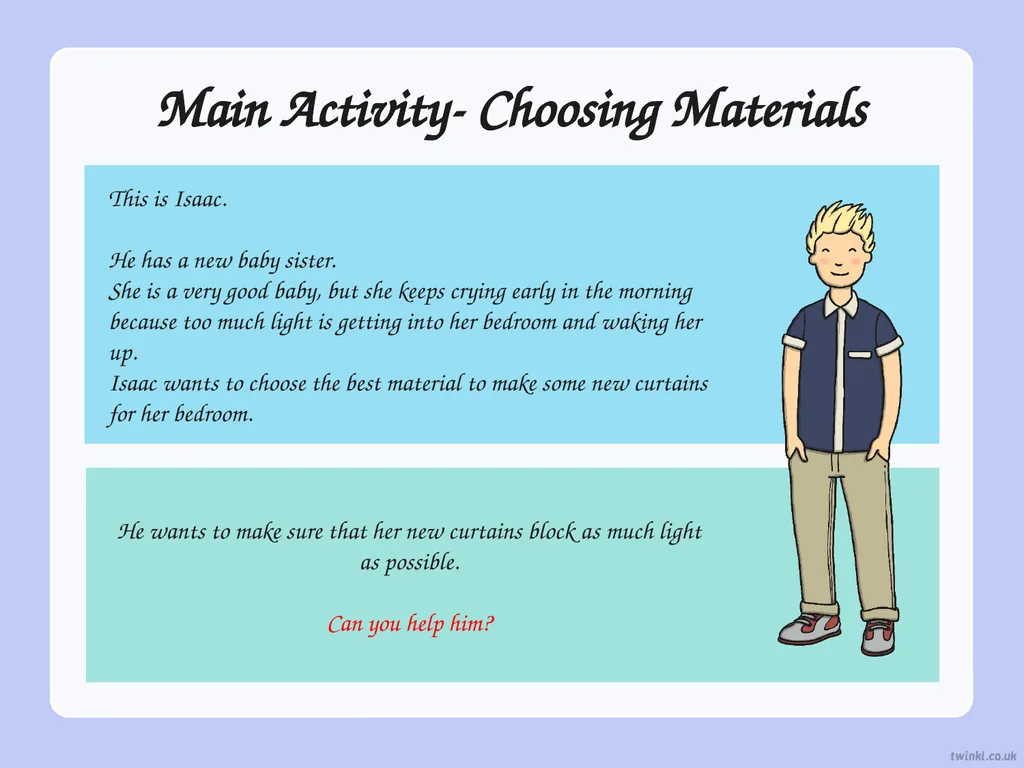
Main Activity- Choosing Materials This is Isaac.
He has a new baby sister.
She is a very good baby, but she keeps crying early in the morning because too much light is getting into her bedroom and waking her up.
Isaac wants to choose the best material to make some new curtains for her bedroom. He wants to make sure that her new curtains block as much light as possible.
Can you help him?<br>
12
Plenary Which materials did not let light through?