
Waltham Forest Reception Transfer Information –
AM
Published · 15 slides · 0 views
1 / 1
Description
Waltham Forest Reception Transfer Information children with SEND Eva Gunkova Agenda Introduction Timelines for choosing schools What to consider when choosing a school The transition process Code of practice SEND The Code of Practice
Related Topics
Share
Embed code
Download this presentation From Below
"Waltham Forest Reception Transfer Information –" is the property of its rightful owner. Permission is granted to download and print the materials on this website for personal, non-commercial use only, and to display it on your personal computer provided you do not modify the materials and that you retain all copyright notices contained in the materials. By downloading content from our website, you accept the terms of this agreement.
Presentation Transcript
01
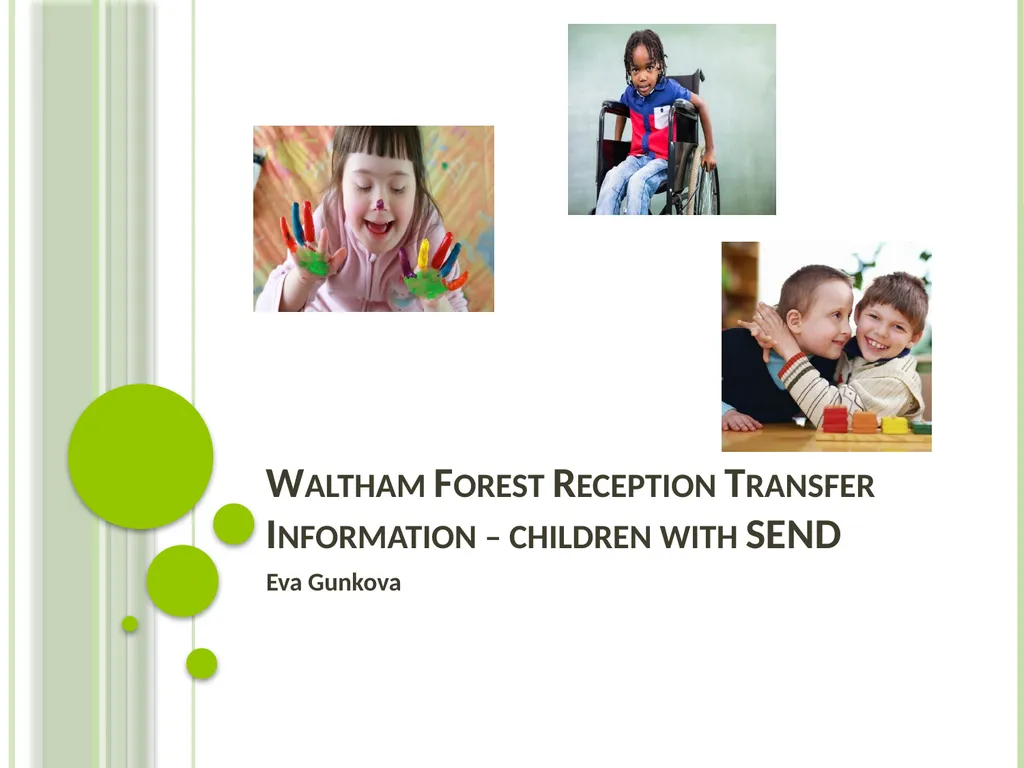
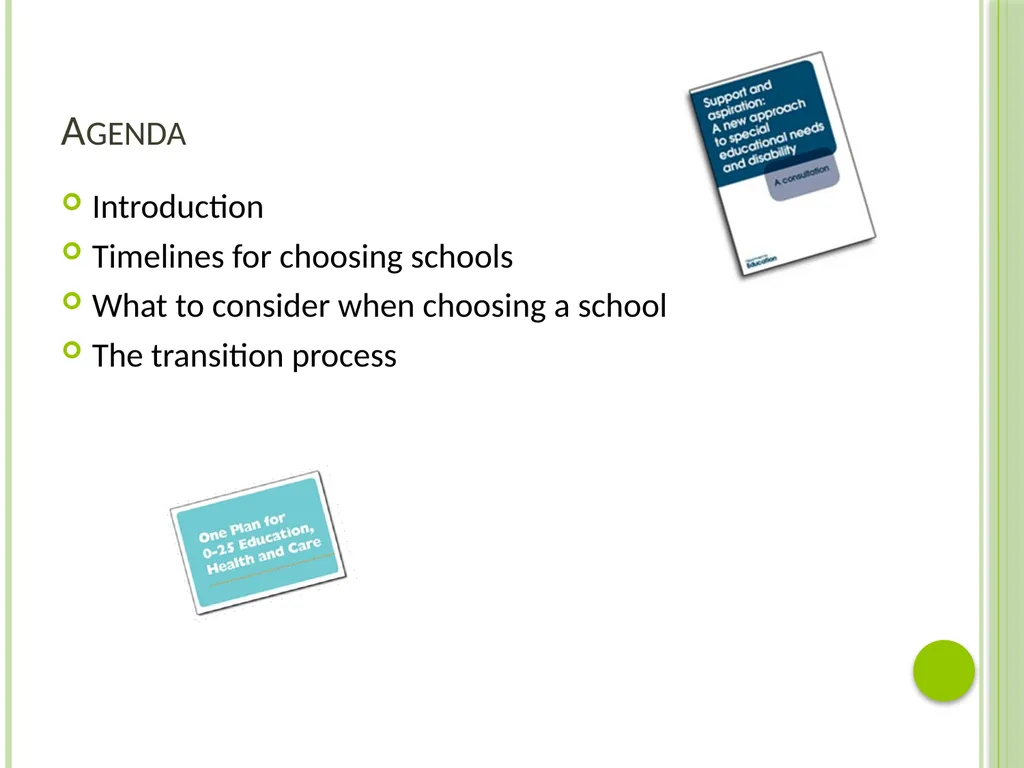
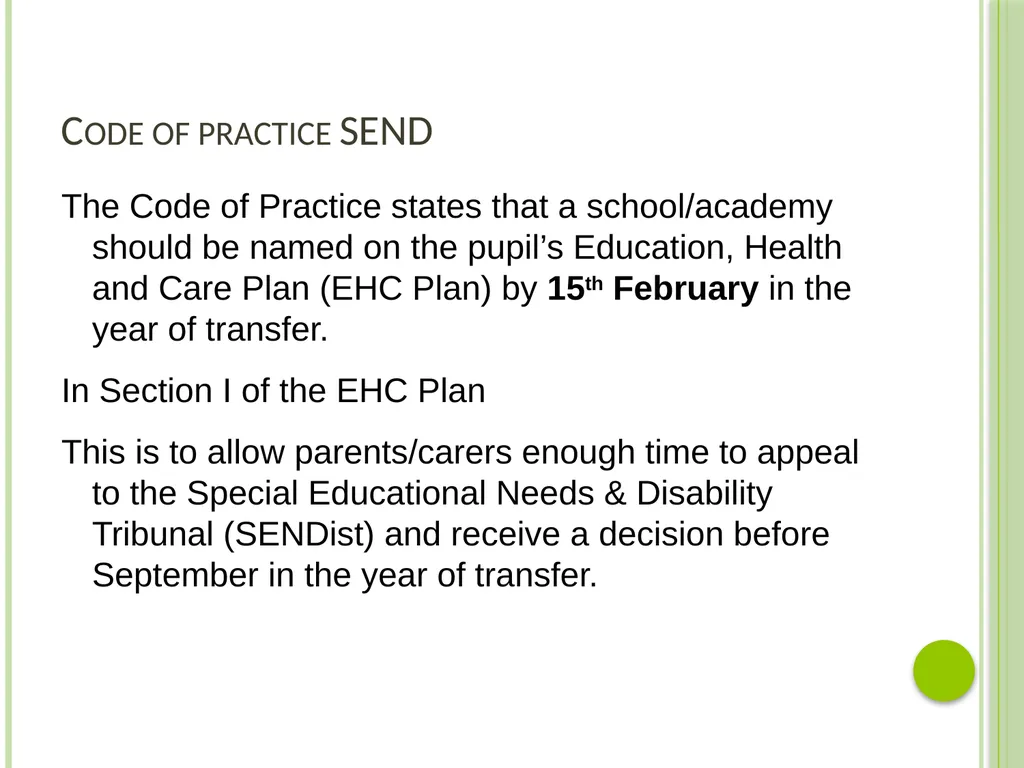
Waltham Forest Reception Transfer Information – children with SEND Eva Gunkova<br>
02
Agenda Introduction
Timelines for choosing schools
What to consider when choosing a school
The transition process<br>
Timelines for choosing schools
What to consider when choosing a school
The transition process<br>
03
Code of practice SEND The Code of Practice states that a school/academy should be named on the pupil’s Education, Health and Care Plan (EHC Plan) by 15th February in the year of transfer.
In Section I of the EHC Plan
This is to allow parents/carers enough time to appeal to the Special Educational Needs & Disability Tribunal (SENDist) and receive a decision before September in the year of transfer.<br>
In Section I of the EHC Plan
This is to allow parents/carers enough time to appeal to the Special Educational Needs & Disability Tribunal (SENDist) and receive a decision before September in the year of transfer.<br>
04
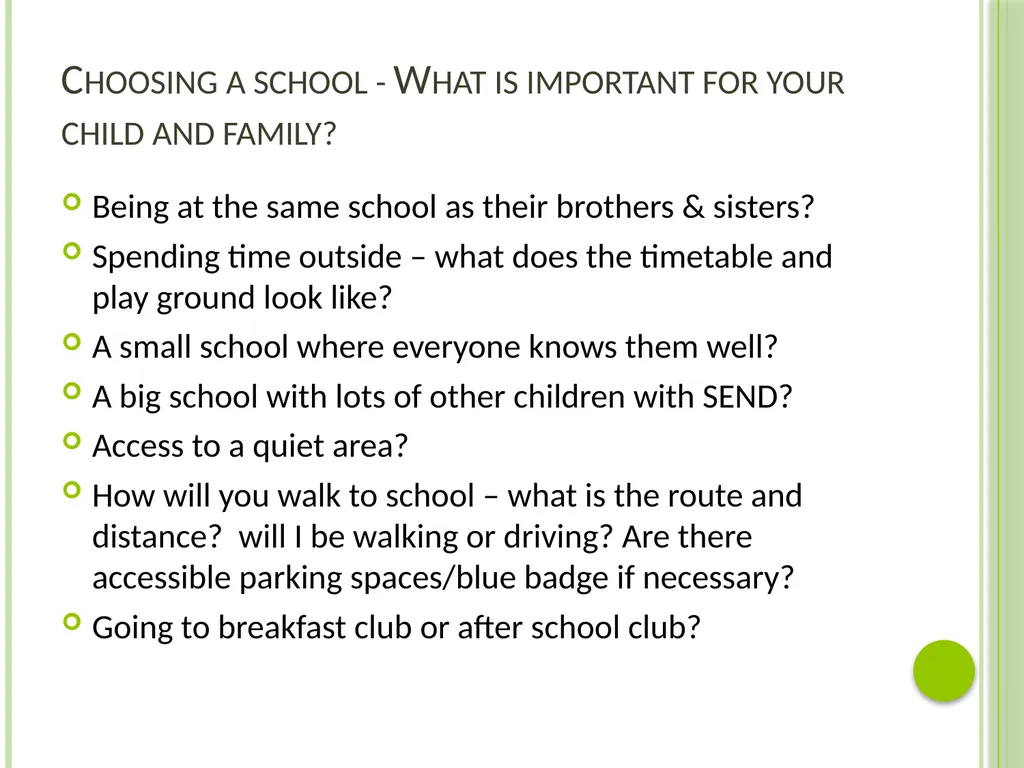
Choosing a school - What is important for your child and family? Being at the same school as their brothers & sisters?
Spending time outside – what does the timetable and play ground look like?
A small school where everyone knows them well?
A big school with lots of other children with SEND?
Access to a quiet area?
How will you walk to school – what is the route and distance? will I be walking or driving? Are there accessible parking spaces/blue badge if necessary?
Going to breakfast club or after school club?<br>
Spending time outside – what does the timetable and play ground look like?
A small school where everyone knows them well?
A big school with lots of other children with SEND?
Access to a quiet area?
How will you walk to school – what is the route and distance? will I be walking or driving? Are there accessible parking spaces/blue badge if necessary?
Going to breakfast club or after school club?<br>
05
How to choose a school – doing your research Visit the school website - SEN Policy, Behaviour Policy
Read the SEN Information report
Read the OFSTED report https://reports.ofsted.gov.uk/
Talking to other parents who have children already attending the school - particularly those who have a child with an EHCP or additional need and how the school are meeting their needs.
Contact the SENCOs of the schools on your shortlist and arrange a visit or see a virtual tour<br>
Read the SEN Information report
Read the OFSTED report https://reports.ofsted.gov.uk/
Talking to other parents who have children already attending the school - particularly those who have a child with an EHCP or additional need and how the school are meeting their needs.
Contact the SENCOs of the schools on your shortlist and arrange a visit or see a virtual tour<br>
06
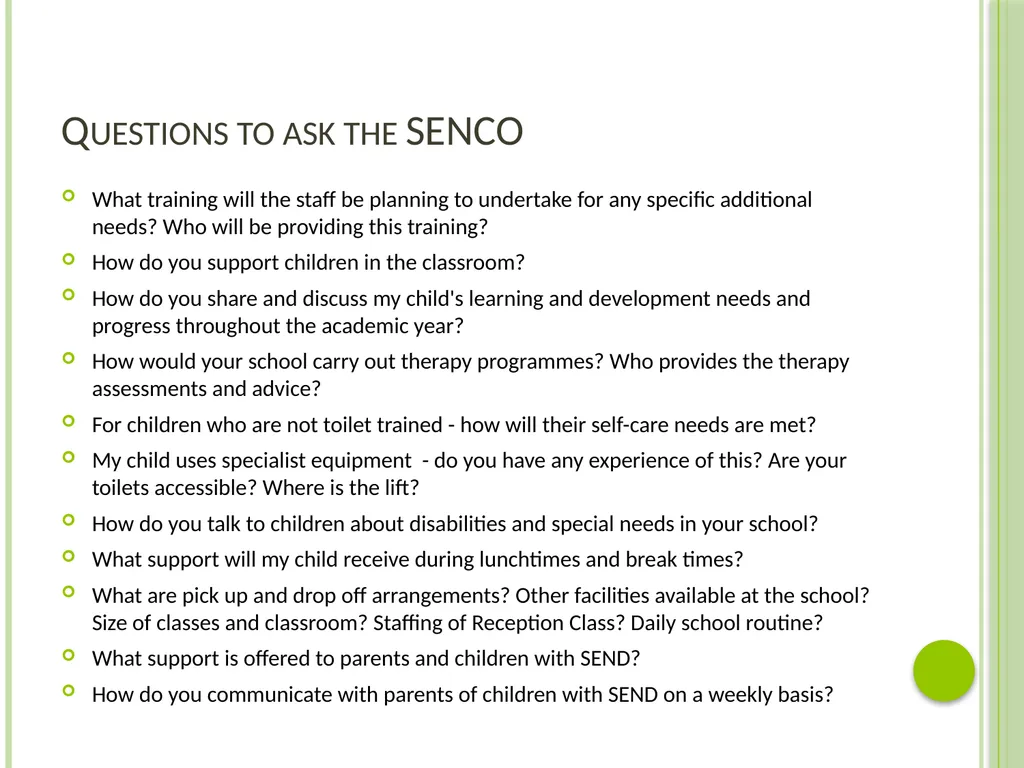
Questions to ask the SENCO What training will the staff be planning to undertake for any specific additional needs? Who will be providing this training?
How do you support children in the classroom?
How do you share and discuss my child's learning and development needs and progress throughout the academic year?
How would your school carry out therapy programmes? Who provides the therapy assessments and advice?
For children who are not toilet trained - how will their self-care needs are met?
My child uses specialist equipment - do you have any experience of this? Are your toilets accessible? Where is the lift?
How do you talk to children about disabilities and special needs in your school?
What support will my child receive during lunchtimes and break times?
What are pick up and drop off arrangements? Other facilities available at the school? Size of classes and classroom? Staffing of Reception Class? Daily school routine?
What support is offered to parents and children with SEND?
How do you communicate with parents of children with SEND on a weekly basis?<br>
How do you support children in the classroom?
How do you share and discuss my child's learning and development needs and progress throughout the academic year?
How would your school carry out therapy programmes? Who provides the therapy assessments and advice?
For children who are not toilet trained - how will their self-care needs are met?
My child uses specialist equipment - do you have any experience of this? Are your toilets accessible? Where is the lift?
How do you talk to children about disabilities and special needs in your school?
What support will my child receive during lunchtimes and break times?
What are pick up and drop off arrangements? Other facilities available at the school? Size of classes and classroom? Staffing of Reception Class? Daily school routine?
What support is offered to parents and children with SEND?
How do you communicate with parents of children with SEND on a weekly basis?<br>
07
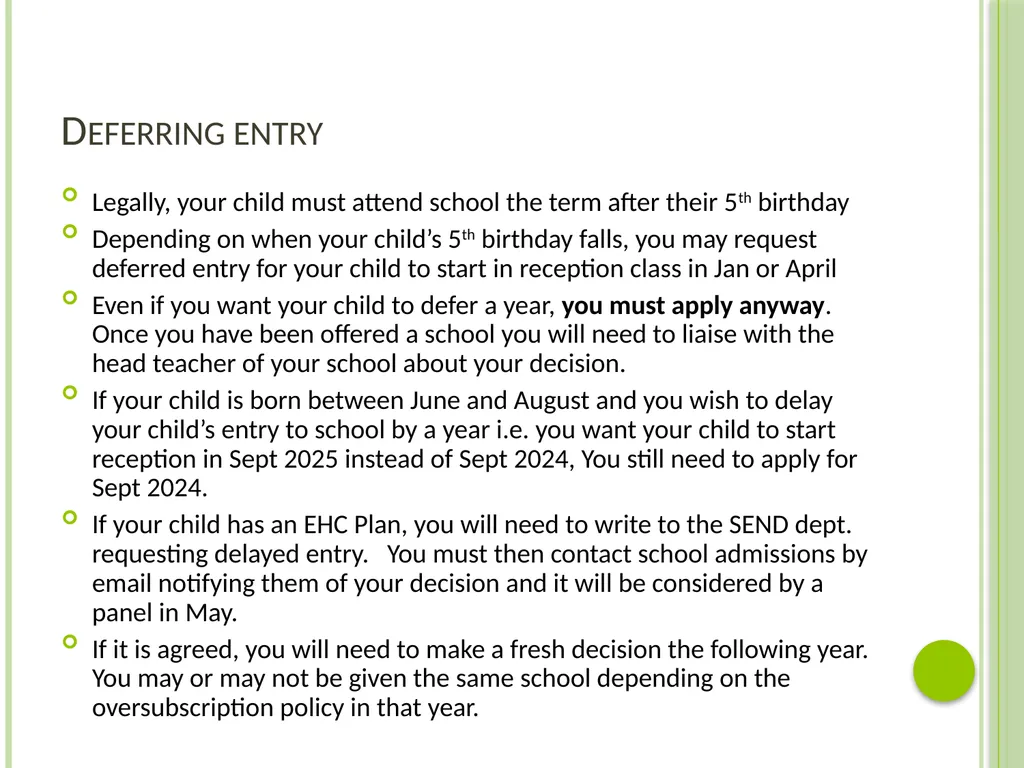
Deferring entry Legally, your child must attend school the term after their 5th birthday
Depending on when your child’s 5th birthday falls, you may request deferred entry for your child to start in reception class in Jan or April
Even if you want your child to defer a year, you must apply anyway. Once you have been offered a school you will need to liaise with the head teacher of your school about your decision.
If your child is born between June and August and you wish to delay your child’s entry to school by a year i.e. you want your child to start reception in Sept 2025 instead of Sept 2024, You still need to apply for Sept 2024.
If your child has an EHC Plan, you will need to write to the SEND dept. requesting delayed entry. You must then contact school admissions by email notifying them of your decision and it will be considered by a panel in May.
If it is agreed, you will need to make a fresh decision the following year. You may or may not be given the same school depending on the oversubscription policy in that year.<br>
Depending on when your child’s 5th birthday falls, you may request deferred entry for your child to start in reception class in Jan or April
Even if you want your child to defer a year, you must apply anyway. Once you have been offered a school you will need to liaise with the head teacher of your school about your decision.
If your child is born between June and August and you wish to delay your child’s entry to school by a year i.e. you want your child to start reception in Sept 2025 instead of Sept 2024, You still need to apply for Sept 2024.
If your child has an EHC Plan, you will need to write to the SEND dept. requesting delayed entry. You must then contact school admissions by email notifying them of your decision and it will be considered by a panel in May.
If it is agreed, you will need to make a fresh decision the following year. You may or may not be given the same school depending on the oversubscription policy in that year.<br>
08
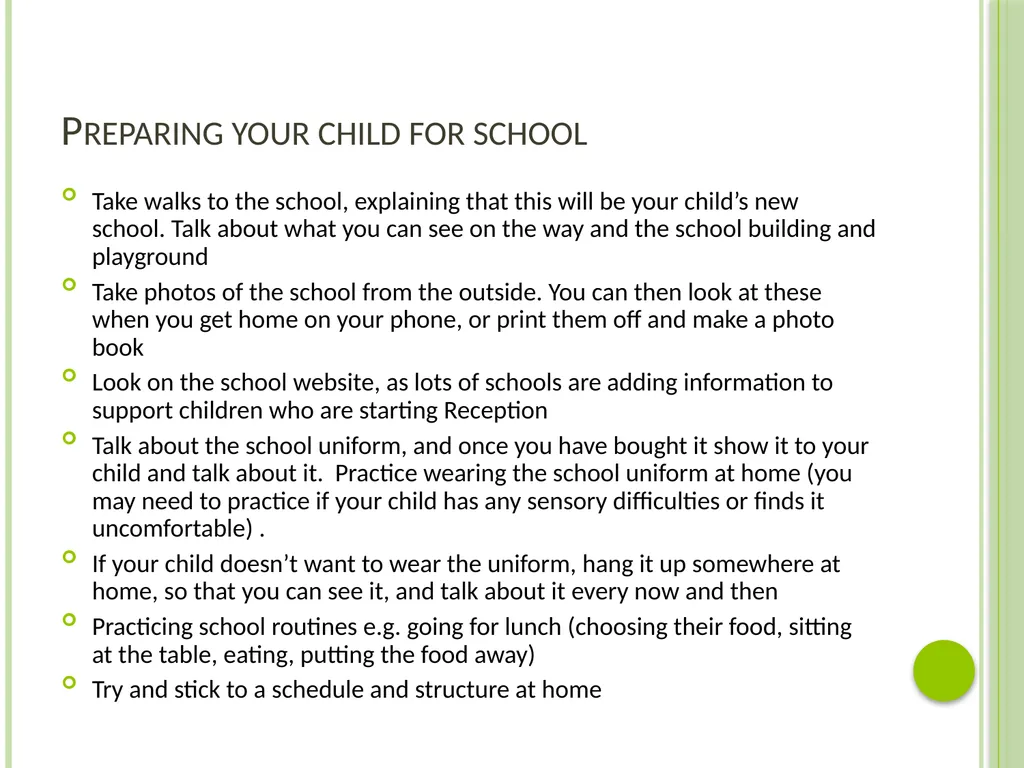
Preparing your child for school Take walks to the school, explaining that this will be your child’s new school. Talk about what you can see on the way and the school building and playground
Take photos of the school from the outside. You can then look at these when you get home on your phone, or print them off and make a photo book
Look on the school website, as lots of schools are adding information to support children who are starting Reception
Talk about the school uniform, and once you have bought it show it to your child and talk about it. Practice wearing the school uniform at home (you may need to practice if your child has any sensory difficulties or finds it uncomfortable) .
If your child doesn’t want to wear the uniform, hang it up somewhere at home, so that you can see it, and talk about it every now and then
Practicing school routines e.g. going for lunch (choosing their food, sitting at the table, eating, putting the food away)
Try and stick to a schedule and structure at home<br>
Take photos of the school from the outside. You can then look at these when you get home on your phone, or print them off and make a photo book
Look on the school website, as lots of schools are adding information to support children who are starting Reception
Talk about the school uniform, and once you have bought it show it to your child and talk about it. Practice wearing the school uniform at home (you may need to practice if your child has any sensory difficulties or finds it uncomfortable) .
If your child doesn’t want to wear the uniform, hang it up somewhere at home, so that you can see it, and talk about it every now and then
Practicing school routines e.g. going for lunch (choosing their food, sitting at the table, eating, putting the food away)
Try and stick to a schedule and structure at home<br>
09
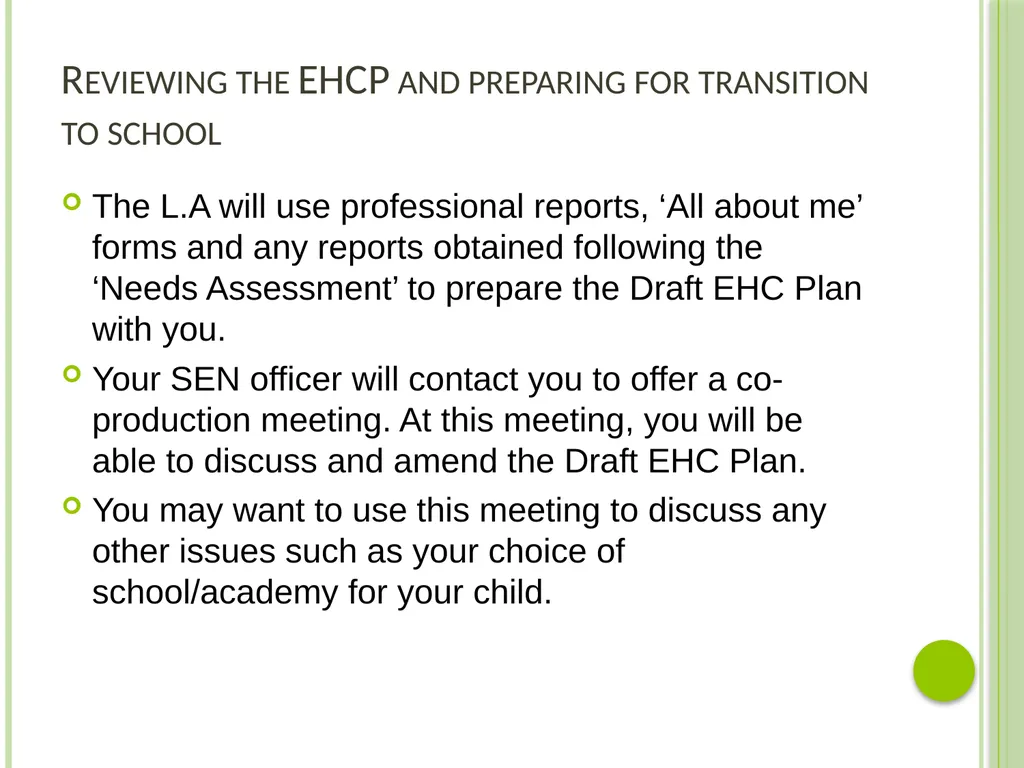
Reviewing the EHCP and preparing for transition to school The L.A will use professional reports, ‘All about me’ forms and any reports obtained following the ‘Needs Assessment’ to prepare the Draft EHC Plan with you.
Your SEN officer will contact you to offer a co-production meeting. At this meeting, you will be able to discuss and amend the Draft EHC Plan.
You may want to use this meeting to discuss any other issues such as your choice of school/academy for your child.<br>
Your SEN officer will contact you to offer a co-production meeting. At this meeting, you will be able to discuss and amend the Draft EHC Plan.
You may want to use this meeting to discuss any other issues such as your choice of school/academy for your child.<br>
10
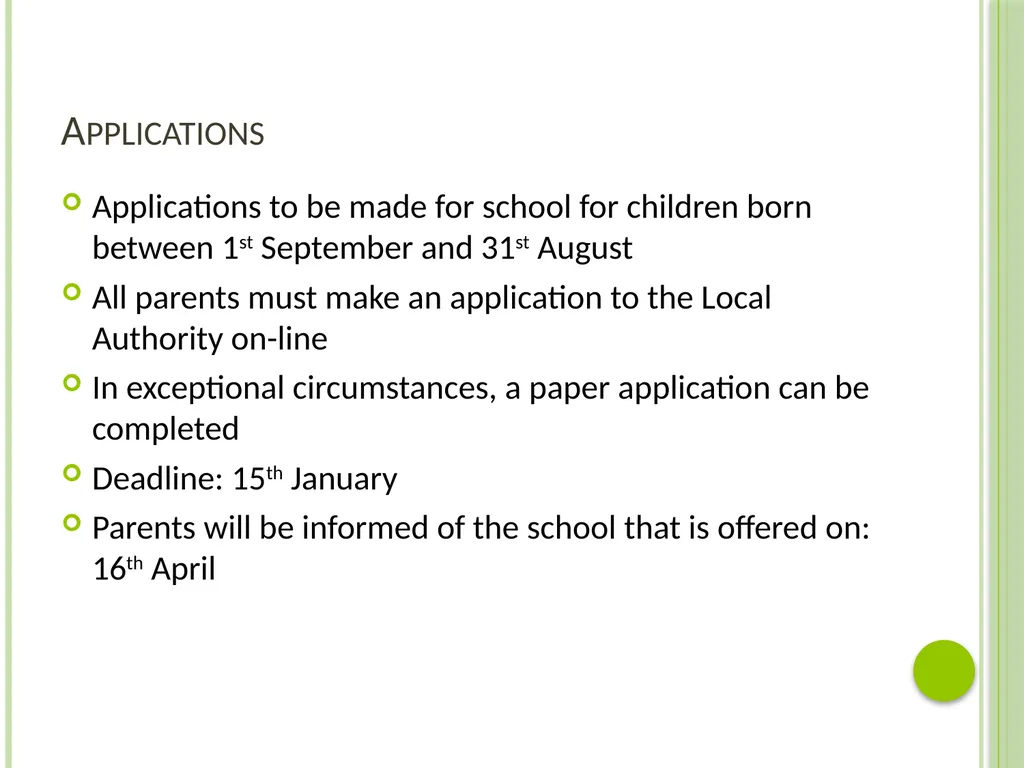
Applications Applications to be made for school for children born between 1st September and 31st August
All parents must make an application to the Local Authority on-line
In exceptional circumstances, a paper application can be completed
Deadline: 15th January
Parents will be informed of the school that is offered on: 16th April<br>
All parents must make an application to the Local Authority on-line
In exceptional circumstances, a paper application can be completed
Deadline: 15th January
Parents will be informed of the school that is offered on: 16th April<br>
11
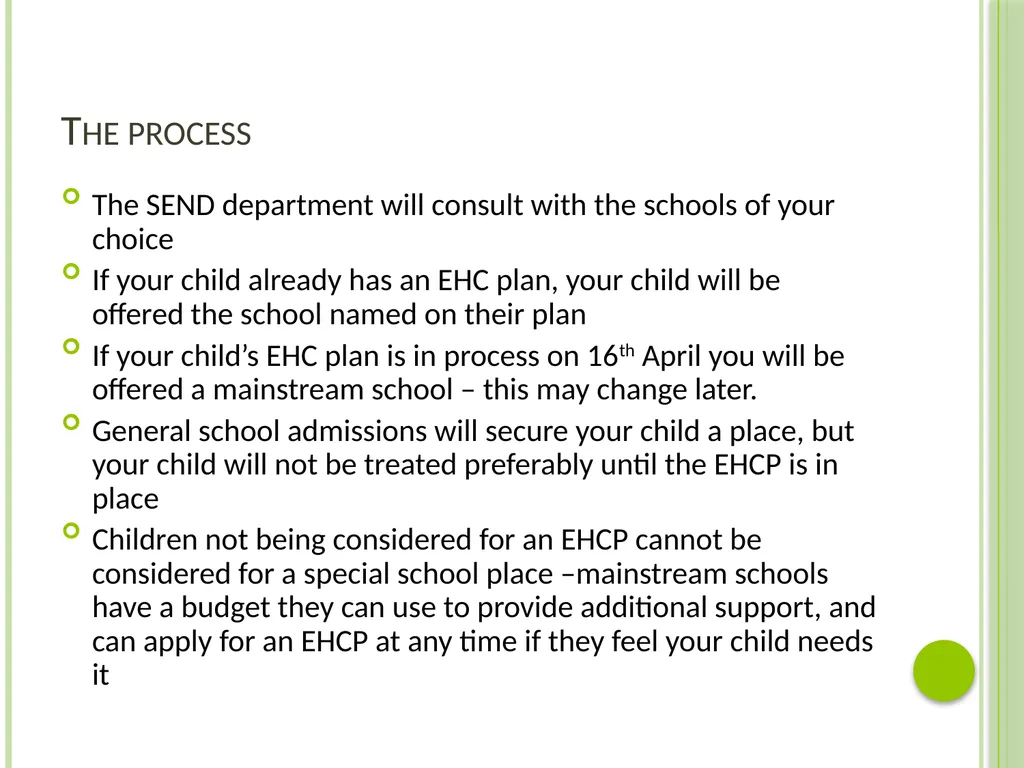
The process The SEND department will consult with the schools of your choice
If your child already has an EHC plan, your child will be offered the school named on their plan
If your child’s EHC plan is in process on 16th April you will be offered a mainstream school – this may change later.
General school admissions will secure your child a place, but your child will not be treated preferably until the EHCP is in place
Children not being considered for an EHCP cannot be considered for a special school place –mainstream schools have a budget they can use to provide additional support, and can apply for an EHCP at any time if they feel your child needs it<br>
If your child already has an EHC plan, your child will be offered the school named on their plan
If your child’s EHC plan is in process on 16th April you will be offered a mainstream school – this may change later.
General school admissions will secure your child a place, but your child will not be treated preferably until the EHCP is in place
Children not being considered for an EHCP cannot be considered for a special school place –mainstream schools have a budget they can use to provide additional support, and can apply for an EHCP at any time if they feel your child needs it<br>
12
Making a preference for out of borough Waltham Forest must write to the Local Authority where the school/academy is situated and also the head teacher of the school/academy.
Most L.A’s try to place children in their local community. If you ask for a school/academy outside of the L.A we may also consult with local schools/academies to ensure that your child has a place for September.<br>
Most L.A’s try to place children in their local community. If you ask for a school/academy outside of the L.A we may also consult with local schools/academies to ensure that your child has a place for September.<br>
13
Naming a school/academy The Code of Practice states that the LA must agree to a parental preference for a maintained school/academy unless the following applies:
the school /academy is unsuitable for the pupil’s age, ability, aptitude or to his/her special educational needs;
the attendance of the pupil at the school/academy would be incompatible with the provision of efficient education for the pupils with whom he/she would be educated ;
the placement is an inefficient use of the LA resources and there are no reasonable steps that the L.A or the school/academy could take to prevent the incompatibility.<br>
the school /academy is unsuitable for the pupil’s age, ability, aptitude or to his/her special educational needs;
the attendance of the pupil at the school/academy would be incompatible with the provision of efficient education for the pupils with whom he/she would be educated ;
the placement is an inefficient use of the LA resources and there are no reasonable steps that the L.A or the school/academy could take to prevent the incompatibility.<br>
14
Resource bases and Special Schools The Special Schools in Waltham Forest are as follows:
Margaret Brearley, Peter Turner, Neils Chapman, Joseph Clarke – Visual Impairment – Whitefield special schools
Brookside and William Morris – Hornbeam special schools
Waltham Forest also has some schools with a resource bases, which is a school with additional resources for a certain number of children with additional needs
Primary resource bases: South Grove, Hillyfield, Woodside, Davies Lane
The SEN department can name a school which has a resource base, but cannot name the resource base on a child’s EHC plan.<br>
Margaret Brearley, Peter Turner, Neils Chapman, Joseph Clarke – Visual Impairment – Whitefield special schools
Brookside and William Morris – Hornbeam special schools
Waltham Forest also has some schools with a resource bases, which is a school with additional resources for a certain number of children with additional needs
Primary resource bases: South Grove, Hillyfield, Woodside, Davies Lane
The SEN department can name a school which has a resource base, but cannot name the resource base on a child’s EHC plan.<br>
15
Supporting children with medical needs in school Supporting Children with Medical Needs in School
On 1 September 2014 a new duty came into force for governing bodies of schools to make arrangements to support pupils at school with medical conditions.
Key points
Pupils at school with medical conditions should be properly supported so that they have full access to education, including school trips and physical education.
Governing bodies must ensure that arrangements are in place in schools to support pupils at school with medical conditions.
Governing bodies should ensure that school leaders consult health and social care professionals, pupils and parents to ensure that the needs of children with medical conditions are effectively supported.
You and your child may be worried about attending school if they have a complex medical condition. When you speak to your child’s school, you can ask them who has the responsibility for ensuring your child’s medical needs are met. This may be the school’s Special Educational Needs Co-ordinator.
You can ask:
Who is responsible for ensuring that staff are suitably trained? This might be the school nurse or specialist nurse from your child’s hospital
How staff in school will be made aware of your child’s condition? This is likely to be through sharing of a health care plan and training to staff. It should include conversations with yourself and your child
Who will ensure cover arrangements in case of staff absence to make sure someone is always available? Check that you know who will be aware of your child’s needs if their teacher is away
How will trips and holidays, and after school activities be risk assessed? The school will be able to tell you how staff who are less familiar with your child will be trained
Who will monitoring the individual healthcare plans? This is likely to be the trained school staff in consultation with the school nursing team<br>
On 1 September 2014 a new duty came into force for governing bodies of schools to make arrangements to support pupils at school with medical conditions.
Key points
Pupils at school with medical conditions should be properly supported so that they have full access to education, including school trips and physical education.
Governing bodies must ensure that arrangements are in place in schools to support pupils at school with medical conditions.
Governing bodies should ensure that school leaders consult health and social care professionals, pupils and parents to ensure that the needs of children with medical conditions are effectively supported.
You and your child may be worried about attending school if they have a complex medical condition. When you speak to your child’s school, you can ask them who has the responsibility for ensuring your child’s medical needs are met. This may be the school’s Special Educational Needs Co-ordinator.
You can ask:
Who is responsible for ensuring that staff are suitably trained? This might be the school nurse or specialist nurse from your child’s hospital
How staff in school will be made aware of your child’s condition? This is likely to be through sharing of a health care plan and training to staff. It should include conversations with yourself and your child
Who will ensure cover arrangements in case of staff absence to make sure someone is always available? Check that you know who will be aware of your child’s needs if their teacher is away
How will trips and holidays, and after school activities be risk assessed? The school will be able to tell you how staff who are less familiar with your child will be trained
Who will monitoring the individual healthcare plans? This is likely to be the trained school staff in consultation with the school nursing team<br>