
Washington Capital ICEAA Chapter Luncheon July 27,
T
Published · 24 slides · 0 views

1 / 1



Description
Washington Capital ICEAA Chapter Luncheon July 27, 2016 Training Cost Analysts A Cohesive Pedagogical Framework for Success Kammy Mann Herren Associates The purpose of this effort was to identify: the current state of the Cost Analyst
Related Topics
Share
Embed code
Download this presentation From Below
"Washington Capital ICEAA Chapter Luncheon July 27," is the property of its rightful owner. Permission is granted to download and print the materials on this website for personal, non-commercial use only, and to display it on your personal computer provided you do not modify the materials and that you retain all copyright notices contained in the materials. By downloading content from our website, you accept the terms of this agreement.
Presentation Transcript
01
Washington Capital ICEAA Chapter Luncheon
July 27, 2016 Training Cost Analysts A Cohesive Pedagogical Framework for Success Kammy Mann
Herren Associates<br>
July 27, 2016 Training Cost Analysts A Cohesive Pedagogical Framework for Success Kammy Mann
Herren Associates<br>
02
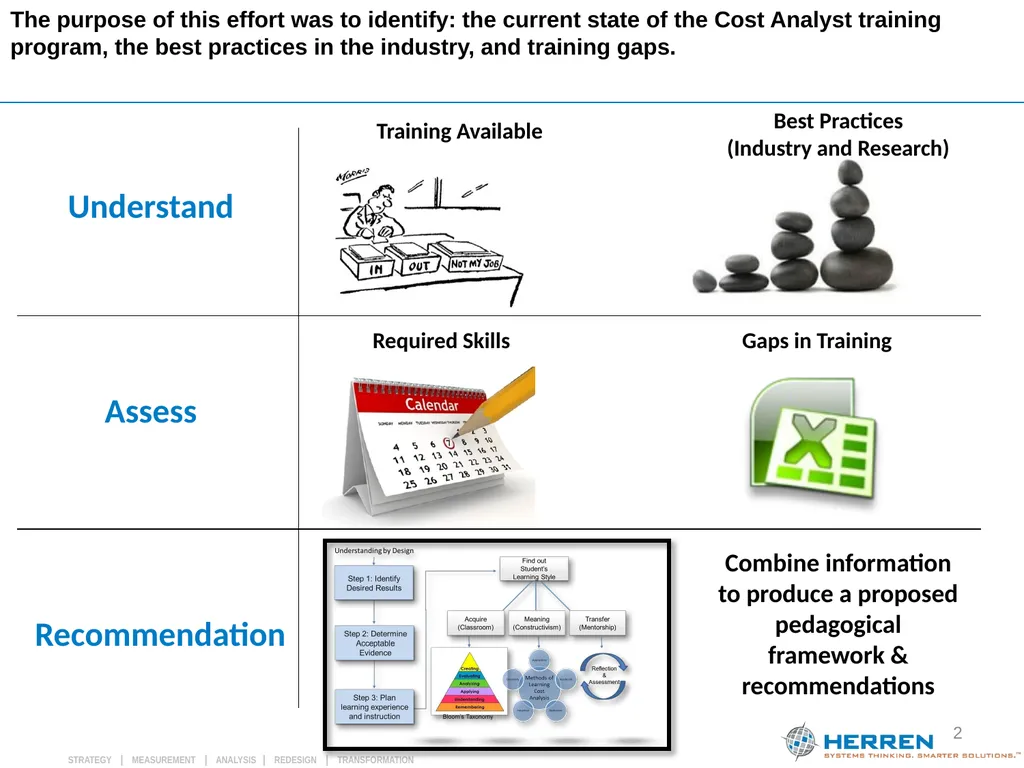
The purpose of this effort was to identify: the current state of the Cost Analyst training program, the best practices in the industry, and training gaps. Understand Assess Recommendation Combine information to produce a proposed pedagogical framework & recommendations Training Available Best Practices
(Industry and Research) Gaps in Training Required Skills 2<br>
(Industry and Research) Gaps in Training Required Skills 2<br>
03
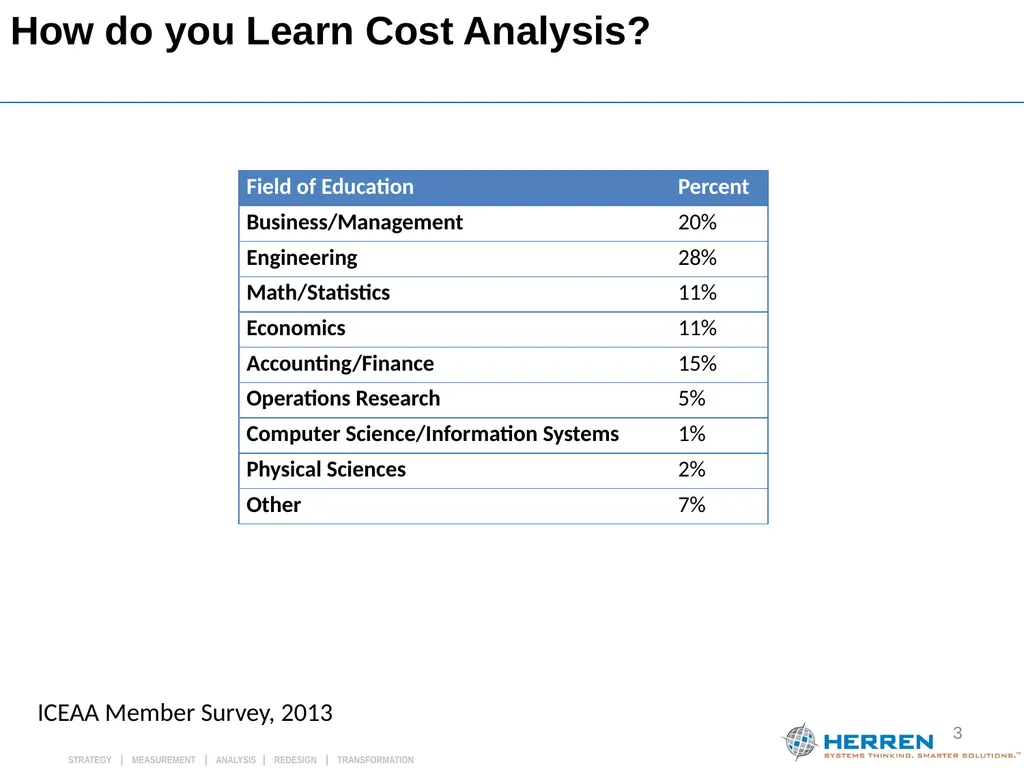
How do you Learn Cost Analysis? 3 ICEAA Member Survey, 2013<br>
04
Current State/Challenges 4 Cost Analysis is not an easy profession!
Training employees cost time, money and materials
There are currently no common or consistent training requirements for cost analysts
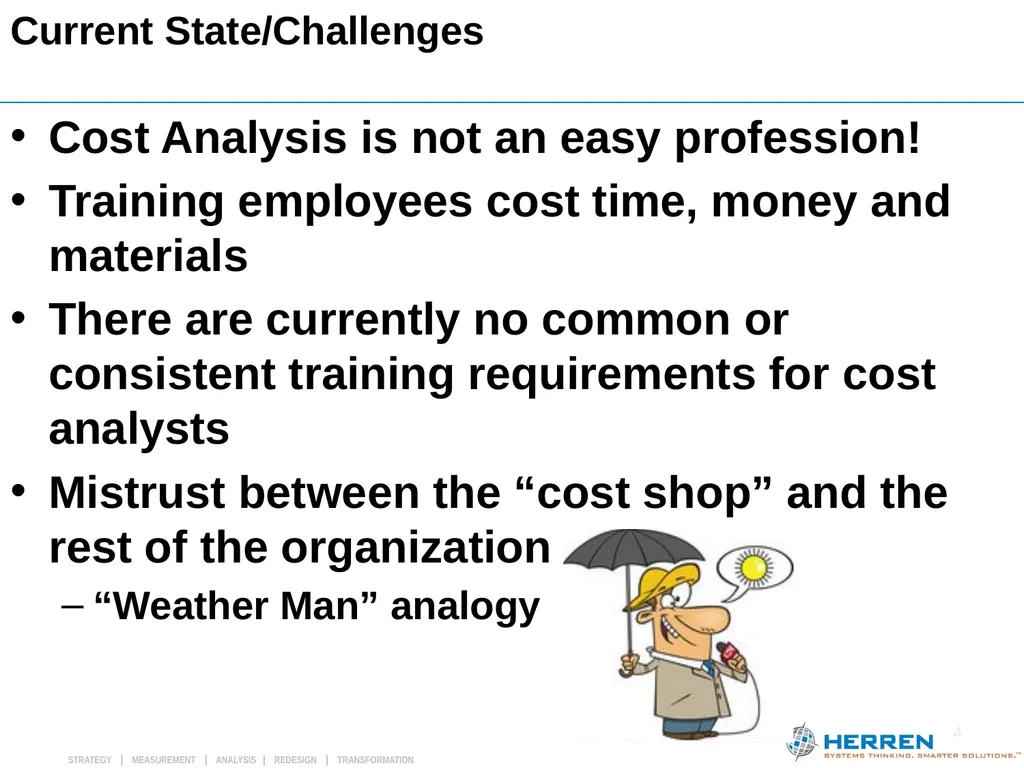
Mistrust between the “cost shop” and the rest of the organization
“Weather Man” analogy<br>
Training employees cost time, money and materials
There are currently no common or consistent training requirements for cost analysts
Mistrust between the “cost shop” and the rest of the organization
“Weather Man” analogy<br>
05
Importance of Training 5 Training employees costs time, money, and materials
Research has shown that not training employees leads to discontentment and turn over
Time and Money can be lost when untrained workers make mistakes, re-work occurs, and inadequate products are delivered<br>
Research has shown that not training employees leads to discontentment and turn over
Time and Money can be lost when untrained workers make mistakes, re-work occurs, and inadequate products are delivered<br>
06
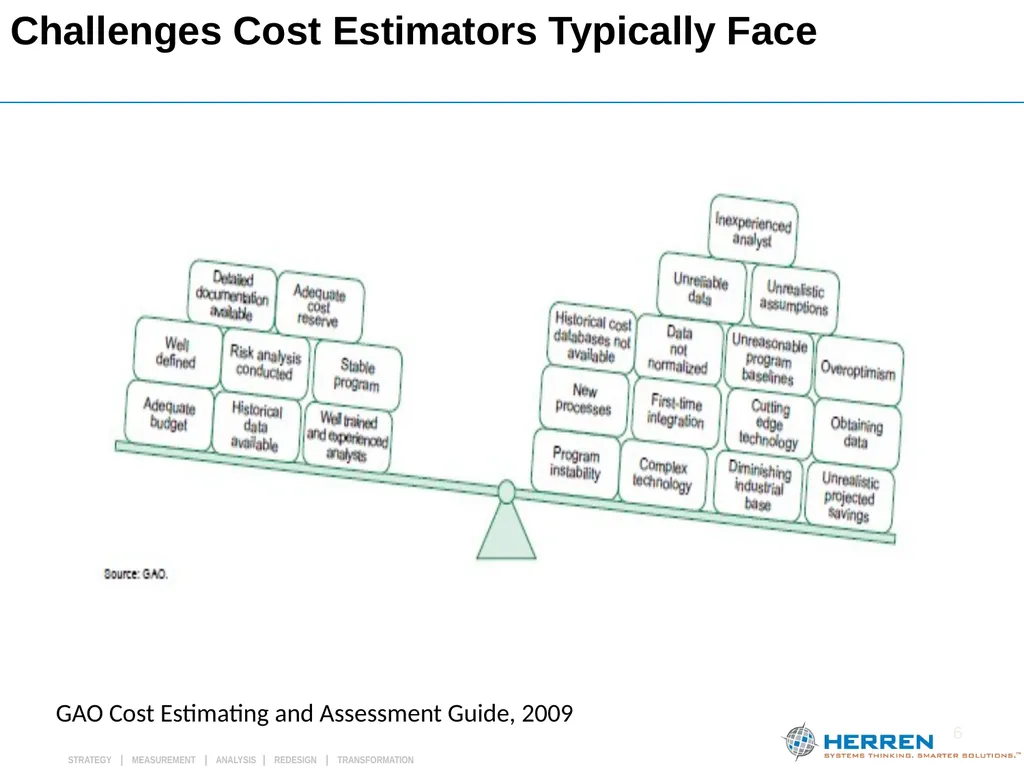
Challenges Cost Estimators Typically Face 6 GAO Cost Estimating and Assessment Guide, 2009<br>
07
Academic Literature Review 7 Research was taken from the field of Engineering Education
Students learn by doing design/hands-on activities vs. traditional lectures (“Sage on the Stage”)
Problem/Project based learning shows higher knowledge retention rates
Constructivism – knowledge is learned through experience
Continuous feedback and assessment, tailor to individual student’s learning style
Cooperative/cross-functional team learning is integral to prepare students for the work force<br>
Students learn by doing design/hands-on activities vs. traditional lectures (“Sage on the Stage”)
Problem/Project based learning shows higher knowledge retention rates
Constructivism – knowledge is learned through experience
Continuous feedback and assessment, tailor to individual student’s learning style
Cooperative/cross-functional team learning is integral to prepare students for the work force<br>
08
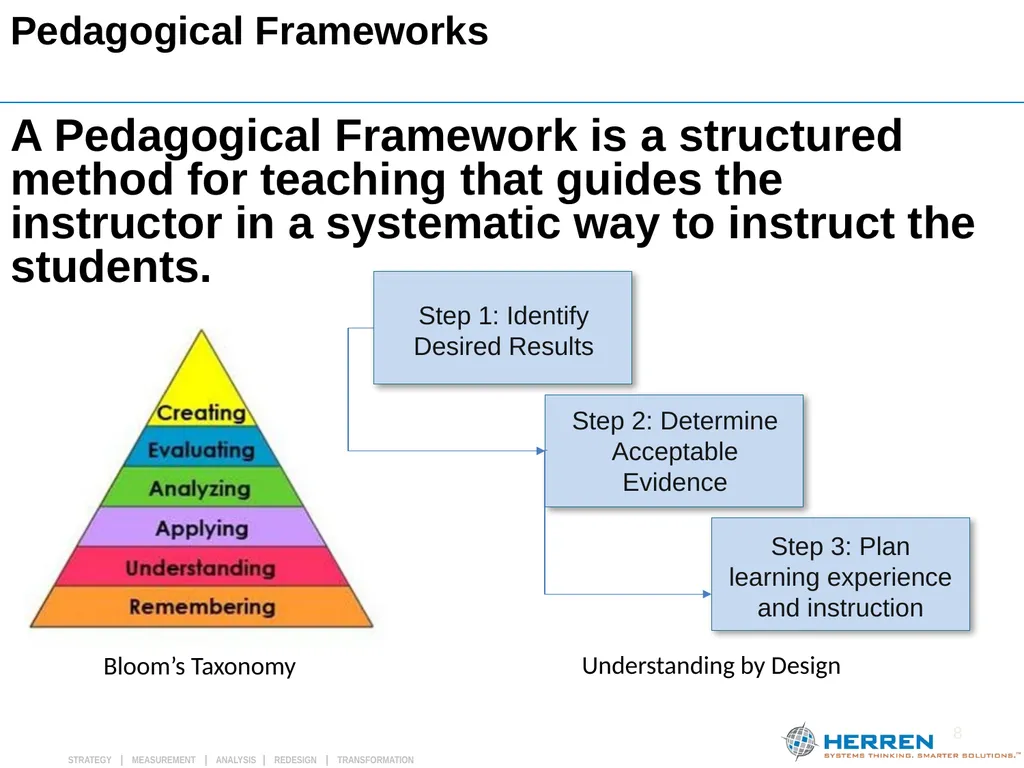
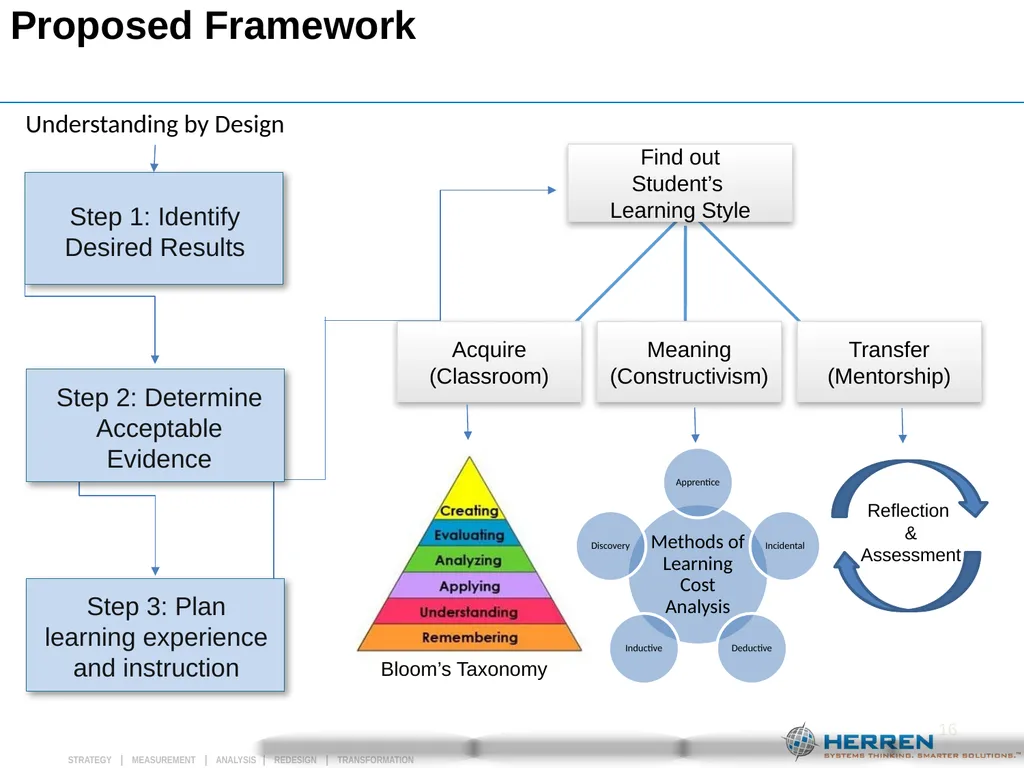
Pedagogical Frameworks 8 A Pedagogical Framework is a structured method for teaching that guides the instructor in a systematic way to instruct the students. Bloom’s Taxonomy Understanding by Design Step 1: Identify Desired Results Step 2: Determine Acceptable Evidence Step 3: Plan learning experience and instruction<br>
09
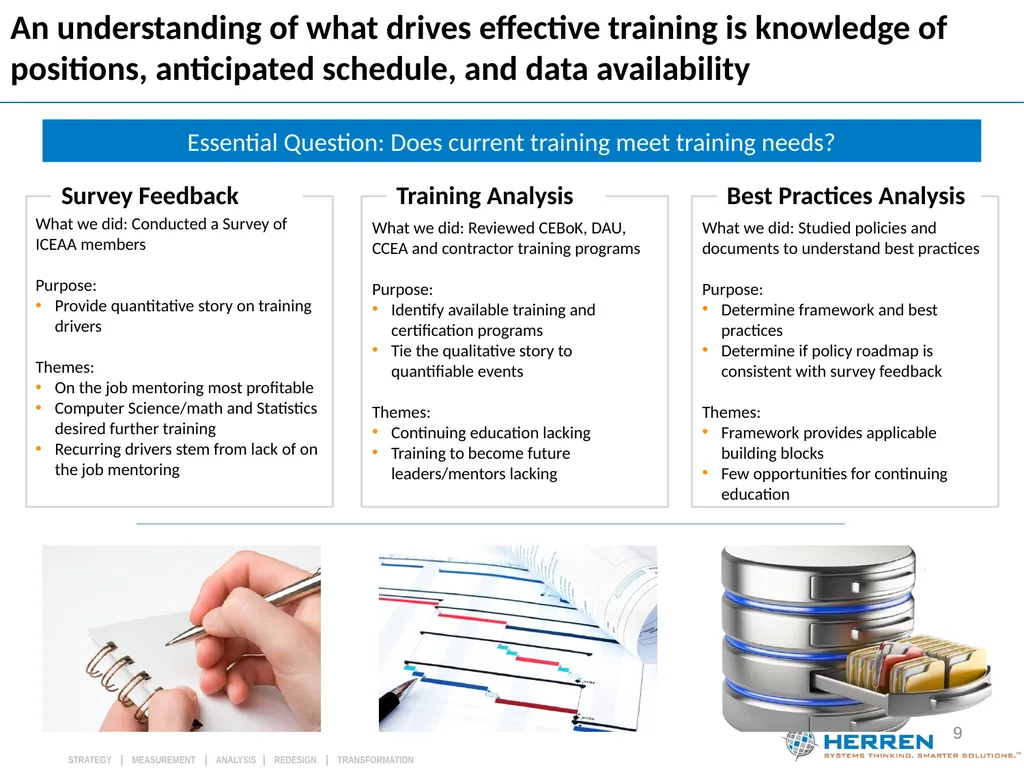
An understanding of what drives effective training is knowledge of positions, anticipated schedule, and data availability Essential Question: Does current training meet training needs? Survey Feedback What we did: Conducted a Survey of ICEAA members
Purpose:
Provide quantitative story on training drivers
Themes:
On the job mentoring most profitable
Computer Science/math and Statistics desired further training
Recurring drivers stem from lack of on the job mentoring Training Analysis What we did: Reviewed CEBoK, DAU, CCEA and contractor training programs
Purpose:
Identify available training and certification programs
Tie the qualitative story to quantifiable events
Themes:
Continuing education lacking
Training to become future leaders/mentors lacking Best Practices Analysis What we did: Studied policies and documents to understand best practices
Purpose:
Determine framework and best practices
Determine if policy roadmap is consistent with survey feedback
Themes:
Framework provides applicable building blocks
Few opportunities for continuing education 9<br>
Purpose:
Provide quantitative story on training drivers
Themes:
On the job mentoring most profitable
Computer Science/math and Statistics desired further training
Recurring drivers stem from lack of on the job mentoring Training Analysis What we did: Reviewed CEBoK, DAU, CCEA and contractor training programs
Purpose:
Identify available training and certification programs
Tie the qualitative story to quantifiable events
Themes:
Continuing education lacking
Training to become future leaders/mentors lacking Best Practices Analysis What we did: Studied policies and documents to understand best practices
Purpose:
Determine framework and best practices
Determine if policy roadmap is consistent with survey feedback
Themes:
Framework provides applicable building blocks
Few opportunities for continuing education 9<br>
10
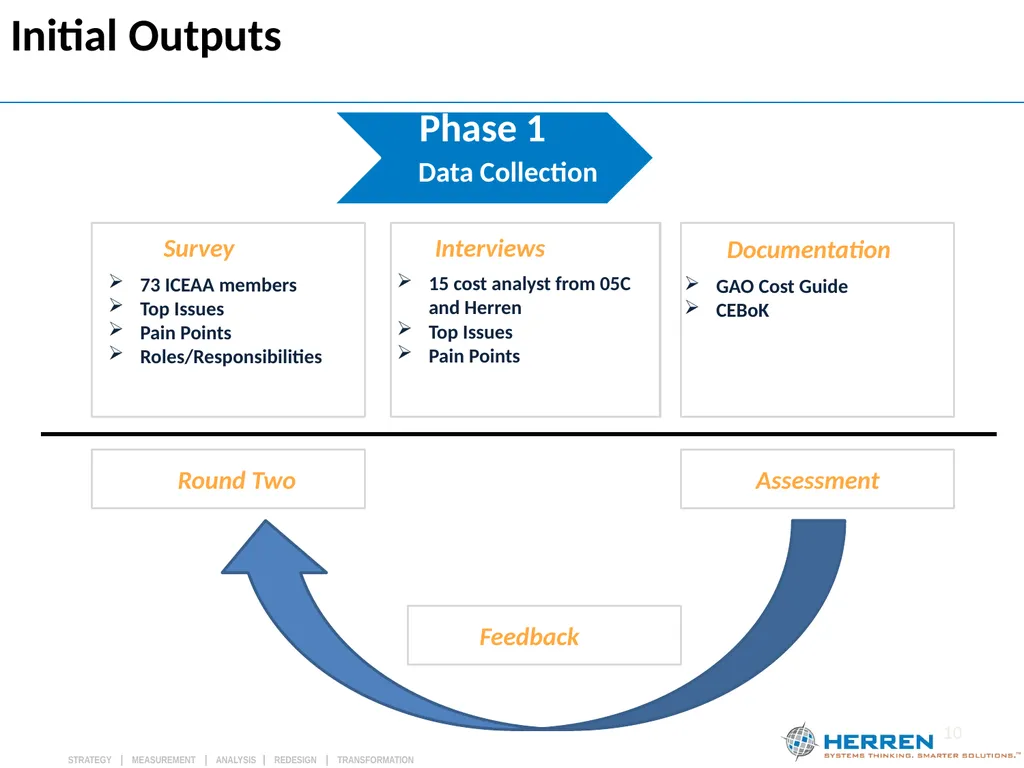
Survey Interviews Initial Outputs 15 cost analyst from 05C and Herren
Top Issues
Pain Points Documentation Assessment Round Two Feedback GAO Cost Guide
CEBoK 10<br>
Top Issues
Pain Points Documentation Assessment Round Two Feedback GAO Cost Guide
CEBoK 10<br>
11
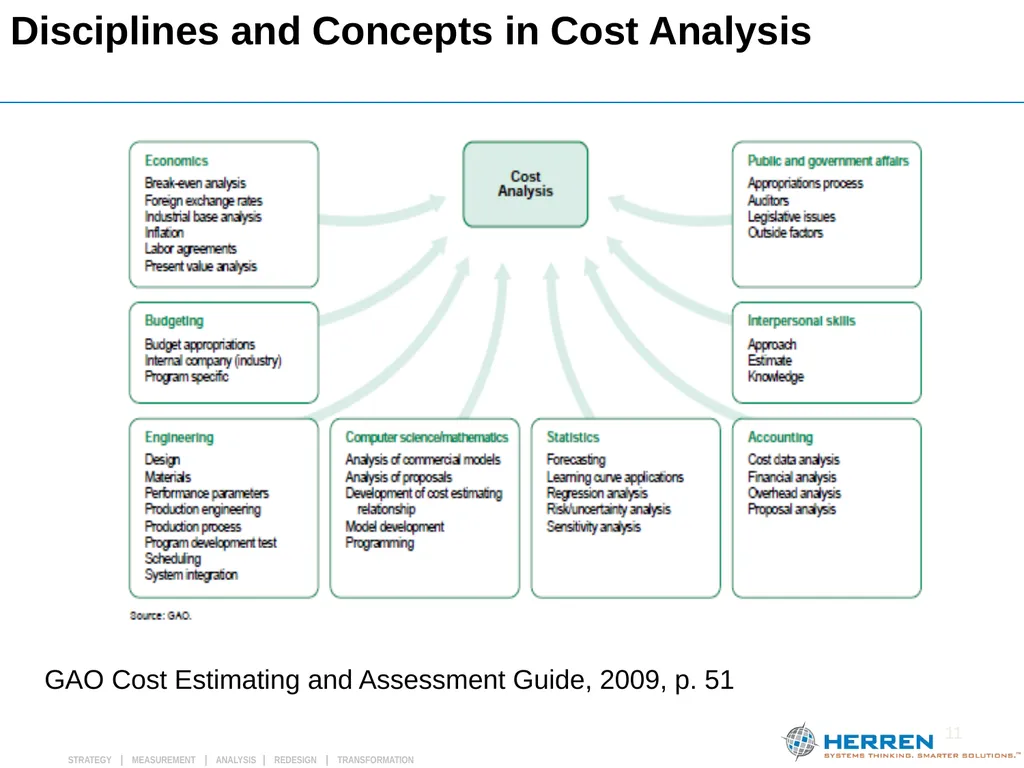
Disciplines and Concepts in Cost Analysis 11 GAO Cost Estimating and Assessment Guide, 2009, p. 51<br>
12
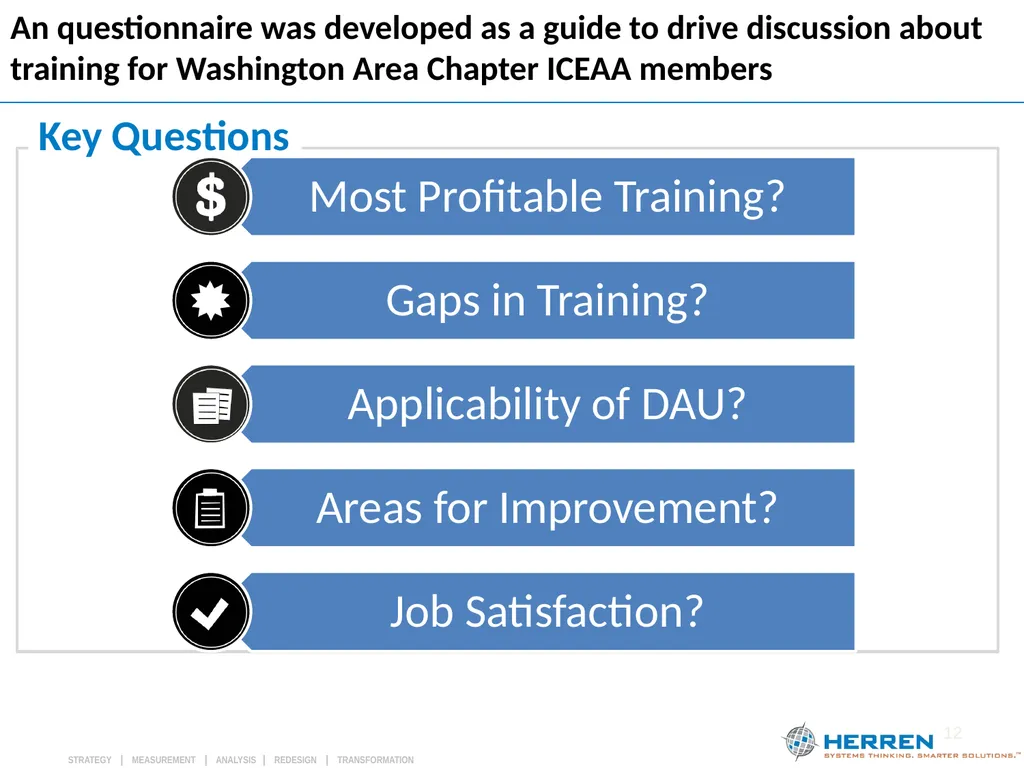
An questionnaire was developed as a guide to drive discussion about training for Washington Area Chapter ICEAA members Key Questions 12<br>
13
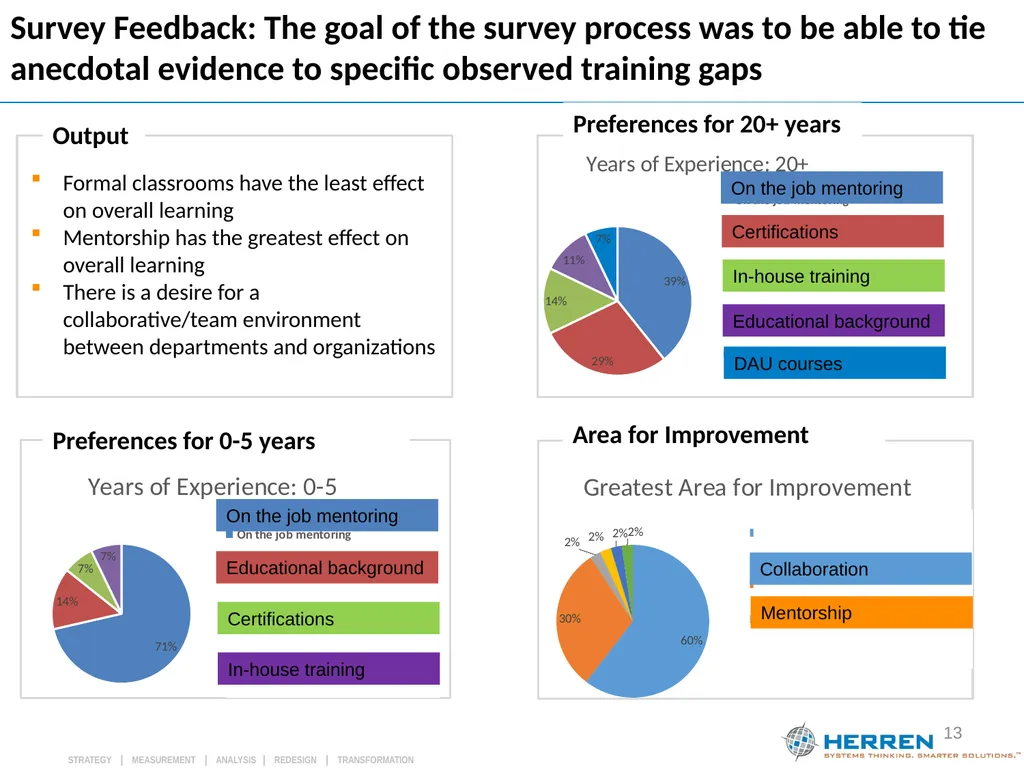
Survey Feedback: The goal of the survey process was to be able to tie anecdotal evidence to specific observed training gaps Output Formal classrooms have the least effect on overall learning
Mentorship has the greatest effect on overall learning
There is a desire for a collaborative/team environment between departments and organizations Preferences for 0-5 years Preferences for 20+ years Area for Improvement 13<br>
Mentorship has the greatest effect on overall learning
There is a desire for a collaborative/team environment between departments and organizations Preferences for 0-5 years Preferences for 20+ years Area for Improvement 13<br>
14
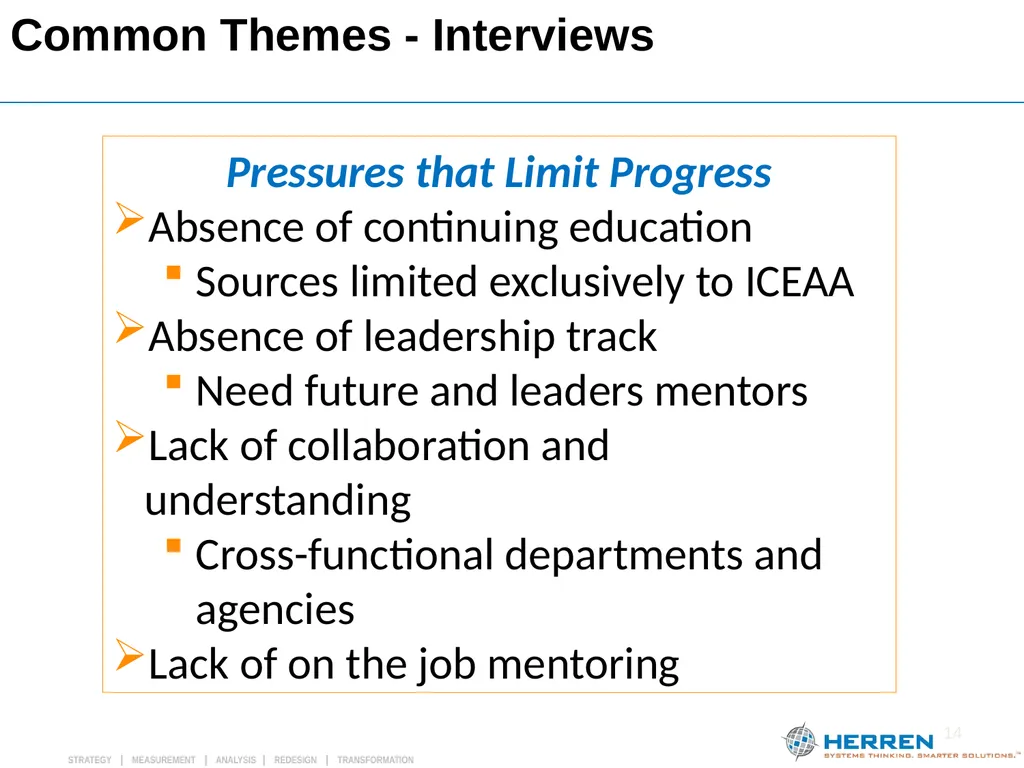
Common Themes - Interviews Pressures that Limit Progress
Absence of continuing education
Sources limited exclusively to ICEAA
Absence of leadership track
Need future and leaders mentors
Lack of collaboration and understanding
Cross-functional departments and agencies
Lack of on the job mentoring 14<br>
Absence of continuing education
Sources limited exclusively to ICEAA
Absence of leadership track
Need future and leaders mentors
Lack of collaboration and understanding
Cross-functional departments and agencies
Lack of on the job mentoring 14<br>
15
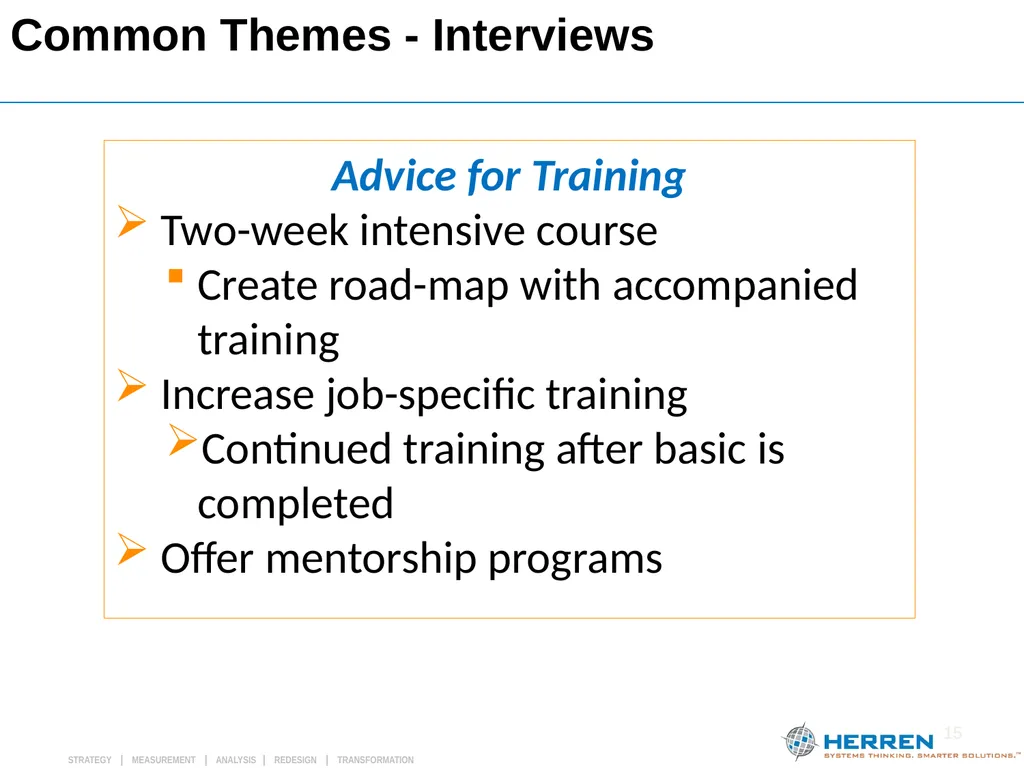
Common Themes - Interviews Advice for Training
Two-week intensive course
Create road-map with accompanied training
Increase job-specific training
Continued training after basic is completed
Offer mentorship programs 15<br>
Two-week intensive course
Create road-map with accompanied training
Increase job-specific training
Continued training after basic is completed
Offer mentorship programs 15<br>
16
Proposed Framework 16<br>
17
Recommendations 17 Establish a systematic methodology for training
Leverage current trainings such as DAU, GAO, ICEAA CEBoK. However, don’t rely on “sage on a stage” lecturing!
Consider utilizing a hands-on design/project based approach to training (case studies, team projects, etc.)
Mentoring is very important!
Assessment and continuous improvement is key<br>
Leverage current trainings such as DAU, GAO, ICEAA CEBoK. However, don’t rely on “sage on a stage” lecturing!
Consider utilizing a hands-on design/project based approach to training (case studies, team projects, etc.)
Mentoring is very important!
Assessment and continuous improvement is key<br>
18
Proposed Training Schedule for New Analysts 18 Assign new analyst a mentor to guide them through the learning process
Have analysts take a self assessment of learning style and discuss how they can get the most out of the training process
1-2 week intensive classroom setting to acquire basic cost analysis knowledge, applying principles of Bloom’s Taxonomy
At the end of the classroom session, to create meaning, have the analysts participate in a case study/design project in a team environment
Throughout the first 2 years of working in the field have the analyst meet frequently with their mentor and cohort for self reflection and additional hands-on training
Have the analysts act as mentors and teachers for the new group of analysts who enter the program in subsequent years<br>
Have analysts take a self assessment of learning style and discuss how they can get the most out of the training process
1-2 week intensive classroom setting to acquire basic cost analysis knowledge, applying principles of Bloom’s Taxonomy
At the end of the classroom session, to create meaning, have the analysts participate in a case study/design project in a team environment
Throughout the first 2 years of working in the field have the analyst meet frequently with their mentor and cohort for self reflection and additional hands-on training
Have the analysts act as mentors and teachers for the new group of analysts who enter the program in subsequent years<br>
19
Future Work/Research 19 Test the proposed pedagogical framework and document in a case study
Consider other fields of educational research
Workforce development research and best practices
Let’s start a conversation about training our next generation of analysts!<br>
Consider other fields of educational research
Workforce development research and best practices
Let’s start a conversation about training our next generation of analysts!<br>
20
Questions? 20<br>
21
Contact Info 21 Kammy Mann:
Kammy.mann@jlha.com<br>
Kammy.mann@jlha.com<br>
22
Backup 22<br>
23
Citations List 23 Adams, R.S., & Felder, R.M. (2008). Reframing Professional Development: A Systems Approach to Preparing Engineering Educators to Education Tomorrow’s Engineer. Journal of Engineering Education, 239-240.
Berry, J., & Asiello, D. (2011). Department of Defense Sustainability Planning: The View from the Second Year. New Orleans, LA: Noblis.
Bloom, B. S.; Engelhart, M. D.; Furst, E. J.; Hill, W. H.; Krathwohl, D. R.(1956). Taxonomy of educational objectives: The classification of educational goals. Handbook I: Cognitive domain. New York: David McKay Company.
Bloom, B.S. & Krathwohl, D.R. Taxonomy of Educational Objectives. Handbook 1: Cognitive Domain. Addison-Wesley, New York, 1984.
Bordogna, J. "Engineering—The Integrative Profession," NSF Directions, May/June, Vol. 5, No. 2, (1992).
Brereton, M.F., J. Greeno, J. Lewis, C. Linde and L. Leifer, "An Exploration of Engineering Learning," Proceedings of the 5th International Conference on Design Theory and Methodology. Held: Albuquerque, NM, USA. American Society of Mechanical Engineers, Design Engineering Division (Publication) DE v 53, Published by ASME, New York, NY, USA. p. 195-206, (1993).
Cost Estimating Body of Knowledge (CEBoK) (1.2 version). (2013). Vienna, VA: International Cost Estimating and Analysis Association.
Estimated Impacts of Sequestration-Level Funding. (2014). Washington, D.C.: Department of Defense. <http://www.defense.gov/pubs/2014_Estimated_Impacts_of_Sequestration-Level_Funding_April.pdf>.
Felder, R.M., Woods, D.R., Stice, J.E., & Rugarcia, A. (2000). The Future of Engineering Education, Teaching Methods that Work. Chemical Engineering Education, 34(1), 26-39.
Forehand, M. (2010, July 6). Bloom's Taxonomy - Emerging Perspectives on Learning, Teaching and Technology. Retrieved March 23, 2016, from http://www.roe11.k12.il.us/GES%20Stuff/Day%204/Process/Blooms/Mary%20Forehand%20discussion-Bloom%27s%20Taxonomy.pdf
Hein. G.E. (1991). Constructivist Learning Theory. Proceedings from: International Committee of Museum Educators Conference, Jerusalem, Israel.
ICEAA. (2013). Survey of Members. Vienna, VA: International Cost Estimating and Analysis Association.
Jonassen, D.H. & Ronrer-Murphy, L. (1999). Activity Theory as a Framework for Designing Constructivist Learning Environments. ETR&D, 47(1), 61-79.
Leifer, L. remarks made at the International Workshop on Project-Based-Learning, Stanford University, Aug. 7-10, (1995).
Lipman, V. (2013). “Why Employee Development is Important, Neglect and Can Cost you Talent.” Forbes. Retrieved from: http://www.forbes.com/sites/victorlipman/2013/01/29/why-development-planning-is-important-neglected-and-can-cost-you-young-talent/#60dd33e62ce0
Mills, J.E. & Treagust, D.F. (2003). Engineering Education – Is Problem-Based or Project-Based Learning the Answer? Austrailasian Journal of Engineering Education, 2-16.
National Science Foundation (NSF). (1995). Restructuring Engineering Education: A Focus on Change. Report of an NSF Workshop on Engineering Education, June 6-9, 1994, Arlington, VA.
Perkins, D.N. "What Constructivism Demands of the Learner," Constructivism and the Technology of Instruction: a conversation, LEA Associates, Hillsdale, NY, p. 161-165, (1992).
Richey, Karen. (2015) GAO Cost Estimating & Scheduling, Best Practices and Audit Findings. Washington, D.C.
Sanders, M. (2009). STEMmania. The Technology Teacher, 20-28.
Sewell, M. & Marczak, M. (2016). “Using Cost Analysis in Evaluation”, The University of Arizona, retrieved from<br>
Berry, J., & Asiello, D. (2011). Department of Defense Sustainability Planning: The View from the Second Year. New Orleans, LA: Noblis.
Bloom, B. S.; Engelhart, M. D.; Furst, E. J.; Hill, W. H.; Krathwohl, D. R.(1956). Taxonomy of educational objectives: The classification of educational goals. Handbook I: Cognitive domain. New York: David McKay Company.
Bloom, B.S. & Krathwohl, D.R. Taxonomy of Educational Objectives. Handbook 1: Cognitive Domain. Addison-Wesley, New York, 1984.
Bordogna, J. "Engineering—The Integrative Profession," NSF Directions, May/June, Vol. 5, No. 2, (1992).
Brereton, M.F., J. Greeno, J. Lewis, C. Linde and L. Leifer, "An Exploration of Engineering Learning," Proceedings of the 5th International Conference on Design Theory and Methodology. Held: Albuquerque, NM, USA. American Society of Mechanical Engineers, Design Engineering Division (Publication) DE v 53, Published by ASME, New York, NY, USA. p. 195-206, (1993).
Cost Estimating Body of Knowledge (CEBoK) (1.2 version). (2013). Vienna, VA: International Cost Estimating and Analysis Association.
Estimated Impacts of Sequestration-Level Funding. (2014). Washington, D.C.: Department of Defense. <http://www.defense.gov/pubs/2014_Estimated_Impacts_of_Sequestration-Level_Funding_April.pdf>.
Felder, R.M., Woods, D.R., Stice, J.E., & Rugarcia, A. (2000). The Future of Engineering Education, Teaching Methods that Work. Chemical Engineering Education, 34(1), 26-39.
Forehand, M. (2010, July 6). Bloom's Taxonomy - Emerging Perspectives on Learning, Teaching and Technology. Retrieved March 23, 2016, from http://www.roe11.k12.il.us/GES%20Stuff/Day%204/Process/Blooms/Mary%20Forehand%20discussion-Bloom%27s%20Taxonomy.pdf
Hein. G.E. (1991). Constructivist Learning Theory. Proceedings from: International Committee of Museum Educators Conference, Jerusalem, Israel.
ICEAA. (2013). Survey of Members. Vienna, VA: International Cost Estimating and Analysis Association.
Jonassen, D.H. & Ronrer-Murphy, L. (1999). Activity Theory as a Framework for Designing Constructivist Learning Environments. ETR&D, 47(1), 61-79.
Leifer, L. remarks made at the International Workshop on Project-Based-Learning, Stanford University, Aug. 7-10, (1995).
Lipman, V. (2013). “Why Employee Development is Important, Neglect and Can Cost you Talent.” Forbes. Retrieved from: http://www.forbes.com/sites/victorlipman/2013/01/29/why-development-planning-is-important-neglected-and-can-cost-you-young-talent/#60dd33e62ce0
Mills, J.E. & Treagust, D.F. (2003). Engineering Education – Is Problem-Based or Project-Based Learning the Answer? Austrailasian Journal of Engineering Education, 2-16.
National Science Foundation (NSF). (1995). Restructuring Engineering Education: A Focus on Change. Report of an NSF Workshop on Engineering Education, June 6-9, 1994, Arlington, VA.
Perkins, D.N. "What Constructivism Demands of the Learner," Constructivism and the Technology of Instruction: a conversation, LEA Associates, Hillsdale, NY, p. 161-165, (1992).
Richey, Karen. (2015) GAO Cost Estimating & Scheduling, Best Practices and Audit Findings. Washington, D.C.
Sanders, M. (2009). STEMmania. The Technology Teacher, 20-28.
Sewell, M. & Marczak, M. (2016). “Using Cost Analysis in Evaluation”, The University of Arizona, retrieved from<br>
24
Citations List (Part 2) 24 Sheppard, S. & Jenison, R. “Freshman Engineering Design Experiences: an Organizational Framework” International Journal of Engineering Education. 1996.
Soloman, B.A. & Felder, R.M. (2016). Index of Learning Styles Questionnaire. NC State University. https://www.engr.ncsu.edu/learningstyles/ilsweb.html
Sonwalkar N. ‘‘Changing the Interface of Education with Revolutionary Learning Technologies: An Effective Guide for Infusing Technology Enabled Education for Universities and Corporations.’’ Presentation at iUniverse, New York, September 2004.
Sonwalkar N. The sharp edge of the cube: pedagogically driven instructional design for online education. Syllabus December 2001, pp. 12–16(www.campus-technology.com/article.asp?id = 5858);
Sonwalkar N. Changing the Interface of Education with Revolutionary Learning Technologies. Syllabus November 2001, pp. 10–13, (http://www.campus-technology.com/article.asp?id = 5663).
Sonwalker, N. (2013). The First Adaptive MOOC: A Case Study on Pedagogy Framework and Scalable Cloud architecture – Part 1. MOOCs Forum, 22-29.
Spurlin, J. E., Rajala, S. A., & Lavelle, J. P. (2008). Designing better engineering education through assessment: A practical resource for faculty and department chairs on using assessment and ABET criteria to improve student learning. Sterling, VA: Stylus Pub.
Teslow, J.L., L.E. Carlson and R.L. Miller, "Constructivism in Colorado: Applications of Recent Trends in Cognitive Science," ASEE Annual Conference Proceedings, Session 1602, (1994).
The Compass. (2016). Understanding by Design: A Framework to Support Effective Teaching and Learning. Newton-Conover’s Online Newsletter for Educators. Retrieved from: http://nccscurriculum.org/2014/01/22/understanding-by-design-a-framework-to-support-effective-teaching-and-learning/
Weimer, M. (2002). Learner-centered teaching: Five key changes to practice. San Francisco: Jossey-Bass.
Wiggins, G., & McTighe, J. (2005). Understanding by Design (Expanded 2nd ed.). Alexandria, Virginia: Association for Supervision and Curriculum Development.
Woods, D.R. Problem-based Learning: How to Gain the Most from PBL. Woods Publishing, Waterdown, 1994. Distributed by McMaster University Bookstore, Hamilton, ON.
Wulf, W. (1998). The Urgency of Engineering Education Reform. Proceedings from: Realizing the New Paradigm for Engineering Education, Baltimore, MD.
VARK Questionnaire. (2016). Retrieved on 29 March, 2016 from: https://www.engr.ncsu.edu/learningstyles/ilsweb.html
U.S Government Accountability Office. (2009) GAO Cost Estimating and Assessment Guide: Best Practices for Developing and Managing Capital Program Costs. Washington, D.C.: Applied Research and Methods.<br>
Soloman, B.A. & Felder, R.M. (2016). Index of Learning Styles Questionnaire. NC State University. https://www.engr.ncsu.edu/learningstyles/ilsweb.html
Sonwalkar N. ‘‘Changing the Interface of Education with Revolutionary Learning Technologies: An Effective Guide for Infusing Technology Enabled Education for Universities and Corporations.’’ Presentation at iUniverse, New York, September 2004.
Sonwalkar N. The sharp edge of the cube: pedagogically driven instructional design for online education. Syllabus December 2001, pp. 12–16(www.campus-technology.com/article.asp?id = 5858);
Sonwalkar N. Changing the Interface of Education with Revolutionary Learning Technologies. Syllabus November 2001, pp. 10–13, (http://www.campus-technology.com/article.asp?id = 5663).
Sonwalker, N. (2013). The First Adaptive MOOC: A Case Study on Pedagogy Framework and Scalable Cloud architecture – Part 1. MOOCs Forum, 22-29.
Spurlin, J. E., Rajala, S. A., & Lavelle, J. P. (2008). Designing better engineering education through assessment: A practical resource for faculty and department chairs on using assessment and ABET criteria to improve student learning. Sterling, VA: Stylus Pub.
Teslow, J.L., L.E. Carlson and R.L. Miller, "Constructivism in Colorado: Applications of Recent Trends in Cognitive Science," ASEE Annual Conference Proceedings, Session 1602, (1994).
The Compass. (2016). Understanding by Design: A Framework to Support Effective Teaching and Learning. Newton-Conover’s Online Newsletter for Educators. Retrieved from: http://nccscurriculum.org/2014/01/22/understanding-by-design-a-framework-to-support-effective-teaching-and-learning/
Weimer, M. (2002). Learner-centered teaching: Five key changes to practice. San Francisco: Jossey-Bass.
Wiggins, G., & McTighe, J. (2005). Understanding by Design (Expanded 2nd ed.). Alexandria, Virginia: Association for Supervision and Curriculum Development.
Woods, D.R. Problem-based Learning: How to Gain the Most from PBL. Woods Publishing, Waterdown, 1994. Distributed by McMaster University Bookstore, Hamilton, ON.
Wulf, W. (1998). The Urgency of Engineering Education Reform. Proceedings from: Realizing the New Paradigm for Engineering Education, Baltimore, MD.
VARK Questionnaire. (2016). Retrieved on 29 March, 2016 from: https://www.engr.ncsu.edu/learningstyles/ilsweb.html
U.S Government Accountability Office. (2009) GAO Cost Estimating and Assessment Guide: Best Practices for Developing and Managing Capital Program Costs. Washington, D.C.: Applied Research and Methods.<br>