
Washington’s Community and technical colleges
LO
Published · 33 slides · 0 views
1 / 1
Description
Washingtons Community and technical colleges SBCTC Winter 2026 WEC Update SBCTC Winter Update Thursday, February 5 Agenda Topics: Program Updates Funding Highlights Staff and Resource Information program Funding updates Work-based
Related Topics
Share
Embed code
Download this presentation From Below
"Washington’s Community and technical colleges" is the property of its rightful owner. Permission is granted to download and print the materials on this website for personal, non-commercial use only, and to display it on your personal computer provided you do not modify the materials and that you retain all copyright notices contained in the materials. By downloading content from our website, you accept the terms of this agreement.
Presentation Transcript
01
Washington’s Community and technical colleges SBCTC Winter 2026 WEC Update<br>
02
SBCTC Winter Update Thursday, February 5
Agenda Topics:
Program Updates
Funding Highlights
Staff and Resource Information<br>
Agenda Topics:
Program Updates
Funding Highlights
Staff and Resource Information<br>
03
program & Funding updates<br>
04
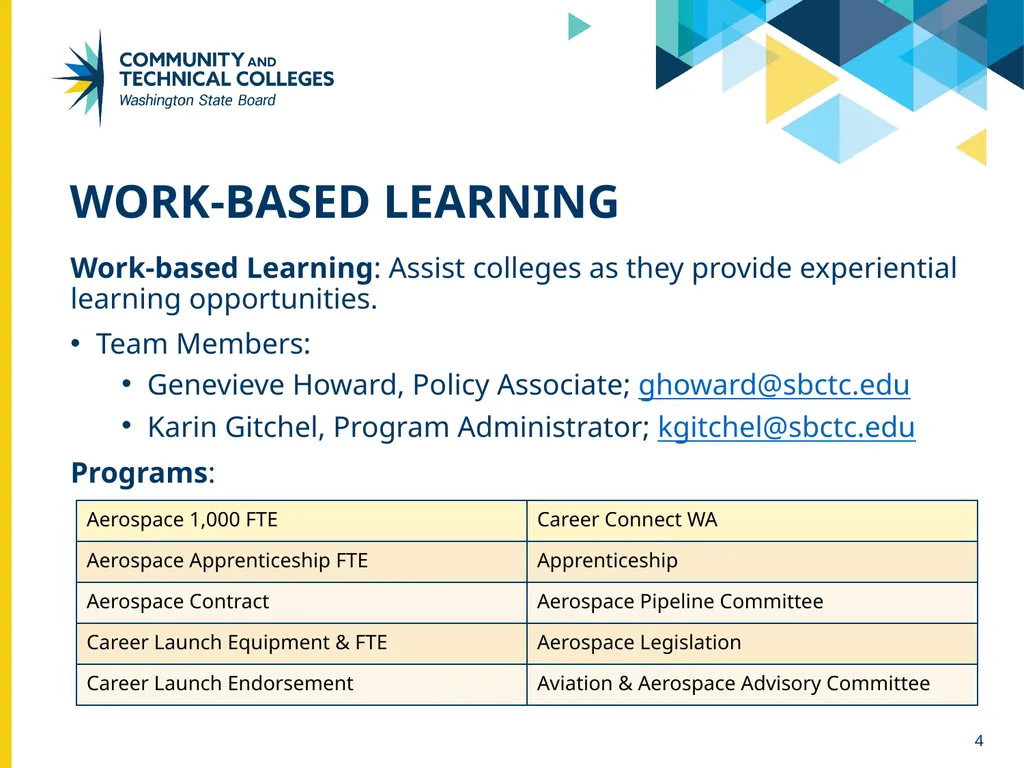
Work-based Learning Work-based Learning: Assist colleges as they provide experiential learning opportunities.
Team Members:
Genevieve Howard, Policy Associate; ghoward@sbctc.edu
Karin Gitchel, Program Administrator; kgitchel@sbctc.edu
Programs: 4<br>
Team Members:
Genevieve Howard, Policy Associate; ghoward@sbctc.edu
Karin Gitchel, Program Administrator; kgitchel@sbctc.edu
Programs: 4<br>
05
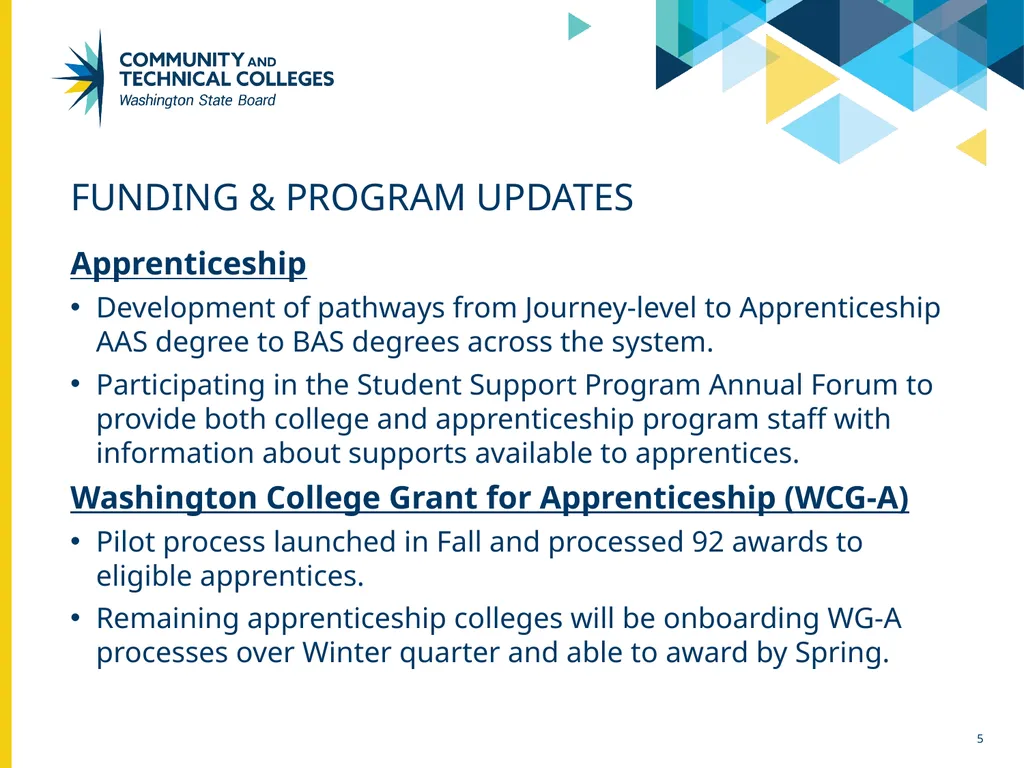
funding & program Updates Apprenticeship
Development of pathways from Journey-level to Apprenticeship AAS degree to BAS degrees across the system.
Participating in the Student Support Program Annual Forum to provide both college and apprenticeship program staff with information about supports available to apprentices.
Washington College Grant for Apprenticeship (WCG-A)
Pilot process launched in Fall and processed 92 awards to eligible apprentices.
Remaining apprenticeship colleges will be onboarding WG-A processes over Winter quarter and able to award by Spring. 5<br>
06
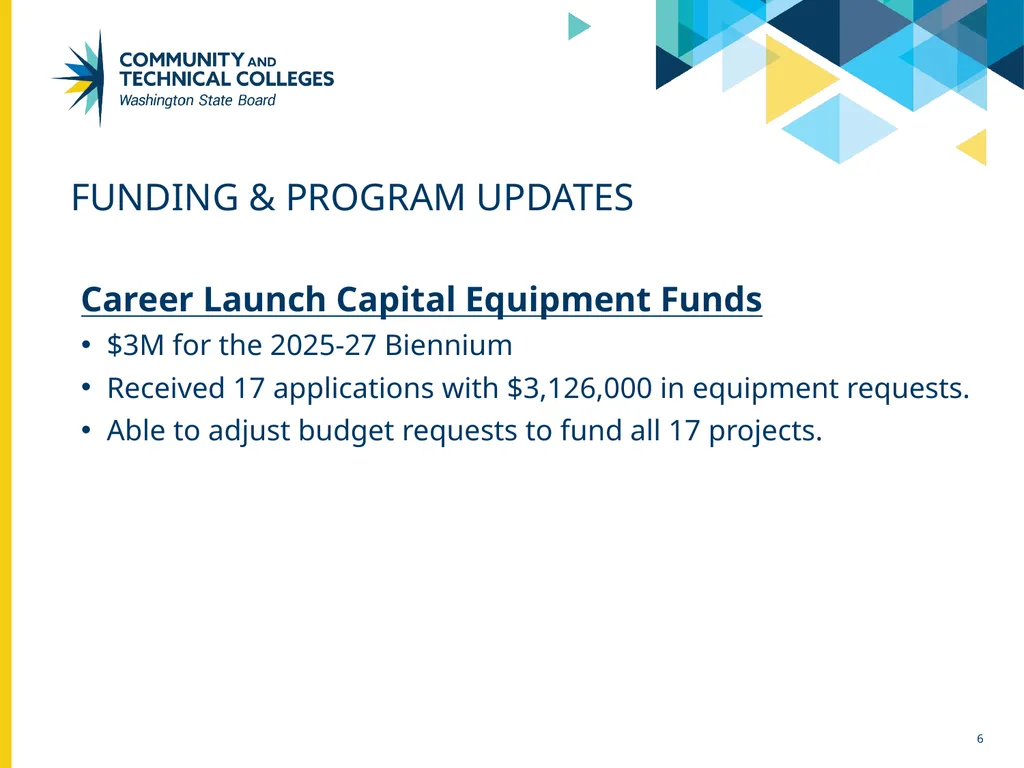
funding & program Updates Career Launch Capital Equipment Funds
$3M for the 2025-27 Biennium
Received 17 applications with $3,126,000 in equipment requests.
Able to adjust budget requests to fund all 17 projects. 6<br>
$3M for the 2025-27 Biennium
Received 17 applications with $3,126,000 in equipment requests.
Able to adjust budget requests to fund all 17 projects. 6<br>
07
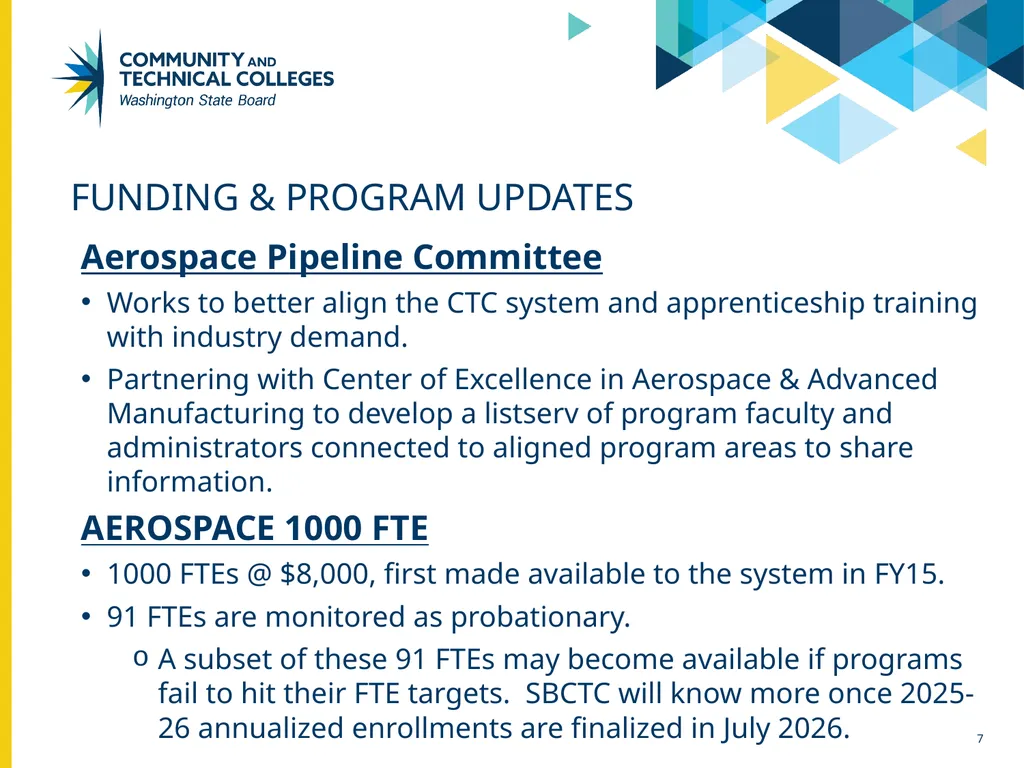
funding & program Updates Aerospace Pipeline Committee
Works to better align the CTC system and apprenticeship training with industry demand.
Partnering with Center of Excellence in Aerospace & Advanced Manufacturing to develop a listserv of program faculty and administrators connected to aligned program areas to share information.
AEROSPACE 1000 FTE
1000 FTEs @ $8,000, first made available to the system in FY15.
91 FTEs are monitored as probationary.
A subset of these 91 FTEs may become available if programs fail to hit their FTE targets. SBCTC will know more once 2025-26 annualized enrollments are finalized in July 2026. 7<br>
08
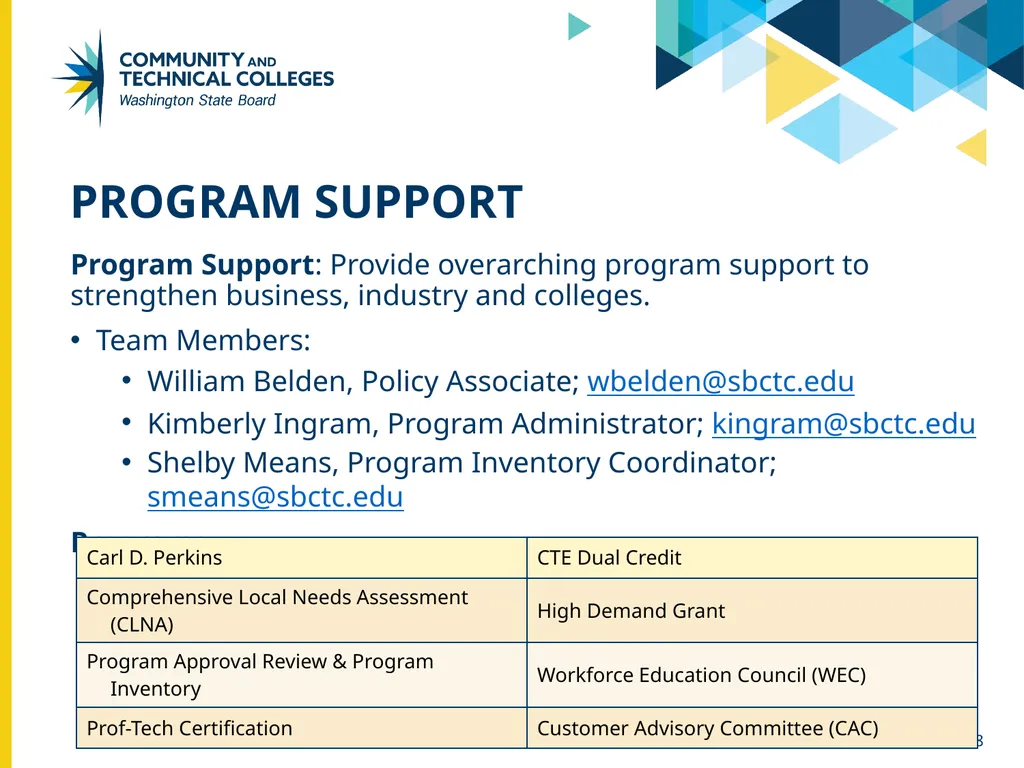
Program support Program Support: Provide overarching program support to strengthen business, industry and colleges.
Team Members:
William Belden, Policy Associate; wbelden@sbctc.edu
Kimberly Ingram, Program Administrator; kingram@sbctc.edu
Shelby Means, Program Inventory Coordinator; smeans@sbctc.edu
Programs: 8<br>
Team Members:
William Belden, Policy Associate; wbelden@sbctc.edu
Kimberly Ingram, Program Administrator; kingram@sbctc.edu
Shelby Means, Program Inventory Coordinator; smeans@sbctc.edu
Programs: 8<br>
09
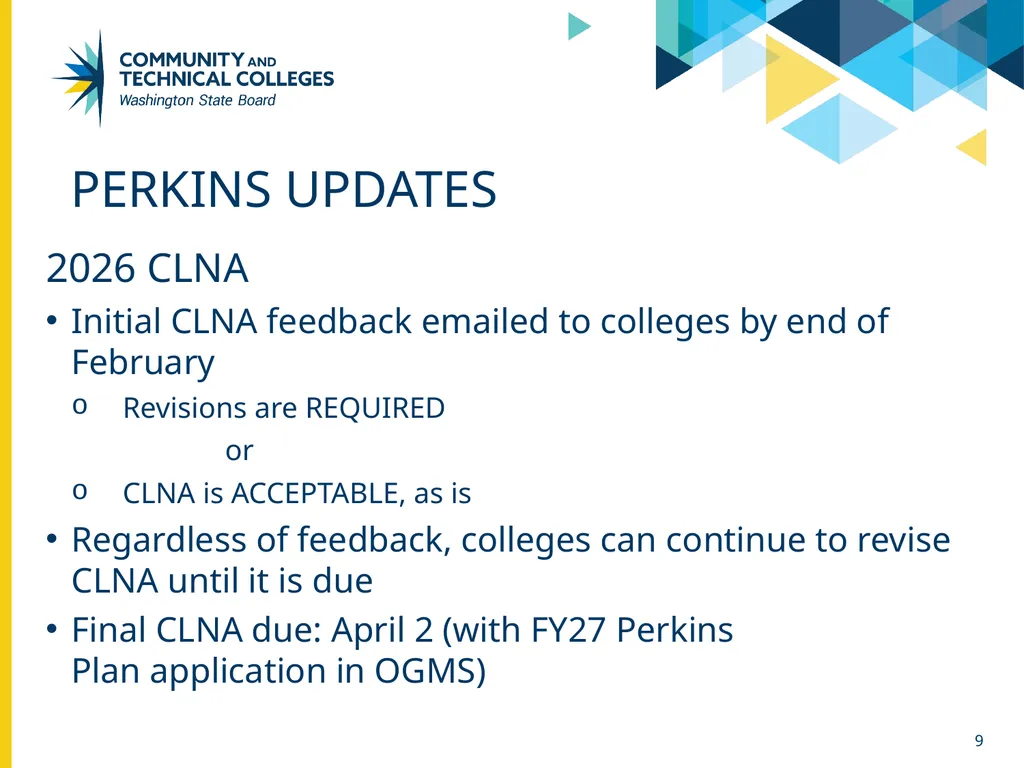
Perkins updates 2026 CLNA
Initial CLNA feedback emailed to colleges by end of February
Revisions are REQUIRED
or
CLNA is ACCEPTABLE, as is
Regardless of feedback, colleges can continue to revise CLNA until it is due
Final CLNA due: April 2 (with FY27 Perkins Plan application in OGMS) 9<br>
Initial CLNA feedback emailed to colleges by end of February
Revisions are REQUIRED
or
CLNA is ACCEPTABLE, as is
Regardless of feedback, colleges can continue to revise CLNA until it is due
Final CLNA due: April 2 (with FY27 Perkins Plan application in OGMS) 9<br>
10
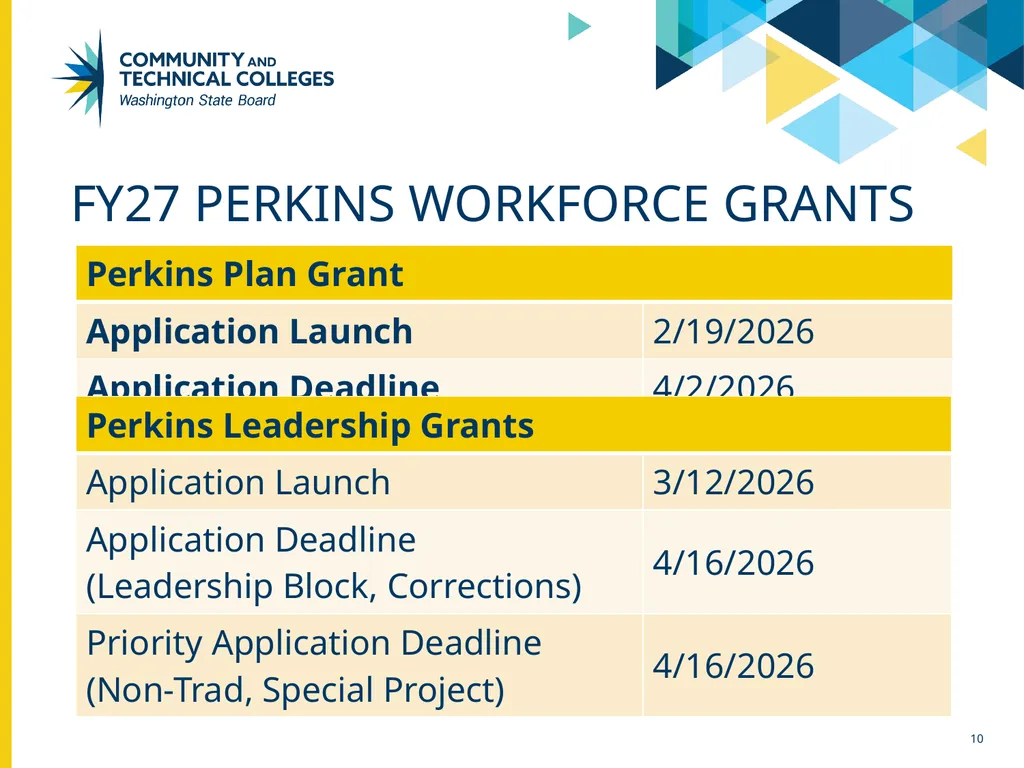
FY27 Perkins workforce Grants 10<br>
11
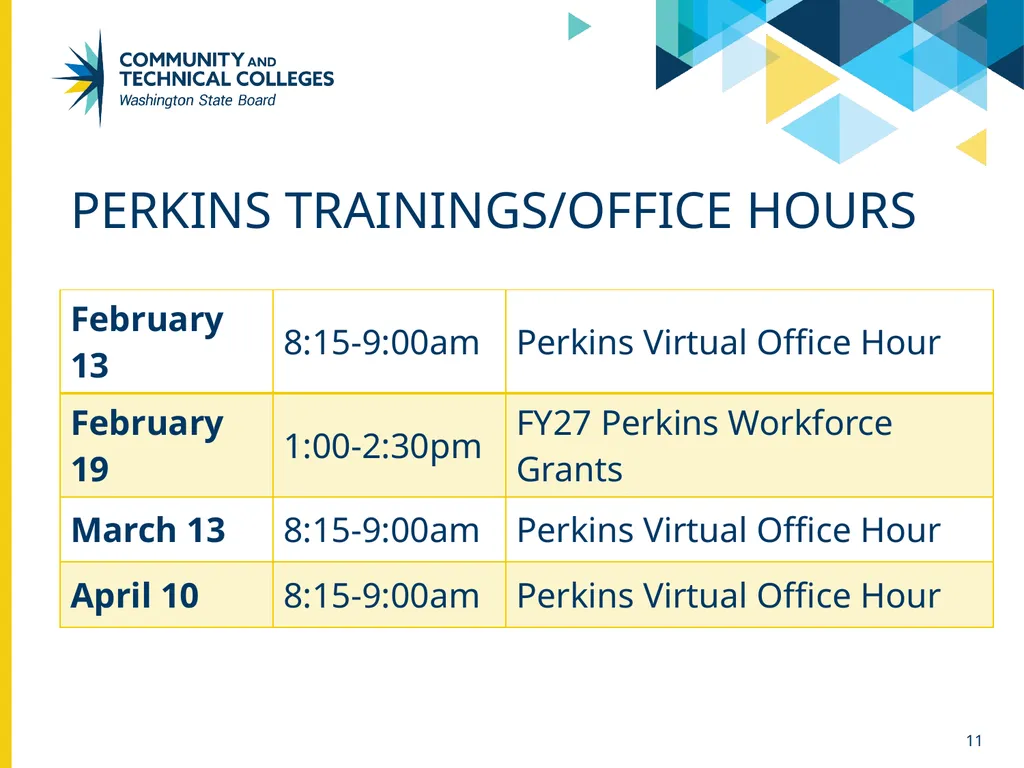
Perkins Trainings/Office Hours 11<br>
12
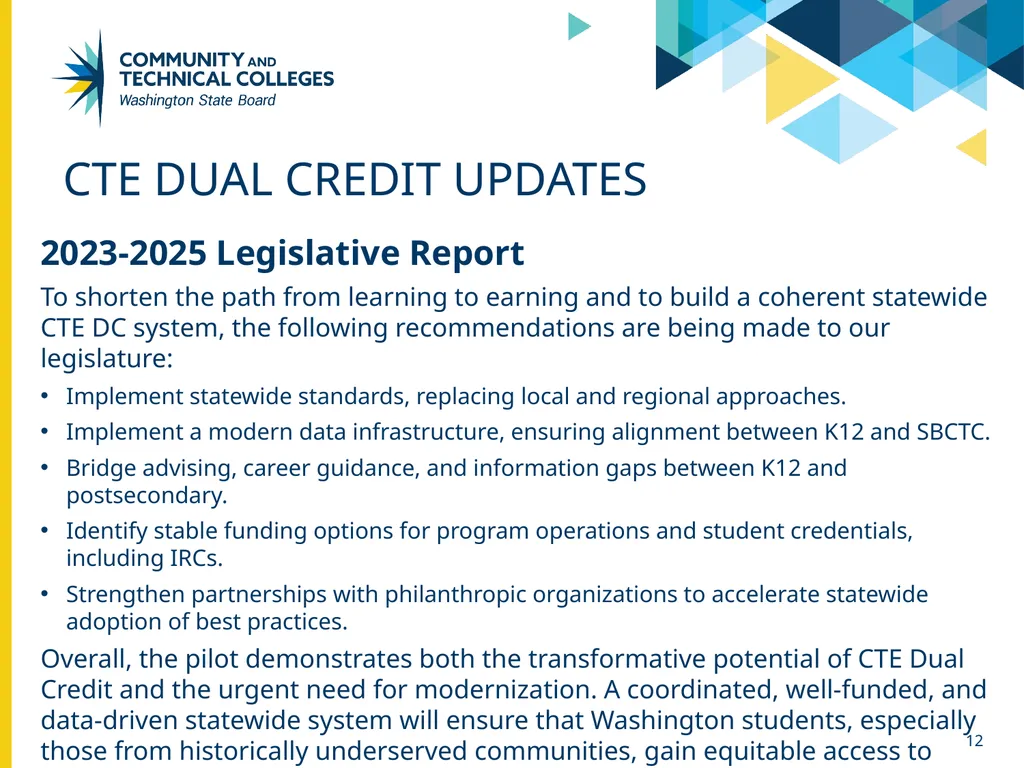
CTE Dual credit updates 2023-2025 Legislative Report
To shorten the path from learning to earning and to build a coherent statewide CTE DC system, the following recommendations are being made to our legislature:
Implement statewide standards, replacing local and regional approaches.
Implement a modern data infrastructure, ensuring alignment between K12 and SBCTC.
Bridge advising, career guidance, and information gaps between K12 and postsecondary.
Identify stable funding options for program operations and student credentials, including IRCs.
Strengthen partnerships with philanthropic organizations to accelerate statewide adoption of best practices.
Overall, the pilot demonstrates both the transformative potential of CTE Dual Credit and the urgent need for modernization. A coordinated, well‑funded, and data‑driven statewide system will ensure that Washington students, especially those from historically underserved communities, gain equitable access to pathways leading to postsecondary credentials, high‑demand careers, and long‑term economic mobility. 12<br>
13
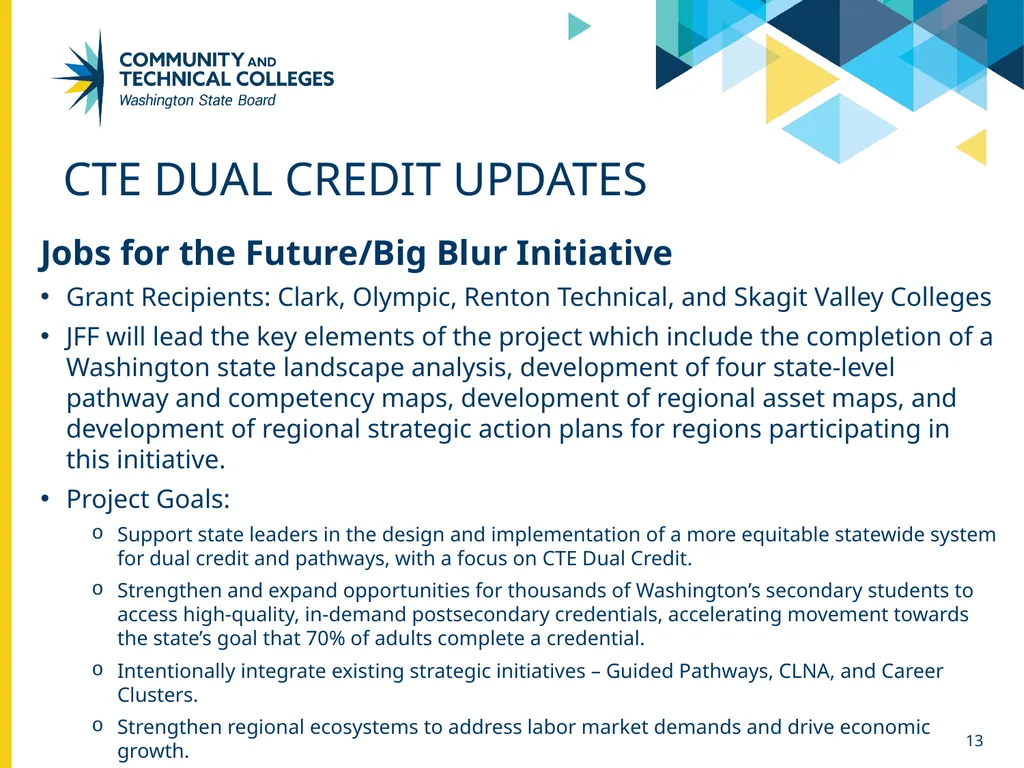
CTE Dual credit updates Jobs for the Future/Big Blur Initiative
Grant Recipients: Clark, Olympic, Renton Technical, and Skagit Valley Colleges
JFF will lead the key elements of the project which include the completion of a Washington state landscape analysis, development of four state-level pathway and competency maps, development of regional asset maps, and development of regional strategic action plans for regions participating in this initiative.
Project Goals:
Support state leaders in the design and implementation of a more equitable statewide system for dual credit and pathways, with a focus on CTE Dual Credit.
Strengthen and expand opportunities for thousands of Washington’s secondary students to access high-quality, in-demand postsecondary credentials, accelerating movement towards the state’s goal that 70% of adults complete a credential.
Intentionally integrate existing strategic initiatives – Guided Pathways, CLNA, and Career Clusters.
Strengthen regional ecosystems to address labor market demands and drive economic growth.
Build a replicable model for regions in Washington that are committed to advancing The Big Blur. 13<br>
14
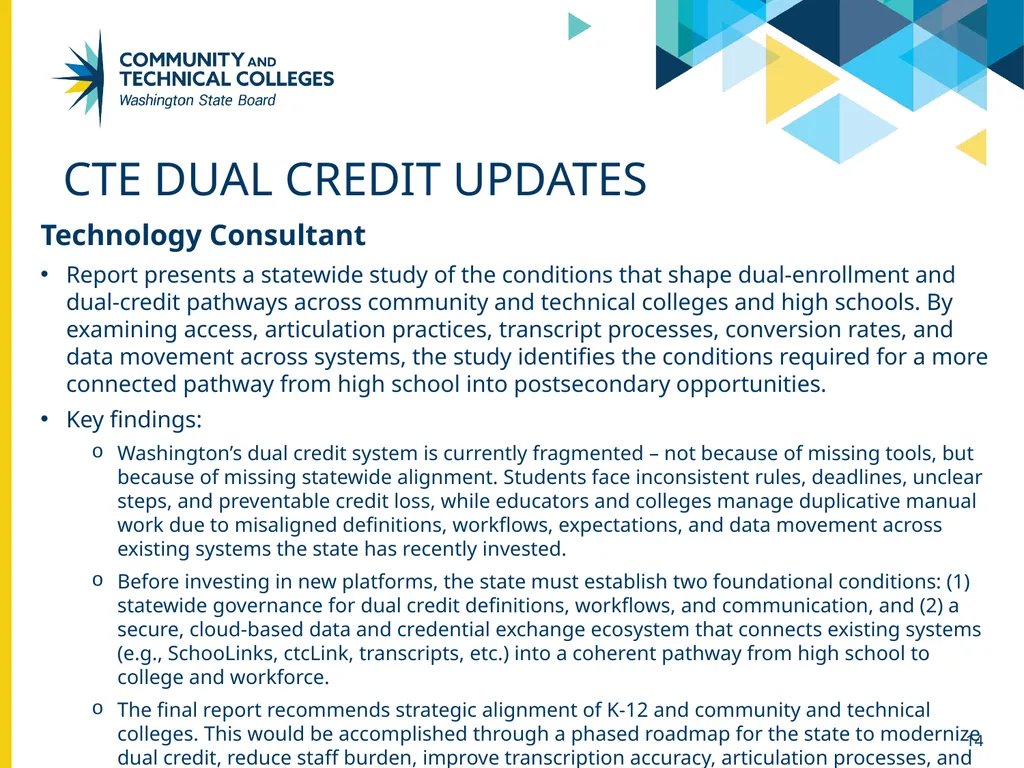
CTE Dual credit updates Technology Consultant
Report presents a statewide study of the conditions that shape dual-enrollment and dual-credit pathways across community and technical colleges and high schools. By examining access, articulation practices, transcript processes, conversion rates, and data movement across systems, the study identifies the conditions required for a more connected pathway from high school into postsecondary opportunities.
Key findings:
Washington’s dual credit system is currently fragmented – not because of missing tools, but because of missing statewide alignment. Students face inconsistent rules, deadlines, unclear steps, and preventable credit loss, while educators and colleges manage duplicative manual work due to misaligned definitions, workflows, expectations, and data movement across existing systems the state has recently invested.
Before investing in new platforms, the state must establish two foundational conditions: (1) statewide governance for dual credit definitions, workflows, and communication, and (2) a secure, cloud-based data and credential exchange ecosystem that connects existing systems (e.g., SchooLinks, ctcLink, transcripts, etc.) into a coherent pathway from high school to college and workforce.
The final report recommends strategic alignment of K-12 and community and technical colleges. This would be accomplished through a phased roadmap for the state to modernize dual credit, reduce staff burden, improve transcription accuracy, articulation processes, and ensure students consistently receive the college credit they earn statewide. 14<br>
15
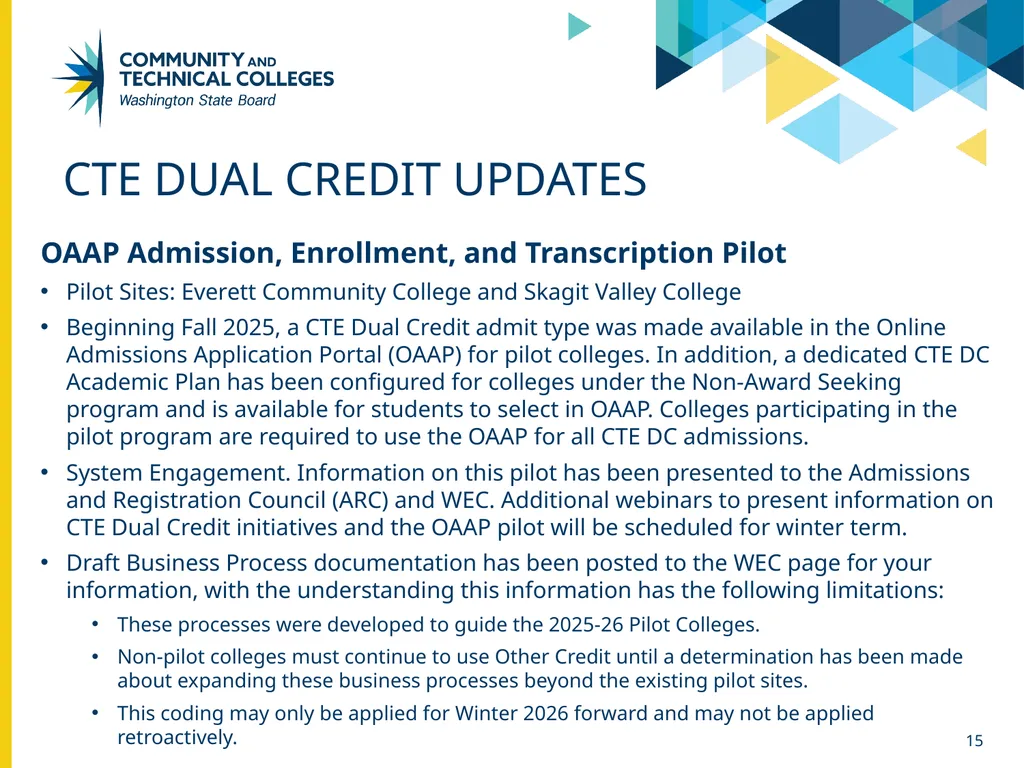
CTE Dual credit updates OAAP Admission, Enrollment, and Transcription Pilot
Pilot Sites: Everett Community College and Skagit Valley College
Beginning Fall 2025, a CTE Dual Credit admit type was made available in the Online Admissions Application Portal (OAAP) for pilot colleges. In addition, a dedicated CTE DC Academic Plan has been configured for colleges under the Non-Award Seeking program and is available for students to select in OAAP. Colleges participating in the pilot program are required to use the OAAP for all CTE DC admissions.
System Engagement. Information on this pilot has been presented to the Admissions and Registration Council (ARC) and WEC. Additional webinars to present information on CTE Dual Credit initiatives and the OAAP pilot will be scheduled for winter term.
Draft Business Process documentation has been posted to the WEC page for your information, with the understanding this information has the following limitations:
These processes were developed to guide the 2025-26 Pilot Colleges.
Non-pilot colleges must continue to use Other Credit until a determination has been made about expanding these business processes beyond the existing pilot sites.
This coding may only be applied for Winter 2026 forward and may not be applied retroactively. 15<br>
16
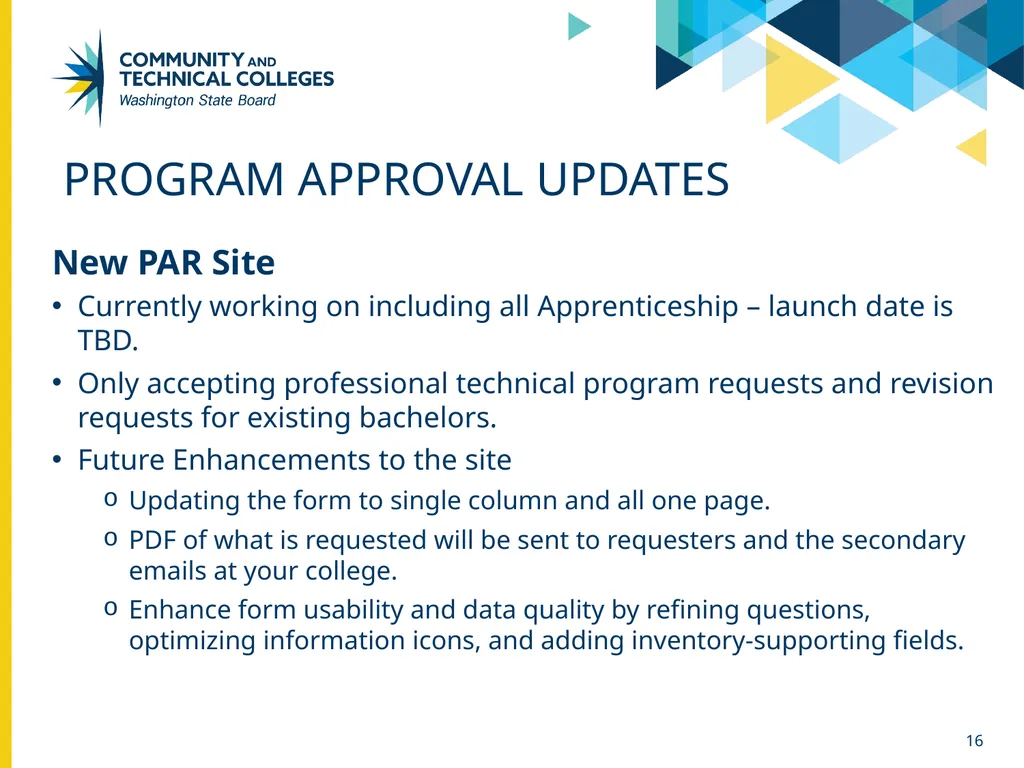
Program Approval Updates New PAR Site
Currently working on including all Apprenticeship – launch date is TBD.
Only accepting professional technical program requests and revision requests for existing bachelors.
Future Enhancements to the site
Updating the form to single column and all one page.
PDF of what is requested will be sent to requesters and the secondary emails at your college.
Enhance form usability and data quality by refining questions, optimizing information icons, and adding inventory-supporting fields. 16<br>
17
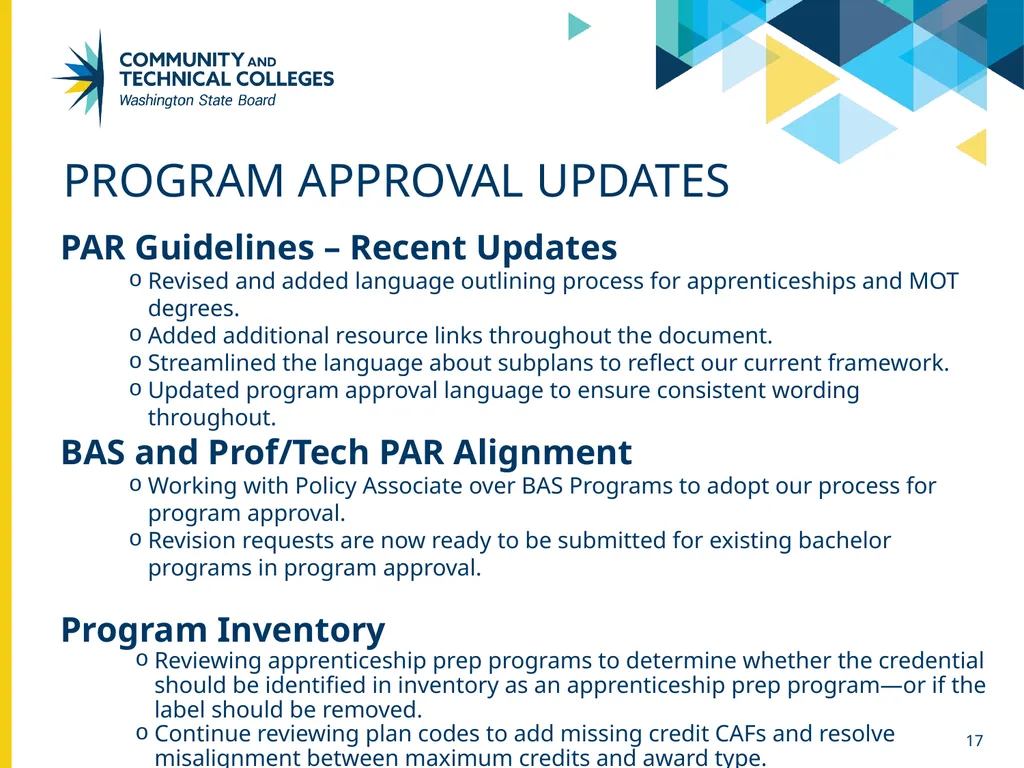
Program Approval Updates PAR Guidelines – Recent Updates
Revised and added language outlining process for apprenticeships and MOT degrees.
Added additional resource links throughout the document.
Streamlined the language about subplans to reflect our current framework.
Updated program approval language to ensure consistent wording throughout.
BAS and Prof/Tech PAR Alignment
Working with Policy Associate over BAS Programs to adopt our process for program approval.
Revision requests are now ready to be submitted for existing bachelor programs in program approval.
Program Inventory
Reviewing apprenticeship prep programs to determine whether the credential should be identified in inventory as an apprenticeship prep program—or if the label should be removed.
Continue reviewing plan codes to add missing credit CAFs and resolve misalignment between maximum credits and award type.
Will be working with colleges to designate fully online programs in ctcLink inventory, enabling improved Search Stax filtering for interested students. 17<br>
18
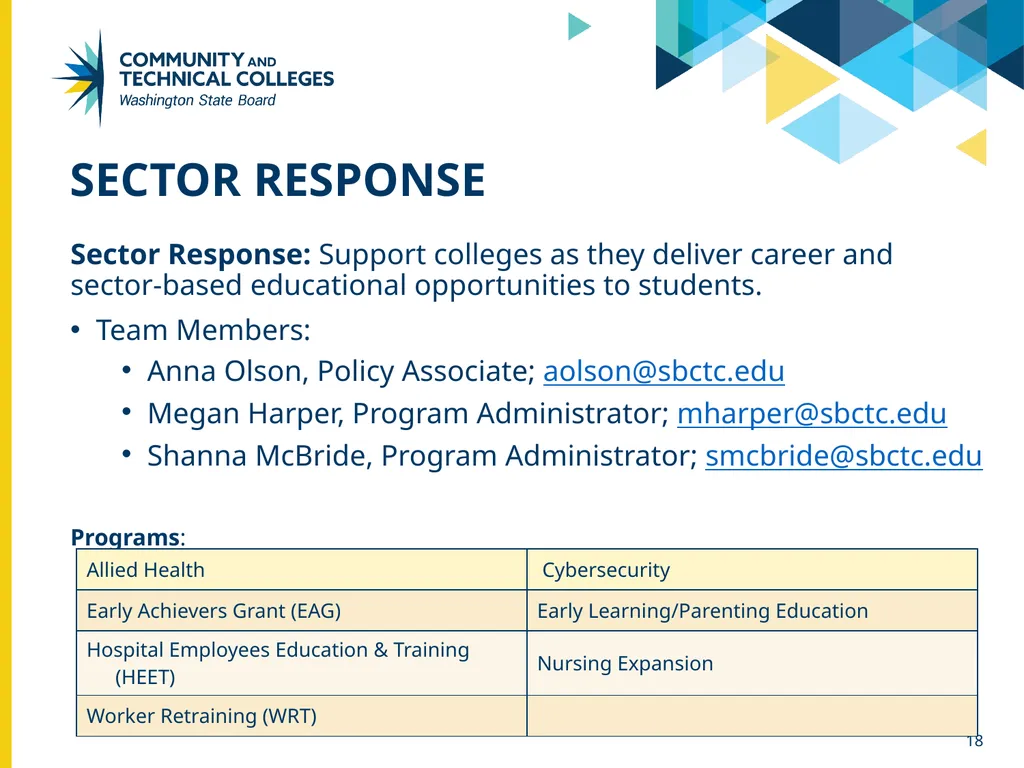
Sector Response Sector Response: Support colleges as they deliver career and sector-based educational opportunities to students.
Team Members:
Anna Olson, Policy Associate; aolson@sbctc.edu
Megan Harper, Program Administrator; mharper@sbctc.edu
Shanna McBride, Program Administrator; smcbride@sbctc.edu
Programs: 18<br>
Team Members:
Anna Olson, Policy Associate; aolson@sbctc.edu
Megan Harper, Program Administrator; mharper@sbctc.edu
Shanna McBride, Program Administrator; smcbride@sbctc.edu
Programs: 18<br>
19
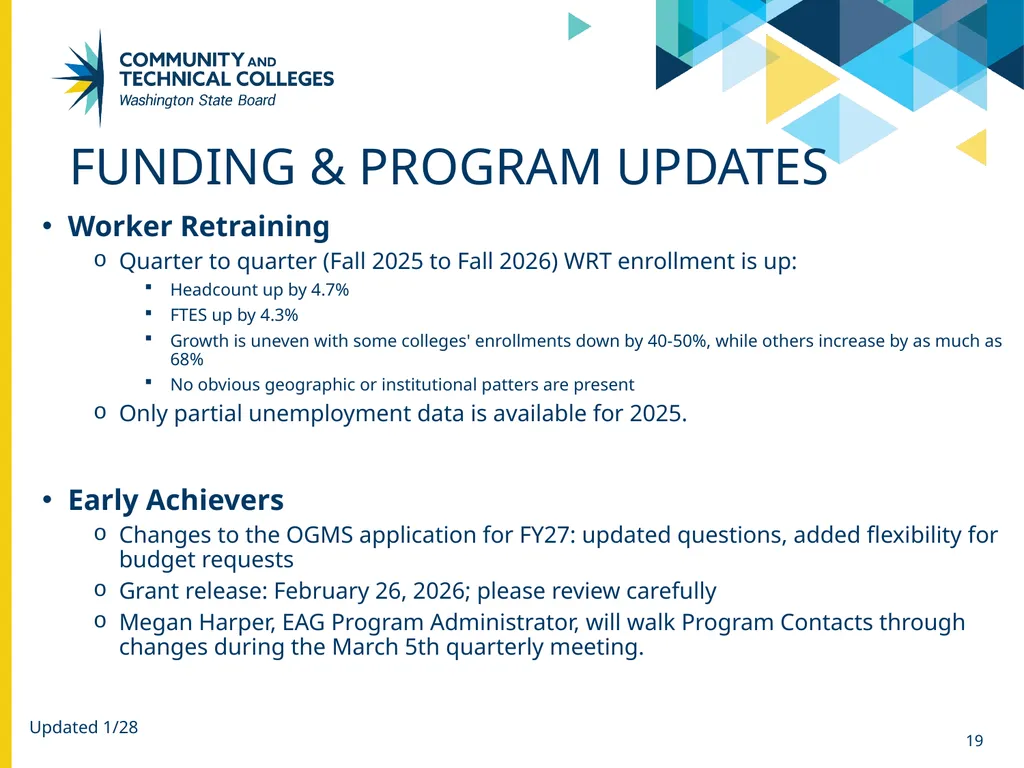
Funding & Program Updates Worker Retraining
Quarter to quarter (Fall 2025 to Fall 2026) WRT enrollment is up:
Headcount up by 4.7%
FTES up by 4.3%
Growth is uneven with some colleges' enrollments down by 40-50%, while others increase by as much as 68%
No obvious geographic or institutional patters are present
Only partial unemployment data is available for 2025.
Early Achievers
Changes to the OGMS application for FY27: updated questions, added flexibility for budget requests
Grant release: February 26, 2026; please review carefully
Megan Harper, EAG Program Administrator, will walk Program Contacts through changes during the March 5th quarterly meeting. 19 Updated 1/28<br>
20
Student support Programs Core Student Supports Team:
Jennifer Dellinger, Policy Associate, jdellinger@sbctc.edu
Vacant, Program Administrator, (WorkFirst)
Sheila Acosta, Program Administrator, sacosta@sbctc.edu
Dylan Jilek, Integrations Coordinator, djilek@sbctc.edu
Rebecca Kay, Relationship & Compliance Analyst, rkay@sbctc.edu
Integrated Student Supports Team:
Jessica Perez, Interim Policy Associate, jperez@sbctc.edu
Christine McMullen, Policy Associate, cmcmullen@sbctc.edu
Laura Coghlan, Program Administrator, lcoghlan@sbctc.edu 20<br>
21
Program & Grant Updates Student Emergency Assistance Grants and Supporting Students Experiencing Homelessness Program
SSEH & SEAG – Quarter two Report and Funding Survey
Due 1/30
Program Updates
SEAG – three new colleges participating, final four are engaged in planning grants
SSEH – all 34 colleges are now participating
Enrollments
SEAG: Summer 2025 – 876 students (up 37% from prior summer)
SEAG: Fall 2025 – 1929 students (down 3% from prior fall)
SSEH: Summer 2025 - 1121 students (up 11% from prior summer)
SSEH: Fall 2025 - 2524 students (up 5% from prior fall)
SSEH 2025 Legislative Report 21<br>
22
Program & Grant Updates Basic Food Employment & Training (BFET) Program
Spring Funding Survey
2/19/26 - 3/16/26
Quarterly Billing – Due 1/31/26
Colleges are approved to bill for services beginning 10/1/25
May not include the period of 11/1-14 in the invoice due to shut down and paused contract services
Fiscal & Program Monitoring
February - July
Policy Requests
DSHS -
Budget Workbooks – request to receive them sooner
Referrals – request for DSHS to develop and provide desk aids, training, support to DSHS staff
Youth Services – request for DSHS to adapt current policy to allow for meaningful support and engagement for youth enrolled in Colleges for GED and High School Equivalency 22<br>
23
Program & Grant updates WorkFirst Program
WorkFirst Referral Training: 1/26/2026 (4 pm)
Audience: Your newer, frontline WF staff, and those looking for a refresher
Spring funding survey runs 2/19/26 - 3/16/26
Aligned with Redistribution Policy and Mid-Year Expenditure
FY27 WFDA Application Opens 2/26/2026 in OGMS
Application webinar takes place one week later, on 3/6/2026
Monthly Billing & Invoicing: Next invoice deadline is 2/28/26
Monthly, must include indirect
Communication with SBCTC is critical; contact Dylan Jilek, djilek@sbctc.edu & Denise Costello, dcostello@sbctc.edu if unable to meet the deadline
Policy Requests
DSHS -
Bachelors & applied baccalaureate degrees as JT comp – DSHS & SBCTC reviewing policy together
Life Skills Policy clarification memo issued in early Jan to support college programming 23<br>
24
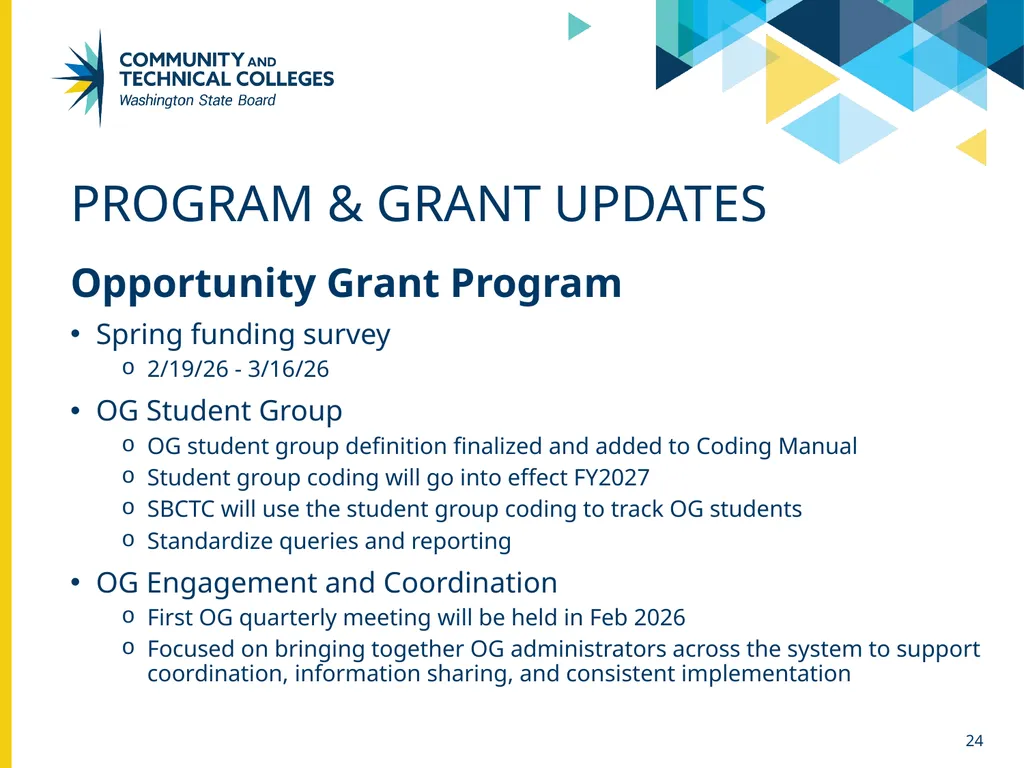
Program & Grant updates Opportunity Grant Program
Spring funding survey
2/19/26 - 3/16/26
OG Student Group
OG student group definition finalized and added to Coding Manual
Student group coding will go into effect FY2027
SBCTC will use the student group coding to track OG students
Standardize queries and reporting
OG Engagement and Coordination
First OG quarterly meeting will be held in Feb 2026
Focused on bringing together OG administrators across the system to support coordination, information sharing, and consistent implementation 24<br>
25
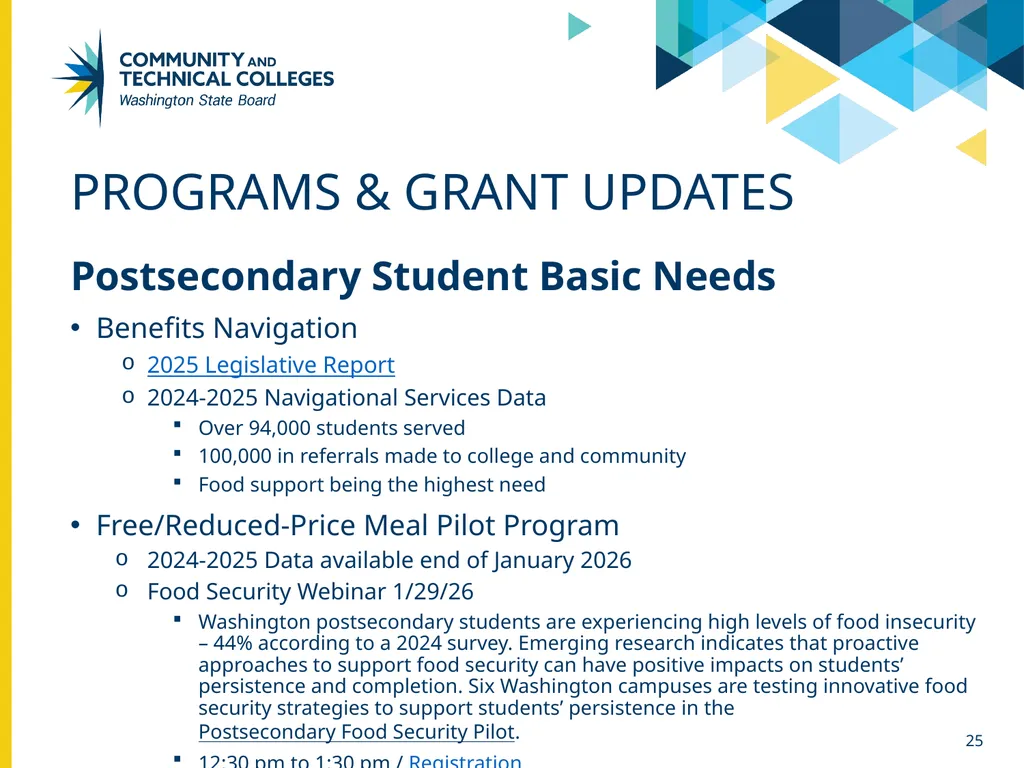
Programs & Grant Updates Postsecondary Student Basic Needs
Benefits Navigation
2025 Legislative Report
2024-2025 Navigational Services Data
Over 94,000 students served
100,000 in referrals made to college and community
Food support being the highest need
Free/Reduced-Price Meal Pilot Program
2024-2025 Data available end of January 2026
Food Security Webinar 1/29/26
Washington postsecondary students are experiencing high levels of food insecurity – 44% according to a 2024 survey. Emerging research indicates that proactive approaches to support food security can have positive impacts on students’ persistence and completion. Six Washington campuses are testing innovative food security strategies to support students’ persistence in the Postsecondary Food Security Pilot.
12:30 pm to 1:30 pm / Registration 25<br>
26
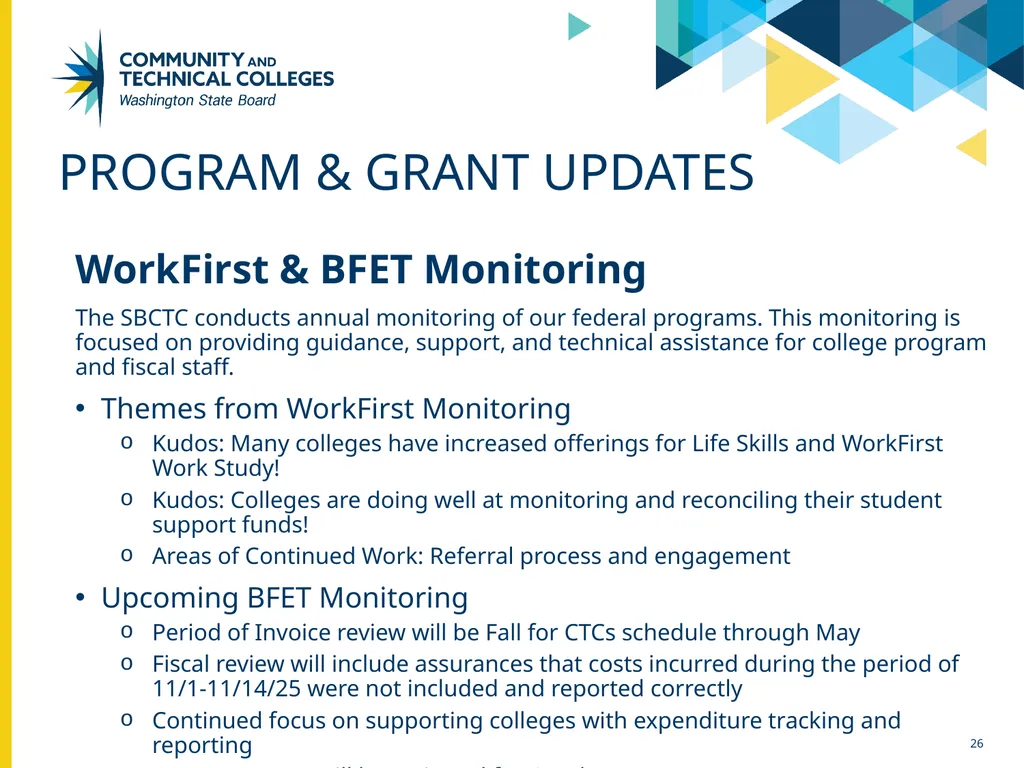
Program & Grant Updates WorkFirst & BFET Monitoring
The SBCTC conducts annual monitoring of our federal programs. This monitoring is focused on providing guidance, support, and technical assistance for college program and fiscal staff.
Themes from WorkFirst Monitoring
Kudos: Many colleges have increased offerings for Life Skills and WorkFirst Work Study!
Kudos: Colleges are doing well at monitoring and reconciling their student support funds!
Areas of Continued Work: Referral process and engagement
Upcoming BFET Monitoring
Period of Invoice review will be Fall for CTCs schedule through May
Fiscal review will include assurances that costs incurred during the period of 11/1-11/14/25 were not included and reported correctly
Continued focus on supporting colleges with expenditure tracking and reporting
Progress notes will be reviewed for October, Dec – present 26<br>
27
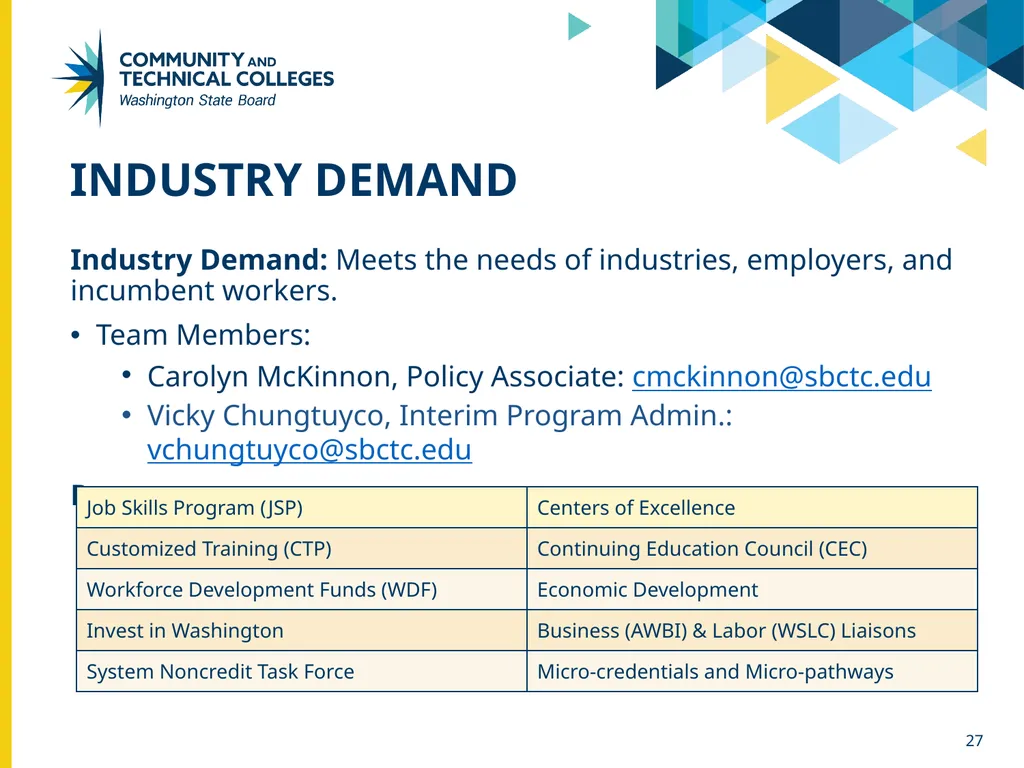
Industry Demand Industry Demand: Meets the needs of industries, employers, and incumbent workers.
Team Members:
Carolyn McKinnon, Policy Associate: cmckinnon@sbctc.edu
Vicky Chungtuyco, Interim Program Admin.: vchungtuyco@sbctc.edu
Programs: 27<br>
Team Members:
Carolyn McKinnon, Policy Associate: cmckinnon@sbctc.edu
Vicky Chungtuyco, Interim Program Admin.: vchungtuyco@sbctc.edu
Programs: 27<br>
28
Program & funding Updates Job Skills Program: $1 for $1 matching grant for customized contract training.
FY26
Funding survey #1 resulted in redistributed funding to three JSP projects from other grants.
Funds utilization is at 100%. No new application rounds expected this fiscal year.
Funding survey #2 will be conducted in February/March to review spending and reallocate funds if necessary. Contact staff early to discuss identified project needs.
FY27
Application opens in OGMS on March 26, 2026.
Application closes on April 30, 2026.
Application webinar: April 2, 2026.
Expecting annual funding of $7.5 million, with quarterly application rounds until fully awarded. 28<br>
29
Program & funding Updates Customized Training Program: Interest-free loan and B&O tax credit for contract training.
New training contracts are processed based on the fund balance and queued applications. Two-week turnaround!
Check the program website for the current fund balance, number of projects on the waitlist, and the next fund replenishment schedule: https://www.sbctc.edu/colleges-staff/programs-services/customized-training/
Workforce Development Funds & Invest in Washington
New for FY27: The Workforce Development Fund, Invest in Washington, and High Demand Enrollment Funds will use a single, consolidated application.
Application opens in OGMS on February 19, 2026.
Application closes on March 26, 2026.
Application webinar: February 26, 2026.
Funding levels: $1.5M for WDF, $82,000 for Invest in Washington, and $1M for High Demand Enrollment Funds. 29<br>
30
Updates Continuing Education Council (CEC)
CEC website updates:
Updated the left navigation to clearly separate internal SBCTC resources (Related Links) from councils, partner organizations, and external groups (Related Councils, Organizations, and Partners).
Added two new pages for improved usability: eList subscription and support and Meeting Materials (archives).
Added a calendar widget to highlight upcoming meetings and key dates.
Introduced a dedicated Upcoming Meeting section with clear meeting details.
Business (AWBI) & Labor (WSLC) Liaisons
New liaisons! This week you'll meet:
Shondae Chapman, Washington State Labor Council, AFL-CIO
Britney Martin, Association of Washington Business Institute
Advisory committee member recruitment.
Helping you gain insights from employers and workers. 30<br>
31
Noncredit task force Co-chaired by presidents Jenni Martin (Spokane) and Jim Lemerond (Bellingham Tech).
Representation:
WEC: Wendy Fox (Olympic) and Skye Field (Yakima).
Councils: Workforce Education, Continuing Education, Financial Aid, Admissions and Registration.
Commissions: Diversity and Equity Officers, Instruction.
Centers of Excellence (Brent Lundstrom, Cybersecurity).
Strengthen data.
Improve pathways to credit.
More intentionally align noncredit education with system mission, vision and strategic priorities. 31<br>
32
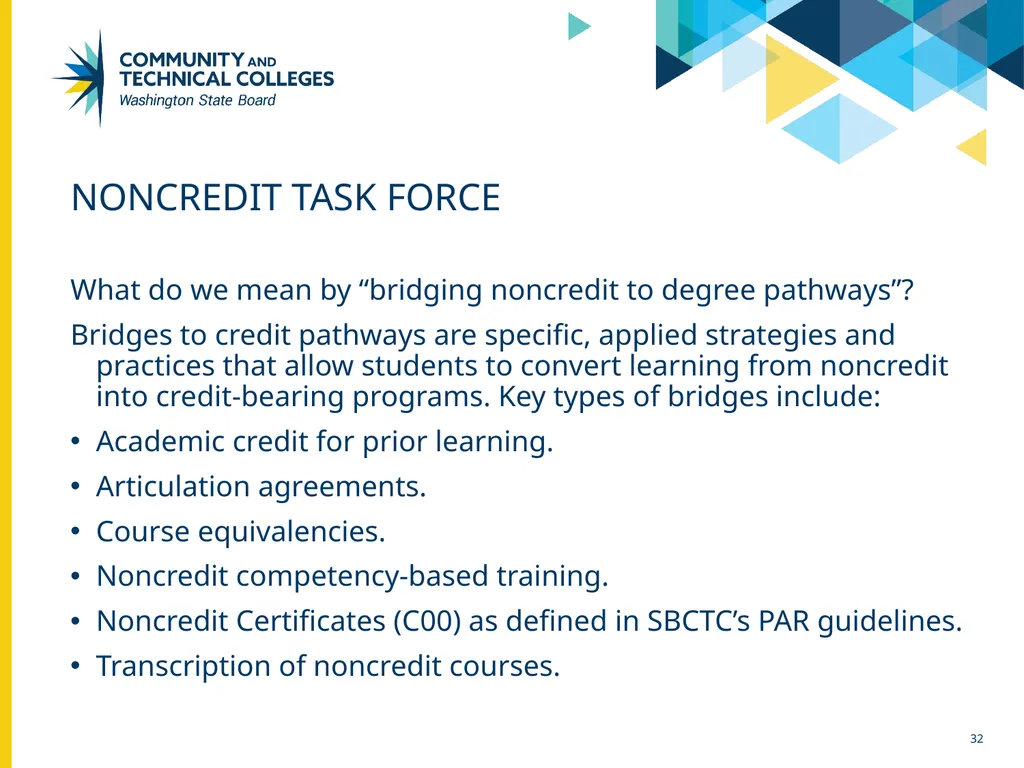
Noncredit task force What do we mean by “bridging noncredit to degree pathways”?
Bridges to credit pathways are specific, applied strategies and practices that allow students to convert learning from noncredit into credit-bearing programs. Key types of bridges include:
Academic credit for prior learning.
Articulation agreements.
Course equivalencies.
Noncredit competency-based training.
Noncredit Certificates (C00) as defined in SBCTC’s PAR guidelines.
Transcription of noncredit courses. 32<br>
33
Noncredit task force Request from the task force to WEC:
In the interest of leveraging rather than duplicating efforts, please share reports from the Noncredit-to-Credit WEC Work Group. 33<br>
In the interest of leveraging rather than duplicating efforts, please share reports from the Noncredit-to-Credit WEC Work Group. 33<br>