
Washington's view of Japan’s Plutonium Program A
NS
Published · 28 slides · 0 views

1 / 1





Description
Washingtons view of Japans Plutonium Program A presentation by Henry Sokolski Executive Director Nonproliferation Policy Education Center www.npolicy.org Nonproliferation Policy Education Center 2232017 1 The US-Japan Nuclear
Related Topics
Share
Embed code
Download this presentation From Below
"Washington's view of Japan’s Plutonium Program A" is the property of its rightful owner. Permission is granted to download and print the materials on this website for personal, non-commercial use only, and to display it on your personal computer provided you do not modify the materials and that you retain all copyright notices contained in the materials. By downloading content from our website, you accept the terms of this agreement.
Presentation Transcript
01
Washington's view of Japan’s Plutonium Program A presentation by
Henry Sokolski
Executive Director
Nonproliferation Policy Education Center
www.npolicy.org
© Nonproliferation Policy Education Center 2/23/2017 1 The US-Japan Nuclear Co-operation Agreement and Japan's Plutonium Policy Conference
Tokyo, Japan
February 23-24, 2017<br>
© Nonproliferation Policy Education Center 2/23/2017 1 The US-Japan Nuclear Co-operation Agreement and Japan's Plutonium Policy Conference
Tokyo, Japan
February 23-24, 2017<br>
02
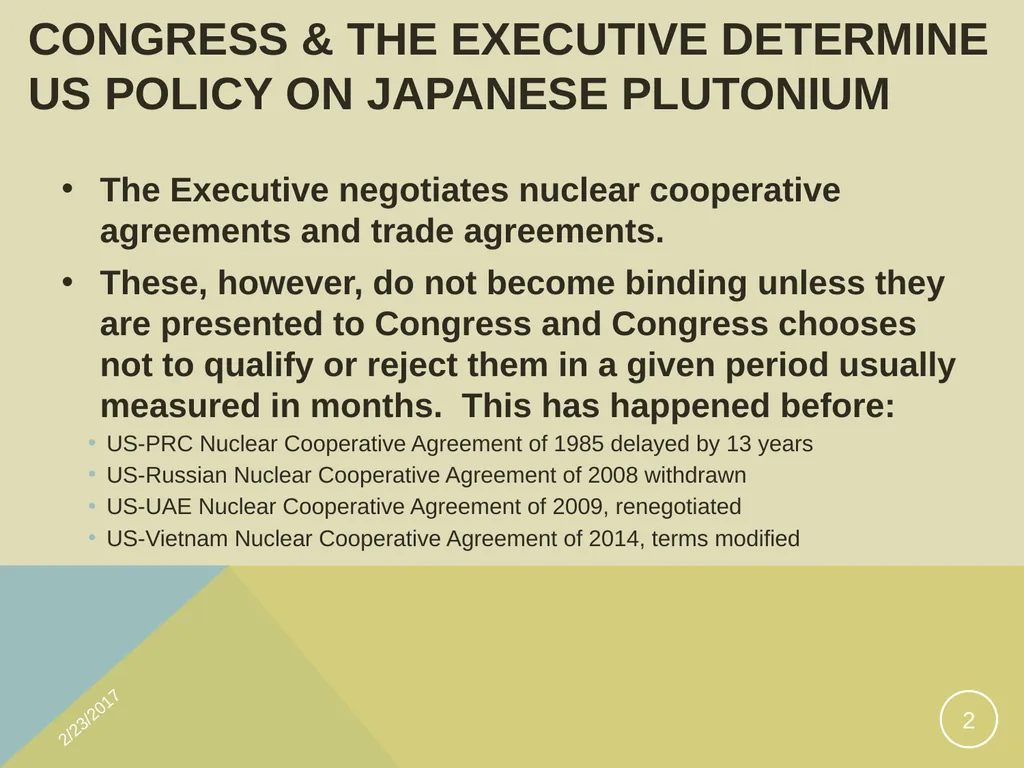
Congress & the Executive Determine US policy on Japanese plutonium The Executive negotiates nuclear cooperative agreements and trade agreements.
These, however, do not become binding unless they are presented to Congress and Congress chooses not to qualify or reject them in a given period usually measured in months. This has happened before:
US-PRC Nuclear Cooperative Agreement of 1985 delayed by 13 years
US-Russian Nuclear Cooperative Agreement of 2008 withdrawn
US-UAE Nuclear Cooperative Agreement of 2009, renegotiated
US-Vietnam Nuclear Cooperative Agreement of 2014, terms modified 2/23/2017 2<br>
These, however, do not become binding unless they are presented to Congress and Congress chooses not to qualify or reject them in a given period usually measured in months. This has happened before:
US-PRC Nuclear Cooperative Agreement of 1985 delayed by 13 years
US-Russian Nuclear Cooperative Agreement of 2008 withdrawn
US-UAE Nuclear Cooperative Agreement of 2009, renegotiated
US-Vietnam Nuclear Cooperative Agreement of 2014, terms modified 2/23/2017 2<br>
03
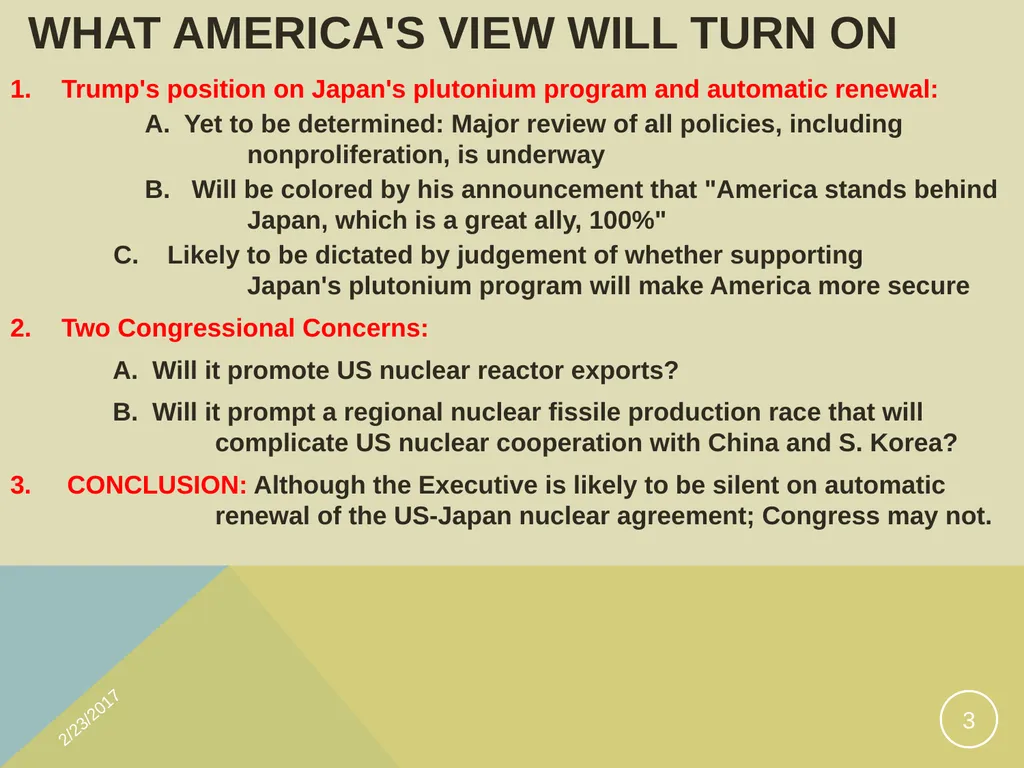
What America's View Will Turn on Trump's position on Japan's plutonium program and automatic renewal:
A. Yet to be determined: Major review of all policies, including nonproliferation, is underway
B. Will be colored by his announcement that "America stands behind Japan, which is a great ally, 100%"
C. Likely to be dictated by judgement of whether supporting Japan's plutonium program will make America more secure
Two Congressional Concerns:
A. Will it promote US nuclear reactor exports?
B. Will it prompt a regional nuclear fissile production race that will complicate US nuclear cooperation with China and S. Korea?
3. CONCLUSION: Although the Executive is likely to be silent on automatic renewal of the US-Japan nuclear agreement; Congress may not. 2/23/2017 3<br>
A. Yet to be determined: Major review of all policies, including nonproliferation, is underway
B. Will be colored by his announcement that "America stands behind Japan, which is a great ally, 100%"
C. Likely to be dictated by judgement of whether supporting Japan's plutonium program will make America more secure
Two Congressional Concerns:
A. Will it promote US nuclear reactor exports?
B. Will it prompt a regional nuclear fissile production race that will complicate US nuclear cooperation with China and S. Korea?
3. CONCLUSION: Although the Executive is likely to be silent on automatic renewal of the US-Japan nuclear agreement; Congress may not. 2/23/2017 3<br>
04
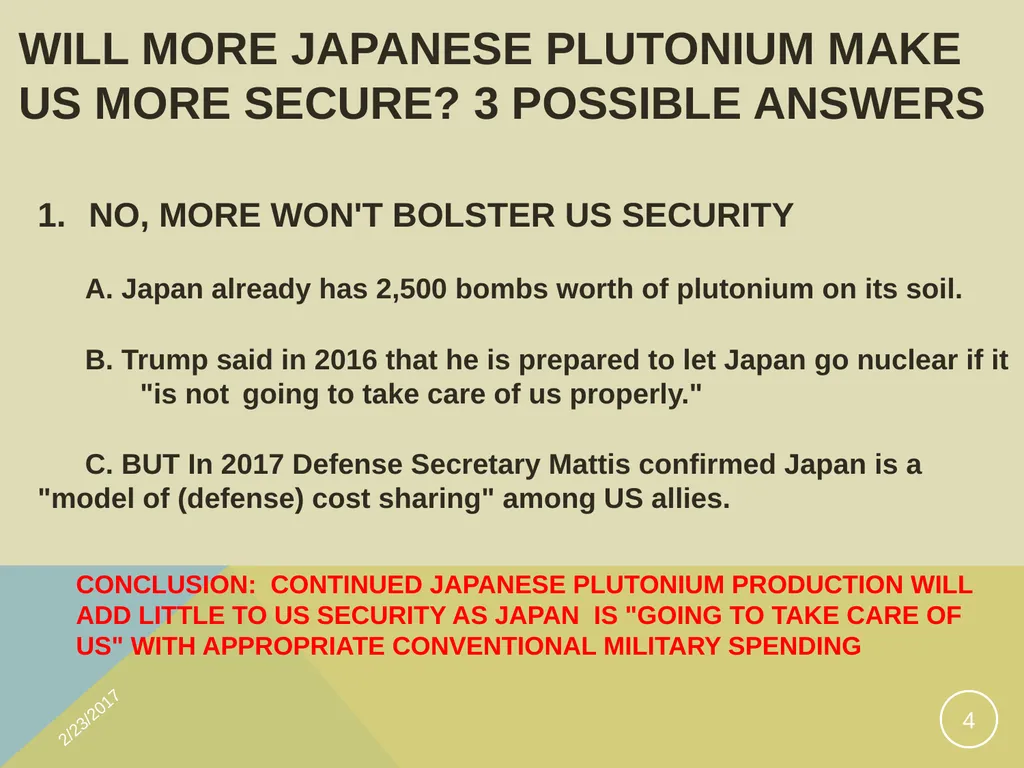
Will more Japanese plutonium make US more secure? 3 possible answers NO, MORE WON'T BOLSTER US SECURITY
A. Japan already has 2,500 bombs worth of plutonium on its soil.
B. Trump said in 2016 that he is prepared to let Japan go nuclear if it "is not going to take care of us properly."
C. BUT In 2017 Defense Secretary Mattis confirmed Japan is a "model of (defense) cost sharing" among US allies.
CONCLUSION: CONTINUED JAPANESE PLUTONIUM PRODUCTION WILL ADD LITTLE TO US SECURITY AS JAPAN IS "GOING TO TAKE CARE OF US" WITH APPROPRIATE CONVENTIONAL MILITARY SPENDING 2/23/2017 4<br>
A. Japan already has 2,500 bombs worth of plutonium on its soil.
B. Trump said in 2016 that he is prepared to let Japan go nuclear if it "is not going to take care of us properly."
C. BUT In 2017 Defense Secretary Mattis confirmed Japan is a "model of (defense) cost sharing" among US allies.
CONCLUSION: CONTINUED JAPANESE PLUTONIUM PRODUCTION WILL ADD LITTLE TO US SECURITY AS JAPAN IS "GOING TO TAKE CARE OF US" WITH APPROPRIATE CONVENTIONAL MILITARY SPENDING 2/23/2017 4<br>
05
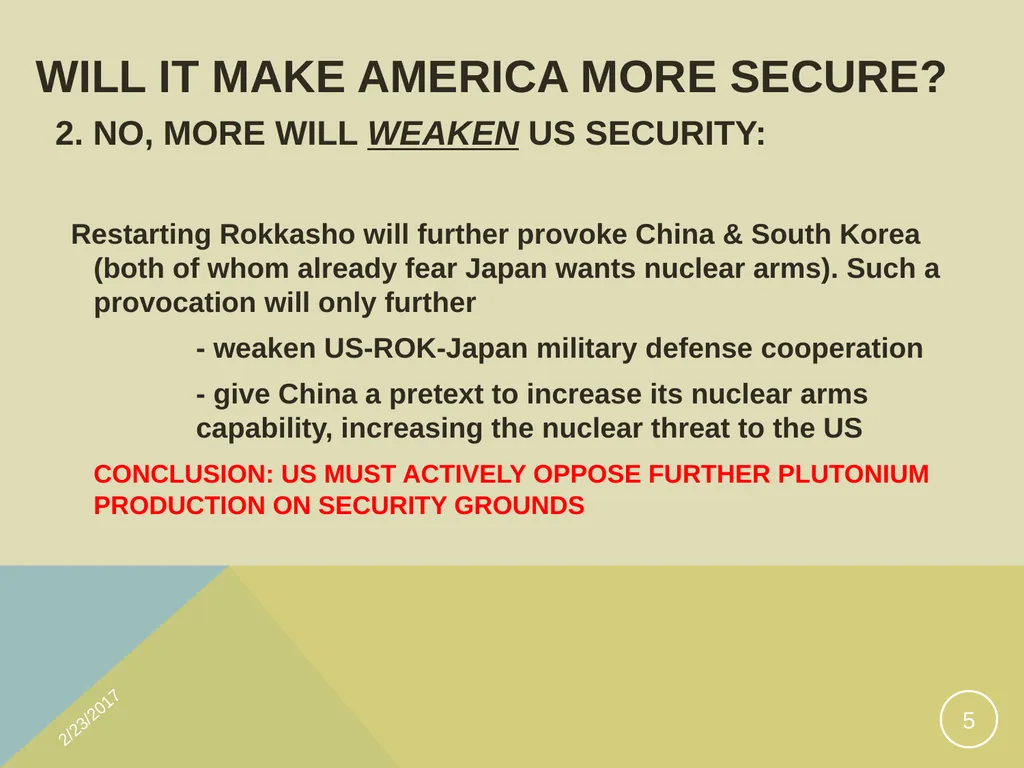
WILL IT MAKE AMERICA MORE SECURE? 2. NO, MORE WILL WEAKEN US SECURITY:
Restarting Rokkasho will further provoke China & South Korea (both of whom already fear Japan wants nuclear arms). Such a provocation will only further
- weaken US-ROK-Japan military defense cooperation
- give China a pretext to increase its nuclear arms capability, increasing the nuclear threat to the US
CONCLUSION: US MUST ACTIVELY OPPOSE FURTHER PLUTONIUM PRODUCTION ON SECURITY GROUNDS 2/23/2017 5<br>
Restarting Rokkasho will further provoke China & South Korea (both of whom already fear Japan wants nuclear arms). Such a provocation will only further
- weaken US-ROK-Japan military defense cooperation
- give China a pretext to increase its nuclear arms capability, increasing the nuclear threat to the US
CONCLUSION: US MUST ACTIVELY OPPOSE FURTHER PLUTONIUM PRODUCTION ON SECURITY GROUNDS 2/23/2017 5<br>
06
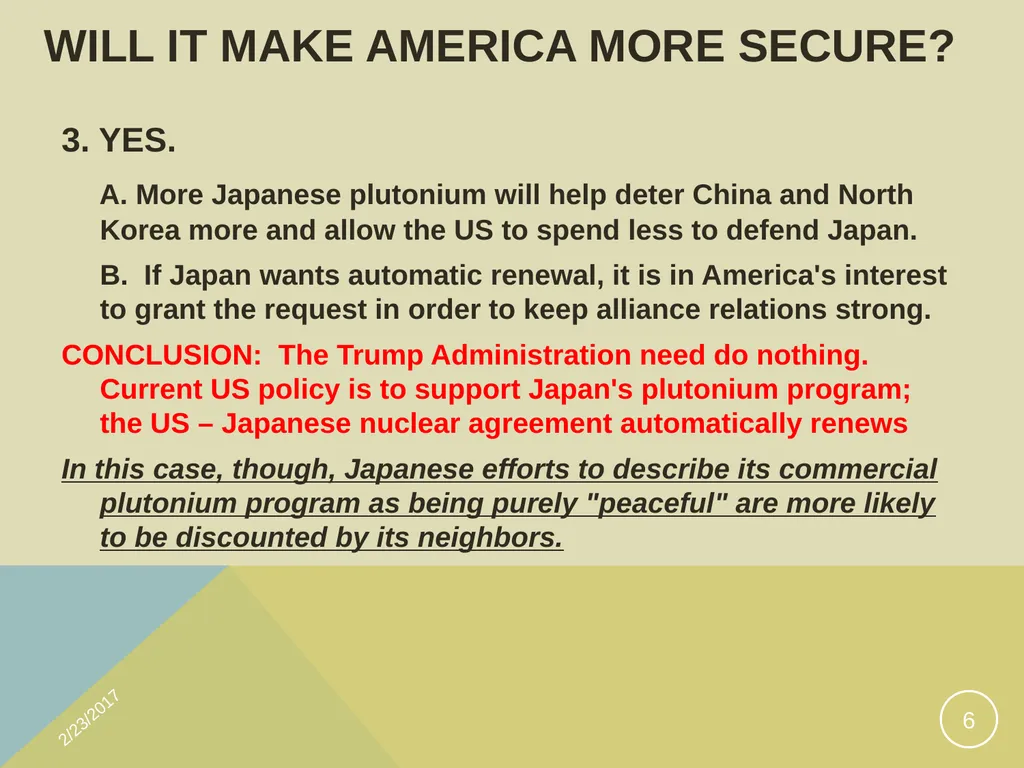
WILL IT MAKE AMERICA MORE SECURE? 3. YES.
A. More Japanese plutonium will help deter China and North Korea more and allow the US to spend less to defend Japan.
B. If Japan wants automatic renewal, it is in America's interest to grant the request in order to keep alliance relations strong.
CONCLUSION: The Trump Administration need do nothing. Current US policy is to support Japan's plutonium program; the US – Japanese nuclear agreement automatically renews
In this case, though, Japanese efforts to describe its commercial plutonium program as being purely "peaceful" are more likely to be discounted by its neighbors. 2/23/2017 6<br>
A. More Japanese plutonium will help deter China and North Korea more and allow the US to spend less to defend Japan.
B. If Japan wants automatic renewal, it is in America's interest to grant the request in order to keep alliance relations strong.
CONCLUSION: The Trump Administration need do nothing. Current US policy is to support Japan's plutonium program; the US – Japanese nuclear agreement automatically renews
In this case, though, Japanese efforts to describe its commercial plutonium program as being purely "peaceful" are more likely to be discounted by its neighbors. 2/23/2017 6<br>
07
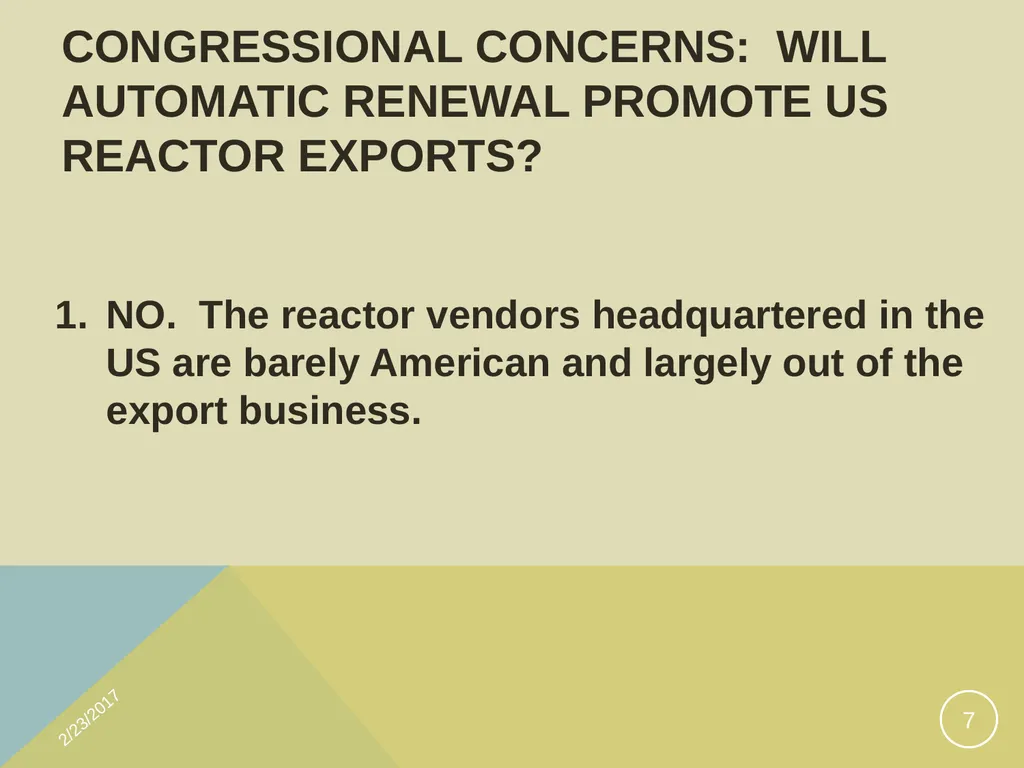
Congressional Concerns: Will automatic renewal promote US reactor exports? NO. The reactor vendors headquartered in the US are barely American and largely out of the export business. 2/23/2017 7<br>
08
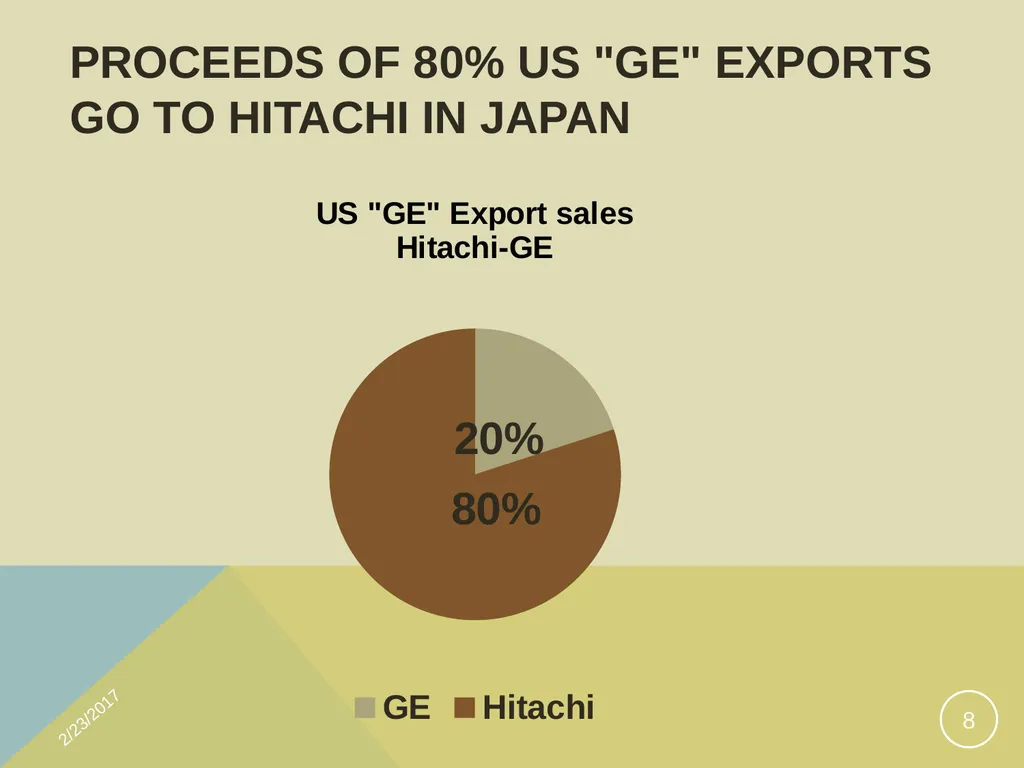
Proceeds of 80% US "GE" Exports Go to Hitachi in japan 8 2/23/2017<br>
09
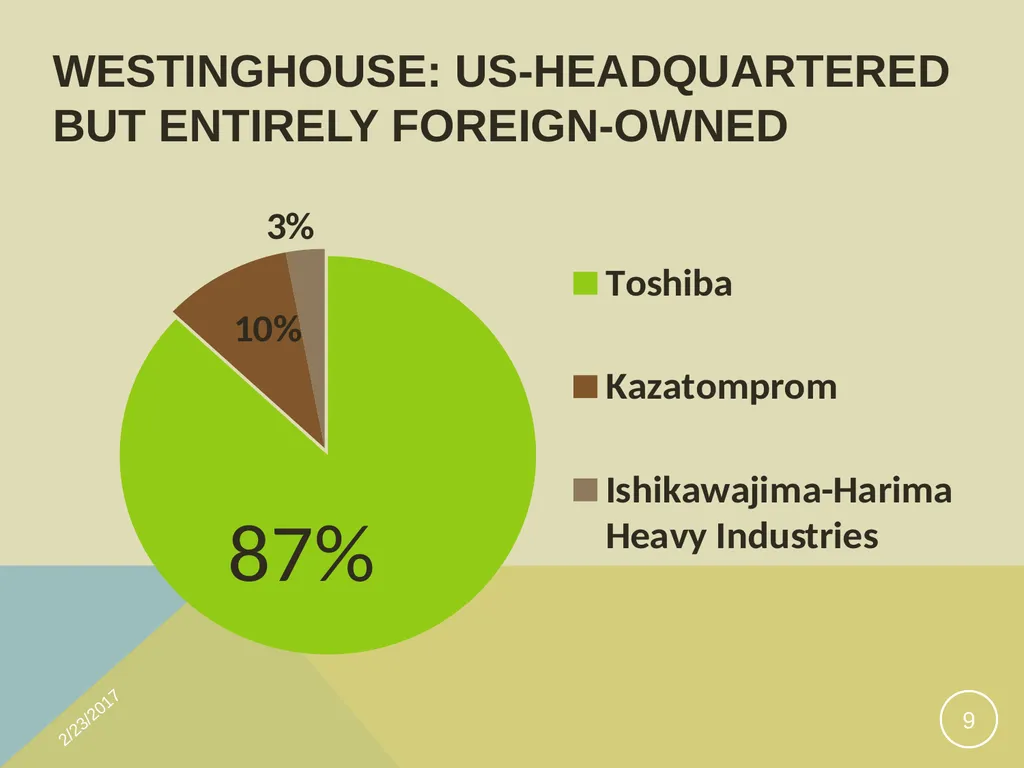
Westinghouse: US-headquartered but entirely foreign-owned 9 2/23/2017<br>
10
Toshiba-westinghouse is getting out of the reactor Construction business “Toshiba to withdraw from nuclear plant construction, chairman to quit,” The Mainichi, January 29, 2017.
GE is not interested in exporting reactors to East Asia
Any large nuclear projects Japan may want to work with the US on would require government financing
Conclusion: Nuclear cooperation with Japan or China no longer promises a major jobs dividend for US 2/23/2017 10<br>
GE is not interested in exporting reactors to East Asia
Any large nuclear projects Japan may want to work with the US on would require government financing
Conclusion: Nuclear cooperation with Japan or China no longer promises a major jobs dividend for US 2/23/2017 10<br>
11
Will automatic renewal promote US reactor exports? NO. IT MAY ACTUALLY REDUCE THEM if, as reported, Toshiba recoups some of its nuclear losses by selling off AP reactor design information.
"It is expected that Toshiba may license its AP1000 technology to other firms as it has done in China." Neuron Bytes, January 29, 2017 at https://neutronbytes.com/2017/01/29/toshiba-to-withdraw-from-nuclear-plant-construction/
As we will see, the reexport of US AP 1000 technology has some in the US Congress worried. 2/23/2017 11<br>
"It is expected that Toshiba may license its AP1000 technology to other firms as it has done in China." Neuron Bytes, January 29, 2017 at https://neutronbytes.com/2017/01/29/toshiba-to-withdraw-from-nuclear-plant-construction/
As we will see, the reexport of US AP 1000 technology has some in the US Congress worried. 2/23/2017 11<br>
12
Will it prompt a fissile production race? MOST LIKELY, YES PRC's key bottleneck to catching up with Russia and US nuclear stockpiles is its lack of a large reprocessing plant, which it could eliminate by buying a French plant similar to Rokkasho
Both China and S. Korea have heavy water reactors that make good weapons usable plutonium
Early 1950s weapons designs and/or tritium boosting allows use of reactor-grade plutonium for efficient nuclear weapons and China, North Korea, South Korea, and Japan all produce tritium
China, South Korea, North Korea, and Japan could use their light water reactors to make plutonium for weapons
S. Korea plans on building a large pyroreprocessing plant with US consent 2/23/2017 12<br>
Both China and S. Korea have heavy water reactors that make good weapons usable plutonium
Early 1950s weapons designs and/or tritium boosting allows use of reactor-grade plutonium for efficient nuclear weapons and China, North Korea, South Korea, and Japan all produce tritium
China, South Korea, North Korea, and Japan could use their light water reactors to make plutonium for weapons
S. Korea plans on building a large pyroreprocessing plant with US consent 2/23/2017 12<br>
13
What Has Congress Proposed? Bob Corker, Chairman of Senate Foreign Relations Committee, called for a commercial plutonium production pause in East Asia. He has not endorsed automatic renewal of the US – Japanese 123 agreement.
Senators Ed Markey and Marco Rubio and Congressmen Brad Sherman and Jeff Fortenberry introduced S. 3010 and H.R.5370: U.S.-China Nuclear Cooperation and Nonproliferation Act of 2016, which restricts Chinese reprocessing of the US-origin spent fuel and the re-export of US nuclear design information. A new version of this legislation will be released early this year.
If this legislation receives attention, it is likely to make Japanese reprocessing and re-exportation of US nuclear design information matters of discussion regarding renewal of the US Japan 123. 2/23/2017 13<br>
Senators Ed Markey and Marco Rubio and Congressmen Brad Sherman and Jeff Fortenberry introduced S. 3010 and H.R.5370: U.S.-China Nuclear Cooperation and Nonproliferation Act of 2016, which restricts Chinese reprocessing of the US-origin spent fuel and the re-export of US nuclear design information. A new version of this legislation will be released early this year.
If this legislation receives attention, it is likely to make Japanese reprocessing and re-exportation of US nuclear design information matters of discussion regarding renewal of the US Japan 123. 2/23/2017 13<br>
14
Executive Most likely to be silent Latest US State Department – Japanese MOFA statement -- "Both countries stress that they do not share [critics'] concerns regarding Japan's plutonium management."
Abe says Trump "assured me that the United States will always be with Japan 100%."
Planned US-Japan trade talks will be between Vice President Mike Pence and Finance Minister Taro Aso. Aso favored a public debate about Japan acquiring nuclear weapons and noted that Japan could get weapons quickly if it chose to do so. 2/23/2017 14<br>
Abe says Trump "assured me that the United States will always be with Japan 100%."
Planned US-Japan trade talks will be between Vice President Mike Pence and Finance Minister Taro Aso. Aso favored a public debate about Japan acquiring nuclear weapons and noted that Japan could get weapons quickly if it chose to do so. 2/23/2017 14<br>
15
Still, almost anything can happen If Abe asks for anything of Trump, Abe risks being asked to deliver on something he may find awkward. But if Abe delivers, Abe may well be able to ask Trump for something as well, including automatic renewal.
On the other hand, if enough is said about the security implications of Japan's plutonium program in the press and on the Hill, and the alternative of a plutonium production pause is promoted, a debate in the US Congress could assure renewal is anything but automatic. 2/23/2017 15<br>
On the other hand, if enough is said about the security implications of Japan's plutonium program in the press and on the Hill, and the alternative of a plutonium production pause is promoted, a debate in the US Congress could assure renewal is anything but automatic. 2/23/2017 15<br>
16
Additional slides 2/23/2017 16<br>
17
China may want an option to catch up with Russia, US 2/23/2017 17 (1.8 tons assumed) (87.6 tons) (169.5-185.5 tons)
8 tons uncertainty Source: http://fissilematerials.org/library/gfmr13.pdf and http://fissilematerials.org/library/gfmr10.pdf<br>
8 tons uncertainty Source: http://fissilematerials.org/library/gfmr13.pdf and http://fissilematerials.org/library/gfmr10.pdf<br>
18
4 kg weapons-grade Pu assumed per bomb based on DOE estimate.
5.2 kg reactor-grade Pu assumed per bomb based on estimate by Richard L. Garwin (see http://fas.org/rlg/980826-pu.htm)
150 kg weapons-grade Pu conservatively assumed per reactor year (see page 64, http://fsi.stanford.edu/sites/default/files/VAF-June.pdf)
250 kg reactor-grade Pu conservatively assumed per reactor year. How Much Plutonium Could a 1 GWe LWR Generate/Year? 2/23/2017 18 ~37 bombs 150 kg 250 kg<br>
5.2 kg reactor-grade Pu assumed per bomb based on estimate by Richard L. Garwin (see http://fas.org/rlg/980826-pu.htm)
150 kg weapons-grade Pu conservatively assumed per reactor year (see page 64, http://fsi.stanford.edu/sites/default/files/VAF-June.pdf)
250 kg reactor-grade Pu conservatively assumed per reactor year. How Much Plutonium Could a 1 GWe LWR Generate/Year? 2/23/2017 18 ~37 bombs 150 kg 250 kg<br>
19
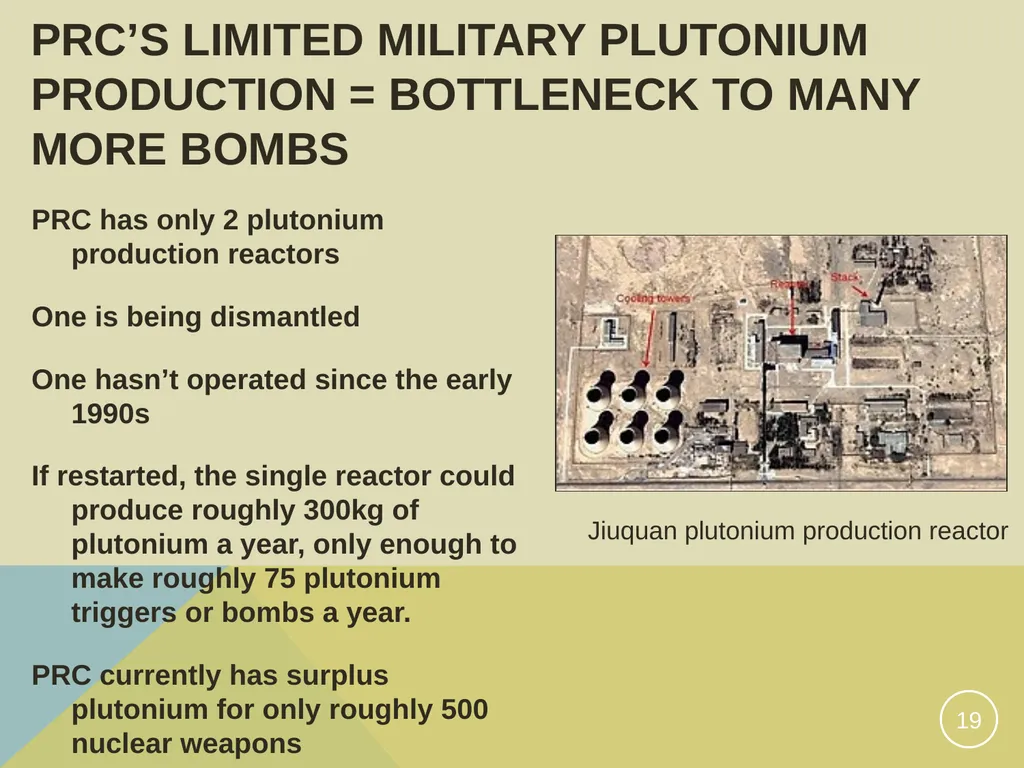
PRC’s Limited military Plutonium Production = Bottleneck to Many More bombs PRC has only 2 plutonium production reactors
One is being dismantled
One hasn’t operated since the early 1990s
If restarted, the single reactor could produce roughly 300kg of plutonium a year, only enough to make roughly 75 plutonium triggers or bombs a year.
PRC currently has surplus plutonium for only roughly 500 nuclear weapons 19 Jiuquan plutonium production reactor<br>
One is being dismantled
One hasn’t operated since the early 1990s
If restarted, the single reactor could produce roughly 300kg of plutonium a year, only enough to make roughly 75 plutonium triggers or bombs a year.
PRC currently has surplus plutonium for only roughly 500 nuclear weapons 19 Jiuquan plutonium production reactor<br>
20
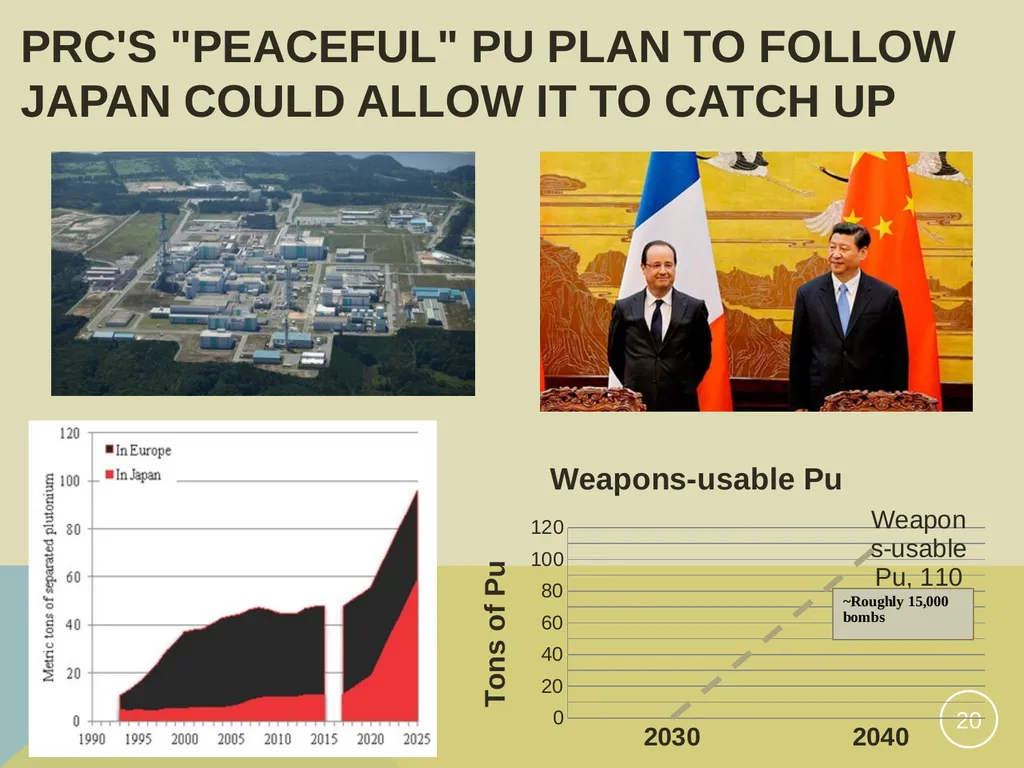
PRC's "peaceful" pU Plan to Follow Japan Could allow it to catch up 2/23/2017 20<br>
21
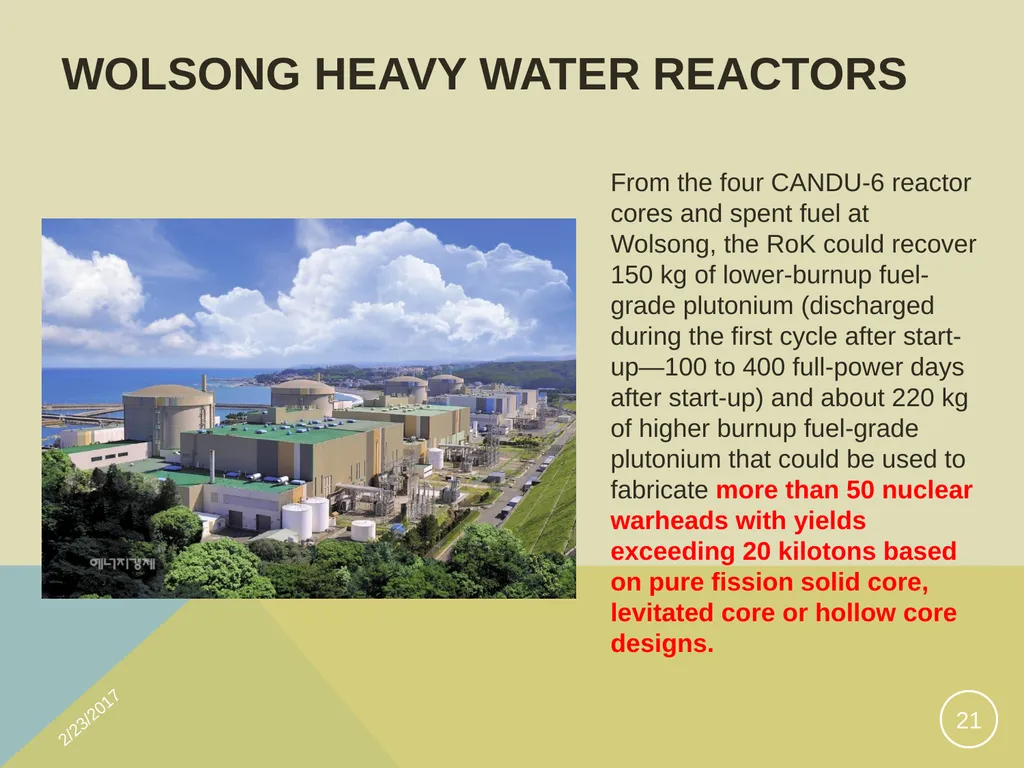
Wolsong Heavy Water Reactors 2/23/2017 21 From the four CANDU-6 reactor cores and spent fuel at Wolsong, the RoK could recover 150 kg of lower-burnup fuel-grade plutonium (discharged during the first cycle after start-up—100 to 400 full-power days after start-up) and about 220 kg of higher burnup fuel-grade plutonium that could be used to fabricate more than 50 nuclear warheads with yields exceeding 20 kilotons based on pure fission solid core, levitated core or hollow core designs.<br>
22
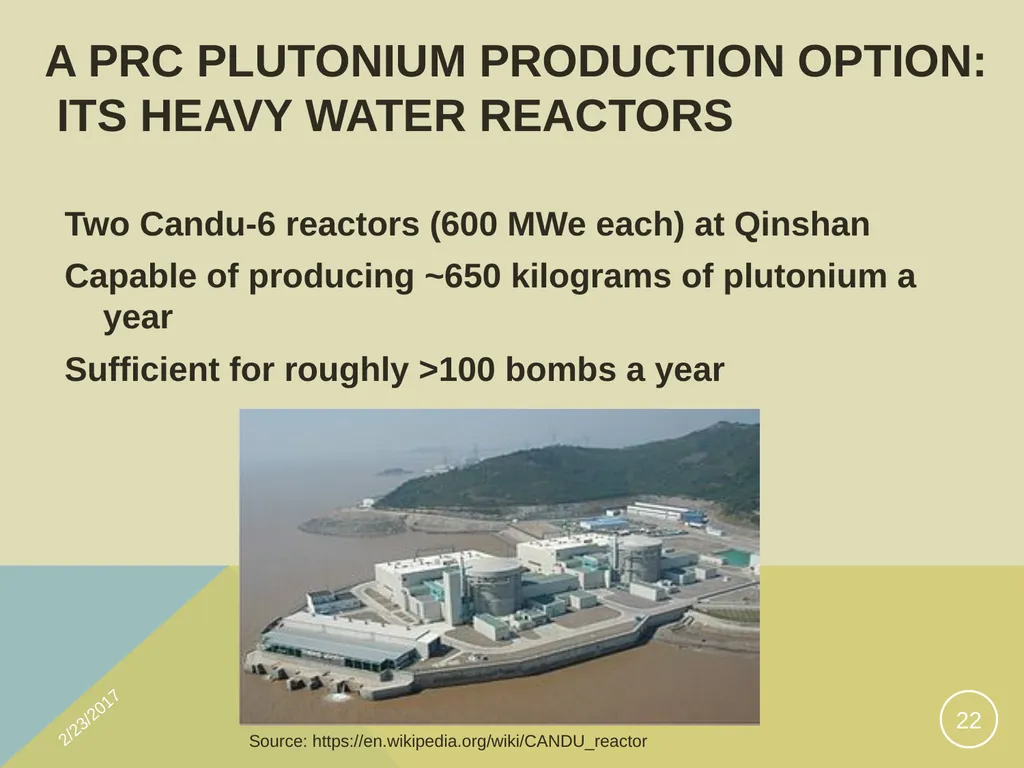
A PRC Plutonium Production Option: Its Heavy Water Reactors Two Candu-6 reactors (600 MWe each) at Qinshan
Capable of producing ~650 kilograms of plutonium a year
Sufficient for roughly >100 bombs a year 2/23/2017 22 Source: https://en.wikipedia.org/wiki/CANDU_reactor<br>
Capable of producing ~650 kilograms of plutonium a year
Sufficient for roughly >100 bombs a year 2/23/2017 22 Source: https://en.wikipedia.org/wiki/CANDU_reactor<br>
23
Even Reactor-Grade Pu Can Make Very Effective Nuclear Weapons By making use of various combinations of advanced technologies -improved implosion techniques such as … boosting with deuterium and tritium…it is possible to offset the problems created by the high rate of spontaneous fission of PU-240. Thomas B. Cochran, “Technological Issues Related to the Proliferation of Nuclear Weapons,” August 23, 1998.
When about 1% of the fission reaction has taken place, the thermonuclear fuel—deuterium and tritium (doubly and triply heavy hydrogen)—reacts and floods the remaining nuclear explosive with neutrons. Thus,…With a boosted weapon there is no concern about stray neutrons starting the fission chain reaction too early and having the bomb blow apart before attaining full yield... it permits a fission bomb to use any type of plutonium, including so-called reactor-grade, without degradation in performance. Gilinsky, Sokolski, “The Other Dangers from that N. Korean Nuke Test,” WSJ, January 18, 2016. 2/23/2017 23<br>
When about 1% of the fission reaction has taken place, the thermonuclear fuel—deuterium and tritium (doubly and triply heavy hydrogen)—reacts and floods the remaining nuclear explosive with neutrons. Thus,…With a boosted weapon there is no concern about stray neutrons starting the fission chain reaction too early and having the bomb blow apart before attaining full yield... it permits a fission bomb to use any type of plutonium, including so-called reactor-grade, without degradation in performance. Gilinsky, Sokolski, “The Other Dangers from that N. Korean Nuke Test,” WSJ, January 18, 2016. 2/23/2017 23<br>
24
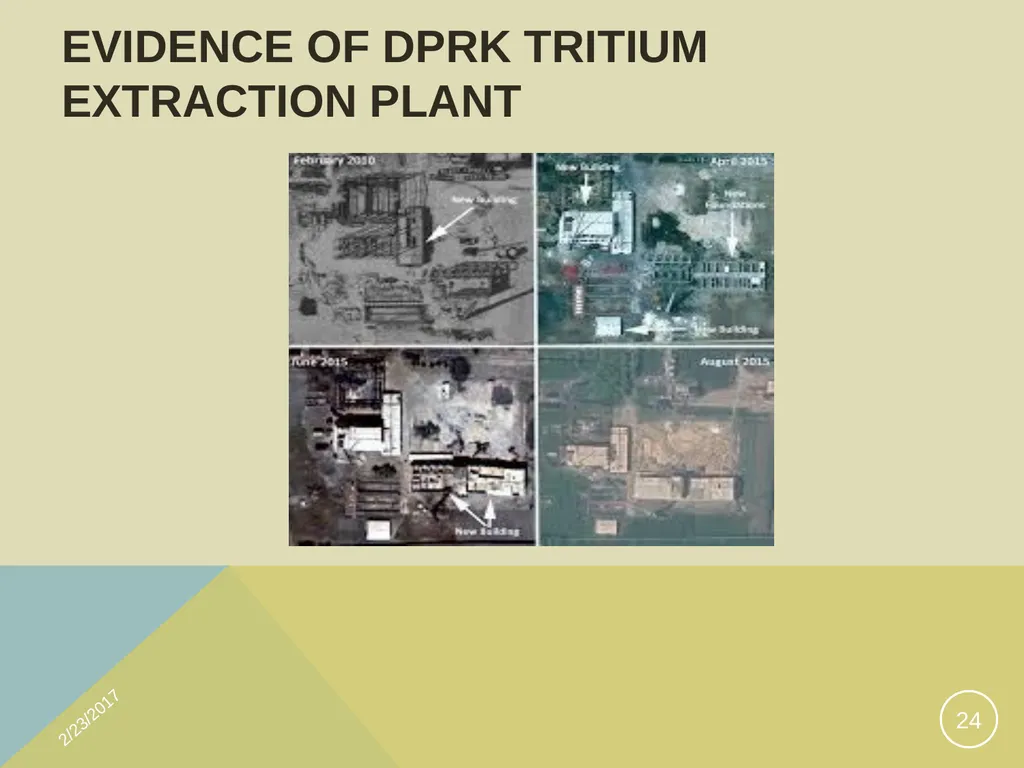
Evidence of DPRK Tritium extraction plant 2/23/2017 24<br>
25
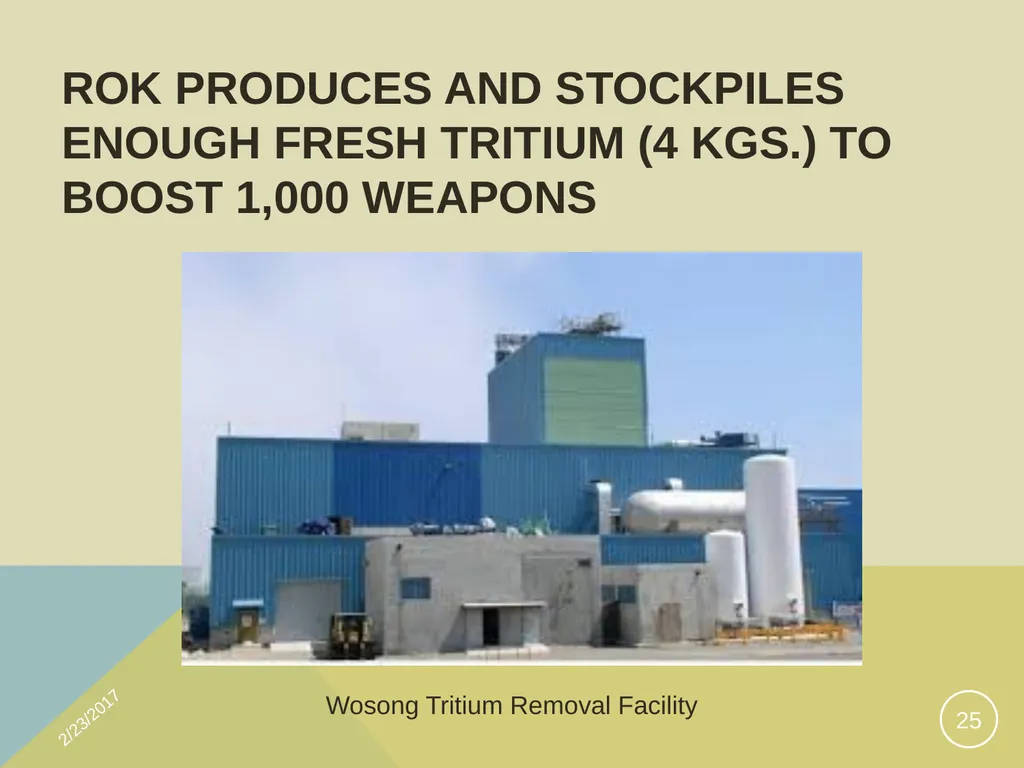
RoK Produces and Stockpiles Enough fresh Tritium (4 kgs.) to Boost 1,000 Weapons 2/23/2017 25 Wosong Tritium Removal Facility<br>
26
Japan can boost if it wants to • The National Institute for Fusion Science (NIFS) in Toki
• Japan Atomic Energy Agency’s (JAEA) Naka Fusion Institute, Ibaraki Prefecture
• Experimental Reactor (ITER) under construction in France, Japan will provide high-tech components and will host an €1 billion materials testing facility – the International Fusion Materials Irradiation Facility (IFMIF).
• Naka Fusion Institute, which includes the Tritium Processing Laboratory
• National Institute of Fusion Research 2/23/2017 26<br>
• Japan Atomic Energy Agency’s (JAEA) Naka Fusion Institute, Ibaraki Prefecture
• Experimental Reactor (ITER) under construction in France, Japan will provide high-tech components and will host an €1 billion materials testing facility – the International Fusion Materials Irradiation Facility (IFMIF).
• Naka Fusion Institute, which includes the Tritium Processing Laboratory
• National Institute of Fusion Research 2/23/2017 26<br>
27
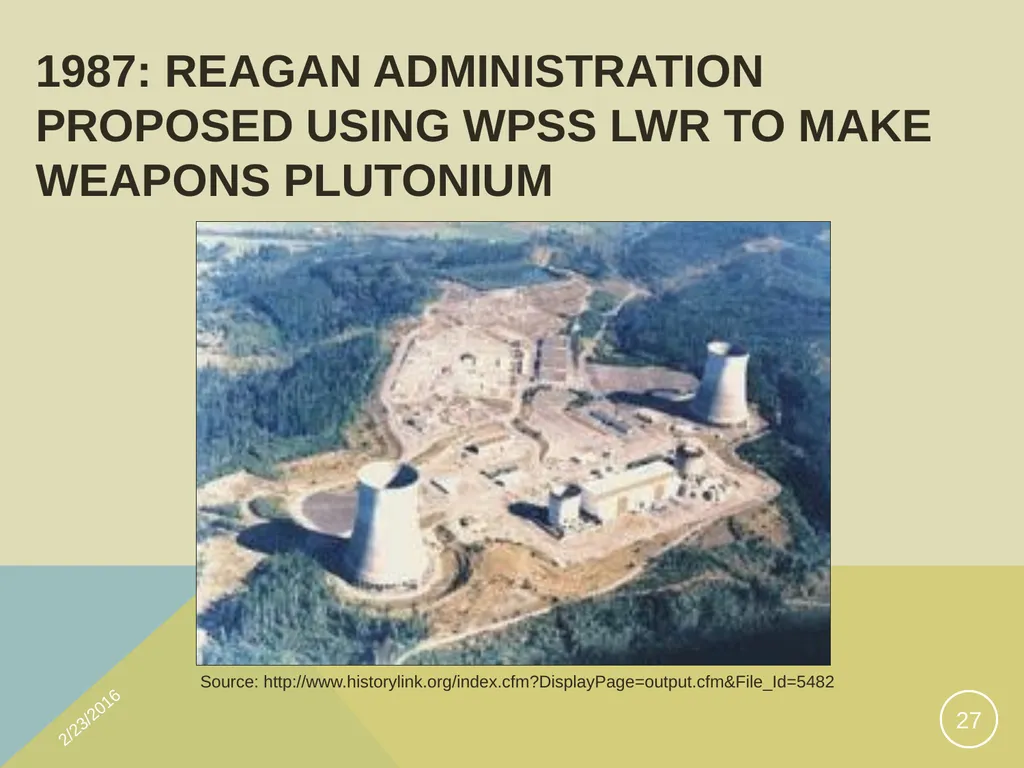
1987: Reagan Administration Proposed Using WPSS LWR to Make Weapons Plutonium 2/23/2016 27 Source: http://www.historylink.org/index.cfm?DisplayPage=output.cfm&File_Id=5482<br>
28
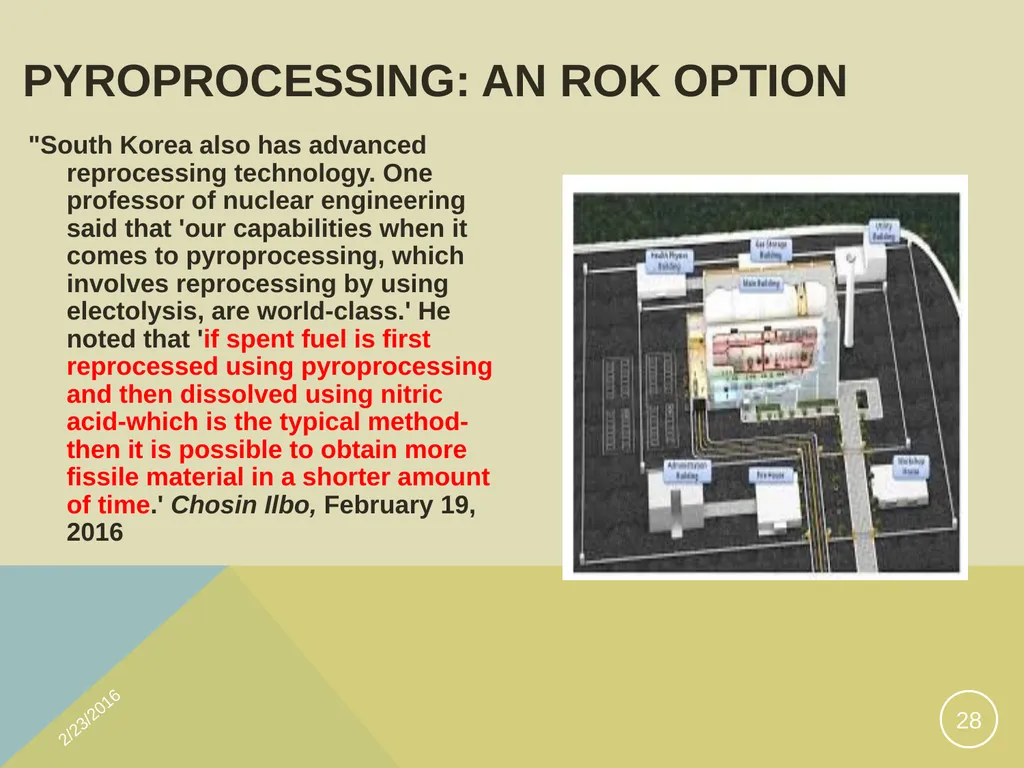
Pyroprocessing: An ROK OPtion "South Korea also has advanced reprocessing technology. One professor of nuclear engineering said that 'our capabilities when it comes to pyroprocessing, which involves reprocessing by using electolysis, are world-class.' He noted that 'if spent fuel is first reprocessed using pyroprocessing and then dissolved using nitric acid-which is the typical method-then it is possible to obtain more fissile material in a shorter amount of time.' Chosin Ilbo, February 19, 2016 2/23/2016 28<br>