Water Torture: A Slow Drip DNS DDoS Attack on QTNet Kei Nishida, Network Center Kyushu Telecommunication Network Co.,Inc 2 About QTNet Company Name Kyushu Telecommunication Network Co., Inc. (QTNet, for short) Telecommunicasions carrier in
"Water Torture: A Slow Drip DNS DDoS Attack on" is the property of its rightful owner. Permission is granted to
download and print the materials on this website for personal, non-commercial use only, and to display it
on your personal computer provided you do not modify the materials and that you retain all copyright
notices contained in the materials. By downloading content from our website, you accept the terms of this
agreement.
Presentation Transcript
01
Water Torture: A Slow Drip DNS DDoS Attack on QTNet Kei Nishida, Network Center
Kyushu Telecommunication Network Co.,Inc<br>
02
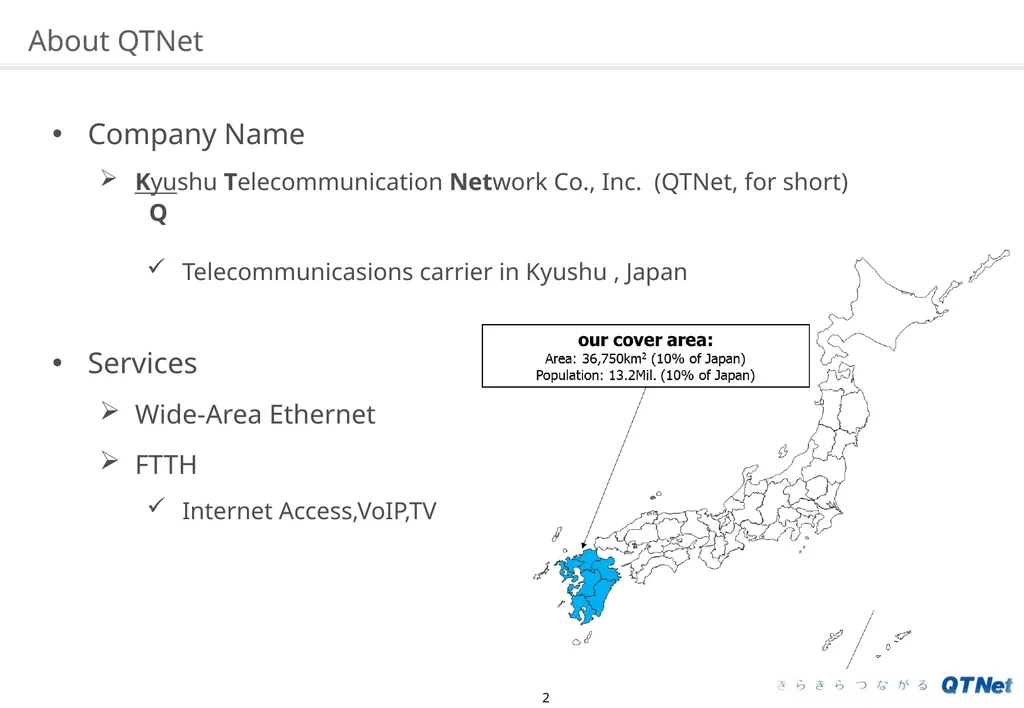
2 About QTNet Company Name
Kyushu Telecommunication Network Co., Inc. (QTNet, for short)
Telecommunicasions carrier in Kyushu , Japan
Services
Wide-Area Ethernet
FTTH
Internet Access,VoIP,TV Q<br>
03
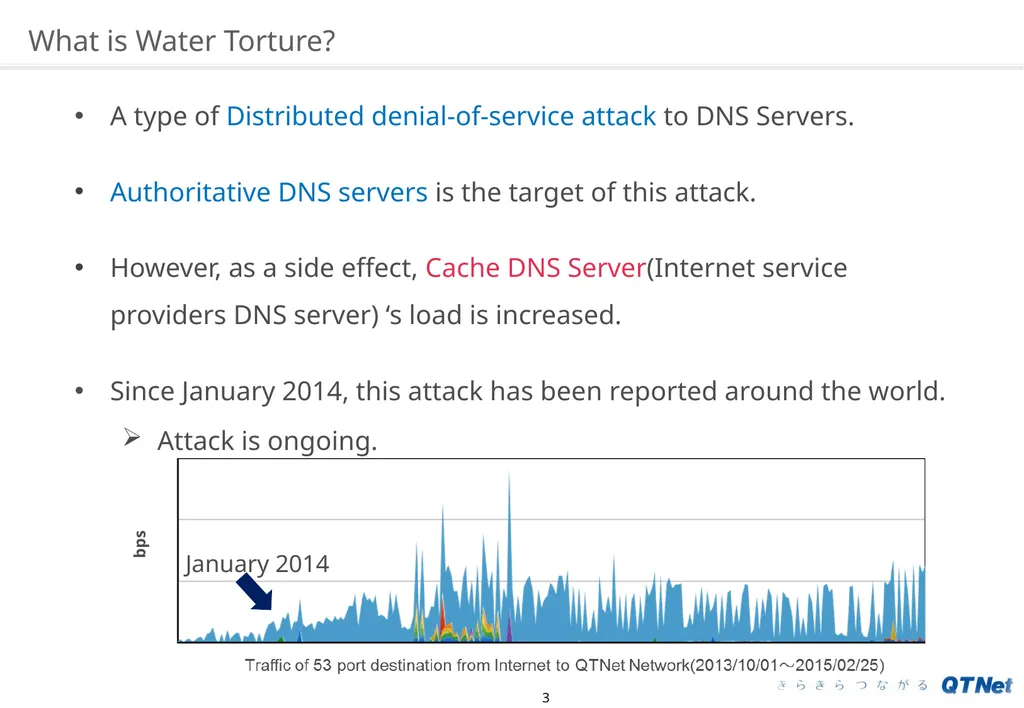
3 What is Water Torture? A type of Distributed denial-of-service attack to DNS Servers.
Authoritative DNS servers is the target of this attack.
However, as a side effect, Cache DNS Server(Internet service providers DNS server) ‘s load is increased.
Since January 2014, this attack has been reported around the world.
Attack is ongoing.<br>
04
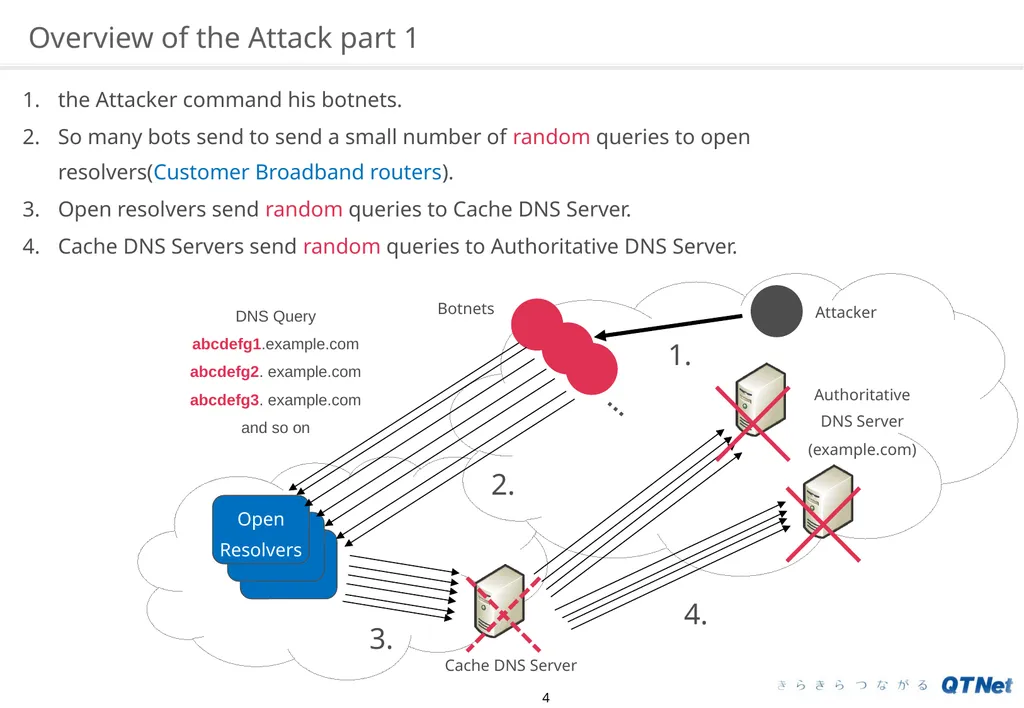
Overview of the Attack part 1 4 Open Resolvers Cache DNS Server Authoritative DNS Server
(example.com) Attacker Botnets DNS Query
abcdefg1.example.com
abcdefg2. example.com
abcdefg3. example.com
and so on … the Attacker command his botnets.
So many bots send to send a small number of random queries to open resolvers(Customer Broadband routers).
Open resolvers send random queries to Cache DNS Server.
Cache DNS Servers send random queries to Authoritative DNS Server. 1. 2. 3. 4.<br>
05
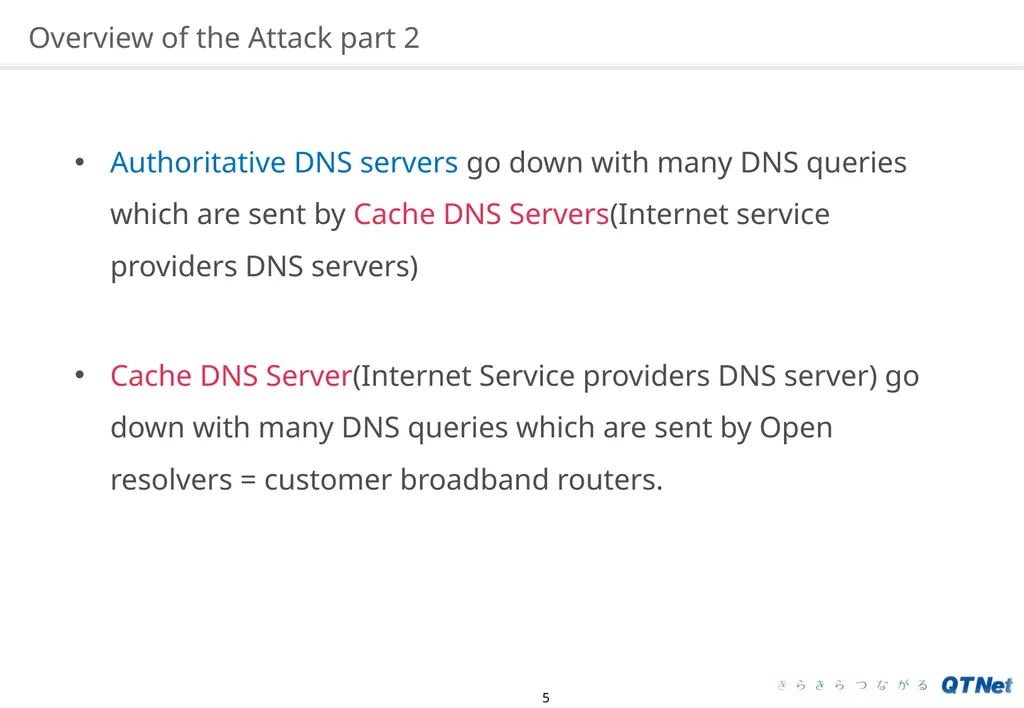
Overview of the Attack part 2 5 Authoritative DNS servers go down with many DNS queries which are sent by Cache DNS Servers(Internet service providers DNS servers)
Cache DNS Server(Internet Service providers DNS server) go down with many DNS queries which are sent by Open resolvers = customer broadband routers.<br>
06
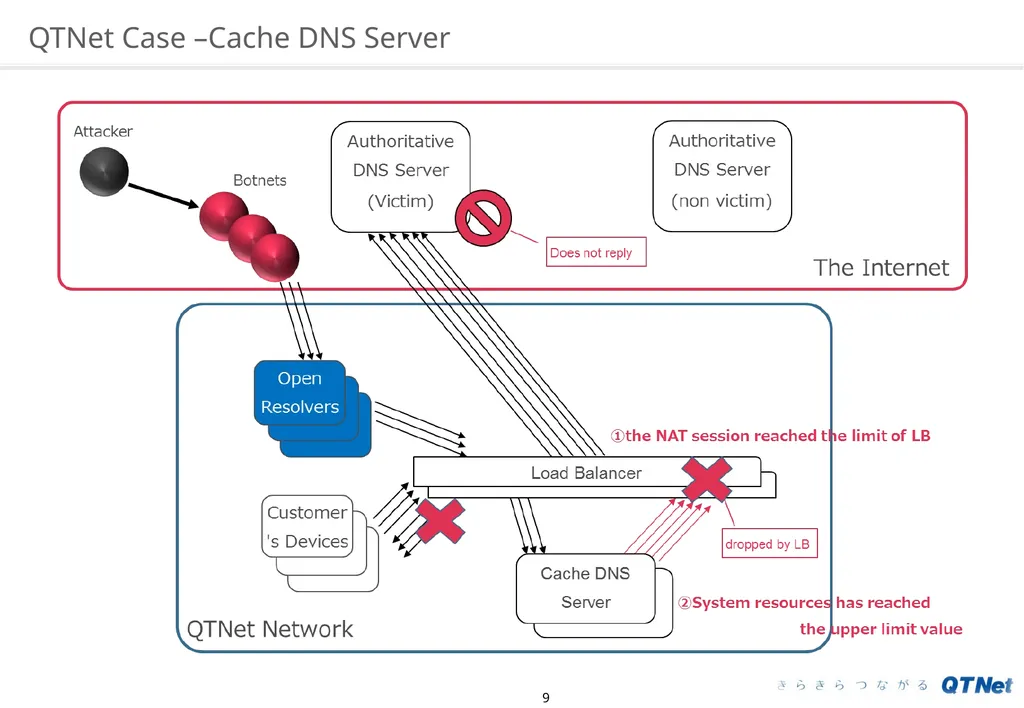
QTNet Case -Overview 6 From 29 May. 2014, queries from botnets grown up.
QTNet Cache DNS Server was effected by these traffic.
Alarm occurs the system resources of Cache DNS Server has reached the limit value.
Some customers informed that they could not access some web sites by their devices.
To Block the Attack, we tried some measures.<br>
07
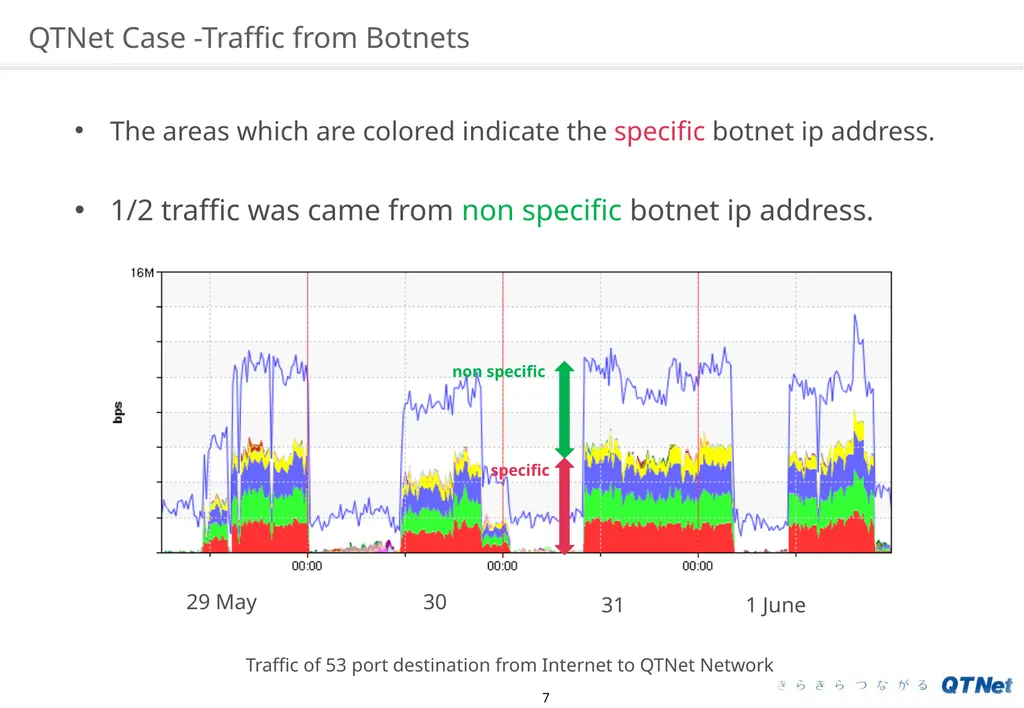
QTNet Case -Traffic from Botnets 7 The areas which are colored indicate the specific botnet ip address.
1/2 traffic was came from non specific botnet ip address. Traffic of 53 port destination from Internet to QTNet Network non specific specific<br>
08
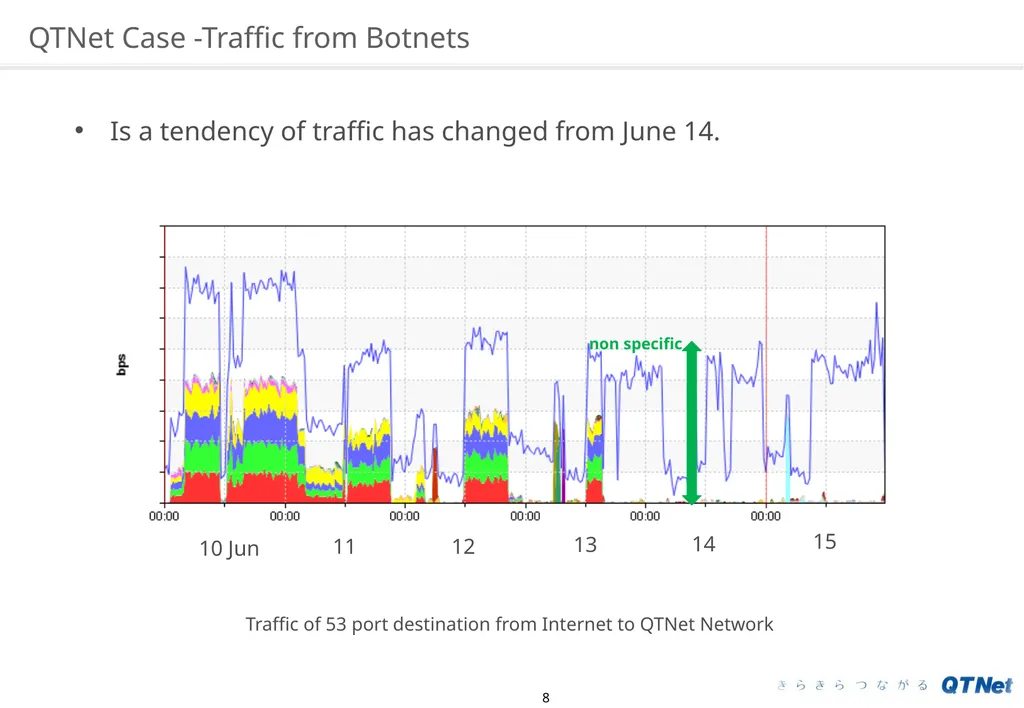
QTNet Case -Traffic from Botnets 8 Is a tendency of traffic has changed from June 14. Traffic of 53 port destination from Internet to QTNet Network non specific 10 Jun 11 12 13 14 15<br>
09
QTNet Case –Cache DNS Server 9<br>
10
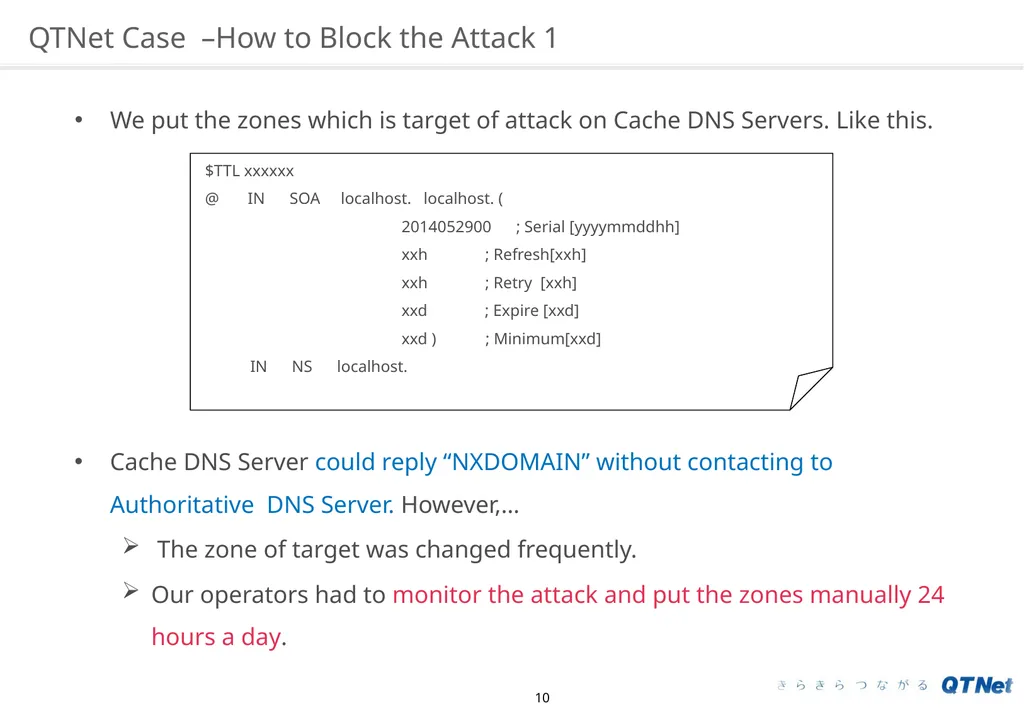
QTNet Case –How to Block the Attack 1 10 We put the zones which is target of attack on Cache DNS Servers. Like this. $TTL xxxxxx
@ IN SOA localhost. localhost. (
2014052900 ; Serial [yyyymmddhh]
xxh ; Refresh[xxh]
xxh ; Retry [xxh]
xxd ; Expire [xxd]
xxd ) ; Minimum[xxd]
IN NS localhost. Cache DNS Server could reply “NXDOMAIN” without contacting to Authoritative DNS Server. However,…
The zone of target was changed frequently.
Our operators had to monitor the attack and put the zones manually 24 hours a day.<br>
11
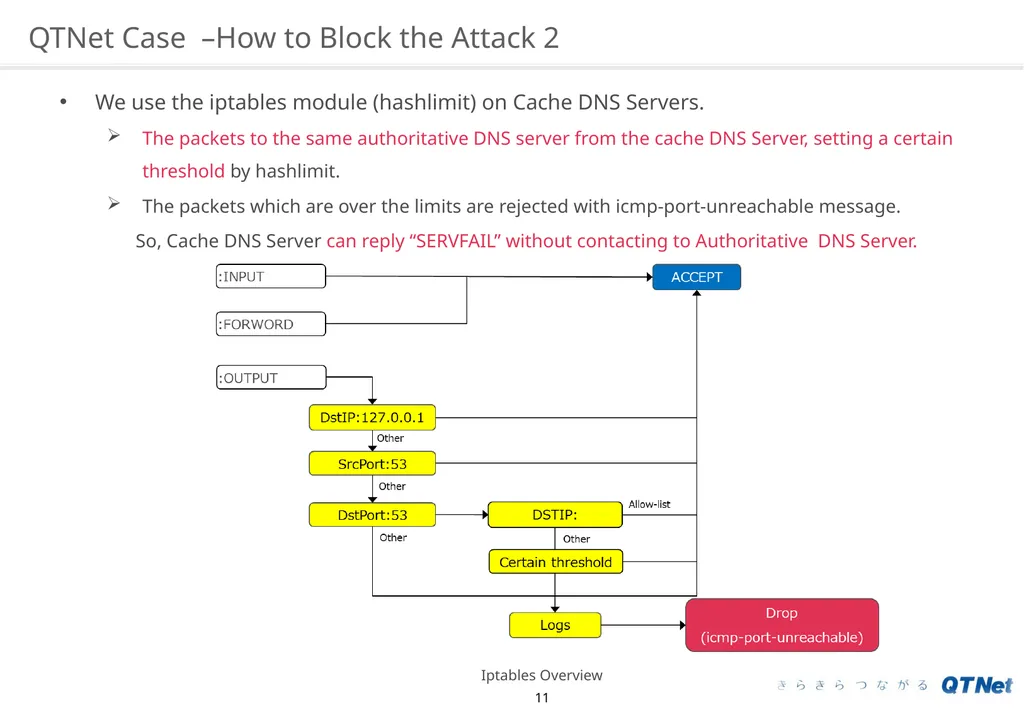
QTNet Case –How to Block the Attack 2 11 We use the iptables module (hashlimit) on Cache DNS Servers.
The packets to the same authoritative DNS server from the cache DNS Server, setting a certain threshold by hashlimit.
The packets which are over the limits are rejected with icmp-port-unreachable message.
So, Cache DNS Server can reply “SERVFAIL” without contacting to Authoritative DNS Server. Iptables Overview<br>
12
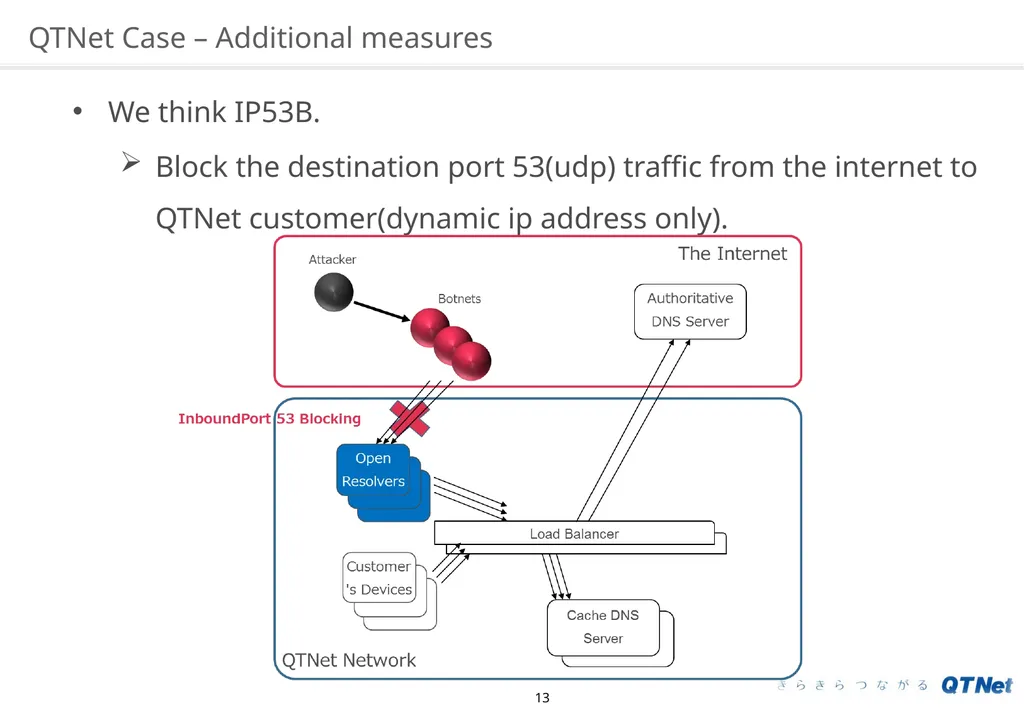
QTNet Case – Additional measures 12 The fundamental problems are open resolvers and traffic from the botnets.
We are asking customers to update their broadband router’s firmware(so as not be open resolvers).<br>
13
QTNet Case – Additional measures 13 We think IP53B.
Block the destination port 53(udp) traffic from the internet to QTNet customer(dynamic ip address only).<br>
14
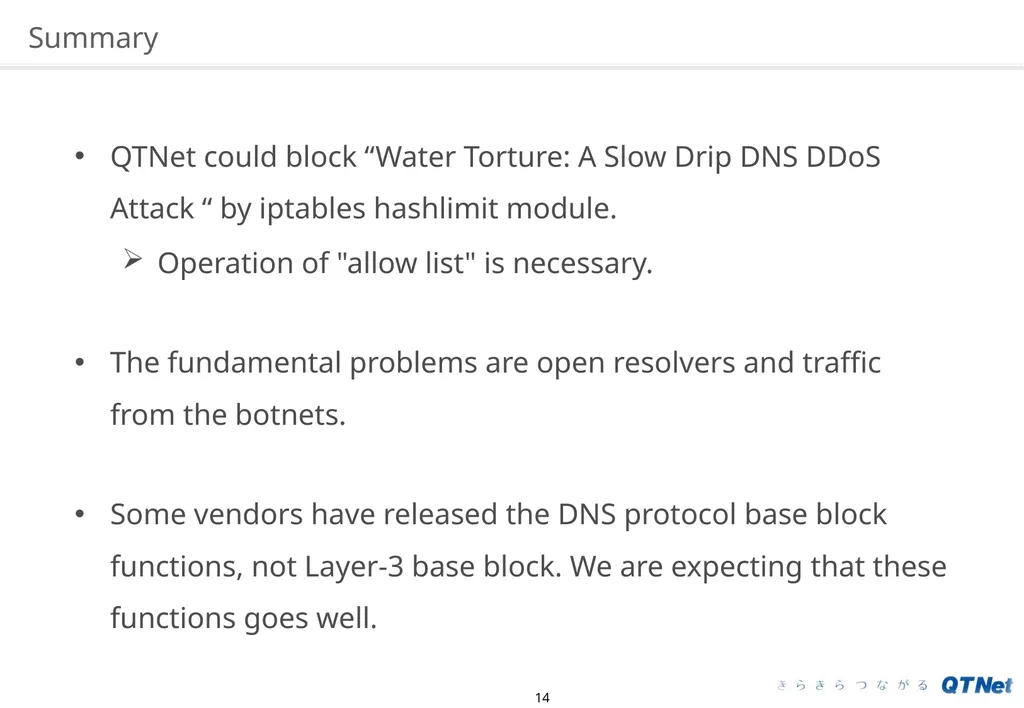
Summary 14 QTNet could block “Water Torture: A Slow Drip DNS DDoS Attack “ by iptables hashlimit module.
Operation of "allow list" is necessary.
The fundamental problems are open resolvers and traffic from the botnets.
Some vendors have released the DNS protocol base block functions, not Layer-3 base block. We are expecting that these functions goes well.<br>
15
References 15 Yasuhiro Orange Morishita@JPRS: About Water Torture
http://2014.seccon.jp/dns/dns_water_torture.pdf (accessed Jun 7th 2015)
SECURE64 BLOG -Water Torture: A Slow Drip DNS DDoS Attack
https://blog.secure64.com/?p=377 (accessed Jun 7th 2015)<br>