
WEATHER READY PACIFIC Six-Monthly Programme Report
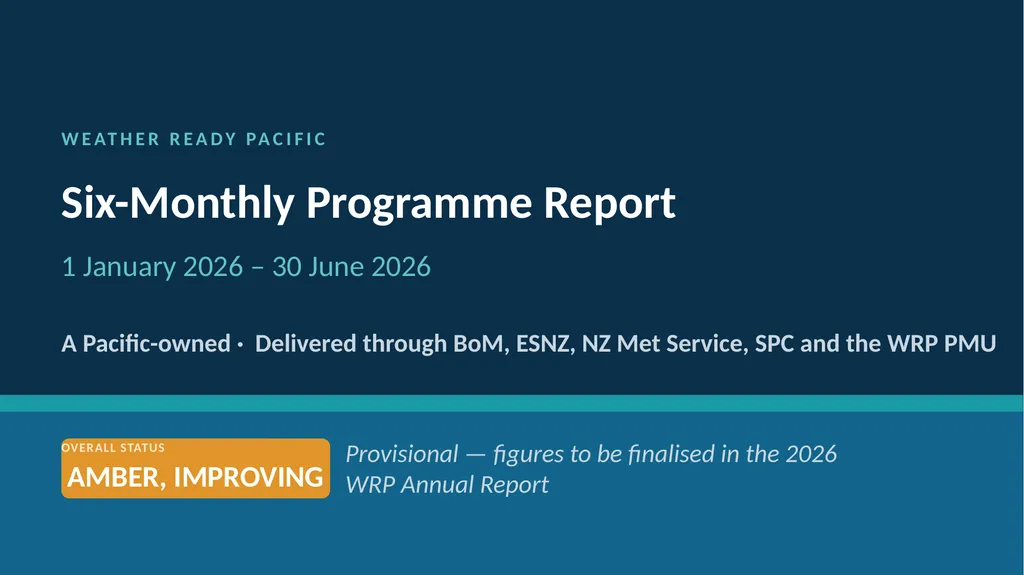
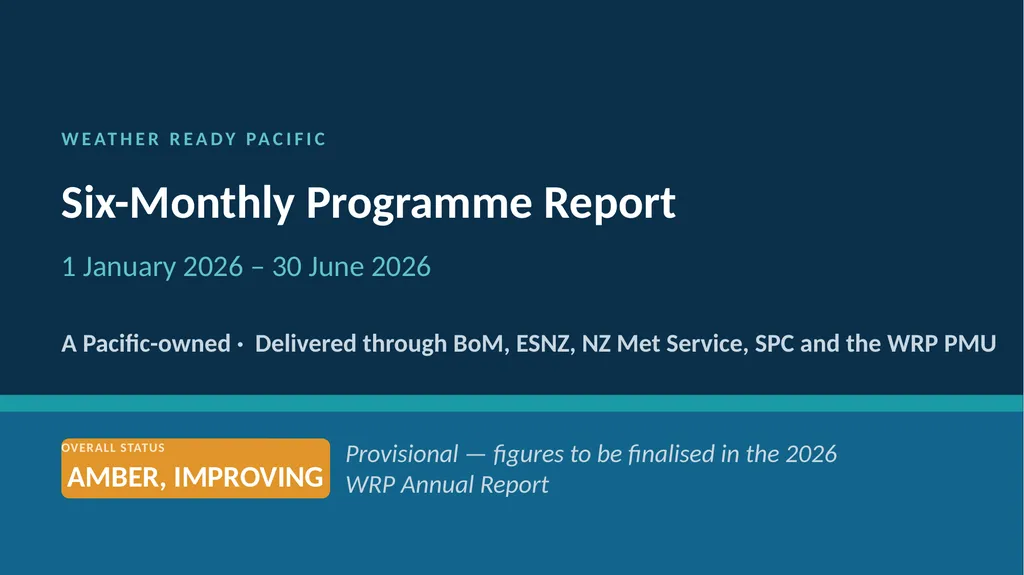
Description: WEATHER READY PACIFIC Six-Monthly Programme Report 1 January 2026 30 June 2026 A Pacific-owned Delivered through BoM, ESNZ, NZ Met Service, SPC and the WRP PMU OVERALL STATUS AMBER, IMPROVING Provisional figures to be finalised in the
Related Topics
Download Presentation
"WEATHER READY PACIFIC Six-Monthly Programme Report" is the property of its rightful owner. Permission is granted to download and print the materials on this website for personal, non-commercial use only, and to display it on your personal computer provided you do not modify the materials and that you retain all copyright notices contained in the materials. By downloading content from our website, you accept the terms of this agreement.
Presentation Transcript
slide1. WEATHER READY PACIFIC Six-Monthly Programme Report 1 January 2026 – 30 June 2026 A Pacific-owned · Delivered through BoM, ESNZ, NZ Met Service, SPC and the WRP PMU OVERALL STATUS
AMBER, IMPROVING Provisional — figures to be finalised in the 2026 WRP Annual Report<br>
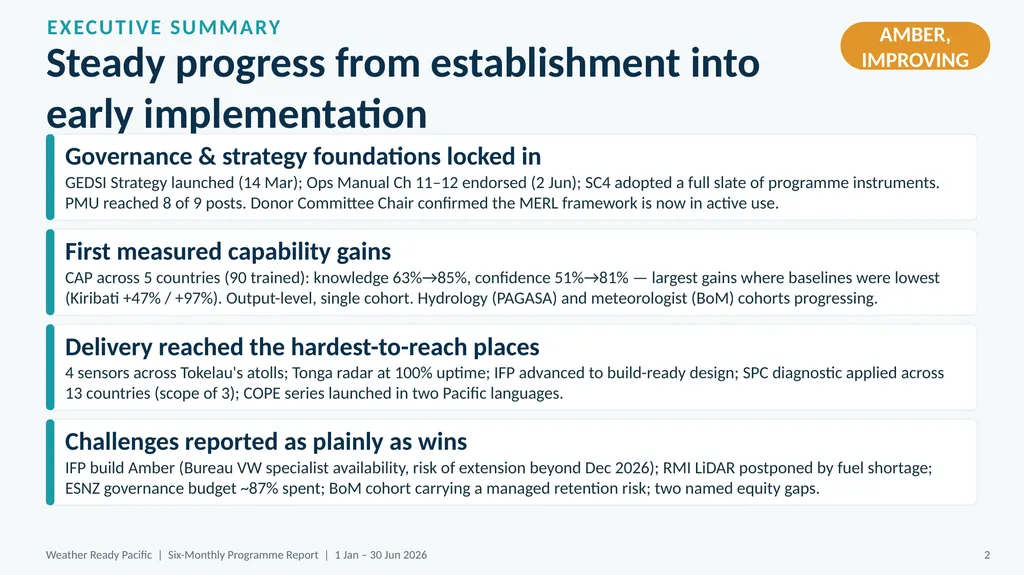
slide3. EXECUTIVE SUMMARY Steady progress from establishment into early implementation AMBER, IMPROVING Governance & strategy foundations locked in GEDSI Strategy launched (14 Mar); Ops Manual Ch 11–12 endorsed (2 Jun); SC4 adopted a full slate of programme instruments. PMU reached 8 of 9 posts. Donor Committee Chair confirmed the MERL framework is now in active use. First measured capability gains CAP across 5 countries (90 trained): knowledge 63%→85%, confidence 51%→81% — largest gains where baselines were lowest (Kiribati +47% / +97%). Output-level, single cohort. Hydrology (PAGASA) and meteorologist (BoM) cohorts progressing. Delivery reached the hardest-to-reach places 4 sensors across Tokelau's atolls; Tonga radar at 100% uptime; IFP advanced to build-ready design; SPC diagnostic applied across 13 countries (scope of 3); COPE series launched in two Pacific languages. Challenges reported as plainly as wins IFP build Amber (Bureau VW specialist availability, risk of extension beyond Dec 2026); RMI LiDAR postponed by fuel shortage; ESNZ governance budget ~87% spent; BoM cohort carrying a managed retention risk; two named equity gaps. Weather Ready Pacific | Six-Monthly Programme Report | 1 Jan – 30 Jun 2026 2<br>
slide4. KRA 1 KEY RESULT AREA Governance, Management & Coordination Building the institutional foundation for a Pacific-led, decade-long programme AMBER, IMPROVING<br>
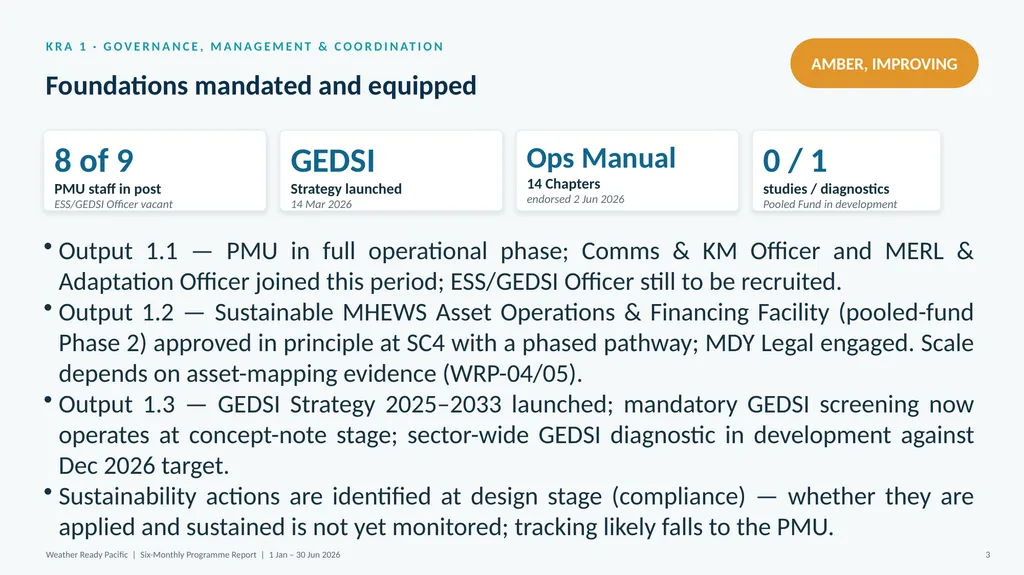
slide5. KRA 1 · GOVERNANCE, MANAGEMENT & COORDINATION Foundations mandated and equipped AMBER, IMPROVING 8 of 9
PMU staff in post
ESS/GEDSI Officer vacant GEDSI
Strategy launched
14 Mar 2026 Ops Manual
14 Chapters
endorsed 2 Jun 2026 0 / 1
studies / diagnostics
Pooled Fund in development Output 1.1 — PMU in full operational phase; Comms & KM Officer and MERL & Adaptation Officer joined this period; ESS/GEDSI Officer still to be recruited.
Output 1.2 — Sustainable MHEWS Asset Operations & Financing Facility (pooled-fund Phase 2) approved in principle at SC4 with a phased pathway; MDY Legal engaged. Scale depends on asset-mapping evidence (WRP-04/05).
Output 1.3 — GEDSI Strategy 2025–2033 launched; mandatory GEDSI screening now operates at concept-note stage; sector-wide GEDSI diagnostic in development against Dec 2026 target.
Sustainability actions are identified at design stage (compliance) — whether they are applied and sustained is not yet monitored; tracking likely falls to the PMU. Weather Ready Pacific | Six-Monthly Programme Report | 1 Jan – 30 Jun 2026 3<br>
slide6. KRA 2 KEY RESULT AREA People Capability Strengthening Pacific meteorological & hydrological skills, confidence and peer networks AMBER–GREEN<br>
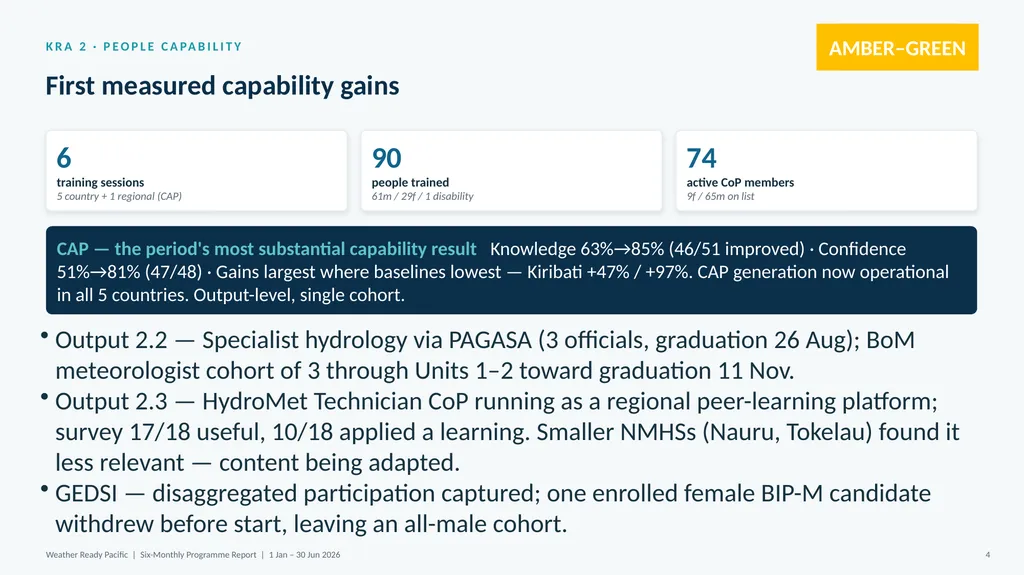
slide7. KRA 2 · PEOPLE CAPABILITY First measured capability gains AMBER–GREEN 6
training sessions
5 country + 1 regional (CAP) 90
people trained
61m / 29f / 1 disability 74
active CoP members
9f / 65m on list CAP — the period's most substantial capability result Knowledge 63%→85% (46/51 improved) · Confidence 51%→81% (47/48) · Gains largest where baselines lowest — Kiribati +47% / +97%. CAP generation now operational in all 5 countries. Output-level, single cohort. Output 2.2 — Specialist hydrology via PAGASA (3 officials, graduation 26 Aug); BoM meteorologist cohort of 3 through Units 1–2 toward graduation 11 Nov.
Output 2.3 — HydroMet Technician CoP running as a regional peer-learning platform; survey 17/18 useful, 10/18 applied a learning. Smaller NMHSs (Nauru, Tokelau) found it less relevant — content being adapted.
GEDSI — disaggregated participation captured; one enrolled female BIP-M candidate withdrew before start, leaving an all-male cohort. Weather Ready Pacific | Six-Monthly Programme Report | 1 Jan – 30 Jun 2026 4<br>
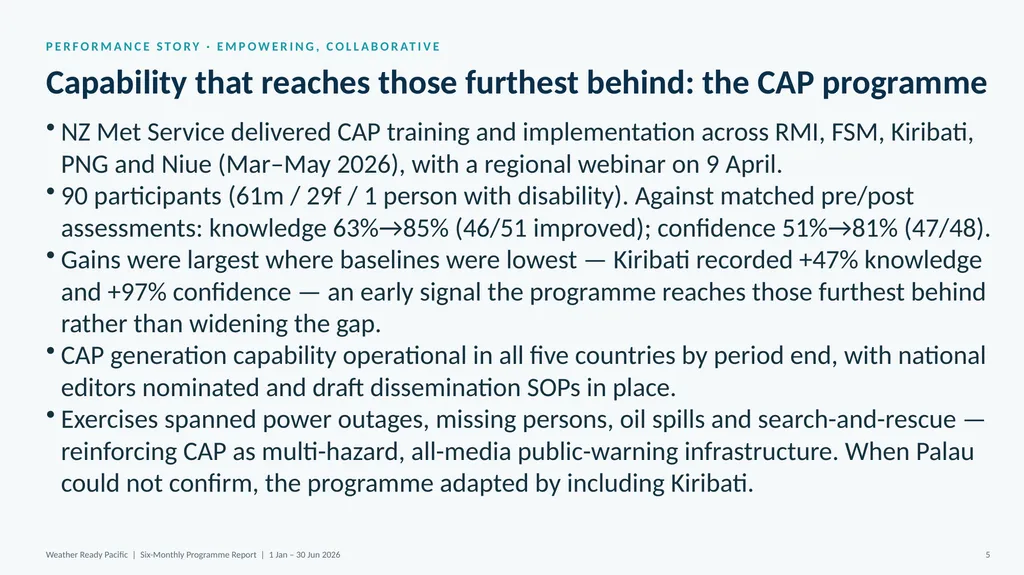
slide8. PERFORMANCE STORY · EMPOWERING, COLLABORATIVE Capability that reaches those furthest behind: the CAP programme NZ Met Service delivered CAP training and implementation across RMI, FSM, Kiribati, PNG and Niue (Mar–May 2026), with a regional webinar on 9 April.
90 participants (61m / 29f / 1 person with disability). Against matched pre/post assessments: knowledge 63%→85% (46/51 improved); confidence 51%→81% (47/48).
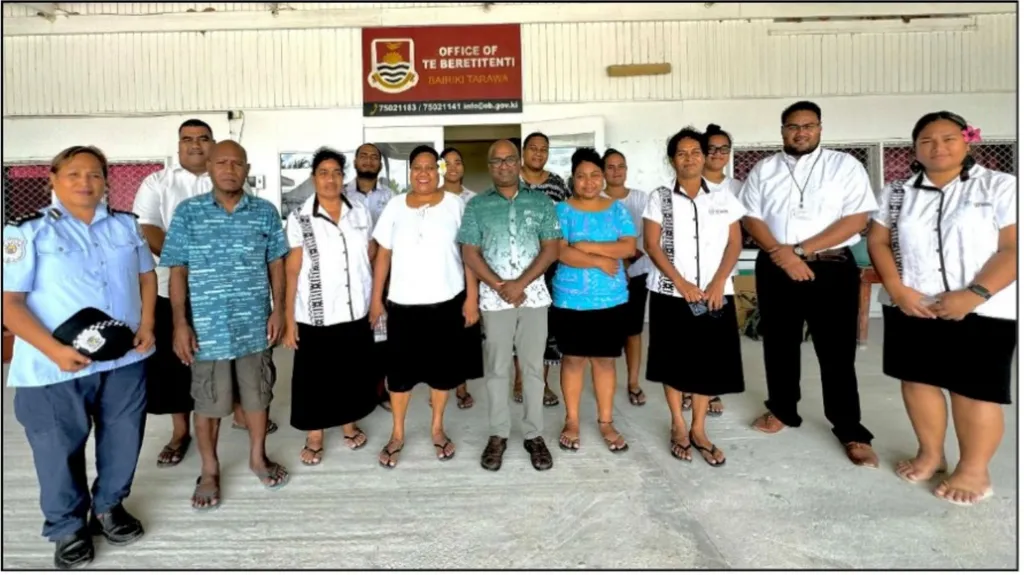
Gains were largest where baselines were lowest — Kiribati recorded +47% knowledge and +97% confidence — an early signal the programme reaches those furthest behind rather than widening the gap.
CAP generation capability operational in all five countries by period end, with national editors nominated and draft dissemination SOPs in place.
Exercises spanned power outages, missing persons, oil spills and search-and-rescue — reinforcing CAP as multi-hazard, all-media public-warning infrastructure. When Palau could not confirm, the programme adapted by including Kiribati. Weather Ready Pacific | Six-Monthly Programme Report | 1 Jan – 30 Jun 2026 5<br>
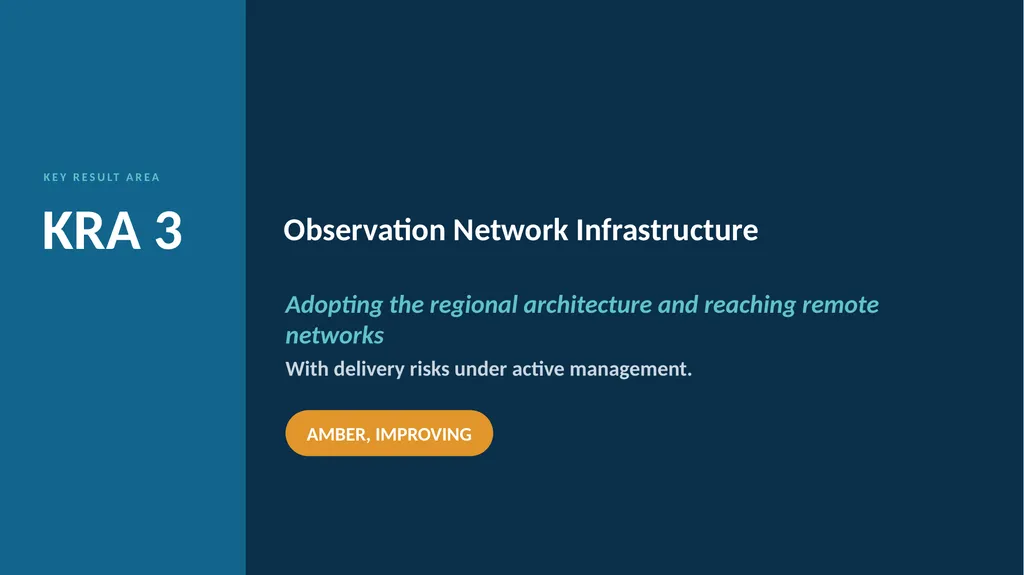
slide10. KRA 3 KEY RESULT AREA Observation Network Infrastructure Adopting the regional architecture and reaching remote networks With delivery risks under active management. AMBER, IMPROVING<br>
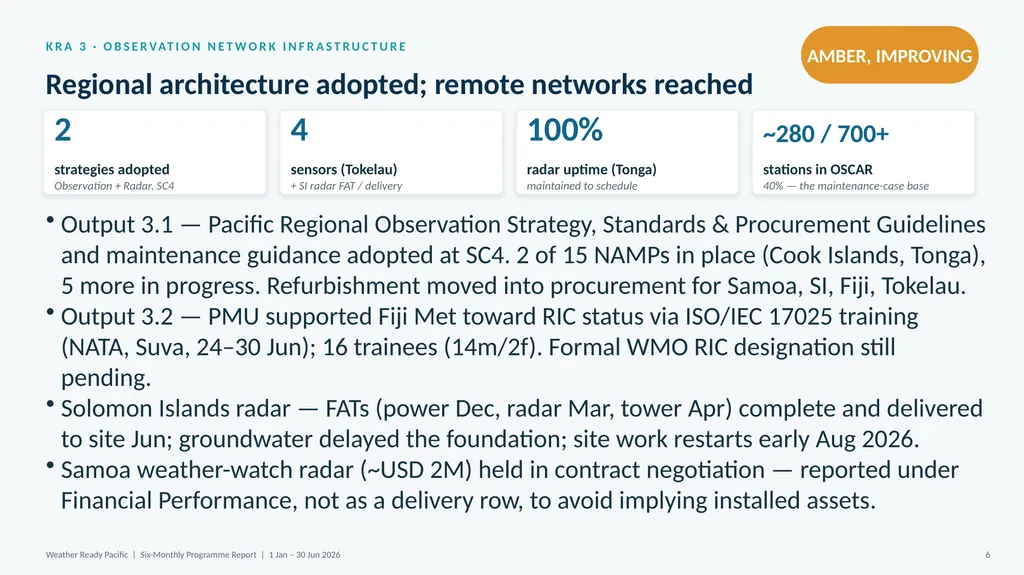
slide11. KRA 3 · OBSERVATION NETWORK INFRASTRUCTURE Regional architecture adopted; remote networks reached AMBER, IMPROVING 2
strategies adopted
Observation + Radar, SC4 4
sensors (Tokelau)
+ SI radar FAT / delivery 100%
radar uptime (Tonga)
maintained to schedule ~280 / 700+
stations in OSCAR
40% — the maintenance-case base Output 3.1 — Pacific Regional Observation Strategy, Standards & Procurement Guidelines and maintenance guidance adopted at SC4. 2 of 15 NAMPs in place (Cook Islands, Tonga), 5 more in progress. Refurbishment moved into procurement for Samoa, SI, Fiji, Tokelau.
Output 3.2 — PMU supported Fiji Met toward RIC status via ISO/IEC 17025 training (NATA, Suva, 24–30 Jun); 16 trainees (14m/2f). Formal WMO RIC designation still pending.
Solomon Islands radar — FATs (power Dec, radar Mar, tower Apr) complete and delivered to site Jun; groundwater delayed the foundation; site work restarts early Aug 2026.
Samoa weather-watch radar (~USD 2M) held in contract negotiation — reported under Financial Performance, not as a delivery row, to avoid implying installed assets. Weather Ready Pacific | Six-Monthly Programme Report | 1 Jan – 30 Jun 2026 6<br>
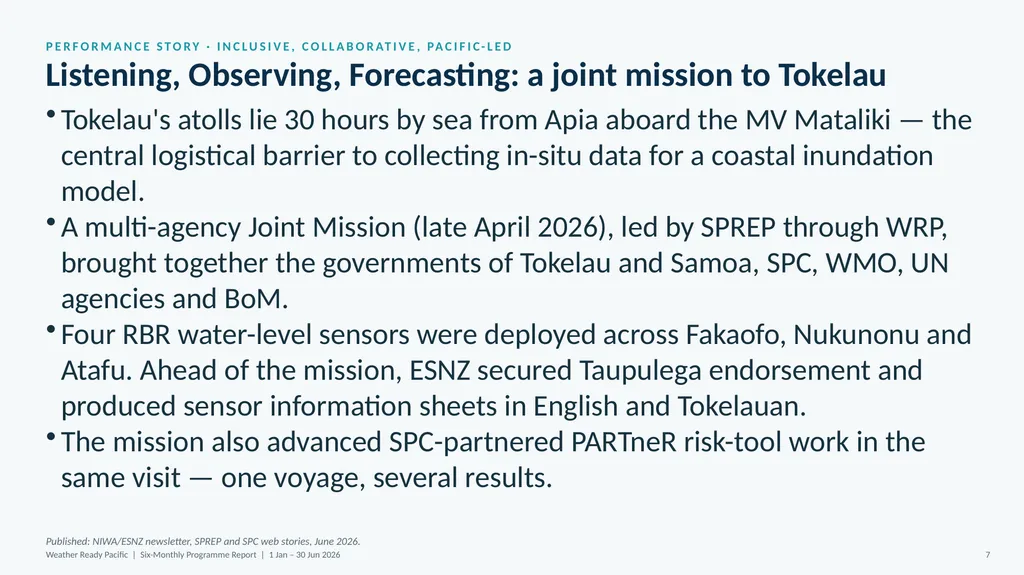
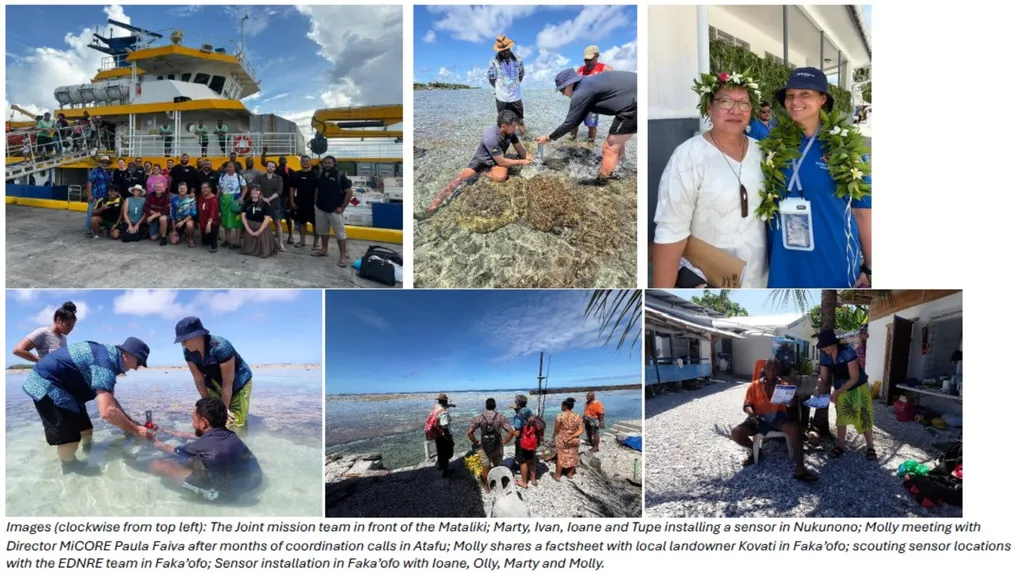
slide12. PERFORMANCE STORY · INCLUSIVE, COLLABORATIVE, PACIFIC-LED Listening, Observing, Forecasting: a joint mission to Tokelau Tokelau's atolls lie 30 hours by sea from Apia aboard the MV Mataliki — the central logistical barrier to collecting in-situ data for a coastal inundation model.
A multi-agency Joint Mission (late April 2026), led by SPREP through WRP, brought together the governments of Tokelau and Samoa, SPC, WMO, UN agencies and BoM.
Four RBR water-level sensors were deployed across Fakaofo, Nukunonu and Atafu. Ahead of the mission, ESNZ secured Taupulega endorsement and produced sensor information sheets in English and Tokelauan.
The mission also advanced SPC-partnered PARTneR risk-tool work in the same visit — one voyage, several results. Published: NIWA/ESNZ newsletter, SPREP and SPC web stories, June 2026. Weather Ready Pacific | Six-Monthly Programme Report | 1 Jan – 30 Jun 2026 7<br>
slide14. KRA 4 KEY RESULT AREA Forecast & Warning Production Advancing the integrated platform, regional hydrology and pilot forecasting tools The IFP build and hydrology-strategy timing are the key forward risks. AMBER<br>
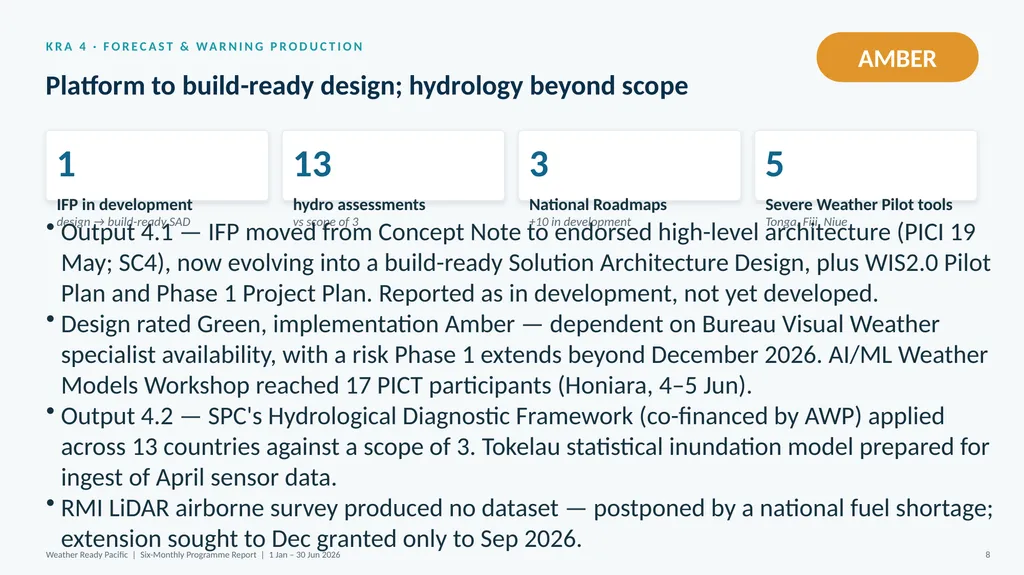
slide15. KRA 4 · FORECAST & WARNING PRODUCTION Platform to build-ready design; hydrology beyond scope AMBER 1
IFP in development
design → build-ready SAD 13
hydro assessments
vs scope of 3 3
National Roadmaps
+10 in development 5
Severe Weather Pilot tools
Tonga, Fiji, Niue Output 4.1 — IFP moved from Concept Note to endorsed high-level architecture (PICI 19 May; SC4), now evolving into a build-ready Solution Architecture Design, plus WIS2.0 Pilot Plan and Phase 1 Project Plan. Reported as in development, not yet developed.
Design rated Green, implementation Amber — dependent on Bureau Visual Weather specialist availability, with a risk Phase 1 extends beyond December 2026. AI/ML Weather Models Workshop reached 17 PICT participants (Honiara, 4–5 Jun).
Output 4.2 — SPC's Hydrological Diagnostic Framework (co-financed by AWP) applied across 13 countries against a scope of 3. Tokelau statistical inundation model prepared for ingest of April sensor data.
RMI LiDAR airborne survey produced no dataset — postponed by a national fuel shortage; extension sought to Dec granted only to Sep 2026. Weather Ready Pacific | Six-Monthly Programme Report | 1 Jan – 30 Jun 2026 8<br>
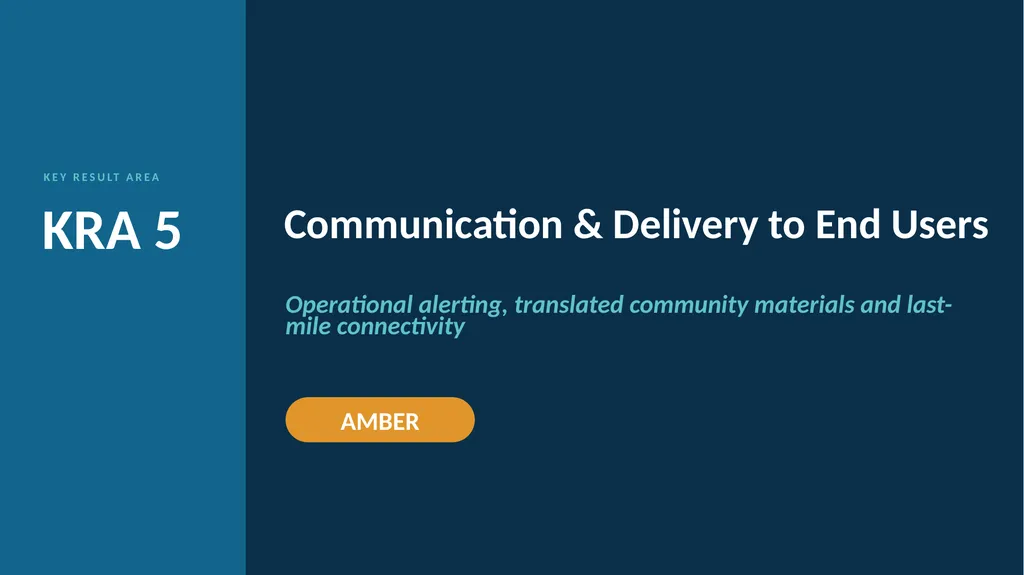
slide16. KRA 5 KEY RESULT AREA Communication & Delivery to End Users Operational alerting, translated community materials and last-mile connectivity AMBER<br>
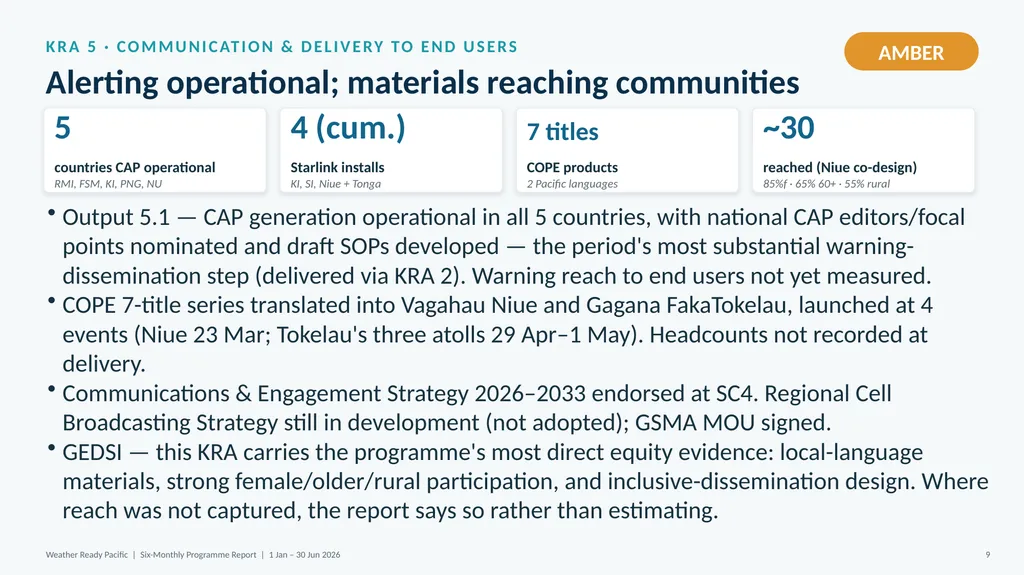
slide17. KRA 5 · COMMUNICATION & DELIVERY TO END USERS Alerting operational; materials reaching communities AMBER 5
countries CAP operational
RMI, FSM, KI, PNG, NU 4 (cum.)
Starlink installs
KI, SI, Niue + Tonga 7 titles
COPE products
2 Pacific languages ~30
reached (Niue co-design)
85%f · 65% 60+ · 55% rural Output 5.1 — CAP generation operational in all 5 countries, with national CAP editors/focal points nominated and draft SOPs developed — the period's most substantial warning-dissemination step (delivered via KRA 2). Warning reach to end users not yet measured.
COPE 7-title series translated into Vagahau Niue and Gagana FakaTokelau, launched at 4 events (Niue 23 Mar; Tokelau's three atolls 29 Apr–1 May). Headcounts not recorded at delivery.
Communications & Engagement Strategy 2026–2033 endorsed at SC4. Regional Cell Broadcasting Strategy still in development (not adopted); GSMA MOU signed.
GEDSI — this KRA carries the programme's most direct equity evidence: local-language materials, strong female/older/rural participation, and inclusive-dissemination design. Where reach was not captured, the report says so rather than estimating. Weather Ready Pacific | Six-Monthly Programme Report | 1 Jan – 30 Jun 2026 9<br>
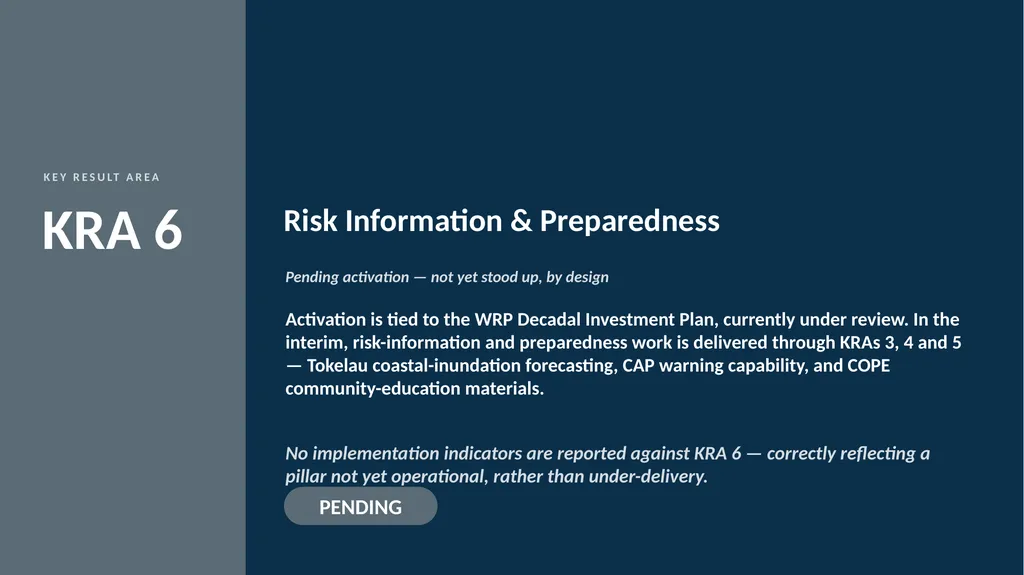
slide18. KRA 6 KEY RESULT AREA Risk Information & Preparedness Pending activation — not yet stood up, by design Activation is tied to the WRP Decadal Investment Plan, currently under review. In the interim, risk-information and preparedness work is delivered through KRAs 3, 4 and 5 — Tokelau coastal-inundation forecasting, CAP warning capability, and COPE community-education materials.
No implementation indicators are reported against KRA 6 — correctly reflecting a pillar not yet operational, rather than under-delivery. PENDING<br>
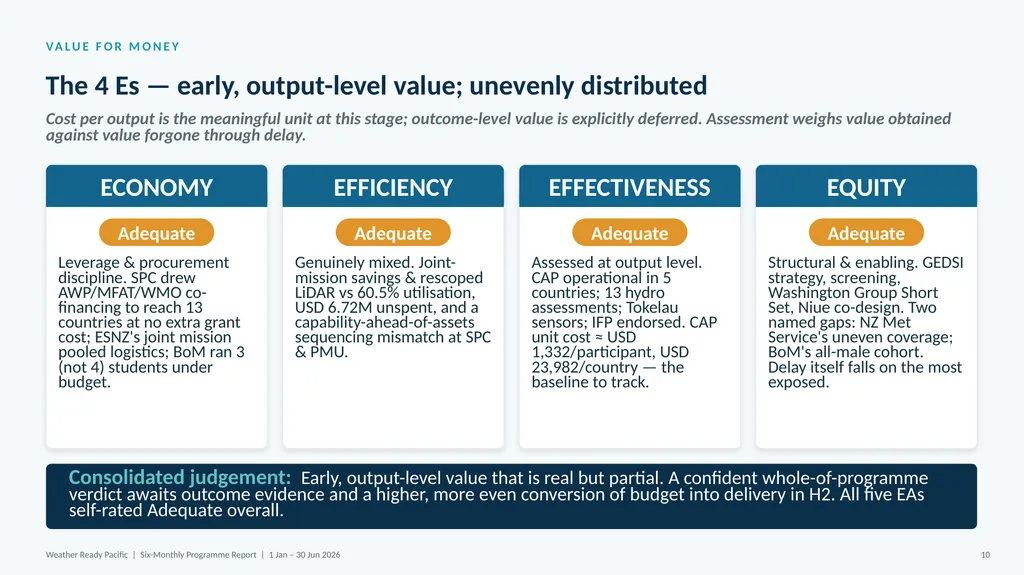
slide19. VALUE FOR MONEY The 4 Es — early, output-level value; unevenly distributed Cost per output is the meaningful unit at this stage; outcome-level value is explicitly deferred. Assessment weighs value obtained against value forgone through delay. ECONOMY Adequate Leverage & procurement discipline. SPC drew AWP/MFAT/WMO co-financing to reach 13 countries at no extra grant cost; ESNZ's joint mission pooled logistics; BoM ran 3 (not 4) students under budget. EFFICIENCY Adequate Genuinely mixed. Joint-mission savings & rescoped LiDAR vs 60.5% utilisation, USD 6.72M unspent, and a capability-ahead-of-assets sequencing mismatch at SPC & PMU. EFFECTIVENESS Adequate Assessed at output level. CAP operational in 5 countries; 13 hydro assessments; Tokelau sensors; IFP endorsed. CAP unit cost ≈ USD 1,332/participant, USD 23,982/country — the baseline to track. EQUITY Adequate Structural & enabling. GEDSI strategy, screening, Washington Group Short Set, Niue co-design. Two named gaps: NZ Met Service's uneven coverage; BoM's all-male cohort. Delay itself falls on the most exposed. Consolidated judgement: Early, output-level value that is real but partial. A confident whole-of-programme verdict awaits outcome evidence and a higher, more even conversion of budget into delivery in H2. All five EAs self-rated Adequate overall. Weather Ready Pacific | Six-Monthly Programme Report | 1 Jan – 30 Jun 2026 10<br>
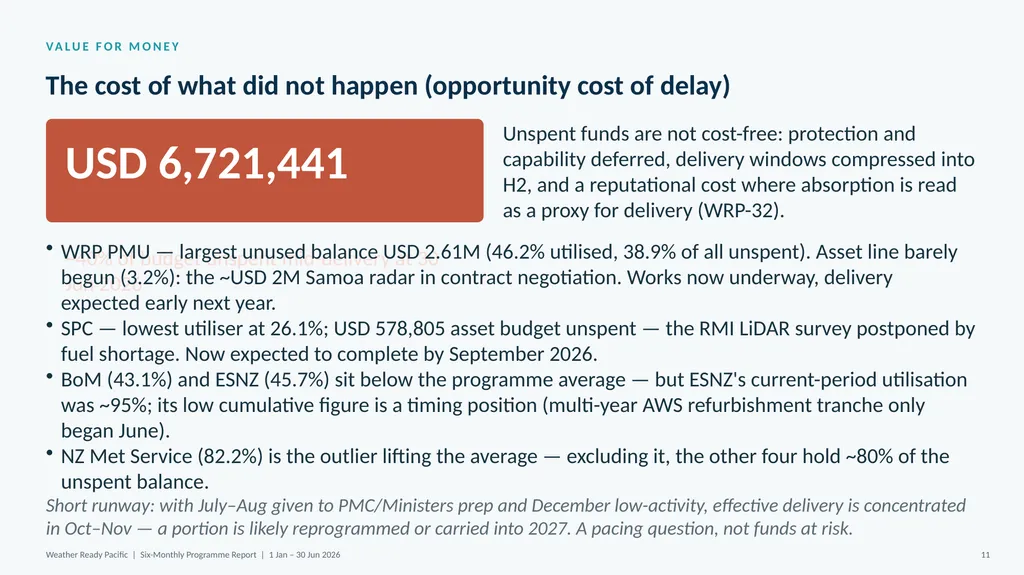
slide20. VALUE FOR MONEY The cost of what did not happen (opportunity cost of delay) USD 6,721,441
~40% of budget unspent mid-delivery at 30 Jun 2026 Unspent funds are not cost-free: protection and capability deferred, delivery windows compressed into H2, and a reputational cost where absorption is read as a proxy for delivery (WRP-32). WRP PMU — largest unused balance USD 2.61M (46.2% utilised, 38.9% of all unspent). Asset line barely begun (3.2%): the ~USD 2M Samoa radar in contract negotiation. Works now underway, delivery expected early next year.
SPC — lowest utiliser at 26.1%; USD 578,805 asset budget unspent — the RMI LiDAR survey postponed by fuel shortage. Now expected to complete by September 2026.
BoM (43.1%) and ESNZ (45.7%) sit below the programme average — but ESNZ's current-period utilisation was ~95%; its low cumulative figure is a timing position (multi-year AWS refurbishment tranche only began June).
NZ Met Service (82.2%) is the outlier lifting the average — excluding it, the other four hold ~80% of the unspent balance. Short runway: with July–Aug given to PMC/Ministers prep and December low-activity, effective delivery is concentrated in Oct–Nov — a portion is likely reprogrammed or carried into 2027. A pacing question, not funds at risk. Weather Ready Pacific | Six-Monthly Programme Report | 1 Jan – 30 Jun 2026 11<br>
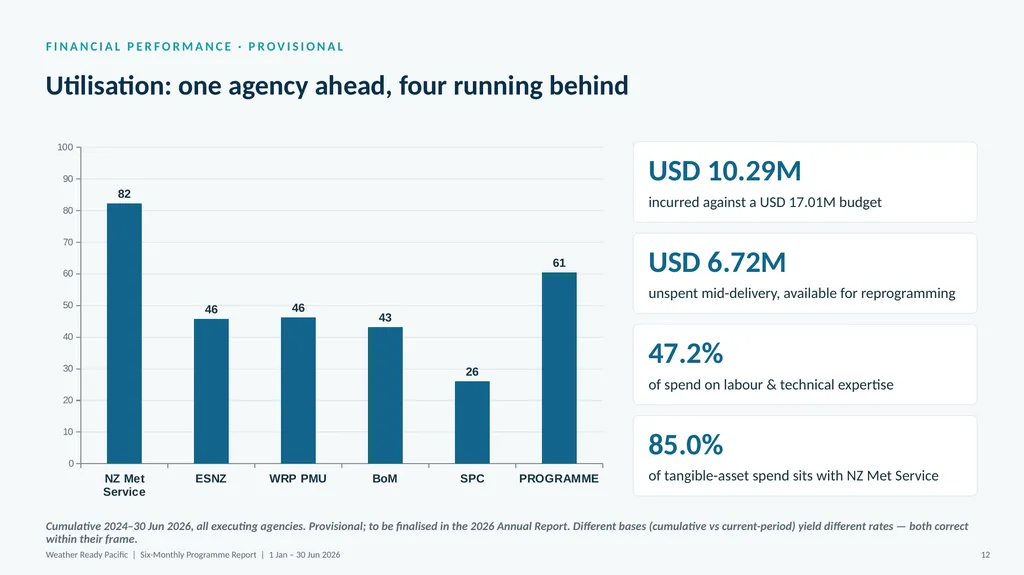
slide21. FINANCIAL PERFORMANCE · PROVISIONAL Utilisation: one agency ahead, four running behind USD 10.29M
incurred against a USD 17.01M budget USD 6.72M
unspent mid-delivery, available for reprogramming 47.2%
of spend on labour & technical expertise 85.0%
of tangible-asset spend sits with NZ Met Service Cumulative 2024–30 Jun 2026, all executing agencies. Provisional; to be finalised in the 2026 Annual Report. Different bases (cumulative vs current-period) yield different rates — both correct within their frame. Weather Ready Pacific | Six-Monthly Programme Report | 1 Jan – 30 Jun 2026 12<br>
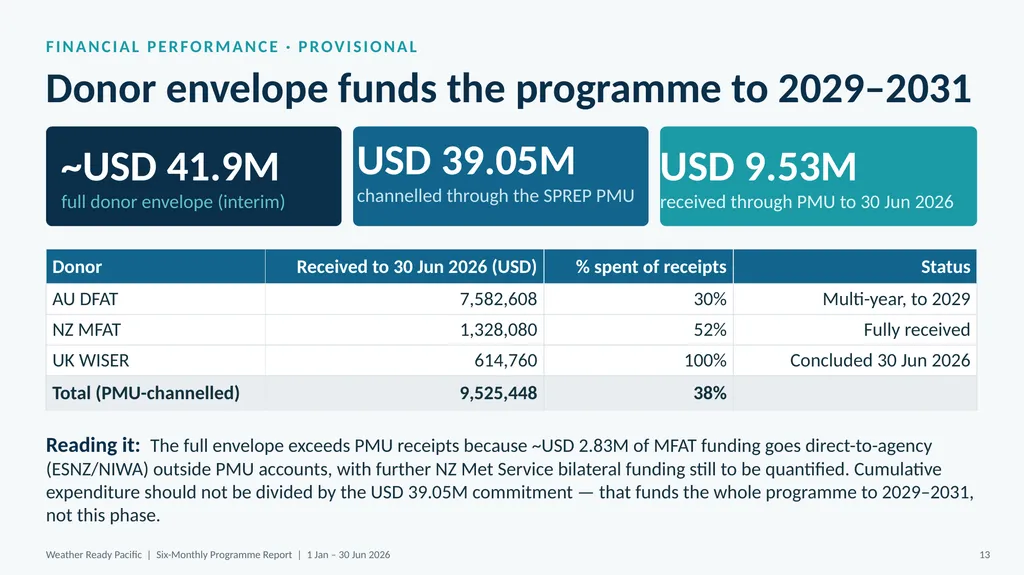
slide22. FINANCIAL PERFORMANCE · PROVISIONAL Donor envelope funds the programme to 2029–2031 ~USD 41.9M
full donor envelope (interim) USD 39.05M
channelled through the SPREP PMU USD 9.53M
received through PMU to 30 Jun 2026 Reading it: The full envelope exceeds PMU receipts because ~USD 2.83M of MFAT funding goes direct-to-agency (ESNZ/NIWA) outside PMU accounts, with further NZ Met Service bilateral funding still to be quantified. Cumulative expenditure should not be divided by the USD 39.05M commitment — that funds the whole programme to 2029–2031, not this phase. Weather Ready Pacific | Six-Monthly Programme Report | 1 Jan – 30 Jun 2026 13<br>
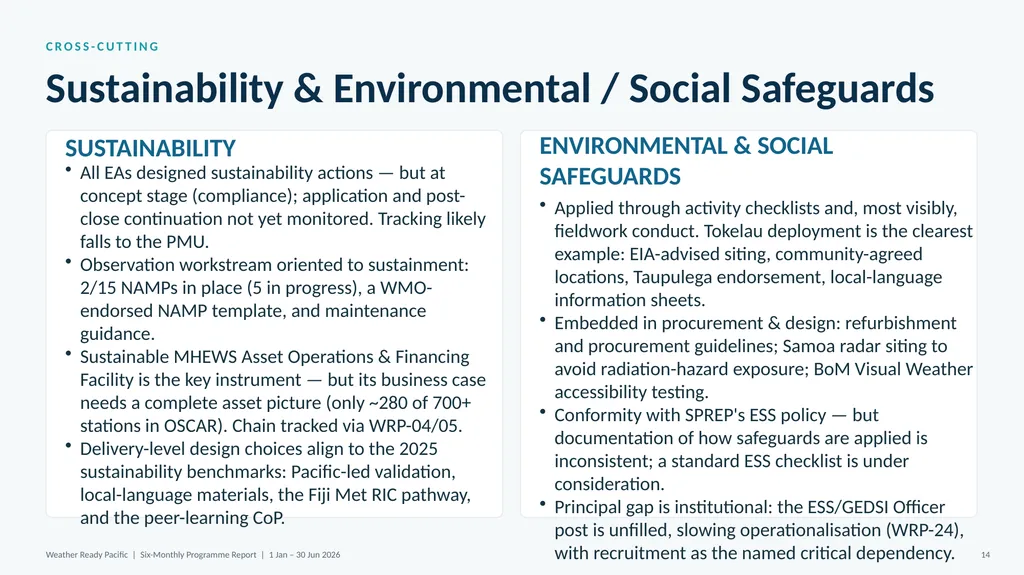
slide23. CROSS-CUTTING Sustainability & Environmental / Social Safeguards SUSTAINABILITY All EAs designed sustainability actions — but at concept stage (compliance); application and post-close continuation not yet monitored. Tracking likely falls to the PMU.
Observation workstream oriented to sustainment: 2/15 NAMPs in place (5 in progress), a WMO-endorsed NAMP template, and maintenance guidance.
Sustainable MHEWS Asset Operations & Financing Facility is the key instrument — but its business case needs a complete asset picture (only ~280 of 700+ stations in OSCAR). Chain tracked via WRP-04/05.
Delivery-level design choices align to the 2025 sustainability benchmarks: Pacific-led validation, local-language materials, the Fiji Met RIC pathway, and the peer-learning CoP. ENVIRONMENTAL & SOCIAL SAFEGUARDS Applied through activity checklists and, most visibly, fieldwork conduct. Tokelau deployment is the clearest example: EIA-advised siting, community-agreed locations, Taupulega endorsement, local-language information sheets.
Embedded in procurement & design: refurbishment and procurement guidelines; Samoa radar siting to avoid radiation-hazard exposure; BoM Visual Weather accessibility testing.
Conformity with SPREP's ESS policy — but documentation of how safeguards are applied is inconsistent; a standard ESS checklist is under consideration.
Principal gap is institutional: the ESS/GEDSI Officer post is unfilled, slowing operationalisation (WRP-24), with recruitment as the named critical dependency. Weather Ready Pacific | Six-Monthly Programme Report | 1 Jan – 30 Jun 2026 14<br>
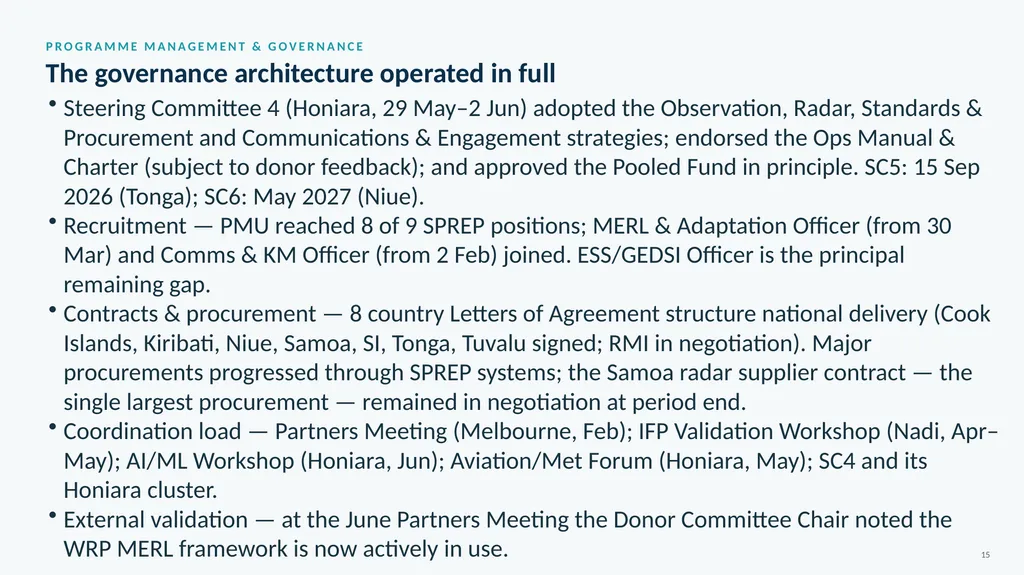
slide24. PROGRAMME MANAGEMENT & GOVERNANCE The governance architecture operated in full Steering Committee 4 (Honiara, 29 May–2 Jun) adopted the Observation, Radar, Standards & Procurement and Communications & Engagement strategies; endorsed the Ops Manual & Charter (subject to donor feedback); and approved the Pooled Fund in principle. SC5: 15 Sep 2026 (Tonga); SC6: May 2027 (Niue).
Recruitment — PMU reached 8 of 9 SPREP positions; MERL & Adaptation Officer (from 30 Mar) and Comms & KM Officer (from 2 Feb) joined. ESS/GEDSI Officer is the principal remaining gap.
Contracts & procurement — 8 country Letters of Agreement structure national delivery (Cook Islands, Kiribati, Niue, Samoa, SI, Tonga, Tuvalu signed; RMI in negotiation). Major procurements progressed through SPREP systems; the Samoa radar supplier contract — the single largest procurement — remained in negotiation at period end.
Coordination load — Partners Meeting (Melbourne, Feb); IFP Validation Workshop (Nadi, Apr–May); AI/ML Workshop (Honiara, Jun); Aviation/Met Forum (Honiara, May); SC4 and its Honiara cluster.
External validation — at the June Partners Meeting the Donor Committee Chair noted the WRP MERL framework is now actively in use. 15<br>
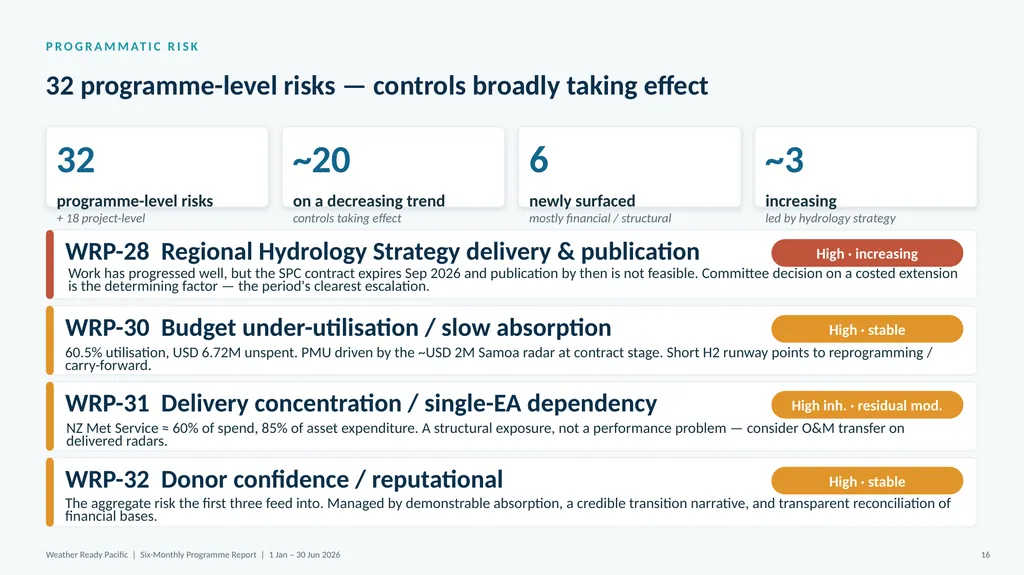
slide25. PROGRAMMATIC RISK 32 programme-level risks — controls broadly taking effect 32
programme-level risks
+ 18 project-level ~20
on a decreasing trend
controls taking effect 6
newly surfaced
mostly financial / structural ~3
increasing
led by hydrology strategy WRP-28 Regional Hydrology Strategy delivery & publication High · increasing Work has progressed well, but the SPC contract expires Sep 2026 and publication by then is not feasible. Committee decision on a costed extension is the determining factor — the period's clearest escalation. WRP-30 Budget under-utilisation / slow absorption High · stable 60.5% utilisation, USD 6.72M unspent. PMU driven by the ~USD 2M Samoa radar at contract stage. Short H2 runway points to reprogramming / carry-forward. WRP-31 Delivery concentration / single-EA dependency High inh. · residual mod. NZ Met Service ≈ 60% of spend, 85% of asset expenditure. A structural exposure, not a performance problem — consider O&M transfer on delivered radars. WRP-32 Donor confidence / reputational High · stable The aggregate risk the first three feed into. Managed by demonstrable absorption, a credible transition narrative, and transparent reconciliation of financial bases. Weather Ready Pacific | Six-Monthly Programme Report | 1 Jan – 30 Jun 2026 16<br>
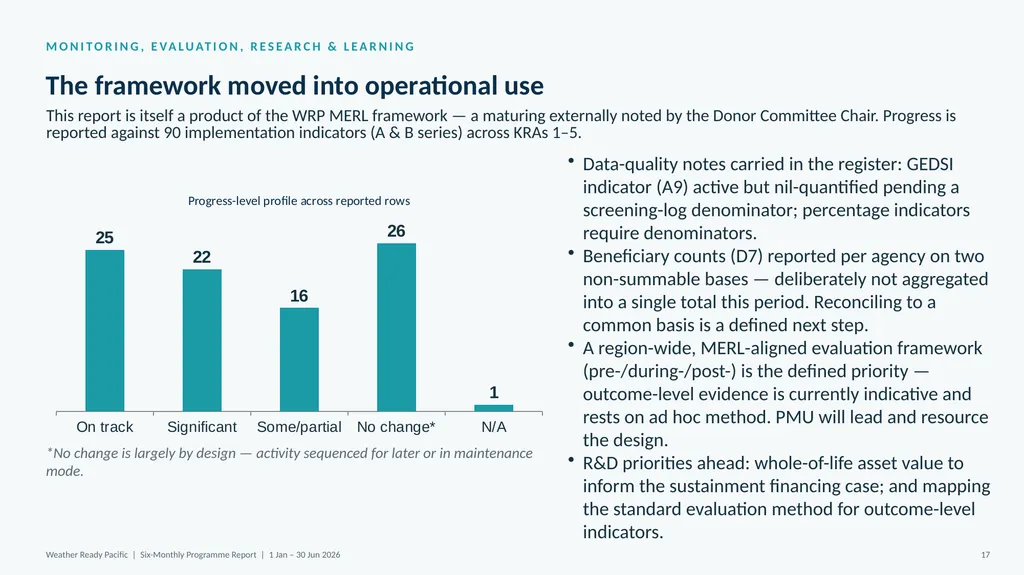
slide26. MONITORING, EVALUATION, RESEARCH & LEARNING The framework moved into operational use This report is itself a product of the WRP MERL framework — a maturing externally noted by the Donor Committee Chair. Progress is reported against 90 implementation indicators (A & B series) across KRAs 1–5. *No change is largely by design — activity sequenced for later or in maintenance mode. Data-quality notes carried in the register: GEDSI indicator (A9) active but nil-quantified pending a screening-log denominator; percentage indicators require denominators.
Beneficiary counts (D7) reported per agency on two non-summable bases — deliberately not aggregated into a single total this period. Reconciling to a common basis is a defined next step.
A region-wide, MERL-aligned evaluation framework (pre-/during-/post-) is the defined priority — outcome-level evidence is currently indicative and rests on ad hoc method. PMU will lead and resource the design.
R&D priorities ahead: whole-of-life asset value to inform the sustainment financing case; and mapping the standard evaluation method for outcome-level indicators. Weather Ready Pacific | Six-Monthly Programme Report | 1 Jan – 30 Jun 2026 17<br>
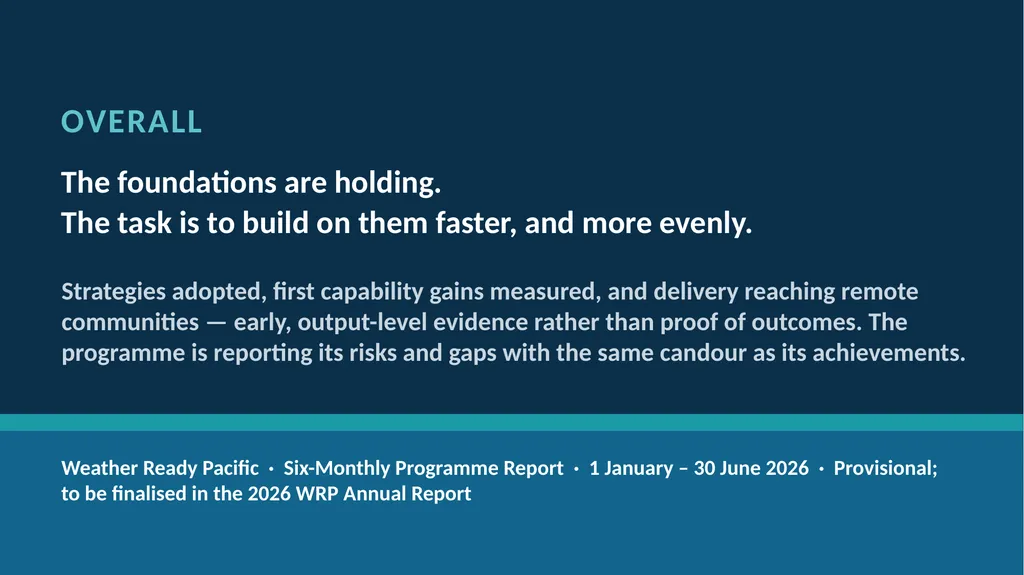
slide27. OVERALL The foundations are holding.
The task is to build on them faster, and more evenly. Strategies adopted, first capability gains measured, and delivery reaching remote communities — early, output-level evidence rather than proof of outcomes. The programme is reporting its risks and gaps with the same candour as its achievements. Weather Ready Pacific · Six-Monthly Programme Report · 1 January – 30 June 2026 · Provisional; to be finalised in the 2026 WRP Annual Report<br>
AMBER, IMPROVING Provisional — figures to be finalised in the 2026 WRP Annual Report<br>
slide3. EXECUTIVE SUMMARY Steady progress from establishment into early implementation AMBER, IMPROVING Governance & strategy foundations locked in GEDSI Strategy launched (14 Mar); Ops Manual Ch 11–12 endorsed (2 Jun); SC4 adopted a full slate of programme instruments. PMU reached 8 of 9 posts. Donor Committee Chair confirmed the MERL framework is now in active use. First measured capability gains CAP across 5 countries (90 trained): knowledge 63%→85%, confidence 51%→81% — largest gains where baselines were lowest (Kiribati +47% / +97%). Output-level, single cohort. Hydrology (PAGASA) and meteorologist (BoM) cohorts progressing. Delivery reached the hardest-to-reach places 4 sensors across Tokelau's atolls; Tonga radar at 100% uptime; IFP advanced to build-ready design; SPC diagnostic applied across 13 countries (scope of 3); COPE series launched in two Pacific languages. Challenges reported as plainly as wins IFP build Amber (Bureau VW specialist availability, risk of extension beyond Dec 2026); RMI LiDAR postponed by fuel shortage; ESNZ governance budget ~87% spent; BoM cohort carrying a managed retention risk; two named equity gaps. Weather Ready Pacific | Six-Monthly Programme Report | 1 Jan – 30 Jun 2026 2<br>
slide4. KRA 1 KEY RESULT AREA Governance, Management & Coordination Building the institutional foundation for a Pacific-led, decade-long programme AMBER, IMPROVING<br>
slide5. KRA 1 · GOVERNANCE, MANAGEMENT & COORDINATION Foundations mandated and equipped AMBER, IMPROVING 8 of 9
PMU staff in post
ESS/GEDSI Officer vacant GEDSI
Strategy launched
14 Mar 2026 Ops Manual
14 Chapters
endorsed 2 Jun 2026 0 / 1
studies / diagnostics
Pooled Fund in development Output 1.1 — PMU in full operational phase; Comms & KM Officer and MERL & Adaptation Officer joined this period; ESS/GEDSI Officer still to be recruited.
Output 1.2 — Sustainable MHEWS Asset Operations & Financing Facility (pooled-fund Phase 2) approved in principle at SC4 with a phased pathway; MDY Legal engaged. Scale depends on asset-mapping evidence (WRP-04/05).
Output 1.3 — GEDSI Strategy 2025–2033 launched; mandatory GEDSI screening now operates at concept-note stage; sector-wide GEDSI diagnostic in development against Dec 2026 target.
Sustainability actions are identified at design stage (compliance) — whether they are applied and sustained is not yet monitored; tracking likely falls to the PMU. Weather Ready Pacific | Six-Monthly Programme Report | 1 Jan – 30 Jun 2026 3<br>
slide6. KRA 2 KEY RESULT AREA People Capability Strengthening Pacific meteorological & hydrological skills, confidence and peer networks AMBER–GREEN<br>
slide7. KRA 2 · PEOPLE CAPABILITY First measured capability gains AMBER–GREEN 6
training sessions
5 country + 1 regional (CAP) 90
people trained
61m / 29f / 1 disability 74
active CoP members
9f / 65m on list CAP — the period's most substantial capability result Knowledge 63%→85% (46/51 improved) · Confidence 51%→81% (47/48) · Gains largest where baselines lowest — Kiribati +47% / +97%. CAP generation now operational in all 5 countries. Output-level, single cohort. Output 2.2 — Specialist hydrology via PAGASA (3 officials, graduation 26 Aug); BoM meteorologist cohort of 3 through Units 1–2 toward graduation 11 Nov.
Output 2.3 — HydroMet Technician CoP running as a regional peer-learning platform; survey 17/18 useful, 10/18 applied a learning. Smaller NMHSs (Nauru, Tokelau) found it less relevant — content being adapted.
GEDSI — disaggregated participation captured; one enrolled female BIP-M candidate withdrew before start, leaving an all-male cohort. Weather Ready Pacific | Six-Monthly Programme Report | 1 Jan – 30 Jun 2026 4<br>
slide8. PERFORMANCE STORY · EMPOWERING, COLLABORATIVE Capability that reaches those furthest behind: the CAP programme NZ Met Service delivered CAP training and implementation across RMI, FSM, Kiribati, PNG and Niue (Mar–May 2026), with a regional webinar on 9 April.
90 participants (61m / 29f / 1 person with disability). Against matched pre/post assessments: knowledge 63%→85% (46/51 improved); confidence 51%→81% (47/48).
Gains were largest where baselines were lowest — Kiribati recorded +47% knowledge and +97% confidence — an early signal the programme reaches those furthest behind rather than widening the gap.
CAP generation capability operational in all five countries by period end, with national editors nominated and draft dissemination SOPs in place.
Exercises spanned power outages, missing persons, oil spills and search-and-rescue — reinforcing CAP as multi-hazard, all-media public-warning infrastructure. When Palau could not confirm, the programme adapted by including Kiribati. Weather Ready Pacific | Six-Monthly Programme Report | 1 Jan – 30 Jun 2026 5<br>
slide10. KRA 3 KEY RESULT AREA Observation Network Infrastructure Adopting the regional architecture and reaching remote networks With delivery risks under active management. AMBER, IMPROVING<br>
slide11. KRA 3 · OBSERVATION NETWORK INFRASTRUCTURE Regional architecture adopted; remote networks reached AMBER, IMPROVING 2
strategies adopted
Observation + Radar, SC4 4
sensors (Tokelau)
+ SI radar FAT / delivery 100%
radar uptime (Tonga)
maintained to schedule ~280 / 700+
stations in OSCAR
40% — the maintenance-case base Output 3.1 — Pacific Regional Observation Strategy, Standards & Procurement Guidelines and maintenance guidance adopted at SC4. 2 of 15 NAMPs in place (Cook Islands, Tonga), 5 more in progress. Refurbishment moved into procurement for Samoa, SI, Fiji, Tokelau.
Output 3.2 — PMU supported Fiji Met toward RIC status via ISO/IEC 17025 training (NATA, Suva, 24–30 Jun); 16 trainees (14m/2f). Formal WMO RIC designation still pending.
Solomon Islands radar — FATs (power Dec, radar Mar, tower Apr) complete and delivered to site Jun; groundwater delayed the foundation; site work restarts early Aug 2026.
Samoa weather-watch radar (~USD 2M) held in contract negotiation — reported under Financial Performance, not as a delivery row, to avoid implying installed assets. Weather Ready Pacific | Six-Monthly Programme Report | 1 Jan – 30 Jun 2026 6<br>
slide12. PERFORMANCE STORY · INCLUSIVE, COLLABORATIVE, PACIFIC-LED Listening, Observing, Forecasting: a joint mission to Tokelau Tokelau's atolls lie 30 hours by sea from Apia aboard the MV Mataliki — the central logistical barrier to collecting in-situ data for a coastal inundation model.
A multi-agency Joint Mission (late April 2026), led by SPREP through WRP, brought together the governments of Tokelau and Samoa, SPC, WMO, UN agencies and BoM.
Four RBR water-level sensors were deployed across Fakaofo, Nukunonu and Atafu. Ahead of the mission, ESNZ secured Taupulega endorsement and produced sensor information sheets in English and Tokelauan.
The mission also advanced SPC-partnered PARTneR risk-tool work in the same visit — one voyage, several results. Published: NIWA/ESNZ newsletter, SPREP and SPC web stories, June 2026. Weather Ready Pacific | Six-Monthly Programme Report | 1 Jan – 30 Jun 2026 7<br>
slide14. KRA 4 KEY RESULT AREA Forecast & Warning Production Advancing the integrated platform, regional hydrology and pilot forecasting tools The IFP build and hydrology-strategy timing are the key forward risks. AMBER<br>
slide15. KRA 4 · FORECAST & WARNING PRODUCTION Platform to build-ready design; hydrology beyond scope AMBER 1
IFP in development
design → build-ready SAD 13
hydro assessments
vs scope of 3 3
National Roadmaps
+10 in development 5
Severe Weather Pilot tools
Tonga, Fiji, Niue Output 4.1 — IFP moved from Concept Note to endorsed high-level architecture (PICI 19 May; SC4), now evolving into a build-ready Solution Architecture Design, plus WIS2.0 Pilot Plan and Phase 1 Project Plan. Reported as in development, not yet developed.
Design rated Green, implementation Amber — dependent on Bureau Visual Weather specialist availability, with a risk Phase 1 extends beyond December 2026. AI/ML Weather Models Workshop reached 17 PICT participants (Honiara, 4–5 Jun).
Output 4.2 — SPC's Hydrological Diagnostic Framework (co-financed by AWP) applied across 13 countries against a scope of 3. Tokelau statistical inundation model prepared for ingest of April sensor data.
RMI LiDAR airborne survey produced no dataset — postponed by a national fuel shortage; extension sought to Dec granted only to Sep 2026. Weather Ready Pacific | Six-Monthly Programme Report | 1 Jan – 30 Jun 2026 8<br>
slide16. KRA 5 KEY RESULT AREA Communication & Delivery to End Users Operational alerting, translated community materials and last-mile connectivity AMBER<br>
slide17. KRA 5 · COMMUNICATION & DELIVERY TO END USERS Alerting operational; materials reaching communities AMBER 5
countries CAP operational
RMI, FSM, KI, PNG, NU 4 (cum.)
Starlink installs
KI, SI, Niue + Tonga 7 titles
COPE products
2 Pacific languages ~30
reached (Niue co-design)
85%f · 65% 60+ · 55% rural Output 5.1 — CAP generation operational in all 5 countries, with national CAP editors/focal points nominated and draft SOPs developed — the period's most substantial warning-dissemination step (delivered via KRA 2). Warning reach to end users not yet measured.
COPE 7-title series translated into Vagahau Niue and Gagana FakaTokelau, launched at 4 events (Niue 23 Mar; Tokelau's three atolls 29 Apr–1 May). Headcounts not recorded at delivery.
Communications & Engagement Strategy 2026–2033 endorsed at SC4. Regional Cell Broadcasting Strategy still in development (not adopted); GSMA MOU signed.
GEDSI — this KRA carries the programme's most direct equity evidence: local-language materials, strong female/older/rural participation, and inclusive-dissemination design. Where reach was not captured, the report says so rather than estimating. Weather Ready Pacific | Six-Monthly Programme Report | 1 Jan – 30 Jun 2026 9<br>
slide18. KRA 6 KEY RESULT AREA Risk Information & Preparedness Pending activation — not yet stood up, by design Activation is tied to the WRP Decadal Investment Plan, currently under review. In the interim, risk-information and preparedness work is delivered through KRAs 3, 4 and 5 — Tokelau coastal-inundation forecasting, CAP warning capability, and COPE community-education materials.
No implementation indicators are reported against KRA 6 — correctly reflecting a pillar not yet operational, rather than under-delivery. PENDING<br>
slide19. VALUE FOR MONEY The 4 Es — early, output-level value; unevenly distributed Cost per output is the meaningful unit at this stage; outcome-level value is explicitly deferred. Assessment weighs value obtained against value forgone through delay. ECONOMY Adequate Leverage & procurement discipline. SPC drew AWP/MFAT/WMO co-financing to reach 13 countries at no extra grant cost; ESNZ's joint mission pooled logistics; BoM ran 3 (not 4) students under budget. EFFICIENCY Adequate Genuinely mixed. Joint-mission savings & rescoped LiDAR vs 60.5% utilisation, USD 6.72M unspent, and a capability-ahead-of-assets sequencing mismatch at SPC & PMU. EFFECTIVENESS Adequate Assessed at output level. CAP operational in 5 countries; 13 hydro assessments; Tokelau sensors; IFP endorsed. CAP unit cost ≈ USD 1,332/participant, USD 23,982/country — the baseline to track. EQUITY Adequate Structural & enabling. GEDSI strategy, screening, Washington Group Short Set, Niue co-design. Two named gaps: NZ Met Service's uneven coverage; BoM's all-male cohort. Delay itself falls on the most exposed. Consolidated judgement: Early, output-level value that is real but partial. A confident whole-of-programme verdict awaits outcome evidence and a higher, more even conversion of budget into delivery in H2. All five EAs self-rated Adequate overall. Weather Ready Pacific | Six-Monthly Programme Report | 1 Jan – 30 Jun 2026 10<br>
slide20. VALUE FOR MONEY The cost of what did not happen (opportunity cost of delay) USD 6,721,441
~40% of budget unspent mid-delivery at 30 Jun 2026 Unspent funds are not cost-free: protection and capability deferred, delivery windows compressed into H2, and a reputational cost where absorption is read as a proxy for delivery (WRP-32). WRP PMU — largest unused balance USD 2.61M (46.2% utilised, 38.9% of all unspent). Asset line barely begun (3.2%): the ~USD 2M Samoa radar in contract negotiation. Works now underway, delivery expected early next year.
SPC — lowest utiliser at 26.1%; USD 578,805 asset budget unspent — the RMI LiDAR survey postponed by fuel shortage. Now expected to complete by September 2026.
BoM (43.1%) and ESNZ (45.7%) sit below the programme average — but ESNZ's current-period utilisation was ~95%; its low cumulative figure is a timing position (multi-year AWS refurbishment tranche only began June).
NZ Met Service (82.2%) is the outlier lifting the average — excluding it, the other four hold ~80% of the unspent balance. Short runway: with July–Aug given to PMC/Ministers prep and December low-activity, effective delivery is concentrated in Oct–Nov — a portion is likely reprogrammed or carried into 2027. A pacing question, not funds at risk. Weather Ready Pacific | Six-Monthly Programme Report | 1 Jan – 30 Jun 2026 11<br>
slide21. FINANCIAL PERFORMANCE · PROVISIONAL Utilisation: one agency ahead, four running behind USD 10.29M
incurred against a USD 17.01M budget USD 6.72M
unspent mid-delivery, available for reprogramming 47.2%
of spend on labour & technical expertise 85.0%
of tangible-asset spend sits with NZ Met Service Cumulative 2024–30 Jun 2026, all executing agencies. Provisional; to be finalised in the 2026 Annual Report. Different bases (cumulative vs current-period) yield different rates — both correct within their frame. Weather Ready Pacific | Six-Monthly Programme Report | 1 Jan – 30 Jun 2026 12<br>
slide22. FINANCIAL PERFORMANCE · PROVISIONAL Donor envelope funds the programme to 2029–2031 ~USD 41.9M
full donor envelope (interim) USD 39.05M
channelled through the SPREP PMU USD 9.53M
received through PMU to 30 Jun 2026 Reading it: The full envelope exceeds PMU receipts because ~USD 2.83M of MFAT funding goes direct-to-agency (ESNZ/NIWA) outside PMU accounts, with further NZ Met Service bilateral funding still to be quantified. Cumulative expenditure should not be divided by the USD 39.05M commitment — that funds the whole programme to 2029–2031, not this phase. Weather Ready Pacific | Six-Monthly Programme Report | 1 Jan – 30 Jun 2026 13<br>
slide23. CROSS-CUTTING Sustainability & Environmental / Social Safeguards SUSTAINABILITY All EAs designed sustainability actions — but at concept stage (compliance); application and post-close continuation not yet monitored. Tracking likely falls to the PMU.
Observation workstream oriented to sustainment: 2/15 NAMPs in place (5 in progress), a WMO-endorsed NAMP template, and maintenance guidance.
Sustainable MHEWS Asset Operations & Financing Facility is the key instrument — but its business case needs a complete asset picture (only ~280 of 700+ stations in OSCAR). Chain tracked via WRP-04/05.
Delivery-level design choices align to the 2025 sustainability benchmarks: Pacific-led validation, local-language materials, the Fiji Met RIC pathway, and the peer-learning CoP. ENVIRONMENTAL & SOCIAL SAFEGUARDS Applied through activity checklists and, most visibly, fieldwork conduct. Tokelau deployment is the clearest example: EIA-advised siting, community-agreed locations, Taupulega endorsement, local-language information sheets.
Embedded in procurement & design: refurbishment and procurement guidelines; Samoa radar siting to avoid radiation-hazard exposure; BoM Visual Weather accessibility testing.
Conformity with SPREP's ESS policy — but documentation of how safeguards are applied is inconsistent; a standard ESS checklist is under consideration.
Principal gap is institutional: the ESS/GEDSI Officer post is unfilled, slowing operationalisation (WRP-24), with recruitment as the named critical dependency. Weather Ready Pacific | Six-Monthly Programme Report | 1 Jan – 30 Jun 2026 14<br>
slide24. PROGRAMME MANAGEMENT & GOVERNANCE The governance architecture operated in full Steering Committee 4 (Honiara, 29 May–2 Jun) adopted the Observation, Radar, Standards & Procurement and Communications & Engagement strategies; endorsed the Ops Manual & Charter (subject to donor feedback); and approved the Pooled Fund in principle. SC5: 15 Sep 2026 (Tonga); SC6: May 2027 (Niue).
Recruitment — PMU reached 8 of 9 SPREP positions; MERL & Adaptation Officer (from 30 Mar) and Comms & KM Officer (from 2 Feb) joined. ESS/GEDSI Officer is the principal remaining gap.
Contracts & procurement — 8 country Letters of Agreement structure national delivery (Cook Islands, Kiribati, Niue, Samoa, SI, Tonga, Tuvalu signed; RMI in negotiation). Major procurements progressed through SPREP systems; the Samoa radar supplier contract — the single largest procurement — remained in negotiation at period end.
Coordination load — Partners Meeting (Melbourne, Feb); IFP Validation Workshop (Nadi, Apr–May); AI/ML Workshop (Honiara, Jun); Aviation/Met Forum (Honiara, May); SC4 and its Honiara cluster.
External validation — at the June Partners Meeting the Donor Committee Chair noted the WRP MERL framework is now actively in use. 15<br>
slide25. PROGRAMMATIC RISK 32 programme-level risks — controls broadly taking effect 32
programme-level risks
+ 18 project-level ~20
on a decreasing trend
controls taking effect 6
newly surfaced
mostly financial / structural ~3
increasing
led by hydrology strategy WRP-28 Regional Hydrology Strategy delivery & publication High · increasing Work has progressed well, but the SPC contract expires Sep 2026 and publication by then is not feasible. Committee decision on a costed extension is the determining factor — the period's clearest escalation. WRP-30 Budget under-utilisation / slow absorption High · stable 60.5% utilisation, USD 6.72M unspent. PMU driven by the ~USD 2M Samoa radar at contract stage. Short H2 runway points to reprogramming / carry-forward. WRP-31 Delivery concentration / single-EA dependency High inh. · residual mod. NZ Met Service ≈ 60% of spend, 85% of asset expenditure. A structural exposure, not a performance problem — consider O&M transfer on delivered radars. WRP-32 Donor confidence / reputational High · stable The aggregate risk the first three feed into. Managed by demonstrable absorption, a credible transition narrative, and transparent reconciliation of financial bases. Weather Ready Pacific | Six-Monthly Programme Report | 1 Jan – 30 Jun 2026 16<br>
slide26. MONITORING, EVALUATION, RESEARCH & LEARNING The framework moved into operational use This report is itself a product of the WRP MERL framework — a maturing externally noted by the Donor Committee Chair. Progress is reported against 90 implementation indicators (A & B series) across KRAs 1–5. *No change is largely by design — activity sequenced for later or in maintenance mode. Data-quality notes carried in the register: GEDSI indicator (A9) active but nil-quantified pending a screening-log denominator; percentage indicators require denominators.
Beneficiary counts (D7) reported per agency on two non-summable bases — deliberately not aggregated into a single total this period. Reconciling to a common basis is a defined next step.
A region-wide, MERL-aligned evaluation framework (pre-/during-/post-) is the defined priority — outcome-level evidence is currently indicative and rests on ad hoc method. PMU will lead and resource the design.
R&D priorities ahead: whole-of-life asset value to inform the sustainment financing case; and mapping the standard evaluation method for outcome-level indicators. Weather Ready Pacific | Six-Monthly Programme Report | 1 Jan – 30 Jun 2026 17<br>
slide27. OVERALL The foundations are holding.
The task is to build on them faster, and more evenly. Strategies adopted, first capability gains measured, and delivery reaching remote communities — early, output-level evidence rather than proof of outcomes. The programme is reporting its risks and gaps with the same candour as its achievements. Weather Ready Pacific · Six-Monthly Programme Report · 1 January – 30 June 2026 · Provisional; to be finalised in the 2026 WRP Annual Report<br>