Web 2.o VS web 3.0 The Technological Revolution of the Internet Anil Rana Vertical Head AIML Gurpreet Singh Vertical Head Blockchain MOOGLELABS - SERVICES Decoding Innovation In AIML, Blockchain, DevOps and Data Science Many
Related Topics
Share
Embed code
Download this presentation From Below
"Web 2.o VS web 3.0 The Technological Revolution of" is the property of its rightful owner. Permission is granted to
download and print the materials on this website for personal, non-commercial use only, and to display it
on your personal computer provided you do not modify the materials and that you retain all copyright
notices contained in the materials. By downloading content from our website, you accept the terms of this
agreement.
Presentation Transcript
01
Web 2.o VS web 3.0 The Technological Revolution of the Internet Anil Rana | Vertical Head AI/ML
Gurpreet Singh | Vertical Head Blockchain<br>
02
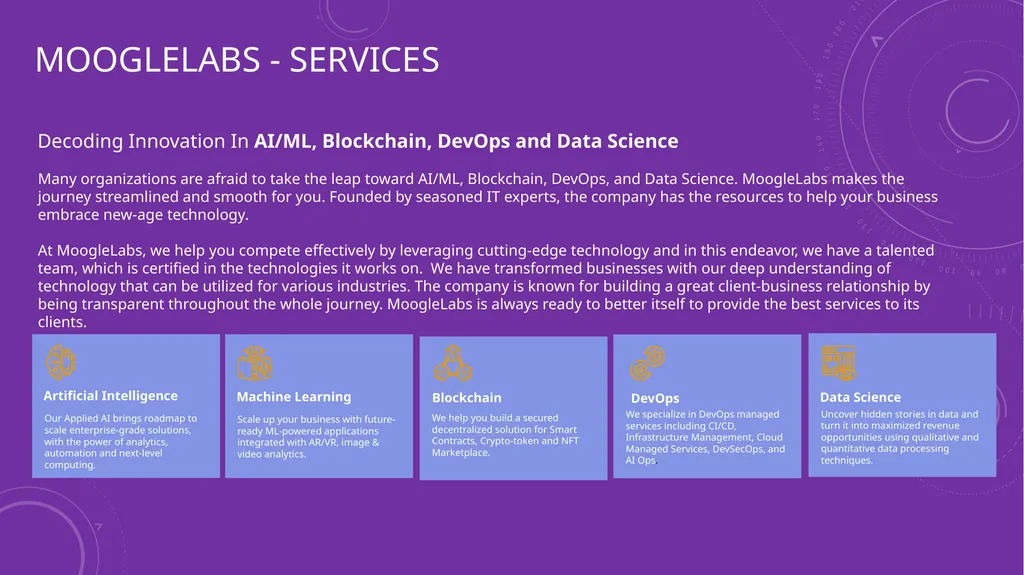
MOOGLELABS - SERVICES Decoding Innovation In AI/ML, Blockchain, DevOps and Data Science Many organizations are afraid to take the leap toward AI/ML, Blockchain, DevOps, and Data Science. MoogleLabs makes the journey streamlined and smooth for you. Founded by seasoned IT experts, the company has the resources to help your business embrace new-age technology.
At MoogleLabs, we help you compete effectively by leveraging cutting-edge technology and in this endeavor, we have a talented team, which is certified in the technologies it works on. We have transformed businesses with our deep understanding of technology that can be utilized for various industries. The company is known for building a great client-business relationship by being transparent throughout the whole journey. MoogleLabs is always ready to better itself to provide the best services to its clients. Our Applied AI brings roadmap to scale enterprise-grade solutions, with the power of analytics, automation and next-level computing. Scale up your business with future-ready ML-powered applications integrated with AR/VR, image & video analytics. We help you build a secured decentralized solution for Smart Contracts, Crypto-token and NFT Marketplace. We specialize in DevOps managed services including CI/CD, Infrastructure Management, Cloud Managed Services, DevSecOps, and AI Ops. Uncover hidden stories in data and turn it into maximized revenue opportunities using qualitative and quantitative data processing techniques. Artificial Intelligence Machine Learning Blockchain DevOps Data Science<br>
03
MoogleLabs Web 3.0 Development Services Learning Management Solution
Social Networking
Content-Based Apps
Non-Fungible Tokens Marketplace
Metaverse
Cryptocurrency Exchange Development
NFT Gaming
ICO and Smart contract development
Enterprise Solution<br>
04
Overview WEB 1.0
WEB 2.0
Characteristics of web 2.0
Technology Overview & Innovations associated
Web 2.0 and Business
WEB 3.0
WEB 3.0 Key Features
The Web 3.0 for business enterprises
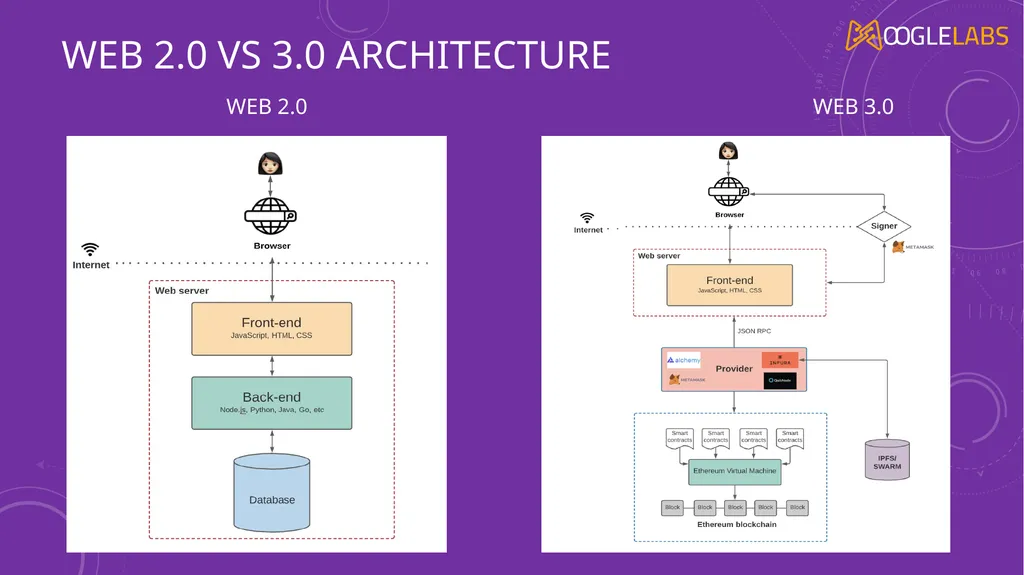
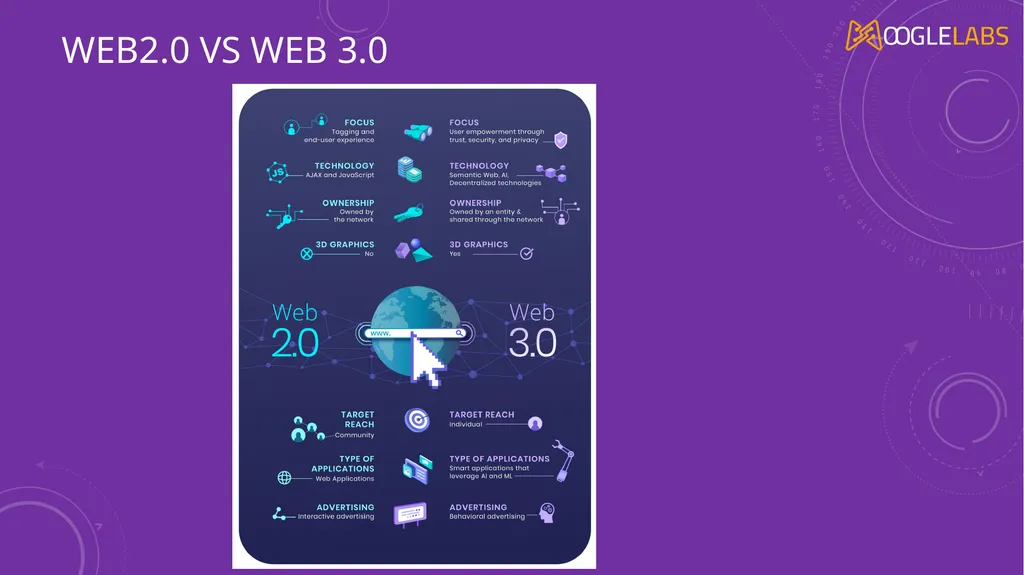
Web 3.0 High Level Architecture, Comparison with Web 2.0 Architecture
Web 2.0 vs Web 3.0<br>
05
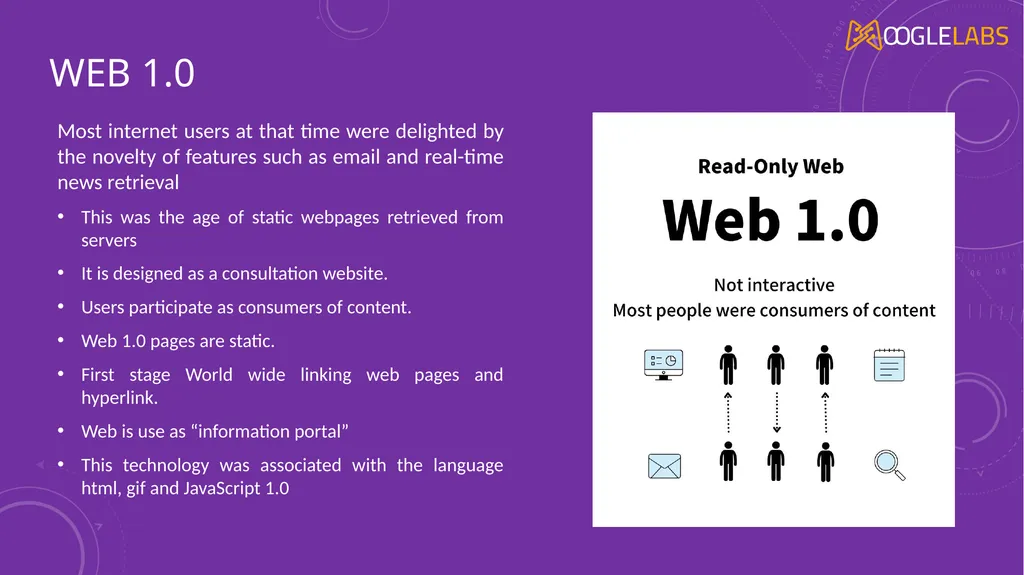
WEB 1.0 Most internet users at that time were delighted by the novelty of features such as email and real-time news retrieval
This was the age of static webpages retrieved from servers
It is designed as a consultation website.
Users participate as consumers of content.
Web 1.0 pages are static.
First stage World wide linking web pages and hyperlink.
Web is use as “information portal”
This technology was associated with the language html, gif and JavaScript 1.0<br>
06
WEB 2.0 Web 2.0 refers to a paradigm shift in how the internet is used. Over the past 15 to 20 years, the bland webpages of Web 1.0 have been completely replaced by Web 2.0’s interactivity, social connectivity, and user generated content.
Web 2.0 makes it possible for user-generated content to be viewed by millions of people around the world virtually in an instant; this unparalleled reach has led to an explosion of this type of content in recent years.
The phenomenal revenue growth of these dominant platforms has made many of the Web 2.0-centric companies—such as Apple, Amazon, Google, Meta (formerly Facebook), and Netflix—among the world’s biggest companies by market capitalization (there is even an acronym for them: FAANG).
It is a platform that give users the possibility to control their data.
This is about user – generated content and the read-write web.
Everyone can be content producer.
Web 2.0 can be describe into 3 concepts which is:-
Rich Internet Application (RIA)
Service Oriented Architecture (SOA)
Social Web<br>
07
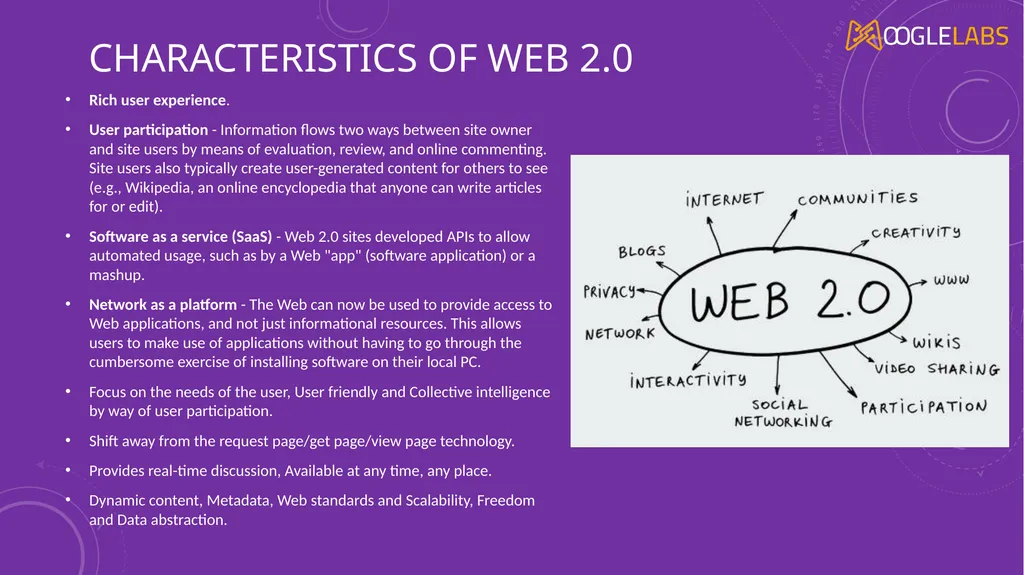
Characteristics of web 2.0 Rich user experience.
User participation - Information flows two ways between site owner and site users by means of evaluation, review, and online commenting. Site users also typically create user-generated content for others to see (e.g., Wikipedia, an online encyclopedia that anyone can write articles for or edit).
Software as a service (SaaS) - Web 2.0 sites developed APIs to allow automated usage, such as by a Web "app" (software application) or a mashup.
Network as a platform - The Web can now be used to provide access to Web applications, and not just informational resources. This allows users to make use of applications without having to go through the cumbersome exercise of installing software on their local PC.
Focus on the needs of the user, User friendly and Collective intelligence by way of user participation.
Shift away from the request page/get page/view page technology.
Provides real-time discussion, Available at any time, any place.
Dynamic content, Metadata, Web standards and Scalability, Freedom and Data abstraction.<br>
08
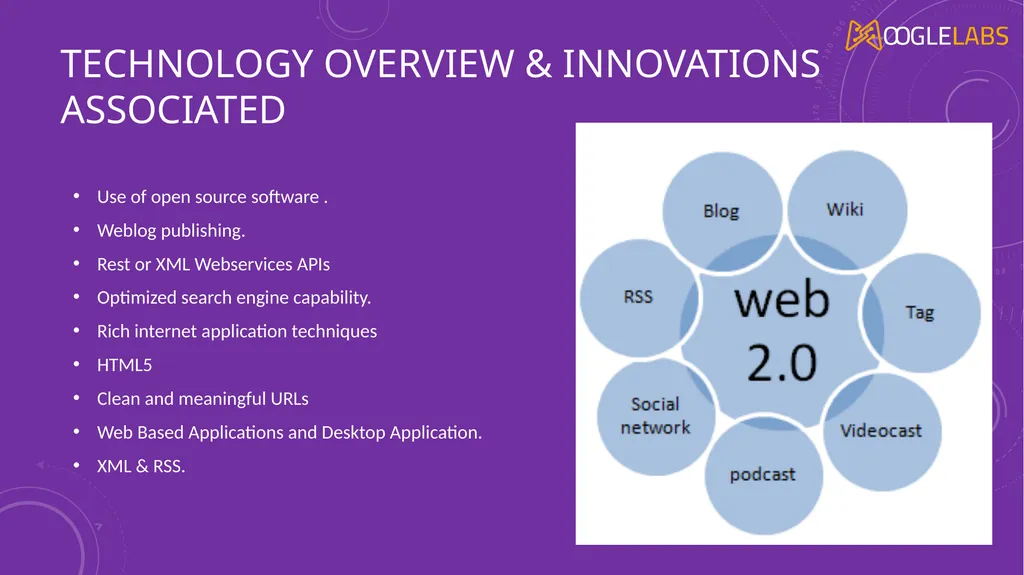
Technology Overview & Innovations associated Use of open source software .
Weblog publishing.
Rest or XML Webservices APIs
Optimized search engine capability.
Rich internet application techniques
HTML5
Clean and meaningful URLs
Web Based Applications and Desktop Application.
XML & RSS.<br>
09
WEB 3.0 Web 3.0 or Web3 is the third generation of the World Wide Web. Currently a work in progress, it is a vision of a decentralized and open Web with greater utility for its users
Suggested name by John Markoff of the New York Times for the third generation of the web.
Defining features of Web 3.0 include decentralization; and permissionless; artificial intelligence (AI) and machine learning; and connectivity and ubiquity.
Web 3.0 represents the next iteration or phase of the evolution of the web/internet and potentially could be as disruptive and represent as big a paradigm shift as Web 2.0 did. Web 3.0 is built upon the core concepts of decentralization, openness, and greater user utility.
A decentralized autonomous organization (DAO) is an automated computer network organization model controlled by its community members rather than a single establishment like the government or a financial institution, and whose transaction records are maintained on a blockchain.<br>
10
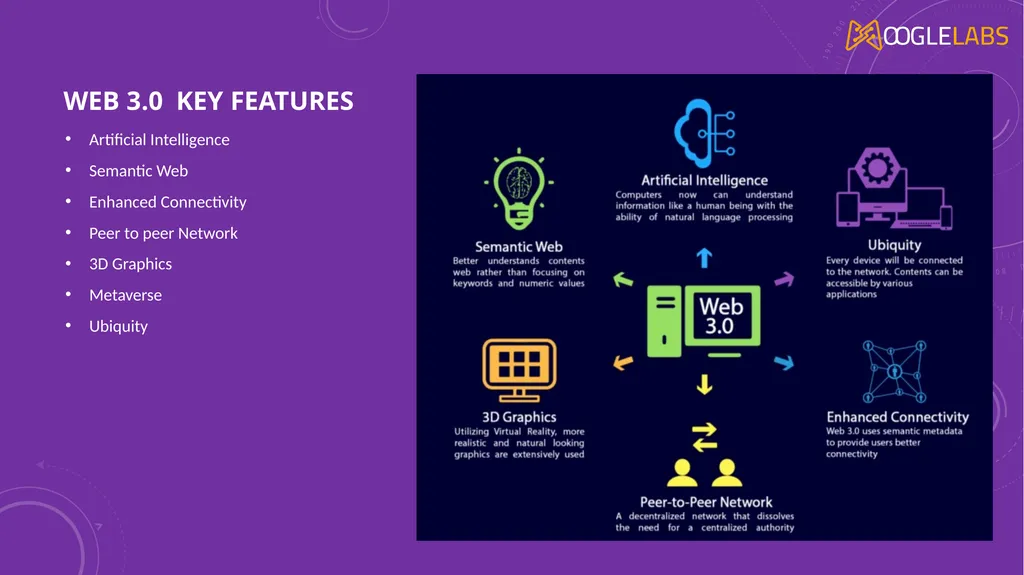
WEB 3.0 Key Features Artificial Intelligence
Semantic Web
Enhanced Connectivity
Peer to peer Network
3D Graphics
Metaverse
Ubiquity<br>
11
The Web 3.0 for business enterprises Transparency for B2B businesses
Power to the end users in Social media industry
Better marketing strategy for the sellers
Smart IoT devices can help in expansion of enterprises
Reaching out to the target audience in retail sector and e-commerce
AI-based Chatbots and interoperability for clients and customers
Blockchain technology for easing technical hassles and high security Walmart Canada
Case Study - https://www.hyperledger.org/learn/publications/walmart-case-study<br>