
Webinar outline Programme aims, objectives and
NS
Published · 36 slides · 0 views
1 / 1



Description
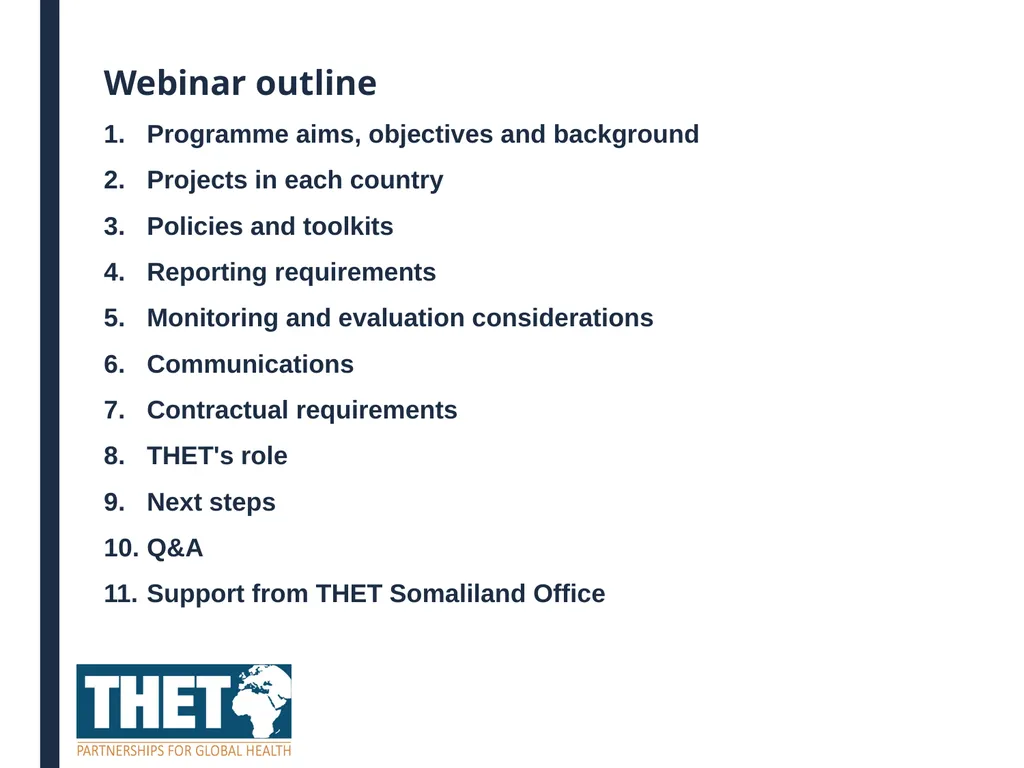
Webinar outline Programme aims, objectives and background Projects in each country Policies and toolkits Reporting requirements Monitoring and evaluation considerations Communications Contractual requirements THETs role Next steps QA
Related Topics
Share
Embed code
Download this presentation From Below
"Webinar outline Programme aims, objectives and" is the property of its rightful owner. Permission is granted to download and print the materials on this website for personal, non-commercial use only, and to display it on your personal computer provided you do not modify the materials and that you retain all copyright notices contained in the materials. By downloading content from our website, you accept the terms of this agreement.
Presentation Transcript
01
Webinar outline
Programme aims, objectives and background
Projects in each country
Policies and toolkits
Reporting requirements
Monitoring and evaluation considerations
Communications
Contractual requirements
THET's role
Next steps
Q&A
Support from THET Somaliland Office<br>
Programme aims, objectives and background
Projects in each country
Policies and toolkits
Reporting requirements
Monitoring and evaluation considerations
Communications
Contractual requirements
THET's role
Next steps
Q&A
Support from THET Somaliland Office<br>
02
1. Aims and outcomes of FIWP – U&S
Overall programme aim:
Address the global shortage of quality health workers, especially nurses.
Through:
1. Delivering training that leads to nurse qualifications to refugees/displaced people
2. Supporting governments to improve their health workforce management
3. Increasing the quantity and quality of healthcare workers, across cadres and health themes, leading to an increase in better trained health workers
4. Increasing access to vital services for the poorest and most vulnerable, including the refugee population, across all regions of Uganda and Somaliland.<br>
Overall programme aim:
Address the global shortage of quality health workers, especially nurses.
Through:
1. Delivering training that leads to nurse qualifications to refugees/displaced people
2. Supporting governments to improve their health workforce management
3. Increasing the quantity and quality of healthcare workers, across cadres and health themes, leading to an increase in better trained health workers
4. Increasing access to vital services for the poorest and most vulnerable, including the refugee population, across all regions of Uganda and Somaliland.<br>
03
1. Aims and outcomes of FIWP – U&S
In Somaliland:
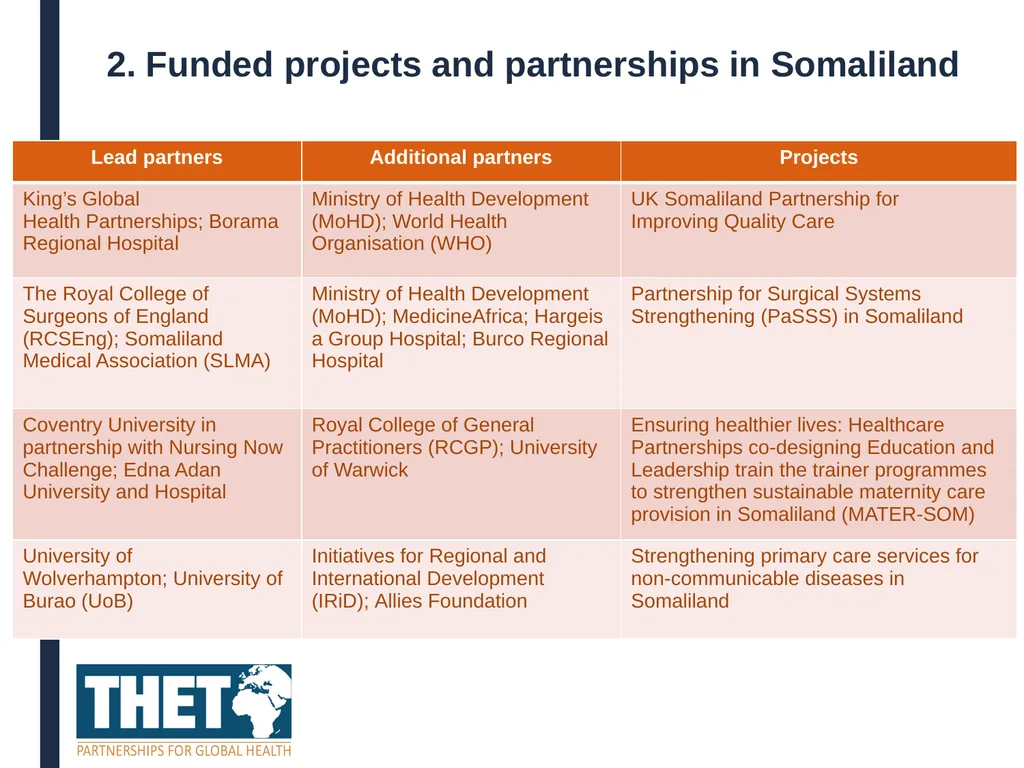
Supporting 4 UK-Somaliland health partnerships to deliver health systems strengthening activities:
208 healthcare professionals
7 regions of Somaliland
21 health delivery institutions
Working closely with the Somaliland Ministry of Health to:
revise and develop nursing and midwifery curricula, ready to be implemented nationally by Somaliland nursing and midwifery faculty<br>
In Somaliland:
Supporting 4 UK-Somaliland health partnerships to deliver health systems strengthening activities:
208 healthcare professionals
7 regions of Somaliland
21 health delivery institutions
Working closely with the Somaliland Ministry of Health to:
revise and develop nursing and midwifery curricula, ready to be implemented nationally by Somaliland nursing and midwifery faculty<br>
04
1. Aims and outcomes of FIWP – U&S
In Uganda:
Supporting UK-Uganda health partnerships to deliver health systems strengthening activities
4 regions of Uganda
3,100 healthcare professionals
70 health delivery institutions
New and improved curricula, policies and guidelines<br>
In Uganda:
Supporting UK-Uganda health partnerships to deliver health systems strengthening activities
4 regions of Uganda
3,100 healthcare professionals
70 health delivery institutions
New and improved curricula, policies and guidelines<br>
05
2. Funded projects and partnerships in Somaliland<br>
06
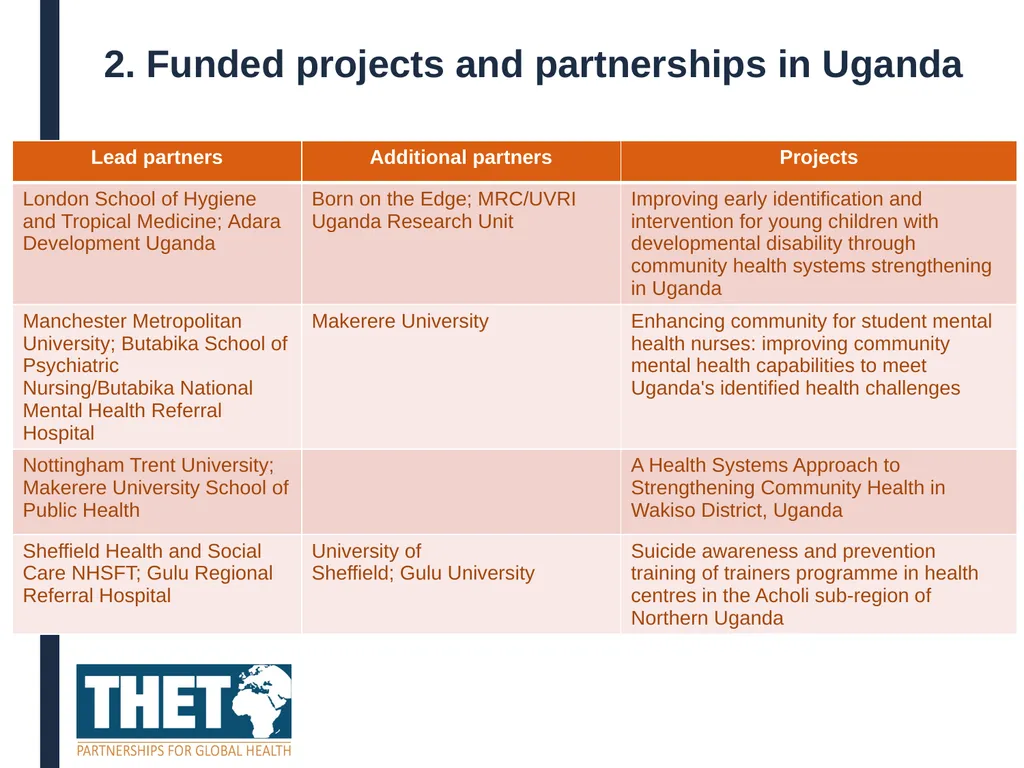
2. Funded projects and partnerships in Uganda<br>
07
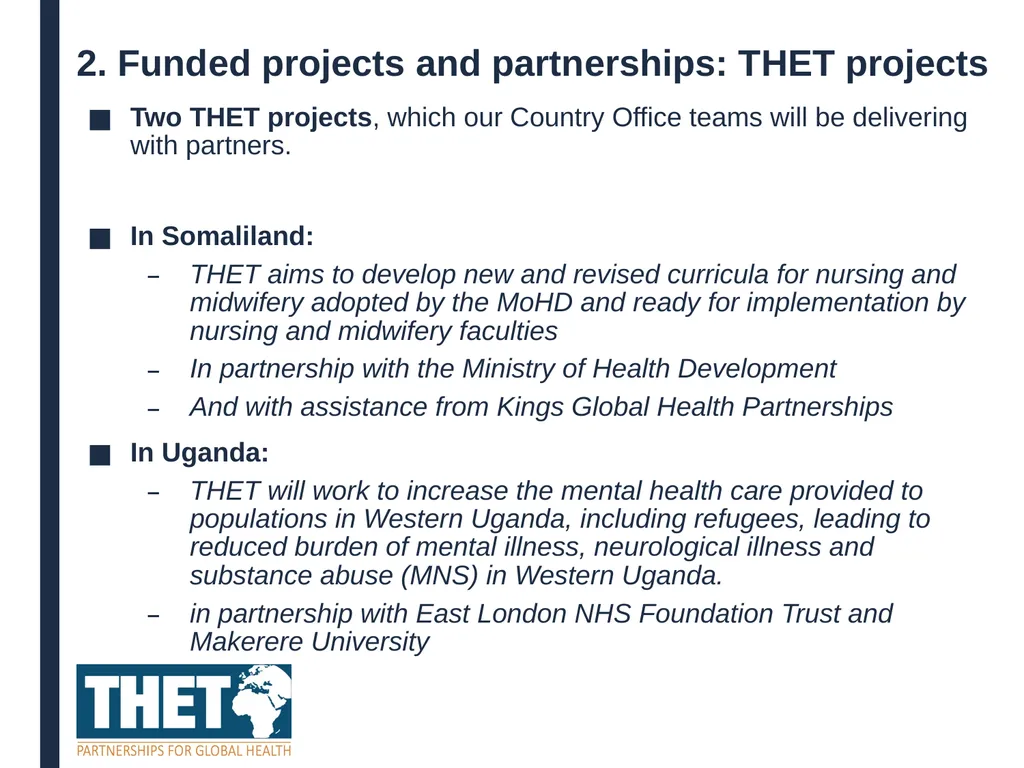
2. Funded projects and partnerships: THET projects Two THET projects, which our Country Office teams will be delivering with partners.
In Somaliland:
THET aims to develop new and revised curricula for nursing and midwifery adopted by the MoHD and ready for implementation by nursing and midwifery faculties
In partnership with the Ministry of Health Development
And with assistance from Kings Global Health Partnerships
In Uganda:
THET will work to increase the mental health care provided to populations in Western Uganda, including refugees, leading to reduced burden of mental illness, neurological illness and substance abuse (MNS) in Western Uganda.
in partnership with East London NHS Foundation Trust and Makerere University<br>
In Somaliland:
THET aims to develop new and revised curricula for nursing and midwifery adopted by the MoHD and ready for implementation by nursing and midwifery faculties
In partnership with the Ministry of Health Development
And with assistance from Kings Global Health Partnerships
In Uganda:
THET will work to increase the mental health care provided to populations in Western Uganda, including refugees, leading to reduced burden of mental illness, neurological illness and substance abuse (MNS) in Western Uganda.
in partnership with East London NHS Foundation Trust and Makerere University<br>
08
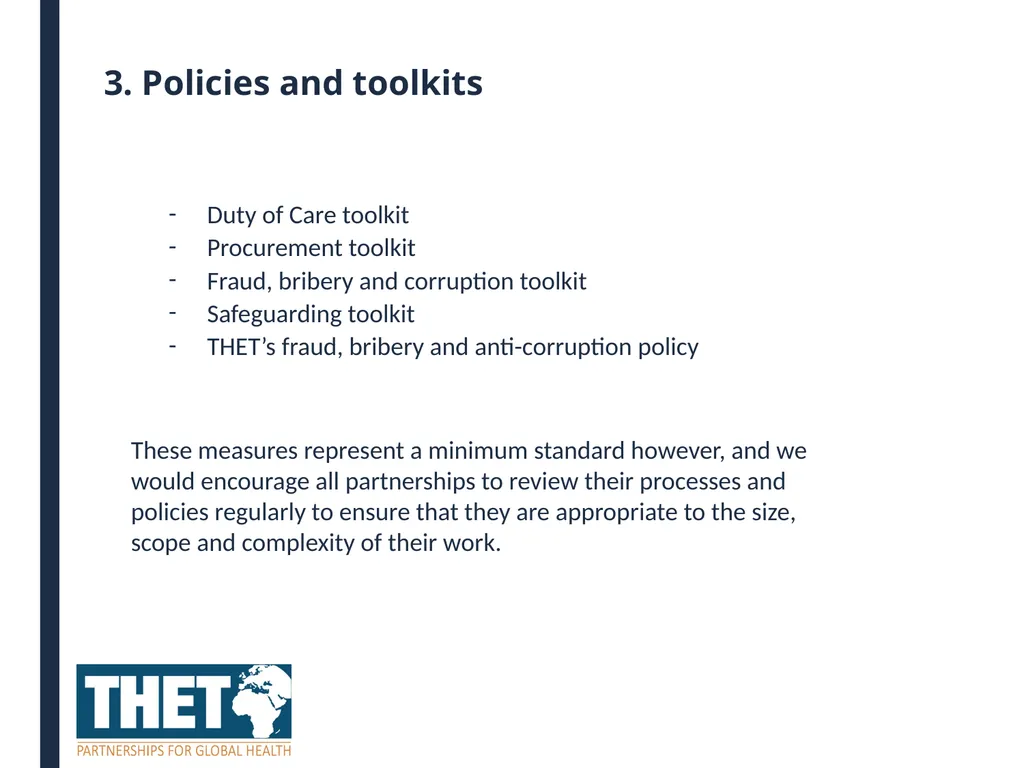
3. Policies and toolkits Duty of Care toolkit
Procurement toolkit
Fraud, bribery and corruption toolkit
Safeguarding toolkit
THET’s fraud, bribery and anti-corruption policy These measures represent a minimum standard however, and we would encourage all partnerships to review their processes and policies regularly to ensure that they are appropriate to the size, scope and complexity of their work.<br>
Procurement toolkit
Fraud, bribery and corruption toolkit
Safeguarding toolkit
THET’s fraud, bribery and anti-corruption policy These measures represent a minimum standard however, and we would encourage all partnerships to review their processes and policies regularly to ensure that they are appropriate to the size, scope and complexity of their work.<br>
09
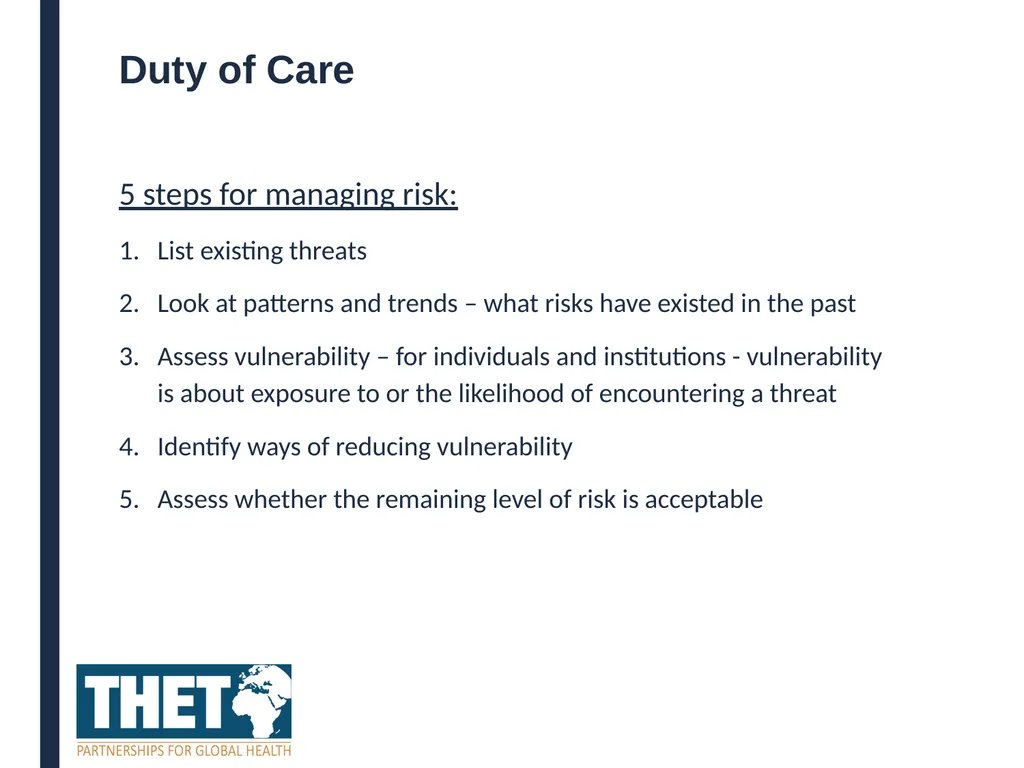
Duty of Care 5 steps for managing risk:
List existing threats
Look at patterns and trends – what risks have existed in the past
Assess vulnerability – for individuals and institutions - vulnerability is about exposure to or the likelihood of encountering a threat
Identify ways of reducing vulnerability
Assess whether the remaining level of risk is acceptable<br>
List existing threats
Look at patterns and trends – what risks have existed in the past
Assess vulnerability – for individuals and institutions - vulnerability is about exposure to or the likelihood of encountering a threat
Identify ways of reducing vulnerability
Assess whether the remaining level of risk is acceptable<br>
10
Duty of Care Good volunteer management procedures include:
Key organisational principles that underpin volunteer engagement
Fair and transparent recruitment policies
Clearly defined mechanisms for the provision of support at all points along the volunteer journey<br>
Key organisational principles that underpin volunteer engagement
Fair and transparent recruitment policies
Clearly defined mechanisms for the provision of support at all points along the volunteer journey<br>
11
Procurement A good procurement policy will include elements to ensure that:
Quality goods and services are purchased in a timely manner according to need and specification, achieving the best possible value for money
Purchases are made fairly and transparently, minimising the risk of fraud
Appropriate levels of authorisation are in place, guaranteeing accountability
Issues around ethics, competition and conflict of interest have been considered and adequately addressed
Purchases comply with relevant donor requirements and/or legislation<br>
Quality goods and services are purchased in a timely manner according to need and specification, achieving the best possible value for money
Purchases are made fairly and transparently, minimising the risk of fraud
Appropriate levels of authorisation are in place, guaranteeing accountability
Issues around ethics, competition and conflict of interest have been considered and adequately addressed
Purchases comply with relevant donor requirements and/or legislation<br>
12
Fraud, bribery and corruption Fraud is defined as an act carried out with the deliberate intention of deceiving the charity, its donors, beneficiaries or the general public to gain a personal advantage, or cause loss to another.
Bribery is defined as the offering, promising, giving, accepting or soliciting of money, a gift or other advantage as an inducement to do something that is illegal or a breach of trust in the course of carrying out an organisation’s activities.
Corruption is defined as the misuse of public power for private profit, or the misuse of entrusted power for private gain.<br>
Bribery is defined as the offering, promising, giving, accepting or soliciting of money, a gift or other advantage as an inducement to do something that is illegal or a breach of trust in the course of carrying out an organisation’s activities.
Corruption is defined as the misuse of public power for private profit, or the misuse of entrusted power for private gain.<br>
13
Fraud, bribery and corruption Steps to prevent the risk of fraud, bribery and corruption:
Having a clear stance and creating a clear zero tolerance policy within the partnership
Good internal controls are a key part of dealing with fraud:
identify key areas related to fraud, bribery and corruption and these should be recorded on a risk register
ensure that there is a clear and appropriate segregation of duties in place and that staff are adequately trained to engage with financial records and either report or ask critical questions should alarm bells go off.
Additionally, mechanisms for detecting fraud, bribery and corruption should be in place, including:
Regular project visits including meetings with staff and volunteers at all levels
Internal audit and/or systems review, including the inspection of processes and records
Verification of financial data against reported activities and results
Fraud prevention and management strategies should be documented in a fraud policy covering:
what fraud is
prevention and detection
reporting and investigation
THET has a zero-tolerance policy towards fraud, the giving and receiving of bribes, and of corruption in any form, in any circumstances.
Any incident or concern of fraud, bribery or corruption should be reported to THET. THET will investigate all instances and all reported concerns of fraud, bribery and corruption and will involve all relevant UK and foreign authorities.<br>
Having a clear stance and creating a clear zero tolerance policy within the partnership
Good internal controls are a key part of dealing with fraud:
identify key areas related to fraud, bribery and corruption and these should be recorded on a risk register
ensure that there is a clear and appropriate segregation of duties in place and that staff are adequately trained to engage with financial records and either report or ask critical questions should alarm bells go off.
Additionally, mechanisms for detecting fraud, bribery and corruption should be in place, including:
Regular project visits including meetings with staff and volunteers at all levels
Internal audit and/or systems review, including the inspection of processes and records
Verification of financial data against reported activities and results
Fraud prevention and management strategies should be documented in a fraud policy covering:
what fraud is
prevention and detection
reporting and investigation
THET has a zero-tolerance policy towards fraud, the giving and receiving of bribes, and of corruption in any form, in any circumstances.
Any incident or concern of fraud, bribery or corruption should be reported to THET. THET will investigate all instances and all reported concerns of fraud, bribery and corruption and will involve all relevant UK and foreign authorities.<br>
14
Safeguarding “Safeguarding means protecting people’s health, wellbeing and human rights, enabling them to live free from harm, abuse and neglect.”
THET does not tolerate the abuse of vulnerable adults and children. Safeguarding applies without exception across our programmes, partners and staff.
Health Partnerships have a responsibility to ensure that all stakeholders are as safe as possible.<br>
THET does not tolerate the abuse of vulnerable adults and children. Safeguarding applies without exception across our programmes, partners and staff.
Health Partnerships have a responsibility to ensure that all stakeholders are as safe as possible.<br>
15
Due diligence and legislative and policy analysis
Starting conversations
Understanding the risks
Policies, protocols and procedures
A safeguarding policy per lead institutions
A code of conduct for the partnership
A safeguarding protocol for the partnership
Positive safeguarding culture
UK staff and volunteer recruitment, training and support
Partnership governance Safeguarding<br>
Starting conversations
Understanding the risks
Policies, protocols and procedures
A safeguarding policy per lead institutions
A code of conduct for the partnership
A safeguarding protocol for the partnership
Positive safeguarding culture
UK staff and volunteer recruitment, training and support
Partnership governance Safeguarding<br>
16
4. Reporting to THET
Initial and ad-hoc progress meetings with THET
Narrative and finance report – due 15 days after the end of the project (by 15th March 2022)
THET will provide the reporting templates
Standard data collection template: THET will work with you to refine the outputs, outcomes and indicators provided in your application (if necessary) and put in place a MEL plan which you will report on in your final report.
There will also be some standard data which we will ask you to report against, which will feed into our logframe with DHSC.<br>
Initial and ad-hoc progress meetings with THET
Narrative and finance report – due 15 days after the end of the project (by 15th March 2022)
THET will provide the reporting templates
Standard data collection template: THET will work with you to refine the outputs, outcomes and indicators provided in your application (if necessary) and put in place a MEL plan which you will report on in your final report.
There will also be some standard data which we will ask you to report against, which will feed into our logframe with DHSC.<br>
17
5. Monitoring and evaluation
Emphasis on evidence
Important that partnerships factor in monitoring requirements from the start of their projects
Short term projects might not be able to demonstrate impact at the health system level or in terms of behaviour in the timeframe, but we are requesting data that can demonstrate some change or output such as:
changes in knowledge or skills immediately after capacity development initiatives,
revision or development of curricula, or
needs assessments with practical steps identified and signed off by relevant institutions<br>
Emphasis on evidence
Important that partnerships factor in monitoring requirements from the start of their projects
Short term projects might not be able to demonstrate impact at the health system level or in terms of behaviour in the timeframe, but we are requesting data that can demonstrate some change or output such as:
changes in knowledge or skills immediately after capacity development initiatives,
revision or development of curricula, or
needs assessments with practical steps identified and signed off by relevant institutions<br>
18
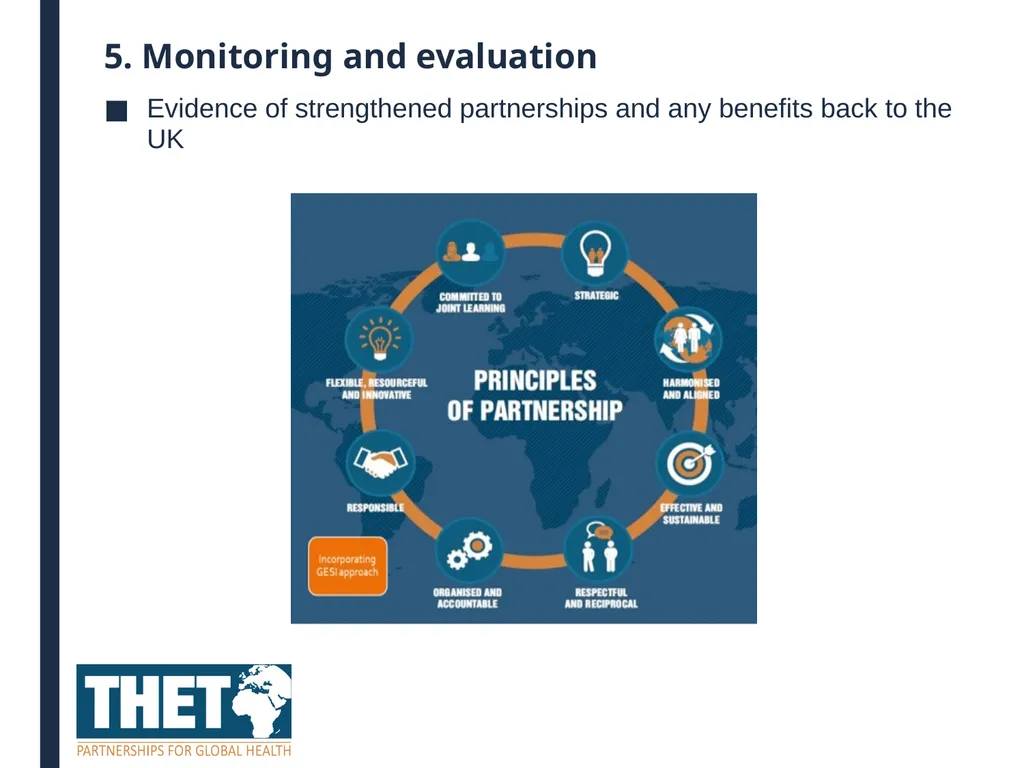
5. Monitoring and evaluation
Evidence of strengthened partnerships and any benefits back to the UK<br>
Evidence of strengthened partnerships and any benefits back to the UK<br>
19
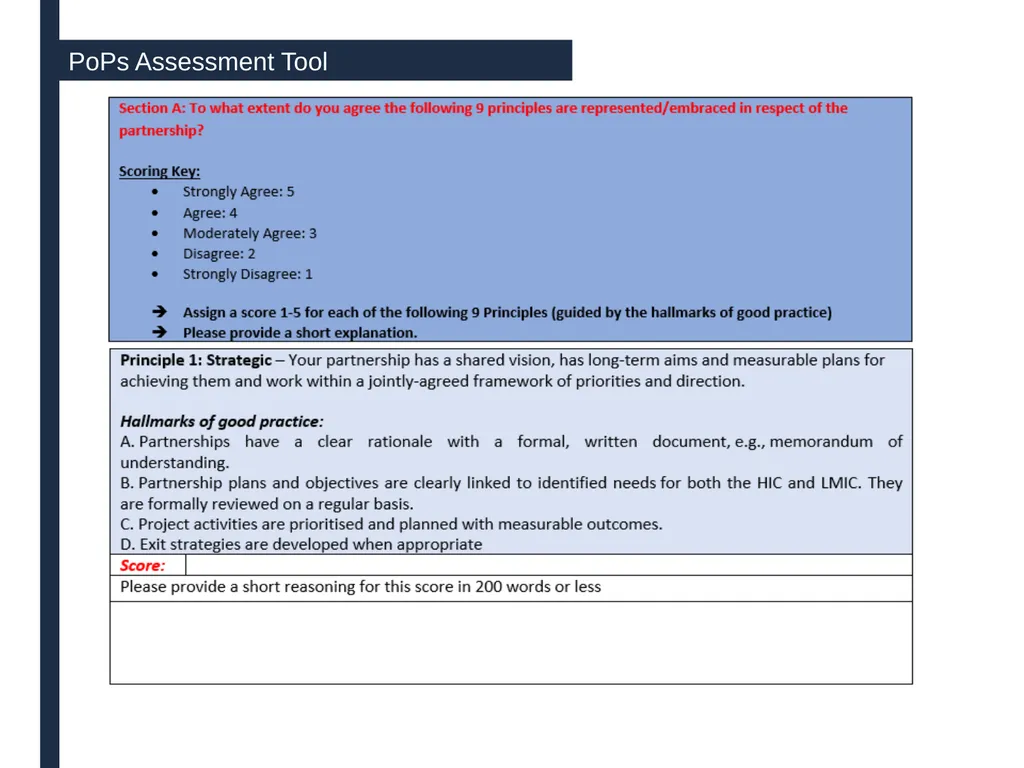
PoPs Assessment Tool<br>
20
6. External Communications Local volunteers and project team are best placed to gather media content for your project
Communications activities should be planned in advance with a clear objective stating what content you want, why, and what use it will have (fundraising, case study etc.).
THET External Engagement team can provide media guides and advice on engaging in communications activities.
Please note: we are currently waiting for sign off from DHSC to be able to communicate publicly about this fund.<br>
Communications activities should be planned in advance with a clear objective stating what content you want, why, and what use it will have (fundraising, case study etc.).
THET External Engagement team can provide media guides and advice on engaging in communications activities.
Please note: we are currently waiting for sign off from DHSC to be able to communicate publicly about this fund.<br>
21
7. Contractual requirements (1/4) Grant Period: [] to []
2.1: Subject to paragraphs 2.2 to 2.11, and paragraphs 12, 19 and 20, THET shall pay the Grant to the Lead Partner in instalments ("Instalments") in accordance with the staged payment schedule set out in Annex 2 and agreed and/or amended by THET from time to time. The instalments shall be paid to the bank account set out in Annex 3.
3.1: The Grant shall be used by the Lead Partner solely for the delivery of the agreed FIWP project in accordance with the terms of this Agreement. For the avoidance of doubt, the Lead Partner shall not spend Grant monies which have not been agreed in the FIWP project without the prior written agreement of THET.
3.7: The Lead Partner shall not spend any part of the Grant on the delivery of the FIWP project after the expiry of the Grant Period without the prior written consent of THET.<br>
2.1: Subject to paragraphs 2.2 to 2.11, and paragraphs 12, 19 and 20, THET shall pay the Grant to the Lead Partner in instalments ("Instalments") in accordance with the staged payment schedule set out in Annex 2 and agreed and/or amended by THET from time to time. The instalments shall be paid to the bank account set out in Annex 3.
3.1: The Grant shall be used by the Lead Partner solely for the delivery of the agreed FIWP project in accordance with the terms of this Agreement. For the avoidance of doubt, the Lead Partner shall not spend Grant monies which have not been agreed in the FIWP project without the prior written agreement of THET.
3.7: The Lead Partner shall not spend any part of the Grant on the delivery of the FIWP project after the expiry of the Grant Period without the prior written consent of THET.<br>
22
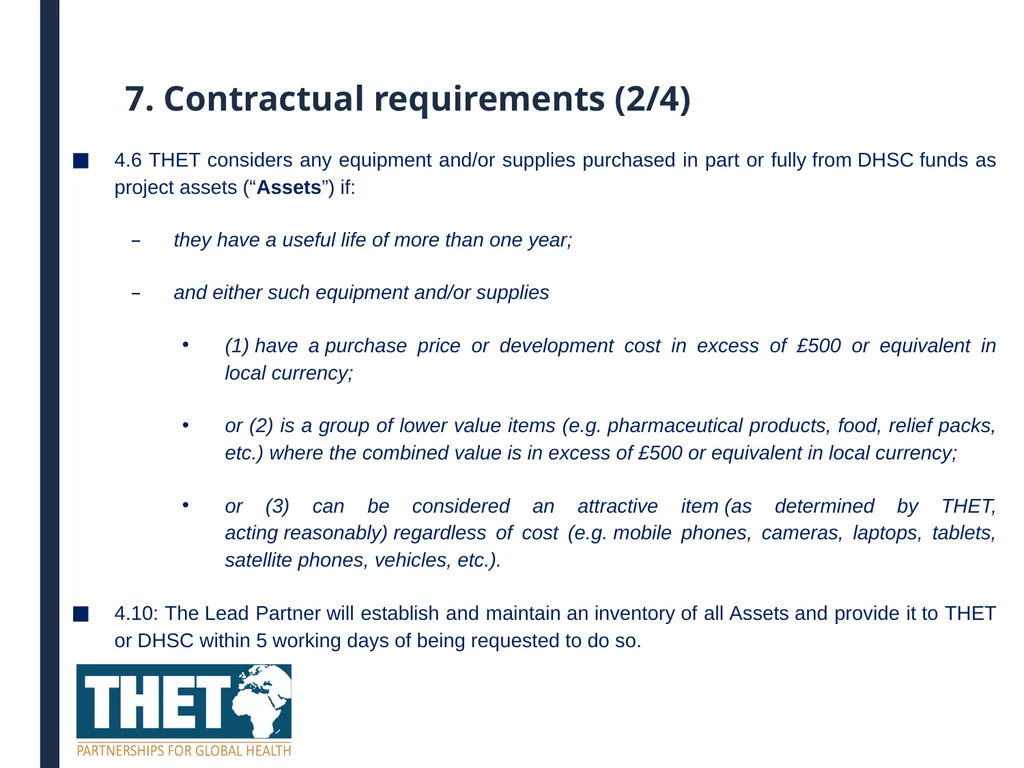
7. Contractual requirements (2/4) 4.6 THET considers any equipment and/or supplies purchased in part or fully from DHSC funds as project assets (“Assets”) if:
they have a useful life of more than one year;
and either such equipment and/or supplies
(1) have a purchase price or development cost in excess of £500 or equivalent in local currency;
or (2) is a group of lower value items (e.g. pharmaceutical products, food, relief packs, etc.) where the combined value is in excess of £500 or equivalent in local currency;
or (3) can be considered an attractive item (as determined by THET, acting reasonably) regardless of cost (e.g. mobile phones, cameras, laptops, tablets, satellite phones, vehicles, etc.).
4.10: The Lead Partner will establish and maintain an inventory of all Assets and provide it to THET or DHSC within 5 working days of being requested to do so.<br>
they have a useful life of more than one year;
and either such equipment and/or supplies
(1) have a purchase price or development cost in excess of £500 or equivalent in local currency;
or (2) is a group of lower value items (e.g. pharmaceutical products, food, relief packs, etc.) where the combined value is in excess of £500 or equivalent in local currency;
or (3) can be considered an attractive item (as determined by THET, acting reasonably) regardless of cost (e.g. mobile phones, cameras, laptops, tablets, satellite phones, vehicles, etc.).
4.10: The Lead Partner will establish and maintain an inventory of all Assets and provide it to THET or DHSC within 5 working days of being requested to do so.<br>
23
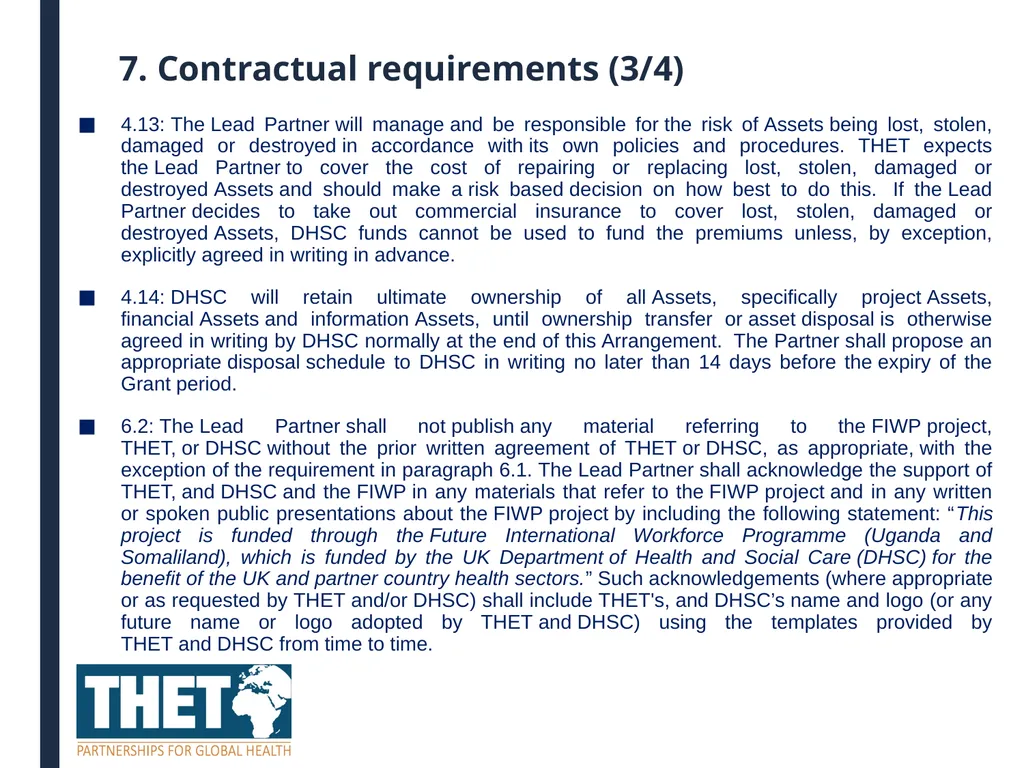
7. Contractual requirements (3/4) 4.13: The Lead Partner will manage and be responsible for the risk of Assets being lost, stolen, damaged or destroyed in accordance with its own policies and procedures. THET expects the Lead Partner to cover the cost of repairing or replacing lost, stolen, damaged or destroyed Assets and should make a risk based decision on how best to do this. If the Lead Partner decides to take out commercial insurance to cover lost, stolen, damaged or destroyed Assets, DHSC funds cannot be used to fund the premiums unless, by exception, explicitly agreed in writing in advance.
4.14: DHSC will retain ultimate ownership of all Assets, specifically project Assets, financial Assets and information Assets, until ownership transfer or asset disposal is otherwise agreed in writing by DHSC normally at the end of this Arrangement. The Partner shall propose an appropriate disposal schedule to DHSC in writing no later than 14 days before the expiry of the Grant period.
6.2: The Lead Partner shall not publish any material referring to the FIWP project, THET, or DHSC without the prior written agreement of THET or DHSC, as appropriate, with the exception of the requirement in paragraph 6.1. The Lead Partner shall acknowledge the support of THET, and DHSC and the FIWP in any materials that refer to the FIWP project and in any written or spoken public presentations about the FIWP project by including the following statement: “This project is funded through the Future International Workforce Programme (Uganda and Somaliland), which is funded by the UK Department of Health and Social Care (DHSC) for the benefit of the UK and partner country health sectors.” Such acknowledgements (where appropriate or as requested by THET and/or DHSC) shall include THET's, and DHSC’s name and logo (or any future name or logo adopted by THET and DHSC) using the templates provided by THET and DHSC from time to time.<br>
4.14: DHSC will retain ultimate ownership of all Assets, specifically project Assets, financial Assets and information Assets, until ownership transfer or asset disposal is otherwise agreed in writing by DHSC normally at the end of this Arrangement. The Partner shall propose an appropriate disposal schedule to DHSC in writing no later than 14 days before the expiry of the Grant period.
6.2: The Lead Partner shall not publish any material referring to the FIWP project, THET, or DHSC without the prior written agreement of THET or DHSC, as appropriate, with the exception of the requirement in paragraph 6.1. The Lead Partner shall acknowledge the support of THET, and DHSC and the FIWP in any materials that refer to the FIWP project and in any written or spoken public presentations about the FIWP project by including the following statement: “This project is funded through the Future International Workforce Programme (Uganda and Somaliland), which is funded by the UK Department of Health and Social Care (DHSC) for the benefit of the UK and partner country health sectors.” Such acknowledgements (where appropriate or as requested by THET and/or DHSC) shall include THET's, and DHSC’s name and logo (or any future name or logo adopted by THET and DHSC) using the templates provided by THET and DHSC from time to time.<br>
24
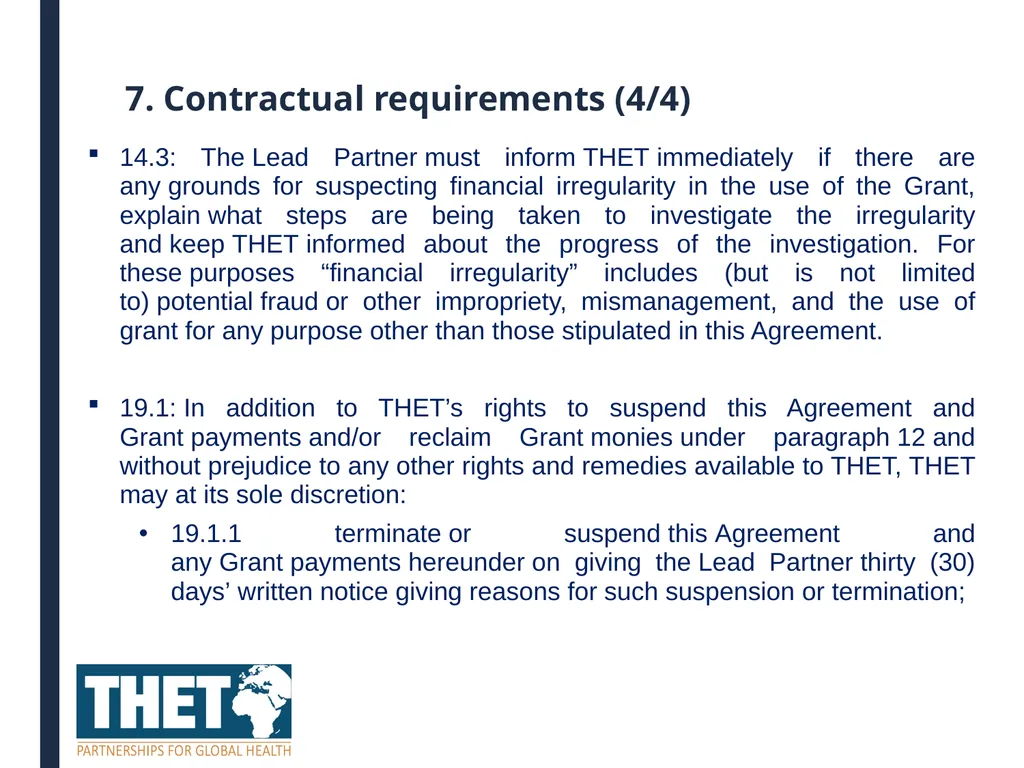
7. Contractual requirements (4/4) 14.3: The Lead Partner must inform THET immediately if there are any grounds for suspecting financial irregularity in the use of the Grant, explain what steps are being taken to investigate the irregularity and keep THET informed about the progress of the investigation. For these purposes “financial irregularity” includes (but is not limited to) potential fraud or other impropriety, mismanagement, and the use of grant for any purpose other than those stipulated in this Agreement.
19.1: In addition to THET’s rights to suspend this Agreement and Grant payments and/or reclaim Grant monies under paragraph 12 and without prejudice to any other rights and remedies available to THET, THET may at its sole discretion:
19.1.1 terminate or suspend this Agreement and any Grant payments hereunder on giving the Lead Partner thirty (30) days’ written notice giving reasons for such suspension or termination;<br>
19.1: In addition to THET’s rights to suspend this Agreement and Grant payments and/or reclaim Grant monies under paragraph 12 and without prejudice to any other rights and remedies available to THET, THET may at its sole discretion:
19.1.1 terminate or suspend this Agreement and any Grant payments hereunder on giving the Lead Partner thirty (30) days’ written notice giving reasons for such suspension or termination;<br>
25
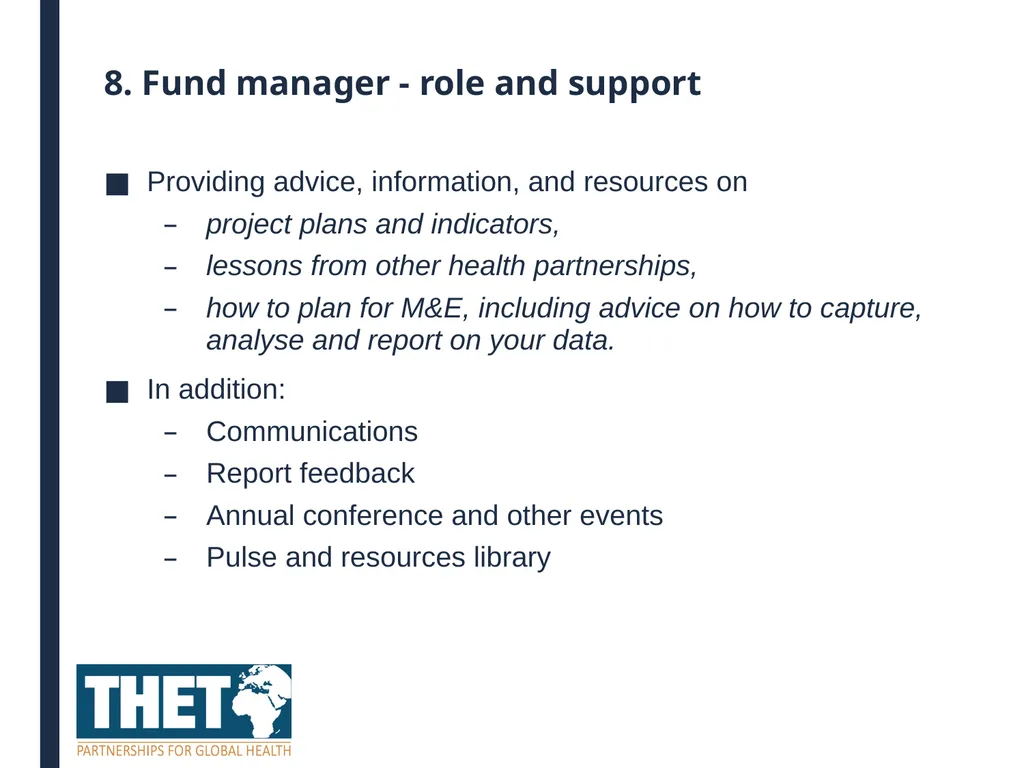
8. Fund manager - role and support
Providing advice, information, and resources on
project plans and indicators,
lessons from other health partnerships,
how to plan for M&E, including advice on how to capture, analyse and report on your data.
In addition:
Communications
Report feedback
Annual conference and other events
Pulse and resources library<br>
Providing advice, information, and resources on
project plans and indicators,
lessons from other health partnerships,
how to plan for M&E, including advice on how to capture, analyse and report on your data.
In addition:
Communications
Report feedback
Annual conference and other events
Pulse and resources library<br>
26
Contacts Bea Waddingham – Programmes Manager – beatricew@thet.org
Richard Skone James – Head of Programmes – richard.skone-james@thet.org
Sheba Gitta – THET Uganda Country Director – sheba.gitta@thet.org
Nura Aided Ibrahim – THET Somaliland Country Director – nura.aided@thet.org<br>
Richard Skone James – Head of Programmes – richard.skone-james@thet.org
Sheba Gitta – THET Uganda Country Director – sheba.gitta@thet.org
Nura Aided Ibrahim – THET Somaliland Country Director – nura.aided@thet.org<br>
27
9. Next steps Read and review the abovementioned toolkits and implement changes to your policies as appropriate
Schedule a project meeting with THET (we will do this once grant managers have been assigned)
Discuss the award of funding and next steps with your partner(s), to include branding and acknowledgement requirements
Review and sign the grant holder sub-agreement with THET
Finalise your project plans and any plans for data collection, with support from THET
Develop a Memorandum of Understanding between the key partner institutions, if one doesn’t already exist
Develop a subcontract with your partner should you wish to transfer any grant funds<br>
Schedule a project meeting with THET (we will do this once grant managers have been assigned)
Discuss the award of funding and next steps with your partner(s), to include branding and acknowledgement requirements
Review and sign the grant holder sub-agreement with THET
Finalise your project plans and any plans for data collection, with support from THET
Develop a Memorandum of Understanding between the key partner institutions, if one doesn’t already exist
Develop a subcontract with your partner should you wish to transfer any grant funds<br>
28
Q&A Please raise your hand if you’d like to ask a question or type it in the chat box<br>
29
Support from the THET Somaliland Office Team Introduction.
1. Nura Aydid. Somaliland Country Director
2. Ayan Mohamed: Programme Coordinator
3. Khadra Mohamed: Operations Manager
4. Samatar Ahmed : Security and Logistics Officer
5. Abdi Ali : THET Somaliland Driver<br>
1. Nura Aydid. Somaliland Country Director
2. Ayan Mohamed: Programme Coordinator
3. Khadra Mohamed: Operations Manager
4. Samatar Ahmed : Security and Logistics Officer
5. Abdi Ali : THET Somaliland Driver<br>
30
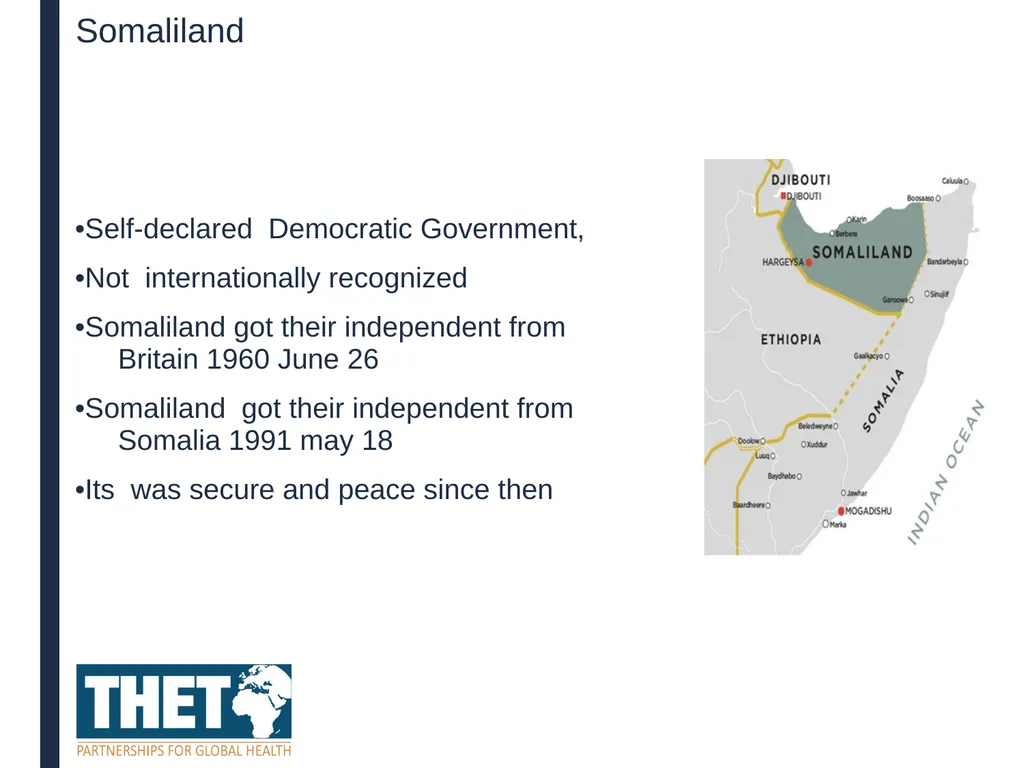
Somaliland •Self-declared Democratic Government,
•Not internationally recognized
•Somaliland got their independent from Britain 1960 June 26
•Somaliland got their independent from Somalia 1991 may 18
•Its was secure and peace since then Click to add text<br>
•Not internationally recognized
•Somaliland got their independent from Britain 1960 June 26
•Somaliland got their independent from Somalia 1991 may 18
•Its was secure and peace since then Click to add text<br>
31
Support from the THET Somaliland Office Somaliland office will support both programm quality and logitical arrangmnt required .
Somaliland Health is Based on the following Key National document.
1. Somaliland Health policy developed 2011 and currently under review
2. Health Sector Strategic plan
3. Somaliland Democratic Health survey published 2020 October UNFPA
4. Very important that you align with all your work with MOHD priories identified in the UKPHS Scooping assessment report.
5. The HPs to ensure closely work with MOH line Management staff.
6. Participation of Bi-annual Health and Nutrition coordination meetings organized by MOH .
7. Somaliland Treatment Guidelines<br>
Somaliland Health is Based on the following Key National document.
1. Somaliland Health policy developed 2011 and currently under review
2. Health Sector Strategic plan
3. Somaliland Democratic Health survey published 2020 October UNFPA
4. Very important that you align with all your work with MOHD priories identified in the UKPHS Scooping assessment report.
5. The HPs to ensure closely work with MOH line Management staff.
6. Participation of Bi-annual Health and Nutrition coordination meetings organized by MOH .
7. Somaliland Treatment Guidelines<br>
32
Support in logistics and security
What activities can the THET Somaliland Office assist with?
Booking accommodation
Transport arrangement including airport pick up
Security briefing to the incoming volunteers
Ensuring safety and security by communication with them on daily basis. Support from the THET Somaliland Office<br>
What activities can the THET Somaliland Office assist with?
Booking accommodation
Transport arrangement including airport pick up
Security briefing to the incoming volunteers
Ensuring safety and security by communication with them on daily basis. Support from the THET Somaliland Office<br>
33
How to arrange support
How should HPs go about arranging logistical support with the THET Somaliland Office?
Sharing HPs trip plan to THET Somaliland
THET to make contract with one of its approved drivers
HPs to make the payment of the vehicle at the end of their itinerary. Support from the THET Somaliland Office<br>
How should HPs go about arranging logistical support with the THET Somaliland Office?
Sharing HPs trip plan to THET Somaliland
THET to make contract with one of its approved drivers
HPs to make the payment of the vehicle at the end of their itinerary. Support from the THET Somaliland Office<br>
34
Next steps
What should grantholders do next?
i.e. inform THET Somaliland Office of their planned travel dates, inform SO of numbers of volunteers travelling etc. Support from the THET Somaliland Office<br>
What should grantholders do next?
i.e. inform THET Somaliland Office of their planned travel dates, inform SO of numbers of volunteers travelling etc. Support from the THET Somaliland Office<br>
35
THANK YOU!
Any further questions:
beatricew@thet.org
richard.skone-james@thet.org<br>