
WELCOME III Seminar on Methods of Training
SB
Published · 61 slides · 0 views

1 / 1




Description
WELCOME III Seminar on Methods of Training Evaluation Presented by Mr. NARESH NT ID NO.PALB 3016 III PhD Flow of Presentation Introduction Concept of Training Concept of Evaluation Training Process Evaluation Strategies Methods of
Related Topics
Share
Embed code
Download this presentation From Below
"WELCOME III Seminar on Methods of Training" is the property of its rightful owner. Permission is granted to download and print the materials on this website for personal, non-commercial use only, and to display it on your personal computer provided you do not modify the materials and that you retain all copyright notices contained in the materials. By downloading content from our website, you accept the terms of this agreement.
Presentation Transcript
01
WELCOME<br>
02
III
Seminar on
Methods of Training Evaluation Presented by
Mr. NARESH NT
ID NO.PALB 3016
III PhD<br>
03
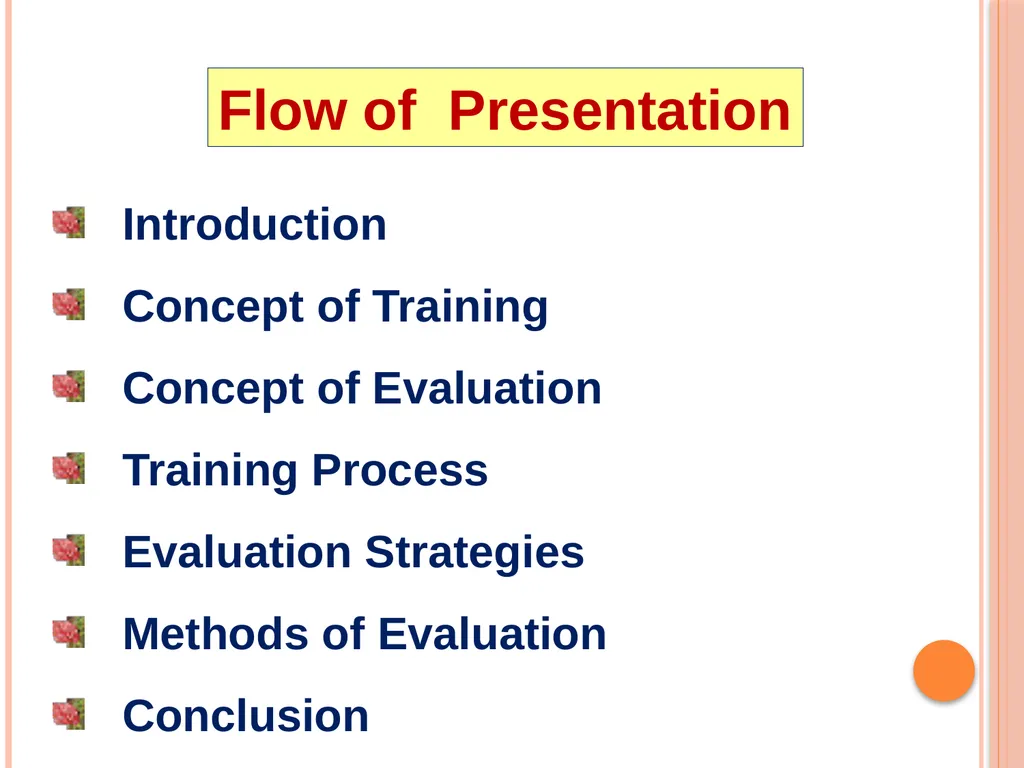
Flow of Presentation Introduction
Concept of Training
Concept of Evaluation
Training Process
Evaluation Strategies
Methods of Evaluation
Conclusion<br>
04
INTRODUCTION<br>
05
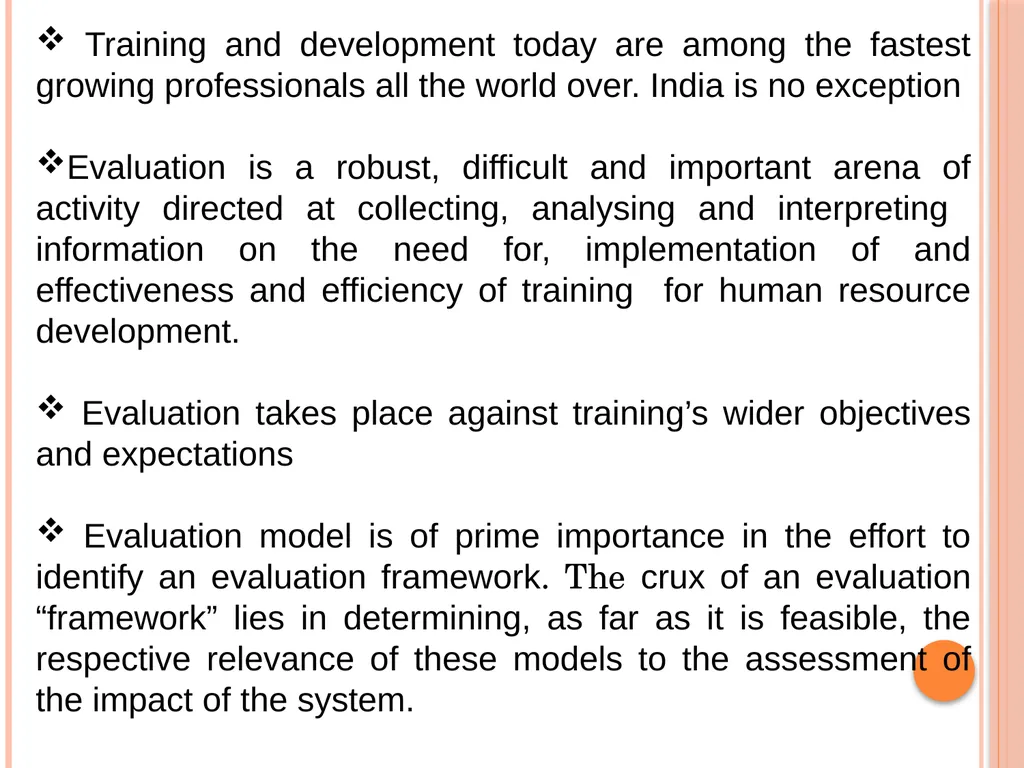
Training and development today are among the fastest growing professionals all the world over. India is no exception
Evaluation is a robust, difficult and important arena of activity directed at collecting, analysing and interpreting information on the need for, implementation of and effectiveness and efficiency of training for human resource development.
Evaluation takes place against training’s wider objectives and expectations
Evaluation model is of prime importance in the effort to identify an evaluation framework. The crux of an evaluation “framework” lies in determining, as far as it is feasible, the respective relevance of these models to the assessment of the impact of the system.<br>
06
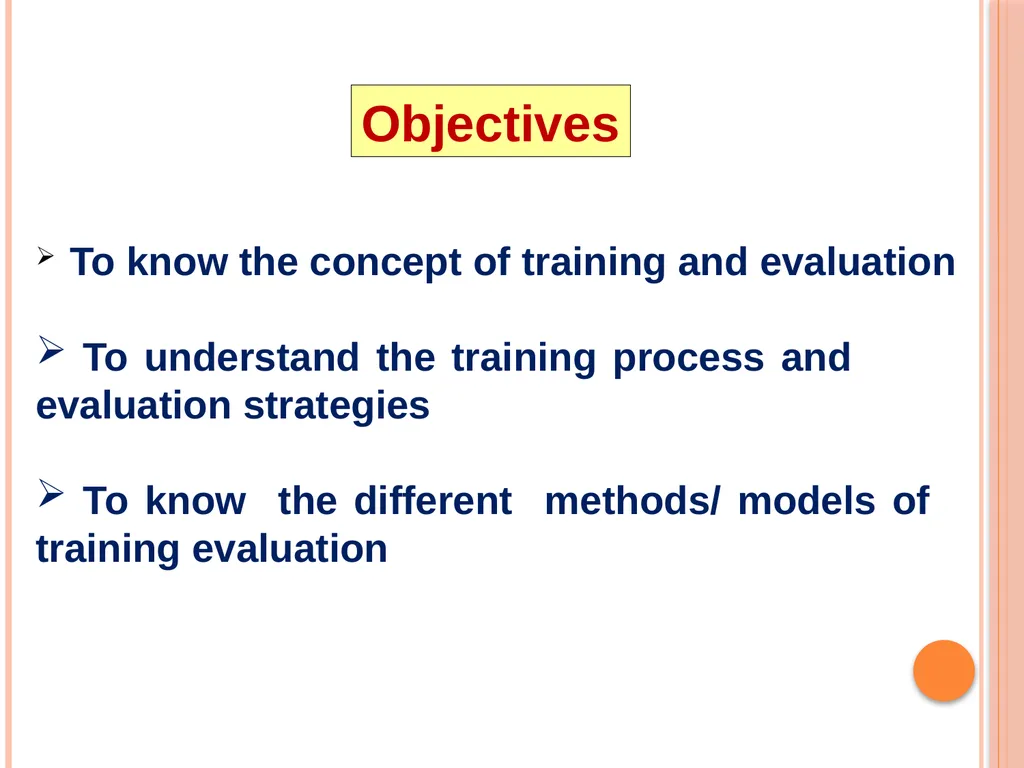
Objectives To know the concept of training and evaluation
To understand the training process and evaluation strategies
To know the different methods/ models of training evaluation<br>
07
It is a planned communication process for manpower development in bringing a desired changes in knowledge, skills, attitude, behaviour etc. in an individual in accordance with the job requirement and for better job performance in the interest of the organization.
The knowledge can be gained through literature, interaction and other communication media where as relevant skills can only be acquired through practicing and working with the professionals. TRAINING<br>
08
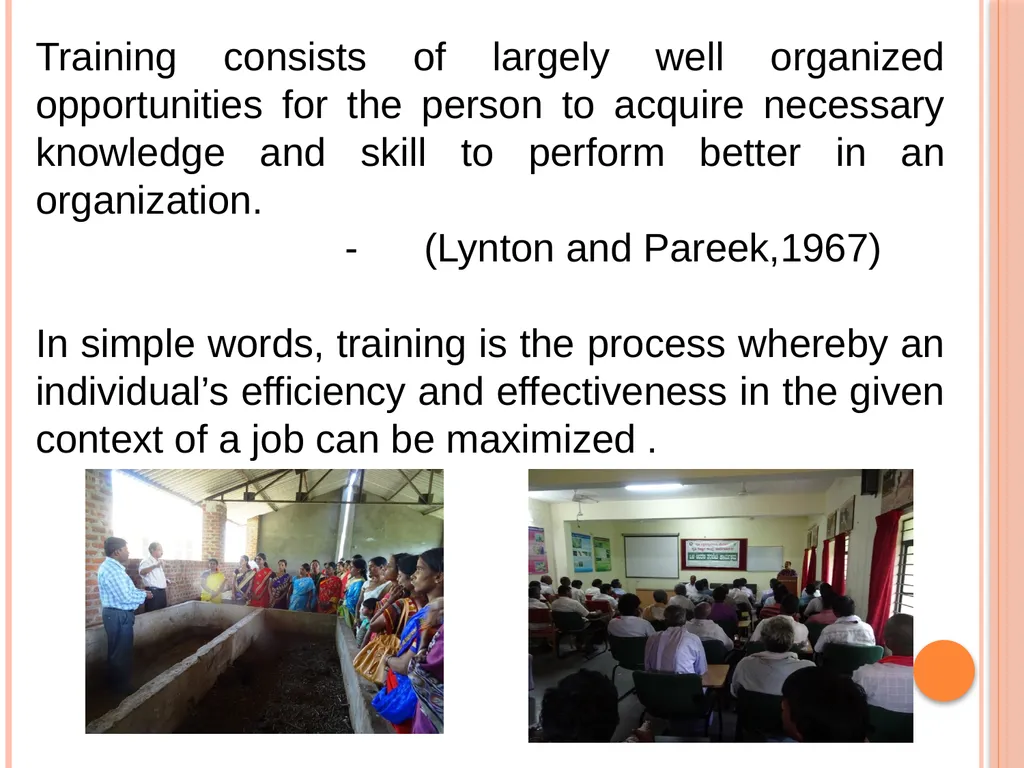
Training consists of largely well organized opportunities for the person to acquire necessary knowledge and skill to perform better in an organization.
- (Lynton and Pareek,1967)
In simple words, training is the process whereby an individual’s efficiency and effectiveness in the given context of a job can be maximized .<br>
09
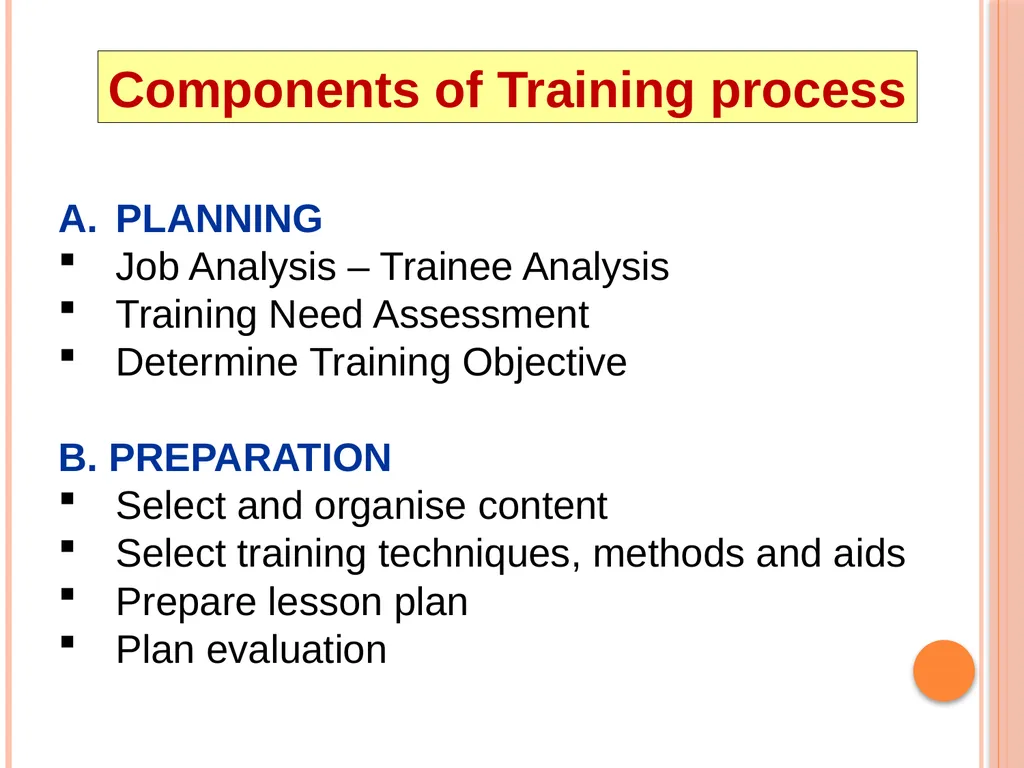
PLANNING
Job Analysis – Trainee Analysis
Training Need Assessment
Determine Training Objective
B. PREPARATION
Select and organise content
Select training techniques, methods and aids
Prepare lesson plan
Plan evaluation Components of Training process<br>
10
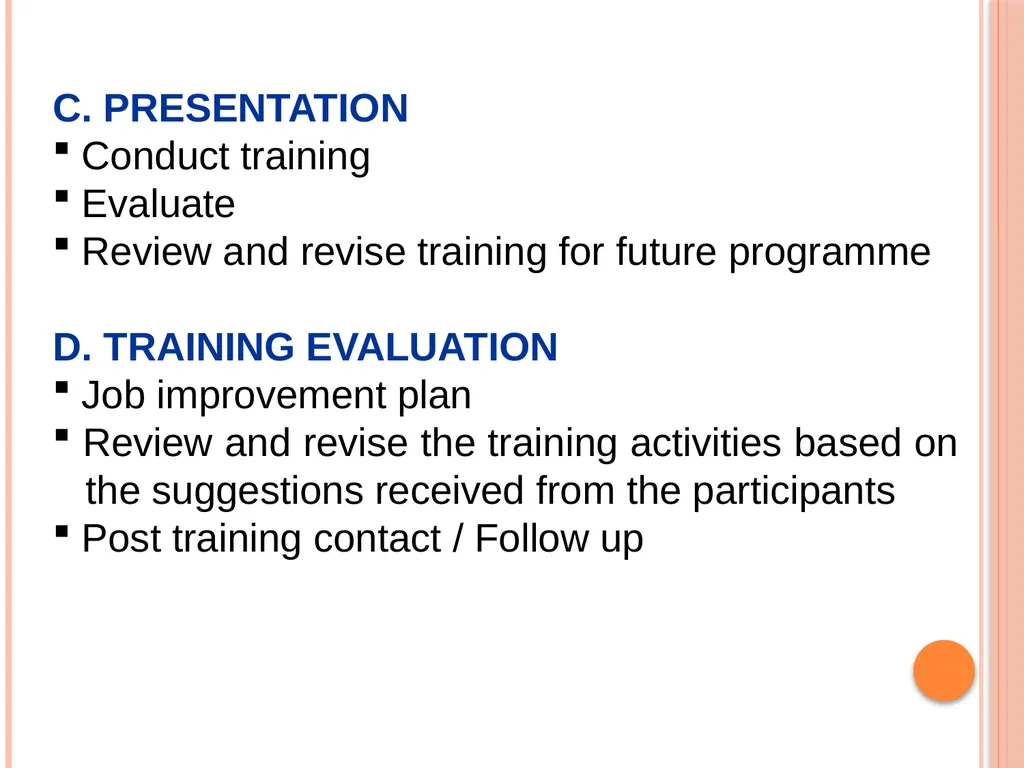
C. PRESENTATION
Conduct training
Evaluate
Review and revise training for future programme
D. TRAINING EVALUATION
Job improvement plan
Review and revise the training activities based on
the suggestions received from the participants
Post training contact / Follow up<br>
11
“gap “ between the work performance of an individual or organisation and “desired “ level of competency is perceived
Training need can be assessed by:
An individual himself
Assessed by supervisors
Assessment through structured set of questionnaires Training Need<br>
12
Informal interviews
Observations
Survey method
Formal interviews
Group conference
Reports from superiors
Examination of records
Advisory committees
Check list
Questionnaires
Management requests
Formal research Types of Training Need Analysis<br>
13
. Simple Approach to Training Needs Assessment
(SATNA) It is a simple and pragmatic approach for performing training need assessment.
It also produces operative results which will create a dynamic and compelling process suitable for all problems oriented training programme<br>
14
Problem identification
Job description (Proposed solution)
People identification
KAS identification
Analysis of trainees ‘KAS’
Disparity identification
Prioritizing of discrepancies of suit
available trainers
available time
available training resources (money, material and manpower etc.) Steps of SATNA<br>
15
It is a statement of desired end product to be achieved through training programme.
It should clearly spell out the type of changes or desired end product, when they will be attained and finally how will be measured to determine the level of success. Training Objective<br>
16
Training objective must be:
well defined
based on the training needs of the trainees
directly related to ones job
specific and precise
able to define a change that is measurable
able to identify and enlist criteria against which
success can be measured or judged
clearly specifying end results
achievable in its stipulated time<br>
17
Training objective must be SMART
Simple
Measurable
Attainable
Realistic
Time bound
Purpose of a training objective
create awareness
generate interest
motivate learning
impart knowledge
change attitude
generate skills<br>
18
Audience who are to be trained
Behaviour i.e., type of change you expect in the trainees behaviour
Condition i.e., under which conditions you expect this change to occur in
Degree i.e., how much change you expect ABCD in determining the training objective<br>
19
Evaluation : Latin word -“valere” means “to be strong, valiant or determination of value”.
Evaluation in its broadest sense means “judging the value of something”.
means the assessment of value or worth
Assess the worth of, value of given activity. Evaluation<br>
20
Evaluation is defined as “ method for determining how far an activity has progressed and how much further it should be carried to accomplish objectives”.
-(Kelsey and Hearne, 1967) conscious use of communication of information to help people from sound opinions and make good decisions.
(Van den Ban and Hawkins, 1996)<br>
21
Training Evaluation Training evaluation not only the assessment of value , but also the collection and analysis of the information on the basis of which the assessment is made
Evaluation should be done before training begins, during the course of training and after the training is over
Evaluation is about the principles and methods used in assessing the effectiveness of various aspects of training<br>
22
Purpose of evaluation Assessing the aims and results
Supporting the extension workers
Ensuring contacts with other institutions at the same or a higher level
- (Bollinger et. al, 1995)<br>
23
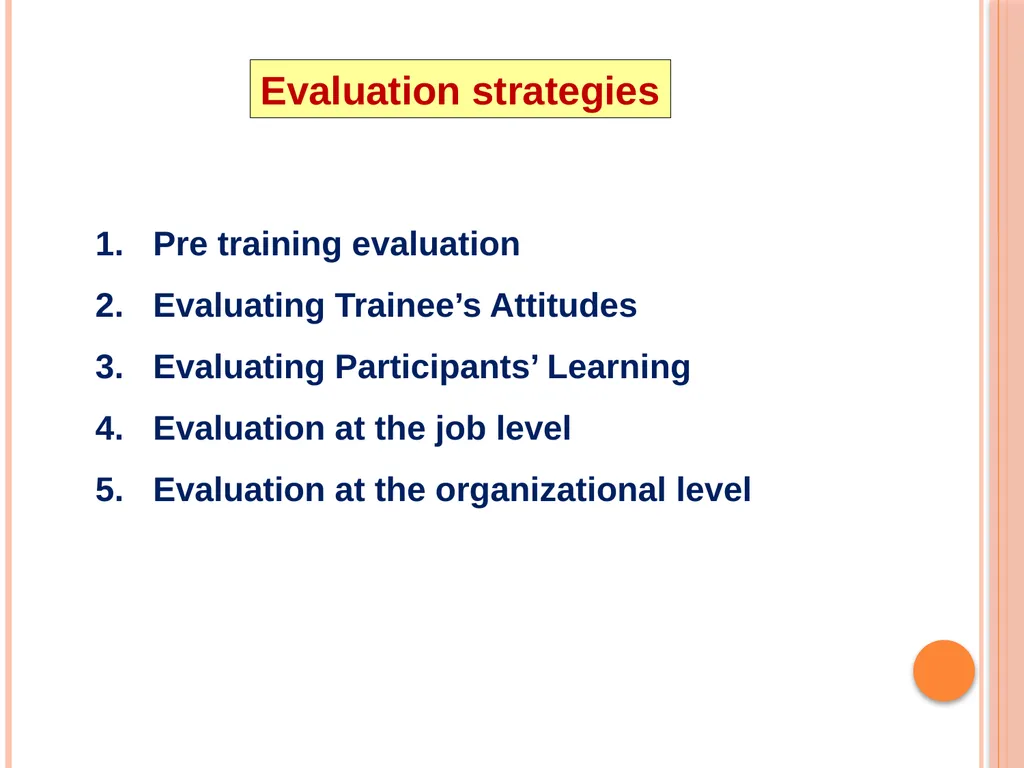
Pre training evaluation
Evaluating Trainee’s Attitudes
Evaluating Participants’ Learning
Evaluation at the job level
Evaluation at the organizational level Evaluation strategies<br>
24
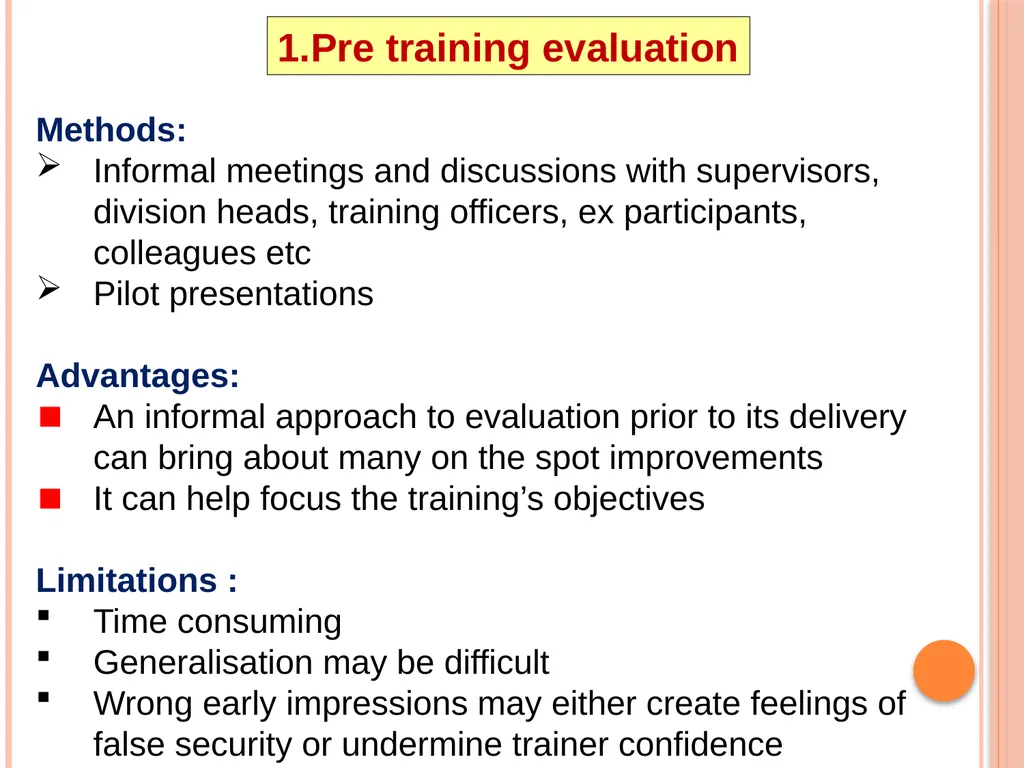
Methods:
Informal meetings and discussions with supervisors, division heads, training officers, ex participants, colleagues etc
Pilot presentations
Advantages:
An informal approach to evaluation prior to its delivery can bring about many on the spot improvements
It can help focus the training’s objectives
Limitations :
Time consuming
Generalisation may be difficult
Wrong early impressions may either create feelings of false security or undermine trainer confidence 1.Pre training evaluation<br>
25
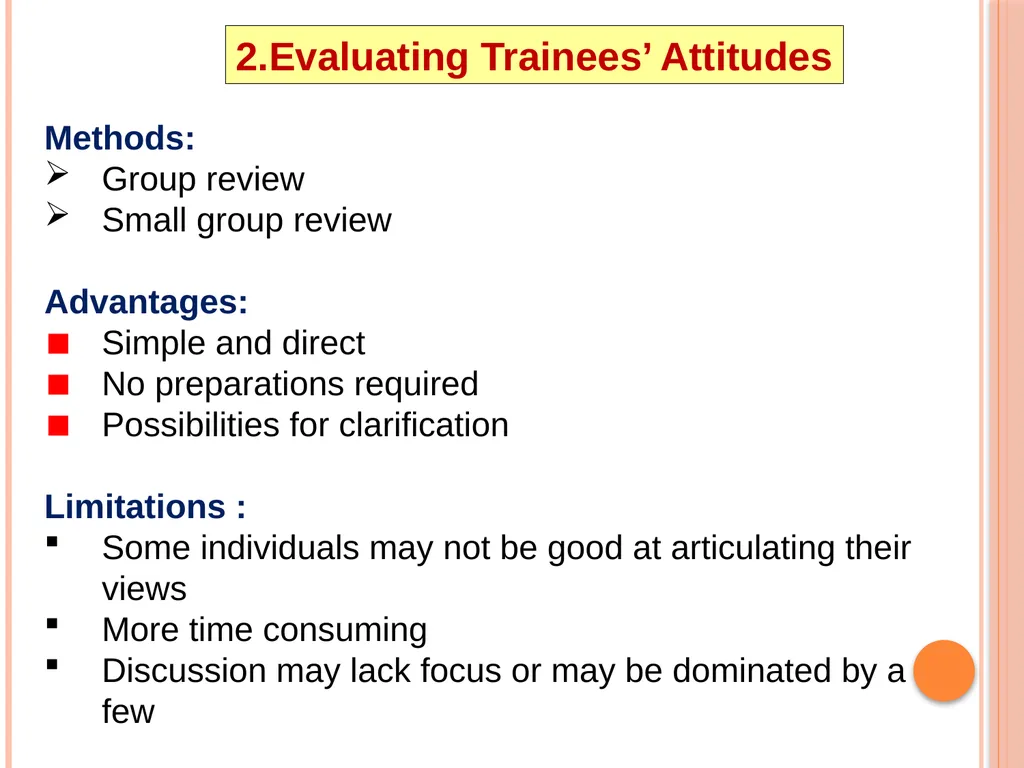
Methods:
Group review
Small group review
Advantages:
Simple and direct
No preparations required
Possibilities for clarification
Limitations :
Some individuals may not be good at articulating their views
More time consuming
Discussion may lack focus or may be dominated by a few 2.Evaluating Trainees’ Attitudes<br>
26
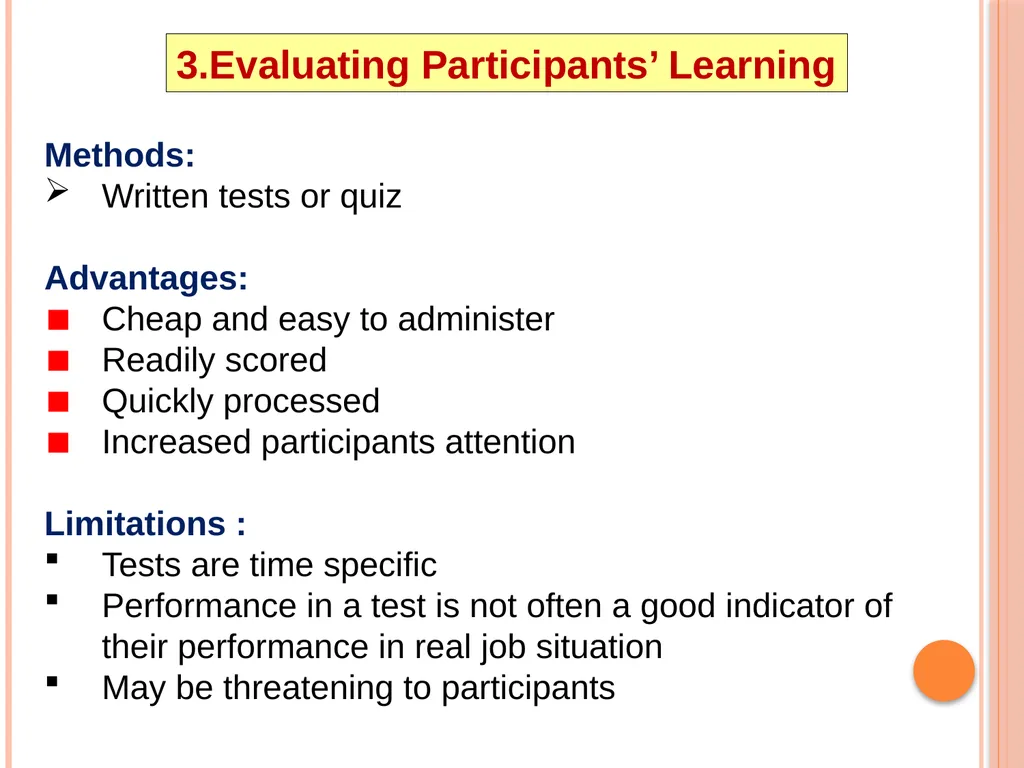
Methods:
Written tests or quiz
Advantages:
Cheap and easy to administer
Readily scored
Quickly processed
Increased participants attention
Limitations :
Tests are time specific
Performance in a test is not often a good indicator of their performance in real job situation
May be threatening to participants 3.Evaluating Participants’ Learning<br>
27
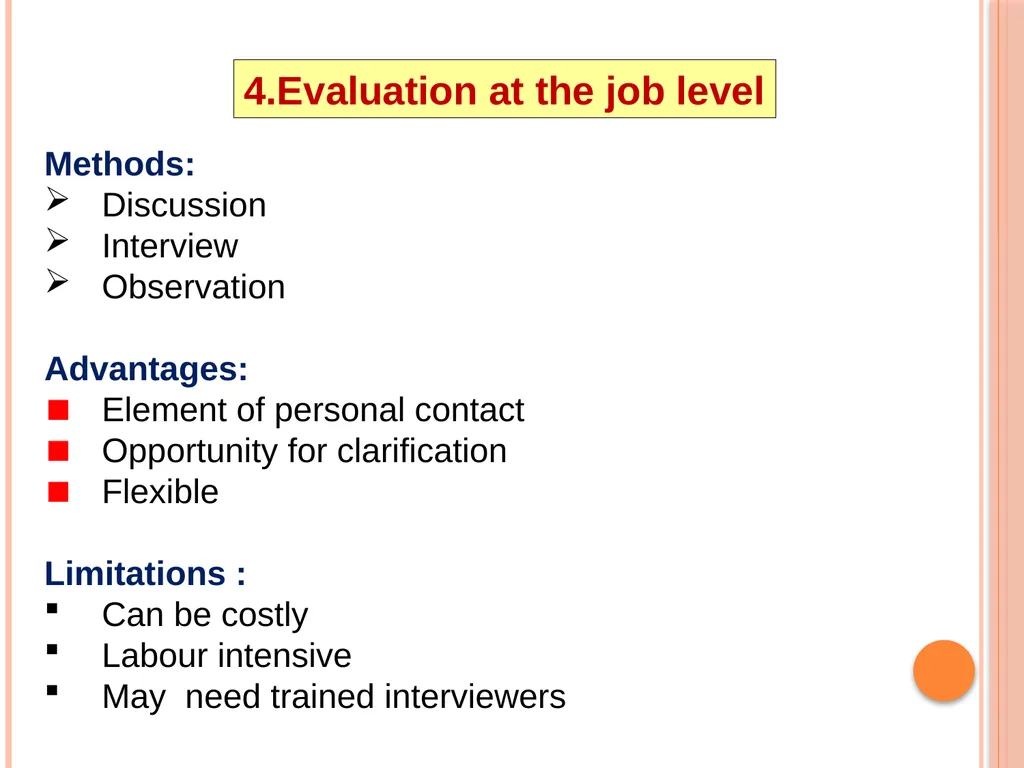
Methods:
Discussion
Interview
Observation
Advantages:
Element of personal contact
Opportunity for clarification
Flexible
Limitations :
Can be costly
Labour intensive
May need trained interviewers 4.Evaluation at the job level<br>
28
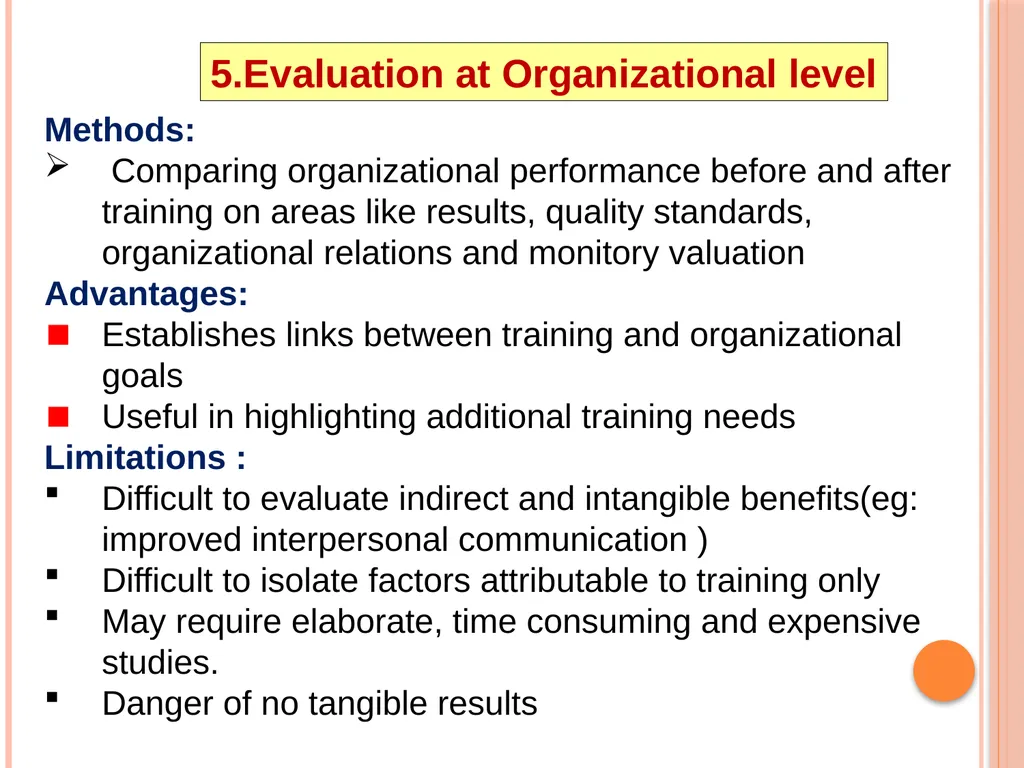
Methods:
Comparing organizational performance before and after training on areas like results, quality standards, organizational relations and monitory valuation
Advantages:
Establishes links between training and organizational goals
Useful in highlighting additional training needs
Limitations :
Difficult to evaluate indirect and intangible benefits(eg: improved interpersonal communication )
Difficult to isolate factors attributable to training only
May require elaborate, time consuming and expensive studies.
Danger of no tangible results 5.Evaluation at Organizational level<br>
29
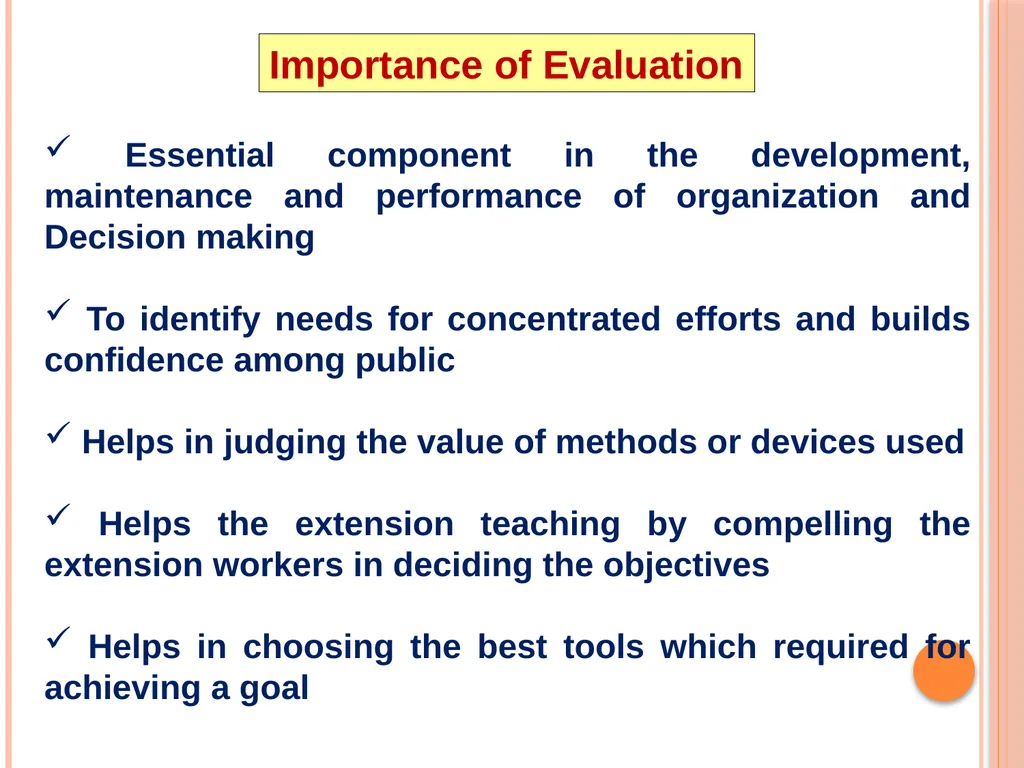
Importance of Evaluation Essential component in the development, maintenance and performance of organization and Decision making
To identify needs for concentrated efforts and builds confidence among public
Helps in judging the value of methods or devices used
Helps the extension teaching by compelling the extension workers in deciding the objectives
Helps in choosing the best tools which required for achieving a goal<br>
30
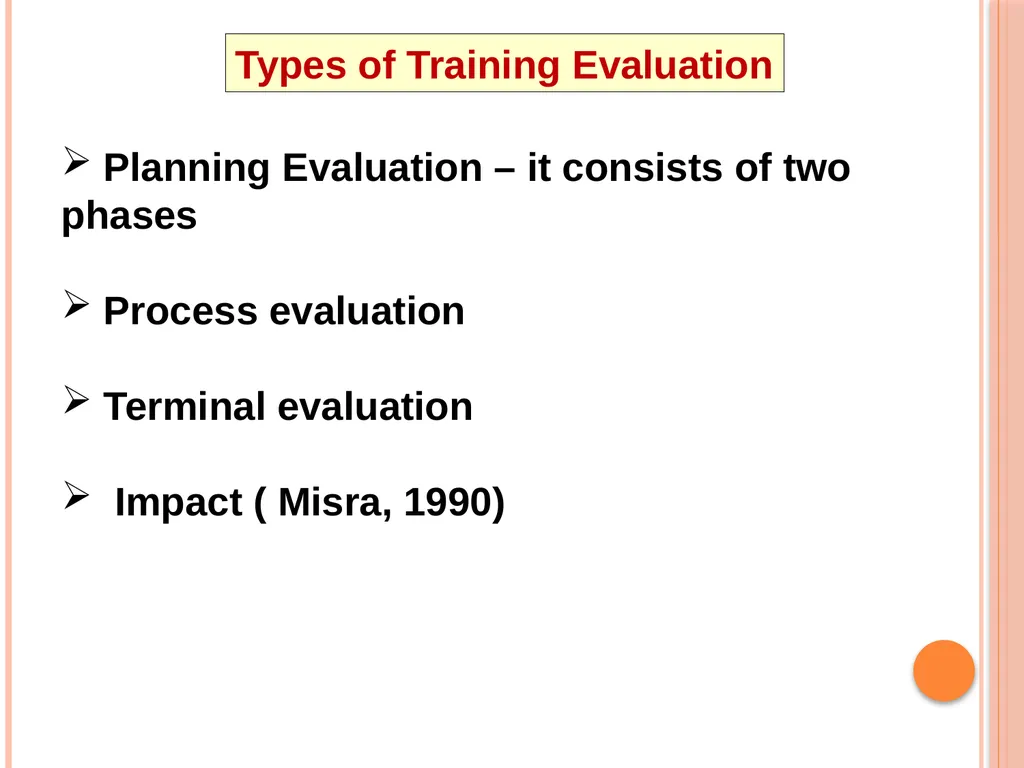
Planning Evaluation – it consists of two phases
Process evaluation
Terminal evaluation
Impact ( Misra, 1990) Types of Training Evaluation<br>
31
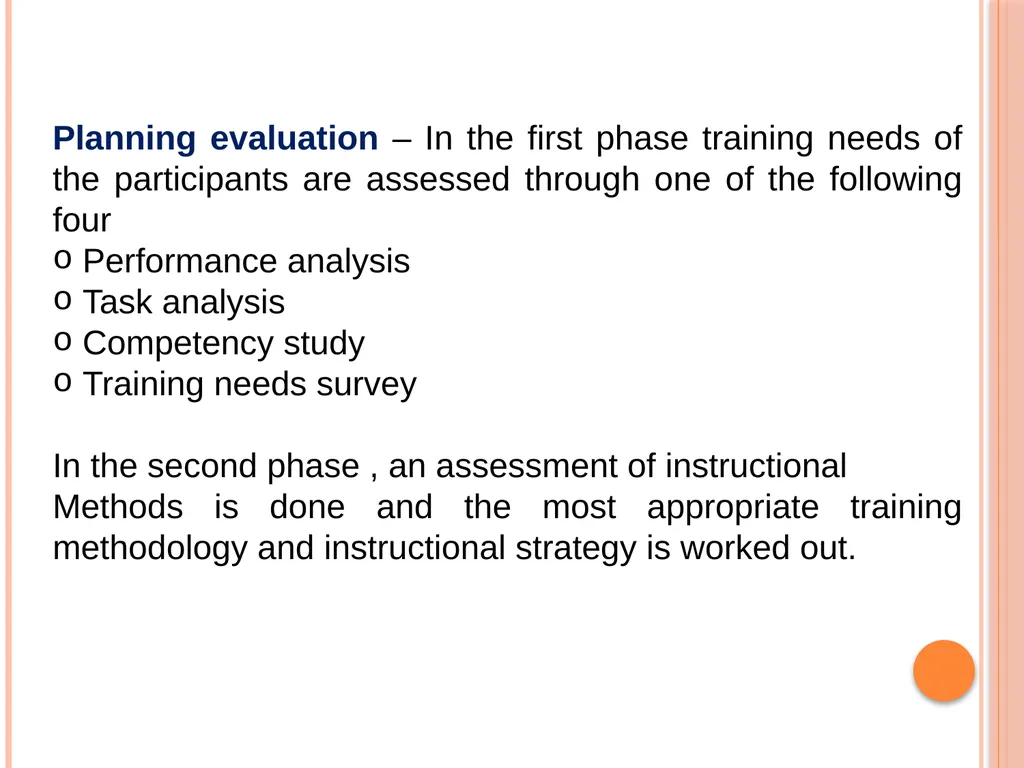
Planning evaluation – In the first phase training needs of the participants are assessed through one of the following four
Performance analysis
Task analysis
Competency study
Training needs survey
In the second phase , an assessment of instructional
Methods is done and the most appropriate training methodology and instructional strategy is worked out.<br>
32
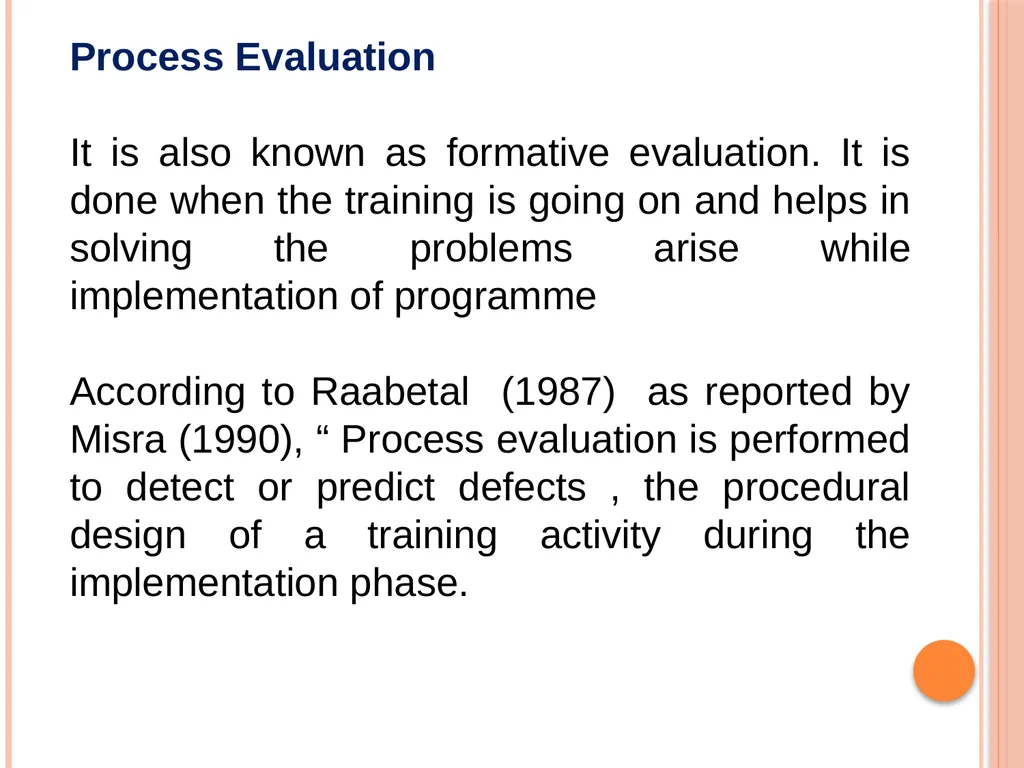
Process Evaluation
It is also known as formative evaluation. It is done when the training is going on and helps in solving the problems arise while implementation of programme
According to Raabetal (1987) as reported by Misra (1990), “ Process evaluation is performed to detect or predict defects , the procedural design of a training activity during the implementation phase.<br>
33
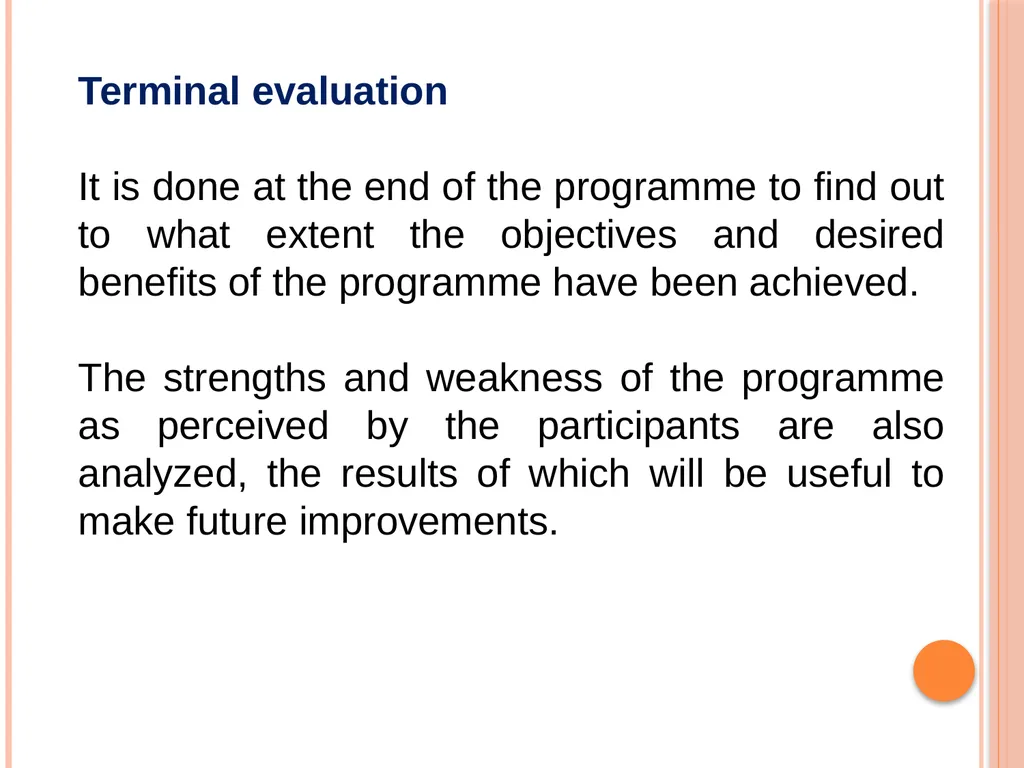
Terminal evaluation
It is done at the end of the programme to find out to what extent the objectives and desired benefits of the programme have been achieved.
The strengths and weakness of the programme as perceived by the participants are also analyzed, the results of which will be useful to make future improvements.<br>
34
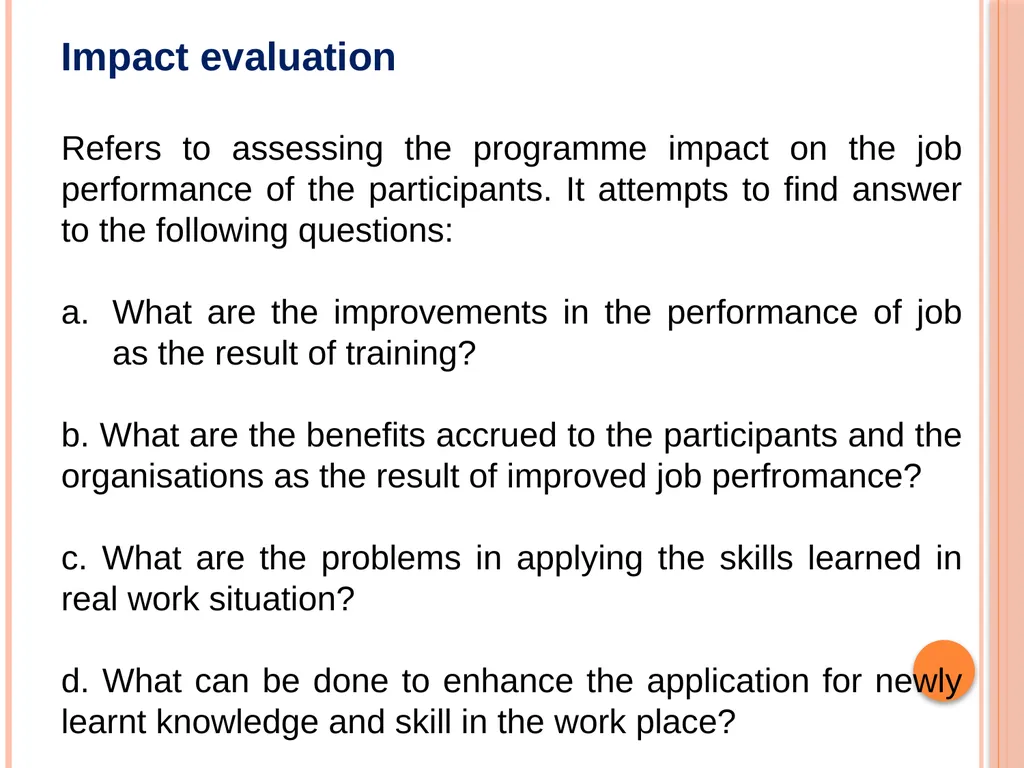
Impact evaluation
Refers to assessing the programme impact on the job performance of the participants. It attempts to find answer to the following questions:
What are the improvements in the performance of job as the result of training?
b. What are the benefits accrued to the participants and the organisations as the result of improved job perfromance?
c. What are the problems in applying the skills learned in real work situation?
d. What can be done to enhance the application for newly learnt knowledge and skill in the work place?<br>
35
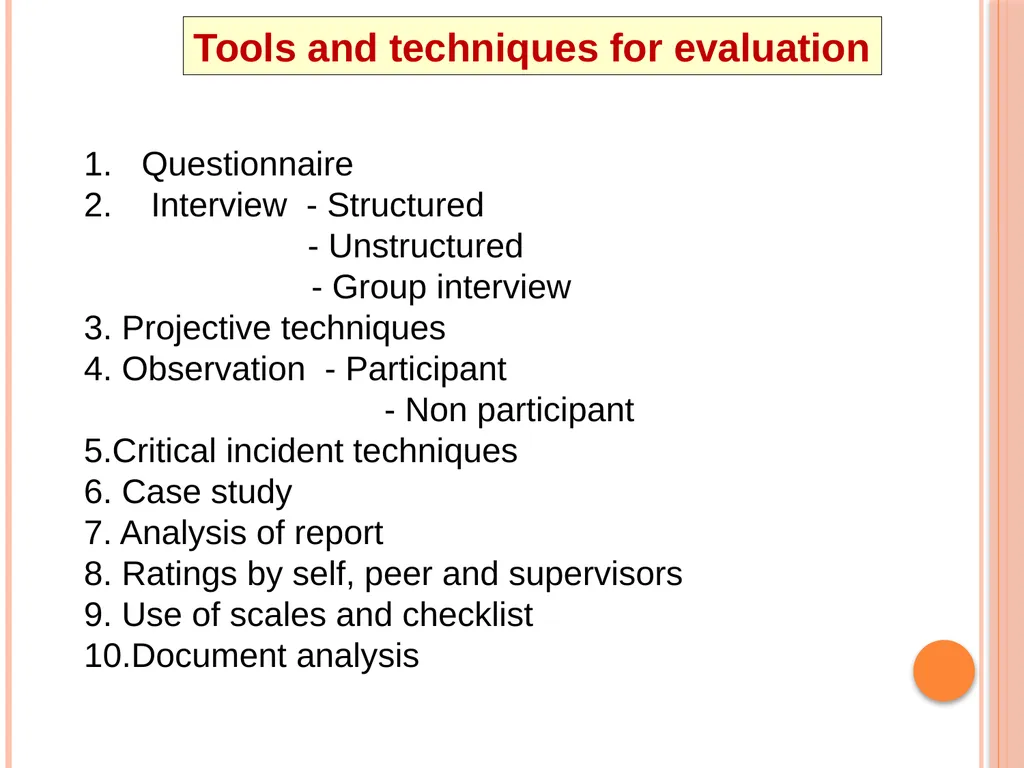
Questionnaire
Interview - Structured
- Unstructured
- Group interview
3. Projective techniques
4. Observation - Participant
- Non participant
5.Critical incident techniques
6. Case study
7. Analysis of report
8. Ratings by self, peer and supervisors
9. Use of scales and checklist
10.Document analysis Tools and techniques for evaluation<br>
36
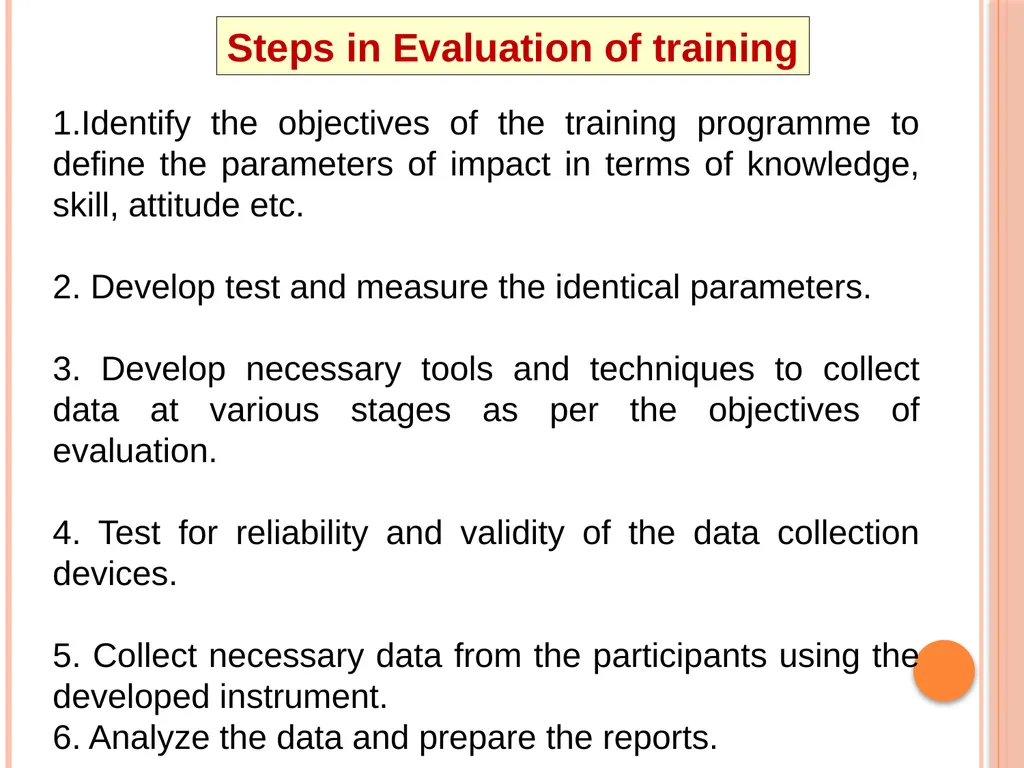
1.Identify the objectives of the training programme to define the parameters of impact in terms of knowledge, skill, attitude etc.
2. Develop test and measure the identical parameters.
3. Develop necessary tools and techniques to collect data at various stages as per the objectives of evaluation.
4. Test for reliability and validity of the data collection devices.
5. Collect necessary data from the participants using the developed instrument.
6. Analyze the data and prepare the reports. Steps in Evaluation of training<br>
37
Goal-based evaluation
• Goal-free evaluation
• Responsive evaluation
• Systems evaluation
• Professional review
• Quasi-legal Methods of Evaluation<br>
38
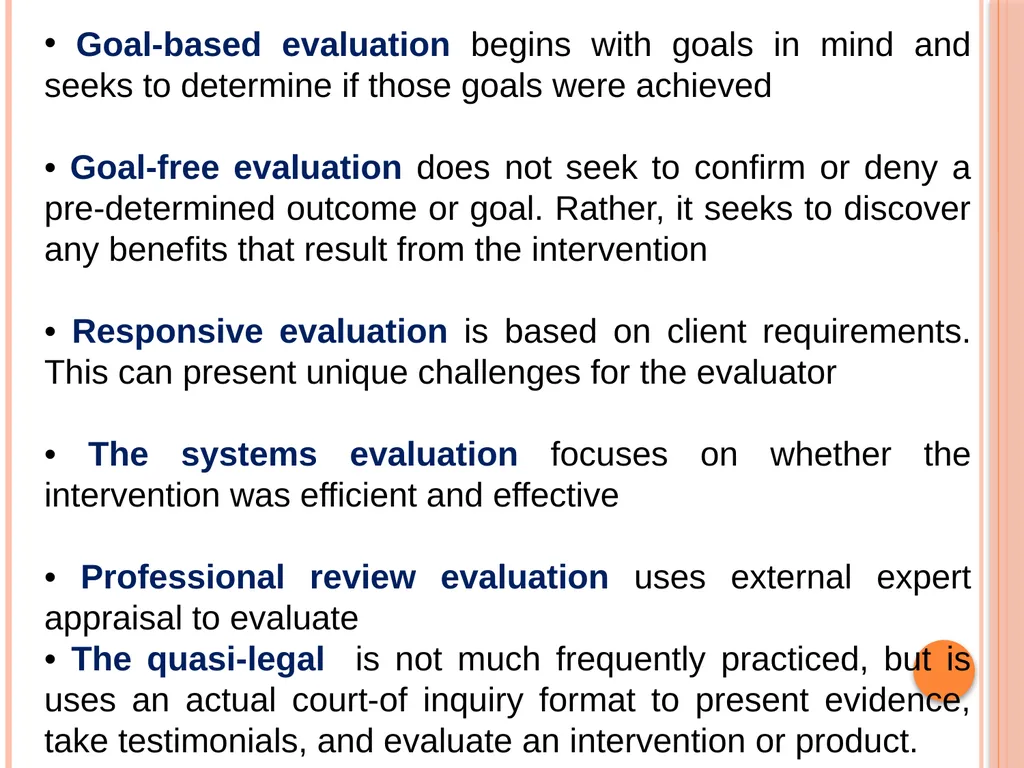
Goal-based evaluation begins with goals in mind and seeks to determine if those goals were achieved
• Goal-free evaluation does not seek to confirm or deny a pre-determined outcome or goal. Rather, it seeks to discover any benefits that result from the intervention
• Responsive evaluation is based on client requirements. This can present unique challenges for the evaluator
• The systems evaluation focuses on whether the intervention was efficient and effective
• Professional review evaluation uses external expert appraisal to evaluate
• The quasi-legal is not much frequently practiced, but is uses an actual court-of inquiry format to present evidence, take testimonials, and evaluate an intervention or product.<br>
39
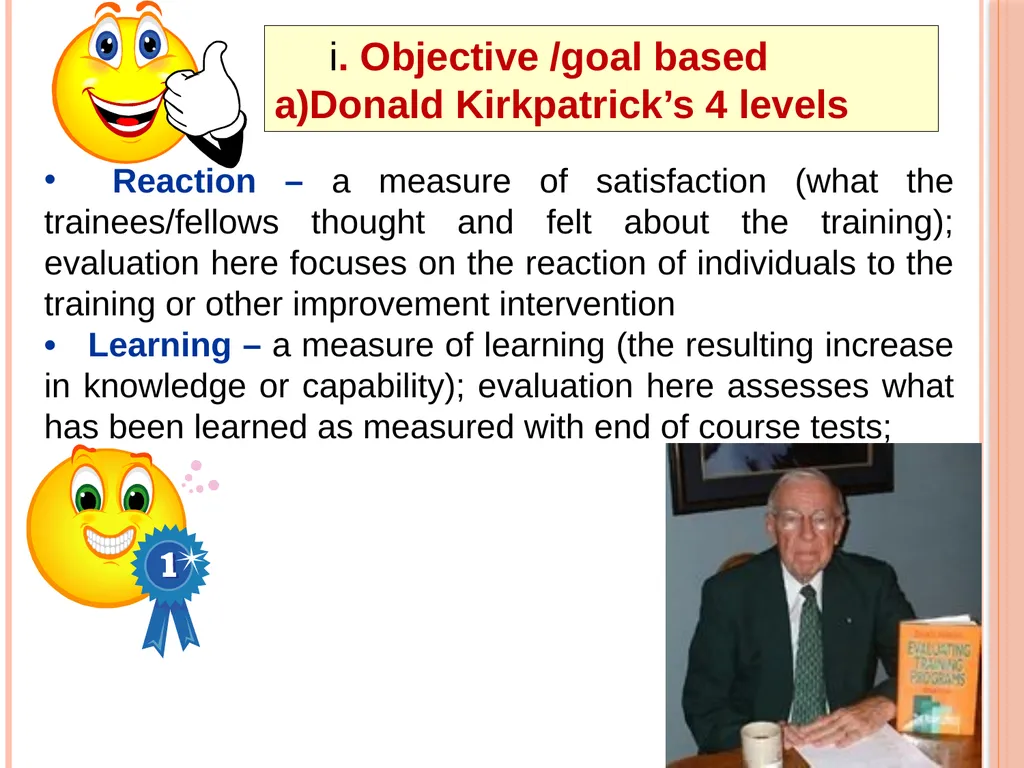
i. Objective /goal based
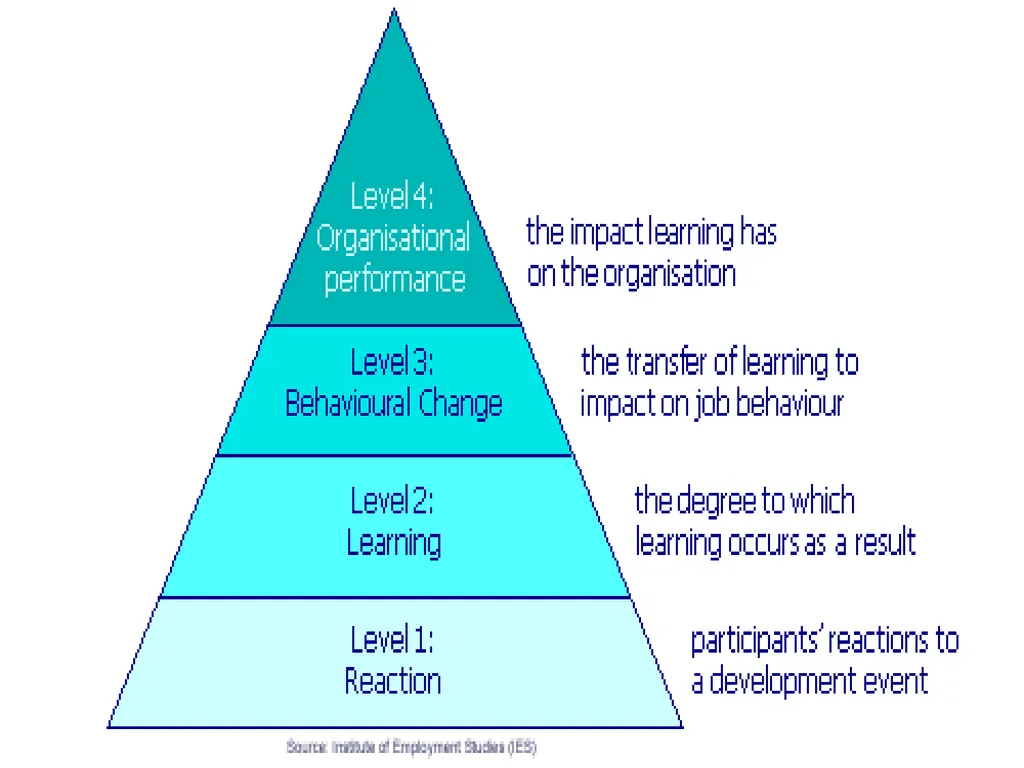
a)Donald Kirkpatrick’s 4 levels Reaction – a measure of satisfaction (what the trainees/fellows thought and felt about the training); evaluation here focuses on the reaction of individuals to the training or other improvement intervention
• Learning – a measure of learning (the resulting increase in knowledge or capability); evaluation here assesses what has been learned as measured with end of course tests;<br>
40
Behaviour – a measure of behaviour change (extent of behaviour and capability improvement and implementation/application);
• Results – a measure of results (the effects on the institutional environment resulting from the fellows’ performance); evaluation here measures (at least tries to) the impact of the training on overall organizational results (in the private sector on business results).<br>
41
42 Jayadeva de Silva<br>
42
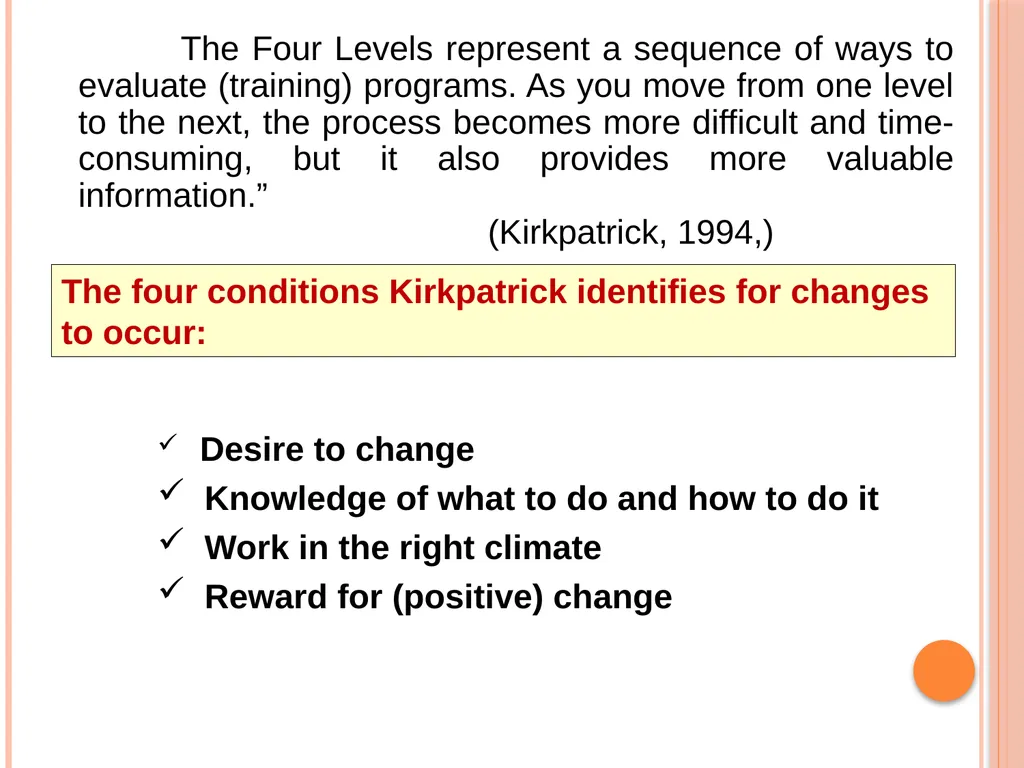
The Four Levels represent a sequence of ways to evaluate (training) programs. As you move from one level to the next, the process becomes more difficult and time-consuming, but it also provides more valuable information.”
(Kirkpatrick, 1994,) The four conditions Kirkpatrick identifies for changes to occur: Desire to change
Knowledge of what to do and how to do it
Work in the right climate
Reward for (positive) change<br>
43
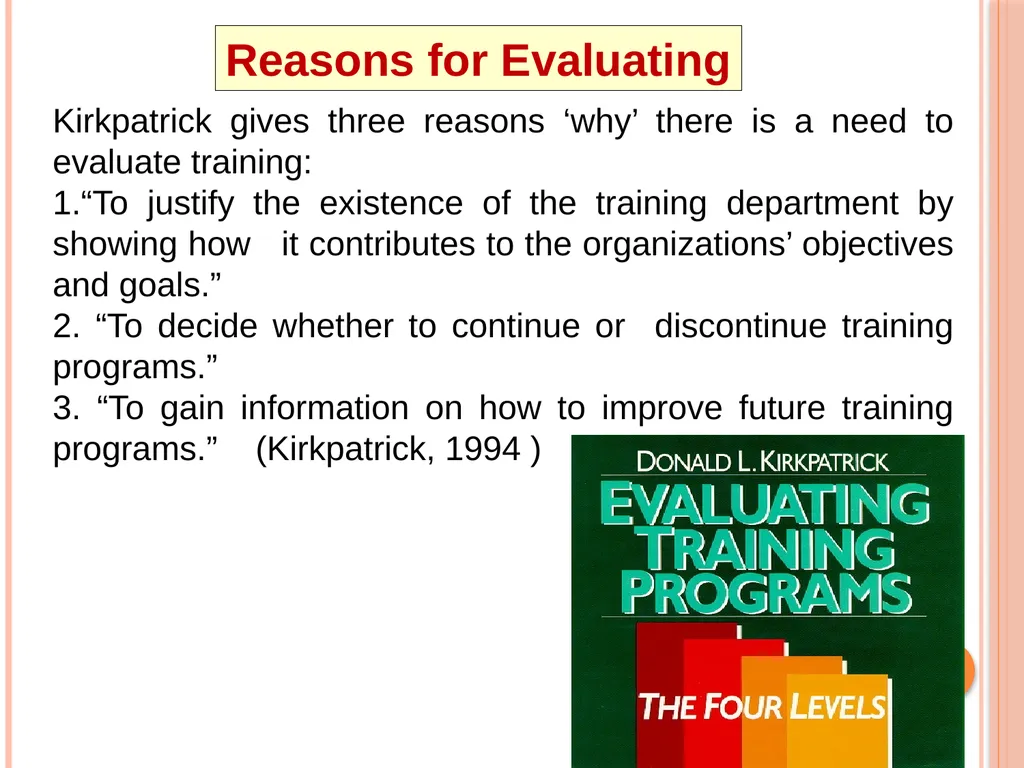
Reasons for Evaluating Kirkpatrick gives three reasons ‘why’ there is a need to evaluate training:
1.“To justify the existence of the training department by showing how it contributes to the organizations’ objectives and goals.”
2. “To decide whether to continue or discontinue training programs.”
3. “To gain information on how to improve future training programs.” (Kirkpatrick, 1994 )<br>
44
Kirkpatrick’s model is useful to evaluate
whether learners liked their instruction,
b) whether they learned something from it, and
c)whether it had some positive effect for the organization, its weakness is that it cannot be used to determine the cost-benefit ratio of training<br>
45
Objective/goal based
b.) Hamblin’s 5 levels Level 1: Reactions
• Level 2: Learning
• Level 3: Job behaviour
•Level 4: Organization – the effects on the organization, from participant’s job to performance changes
• Level 5: Ultimate value – the financial effects, both on the organization and the economy.<br>
46
Among these the CIPP, IPO and TVS models are the best known
a) CIPP (Context, Input, Process, Product)
The CIPP model was developed by Daniel Stufflebeam • Context evaluation – which helps in planning and developing objectives
• Input evaluation – which helps to determine the design by examining capability, resources and different strategies
• Process evaluation – which helps to control the operations by providing on-going feedback
• Product evaluation – which helps to judge and react to the programme attainments in terms of outputs and outcomes ii. Systems-based<br>
47
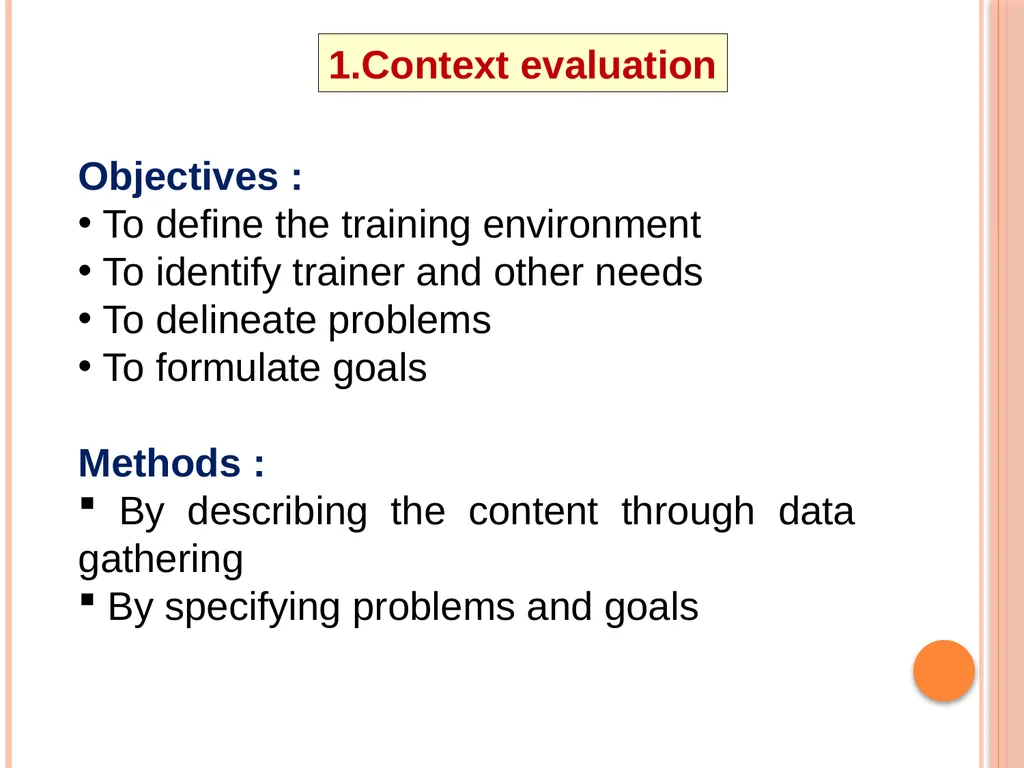
Objectives :
To define the training environment
To identify trainer and other needs
To delineate problems
To formulate goals
Methods :
By describing the content through data gathering
By specifying problems and goals 1.Context evaluation<br>
48
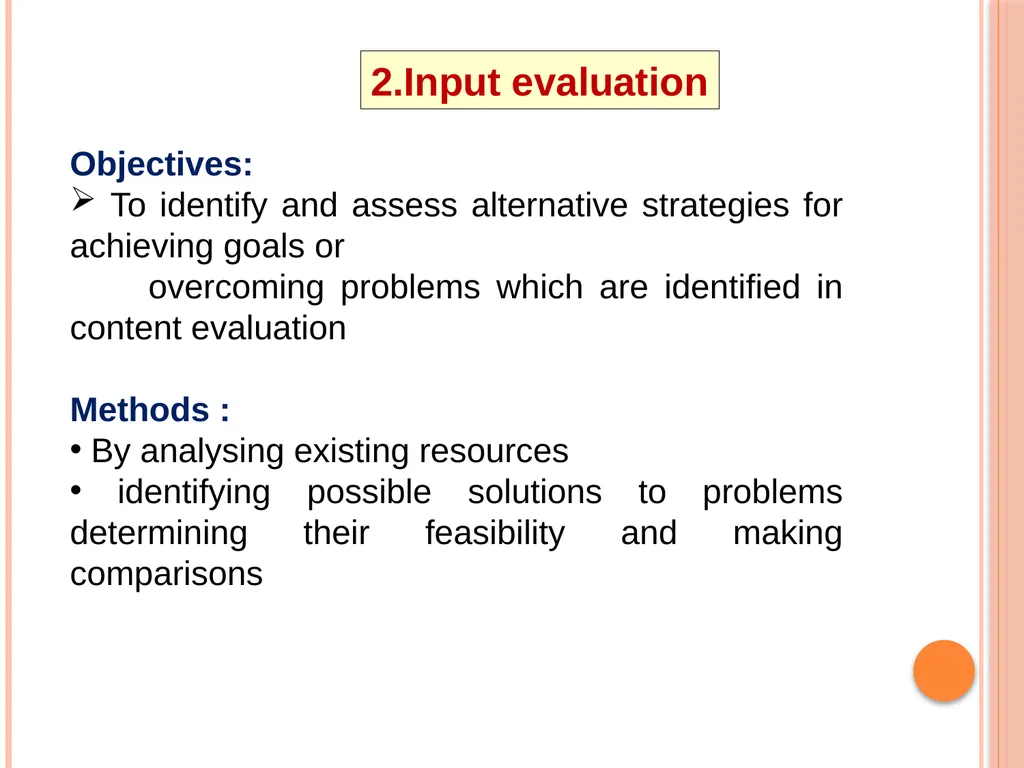
Objectives:
To identify and assess alternative strategies for achieving goals or
overcoming problems which are identified in content evaluation
Methods :
By analysing existing resources
identifying possible solutions to problems determining their feasibility and making comparisons 2.Input evaluation<br>
49
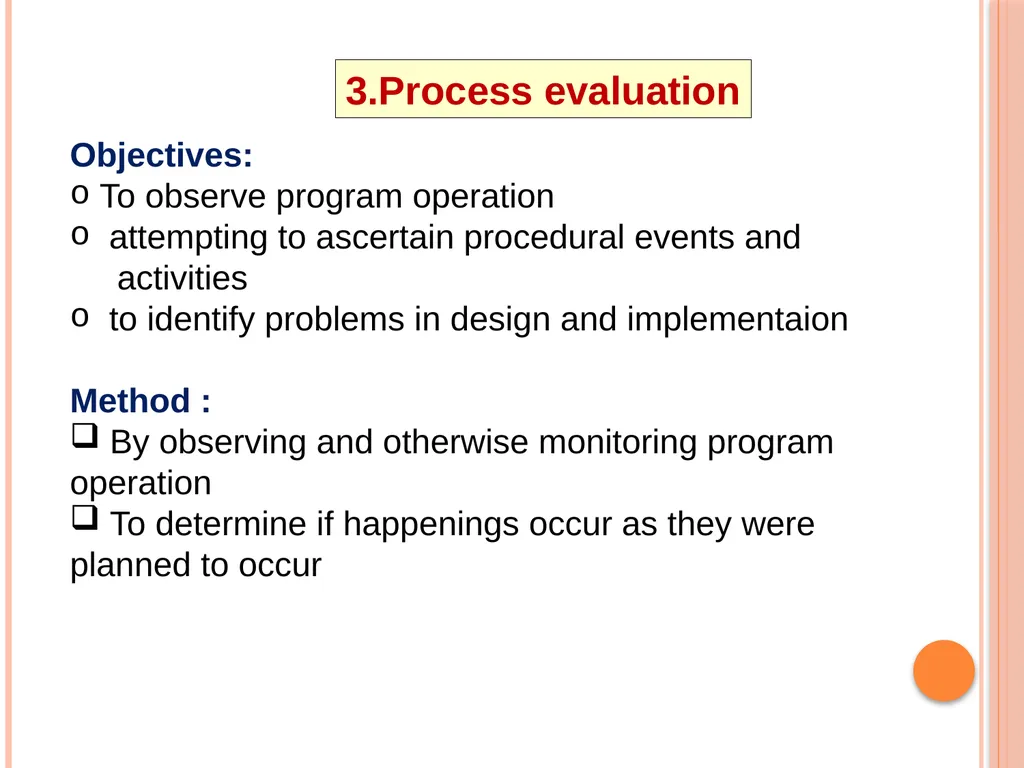
Objectives:
To observe program operation
attempting to ascertain procedural events and
activities
to identify problems in design and implementaion
Method :
By observing and otherwise monitoring program operation
To determine if happenings occur as they were planned to occur 3.Process evaluation<br>
50
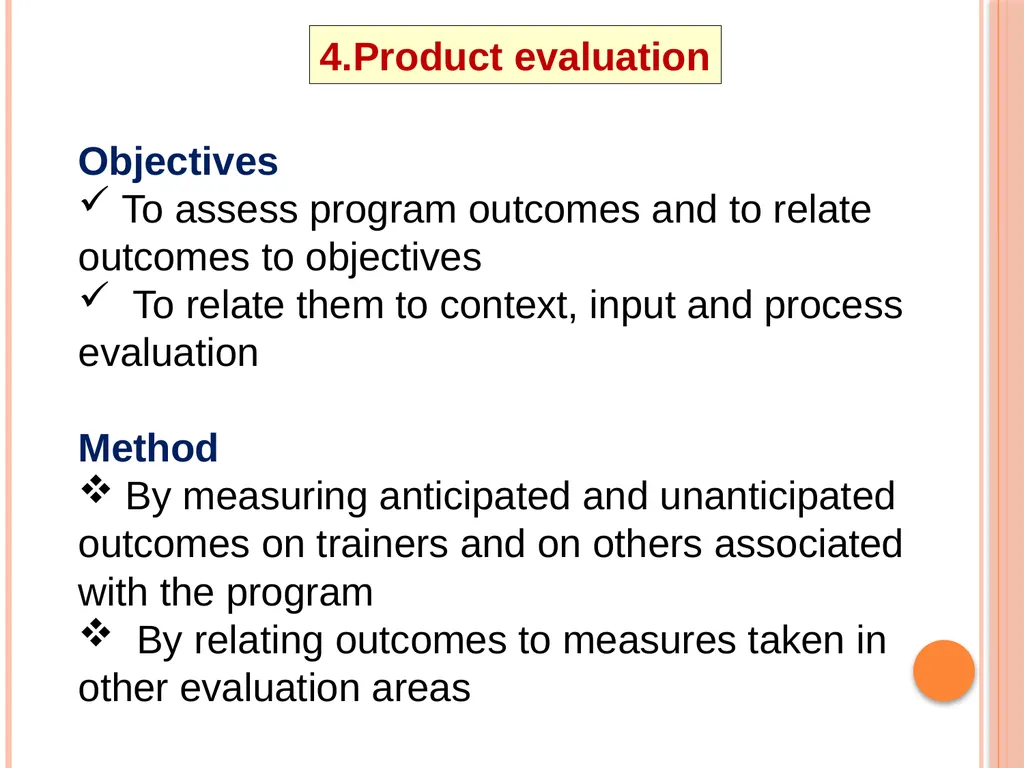
Objectives
To assess program outcomes and to relate outcomes to objectives
To relate them to context, input and process evaluation
Method
By measuring anticipated and unanticipated outcomes on trainers and on others associated with the program
By relating outcomes to measures taken in other evaluation areas 4.Product evaluation<br>
51
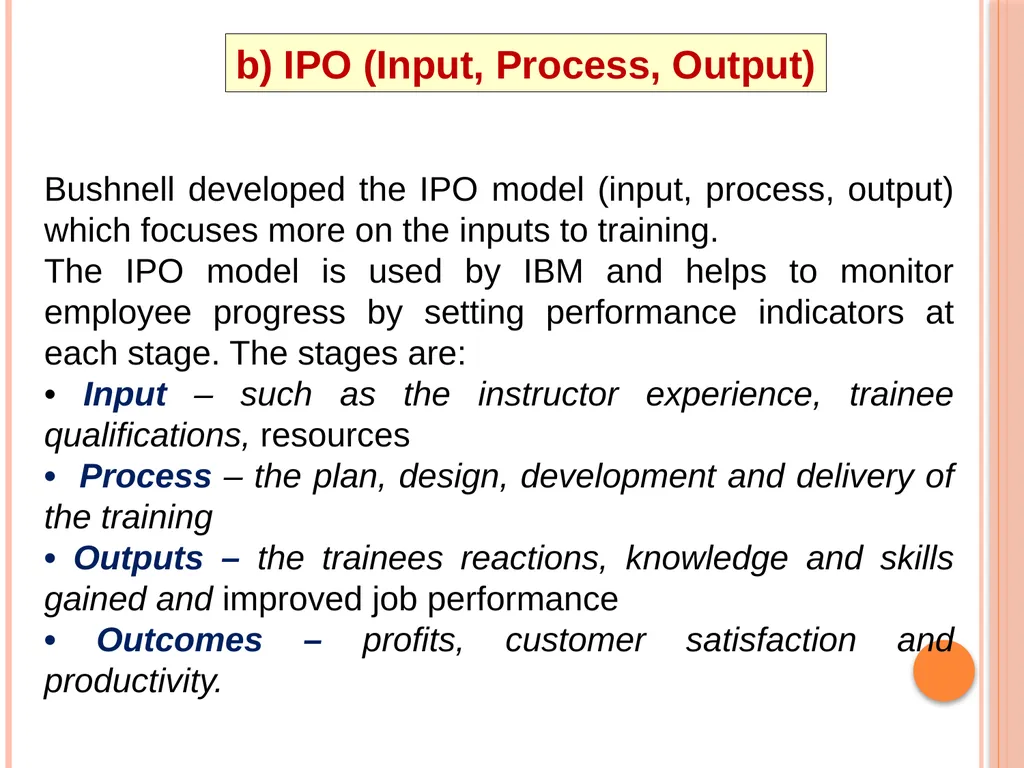
Bushnell developed the IPO model (input, process, output) which focuses more on the inputs to training.
The IPO model is used by IBM and helps to monitor employee progress by setting performance indicators at each stage. The stages are:
• Input – such as the instructor experience, trainee qualifications, resources
• Process – the plan, design, development and delivery of the training
• Outputs – the trainees reactions, knowledge and skills gained and improved job performance
• Outcomes – profits, customer satisfaction and productivity. b) IPO (Input, Process, Output)<br>
52
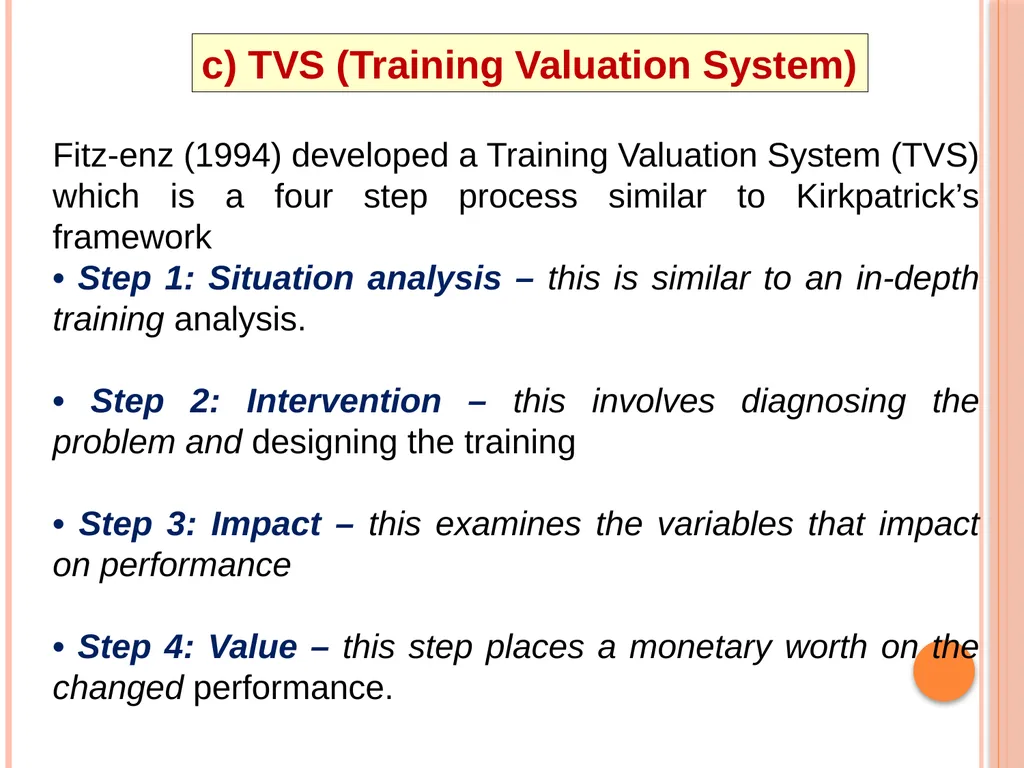
Fitz-enz (1994) developed a Training Valuation System (TVS) which is a four step process similar to Kirkpatrick’s framework
• Step 1: Situation analysis – this is similar to an in-depth training analysis.
• Step 2: Intervention – this involves diagnosing the problem and designing the training
• Step 3: Impact – this examines the variables that impact on performance
• Step 4: Value – this step places a monetary worth on the changed performance. c) TVS (Training Valuation System)<br>
53
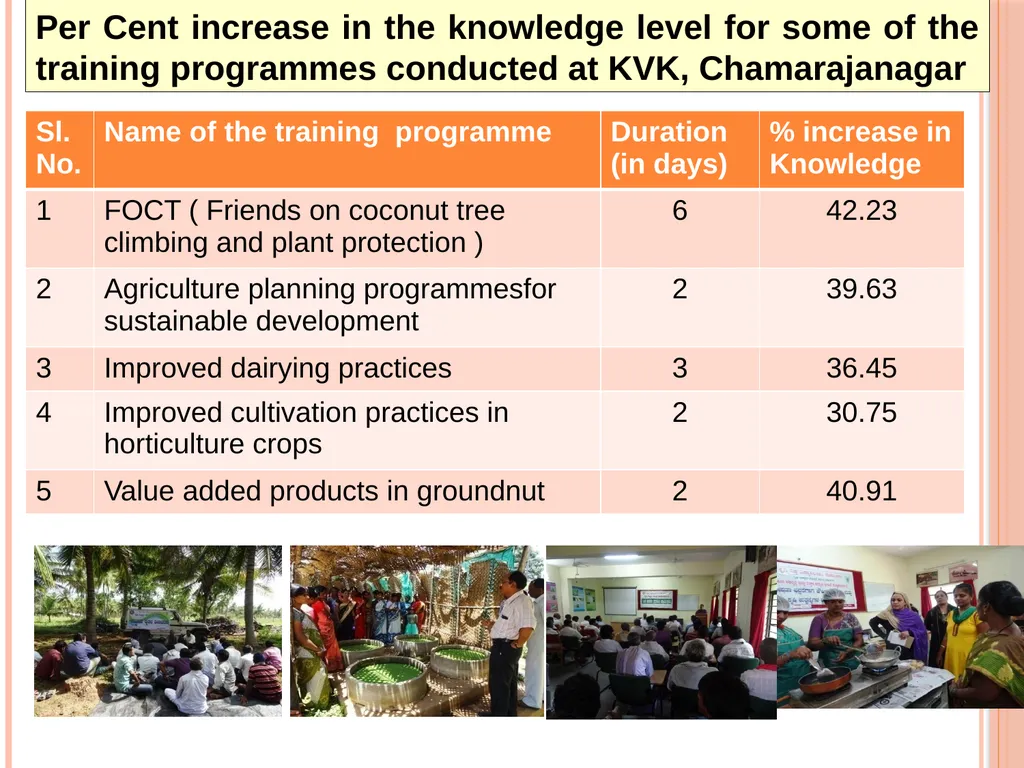
Per Cent increase in the knowledge level for some of the training programmes conducted at KVK, Chamarajanagar<br>
54
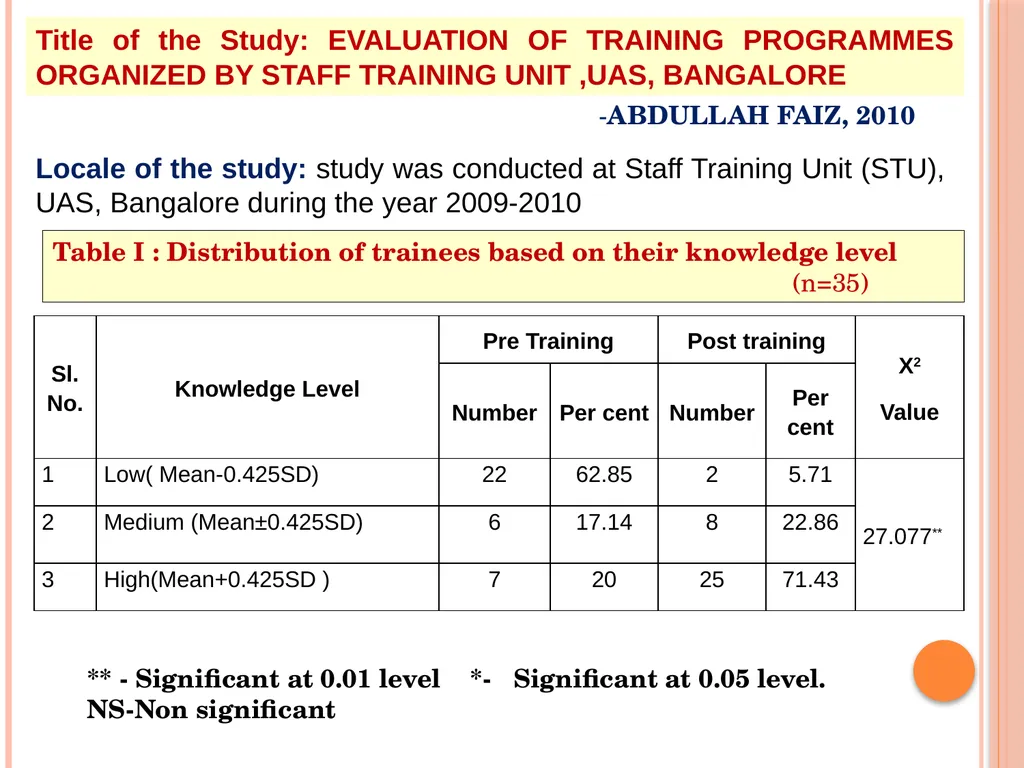
Title of the Study: EVALUATION OF TRAINING PROGRAMMES ORGANIZED BY STAFF TRAINING UNIT ,UAS, BANGALORE -ABDULLAH FAIZ, 2010 Locale of the study: study was conducted at Staff Training Unit (STU), UAS, Bangalore during the year 2009-2010 Table I : Distribution of trainees based on their knowledge level
(n=35) ** - Significant at 0.01 level *- Significant at 0.05 level.
NS-Non significant<br>
55
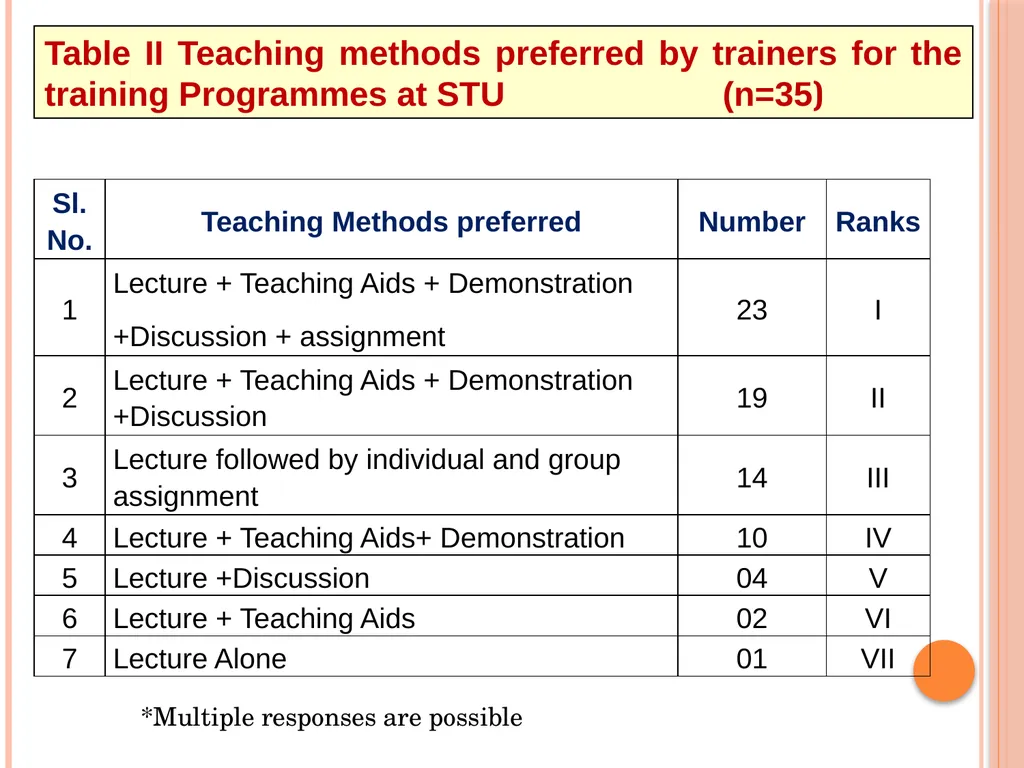
Table II Teaching methods preferred by trainers for the training Programmes at STU (n=35) *Multiple responses are possible<br>
56
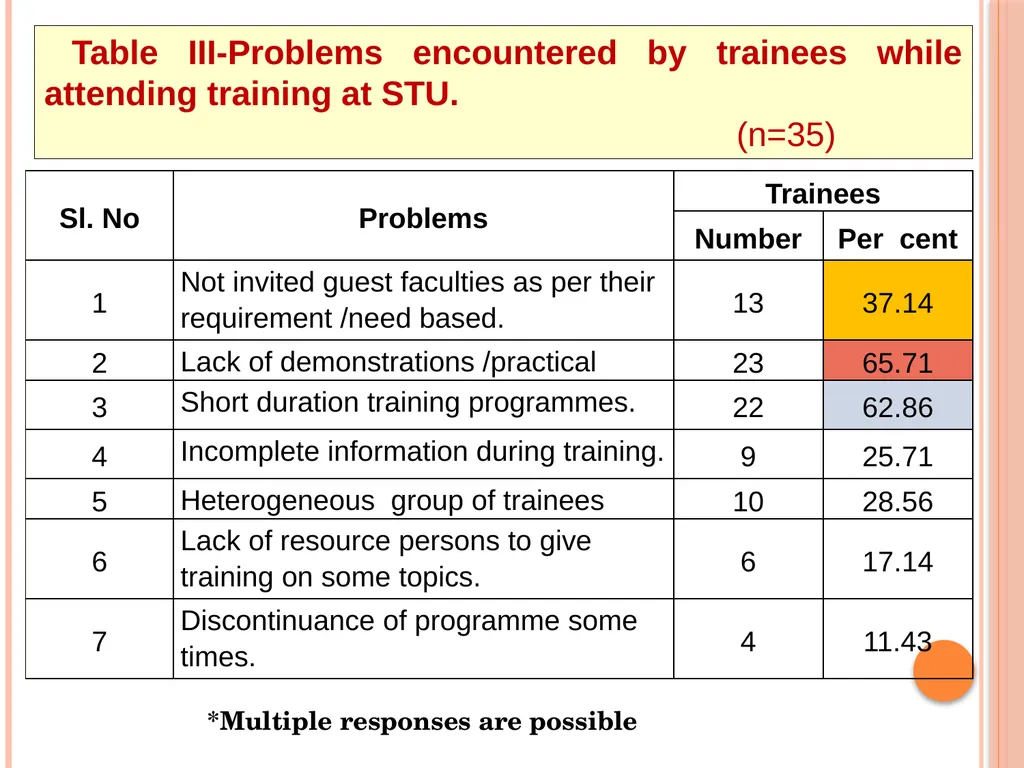
Table III-Problems encountered by trainees while attending training at STU.
(n=35) *Multiple responses are possible<br>
57
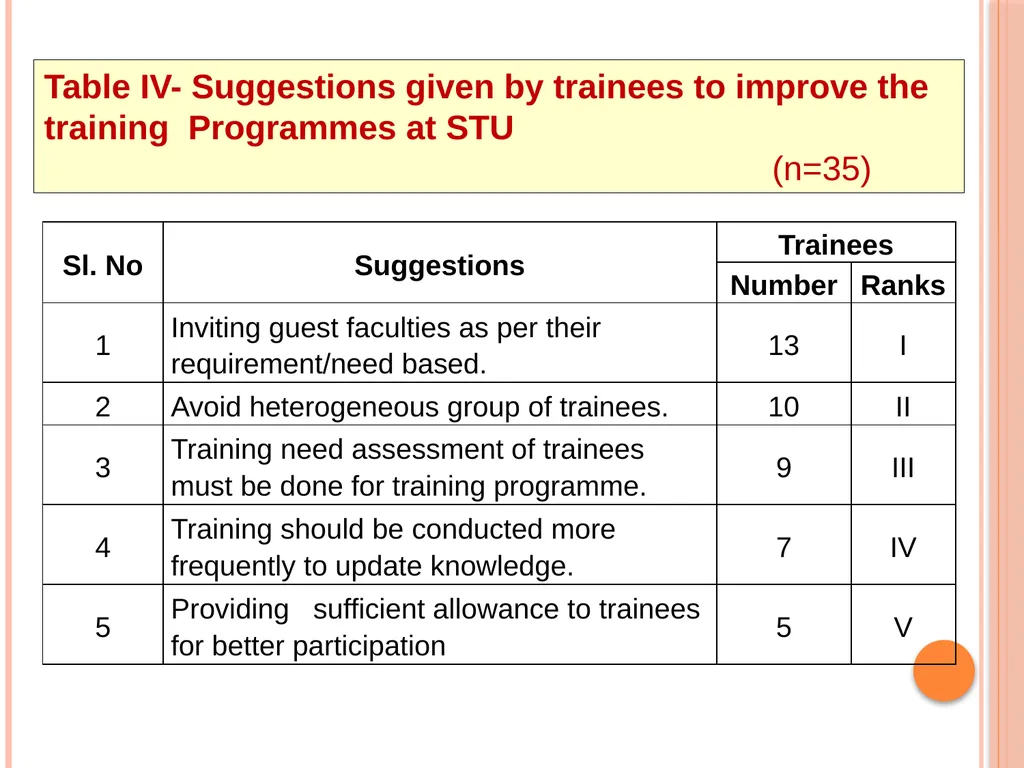
Table IV- Suggestions given by trainees to improve the training Programmes at STU (n=35)<br>
58
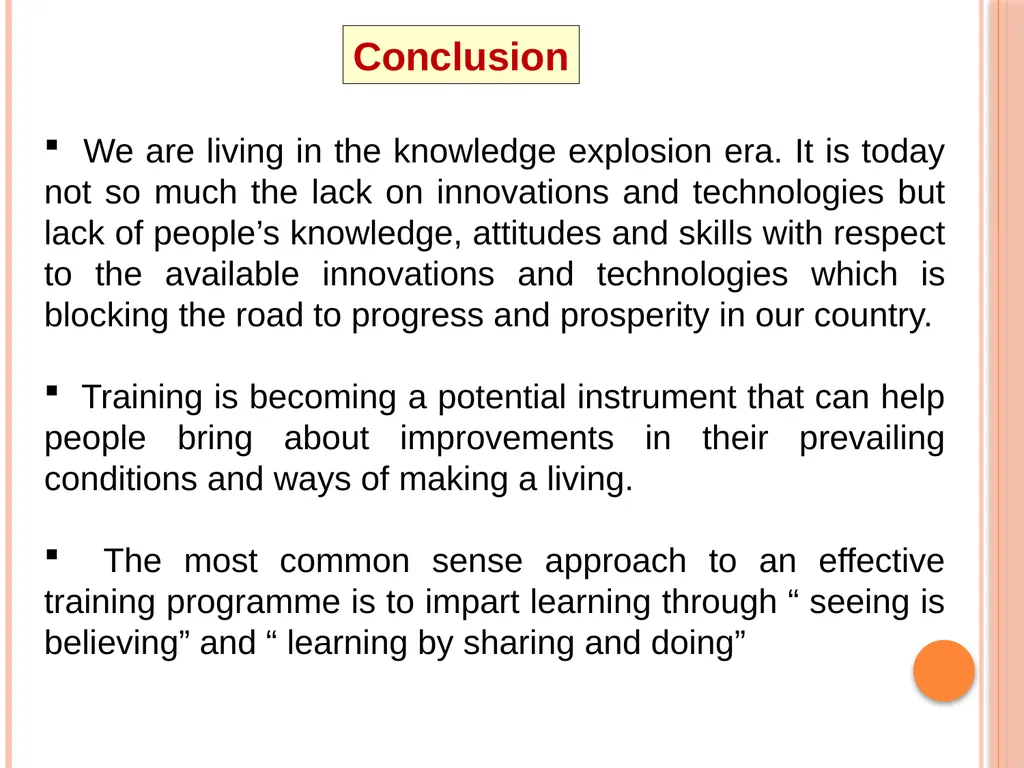
We are living in the knowledge explosion era. It is today not so much the lack on innovations and technologies but lack of people’s knowledge, attitudes and skills with respect to the available innovations and technologies which is blocking the road to progress and prosperity in our country.
Training is becoming a potential instrument that can help people bring about improvements in their prevailing conditions and ways of making a living.
The most common sense approach to an effective training programme is to impart learning through “ seeing is believing” and “ learning by sharing and doing” Conclusion<br>
59
Many training programmes end up without evolving expected impact because of lack of adequate follow up support to the trainees
Ex- trainee meetings are a must and have to be conducted
The trainees require repeated persuasion, guidance and support put into practical application of the newly acquired skills.
Field level constraints need to be addressed carefully by providing them with adequate post training support as per their needs.<br>