
Welcome Once you’ve logged into WebEx, please
LV
Published · 37 slides · 0 views

1 / 1

Description
Welcome Once youve logged into WebEx, please select one of the following audio options: Call Using Computer I Will Call In DO NOT SELECT the Call Me option. This webinar is being recorded. All participants are muted upon entry. Questions
Related Topics
Share
Embed code
Download this presentation From Below
"Welcome Once you’ve logged into WebEx, please" is the property of its rightful owner. Permission is granted to download and print the materials on this website for personal, non-commercial use only, and to display it on your personal computer provided you do not modify the materials and that you retain all copyright notices contained in the materials. By downloading content from our website, you accept the terms of this agreement.
Presentation Transcript
01
Welcome Once you’ve logged into WebEx, please select one of the following audio options:
Call Using Computer
I Will Call In
DO NOT SELECT the “Call Me” option.
This webinar is being recorded.
All participants are muted upon entry.
Questions will be taken following the presentation. Please indicate that you have a question by typing in the chat box to the “Host.”<br>
Call Using Computer
I Will Call In
DO NOT SELECT the “Call Me” option.
This webinar is being recorded.
All participants are muted upon entry.
Questions will be taken following the presentation. Please indicate that you have a question by typing in the chat box to the “Host.”<br>
02
Embracing the Value of Patient Engagement Joseph DiMasi, Tufts Center for the Study of Drug Development
Jaye Bea Smalley, formerly of Celgene February 27, 2020<br>
Jaye Bea Smalley, formerly of Celgene February 27, 2020<br>
03
Disclaimer The views and opinions expressed in this presentation are those of the individual presenter and do not necessarily reflect the views of the Clinical Trials Transformation Initiative or Tufts University.<br>
04
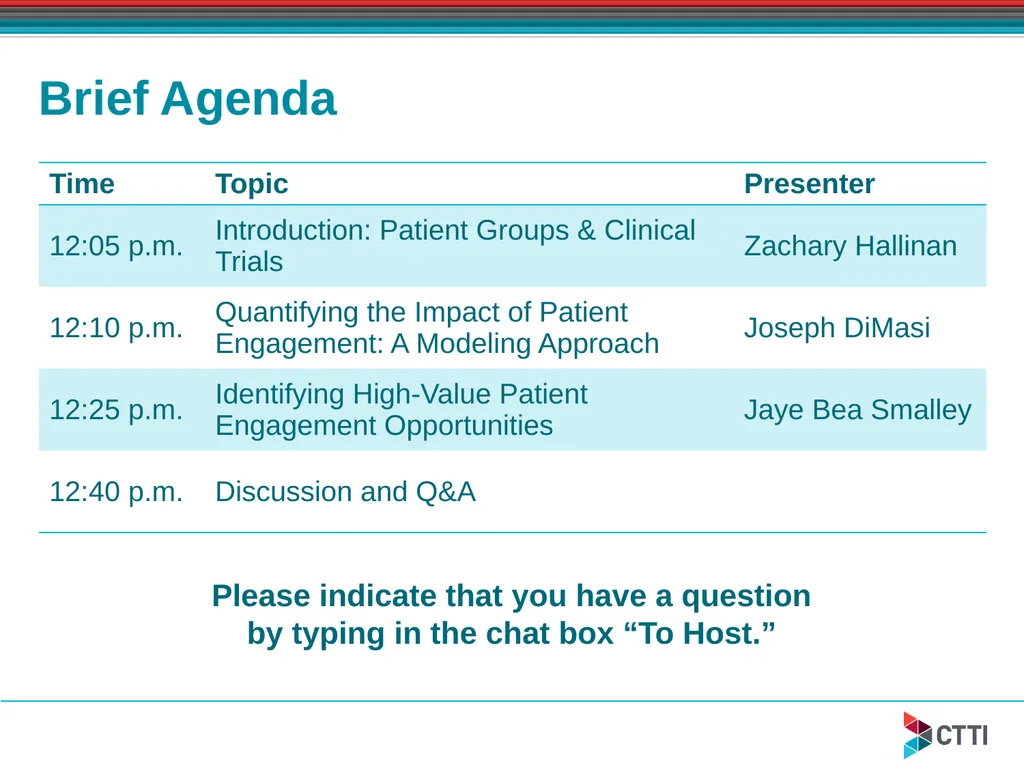
Brief Agenda Please indicate that you have a question by typing in the chat box “To Host.”<br>
05
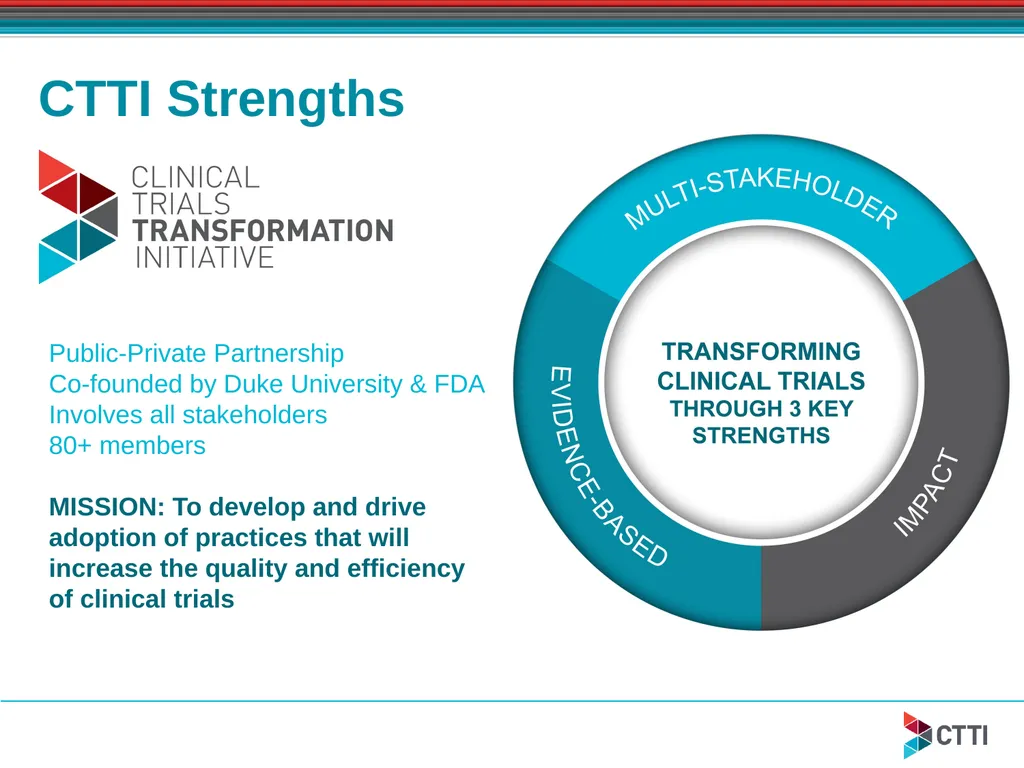
CTTI Strengths Public-Private Partnership
Co-founded by Duke University & FDA
Involves all stakeholders
80+ members
MISSION: To develop and drive adoption of practices that will increase the quality and efficiency of clinical trials<br>
Co-founded by Duke University & FDA
Involves all stakeholders
80+ members
MISSION: To develop and drive adoption of practices that will increase the quality and efficiency of clinical trials<br>
06
Patient Engagement at CTTI Normed (no question) inclusion of patients as equal partners into every aspect of clinical trial (reform)
Full integration into the Steering Committee
Individual patients reimbursed for time on CTTI activities incl. projects
Patient/caregivers on project teams have played critical role in shaping many projects
Co-founded Patient Engagement Collaborative with FDA
Almost all CTTI recommendations advocate for involving all stakeholders and particularly patients in the process, including our Quality by Design work which is included in ICH E8 renovation<br>
Full integration into the Steering Committee
Individual patients reimbursed for time on CTTI activities incl. projects
Patient/caregivers on project teams have played critical role in shaping many projects
Co-founded Patient Engagement Collaborative with FDA
Almost all CTTI recommendations advocate for involving all stakeholders and particularly patients in the process, including our Quality by Design work which is included in ICH E8 renovation<br>
07
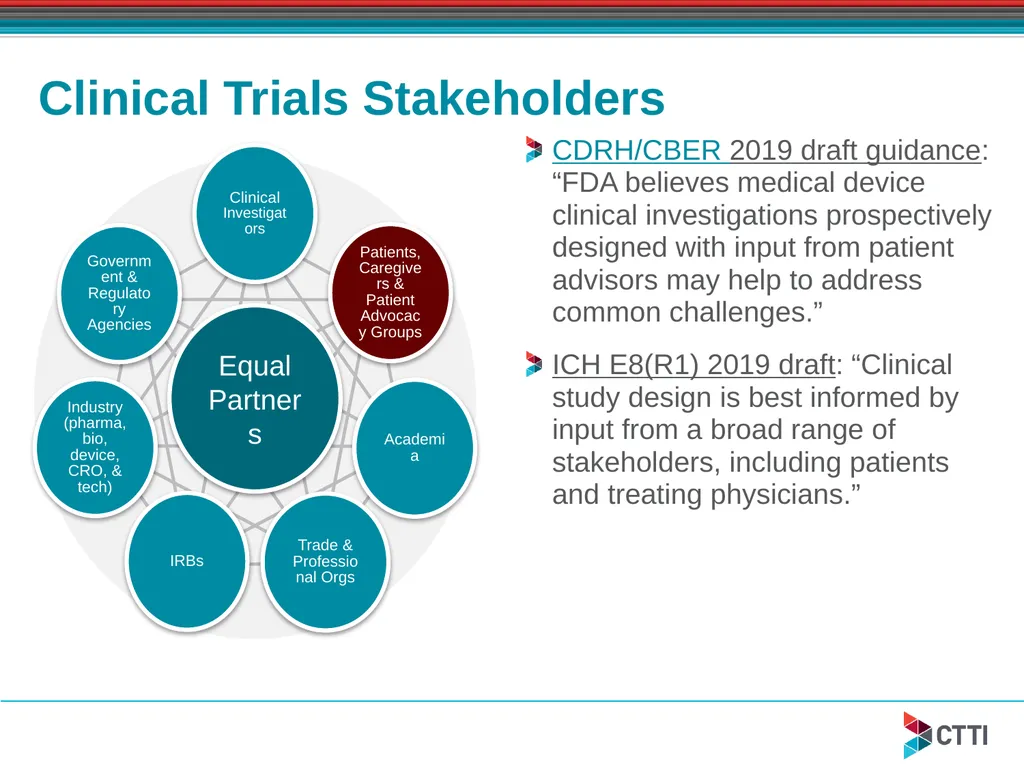
Clinical Trials Stakeholders CDRH/CBER 2019 draft guidance: “FDA believes medical device clinical investigations prospectively designed with input from patient advisors may help to address common challenges.”
ICH E8(R1) 2019 draft: “Clinical study design is best informed by input from a broad range of stakeholders, including patients and treating physicians.”<br>
ICH E8(R1) 2019 draft: “Clinical study design is best informed by input from a broad range of stakeholders, including patients and treating physicians.”<br>
08
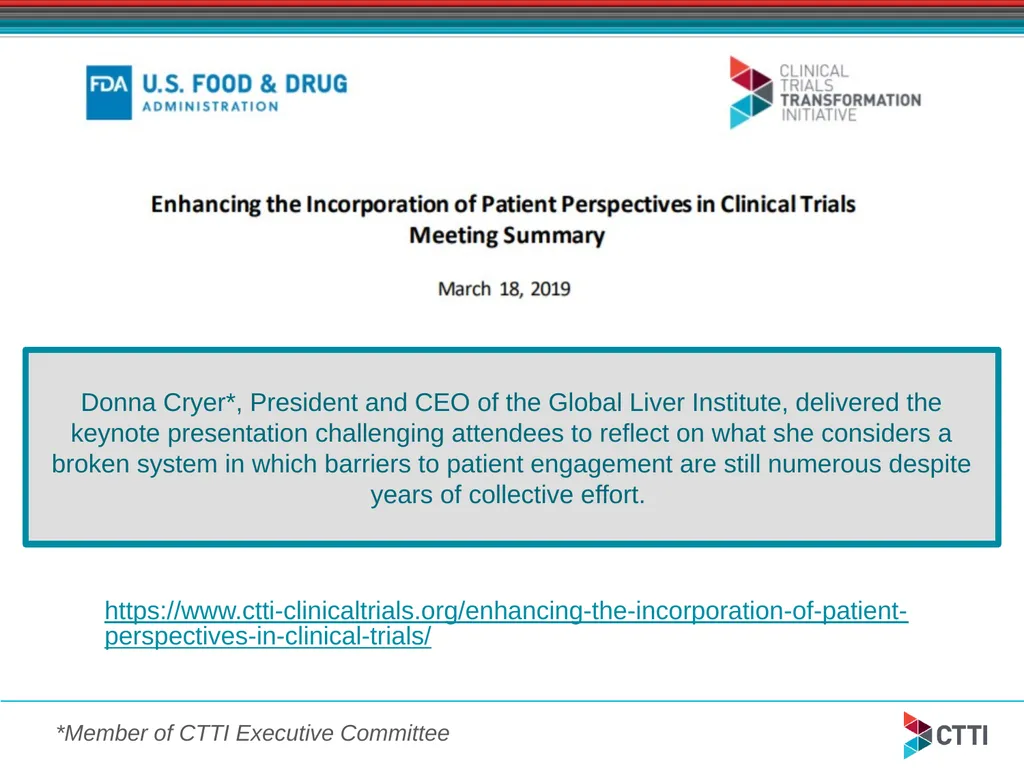
https://www.ctti-clinicaltrials.org/enhancing-the-incorporation-of-patient-perspectives-in-clinical-trials/ Donna Cryer*, President and CEO of the Global Liver Institute, delivered the keynote presentation challenging attendees to reflect on what she considers a broken system in which barriers to patient engagement are still numerous despite years of collective effort. *Member of CTTI Executive Committee<br>
09
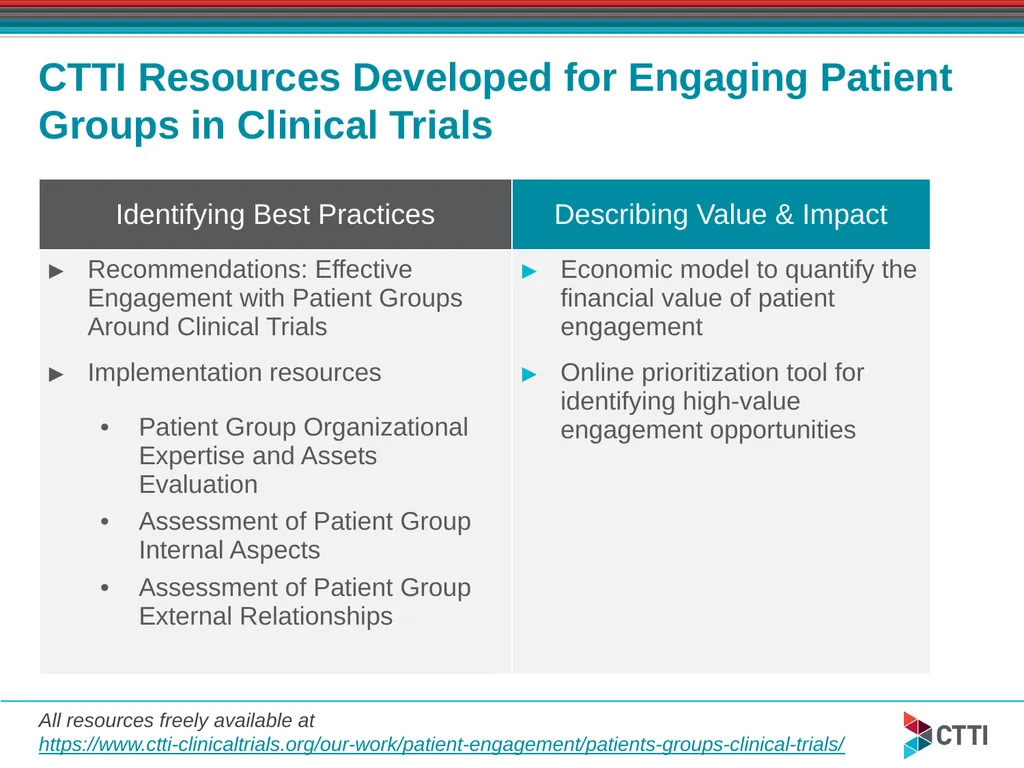
CTTI Resources Developed for Engaging Patient Groups in Clinical Trials All resources freely available at
https://www.ctti-clinicaltrials.org/our-work/patient-engagement/patients-groups-clinical-trials/<br>
https://www.ctti-clinicaltrials.org/our-work/patient-engagement/patients-groups-clinical-trials/<br>
10
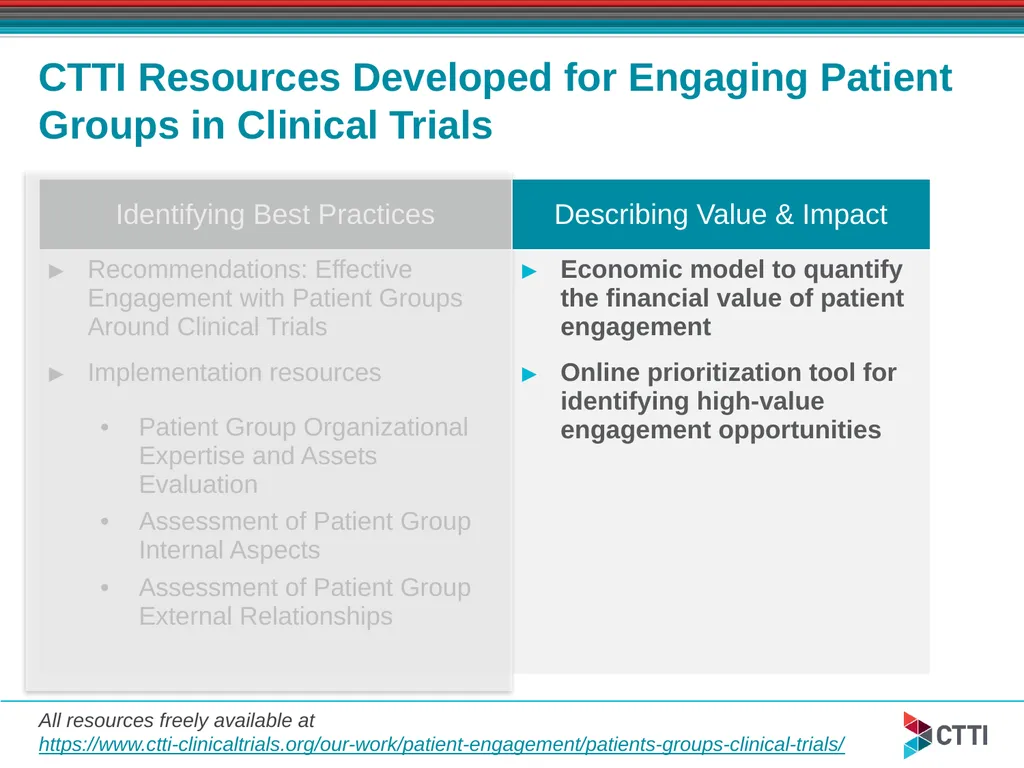
CTTI Resources Developed for Engaging Patient Groups in Clinical Trials All resources freely available at
https://www.ctti-clinicaltrials.org/our-work/patient-engagement/patients-groups-clinical-trials/<br>
https://www.ctti-clinicaltrials.org/our-work/patient-engagement/patients-groups-clinical-trials/<br>
11
Linda Brennan (CFF)*
Richard Klein (FDA)*
David Leventhal (Pfizer)*
Jaye Bea Smalley (Celgene)*
Sophia Smith (Duke)*
Amy Abernathy (Duke)
Ronald Bartek (FARA)
Joel Beetsch (Celgene)
Patricia Cornet (BMS)
Joe DiMasi (Tufts)
Eric Eisenstein (Duke)
Ken Getz (Tufts)
Michele Goldberg (J&J)
Matthew Harker (Duke)
Sharon Hesterlee (Bamboo Therapeutics)
Bennett Levitan (J&J)
Jim Kremidas (ACRP)
Paulo Moreira (EMD Serono)
Bray Patrick-Lake (Duke)
Steve Roberds (Tuberous Sclerosis Alliance)
Jamie Roberts (Duke)
Al Roy (Lupus Research Alliance)
Wendy Selig (WSCollaborative)
Jeff Sherman (DIA)
James Valentine (Hyman, Phelps & McNamara)
Scott Weir (University of Kansas)
CTTI:
Zachary Hallinan (PM)
Amy Corneli (Social Science)
Rae Holliday (Comms)
Laura Shannon (Comms) Patient Groups & Clinical Trials Project Team (2014 – 2019)† *Project team leader | † Affiliations indicated as primary at time of project participation<br>
Richard Klein (FDA)*
David Leventhal (Pfizer)*
Jaye Bea Smalley (Celgene)*
Sophia Smith (Duke)*
Amy Abernathy (Duke)
Ronald Bartek (FARA)
Joel Beetsch (Celgene)
Patricia Cornet (BMS)
Joe DiMasi (Tufts)
Eric Eisenstein (Duke)
Ken Getz (Tufts)
Michele Goldberg (J&J)
Matthew Harker (Duke)
Sharon Hesterlee (Bamboo Therapeutics)
Bennett Levitan (J&J)
Jim Kremidas (ACRP)
Paulo Moreira (EMD Serono)
Bray Patrick-Lake (Duke)
Steve Roberds (Tuberous Sclerosis Alliance)
Jamie Roberts (Duke)
Al Roy (Lupus Research Alliance)
Wendy Selig (WSCollaborative)
Jeff Sherman (DIA)
James Valentine (Hyman, Phelps & McNamara)
Scott Weir (University of Kansas)
CTTI:
Zachary Hallinan (PM)
Amy Corneli (Social Science)
Rae Holliday (Comms)
Laura Shannon (Comms) Patient Groups & Clinical Trials Project Team (2014 – 2019)† *Project team leader | † Affiliations indicated as primary at time of project participation<br>
12
Quantifying the Impact of Patient Engagement: A Modeling Approach<br>
13
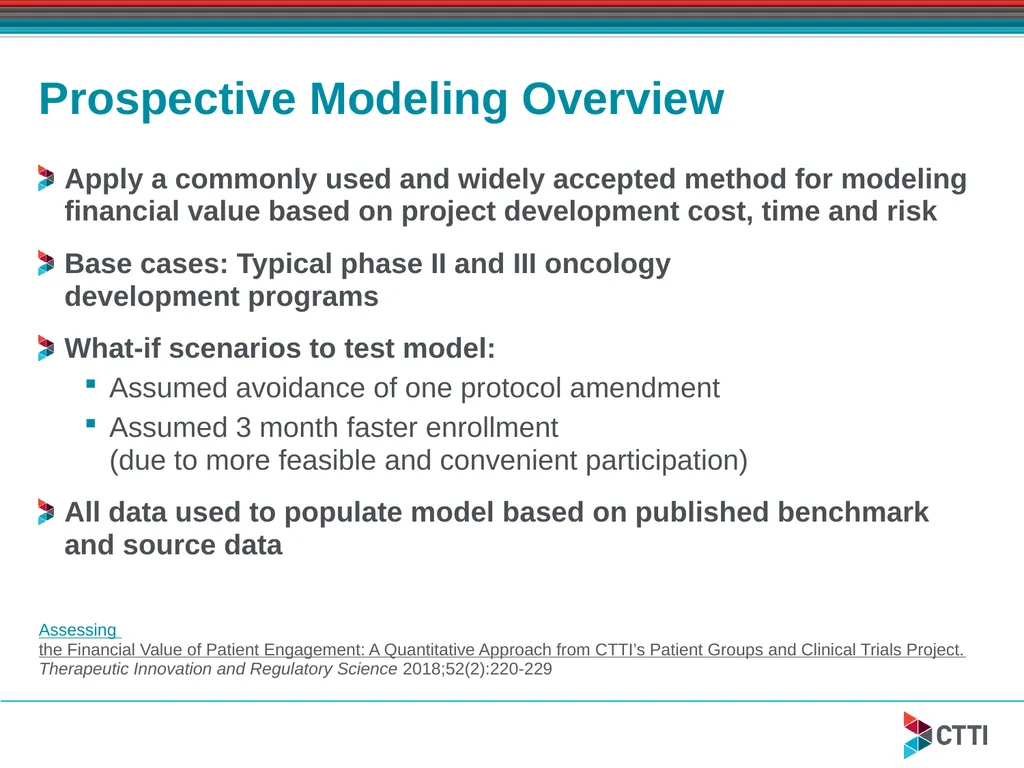
Prospective Modeling Overview Apply a commonly used and widely accepted method for modeling financial value based on project development cost, time and risk
Base cases: Typical phase II and III oncology development programs
What-if scenarios to test model:
Assumed avoidance of one protocol amendment
Assumed 3 month faster enrollment (due to more feasible and convenient participation)
All data used to populate model based on published benchmark and source data
Assessing the Financial Value of Patient Engagement: A Quantitative Approach from CTTI’s Patient Groups and Clinical Trials Project. Therapeutic Innovation and Regulatory Science 2018;52(2):220-229<br>
Base cases: Typical phase II and III oncology development programs
What-if scenarios to test model:
Assumed avoidance of one protocol amendment
Assumed 3 month faster enrollment (due to more feasible and convenient participation)
All data used to populate model based on published benchmark and source data
Assessing the Financial Value of Patient Engagement: A Quantitative Approach from CTTI’s Patient Groups and Clinical Trials Project. Therapeutic Innovation and Regulatory Science 2018;52(2):220-229<br>
14
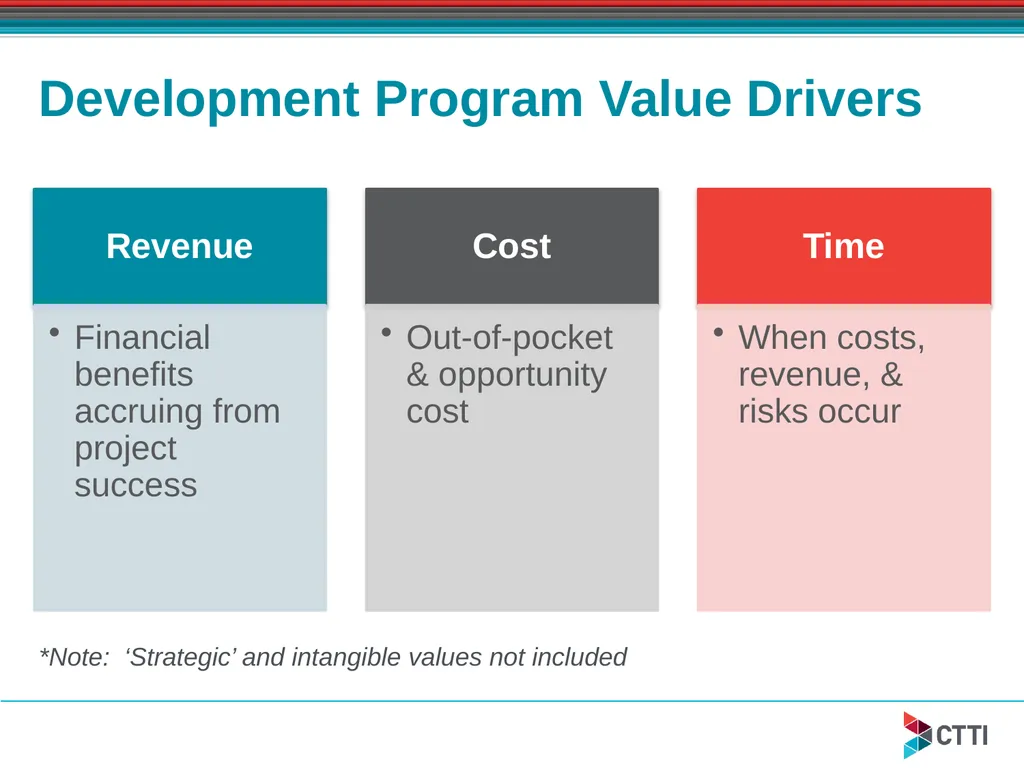
Development Program Value Drivers *Note: ‘Strategic’ and intangible values not included<br>
15
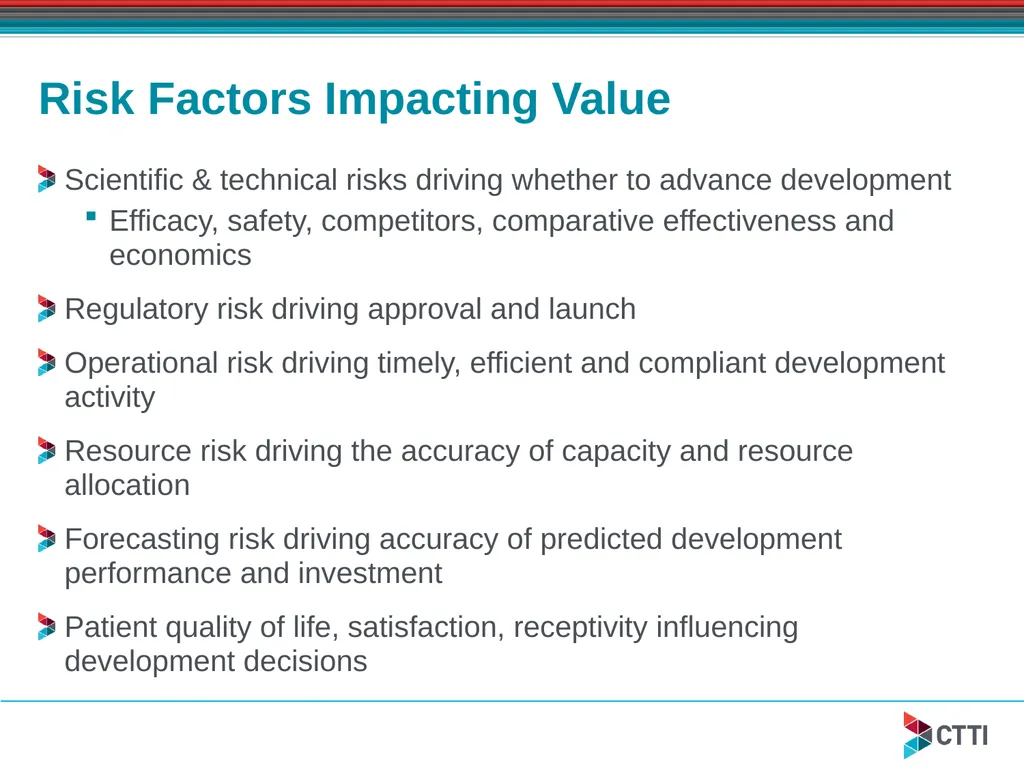
Risk Factors Impacting Value Scientific & technical risks driving whether to advance development
Efficacy, safety, competitors, comparative effectiveness and economics
Regulatory risk driving approval and launch
Operational risk driving timely, efficient and compliant development activity
Resource risk driving the accuracy of capacity and resource allocation
Forecasting risk driving accuracy of predicted development performance and investment
Patient quality of life, satisfaction, receptivity influencing development decisions<br>
Efficacy, safety, competitors, comparative effectiveness and economics
Regulatory risk driving approval and launch
Operational risk driving timely, efficient and compliant development activity
Resource risk driving the accuracy of capacity and resource allocation
Forecasting risk driving accuracy of predicted development performance and investment
Patient quality of life, satisfaction, receptivity influencing development decisions<br>
16
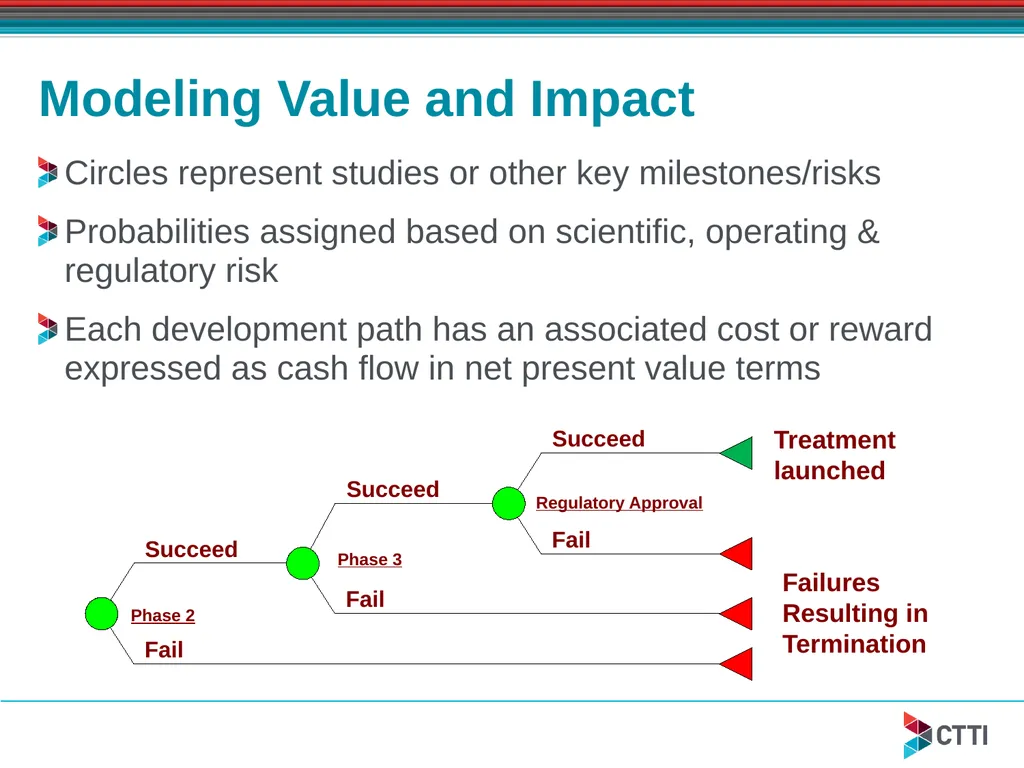
Modeling Value and Impact Circles represent studies or other key milestones/risks
Probabilities assigned based on scientific, operating & regulatory risk
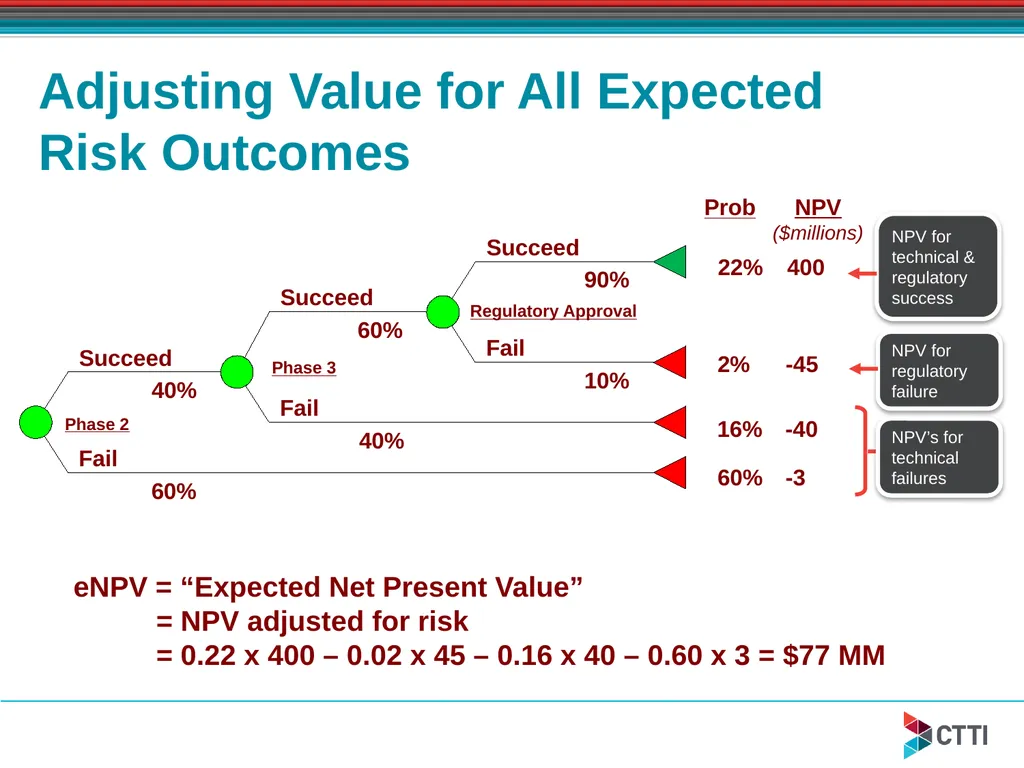
Each development path has an associated cost or reward expressed as cash flow in net present value terms Succeed Fail Succeed Regulatory Approval Fail Succeed Phase 3 Fail Phase 2 Failures Resulting in
Termination Treatment launched<br>
Probabilities assigned based on scientific, operating & regulatory risk
Each development path has an associated cost or reward expressed as cash flow in net present value terms Succeed Fail Succeed Regulatory Approval Fail Succeed Phase 3 Fail Phase 2 Failures Resulting in
Termination Treatment launched<br>
17
Adjusting Value for All Expected
Risk Outcomes eNPV = “Expected Net Present Value”
= NPV adjusted for risk
= 0.22 x 400 – 0.02 x 45 – 0.16 x 40 – 0.60 x 3 = $77 MM<br>
= NPV adjusted for risk
= 0.22 x 400 – 0.02 x 45 – 0.16 x 40 – 0.60 x 3 = $77 MM<br>
18
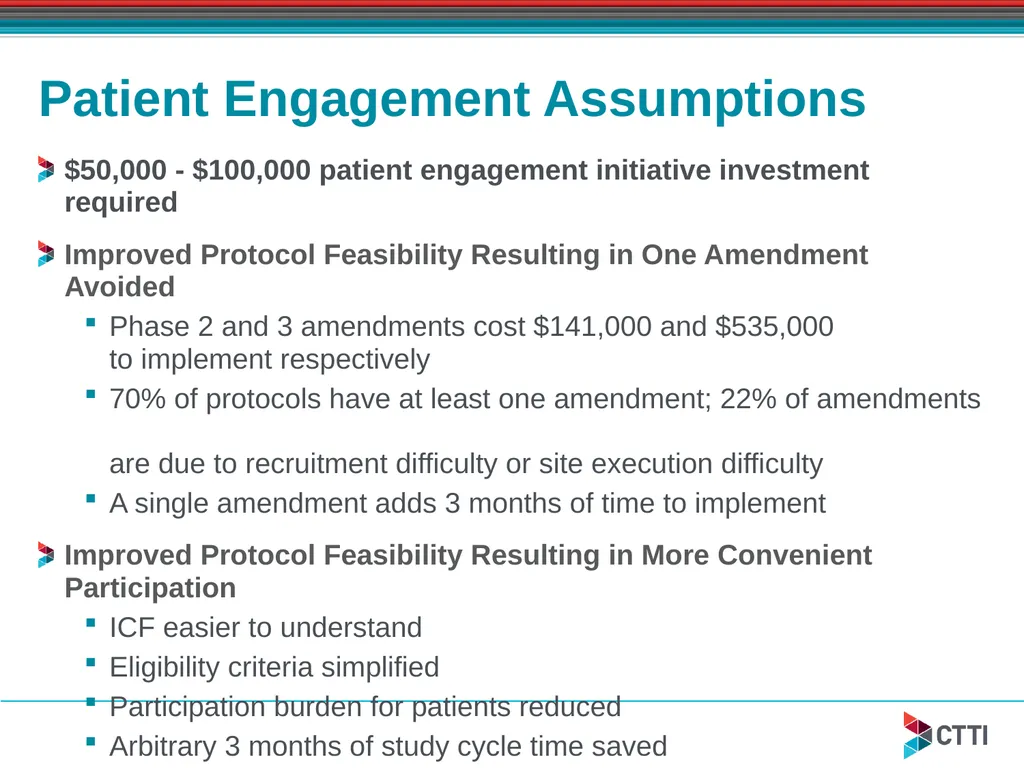
Patient Engagement Assumptions $50,000 - $100,000 patient engagement initiative investment required
Improved Protocol Feasibility Resulting in One Amendment Avoided
Phase 2 and 3 amendments cost $141,000 and $535,000 to implement respectively
70% of protocols have at least one amendment; 22% of amendments are due to recruitment difficulty or site execution difficulty
A single amendment adds 3 months of time to implement
Improved Protocol Feasibility Resulting in More Convenient Participation
ICF easier to understand
Eligibility criteria simplified
Participation burden for patients reduced
Arbitrary 3 months of study cycle time saved<br>
Improved Protocol Feasibility Resulting in One Amendment Avoided
Phase 2 and 3 amendments cost $141,000 and $535,000 to implement respectively
70% of protocols have at least one amendment; 22% of amendments are due to recruitment difficulty or site execution difficulty
A single amendment adds 3 months of time to implement
Improved Protocol Feasibility Resulting in More Convenient Participation
ICF easier to understand
Eligibility criteria simplified
Participation burden for patients reduced
Arbitrary 3 months of study cycle time saved<br>
19
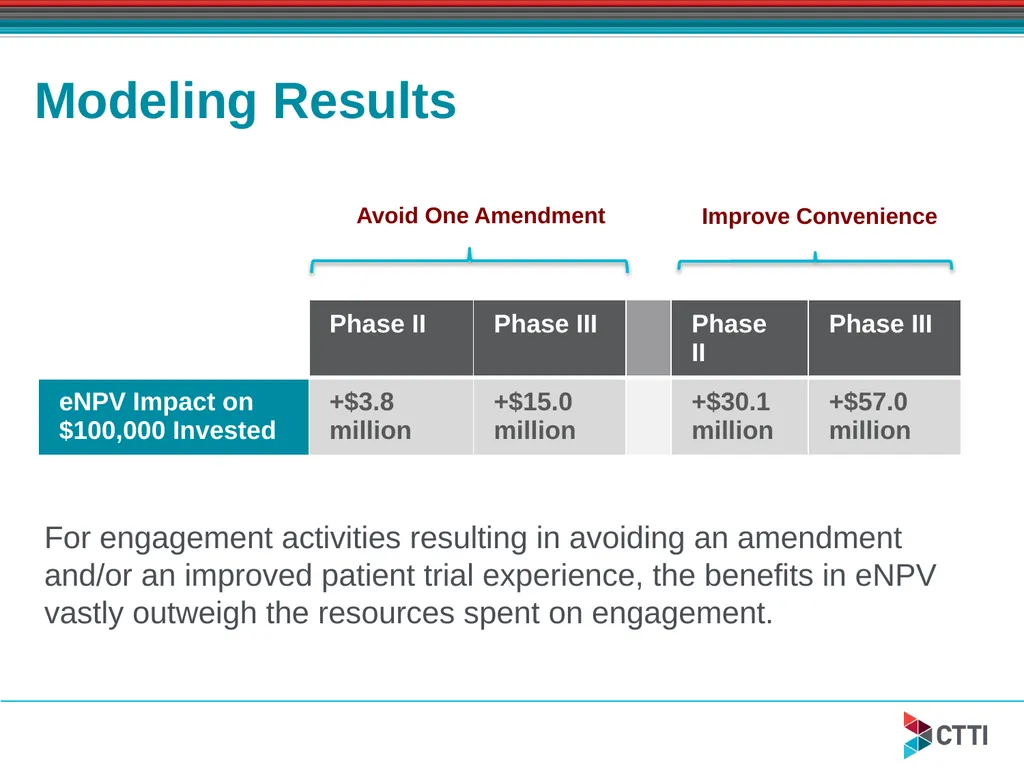
Modeling Results Improve Convenience Avoid One Amendment For engagement activities resulting in avoiding an amendment and/or an improved patient trial experience, the benefits in eNPV vastly outweigh the resources spent on engagement.<br>
20
Expansion of an eNPV Value Framework for Evaluating Patient Engagement Methods<br>
21
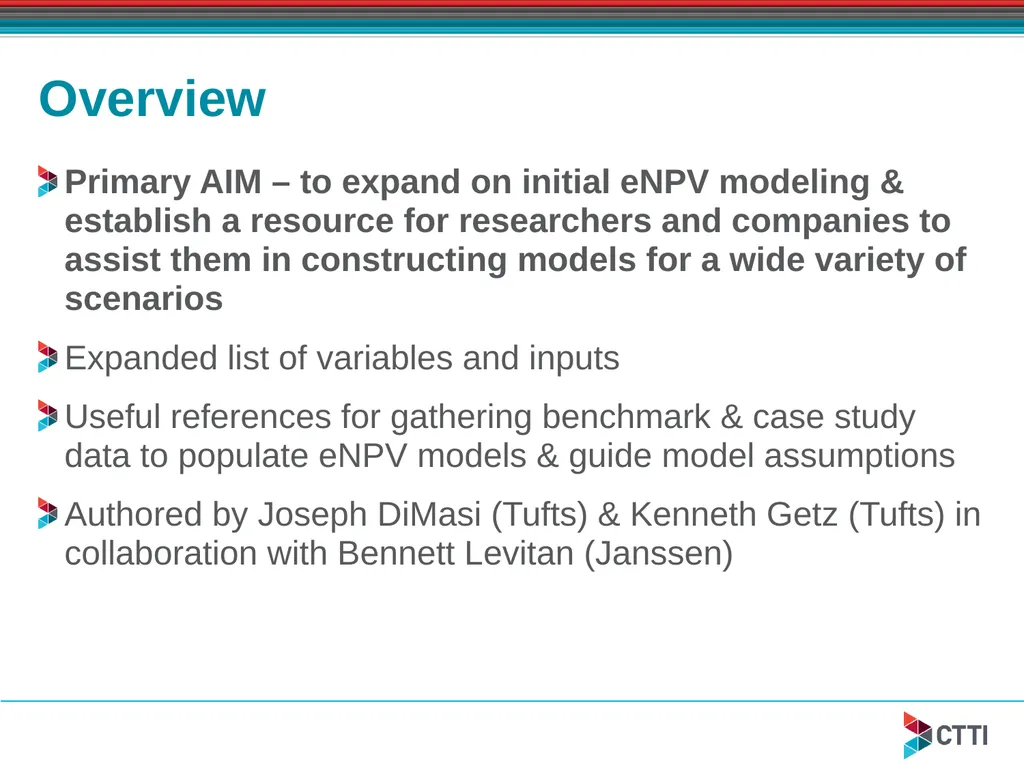
Overview Primary AIM – to expand on initial eNPV modeling & establish a resource for researchers and companies to assist them in constructing models for a wide variety of scenarios
Expanded list of variables and inputs
Useful references for gathering benchmark & case study data to populate eNPV models & guide model assumptions
Authored by Joseph DiMasi (Tufts) & Kenneth Getz (Tufts) in collaboration with Bennett Levitan (Janssen)<br>
Expanded list of variables and inputs
Useful references for gathering benchmark & case study data to populate eNPV models & guide model assumptions
Authored by Joseph DiMasi (Tufts) & Kenneth Getz (Tufts) in collaboration with Bennett Levitan (Janssen)<br>
22
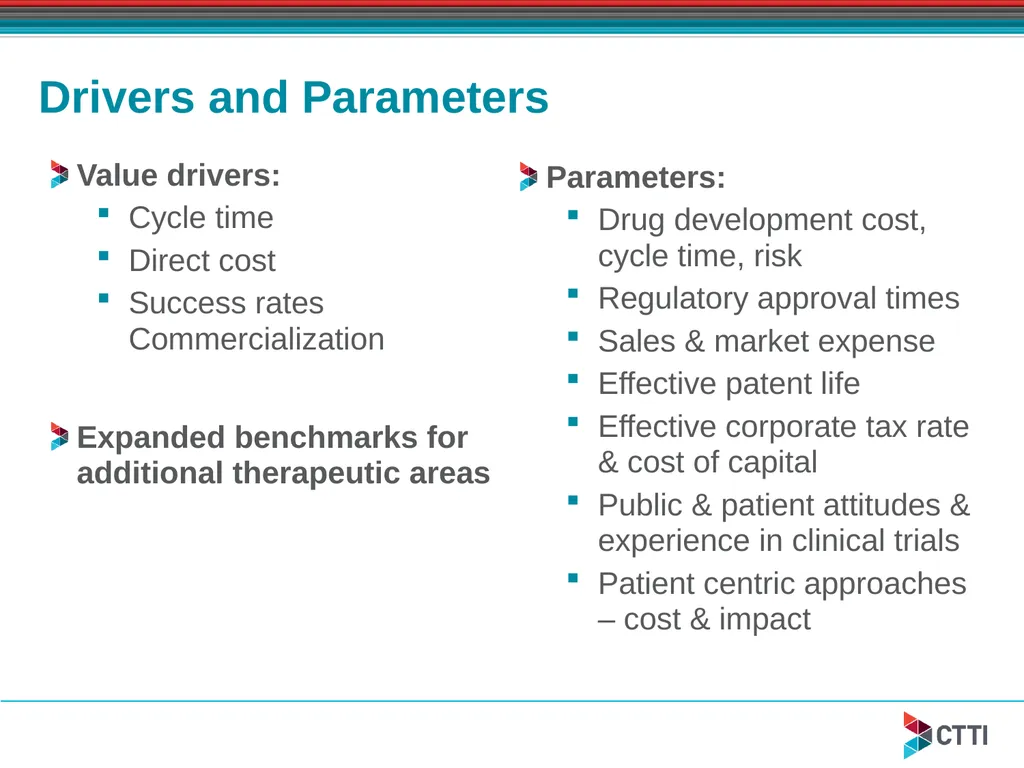
Drivers and Parameters Value drivers:
Cycle time
Direct cost
Success rates Commercialization
Expanded benchmarks for additional therapeutic areas Parameters:
Drug development cost, cycle time, risk
Regulatory approval times
Sales & market expense
Effective patent life
Effective corporate tax rate & cost of capital
Public & patient attitudes & experience in clinical trials
Patient centric approaches – cost & impact<br>
Cycle time
Direct cost
Success rates Commercialization
Expanded benchmarks for additional therapeutic areas Parameters:
Drug development cost, cycle time, risk
Regulatory approval times
Sales & market expense
Effective patent life
Effective corporate tax rate & cost of capital
Public & patient attitudes & experience in clinical trials
Patient centric approaches – cost & impact<br>
23
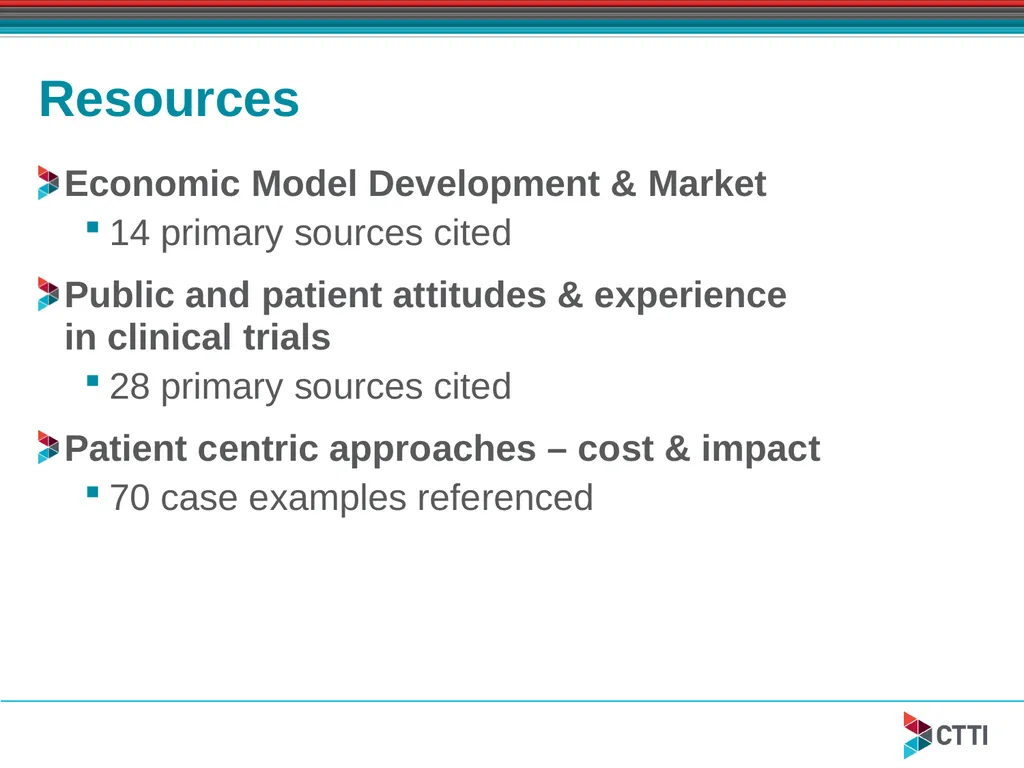
Resources Economic Model Development & Market
14 primary sources cited
Public and patient attitudes & experience in clinical trials
28 primary sources cited
Patient centric approaches – cost & impact
70 case examples referenced<br>
14 primary sources cited
Public and patient attitudes & experience in clinical trials
28 primary sources cited
Patient centric approaches – cost & impact
70 case examples referenced<br>
24
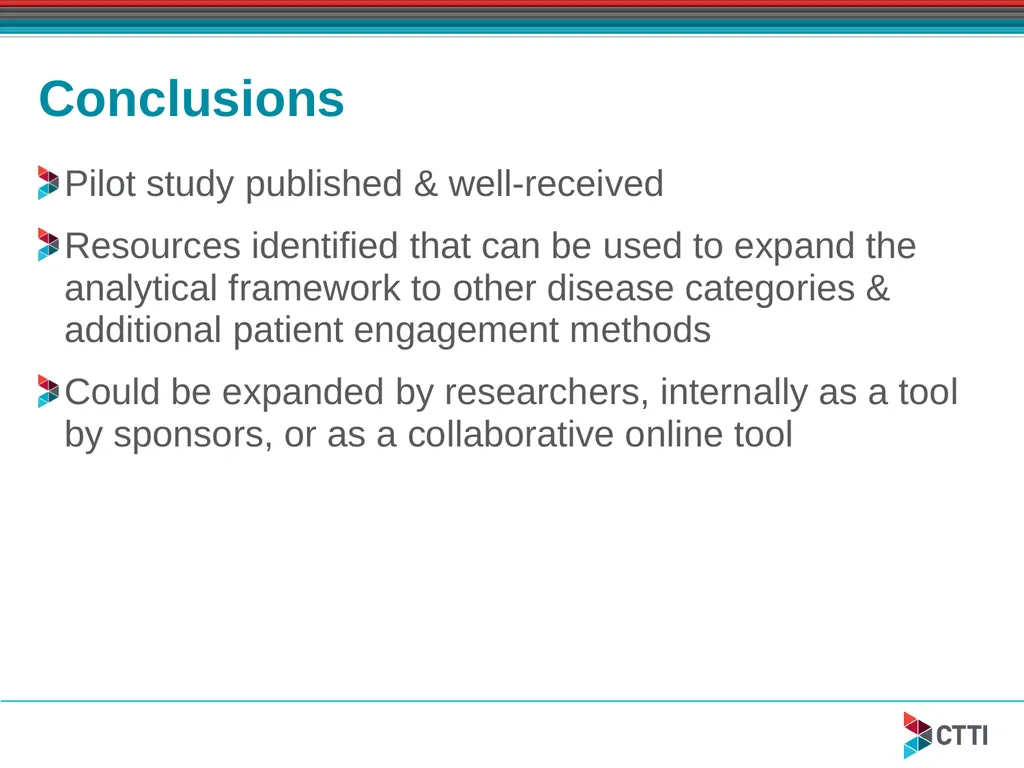
Conclusions Pilot study published & well-received
Resources identified that can be used to expand the analytical framework to other disease categories & additional patient engagement methods
Could be expanded by researchers, internally as a tool by sponsors, or as a collaborative online tool<br>
Resources identified that can be used to expand the analytical framework to other disease categories & additional patient engagement methods
Could be expanded by researchers, internally as a tool by sponsors, or as a collaborative online tool<br>
25
Identifying High-Value Patient Engagement Opportunities<br>
26
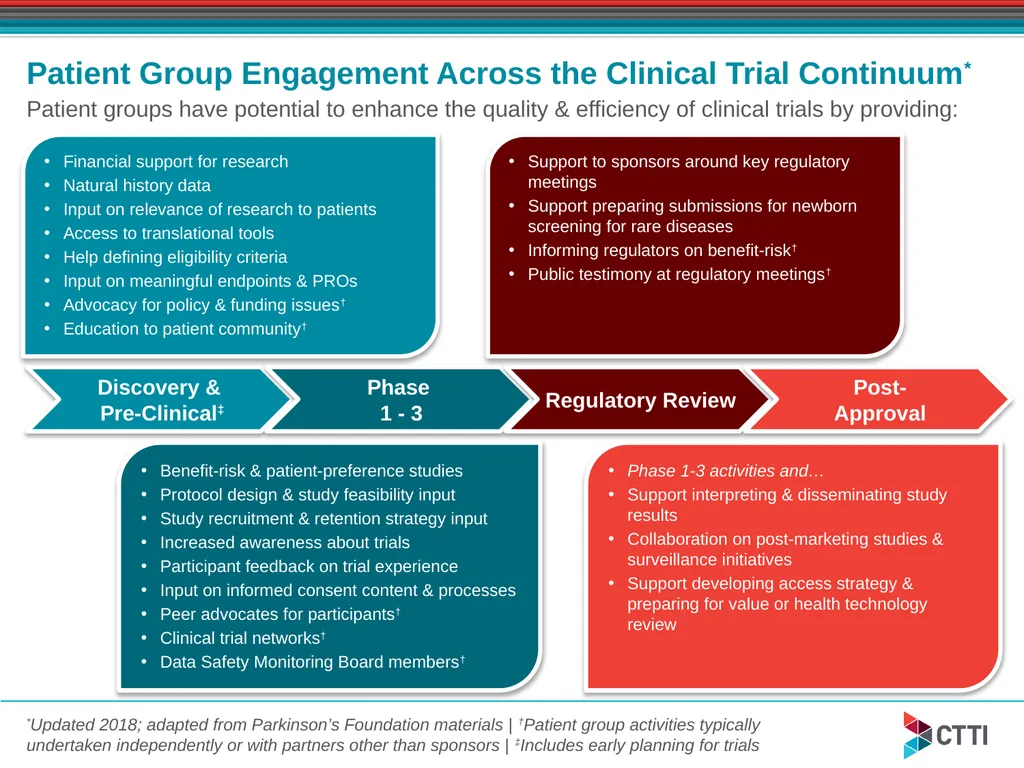
Patient Group Engagement Across the Clinical Trial Continuum* Patient groups have potential to enhance the quality & efficiency of clinical trials by providing: Financial support for research
Natural history data
Input on relevance of research to patients
Access to translational tools
Help defining eligibility criteria
Input on meaningful endpoints & PROs
Advocacy for policy & funding issues†
Education to patient community† Benefit-risk & patient-preference studies
Protocol design & study feasibility input
Study recruitment & retention strategy input
Increased awareness about trials
Participant feedback on trial experience
Input on informed consent content & processes
Peer advocates for participants†
Clinical trial networks†
Data Safety Monitoring Board members† Phase 1-3 activities and…
Support interpreting & disseminating study results
Collaboration on post-marketing studies & surveillance initiatives
Support developing access strategy & preparing for value or health technology review Support to sponsors around key regulatory meetings
Support preparing submissions for newborn screening for rare diseases
Informing regulators on benefit-risk†
Public testimony at regulatory meetings† *Updated 2018; adapted from Parkinson’s Foundation materials | †Patient group activities typically undertaken independently or with partners other than sponsors | ‡Includes early planning for trials<br>
Natural history data
Input on relevance of research to patients
Access to translational tools
Help defining eligibility criteria
Input on meaningful endpoints & PROs
Advocacy for policy & funding issues†
Education to patient community† Benefit-risk & patient-preference studies
Protocol design & study feasibility input
Study recruitment & retention strategy input
Increased awareness about trials
Participant feedback on trial experience
Input on informed consent content & processes
Peer advocates for participants†
Clinical trial networks†
Data Safety Monitoring Board members† Phase 1-3 activities and…
Support interpreting & disseminating study results
Collaboration on post-marketing studies & surveillance initiatives
Support developing access strategy & preparing for value or health technology review Support to sponsors around key regulatory meetings
Support preparing submissions for newborn screening for rare diseases
Informing regulators on benefit-risk†
Public testimony at regulatory meetings† *Updated 2018; adapted from Parkinson’s Foundation materials | †Patient group activities typically undertaken independently or with partners other than sponsors | ‡Includes early planning for trials<br>
27
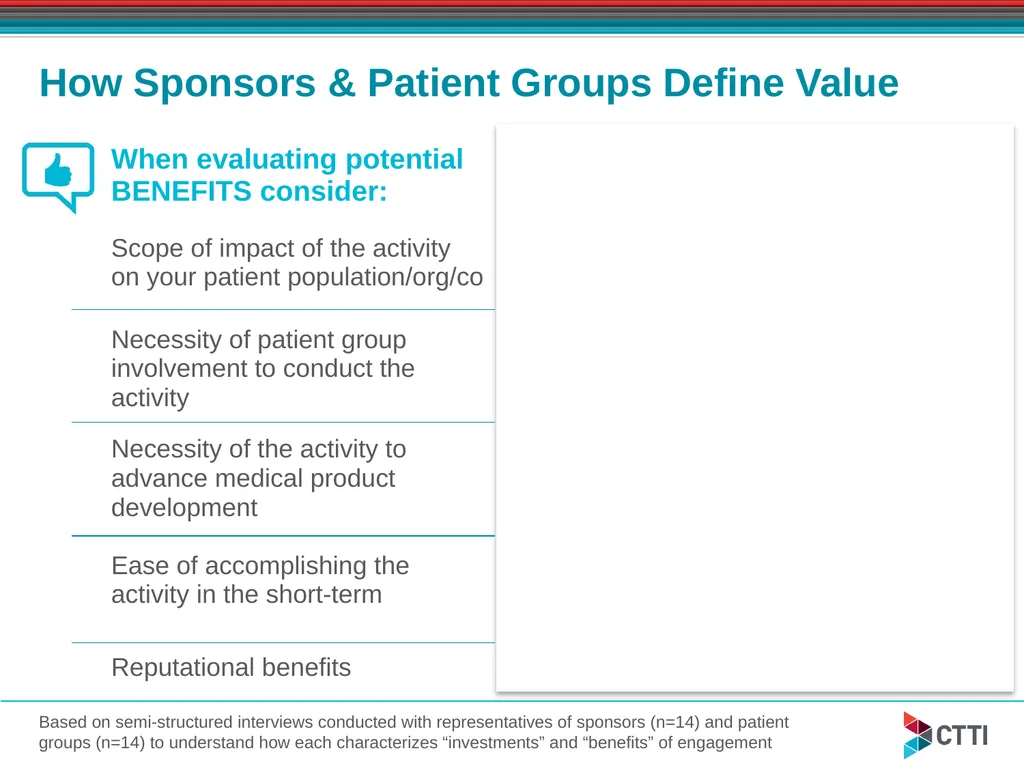
How Sponsors & Patient Groups Define Value When evaluating potential BENEFITS consider: Scope of impact of the activity on your patient population/org/co Necessity of patient group involvement to conduct the
activity Necessity of the activity to advance medical product development Reputational benefits Ease of accomplishing the activity in the short-term When evaluating potential INVESTMENTS and RISKS: Amount of financial
resources needed Reputational risks Level of staff time &
expertise required across
the lifespan of the activity Amount of additional
organizational commitment needed
given existing infrastructure Amount of direct patient
involvement & potential
patient burden Based on semi-structured interviews conducted with representatives of sponsors (n=14) and patient groups (n=14) to understand how each characterizes “investments” and “benefits” of engagement<br>
28
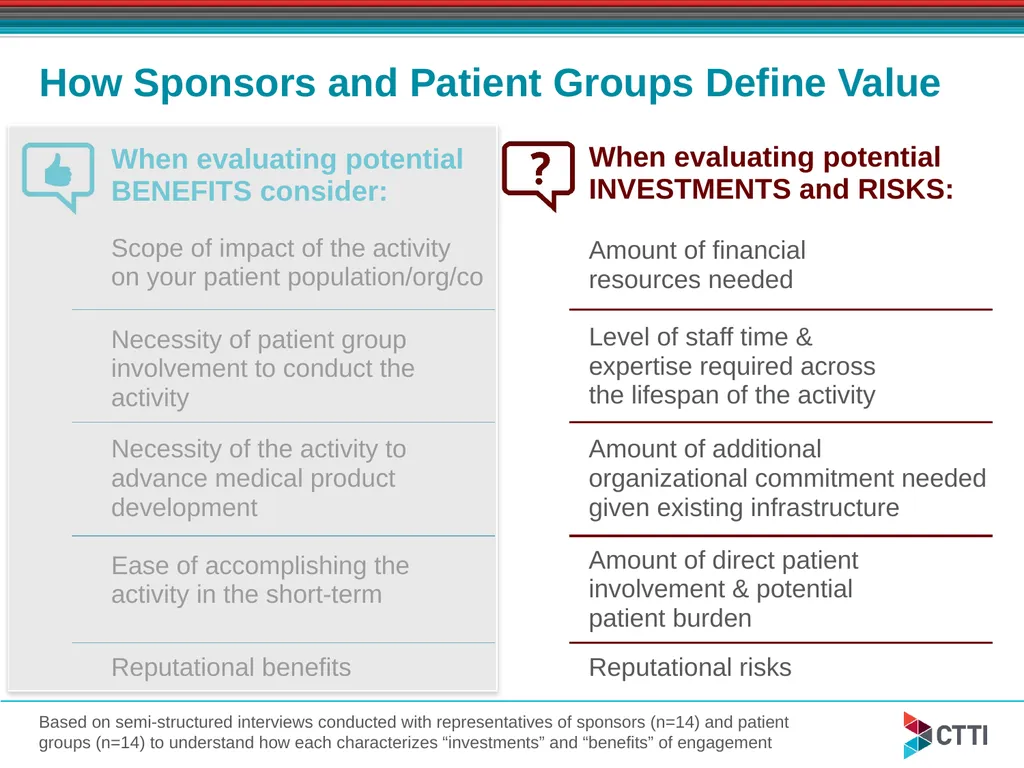
How Sponsors and Patient Groups Define Value When evaluating potential BENEFITS consider: Scope of impact of the activity on your patient population/org/co Necessity of patient group involvement to conduct the
activity Necessity of the activity to advance medical product development Reputational benefits Ease of accomplishing the activity in the short-term When evaluating potential INVESTMENTS and RISKS: Amount of financial
resources needed Reputational risks Level of staff time &
expertise required across
the lifespan of the activity Amount of additional
organizational commitment needed
given existing infrastructure Amount of direct patient
involvement & potential
patient burden Based on semi-structured interviews conducted with representatives of sponsors (n=14) and patient groups (n=14) to understand how each characterizes “investments” and “benefits” of engagement<br>
29
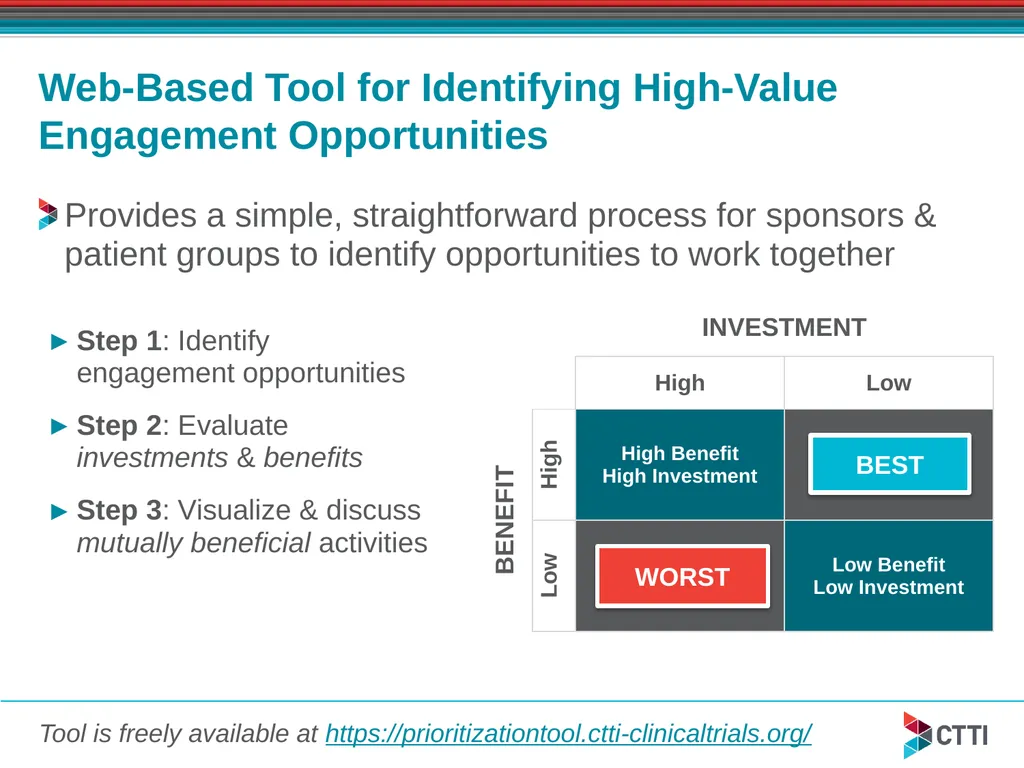
Web-Based Tool for Identifying High-Value Engagement Opportunities Provides a simple, straightforward process for sponsors & patient groups to identify opportunities to work together BEST WORST Step 1: Identify engagement opportunities
Step 2: Evaluate investments & benefits
Step 3: Visualize & discuss mutually beneficial activities Tool is freely available at https://prioritizationtool.ctti-clinicaltrials.org/<br>
Step 2: Evaluate investments & benefits
Step 3: Visualize & discuss mutually beneficial activities Tool is freely available at https://prioritizationtool.ctti-clinicaltrials.org/<br>
30
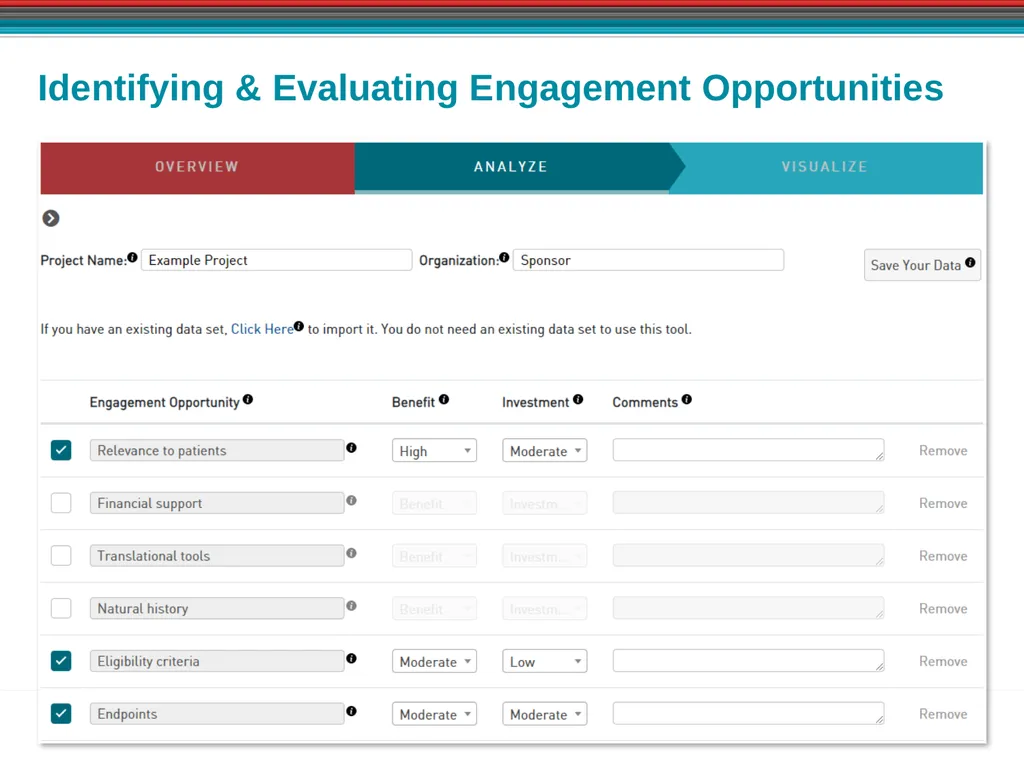
Identifying & Evaluating Engagement Opportunities<br>
31
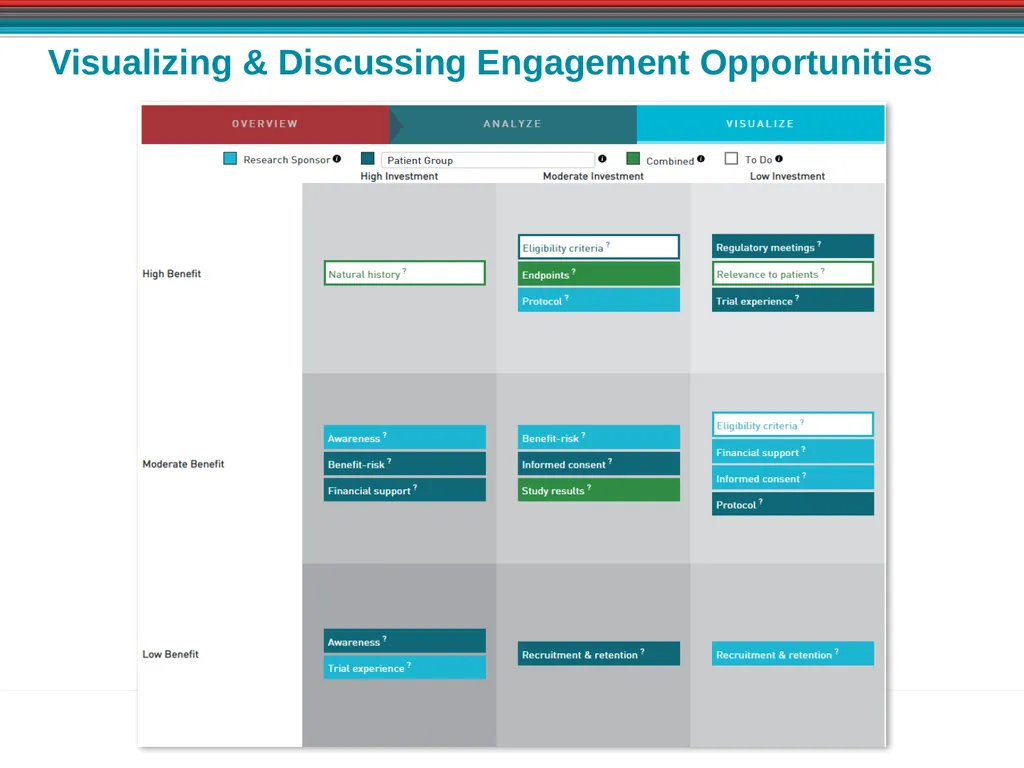
Visualizing & Discussing Engagement Opportunities<br>
32
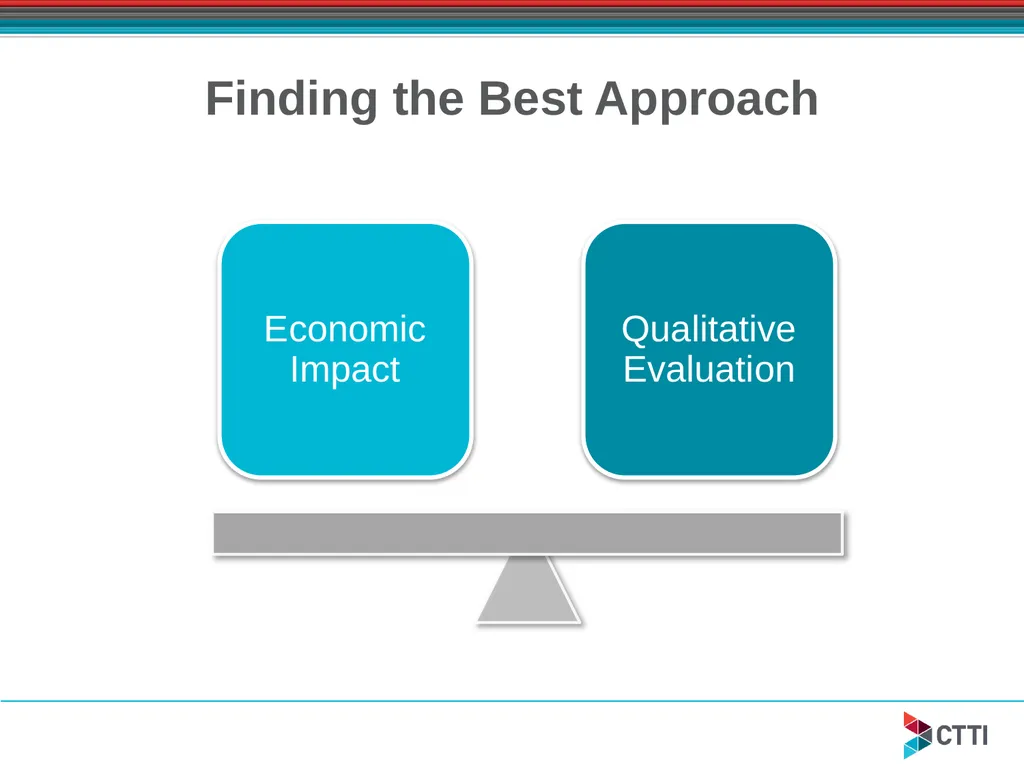
Finding the Best Approach<br>
33
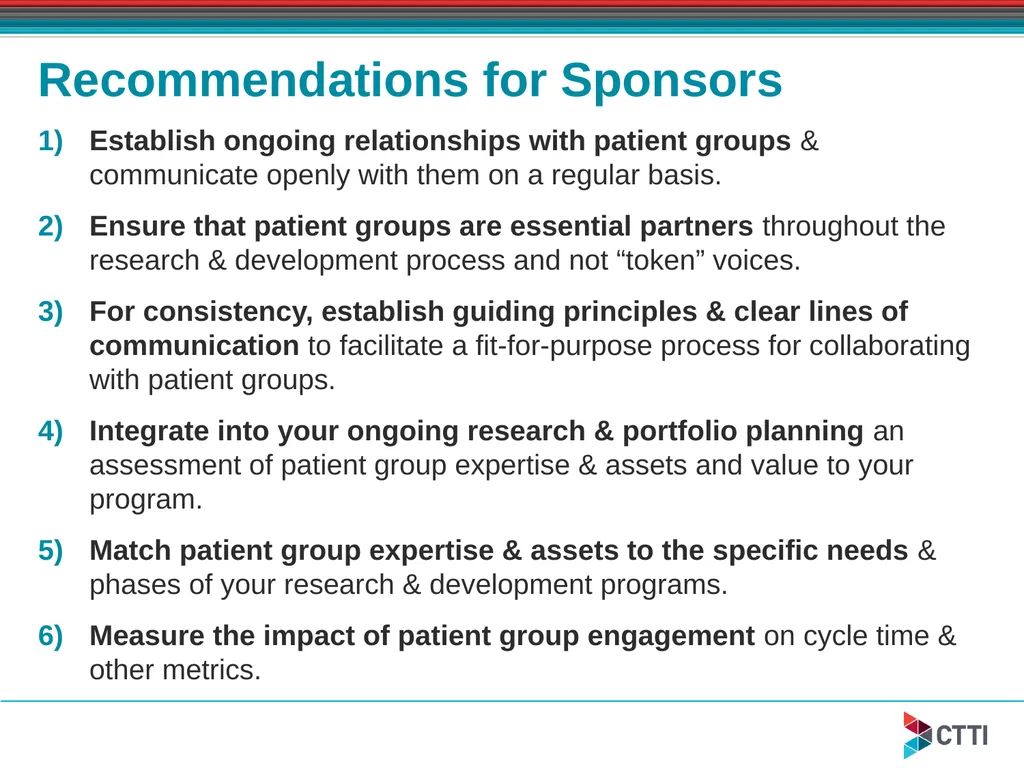
Recommendations for Sponsors Establish ongoing relationships with patient groups & communicate openly with them on a regular basis.
Ensure that patient groups are essential partners throughout the research & development process and not “token” voices.
For consistency, establish guiding principles & clear lines of communication to facilitate a fit-for-purpose process for collaborating with patient groups.
Integrate into your ongoing research & portfolio planning an assessment of patient group expertise & assets and value to your program.
Match patient group expertise & assets to the specific needs & phases of your research & development programs.
Measure the impact of patient group engagement on cycle time & other metrics.<br>
Ensure that patient groups are essential partners throughout the research & development process and not “token” voices.
For consistency, establish guiding principles & clear lines of communication to facilitate a fit-for-purpose process for collaborating with patient groups.
Integrate into your ongoing research & portfolio planning an assessment of patient group expertise & assets and value to your program.
Match patient group expertise & assets to the specific needs & phases of your research & development programs.
Measure the impact of patient group engagement on cycle time & other metrics.<br>
34
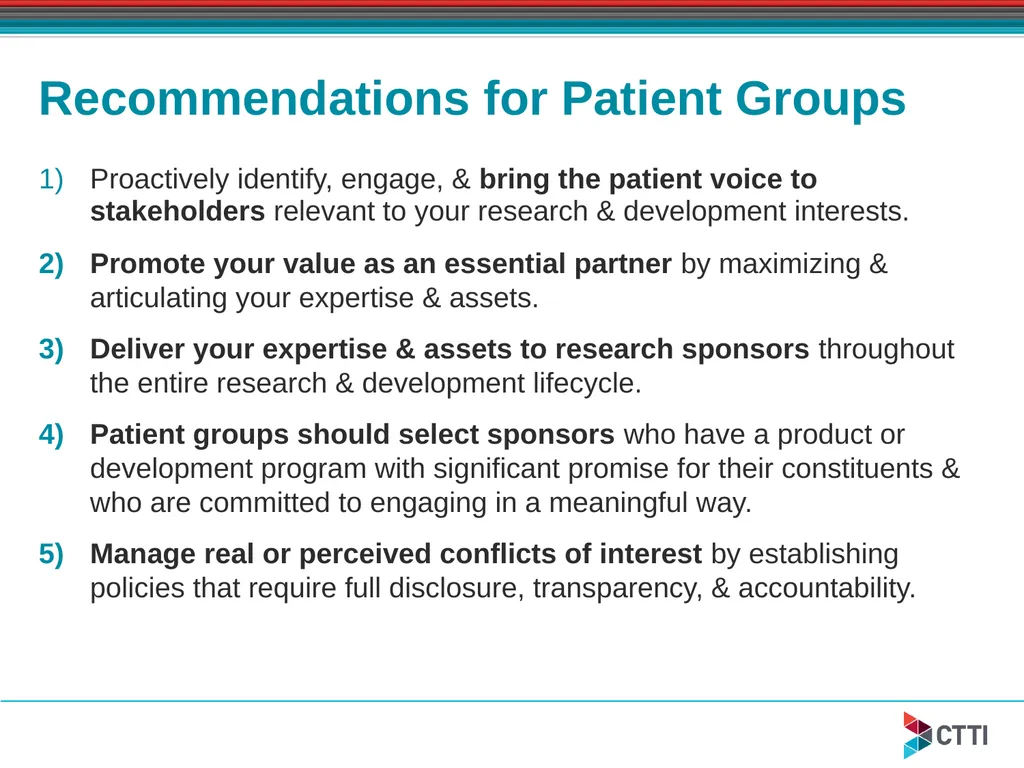
Recommendations for Patient Groups Proactively identify, engage, & bring the patient voice to stakeholders relevant to your research & development interests.
Promote your value as an essential partner by maximizing & articulating your expertise & assets.
Deliver your expertise & assets to research sponsors throughout the entire research & development lifecycle.
Patient groups should select sponsors who have a product or development program with significant promise for their constituents & who are committed to engaging in a meaningful way.
Manage real or perceived conflicts of interest by establishing policies that require full disclosure, transparency, & accountability.<br>
Promote your value as an essential partner by maximizing & articulating your expertise & assets.
Deliver your expertise & assets to research sponsors throughout the entire research & development lifecycle.
Patient groups should select sponsors who have a product or development program with significant promise for their constituents & who are committed to engaging in a meaningful way.
Manage real or perceived conflicts of interest by establishing policies that require full disclosure, transparency, & accountability.<br>
35
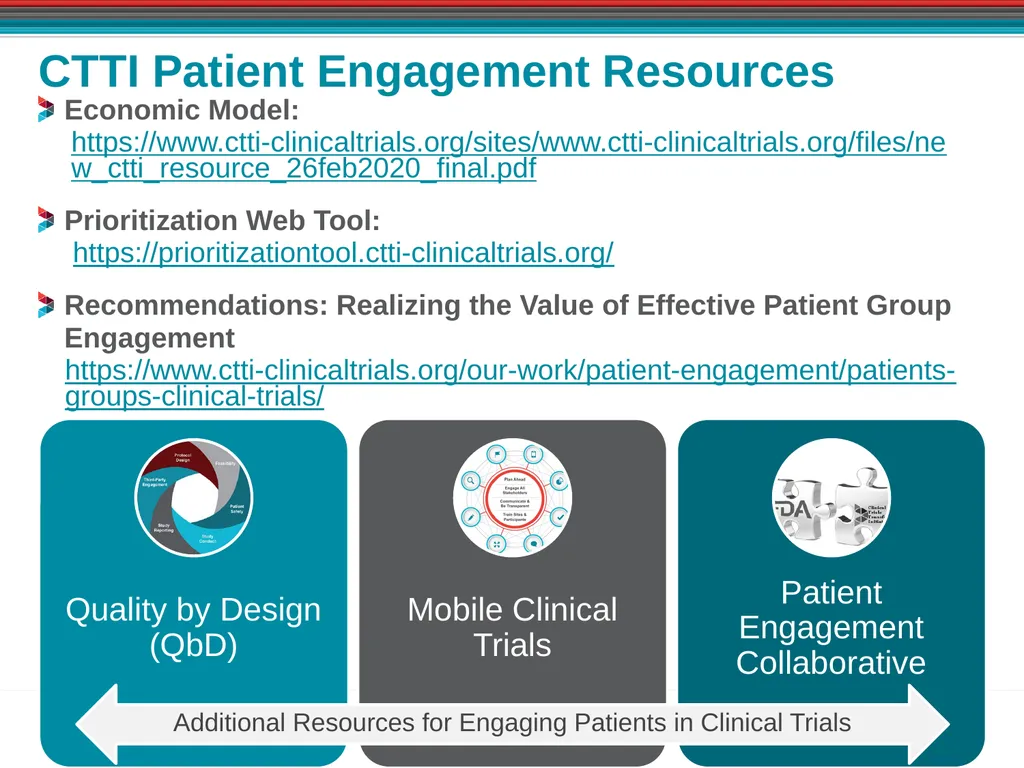
CTTI Patient Engagement Resources Economic Model:
https://www.ctti-clinicaltrials.org/sites/www.ctti-clinicaltrials.org/files/new_ctti_resource_26feb2020_final.pdf
Prioritization Web Tool:
https://prioritizationtool.ctti-clinicaltrials.org/
Recommendations: Realizing the Value of Effective Patient Group Engagement
https://www.ctti-clinicaltrials.org/our-work/patient-engagement/patients-groups-clinical-trials/ Additional Resources for Engaging Patients in Clinical Trials<br>
https://www.ctti-clinicaltrials.org/sites/www.ctti-clinicaltrials.org/files/new_ctti_resource_26feb2020_final.pdf
Prioritization Web Tool:
https://prioritizationtool.ctti-clinicaltrials.org/
Recommendations: Realizing the Value of Effective Patient Group Engagement
https://www.ctti-clinicaltrials.org/our-work/patient-engagement/patients-groups-clinical-trials/ Additional Resources for Engaging Patients in Clinical Trials<br>
36
Webinar recording & slides available at:
https://www.ctti-clinicaltrials.org/webinars/<br>
https://www.ctti-clinicaltrials.org/webinars/<br>