
Welcome To The Webinar We will begin at 2 pm
YM
Published · 30 slides · 0 views

1 / 1
Description
Welcome To The Webinar We will begin at 2 pm Eastern Time Basic Requirements of the McKinney-Vento Act National Center for Homeless Education Jacinda Goodwin Program Specialist NCHE jgoodwinserve.org Meet Your Presenters Christina Endres
Related Topics
Share
Embed code
Download this presentation From Below
"Welcome To The Webinar We will begin at 2 pm" is the property of its rightful owner. Permission is granted to download and print the materials on this website for personal, non-commercial use only, and to display it on your personal computer provided you do not modify the materials and that you retain all copyright notices contained in the materials. By downloading content from our website, you accept the terms of this agreement.
Presentation Transcript
01
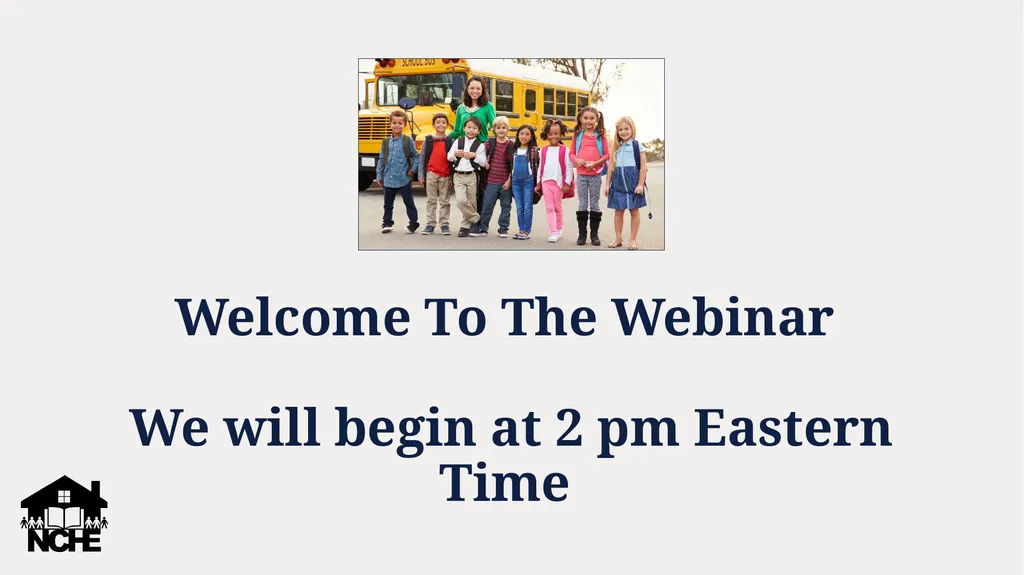
Welcome To The Webinar
We will begin at 2 pm Eastern Time<br>
02
Basic Requirements of the
McKinney-Vento Act National Center for Homeless Education<br>
03
Jacinda Goodwin
Program Specialist
NCHE
jgoodwin@serve.org Meet Your Presenters Christina Endres
Program Specialist
NCHE
cendres@serve.org<br>
Program Specialist
NCHE
jgoodwin@serve.org Meet Your Presenters Christina Endres
Program Specialist
NCHE
cendres@serve.org<br>
04
About NCHE NCHE is the U.S. Department of Education’s technical assistance center for the federal Education for Homeless Children and Youth (EHCY) Program.
Website: http://nche.ed.gov
Helpline: 800-308-2145 or homeless@serve.org
Products: https://nche.ed.gov/resources/
Webinars: https://nche.ed.gov/group-training/
Listserv: https://nche.ed.gov/resources/ (click Listserv tab)
Twitter: @NCHEducation | Facebook: facebook.com/NCHEducation<br>
Website: http://nche.ed.gov
Helpline: 800-308-2145 or homeless@serve.org
Products: https://nche.ed.gov/resources/
Webinars: https://nche.ed.gov/group-training/
Listserv: https://nche.ed.gov/resources/ (click Listserv tab)
Twitter: @NCHEducation | Facebook: facebook.com/NCHEducation<br>
05
By the end of this session participants will be able to… Explain the criteria for a student to be considered a homeless child or youth (HCY) under the McKinney-Vento Homeless Assistance Act (MV)
Explain the responsibilities of a local educational agency (LEA) homeless liaison
Identify the basic rights of students experiencing homelessness and LEA responsibilities for ensuring those rights<br>
Explain the responsibilities of a local educational agency (LEA) homeless liaison
Identify the basic rights of students experiencing homelessness and LEA responsibilities for ensuring those rights<br>
06
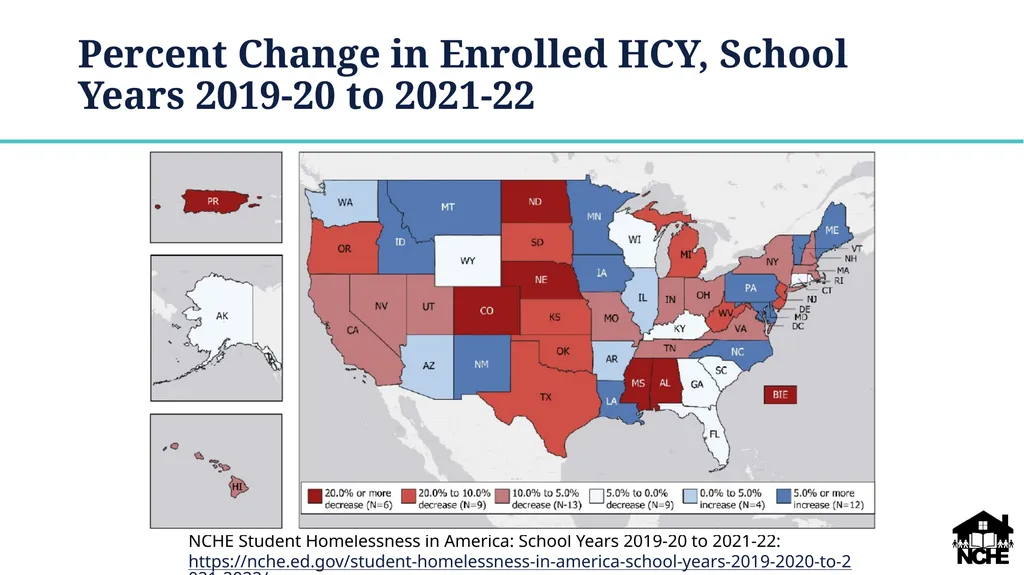
Percent Change in Enrolled HCY, School Years 2019-20 to 2021-22 NCHE Student Homelessness in America: School Years 2019-20 to 2021-22: https://nche.ed.gov/student-homelessness-in-america-school-years-2019-2020-to-2021-2022/<br>
07
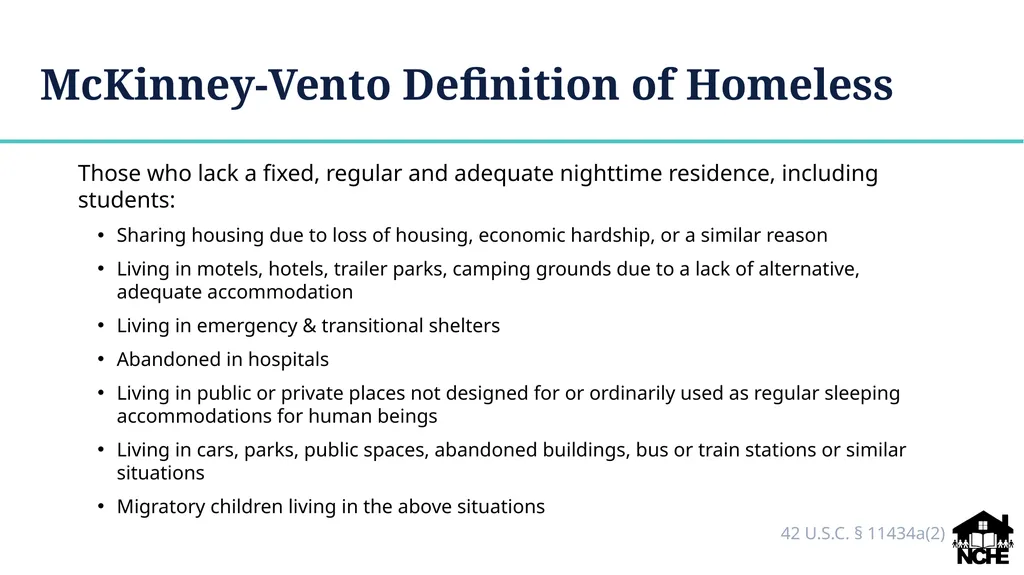
McKinney-Vento Definition of Homeless Those who lack a fixed, regular and adequate nighttime residence, including students:
Sharing housing due to loss of housing, economic hardship, or a similar reason
Living in motels, hotels, trailer parks, camping grounds due to a lack of alternative, adequate accommodation
Living in emergency & transitional shelters
Abandoned in hospitals
Living in public or private places not designed for or ordinarily used as regular sleeping accommodations for human beings
Living in cars, parks, public spaces, abandoned buildings, bus or train stations or similar situations
Migratory children living in the above situations
42 U.S.C. § 11434a(2)<br>
Sharing housing due to loss of housing, economic hardship, or a similar reason
Living in motels, hotels, trailer parks, camping grounds due to a lack of alternative, adequate accommodation
Living in emergency & transitional shelters
Abandoned in hospitals
Living in public or private places not designed for or ordinarily used as regular sleeping accommodations for human beings
Living in cars, parks, public spaces, abandoned buildings, bus or train stations or similar situations
Migratory children living in the above situations
42 U.S.C. § 11434a(2)<br>
08
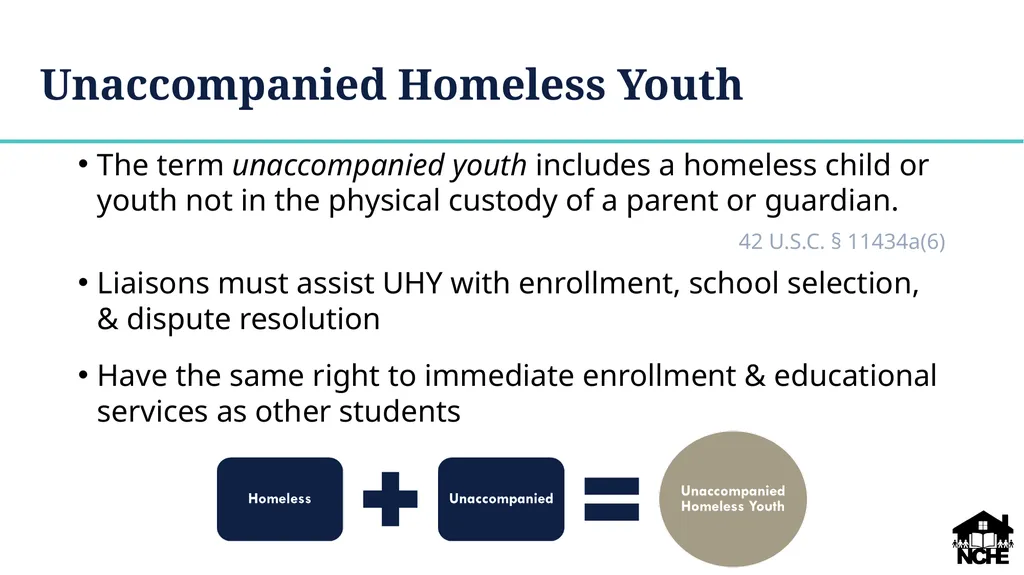
Unaccompanied Homeless Youth The term unaccompanied youth includes a homeless child or youth not in the physical custody of a parent or guardian.
42 U.S.C. § 11434a(6)
Liaisons must assist UHY with enrollment, school selection, & dispute resolution
Have the same right to immediate enrollment & educational services as other students<br>
42 U.S.C. § 11434a(6)
Liaisons must assist UHY with enrollment, school selection, & dispute resolution
Have the same right to immediate enrollment & educational services as other students<br>
09
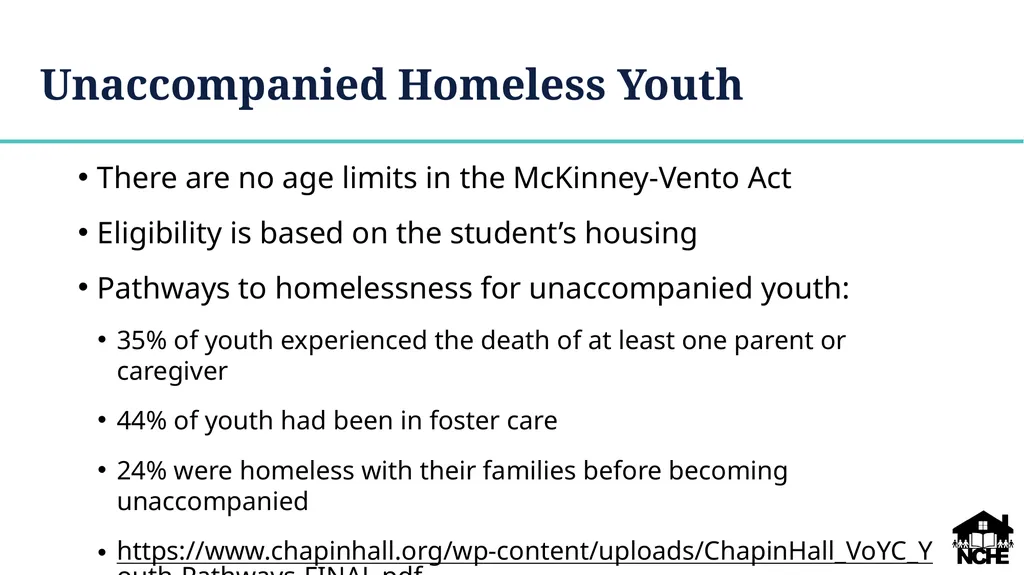
Unaccompanied Homeless Youth There are no age limits in the McKinney-Vento Act
Eligibility is based on the student’s housing
Pathways to homelessness for unaccompanied youth:
35% of youth experienced the death of at least one parent or caregiver
44% of youth had been in foster care
24% were homeless with their families before becoming unaccompanied
https://www.chapinhall.org/wp-content/uploads/ChapinHall_VoYC_Youth-Pathways-FINAL.pdf<br>
Eligibility is based on the student’s housing
Pathways to homelessness for unaccompanied youth:
35% of youth experienced the death of at least one parent or caregiver
44% of youth had been in foster care
24% were homeless with their families before becoming unaccompanied
https://www.chapinhall.org/wp-content/uploads/ChapinHall_VoYC_Youth-Pathways-FINAL.pdf<br>
10
Local Liaison Duties Ensure HCY are identified in coordination with others
Ensure immediate enrollment & access to services
Provide information about rights & opportunities
Includes meaningful opportunities for parents to participate in their children’s education
Includes transportation, school meals, & other programs
Ensure disputes are mediated
May affirm for Housing and Urban Development programs that HCY meet MV eligibility criteria<br>
Ensure immediate enrollment & access to services
Provide information about rights & opportunities
Includes meaningful opportunities for parents to participate in their children’s education
Includes transportation, school meals, & other programs
Ensure disputes are mediated
May affirm for Housing and Urban Development programs that HCY meet MV eligibility criteria<br>
11
Local Liaison Duties Support UHY in school selection & dispute resolution
Ensure UHY are provided verification of their status for FAFSA purposes
Provide training & other support for school personnel
Provide referrals to services in the community
Collaborate & coordinate services with State Coordinators, community and school personnel
Includes collecting & reporting data
42 U.S.C. § 11434(g)(6)<br>
Ensure UHY are provided verification of their status for FAFSA purposes
Provide training & other support for school personnel
Provide referrals to services in the community
Collaborate & coordinate services with State Coordinators, community and school personnel
Includes collecting & reporting data
42 U.S.C. § 11434(g)(6)<br>
12
Requirement to Remove Barriers States and school districts must develop, review, and revise policies
To remove barriers to the school identification, enrollment and retention of McKinney-Vento students
Includes barriers due to outstanding fees or fines, or absences
42 U.S.C. § 11432(g)(1)(I)
Question A-4 of EHCY Non-Regulatory Guidance provides the following information on ensuring homeless students have equal access to public education
Review of policy and practices is a broad, ongoing requirement
Reviews should include input from parents, students, and advocates
Should include review of discipline policies that disproportionately impact homeless students
https://oese.ed.gov/files/2020/07/160240ehcyguidanceupdated082718.pdf<br>
To remove barriers to the school identification, enrollment and retention of McKinney-Vento students
Includes barriers due to outstanding fees or fines, or absences
42 U.S.C. § 11432(g)(1)(I)
Question A-4 of EHCY Non-Regulatory Guidance provides the following information on ensuring homeless students have equal access to public education
Review of policy and practices is a broad, ongoing requirement
Reviews should include input from parents, students, and advocates
Should include review of discipline policies that disproportionately impact homeless students
https://oese.ed.gov/files/2020/07/160240ehcyguidanceupdated082718.pdf<br>
13
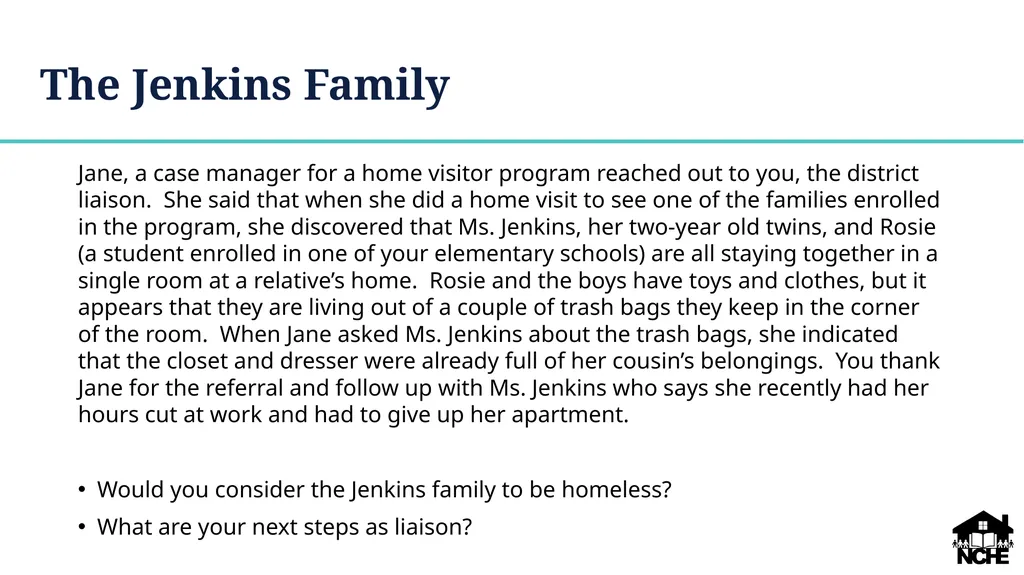
The Jenkins Family Jane, a case manager for a home visitor program reached out to you, the district liaison. She said that when she did a home visit to see one of the families enrolled in the program, she discovered that Ms. Jenkins, her two-year old twins, and Rosie (a student enrolled in one of your elementary schools) are all staying together in a single room at a relative’s home. Rosie and the boys have toys and clothes, but it appears that they are living out of a couple of trash bags they keep in the corner of the room. When Jane asked Ms. Jenkins about the trash bags, she indicated that the closet and dresser were already full of her cousin’s belongings. You thank Jane for the referral and follow up with Ms. Jenkins who says she recently had her hours cut at work and had to give up her apartment.
Would you consider the Jenkins family to be homeless?
What are your next steps as liaison?<br>
Would you consider the Jenkins family to be homeless?
What are your next steps as liaison?<br>
14
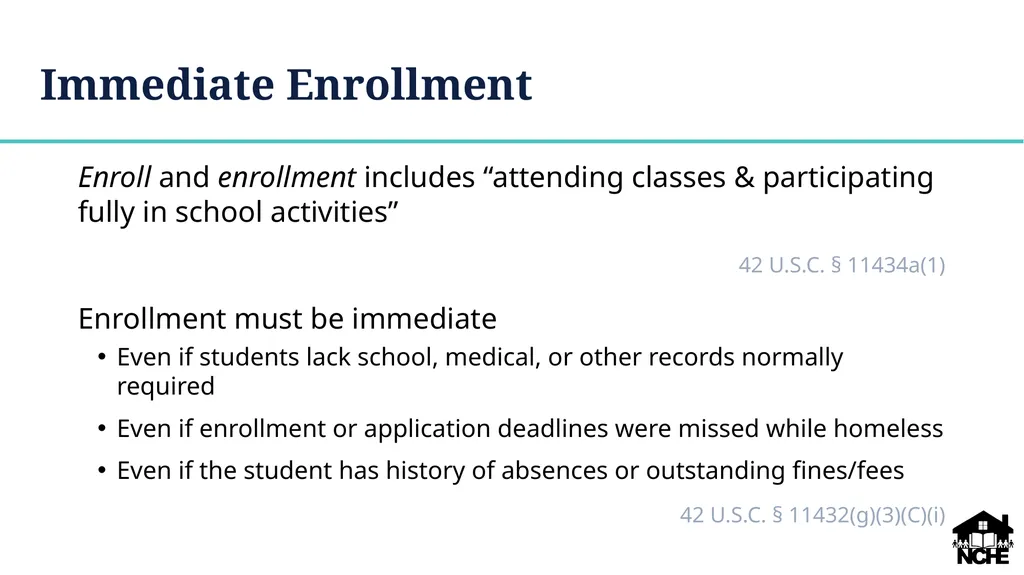
Immediate Enrollment Enroll and enrollment includes “attending classes & participating fully in school activities”
42 U.S.C. § 11434a(1)
Enrollment must be immediate
Even if students lack school, medical, or other records normally required
Even if enrollment or application deadlines were missed while homeless
Even if the student has history of absences or outstanding fines/fees
42 U.S.C. § 11432(g)(3)(C)(i)<br>
42 U.S.C. § 11434a(1)
Enrollment must be immediate
Even if students lack school, medical, or other records normally required
Even if enrollment or application deadlines were missed while homeless
Even if the student has history of absences or outstanding fines/fees
42 U.S.C. § 11432(g)(3)(C)(i)<br>
15
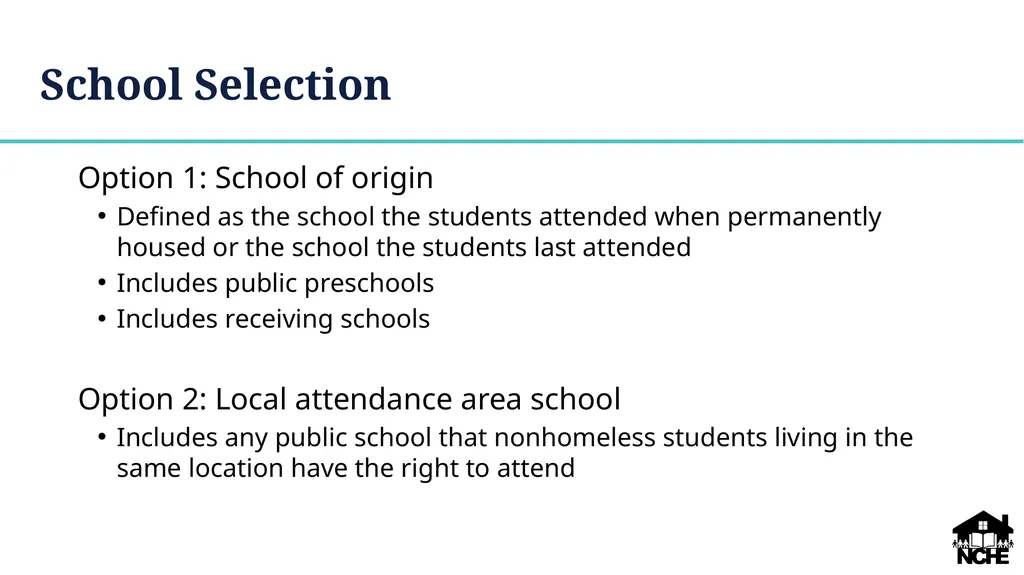
School Selection Option 1: School of origin
Defined as the school the students attended when permanently housed or the school the students last attended
Includes public preschools
Includes receiving schools
Option 2: Local attendance area school
Includes any public school that nonhomeless students living in the same location have the right to attend<br>
Defined as the school the students attended when permanently housed or the school the students last attended
Includes public preschools
Includes receiving schools
Option 2: Local attendance area school
Includes any public school that nonhomeless students living in the same location have the right to attend<br>
16
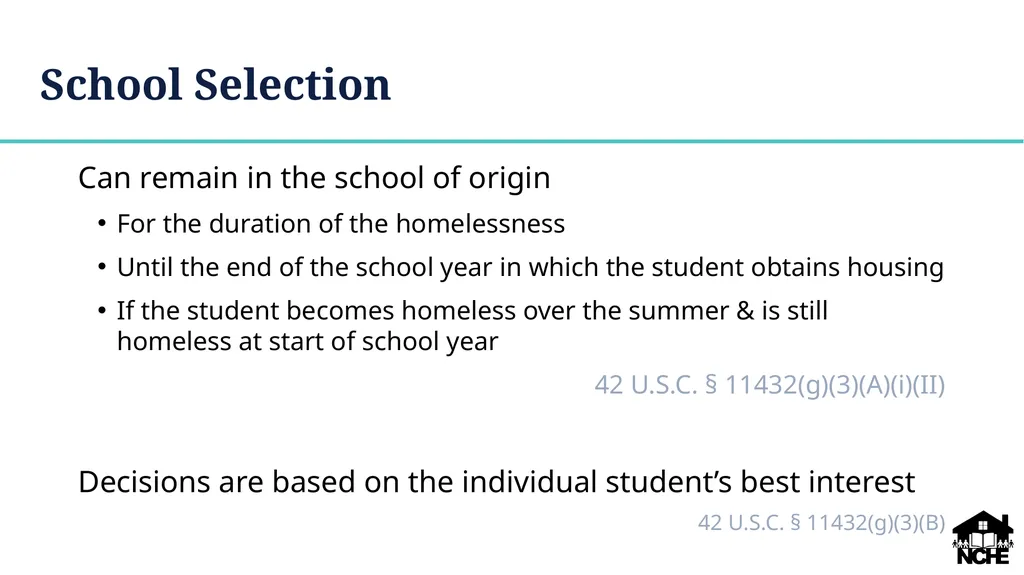
School Selection Can remain in the school of origin
For the duration of the homelessness
Until the end of the school year in which the student obtains housing
If the student becomes homeless over the summer & is still homeless at start of school year
42 U.S.C. § 11432(g)(3)(A)(i)(II)
Decisions are based on the individual student’s best interest
42 U.S.C. § 11432(g)(3)(B)<br>
For the duration of the homelessness
Until the end of the school year in which the student obtains housing
If the student becomes homeless over the summer & is still homeless at start of school year
42 U.S.C. § 11432(g)(3)(A)(i)(II)
Decisions are based on the individual student’s best interest
42 U.S.C. § 11432(g)(3)(B)<br>
17
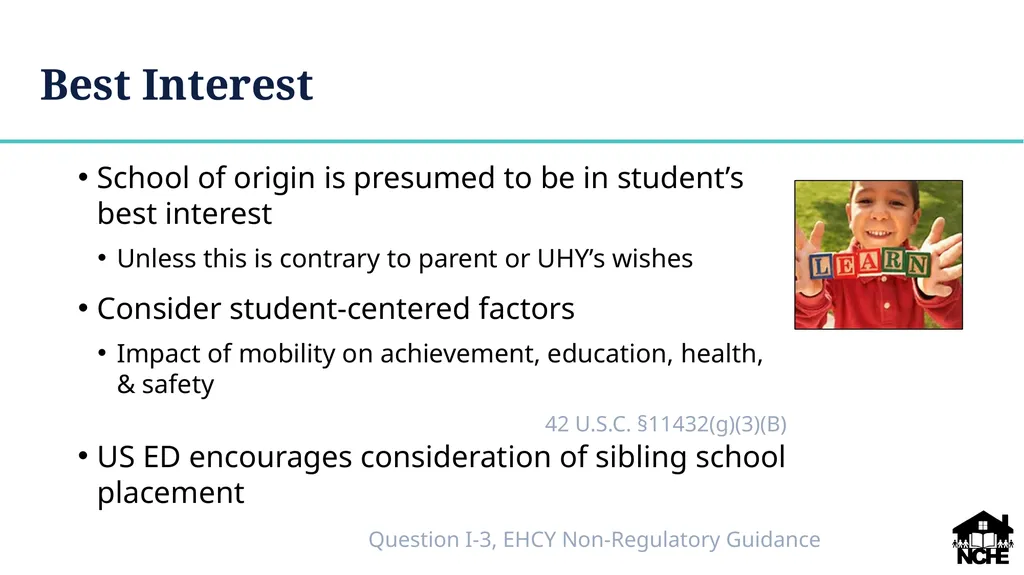
Best Interest School of origin is presumed to be in student’s best interest
Unless this is contrary to parent or UHY’s wishes
Consider student-centered factors
Impact of mobility on achievement, education, health, & safety
42 U.S.C. §11432(g)(3)(B) US ED encourages consideration of sibling school placement
Question I-3, EHCY Non-Regulatory Guidance<br>
Unless this is contrary to parent or UHY’s wishes
Consider student-centered factors
Impact of mobility on achievement, education, health, & safety
42 U.S.C. §11432(g)(3)(B) US ED encourages consideration of sibling school placement
Question I-3, EHCY Non-Regulatory Guidance<br>
18
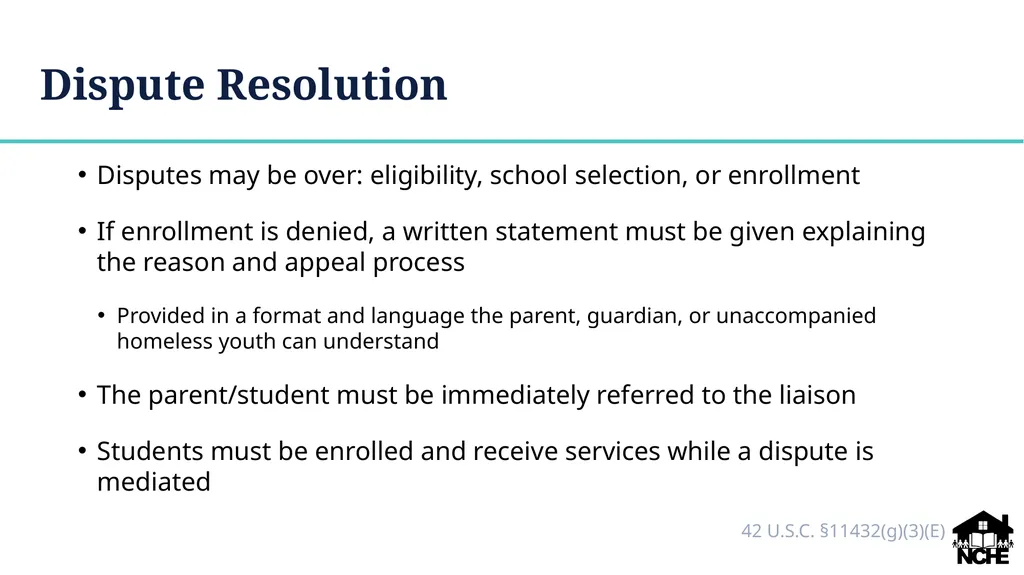
Dispute Resolution Disputes may be over: eligibility, school selection, or enrollment
If enrollment is denied, a written statement must be given explaining the reason and appeal process
Provided in a format and language the parent, guardian, or unaccompanied homeless youth can understand
The parent/student must be immediately referred to the liaison
Students must be enrolled and receive services while a dispute is mediated
42 U.S.C. §11432(g)(3)(E)<br>
If enrollment is denied, a written statement must be given explaining the reason and appeal process
Provided in a format and language the parent, guardian, or unaccompanied homeless youth can understand
The parent/student must be immediately referred to the liaison
Students must be enrolled and receive services while a dispute is mediated
42 U.S.C. §11432(g)(3)(E)<br>
19
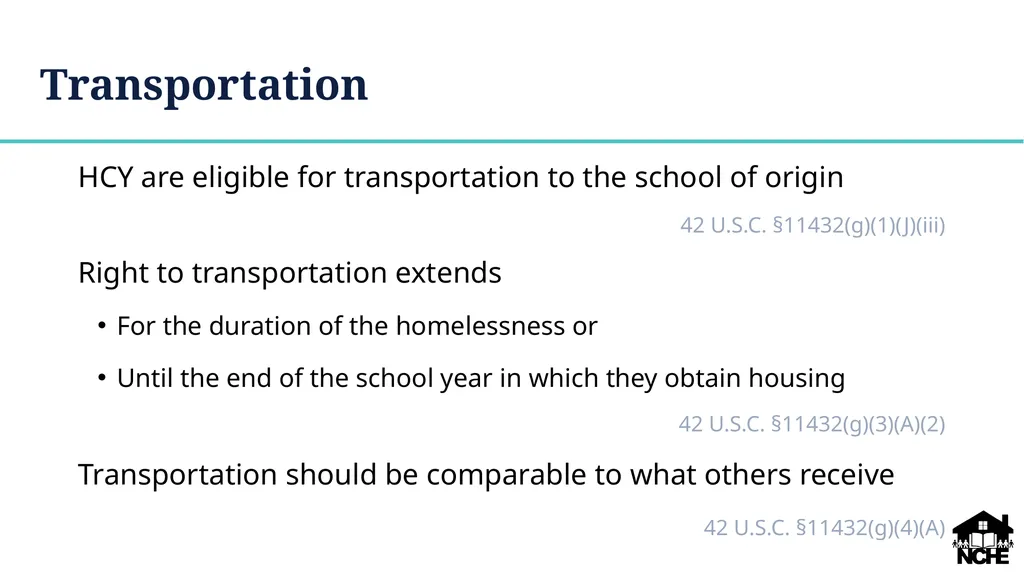
Transportation HCY are eligible for transportation to the school of origin
42 U.S.C. §11432(g)(1)(J)(iii)
Right to transportation extends
For the duration of the homelessness or
Until the end of the school year in which they obtain housing
42 U.S.C. §11432(g)(3)(A)(2)
Transportation should be comparable to what others receive
42 U.S.C. §11432(g)(4)(A)<br>
42 U.S.C. §11432(g)(1)(J)(iii)
Right to transportation extends
For the duration of the homelessness or
Until the end of the school year in which they obtain housing
42 U.S.C. §11432(g)(3)(A)(2)
Transportation should be comparable to what others receive
42 U.S.C. §11432(g)(4)(A)<br>
20
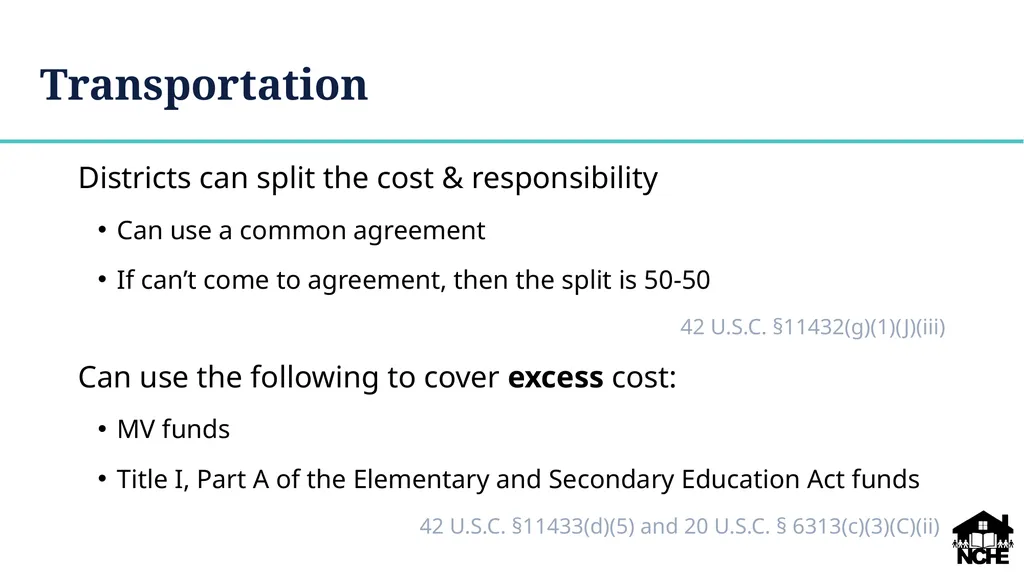
Transportation Districts can split the cost & responsibility
Can use a common agreement
If can’t come to agreement, then the split is 50-50
42 U.S.C. §11432(g)(1)(J)(iii)
Can use the following to cover excess cost:
MV funds
Title I, Part A of the Elementary and Secondary Education Act funds
42 U.S.C. §11433(d)(5) and 20 U.S.C. § 6313(c)(3)(C)(ii)<br>
Can use a common agreement
If can’t come to agreement, then the split is 50-50
42 U.S.C. §11432(g)(1)(J)(iii)
Can use the following to cover excess cost:
MV funds
Title I, Part A of the Elementary and Secondary Education Act funds
42 U.S.C. §11433(d)(5) and 20 U.S.C. § 6313(c)(3)(C)(ii)<br>
21
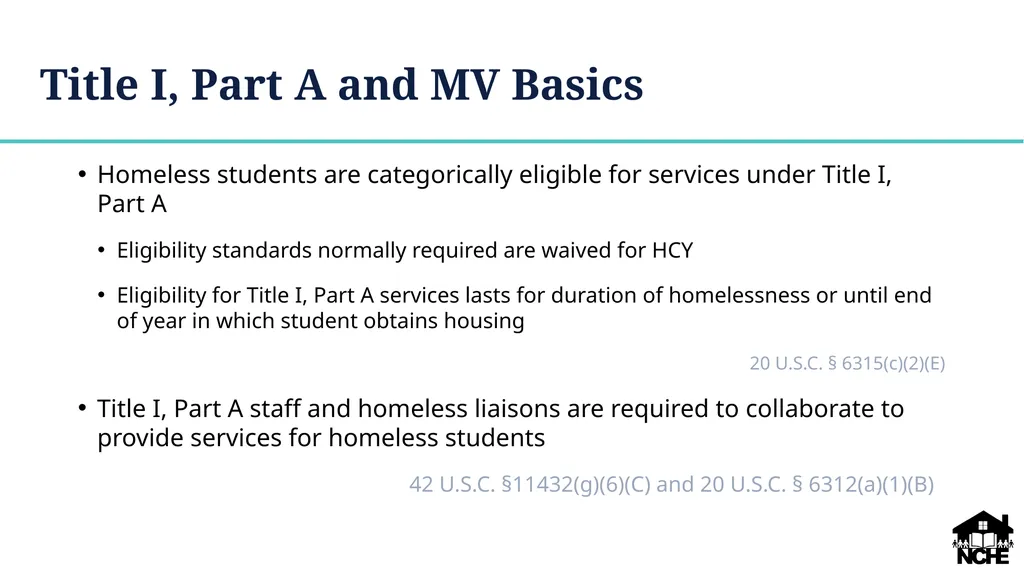
Title I, Part A and MV Basics Homeless students are categorically eligible for services under Title I, Part A
Eligibility standards normally required are waived for HCY
Eligibility for Title I, Part A services lasts for duration of homelessness or until end of year in which student obtains housing
20 U.S.C. § 6315(c)(2)(E)
Title I, Part A staff and homeless liaisons are required to collaborate to provide services for homeless students
42 U.S.C. §11432(g)(6)(C) and 20 U.S.C. § 6312(a)(1)(B)<br>
Eligibility standards normally required are waived for HCY
Eligibility for Title I, Part A services lasts for duration of homelessness or until end of year in which student obtains housing
20 U.S.C. § 6315(c)(2)(E)
Title I, Part A staff and homeless liaisons are required to collaborate to provide services for homeless students
42 U.S.C. §11432(g)(6)(C) and 20 U.S.C. § 6312(a)(1)(B)<br>
22
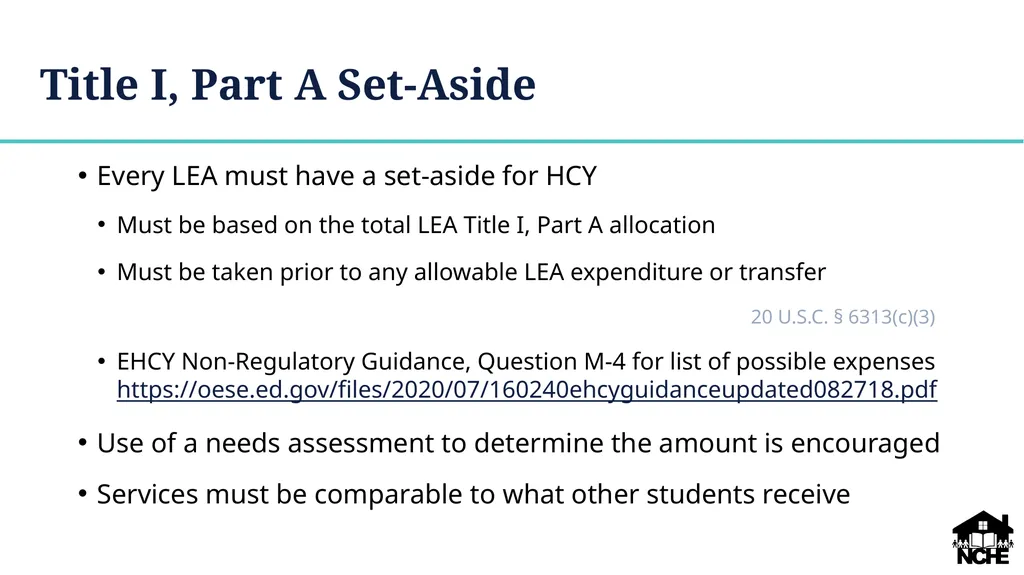
Title I, Part A Set-Aside Every LEA must have a set-aside for HCY
Must be based on the total LEA Title I, Part A allocation
Must be taken prior to any allowable LEA expenditure or transfer
20 U.S.C. § 6313(c)(3)
EHCY Non-Regulatory Guidance, Question M-4 for list of possible expenses https://oese.ed.gov/files/2020/07/160240ehcyguidanceupdated082718.pdf
Use of a needs assessment to determine the amount is encouraged
Services must be comparable to what other students receive<br>
Must be based on the total LEA Title I, Part A allocation
Must be taken prior to any allowable LEA expenditure or transfer
20 U.S.C. § 6313(c)(3)
EHCY Non-Regulatory Guidance, Question M-4 for list of possible expenses https://oese.ed.gov/files/2020/07/160240ehcyguidanceupdated082718.pdf
Use of a needs assessment to determine the amount is encouraged
Services must be comparable to what other students receive<br>
23
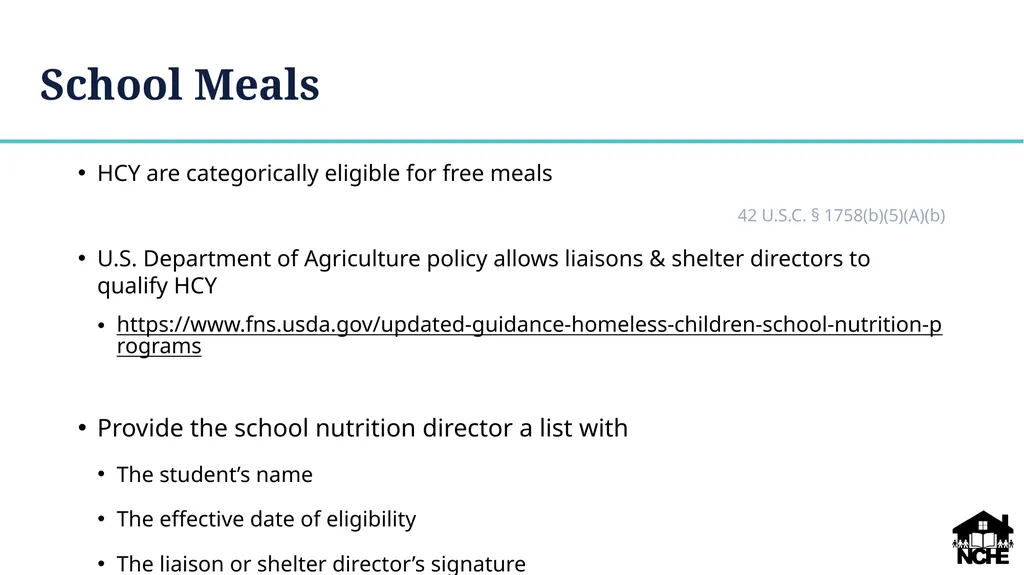
School Meals HCY are categorically eligible for free meals
42 U.S.C. § 1758(b)(5)(A)(b)
U.S. Department of Agriculture policy allows liaisons & shelter directors to qualify HCY
https://www.fns.usda.gov/updated-guidance-homeless-children-school-nutrition-programs
Provide the school nutrition director a list with
The student’s name
The effective date of eligibility
The liaison or shelter director’s signature<br>
42 U.S.C. § 1758(b)(5)(A)(b)
U.S. Department of Agriculture policy allows liaisons & shelter directors to qualify HCY
https://www.fns.usda.gov/updated-guidance-homeless-children-school-nutrition-programs
Provide the school nutrition director a list with
The student’s name
The effective date of eligibility
The liaison or shelter director’s signature<br>
24
Credit Accrual Districts must have clear procedures in place to award full or partial credit for work completed in a previous district
42 U.S.C. §11432(g)(1)(F)(ii)
Examples:
Consult with the prior school to evaluate the work completed
Evaluate the student’s mastery of courses & award credits accordingly
Offer credit recovery or mastery- based courses
Offer distance learning<br>
42 U.S.C. §11432(g)(1)(F)(ii)
Examples:
Consult with the prior school to evaluate the work completed
Evaluate the student’s mastery of courses & award credits accordingly
Offer credit recovery or mastery- based courses
Offer distance learning<br>
25
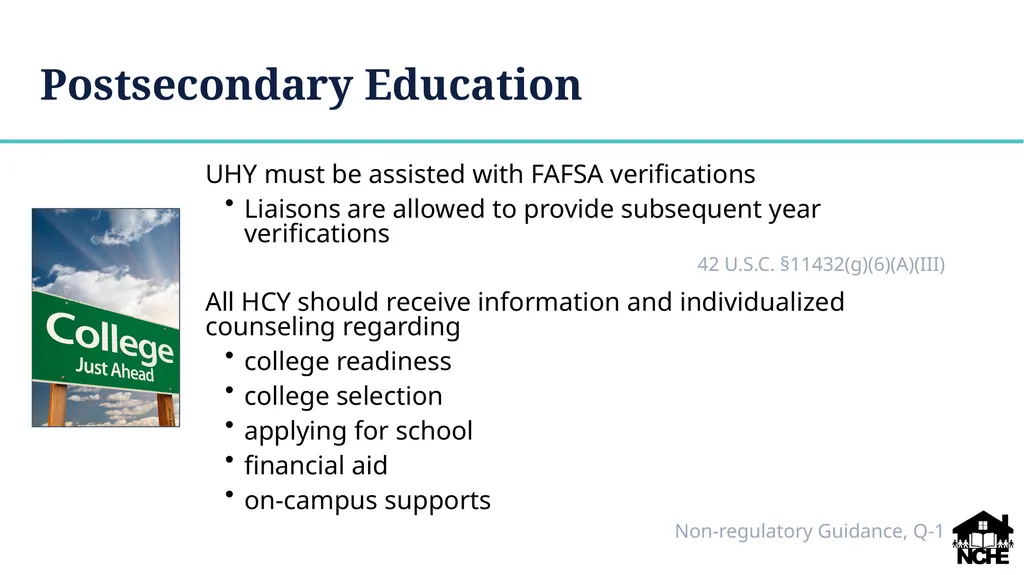
Postsecondary Education UHY must be assisted with FAFSA verifications
Liaisons are allowed to provide subsequent year verifications
42 U.S.C. §11432(g)(6)(A)(III)
All HCY should receive information and individualized counseling regarding
college readiness
college selection
applying for school
financial aid
on-campus supports
Non-regulatory Guidance, Q-1<br>
Liaisons are allowed to provide subsequent year verifications
42 U.S.C. §11432(g)(6)(A)(III)
All HCY should receive information and individualized counseling regarding
college readiness
college selection
applying for school
financial aid
on-campus supports
Non-regulatory Guidance, Q-1<br>
26
The Brown Family Franklin and his daughter Violet had to go stay with Franklin’s mother after they were evicted from their apartment. They were referred to you and you were able to designate Violet as homeless right away. Her grandmother’s home is out of your school district, so you also arranged to keep Violet in the school of origin, where she’s been attending ever since. That was over a year and a half ago and the new school year is about to begin. When you check in with Franklin, you ask him how much longer they’ll be at his mother’s home. He says it’s become apparent that his mother’s health is not what it used to be. As a result, he’s not sure when they’ll be able to move out because they need to work out a care plan for his mother first. However, he stresses that it is still their plan to get a place of their own for him and Violet as soon as they can.
Would you consider Franklin and his daughter to be homeless?<br>
Would you consider Franklin and his daughter to be homeless?<br>
27
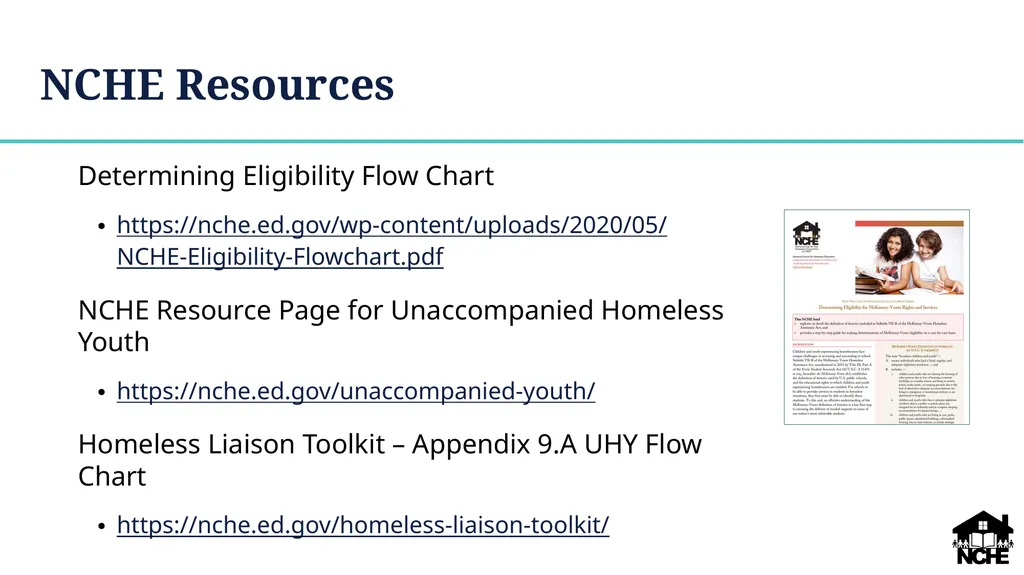
NCHE Resources Determining Eligibility Flow Chart
https://nche.ed.gov/wp-content/uploads/2020/05/ NCHE-Eligibility-Flowchart.pdf
NCHE Resource Page for Unaccompanied Homeless Youth
https://nche.ed.gov/unaccompanied-youth/
Homeless Liaison Toolkit – Appendix 9.A UHY Flow Chart
https://nche.ed.gov/homeless-liaison-toolkit/<br>
https://nche.ed.gov/wp-content/uploads/2020/05/ NCHE-Eligibility-Flowchart.pdf
NCHE Resource Page for Unaccompanied Homeless Youth
https://nche.ed.gov/unaccompanied-youth/
Homeless Liaison Toolkit – Appendix 9.A UHY Flow Chart
https://nche.ed.gov/homeless-liaison-toolkit/<br>
28
Thank You for Joining Us! Live webinar participants will receive a follow-up e-mail shortly
Link to webpage where you can download handouts
Link to a brief, anonymous online evaluation; once your evaluation is completed, you’ll be directed to a webpage to download a certificate of completion, if desired
Presenter Contact Information:
Jacinda Goodwin – jgoodwin@serve.org
Christina Endres – cendres@serve.org<br>
Link to webpage where you can download handouts
Link to a brief, anonymous online evaluation; once your evaluation is completed, you’ll be directed to a webpage to download a certificate of completion, if desired
Presenter Contact Information:
Jacinda Goodwin – jgoodwin@serve.org
Christina Endres – cendres@serve.org<br>