
Welcome to Writing Proposal on “Academic




Description: Welcome to Writing Proposal on Academic Transformation Fund (Session 2) Md. Enayet Hossain (PhD, Curtin University, Australia) Professor, Department Tourism and Hospitality Management E-mail: mehossainyahoo.com Tel: 01711461460,
Related Topics
Download Presentation
"Welcome to Writing Proposal on “Academic" is the property of its rightful owner. Permission is granted to download and print the materials on this website for personal, non-commercial use only, and to display it on your personal computer provided you do not modify the materials and that you retain all copyright notices contained in the materials. By downloading content from our website, you accept the terms of this agreement.
Presentation Transcript
slide1. Welcome to Writing Proposal on
“Academic Transformation Fund”
(Session 2) Md. Enayet Hossain
(PhD, Curtin University, Australia)
Professor, Department Tourism and Hospitality Management
E-mail: mehossain@yahoo.com
Tel: 01711461460, 01746583853<br>
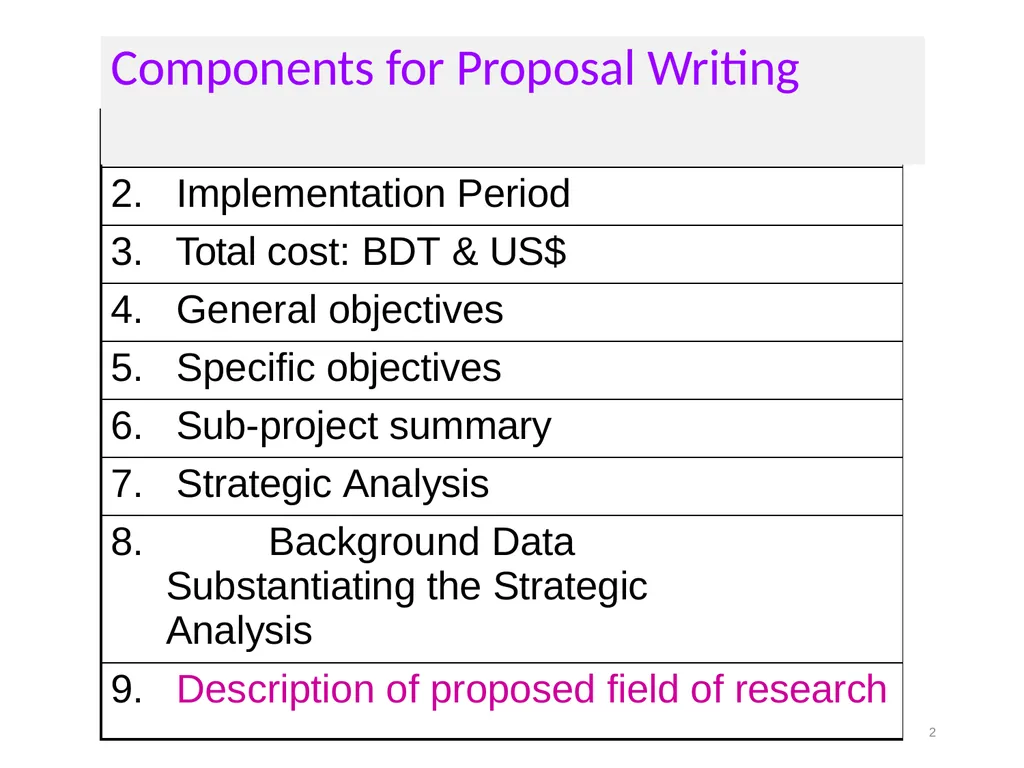
slide2. 2 Components for Proposal Writing<br>
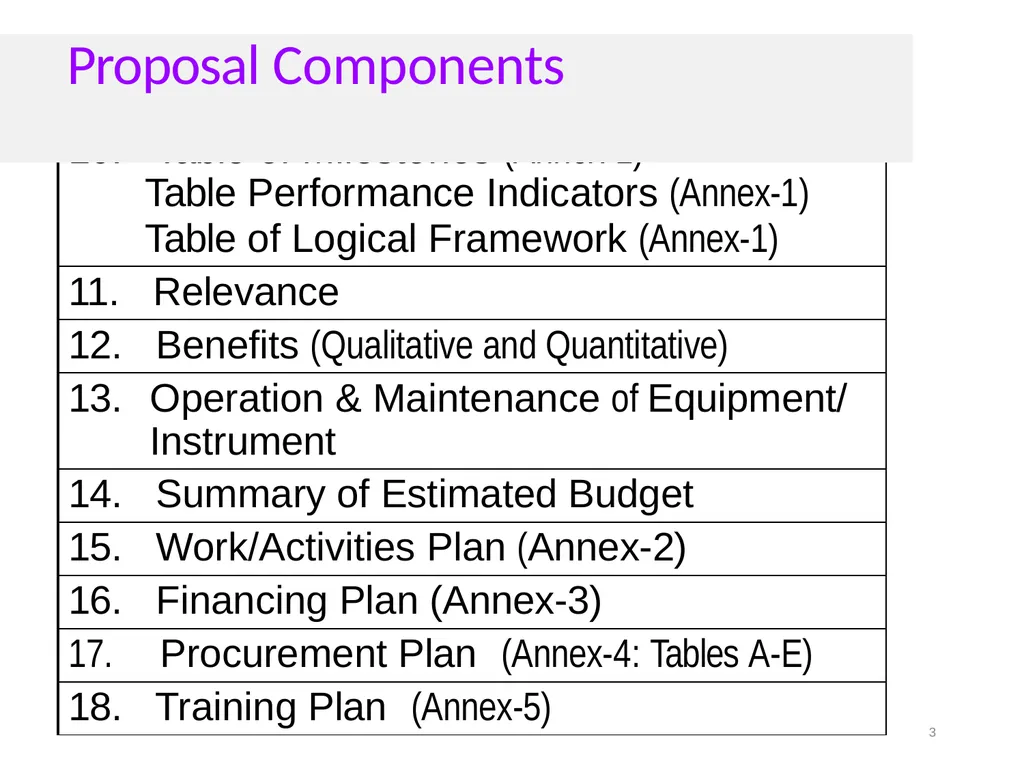
slide3. 3 Proposal Components<br>
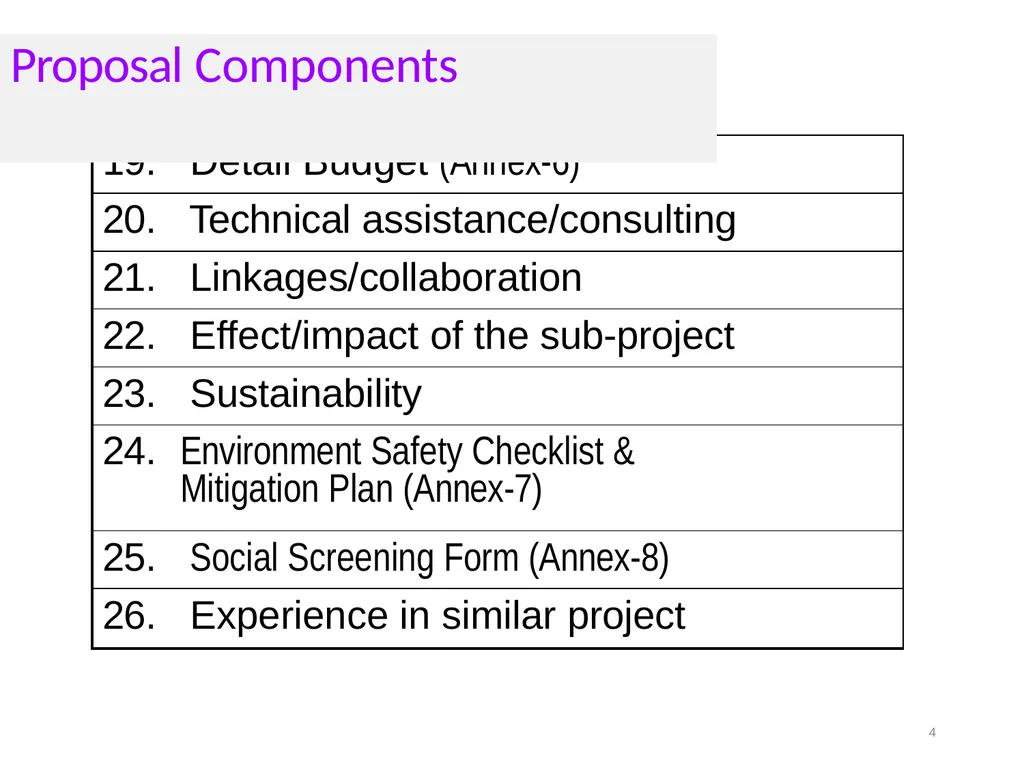
slide4. 4 Proposal Components<br>
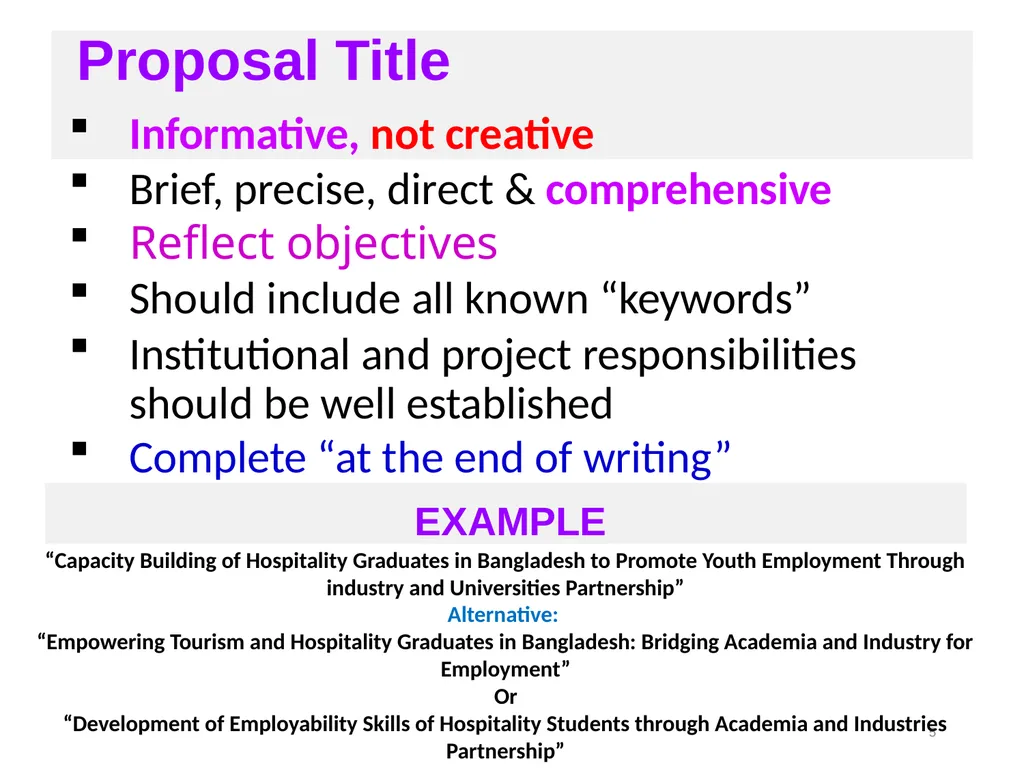
slide5. 5 Proposal Title Informative, not creative
Brief, precise, direct & comprehensive
Reflect objectives
Should include all known “keywords”
Institutional and project responsibilities should be well established
Complete “at the end of writing” “Capacity Building of Hospitality Graduates in Bangladesh to Promote Youth Employment Through industry and Universities Partnership”
Alternative:
“Empowering Tourism and Hospitality Graduates in Bangladesh: Bridging Academia and Industry for Employment”
Or
“Development of Employability Skills of Hospitality Students through Academia and Industries Partnership” EXAMPLE<br>
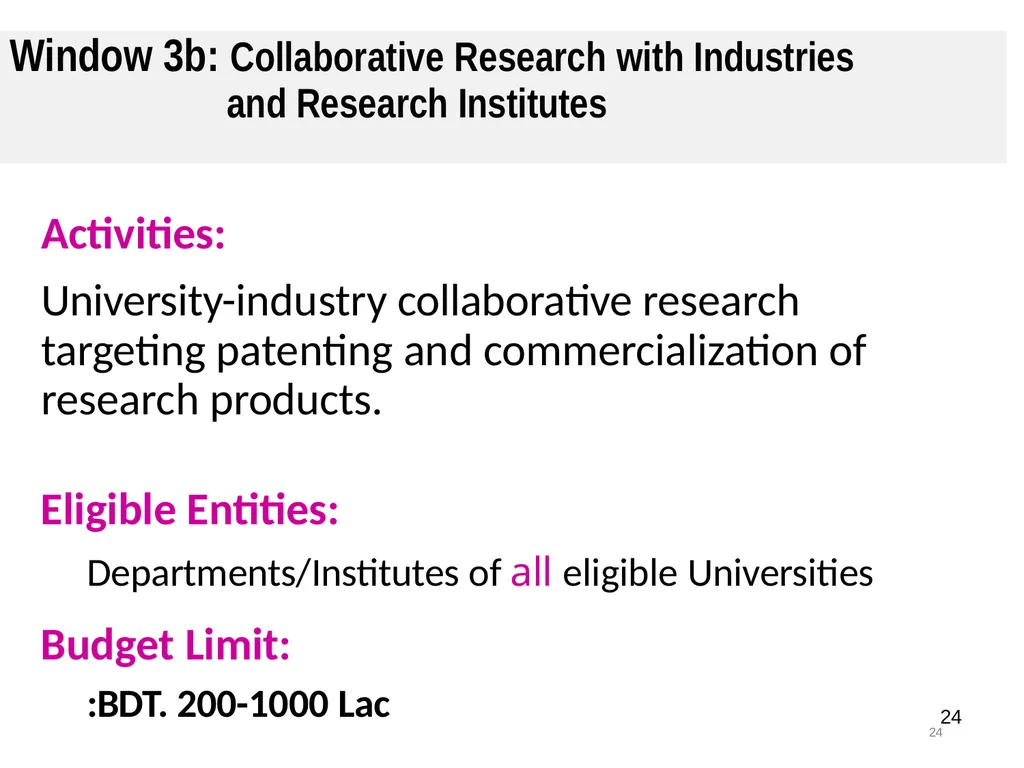
slide6. 24 Window 3b: Collaborative Research with Industries and Research Institutes Activities:
University-industry collaborative research targeting patenting and commercialization of research products. Eligible Entities:
Departments/Institutes of all eligible Universities
Budget Limit:
:BDT. 200-1000 Lac 24<br>
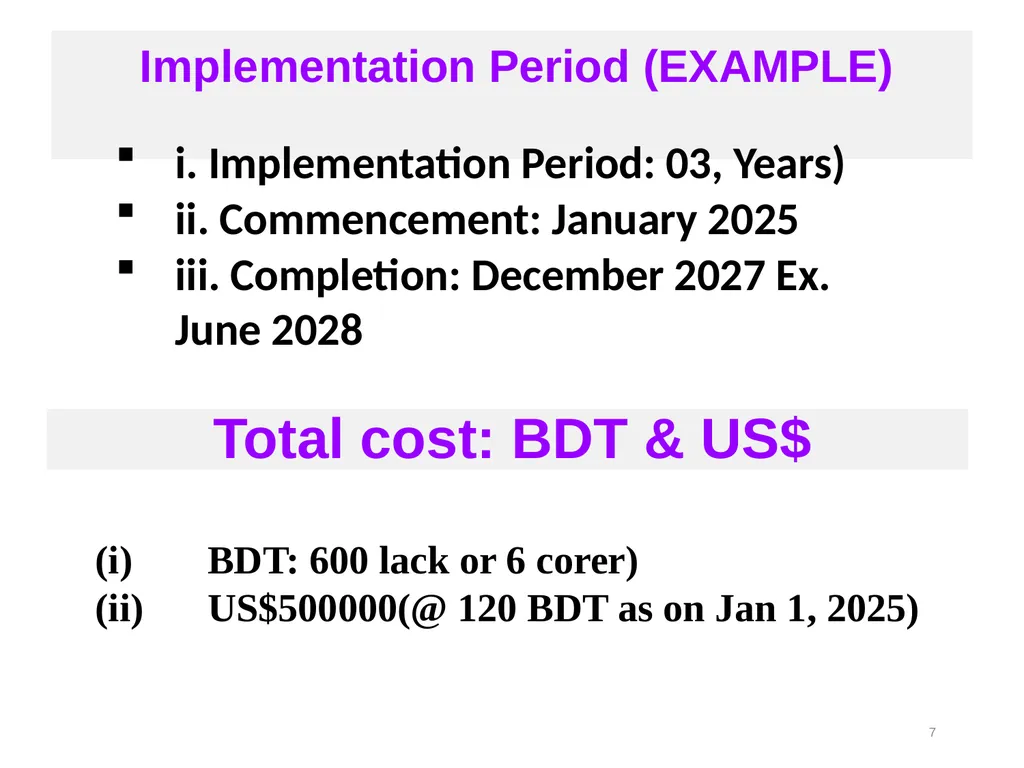
slide7. 7 Implementation Period (EXAMPLE) i. Implementation Period: 03, Years)
ii. Commencement: January 2025
iii. Completion: December 2027 Ex. June 2028 Total cost: BDT & US$ (i) BDT: 600 lack or 6 corer)
(ii) US$500000(@ 120 BDT as on Jan 1, 2025)<br>
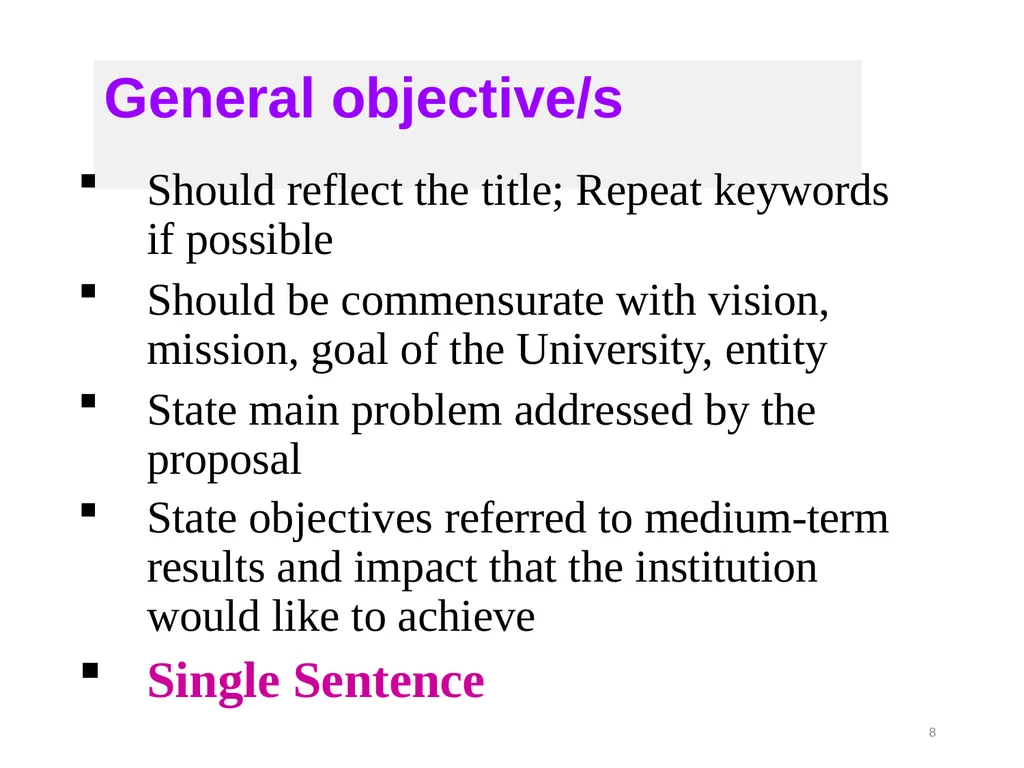
slide8. 8 General objective/s Should reflect the title; Repeat keywords if possible
Should be commensurate with vision, mission, goal of the University, entity
State main problem addressed by the proposal
State objectives referred to medium-term results and impact that the institution would like to achieve
Single Sentence<br>
slide9. General Objective
The general objective of the study is to empower tourism and hospitality graduates in Bangladesh by bridging the gap between academia and industry, ensuring they are equipped with the skills, knowledge, and experiences necessary for successful employment in the local and global markets. Example<br>
slide10. 10 Specific objectives Should support the General Objectives
Several specific objectives against one General objective
Identified and numbered
Clear and Specific
Measurable, not necessarily quantified
Achievable during lifetime of the project but outreach beyond
Relevant in the local context
Should allow periodic M&E<br>
slide11. Industry Collaboration: To establish strong partnerships with tourism and hospitality organizations for internships, mentorship, and job placement opportunities.
Global Competency: To prepare graduates for international markets by integrating global best practices, foreign language training, and international certifications/recognition.
Entrepreneurship Development: To foster entrepreneurial skills among students, enabling them to create innovative tourism and hospitality businesses in Bangladesh.
Research and Innovation: To promote research and innovation in tourism and hospitality, addressing both local and global challenges and contributing to industry advancements. Example<br>
slide12. 12 Institutional information Information should be based on the importance of the Department/institute. It would be wise to emphasize the relevance of the project (implied)<br>
slide13. Example The tourism industry is considered as one of the largest and the most diverse industries in the world. It has been drawing attention as a modern service industry and the device to create connectivity among nations and various people across the world. This industry has the most potential in the world. Every 1 in 10 jobs; generating 10% of global GDP and 9 % of the world’s jobs are part of this industry. Currently there are more than 5 million jobs available in the world; and roughly 0.5 million jobs are in Bangladesh. It is expected that by 2022 more than 2.5 million jobs will be created in Bangladesh in this field. The estimated statistics indicate that there are many possibilities and potentials existing in our country as well as abroaod. Unfortunately, due to the lack of strategic attention, tourism industry has not shown considerable progress.<br>
slide14. Example only The economy of the country is growing at over 7%; the government has set a target of over 8% economic growth in the next fiscal year and employment generation will be 15 million within next five years. Obviously, tourism industry will play significant role for fulfill these targets.
The Department is also committed to achieve quality and to establish an effective system that helps in elevating the educational process, in reaching the department to leadership. It wants see itself as iconic department through an even balance between theoretical and practical expertise, while also keeping aligned with the labor market to promote tourism industry in a way that goes with the Bangladesh status regionally and globally.<br>
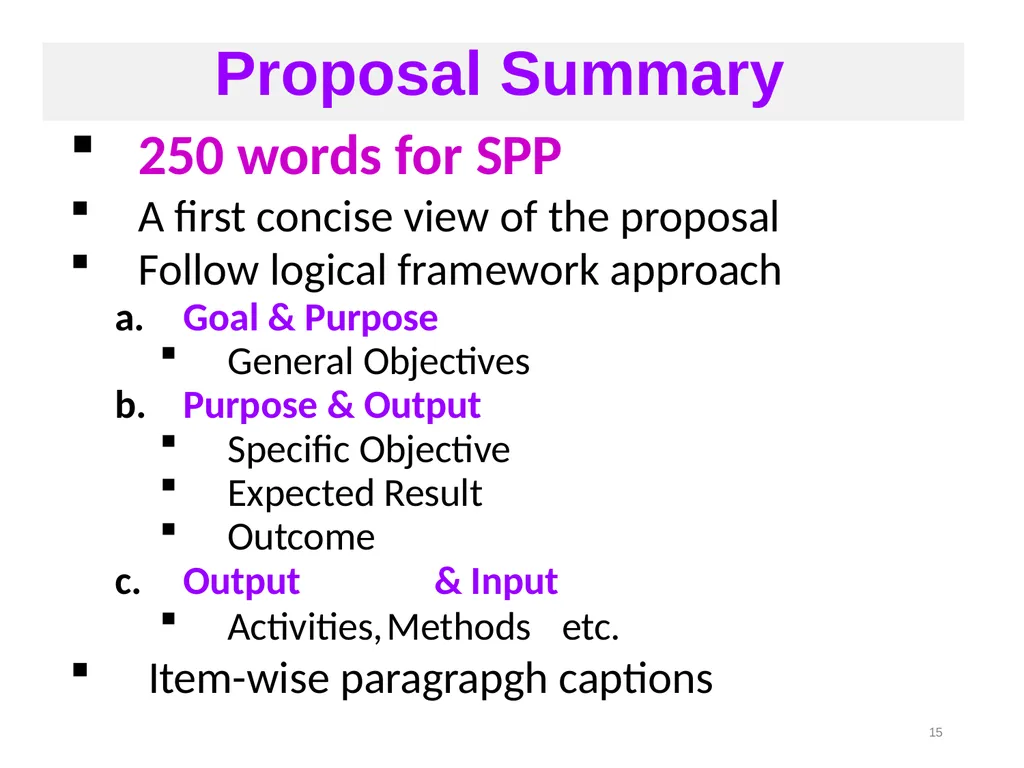
slide15. Proposal Summary 250 words for SPP
A first concise view of the proposal
Follow logical framework approach
Goal & Purpose
General Objectives
Purpose & Output
Specific Objective
Expected Result
Outcome
Output & Input
Activities, Methods etc.
Item-wise paragrapgh captions 15<br>
slide16. PROPOSAL SUMMARY (EXAMPLE) Tourism and hospitality are rapidly growing sectors with significant economic potential. However, a gap between academic teaching and industry needs hinders graduates’ success. This project aims to bridge this gap by aligning curricula with industry requirements, incorporating practical skills, and fostering global competencies. The project emphasizes hands-on training, industry-led internships, and strong academia-industry partnerships, both locally and internationally. Key areas include global acceptance, language training, international exposure, sustainability, ethical practices, and entrepreneurship. The goal is to enhance graduate employability, support economic growth, and position Bangladesh as a competitive destination in the global tourism and hospitality market.<br>
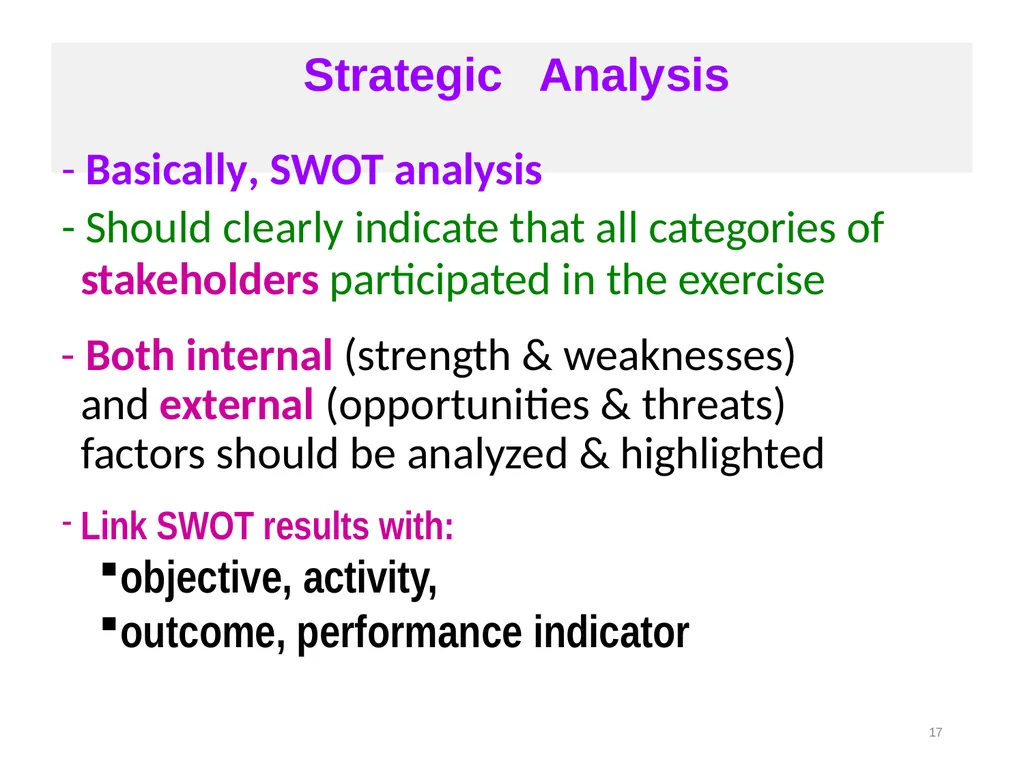
slide17. 17 Strategic Analysis - Basically, SWOT analysis
- Should clearly indicate that all categories of
stakeholders participated in the exercise
- Both internal (strength & weaknesses) and external (opportunities & threats) factors should be analyzed & highlighted
Link SWOT results with:
objective, activity,
outcome, performance indicator<br>
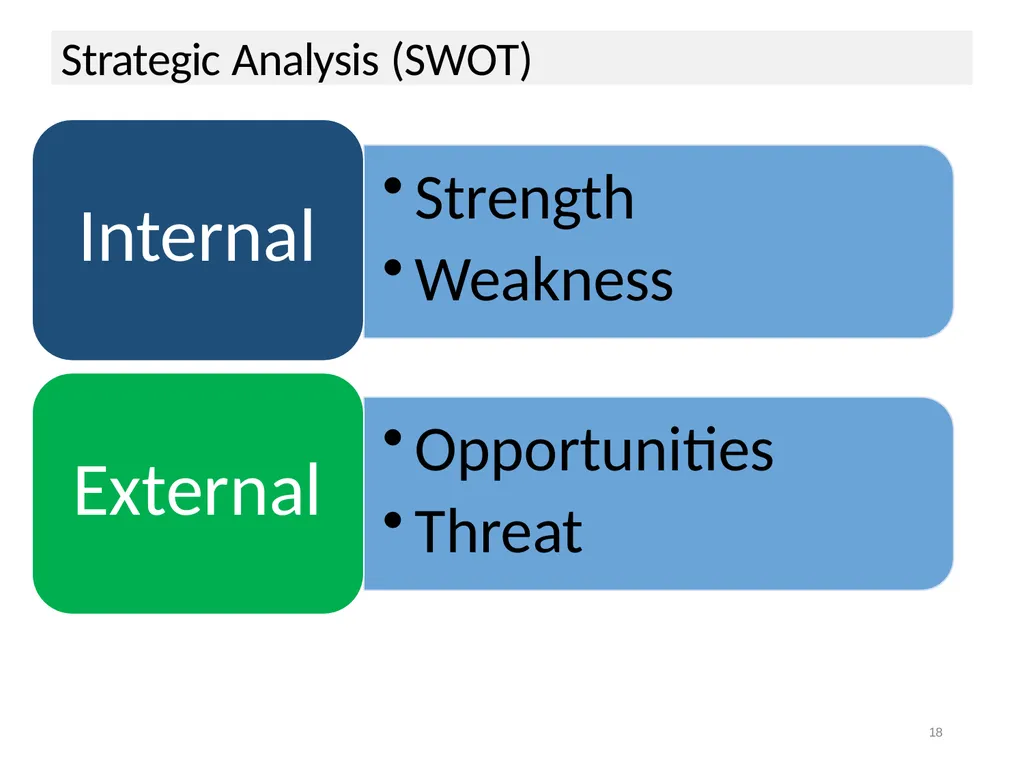
slide18. Strategic Analysis (SWOT) Strength
Weakness Internal Opportunities
Threat External 18<br>
slide19. Strength Analysis EXAMPLE Bangladesh's tourism and hospitality industry is expanding, offering significant job opportunities for skilled graduates. A large and dynamic young workforce eager to contribute to the sector. Several universities and training centers offer tourism and hospitality programs, providing a foundation for skill development. In Bangladesh there are around 42 universities are offering this program. Bangladesh Government also recognizes tourism as a key sector for economic growth, ensuring policy support for workforce development. Thus, this sector have a lot potentially in home and abroad. However, in the flowing sections partially a brief description is given focusing SWOT.<br>
slide20. Strength Analysis EXAMPLE Growing Tourism Sector: Bangladesh's tourism and hospitality industry is expanding, offering significant job opportunities for skilled graduates.
Youth Demographics: A large and dynamic young workforce eager to contribute to the sector.
Established Academic Institutions: Several universities and training centers offer tourism and hospitality programs, providing a foundation for skill development.
Government Focus on Tourism: The government recognizes tourism as a key sector for economic growth, ensuring policy support for workforce development.
Untapped Potential in Sustainable Tourism: Opportunities in ecotourism, cultural tourism, and heritage tourism that graduates can capitalize on.<br>
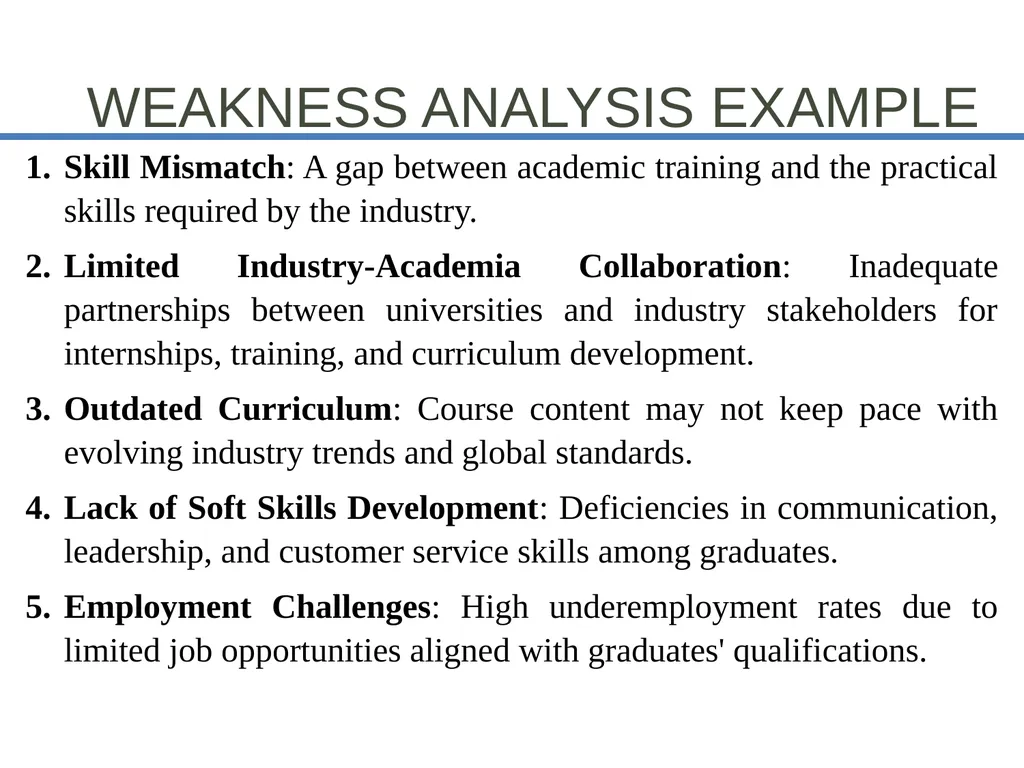
slide21. WEAKNESS Analysis EXAMPLE Skill Mismatch: A gap between academic training and the practical skills required by the industry.
Limited Industry-Academia Collaboration: Inadequate partnerships between universities and industry stakeholders for internships, training, and curriculum development.
Outdated Curriculum: Course content may not keep pace with evolving industry trends and global standards.
Lack of Soft Skills Development: Deficiencies in communication, leadership, and customer service skills among graduates.
Employment Challenges: High underemployment rates due to limited job opportunities aligned with graduates' qualifications.<br>
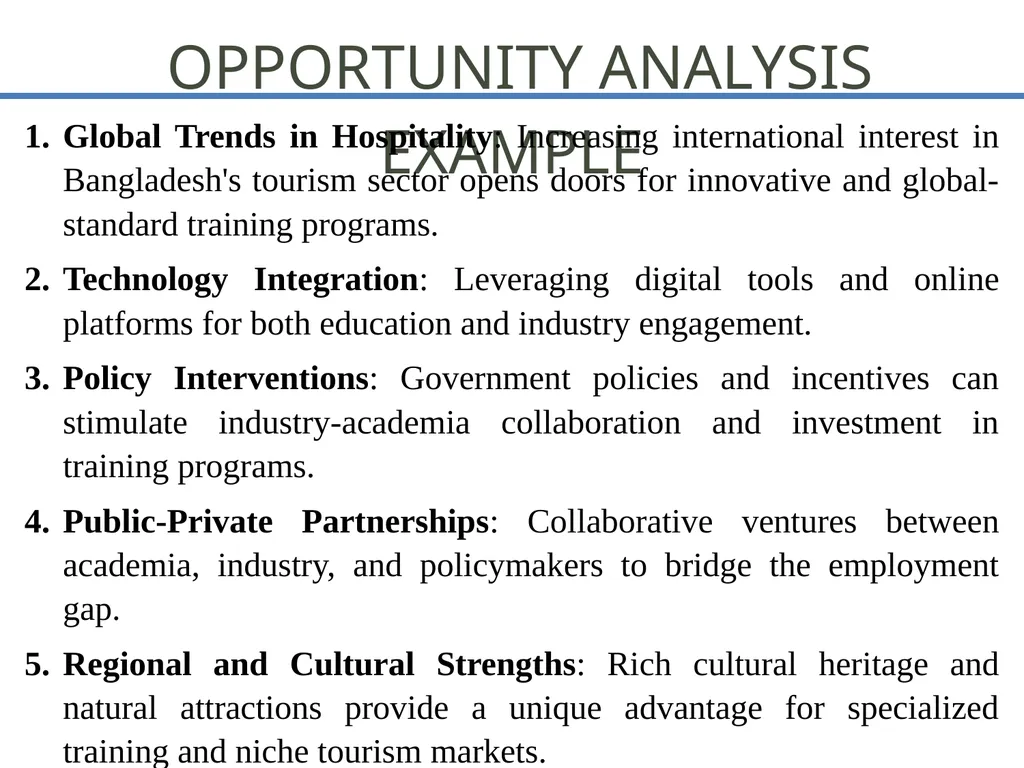
slide22. OPPORTUNITY Analysis EXAMPLE Global Trends in Hospitality: Increasing international interest in Bangladesh's tourism sector opens doors for innovative and global-standard training programs.
Technology Integration: Leveraging digital tools and online platforms for both education and industry engagement.
Policy Interventions: Government policies and incentives can stimulate industry-academia collaboration and investment in training programs.
Public-Private Partnerships: Collaborative ventures between academia, industry, and policymakers to bridge the employment gap.
Regional and Cultural Strengths: Rich cultural heritage and natural attractions provide a unique advantage for specialized training and niche tourism markets.<br>
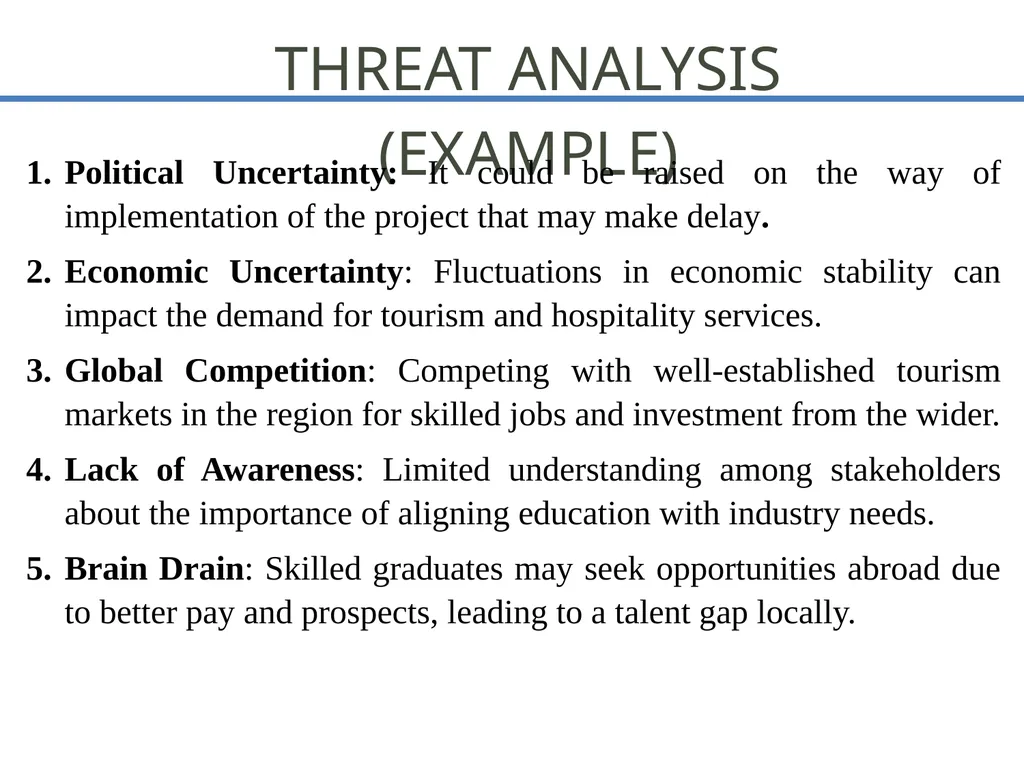
slide23. THREAT Analysis (EXAMPLE) Political Uncertainty: It could be raised on the way of implementation of the project that may make delay.
Economic Uncertainty: Fluctuations in economic stability can impact the demand for tourism and hospitality services.
Global Competition: Competing with well-established tourism markets in the region for skilled jobs and investment from the wider.
Lack of Awareness: Limited understanding among stakeholders about the importance of aligning education with industry needs.
Brain Drain: Skilled graduates may seek opportunities abroad due to better pay and prospects, leading to a talent gap locally.<br>
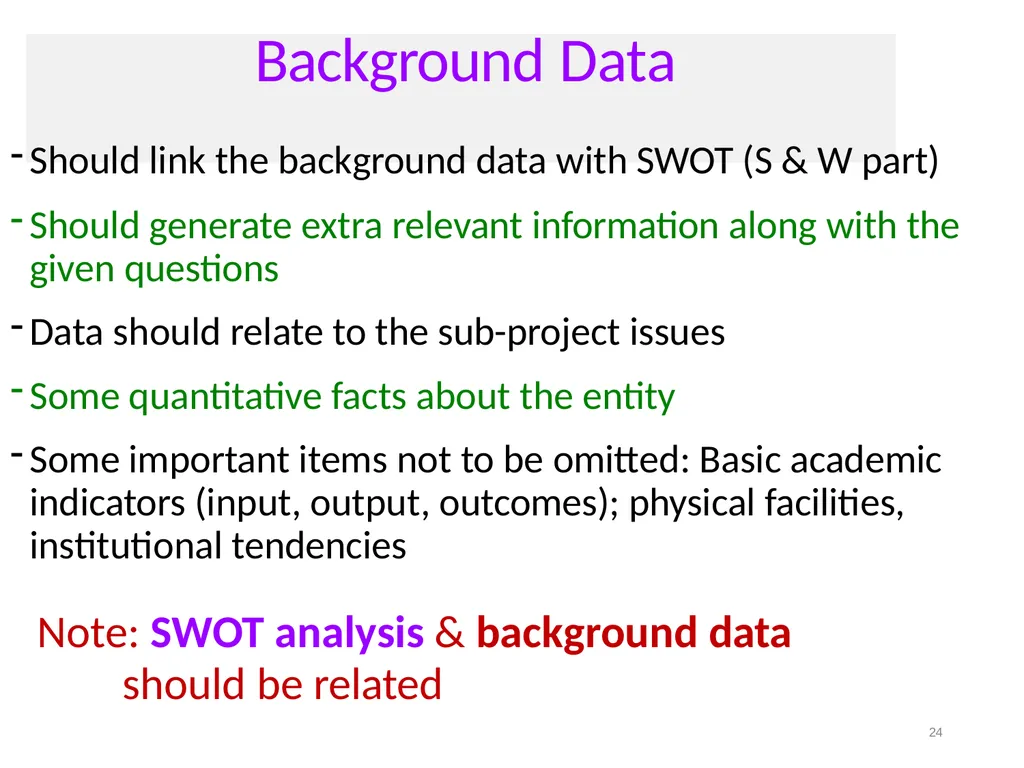
slide24. 24 Background Data Should link the background data with SWOT (S & W part)
Should generate extra relevant information along with the given questions
Data should relate to the sub-project issues
Some quantitative facts about the entity
Some important items not to be omitted: Basic academic indicators (input, output, outcomes); physical facilities, institutional tendencies
Note: SWOT analysis & background data
should be related<br>
slide25. (Example) According to the World Travel & Tourism Council (WTTC), the tourism sector in Bangladesh contributed BDT 1.02 trillion (USD 9.5 billion) to the country’s GDP in 2023, accounting for 3% of the total employment in Bangladesh, with 2.14 million jobs.
A Bangladesh Bureau of Educational Information and Statistics (BANBEIS) survey shows that only 40% of tourism and hospitality graduates find jobs within six months, with employers citing a lack of practical skills and industry exposure as major barriers.
United Nations World Tourism Organization (UNWTO) highlights the global shift toward sustainable and digital tourism, which demands proficiency in areas such as technology integration, sustainability practices, and cross-cultural communication.<br>
slide26. (Example) A 2021 study by the Bangladesh Institute of Development Studies (BIDS) found that less than 30% of academic institutions have active partnerships with industry stakeholders, resulting in limited opportunities for internships, on-the-job training, and industry-aligned recognitions.
Furthermore, the lack of entrepreneurship development programs within academic institutions restricts graduates’ potential to create innovative tourism ventures. This is critical in a market where micro, small, and medium enterprises (MSMEs) drive local tourism growth.<br>
slide27. Description of proposed field of research (EXAMPLE) There are multiple career opportunities in this industry like managing hotels, resorts, restaurants, public houses; conference hall, accommodations, catering services, customer services, and management access a range of industries. Jobs are also available in airlines, cruises, hospitals, transportation services, spa, beauty-parlor destination planning, designing and development .The leisure industry also covers sport and entertainment as additional avenues of employment in sport and fitness centers, cinemas, and theatres as well as other leisure venues such as bowling alleys and theme parks. Other service-focused roles in retailing, human resources management and events management also could be of interest areas. Many become on entrepreneur in the services industry like tour entrepreneur, club, travel, event, restaurant, hotel owner and several others.
While we are committed to achieve global excellence in tourism and hospitality education, we continue to forge strong relationship between the industry and students, academic and non-academic staffs, partnerships through industry collaboration and effective teaching and research.<br>
slide28. Description of proposed field of research (EXAMPLE) 1. Academia-Industry Gap: Curricula often fail to address the real-world challenges and practical requirements of the industry.
2. Skill Deficiency: Employers frequently report a lack of soft skills, technical expertise, and leadership qualities among graduates.
3. Limited Industry Collaboration: A lack of partnerships between educational institutions and industry stakeholders restricts students’ opportunities for internships, apprenticeships, and hands-on learning.
4. Underutilization of Educated Human Resources: The mismatch between the skills acquired by graduates and the needs of the industry leads to underemployment and unemployment.<br>
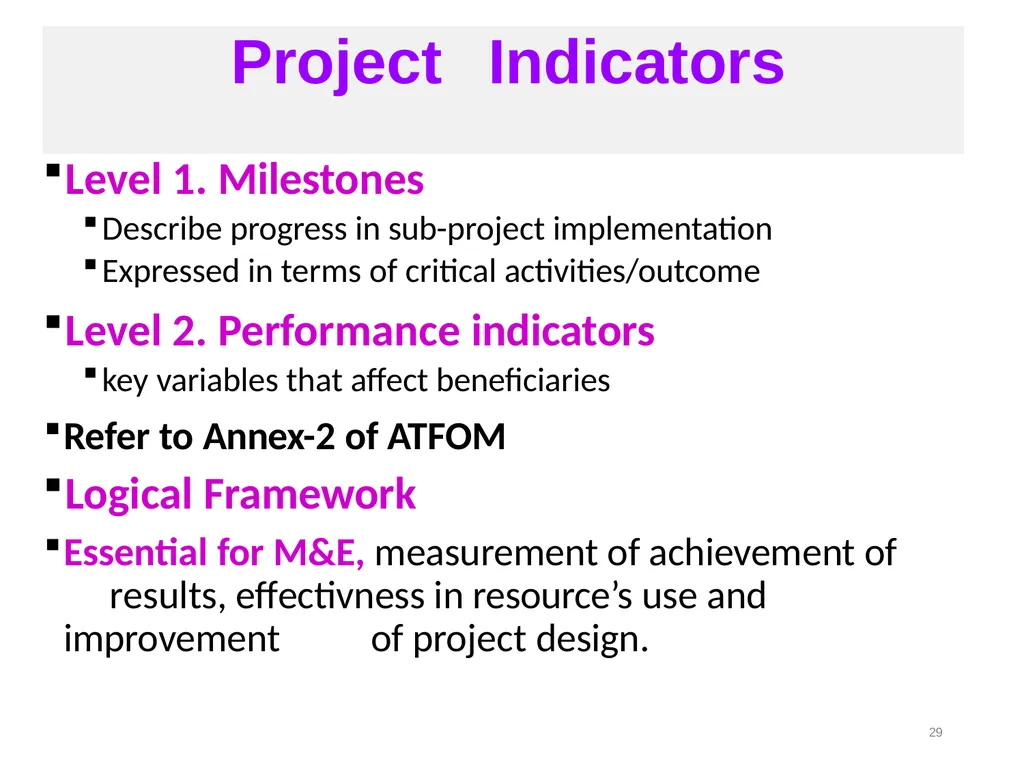
slide29. 29 Project Indicators Level 1. Milestones
Describe progress in sub-project implementation
Expressed in terms of critical activities/outcome
Level 2. Performance indicators
key variables that affect beneficiaries
Refer to Annex-2 of ATFOM
Logical Framework
Essential for M&E, measurement of achievement of results, effectivness in resource’s use and improvement of project design.<br>
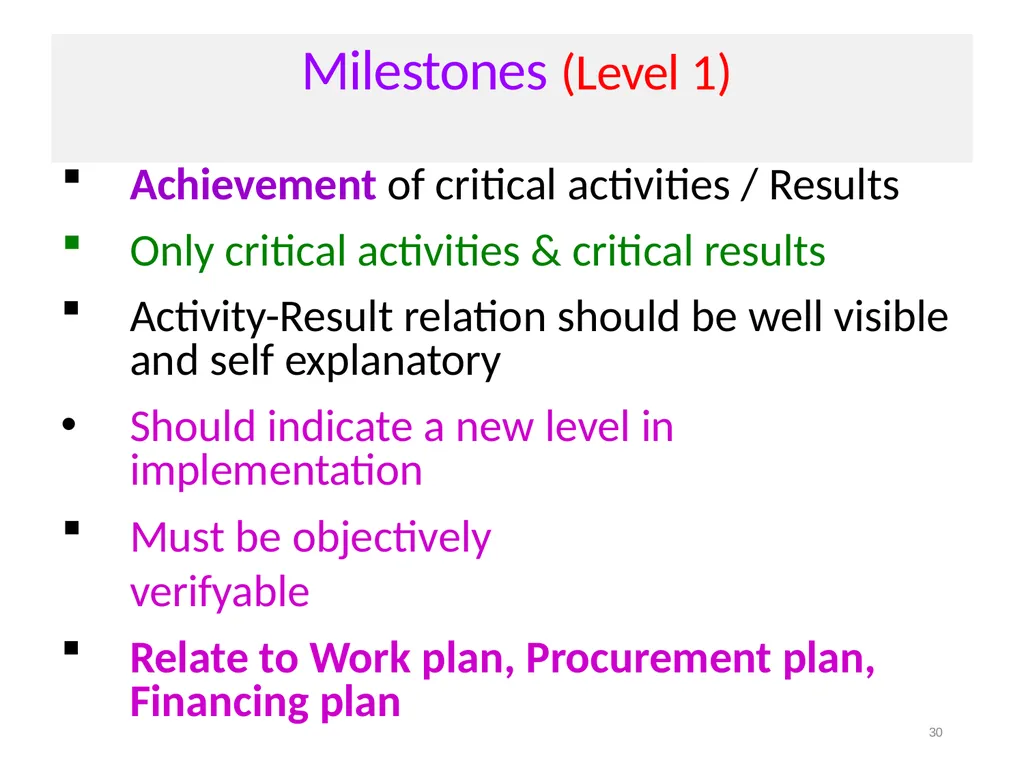
slide30. 30 Milestones (Level 1) Achievement of critical activities / Results
Only critical activities & critical results
Activity-Result relation should be well visible and self explanatory
Should indicate a new level in implementation
Must be objectively verifyable
Relate to Work plan, Procurement plan, Financing plan<br>
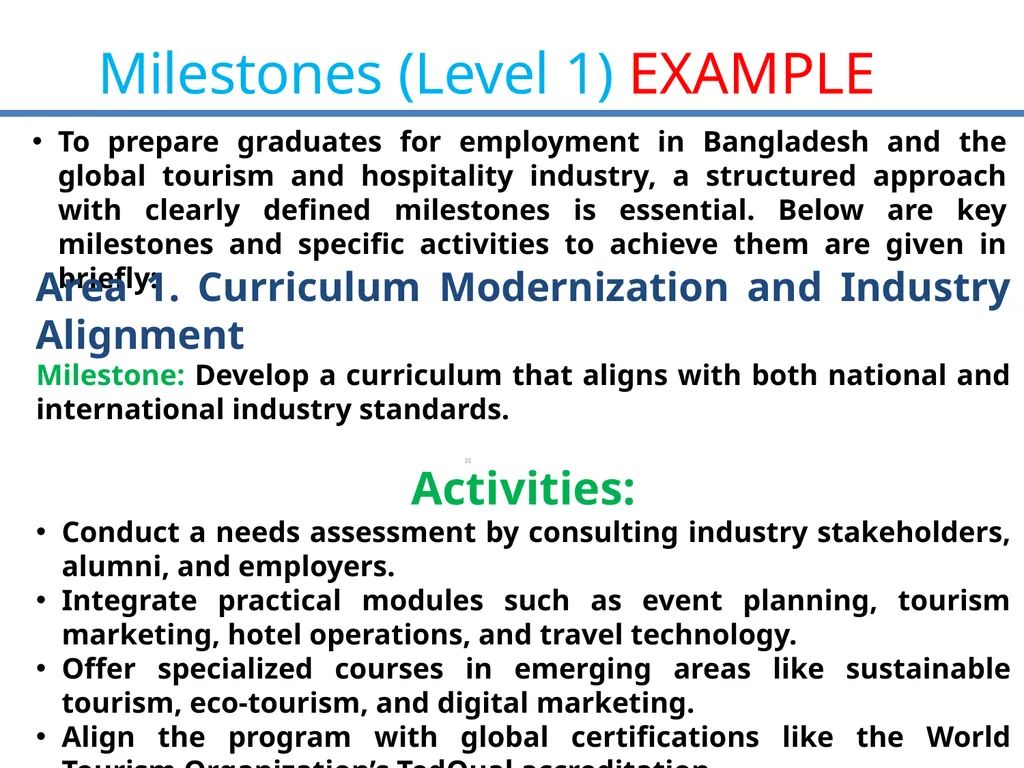
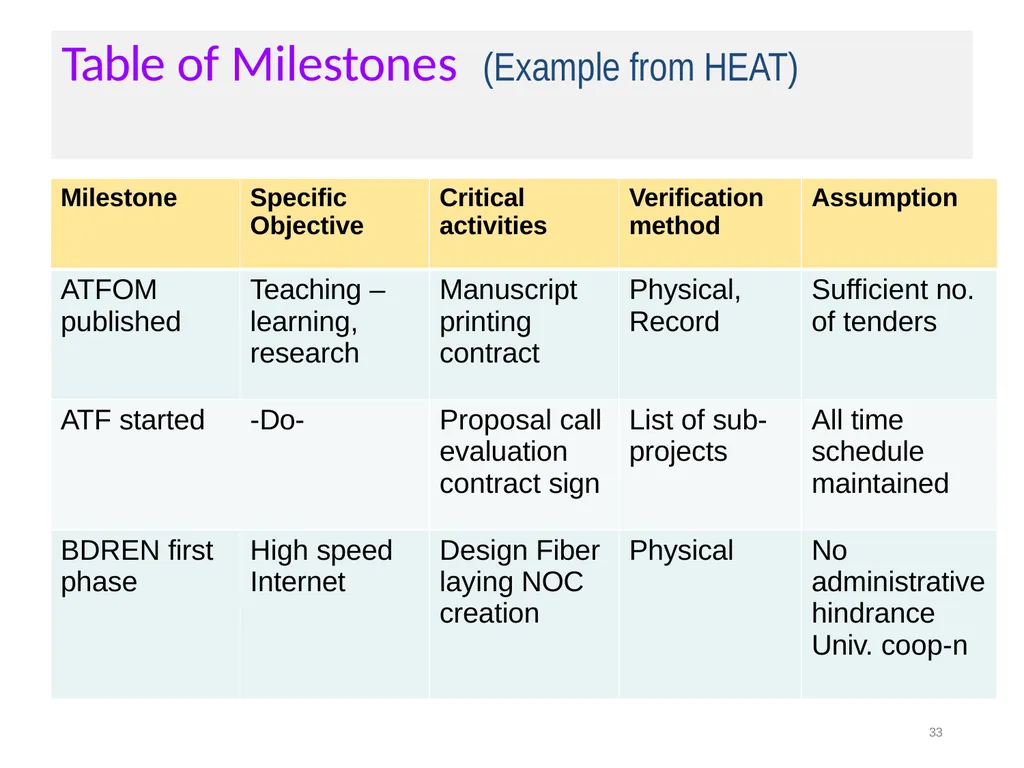
slide31. To prepare graduates for employment in Bangladesh and the global tourism and hospitality industry, a structured approach with clearly defined milestones is essential. Below are key milestones and specific activities to achieve them are given in briefly: Milestones (Level 1) EXAMPLE 31 Area 1. Curriculum Modernization and Industry Alignment
Milestone: Develop a curriculum that aligns with both national and international industry standards.
Activities:
Conduct a needs assessment by consulting industry stakeholders, alumni, and employers.
Integrate practical modules such as event planning, tourism marketing, hotel operations, and travel technology.
Offer specialized courses in emerging areas like sustainable tourism, eco-tourism, and digital marketing.
Align the program with global certifications like the World Tourism Organization’s TedQual accreditation.<br>
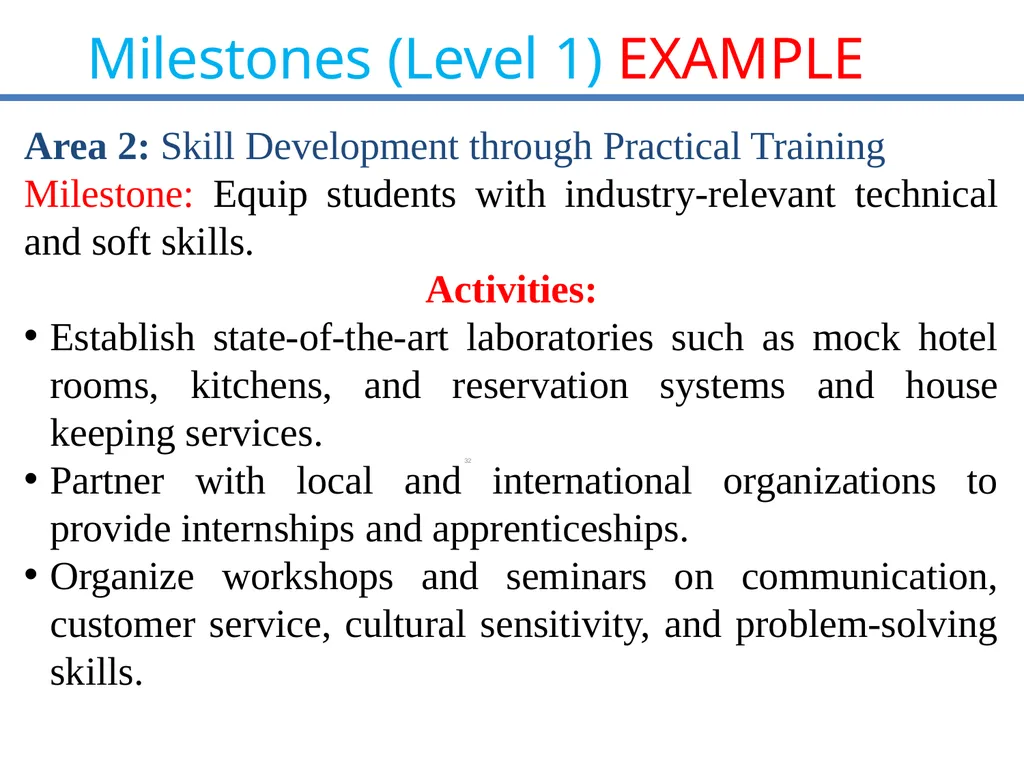
slide32. Area 2: Skill Development through Practical Training
Milestone: Equip students with industry-relevant technical and soft skills.
Activities:
Establish state-of-the-art laboratories such as mock hotel rooms, kitchens, and reservation systems and house keeping services.
Partner with local and international organizations to provide internships and apprenticeships.
Organize workshops and seminars on communication, customer service, cultural sensitivity, and problem-solving skills. Milestones (Level 1) EXAMPLE 32<br>
slide33. 33 Table of Milestones (Example from HEAT)<br>
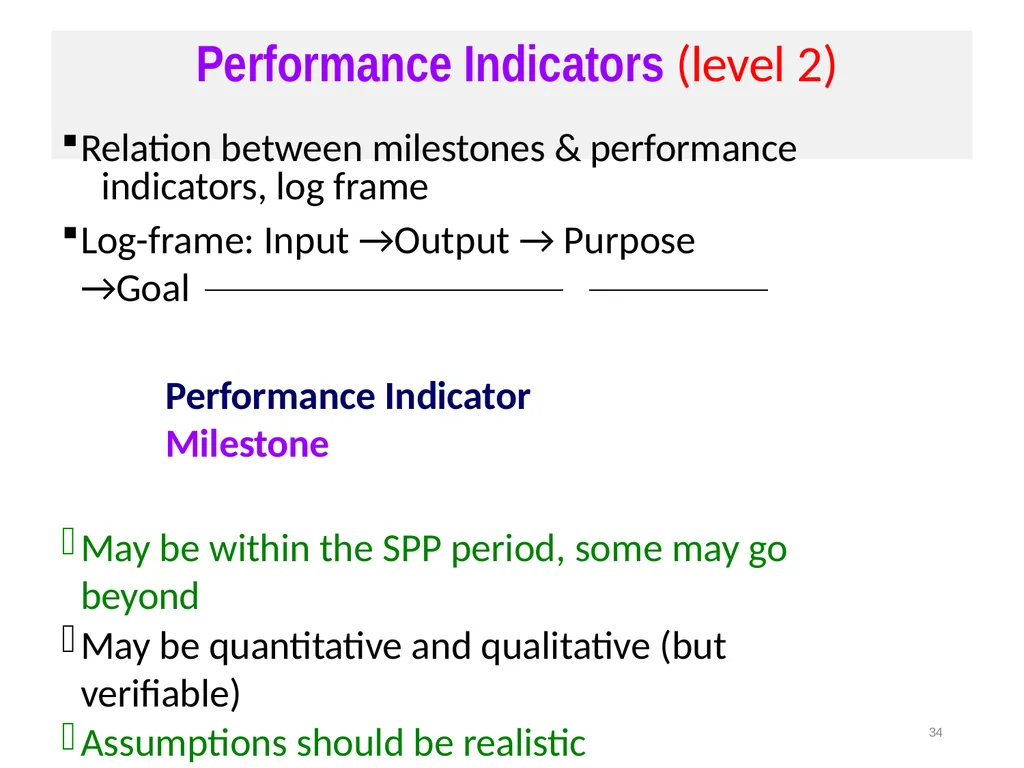
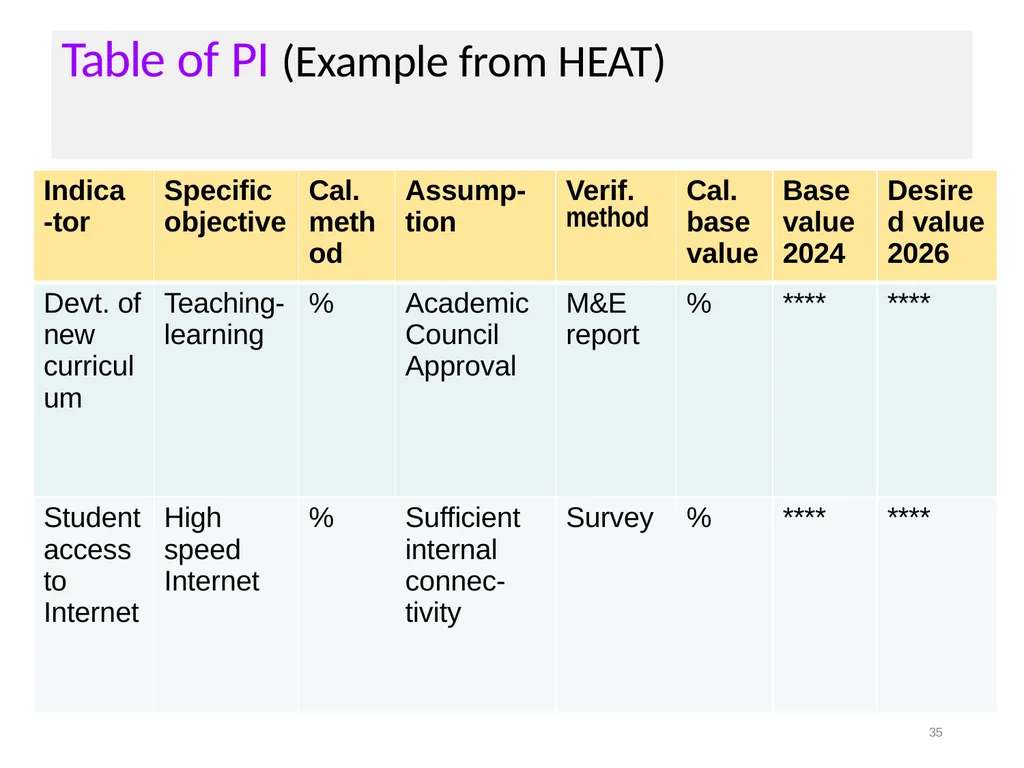
slide34. Performance Indicators (level 2) Relation between milestones & performance indicators, log frame
Log-frame: Input →Output → Purpose →Goal
Performance Indicator Milestone
May be within the SPP period, some may go beyond
May be quantitative and qualitative (but verifiable)
Assumptions should be realistic
Verification methods clear, operational
Refer to general objective, specific objectives, benefits, University characteristics etc. 34<br>
slide35. 35 Table of PI (Example from HEAT)<br>
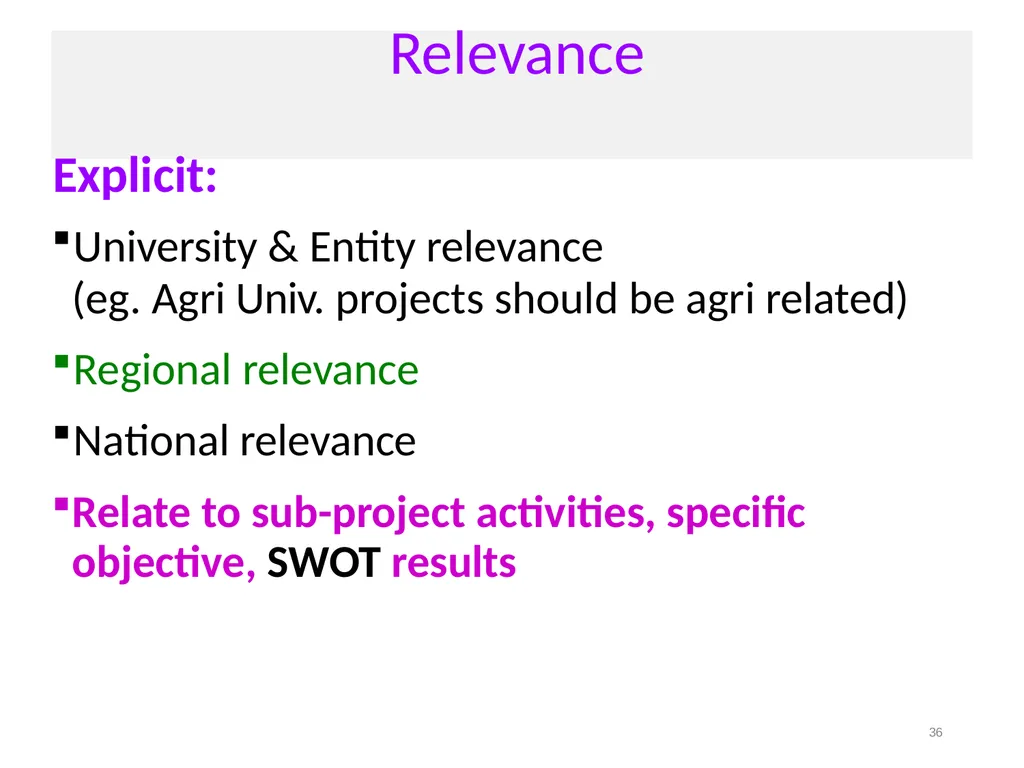
slide36. 36 Relevance Explicit:
University & Entity relevance
(eg. Agri Univ. projects should be agri related)
Regional relevance
National relevance
Relate to sub-project activities, specific objective, SWOT results<br>
slide37. Employment Challenges for Graduates: Tourism and hospitality graduates in Bangladesh face difficulties in securing jobs that match their qualifications due to a lack of industry-specific skills and practical experience.
Sectoral Growth and Economic Contributions: Tourism and hospitality contribute significantly to Bangladesh’s GDP and provide direct and indirect employment opportunities.
Meeting Industry Demands: The rapid growth of sustainable tourism, digital technologies, and globalized markets demands a workforce with diverse skills, including technology integration, sustainability practices, and cultural adaptability. Relevance (EXAMPLE)<br>
slide38. 38 Benefits (qualitative and quantitative) Be imaginative but objective
Direct and indirect benefit
Relate to general objective, specific objective
Relate to performance indicators
Some examples
Better R&D infrastructure and capacity
Wider PhD disciplinary coverage, enrolment and graduation
Higher research outputs, productivity and international linkages<br>
slide39. 1. Enhanced Employability of Graduates: By aligning academic training with industry requirements, graduates will possess the relevant skills and practical experience needed to meet employer expectations. This will boost their confidence and readiness for the workforce, allowing them to transition smoothly from education to employment.
2. Strengthened Academia-Industry Relationships: Establishing partnerships between educational institutions and tourism and hospitality businesses fosters mutual learning and collaboration. These relationships ensure that the curriculum stays relevant and responsive to industry demands, benefiting both students and employers in the long term. Qualitative Benefits (EXAMPLE)<br>
slide40. 1. Increased Graduate Employment Rate: By bridging the gap between academia and industry, graduate employment rates are likely to increase. For example, the percentage of graduates securing employment within six months of graduation can rise from the current 40% to 70% or higher, reducing unemployment in the sector.
2. Higher Salary and Job Placement Rates: Graduates equipped with industry-relevant skills and experience are more likely to command higher salaries. This can result in increased average salaries for tourism and hospitality graduates, with potential increases in salaries by 15-30% as they fill key positions in industry-leading organizations. Quantitative Benefits (EXAMPLE)<br>
slide41. 41 Proposal Sustainability Continuation after the contract can be foreseen and is realistic
Capitalisation on previous experiences
Medium/long term impact can be expected
Long-lasting effect on institutions/target groups
Environmental, safety hazard protection and risk mitigation have been considered
Institutional commitments on implementation and sustainability are clear and convincing<br>
slide42. 42 Proposal Sustainability (EXAMPLE) 1. Establishing Long-Term Academia-Industry Partnerships
• Action: Build continuous and strategic partnerships with key industry stakeholders, including hotels, airlines, travel agencies, and government tourism bodies.
• Sustainability Mechanism: Forming advisory boards consisting of industry leaders who actively participate in curriculum development, internship programs, and job placements. Regular review meetings and partnership contracts will ensure that both academia and industry stay aligned with evolving market trends.
• Outcome: Ongoing collaboration between institutions and employers will ensure that industry requirements are continuously reflected in academic programs, while providing students with continuous access to internship, industrial attachment and employment opportunities.<br>
slide43. Proposal Sustainability (EXAMPLE).. 2. Curriculum Flexibility and Global Integration
• Action: Continuously revise the curriculum to reflect global trends, digitalization, and sustainability while also maintaining flexibility to adapt to emerging industry needs.
• Sustainability Mechanism: Develop strong collaborations with international academic institutions, ensuring that curricula remain globally competitive. Offer exchange programs and online learning platforms to allow students to engage with global trends.
• Outcome: The curriculum will be continuously updated to keep pace with industry demands, ensuring that graduates are always prepared for global job markets. International exposure and certifications will further increase the employability and competitiveness of graduates.<br>
slide44. Operation and Maintenance
of equipment and instruments Institutional capacity in operation and maintenance of equipment and instruments that will be used in the project:
In-house preventive maintenance
In-house servicing
Repair parts (if any)
Externaly procured servicing<br>
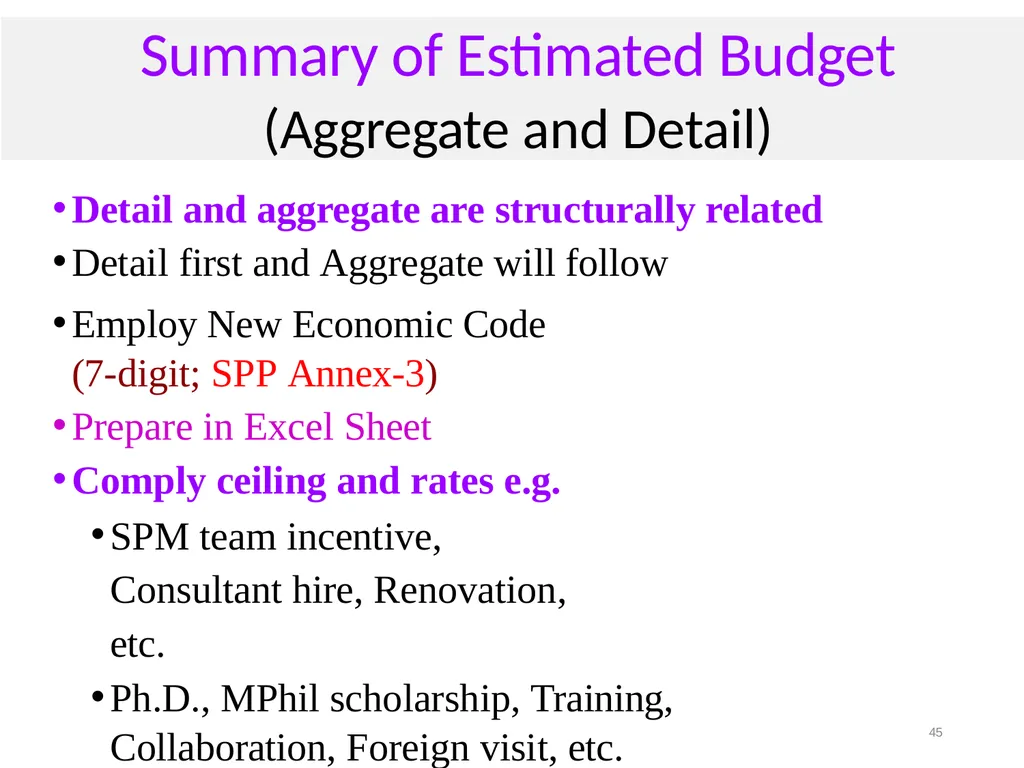
slide45. 45 Summary of Estimated Budget (Aggregate and Detail) Detail and aggregate are structurally related
Detail first and Aggregate will follow
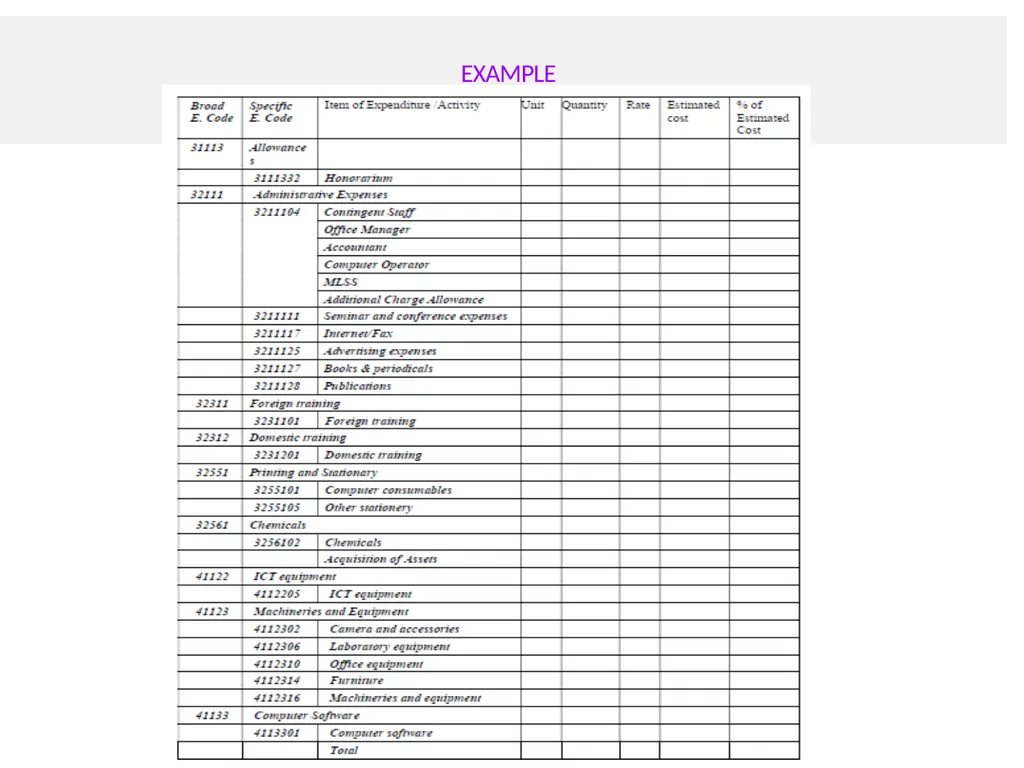
Employ New Economic Code (7-digit; SPP Annex-3)
Prepare in Excel Sheet
Comply ceiling and rates e.g.
SPM team incentive, Consultant hire, Renovation, etc.
Ph.D., MPhil scholarship, Training, Collaboration, Foreign visit, etc.<br>
slide46. EXAMPLE<br>
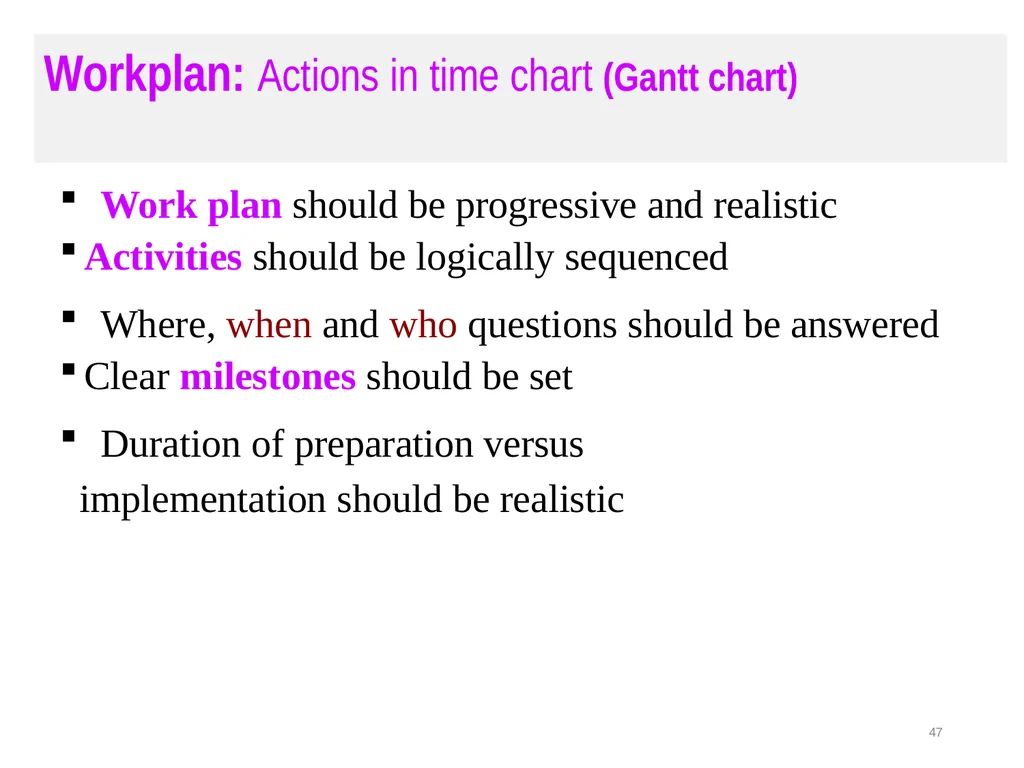
slide47. 47 Work plan should be progressive and realistic
Activities should be logically sequenced
Where, when and who questions should be answered
Clear milestones should be set
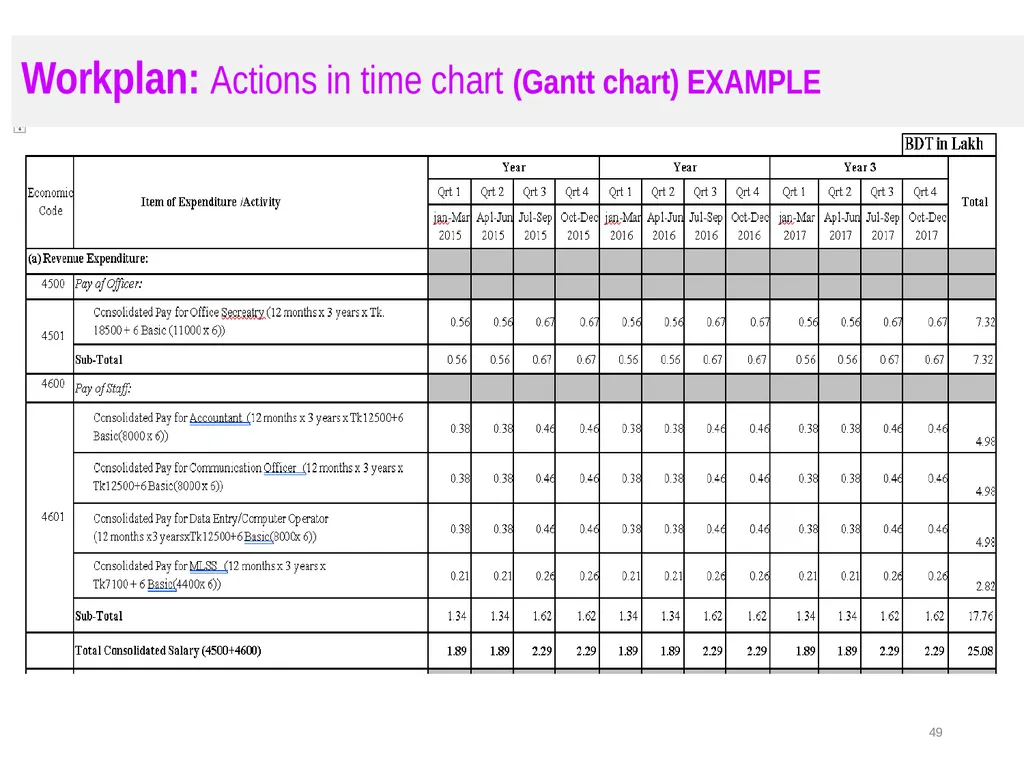
Duration of preparation versus implementation should be realistic Workplan: Actions in time chart (Gantt chart)<br>
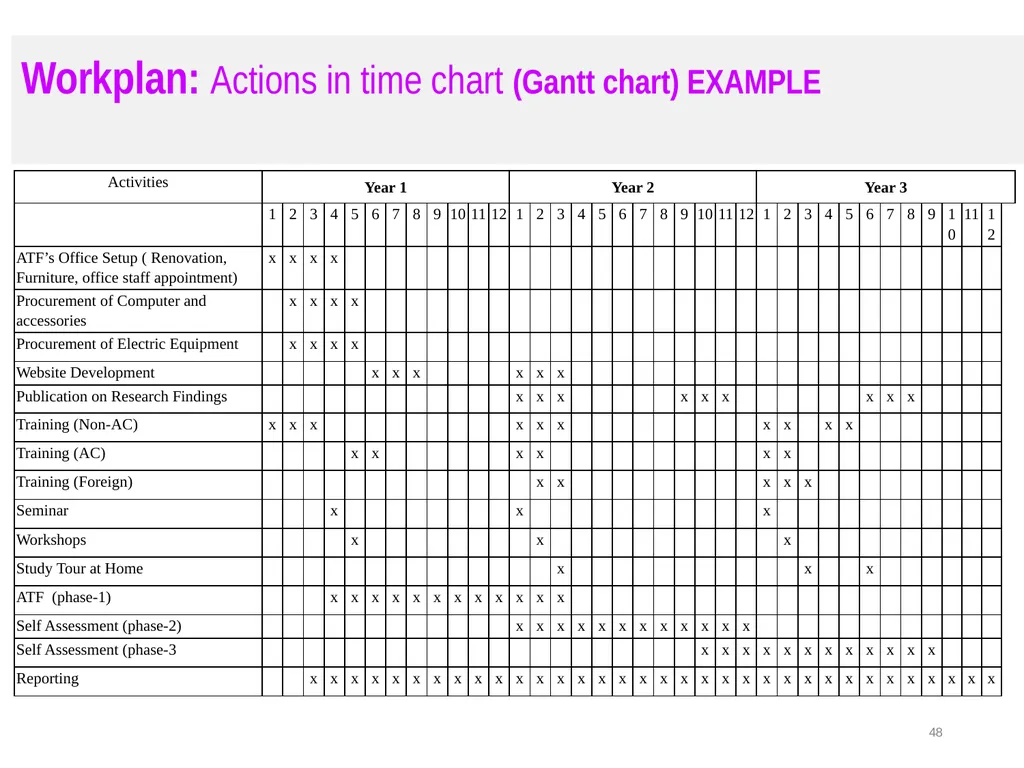
slide48. 48 Workplan: Actions in time chart (Gantt chart) EXAMPLE<br>
slide49. 49 Workplan: Actions in time chart (Gantt chart) EXAMPLE<br>
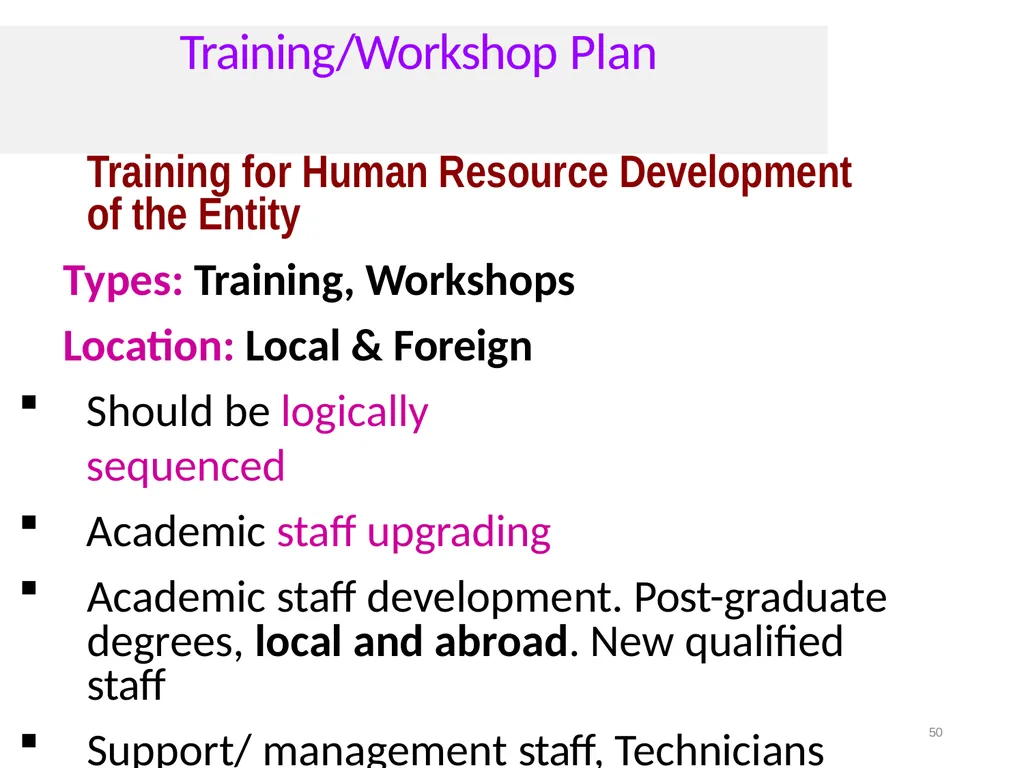
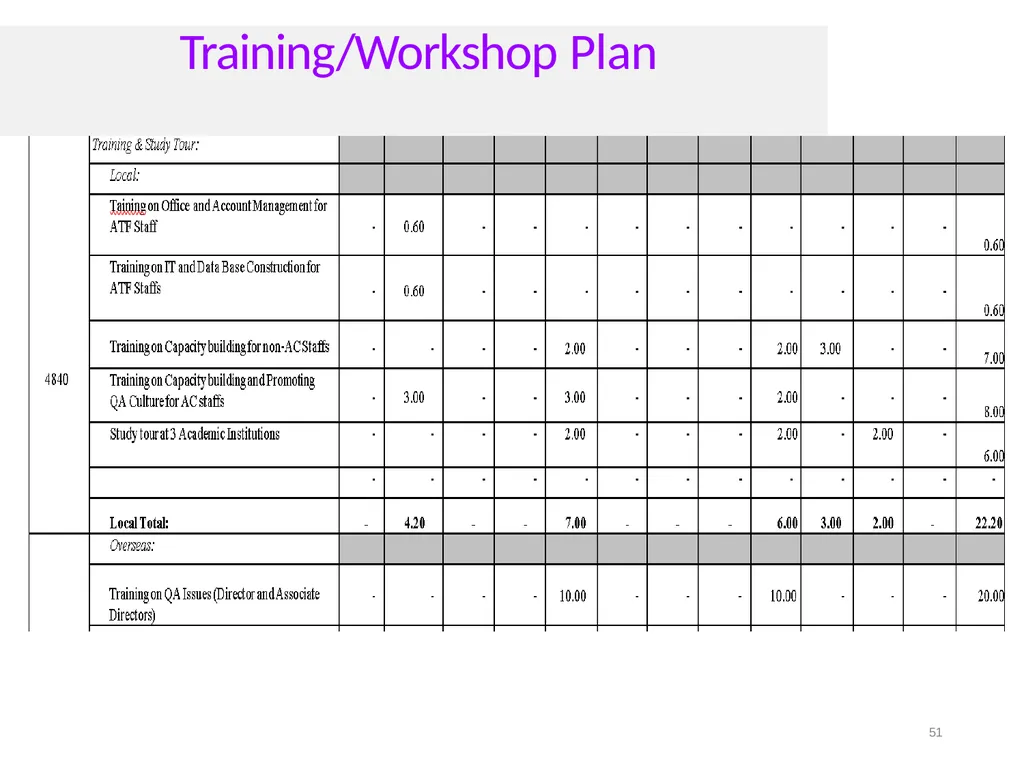
slide50. 50 Training/Workshop Plan Training for Human Resource Development of the Entity
Types: Training, Workshops Location: Local & Foreign
Should be logically sequenced
Academic staff upgrading
Academic staff development. Post-graduate degrees, local and abroad. New qualified staff
Support/ management staff, Technicians<br>
slide51. 51 Training/Workshop Plan<br>
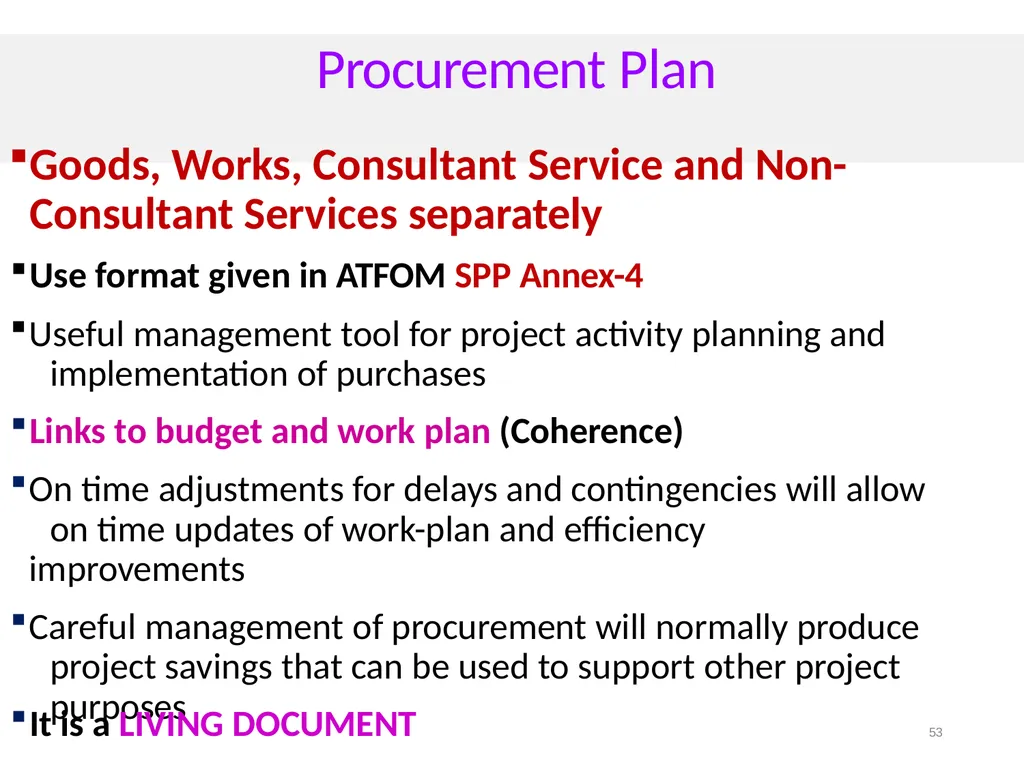
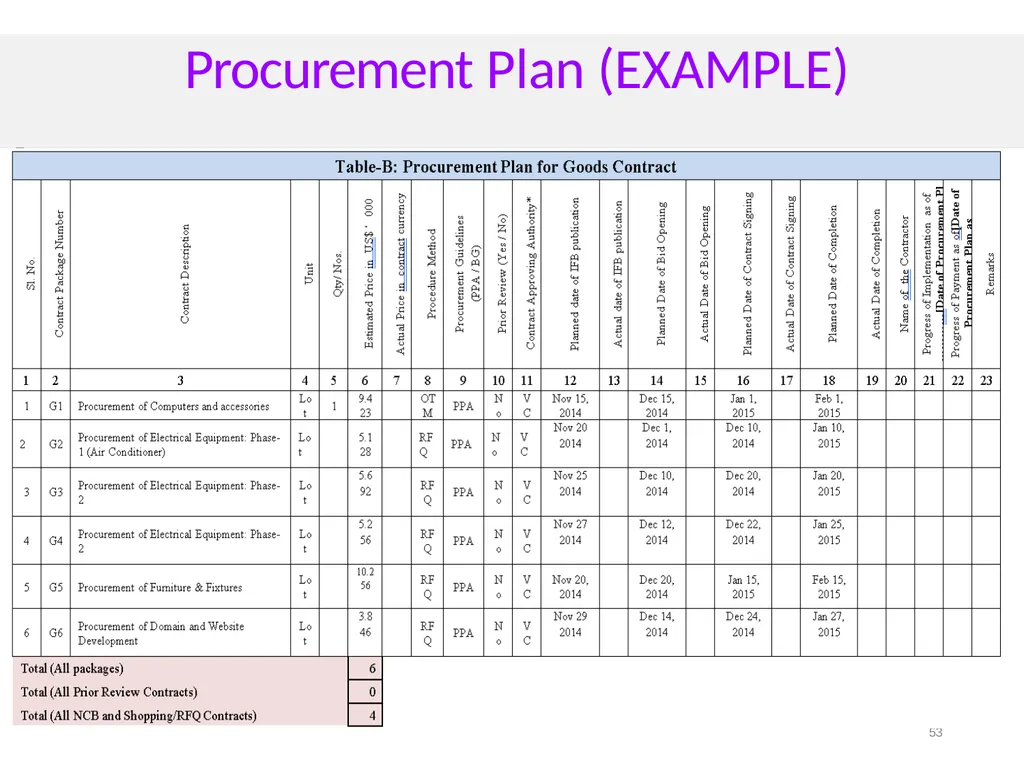
slide52. 53 Procurement Plan Goods, Works, Consultant Service and Non- Consultant Services separately
Use format given in ATFOM SPP Annex-4
Useful management tool for project activity planning and implementation of purchases
Links to budget and work plan (Coherence)
On time adjustments for delays and contingencies will allow on time updates of work-plan and efficiency improvements
Careful management of procurement will normally produce project savings that can be used to support other project purposes It is a LIVING DOCUMENT<br>
slide53. 53 Procurement Plan (EXAMPLE)<br>
slide54. Eligible and Non-Eligible Expenditure A. Indicative Eligible Expenditure (Art-2.7)
Training of permanent academic staff (all Windows)
Teaching aids-materials (W-2)
Equipment/ stationeries (all Windows)
Local conference/seminar/workshops (all Windows)
Research support to Masters/MPhil./PhD (W-3)
Financial support to research students (W-3)
Research stay abroad (Fellows & host) (W-3)
Academic collaboration visit (all Windows)<br>
slide55. Eligible and Non-Eligible Expenditure B. Ineligible Expenditure (Art.-2.7.7)
Salary and allowances for permanent staff
Any establishment/recurring/revenue expenditures of the entities
Large civil works (Not exceeding 10% of total sub project cost)
Expenditure not included in the sub project work/financing/procurement plans and budget<br>
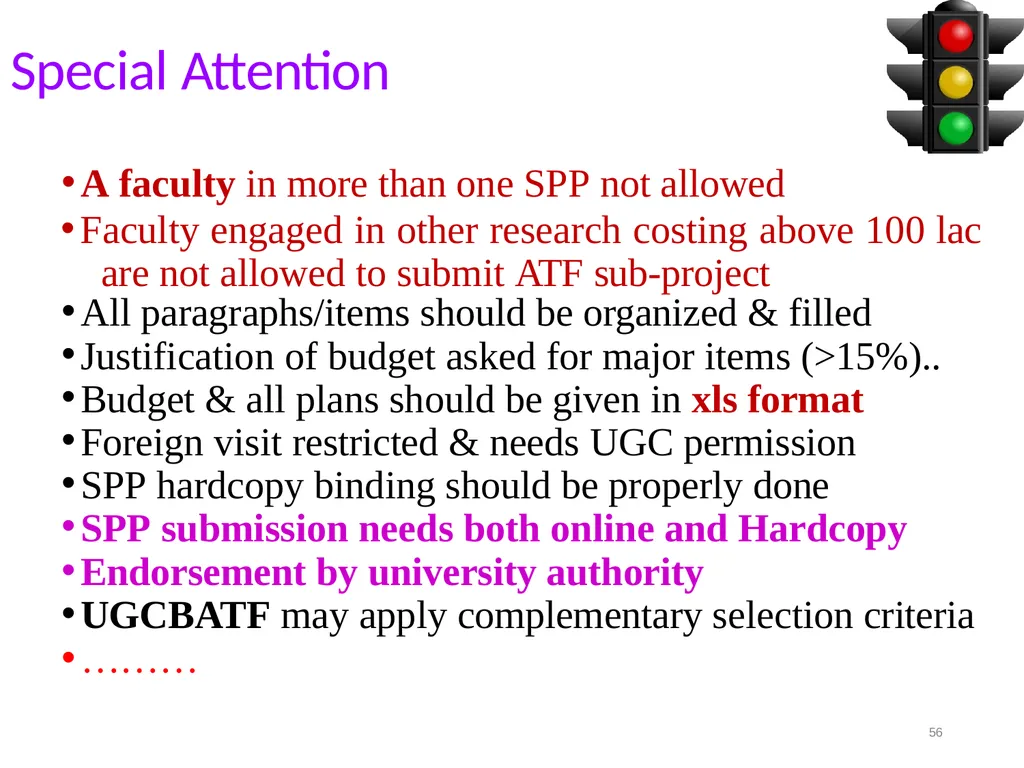
slide56. Special Attention A faculty in more than one SPP not allowed
Faculty engaged in other research costing above 100 lac are not allowed to submit ATF sub-project
All paragraphs/items should be organized & filled
Justification of budget asked for major items (>15%)..
Budget & all plans should be given in xls format
Foreign visit restricted & needs UGC permission
SPP hardcopy binding should be properly done
SPP submission needs both online and Hardcopy
Endorsement by university authority
UGCBATF may apply complementary selection criteria
……… 56<br>
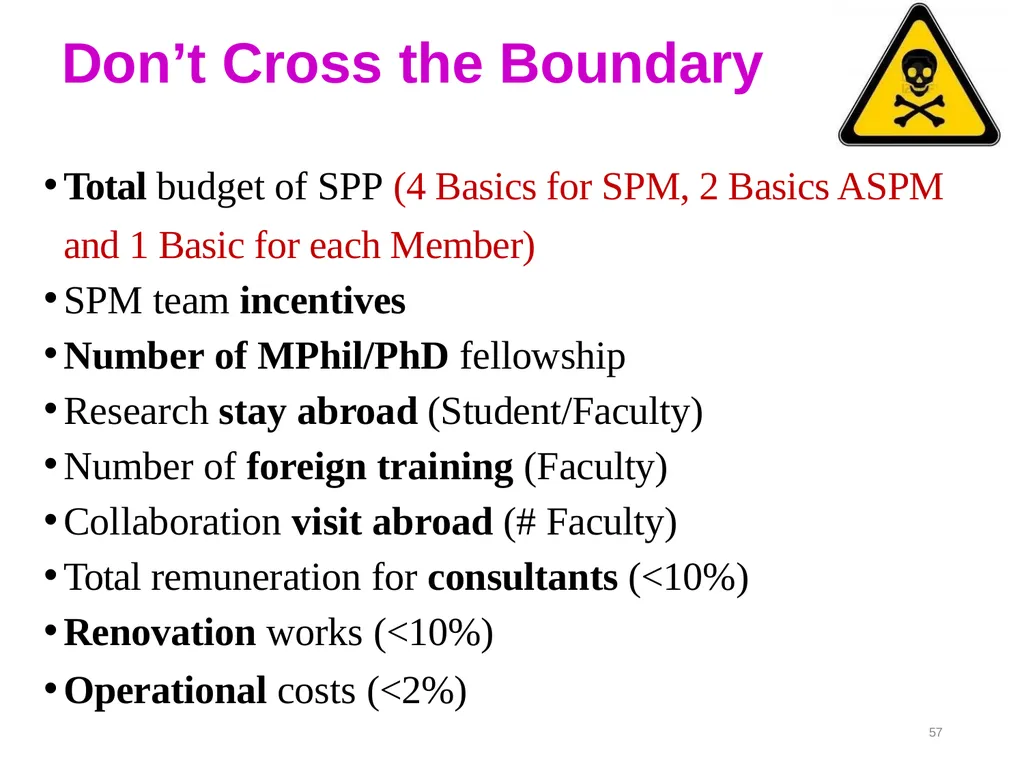
slide57. Don’t Cross the Boundary Total budget of SPP (4 Basics for SPM, 2 Basics ASPM and 1 Basic for each Member)
SPM team incentives
Number of MPhil/PhD fellowship
Research stay abroad (Student/Faculty)
Number of foreign training (Faculty)
Collaboration visit abroad (# Faculty)
Total remuneration for consultants (<10%)
Renovation works (<10%)
Operational costs (<2%) 57<br>
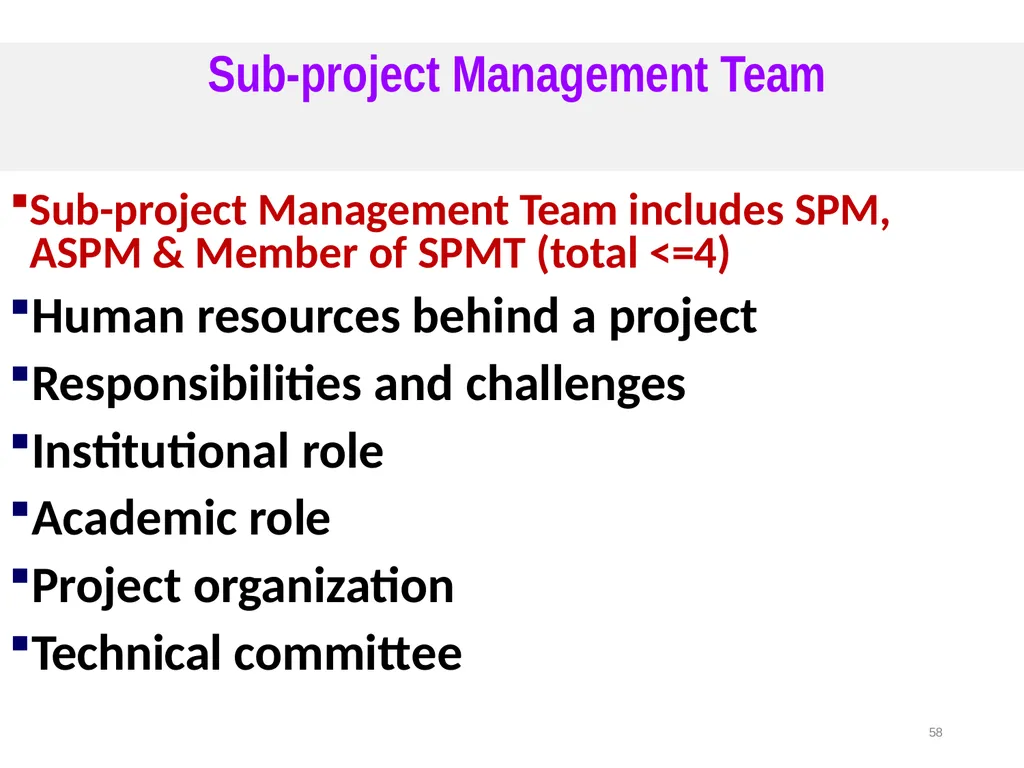
slide58. 58 Sub-project Management Team Sub-project Management Team includes SPM, ASPM & Member of SPMT (total <=4)
Human resources behind a project
Responsibilities and challenges
Institutional role
Academic role
Project organization
Technical committee<br>
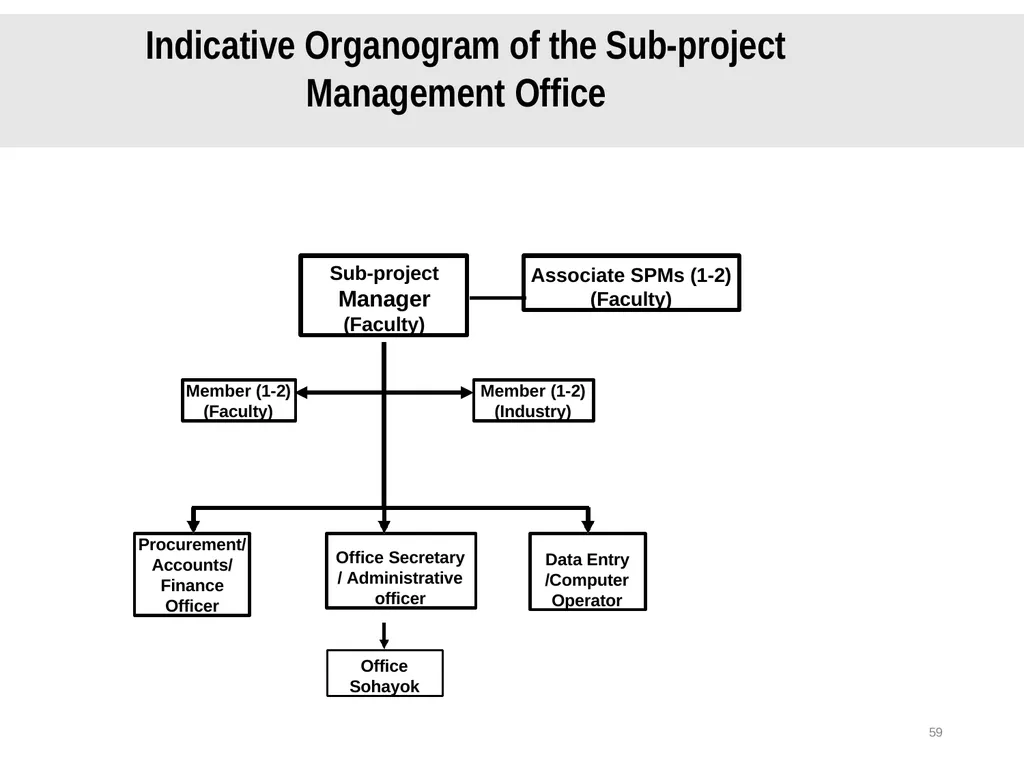
slide59. Sub-project Manager (Faculty) Office Sohayok Member (1-2) (Industry) Procurement/ Accounts/ Finance Officer Data Entry
/Computer Operator Office Secretary
/ Administrative officer Member (1-2) (Faculty) Associate SPMs (1-2) (Faculty) Indicative Organogram of the Sub-project Management Office 59<br>
slide60. Status of Team Members The SPM would be the same person proposed in the approved subproject proposal and will be assisted by Associate SPM (ASPM), another faculty of the same entity. There will be a Sub-project Management Team (SPMT) consisting of the SPM, ASPMs and members who will normally be academics of the entity. In the case of WINDOW-3b sub-projects, a scientist from the industry partner will be a member of the SPMT. In the case of WINDOW 3, 4 and 5 sub-projects, an officer of the university may be included in the SPMT. SPM will recruit office staff, i.e., Secretary/Office Manager,
Accountant/Finance Officer, Data Entry Technician, and support staff, i.e., Janitor/MLSS etc., (with consolidated salary or as additional duty/part-time contract basis) provisionally in line with approved sub-project proposal to work in SPMO. (Page 23 ATF OM)<br>
slide61. Fund allocation All sub-projects will require fund for renovation and refurbishing of class rooms, lecture theaters, women’s facilities renovation, labs, procurement of scientific equipment for labs, computers, communication and teaching-learning devices, office equipment, stationary, soft-ware, renovation work of classrooms and labs, etc. Sub-project budget will also cover expenses for other activities included in the work and financing plans, e.g., training, travel allowances, remuneration to MPhil, Master’s, PhD and Post-doc fellows, etc., and salary for contractual staff of the sub-project. However, Pandemic Research and Development sub-projects and those of the STAGE/ STEM disciplines would require modern state-of-the-art lab equipment for conducting advanced research.
Most of these scientific lab equipment are very expensive.<br>
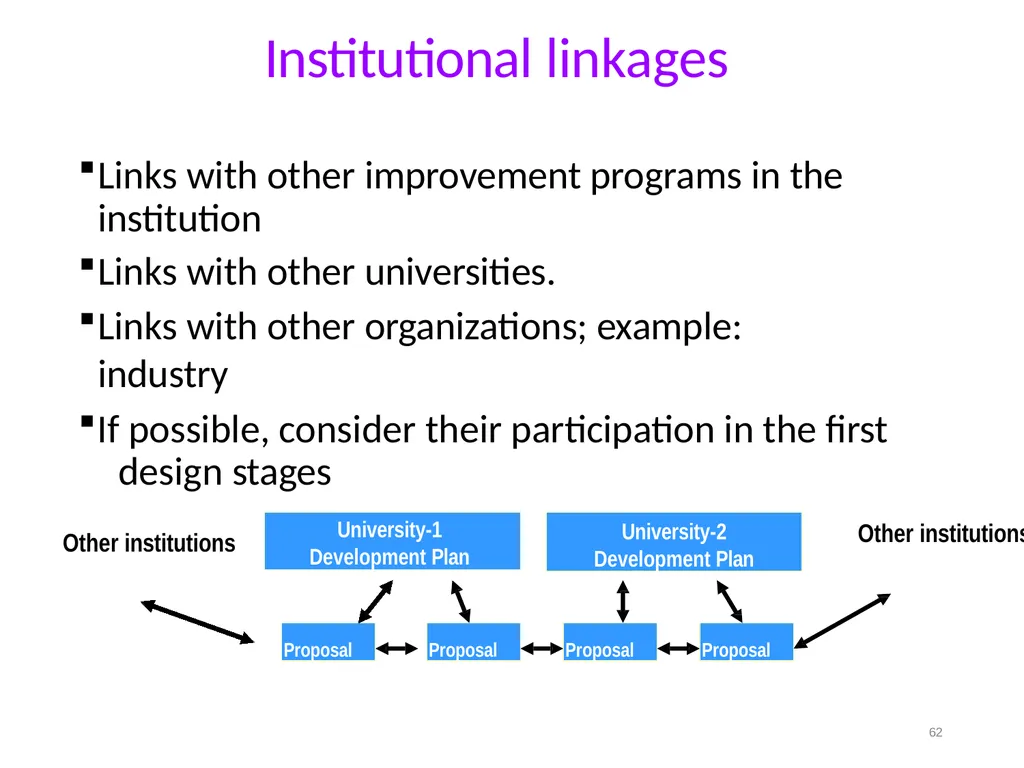
slide62. Institutional linkages Links with other improvement programs in the institution
Links with other universities.
Links with other organizations; example: industry
If possible, consider their participation in the first design stages University-1
Development Plan Proposal Proposal Proposal Proposal Other institutions Other institutions University-2
Development Plan 62<br>
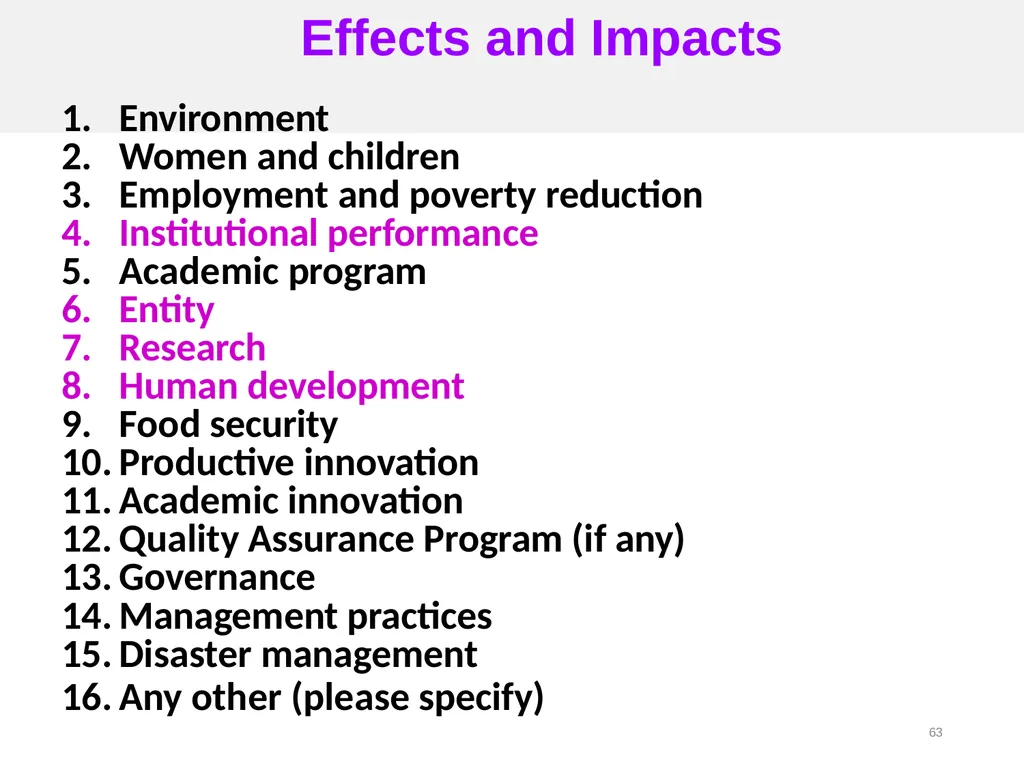
slide63. 63 Effects and Impacts Environment
Women and children
Employment and poverty reduction
Institutional performance
Academic program
Entity
Research
Human development
Food security
Productive innovation
Academic innovation
Quality Assurance Program (if any)
Governance
Management practices
Disaster management
Any other (please specify)<br>
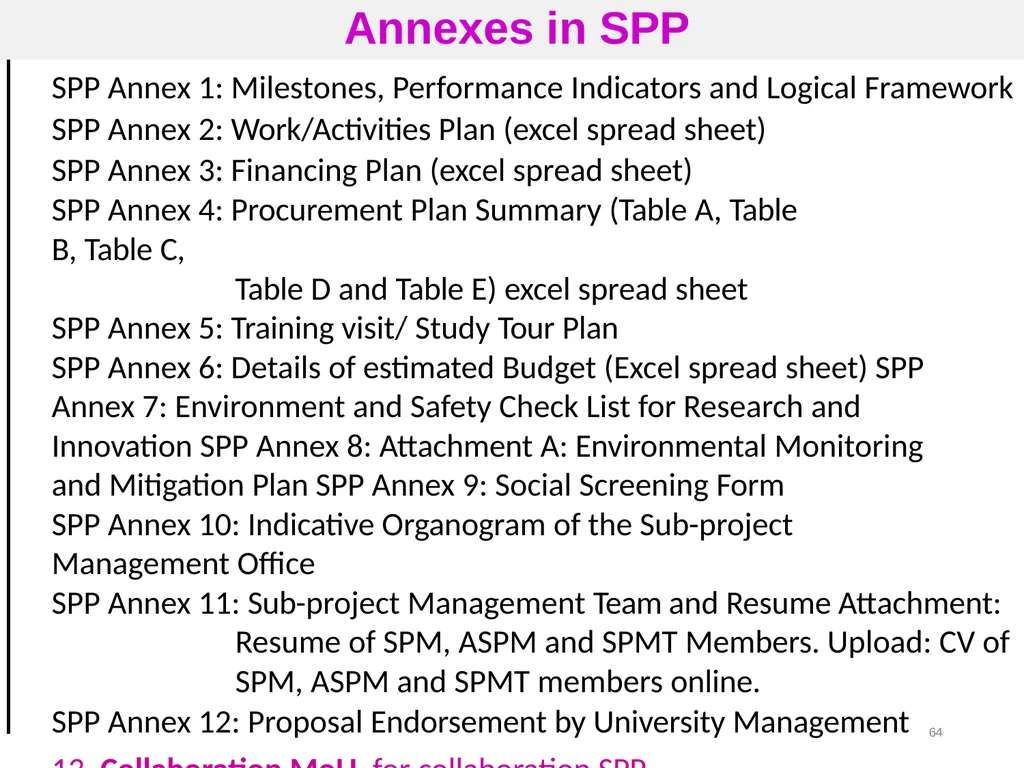
slide64. SPP Annex 1: Milestones, Performance Indicators and Logical Framework
SPP Annex 2: Work/Activities Plan (excel spread sheet) SPP Annex 3: Financing Plan (excel spread sheet)
SPP Annex 4: Procurement Plan Summary (Table A, Table B, Table C,
Table D and Table E) excel spread sheet SPP Annex 5: Training visit/ Study Tour Plan
SPP Annex 6: Details of estimated Budget (Excel spread sheet) SPP Annex 7: Environment and Safety Check List for Research and Innovation SPP Annex 8: Attachment A: Environmental Monitoring and Mitigation Plan SPP Annex 9: Social Screening Form
SPP Annex 10: Indicative Organogram of the Sub-project Management Office
SPP Annex 11: Sub-project Management Team and Resume Attachment: Resume of SPM, ASPM and SPMT Members. Upload: CV of SPM, ASPM and SPMT members online.
SPP Annex 12: Proposal Endorsement by University Management
13. Collaboration MoU, for collaboration SPP Annexes in SPP 64<br>
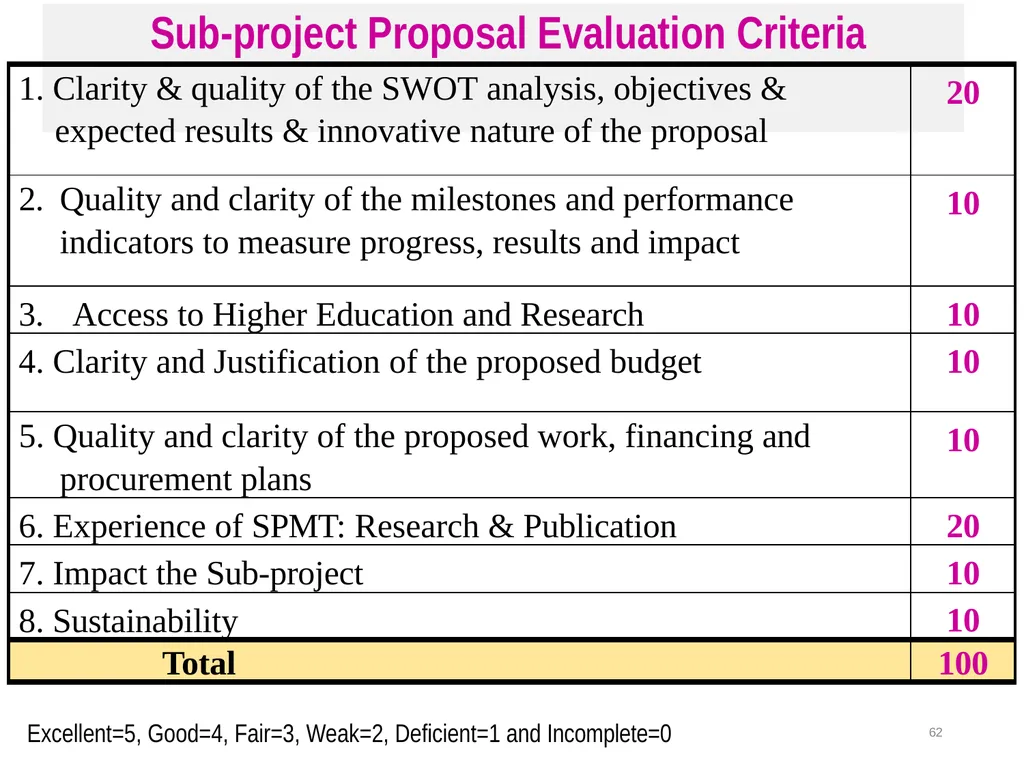
slide65. 62 Sub-project Proposal Evaluation Criteria Excellent=5, Good=4, Fair=3, Weak=2, Deficient=1 and Incomplete=0<br>
slide66. 66 Environment Safety Checklist & Mitigation Plan (Annex-7)<br>
slide67. 67 Social Screening Form (Annex-8)<br>
slide68. 68 Experience in similar project<br>
slide69. Questions ???
Comments !!! 63<br>
(PhD, Curtin University, Australia)
Professor, Department Tourism and Hospitality Management
E-mail: mehossain@yahoo.com
Tel: 01711461460, 01746583853<br>
slide2. 2 Components for Proposal Writing<br>
slide3. 3 Proposal Components<br>
slide4. 4 Proposal Components<br>
slide5. 5 Proposal Title Informative, not creative
Brief, precise, direct & comprehensive
Reflect objectives
Should include all known “keywords”
Institutional and project responsibilities should be well established
Complete “at the end of writing” “Capacity Building of Hospitality Graduates in Bangladesh to Promote Youth Employment Through industry and Universities Partnership”
Alternative:
“Empowering Tourism and Hospitality Graduates in Bangladesh: Bridging Academia and Industry for Employment”
Or
“Development of Employability Skills of Hospitality Students through Academia and Industries Partnership” EXAMPLE<br>
slide6. 24 Window 3b: Collaborative Research with Industries and Research Institutes Activities:
University-industry collaborative research targeting patenting and commercialization of research products. Eligible Entities:
Departments/Institutes of all eligible Universities
Budget Limit:
:BDT. 200-1000 Lac 24<br>
slide7. 7 Implementation Period (EXAMPLE) i. Implementation Period: 03, Years)
ii. Commencement: January 2025
iii. Completion: December 2027 Ex. June 2028 Total cost: BDT & US$ (i) BDT: 600 lack or 6 corer)
(ii) US$500000(@ 120 BDT as on Jan 1, 2025)<br>
slide8. 8 General objective/s Should reflect the title; Repeat keywords if possible
Should be commensurate with vision, mission, goal of the University, entity
State main problem addressed by the proposal
State objectives referred to medium-term results and impact that the institution would like to achieve
Single Sentence<br>
slide9. General Objective
The general objective of the study is to empower tourism and hospitality graduates in Bangladesh by bridging the gap between academia and industry, ensuring they are equipped with the skills, knowledge, and experiences necessary for successful employment in the local and global markets. Example<br>
slide10. 10 Specific objectives Should support the General Objectives
Several specific objectives against one General objective
Identified and numbered
Clear and Specific
Measurable, not necessarily quantified
Achievable during lifetime of the project but outreach beyond
Relevant in the local context
Should allow periodic M&E<br>
slide11. Industry Collaboration: To establish strong partnerships with tourism and hospitality organizations for internships, mentorship, and job placement opportunities.
Global Competency: To prepare graduates for international markets by integrating global best practices, foreign language training, and international certifications/recognition.
Entrepreneurship Development: To foster entrepreneurial skills among students, enabling them to create innovative tourism and hospitality businesses in Bangladesh.
Research and Innovation: To promote research and innovation in tourism and hospitality, addressing both local and global challenges and contributing to industry advancements. Example<br>
slide12. 12 Institutional information Information should be based on the importance of the Department/institute. It would be wise to emphasize the relevance of the project (implied)<br>
slide13. Example The tourism industry is considered as one of the largest and the most diverse industries in the world. It has been drawing attention as a modern service industry and the device to create connectivity among nations and various people across the world. This industry has the most potential in the world. Every 1 in 10 jobs; generating 10% of global GDP and 9 % of the world’s jobs are part of this industry. Currently there are more than 5 million jobs available in the world; and roughly 0.5 million jobs are in Bangladesh. It is expected that by 2022 more than 2.5 million jobs will be created in Bangladesh in this field. The estimated statistics indicate that there are many possibilities and potentials existing in our country as well as abroaod. Unfortunately, due to the lack of strategic attention, tourism industry has not shown considerable progress.<br>
slide14. Example only The economy of the country is growing at over 7%; the government has set a target of over 8% economic growth in the next fiscal year and employment generation will be 15 million within next five years. Obviously, tourism industry will play significant role for fulfill these targets.
The Department is also committed to achieve quality and to establish an effective system that helps in elevating the educational process, in reaching the department to leadership. It wants see itself as iconic department through an even balance between theoretical and practical expertise, while also keeping aligned with the labor market to promote tourism industry in a way that goes with the Bangladesh status regionally and globally.<br>
slide15. Proposal Summary 250 words for SPP
A first concise view of the proposal
Follow logical framework approach
Goal & Purpose
General Objectives
Purpose & Output
Specific Objective
Expected Result
Outcome
Output & Input
Activities, Methods etc.
Item-wise paragrapgh captions 15<br>
slide16. PROPOSAL SUMMARY (EXAMPLE) Tourism and hospitality are rapidly growing sectors with significant economic potential. However, a gap between academic teaching and industry needs hinders graduates’ success. This project aims to bridge this gap by aligning curricula with industry requirements, incorporating practical skills, and fostering global competencies. The project emphasizes hands-on training, industry-led internships, and strong academia-industry partnerships, both locally and internationally. Key areas include global acceptance, language training, international exposure, sustainability, ethical practices, and entrepreneurship. The goal is to enhance graduate employability, support economic growth, and position Bangladesh as a competitive destination in the global tourism and hospitality market.<br>
slide17. 17 Strategic Analysis - Basically, SWOT analysis
- Should clearly indicate that all categories of
stakeholders participated in the exercise
- Both internal (strength & weaknesses) and external (opportunities & threats) factors should be analyzed & highlighted
Link SWOT results with:
objective, activity,
outcome, performance indicator<br>
slide18. Strategic Analysis (SWOT) Strength
Weakness Internal Opportunities
Threat External 18<br>
slide19. Strength Analysis EXAMPLE Bangladesh's tourism and hospitality industry is expanding, offering significant job opportunities for skilled graduates. A large and dynamic young workforce eager to contribute to the sector. Several universities and training centers offer tourism and hospitality programs, providing a foundation for skill development. In Bangladesh there are around 42 universities are offering this program. Bangladesh Government also recognizes tourism as a key sector for economic growth, ensuring policy support for workforce development. Thus, this sector have a lot potentially in home and abroad. However, in the flowing sections partially a brief description is given focusing SWOT.<br>
slide20. Strength Analysis EXAMPLE Growing Tourism Sector: Bangladesh's tourism and hospitality industry is expanding, offering significant job opportunities for skilled graduates.
Youth Demographics: A large and dynamic young workforce eager to contribute to the sector.
Established Academic Institutions: Several universities and training centers offer tourism and hospitality programs, providing a foundation for skill development.
Government Focus on Tourism: The government recognizes tourism as a key sector for economic growth, ensuring policy support for workforce development.
Untapped Potential in Sustainable Tourism: Opportunities in ecotourism, cultural tourism, and heritage tourism that graduates can capitalize on.<br>
slide21. WEAKNESS Analysis EXAMPLE Skill Mismatch: A gap between academic training and the practical skills required by the industry.
Limited Industry-Academia Collaboration: Inadequate partnerships between universities and industry stakeholders for internships, training, and curriculum development.
Outdated Curriculum: Course content may not keep pace with evolving industry trends and global standards.
Lack of Soft Skills Development: Deficiencies in communication, leadership, and customer service skills among graduates.
Employment Challenges: High underemployment rates due to limited job opportunities aligned with graduates' qualifications.<br>
slide22. OPPORTUNITY Analysis EXAMPLE Global Trends in Hospitality: Increasing international interest in Bangladesh's tourism sector opens doors for innovative and global-standard training programs.
Technology Integration: Leveraging digital tools and online platforms for both education and industry engagement.
Policy Interventions: Government policies and incentives can stimulate industry-academia collaboration and investment in training programs.
Public-Private Partnerships: Collaborative ventures between academia, industry, and policymakers to bridge the employment gap.
Regional and Cultural Strengths: Rich cultural heritage and natural attractions provide a unique advantage for specialized training and niche tourism markets.<br>
slide23. THREAT Analysis (EXAMPLE) Political Uncertainty: It could be raised on the way of implementation of the project that may make delay.
Economic Uncertainty: Fluctuations in economic stability can impact the demand for tourism and hospitality services.
Global Competition: Competing with well-established tourism markets in the region for skilled jobs and investment from the wider.
Lack of Awareness: Limited understanding among stakeholders about the importance of aligning education with industry needs.
Brain Drain: Skilled graduates may seek opportunities abroad due to better pay and prospects, leading to a talent gap locally.<br>
slide24. 24 Background Data Should link the background data with SWOT (S & W part)
Should generate extra relevant information along with the given questions
Data should relate to the sub-project issues
Some quantitative facts about the entity
Some important items not to be omitted: Basic academic indicators (input, output, outcomes); physical facilities, institutional tendencies
Note: SWOT analysis & background data
should be related<br>
slide25. (Example) According to the World Travel & Tourism Council (WTTC), the tourism sector in Bangladesh contributed BDT 1.02 trillion (USD 9.5 billion) to the country’s GDP in 2023, accounting for 3% of the total employment in Bangladesh, with 2.14 million jobs.
A Bangladesh Bureau of Educational Information and Statistics (BANBEIS) survey shows that only 40% of tourism and hospitality graduates find jobs within six months, with employers citing a lack of practical skills and industry exposure as major barriers.
United Nations World Tourism Organization (UNWTO) highlights the global shift toward sustainable and digital tourism, which demands proficiency in areas such as technology integration, sustainability practices, and cross-cultural communication.<br>
slide26. (Example) A 2021 study by the Bangladesh Institute of Development Studies (BIDS) found that less than 30% of academic institutions have active partnerships with industry stakeholders, resulting in limited opportunities for internships, on-the-job training, and industry-aligned recognitions.
Furthermore, the lack of entrepreneurship development programs within academic institutions restricts graduates’ potential to create innovative tourism ventures. This is critical in a market where micro, small, and medium enterprises (MSMEs) drive local tourism growth.<br>
slide27. Description of proposed field of research (EXAMPLE) There are multiple career opportunities in this industry like managing hotels, resorts, restaurants, public houses; conference hall, accommodations, catering services, customer services, and management access a range of industries. Jobs are also available in airlines, cruises, hospitals, transportation services, spa, beauty-parlor destination planning, designing and development .The leisure industry also covers sport and entertainment as additional avenues of employment in sport and fitness centers, cinemas, and theatres as well as other leisure venues such as bowling alleys and theme parks. Other service-focused roles in retailing, human resources management and events management also could be of interest areas. Many become on entrepreneur in the services industry like tour entrepreneur, club, travel, event, restaurant, hotel owner and several others.
While we are committed to achieve global excellence in tourism and hospitality education, we continue to forge strong relationship between the industry and students, academic and non-academic staffs, partnerships through industry collaboration and effective teaching and research.<br>
slide28. Description of proposed field of research (EXAMPLE) 1. Academia-Industry Gap: Curricula often fail to address the real-world challenges and practical requirements of the industry.
2. Skill Deficiency: Employers frequently report a lack of soft skills, technical expertise, and leadership qualities among graduates.
3. Limited Industry Collaboration: A lack of partnerships between educational institutions and industry stakeholders restricts students’ opportunities for internships, apprenticeships, and hands-on learning.
4. Underutilization of Educated Human Resources: The mismatch between the skills acquired by graduates and the needs of the industry leads to underemployment and unemployment.<br>
slide29. 29 Project Indicators Level 1. Milestones
Describe progress in sub-project implementation
Expressed in terms of critical activities/outcome
Level 2. Performance indicators
key variables that affect beneficiaries
Refer to Annex-2 of ATFOM
Logical Framework
Essential for M&E, measurement of achievement of results, effectivness in resource’s use and improvement of project design.<br>
slide30. 30 Milestones (Level 1) Achievement of critical activities / Results
Only critical activities & critical results
Activity-Result relation should be well visible and self explanatory
Should indicate a new level in implementation
Must be objectively verifyable
Relate to Work plan, Procurement plan, Financing plan<br>
slide31. To prepare graduates for employment in Bangladesh and the global tourism and hospitality industry, a structured approach with clearly defined milestones is essential. Below are key milestones and specific activities to achieve them are given in briefly: Milestones (Level 1) EXAMPLE 31 Area 1. Curriculum Modernization and Industry Alignment
Milestone: Develop a curriculum that aligns with both national and international industry standards.
Activities:
Conduct a needs assessment by consulting industry stakeholders, alumni, and employers.
Integrate practical modules such as event planning, tourism marketing, hotel operations, and travel technology.
Offer specialized courses in emerging areas like sustainable tourism, eco-tourism, and digital marketing.
Align the program with global certifications like the World Tourism Organization’s TedQual accreditation.<br>
slide32. Area 2: Skill Development through Practical Training
Milestone: Equip students with industry-relevant technical and soft skills.
Activities:
Establish state-of-the-art laboratories such as mock hotel rooms, kitchens, and reservation systems and house keeping services.
Partner with local and international organizations to provide internships and apprenticeships.
Organize workshops and seminars on communication, customer service, cultural sensitivity, and problem-solving skills. Milestones (Level 1) EXAMPLE 32<br>
slide33. 33 Table of Milestones (Example from HEAT)<br>
slide34. Performance Indicators (level 2) Relation between milestones & performance indicators, log frame
Log-frame: Input →Output → Purpose →Goal
Performance Indicator Milestone
May be within the SPP period, some may go beyond
May be quantitative and qualitative (but verifiable)
Assumptions should be realistic
Verification methods clear, operational
Refer to general objective, specific objectives, benefits, University characteristics etc. 34<br>
slide35. 35 Table of PI (Example from HEAT)<br>
slide36. 36 Relevance Explicit:
University & Entity relevance
(eg. Agri Univ. projects should be agri related)
Regional relevance
National relevance
Relate to sub-project activities, specific objective, SWOT results<br>
slide37. Employment Challenges for Graduates: Tourism and hospitality graduates in Bangladesh face difficulties in securing jobs that match their qualifications due to a lack of industry-specific skills and practical experience.
Sectoral Growth and Economic Contributions: Tourism and hospitality contribute significantly to Bangladesh’s GDP and provide direct and indirect employment opportunities.
Meeting Industry Demands: The rapid growth of sustainable tourism, digital technologies, and globalized markets demands a workforce with diverse skills, including technology integration, sustainability practices, and cultural adaptability. Relevance (EXAMPLE)<br>
slide38. 38 Benefits (qualitative and quantitative) Be imaginative but objective
Direct and indirect benefit
Relate to general objective, specific objective
Relate to performance indicators
Some examples
Better R&D infrastructure and capacity
Wider PhD disciplinary coverage, enrolment and graduation
Higher research outputs, productivity and international linkages<br>
slide39. 1. Enhanced Employability of Graduates: By aligning academic training with industry requirements, graduates will possess the relevant skills and practical experience needed to meet employer expectations. This will boost their confidence and readiness for the workforce, allowing them to transition smoothly from education to employment.
2. Strengthened Academia-Industry Relationships: Establishing partnerships between educational institutions and tourism and hospitality businesses fosters mutual learning and collaboration. These relationships ensure that the curriculum stays relevant and responsive to industry demands, benefiting both students and employers in the long term. Qualitative Benefits (EXAMPLE)<br>
slide40. 1. Increased Graduate Employment Rate: By bridging the gap between academia and industry, graduate employment rates are likely to increase. For example, the percentage of graduates securing employment within six months of graduation can rise from the current 40% to 70% or higher, reducing unemployment in the sector.
2. Higher Salary and Job Placement Rates: Graduates equipped with industry-relevant skills and experience are more likely to command higher salaries. This can result in increased average salaries for tourism and hospitality graduates, with potential increases in salaries by 15-30% as they fill key positions in industry-leading organizations. Quantitative Benefits (EXAMPLE)<br>
slide41. 41 Proposal Sustainability Continuation after the contract can be foreseen and is realistic
Capitalisation on previous experiences
Medium/long term impact can be expected
Long-lasting effect on institutions/target groups
Environmental, safety hazard protection and risk mitigation have been considered
Institutional commitments on implementation and sustainability are clear and convincing<br>
slide42. 42 Proposal Sustainability (EXAMPLE) 1. Establishing Long-Term Academia-Industry Partnerships
• Action: Build continuous and strategic partnerships with key industry stakeholders, including hotels, airlines, travel agencies, and government tourism bodies.
• Sustainability Mechanism: Forming advisory boards consisting of industry leaders who actively participate in curriculum development, internship programs, and job placements. Regular review meetings and partnership contracts will ensure that both academia and industry stay aligned with evolving market trends.
• Outcome: Ongoing collaboration between institutions and employers will ensure that industry requirements are continuously reflected in academic programs, while providing students with continuous access to internship, industrial attachment and employment opportunities.<br>
slide43. Proposal Sustainability (EXAMPLE).. 2. Curriculum Flexibility and Global Integration
• Action: Continuously revise the curriculum to reflect global trends, digitalization, and sustainability while also maintaining flexibility to adapt to emerging industry needs.
• Sustainability Mechanism: Develop strong collaborations with international academic institutions, ensuring that curricula remain globally competitive. Offer exchange programs and online learning platforms to allow students to engage with global trends.
• Outcome: The curriculum will be continuously updated to keep pace with industry demands, ensuring that graduates are always prepared for global job markets. International exposure and certifications will further increase the employability and competitiveness of graduates.<br>
slide44. Operation and Maintenance
of equipment and instruments Institutional capacity in operation and maintenance of equipment and instruments that will be used in the project:
In-house preventive maintenance
In-house servicing
Repair parts (if any)
Externaly procured servicing<br>
slide45. 45 Summary of Estimated Budget (Aggregate and Detail) Detail and aggregate are structurally related
Detail first and Aggregate will follow
Employ New Economic Code (7-digit; SPP Annex-3)
Prepare in Excel Sheet
Comply ceiling and rates e.g.
SPM team incentive, Consultant hire, Renovation, etc.
Ph.D., MPhil scholarship, Training, Collaboration, Foreign visit, etc.<br>
slide46. EXAMPLE<br>
slide47. 47 Work plan should be progressive and realistic
Activities should be logically sequenced
Where, when and who questions should be answered
Clear milestones should be set
Duration of preparation versus implementation should be realistic Workplan: Actions in time chart (Gantt chart)<br>
slide48. 48 Workplan: Actions in time chart (Gantt chart) EXAMPLE<br>
slide49. 49 Workplan: Actions in time chart (Gantt chart) EXAMPLE<br>
slide50. 50 Training/Workshop Plan Training for Human Resource Development of the Entity
Types: Training, Workshops Location: Local & Foreign
Should be logically sequenced
Academic staff upgrading
Academic staff development. Post-graduate degrees, local and abroad. New qualified staff
Support/ management staff, Technicians<br>
slide51. 51 Training/Workshop Plan<br>
slide52. 53 Procurement Plan Goods, Works, Consultant Service and Non- Consultant Services separately
Use format given in ATFOM SPP Annex-4
Useful management tool for project activity planning and implementation of purchases
Links to budget and work plan (Coherence)
On time adjustments for delays and contingencies will allow on time updates of work-plan and efficiency improvements
Careful management of procurement will normally produce project savings that can be used to support other project purposes It is a LIVING DOCUMENT<br>
slide53. 53 Procurement Plan (EXAMPLE)<br>
slide54. Eligible and Non-Eligible Expenditure A. Indicative Eligible Expenditure (Art-2.7)
Training of permanent academic staff (all Windows)
Teaching aids-materials (W-2)
Equipment/ stationeries (all Windows)
Local conference/seminar/workshops (all Windows)
Research support to Masters/MPhil./PhD (W-3)
Financial support to research students (W-3)
Research stay abroad (Fellows & host) (W-3)
Academic collaboration visit (all Windows)<br>
slide55. Eligible and Non-Eligible Expenditure B. Ineligible Expenditure (Art.-2.7.7)
Salary and allowances for permanent staff
Any establishment/recurring/revenue expenditures of the entities
Large civil works (Not exceeding 10% of total sub project cost)
Expenditure not included in the sub project work/financing/procurement plans and budget<br>
slide56. Special Attention A faculty in more than one SPP not allowed
Faculty engaged in other research costing above 100 lac are not allowed to submit ATF sub-project
All paragraphs/items should be organized & filled
Justification of budget asked for major items (>15%)..
Budget & all plans should be given in xls format
Foreign visit restricted & needs UGC permission
SPP hardcopy binding should be properly done
SPP submission needs both online and Hardcopy
Endorsement by university authority
UGCBATF may apply complementary selection criteria
……… 56<br>
slide57. Don’t Cross the Boundary Total budget of SPP (4 Basics for SPM, 2 Basics ASPM and 1 Basic for each Member)
SPM team incentives
Number of MPhil/PhD fellowship
Research stay abroad (Student/Faculty)
Number of foreign training (Faculty)
Collaboration visit abroad (# Faculty)
Total remuneration for consultants (<10%)
Renovation works (<10%)
Operational costs (<2%) 57<br>
slide58. 58 Sub-project Management Team Sub-project Management Team includes SPM, ASPM & Member of SPMT (total <=4)
Human resources behind a project
Responsibilities and challenges
Institutional role
Academic role
Project organization
Technical committee<br>
slide59. Sub-project Manager (Faculty) Office Sohayok Member (1-2) (Industry) Procurement/ Accounts/ Finance Officer Data Entry
/Computer Operator Office Secretary
/ Administrative officer Member (1-2) (Faculty) Associate SPMs (1-2) (Faculty) Indicative Organogram of the Sub-project Management Office 59<br>
slide60. Status of Team Members The SPM would be the same person proposed in the approved subproject proposal and will be assisted by Associate SPM (ASPM), another faculty of the same entity. There will be a Sub-project Management Team (SPMT) consisting of the SPM, ASPMs and members who will normally be academics of the entity. In the case of WINDOW-3b sub-projects, a scientist from the industry partner will be a member of the SPMT. In the case of WINDOW 3, 4 and 5 sub-projects, an officer of the university may be included in the SPMT. SPM will recruit office staff, i.e., Secretary/Office Manager,
Accountant/Finance Officer, Data Entry Technician, and support staff, i.e., Janitor/MLSS etc., (with consolidated salary or as additional duty/part-time contract basis) provisionally in line with approved sub-project proposal to work in SPMO. (Page 23 ATF OM)<br>
slide61. Fund allocation All sub-projects will require fund for renovation and refurbishing of class rooms, lecture theaters, women’s facilities renovation, labs, procurement of scientific equipment for labs, computers, communication and teaching-learning devices, office equipment, stationary, soft-ware, renovation work of classrooms and labs, etc. Sub-project budget will also cover expenses for other activities included in the work and financing plans, e.g., training, travel allowances, remuneration to MPhil, Master’s, PhD and Post-doc fellows, etc., and salary for contractual staff of the sub-project. However, Pandemic Research and Development sub-projects and those of the STAGE/ STEM disciplines would require modern state-of-the-art lab equipment for conducting advanced research.
Most of these scientific lab equipment are very expensive.<br>
slide62. Institutional linkages Links with other improvement programs in the institution
Links with other universities.
Links with other organizations; example: industry
If possible, consider their participation in the first design stages University-1
Development Plan Proposal Proposal Proposal Proposal Other institutions Other institutions University-2
Development Plan 62<br>
slide63. 63 Effects and Impacts Environment
Women and children
Employment and poverty reduction
Institutional performance
Academic program
Entity
Research
Human development
Food security
Productive innovation
Academic innovation
Quality Assurance Program (if any)
Governance
Management practices
Disaster management
Any other (please specify)<br>
slide64. SPP Annex 1: Milestones, Performance Indicators and Logical Framework
SPP Annex 2: Work/Activities Plan (excel spread sheet) SPP Annex 3: Financing Plan (excel spread sheet)
SPP Annex 4: Procurement Plan Summary (Table A, Table B, Table C,
Table D and Table E) excel spread sheet SPP Annex 5: Training visit/ Study Tour Plan
SPP Annex 6: Details of estimated Budget (Excel spread sheet) SPP Annex 7: Environment and Safety Check List for Research and Innovation SPP Annex 8: Attachment A: Environmental Monitoring and Mitigation Plan SPP Annex 9: Social Screening Form
SPP Annex 10: Indicative Organogram of the Sub-project Management Office
SPP Annex 11: Sub-project Management Team and Resume Attachment: Resume of SPM, ASPM and SPMT Members. Upload: CV of SPM, ASPM and SPMT members online.
SPP Annex 12: Proposal Endorsement by University Management
13. Collaboration MoU, for collaboration SPP Annexes in SPP 64<br>
slide65. 62 Sub-project Proposal Evaluation Criteria Excellent=5, Good=4, Fair=3, Weak=2, Deficient=1 and Incomplete=0<br>
slide66. 66 Environment Safety Checklist & Mitigation Plan (Annex-7)<br>
slide67. 67 Social Screening Form (Annex-8)<br>
slide68. 68 Experience in similar project<br>
slide69. Questions ???
Comments !!! 63<br>