What is a canvass? The canvass is a meeting held
Description: What is a canvass? The canvass is a meeting held to ensure that every valid vote cast is included in the election results. Canvass meetings are public, and you can observe the process the board of canvassers uses to certify the results of
Related Topics
Download Presentation
"What is a canvass? The canvass is a meeting held" is the property of its rightful owner. Permission is granted to download and print the materials on this website for personal, non-commercial use only, and to display it on your personal computer provided you do not modify the materials and that you retain all copyright notices contained in the materials. By downloading content from our website, you accept the terms of this agreement.
Presentation Transcript
slide1. What is a canvass? The canvass is a meeting held to ensure that every valid vote cast is included in the election results. Canvass meetings are public, and you can observe the process the board of canvassers uses to certify the results of the election.
When is it? The canvass board may begin its work as early as Election Day. Depending on your state and the type of election (local or presidential), canvassers must finish their official duties between one and four weeks after the election.
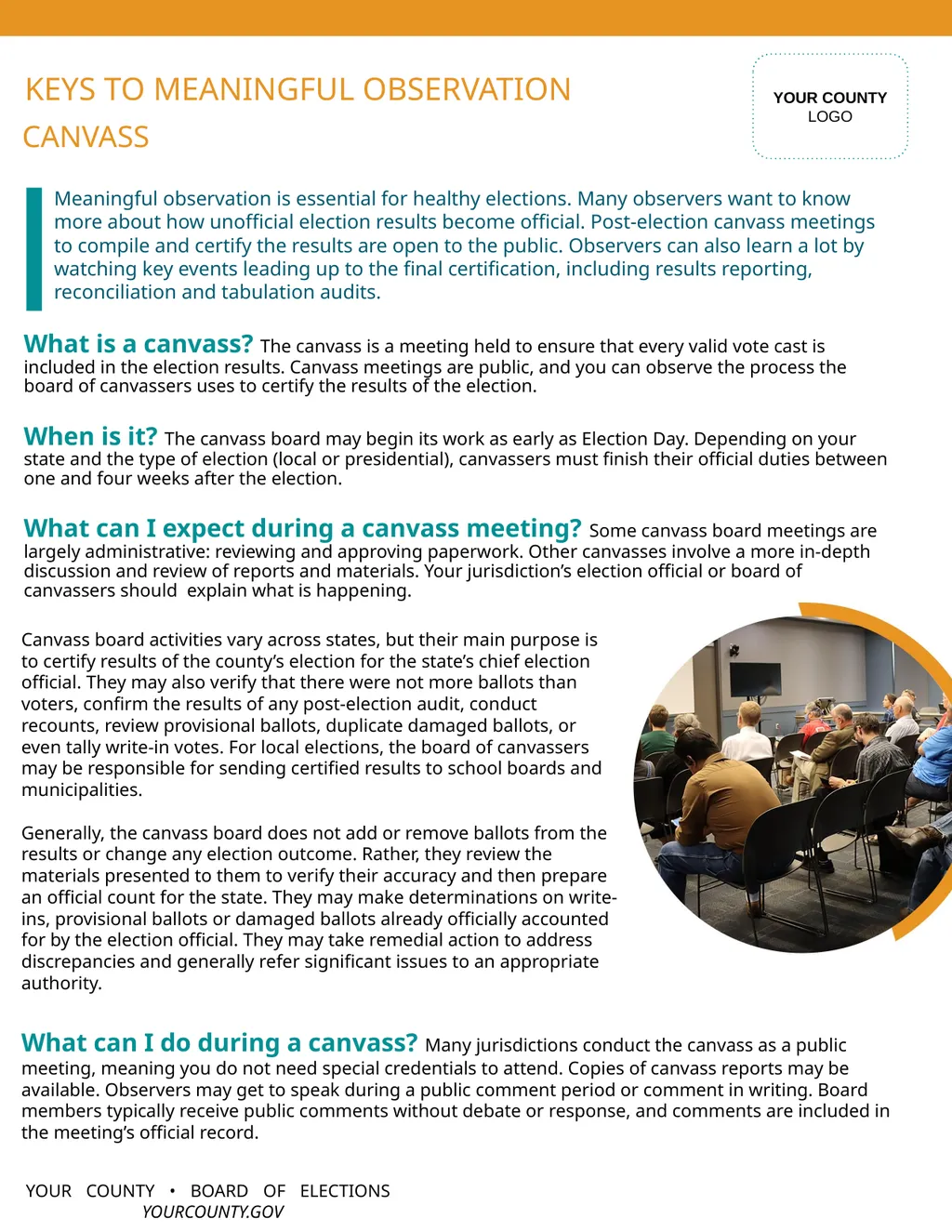
What can I expect during a canvass meeting? Some canvass board meetings are largely administrative: reviewing and approving paperwork. Other canvasses involve a more in-depth discussion and review of reports and materials. Your jurisdiction’s election official or board of canvassers should explain what is happening. KEYS TO MEANINGFUL OBSERVATION YOUR COUNTY LOGO CANVASS YOUR COUNTY • BOARD OF ELECTIONS YOURCOUNTY.GOV Meaningful observation is essential for healthy elections. Many observers want to know more about how unofficial election results become official. Post-election canvass meetings to compile and certify the results are open to the public. Observers can also learn a lot by watching key events leading up to the final certification, including results reporting, reconciliation and tabulation audits. What can I do during a canvass? Many jurisdictions conduct the canvass as a public meeting, meaning you do not need special credentials to attend. Copies of canvass reports may be available. Observers may get to speak during a public comment period or comment in writing. Board members typically receive public comments without debate or response, and comments are included in the meeting’s official record. Canvass board activities vary across states, but their main purpose is to certify results of the county’s election for the state’s chief election official. They may also verify that there were not more ballots than voters, confirm the results of any post-election audit, conduct recounts, review provisional ballots, duplicate damaged ballots, or even tally write-in votes. For local elections, the board of canvassers may be responsible for sending certified results to school boards and municipalities.
Generally, the canvass board does not add or remove ballots from the results or change any election outcome. Rather, they review the materials presented to them to verify their accuracy and then prepare an official count for the state. They may make determinations on write-ins, provisional ballots or damaged ballots already officially accounted for by the election official. They may take remedial action to address discrepancies and generally refer significant issues to an appropriate authority.<br>
slide2. IF YOU SEE SOMETHING, SAY SOMETHING If you see something concerning at a canvass meeting, tell the proper authority.
Direct inquiries to the official in charge of the location. In some counties, there may
be a formal complaint process to follow.
Always be respectful and realize that front line election workers may not be able to address all your concerns – and they may need to defer questions to the election office.
If that occurs, document your observations and inform your local election official. YOUR COUNTY • BOARD OF ELECTIONS YOURCOUNTY.GOV As an observer, how do I know the canvass process is unbiased and accurate? The canvass is designed to ensure accurate results and public confidence in those results through openness and bipartisanship. The canvass board is composed of citizen appointees representing both major political parties. Meetings are open to the public, which has a right to view and copy the records.
Observers can ensure the accuracy of the canvass by attending those meetings. If there are
deficiencies, the board may investigate and report them in their certification. In some instances, they may call on staff or poll workers to explain why a deficiency occurred. If there are resolved or unresolved discrepancies during the county canvass, observers can document them and bring them to the attention of the public, the media and elected leaders.
Should I worry if there are discrepancies? Not necessarily. Election officials usually find and investigate any discrepancies before the canvass board meets. The canvass board’s job is to review and fix any errors before certifying the election results, so observers may witness them discussing minor discrepancies. For example, if a polling place had one more ballot than voters, the board can review a poll worker’s incident report explaining what caused the discrepancy and decide whether further investigation is required.
Major discrepancies are rare. If there is one between the number of ballots counted and voter turnout, the election official should have thoroughly investigated the issue. The canvass board will review those findings and may take appropriate action.
Election officials view the canvass process as an opportunity to learn from mistakes. They will
often modify poll worker training or update procedures based on canvass findings.
What are canvass reports? Canvass reports typically show the total number of votes cast and how many votes each candidate received. There are usually reports for each race and referendum. Canvass reports usually show the number of votes per precinct.
Election officials create canvass reports from several sources, including official results, reports from the voting system and poll worker reports. The canvass board mostly reviews and discusses the reports. The canvass board itself does not create new reports.
For example, poll workers and staff will have already performed a reconciliation of ballots and voters and will present their findings to the canvass board. The board will review the reconciliation forms, but they will not perform a second reconciliation.<br>
When is it? The canvass board may begin its work as early as Election Day. Depending on your state and the type of election (local or presidential), canvassers must finish their official duties between one and four weeks after the election.
What can I expect during a canvass meeting? Some canvass board meetings are largely administrative: reviewing and approving paperwork. Other canvasses involve a more in-depth discussion and review of reports and materials. Your jurisdiction’s election official or board of canvassers should explain what is happening. KEYS TO MEANINGFUL OBSERVATION YOUR COUNTY LOGO CANVASS YOUR COUNTY • BOARD OF ELECTIONS YOURCOUNTY.GOV Meaningful observation is essential for healthy elections. Many observers want to know more about how unofficial election results become official. Post-election canvass meetings to compile and certify the results are open to the public. Observers can also learn a lot by watching key events leading up to the final certification, including results reporting, reconciliation and tabulation audits. What can I do during a canvass? Many jurisdictions conduct the canvass as a public meeting, meaning you do not need special credentials to attend. Copies of canvass reports may be available. Observers may get to speak during a public comment period or comment in writing. Board members typically receive public comments without debate or response, and comments are included in the meeting’s official record. Canvass board activities vary across states, but their main purpose is to certify results of the county’s election for the state’s chief election official. They may also verify that there were not more ballots than voters, confirm the results of any post-election audit, conduct recounts, review provisional ballots, duplicate damaged ballots, or even tally write-in votes. For local elections, the board of canvassers may be responsible for sending certified results to school boards and municipalities.
Generally, the canvass board does not add or remove ballots from the results or change any election outcome. Rather, they review the materials presented to them to verify their accuracy and then prepare an official count for the state. They may make determinations on write-ins, provisional ballots or damaged ballots already officially accounted for by the election official. They may take remedial action to address discrepancies and generally refer significant issues to an appropriate authority.<br>
slide2. IF YOU SEE SOMETHING, SAY SOMETHING If you see something concerning at a canvass meeting, tell the proper authority.
Direct inquiries to the official in charge of the location. In some counties, there may
be a formal complaint process to follow.
Always be respectful and realize that front line election workers may not be able to address all your concerns – and they may need to defer questions to the election office.
If that occurs, document your observations and inform your local election official. YOUR COUNTY • BOARD OF ELECTIONS YOURCOUNTY.GOV As an observer, how do I know the canvass process is unbiased and accurate? The canvass is designed to ensure accurate results and public confidence in those results through openness and bipartisanship. The canvass board is composed of citizen appointees representing both major political parties. Meetings are open to the public, which has a right to view and copy the records.
Observers can ensure the accuracy of the canvass by attending those meetings. If there are
deficiencies, the board may investigate and report them in their certification. In some instances, they may call on staff or poll workers to explain why a deficiency occurred. If there are resolved or unresolved discrepancies during the county canvass, observers can document them and bring them to the attention of the public, the media and elected leaders.
Should I worry if there are discrepancies? Not necessarily. Election officials usually find and investigate any discrepancies before the canvass board meets. The canvass board’s job is to review and fix any errors before certifying the election results, so observers may witness them discussing minor discrepancies. For example, if a polling place had one more ballot than voters, the board can review a poll worker’s incident report explaining what caused the discrepancy and decide whether further investigation is required.
Major discrepancies are rare. If there is one between the number of ballots counted and voter turnout, the election official should have thoroughly investigated the issue. The canvass board will review those findings and may take appropriate action.
Election officials view the canvass process as an opportunity to learn from mistakes. They will
often modify poll worker training or update procedures based on canvass findings.
What are canvass reports? Canvass reports typically show the total number of votes cast and how many votes each candidate received. There are usually reports for each race and referendum. Canvass reports usually show the number of votes per precinct.
Election officials create canvass reports from several sources, including official results, reports from the voting system and poll worker reports. The canvass board mostly reviews and discusses the reports. The canvass board itself does not create new reports.
For example, poll workers and staff will have already performed a reconciliation of ballots and voters and will present their findings to the canvass board. The board will review the reconciliation forms, but they will not perform a second reconciliation.<br>