What is a Seed Grant Good For? What does seed grant mean? SEED GRANTS are: competitive awards that are focused on the feasibility of a concept, assembly of compelling, qualified interdisciplinary investigator teams, identification of
"What is a Seed Grant Good For? What does “seed" is the property of its rightful owner. Permission is granted to
download and print the materials on this website for personal, non-commercial use only, and to display it
on your personal computer provided you do not modify the materials and that you retain all copyright
notices contained in the materials. By downloading content from our website, you accept the terms of this
agreement.
Presentation Transcript
01
What is a Seed Grant Good For?<br>
02
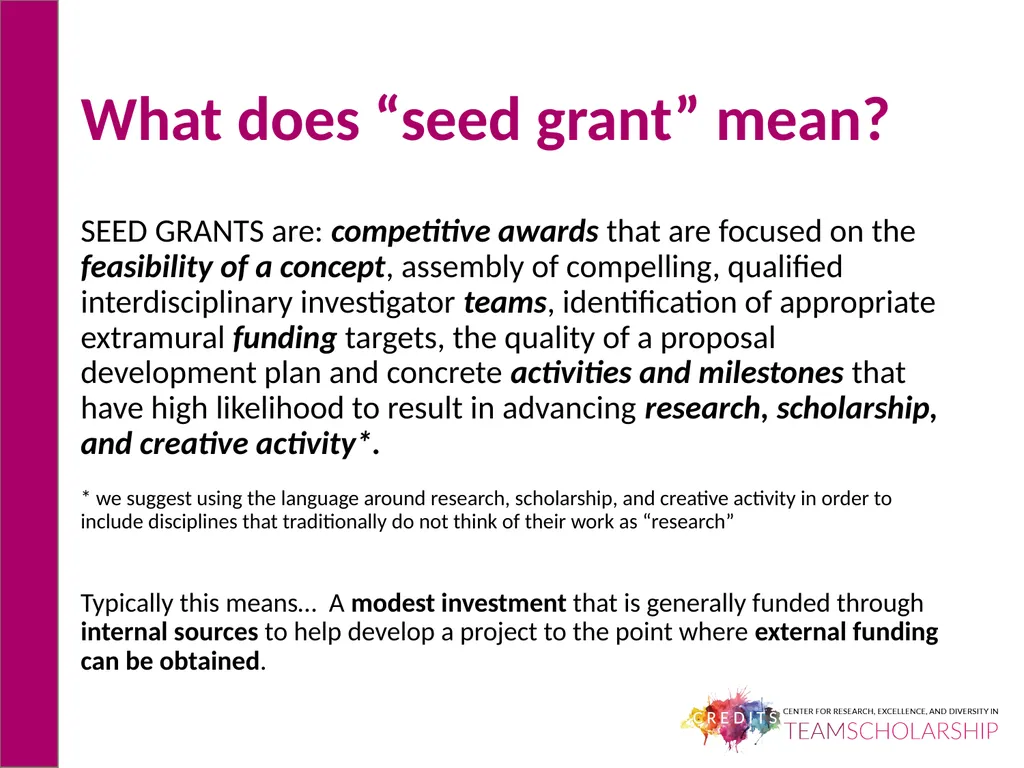
What does “seed grant” mean? SEED GRANTS are: competitive awards that are focused on the feasibility of a concept, assembly of compelling, qualified interdisciplinary investigator teams, identification of appropriate extramural funding targets, the quality of a proposal development plan and concrete activities and milestones that have high likelihood to result in advancing research, scholarship, and creative activity*.
* we suggest using the language around research, scholarship, and creative activity in order to include disciplines that traditionally do not think of their work as “research”
Typically this means… A modest investment that is generally funded through internal sources to help develop a project to the point where external funding can be obtained.<br>
03
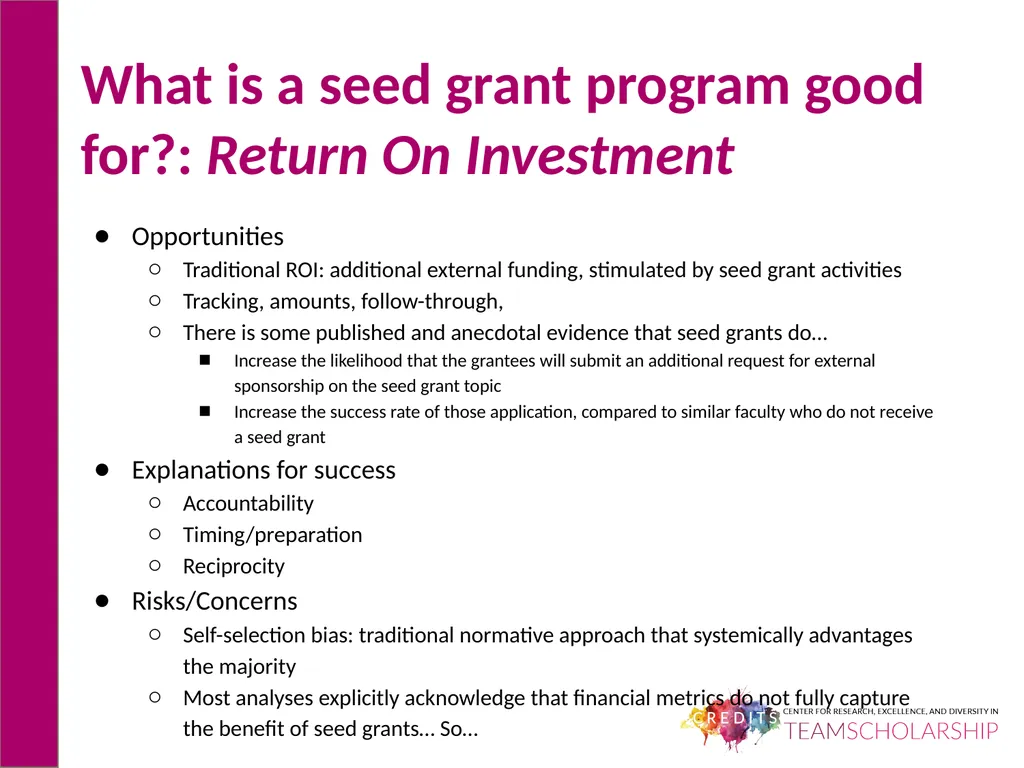
What is a seed grant program good for?: Return On Investment Opportunities
Traditional ROI: additional external funding, stimulated by seed grant activities
Tracking, amounts, follow-through,
There is some published and anecdotal evidence that seed grants do…
Increase the likelihood that the grantees will submit an additional request for external sponsorship on the seed grant topic
Increase the success rate of those application, compared to similar faculty who do not receive a seed grant
Explanations for success
Accountability
Timing/preparation
Reciprocity
Risks/Concerns
Self-selection bias: traditional normative approach that systemically advantages the majority
Most analyses explicitly acknowledge that financial metrics do not fully capture the benefit of seed grants… So…<br>
04
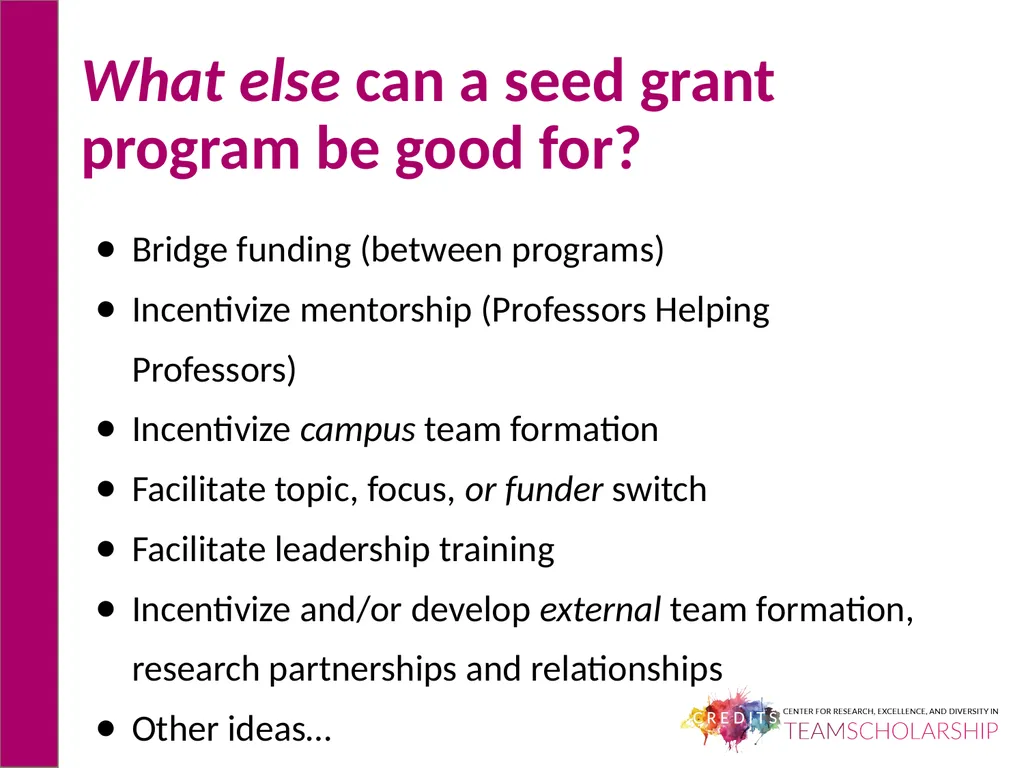
What else can a seed grant program be good for? Bridge funding (between programs)
Incentivize mentorship (Professors Helping Professors)
Incentivize campus team formation
Facilitate topic, focus, or funder switch
Facilitate leadership training
Incentivize and/or develop external team formation, research partnerships and relationships
Other ideas…<br>
05
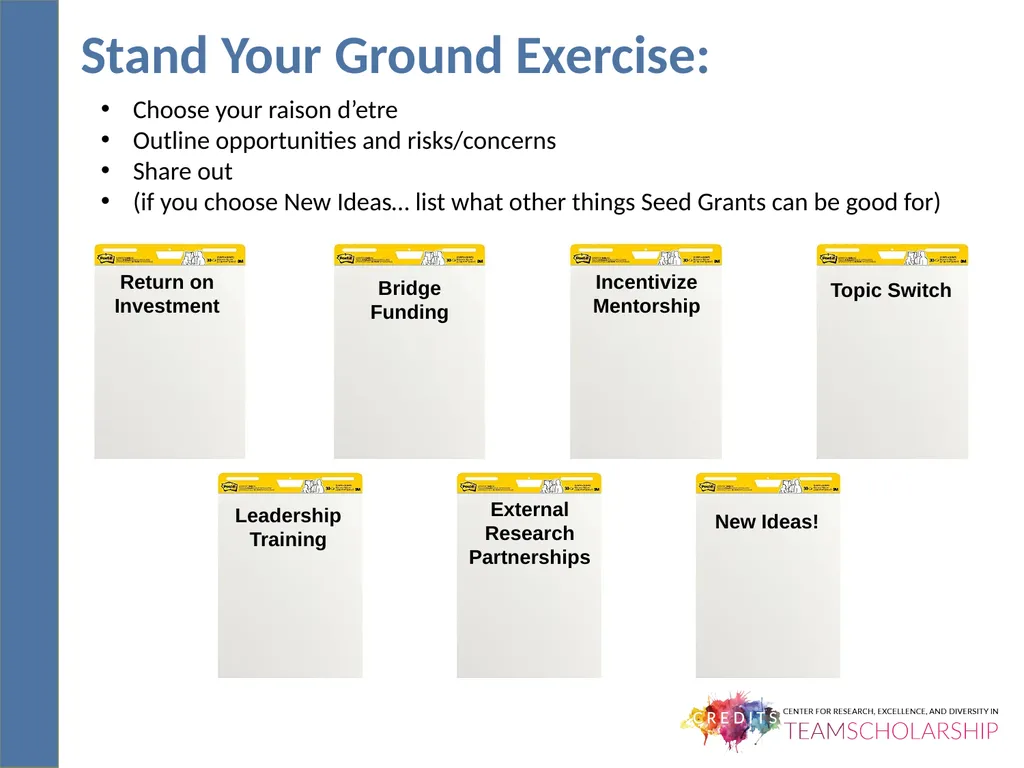
Return on Investment Bridge Funding Incentivize Mentorship Topic Switch External Research Partnerships Leadership Training New Ideas! Stand Your Ground Exercise: Choose your raison d’etre
Outline opportunities and risks/concerns
Share out
(if you choose New Ideas… list what other things Seed Grants can be good for)<br>
06
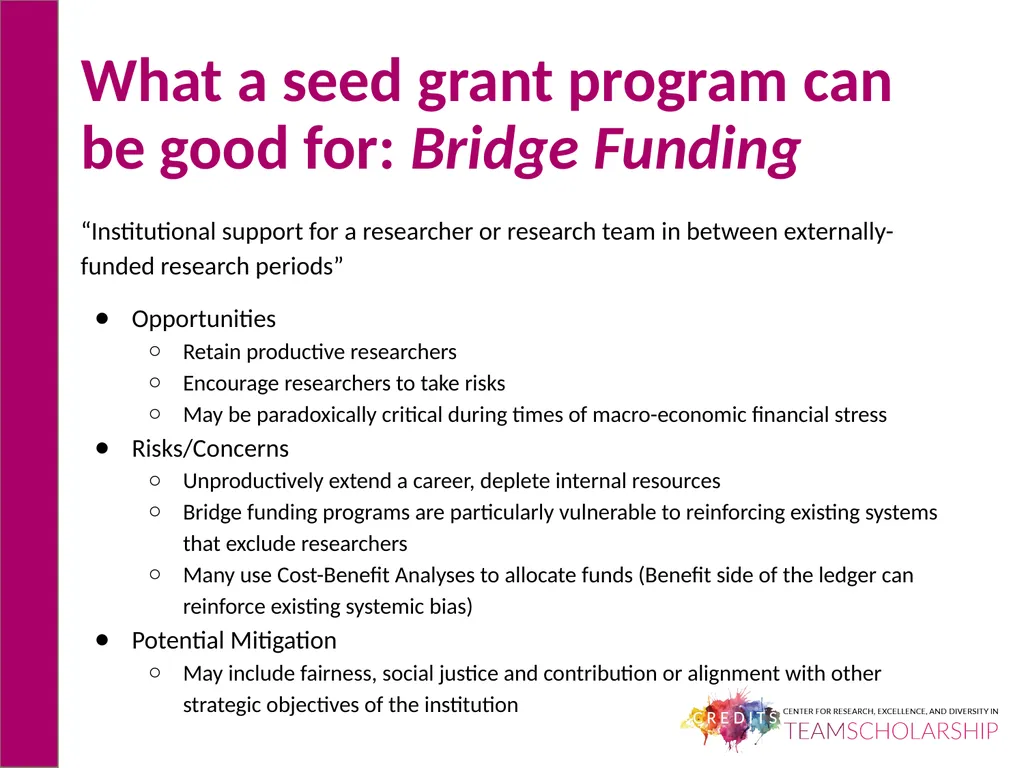
What a seed grant program can be good for: Bridge Funding “Institutional support for a researcher or research team in between externally-funded research periods”
Opportunities
Retain productive researchers
Encourage researchers to take risks
May be paradoxically critical during times of macro-economic financial stress
Risks/Concerns
Unproductively extend a career, deplete internal resources
Bridge funding programs are particularly vulnerable to reinforcing existing systems that exclude researchers
Many use Cost-Benefit Analyses to allocate funds (Benefit side of the ledger can reinforce existing systemic bias)
Potential Mitigation
May include fairness, social justice and contribution or alignment with other strategic objectives of the institution<br>
07
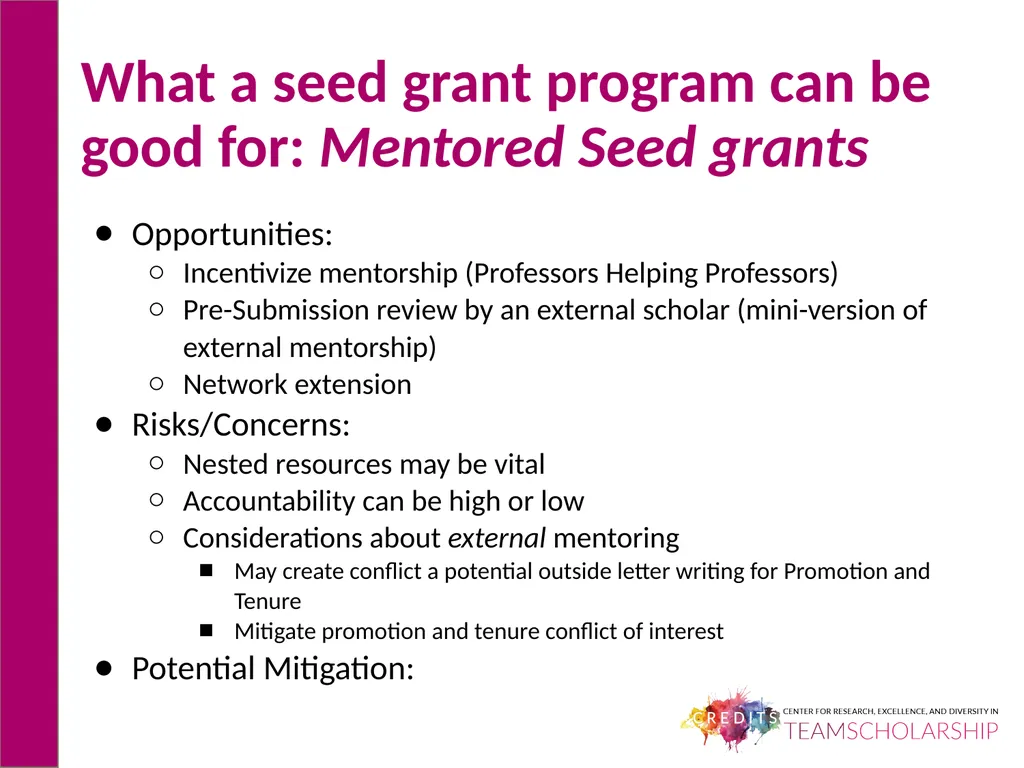
What a seed grant program can be good for: Mentored Seed grants Opportunities:
Incentivize mentorship (Professors Helping Professors)
Pre-Submission review by an external scholar (mini-version of external mentorship)
Network extension
Risks/Concerns:
Nested resources may be vital
Accountability can be high or low
Considerations about external mentoring
May create conflict a potential outside letter writing for Promotion and Tenure
Mitigate promotion and tenure conflict of interest
Potential Mitigation:<br>
08
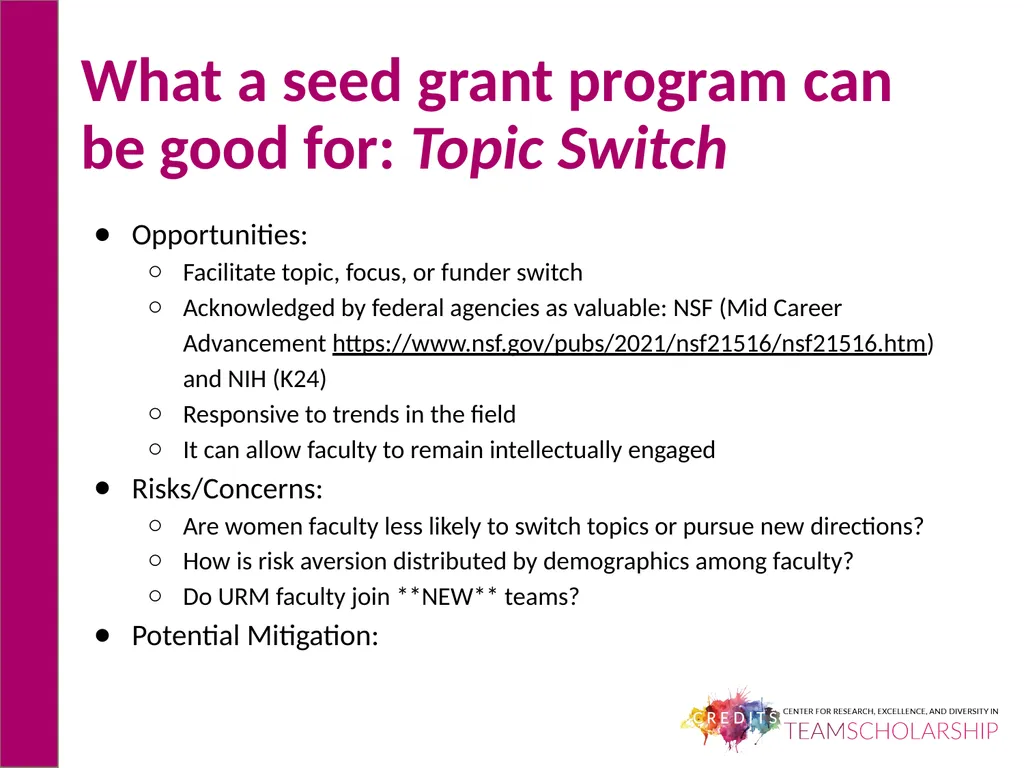
What a seed grant program can be good for: Topic Switch Opportunities:
Facilitate topic, focus, or funder switch
Acknowledged by federal agencies as valuable: NSF (Mid Career Advancement https://www.nsf.gov/pubs/2021/nsf21516/nsf21516.htm) and NIH (K24)
Responsive to trends in the field
It can allow faculty to remain intellectually engaged
Risks/Concerns:
Are women faculty less likely to switch topics or pursue new directions?
How is risk aversion distributed by demographics among faculty?
Do URM faculty join **NEW** teams?
Potential Mitigation:<br>
09
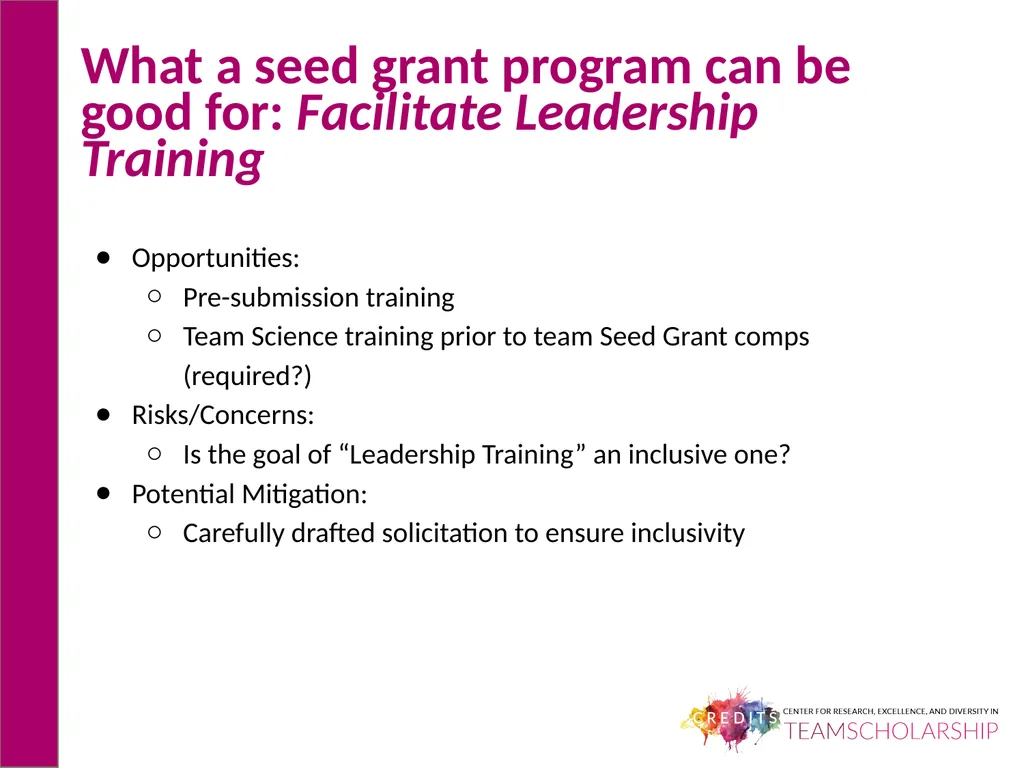
What a seed grant program can be good for: Facilitate Leadership Training Opportunities:
Pre-submission training
Team Science training prior to team Seed Grant comps (required?)
Risks/Concerns:
Is the goal of “Leadership Training” an inclusive one?
Potential Mitigation:
Carefully drafted solicitation to ensure inclusivity<br>
10
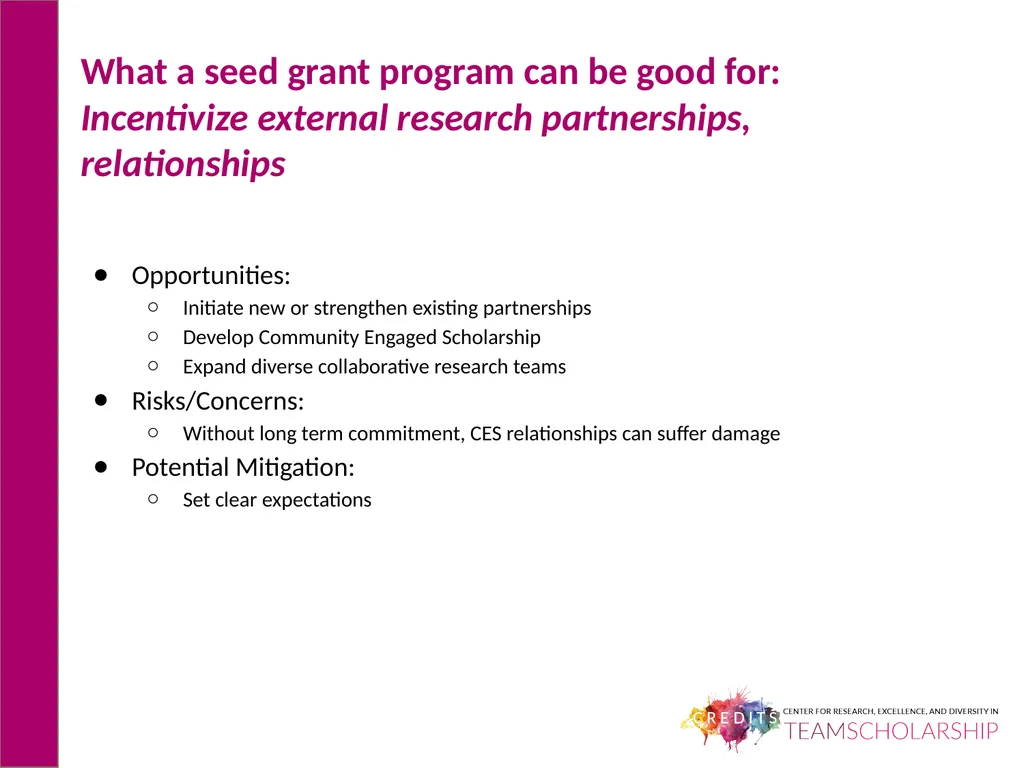
What a seed grant program can be good for: Incentivize external research partnerships, relationships Opportunities:
Initiate new or strengthen existing partnerships
Develop Community Engaged Scholarship
Expand diverse collaborative research teams
Risks/Concerns:
Without long term commitment, CES relationships can suffer damage
Potential Mitigation:
Set clear expectations<br>
11
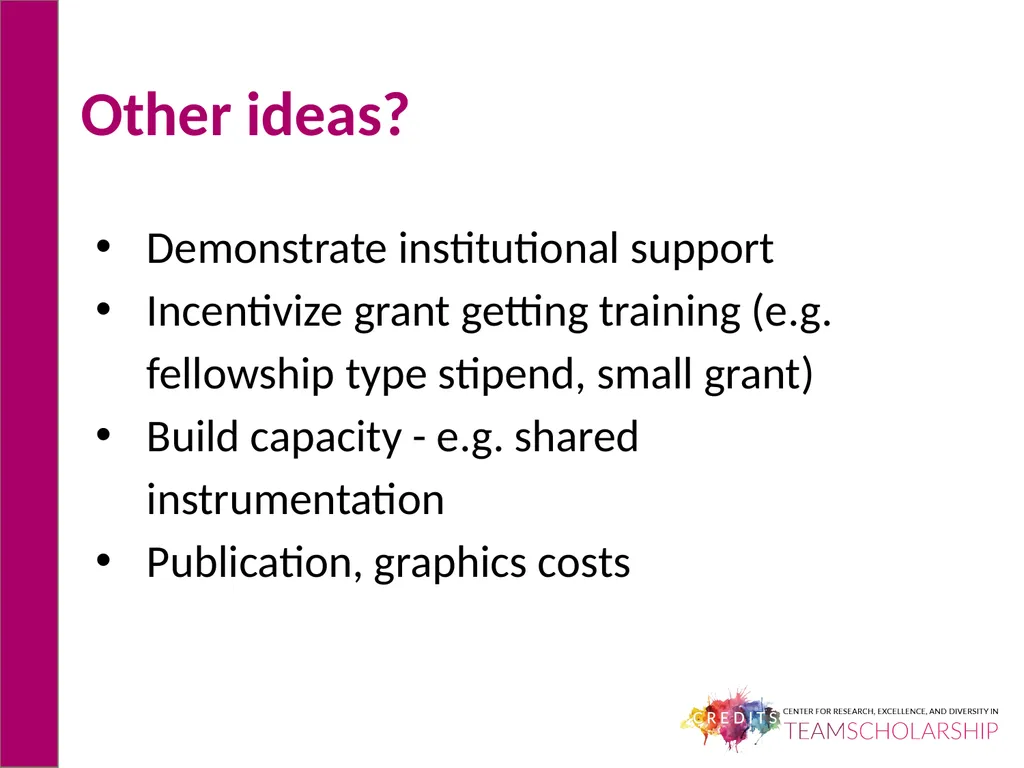
Other ideas? Demonstrate institutional support
Incentivize grant getting training (e.g. fellowship type stipend, small grant)
Build capacity - e.g. shared instrumentation
Publication, graphics costs<br>