What is Health? Session Aims To explore the complexities of health as a concept To reflect on your own perspective on health To summarize and critique key debates about the concept of health Definitions of health Dependent on a wide range
Related Topics
Share
Embed code
Download this presentation From Below
"What is Health? Session Aims To explore the" is the property of its rightful owner. Permission is granted to
download and print the materials on this website for personal, non-commercial use only, and to display it
on your personal computer provided you do not modify the materials and that you retain all copyright
notices contained in the materials. By downloading content from our website, you accept the terms of this
agreement.
Presentation Transcript
01
What is Health?<br>
02
Session Aims To explore the complexities of health as a concept
To reflect on your own perspective on health
To summarize and critique key debates about the concept of health<br>
03
Definitions of health Dependent on a wide range of perspectives, subjectivities and experiences
Socially, historically and culturally located
Health is a contested concept
Health is an abstract concept and difficult to define (Green et al, 2019)<br>
04
Definitions of Health Health as the absence of disease
Health as a continuum (positive/negative)
Holistic health
Health as well-being
Health as being able to function<br>
05
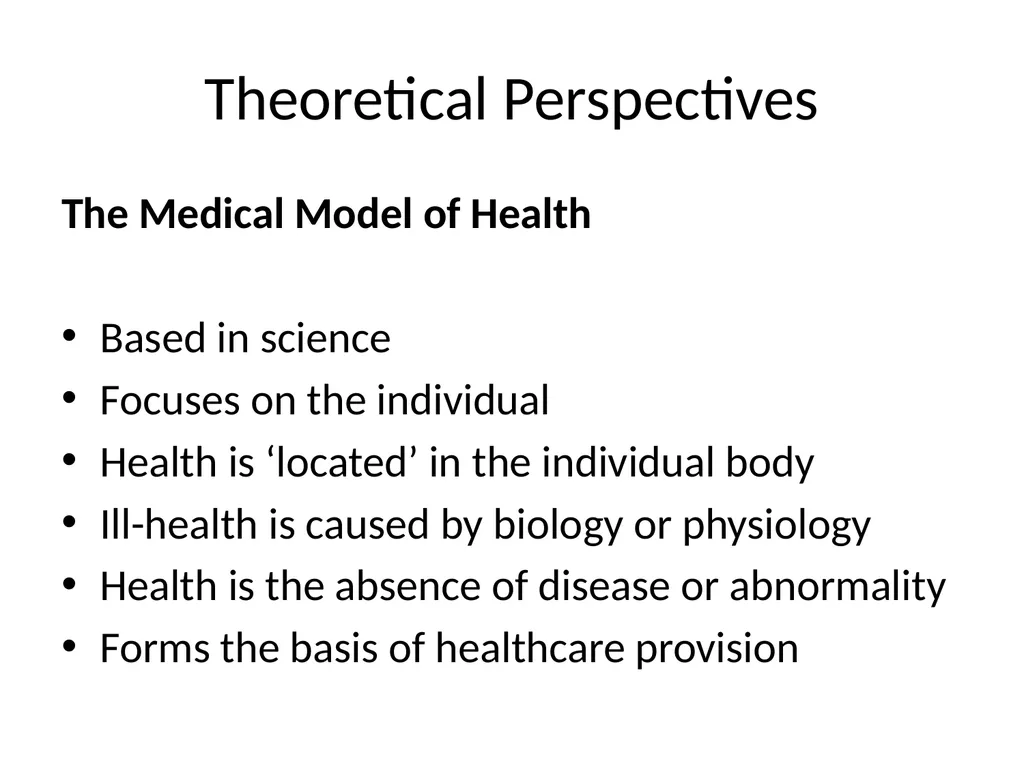
Theoretical Perspectives The Medical Model of Health
Based in science
Focuses on the individual
Health is ‘located’ in the individual body
Ill-health is caused by biology or physiology
Health is the absence of disease or abnormality
Forms the basis of healthcare provision<br>
06
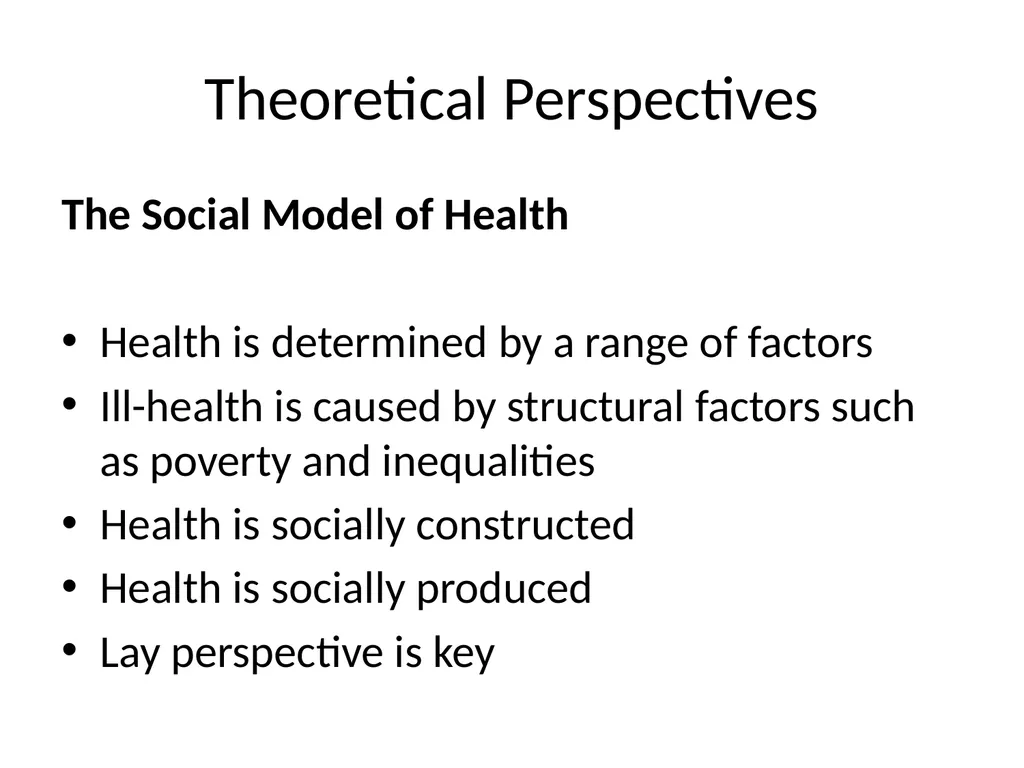
Theoretical Perspectives The Social Model of Health
Health is determined by a range of factors
Ill-health is caused by structural factors such as poverty and inequalities
Health is socially constructed
Health is socially produced
Lay perspective is key<br>
07
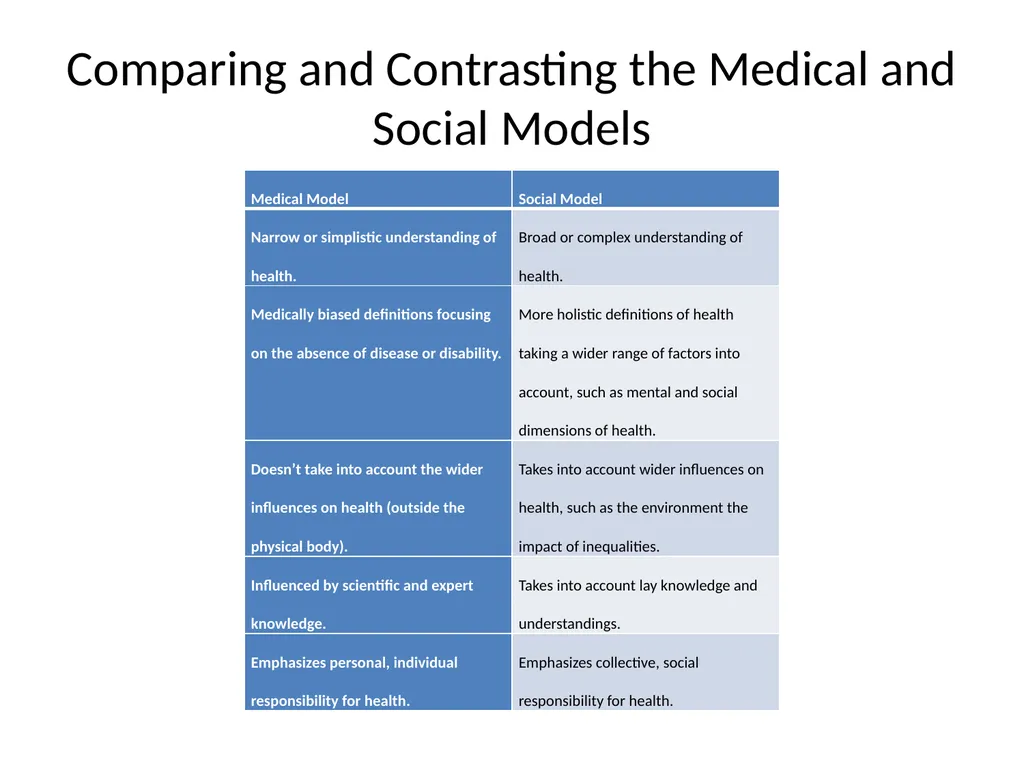
Comparing and Contrasting the Medical and Social Models<br>
08
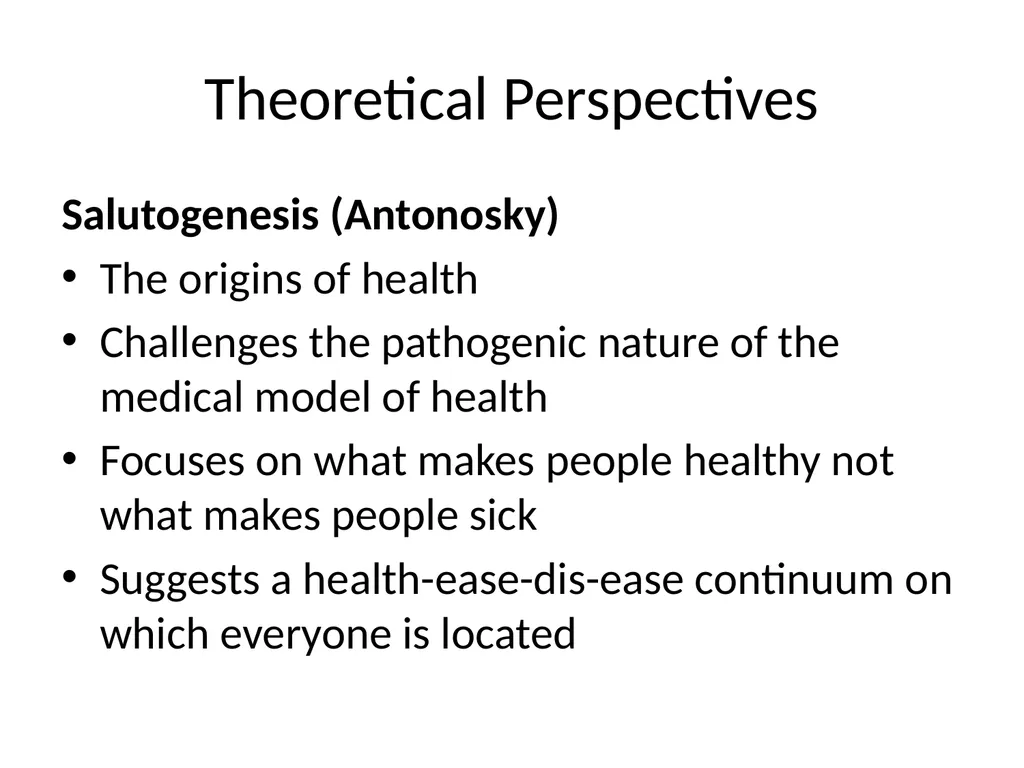
Theoretical Perspectives Salutogenesis (Antonosky)
The origins of health
Challenges the pathogenic nature of the medical model of health
Focuses on what makes people healthy not what makes people sick
Suggests a health-ease-dis-ease continuum on which everyone is located<br>
09
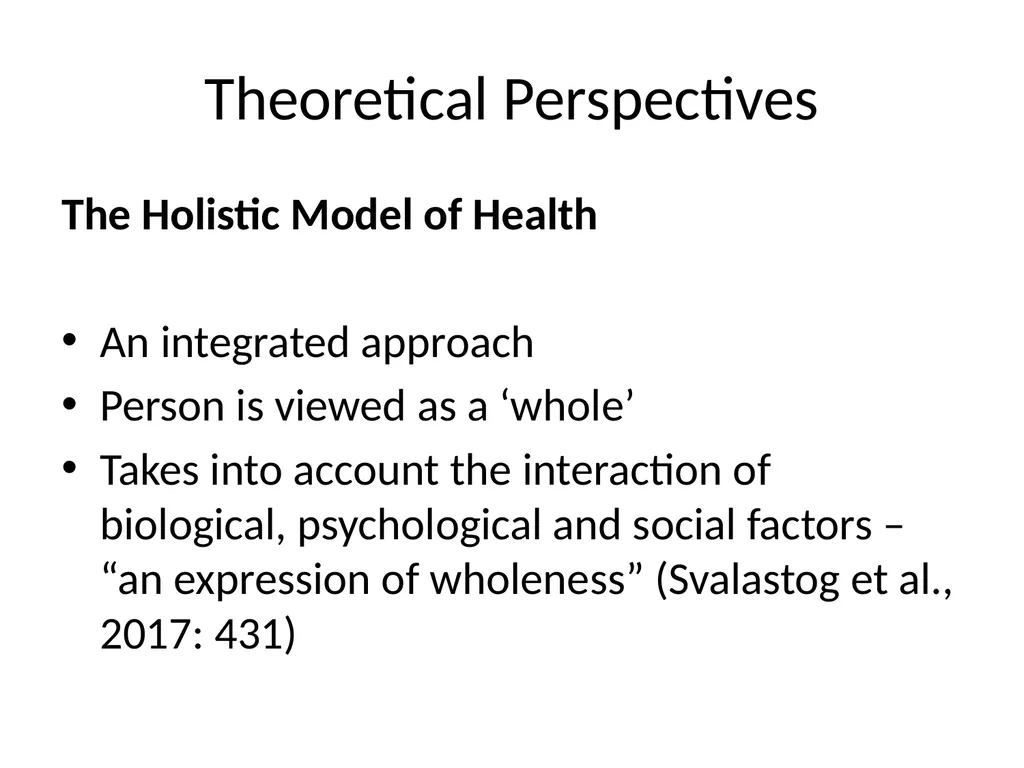
Theoretical Perspectives The Holistic Model of Health
An integrated approach
Person is viewed as a ‘whole’
Takes into account the interaction of biological, psychological and social factors – “an expression of wholeness” (Svalastog et al., 2017: 431)<br>
10
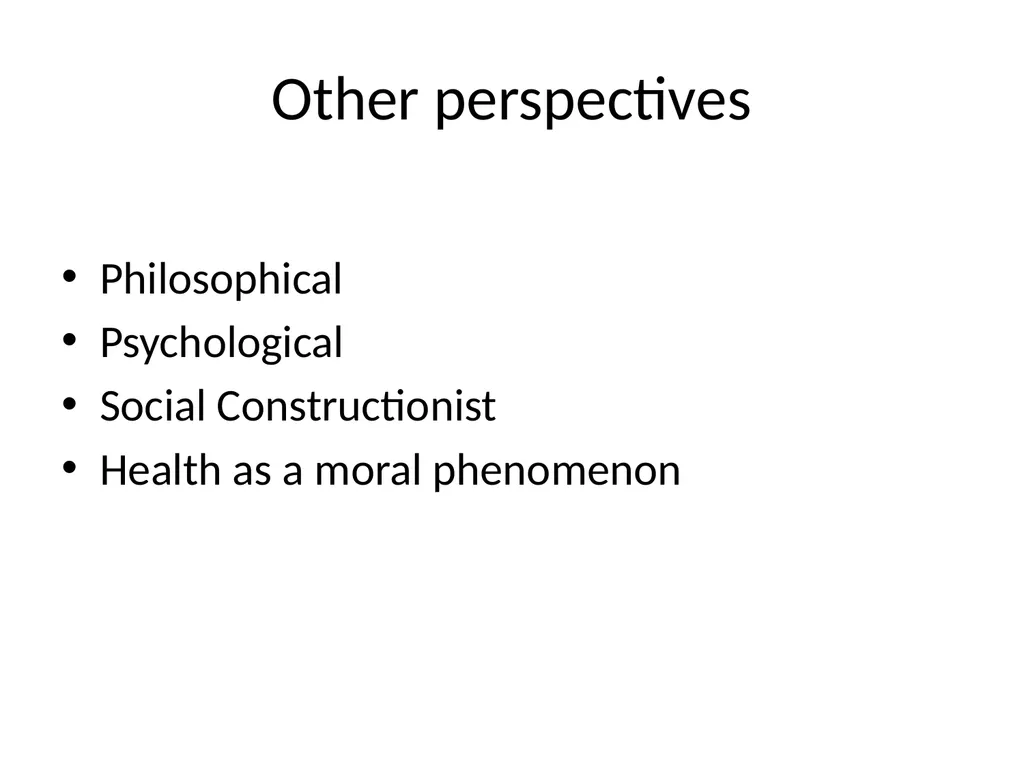
Other perspectives Philosophical
Psychological
Social Constructionist
Health as a moral phenomenon<br>
11
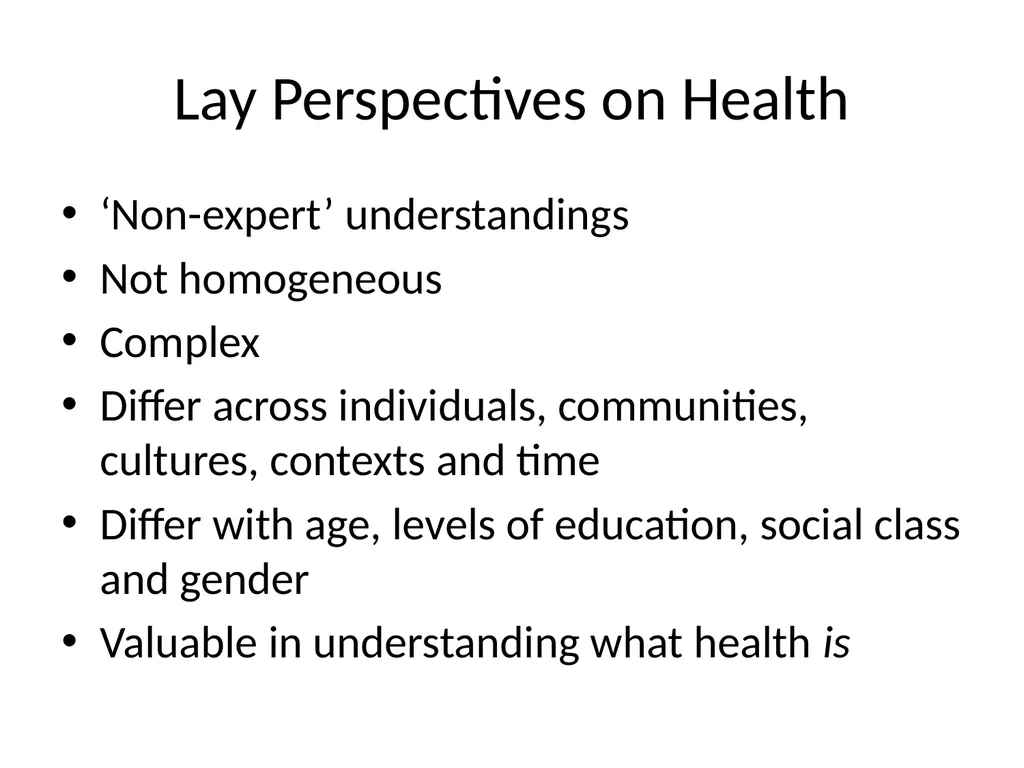
Lay Perspectives on Health ‘Non-expert’ understandings
Not homogeneous
Complex
Differ across individuals, communities, cultures, contexts and time
Differ with age, levels of education, social class and gender
Valuable in understanding what health is<br>
12
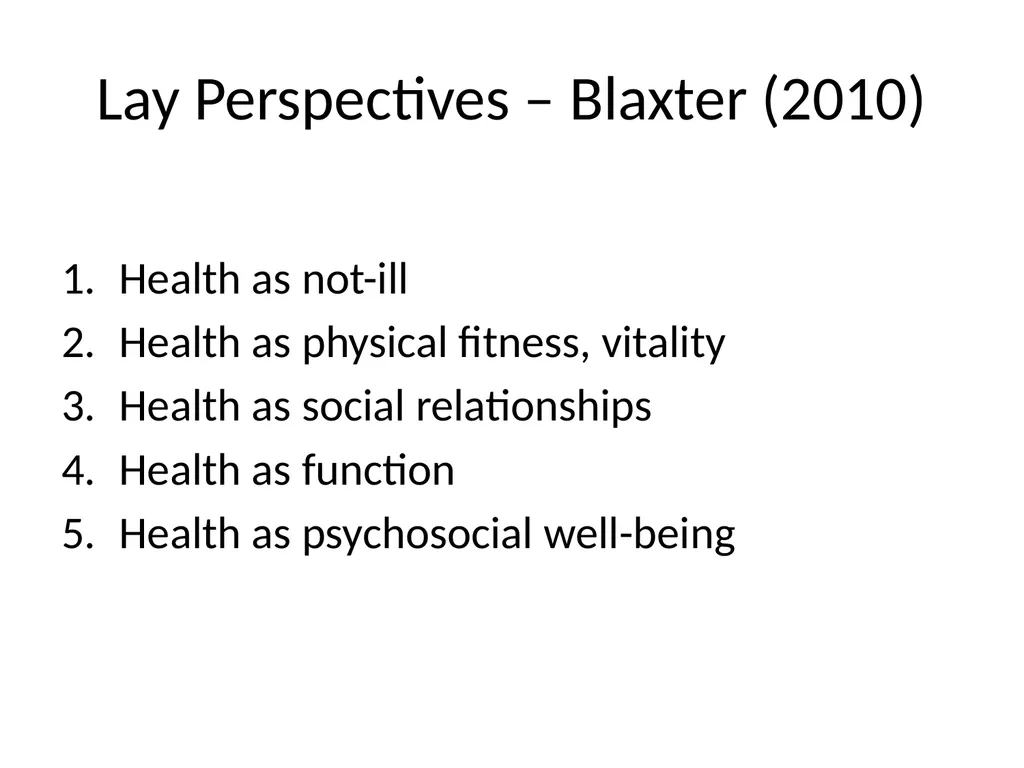
Lay Perspectives – Blaxter (2010) Health as not-ill
Health as physical fitness, vitality
Health as social relationships
Health as function
Health as psychosocial well-being<br>
13
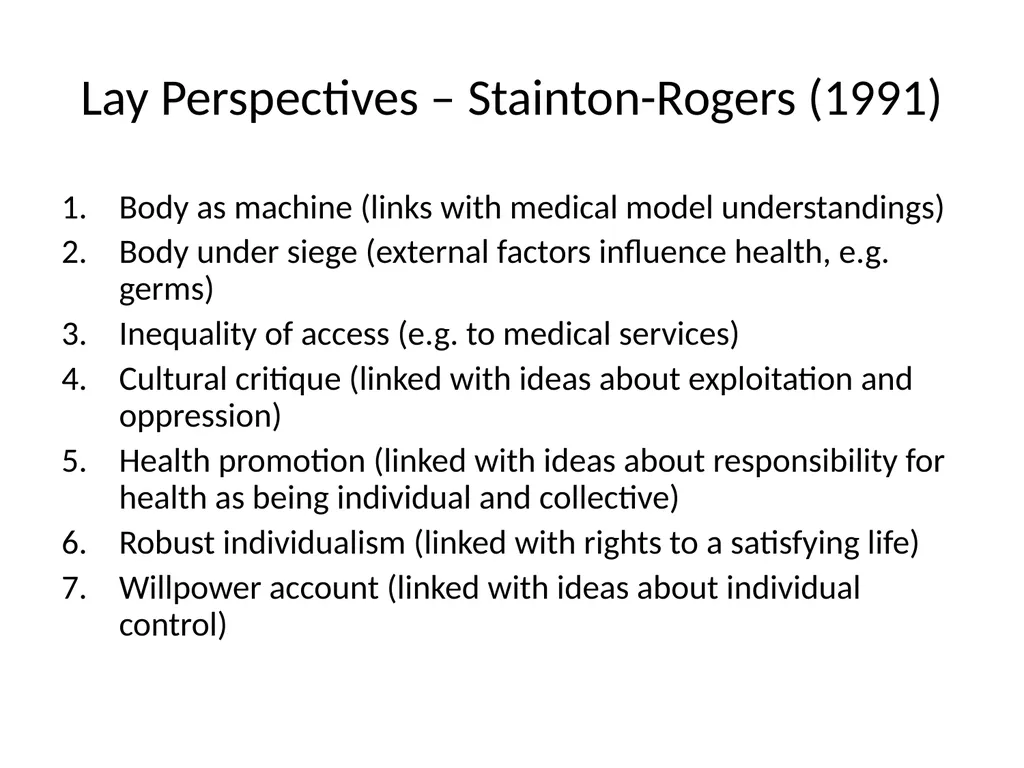
Lay Perspectives – Stainton-Rogers (1991) Body as machine (links with medical model understandings)
Body under siege (external factors influence health, e.g. germs)
Inequality of access (e.g. to medical services)
Cultural critique (linked with ideas about exploitation and oppression)
Health promotion (linked with ideas about responsibility for health as being individual and collective)
Robust individualism (linked with rights to a satisfying life)
Willpower account (linked with ideas about individual control)<br>
14
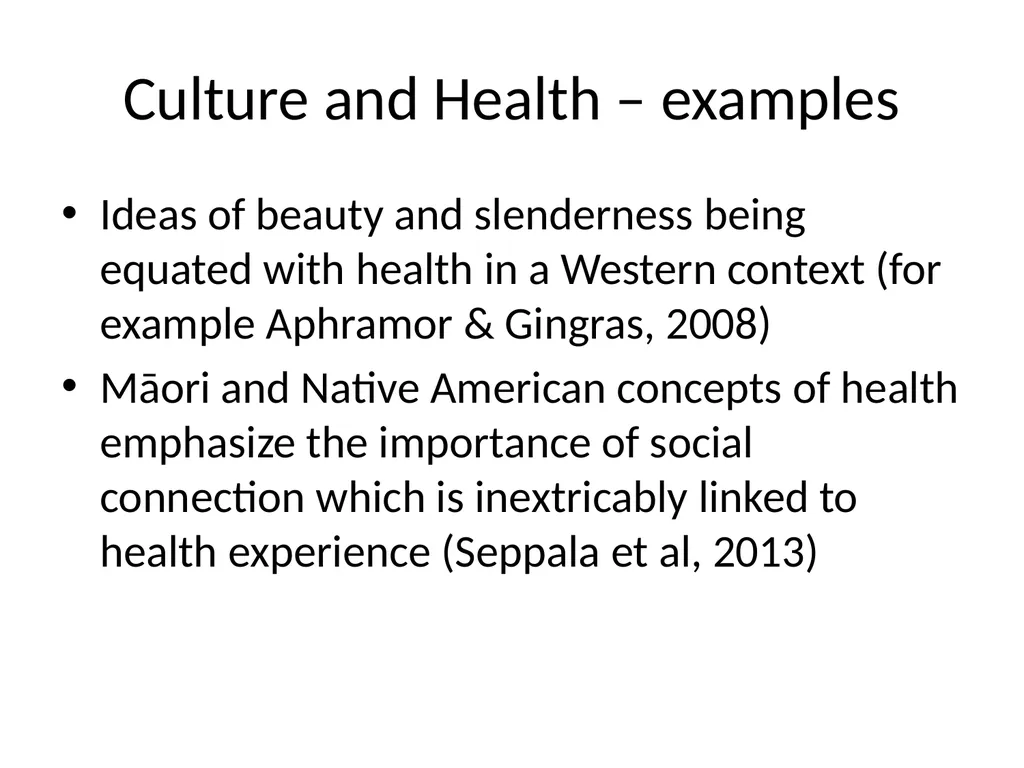
Culture and Health – examples Ideas of beauty and slenderness being equated with health in a Western context (for example Aphramor & Gingras, 2008)
Māori and Native American concepts of health emphasize the importance of social connection which is inextricably linked to health experience (Seppala et al, 2013)<br>
15
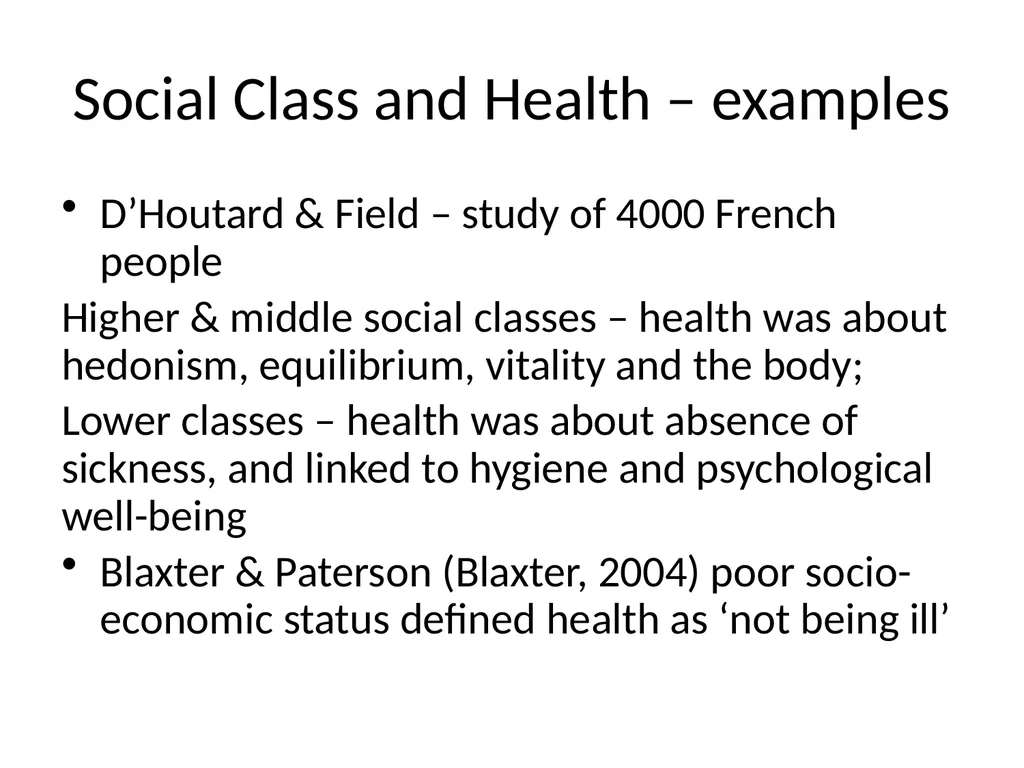
Social Class and Health – examples D’Houtard & Field – study of 4000 French people
Higher & middle social classes – health was about hedonism, equilibrium, vitality and the body;
Lower classes – health was about absence of sickness, and linked to hygiene and psychological well-being
Blaxter & Paterson (Blaxter, 2004) poor socio-economic status defined health as ‘not being ill’<br>
16
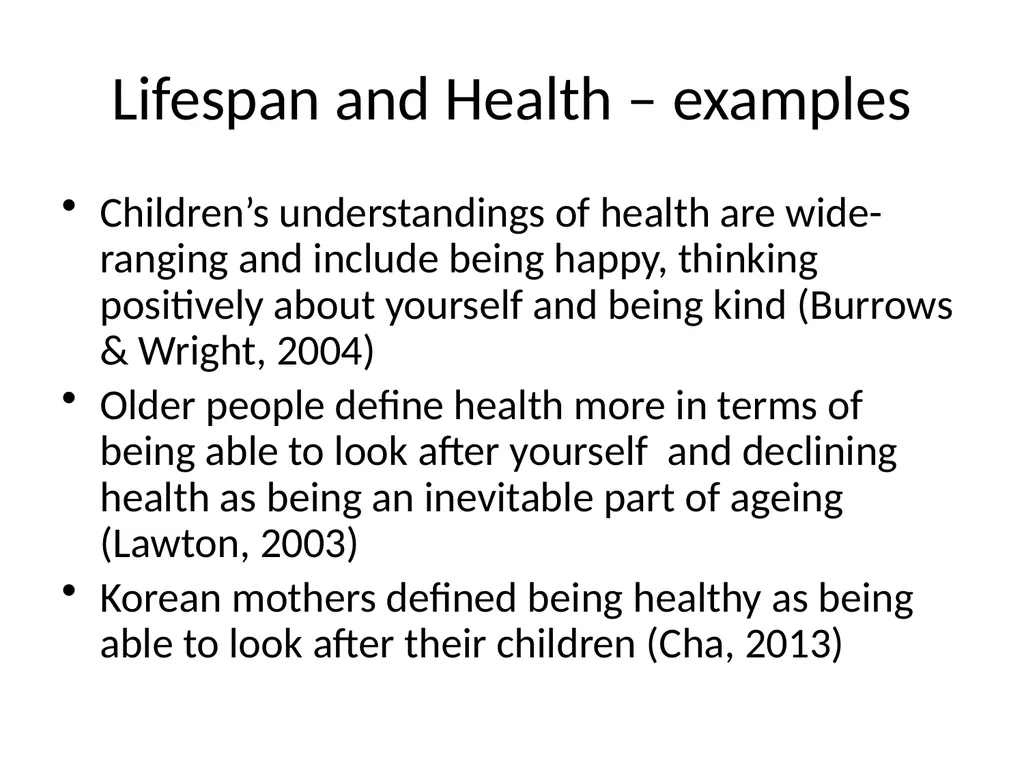
Lifespan and Health – examples Children’s understandings of health are wide-ranging and include being happy, thinking positively about yourself and being kind (Burrows & Wright, 2004)
Older people define health more in terms of being able to look after yourself and declining health as being an inevitable part of ageing (Lawton, 2003)
Korean mothers defined being healthy as being able to look after their children (Cha, 2013)<br>
17
Gender and Health – examples Women are more likely to focus on caring and reproductive roles; men more on the disadvantages of their ‘provider’ roles (Emslie & Hunt, 2008)
Assumptions that women are more interested in health than men; men’s perspectives often reflect notions of strength and fitness (Woodall, 2010)<br>
18
Key issues The nature of health is contested, varied and changeable
A range of different perspectives should be taken into account
Lay perspectives on health are important and influential
Understanding what health is about is crucial to promoting and researching it<br>
19
Summary Health is a complex concept and is difficult to define. Many different definitions and understandings exist.
Understandings of health differ according to experience and expertise. Factors such as age, social class and gender impact on these. Theoretical perspectives about health can aid our understandings of subjective health experience.
Lay and expert understandings of health may differ but both are central to developing understandings about what health is, how it may be explored and how it may be maintained.<br>